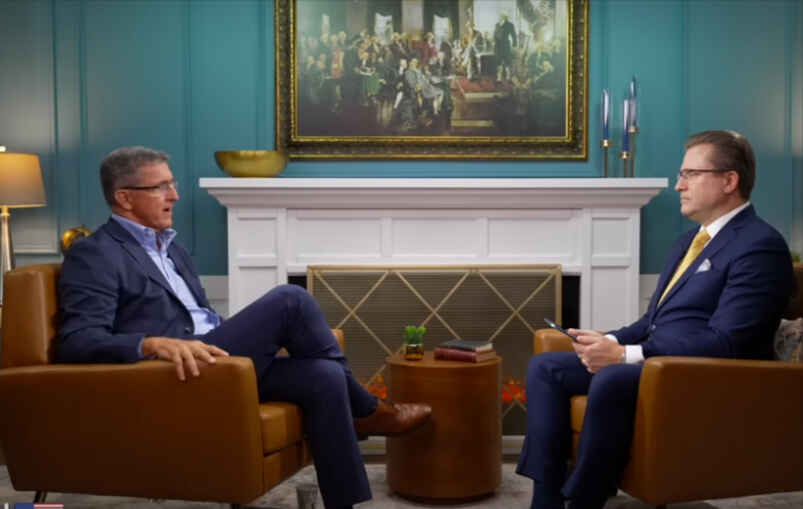
Read the full transcript of former Trump national security adviser retired Lt. Gen. Michael Flynn in conversation with host Jan Jekielek of American Thought Leaders show, premiered on July 27, 2025.
Michael Flynn on American Thought Leaders: The Weaponization of Government
JAN JEKIELEK: Michael Flynn. So good to have you back on American Thought Leaders.
MICHAEL FLYNN: It’s great. I love it. And I watch American Thought Leaders all the time. I wouldn’t say that I watch every minute of every show, but I think the people that you have on are people that are out there doing the work that needs to be done. And it’s fascinating stories, fascinating people, and I think that’s what people are looking for these days. I know that’s why we’re here today, to talk about a story that most people can’t believe.
JAN JEKIELEK: This is the whole thing. I mean, of course I’ve been reading “Pardon of Innocence” and it really is astonishing. I mean, it’s been such a long time. Of course we’ve been covering this story at the Epoch Times. I mean, various aspects of it, not everything, both from your perspective and then the whole crossfire hurricane perspective and everything that happened afterwards. It’s hard to even know where to start. Why did you write this book?
Why Document This Story for History
MICHAEL FLYNN: Yeah, I mean, I wanted to document for historical purposes something that happened to the United States of America. So I did it through my voice and through my lens. But it actually is not just a story about an individual, you know, in this case, General Mike Flynn. It’s a story about what is happening and what does happen to America and all the people of this country.
I mean, there’s so many people that have come to the realization that in order to maintain this beautiful experiment in democracy called the Constitutional republic, that we are going to have to constantly sacrifice for it. And some people end up being sacrificed in some cases, or certainly being in a position where you have to discover for yourself that there’s a lot more to it than just going and voting. It actually requires service and sacrifice.
And as someone who has served in our military, I know what service means from that perspective. But I think for others who are just now coming to the realization, the inspiring part of this book is, how do you serve in this country? How does every person serve now? Because it’s not just about putting on a uniform and going to serve overseas. It’s not just about being a servant as a police officer or as a fireman. You know, we call them first responders, but it’s how do you serve as a citizen?
And when you think about what the founders wanted out of this country, they wanted every citizen to have a voice and to have a role. And that was really the big arguments at the beginning of the country. And I think we’ve lost sight of that. That’s what I want people to walk away from this book understanding. It’s not a story about one person. It’s really a story about all of us.
But it needed to be told and it needed to be documented historically, because if you don’t put it out there in a public way, then it just gets lost in history. And I think that this is a really critical point of history. And I think that the book adds to that story.
The Russian Ambassador Conversation
JAN JEKIELEK: Let’s just start at the beginning. You know, you, as the national security advisor for a newly elected President Trump, were speaking with the Russian ambassador.
MICHAEL FLYNN: There’s been a lot of stories and a lot of reports on that, a lot of shows on that, a lot of discussion about that. And was it the right thing for me to be doing? Was I okay to be speaking to foreign counterparts? And the answer at the end of the day is, yeah, I was doing my job, right?
And even the president of the United States, President Trump, even said it after the fact, after I had departed the White House, “the guy was just doing his job.” And so I don’t know what the big deal was, but then he said that I had misinformed or lied to the vice president, which we now know that that actually wasn’t true. That wasn’t a true statement. He said it as though it was true because that’s what he knew at the time. But it turns out that it actually wasn’t true. And we learned about that in evidence.
I think that it’s not just the conversation that I had with the Russian ambassador. It’s actually the result of that. And then what we have experienced, because here it is, that was 2016. Here we are in 2025, and halfway through 2025, and so almost a decade later, and we’re still in the throes of a component of something that actually we just learned about is vastly different than when anybody believed or anybody knew at the time.
The Role of Media and Alternative Voices
One of the things that wasn’t around at that time was, now what we see is the alternative media. So there would be an alternative to the story, somebody who would actually question it and say, “well, what was going on here? Is this right? Is it wrong?” where you had one element of the media. Because the media played a big role in what happened to me, a huge role. And how the media came in and worked hand in glove with the government at the time, with the White House at the time, and particularly the intelligence community.
Government Weaponization Against Citizens
And I think the bigger strategic issue, Jan, is not so much the conversation and rehashing the conversation and what it meant or what I did. It’s actually, how does the government weaponize itself against the American people?
And they made a conscious decision to weaponize components of the government against the President of the United States himself. In this case, the incoming president at the time was Donald J. Trump. And from that moment in latter part of 2016 and 2017, where we really didn’t know, I mean, I would say I’m as naive as the next person. I mean, I know a lot more now today, but I was naive to think that the FBI was this weaponized, that the CIA was this weaponized against the person who had been working with them had run one of the largest intelligence agencies in the world.
But the discovery for all Americans and for anybody that listens to this show, this interview, is that the weaponization of the United States government against its own citizenry is very real. It happens on a daily basis, and it doesn’t just happen to high profile political figures. It happens to everyday Americans where somebody does something that the, in this case, the FBI or the Department of Justice doesn’t like.
And what they do is they put the full weight of their authorities against any American who can’t financially afford it, can’t emotionally sustain it, and really doesn’t have the wherewithal to be able to even understand what is happening. And the next thing that happens is they find themselves in a place where they have to plead guilty to something that they know they didn’t do, because otherwise they’re going to be completely crushed and their families are going to be destroyed, which in many cases, those things already happen.
The Intelligence Community’s Weaponization
And so that’s the weaponization of just the Justice Department, the weaponization of the intelligence community. And when we say the intelligence community, like it’s some esoteric thing. It’s the Central Intelligence Agency, it’s the National Security Agency, it’s the Defense Intelligence Agency, it’s elements within our governments. The Department of State has its own intelligence component. Department of Homeland Security has its own intelligence component.
And the White House actually is weaponized as well. The White House can weaponize itself against an American citizen that they don’t like particularly. The White House will go against people politically for a political advantage. And so I became the fulcrum of what essentially is a color revolution that’s still ongoing in the United States of America.
Understanding Color Revolutions
So people can look up color revolutions in history. I mean, there’s a lot of color revolutions that have occurred. I mean, going back to almost really the collapse of the Soviet Union and the end of the Cold War. We learned a lot of lessons. Color revolutions in the Philippines, color revolutions in Poland, color revolutions certainly in other parts of Europe, Yugoslavia at the time, most Americans don’t remember.
But in 2014, there was a color revolution in Ukraine. Post the Sochi Olympics in February of 2014, that’s when the Russians attacked into Ukraine. Now, the Russians, this is just the Russian Federation, and they blame it on the encroachment of NATO.
And I’m going back to this example because what happened in 2016, and now we know this for nearly factual basis now, based on what the latest Director of National Intelligence has exposed from a meeting that I was not aware of, that is not written about in my book on the 8th of December, which is all held in classified channels.
The Power of Classification
So that’s another part of weaponization. If you’re in government, you can have communications at the highest level between the President of the United States between his national security team, maybe a dozen people, you can have communications and you can protect those in classified systems. And unless somebody actually knows where to look and what they’re doing and has the authority to go and expose it like Tulsi Gabbard just did, we wouldn’t know any of these things.
The 2016 Shock and Color Revolution Tactics
After Donald Trump won in 2016, which was a shock to everybody, except for those of us that were watching the sentiment closely, the sentiment of the American people who were sick and tired of the normal politics, knew that. I knew that Trump was going to win before the election.
So when Trump won, it was a shock to everybody because the heir apparent was supposed to be Hillary Clinton. And that’s when there was a decision made. And they took the color revolution example of what they had just done, what the Obama administration had just done. So they weaponized our government, the State Department, the intelligence community, and elements of the Department of Defense against Russia at the time in 2014, and they overthrew the Ukrainian government.
So they took the color revolution and they basically ran a play. They ran a scenario right here in the United States of America, right? It’s the Nancy Pelosi, you know, “create the smear and then attack, attack, attack,” even if it’s false, right?
JAN JEKIELEK: The wraparound smear.
The Wrap-Up Smear and Targeting Flynn
MICHAEL FLYNN: The wrap-up smear. She calls it the wrap-up smear, which was crazy. But she got out and spoke about it. She actually went out and spoke about the wrap-up smear, how to destroy somebody. And that’s what they were doing to President Trump.
But a guy like me, you know, back to the question of the conversation I had with the Russian ambassador, what they had to do is they had to connect some dots, and they did. And when they connected those dots, they did it in a way that allowed them to have this story. They needed their minions in the media to be able to push it and promote it and to propagandize it and to get it to where some number of enough people needed to believe that Mike Flynn committed treason, was a traitor to the country.
The number of names that I’ve been called, it’s gotten to the point where it doesn’t even bother me because I knew, I know who I am and I know what happened, and I knew it then, but I had to get through it.
Evidence and Revelations
So we have seen almost a decade of evidence come out, evidence that you guys out of your great organization have been extracting from the government, other organizations like Tom Fitton, lawyers, people who have been battling to get to the truth of what actually happened. And now we have even more revelations by a Democrat, right, who really is an American patriot and somebody like Tulsi Gabbard.
And if you think about it, they’ve been after Tulsi Gabbard because I’ll tie it back to me and back to 2016 into 2017 timeframe. So Tulsi Gabbard is a former Democrat congresswoman. She ran for president on a Democrat ticket. And what did she do? She turned against her own kind.
And at the time, to kind of draw a little bit of an analogy, I was a Democrat. So I’m in the final four of the candidates that Donald Trump is looking at for vice president of the United States, the other three being Pence, Christie and Newt Gingrich. And I’m sort of on the outside. I was not a political person. I was a military guy. But I just so happened to be a Democrat.
In fact, when I went into the White House as the national security advisor, I was a Democrat. And I was apolitical because I really believed, I served our country. I believed in America. I believed in what Donald Trump was espousing, which was America first and Make America Great Again, which is his bumper sticker.
Why They Targeted Flynn
And you kind of say to yourself, why? Why were they going after me so hard? Because we now have learned about this. So one of the documents that came out very recently, Comey actually talks about from this very famous now, December 8th, 2016 meeting, Comey actually talks about targeting General Flynn.
They knew that if they allowed me to go into the White House with Trump and they didn’t bother going after Trump the way they went after him, that this whole thing would have been exposed. It would have been exposed very early on. Obama had said to Trump, “Don’t hire General Flynn.” Where does that come from? Transitioning the entirety of the US Government from one president to another. And you talk about two people. One is a dictator in North Korea and the other is a general that was appointed twice by Obama.
Because they knew that I would have dug in and dug my heels in because that’s my way, and that’s been my sort of background, certainly in the military and the intelligence community. And five years of my life in direct combat operations. So they knew that I would have had access to all this information.
Manipulation of Intelligence
One of the things that they talked about was something called the Presidential Daily Briefing. They made a conscious decision to change the Presidential Daily Briefing. I was actually reading the Presidential Daily Briefing after I was designated as a National Security Advisor damn near every day during the transition. So they purposely and intentionally left out information or changed information in it.
There is an element of subversion inside of our government that’s very real. And a lot of Americans kind of go, it goes right over their heads. It’s just like saying to somebody, our debt is $35 trillion. I mean, for an American who’s worried about how much money they’re going to have to fill up their gas tank with, $35 trillion. And it’s the same thing.
The Ongoing Revolution
It’s like America’s going through a coup. America has people that are serving in the highest levels of our government who are anti-American pro-communism, who are people that are serving in our government that are more aligned with the dictatorship of the CCP than they are with the constitutional republic of our government. And the answer is absolutely. And that’s exactly what we have because there is a subversion of our government that started many, many years ago.
I don’t go into all the background there, but I mean, it does go back as far as the era of Eisenhower and Kennedy. Now we’re at a place where there was an opportunity to actually overthrow the country. And when Donald Trump comes down the very famous escalator, they were like, it was a joke, right? Until it wasn’t a joke. And until he won in November of 2016, and when he won on November 8th, 2016, then all of a sudden they had to adjust their plans because their plans really were eight years of Obama, eight years of Hillary.
And your great media outlet, wonderful media outlet would never, wouldn’t see the light of day. You would not exist. Nobody would know who you are as a great interviewer, because they would have turned this country completely around. They would have eliminated major parts of the Constitution. And we find ourselves as principally a socialist country.
Chinese Infiltration
There’s been such an effort to subvert this government and one of the principal nation states behind it are the Chinese is no doubt. So during the Clinton administration, one of the things that they allowed, particularly in the second term of Bill Clinton was they allowed the Chinese government to begin to send a large number of students to colleges and universities. And they also had massive, massive spying operations.
So this began in the second half of the 90s, and all it has done is it’s grown and grown and grown in time. So what the Chinese decided to do is they really began to really work hard on taking over the United States of America in a very subverted way, in a very quiet, covert way.
The Real Purpose
So all ties into 2016 and 2017. And your question about this famous conversation I had with the Russian ambassador, which amounted to nothing. They knew. And you can go back and look at a lot of other things that I’ve said over time or I’ve written about, and I’ve been writing about things for a long, long time about this issue, about the rise of communism in the United States of America.
What drives me is this country, and that’s where Trump and I connected. If there’s one thing that we both firmly believe in, it’s the greatness of America. Frankly, I would love to, and maybe one of these days, maybe Tulsi will do it, maybe she’ll give all the transcripts out of my conversations with not just him, but others to show that what I was doing is I was protecting the United States of America from enemies foreign and domestic. And they knew it.
So the Obama administration, Obama himself knew it because he was being briefed on it. And that more and more that’s going to come out. And people in this country, people that listen to this broadcast, they need to understand that evil exists. We’re in a tough spot still. We’re not out of the woods yet. And that’s why people need to understand that this fight is still ensuing because this revolution is not over. This color revolution is not over because the players that are in charge of this color revolution, they are still out there on the streets of America. They’re still out there in the media. They’re still out there in the political realm of our system of government.
Historical Warnings
Federalist Paper 2 and 3. And we wrote about this recently. John Jay, who was one of the authors of that, talked about the greatest threat to our country is never going to be a foreign foe. It’s always going to be somebody. It’s always going to be a subversion within, from within. So many people have warned us about that.
Abraham Lincoln was another one when he was 28 years old, talking about no foreign foe will ever take a drink from the Ohio or a step on the Blue Ridge. Never even with a Bonaparte for a commander. If we’re going to die, we’re going to die by our own suicide. He said that at the age of 28 years old, so many people that were prescient and visionaries and historic figures that were worldly and thought about these things, and also were men or women of action would always talk about this kind of behavior and potential and possibility.
And here we are, we are now in a place where this is it. This is a moment of existentialism for the United States of America. And I think that people are going to have to come to grips with it. And it’s not that everybody’s got to get behind Donald J. Trump, it’s people need to get behind this idea that we need to continue to be constitutional republic based on ideas and based on the rights of citizens, life, liberty, and the pursuit of happiness, because all three of those things can be taken away.
Information Warfare Tactics
JAN JEKIELEK: So you yourself are deeply experienced in the realm of information warfare, which has been a centerpiece of all of these weaponization activities for the last decade plus. So how does it work?
MICHAEL FLYNN: Yeah, well, a couple of things. First, an event has to occur. So you have to create some things, create an event. And the event that occurs is in most cases staged. And it might be demonstrations on a street, it may be demonstrations in a square. Overseas, it might be the assassination of an individual, it might be a conflict between two warring parties. Literally, if conflict overseas, like in Africa, I saw a lot of this, and I saw it certainly in Central America in my early days in the military.
So you have to have an event. You create the event. Once you create the event, then you take the components of what part of your plan. And that’s the intelligence community. It’s members of Congress in our country, members of Congress, because they’re going to be part of it. Some of them are going to be witting, some will be unwitting. But you know what their behaviors will be once the event occurs, because you’ve studied them enough. This is where your intelligence system kicks in.
And the intelligence system is not 17 agencies and hundreds of thousands of people. It’s actually a small group. So you have to have a small group of people that are part of this event, crisis moment, and they have to be ready to go to town, go to work.
You also have to have your elements inside the media and you have to have, in our case, you have to have staff over in certain parts of the government. So the bureaucrats. So there’s bureaucrats in Congress, there’s bureaucrats in the Department of Defense, there’s bureaucrats in the Department of State. So these are the elements of your plan.
So when you’re looking at the plan, you have the event. Part of the strategy for the plan is you’ve got to have all of the different pieces in place. And once you’ve said, this is what we’re going to do, we’re going to overthrow this country, we’re going to assassinate this president, we’re going to destroy Donald Trump and we’re going to get him to quit or we’re going to maybe do something worse. I mean, there’s been two assassination attempts on Trump just in the last year alone. Year plus now. And they’re still, we still don’t know the results of those. We don’t know the outcomes of those.
JAN JEKIELEK: We don’t know like what happened, like how they happened.
MICHAEL FLYNN: Well, we don’t know. We don’t know who’s behind it.
JAN JEKIELEK: Right, okay.
The Deep State’s Response to Trump’s Victory
MICHAEL FLYNN: We don’t really know who’s behind it. In the case of President Trump, the event was an unexpected event, his victory in 2016. So when they failed to get Hillary Clinton over the hump and win the election in 2016, then it kicked in. And now we know the 8th of December, now it’s going to be a very famous meeting now, the 8th of December that Barack Obama led.
So they had the event, a Trump victory. They now needed to organize quickly and they needed to begin to select targets that they were going to go after. The principal target was Donald Trump. Principal target was get him out of the way. Like maybe we could figure out a way to get him out before he even took the, you know, assumed the presidency in January of 2017.
When that happened, then they had to figure out the next step, which was the 25th amendment. People tend to forget these things, but these are all things that happened. And they wanted to do a 25th amendment really before that noise was out there, before the Mueller investigation, before Mueller was even appointed, they were talking about a 25th amendment.
JAN JEKIELEK: The Mueller investigation, of course, is the investigation into so called Russian collusion.
The Fabricated Mueller Investigation
MICHAEL FLYNN: Right. And the Mueller investigation, you know, he gets appointed and now he’s going to run an investigation that we now know is based on a complete fabricated lie. It was a lie to the American people, but it was all based on an event.
So once that event kicked in, they, they being the Obama administration and elements of his national security team, a very small group. And within each one of their organizations, they had to have people that were adherents to their way of thinking. And we have learned about these small groups since Trump has come back into office, one of which was up at the National Security Agency not too far from here, up to about another hour, hour and a half away.
And that where recently Tulsi Gabbard, for example, fired the director of National Security Agency and the deputy director of the National Security Agency because they were doing things inside to undermine the current president of the United States. You know, in this case, Trump, because he won again. Another event.
So these are events that occurred. They had to scramble in the 2016 timeframe because it was unexpected. So now they had to figure out how to take their plan and put it into a different set of motions.
One of the very famous lines by a person that was the deputy head of counter espionage for the FBI, his name was Peter Strzok, and he basically talks about an “insurance policy” again, prior to the election, “if, in case he wins, we have an insurance policy.” So what did that mean? And now we’re starting to see almost a decade later what that means.
We now see the evidence in black and white of what they decided to do back in 2016 to not just subvert Donald Trump. Okay, whatever people want to think about Donald Trump, but to subvert the will of the American people. That’s as weaponized a government as you can actually have in a system of government that is supposed to be based on the rule of law.
And we’re only based on the rule of law if we follow them. And there is clear evidence now that laws were broken and violated. And we’ll see how this plays out over the next couple of weeks, because people in this country are demanding accountability.
And I do think that a big component of this is trust. American people don’t trust our government anymore. They don’t even trust the government that Trump now is in charge of. They’re having a really difficult time.
You know, you mentioned China. You mentioned about the Epoch Times and the creation of this. I mean, so I’ll just add, because we talked about this briefly prior and I met these two guys. Unrestricted warfare doctrine was not put out publicly until the late 90s. And they actually wrote another appendix to it in I think 2003.
JAN JEKIELEK: And just to clarify a couple of things, one, you know, I commented earlier that it was during, in the 90s that the Epoch Times founders actually came to America, you know, coming after the Tiananmen Square massacre and after the student movement had collapsed and ultimately founded Epoch Times in 2000, which I think to the great benefit of the American people and globally. That’s one part. The other part was simply the two colonels that wrote this famous treatise, unrestricted warfare. You’ve actually met them.
China’s Strategic Threat and Unrestricted Warfare
MICHAEL FLYNN: Yeah. What I think people need to understand is my military career was a big part of it was during the days of the Cold War, the Warsaw Pact, Soviet Union and the west, and also was looking at and studying the rise of China. And the greatest threat that we face in my military career, for a large portion of it externally, was China because of everything that they represent for what they want in terms of how they want to see the world.
And they do see the world. I mean, I’ve read parts of their 100 year plan, which there was a lot of. It was classified until like 1997 time frame. I think we declassified a big chunk of it. But we’ve, you know, those are things that I have studied.
And China saw the United States rise as it did in the last century, and made a conscious decision that we’re going to be what the United States was in the 20th century. We’re going to be that in the 21st century. Their hundred Year Plan was going to occur from 1949 to 2049. But with Xi in charge, Xi made the decision, no, we’re going to make it go faster. So we’re going to actually, I want to see it happen by 2030, 2035.
So they really got involved in this. It is the proverbial winning a war without ever firing a shot. I mean, it really. This idea of propaganda, of information, of using intelligence in a smart way of subverting, learning about the weaknesses of our system of government.
JAN JEKIELEK: Of using the COVID pandemic and fentanyl.
MICHAEL FLYNN: You talk about biological warfare, you know, the methamphetamine was the earlier days, not just cocaine and some of the other drugs that entered the streets of America. And then all of a sudden it turned into now fentanyl.
So the Chinese were very smart about who they were going to work with. And they began to work with the drug cartels. Because, one, it’s a lot of money, but that’s less of it for them. You know, the money is an element of it, but it’s about undermining and basically physically, intellectually, emotionally, spiritually killing the United States of America and doing it in such a damaging way.
When you think about fentanyl, I mean, we’re talking about hundreds of thousands of Americans that are killed in action on the battlefield, on the streets of America, never mind the wounded in action, to use military terms.
JAN JEKIELEK: And that’s the unrestricted battlefield. Unrestricted from the Chinese perspective, which is everything.
China’s Multi-Front Attack on America
MICHAEL FLYNN: One of the things that we do know, we know recently, but it doesn’t get a lot of coverage in the mainstream media, is the use of biological warfare against our farming industry. Bringing in biological components to damage or destroy, in some cases, entire components of our agricultural industries. Of our farming capabilities.
Never mind making sure that you have people in here that know how to do electronics, that know how to, they come in and now they’re citizens. Now they’re citizens of this country working directly for the Chinese government. Some of them are in our government. Some of them are actually in our government.
So the Chinese were very smart, very shrewd. And it’s been going on for a generation, maybe more than a generation, and people have recognized it at times. But when you say it does those that are undermining our country do. What do they take us back to? They take us back to Russia. Why. Why is it Russia and not China?
Because for 40 years, and I know this for a fact, because I’ve read all of the presidential findings up to 2017. And presidential findings are very specific intelligence programs that the President of the United States has to sign off on. And they’re typically covert, which means only a few people are going to know about them. But they’re well funded.
And for the better part of 40 years, we had many findings that brought in billions and billions of dollars because Russia was the bad guy. And when Russia collapsed, when the Warsaw Pact collapsed and Russia fell apart, instead of embracing them and bringing them into our sphere of influence, we needed to keep that flow of money going. And it’s a lot of money. I mean, it’s tens of billions of dollars.
And it’s all in a very realm of classification and a realm of secrecy that majority of Americans. You might be able to read about it in a few books. I’ve read them, I’ve seen them, I’ve been briefed on them, and I know that they exist. I won’t go into what they are or how long they’ve been going on specifically, but you’re talking about a lot of money.
So if you win the battle, in this case, we won the war against the Soviet Union, and now it’s the Russian Federation. And instead of embracing Russia. Well, because if we did that and we brought them into our sphere of influence and we now tried to work with them, maybe bring them into a NATO. I mean, which was some of the discussion in the early 90s, particularly even when the Clintons came in. But then all of a sudden it changed because the money flow was going to stop. Why do you need all this money flowing in if you don’t have an enemy anymore?
And China entered. So smart. This is the grand strategy, the grand geopolitics that’s at play constantly. And now we’re beginning to see the ugliness of the underbelly of what we’ve all referred to as the deep state.
I talk about faith in the book quite a bit, and I do believe that this was a period of history that the United States of America had to experience. And I think that God ordained this period of time, and he put people into a place where we are able to fight back. And Donald Trump is one of them.
The Reverse Kissinger Strategy
JAN JEKIELEK: A number of people, including Lee Smith, has written some of the most definitive work about Russiagate, or what we used to call Spygate in multiple books. And this whole weaponization government of picture. He described what Trump was trying to do with Russia today by trying to create this peace with Ukraine and Russia quickly as a “reverse Kissinger” trying to pull a reverse Kissinger.
But at the same time, it seems like Vladimir Putin is making it very difficult for him to do that. And just with the language that you just used, some people might say, well, Michael Flynn is just a Russia backer. It’s this constant weaponization of information that we have to face. Any comments there?
The Weaponization of Government Through Name-Calling
MICHAEL FLYNN: I’ve been called an anti-Semite, a pro-Zionist, pro-Israeli. I’ve been called a racist. The name calling is a component of the way that they weaponize the government, and they weaponize the government against Americans or against anybody that they don’t like is to immediately start in with the name calling. The narrative. The narrative assassination. That’s what they’re doing to Donald Trump. That’s what they did to me.
So, you know, as a mid-grade officer, I’m attending schools, military schools, and I was in units in the 90s where we worked with the Russians. We had the 82nd Airborne Division and elements of the 18th Airborne Corps did a big airborne operation into, guess where, Ukraine, to work with the Russians.
After the fall of the collapse of the Soviet Union, there was an embracing, a perestroika, they called it, and embracing of Russia, I mean, military to military. I worked with Russian military forces over my career because we were directed to try to embrace these guys and bring them in. I had a Russian officer in my staff group at the Army Command and General Staff College in the 1993, 94 timeframe.
Finding Friends Instead of Creating Enemies
So all that noise that they use now, we were actually trying to embrace them because we didn’t want them to be our enemy anymore. Why do we want Russia to be our enemy? Why don’t we… what I’m trying to do as a national security expert and as a former national security advisor to this country, I would rather find more friends than create more enemies.
And that’s one of the things that the left, so those subversive elements on the left of this country, what they want to do is they want to create tension and they want to create these enemies out there. So there’s this constant tension and division because that’s really what they’re all about is they’re about dividing the country so they can create a new system of government in here, in the United States of America, which is unimaginable to Joe and Jane, America.
I do believe that if we don’t have some of us who are in there fighting for this country, for the values that we were created based on, then people like your family can’t come to this country. Won’t come to this country and we won’t have this beautiful, free land of life, liberty and the pursuit of happiness that we have. I mean, those principles are timeless.
The Unbreakable Spirit of Freedom
You had said the one about earlier, I don’t know if we talked about it here. You know, Paul in the Bible. Who was persecuted and he, the way I interpret it, just as I think, as Madison spoke about it, that there’s a part of us that can’t be taken. This idea of freedom.
I might be chained to the ground as I think Paul was. And he was singing and some Roman soldier went into the cave or the cell where he was at, and he’s wondering, “Why is this guy singing?” and Paul singing? Because he believed in God. He didn’t care that he was chained to the ground. He believed in this idea that he was. That he had a conscience that gave him something much higher than somebody trying to take his liberty and his freedom.
I think that inside of every single American, we have that, we still have that. And that’s why the American people right now, in their conscience, their idea about what America should be, they are fighting back. The American people are using every single fiber that they have right now, fighting back against this institutionalism and this weaponization of what the federal government has done. And that sadly, it has crept down into state and local level.
Trump: The Historic Man for This Moment
And I think that now the rising up of the American people because of a guy, this crazy guy in the White House, named Donald J. Trump, who’s this imperfect person, but he is the man, the historic man for this moment in US History. He dared. He dared to take on something that was much bigger than him.
And people can say what they want about the guy and they can say what they want about his behaviors and his characteristics and his character, himself, his ego, whatever. He made a conscious decision to take on a fight that he could have easily walked away from and just left it to the mess that it was. And he did. And when he did, it’s like the gates of hell were unleashed upon him.
I came to the realization that it didn’t make any difference what they came at me, whatever spears, whatever they did to me, to include threats to my life and my family’s life, that it was a belief that we have that they can’t take away. And thank God that I was raised that way and my wife was raised that way because we learned that we know who we are.
And I think that as more and more Americans figure out who they are and understand what their role is in life, whether it’s at a grassroots level, in a local community, in their churches, or in some other higher up position of authority, that there is a responsibility that we all have in this country to serve as citizens. And I think that that’s really the call to action.
JAN JEKIELEK: One thing that I did notice in the book was a few times you talk about, for example, people expecting you to become vindictive based on what happened to you. And it wasn’t just you, it was your family, it was friends, it was many people also you have a line that says, “I’m not someone who holds on to hate. Hate will just tear you apart. Hate is the natural reaction for people who feel like the world has turned against them, that they have no power in their lives. But that’s not me. I act to make my life better and my family’s life better.” And I just… It’s a very simple idea, but it’s a very easy idea to forget in the heat of the moment, especially if you feel wronged.
MICHAEL FLYNN: Right.
JAN JEKIELEK: I’ll just get you to comment on that a little bit.
Moving Forward Instead of Holding Grudges
MICHAEL FLYNN: Yeah. And I appreciate you reading that part. I think that we too much… I mean, I’m one of these people where, particularly in my military service, but I grew up like this. Don’t be about what happened. Be about what do you do about it? What is it that you do about whatever happened in life? Do you sit there and you simmer and feel a sense of hatred or betrayal? You know, I mean, get over it because we’re alive. We’re alive. I’m still alive.
And I’ve been through a lot in my life to include in my family growing up, where we lost… Tragically lost. I lost my oldest sister. I talk about Lenny briefly in the book. So I experienced that. I experienced other tragedies in my family’s life. And my parents were always about, “We’re going to, you know, we’re not going to accept it. We’re going to learn from it and we’re going to move on.”
And I think in my military experiences and training, especially as we got into combat operations where people were dying, and you knew their families, you spent time with their little kids, it’s not about having this sense of betrayal or hatred and just eating you up. It’s about, what do you do about it? How are you going to be judged? How will you judge yourself? What is it that you’re going to do to overcome that?
Rebuilding Trust in Government
And to me, my fight back… I mean, it’s not that I don’t dislike the things that happened or maybe even some of the people, but I’m not going to hold a grudge against them. I just want… I want what our country is capable of doing, which is capable of looking internally at ourselves and saying, “Okay, where are our imperfections? Where are the problems that we have? And let’s fix them.” We’re supposed to be able to fix them as people. As citizens of the country. And we’re supposed to be able to do it through a representative government.
And what we have discovered is that that representative government is not necessarily doing the best that it can for those of us who trust in our government to do the right things. So for me, big picture, I want to take a statement like that and I want to turn it into something good and I want to help to re-establish trust between the people that are supposed to be served and those that are the servants of the people.
I would really like to think that if I can have some legacy, it’s to try to rebuild trust in this institution. Because if we don’t, Jan, if we don’t rebuild the trust, some modicum of it, then we are not going to go much further in our existence. And I think that that’s one of the areas that our country has to do. Our country has to re-establish trust between those that are leading us and those that are led. And I think that if we do that, then we can get another 250 years out of this existence.
Trump’s Potential to Pull Russia from China’s Orbit
JAN JEKIELEK: So two quick questions just as we actually finish up. One is, do you think President Trump, given the difficult realities, frankly, could be able to pull off a reverse Kissinger and pull Russia out of this deep, “no limits,” as it’s called, alliance with the Chinese Communist Party?
MICHAEL FLYNN: Yeah, I do believe that. I do believe that Trump has the potential and the capability and the intellect to do it. I do know that if he doesn’t, the Russian leadership is desperately afraid of China taking over Russia. And east of the people that want to study geography, you know, if you look at the Ural Mountains, east of the Ural Mountains is an extraordinary amount of resources. And the Chinese want it.
And the Chinese, right now, as I sit here with you, they are working to take over a lot of those resources. So Trump can do it. If there’s one person that can do it, he can pull Russia out of that orbit. If we don’t, then we have an alliance that’s much more dangerous for the existence of the United States of America. And there are people in our government that want that, they want that tension and we can’t have it.
And I’m not an apologist. I’m not a… I mean, all I’m looking at is, I’m looking at the geostrategic dynamics that are going on globally. And I’m watching closely what the Chinese are doing and what the Chinese are doing. It is the death knell for Russia. Russia will just become a satellite of China between the Chinese frontier, Mongolia and the Russian Eastern Federation. It’s incredible what the Chinese are doing. So Trump has the ability to do that. He’s going to need to be able to see that.
The Difference Between Russia and China’s Demonization
JAN JEKIELEK: You described how Russia has been demonized in this way, and you explained some reasons as to why that might be. There’s other people that might say that actually, it’s the same thing with China. Same situation.
MICHAEL FLYNN: Right, Right.
JAN JEKIELEK: Is it the same situation?
MICHAEL FLYNN: I don’t think that China has been demonized as much as Russia has, in fact, by far.
JAN JEKIELEK: Well, I would say that, you know, the blinders have just been taken off with respect to Communist China, which we’ve been trying to do for decades. But what I’m saying is, what would you say to someone who would say, “Hey, you know, now there’s always sort of this boogeyman. Now Communist China is going to become the boogeyman.”
China’s Global Ambitions and the Communist Threat
MICHAEL FLYNN: Right? I mean, there’s so much about Russia. I mean, we fought alongside the Russians not just in World War II, we fought alongside them against ISIS in Syria. So, I mean, there’s dynamics that the American people don’t know that the media and the weaponized government, weaponized components of our government won’t say, won’t talk about, because they want to make sure that there is a boogeyman that is bringing in billions of dollars into the coffers of organizations like USAID.
If you deeply understand the Chinese One Belt Road initiative, it is a global takeover, and they work with a set of allies in that to be able to achieve that. I mean, the manufacturing prowess of China, I’ll bet you that there’s something on you or there’s something on me that says “made in China.”
We must overcome that, unless or otherwise. Otherwise, when I go to do anything, I got to go to China to ask for. I got to go to the premier and ask for permission to do it. Whether it’s my school system, my banking system, my health care system, my law enforcement system, they will dominate all of it if we don’t wake this country up and realize that there is a competing ideology called communism.
And the leader of that ideological alliance is China, is the CCP, the Communist Chinese Party. I mean, it is the tip of the spear for what they want. And they have written about and they talk about very blatantly now that this will be their century. And at the end of this century, for anybody that can see to the latter part of this century, which is another. Which is really only 70 years away. It’s not that far away, really. We’re a quarter in and 75 years. I mean, that’s what they want to be what the United States is right now. That’s what people need to understand.
The Stakes of Freedom
And so in order to not have that. And there will be some, and I’ll go on in my answer here, because there will be some in this country that’ll say, “Well, why shouldn’t they? Why is that such a bad thing?” It’s a bad thing if you want to be free, if you want to have the freedom to be able to have this conversation that we’re having right now, because you can’t have this conversation in China.
You can’t even get outside of certain parts of your cantonment area where you live without making sure that you smile in front of a camera so you look happy. I mean, that’s the control that the Chinese have when we talk about social credit scores, right?
Taking Control of What You Can
The last thing I’d say is my message to the audience is to get involved in the arena that you can control, right? If you can’t control what Donald Trump is going to post on X, don’t worry about it, read it, try to analyze it or overanalyze it, but if you can’t control it, don’t worry about it. Control what you can control in your own lives.
And a lot of people don’t learn that until later on in life. And I’m glad that I learned it as a young man, as a young person in a family that was a tough family, and people, I described that in the book a bit. And people need to understand that, control what you can control and don’t worry about what you can’t, let somebody else figure that out and be glad that there are people out there fighting and that understand this, because if we don’t, if we don’t understand this, these are things that, these are not theoretical things that we’ve talked about in this discussion. These are real things and they’re happening right now. And people need to understand that.
JAN JEKIELEK: But you can also support people that you’ve come to trust as, frankly, as I read in your book, and as I know from looking at past years, quite a few Americans have come to support you and help you and express their admiration, I suppose.
American Common Sense
MICHAEL FLYNN: I mean, American people, they, I hate to say it like this, but they can see through the bullshit. If there’s one thing about sort of the American fabric, it’s something called common sense. And the American people have still retained a level of common sense that they look at something and they go, “That’s dumb. That’s wrong. That’s right.” And it’s just common sense. What happens is people up at this level, and we’re in Washington, D.C. now, they lose that. They lose sight of that and they overthink things sometimes.
JAN JEKIELEK: Well, Mike Flynn, it’s such a pleasure to have had you on.
MICHAEL FLYNN: This has been great. Jan, thank you.
JAN JEKIELEK: Thank you all for joining General Michael Flynn and me on this episode of American Thought Leaders. I’m your host, Jan Jekielek.
Related Posts
- President Trump Remarks on US, Israel Attacking Iran (Transcript)
- President Trump on Economy, Energy in Corpus Christi, TX (Transcript)
- Bulwark Podcast: w/ Susan Glasser on Trump’s State of the Union address (Transcript)
- Douglas Macgregor: US-Iran Diplomacy Fail (Transcript)
- The Truth About Trump’s State of the Union w/ Sen. Bernie Sanders (Transcript)