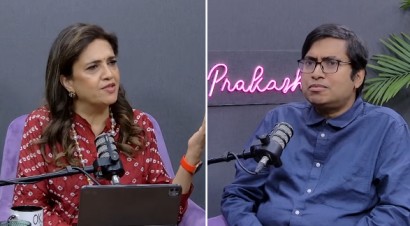
The following is the full transcript of podcaster, and cybersecurity professional Arnab Ray’s interview on ANI Podcast with Smita Prakash #EP-433, July 19, 2026.
Editor’s Note: In this episode of the ANI Podcast, Smita Prakash is joined by novelist, podcaster, and cybersecurity professional Arnab Ray—widely known by his satirical persona ” Greatbong “. Coming from his perspective as a long-term resident of the United States, Ray shares his candid insights on the realities of the Indian diaspora, the realities of the H-1B visa landscape, and the shifting dynamics of AI-driven tech layoffs. They also dive into a broader conversation spanning political representation in America, the evolution of comedy, and his thoughts on the changing political tides back home in Bengal.
Indians in the USA: Rising Hostility or Social Media Exaggeration?
SMITA PRAKASH: Namaste, Jai Hind! You’re watching or listening to another edition of the ANI Podcast with Smita Prakash. My guest today is Arnab Ray, who’s popularly known as Great Bong. He’s a novelist, blogger, podcaster, and cybersecurity professional based in the United States. He’s known for his satirical commentary on Indian politics, society, and popular culture. You can watch my earlier podcast with Arnab in episode 188. Today, we’ll talk about Indians in the USA. Arnab, thank you so much for coming on the show.
So everybody knows you as Great Bong on social media, and you’re one of the earliest users, I think, of X, Twitter, right?
ARNAB RAY: Yes.
SMITA PRAKASH: And that’s where I first met with you. And I think the first time I met you actually was like, what, 12, 15 years ago in Washington, DC? Yes. And I wanted to know, what is this man who’s so obsessed with Mithun Chakraborty and all things Indian living in the US. And subsequently, you move to the West Coast and novelist, blogger, everything. You have columns in newspapers and you follow Indian politics immensely.
And everything in India these days is so political with state elections happening and very pathbreaking changes which have taken place in politics in the past couple of months. But I want to begin the conversation with, you know, basically what immigrants are going through in the US, because we’re getting a microcosm view on social media, and it seems like everybody’s out to throw out immigrants and there are racist attacks happening and Indian students are dying all around the place and all that. But when you actually go there, it doesn’t seem like that at all. And it seems exaggerated on Facebook, X, and Insta.
So I just want to know, is there a rising hostility against Indians in the US, more so now than you have seen in the past? In the past, what, 20 years you’ve been there? Yes. 20 years.
Street-Level Reality vs. Social Media Perception
ARNAB RAY: So actually, that’s not true. I think if you have the lived experience of people outside social media — of course, social media is different, and we can come to why it’s exploded on social media — but in real life, there’s been absolutely no change, absolutely none whatsoever on the street. I mean, the most racist incidents I’ve ever faced in the US was early on when I was a student, in 1999 and 2000.
So if at all, I would say nowadays with people having cell phone cameras, people are less likely to openly say racist things on the street because they’re afraid of being recorded, being uploaded on social media, and then losing their jobs. That was not the case before. So I don’t think racism or xenophobia has gone up or down, but at least I would say on the street, the expression of it has become more muted because people know they might be recorded.
SMITA PRAKASH: But have you seen an increase in when the administration changes? And you have a Republican administration as compared to a Democrat. Also, you’re living—
ARNAB RAY: I live in California, which is like — yeah, yeah, which is a very liberal place. And I live in Los Angeles.
SMITA PRAKASH: So, but you do interact with others, say from Texas, where one is seeing more of these attacks.
Indians as a Visible and Successful Migrant Group
ARNAB RAY: So Texas was always — or Georgia or whatever — Texas, I would say, has always been among the — I mean, it’s solidly Republican, very traditional place. And I’ve never lived in Texas, so I wouldn’t be able to compare with what things were before to what things are now.
What has happened is that Indians have increasingly — and that has changed from the 20 years that I’ve been in the US — is the Indians are increasingly seen to be a very highly successful group of migrants. Before that, Indians were largely invisible. When my dad came to do his PhD, it was basically — India was an exotic country of yogis in the ’60s and the ’70s. And it was never taken seriously. I mean, it was like, oh, we are materialistic, you guys are not. But it was a little condescending always.
By the ’90s, it was mostly Y2K. And now, at least in the US, there are some like Vivek Ramaswamy and Thanedar and some people who are like — that is when Indians become visible. They become visible both as CEOs in Silicon Valley, as well as there are some Indian politicians. So that means Indians are now being noticed, they’re being taken seriously. And with being taken seriously comes this.
Now, of course, again, on X, the level of India hatred that you find is mostly done for engagement farming because of the X dollars. You know, any kind of hatred towards Indians, Indians go and respond to it, and that boosts your X earnings. Also, with Elon Musk’s kind of very loose notion of censorship. Under the previous X ownership, you wouldn’t be able to say any of these, plus you couldn’t make money, so nobody said.
SMITA PRAKASH: Also, one doesn’t know whether these are Twitter farms operated from Dhaka or Muscat or whatever, or Turkey.
ARNAB RAY: Yes, so that was the third thing, that a lot of it is information warfare that is being conducted by nation-states.
Anti-Immigrant Sentiment: MAGA or Something Deeper?
SMITA PRAKASH: Okay, I’ll get to the political representation of Indians later. But I just also want to know whether this anti-immigrant sentiment, the few incidents which are being reported on social media and which also traditional media is picking up — is it limited to the MAGA camp, or is there something deeper going on out here? Are these individual random attacks, or is there really a sentiment that Indians are taking away our jobs?
ARNAB RAY: No, I don’t think these attacks — and I would not do the exact same thing that many people in India do about attacks on minorities, where are people being attacked because they’re minorities, or are they just being attacked statistically? Because if you are a certain portion of the population, you are attacked, right? If you are, let’s say, 1% of the population, 1% of the attacks will likely happen to you.
And the attacks on Indians are not because they’re Indians, but often because they’re vulnerable. That is different. It’s not that people distinguish between an Indian or Pakistani or a Sri Lankan, but some Indians, especially those who come into this country the first few years, they often stay in fairly sketchy neighborhoods where they are more likely vulnerable to crime.
For instance, I remember when I used to stay on campus in Stony Brook, so I wasn’t exposed to this. But my wife, who was a student in Buffalo, she used to stay off campus and I used to visit her. And that was a fairly sketchy part of town in Buffalo. Stony Brook is New York.
SMITA PRAKASH: New York.
ARNAB RAY: And so is Buffalo. But Stony Brook is Long Island, which is a very posh area. And Buffalo is kind of the Badlands of New York State.
SMITA PRAKASH: So did she experience any crime?
ARNAB RAY: No, she didn’t experience any crime, but it was — I mean, she was lucky not to.
SMITA PRAKASH: She was not feeling welcome, would you say?
ARNAB RAY: No, she was not feeling — it’s not a question of not feeling welcome, but—
SMITA PRAKASH: The Jhumpa Lahiri experience.
ARNAB RAY: No, that is not the thing. But I think it was more that it was cold and we were living in a place where the houses were creaky. And it wasn’t like the US experience that people feel. And of course, you are more likely to be a victim of a crime in those areas than the area where I currently live. So that is true.
Assimilation, Identity, and the Assertiveness of Minorities
SMITA PRAKASH: So Indians, when you’re also like, you know, once you move to a posh area and you continue to keep up with your traditions — and you don’t assimilate very easily, like you want to keep your Diwali lights on longer than Thanksgiving, you want to keep it on till Christmas, you don’t take it down, you have, you know, take out Hindu idols in processions, dance on the streets, you know, those kind of things. Does it really bother the non-Indians in that posh neighborhood?
ARNAB RAY: It will. Again, I don’t have any objective evidence, but it will. And that’s, in my opinion, very normal human nature, that assimilation is expected.
So when you’re a minority — there are two things to consider. When you are a minority moving consciously to a place where you are a minority, then the expectation is — that’s where the “go back to your country” comes from — is that you are not coming here to change us. You have decided that you will assimilate to an extent. Now, nobody is going to knock on my door and see if I’m supporting India during cricket. Nobody really cares if I’m wearing an India jersey. Nobody really cares.
It’s when there are more egregious symbols of identity, usually not expressed individually but expressed as a group, that is when the tensions start happening. And this is not just in the US. If you go back to Mamata Banerjee, that is exactly the tensions that rise in Kolkata. It’s the assertiveness of minorities that — and I think I have a unique position that I can say this, becoming a minority in the US, that I think that minorities in general, they can express that they have arrived. But whether they should is another thing.
From Quiet Assimilation to Bold Assertion: A Shift in Indian Identity Abroad
SMITA PRAKASH: You know, the first time I saw this for myself was about 15 years ago. I had gone for a concert of a Pakistani singer. Again, I’m not mentioning unnecessarily, don’t want to give that person publicity or a platform. So 15 years ago I went there, and this was on the East Coast. And when I went there, the best seats in the house were taken by Indians. He was a Pakistani singer, but the best seats were taken by Indians. And he kept saying, “mera Pakistani friends,” and he sang a couple of Pakistani songs before he actually got down to singing the Bollywood numbers, for which he got a whole lot of adoration from Indians — the reason why he was there, because the organizers were Indians.
And while coming out, I could overhear Indians saying, “We’re never again spending our money on this man, never again going to do this. We are the ones who — ” and clearly there were more Indians in the audience than Pakistanis. And so it was like, “We have spent more money than the Pakistanis and he’s insulting us. Bollywood continues to give him songs. Why should we give our hard-earned money to him?”
Cut to 2014, Prime Minister Modi at the UN when he had come, and after that the Madison Square Garden event. And there was, you know, the Indians had come in their traditional attire. Somebody’s dressed in the Punjabi attire, somebody in Gujarati attire. They had brought dhol, nagade, everything. Somebody was playing garba somewhere, bhangra somewhere else. Very assertive, you know, and literally daring anybody on New York streets that come say something to me.
And I saw this subtle change happening — from their annoyance but no steps taken, to here, a bold assertion. Subsequently, I have seen that in many visits to America. I’m seeing this thing where in public places, they will hold a dandiya evening, or they will hold a bhangra evening. In campuses, I have seen bhangra competition, not shying away from it. And that assertiveness, which maybe 25 years ago one saw in the UK, is happening in the US.
Do you see this as a healthy trend, or do you see this as disrupting a kind of accepted bonhomie that existed — that you stay inside your home and do this but don’t come out? What do you say?
Indian Diaspora: Political Power, Identity, and Community Influence in America
ARNAB RAY: So for me, there’s my personal opinion, and then there is what I believe is inevitable. So my personal opinion is I wouldn’t do it myself. The reason why I wouldn’t do it is because besides the fact that I’m in the US and I strongly feel that, if you’re a minority and if you’ve decided it has to be, you do things as per what the majority lines are, which are often unspoken. And it is your maturity to understand what the lines are, right?
For instance, you could say logically, well, if the Irish can paint the— you know, make the Chicago River green, why can’t we do Chhat Puja there? But I would possibly hesitate to do that. Now here’s a pragmatic reason why I would hesitate to do that. The reason is that when the Irish came, there was a lot of anti-Irish resentment. This was in the 1920s and stuff. If you see Scorsese’s Gangs of New York and stuff, you’ll— so, but then what happened was there was— they had a number of politicians, so they were supported in the political infrastructure. The Hispanics, they have Hispanic politicians. So when they express their identity through Cinco de Mayo, for instance, they have a political cover that is dependent. So they vote as a bloc. So you can only do this if you have political power. You can’t go ahead and say, oh, we don’t have political power, but let’s do it anyways because, oh, the Mexicans are doing it, the Irish are doing it. No, but they’ve covered. So that’s where the pragmatism comes in.
SMITA PRAKASH: And the Hispanics too, right?
ARNAB RAY: Yes.
SMITA PRAKASH: Yes.
ARNAB RAY: So all of them, they have— first of all, they have been in the country for a long time, longer time. Second is that there are Indians in general. So if you look at a Bangladeshi, if you look at Somalis, so the whole thing with Ilhan Omar is because the Somalis are much more adept or work more strategically to seize political power, at least in the communities that they are in. Bangladeshis in New York City are also like that. You have, for instance, Alexandria Ocasio-Cortez and all of them posters in Bengali. Once, once thought that Bengal is equal to Bangladesh, didn’t even know that they were like Indians or Bengalis too.
SMITA PRAKASH: So, but their caucus is stronger there.
ARNAB RAY: So they are more— I wouldn’t say their caucus is stronger because caucus means the House and stuff. But they are more involved at the local level.
SMITA PRAKASH: No, what I mean to say is that their impact on the caucus is stronger.
ARNAB RAY: Yes. So what happens is in the US, and it’s taking me some time to understand this, that a lot of power actually happens from the very lowest levels, from city councils. And because they decide what the zoning laws are going to be, it’s like gram panchayats. So those places where Indians, when they— let’s say they are Desi areas, they don’t really try to go for political power at the— I mean, there might be a Thanedar at that level, or there might be a Vivek Ramaswamy, but those are actually getting ahead of themselves.
Other communities, other immigrant communities who are also assertive— and the Somalis have faced that, they have faced the wrath of Trump because of that— is that they have been much more assertive at the local level, at the city block level, at the state level. And that is how they move up. That is exactly how the Hispanic population, how they became powerful politically. Indians either go to that— they either go to the absolute top. There’s nothing in the middle. So they do not have that level of community political support. And then if you go out and start dancing and making viral reels in the street, that’s when you’ve kind of moved ahead of where you should be.
SMITA PRAKASH: The majority of the immigrants who are there are at that middle level, right? Not the crème de la crème. Of course there are the Satyendranath Taylor types.
ARNAB RAY: Yes, but—
SMITA PRAKASH: Or Ajay Banga or any of them. I had better not to name because then I will— they are there, but they should also be able to exert influence, no? Political influence.
Indians Abroad: Wealth Without Community Investment
ARNAB RAY: So the crème de la crème, once they go— and again, I can’t— I don’t have any data to say why they do it, but most of them are not concerned with politics for their community. They are more concerned with owning an MLC cricket team. They are more concerned with lobbying for their companies. They don’t carry their identity as much as certain other immigrant groups do.
SMITA PRAKASH: So they seem to carry it when they meet with the Prime Minister and when they meet with MPs from here who go there and things like that.
ARNAB RAY: Yes, but that could be the way they want to appear, but consistently they don’t push for Indian interests. Do they not attend Indian immigrant festivals? They might, but attending festivals isn’t what— they don’t create institutions. They don’t put up money in universities for a chair professorship. I mean, those are the real big ticket items. It’s not let me contribute $1,000 for a table— that is not what I’m talking about. I’m talking about institutions. I’m talking about creating a kind of theory behind that legitimizes your presence in the country. I’m talking about supporting— I mean, in America, lobbying is much more overt, right, than in India. India, it’s not there.
SMITA PRAKASH: I mean, it’s not a legal profession, legal occupation, whereas in the US it is.
ARNAB RAY: So the kind of big-ticket lobbying for Indian causes you would normally not see. Indians— I’m not even talking about the Satya Nadella level. I’m even talking about the guy who owns 10 grocery stores. They wouldn’t do it. But other communities do. They are very, very— that sometimes is their biggest thing.
The H-1B Debate and the Silence of Indian Americans
SMITA PRAKASH: Like, with regard to the H-1B issue, there’s so much which is happening, but the conversation is really being spearheaded by Indians in India. The Indians in America are terrified. Even those who have gone after the H-1B into the green card and citizenship level, even they don’t speak about it. Is it because of the fear factor that, you know, ICE agent, and you have to prove that you are a citizen?
ARNAB RAY: No. So it’s not—
SMITA PRAKASH: Nobody’s talking about it.
ARNAB RAY: See, the fact is, that is, again, I would say, an exaggerated fear. ICE doesn’t go and just knock on doors of legal immigrants. I mean, there might have been one or two examples, but those are isolated examples. And that’s kind of the same kind of reporting that happens in India where you have one isolated incident and the New York Times will carry it as if that’s the general rule.
I don’t think that’s the reason. First of all, most people— and that’s unfortunate— once they clear the hurdle, then they don’t care for the next guy. They would actually say, you know what, yeah, let’s raise the bar. I’ve crossed it, who cares?
SMITA PRAKASH: That’s a typical immigrant.
ARNAB RAY: Yeah. Well, not all immigrants. There are many other immigrants who come to this country through chain migration. So they come with the family, their brothers. So they want to ensure, lobby, that the bar remains low because they don’t want to lose the chain migration, because the people that are coming in next are people who they care for. For Indians, that’s not true. For especially H-1B, it’s not true.
SMITA PRAKASH: But it also remains family and their immediate family and their community. I mean, a Punjabi wants a Punjabi, a Malayali wants a Malayali, and that’s where it ends. There is no national cause in this that, you know, we want more Indians to get H-1B.
ARNAB RAY: That’s exactly true. So even though we have a country quota which is not based on Gujarati or Bengali or Tamil, right, the country quota is on India. But people don’t see it in those terms, especially once you’re outside the country. Let’s just be honest. Once you’re a US citizen, how are you an Indian? You are a Hindu, you’re a Gujarati. Those identities remain, but you’re definitely not Indian anymore unless you have an OCI. Right. So, but this is not a technical thing. It’s how people feel.
And Indians, at least in my experience, what I’ve seen is— and I’ve said this on social media many times— that people who’ve made it big, they just don’t care for the issues of the next Indian person in the US at least. Other countries do much more. And again, the way to do it is to support and to finance. Like, if you are one of the guys who made it, then finance Indian-seeking elections at local council elections. It doesn’t have to be at the Trump level or at the Rubio level. They might do it at that level.
SMITA PRAKASH: But would Indians, or people of Indian origin, vote for somebody from their community at the councilor level and things? Would they do it?
Demographics, Local Power, and the Rise of Zohran Mamdani
ARNAB RAY: They might. I mean, again, it depends on the councilor, because the reason why Mamdani got elected is because there were sufficient number of people of color in New York City. So contrary to what people think of New York City, most of the people you think live in New York City don’t live in New York City. They live in Connecticut and Long Island. The people who live in New York City are the people who have a sense of kinship to Zohran Mamdani.
So Zohran Mamdani, when he comes there versus, let’s say, anybody who was like David Dinkins, for instance, who was the mayor of New York City before Giuliani— and then Giuliani. So Giuliani would be kind of foreign among the voting population now. Giuliani wouldn’t have been in 2000 when he won. But now Zohran Mamdani is the guy who they feel belongs to the community of New Yorkers because demographics have changed. And they see that in Zohran Mamdani in different ways— the religion, his color of skin, his Bollywood thing, everything. He’s just culturally aligned with them. He’s just way more familiar. The same thing is why Alexandria Ocasio-Cortez, because of the Hispanic population, the Puerto Rican population, she represents them in not just her policies, but as to who she is.
SMITA PRAKASH: So it’s going to be pockets and boroughs where such incidents will happen, where people of color, people of different origin other than American origin, are going to get elected to offices?
ARNAB RAY: Yes, yes. So there are going to be, like, for instance, in Minnesota there are certain sections where there’s like majority are Somalian immigrants. So of course the city council and everything are dominated by Somalian immigrants. There was in Texas, for instance, there was a picture of— there were Bangladeshis in the city council. So that’s where you’ll find that most of these tensions that you hear are city council meetings.
SMITA PRAKASH: But like the Bangladeshis, you can’t expect them to vote for a Kamala Harris or a Pakistani, but they might vote for a Mamdani.
ARNAB RAY: No, they might vote for Kamala Harris. They might vote for Kamala Harris. That they might. So again, it is a question of the degrees of separation that they have. So between Kamala Harris and, let’s say, Donald Trump, they would possibly vote for Kamala Harris.
But again, in the local councils and all these things in Texas where they ripped the flag and stuff— you’ll see the protests are happening in local councils because what’s happened is a set of people who traditionally held power at the local government, the panchayat level, have been supplanted. It’s like if you go to the extreme case, if you go and find that the White House is occupied fully by Indians, right? The kind of tension that would cause in the US— and local government is extremely powerful. So if you are a shop owner, the zoning laws, the checks that you get for health inspection checks and everything, if you fail the health inspection check, who are you going to appeal to? So they feel that, oh, all these restaurants have been brought by Bangladeshis. Now the owner of the chain is now the city council chairman.
SMITA PRAKASH: So that gets— you get impacted with that.
ARNAB RAY: So that is how whatever resentment happens through that. And again, this is every immigrant organization.
SMITA PRAKASH: They were doing just 7-Elevens, they were okay, they were okay.
ARNAB RAY: But now the 7-Eleven guy used to work for 7-Eleven, who’s the worker, now has taken the franchise. He owns the franchise. He owns 10 franchises now. He has enough money to now get himself elected.
SMITA PRAKASH: And it’s not just the motels that the Patel is owning. He’s holding a Hilton or a Hyatt chain also.
H-1B Crackdowns, AI, and the Changing American Dream
ARNAB RAY: And many of the Indians, like people like me, we don’t have time, right? We don’t have passive income. We don’t own franchises. We have a full-time job. So after doing that job, I can’t go and run for city council, or I can’t— people like that can’t do that, right?
SMITA PRAKASH: So businesses—
ARNAB RAY: Yes, you have to have businesses. And Bangladeshis in general and other communities are much more— and even in India, maybe Gujaratis, but there are many other communities that don’t really open businesses like that, like franchises or 7-Elevens or Taco Bells, right? They are the people who are— who actually want to influence local government. They understand local government, and because they have been victimized by local government when it was under somebody else, right? For most of the San Francisco Bay Area type, they are— this doesn’t affect them. It’s invisible to them.
SMITA PRAKASH: So what is affecting is the H-1B crackdown, is, you know, what is going to happen now. That and the AI boom replacing jobs. So now tech workers worried that on the one hand you are waitlisted for, you know, your GC, and on the other hand AI could replace you before your GC comes through.
ARNAB RAY: Yes.
SMITA PRAKASH: So caught between a rock and a hard place. So how is that translating, you know, in real estate prices, your community issues? How is that impacting on NRIs?
ARNAB RAY: So it doesn’t really affect real estate prices, but here’s the thing I would address.
SMITA PRAKASH: School admission.
ARNAB RAY: Yes. So what it really affects is— I would say that the H-1B, that has been the real crisis, because what happens is that in order to change the law, there’s a lot of things that need to be done which nobody can actually. But there are things that they can always do from a budgetary perspective. So they can say, for instance, that let’s cut the external budget spend for contractors. So most of these H-1B applications are reviewed by contractors. So let’s just cut the budget. That’s just one-third the budget. What does that mean? That means that it will take 3 times more time. And so the whole thing is the process is the punishment. So it is just to increase the wait times. It’s not changing the law. It’s changing the enforcement discretion. It is definitely so. If there has been any “quote unquote” attack on the Indian NRI, it has been through the tightening of the screws by the Trump administration, through the H-1B and the green card system.
SMITA PRAKASH: Okay.
ARNAB RAY: That has led to— and of course AI means that a lot of people have lost jobs previously, even though again the law was same. Previous governments used to show some discretion in terms of what they— but here they are merciless at this point of time. So that’s why again, if I was coming to the US now, I wouldn’t.
SMITA PRAKASH: You wouldn’t?
ARNAB RAY: I wouldn’t. I absolutely wouldn’t.
SMITA PRAKASH: As a student or as somebody applying for jobs?
ARNAB RAY: As a student or somebody applying for jobs?
SMITA PRAKASH: Both.
ARNAB RAY: I think for both. I did it because I did it in 1999 where things were different. But now I just— India’s changed. You have far better opportunities here and the ROI for it is just not worth it.
Declining Indian Enrollment in American Universities
SMITA PRAKASH: Yeah, at this point of time, because I think everybody is figuring that out because enrollment in American universities of Indians has dropped by 45%. I don’t know of anybody my age whose children are seeing America as an option to go for, when just about 10 years ago that was the only option that everybody aspired for, either at undergrad level or postgrad level. You hunted for scholarships, whatever, or you pressurized parents or somebody to foot the bill, or you applied for loans, anything to get into American campuses because it opened up a whole world or the prospects of it. But now 45% is a huge number, you know.
ARNAB RAY: And also I think that without thinking of education as a path to immigration, one of the things for me was that I just wanted to learn things that I couldn’t learn in India. In Jadavpur University, there was just textbooks. We just— our college fees was ₹180 for 12 months.
SMITA PRAKASH: What labs will you have then?
ARNAB RAY: Yes. So we didn’t— there was no YouTube, there was no internet. We just didn’t know. When we came to the US, we just came to know of things that we could not have known in India. Now, with the internet and with YouTube and with Coursera and with AI, that is gone. That distinction is gone. You can sit in India and have a US quality education. So unless your education is a pathway to immigration, if you just want to learn, there is no reason to go to the US at all.
Now, with respect to immigration, yes, even after, let’s say, the Trump administration change. Of course he will, unless he runs for a third time. Even if there is no Trump, the problem with these things is that the inertia of motion— once they tighten the screws, it is never— even for a very liberal Democrat, if they come in, they’re not— this is like the last thing they’re going to do. And honestly, even very progressive Democrats also want the H-1B program to be killed, like Bernie. Because they feel that it is labor exploitation of them. So both the right and the left agree that the H-1B is a bad idea. It’s mostly the centrists, the Clinton-Bush kind of people, who were in support of it. Neither Bernie nor the MAGA crowd like the H-1B.
Attacks on Indian Students Abroad
SMITA PRAKASH: Yeah. And so coming back to the students, you know, one is hearing about attacks on Indian students, suicides at times, trying to do a second job or a third job and getting attacked, a knife attack here. And there’s not much of media attention there. We don’t see the reporting happening. So the parents here or the Indian media here really doesn’t know— is that a racism attack or was it a mugging gone wrong? Was it suicide? Nobody really knows what happened. But there are increasing number of attacks, or unnatural deaths if I may say, of Indian students. Is it just that there are more Indian students, or is it deliberate? Do you see a pattern?
ARNAB RAY: No, I don’t see a pattern. I personally don’t see a pattern. They’re just more Indian students, as I said, living in sketchy areas, taking risks, running 2 jobs, you know, delivering pizza— that thing that happened recently, that Telangana student. Yes. So doing things like that just puts you at risk. And again, as I said, the Indians are deemed to be vulnerable because they don’t have a community there that will stand up for them. Again, I don’t think that’s kind of why they are being picked on. I don’t think they’re being picked on particularly. It’s just there are more of them, they are doing risky things, and it’s just happening.
SMITA PRAKASH: Because also you’re not getting regular jobs all that easily, because in any application there is that, do you need a visa, you know? And as soon as you tick mark that you need a visa, that is the first screening, because companies are not going to hire.
ARNAB RAY: That is exactly what they do.
SMITA PRAKASH: Jobs like pizza delivery.
COVID Overhiring, AI as a Scapegoat, and Tech Layoffs
ARNAB RAY: H-1B— that is the thing with H-1B. Because the screws have tightened, many companies— what happens is it’s not the Googles of the world or the big companies that will back away, but there are a lot of other smaller long-tail companies that will not apply for H-1Bs anymore, because of the sheer— they just feel it is very risky. Why bother? And add to it AI, which is definitely a— but again, it is over-exaggerated. Many of the AI-led firings have nothing to do with AI, even though they say it is because of AI. AI is a convenient scapegoat, essentially for the big tech companies of the world.
So really what happened was that during COVID many of these companies started growing unnaturally because we were in an unnatural situation. People were not going out, they were ordering in, watching movies, OTT. So there was this enormous growth in some of the tech sectors. You can understand, like online ordering of things. So as many businesses failed, somebody gained from that. So for many of these Wall Street companies, for many of these Bay Area companies, what they did was the way to increase their stock valuation is always to say, “Oh, we have grown at 40%. I’ll grow at 60%.” That’s how the CEO becomes the CEO. So I’ll grow at 60%, so we exceed the street’s expectation. Now, how do you do it? In order to do it, you just can’t say, “Okay, I have 100 people, I’ll just whip them more and make them do more work.” That doesn’t happen, right? So nobody’s going to invest in you.
SMITA PRAKASH: You cut costs.
ARNAB RAY: No, you don’t cut costs. You hire more people knowing fully well you’re going to fire them.
SMITA PRAKASH: Ah, okay.
ARNAB RAY: So during COVID times, they actually started hiring like crazy. And it was remote work. Amazon, all of these big guys, they hired like crazy. And I know because I was in the market, I know exactly how hot the market was at that point of time. Now, I did realize at that point of time that this couldn’t last. Because even in big companies, and sometimes people don’t realize that— let’s say you get a job offer or an interview call from any FAANG company. A FAANG company is basically a collection of a lot of other smaller companies. So you should be very careful as to which division you’re going to, because if the division is not part of their core business— let’s say if you’re in Alexa, in Amazon, you’re not really on the super secure path. You think it’s Amazon, what could go wrong? But no.
And so many people at that point of time, in my opinion— and they knew that this couldn’t last. And many of these CEOs have said, “I’m sorry, we overhired.” But it’s not a sorry. It’s not a, you know, you didn’t spill the coffee kind of sorry thing. This was well planned. And it was part of your strategy. They overhired and then they had to fire them. There was no way they could sustain that growth. And so when they started firing them, rather than say, “Oh, you know what, we always knew they were going to get fired,” they said AI, because that would also boost their investments in AI. In every company that you have. So if it’s really Salesforce, even the companies that you don’t think— that’s not Anthropic. But many of these big companies have huge stakes in the Anthropics and the OpenAIs of the world.
SMITA PRAKASH: Yes, and now lots of people saying that— does the valuation of the AI companies— it seems a little bit of an inflation. And some kind of a bubble.
ARNAB RAY: So everything, right— ultimately when the valuation of something is what people are willing to pay for it, right, and people don’t know stuff, right, and we’re not talking about technically adept people, it’s people who—
SMITA PRAKASH: And unfortunately the thing is— do you know of people who’ve lost their jobs and come back to India with—
ARNAB RAY: For AI? Yes, I— not AI, but I know of people. Yeah, I know of people who have lost their jobs and they opted to come back to India when they could have stayed on in America. No, no, I don’t know of anybody who could have stayed on in America but chose to come back to India. I don’t know any.
SMITA PRAKASH: I know about 10 people who, even though you say that there are better opportunities here today, no, but to rise, to improve one’s condition.
ARNAB RAY: Yes, but because they were— in their defense, they had American citizen children, so there was— they had houses, there were other reasons. So I’m saying if you don’t have a base in the US, if you’re a 25-year-old without a family who’s thinking of going to the US, don’t.
SMITA PRAKASH: Okay.
ARNAB RAY: At this point of time, once you’re there, then there are a lot of things that are keeping you back, right? So now is not the time to come to America, that’s what I’m saying. But I wouldn’t judge people for not wanting— because they had other reasons why they didn’t want to come.
The NRI Mindset: Why Indians Abroad Stay Fixated on Home
SMITA PRAKASH: Okay, one question which always everybody wants to know is that why are Indians who live in America, silent about stuff that happens there but are very, very vocal about politics in India, or things that go wrong in India? They’re the first ones to stand on line and say, are you— tomorrow, civic sense, roads, you spit in public and things like that. But when crime happens in their neck of the woods in America, they are absolutely silent. Or when the President of America says something totally bizarre, you don’t see the NRI community talking about it much.
ARNAB RAY: So first of all, I don’t think there’s an NRI community. I think people do. I think for Trump they absolutely do. But if you’re talking about the entitled NRI stereotype, the reason is that most people— and this happens in India too, from Indians nowadays— I see people comparing India to America. Growing up in the ’70s and ’80s, I can’t even imagine that this would even— like, why would you even think that we would even be compared, comparable? But people now feel at least that level of confidence to think, why aren’t we like America?
I couldn’t even think of even thinking of this. So with respect to NRIs, I think NRIs do complain a lot about America. Actually, NRIs— I would actually say NRIs get— in America in general, I would say people complain, and that is a very American thing that I’ve noticed. People generally complain a lot less about inconveniences than we Indians do.
I’ll give you a very simple example. If a flight is delayed by 4 or 5 hours, you will rarely find people going up and shouting. They just take it like that. Nobody. And most— sometimes I feel, should I get angry? And then I say, well, nobody else is angry. Maybe I’ll look like a sore thumb saying, wow, it’s like 3 hours, 4 hours. There is— it’s actually a reality show that Southwest used to do, where they focus on the angry customers. And even the angry customers would not be the subject of a reality show if they were doing it in any airport in India.
So what I’ve observed is that Americans in general— and again, I can only say in America because I don’t know Europe— Americans are in general much more tolerant of breakdowns. We Indians have a lot less tolerance, at least in the airport, I would say so. But Indians, once— that NRI stereotype is in a way true, right? In terms of some of the cleanliness and stuff, it is true once you stay there.
SMITA PRAKASH: It’s also, for some people, this justification in their mind as to why they left India, because they have the wider roads, they have the house with the deck, which they could have not imagined unless they had generational wealth back in India. So they would like that stereotype to stay of India, because if they see the wide roads in India and the swanky airports, it’s like, did we really make the right choice of moving back? Or the hospitals where for $30, you can actually get an ECG, you can get a root canal treatment. So when they see all that— but they do come to do their root canal treatment here, by the way, if they can afford the air tickets now, because that is so phenomenally expensive and they can get leave.
ARNAB RAY: It’s still cheaper to do a root canal with the air tickets and with the leave than to do it there. Yes.
SMITA PRAKASH: So when that’s the conflict that one sees often happening, where they— when that stereotype happens of the spitting, urinating in public, and the chaos in the politics, and maybe a riot here, maybe some cockroach Janata Party becoming the next andolan, those kind of things, when they happen there’s a lot of, “ah, so see, we did the right thing by moving away from this chaotic situation that is India.”
Why Indians Left — Then and Now
ARNAB RAY: So I think that, again, I cannot speak for all NRIs, but I think the reason why a lot of people move away is, at least now, not so— in the ’80s it was different. In the ’80s and the ’90s, the standard of living was very different.
SMITA PRAKASH: And so much you could do in America which you— there was nothing available in India. If you were in the STEM courses, getting a test tube in your laboratory would have been a huge thing.
ARNAB RAY: So there was no access to journals, there was nothing. I mean, for me, the biggest fun of going to the US in ’99 was I got to watch movies that I wouldn’t have been able to see. So that again, it’s nowadays different reasons for different people. But I think for many people, the biggest— more young people now— the biggest thing is the work, is the kind of work they do and the way they are rewarded. That to me, increasingly, the difference between how it is in India and how it is in the US is the biggest differential.
So when I talk to people who are leaving, their biggest problem is not “I’ll have to go back to the gandagi.” That’s not what they’re saying. They have other problems like kids and everything and school and all that stuff, but their main thing is that “I really liked working here and I don’t think I’ll be able to get this kind of work.”
SMITA PRAKASH: Do they get the satisfaction, work-related satisfaction, and the work-life balance in the US as compared to what they could have got in India? Do they say that, when you have your conversations, some of them doing 2 jobs, 3 jobs, both parents working, not being able to pay the mortgage, those kind of things?
ARNAB RAY: So again, if you have generational wealth here, maybe it makes sense. Most people don’t feel— they don’t take life decisions based on data or in terms of analytics, right? It’s a lot of inertia. Where you are. You have made like 20 years worth of decisions and you now have to justify them.
SMITA PRAKASH: Yeah.
ARNAB RAY: To yourself. So it is not a question of would my life be objectively better in India via the US? I don’t think anybody asks. I don’t think anybody really asks that question. Or even if they do, I don’t think that they come to their decision based on data and based on logic.
SMITA PRAKASH: It’s like I have made this bed, now I have to lie on it.
ARNAB RAY: Yes.
SMITA PRAKASH: So, and make the best of it.
The Elephant and the Rider: How We Really Make Decisions
ARNAB RAY: What today’s neuroscience says is that they use this analogy of an elephant and a rider. So all our decisions, there are 5 or 6 knobs, are taken by the elephant. So the elephant instantly comes to decisions, and after that, the intellectual mind figures out the justification for it. So rationality says that rational human beings think through their actions and then come to the rational action, right? That’s absolutely wrong. That’s not the way science says. We don’t think like that. Anybody who’s saying they do it is lying.
They actually first came to the decision and then they are rationalizing, because the rational brain moves much slower than the decision brain. It just can’t happen. So everything, our biases, our perception of the world is first determined by notions of fairness. I mean, things that even babies have, even before they have rational thought, they can take those decisions. That’s what they’ve shown. So with NRIs, that’s also the case. They have taken decisions. The elephant has already taken the decision. The rest of it is their rationalization work.
Obsessing Over Indian Politics from Abroad
SMITA PRAKASH: You obsessively write and read about Indian politics. You write your columns, you’re constantly on social media commenting about incidents. You draw parallels with incidents which happened in the ’90s, in the 2000s. Why do you follow Indian politics to such a granular level?
ARNAB RAY: I just find it fascinating. I mean, I’m—
SMITA PRAKASH: Why not American politics, where you’ve lived there for 25, 30 years? One rarely reads you commenting on that.
ARNAB RAY: But in Times of India, all my editorials are on Elon Musk, SpaceX, Trump. That’s my beat now.
SMITA PRAKASH: Or is it the publication telling you to write since you’re based there?
ARNAB RAY: I mean, to an extent, I think they have a lot of Indian columnists. They don’t have so many American Indian columnists.
SMITA PRAKASH: Inclination is to follow Indian politics?
ARNAB RAY: Again, I don’t follow, let’s say, politics in Telangana.
SMITA PRAKASH: It’s Bengal.
ARNAB RAY: It’s Bengal. Because I’m just— I’m Bengali. I mean, what am I going to do? I mean, I grew up with Mamata Banerjee and Jyoti Basu, and I just can’t— it’s like growing up with cricket. It’s who I am. So I enjoy it.
One thing that I grew up with and I don’t enjoy anymore is Bollywood. I don’t watch it anymore. I’ve either outgrown it or it has outgrown me. But politics, Bengal politics, Indian politics, yeah, I follow it because that’s— I mean, I was here till I was 23. That’s all I did. And those are the most formative periods of your life. That’s when your neural pathways are being burnt. So of course, my elephant always moves towards India.
SMITA PRAKASH: Like, when you meet with other Indians in restaurants and in your community events and stuff like that, does everybody just— I mean, when I travel, invariably they ask me about India because I’ve come from India and I’m meeting them. But I just wonder, when they all meet each other, why do they obsessively talk about Indian politics. I find them talking more about Indian fashions, Indian politics, Indian IT sector, or medicine. It’s India they are still focused on rather than their community events.
It might be the grocery store, mango, that much, a little bit, or Costco, those kind of things, yes. But not so much about American politics or about American sports as much as this. Maybe the third generation, second generation immigrants, yes, but not otherwise.
ARNAB RAY: Well, first of all, with me, I don’t associate with the Indian community at all there. That’s my problem, because I don’t have time basically, and I don’t have the inclination. I’m very bad at small talk. And actually, I would—
SMITA PRAKASH: You’re not. Because I’ve seen you, I’ve known you for 15 years, you’re not.
Social Dynamics in the Indian Diaspora and Political Polarization
ARNAB RAY: No, but I have problems with small talk with people who I don’t know that well. So what happens is, in, let’s say when I go to a Durga Puja, or I go to— very rarely do I go to, let’s say, a party which somebody has invited me to where there are other Indians. Actually, in my experience, nobody wants to talk about politics because it’s considered to be divisive. Nobody knows who you are and where you’re coming from. So nobody wants to talk about— and as a matter of fact, if anybody starts talking about anything, you see that people start becoming uncomfortable.
And actually, that is why I don’t go to these places, because all the conversation topics are the most anodyne, inoffensive conversations you can think of. You know, what is the mortgage rate? What kind of DSLR camera have you bought? Which school district is the best? Besides, of course, the bragging about my kid versus your kid. Those are there, right? So other than that, all of these conversations to me are, as I like to tell my wife, have not enriched my life in any shape or form. I would like to be in a place where I learn something or somebody wants to learn something from me. I’m perfectly fine staying quiet and listening to other people. But in these places, all I— and that’s why I don’t go to these places— is mind-numbing boredom.
And you are afraid at any point of time that what if I stand out and say something that makes people think, hmm, weird guy, right? And the reason why you can say, well, who cares if they think I’m a weird guy? Sometimes the problem is your daughter might be going to school with the— correct. So that is like, I mean, as you know, I post on a lot of things and some of it might be considered to be weird. So I’m always conscious of the fact that, before my daughter was born, I actually never cared. I am who I am. But now I have to wonder, I don’t want to be an embarrassment to my daughter. I don’t have the right to be that. So I am very conscious sometimes of— and so especially as I come more and more close to my daughter’s circle, like something at school, I become increasingly boring, more and more boring, and you would hardly even know what I think, what I do. So with respect to Trump, they do talk— Americans talk a lot about Trump.
SMITA PRAKASH: Yeah, but I’m talking about the Indian community. Also, you know, to a large extent, if you want to call it South Asian or you want to call it India, Pakistan, Nepal, Bangladesh diaspora— in many WhatsApp groups, you know, in the East and West Coast of America, they are like professional groups. Physicians, IT professionals, nursing staff, right? And many that I speak with say that the polarization has happened out there. Suddenly Indians and Pakistanis post— especially after Sindoor. It was there earlier when the 26/11 attack happened. There was that, but there was no WhatsApp group. There was at that time more of, you know, BlackBerrys, chalta tha उस time, and that transition was still happening into Apple phones and, you know, that.
But with this, when Operation Sindoor happened and when Pahalgam and when, you know, all these things have happened, there has been very strong battle lines which have gone. So friendships have got impacted. Even within the Indian community also, divisiveness has come about. So do you feel that that is the reason why people like you would say, ah, I don’t want to be here because these guys are being so politically correct, I don’t want to be part? Do you like the noise of expressing one’s opinion and getting—
ARNAB RAY: Yes, yes. I come from— it’s me, I do like conflict, of different sorts. So this is work to me. Work is everybody works together in order to make money. Nobody cares for your opinions, nobody cares as to who you are. You’re here on a mission, check in, check out. But once I’m out of work, I absolutely want to be myself, and the more I’m not myself, the more it sounds like work to me.
So you’re absolutely right that I think overall India and Pakistan— but these community places that I talk about, there are no Pakistanis there, it’s all Indians. What they’re more afraid of is even in India the politics has become more polarized. There are people who love the current dispensation and there are people who hate the current dispensation. Correct. So you are afraid of showing your hand either way. In Bengali communities, it’s the same thing. Are you a pro-Trinamool Congress person or you are an anti-Trinamool Congress person? So you will possibly not want to say that. Straight up. You would kind of dance around that.
And why has it happened now? Politics has always been there. Why wasn’t it true for Jyoti Basu or Rajiv Gandhi? It was because there was no social media. Social media has definitely, without doubt, it goes without saying, deepened divisions. Because no matter what opinion you have, there will always be about 1,000 people who will validate exactly that flavor of your opinion. So before, if you were in a place where— see, let’s just take an example. When I was growing up, pretty much everybody around me was communist in Bengal. Now, if you were not a communist, you wouldn’t even say that because you would be afraid. Not afraid that they will kill you, or they’ll do anything to you. This is your own relatives, but you would be seen as out of the community. But now— and you would think maybe I’m the only person that feels this way, but now nobody is like that. Everybody knows that there are a million people who feel exactly the same way as they do. So it ossifies and calcifies every kind of position.
So yes, absolutely. I don’t know if you saw this video of the India-Pakistan Women’s World Cup where they almost came to blows. This person runs and pulls her. So we’ve had heated arguments in men’s cricket, right? But I’ve never seen that on women’s cricket. I mean, any cricket, I haven’t seen that level of almost violence. Like almost football, it happens all the time in Bengal, but in cricket I’ve never seen Indian Pakistani players— I’ve seen Gautam Gambhir and Kamran Akmal come close, but sledging, that’s it. Sledging and that kind of thing we have seen.
SMITA PRAKASH: But that—
ARNAB RAY: And I think that especially in the last few years, definitely all sorts of divisions have been deepened. It’s true in America also. People have, over Trump, and it’s very well known that families have split. Unlike, let’s say, during the Bush era, they would say there was always this weird Republican uncle, but there would never be splits.
Political Polarization and Late-Night Comedy in America
SMITA PRAKASH: Yeah, I mean, now a very famous stand-up comedian, his wife actually wrote an article saying that she disinvited some family members from the Thanksgiving dinner because they are pro-Trump. So Trump has been nasty to her husband and tried to take him off air, but she actually disinvited them from a Thanksgiving dinner because of their political views. Now, this was supposed to be the land of the free and, you know, freedom of speech and all those things where you were more accepting of diverse opinions. Since when did America become like this, where polarization to such an extent that you ostracize people?
ARNAB RAY: So what happened was that— I mean, I don’t know if this is Jimmy Kimmel, you’re talking about Jimmy Kimmel. So the thing is that the battle between Jimmy Kimmel and Trump became personal. It is not a question of— for instance, the difference between Trump and let’s say George Bush. George Bush, when he was a president, also used to be pilloried by liberal comics. But the only thing was he didn’t respond, right? So that was deemed to be presidential, that the president— and then nobody responds in the currency that they taunt him in. Trump is the first person who will go one level lower than where— personally, as a president, you will do that. So what happens is it is no longer a question of, you know, I’m a comedian, I make jokes, I should be able to take a joke on myself. It is a question of personal kunnas. It’s like Dilip Kumar versus Rajkumar kind of things in previous movies.
SMITA PRAKASH: Do you see parallels in India with Indian comedians, like a Kamra or whoever?
ARNAB RAY: So yeah, that for instance, they would get in the face of Arnab Goswami and do that because it is a performative thing for them. So even with Jimmy Kimmel, I mean, I have no love for Trump, as people who follow me know, but Jimmy Kimmel also crossed the line many times in terms of the things that he made fun of, of Trump and Melania. But even Trump. Like, so the problem—
SMITA PRAKASH: Stephen Colbert with that, or Stephen Colbert.
ARNAB RAY: Here’s the problem. The problem is that, and this is exactly the thing that Trump and his side kind of leap on. So they, on the other hand, they have a lot of— so if you look at Jay Leno, okay, if you look at Jay Leno and if you look at Saturday Night Live in the ’80s and the ’90s, they truly made jokes about everything and everyone, and very tasteless things too. And again, taste is a matter of your personal taste, but they were equal opportunity offenders. For many years. So if you look at the kind of jokes that Saturday Night Live made about Hillary Clinton, who was ideologically aligned with them—
SMITA PRAKASH: But Leno and Letterman were not as political as a Colbert or a Kimmel.
ARNAB RAY: No, they weren’t.
SMITA PRAKASH: John Oliver, they are extremely political.
ARNAB RAY: They went, but they— even then there were a lot of, for instance, very— what would not pass today as jokes on Monica Lewinsky that were made by Jay Leno.
SMITA PRAKASH: In that way, even movies don’t stand the test of time. Yeah, some of them.
ARNAB RAY: But whatever it was, so the first thing was that everything was allowed. But then the problem with the Kimmel generation was that they said you cannot make jokes on certain people. There were very few jokes on Kamala Harris. They were very—
SMITA PRAKASH: Because if you’re Obama, they were simpering sweet towards him.
ARNAB RAY: And so the fact is, the worst thing that they would say about Biden is he falls asleep. Yeah, right, he falls asleep. So the jokes were he falls asleep. With Obama there were jokes too, but again, where they would draw the line— with Kamala Harris, maybe the joke is that they’re laughing. That’s it. That would be the worst that they would say about Kamala Harris.
SMITA PRAKASH: Literally nothing on Michelle Obama. I don’t recall even a single joke on Michelle Obama.
ARNAB RAY: So they draw these lines, and they would say that the reason why we don’t have jokes on Michelle Obama is because she is an African-American, she’s a lady, we’re not going to do that. So they look at— and this was what I said in the last podcast. We had said that this kind of undermining of the very things that defined America— one of the things was late-night comedy and that there were no lines. Then they drew their own lines.
SMITA PRAKASH: Yeah.
ARNAB RAY: Then they said that you can’t punch down. So they basically came up with this theory which is effectively Marxism— the reboot is that in America, the main problem with Marxism was that they had, just like any kind of quote-unquote religion, they had 2 different standards for the bourgeois and the working class and those who had money. But sooner or later, the Marxists understood that this is a very hard— nobody thinks of themselves as a poor person. They all think of themselves as rich people in exile.
SMITA PRAKASH: Yeah.
Looking Ahead: BJP in Bengal and Trump’s Second Term
ARNAB RAY: So it’s much easier to create this victimhood narrative around the identities that are kind of interwoven into the human experience, like gender, race, and religion. So now they said exactly the same thing that there is in religion, and then there is Marxism, that there’s certain— you cannot joke about these things. These are certain topics you cannot joke over.
And we’ve had so many, so many more liberal comics, like Jerry Seinfeld and stuff. They said, we don’t do colleges with this. Cancel culture. We just can’t do it, right? They were all pretty liberal guys, right, from the ’90s. But they were all people from my age who just cannot work anymore. Bill Maher can’t work anymore. So they said, we just cannot work in this atmosphere anymore.
Stephen Colbert, by the way, can work in that. And the irony is with Jimmy Kimmel, actually. So I don’t know if you’ve— have you ever seen Jimmy Kimmel and Man Show? No. So Jimmy Kimmel’s entire progressive thing is an act. So either— mostly, most likely an act, because Jimmy Kimmel used to do the most misogynist by today’s standards show called The Man Show, which used to come on Comedy Central. He and Adam Carolla.
So he started his career with a guy called Adam Carolla. So Adam Carolla and Jimmy Kimmel used to do this show called The Man Show. Which I used to watch. I used to like it in the ’90s. So when I went to the US, they were pretty funny in my opinion in those days. Then their careers went different ways. Jimmy Kimmel became— he was also a host on this show called Win Ben Stein’s Money, where he was like the not the quizmaster, but he was the guy who used to make jokes. He was the sidekick. And then he became progressive, which was very convenient for him. And Adam Carolla stayed the way he was. So nobody very well— he still has a huge podcast, Adam Carolla, but he’s nowhere close to what Jimmy Kimmel is.
SMITA PRAKASH: But it’s okay, no, if one’s views on life evolve, they evolve and they evolve.
ARNAB RAY: I get it, but I sometimes feel that— I totally get the thing that I’ve evolved.
SMITA PRAKASH: But like, for example, now you have lived under communism in Bengal. You’ve lived the Mamata years, or partially lived the Mamata years, and now you’re heading to Bengal in the third wave, which is a BJP government in place. What are you looking forward to? Finally, I want to ask you this as we wind up.
Returning to Bengal: A Changed Political Landscape
ARNAB RAY: The first thing I’m looking forward to is when I’m going to be driving from the airport. I’m definitely not going to see so many posters of Mamata Banerjee. I know that because I think those are the first ones that have been removed. See, one of the biggest changes that happened from the CPM age to the Mamata Banerjee age was that under the CPM, the only good thing I can say about the CPM is that you did not see images of Buddhadev and Jyoti Basu ever. You might see the odd picture of Karl Marx, but you would never ever see the faces of the politicians. Yeah, because the personality was always considered to be bad.
With Congress, that was not the case. You could not drive 15 minutes without seeing the local MP in this and Mamata Banerjee in this font everywhere. So I’m pretty sure that is going to— and I’m pretty sure they’re going to rename the Ma Bridge pretty soon to something else, and they’re going to color over the blue, white, and light blue. I think those things, if they’re not already gone, will be gone soon.
But yeah, this is— I mean, 2 of the things that I could never imagine growing up in the ’90s, and it’s going to be a book that I want to write someday, is BJP government in Bengal and Trump term 2. Not Trump term 1. Trump term 1 was okay. I mean, it was an extreme Republican term, but it was not unheard of in terms of some of the things it has done. But Trump term 2. Yeah, UFC fights in White House— that is where we are now. And that’s not even a—
SMITA PRAKASH: And wars which have impacted the entire world.
ARNAB RAY: Yes. So that kind of thing that—
SMITA PRAKASH: Oh my God.
ARNAB RAY: And the kind of people he has on his— I mean, everything is just— again, good or bad, I’m pretty sure people, many people like it.
SMITA PRAKASH: Not anticipated by anybody who’s lived in America.
ARNAB RAY: And this also, I think, popular, by the way.
SMITA PRAKASH: Anybody living in Bengal also wouldn’t have anticipated this kind of a complete rout of Mamata Banerjee.
Trinamool’s Collapse: An Ideological Vacuum
ARNAB RAY: So I think there was a CPM leader who recently, and I kind of agree with him. I normally don’t agree with anything they say, but this one I agreed. They said that we never wanted BJP in Bengal, but once you have 15 years of Mamata Banerjee, it’s inevitable. She’s actually laid the groundwork for BJP. BJP would have never come into place if it was just based on CPM. Okay, this 15 years has been preparation, has created the ground condition for the BJP now to come into Bengal, which I in a way kind of agree. That it wouldn’t have— we would never have gone from the CPM to the BJP. So this was 15 years of a kind of— as I like to say, I mean, the main thing about Trinamool Congress is that it didn’t represent any coherent ideology.
SMITA PRAKASH: Sure.
ARNAB RAY: It was— and that’s why it’s collapsed, because there is no— whether you agree with the ideology of BJP or the left, it’s not as if when the BJP is voted out, everybody leaves.
SMITA PRAKASH: One ideology, the next ideology, beach cleansing process.
ARNAB RAY: There is an absolute blank vacuum zone. Right? It’s like a flask, okay? There is no air in the middle. And now that the personality is gone, it’s been defeated, they’re all leaving because there is not one thing left to hold on to. Like in CPM, you would still find— it’s been 15 years— there’s still people who are with the party who go and take the Gana Shakti and paste it on boards. They still believe. And with BJP also, I mean, they go out of power, but people just don’t— just don’t do this within a month, right?
But here, because it is an ideologically absolute vacuum, and even the Bengali nationalism thing, she could have gone with that, but she undermined it by Kirti Azad, Shatrughan Sinha, Yusuf Pathan—
SMITA PRAKASH: They—
ARNAB RAY: In her choice of the people who she chose as representatives of Bengal, many of them couldn’t speak Bengali, never been in Bengal, had nothing to do with us. And then how can you then say that you’re a Bengali National Party? You can’t even do that. So it was ultimately nothing. And that’s exactly where they are now. Kirti Azad is with one group, Satyendra Ghoshal is with the other group.
SMITA PRAKASH: And by the time we air this, we don’t know which group either of them is going to be.
ARNAB RAY: Yes, sir.
SMITA PRAKASH: But I’m looking forward to reading your writings post-Bengal visit. And this will probably be aired after that. So we will put the links to the articles. So have a great trip back home and to Bengal as well as back to the US when you are. And we hope to see you in a couple of years when you come back here.
ARNAB RAY: Thank you so much. Thank you for having me.
SMITA PRAKASH: All the best. Thank you for watching or listening to this edition of the ANI Podcast with Smita Prakash. Do like or subscribe on whichever channel you’ve seen this or heard this. Namaste. Jai Hind.
Related Posts
- Transcript: Tucker and Saagar Enjeti on America’s Fastest-Growing Addictions – Tucker Carlson Show
- Transcript: NVIDIA’s .2B Quarter, China’s 200,000 Fake Accounts, & OpenAI’s New Chip – Moonshots EP #284
- Transcript: The Historians Who’ve Had Enough of Woke History – Nigel Biggar and Robert Tombs
- Tucker Carlson Interviews Missouri Farmer Joe Maxwell (Transcript)
- Transcript: David Friedberg Interview on Diary Of A CEO Podcast