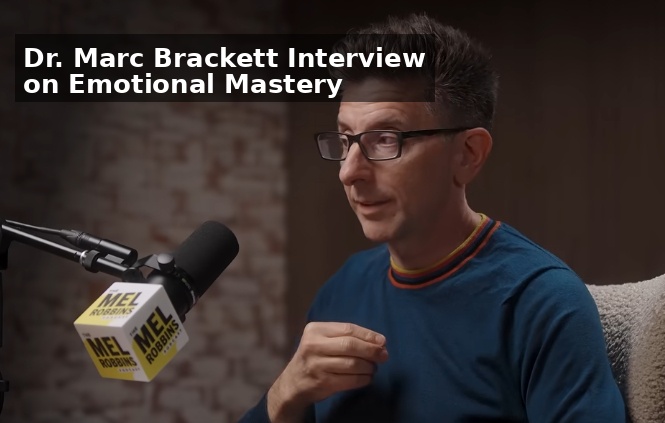
Read the full transcript of emotional intelligence expert Dr. Marc Brackett’s interview on The Mel Robbins Podcast, July 16, 2026.
Editor’s Note: In this compelling episode of the Mel Robbins Podcast, Mel sits down with Dr. Marc Brackett, founding director of the Yale Center for Emotional Intelligence, to discuss how to master your emotions and stop letting them control your life. Dr. Brackett introduces his evidence-based “RULER” framework—recognizing, understanding, labeling, expressing, and regulating emotions—designed to help individuals navigate strong feelings and achieve their personal goals. From this interview, you will learn practical strategies, such as temporal distancing and the concept of “giving yourself permission to feel,” to transform how they handle daily stress, conflict, and negativity.
Welcome and Overview
MEL ROBBINS: Dr. Marc Brackett, welcome to the Mel Robbins Podcast.
DR. MARC BRACKETT: I can’t believe I’m here.
MEL ROBBINS: I have had you at the top, top, top of the list for a long time because your work has made a big difference for me, particularly as a parent and for myself. I would love to have you explain, if I take everything to heart that you’re about to teach me today, what is going to change about my experience of life?
DR. MARC BRACKETT: I think most importantly is that you’re going to learn how to use your emotions wisely to have freedom, to have good relationships, to have well-being, to achieve your goals, and honestly, to achieve all the dreams you have and want in life.
MEL ROBBINS: If I use my emotions wisely—
DR. MARC BRACKETT: Correct.
MEL ROBBINS: I can achieve my goals, dreams, and be happier?
DR. MARC BRACKETT: 100%.
MEL ROBBINS: What do you mean by that? Because most of us feel like emotions are something we have to endure or overcome or we’re subject to or dictated by.
DR. MARC BRACKETT: Yeah, that’s the problem. The problem is that we didn’t get an emotion education. Emotions pile up like a debt.
MEL ROBBINS: They pile up like a debt?
DR. MARC BRACKETT: They do. Those strong, unpleasant ones. And if we don’t know how to express them in ways that are healthy, what happens? The debt comes due. It’s denial, it’s suppression, it’s repression, it’s perfectionism, it’s control, it’s shame.
We need ways to process our emotions. We need skills to do that, and we need skills to be able to communicate them, and we need skills to be able to manage them effectively. That’s the goal of this work, is that emotional intelligence is a real set of skills that can help you navigate all emotions and then apply that knowledge to achieve your goals in life.
MEL ROBBINS: How does somebody who’s really thinking about, I want what Dr. Brackett’s talking about, I don’t want my emotions to run me over, how do you begin this?
DR. MARC BRACKETT: It starts with permission to feel. It always starts going back to the basics.
MEL ROBBINS: Okay.
DR. MARC BRACKETT: So let me explain some of this research.
MEL ROBBINS: Okay.
Dr. Brackett’s Personal Story: The Uncle Marvin Effect
DR. MARC BRACKETT: So a little bit of my background. I grew up in northern New Jersey, 2 parents that loved me. My father was that toughen up kind of guy. My mother was very anxious, and neither one of them knew how to deal with their own emotions, nevertheless mine.
Unfortunately, I had 2 older brothers. Fortunately, I love them, but they also had their own problems. And my parents, by the time I was around 6, they were raising me alone, meaning my brothers had left. They were desperate. They had a lot of struggles. And unfortunately, the person who was my caretaker was a pedophile. And so from age 5 to 10, I was abused by my parents’ closest friend.
And I never shared it. I share this now in my 50s with courage. I suppressed it, denied it until I was 48 years old. I did not share it publicly.
And then something magical happened. I had an uncle named Uncle Marvin. He was my mother’s brother. He was a band leader by night in the Catskill Mountains and a 6th grade teacher by day, who by some wave of a magic wand was developing a curriculum to teach kids about feelings. Who by another wave of a magic wand lived with us when I was 11 years old for a summer, because he was going to graduate school near my hometown. Who ended up rehearsing and practicing his curriculum with me in the backyard when I was 11.
And he was the first adult who said to me, “Hey, Marc, how are you feeling?” No one had ever asked me how I was feeling, ever. It was always like, “Go to your room, wait till your father gets home,” “Toughen up.” No one actually sat with me and literally had presence.
Now fast forward — so I was 11, I’m 56, that’s 45 years ago. I mean, my whole career is based on that moment in my life, to be frank. So I dedicate my work to this remarkable human who gave me permission to feel.
And I became very curious as a scientist: what percentage of people have an Uncle Marvin or an Aunt Maria? So for people who are listening, just take a moment and think about that. Was there an adult while you were growing up that created the conditions for you to be your true, full, feeling self? And again, my research shows that only 1/3 of us say yes and 2/3 of us say no.
The Big 5 Characteristics of an Emotional Ally
DR. MARC BRACKETT: The next step is, what are the characteristics of these Uncle Marvins and Aunt Marias? So the research shows — I call them the Big 5 characteristics. The first one is just general warmth. The second is nonjudgmental. The third is an incredible listener.
Notice what’s not there. Brilliant problem solver, fixer, advice giver. Because what I find in my research is something remarkable, that most people say they’re afraid to be the emotion ally for somebody else because they don’t feel confident and capable. “I don’t know what to say or do.” But notice the characteristics. They’re not asking you to do very much except be present.
It’s amazing to me. People say, “I’m afraid because I’m not sure if they say something, I don’t know what I’m going to do. I’m not going to be able to fix their problem or give them the advice that they need.” And I said, no one’s looking for advice. No one’s looking for fixing.
Now, what my research shows also is that people who report having had this emotion ally in their childhood, as adults, they are more emotionally intelligent. They have better physical health, better mental health. They have better sleep quality. They have greater life satisfaction, and they have greater purpose and meaning in life.
And it’s funny because one of my closest friends from childhood came to hear me speak, and he had this reaction to my presentation. “I hated your presentation.” I’m like, “You hated it? I got a standing ovation, what are you talking about?” He’s like, “Well, I didn’t have an Uncle Marvin. Now I realize that’s why I don’t have purpose and meaning in life, and I’m freaked out about it.”
And I said, maybe you can be your own Uncle Marvin at some point. We have to look in the mirror and be those things to ourselves. We have to look in the mirror and have warmth for ourselves. No more judgment. Listen to our feelings. Self-compassion. And just be reliable to yourself. We can all be our own Uncle Marvins, too.
Paying It Forward
DR. MARC BRACKETT: And here’s something even more remarkable, Mel. I do a lot of speaking, and I’m out somewhere in New York State, and I’m giving this speech about this deep data. And all of a sudden, this man stands up, and he looks at me, and he’s like, “Are you talking about Marvin Moore, the 6th grade social studies teacher from Monticello, New York?” I said, “I am.” He’s like, “Marc, you’re not going to believe this, but your Uncle Marvin was my Uncle Marvin.” I’m like, “What are you talking about?” He’s like, “Your uncle was my 6th grade teacher, and he transformed my life.”
And we had this amazing conversation afterwards for 45 minutes. And he said, “Clearly, he’s transformed who you are as a person today.” I said, “I give him all the credit.” And then he looked at me and he goes, “Well, Marc, for whom are you an Uncle Marvin?”
It was so eye-opening for me. I’d never been given that kind of in my face, “For whom are you paying it forward?” It transformed my relationships that day because I realized that I just was not giving it.
MEL ROBBINS: It’s so beautiful. Really, really beautiful. And as you were going through that list of attributes, I’m like, this is why our kids always go to my husband. I’m not kidding.
DR. MARC BRACKETT: He can be your emotional ally now, and he probably is.
MEL ROBBINS: Yes, 100%.
How Emotions Shape Our Lives
MEL ROBBINS: Dr. Brackett, I would love to start with some more of the 4th grade level stuff about emotions, since I feel like I’m definitely in that camp of, okay, what are we talking about? What are we talking about here? Is this going to be one of these weird episodes where I’m thinking about my feelings, but I’m not sure what we’re talking about? How do emotions shape our lives?
DR. MARC BRACKETT: So in my work, I talk about 5 reasons why emotions matter. The first is that emotions drive our attention, memory, and learning.
Now, you’re looking at me now as a tenured professor of psychology. I grew up in northern New Jersey. I was terribly abused as a kid. I had terrible bullying as a kid. I was a failing student. I didn’t realize until I was in graduate school that I was in fight-flight mode all day long. How could I learn when I’m getting punched in the face on the bus or made fun of in school? My brain was in survival mode, not learning mode. Emotions drive our attention, period.
The second, emotions drive our judgments. Mel, have you ever made a bad decision?
MEL ROBBINS: Oh my God, is my name Mel?
DR. MARC BRACKETT: I mean, we all make decisions. What we don’t like to own is that how we feel oftentimes drives the choices we make. I’ll give you an example.
So in my research, we do studies where we ask people to think about a good day versus a bad day. So going to my work with teachers, “I want you to think about the best day you ever had in the classroom. I want you to think about the worst day you ever had in the classroom.” You can apply this to any setting. Immediately thereafter, I gave the teachers the exact same essay to grade. And my question was, would there be differences in how the teachers evaluated the exact same essay just after thinking for 5 minutes about a good day versus a bad day?
What do you think?
MEL ROBBINS: Oh no.
DR. MARC BRACKETT: 1 to 2 full grade differences.
MEL ROBBINS: 1 to 2 full grade differences based on the mood of the professor?
DR. MARC BRACKETT: Correct. Now, when I asked the people at the end of the study, “Do you believe that how you felt had any influence?” “Of course not. All I do all day long is grade papers and make decisions.” I said, “Well, here’s the data. 1 to 2 full grade differences.”
MEL ROBBINS: Wow.
DR. MARC BRACKETT: So what this tells us is that our emotions are guiding us through the day. And oftentimes what’s happening is we’re making a judgment based on the mood we’re in that’s not necessarily the best judgment. Now, what’s the antidote to allow our emotions to subconsciously influence our judgments?
MEL ROBBINS: And the antidote means you change it?
DR. MARC BRACKETT: Yes.
MEL ROBBINS: Okay. You allow the— you name the emotion.
DR. MARC BRACKETT: See how smart you are?
The Emotional Leakage Problem
MEL ROBBINS: Is that right? Oh my God, I was actually panicking a little bit there. I’m like, oh my God, I’m going to get it wrong on my own podcast. You just name it because what happens when you name it?
DR. MARC BRACKETT: You attribute it to its cause. When I can attribute my emotion to its actual cause, it will no longer have that subconscious influence over the future judgment.
MEL ROBBINS: I really struggle with this, and I am not proud to say this, but I’m a very leaky emotional person, meaning that it has been a challenge for my entire life to be able to separate myself from the thing that happened and the emotions that I feel. And instead, I wouldn’t say leak. I’d say there have been times I’ve been more like a tidal wave.
DR. MARC BRACKETT: Yeah, me too.
MEL ROBBINS: And I’m not proud of that. And I can even say that this morning, that there was something that happened in our studios yesterday that really made me angry. Not with our team, somebody coming in from the outside.
DR. MARC BRACKETT: Yeah.
MEL ROBBINS: I walked into a meeting that was a great, like, collaborative meeting. And within 2 minutes, I could feel my intensity. So the leakiness.
DR. MARC BRACKETT: Yes.
MEL ROBBINS: That wasn’t about the meeting I was in. It was about how I felt even talking about something that happened yesterday that had nothing to do with that meeting.
DR. MARC BRACKETT: Correct.
MEL ROBBINS: And it’s very useful to understand that a simple thing that you could do in that moment, if you notice that the volcano or the tidal wave or all of this is leaking, to just say, oh, I’m really irritable.
DR. MARC BRACKETT: That’s it.
MEL ROBBINS: And I could have just said, I don’t mean to be intense, everybody. I realize it’s from the thing yesterday. And let me just take a beat because it’s not about you. Because I think what happens is your emotions feel like you have no choice.
DR. MARC BRACKETT: That’s exactly right.
MEL ROBBINS: I mean, for most of my life, Dr. Brackett, I— and I apologize for talking over you. I just feel like I feel— I’m the kind of person that was ruled by my emotions. To the detriment.
DR. MARC BRACKETT: We’re the same people because I just did not like life as a child or an adolescent. And I remember even in high school crawling up in a ball, crying and saying, who am I? Where am I going with my life? And thinking, oh my gosh, this is who I am. There’s no— there’s no way out. I didn’t know there were skills to learn. And that’s why I’ve dedicated my whole life to helping people realize that emotions are impermanent. There are no bad emotions, and we can learn to use our emotions wisely to achieve our goals in life.
The 5 Reasons Emotions Matter
MEL ROBBINS: I want to make sure that we got all 5 of the reasons why emotions matter. And we have attention, we have judgment.
DR. MARC BRACKETT: Yes. The 3rd is relationship quality. Emotions drive the quality of our relationships. Here’s a simple phrase. Emotions are signals to approach or avoid, period.
MEL ROBBINS: You just described my childhood. Emotions are signals to approach or avoid.
DR. MARC BRACKETT: That’s right. So my facial expression, my body language, my vocal tone, my presence is either going to send a signal to you, Mark likes me, Mark’s with me, Mark respects me. Or it’s going to say, stay away. I don’t respect you. Like, who are you? I don’t need you. That’s critical. And that’s from the micro to the macro. I mean, just a vocal tone. I always joke that I can literally influence how a room feels by lifting my right nostril. I mean, literally. If I—
MEL ROBBINS: I looked like I was going to get a bad grade, Professor Brackett, when you did that.
DR. MARC BRACKETT: Yeah. Well, people who are listening can just imagine this. And if you’re watching, you can see it. So if I look at you right now and I do this. Uh-oh.
MEL ROBBINS: Oh, you had a little bit of disgust and judgment. Whoa.
DR. MARC BRACKETT: Isn’t that amazing? Like, I just literally lifted my right nostril a little bit, and all of a sudden you’re like, yeesh, like, I’m not comfortable anymore. Yes, like that. That’s how fast emotions impact our relationships. So that was an example of me showing an emotion that makes people not want to approach me.
But then the same thing applies to myself. I wake up in the morning and I think, what’s happening today? Oh my God. And that dread or that fear or that loneliness is going to drive how I communicate. So it’s both internal and it’s both external.
MEL ROBBINS: So we’ve got attention, judgment, and relationships. What are the other 2 ways that emotions really run your life?
DR. MARC BRACKETT: The 4th is mental and physical health. So think about this. Little emotions become big emotions if they’re not dealt with. Sad becomes hopeless, hopeless becomes despair, despair becomes depressed, peeved becomes irritated, becomes angry, becomes livid and enraged. And if we don’t recognize the little emotions and find strategies for dealing with them, all of a sudden they tear away at our mental and physical health.
MEL ROBBINS: That makes a lot of sense. And what’s the 5th way?
DR. MARC BRACKETT: The 5th one is that emotions influence our performance, our everyday performance. I think about this all the time because I grew up with 2 blue-collar parents. Neither one of my parents had a college education. And then all of a sudden I ended up with this job at Yale. And so every one of my students had higher SAT scores than I had, greater grade point averages. They played instruments I never heard of. They traveled to countries I didn’t know were on the map. And I’m their teacher.
And I had imposter syndrome for years thinking they’re going to find out that I didn’t go to an Ivy League school myself. I didn’t even get in. To an Ivy League school. I didn’t even know what one was, to be frank. And I just had this assumption for so many years that, oh my gosh, these are the brightest crayons in the box who have all this background knowledge and parents who read to them and parents who were senators and producers.
And then I’ve gotten to watch for 25 years what happens, and so many people don’t achieve their goals in life. And it’s not because they’re not smart. You know what it is?
MEL ROBBINS: No.
DR. MARC BRACKETT: They can’t deal with their feelings. They can’t deal with feedback. They can’t deal with disappointment. They can’t deal with the anxiety. And so there’s a point in our lives when our brainpower— we need it, of course. The more academically skilled we are, the better. But it’s insufficient. It’s insufficient.
So here I am. I got 500 students in my class. Every one of them looks the same on their CVs. They all got the same grades. They all got the same SAT scores. So I look at them and I say, who’s going to make it? Because you’re all going to apply for the same job. Who’s going to get hired? And it’s not going to be about your intelligence. Just like when you’re a basketball player, it’s not about your height. Everybody’s tall. It’s going to be another set of skills. And those skills are emotional intelligence.
What Is Emotional Intelligence?
MEL ROBBINS: Dr. Brackett, what is emotional intelligence?
DR. MARC BRACKETT: If I were to define emotional intelligence in its simplest form, emotional intelligence is a set of skills that helps us to use our emotions wisely to achieve our goals in life. Now, of course, that’s very broad. So you say, all right, well, what exactly are the skills? And I have an acronym, RULER, which helps describe the 5 skills of emotional intelligence.
The first skill is recognizing emotions. Number 2 is we understand emotions. Number 3 is we label them. Number 4 is we learn how to express them in ways that help us achieve our goals, because we’ve all expressed them in ways that have not helped us.
MEL ROBBINS: That’s been the norm for me.
DR. MARC BRACKETT: And then the final one is regulation. So recognize, understand, label, express, and regulate.
Breaking Down the RULER Framework
MEL ROBBINS: I would love for you to walk us through each one of those 5 things of the acronym RULER. And the first letter is recognize. What does that mean?
DR. MARC BRACKETT: So you’ve created these wonderful blocks for me to show everybody.
MEL ROBBINS: Yes. It’s a big R. If you’re listening, I don’t want you to miss anything. He’s putting a yoga block in front of him and it’s got a big R and it says recognize.
DR. MARC BRACKETT: Recognizing emotions. Think about it. What are we doing here? We’re paying attention. Like me right now, I’m laser-focused on you, and I’m paying attention to your facial expression, your body language, your vocal tone, and your behavior. That’s the social awareness piece of it.
MEL ROBBINS: Okay.
DR. MARC BRACKETT: Then there’s the introspective piece of recognition. Mark, what’s going on in your body? What’s going on in your mind right now? It’s that basic, basic piece.
MEL ROBBINS: Yeah.
DR. MARC BRACKETT: Well, let me ask you this question. Everyone listening, on a scale from 1 to 10, how skilled are you at recognizing emotions? 1 being terrible, 10 meaning you’re great.
MEL ROBBINS: I think I’m 10 at recognizing an emotion is happening. I think I’m probably a 4 at understanding what exactly the emotion is.
DR. MARC BRACKETT: Okay, so my research shows that the correlation between our belief and our skill is next to zero.
MEL ROBBINS: Meaning what you can actually do versus what you think you can do?
DR. MARC BRACKETT: Is not related at all.
MEL ROBBINS: Okay.
DR. MARC BRACKETT: Because, like, how much feedback have we gotten in our development? Like, when you were coming down the stairs at home, did your father say, oh my gosh, honey, I’m noticing your facial expression today? We didn’t do that kind of conversation. Nobody taught us how to read happy, sad, fear, surprise, all that stuff.
MEL ROBBINS: Right, because nobody taught our parents either.
DR. MARC BRACKETT: Exactly. So we tend to get pleasant, unpleasant right, like approach, avoid kind of feelings. But the specific emotions, we tend to be very poor at guessing. We tend to attribute emotion to people as opposed to actually recognize their feelings. So let me give you an example.
MEL ROBBINS: Okay.
DR. MARC BRACKETT: Like right now, you would— you went, hmm. If I had some kind of terrible thing that happened this morning, or I heard weird things about Mel, I would come into the meeting and she’d go, hmm, and I’d be, oh, she’s judging me. She’s not curious. That’s a judgment signal. I have no clue what the hell’s going on in your head or your mind, but I am projecting my own issues or the other issues that people said onto your facial expression all of the time. I mean, have you ever been misread?
Misreading Emotions in Relationships
MEL ROBBINS: Well, I’ve been misread, and I was thinking when I made that sound of a thing that I did with our daughter Sawyer, who for a while I was misreading her expressions, and she would get very rigid and her face would go cold, and I would immediately feel like she was judging me. And what I’ve come to learn in those moments, which makes me really sad, is that she actually was becoming emotionally flooded and felt overwhelmed and didn’t know what to do because it seemed like I was getting angry about something. And so here we were, 2 people in constant situations where we are not actually getting each other because I’m not angry at all, but my voice is going in a direction that cues it.
DR. MARC BRACKETT: Yeah.
MEL ROBBINS: She then stiffens and I think she’s getting combative. And in fact, it’s the opposite. She’s in fear.
DR. MARC BRACKETT: There you go.
MEL ROBBINS: And we miss each other and we misunderstand each other. And I can see how I was attributing something that then, of course, affects my emotions and understanding that the first response for her typically, and same as with my husband actually, is I would always get so mad because he would go silent when I was pissed off. I mean, smart dude. And then I would be, of course, walking behind him going, what now? You’re going to talk? And what I thought was he was trying to control the situation and pull a power move and dominate. And the truth is he was shutting down because in those moments he felt like there’s absolutely nothing I can do. Nothing I can do here.
DR. MARC BRACKETT: You’re like so clearly showing why we need skills.
MEL ROBBINS: Yes.
DR. MARC BRACKETT: Because otherwise we’re just projecting all the time. And so using that antidote word again, the antidote is what?
MEL ROBBINS: To name it.
DR. MARC BRACKETT: There you go.
MEL ROBBINS: Because that’s what changed everything in the dynamic with my daughter.
The Courage to Ask How Someone Feels
DR. MARC BRACKETT: You have to say how you’re feeling, but you also have to have the courage to ask her how she’s feeling.
MEL ROBBINS: How would you advise us to ask somebody else? Because I do feel like, especially with couples— my husband and I are celebrating our 30th wedding anniversary, and the question I’ve asked him the most in our marriage, what are you thinking? Which ironically doesn’t typically lead to an answer that tells me how he’s feeling or what he’s thinking. What is the best way to ask somebody as dumb a question as that is?
DR. MARC BRACKETT: It’s not that dumb because we just don’t do it because I think that we are intimacy-phobic. So it’s easier to say, what are you thinking? There’s less connection involved in it. And so when you are in this weird place with your husband or your daughter, you just say, I’m in a weird place right now. I’m not even sure how I’m feeling. I’m kind of this odd mixture of frustration and overwhelm right now. And I just want you to know that. And I’m really curious about how you’re feeling about this situation. That’s it.
MEL ROBBINS: It seems so easy.
DR. MARC BRACKETT: It is, but we’re afraid to hear the response because we don’t want to own the fact that we might have created an emotion, which is more complicated than it’s said. But we do support other people in experiencing unpleasant feelings, and we don’t want to own that. So it’s easier to just not ask the question.
Understanding Emotion: The Hidden Driver of Emotional Intelligence
MEL ROBBINS: Wow. So the next letter is U. And you say, you wrote in your mega bestseller, Dealing with Feeling, that this is the hidden driver of emotional intelligence.
DR. MARC BRACKETT: Because this is where we build relationships and connection. Understanding emotion, we define it as understanding the causes and the consequences of emotion, including how our emotions impact all the things that we’ve talked about, thinking, judgment, and behavior. But here’s the kicker, and this is where I think most people get it wrong. We have to have a common understanding of emotion. So anger, for example. If I were to ask you, what is the general cause of anger, what would you say?
MEL ROBBINS: I would think either sadness.
DR. MARC BRACKETT: Oh.
MEL ROBBINS: Injustice.
DR. MARC BRACKETT: Thank you.
MEL ROBBINS: Okay.
DR. MARC BRACKETT: Anger is the result of a perceived injustice or unfairness. Now, you’re a woman, I’m a man. We have different upbringings, we have different religions, we have different belief systems. So the things that I see in society that may trigger me to make me feel angry may not trigger you, vice versa. I don’t need to prove to you why you should or should not feel angry. You don’t need to prove to me why I should or should not feel angry. The goal of emotional understanding is to have connection and empathy. I want to know. Tell me, why do you feel this way about this so that I can be supportive of you? That’s the key to understanding.
MEL ROBBINS: Wow. And that means more intimacy.
DR. MARC BRACKETT: Sorry.
MEL ROBBINS: Which is why we don’t ask.
DR. MARC BRACKETT: I mean, it’s why we go to AI to get help with our feelings, because we’re so afraid of having the connection with a human that we just think it’s easier to ask a chatbot.
Understanding the Cause of Your Emotions
MEL ROBBINS: Now, what I found interesting about the understand part of this is that it was both understanding the cause of it and then understanding what it’s impacting in your life. How do you understand the cause of it?
DR. MARC BRACKETT: The cause is going back to the theme. So injustice.
MEL ROBBINS: Oh, gotcha. Okay, so— oh, I got it. So if you’re angry and you don’t know why, ask yourself, what has happened that makes me feel like something’s unfair?
DR. MARC BRACKETT: Correct. Or if you are disappointed, it would be what?
MEL ROBBINS: What was my expectation?
DR. MARC BRACKETT: Exactly. Disappointment is about unmet expectations. Now, here’s the deal. You’re with your kid, you’re with your partner, you’re out and about, and someone says, “I can’t take it anymore.” I just said that to you. “I can’t take it anymore.”
MEL ROBBINS: Oh my God. Okay. I just had a little bit of a flashback from something. Go ahead.
DR. MARC BRACKETT: That’s okay. How am I feeling?
MEL ROBBINS: You are feeling frustrated.
DR. MARC BRACKETT: How do you know?
MEL ROBBINS: You grit your teeth. You raised your hands. You had a face that was very angry.
DR. MARC BRACKETT: Freeze. What are you doing right now? You are making the what error?
MEL ROBBINS: I am attributing.
DR. MARC BRACKETT: Thank you.
MEL ROBBINS: Something I actually don’t know how you feel.
DR. MARC BRACKETT: Of course not. I’m a dude. I’m not going to tell you that I feel shame or disappointment. I’m going to act out like I’m angry to get my needs met.
MEL ROBBINS: Oh, so, for example, a father in a toy aisle and kids want the expensive thing. You can’t afford it. The deeper emotion is shame, but you’re going to just erupt at your kids and it’s going to read anger and frustration.
DR. MARC BRACKETT: Great example. Hence why we need to deactivate, get curious, find out what’s happening to build the connection so that we can be helpful to each other.
Emotions are data. So when I’m feeling an unpleasant emotion, it’s legitimate. There’s nothing wrong with that. As a matter of fact, I’ve been really thinking about this around my anxiety. And a friend of mine who studies anxiety, we had this long conversation about it. And she said to me, “Marc, tell me all the things that make you anxious.” Well, I’m anxious about fundraising. I got to constantly raise money to keep my research center alive. What else? I’m anxious about the quality of our center’s work. I always want it to be the top quality. What else are you anxious about? And I named all these things. And she said, “What do those things have in common?” I’m like, what are you talking about? She said, “No, listen to me. What do those things have in common?” And I had an epiphany. I said, “They’re all the things that I care about in my life.” And she said, “Exactly. So why would anxiety be a bad thing? It’s telling you that something may not be going exactly right with something that you care about. So now it’s an opportunity to look deeper into that.”
MEL ROBBINS: Okay. That’s personally why you’re here for me. That one story and that one reframe around anxiety is exactly what I needed as a parent right now to send to one of my adult kids. That was like a gift.
The L in RULER: Labeling Your Emotions
MEL ROBBINS: The 3rd letter of RULER is label.
DR. MARC BRACKETT: Correct.
MEL ROBBINS: What does that mean?
DR. MARC BRACKETT: So labeling emotions. Before, in understanding, we talked about understanding the causes and the consequences, the differences between, let’s say, anger and anxiety. Anger is about injustice. Anxiety is about uncertainty. But now with labeling, we’re going to get super precise with our words.
MEL ROBBINS: Okay.
DR. MARC BRACKETT: I’m going to ask everyone who’s listening to take a little quiz.
MEL ROBBINS: Okay.
DR. MARC BRACKETT: We have anxiety, stress, pressure, fear, overwhelmed. This is a big quiz. Anxiety, stress, pressure, fear, overwhelmed. What’s the difference between anxiety, stress, pressure, fear, and overwhelmed?
MEL ROBBINS: Anxiety is about the future.
DR. MARC BRACKETT: I gave you that one already.
MEL ROBBINS: Okay, I know. Okay, so that means I’m learning. Stress is about your body state.
DR. MARC BRACKETT: Keep going.
MEL ROBBINS: Okay. Overwhelm. I’m now starting to panic and I forgot the other 2. Overwhelm is I don’t know what to do. Pressure is I can’t handle this. And fear is something bad’s going to happen.
DR. MARC BRACKETT: You’re pretty good. B+.
MEL ROBBINS: Okay.
DR. MARC BRACKETT: So anxiety, perceived uncertainty. Stressed, too many demands, not enough resources. Pressure, something at stake is dependent upon my behavior. Fear, impending danger. Overwhelmed, saturated with emotion.
Now, why does that matter? Why am I trying to get you to be, as we call it, so granular about your feelings?
MEL ROBBINS: Well, I can see why this matters, and it’s very helpful because it applies to something I’m dealing with at work where it feels like all 5 of those things are present: anxiety, stress, overwhelm, pressure, fear.
DR. MARC BRACKETT: Yep.
MEL ROBBINS: And I think in some way all of those things are present in this situation.
DR. MARC BRACKETT: They could be.
MEL ROBBINS: But just taking stress, which is too much to do and not enough resources, that is a very different operational problem than having you feel overwhelmed, which is emotionally flooded and I can’t do anything.
Why Precision in Labeling Emotions Matters
DR. MARC BRACKETT: Exactly. And so that precision is a guide to healthy regulation. Anxiety is about uncertainty around the future. You can take all the deep breaths, you can take all the walks. Guess what? You’re going to come back and you’re going to ruminate about all the uncertainty. Stress is having too many demands and not enough resources. You can go to the gym and pump it out. Maybe it’ll be some immediate relief, but at the end of the day, you got too much on your plate and you can’t handle it. So if you’re stressed, either you’re going to have to say, “Marc, your job never ends, you’re going to have to accept this,” or you’re going to have to distribute more and get more people to support you. Otherwise, the stress is not going to go away, period.
Here’s a quick one for you. So I did a study with my own students on how they feel. And it’s sad. 70% of them say they’re tired and stressed and bored. And by the way, this parallels with a big study I did with high schoolers across the nation. 77% of the time, tired, bored, and stressed. But then I got really interested in, well, do they really know how they’re feeling? So I had them journal about all the reasons that they’re tired and bored and stressed and overwhelmed and all this stuff. What do you think the real emotion was?
MEL ROBBINS: Despair.
DR. MARC BRACKETT: The real emotion was envy.
MEL ROBBINS: What?
DR. MARC BRACKETT: Envy. Because everything they wrote about, about being stressed was social comparisons. “They study for less hours and get better grades. They’ve got better hips. They’ve got better lips. This one’s parents have more connections.” And so they go to the university counseling center and they get treated for stress and anxiety and doing breathing exercises and yoga. And I keep on thinking to myself, I don’t know what yoga pose is going to decrease envy, but no offense to the yoga people out there. I love yoga. But the point is, if we don’t really know what we’re feeling, then we don’t know what to do with our feelings. And if we’re kind of unself-aware, then we’re just like, “Give me breathing exercises.” Like, I don’t know what the breathing exercise is going to do when you’re sitting around thinking, “Oh my God, everybody’s better than I am, everybody’s better than I am.” You need cognitive strategies for that. You got to change the dialogue in your head and stop comparing yourself. That’s the only thing that’s going to decrease the envy.
Gratitude as a Strategy Against Envy and Comparison
MEL ROBBINS: So, Dr. Brackett, what is the thing that you need to do if it is envy and comparison that’s making you feel sad, stressed, bored, and tired?
DR. MARC BRACKETT: How about gratitude?
MEL ROBBINS: Now, if I’m sad, stressed, bored, and tired, I’m like, “How about you go f* yourself?” Like, I’m literally— because you know how people— how do I access gratitude if I’m in that spiral?
DR. MARC BRACKETT: You take a deep breath and you say to yourself, “Look at me, look at where I’m at, what’s going right for me. What are the 3 things today that happened that are actually positive?” And I always tell students, “You got great freaking professors. Come on, let’s have some gratitude here, right? You can hate yourself, but let’s be honest about who I am. It’s not like the food is bad here. It’s not like the dorms are so bad. Can we just take a moment and pause and just think about what’s going right?”
Again, that negativity bias just pours over us. Just take a minute and think about something you’re grateful for. It just changes the chemistry in your brain. We need to reflect on what’s going right and not always on what’s going wrong. That’s a skill. It’s a practice. Just like you brush your teeth in the morning, at the end of the day, when we have dinner together, we do— it sounds cliché, but you know what? We do a gratitude reflection.
The RULER Framework: Expressing and Regulating Emotions
MEL ROBBINS: That is so insanely helpful. If you start adopting a practice, if you recognize yourself being in this loop that we’ve all been in where you’re sad, you’re stressed, you’re bored, you’re tired, maybe the next time you’re in that self-criticism beatdown spiral, you go, whoa, hold on. Let me remember what Dr. Brackett said. Let me look around and find 3 things that are going well.
DR. MARC BRACKETT: Or it might just be simpler than that. Mark, this feeling is impermanent. You’re 56. There have been rainy days, there have been sunny days. Today’s a rainy day for legitimate reasons. It’s not going to rain forever. But we have to recognize the key element is that all emotions are impermanent.
MEL ROBBINS: They’re impermanent.
DR. MARC BRACKETT: They are impermanent. The law of physics says that emotions are ephemeral, they are impermanent. I just say that, and I just— it makes me feel at ease because I lean into rainy days more than sunny days. That’s a whole— that’s a therapy session we won’t get into right now.
But the point is that I have to use that language. I have to talk to myself and say, Mark, today’s the rainy day. You’ve had some beautiful sunny days over the last couple of years. Remember, they’re there too. And how relieving that is.
We’ve gone from recognizing to understanding to labeling, and I want to get to expressing. Can I do that one now?
MEL ROBBINS: Please.
The Skill of Expressing Emotions
DR. MARC BRACKETT: So expressing emotions— this is bringing us to that last big R of regulating— is that there’s a lot of discernment in expressing emotions. There’s a lot of discernment in me feeling safe psychologically with you, Mel, right here, right now, to be my true self. Like, you create the context. I’m in your home right now, and so you’re creating a context for me either to be completely open or guarded. Every home is that way. Every classroom is that way. Every workplace is that way.
So when we want to express our emotions, we can’t just do it. It’s a skill that is embedded in a context. We also have to know how and when to express emotions. I’ve gotten this pushback too about, like, you’re just saying that permission to feel means permission to say whatever you’re feeling, whenever you want to say it. I’m like, I never wrote that. Just to let you know, there are norms in our workplaces, there are norms in our homes, in society. And yes, you can be your true self, but is that the most helpful self? If I said everything I was feeling to everybody I was with, I would be a very lonely person.
MEL ROBBINS: So I’d be fired from my own company.
DR. MARC BRACKETT: Exactly. There you go. The question here is, are we in relationships with people with whom we can be our authentic selves? I can’t tell you how many people I talk to, people who are listening right now, and if I said, can you tell your loved ones how you really feel? Can you be open and say, I’m feeling sad, I’m feeling lonely? Do you have the courage to talk about it with someone?
Do you know that most people say no? My research shows that about 2/3 of us say no. And this is why we need to help people learn the skills, because they don’t feel like there is an actual person in their life with whom they can be their true, full feeling self.
The Final R: Regulate
MEL ROBBINS: What is the final R?
DR. MARC BRACKETT: So the final R of RULER is regulate. It’s about regulating your emotions to achieve your goals.
MEL ROBBINS: What does that mean, to be regulating your emotion?
DR. MARC BRACKETT: Well, let me ask everyone who’s listening and you, what’s your definition of emotion regulation?
MEL ROBBINS: For me, I think it means to recognize what’s happening and to basically try to let it rise up and dissipate. To try to not let it be leaking all over other human beings. To try to not let my mood or my feelings in the moment dictate the actions that I take next. That’s what it means to me.
DR. MARC BRACKETT: Yeah, and that’s a great way of thinking about it. The scientist definition is it’s about the thoughts and the actions. So the things we can do in our heads. I can prevent the anxiety before the presentation because I can get ready for it. I can reduce an unwanted emotion. I can initiate an emotion. I can intentionally try to help you savor your emotions. I can maintain a pleasant emotion.
So when I leave here today, I’m going to assume that we all think this went well, and I’m going to call people, and I’m going to say, I had an amazing experience with Mel, ask me some questions please, so that I can think back and savor it. I think that’s important. We tend to just move on. Why? Let’s savor it.
Or we can boost or enhance emotions. And we do that in the service of all the things that I do my work for, which is we regulate so we have better attention, we regulate so we make better decisions, we regulate so we can have better relationships, we regulate so we can have better mental health, and we regulate so we can achieve our goals in life. And so there are strategies. Should we go through them?
Unhelpful Emotion Regulation Strategies
MEL ROBBINS: Yeah, let’s start with the ones that are unhelpful that people may reach for and don’t realize it’s not actually working. And I’ll share one.
DR. MARC BRACKETT: Go.
MEL ROBBINS: I recently started to realize that when I would kind of become a volcano or I’d get angry because I feel a sense of injustice, or I get frustrated because I have unmet expectations, usually, by the way, that I’ve not expressed, that in the venting, like, I just need to get it out. I’m a verbal processor. That’s how it just— it stirs up even more.
And so that’s one thing. Another one that has been very unhelpful that I used for decades was telling myself to not be anxious or telling myself I shouldn’t be this way and really rejecting the thing that I was feeling and trying to ignore it.
DR. MARC BRACKETT: Yeah, welcome to America. I think those are many people’s go-to strategies. My research shows that there are 3 big ones that are unhelpful. For everybody who’s listening, take a moment and think about it. When you’re overwhelmed, when you’re stressed, when you’re pissed off, what’s your automatic go-to unhelpful way of dealing with your emotions? Just think about it.
MEL ROBBINS: Sending an email and venting on people.
DR. MARC BRACKETT: Yeah.
MEL ROBBINS: Bitching to my husband about what some idiot did. Yes. Talking about the state of the world and why this is still happening.
DR. MARC BRACKETT: Exactly.
MEL ROBBINS: Yes. And now I’m already feeling it actually.
DR. MARC BRACKETT: Totally. I can’t believe I’m going to say this. I get mean and I hate myself for it. But when I get triggered, I want to retaliate. And I’m working on it for years. But if I get low enough and angry enough or frustrated enough, it just— and I’m like this. I always say to myself, Mark, you’re the director of the Center for Freaking Emotional Intelligence. Don’t say it. Don’t do it, Mark. You have the strategies. You’re the expert. And I go for it and it’s like, ah.
But here’s the big ones. Avoidance. It’s like the person you’re having a difficult time with at work. You’re like, I’m just going to not go into the lunchroom. I’m going to avoid that person in the hallway. Or I’m just not going to tell the person how I really feel and just bury it. That also includes the kind of denial, the suppression stuff.
The second is eating and drinking. How many of us have had one too many chips or scoops of ice cream or one too many alcoholic beverages?
MEL ROBBINS: Yeah, what do you think the odds are that I had a martini last night after a stressful day?
DR. MARC BRACKETT: There you go.
MEL ROBBINS: And then I walked in here this morning and leaked all over a bunch of people.
DR. MARC BRACKETT: Self-awareness is a gift. And the other masterful one, I say that jokingly, is just negative self-talk. We are self-saboteurs.
The Power of Reframing: A Personal Story
MEL ROBBINS: Right.
DR. MARC BRACKETT: I think we are gaslighted to use it. Let me give you a really concrete example. So I have a niece who is the love of my life. Her name is Esme. She was adopted from Guatemala. And I speak Spanish. And I went to bring her home back 21 years ago. She just graduated college. I’m very proud of you, Esme.
She is dark-skinned. She’s Latina. She was in a very white area of New York State, and in kindergarten, some kids said to her, “You’re a different color than your mother, that’s disgusting.” Now, of course, her mother called me and said, “You better get up here because I’m going to get in my car, I’m going to run over that kid, I’m going to run over the mother.” I’m like, take a deep breath, Uncle Mark, road trip.
Now, when I got to their home, this is the love of my life, this 5-year-old girl. And I know what it’s like because I was terribly bullied as a kid. I knew that I had to be her emotion ally. I knew that I had to help intervene because she was already saying, “I don’t want to go to school. I hate school. I don’t want to go to school.” She was already questioning her skin color. “Why am I this? Why are you my mother?”
And in that moment, which was a difficult moment for our family, I had to figure out a way to connect with this young woman and in her 5-year-old language tell her that no one has the right to define your reality. Now, if she were Uncle Mark, in his 40s at the time, he would have the courage to say, “Wait a minute, who do you think you are talking to me that way? I love myself. You don’t have that power.” She’s 5.
MEL ROBBINS: Yeah.
DR. MARC BRACKETT: Do you see why I’m saying how important it is?
MEL ROBBINS: Of course.
DR. MARC BRACKETT: We have to build the skill early. And so this young girl, with her uncle and her parents and other people, were really trying to help her reframe, build more positive self-talk, recognize that our family has different skin colors and tones, and it’s okay, and that we love her, and that she’s going to be okay, and et cetera. But imagine no intervention there. Imagine no one noticing.
We were intentional about providing her that support so she could reframe and have more positive self-talk. So our negative self-talk starts early. And it doesn’t come from within. It comes from without. It’s our parents saying, “Why are you wearing those pants? Why are you doing that?” And all that negativity about your skin color, about your height, about your weight, about the way you walk, the way you talk, the way you do your homework, everything.
And from what I gather, other than the work I do and some others do, there’s nobody intervening and helping parents and children notice and say, wait a minute, we need to not be self-saboteurs. We need to be self-compassionate.
Building a Growth Mindset Around Emotions
I wake up every single morning with a mindset that today is the first day of the rest of my life. Today is a day that I can start the journey to be the best version of myself. I just think we have to have that mindset about life. Otherwise, we just get stuck, and we’re endlessly stuck, and we’re endlessly trying to fix. There’s nothing to fix. Only learning.
MEL ROBBINS: Why is that mindset so important? What has it done for you?
DR. MARC BRACKETT: What it does for me is it allows me to set goals to be the better version of myself that day. And it’s like, Mark, you said that to your partner, not cool. Like, let’s think about that a little bit. What need did you have that was unmet that made you project or displace that crap on him?
And so for me, it’s an opportunity to grow. It’s an opportunity to flourish. And as a kid who had a lot of trauma, and I walk around the world and I see the data on how many people have experienced trauma and how many people stay stuck in that trauma, I just feel like that’s not the way life should be. Life is about moving forward.
MEL ROBBINS: What are the research-backed strategies that are effective for regulating an emotion?
Emotional Regulation Strategies: Observe, Don’t Absorb
DR. MARC BRACKETT: Yeah, number one is the permission to feel. Okay, you got to just— it’s okay, I’m feeling it, no big deal. Number 2, build the vocabulary. We got there. Number 3, you have to learn how to deactivate. You do have to build the space. So if you get annoyed with someone here before you go home, sometimes you don’t have access to those cognitive strategies right away. So maybe it’s taking a walk around the block, maybe it’s taking a deep breath, maybe it’s a little meditation. It’s whatever works for you. For me, it’s breathing. I just take some breaths. I’m like, okay. And then I can activate my best self.
So just to— it goes from attitude of permission to feel, to having the vocabulary, to knowing how to deactivate, to the cognitive strategies. One of my favorite go-to strategies is temporal distancing. It’s a fancy way for saying, how am I going to feel about this in a month?
So I’m triggered by everything, just so you know. I just— I am. I grew up with a father who was cheap. Like, why are we buying that? That’s ridiculous. So we go shopping and my partner wants the organic almond milk. I’m like, that’s ridiculous. We’re not spending $7 on milk. Are you out of your mind? And then I realized, A, I’m not my partner’s father. Oh yeah, that’s right. Everybody can buy whatever milk they want to buy. It’s not like, control freak, shut up, control freak.
But sometimes I have to go down another aisle, take a deep breath, and be like, Marc, is it worth your relationship, this freaking almond milk? Like, this is ridiculous. Are you really going to even remember that you bought the almond milk in a week from now? No. Let it go. So it’s like you build in time, or you create the time.
One of my ultimate favorites is a relational one. Have you ever been in a meeting with someone that their energy is really uncomfortable?
MEL ROBBINS: Yeah, it was like this a lot. He would get triggered when we were at family gatherings, and then all of a sudden he’d go into attack mode.
DR. MARC BRACKETT: And then you feel like, oh my God, what are they going to do?
MEL ROBBINS: Oh my God, yes, like I have no control here.
DR. MARC BRACKETT: Yeah, you create a picture frame. So let’s imagine right now, for listeners, I’m with Mel, and Mel is saying like, “Marc, I think your stuff is bullshit.” And I’m like, I can’t believe this is happening right now. And so I could just sit here and absorb it all and be like, oh my God, my life is over. 5 million people are going to listen to Mel tell me that my life’s work is meaningless. Okay, Marc. A, she didn’t say it. B, make a little picture frame. So I literally make you into a movie.
MEL ROBBINS: Okay.
DR. MARC BRACKETT: And I observe you as opposed to absorb you. Observe versus absorb.
MEL ROBBINS: Wow.
DR. MARC BRACKETT: Do you get it?
MEL ROBBINS: Yes. I need this.
DR. MARC BRACKETT: We all need it.
MEL ROBBINS: And I especially need it when I see clips from the news.
DR. MARC BRACKETT: Yeah.
MEL ROBBINS: Because it’s so activating to see certain people and certain headlines, and I absorb it.
DR. MARC BRACKETT: Me too.
MEL ROBBINS: Versus observing it. Yes. Where there is this distance.
DR. MARC BRACKETT: Correct. It’s spatial distance. So when my father would say things like, “Marc, you think your blank doesn’t stink now that you’re a professor?” And I would be like, okay, this is going to be a fun night, but this is going to be a B-level movie, and I’m just going to watch my father go on his rampage and just— wow, gosh, I wish he had an emotion education when he was young. Gosh, it would have been nice for him to learn some skills. Wow. It’s a great movie. And so I would just talk about it while I am observing it.
MEL ROBBINS: To yourself.
DR. MARC BRACKETT: And I would disallow him to bring that into my life. It’s a beautiful technique.
The “Let Them” Philosophy and Emotional Regulation
MEL ROBBINS: It is beautiful. And what I just realized is that when I’m saying, “let them,” in a moment where somebody is very triggering or they’re activated, I’ve never thought about it like the movie, but I’m basically cueing myself to recognize who I’m dealing with and to take a step back emotionally and remind myself I can’t control this. This person’s acting like an 8-year-old throwing a tantrum. Yeah, I’m just going to let them.
DR. MARC BRACKETT: So that’s actually really cool because I’ve read your book, which I think is wonderful, and I have applied my own work to your work, and we’re aligned 100% there because when you are letting them, you still have to regulate your feelings. It’s not like you just let them and be like, whatever. You have to manage your own experience with that person and allow them— allow the disengagement or let the relationship go in a different direction or whatever it is. But that takes some personal work.
MEL ROBBINS: Well, what I realized is that before being able to say “let them” as a way to create the distance between me and somebody else and observe what’s happening, I couldn’t actually regulate my own emotions because I was so— their leakiness and my reaction to absorbing, and now I’m just reacting to that. I couldn’t actually regulate myself. And it’s this distance that you’re talking about of observing, whether it’s in yourself or someone else, and these tools that you’re talking to yourself where you start to talk to yourself or you notice it in a picture frame, you go, okay, interesting. Acting like toddlers.
DR. MARC BRACKETT: Yes.
MEL ROBBINS: 6 years old. It’s very interesting that a 70-year-old person is doing this right now.
DR. MARC BRACKETT: Okay.
MEL ROBBINS: And not my job to manage. I’m going to let them, you know? And it helps me stay over here. I think about it like snow globes. Like when somebody gets super emotional, there’s all this agitation that gets shaken up. And the tools you’re teaching us can allow you to keep that stuff in their snow globe from hitting you and from recognizing that you can choose to try to calm it, but you don’t have to.
Choosing Your Best Self Over Your Authentic Reaction
DR. MARC BRACKETT: I remember, back a number of years ago, I was giving a speech and this other person who was mean gave a speech after me. I had given a speech and I was really being heartfelt about my bullying experience as a kid. For some reason, the second presenter thought they were like a smartass. And before they began their talk, which was right after mine, he got up, he showed this video of a boy being bullied. And he goes, “That was Marc before he got his black belt.”
Now, in that moment, I was crushed. And here I was like a 40-something-year-old man in the front of 300 people. I was off to the side. I literally transgressed to being 12. It was mind-blowing. I’m like, wow. I just went, whoo. And so I had a moment in my life where I had to make a choice. I wasn’t going to run on stage and give him— I had this visual of me, because I’m a 5th-degree black belt. I was going to run on stage with a flying sidekick and knock him out. That was like my authentic self.
My best self, on the other hand, said, “Marc, let’s wait.” But afterwards, I really had to go up to this person, and I had to make it clear that what they said was not only embarrassment for themselves, but for the community. And that it was like, you’re done. Like, this will never happen again. You know how much work that took? Oh my gosh. The courage to just be like, I got to give this person feedback. In terms of the way they treated me, and it was embarrassing and gross. Whether you do anything about it or not is not my control, but I have to have the courage and the skill to go up to you and say, never again.
MEL ROBBINS: What I love about that is you are using all the tools you talked about, and then you’re choosing a way to behave that makes you really proud of yourself. It’s almost a way for you to be your own Uncle Marvin. Yes. It’s so beautiful.
Key Takeaways and Closing Thoughts
MEL ROBBINS: Your work is so important, and I am grateful that you made the time to be here with us to explain all this. And there is so much that I have absorbed, and I cannot wait to apply this. And so just personally, I wanted to say thank you. After all of these incredible tools and insights that you’ve taught us today, if you could identify what is the one takeaway that you would want somebody to walk away with after listening?
DR. MARC BRACKETT: I want people to leave realizing they have the power to choose the response in their lives. I want people to leave knowing that emotional intelligence is not a fixed trait. You weren’t born that way. It’s a learned skill. We can learn to recognize our emotions better and other people’s. We can learn to understand them. We can learn to label them, express them, and regulate them in ways that can help us to achieve all of our goals, to build the best possible relationships, to have the well-being that we want. And I do believe that these skills help us to ensure that our dreams come true.
MEL ROBBINS: Dr. Marc Brackett, what are your parting words?
DR. MARC BRACKETT: My parting words are, please give yourself permission to feel. Please give everyone you love, and even the people you don’t love that much, permission to feel. And build that toolbox of strategies to help you manage the full range of emotions so that you can have emotional freedom and achieve your goals.
MEL ROBBINS: Well, Dr. Brackett, I have such a deep admiration for you.
DR. MARC BRACKETT: I appreciate that.
MEL ROBBINS: And I think your work is a real gift. Thank you for sharing it with us today.
DR. MARC BRACKETT: Thank you for giving me the opportunity.
MEL ROBBINS: You’re welcome. And I also want to thank you for giving us the gift of your time. I know there is so much that you took away from this and that you are going to share with people that you care about and that you’re going to start applying in your life. And I’m so excited for you to have these tools and to have all of the wisdom from Dr. Brackett.
And in case nobody else tells you today, as your friend, I wanted to be sure to tell you that I love you and I believe in you and I believe in your ability to create a better life. And as Dr. Brackett said, when you give yourself permission to feel, when you start to use some of the tools that you learned about today to better understand yourself, to better understand the emotions that you’re feeling, you’re going to experience a level of freedom that you deserve, and you’re going to start seeing yourself and your entire life in a different light. I’ll see you in the next episode. I’ll welcome you in the moment you hit play.
Related Posts
- Transcript: Why Working Harder Won’t Make You Rich – Codie Sanchez on Modern Wisdom
- Transcript of Communication Coach Vinh Giang Interview: On Purpose Podcast
- Transcript of Seth Godin Interview: Diary Of A CEO Podcast
- Transcript of David Senra Interview: 14 Patterns Behind the World’s Greatest Minds
- Transcript of Seth Godin Interview: Mel Robbins Podcast