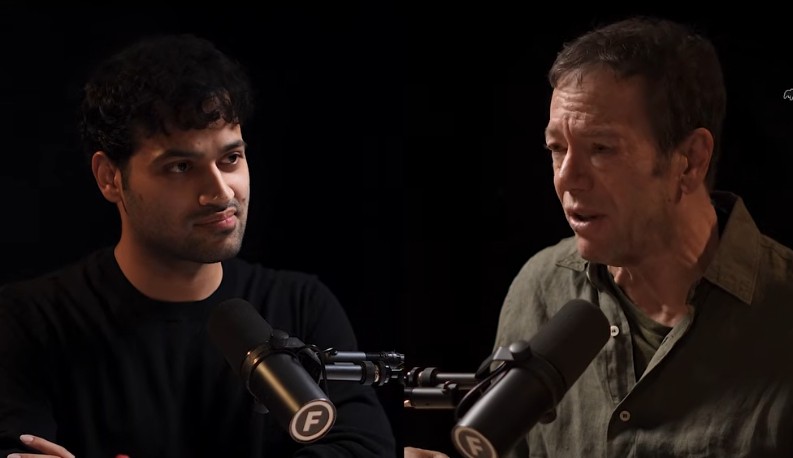
EDITOR’S NOTE: In this episode of Figuring Out, Raj Shamani sits down with Robert Greene — author of The 48 Laws of Power, The Art of Seduction, and Mastery — to unpack the psychology of seduction, influence, and power. Greene draws on stories ranging from a Brazilian seducer he knew in Paris to Napoleon, Kobe Bryant, and Malcolm X to explain why absence, mystery, and controlled darkness make people magnetic, and closes with reflections on curiosity, history, and what it has cost him personally to become who he is. This interview was premiered September 22, 2026.
TRANSCRIPT:
Intro
RAJ SHAMANI: (00:01:04 – 00:01:19) Robert Greene, the author of The 48 Laws of Power, The Art of Seduction and Mastery. And in this episode, we get inside his mind and uncover the rules of power, influence, and human behavior that could make you the most powerful person in the room.
How to Seduce Anyone
RAJ SHAMANI: (00:02:22 – 00:03:14) One of the first things in my head comes is, how do I become the most attractive person in the room so that I start attracting opportunities, right? And I often ask myself the same question which you answered in your books, I want to ask you again, how to seduce anyone?
ROBERT GREENE: (00:03:18 – 00:03:29) Well, is it seducing a woman? Is it seducing an audience? Is it seducing the world? Is it— what is it? You’re— what kind of seduction are you?
RAJ SHAMANI: (00:03:29 – 00:03:30) Let’s go one by one. All 3.
ROBERT GREENE: (00:03:33 – 00:05:33) Seduction is a psychological process. It’s not a physical thing. It’s all pure psychology. And one thing we can say for sure, that people who are insecure do not have a very hard time seducing. It makes— if you’ve ever had this experience where you’re around somebody who you can sense is very insecure, it makes you a bit insecure. It makes you feel odd, right?
But if you’re around somebody who’s confident, who feels secure, who feels powerful and accomplished things. Yes, you might be a little bit intimidated, but it also is very seductive to be around that person. You could kind of catch some of their confidence.
So the first quality in all these forms of seductions is to try and get rid of your insecurities. And the way you get rid of your insecurities is when you’re with people you’re not thinking about yourself. You’re focused on them, right? You get outside of yourself.
People think seduction is evil. The word is evil, but it’s not. It’s a form of therapy, and it’s actually a form of being social. You get outside of all of your problems, all of your worries, all of your anxieties, and you focus on the other person— what they want, what they need, what their weaknesses are, what they’re not getting from life— and you give that to them.
And so getting outside of yourself and all of your worries and concerns, projecting a feeling of strength and confidence, and focusing on their spirit and getting inside of that and giving them— think of how rare it is in your life or anybody’s life that people recognize you and validate who you are and understand what your psychology is and kind of, you know, get inside your world and are interested in it and think that there’s something great about you. It hardly ever happens.
RAJ SHAMANI: (00:05:33 – 00:05:33) True.
ROBERT GREENE: (00:05:33 – 00:05:40) Because everybody’s thinking about themselves. You give that to people, the world will open up to you.
RAJ SHAMANI: (00:05:40 – 00:05:52) So be interested in the other person. And you said find out what do they need, right? How do I find out what another person needs in a social setting?
ROBERT GREENE: (00:05:54 – 00:07:13) Well, if you’re talking about individual people, yes, it’s— you can’t do it like in one go. You’d have to— it takes a little bit of time. We think so much in words and we’re in our heads a lot, but there’s an animal part of our nature, right, that’s very powerful.
If you stop, you stop your thoughts, you stop thinking about yourself and you absorb yourself in the energy of the other person, you start picking up signs and signals that are nonverbal, that are physical, that come from who they are. You say something and their eyes light up and they get very excited. Ah, you know that that’s something that they’re missing, that they want, that they need, that no one’s giving them, right? But you’re not going to pick up that signal if you’re thinking about yourself. Do they like me? Do I look good? Am I wearing the right clothes? You won’t pick up their signals.
So, but you know, Raj, it’s not easy to cut off internal chatter. That takes practice, listening to people and not having all that inner chatter and focusing on them. And slowly it’ll become a skill that you can develop. It’s the most important skill that you’ll have for success in life, for seduction, or for any kind of power.
RAJ SHAMANI: (00:07:13 – 00:07:21) To shut down inner chatter, is there a practice or a trick that somebody could practice in their life on daily basis to learn that?
ROBERT GREENE: (00:07:21 – 00:08:40) Well, I tell people, go out in the world in something that you do every day. Like, you go to the supermarket every day and you buy whatever it is. Here in the States, you go to the counter and you buy fish or meat from somebody behind a counter, right? You see them every day, but they’re not a person to you, right?
And I say, pick somebody out like that in your life that you see often, but you never pay any attention to, right? And try to think of what their world is like as you talk to them.
So going out in the world and thinking it’s like a movie and I’m going to figure out what these characters are like, what their world is like — it’s actually entertaining. And because I’ve been doing it my whole life, and maybe it is who I am, I’m always doing that with other people.
The Most Seductive Quality
RAJ SHAMANI: (00:08:40 – 00:08:45) Tell me, what is the most seductive quality somebody can possess?
ROBERT GREENE: (00:08:46 – 00:11:50) Well, I’ll tell you, I lived in Paris many years ago, well before you were born. I was like 21 years old. I was working in a hotel. I was a receptionist in a hotel, and there was this man who was from Brazil, very tall, very handsome. He was the most brilliant seducer I’ve ever seen, right?
And I remember once — he had all these women were attracted to him, it was so easy for him to seduce, but he never was faithful, right? He was always cheating on whatever it was. I was walking down the street with him, and this woman came up to him very angry because she saw he was with another woman, implying that he was cheating on her. She got really angry. She started yelling, and he stood there, and he was so calm, and he didn’t get angry, and he didn’t get apologizing. He just stood there, and he was understanding, he was listening to her, and he had this kind of calmness and this coolness about him. And he expressed regret for this, etc. But he wasn’t weak and mewling and apologetic, right? And she just melted. She just melted. She couldn’t resist it.
So the point I’m saying is the lack of defensiveness in a person is incredibly seductive, right? So most people that you meet are all defensive and closed and resistant, right? They’re so worried and so trying to protect themselves, right? You meet somebody and they don’t have that quality, and it’s like almost like they don’t have an ego, right? And they’re not defensive, they’re not resisting you. It draws the same quality in you as well.
There was an actor in Hollywood named Errol Flynn who — women just dreamed about him. He was very handsome. He was just a very seductive male figure, and he was an incredible seducer. He probably slept with over 5,000 women, and he died when he was 50 years old because he was an alcoholic. But I found a quote from a woman. I was trying to figure out why was he so seductive. And the quote from this woman was, being around him was like having drunk 3 martinis. You just felt so relaxed. He made you feel so relaxed. He had this animal presence. He wasn’t nervous. He wasn’t defensive. He wasn’t all tight. It just was like drinking a martini. He just made you relax. It’s not an easy quality. A lot of people don’t have it, but it’s by far the most seductive quality you could—
Being Remembered vs. Being Forgotten
RAJ SHAMANI: (00:11:50 – 00:12:12) So let’s say if there are 2 people, right? One becomes very memorable and seductive in one room, and the other person is also — let’s say it’s social, is great, but the other person becomes instantly forgettable. What is the difference between people who are remembered and people who get forgotten in a day?
ROBERT GREENE: (00:12:14 – 00:14:14) Well, I’d go around this question from a different angle. So seduction is a game where you’re trying to make the other person think about you when you’re not there, right? So if there’s a woman and you’re out on a date and she goes home and she’s thinking about you, you’ve seduced her. If she goes home and she’s kind of thinking about you a little bit, but she’s also thinking about other people, her job, you haven’t really succeeded. So the game is to make people think about you when you are not there in front of them, right?
So I wrote a whole book about that and what you need to do. But you need to create a little bit of mystery about yourself. Like you said something that’s kind of provocative, that they don’t quite understand, and it makes them go home and they think about you. What did you mean? You have qualities that— I had a chapter in Seduction called Mixed Signals, Sending Mixed Signals. You appear to be something very strong, but you send a sign of there’s something else going on inside of you that’s quite different, right? So you’re a man, you feel very— you come across as very masculine and strong, but you send a signal that there’s something about you that’s almost feminine, where you’re aesthetic, you’re interested in flowers or whatever. The woman goes home and goes, hmm, what an interesting character. I’ve never met anybody like that. He’s very masculine, but he has this other side to him. So she’s thinking about you.
So if you don’t— if you’re just trying to be yourself, if you don’t understand the game, if you don’t put any effort into it, people won’t remember anything about you. They’ll only remember you when you’re there in front of them. But when you leave the room, when they’re not there, forget it. And that’s the whole game, is making them think about you when you’re not there.
RAJ SHAMANI: (00:14:15 – 00:14:22) Give me one more example. I love this. How to make people think about you when you’re not in the room?
ROBERT GREENE: (00:14:22 – 00:16:51) Well, as I said, these are all things in The Art of Seduction. So when I first met the woman that I’m with now, a while ago, right before I wrote The Art of Seduction, we had gone on a date, but nothing really came of it, okay? And so I didn’t know if she was interested in me.
My birthday was coming up, and I happened to have at that time — I still do — I had a lot of female friends who were very beautiful, right? And I was going to have a birthday party at this restaurant, and there would be 4 or 5 of these very beautiful women there. I very clearly invited her to come to this party afterwards, when we were having dessert and everything. So she would see me surrounded by attractive women who were interested in me, right?
So knowing that somebody that is attracted to other people is very seductive, particularly to women who can be very competitive that way. But it works with men as well. So the sense that nobody desires you, that nobody — you never had a girlfriend, women really aren’t interested in you — makes the other person wonder. But if they see you surrounded by other people who are attractive and know that there are other people interested in you, it makes them interested in you as well. And then they will go home and they will think about you because they will be competitive.
So human desire is very much viral. We want what other people have. If you pass by a restaurant, you want to have dinner, and it looks good, but there’s nobody in the restaurant. I don’t know. But the food’s good, but you don’t want to go in there. You pass by this other restaurant, which might have mediocre food, but 20 people are in there. They’re all laughing, they’re drinking, having a great time. I’ll go in there, right? Because other people are enjoying it, and our desire is viral. It’s contagious. So if you make other people feel like you are desired by others, they will go home and they will be thinking about you because they’re competitive. They’re going to want to be one of those people that desire you as well.
RAJ SHAMANI: (00:16:52 – 00:17:10) See, that’s true, but somebody who’s not desired at all, someone who is not in demand — it doesn’t look like that man or a woman is being desired by anyone. How can they manufacture this? How can they actually do this? Because their first problem is that nobody’s interested in them. How can they make other people—
ROBERT GREENE: (00:17:10 – 00:18:00) I can’t make somebody like that into a great seducer. You have to work at it. So it’s not like people are born great at this game, right? The man I mentioned in Paris, it wasn’t that— okay, he was handsome, I grant you that. But he had been working on it for a long time. He understood the psychology of it.
So if you understand the psychology of it, you’re going to go, all right, I have to find people— I have to get people interested in me, right? I have to get women looking at me. What are the qualities that I can have that will do that, right? You have to put some effort into it— you have to work on it too. So nobody is born with, you know, all these women coming to them and looking attractive. You work at it.
RAJ SHAMANI: (00:18:00 – 00:18:00) You—
ROBERT GREENE: (00:18:01 – 00:18:30) I built those friendships over years because I happen to like women, and I was a rake back then. But it took work. It took effort. It took effort to be desired by other people, right? You have to have some skills with words and language. Women are very susceptible to words. When they hear somebody talking well, who’s funny, who’s witty, who’s good with compliments, etc., it has a very seductive power.
RAJ SHAMANI: (00:18:30 – 00:18:30) True.
ROBERT GREENE: (00:18:31 – 00:19:32) Men, their weakness is the visuals, is the looks, is the physical aspect of the woman, right? So you have to be aware of the psychology of what’s going on and play to those things and build up those qualities in yourself. You’re not born that way. I can’t take somebody who feels like they’re a loser, that nobody likes them, I can’t instantly turn them around. They have to work at it, right?
And I’ve helped people before who’ve been in that situation, and slowly we build up confidence, we get rid of the insecurities step by step. If you’re that person that you mentioned, if you start getting rid of your insecurities, if you do things that will make you confident — and sometimes you can fake a little bit of confidence — you will start attracting interest. You will start attracting people, and then you will build some momentum. And then the things that I’m talking about, about creating triangles of desire, will start to be powerful and effective, right? True, true.
Why Nice People Struggle
RAJ SHAMANI: (00:19:32 – 00:20:02) You gave an example of this Brazilian man. You said that he was unfaithful, and yet women would engage with him. And yet women will melt in front of him. And we all have seen this, right? The kind people, the generous, the nicest people, they don’t end up getting a lot of women, right? Why do you think? Like, why don’t nice people?
ROBERT GREENE: (00:20:02 – 00:21:02) Well, it’s not completely true. Some nice people can be very seductive. But if you’re too nice, it comes across as weakness. And it comes across as insecurity. So we talked about mixed signals. You’re a genuinely nice person, you can’t help it, that’s who you are. But if you can mix in something that’s a little bit harsh, that doesn’t seem quite so nice, that will have some seductive power. But if you’re so weak and you’re so nice, people will wonder about you, what’s wrong with you, right?
But so like with the rake, like this man, the Brazilian man, women knew that he was never faithful. But it’s always in the back of their mind, maybe I will be the one that will finally make this guy faithful, right? That competitive interest in the other person.
RAJ SHAMANI: (00:21:02 – 00:21:06) Why? Like why the person who’s faithful, you’re not attracted to that?
ROBERT GREENE: (00:21:08 – 00:22:23) Because there’s a side of people that feels that there’s something weak about you. So if this man is desired by all these other women, well, there must be something very interesting about him. There must be something very attractive about him.
There was an English poet named Lord Byron who was like Eduardo, this Brazilian man. He was extremely unfaithful. And there was a reputation that he was kind of evil, right? Did he actually sleep with his sister? Did he actually maybe kill somebody? It made them really, really interested in him. That hard edge, they’re very, very attracted to it.
Men — if the woman is so soft and so sentimental and so nice, something feels wrong about it. But you give me a woman who’s got a little bit of an edge to it, who maybe isn’t so nice to me, who feels like there’s something slightly dangerous about it, that is incredibly, incredibly seductive. That very nice woman, you may want to marry her and have children with her, but it’s not the same thing as a seduction, as a woman who’s very seductive.
RAJ SHAMANI: (00:22:23 – 00:22:37) But have you noticed that the woman that you’re describing — nice, she is most trusted, she’s genuinely a good person — often gets played the most?
ROBERT GREENE: (00:22:38 – 00:23:49) Yeah. Well, because they’re very naive, and they’re very trusting, and their trustingness makes them open to the worst kind of man. But also, I’ll make this point. People are secretly drawn to what is dark and transgressive. So we all pretend to be interested in virtue and being so nice and loving and caring and doing all the great things that make us virtuous, because that’s the culture we live in and we’re social animals.
But at the same time, we’re attracted to the dark side, to what’s transgressive, to what has a little touch of evil to it, right? And because there’s so much pressure in our world to be so nice all of the time that we get kind of sick of it, right? And so the woman who is very nice and sweet and trusting, secretly she is drawn to the rake, to the rebel, to the man who’s going to hurt her. She doesn’t want to be hurt, don’t get me wrong, but she’s secretly drawn to that man who is not like her at all. Right?
RAJ SHAMANI: (00:23:51 – 00:23:58) Then is being good, or being a good person, a big disadvantage in today’s world?
ROBERT GREENE: (00:23:59 – 00:24:02) No. I mean, it depends on how you play it.
RAJ SHAMANI: (00:24:03 – 00:24:16) I mean, see, because you said a good naive woman gets played, a good man doesn’t usually end up getting a lot of attraction. So technically, being a good person, it looks like a disadvantage to me.
ROBERT GREENE: (00:24:17 – 00:25:40) No, I would never say that. We’re talking about seduction in the realm of seduction. But in the world, when it’s like politics or it’s dealing with your family or dealing with friends, I would never say that being a bad person or being mean to people is good. I don’t like that quality in people. But when it comes to love and seduction and sex and the physicality, an edge— all I’m talking about is you have an edge. Right? If you’re just all soft and cuddly, and you have no edge, that isn’t a seductive quality.
Because we live in a culture in a time where it’s kind of woke, and people are supposed to appear virtuous and good. A lot of people who appear nice and virtuous aren’t inside, don’t have that quality. They’re actually not like that. They’re covering up something else going on inside of them.
When I worked in Hollywood, it’s a world where everyone’s supposed to be so liberal, so nice, so wonderful, so woke, but they’re not like that at all. You close the door, they’re yelling at their secretary, they’re screwing people around, they’re being manipulative, but nobody ever sees that. So there are a lot of people who are fake with their virtue.
Manipulation, Power, and Anonymity
RAJ SHAMANI: (00:25:41 – 00:26:40) Do you feel — and that’s something that I think, and that’s my belief based on what we just spoke about — I feel being a little evil and playing these games or manipulating is a leverage in environments where there’s anonymity. And what I mean by that is when you are in a big city, when you meet new people every day, when you are on dating apps, when there’s an n number of people and you don’t have to meet them again and again, probably manipulation and evil games take you a little further and make people more attracted towards you. But when you’re in an environment where there’s a lot of social and community around you, where you have to see the same person again and again, then manipulation usually becomes a disadvantage because the word travels all around and people know you. And once they know that you’re a liar, you’re manipulative, your chances of succeeding in that small environment actually reduce.
ROBERT GREENE: (00:26:41 – 00:28:18) I don’t disagree with you, but it’s a subtle game. It’s not like just black and white. So let’s say you enter an office and you have a job and there are 40 people there, right? That’s a pretty small, limited community. And inevitably, in an environment of 40 people, there’ll be one or two manipulators, power players, people who understand the 48 Laws of Power but have never read the book, right? And you are all trusting and naive and good, right? And they use you and they manipulate you and they play games with you, and you’re hurt and you get emotional and you get upset, and this makes you weaker and it makes it harder to get on in life. And you go home and you carry it home with you. And then you quit. And then it has cascading effects on you psychologically.
So what I’m telling people in The 48 Laws of Power, and even in The Art of Seduction, is don’t be so damn naive. I don’t want you to go out there and be manipulative. I’m telling you, be aware of these games that are being played. And don’t be so naive. So Law number 4, always say less than necessary. It’s not really manipulative or evil. It just means don’t be talking so much. Control what you say a little bit. Be more in control of yourself, right? Be aware that other people are looking at you and judging you. And so that kind of self-awareness will help you in the world.
Signs of Weakness
RAJ SHAMANI: (00:28:18 – 00:28:35) You spoke about not being weak in environments. That’s something that you want people to learn. What are small behaviors that people are unconsciously doing that make them appear weak, insecure, and desperate?
ROBERT GREENE: (00:28:35 – 00:29:21) Always say less than necessary. So people who talk a lot, who can’t control themselves, who are always blathering about what they think, about their emotions, about their feelings — that makes you look weak. You don’t think that. You think, well, I’m just being honest, I’m being sincere, I’m just talking about who I am. What’s wrong with that, Robert? Can I just be myself? Well, but we’re not — humans are animals too, and we smell that if you can’t control yourself, if you’re always having to talk, then you can’t control other things about yourself, and that’s a sign of weakness. And inevitably, if you talk and talk and talk and talk, you’re going to say something stupid, right?
RAJ SHAMANI: (00:29:21 – 00:29:21) True.
ROBERT GREENE: (00:29:22 – 00:31:17) If you’re able to control yourself, if you’re able to let the other person do more of the talking, first of all, that’ll be a seductive quality. But also, I noticed in meetings, in business meetings, etc., the person who talks less but has a commanding presence to him or her kind of emanates power, right? And then when they do say something, everyone’s listening. What did they say?
I had that experience with 50 Cent when I did the book with him, right? I was in there on several meetings. People could not stop looking at 50 Cent. What’s going on with him? Because he never said anything. You’d sit in this very powerful meeting with millions of dollars at stake. He would sit there all calm with this kind of strange smile on his face. He appeared to be listening, but he never said anything. What’s going on with 50? What’s he thinking? It was so powerful, right?
So talking all of the time makes you feel weak, makes you look weak. Trying to please too many people makes you look weak. Sometimes you think, wow, that’s a great quality. You’re always trying to please people and get them to like you. Okay, but it doesn’t feel like— sometimes it doesn’t come from a position of actually — it comes from insecurity, right? You’re defensive. You’re worried that people might hurt you, so you’re always trying to please them. That makes you look weak.
Some of these qualities — having, demonstrating that you have self-control, that you can kind of craft your appearances, that you have this presence — is very powerful. But the feeling that somebody has no control, they’re just who they are, they’re just blathering and talking and trying to please people — it makes you look weak.
RAJ SHAMANI: (00:31:18 – 00:31:42) You said people who try to please people look weak, and that makes you weak, right? And I’ve also noticed that when you’re trying too hard to impress, it makes you less desirable. Why is that? Because you’re essentially just trying to do more things, which makes you desirable in front of someone else.
ROBERT GREENE: (00:31:44 – 00:33:30) Because it doesn’t really feel like it comes from a place of strength and security. So if you’re a Buddha, if you’re Gandhi, if you’re somebody of that high level, it’s genuine. You’re a genuine saintly person. It’s very powerful. And it reads that way. We can smell when that desire to impress people and get them to like you comes from a genuine love of other people, a genuine concern. We can feel it. But a lot of times it feels desperate. It feels like they want you to like them so that you won’t hurt them. And we smell that kind of weakness.
Now I’ll tell you something, Raj. I’m normally, I think, a fair — a pretty nice person, right? I came from the side that’s more naive. I have a bit of weakness to myself. I’ve learned over the years that playing up the niceness and going along with people, being interested in them, can work if I demonstrate there are limits and there are boundaries. And you do something to me and I’m going to mess with you. You can’t go that far with me. I’m nice, I’m gentle, I like what you say, I’m interested. Then you start taking advantage of me, I’m going to put the hammer on your head in an instant. I’m going to show you the limits and the boundaries. And then my genuinely nice nature, which I do have, works for me, right? But I have limits. And there are people out there who will attest to how I can be when you test those limits.
Dark Traits People Are Attracted To
RAJ SHAMANI: (00:33:30 – 00:33:46) In the middle, you said we are all unconsciously attracted towards dark traits, attracted towards evil traits. What are these dark traits that people are attracted towards?
ROBERT GREENE: (00:33:48 – 00:33:54) Well, first of all, you have to understand the dark side of everybody.
RAJ SHAMANI: (00:33:58 – 00:33:58) Right?
ROBERT GREENE: (00:33:58 – 00:36:05) So, when you were a child, you were just a complete individual. You weren’t yet socialized. You would maybe beat up your sister, you would hit your sister, you would steal from her, you would do things, but you would also be sweet and nice. And then slowly, you become socialized. Your parents tell you, don’t do that, Raj. Don’t hit your sister. Be nice to her. Your teachers are doing that, on and on. And that kind of human quality that we all possess, that kind of animal energy that’s just explosive, it gets pressed down further and further and repressed.
And we suffer from that because we’re not complete human beings anymore. A big part of ourselves has been cut off from us, something that was in our childlike nature. So when we see people who give out some of that energy from childhood, it seems very authentic to us. It seems very real. And we’re attracted to people like that.
If you look at entertainment, in movies and television shows, it’s the dark characters, it’s the evil ones, it’s the Machiavellians that we’re interested in, that we’re excited by, that make us want to watch that movie, make us want to know what’s going to happen. The villains. If there were no villains in this world, there’d be no drama, there’d be no entertainment. We are drawn to that secretly. We’re drawn to those types of people because it’s a part of ourselves that we’ve had to cut off and repress.
Now, I’m not telling you to go out there and be evil and be dark and steal and rob and cheat and kill. I want you to take that dark energy that you have, that we all have, and channel it into something productive and make it work. So I took all of my dark, evil Machiavellian energy, which I’ve had since I was a child, and I put it into The 48 Laws of Power, which has had some success and has helped a lot of people.
RAJ SHAMANI: (00:36:06 – 00:36:10) Tell me the top 3 dark traits which people are really attracted to.
ROBERT GREENE: (00:36:13 – 00:36:23) Well, I know for instance, there’s an athlete that I admired very much, Kobe Bryant, basketball player. I love him.
RAJ SHAMANI: (00:36:23 – 00:36:23) Okay.
ROBERT GREENE: (00:36:24 – 00:37:12) He was my idol. He’s the greatest. Kobe had a lot of dark energy to him and he talked about it a lot. And when he was young, it could get him in trouble. And I remember when he first got on the Lakers, there was something about him that wasn’t mixing well with the team. He was so competitive, so ambitious. He would do anything to get an edge on you, right? And Michael Jordan was a bit like that as well, okay? So that sense of somebody who has that kind of ambition but is controlling it and putting it into a basketball game is incredibly powerful, and we’re attracted to it, right? On the court particularly.
RAJ SHAMANI: (00:37:13 – 00:37:22) Another thing was, so willingness to do anything for your ambition in a professional setting — that’s an attractive trait.
ROBERT GREENE: (00:37:22 – 00:40:12) Yes. I mean, Elon Musk is not somebody that I admire, but his quality of he’ll do anything to promote himself, anything to promote his business, is what attracts a lot of energy towards him — hatred and love as well, right?
Another quality is I talked in The Art of Seduction about charisma, right? And I equate charisma — a charismatic person is like they have a light inside of them that animates them. They’re so excited, you see it in their eyes and their voice. One of the people I talked about in there was Malcolm X, a very important figure here in America. He had a lot of anger and righteous anger because he was a Black person in America who suffered very deeply. He was a hustler who was put in prison for several years, right? And then he came out and he saw all the racism in America and it made him so angry. But when he spoke, he was one of the most elegant speakers. You can look at it on YouTube and watch one of his talks. He doesn’t seem angry. He doesn’t come across yelling and bitter. He controls it. It’s in his word. It’s in his tone. It’s in what he says. It’s in his gestures. It’s in his body language. It’s very, very powerful.
Anger can be very — we’re drawn to it if it’s in that channeled, controlled way. Somebody who yells and screams like a Hitler, like a Mussolini — yeah, that could be, some people are drawn to that. But the person who channels that energy, that anger, into something that’s kind of controlled, that’s in the background, is very, very — we’re attracted to that. So I took my own anger and I put it in The 48 Laws of Power. And when you read it, you’re not aware of an author who’s angry, who’s been screwed in Hollywood. But it’s in the background.
And the kind of darkness in The 48 Laws of Power is what has made it, I’m afraid, so successful, because people are secretly drawn to that. There’s so many icky, gooey, sweet, sentimental self-help books out there that say just be kind, just be good, just be a team player, just be cooperative. That’s all we’ve read. We know that the world isn’t like that. But here’s a book that kind of talks about act like a friend, be like a spy, crush your enemy totally, play a sucker to catch a sucker. Yeah, I’m interested in that. So I kind of accomplished that in my book itself.
RAJ SHAMANI: (00:40:13 – 00:40:22) So first was willingness to do anything for ambition. Second was anger. What’s the third one?
ROBERT GREENE: (00:40:24 – 00:40:36) I don’t know, I have to think about people who have that quality. You’re giving me a hard time, that’s all right, I deserve it. The other thing is that you have a past.
RAJ SHAMANI: (00:40:37 – 00:40:57) What do you mean by that? That there’s something dark in your past that makes people more attracted towards you. Yeah, I think so too. When you show people that you’re broken in a way which — and you accept that in a way that most people will never accept, and you show up out there, it makes you instantly attractive.
ROBERT GREENE: (00:40:57 – 00:41:01) Yeah. All right, I got one.
RAJ SHAMANI: (00:41:02 – 00:41:24) Yes, because in fact, I’ve seen this — to me personally — people who appear to be having a great past and they have no darkness, and it feels like they’re too good to be true, I find it very difficult to trust them.
ROBERT GREENE: (00:41:24 – 00:41:25) Yeah, yeah, yeah.
RAJ SHAMANI: (00:41:25 – 00:41:27) I want to be careful of them.
ROBERT GREENE: (00:41:28 – 00:41:28) Yeah.
RAJ SHAMANI: (00:41:28 – 00:41:41) And if somebody comes and tells me about some broken, bad thing which probably is negative, I still trust them more than the people who appear to have no past at all.
ROBERT GREENE: (00:41:41 – 00:41:51) And also, if you’ve been hurt really badly, and you had a bad childhood or something, there’s something very — we’re drawn to people like that.
RAJ SHAMANI: (00:41:52 – 00:41:53) We’re drawn towards broken people.
ROBERT GREENE: (00:41:53 – 00:41:53) Yes.
RAJ SHAMANI: (00:41:54 – 00:41:59) That is— it’s true. That is so true.
ROBERT GREENE: (00:42:00 – 00:42:16) I know personally, in the realm of seduction, the woman that has had a wonderful childhood, everybody treated her well, who’s so happy — doesn’t interest me. So, I’m particularly vulnerable to that problem.
RAJ SHAMANI: (00:42:17 – 00:42:21) Yeah. So, being broken, being ambitious, and anger.
ROBERT GREENE: (00:42:21 – 00:42:24) Okay.
The Law of Absence
RAJ SHAMANI: (00:42:25 – 00:42:43) You know, one thing which helped me a lot — I started purposely following that rule in my life at the beginning of my professional career. Now I don’t think about these things at all. It was the law of absence.
ROBERT GREENE: (00:42:43 – 00:42:45) What does that mean?
RAJ SHAMANI: (00:42:46 – 00:42:48) That don’t be present everywhere.
ROBERT GREENE: (00:42:48 – 00:42:49) What?
RAJ SHAMANI: (00:42:49 – 00:42:51) Don’t be present everywhere. Be absent.
ROBERT GREENE: (00:42:52 – 00:42:53) Oh, yeah, yeah, of course.
RAJ SHAMANI: (00:42:53 – 00:42:53) Like that.
ROBERT GREENE: (00:42:54 – 00:42:55) Well, you know, I talk about that a lot.
RAJ SHAMANI: (00:42:55 – 00:43:31) That’s it. You talked about it, and that’s how I got to know. And I started putting that in my life, and I’ve seen changes. I never used to believe in that. I used to feel — and this is strictly professional — that if I go to every networking event, every place, every conference, I’m there, I’m being seen everywhere, it’s going to help my career. It’s usually the opposite. If I’m seen at very few places, that has helped me way more than being seen everywhere. So the law of absence became a primary rule in my life.
ROBERT GREENE: (00:43:31 – 00:43:32) I’m so glad to hear that.
RAJ SHAMANI: (00:43:32 – 00:43:33) Everybody in my team follows it.
ROBERT GREENE: (00:43:34 – 00:46:27) I’m so glad you realized that. Well, I said before that the art of seduction is making people think about you when you’re not there. So if you’re there at every event, every networking thing, they take you for granted. But if you’re not there — why isn’t Raj here? What’s going on with him? Does he have better things to do, better than being here? You’re making them think about you. You’re creating a little bit of mystery so that when you do show up, it has meaning. It has import.
It’s an incredibly important law because in the age of social media, it almost seems counterintuitive. I’ve got to be seen everywhere. I’ve got to have attention. I’ve got to have as many followers as possible. If a day goes by and I haven’t posted something, people aren’t thinking about me. They’re not talking about me. But what you don’t realize is that in playing the game that way, you’re just like everybody else. And other people are going to come along and they’re going to attract attention, and people will forget about you because they take you for granted. You’re just like everybody else.
And the game is to be different, to not be like anybody else, to be who you are. So it’s not like Raj shows up every other time at an event. We don’t know. We can’t figure it out. He’s got his own weird pattern. He’s got his own weird things. And so it’s you. It makes you unique. And as you get older, because you’re only 29, you’ll see more and more of the possibilities to be different and be yourself and have power in that.
Because it’s hard when you’re in your 20s to think that way, because you think, I’ve got to be like everybody else, I’ve got to fit in, because that’s what it means to be young, to be hip. But as you get older and you’re confident and you know yourself, the game is actually to not be like anybody else out there. That’s what really draws attention. And so not showing up is part of that game.
Yeah, there’s nothing wrong with that kind of manipulation. I mean, you’re going out on a date with a woman that you’re very interested in, right? So you dress nicely, right? You dress nicer than you normally would. You think more deeply about what to wear. And you think, I want to take her to a good restaurant. These are things you wouldn’t normally do. You’re playing a game. You’re manipulating her. She thinks you dress nicely. You don’t normally dress that way. So that’s part of being a human being. It’s part of being a social animal.
I get a little bit angry sometimes with people who are so worried about always having to be like an angel, because the people who have to pretend that they’re always an angel are actually hiding something very deep inside. We all play games.
RAJ SHAMANI: (00:46:27 – 00:46:28) True.
What People Are Really Addicted To
RAJ SHAMANI: (00:46:28 – 00:47:29) That is so true. Thanks for saying that out loud, because I do sometimes have certain guilt about certain things. So thanks for pointing that out. Okay, tell me, when you practice all of these things, and you become this one person who everybody is attracted towards, right? Then a lot of people get addicted to you, right? People get obsessed with you. So when someone is obsessed with someone, what are they really addicted towards? What quality is there that is making this one person so addictive that you can’t leave that person? You know that this person is not right. You know that this person shows 50% interest, 50% doesn’t show interest. You get addicted to it.
ROBERT GREENE: (00:47:29 – 00:48:49) Why? Okay, well, the most powerful — in The Art of Seduction I have the 9 types of seducers. The most powerful of them all is the coquette. Often traditionally associated with a woman, but men equally can play the game. And a coquette is someone who blows hot and cold, right?
So let’s just say it’s a woman, but it could be a man — if this woman were always cold and indifferent, nobody would be interested in her. If she was always hot and exciting and sexy and coming on — ah, but she’s exciting and sexy and alluring, you go after her, and then she pulls back, and she’s a little bit cold, and you go, she was interested, what’s going on, what’s my problem, she’s not interested in me, I’ve got to try even harder. It’s a very addictive type of person. It makes you chase them.
So people who withdraw, who step back and make you chase them and make you go after them, it becomes a form of addiction. It becomes a kind of a hunt. You want to conquer them. You want to get them. You want to be the person that has them as well. So that sense of mystery, of retreat, of a little bit of absence is what can make you very addicted to them.
RAJ SHAMANI: (00:48:49 – 00:48:51) True. You know, I was reading—
ROBERT GREENE: (00:48:51 – 00:49:02) I mean, when you’re addicted, what makes you addicted is withdrawal. You don’t have that drug and now you’ve got to get it. That’s what this person is doing.
RAJ SHAMANI: (00:49:02 – 00:49:19) True. I was reading a little bit of neuroscience around this, and I found out that your dopamine neurons, they fire up not because of the reward, it’s because of the anticipation.
ROBERT GREENE: (00:49:19 – 00:49:20) Ah, very interesting.
RAJ SHAMANI: (00:49:20 – 00:49:34) And they fire up to the maximum not at 100% but at 50%. So whenever you’re chasing something and there’s an anticipation that you’re going to get it 50% and 50% you might not get.
ROBERT GREENE: (00:49:35 – 00:49:35) I see.
RAJ SHAMANI: (00:49:35 – 00:50:06) That is when your dopamine neurons are fired up to the maximum, and that’s why you get addicted to it. That she might say yes, she might say no. Neurologically it’s more addictive, and it’s proven by science. So this whole anticipation game works way better. A lot of people think that the reward makes them addictive, but it’s actually the anticipation inside that maybe I’ll get it and maybe I won’t.
ROBERT GREENE: (00:50:06 – 00:51:12) Yeah, yeah. I mean, I talked in the war book about leaders who are very good at motivating people. And one of the greatest motivators was Napoleon Bonaparte. And Napoleon Bonaparte’s strategy was mixing harshness with kindness. So he was very interested in his soldiers. He was very thinking about them and trying to protect them and making them comfortable. But when he was harsh, man, he would make a show of it. And he was the meanest person of all.
And there was no leader who people were more addicted to, who were more in love with, than Napoleon Bonaparte, even though he led millions of young men to death, literally in the wars in Europe. By mixing that harshness and kindness, they were constantly thinking about him. They were so enraptured by him because those moments of harshness — whoa, it’s like a slap in the face. That’s not who Napoleon is. But yeah, he is. And it made the respect levels go way up.
RAJ SHAMANI: (00:51:13 – 00:51:14) 50-50% true.
ROBERT GREENE: (00:51:14 – 00:51:18) And they were anticipating that moments of harshness, as you say.
RAJ SHAMANI: (00:51:18 – 00:51:38) Exactly. So it’s like then the obsession with the leader or with a woman or a man is not about the person at all. You’re not addicted to that person. You’re actually addicted to the unanswered question, which you feel like only this person can answer. And that’s why you get more addicted.
ROBERT GREENE: (00:51:38 – 00:51:57) I mean, the flip side of it is I’m wondering — algorithms are designed to be incredibly addictive, right? They figured out how to kind of capture our attention and to return over and over and over again to the same kinds of posts on social media.
RAJ SHAMANI: (00:51:57 – 00:52:01) Because the same rule, right? You don’t know if the next reel is going to be good or bad.
ROBERT GREENE: (00:52:01 – 00:52:02) Yeah.
RAJ SHAMANI: (00:52:02 – 00:52:07) So in your head you’re anticipating the next one’s a little better.
ROBERT GREENE: (00:52:07 – 00:52:08) And that’s very interesting.
RAJ SHAMANI: (00:52:08 – 00:52:08) You’ve just—
ROBERT GREENE: (00:52:08 – 00:52:09) you’ve hit something.
RAJ SHAMANI: (00:52:09 – 00:52:13) Yeah, right? Like you’ve just gamified the whole anticipation mechanism in your head.
ROBERT GREENE: (00:52:13 – 00:52:23) Well, you know, all that stuff like neuroscience that you mentioned — they’re all reading all about that. They know about all these studies and they’re very clever at getting us hooked and addicted.
Why Wounded People Make Bad Seducers
RAJ SHAMANI: (00:52:23 – 00:52:36) True. Is seduction ultimately the art of discovering an unmet emotional need of someone else?
ROBERT GREENE: (00:52:37 – 00:53:07) So, in ancient Greek, the god of love was Cupid or Eros, and he had a bow and an arrow. And what that meant was he would wound you with the bow and arrow. And in that wound, you would fall in love now. Because if we feel completely secure and happy in our lives, we can’t be seduced, right? There’s nothing to seduce. We’re already so perfect and happy.
RAJ SHAMANI: (00:53:07 – 00:53:07) Yeah.
ROBERT GREENE: (00:53:08 – 00:53:53) But if we’re missing something, if we have a wound from our childhood, most often something that hurt us, something that we never got before, then we are extremely vulnerable to being seduced, right? So if somebody as a child never got enough attention — their mother was a narcissist, wasn’t really attending to them very much — they’re going to spend their entire life with that emptiness, that wound in them, that they never got enough attention, that they never got enough recognition. When a person comes along who senses that weakness in them and gives them that attention, they’re just going to melt, right?
RAJ SHAMANI: (00:53:54 – 00:53:54) Yeah.
ROBERT GREENE: (00:53:55 – 00:54:17) Everybody has a wound from their childhood, something missing, right? And you realize what that is and you’re giving it to them in some form or another. It could be wicked and manipulative, or it can be very caring and helpful to the other person. But if someone is completely happy and has no wounds, you cannot seduce them.
RAJ SHAMANI: (00:54:17 – 00:54:27) True. It’s always like that — your childhood voids end up becoming your adulthood things that you value the most in life.
ROBERT GREENE: (00:54:28 – 00:54:28) Right.
RAJ SHAMANI: (00:54:29 – 00:54:37) And then if you can figure out that void and become a person who provides that, you usually end up making the other person fall in love with you.
ROBERT GREENE: (00:54:38 – 00:54:48) Well, you see, the thing is, as I mentioned before, you’re not going to figure out what people are missing in life if you’re thinking about yourself and your own wounds.
RAJ SHAMANI: (00:54:48 – 00:54:48) True.
ROBERT GREENE: (00:54:48 – 00:56:07) So the problem that people have is when you’re somebody who is wounded from childhood, like you weren’t given something, it tends to make you very self-absorbed. And it makes you a bad seducer. So the problem is you have to overcome that, and you have to be outer-directed and very much looking at the other person so that you can figure out what they are missing.
Sometimes you can sense that intuitively the moment you meet somebody and don’t have to put it into words. But most often people aren’t realizing it. They’re not conscious. They’re not aware because they’re not paying deep attention to the signs that people give. I tell people that if you get people to talk about their childhood, but you’re not obvious about it, you don’t make it look like you’re questioning them for information, but in the course of a conversation, you get them to talk about their childhood, about their parents, their early years, you’re going to figure out very quickly what that wound is. They’re going to reveal it. Things that excite them, things that they tell, and then little dark secrets, little shadows and corners that they don’t really want to talk about, but kind of come out. Get people to talk about their childhood, and you’ll pretty quickly figure out what it is that they’re missing.
RAJ SHAMANI: (00:56:07 – 00:56:09) True. True.
ROBERT GREENE: (00:56:12 – 00:56:12) It’s—
RAJ SHAMANI: (00:56:12 – 00:56:34) and when you figure out something about the other person’s childhood, and you’re interested in trying to know that — it somehow, I don’t know why, it somehow gets you closer as two people. Like the moment you start talking about childhood, the good, bad, and ugly things altogether, it just brings you so much closer to the other person.
ROBERT GREENE: (00:56:35 – 00:56:35) Yeah, yeah.
RAJ SHAMANI: (00:56:36 – 00:56:36) Right.
ROBERT GREENE: (00:56:36 – 00:56:41) When people talk about their childhood, they become like a child.
RAJ SHAMANI: (00:56:41 – 00:56:41) Yeah.
ROBERT GREENE: (00:56:43 – 00:57:16) They’re reliving experiences, and they have their facially, their smiles, their laughter, uncontrollable things light up. You can see the 4 or 5-year-old in them coming out. It’s very interesting. And people love to talk about their childhood. Even if you had a bad childhood, people love to talk about it. You get them to open up because they’re dying to share their little secrets and everything that they suffered and all their pleasures that they had. It would work wonders on me as well. I have that weakness too.
RAJ SHAMANI: (00:57:17 – 00:57:42) Yeah, you know, that’s one of my go-to questions when I meet someone for the second or third time — what did you used to do the most as a kid? And then it just starts a new segue into a conversation which can either go very deep, or into so much fun, or can lead to a different adventure that, hey, I used to do this and I missed it. Okay, let’s go do that.
ROBERT GREENE: (00:57:43 – 00:57:50) Right. And then it brings it out in you and you want to share your own experiences and then you can kind of bond on some level.
RAJ SHAMANI: (00:57:50 – 00:58:00) So, and then people end up telling you what they miss today, what they used to get, and what is something they continue to do. So it’s a great way to realize what the other person likes or dislikes.
ROBERT GREENE: (00:58:01 – 00:58:46) And when people talk about their mother or their father, that’s particularly powerful. So, for a boy, the relationship with his mother is extremely potent. All sorts of things are constellated around that relationship — all the things they never got, all the things that they love, what they’re attracted to. I don’t mean to get Freudian on you, but your relationship to your mother is incredibly powerful. And for women, it’s also the mother, but it’s also the father and their relationship to the male figure. To that dark, shadowy father that was looming in the background carries all sorts of power in it and reveals all sorts of weaknesses and things that they’re afraid of and things that they’re attracted to.
Falling in Love With a Person or a Fantasy
RAJ SHAMANI: (00:58:47 – 00:58:58) Yeah, I absolutely agree. That makes me question, do you fall in love with another person, or do you fall in love with the fantasy of who you become with that person?
ROBERT GREENE: (00:59:02 – 00:59:44) Well, it depends. Most often we fall in love with the fantasy, right? But sometimes it can happen. Also, what often happens is when you first fall in love, it’s the fantasy. And then if a relationship develops and it’s several years down the road, you start falling in love with the person as they are, the real person with all their weaknesses and all their foibles. And even the things you don’t like about them and the imperfections in them become something that you cherish. You love when you think about them, what you would miss if they were gone. But originally, in the first moments, we’re almost always attracted to the fantasy that they’re somehow fulfilling for us.
RAJ SHAMANI: (00:59:44 – 01:00:48) True. Because I often believe that you usually don’t fall in love with the person, right? You fall in love with the idea of you around them, how they make you feel, who you become, how enlarged you get or how empowered you feel when they are around you. Because that is a different personality of you which you really get addicted to. So you always keep asking yourself a question, who am I without you and who am I with you? And that usually is the answer to why did you fall in love with someone.
Because even if you look at when people break up, they usually don’t tend to miss the person. They miss the version of themselves which they were with that person. And that’s what they mourn the most, because they almost feel like they’ve lost something, a part of their personality which they had in themselves when they were with this partner who they absolutely loved.
ROBERT GREENE: (01:00:49 – 01:00:51) Then they go in search of someone else who will give that to them.
RAJ SHAMANI: (01:00:52 – 01:00:53) And it’s very difficult to find that.
ROBERT GREENE: (01:00:54 – 01:00:54) Yeah.
RAJ SHAMANI: (01:00:55 – 01:00:55) Yeah.
ROBERT GREENE: (01:00:56 – 01:05:21) So, in my new book, I have a chapter on — it’s a book about the sublime, and I have a chapter on love sublime. And I talk about this story from the Middle Ages in Europe of Abelard and Heloise, one of the greatest love stories in Western culture. Essentially, Abelard was this professor in Paris who was very logical, could figure things out, but he had never had a relationship with a woman.
And there was this young woman named Heloise who was the most educated, philosophical and desired woman in all of France. It was very unusual for a woman to be a scholar, but she knew Hebrew and Latin and Greek, and she was beautiful. He sees her one day walking by the River Seine, and he tells himself, I’m going to be the one that conquers Héloïse. I’m going to seduce her. I’ve had no experience with women, but I’m going to seduce her somehow. Because it was for his ego. He wanted to show everyone that he was the greatest person of the time.
So he becomes her tutor, and as he starts instructing her, they start becoming physical because he was a very handsome man. And quickly they’re having sex and they’re doing all sorts of very naughty things for the time. And he starts falling in love with her, and he starts realizing that what he thought she was, the fantasy that he had imagined, isn’t the reality. She seems so sweet and innocent, but actually she’s got a very dark and devilish side. He’s always afraid that they’re going to be caught and will ruin his reputation. She doesn’t care. She wants to be caught. They sneak into churches and they have sex inside the church. She’s transgressive. He didn’t understand who she was. So he gets to know her more and more. And finally, the fantasy that drew him to her turns into the reality that this is a person who is incredibly interesting, incredibly dimensional, and he’s completely hooked and he falls deeply, deeply in love.
And their story and their connection is one of the most fascinating stories because we have the letters between them and the connection that they developed between each other was just insane. And I’m trying to say — we say falling in love. Right? So it’s a brilliant metaphor because it is like falling. You’re falling because you’re letting go. You’re letting go of all of your defenses. You’re letting go of all your vulnerabilities. You’re letting go of all that keeps you separate from other people. You’re letting go of your ego. You fall and you fall and you fall. You let go of all that. You reach a point where there’s nothing left and you become like the other person and you have this incredible bond. It’s an ideal that is very rarely realized.
But to get to your point, what happens is for most people, they start falling and they get afraid. Oh no, I’m going to get hurt. I don’t want to give up so much of myself because what if this person suddenly doesn’t desire me anymore? I’ve fallen this far. If I fall any further, the pain will be that much greater. I’m going to stop. And then you start hearing from friends about, oh, there’s somebody, you start thinking, oh, there must be somebody else out there because you’re addicted to that sensation of falling and letting go, but you wouldn’t let go far enough to fall really in love. So you become addicted to the sensation of falling, but you won’t let yourself fall far enough for anything meaningful to happen. So you go search for other people and you never quite let go enough to ever have that sort of sensation that is the deepest — it’s almost a religious feeling that a human can have because it’s combining the physical and the spiritual. It’s the physical powerful connection to a woman or a man, and it’s the spiritual side of getting to understand what makes them a unique individual. They become something that lives inside of you. It is a religious experience. It could be very powerful, but people are too afraid to let go to have that happen because they’re so defensive and worried about the pain that might occur.
Dating Apps and Falling in Love
RAJ SHAMANI: (01:05:22 – 01:06:05) And then, do you feel that a lot of people get this kind of really aggressive love, deeply-in-love feeling? And even after that, they leave. Like, they get really into the relationship, they are in love, they’re addicted to it, they’re enjoying it. And then they leave. Immediately something goes on and they try to look for that kind of feeling, or maybe a deeper feeling, with someone else. It’s like almost they feel like there’s something which is better, and not complete here.
ROBERT GREENE: (01:06:06 – 01:08:18) Well, the thing is, humans are flawed individuals. They have imperfections, they have weaknesses. And the longer you’re involved with someone, the more you’re going to see their flaws and their weaknesses and what makes them a human being. So you fell in love with the fantasy, the image, which is idealized and kind of perfect. And then you start seeing that they’re not really what you thought of. Some of what you now discover is interesting, but some of what you discover is kind of off-putting. You didn’t realize they were so needy and so insecure. You didn’t realize they needed all these things that aren’t necessarily prepared to give them. All right, I’m going to cut off that falling process and I’m going to find somebody else who’s better, who’s more perfect.
And we live in a time where the prevailing metaphor is the marketplace. So it’s Tinder, swipe — ah, somebody better, they’re going to be better. They look a little better, a little bit younger, they’re not going to have all of these flaws. But of course, inevitably they do because they’re a human being.
So you have to get rid of your fantasies and think — if you value having a relationship over time, and I can tell you personally, as someone who was a rake in my 20s, who had many different women that I was involved with, having a relationship over time is incredibly satisfying, incredibly enriching. It’s a beautiful, wonderful thing. Right? But it’s not going to happen unless you accept the very glaring imperfection in the other person and even come to love them and appreciate them and realize that the imperfections are what makes them a human being and what makes them in some ways very attractive to you.
But you’re always listening — your friends are always telling you, oh, there’s somebody else out there, there’s something wrong with that person, she’s like this, she’s like that, you can find somebody better, right? And then you have the swiping thing going on. So you’re never going to let yourself ever have that sensation of falling in love with the complete human being that they are, imperfections and all.
Feeling Like Something Is Missing
RAJ SHAMANI: (01:08:20 – 01:08:40) This gets me to a larger point, which you also mentioned in the beginning of the conversation — something missing. Why do young people today feel that there’s something missing? This has almost become like a constant emotion or a constant state of living. I feel there’s something missing.
ROBERT GREENE: (01:08:41 – 01:09:59) You know, when you’re young, I had that feeling as well, like something was missing. You have all of this energy, all of this excitement inside you physically, you’re so charged. You look good usually, and you want things to happen. And the world isn’t providing it for you because everything nowadays is so virtual that to have a real experience, to have a real adventure, to be taken outside of yourself, to be taken into something so different and exciting, it just never happens anymore.
So the feeling that something is missing, a lot of it has to come from our technology and how we’re being programmed and we’re not experiencing things for ourselves. And so the book that I’ve just written is about how to get out of that trap and how to live your own life more intensely, more connected to the world, and to have real concrete physical experiences and get outside of your phone. That’s why I think a lot of people are feeling like they’re missing something. They won’t admit it because they’re addicted to their phones and to their screens. But what they’re missing is real life, life intense, life physical, life exciting. Direct, immediate, not mediated by this thing.
RAJ SHAMANI: (01:10:00 – 01:10:17) Tell me how someone who’s socially anxious, always feeling that something is missing, trapped in this feeling, can get out of it. Tell me one interesting framework from the book that people can implement today to get out of this whole trap of feeling something missing.
ROBERT GREENE: (01:10:18 – 01:12:31) So, first of all, give yourself moments where you put the phone away. Give yourself some moments of silence. Take a walk and not hear anything. Just look around and be observant and get rid of this addiction, right? I remember I used to swim all the time and there would be people who had earphones in their head while they were swimming. What’s wrong with you? Don’t you want to be directly related to what’s going on in your environment?
That’s the first thing. It’s the most important thing of all — putting your phone away, putting it in a drawer, taking a hike, taking a walk, going on a date and putting your phone away and talking to the other person. You’ll see couples at restaurants and both of them are on their phones, right? So you’re not living your life. You’re living the life that other people are giving to you, that are programming you, that are conditioning you. You’re not even aware of it.
But when I meditate, I become aware of how programmed I am, right? I become aware of these thoughts that I can’t get rid of, but that were literally on my phone half hour before when I looked at them. And then I’m aware, I am being programmed, I am being conditioned. So the first thing you can do is experience life around you directly. You’re young. Your senses are alive and awake and aware. When you get older, your senses become dulled and you’re not so active. But you’re not attuned to your body. You’re not attuned to yourself. You’re not attuned to your own rhythms. Put the phone away and start opening yourself to your environment, to the things around you, to the sounds.
I do this exercise when I’m riding my bike up in the hills. I do 2 things. I absorb my mind completely in the environment, in the strange trees and the rock formations. And so the sounds — I’m not hearing thoughts in my head. I’m hearing the traffic in the distance. I’m hearing the bird calls. I’m hearing the wind. I can’t tell you how wonderful it is, what a wonderful sensation it is. But I won’t have it if I’m on my phone.
RAJ SHAMANI: (01:12:32 – 01:12:54) But do you think that will help people feel better? Because what I’m talking about is this constant anxiety that people feel — like there’s something missing in my life, I’m doing everything right, and yet I’m not fulfilled. Do you think just by getting close to nature and leaving technology is going to help them that much?
ROBERT GREENE: (01:12:55 – 01:13:01) Yes, it’ll— it’s not going to solve all of your problems. There are other things I can talk about from my book.
RAJ SHAMANI: (01:13:01 – 01:13:02) Tell me one of the other things.
ROBERT GREENE: (01:13:02 – 01:13:53) Well, I have a chapter in there about your childhood and how, when you were a child, the world was so much more intense, right? I mean, nowadays, I don’t know, children with their iPads, it’s changing. But for me, at least, my childhood was the most intense period of my life. And I’m telling people, what you’re nostalgic about isn’t being young, what you’re nostalgic about is the intensity of your experience, right?
So I try to analyze what made the experience so intense back then. A lot of it was you were curious about the world. So the problem that you have when you get in your 30s and 40s and 50s is you think you know everything.
RAJ SHAMANI: (01:13:53 – 01:13:53) Yeah.
ROBERT GREENE: (01:13:54 – 01:14:10) I’ve read all of these books. I know what the world is. I know what reality is. I know what’s politically great and right. And your mind just closes and gets narrower and narrower on these certain small little sets of ideas. You think you know them, right? When you were a child, you had none of that.
RAJ SHAMANI: (01:14:11 – 01:14:11) What is—
ROBERT GREENE: (01:14:12 – 01:15:15) you’re interested in everything because you’re so small and the world is so weird and mysterious, you want to understand. Well, go back to that. Go back to that feeling of curiosity. Start playing the exercise.
I do this exercise on myself as I go around and I look at things. I don’t know anything. I have no ideas. I don’t know what the world is like. I don’t know where birds come from. I don’t know what my body is. I don’t know who I am. Return to a sense of mystery and wonder about the world like you had when you were 3 or 4 or 5 years old. You can do that. Each chapter in my book ends with literally exercises that you can practice for putting this into your daily life, because I don’t want this to be some boring academic book about the sublime. It’s about how you can have these experiences. So I literally give you exercises to enact each of these things, right?
RAJ SHAMANI: (01:15:15 – 01:16:14) So interesting. There’s something similar which I do in my life, but it’s accidental. Now I can just draw parallels. I do this to stay purposely and intentionally curious. If I have to go to one place, let’s say every day, I usually try to take different routes. And if I’m going to any new place, new city, or just a new area, I try to just look around and look at houses, look at trees, look at the shapes of leaves, look at all of these things and make theories in my head. Why is this leaf round? Why is this one pointed? And then I make up theories in my head to just amuse myself. And then when I come home, whichever thing I’m most curious about, I start Googling it and try to find out — okay, this theory was completely wrong, or this was completely right. And it just keeps me so much more curious about the world. It helps me.
ROBERT GREENE: (01:16:15 – 01:17:24) Well, I would give you one wrinkle to your exercise. So you take a different route — try taking the same route, but making yourself observe things you had never seen before on that same route. So on my bike rides, I have only like 5 different versions I can go on, but I take the same one and I’m always looking for something I had never noticed before. Some strange tree growing out of the ground.
So one thing in the book I say is everything you do is language-oriented, right? So you don’t look at a tree. You just think of the word tree. The general category of tree. But look at that strange thing emerging out of the ground that doesn’t have a brain, but is alive. It has its own strange consciousness because trees do have a consciousness. If you came from another planet where there might be life, but there are no trees — what a fascinating, weird thing. And each one is different. They may be the same tree, but no two trees are the same, right? So that’s part of the exercise that I go through.
RAJ SHAMANI: (01:17:24 – 01:17:25) I’ll try to do that.
ROBERT GREENE: (01:17:25 – 01:17:25) Okay.
The Interspecies Sublime and History
RAJ SHAMANI: (01:17:26 – 01:17:30) Tell me the most interesting chapter from your book, which you feel is interesting.
ROBERT GREENE: (01:17:32 – 01:21:44) Well, the chapter I’m personally most drawn to is one about animals. I call it the interspecies sublime. So a lot of the book I tell you that your brain is wired a certain way and it makes you think a certain way and you take that for reality. So when I’m meditating, I try and make myself aware of consciousness itself and how it feels, right? And I tell myself, if I came from another planet, my brain would be wired so differently, I wouldn’t have this consciousness. So this consciousness has a feeling towards it. It’s like, it’s not inside of my brain. It’s not in the world. It’s nowhere. It’s like the sky. It’s empty. What is the feeling of it?
But animals have a different kind of consciousness. Their brains are wired differently. Each one has — their senses are different. A dog lives in a world of smells. They can tell more things about the world through smells than we can ever do through our intelligence. They’re brilliant. They’re philosophers, right? Cats live in their own world. Bats live in a world of sound, as do dolphins. Spiders are blind, but they live in a world of vibrations. They can feel the world. They understand the world through vibrations.
The point of this chapter is you think that you understand the world, but you’re just seeing a version of what your brain is telling you because your brain is wired a certain way. Animals are like alien beings on our planet. We’re so interested in science fiction and things that don’t exist, that are not real, but we’re surrounded by aliens, by space aliens, by spiders, by bats, by butterflies, by dogs and cats. They’re insane. They’re amazing. They evolved over millions and millions of years with their own consciousness. And I give you exercises about how to get outside of your consciousness and enter into their world. And I have examples of people who’ve done this with octopuses, with whales, with wolves, and with birds.
The second chapter that I’m most excited about is one about history. And I’m trying to tell you that history is not about dead facts and things that you read about in a book. People 500, 1,000, 10,000 years ago were alive just like you. They had emotions, they had feelings, they had sensations, they had dreams. They were alive. Enter their world, enter into the past as if it’s something present. And I give you exercises on that. And I recreate the past for you.
So for instance, I take you on a journey through ancient cities. Ancient Babylonia kind of fascinated me, and I literally take you on a walk through the city of ancient Babylonia, and I make you aware that you think New York is beautiful, or San Francisco, Los Angeles — these places were unbelievably beautiful in a way we can’t even begin to comprehend. These 40-foot statues, these ziggurats going up into the sky, these buildings that were all reflecting the sunlight in the same way, these gods, the Hanging Gardens of Babylon. If you were to transport yourself there now and look how strange it was — my god, my world is so ugly and drab, but these cities were unbelievable. They were so beautiful. And then at 6 o’clock at night, as the sun goes down in ancient Babylonia, suddenly there’s this wild sexual energy where prostitutes, male and female, are filling the streets and everyone’s having sex. And there are these orgies going on even in temples.
I just want you to make the past come to life and not see it as something dead. And so those are the 2 chapters that I love the most from the book. And there are 12 of them, 12 chapters.
RAJ SHAMANI: (01:21:44 – 01:21:53) Nice. Give me an exercise. Give me one exercise which helps me become better with the world of history specifically, which you just told me.
ROBERT GREENE: (01:21:53 – 01:22:19) Okay. Well, one of the exercises I have is — if you can remember the apartment or the house that you grew up in originally, right? And the objects that were there, right? Okay. So the exercise is to think about the house and the furniture and the objects that were there. Some of them were there before you were born, right?
RAJ SHAMANI: (01:22:19 – 01:22:19) Yeah.
ROBERT GREENE: (01:22:20 – 01:22:22) Okay. And they come from a world that you never lived in.
RAJ SHAMANI: (01:22:23 – 01:22:23) True.
ROBERT GREENE: (01:22:23 – 01:24:12) The early ’90s, the ’80s, the ’70s. Your parents probably even have things from the ’60s, things that they inherited from the ’50s and ’40s. There are objects in your house that were there before you were born. And they have a style to them that’s alien to you because it’s not the world that you lived in, right? They lived before you were born. Do you understand what that means? You were literally not existing. You were dead. You were not a creature. But these objects were there before you. They carry a weird energy and a weird life to them because they’re signs of the past, and it’s sort of a twilight zone.
So there are things that you can remember that you lived with, but they come from a period before you were born. And so they have an energy to them. And so I’m trying to show you that the past lives in these objects, and they have a life of their own. And the life of their own is the past. And they’re full of this weird energy.
You can do that with movies. You can look at movies from the 1980s and you could go, this is when my parents were young and exciting and happening and they first met and they were in their 20s, right? And they had these weird fashions and these weird hairstyles and these clothes. You can look at the movie and go, this is the world before I was born. It’s strange, yet it’s familiar because there was something still like that when I was living, right?
So I’m trying to give you a sense of what the past was like as something alive, not dead. And it’s carried in these objects. And so then when you go to a museum or you see photographs from the past, you can go through the same exercise and see them as something that was once very much alive. So that’s one of my exercises.
RAJ SHAMANI: (01:24:13 – 01:24:14) And what happens if I do that?
ROBERT GREENE: (01:24:16 – 01:26:00) Well, first of all, you become aware of another world. So the world now is something that you take for granted, that it’s like, this is how things are, right? But the world was different 50 years ago. It was very different, had a different energy, a different cultural moment, a different zeitgeist. And so by connecting to the past, you become more of a human.
The problem I think that a lot of people have nowadays — I read a lot of history, okay? I’m not good at many things, Raj. I have many weaknesses and flaws, but I read a lot of history. I understand history on a very deep level, and it gives me a perspective on life and the world that is very different — if you don’t understand history, it expands my mind. It makes me aware that there are other ways of thinking, other ways of behaving in the world, different customs, different cultures.
Going through this exercise takes you out of your narrow little moment in the present and makes you aware of the world before you were alive, but that still has some spirit to it, still has some liveness to it. So it’s opening your mind up to a different world, to a different reality. The world of your parents. It’s not a world that’s dead. It’s a world — they’re alive. They raised you. And so you’re entering into their world and you’re entering into the world of your grandparents. I don’t know if you don’t find that exciting. There’s nothing I can do that’s going to make it— to me, I find it exciting. Entering into the past is one of the most immense experiences.
RAJ SHAMANI: (01:26:00 – 01:26:39) Yeah, I love both of these things because it gives me a perspective of what my parents or grandparents must be going through or living through. And the second, I think that’s even more fascinating — the exercise that I live in some civilization which was thousands of years ago. And then I try to understand what happens when the sun rises and when the sun sets. And I’m trying to experience it by just expanding my imagination. And that helps me a lot and helps me see things today from a different perspective and not just in one perspective.
ROBERT GREENE: (01:26:39 – 01:27:17) Well, that’s what my book is about. But look at the sun someday, just stare up at the sun and realize that 20,000 years ago, our ancestors back in the Paleolithic era were looking at the same thing and having strange sensations from it because the sun is a very strange thing you take for granted. It’s a star that at some point will disappear. And in one of my chapters, I described the birth of our sun. But they were having the same sensation 20,000 years ago that you can have. I don’t know, for me, that’s a very powerful thought.
How to Become the Most Powerful Person in the Room
RAJ SHAMANI: (01:27:17 – 01:27:20) How do you become the most powerful person in the room?
ROBERT GREENE: (01:27:21 – 01:29:59) Okay. Well, in The Laws of Human Nature, I have a chapter on nonverbal communication. And I talk about the qualities that emanate power in people. So if you read that chapter and you study that, you will understand the qualities that you should have.
So first of all, a powerful person is not like — that is not like looking everywhere. It’s not like — because that’s a sign of nervousness, like, oh, are people looking at me? People noticing me? Okay, so you’re controlling your facial expressions. You’re not looking everywhere. You have a focus on something in particular, a particular person, a point in the room. You have a posture that you’re not like — you feel confident. You have this particular pose. And so I say that a powerful person is relaxed, right?
So when you enter that room, you are relaxed. You’re not nervous. You’re not looking for attention. You’re not wondering what people think about you. You’re inside your body, you’re calm and you’re confident and you’re relaxed. That relaxed quality is incredibly powerful, incredibly attractive. Because if you enter a room and you’re a stranger or people don’t know you, everyone’s nervous. Everyone naturally is nervous, but you’re not. You’re calm. You’re not looking everywhere. You’re not touching yourself. You’re not talking a lot. You’re relaxed. You’re going to draw a lot of attention, a lot of power.
And don’t talk a lot. Control your words. Have a sense of mystery. So when we talked about withdraw and absence, you can be in a room but also slightly absent. How? Well, you’re not trying so hard to get attention. You’re almost stepping back and letting people come to you instead of you having to go out and get them. So you’re inwardly stepping back, and people are drawn to you in that way. If you’re always in their face trying to get them to talk to you — but you’re stepping back and you’re the one kind of inside your own body and commanding, they’re going to come to you and they’re going to want to talk to you. So that sense of withdrawal, of retreating, is very, very powerful.
I told you in that room with 50 Cent, of course, it’s a little bit skewed because he’s 50 Cent.
RAJ SHAMANI: (01:29:59 – 01:29:59) Exactly.
ROBERT GREENE: (01:29:59 – 01:30:24) So I’m sorry. But the fact that he wasn’t talking at all, that he was so quiet, and had that kind of enigmatic smile on his face, being sort of mysterious and enigmatic is very powerful. Made everybody like, what’s he thinking? What’s he doing? What’s he up to? So a little sense of mystery, you’re not obvious, and you’re relaxed and in control. I think that will command attention when you enter that room.
RAJ SHAMANI: (01:30:24 – 01:30:46) Let’s say you’re not someone who’s popular and famous. You’re an average person. You are on your journey to become someone exceptional. You enter a room, you enter a social gathering, and you’re confident, you’re relaxed. And what do you do? You just stand in the corner and do nothing and just look at people? That’s going to make it very weird, right? You’re just standing alone.
ROBERT GREENE: (01:30:49 – 01:31:45) Well, I mean, you can go up to somebody — if you recognize that there’s a person that’s like, maybe they’re kind of powerful or interesting, you can go up to them. But you’re asking kind of a slightly impossible question because you can’t command a room without a reputation of some sort. You have a past, people know you. If there’s just strangers, what I’m telling you will have some power, will have some effect. But if you just walk into the room and you’re just relaxed and you don’t do anything, okay, I agree with you, right? But normally, in normal life, people have reputations. So when 50 Cent enters the room, wow. When Robert Greene, when he was 20 years old, entered the room, who cares about him, right? So your reputation carries a lot of power behind it.
RAJ SHAMANI: (01:31:46 – 01:31:51) How do you not feel powerless and insecure in front of a very powerful person?
ROBERT GREENE: (01:31:52 – 01:33:20) I tell you, and I know this because I have to interact sometimes with powerful people, by being calm and relaxed and not asking them a million questions and not acting like I think they’re a god. I feel like they’re a human being. So when I was with 50, I was very normal and natural around him. And I talked to him like I talked to anybody. And boy, was that kind of powerful for him, because he was expecting me to be all weird and Henry Kissinger-like with him or Machiavellian. And instead, I was talking to him about strategy and how he was strategizing with his record albums.
So just being a normal human being, because they’re so used to people — famous celebrities are so used to people being weird around them and being intimidated and being insecure and not knowing — when someone’s natural around them and relaxed, that’s really interesting because it almost makes it seem like you’re equals right now. That could be a little bit insulting if you’re not careful. So it’s not like you’re equals, because I’m not as powerful as 50, but it’s equal as human beings. And I’m really intimidated by you — I actually want to talk to you about regular things. If you do that in the right way, it can be very powerful. It could also be taken the wrong way too. So you have to be careful.
The Most Powerless Moment
RAJ SHAMANI: (01:33:20 – 01:33:23) When did you feel the most powerless in your life?
ROBERT GREENE: (01:33:26 – 01:34:07) Well, prior to writing The 48 Laws of Power, I had been working in many different jobs. Like my girlfriend, my wife, and I counted, it must have been 60 different jobs. I couldn’t hold any job down because I wasn’t happy. I wanted to be a writer and I had no success. I tried journalism, I tried writing novels, I tried working in Hollywood. And so in the ’90s, in the mid-’90s, I fell into a very deep depression because my life wasn’t going anywhere. And that’s when I felt very, very helpless.
RAJ SHAMANI: (01:34:08 – 01:34:08) Not this time?
ROBERT GREENE: (01:34:11 – 01:34:17) This time I feel physically helpless. That time I felt mentally kind of helpless.
RAJ SHAMANI: (01:34:17 – 01:34:17) And what was worse?
ROBERT GREENE: (01:34:19 – 01:34:48) It’s a good question. I think the depression in the ’90s was worse because I now have all of this success that I never had before. So having my body kind of destroyed — at least I have accomplished something, I’ve achieved. So I could die and I could die happy because I did what I wanted to do. But back in the ’90s, it was a very bad time for me.
RAJ SHAMANI: (01:34:48 – 01:34:59) It’s very fascinating that you ranked psychological helplessness above physical helplessness.
ROBERT GREENE: (01:35:01 – 01:36:37) Yeah, because physically, you know, you can do things. You can do therapy. You can try the hyperbaric chamber. You can practice walking. You can deal with it. I got — because I was very physical, I did a lot of exercise. I got a special kind of bicycle. It’s called a recumbent bike. And I live near this giant park and I’m able to go ride up into — yesterday I took a 2-hour bike ride way up into these hills. Physically, I can deal with it. It’s not fun. It was a big loss for me, but I can handle it.
But the psychological — you don’t know what to do, you don’t know where to turn. I knew that I had something important to express to the world. I have a strange way of thinking. I had lots of experiences, and I knew that there was something inside of me, but I couldn’t connect it to anything. I couldn’t get it out into the world. And that was worse, I think, because there was nothing I could do. I was very fortunate to meet a man in 1995 who packages books, and he’s basically the one who kind of saved my life because he gave me the opportunity to write The 48 Laws of Power. So I think that was worse than what I’m going through now in a strange way.
RAJ SHAMANI: (01:36:37 – 01:36:50) Yeah, you know, there was a time in my life — this was 5 and a half years ago — where I was feeling completely helpless and powerless and psychologically—
ROBERT GREENE: (01:36:51 – 01:36:52) How old are you, Raj? I’m just curious.
RAJ SHAMANI: (01:36:52 – 01:36:55) I’m 29 now.
ROBERT GREENE: Wow, you’re so young.
ROBERT GREENE: (01:36:56 – 01:36:56) Okay, go on.
RAJ SHAMANI: (01:36:56 – 01:37:37) I’m sorry. So there was a point where I was leaving my home, and in India you live with your parents, you don’t move out. It’s not a very normal thing to do, right? And it’s almost seen as a bad thing if you leave your parents and live somewhere else. Something I wanted to leave and start something of my own. And that was a point where I felt really helpless in my head because I didn’t know what to do. The idea of a podcast or anything was not in my head at all. And I have to thank you because I used to read a lot of small snippets which were just roaming around on the internet by you.
ROBERT GREENE: (01:37:38 – 01:37:39) I’m sorry, what was that about?
RAJ SHAMANI: (01:37:39 – 01:37:47) Like small snippets, like tweets or small quotes of you which were roaming around on the internet all around. That helped me a lot.
ROBERT GREENE: (01:37:47 – 01:37:47) Really?
RAJ SHAMANI: (01:37:48 – 01:38:04) And I’m so grateful because when I look back and think about those days, one of the big reasons I got the courage to do certain things was your quotes.
ROBERT GREENE: (01:38:04 – 01:38:05) Really?
RAJ SHAMANI: (01:38:05 – 01:38:06) So thank you so much.
ROBERT GREENE: (01:38:07 – 01:38:07) Did you get the book?
RAJ SHAMANI: (01:38:08 – 01:38:17) Yeah, so I read — I read The Seduction, I read Art of War, I read bits of Mastery, I read 48 Laws of Power. I was like a Robert Greene junkie.
ROBERT GREENE: (01:38:17 – 01:38:20) Wow, that’s very good.
RAJ SHAMANI: (01:38:21 – 01:39:04) And even right now, a couple of months ago, there was a big decision in my life that I wanted to take, and I’ve been dabbling around that decision since last 1 year or so. And I was going through this frustration. I’m like, I really don’t know what to do. And I read a tweet by you — I’m paraphrasing it, but it was something around death ground. Like, if you are not on the death ground, you can’t actually go out and win. And that was a day we took a decision to just do something we were scared of. Do you think every young person at some point, to become someone really big, should put themselves on death ground, should leave everything and just start somewhere new?
ROBERT GREENE: (01:39:05 – 01:40:38) Well, it depends. Some people can’t handle it. Some people have so much anxiety and they’ve had issues from early childhood and they can’t handle it. If you put them on death ground, they would just destroy themselves. It would be too powerful. So you need to have a certain degree of inner strength, which you probably had even when you were 24 and you were feeling helpless.
So just to backtrack — even when I felt helpless and desperate in the ’90s, I never gave up on myself because I knew that there was something I could express to the world. You had something like that in yourself. So if you have a foundation, a degree of inner strength, then the death ground is fantastic for you. But if inside you’re sort of weak or you’re soft — and I’m not criticizing because this world is a hard place — then death ground could just absolutely destroy you. So it just depends on the individual.
But I would advocate for a lot of young people who don’t have any direction, who feel lost in this world, to try that if they can, because — if you feel like tomorrow I could die, I’m 25 years old, I’ve gone to college, I have these ideas, these businesses I want to start, but it could all end tomorrow. I could have a terrible illness, I could die. I better get going, I better get moving. It could be a huge motivational factor.
RAJ SHAMANI: (01:40:39 – 01:40:44) But how to build inner strength? That’s the most difficult part. How to build inner strength?
ROBERT GREENE: (01:40:47 – 01:40:51) Well, it’s one thing you cannot fake, right?
RAJ SHAMANI: (01:40:52 – 01:40:52) Yeah.
ROBERT GREENE: (01:40:52 – 01:42:34) And you can’t take a drug for it. There’s no hack, there’s no app, there’s nothing on the internet that’s going to give it for you. It can only come from you, but it has to be built up slowly. It has to come from doing things in the world, from trying things, from trying to start a podcast, from trying to go to the university and getting a degree. You fail, but then you realize, well, I can pick myself back up. I can get back up and I can try again. I can do something else. It builds, you build some confidence in yourself. Slowly, day by day, if you’re patient and you don’t give up, you have down moments, but then you get up, then you have down moments and you get up, you’re going to build that inner strength. It’s resilience. That is the word. You can bounce back from adverse situations, right?
And so I can say, for writing this book, for 7 years, in the beginning, I just couldn’t imagine accomplishing it because it was so — there was so much difficulty. But as I started going the second year, the third year, the fourth year, and I was making progress, I started developing a kind of inner strength and a confidence in myself. So you have to build confidence in yourself, but it can’t come from talking or thinking or hanging out with your friends. It can only come from doing things in the world and failing and having tough times and things going bad and doubting yourself, but getting back up. It has to be through your actions, not through a lot of talk.
RAJ SHAMANI: (01:42:34 – 01:42:34) True.
The Cost of Becoming Robert Greene
RAJ SHAMANI: (01:42:34 – 01:42:37) Here’s the last question that I ask all my guests.
ROBERT GREENE: (01:42:37 – 01:42:38) Uh-oh.
RAJ SHAMANI: (01:42:40 – 01:42:43) What is the cost of becoming Robert Greene?
ROBERT GREENE: (01:42:46 – 01:43:24) Well, that people think I have an answer to everything and I don’t. Sometimes I’m just stupid and sometimes I don’t have an answer. And you ask me a question and I kind of blather and I give this thing, but I’m actually kind of just covering up my ignorance. I don’t know everything. I have gaps, right? And so sometimes if I think about it, I come up with a good answer, but in the moment I don’t have any answers. So the cost of it is that people think I know a lot more than I actually do know. So that’s the problem.
RAJ SHAMANI: (01:43:24 – 01:43:32) But do you sacrifice personally anything in life to become who you are today? The kind of successful person you’ve become?
ROBERT GREENE: (01:43:32 – 01:44:36) Well, I write these books that are like — I’m not bragging, but they’re like marathons. This last book took 7 years. The Laws of Human Nature took 6 years and it led to my stroke because it was so intense. Mastery took me 5. They keep getting longer and longer. They’ve worn my body down. They’ve just made me age. They’ve just really sucked a lot of energy out of me.
So the cost has been physical, right? And when I wrote The 48 Laws of Power, I was 37, 38. I was young, relatively young. I was bursting with energy. I wrote that book in 2 years. I could never do that now. So the cost has been slowing down, slowing down, taking more and more time, and physically draining myself. So, but on the other hand, I have a very rich life. So I cannot complain.
RAJ SHAMANI: (01:44:37 – 01:44:39) Absolutely. Thank you so much.
ROBERT GREENE: (01:44:39 – 01:44:39) Thank you.
RAJ SHAMANI: (01:44:39 – 01:44:42) Thank you for spending time with me. It was an honor to have you.
ROBERT GREENE: (01:44:42 – 01:44:44) Oh yeah. Well, we’ll have to do it again.
RAJ SHAMANI: (01:44:44 – 01:44:49) Absolutely. It’d be my honor again. Whenever you just tell me you’re free, I’ll come down. Hello.
ROBERT GREENE: (01:44:50 – 01:44:50) Hi. You arrived?
RAJ SHAMANI: (01:44:51 – 01:44:51) Yes.
ROBERT GREENE: (01:44:51 – 01:44:52) Very nice. Nice, my pleasure.
RAJ SHAMANI: (01:44:52 – 01:44:57) Pleasure meeting you, sir. Is there any feedback for me? How can I do this better?
ROBERT GREENE: (01:44:59 – 01:45:26) You have a very good style. You have a very good style. I can’t think of any. First of all, it’s a very good question. Instead of asking a general question, if you could maybe make it a little more specific with a particular scenario. So it’s easier to answer. But I’m sorry, I have really no other comments because you’re a great interviewer.
RAJ SHAMANI: (01:45:27 – 01:45:30) I’ll do that next time. Every question is going to be specific.
ROBERT GREENE: (01:45:30 – 01:45:30) Not every—
RAJ SHAMANI: (01:45:30 – 01:45:32) it’s a great feedback. Thank you so much.
ROBERT GREENE: (01:45:32 – 01:45:33) No, no, no, you’re welcome.
RAJ SHAMANI: (01:45:33 – 01:45:52) You’re very welcome. Thank you for watching this episode till the end. We would love to know what you liked or disliked about this episode and which guests you would like to see on the show. Let us know in the comments. Your feedback helps us improve and make every episode a little better. I’ll see you next time. Until then, keep figuring out.
Related Posts
- Mel Robbins Podcast: w/ Oprah Winfrey – How to Find Your Unique Purpose (Transcript)
- Transcript: Dr Sahar Yousef Interview – Guide To 10X Your Focus & Memory – FO559
- Transcript: Why Working Harder Won’t Make You Rich – Codie Sanchez on Modern Wisdom
- Transcript of Communication Coach Vinh Giang Interview: On Purpose Podcast
- Transcript of Seth Godin Interview: Diary Of A CEO Podcast