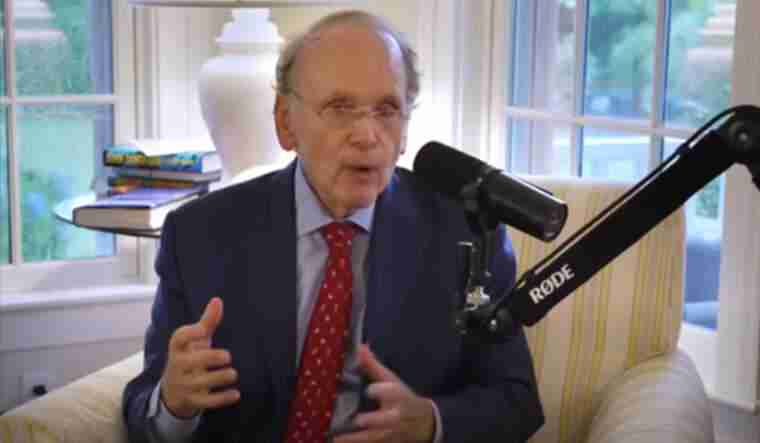
Read the full transcript of a conversation between economic historian Daniel Yergin and Dwarkesh Patel on “– Oil Destroyed Hitler, Fracking Destroyed Putin”, Sep 18, 2024.
TRANSCRIPT:
Introduction
DWARKESH PATEL: Today, I have the pleasure to chat with Daniel Yergin. He is literally the world’s leading authority on energy. His book, The Prize, won the Pulitzer Prize about the entire history of oil. His most recent book is The New Map, Energy, Climate, and the Clash of Nations. Welcome to the podcast, Dr. Yergin.
DANIEL YERGIN: Glad to be with you.
Writing The Prize: A History of the 20th Century
DWARKESH PATEL: My first question is a book like The Prize. It’s literally a history of the entire 20th century, right? Because everything in the last 150 years involves oil. That’s happened since then. How does one begin to write a book like that?
DANIEL YERGIN: I think you begin by not realizing what you’re doing. I mean, I agreed to do that book. I said I’d do it in two years. It took me seven. The stories just became so compelling. It became woven in with the history of the 20th century.
The funny thing was that some years before that, a publisher had flown up from New York to see me when I was teaching at Harvard. She had a very interesting idea for a book. I said, what? She said, a history of the 20th century. I said, that’s an interesting idea. And I thought to myself, it’s rather broad. And actually, the century wasn’t over yet at that point. But somehow, I think that was kind of in the DNA of the book. And so as I told the story, it really was not the history of the 20th century, but a history of the 20th century.
DWARKESH PATEL: I found that there’s a lot of books which are nominally about one subject. But the author just feels the need to, if you really want to understand my topic, you have to understand basically everything else in the world. And I think a couple of biographies, especially if you read Kira’s biography of LBJ or Calkins and Stalin, it is a history of the entire period in their country’s history when this is happening. And I wonder if it was for you, you actually did just want to write about oil. And you just have to write about what’s happening in the Middle East, what’s happening in Asia. Or is it just like, no, you set out to write about World War II and World War I and everything?
DANIEL YERGIN: I think it’s also, I mean, because I think geopolitics, narrative, storytelling, those are things that are very much in my interest. And my first book had actually been a narrative history of the origins of the Soviet American Cold War. So I brought that perspective to it.
And as I was writing the prize, it was just, I didn’t intend to do all of that. But the discoveries, just one thing led to another. And I would just be amazed and think, this is an incredible story and no one knows it.
And I did see how somehow in my mind, I did not do a detailed outline, but the pieces kind of came together in this larger narrative that located oil in this larger context of the 20th century. And because it made it clear how central oil was as a way to understand the 20th century.
Risk-Takers and Strong Personalities in Oil
DWARKESH PATEL: Yeah. So we’ll get to the new map and the contemporary issues around energy later on. But first, I want to just begin with the beginning of the history of oil.
One of the things you notice, not only in the early stories of oil with people like Drake and Rockefeller, but also even very modern, like the frackers like Mitchell and so forth, it’s just that you have these incredibly risk-taking and strong personalities who have been the dominant characters in the oil industry. And I wonder if there’s a specific reason that oil attracts this kind of personality.
DANIEL YERGIN: Well, I think maybe it attracts, those are the ones who are successful. It takes a lot of willpower and perseverance. I mean, clearly Rockefeller had an idea of what to do and how, but he was also creating a new kind of business organization.
He’s doing it in a new kind of industry at the same time that he was doing it. And then if we jump ahead to this guy, George Mitchell, who’s more responsible than anybody else for the shale revolution that has transformed the current position of the United States in the world. I mean, he kept at it for 18 years when people told him, you’re wasting your money, you’re wasting your time.
He said, well, it’s my money and I’ll waste it. But one of the things that comes through in the book is the power of willpower.
The Rapid Rise of the Oil Industry
DWARKESH PATEL: One thing that really struck me is how fast things kick off. So in 1859, Colonel Drake hits the first oil well in Pennsylvania. And in less than a decade, you have many oil boom towns and oil busts and standard oil is formed and millions of barrels of crude are being pumped out every year. I don’t know if there’s been any deployment like that since. What was it like?
DANIEL YERGIN: Well, I think actually, when I think about what we saw with the oil industry, then what we saw with the automobile industry in the 1920s is kind of what we saw with the internet at the beginning of the 21st century. Another example of that that always struck me is the movie industry. At one point, you have guys who are showing these sort of silent movies over vaudeville houses for five cents.
And 15 years later, they’re living in mansions on Long Island and have chauffeurs. So it is striking to sort of see these businesses that come from nowhere and then they just take off and gravitate and develop so quickly when people grab hold in 10 or 15 years.
If you go back, you know, it’s a while back, certainly. But there was no tech. Nobody talked about tech. It didn’t exist. Well, and, you know, now we talk about big tech the way people talk about big oil.
DWARKESH PATEL: Yeah. So I think the internet is interesting because what you have with the internet in the 90s, you have this big internet bubble, the dotcom bubble, and a lot of people lose money. But they are fundamentally investing in something that actually was a real technology actually did transform the world.
And I think in many cases through energy, you have investors who kind of go broke, but they’re like, I think fracking is a particularly good example of this, where they’ve like changed the geopolitical situation in the United States. But they’ve been like so right that they’ve eaten away at each other’s profits.
DANIEL YERGIN: Right. And you saw that in the 19th century. I mean, that was one thing when I was writing about like the beginning of the 20th century. I mean, it’s far away and yet it felt contemporary because you saw a very similar pattern. You saw booms and busts. You saw trees that were going to grow to heaven and then fell apart. And then those people who came in and either had resilience or pick things up and carried them forward.
Standard Oil and Rockefeller’s Empire
DWARKESH PATEL: In the beginning of the oil industry, when it was just kerosene and used for lighting. Why was oil so centralizing? Why was it the case that Standard Oil and Rockefeller controlled so much?
DANIEL YERGIN: People think of John D. Rockefeller and Standard Oil, they go, you know, gasoline, nothing to do with gasoline. John D. Rockefeller was a lighting merchant because what they did is that they rolled back the darkness with kerosene, with lighting. Before that, the number one source of lighting, you know, candles and whaling, you know, the whaling industry was delivering light, lighting. And so for the first 30 or 40 years of the oil industry was a lighting business.
And then came along this other guy, this other guy named Thomas Edison. And suddenly you have electric lights and you say, well, that’s going to be the end of the oil business. But by the way, over here is Henry Ford and others. And you’re creating this whole new market in the 20th century for gasoline. In the 19th century, gasoline was a waste product. It went like for three cents a gallon.
DWARKESH PATEL: Yeah. One of the things I learned from the prize, which I didn’t appreciate before, is that before the car is invented, when Edison was a label, people were saying, you know, Standard Oil will go bankrupt because the label was invented.
DANIEL YERGIN: John D. Rockefeller became the richest man in the United States as a merchant of lighting, not as a merchant of mobility.
DWARKESH PATEL: So I think one of the things you say in some of the earlier chapters is that Rockefeller was especially interested in controlling the refining business and not the landowning and the drilling. And a lot of the producer surplus went in refining. Why did the economics of it shape up such that the producer surplus went to refining?
DANIEL YERGIN: Well, I guess because that was the control of the market. That was the access to the market. And so the producers, they needed John D. Rockefeller. I mean, there were a few other people, but, you know, Rockefeller had like 90 percent of the business. And he would either give you a good sweating, drive down prices and force you out of business or force you to sell to him or to amalgamate with him.
Management Lessons from Rockefeller
DWARKESH PATEL: What can we learn about management today from Rockefeller and the way Standard Oil is run?
DANIEL YERGIN: Well, I think it was the discipline of the business. He really created a very disciplined business. They went out to, you know, two decimal points. And, you know, that was before it was not even no computers or no calculators, but it was that rigorous attention to detail, but scale. But I think it was also boldness and being able to to see where you needed to go next and then to implement it.
DWARKESH PATEL: What did they do with the non-kerosene parts of crude oil in the early history of the business?
DANIEL YERGIN: Well, it was really a waste product. You know, there was not much to do with it because it was all about lighting. Today, of course, you know, oil, you know, it’s so much in everything. It’s, you know, it’s in your furniture. It’s in your COVID vaccine. I mean, it’s, you know, it’s everywhere.
The Standard Oil Antitrust Case
DWARKESH PATEL: Was the antitrust case against Standard Oil unwarranted? Because when I’m reading the prize, I’m like, oh, these guys actually were doing a ton of great stuff. As their name implies, they were standardizing oil, the logistics, the transportation, the refining. And also the market share was going down. The price of crude was going down. In retrospect, was the antitrust a mistake?
DANIEL YERGIN: Well, a mistake. I don’t know. It is the most famous antitrust case in history. And it reflected the times because you had these big trusts. And it was a mistake. I don’t know. It broke up these companies and created more independent companies, provided more room for innovation for people to develop. So probably actually led to a stronger industry. Of course, the other thing that happened as a result of the break of Standard Oil was that these individual parts then got valued in the marketplace. And lo and behold, as a result of that, that John D. Rockefeller as a shareholder actually became three times as rich.
DWARKESH PATEL: And there was also some scientists who came up with a new way of refining gasoline.
DANIEL YERGIN: Yeah, exactly. That, you know, things, because they’re not centralized, there was more room for entrepreneurship, for experimentation, for research, for people to solve problems that other people said, oh, you can’t solve them.
Rockefeller’s Management Style and Public Perception
DWARKESH PATEL: Going back to the management thing. So one thing that stunned me is that the people who ran Standard Oil were people who were initially competing against him. And I’m curious, why did he only recruit the people who are hard-nosed enough to compete against him?
DANIEL YERGIN: You know, I think he respected his competitors, particularly the hardy ones. And those were the ones who were players who said, OK, rather than fight you, I’m going to get on board this ship as well. And so he brought them in and, you know, they all prospered as a result of that. As you know, they gave up. They said, we’re not going to fight you. We’re going to join you.
DWARKESH PATEL: Why was Rockefeller so hated in his time?
DANIEL YERGIN: He became the very epitome of the monopolist. There’s a famous woman journalist, one of the great women journalists named Ida Tarbell, wrote this book about him, about the Standard Oil Trust. She said it was a great company, but it always played with loaded dice.
You know, so he was a very embodiment. You know, you had this trust-busting president, Theodore Roosevelt, and this was the most obvious trust. And I think also, because like today with gasoline, it’s the one thing everybody buys.
You know, you and I don’t go out and buy steel, but, you know, you go to a gasoline, unless you have an electric car, you go to a gasoline station to fill it up. And I think that was the same thing. This was the omnipresent product.
But Rockefeller, his idea was to get scale and drive down the price, in a sense, expand the market. But it was a monopoly. And, you know, it just, and we have an antitrust law. And I think there’s also the suspicion that it was not only the economic monopoly, but the political muscle that came with that.
DWARKESH PATEL: Right. The thing I’m curious about is, is there some, because it seems like they really messed up the PR, right? Like Theodore Roosevelt ran for the presidency on busting, if you mess up the PR so bad, like the guy who becomes president runs on breaking up your company. Like probably maybe it would have been intrinsically unpopular, but it feels like you really, the PR could have been better.
DANIEL YERGIN: Why does anybody need to know about our private business was his notion. We’re a private business. It’s nobody’s business.
Oil’s Strategic Importance in World Wars
DANIEL YERGIN: Today, you know, you would have a PR advisor tell him that’s not really the right stance to take. But at that time, it probably also came from the arrogance of having created this huge company with its global reach, running a global company from an office on 26 Broadway.
You know, you did have a sense of power.
DWARKESH PATEL: I mean, another thing you see is that he retires early.
DANIEL YERGIN: But let me mention, I do know that one of his guys who was running the company went to see Theodore Roosevelt and brought him copies of Roosevelt’s books, specially bound in leather, thinking he could win over Roosevelt. Didn’t do any good.
DWARKESH PATEL: How come? Because Roosevelt was the trust buster.
Churchill’s Technological Vision
DWARKESH PATEL: Let’s go to World War I and World War II. A couple of months ago, I interviewed the biographer of Churchill, Andrew Roberts. As you discuss in your book and he discusses, Churchill was this sort of technological visionary, and that’s the side of him that isn’t talked about often. Maybe talk a little bit about what Churchill did and how he saw the power of oil.
DANIEL YERGIN: Churchill was the First Lord of the Admiralty. He saw that all the naval ships at that time ran on coal, which means you had to have people on board shoveling coal. And it took a long time to get the coal on board. If you switched to oil, the ships would be faster. They wouldn’t need to take the same time. They wouldn’t need to carry the same people.
So he made the decision, obviously others like Admiral Jackie Fisher were pushing him to convert the Royal Navy to oil. People were saying, this is treacherous because we’ll depend upon oil from far away from Persia rather than Welsh coal. And he said, “This is the prize of the venture.” That’s where I got my title from. Originally it was going to be called “The Prize of the Venture” because that’s what he said. And then I just made it “The Prize.”
During World War I, he promoted another military development. I’m forgetting what it was called initially, but it eventually became known as the tank. So he really did constantly push technology. Why? I don’t know. He was not educated in that. He was educated in the classics, that’s why he wrote so well. But he understood technology and that you had to constantly push for advantage.
DWARKESH PATEL: World War II is just like who can produce the most amount of things. But World War I is especially interesting as a technological war, because in the span of four or five years, you go from battlefields with horses to literally the tank being invented during this time. And you go from hundreds to thousands of trucks and cars and planes.
DANIEL YERGIN: It’s extraordinary. I think in 1912, the head of the Italian military said planes are interesting, but of no use in war. And the war did begin with cavalry charges. The German military position was based upon the railroad, inflexible.
But suddenly you had trucks, you had motorcycles, you had tanks, you had airplanes. So a war that began with cavalry ended up with tanks and airplanes and trucks. It was World War I, in my reading and in the writing of “The Prize,” that really established oil as a strategic commodity. The person who became Britain’s foreign secretary said that “the allies floated to victory on a sea of oil.”
DWARKESH PATEL: And I think even the Germans said that we would have won the war if it wasn’t for the tank or the trucks or something like that.
DANIEL YERGIN: Right. Exactly. It was what the allies had is mobility that the Germans didn’t have.
Modern Warfare Technology
DWARKESH PATEL: One thing I sort of worry about, it seems like today, if you had a sort of World War III type conflict, it seems like there’s an overhang of new technologies, just like before World War I, there’s a sort of overhang of “we could develop planes and tanks and so forth if you wanted to.” With drones and other sorts of robots and other kinds of things today, it feels like if you did have a World War III today, it would be fought with very different weapons by the end than the beginning.
DANIEL YERGIN: People say that the Spanish Civil War in the second half of the 1930s was the dress rehearsal for World War II, where a lot of technologies and techniques of warfare were developed. And I think sadly, if you look at Ukraine today, you see that happening, because on one hand, it is the advanced technologies—information technologies, cyber warfare, and of course, drones in a way that hadn’t been conceived that hobby drones could become agents of war, obviously, the automation of the battlefield.
But it’s also a World War II war in that there’s been tank battles. And it’s a World War I one in that it’s called positional warfare, trench warfare. So you have like a whole century of warfare there. But it is certainly the beta test for new technologies.
Oil and World War II
DWARKESH PATEL: So let’s go forward to World War II. Why wasn’t Hitler able to produce more synthetic fuel? Because it seems like he could have won if he had more synthetic fuel.
DANIEL YERGIN: Well, I think you would have needed to get to a scale that they could never get to. That was one thing, the synthetic fuel, which meant making oil out of coal, using a chemical process. But the Allies also bombed the plants as well.
When I wrote “The Prize,” I intended to write one chapter on World War II, I ended up writing five because it was just so amazing. World War II was not an oil war, but there was an oil war within World War II. When Hitler invaded Russia, he was not only going for Moscow, he was also going for the oil fields of Baku.
When the Japanese bombed Pearl Harbor, as Admiral Nimitz, who was the naval commander said, if they’d come back a third time and hit the oil tanks, World War II in the Pacific would have taken another two years. General Rommel in North Africa runs out of oil. He says, he writes his wife, “It’s enough, shortage of oil, it’s enough to make one weep.”
General Patton’s lunge in 1944 for Germany is held back by oil. And the U.S. is going after the oil lines that are supplying the Japanese to basically drain the oil out of the Japanese war machine. And one of the things that was a real eye-opener for me, you know, people have heard of the kamikaze pilots who would fly their planes into the aircraft carrier. One big reason they were doing that was to save fuel so they wouldn’t have to fly back.
DWARKESH PATEL: Right. And also the Pacific War was instigated. I don’t know if instigated is the right word, but the Japanese needed more oil because of the war in Manchuria, but precisely because of the war, there were embargoes on oil.
DANIEL YERGIN: Yeah, the U.S. put an embargo on them. And one of the Japanese admirals said, “Without the oil, our fleet will become scarecrows.”
Oil as a Strategic Resource
DWARKESH PATEL: World War I is when people realized that oil is a strategic resource, but in World War II, it’s really… I’m kind of curious about when different parts of the world realized how crucial oil is as a strategic resource. Was it after World War I, after World War II?
DANIEL YERGIN: I think after World War I, it clearly was on the agenda in a way that it hadn’t been before. And you had governments much more engaged in supporting U.S. companies. The U.S. was so dominant as a producer. Remember that six out of seven barrels of oil that were used by the allies during World War II came from the United States. But after World War I, you had these fears of running out. And so that was one reason the U.S. government supported American companies beginning to go into the Middle East, because governments recognized you needed oil.
DWARKESH PATEL: So after World War II, the big picture, you have the dominant ally powers, and they’re trying to figure out what to do with the rest of the world, and they realize oil is such an important resource. It seems to be just like fast forward 30 years after that, you’re in a position where you’ve lost a ton of leverage against the OPEC countries, and you’re not in a position to control the supply of oil. How did that happen?
DANIEL YERGIN: U.S. had been this huge supplier, but after World War II, we had economic growth, we had highway systems, we had the suburbs, oil demand is going way up, and we outrun production. So the U.S. becomes in 1946, 47, 48, an importer of oil, but modest amounts. But then as we go into the late 60s, you have this global economic boom, and Japan is suddenly a vibrant economy. Europe has recovered as a vibrant economy, and oil demand is shooting up really rapidly, and the markets that were quite amply supplied become very tight.
I think that in the United States, people didn’t realize that we were becoming the world’s largest importer of oil. They just weren’t paying attention to that. And it was thought, well, there are only limits to what we can do as a country anyway. And then when we finally get to the crisis, the famous oil crisis of 1973, which probably opened the modern age of energy, what’s going on at the same time is this political crisis in the United States called Watergate.
The front page of the newspaper is not about tight oil supplies or risks. It’s all about what did Richard Nixon do in terms of subverting the election, subverting the political process. So there was just sort of inattention, and I think that’s one of the risks. I think a lot about energy security as an issue, and it tends to fall off the table until it hits you in the face.
The Middle East Oil Discovery
DWARKESH PATEL: And when did we realize that there was just a ton of oil in the Middle East?
DANIEL YERGIN: I think it was after World War II. People had begun to know it, but during World War II, a famous geologist named Everett DeGolyer did a trip to the Middle East on behalf of the U.S. government and came back and said “the center of gravity of world oil is shifting to the Middle East.” So that led to—but no one knew how much or anything—but they knew it was a strategic resource.
And by the way, they didn’t want it to fall into the hands of the Russians. That was a concern. Most people don’t know the first post-war crisis with the Soviet Union was actually over Iran and the Soviet Union making a grab for a part of Iran.
So after World War II, there was this real sense you’ve got to secure oil supply because it’s such a strategic resource. And the Middle East now suddenly becomes much more important as a source than anybody thought about it really. The only place producing oil in the Middle East before then was Persia, Iran. Oil was discovered in 1938 in Kuwait and Saudi Arabia, and then got bottled up until after World War II.
DWARKESH PATEL: When I read about in “The Prize” about what happens after World War II in the Middle East, it’s about 200 pages of, initially the Western companies make these deals with exporting countries. And over time, what happens is that first it’s just like an incredibly favorable deal towards the Western companies, but then the exporting countries are like, no, we’ve got to do the 50-50 split. And then it just over a couple of decades, what happens is that they just keep asking for more and more concessions. We want 55%. We want 60%. This is the exporting countries I’m talking about. And they form the cartel, obviously, OPEC in 1960. But even before that, they have leverage over these Western companies in the sense that they can say, if you don’t agree, we’ll just nationalize you.
DANIEL YERGIN: I had a mentor, an economist named Ray Vernon, who came up with this term, “the obsolescing bargain,” which is Dwarkesh Oil invests in such and such a country. And you put $2 billion in there, and it’s great. And everybody’s very happy. Governments change or times change, and people forget the risk that you took to do it. And they say, we want a different deal. And that just happens again and again and again.
It happens with all natural resources, with oil, with minerals. And then it was also, you had the end of colonialism, countries becoming independent. Today, if a company makes a deal with a country to go develop oil, the country gets 80% of the profit.
DWARKESH PATEL: So if you’re one of these Western companies, what should you have? Let’s say it’s 1950. And you know that over time, they have obviously the monopoly of violence, so they can nationalize you if they want. What should you have done so that you can basically prevent the outcome that kind of universally happens?
Oil Nationalization and Government Relations
DANIEL YERGIN: Yeah, probably. I mean, you would obviously work really hard on government relations, but the countries are generally poor, and they say, “Well, we just want our share—it’s our resource.” So over time, what you had as a company was access to the market, refineries, and tankers.
So it isn’t like they can just take it over, and they don’t necessarily have the trained population to develop indigenous oil people who can run it. But looking back, I think there was an inevitability to it, which also had to do with the consolidation of nation states.
DWARKESH PATEL: Why didn’t the US government or the UK government do more to be like, “Okay, you guys are companies, you can’t negotiate that hard. But we really care about making sure that America has a lot of oil.”
DANIEL YERGIN: I think the governments did back up the companies. The British owned a big share of British Petroleum, now BP, until the late 1980s. So the British government was involved, but then you had the nationalization of what was then called Anglo-Persian, Anglo-Iranian oil, which became BP.
I think it was inevitable, but governments did try to support, though there were limits to what they could do. The question of access and maintaining supplies then and now remains crucial today. I mean, you have the US Navy today trying to push back on the Houthis in Yemen, who are attacking oil tankers.
DWARKESH PATEL: Thinking purely from the perspective of the companies. If you were in charge of one of the majors, would you have refused to train domestic workers in the exporting country?
DANIEL YERGIN: No, I think that was part of your way of trying to embed yourself there, to bring them in so that you were not this isolated island. Venezuela nationalized its oil operations, but by that point they had people who were very well trained at running refineries, drilling, and finding oil. They still carried some of that DNA with them in their operations for quite a number of years, until the complete nationalization when Chavez came to power.
Antitrust and Oil Negotiations
DWARKESH PATEL: Was the continuation of antitrust in oil after World War II a mistake? Because what happens often when I’m reading your book is like, the oil producing countries can negotiate together, obviously after OPEC, they’re literally a cartel, but then these different Western companies…
DANIEL YERGIN: In 1973, finally, the US government did give an antitrust waiver to the companies to try and have a united front in the negotiations. But remember, it got all tied up with geopolitics. It got tied up with Arab-Israeli wars and so forth.
So it wasn’t just about oil. There were other things going on and the use of what was called the oil weapon.
The 1973 Oil Crisis
DWARKESH PATEL: Let’s talk about the oil crisis in 1973. One thing I was surprised to learn is that the supply of oil didn’t actually go down that much, like global supply declined 15% or something.
DANIEL YERGIN: This was completely unprecedented, unexpected. So it created a panic and it was also right towards the final months of the Nixon administration.
It got all tangled up. And then we had the system of price controls and allocation controls, which made it much harder for the market to adapt. One of the lessons from The Prize is actually enabling markets to adjust because when governments try to control them and make decisions and allocate, it accentuates shortages and disruptions and price spikes.
But the tendency is to want to control them. There was far less knowledge about the market and where supplies were. There was no sort of coordination.
Now there’s much greater knowledge and transparency. You had what were called integrated companies—the same company that produced the oil in the Middle East, put it on their tankers and sent it to their refineries in the United States or Europe to their gas stations. And that system is gone.
When you see the names of the big oil companies on a gas station, if you’re not driving an electric car and you pull in, odds are that it’s not owned by that company. It’s a franchise.
Oil Pricing Before Futures Markets
DWARKESH PATEL: I was confused about how, before spot and future exchanges for oil, which happens after the oil crisis in the late 70s and 80s, how oil was getting priced and how different countries were able to have such control, because traditionally price is set by supply and demand.
DANIEL YERGIN: Well, OPEC was setting prices, but then the market responds, demand goes down. In fact, that’s exactly what OPEC did with its prices. It created incredible incentive to bring on new supplies and to be more efficient.
And thus it ended up undercutting its own price. One of the things I really carried away from The Prize is there are hundreds of really interesting characters in the book, but the two most important characters, one is named supply and one is named demand. That’s something that you’ve got to keep in mind with all the other drama that goes on.
DWARKESH PATEL: The interesting thing from the book is that oil did seem to be, at least until very recently, pretty different in that with other commodities, you have strong elasticities of supply where if lithium gets more expensive, you’ll figure out substitutes for lithium.
DANIEL YERGIN: Or find more lithium.
DWARKESH PATEL: Yeah. Whereas at least during the oil crises, it really felt like the entire world economy is just on hold.
DANIEL YERGIN: Well, I think that goes back to the centrality of oil as a strategic commodity. Japan had basically just switched its economy from coal to oil. Europe was switching from coal to oil and there was such a high dependence.
Markets did eventually respond. You had a price collapse in 1986, which was the result of that. In the early 1980s, people were saying the price of oil is going to go to what in today’s dollars would be two or $300 a barrel. It collapsed. So markets do respond. It just took longer for that to happen.
OPEC’s Leverage and Political Power
DWARKESH PATEL: If you were in charge of one of these OPEC countries in 1973, and you realized that you have a tremendous amount of leverage in the short term on the world economy because everything’s at a standstill, but over the long run, substitutes will be developed or oil will come online. What would you have done? Would you have said “give me a seat on the UN Security Council and I’ll open up the gushers”?
DANIEL YERGIN: I think these countries did assert their political power. Certainly, it was a very different Iran, but the Shah of Iran, until he fell, was asserting “we’re players on the world economy.” Suddenly Saudi Arabia, which had been a country that people didn’t think much about in the United States, became really important.
And you had this huge flow of money that went into these economies, what were called petrodollars. That made them a whole other source of influence.
In the book, I talk about Richard Nixon’s vice president, Spiro Agnew, who had to quit. He resigned because he was corrupt and even had people paying for his groceries. A couple of years later, he shows up in Saudi Arabia trying to do business as a consultant.
People went there because that’s where the money was. If you’re a private equity fund today, many of them, their number one place to go to raise money is not necessarily the pension funds of various states in the United States. These private equity funds or venture capital funds are going to the Gulf countries again, because that’s where the money is.
DWARKESH PATEL: Does this happen with you? You’re the world’s expert on energy. I’m sure your expertise is worth a lot to them.
DANIEL YERGIN: Well, I certainly speak in that part of the world. Sometimes I joke, the best thing about the energy business, if you’re a curious person, is it’s global. In some ways, it’s the worst thing because it involves so much travel and so much jet lag. But I certainly will spend time there. And for me, it’s a constant process of learning, because you have to sort of show up to get the perspectives and understand what’s in people’s minds.
Oil Wealth Management
DWARKESH PATEL: Which of the oil producing countries, who got tremendous gush revenues in the 70s when the price of oil jumped up so high, used it best? The Soviet Union didn’t do enough to make sure it didn’t fall when oil prices collapsed. Iran and Iraq used the money to go to war. Saudi Arabia uses it on welfare.
DANIEL YERGIN: I think the country that has done the best, though it was not a big player then, is the United Arab Emirates, Abu Dhabi. They built a sovereign wealth fund that’s worth a trillion dollars and diversified their economy. A couple of years ago I looked at it, and more than half their GDP was no longer oil.
That’s what Saudi Arabia is trying to do today—to diversify their economies and make them not just dependent upon the price of oil, because you don’t know where technology is going or where the markets are going to be.
The Shah of Iran, who fell from power in 1979, used to say that he wanted to save the oil for his grandchildren. Now, the grandchildren are in charge in many of those countries.
DWARKESH PATEL: Not his grandchildren.
DANIEL YERGIN: His grandchildren are somewhere else. But on the Arab side of the Gulf, they’re focused both on continuing that revenue stream, but needing oil in order to diversify their economies away from oil. Russia is still, at the end of the day, heavily dependent upon oil and gas. And that distorts their economy.
Oil and Middle East Politics
DWARKESH PATEL: The Middle East obviously today has a lot of crazy ideas. A lot of the worst sort of pathologies, political and religious pathologies in the world exist there. Is it just a coincidence that this is where the oil happened or did the oil in some way enable or exacerbate this radical tendency?
DANIEL YERGIN: That’s a very good question. I don’t have a good answer to that because it’s not just oil, but also religion. There’s also the Arab-Israeli conflict. There’s Iran, which is really in some ways a neocolonial power in the Middle East. It has probably, if you look at its proxies, 250,000 troops in other countries who belong to various militias.
It’s interesting when sometimes I’m in the Arab Gulf countries, they don’t refer to Iran, they refer to the Persians in the sense that Persia wants to dominate the Middle East as it did in centuries past.
Sovereign Wealth Funds
DWARKESH PATEL: So we’re talking about sovereign wealth funds. This is a very interesting aspect of the modern world where some of the biggest investment vehicles in the world are the offshoots of oil proceeds over the last decades.
DANIEL YERGIN: I think if you look at Norway or if you look at the Middle East, they are offshoots of oil. Singapore, of course, is the offshoot of hard work.
DWARKESH PATEL: If you are in charge of an oil producing country’s sovereign wealth fund, and it’s a trillion dollars or something, which per capita is actually not that much, right? If you’re like Saudi Arabia, you got a trillion dollar sovereign wealth fund, and the population is like 30, 40 million people.
Oil Wealth Management and Economic Development
DANIEL YERGIN: Well, it’s very interesting in Saudi Arabia. It’s a question whether you use that money as a national development bank, which is one thing, which is quite another thing to use it as a, basically as a global diversification investment vehicle. And I think in Saudi Arabia, what’s called the PIF, the public investment fund, is doing both.
I think in Abu Dhabi, they’ve differentiated the roles of these different funds as to what is a global fund. But I think, you know, the argument is the same argument that you would get from a financial advisor in the United States, which is diversify.
DWARKESH PATEL: Right. But if you’re just purely like thinking of it as an investment vehicle, then maybe the rates of return aren’t that high domestically. And then so…
DANIEL YERGIN: Well, yeah, but you do want to diversify your economy. You want to bring in investment. And there’s also another critical need.
You need to create jobs. And the oil industry is a capital intensive business. It’s not a labor intensive business.
So you need to bring in other kinds of industries as well. Because if you look at your population, maybe 60% of your population just roughly is under the age of 30, something like that. So you have a real need, a real job creation need.
The Oil Curse and Dutch Disease
DWARKESH PATEL: Oil famously makes rich countries richer and poor countries poor when they discover it. And if you’re, let’s say you’re a country that just discovered oil today, but it’s got a really low GDP per capita, maybe you’re already advising such countries. But if you were advising them, what is it that you tell them to do to avoid getting Dutch disease themselves?
DANIEL YERGIN: So we need to explain the Dutch disease, which means that you create an inflationary economy and make businesses uncompetitive, the heart of the Dutch disease. And of course, that concept was invented for the Dutch because that happened when the Netherlands became a big producer of natural gas. So I think it is a cautionary tale.
You want to, as I say, sterilize some of the money that comes in, put it into a sovereign wealth fund, invest it overseas. And then you want to put money into education and health and those basic human needs, create, I mean, you want to turn, I guess, financial capital into human capital.
DWARKESH PATEL: Why is it so hard to set up a stable oil rentier state? Because you have, like theoretically it should, it seems like, I don’t know, you’ve got trillions of dollars of wealth right under your feet.
DANIEL YERGIN: Well, I think there’s no single, some have, some haven’t.
DWARKESH PATEL: But I was just about to say, if you, there’s like, if you look at the examples, it’s like so many just go off kilter, right? Like Iran, Venezuela, Libya, so forth. And very few of them are like the stable, yeah, we made a ton of money Saudi Arabia type states.
DANIEL YERGIN: Well, I think it is. If you have that huge inflow of money, it really can create a lot of distortions. And, you know, I think if you look back at the events that led to the overthrow of the Shah of Iran, I mean, things don’t happen for one reason or another.
He probably had cancer for two years and was losing it. And he also had been so arrogant that he kind of alienated people and he had his secret police and so forth. And then in this pale male rush of overspending created inflation, dislocated the economy.
So, I mean, it’s a, you know, it’s a good question for study, you know, to look at it on a comparative basis, what worked and didn’t work. And, you know, and it isn’t just oil, and it isn’t just money. There are other things that are involved as well.
I mean, clearly, there was a huge religious, well, a religious reaction led by the al-Atiyah Khomeini against modernization, against the role of women. I mean, the Shah was, you know, saying women should, you know, can get educated, play major roles in their economy. And that was not something that the very conservative clerics could stand.
So it isn’t just about oil and just about money, but it’s part of a, you know, a larger mix.
Aramco and National Oil Companies
DWARKESH PATEL: Why is Aramco so much better run than other companies tied to, other basically sort of nationalized oil companies?
DANIEL YERGIN: I mean, there are others that are well-run, but Aramco is a very well-run company because I think they did, you know, you described it before, they rather smoothly did their transition and retained, and their people are highly trained. I mean, you know, if you go to Aramco, you meet people who have PhDs from MIT or Stanford or, you know, University of Texas. They have a very well-trained global workforce and a very high standard.
But I think they drew upon initially the cultures of the companies that were eventually nationalized out of the business, but the people were trained.
Global Leadership and Economic Transformation
DWARKESH PATEL: I’m curious if there’s any sort of stories you can, I don’t know, I imagine since you wrote the prize, you’re like, the world leaders are inviting you to come meet them and give advice and so forth. I don’t know how many stories you can tell from these sorts of conversations, but is there some person who’s like really struck you as they’ve got their head on straight on these kinds of issues or, I don’t know, just like you’ve been all around the world. I’m just curious if you have some sort of crazy stories about it.
DANIEL YERGIN: Well, I think one that is in the new map and that you and I have talked about is the meeting with Prime Minister Modi in India, where India was really at a crucial point, whether to get out of, in a book you probably don’t know that I did called the Commanding Heights in the Permit Raj, where government really tightly controlled the economy. And, you know, I describe a scene in the book where he brought his senior advisors together to argue about whether you allow market forces to work or not. And it was a very heated discussion.
And then I just remember his remarks is we need new thinking. And that, you know, just those simple words, I think, have pointed to how India has become so much of a bigger force in the world economy today, as opposed to being a enclosed, closed economy.
The 1973 Oil Crisis and Economic Growth
DWARKESH PATEL: So in 1973, oil crisis, before that, if you look at the sort of…
DANIEL YERGIN: We’re back to 1973. I thought we were already in 2024. Okay.
DWARKESH PATEL: We’re moving around. If you look at the sort of rates of economic growth or rates of total factor productivity growth before that date, it’s like pretty high for a long time. You know, it’s like 2% total factor productivity growth before 1970s.
And then afterwards, it’s like less than 1% in the United States. How much of that is tied to the energy crisis or was that just a coincidence?
DANIEL YERGIN: Well, I don’t have expertise on that, but I know people like Ben Bernanke, the former head of the Fed, have actually studied that crisis and why you had that slowdown that occurred. But it was, you know, the U.S. went from, you know, being on a very strong growth trajectory, went into, you know, what at that time was the deepest recession since the Great Depression. Of course, we’ve had deeper recessions since then.
And, you know, it took, you know, it took a decade to get out. It took a decade to dig out of that hole.
DWARKESH PATEL: But then, I mean, the rates of economic growth didn’t go back to…
DANIEL YERGIN: Well, also the U.S. was, you know, as your economy becomes bigger, you don’t grow at the same rate, but you’re growing off a much larger base.
Energy Costs and Economic Growth
DWARKESH PATEL: One of the things in Silicon Valley that these techno-optimistic people really talked about is, what if you had just ridiculously cheap energy because of solar, because of other things? And the question is, would you just have, would the economy just explode because the economy is bottlenecked by the price of energy? Or would it just, would it not be a big deal because there’s other bottlenecks?
DANIEL YERGIN: Well, I don’t think, it seems to me today, I mean, we’ll come to it in terms of AI and electricity, but I mean, I need to reflect on that, but it doesn’t seem to me that the cost of energy is a general constraint on the economy. It is probably somewhat of a constraint in California because it has the most expensive energy in the country, but that’s because of state regulation. But, you know, all of the big tech, you know, big tech wasn’t born in 1973, it’s much more recently that it’s happened.
I mean, it is, you know, like the oil industry, it’s happened pretty quickly actually in this space of time. And so I don’t think, I mean, I think when you have price spikes, when you have disruptions, then that’s when you see the costs and those risks are there. But in general, although when you get into a presidential election, the incumbents always worry about the price of gasoline because it’s so sensitive because people pay it, it’s the one price you pay all the time and you see it.
I need to think about it more, but I don’t think it’s, you know, a huge constraint. Now, maybe, you know, nuclear energy way back in the 1950s was supposed to be so cheap that you wouldn’t meter it. Too cheap to meter was the phrase.
And, you know, now there’s the, you know, fusion, which seemed to be 50 years away is now maybe 10 years away. And, you know, I think technology will change things. But, you know, I don’t think, you know, electricity may be a constraint on the growth of AI in the near and the medium term, but that’s a very specific problem.
AI and Energy Demand
DWARKESH PATEL: There’s been different projections made about how much energy will be required for AI. But, you know, the big thing is they need these big training runs and they keep getting bigger and bigger over time.
DANIEL YERGIN: I mean, there’s one projection is that 10% of US electricity by 2030, which is half a decade away, will be going to data centers. And it’s about 4% today. What a change it’s been in the last year and a half in terms of thinking about data centers, AI, and electricity.
It wasn’t on the agenda a year and a half ago. And I remember I was at a CEO conference with electric power utility CEOs about a year ago, and they were talking about growth, being surprised by it. Then we have our conference in Houston in March.
And by then people have woken up to, in fact, you’re talking about going from 4% of US electricity to 10%. And US electricity hasn’t grown very much over the last 10 years. It’s grown at 0.35%. Now you’re looking at maybe it’s going to grow at 2% or more. And that adds up very quickly. And I was very struck. I did a discussion with Bill Gates at our CERA week conference in March, and he said, we used to talk about data centers as 20,000 CPUs.
He said, now we talk about them as 300 megawatt data centers. And the sense is that you have electric cars and energy transition demand. Then you bringing back chip manufacturers and smart manufacturing United States, that’s electricity demand.
Then you have AI and data centers. And suddenly this industry that had been very flat is now looking at growth and how are you going to meet the growth is very much on the agenda right now. And data centers are looking at where can we position ourselves so that we have access to the electricity that we need reliable 24-hour electricity.
So now there’s energy security in terms of oil and gas, but actually it’s also energy security in terms of electricity. So there’s your potential constraint on economic activity. Now let me say, some will say the answer to that is innovation, that chips will become less electricity dependent or data centers will operate differently, that the demand will not grow as much.
So there is those who say that will happen, but it hasn’t happened yet. And those who are saying, how are we going to meet that demand? And AI is going to demand a lot more electricity than we had thought about a year or a year and a half ago.
DWARKESH PATEL: It’s potentially even worse than the 10% number implies, because it’s not just widely distributed like households would be. In many cases, they have to be one gigawatt to one specific campus or location.
DANIEL YERGIN: Right. You look at developing data centers where they’ll take all of the electricity generated by a nuclear power plant. Well, if they do that, that means you’ve taken that baseload nuclear power off the grid.
So there’s a kind of scramble to understand this. And then there’s the issues that we have in our country, which is you can’t get things permitted. It takes so long.
You have supply chain problems and you have a workforce that is aged out. It’s said that to be a fully trained lineman, you need seven years. So you can see that this area of electricity is, pardon me for saying it, is hot.
The Fundamental Role of Hydrocarbons
DWARKESH PATEL: Yeah. You know, the thing I find wild when I’m reading the prize is that how much sort of economic development is ultimately contingent on the laws of physics, where suppose that fossilization happened in a different way and then oil didn’t form. Right.
And so you have to, let’s say coal didn’t form either. And then it’s hard to imagine how society goes from like water wheels to solar power.
DANIEL YERGIN: Well, that’s right. What you really realize is that hydrocarbons have been the fuel, the engine really of economic development. I mean, you know, people would still be in sailboats.
Oil Destroyed Hitler, Fracking Destroyed Putin
DANIEL YERGIN: Yeah. You know, they would still spend six weeks crossing the Atlantic. It would take weeks to go from one place to another. It’s hard to imagine our world without them.
DWARKESH PATEL: It’s also interesting that the tech trees play such that just when you need more runway, you get like the next energy transition and then you get a little more runway. It’s weird how that works.
DANIEL YERGIN: Well, you were kind of going to run out of whales basically. And I love that these consultants, this professor at Yale did this experiment, he needed some extra money and he did some studies that showed, well, actually this stuff called rock oil, you could turn it into a lighting fuel. But yeah, it’s hard to imagine – we wouldn’t be where we are.
We wouldn’t have the world today. We wouldn’t be a world of 8 billion people were it not for it. Obviously there’s going to be change. And I’d say right now, the incentives for innovation are there. That’s why we may see a runway of what’s going to come, but it may really come from the side.
The Evolution of Energy and AI
DWARKESH PATEL: Something else that’s interesting is that oil for the first 50 years was used for only lighting. Another thing that’s interesting about that is people are asking now about these AI models where you can literally get a million tokens, like many books, length of content out of these models for 15 cents.
So one question people are asking is, if you’re using, let’s say if you did a hundred billion dollars worth of tokens, what does that look like? What does an industrial scale use of intelligence look like? With crude oil, in the beginning, you’re producing a certain amount, but you had a glut because you’re only using it for lighting. Then you discover this industrial scale use of this technology, which is obviously motorized transportation. If currently what we’re using these AI models for like research and chat is like the kerosene, what would the billions of vehicles equivalent of AI look like?
DANIEL YERGIN: Well, I think that’s a question that I’d like to ask you, but it is a sense that we are at the beginning of something new. I remember when actually it was an interesting political leader in Central Asia saying, “AI is going to be the true source of power in the future.”
The Shale Revolution and American Energy Independence
DWARKESH PATEL: How mad are the frackers that they basically solved America’s main geopolitical problem, but they were so successful that they’ve competed away their profits?
DANIEL YERGIN: Well, no, I think that was a period, and that was a period up until about 2017, when it was growth for growth’s sake. And then basically the financial community said, hey guys, the party’s over. I’m not going to reward you for growth. I’m going to reward you for sending money back on my investment. So I think, in a sense, shale is almost a mature industry. And I think people don’t understand how transformative it’s been.
The United States was the world’s largest importer of oil. We were only producing 5 million barrels a day of oil in 2008. Now we’re 13.2 million barrels a day. The US is energy independent. People thought it was a big joke. It could never be energy independent. It was every president said, we want energy independence. And it was like, the late night comedians could make fun of it. Actually, it’s happened.
And it’s had huge economic significance. Back in 2008, the US was spending like $400 billion a year to import oil, basically spend nothing to import oil. And it’s been geopolitically very significant.
I think that’s been a learning experience for the Biden administration. Because it turns out that if it wasn’t for shale gas made into what’s called LNG, liquefied natural gas, shipped to Europe, Putin could well have shattered the coalition supporting Ukraine when he cut off, he used the energy weapon, not oil, but gas. And suddenly you had European politicians coming to the United States to try and secure supplies of LNG because they were so worried about it.
So it’s something that is really a revolution that is playing out today. China imports 75% of its oil. It wishes it was in our position.
DWARKESH PATEL: We’re energy independent, but how far are we from a scenario where our allies, most notably Japan, are also energy independent? Very far. But including our exports?
DANIEL YERGIN: Well, that’s why when the Japanese prime minister was here for a state visit a few months ago, they were expressing great alarm about future LNG exports because for them, being able to import energy from the United States is very critical to their energy security. Otherwise, they’re pushed back. Where are they going to get their LNG?
They’ll get some from the Middle East, some from Australia, but they’ll be pushed back to getting it from Vladimir Putin. So for them, their energy security, this has become U.S. energy exports, U.S. shale has become part of their energy security. I never thought of it quite that way, but if you think about what the Japanese are saying, that’s really what their message is.
I did an event with the Japanese prime minister and now I think about it in the springtime, that came through very clearly that for them, U.S. exports to them are part of the security relationship. U.S. LNG is now part of the arsenal of NATO. No one would be happier to see a ban on U.S. shale production than Vladimir Putin.
Putin’s Reaction to the Shale Revolution
I have firsthand sense of that because in 2013, before he annexed Crimea, I was at this conference, which is his version of a global economic conference. And they said, you could ask the first question.
So I said, when it was going to be about something we were talking about before there, over-dependence on oil and gas revenues, I mentioned the word shale and he erupted and kind of said, “It’s barbaric, it’s terrible.” And he got really angry. And this is in front of 3,000 people.
So it’s rather uncomfortable in that position. But I realized there were two reasons. One, he was worried about shale gas competing with Russian gas. And two, he saw that shale revolution would augment the position and influence of the United States because the U.S. would no longer be energy dependent. And he was very prescient. He was right about both of them.
I think when he invaded Crimea, I don’t think he ever imagined that if he cut off the gas to Europe, that Europe could survive. Europe survived.
The Art of Narrative in Energy History
DWARKESH PATEL: One thing I’m actually very curious about is the prize, especially with all your books have a narrative, are narratively driven and you have detailed understanding of people and events. As compared to somebody who’s just like, here’s how many barrels are produced in year X, here’s how many barrels are produced in year Y. Do you feel like when you’re in these conversations about the future of energy, you really need to know how Drake was thinking about the drill well?
DANIEL YERGIN: Yeah. I mean, I think in one way, I see myself as a storyteller and I like narrative. I think that’s the best way to communicate. I like writing about people and not just about abstractions. It’s funny when I was writing the prize or writing these books, I almost, it’s strange to say, I almost see it like a movie when I’m writing. I see what’s happening and that makes it more vivid for me.
And I also think that there are more and more things you’re competing with. If you’re a writer, you’re competing with TikTok, you’re competing with YouTube and everything.
DWARKESH PATEL: Podcasts.
DANIEL YERGIN: Podcasts. So you’ve got to draw people in and people love stories. I mean, I started writing when I was like a child. My father had an old typewriter. He’d been a newspaper reporter and I would hunt and peck and just write stories. So in high school, I was student body president, but I was also editor of the literary magazine.
And when I was an undergraduate at Yale, I started a magazine called the New Journal, which was narrative journalism. And so I learned a lot of my writing doing that. I learned a lot of my writing, writing magazine articles, how to tell a story.
And so I really love shaping a story. I love finding a character. I love finding the great quote that just kind of illuminates everything you’re trying to do. And I love not boring people.
DWARKESH PATEL: When you’re writing the prize, it’s a seven-year process where there’s the endurance, but there’s also like the sense of, you got to have faith that at the end of this…
DANIEL YERGIN: You’re making a deal with yourself. You’re making a deal that what you write in year four, you’re not going to totally rewrite in year seven because otherwise you’ll never get it done. And I started a business the same year I started the prize.
So I felt that I learned. So I was living entrepreneurship. And I think that sometimes people, when they go back and write history, they know the outcome. So I think everybody knows what was, they had all the information, they had all the time and they knew the outcome. Of course, you never have all the information. You certainly don’t have all the time and you surely don’t know the outcome.
And I think that sense of contingency, which is such a part of human history – I tried to capture that. I think that is one of the things that made the prize distinctive, that makes the new map, that makes the quest distinctive. In the quest, the middle book, it was a question, where did the modern solar and wind industry come from anyway? And it’s sort of entrepreneurs. And because I have been an entrepreneur, I have a feeling for it. I mean, you’re an entrepreneur in terms of what you’re doing with podcasts, you sort of invented as you go along. And I tried to capture that. At the same time, I love writing narrative.
DWARKESH PATEL: Well, the thing I’m curious about is if, let’s say you meet another analyst who doesn’t have a vivid sense of narrative history, but just knows the facts and figures, what is it that they’re missing? What kinds of understanding do they often lack?
DANIEL YERGIN: Well, sometimes, I mean, I will have great respect for them. I have great respect for reading the monthly energy review from the Department of Energy, which is only statistics or the statistical energy review. But I think what you may miss is the contingency, the human agency, the decisions that went on to things, the right decisions that were made, the mistakes and the things that you missed that you were wrong about. So it’s the texture.
There is a tendency to think that things are inevitable, but you know that the world can change from one day to the next. That’s what happened on December 7th, 1941, September 1, 1939. It could happen any day in the Middle East right now that you could go from one day to the next. And it’s a different world.
DWARKESH PATEL: Yeah. And I mean, just reading it, you can tell, it’s hard to understand many of the things if you don’t have an understanding of like, Arab nationalism forced the Saudis to support the embargo. And then why did Egypt launch an attack? Because they wanted the ceasefire to be in a different place, but they actually wanted to end the war.
DANIEL YERGIN: Yeah. You don’t understand why these things happened. And you just look at the numbers, but why did it happen? And so part of it is through narrative, explaining why it happened.
Renewable Energy and Geopolitics
DWARKESH PATEL: Let’s talk about solar and renewables. With oil, you have a commodity, which is a flow, and you can cut it off and you can turn it back on again. So it gives the person who’s producing it a lot of leverage. Whereas with wind and solar, if you’re the people producing it, it’s just a capital stock, right? So how does that change the geopolitical situation and the kind of leverage that the producer might have?
DANIEL YERGIN: You know, it’s a question of scale and how long. I mean, I think what I carried away, basic premise of energy security goes back to Churchill. He said, “Safety lies in variety and variety alone, diversification.”
Oil Destroyed Hitler, Fracking Destroyed Putin
DANIEL YERGIN: So wind and solar give you diversification. Electric vehicles diversify your fleet. So I think those are all there.
I think for China, wind and solar, electric cars is very much a strategic issue because they see the vulnerability of importing 75% of their oil, much of it coming through the South China Sea. They know the story of what happened with World War II, with Japan. And so for them, the shift to electric cars is less about air pollution, much more about energy security.
And it’s also about knowing that they couldn’t compete in the global market with gasoline powered cars, but they can with electric cars. So those are the strategic things. But wind and solar give you a more diversified system until you have batteries that can really deliver the storage.
You have the intermittency problem. So you take California today, people think wind and solar is advanced. It’s true. They’re 25% of your electric generation in California, but 43% of electric generation comes from natural gas. So natural gas, and that gets back to the data centers. You’re going to need to bolster your electricity power system.
How much can you do with batteries? And how much can you do with and using natural gas? But wind and solar are also stories about entrepreneurship.
The Origins of Wind and Solar Industries
In the Quest I asked myself, where did the wind and solar industries come from? The solar industry came from two emigres who had left Europe, one of whom had driven his car out of Hungary in the 1956 revolution. 1969, he’s a chemist working for the US government. He and his partner decided to go in the solar business. And that became the first solar company. They started in 1973.
And the wind business, I like to say the modern wind business is a result of the marriage between California tax credits and the sturdy Danish agricultural industry, because it was driven by tax credits. But they needed to find wind machines that could stand up when the wind blew in the Hatchipi Pass.
But it took about 30 years for both those industries to become competitive. And it only happened around 2010, that they actually became competitive. And now, of course, they’re very competitive. But then guess what? Now, renewables are also tied up in geopolitics.
In what I call the new map, the movement to the great power competition. The US just put 100% tariffs on Chinese electric cars, 25% tariffs on Chinese storage batteries. So we just had this bill, the Inflation Reduction Act, huge, about a trillion dollars, the Treasury estimates when it’s done. But it’s about climate and renewables. Oh, but it’s also about competing with China.
DWARKESH PATEL: Speaking of solar deployment, solar is on an annualized $500 billion. That’s the yearly amount that we’re investing in deploying it. Is there anything when you look through the history of the prize or the history of energy, is there anything comparable to this scale of deployment, maybe initially electrification or is this just unprecedented scale?
DANIEL YERGIN: I’d have to think about it. I mean, it’s happening fast. But, as I say, these guys started the solar business in 1973. It’s now taken off.
It’s also interesting that what really gave the boost to the solar industry is German feed-in tariffs, which provided the incentive for the Chinese to develop, because they dominate the business. But solar, right now, wind is about 10% of U.S. electricity, solar is about three and a half percent. But solar is going to grow. It certainly will grow very fast.
You do see, and I just heard this when I was at this utility commissioners conference, real tension between states and localities where the states want to push it, but localities don’t want solar or don’t want wind.
DWARKESH PATEL: I think we’re in Nantucket and I saw a couple of signs around of no more wind.
DANIEL YERGIN: Well, they just had a thing where one of the blades off one of the big wind turbines fell off and washed up on the beach and has now created consternation and suddenly reopened the discussion. But you need supply chains and wind and solar are different, of course.
If you want to start a new offshore wind project in the United States, you can order your cables, but you won’t get them until 2029 or 2030 because of the supply chain issues. Solar is different. But of course, solar is so dominated by China.
Oil Companies and Renewables
DWARKESH PATEL: So oil companies are investing a lot in renewables. Is there a bunch of skill transfer here that actually means that these oil companies will actually be really good at deploying solar or something? Or is that a mistake?
DANIEL YERGIN: There’s a difference among some companies. Some companies say yes, and they look at offshore wind and say, well, we’re in the offshore oil business. We can do offshore wind. And you see that in Europe where Equinor, which is the Norwegian company or BP or Shell or Total are big in offshore wind. And they say we have skills in that. Solar is a little different.
Exxon is now going into mining lithium, thinking that they can use skills that they use for that. But the U.S. major companies say, well, basically we do molecules. We don’t do electrons. And that’s where the difference is. The European companies say we can do all of it. The American companies say, well, we have no comparative advantage in electrons.
But there’s a lot of interest in hydrogen because that’s another molecule. And hydrogen can substitute for natural gas, for instance. And that’s where a lot of investment. But it’s very early. And, again, sometimes people forget about the energy business. It’s scale. It’s so big, what the requirements are.
DWARKESH PATEL: Yeah. But also, it’s surprisingly small as a fraction of GDP, like oil is like two to three percent of GDP. And obviously, the entire world depends on it. But you wouldn’t see that in the GDP numbers.
DANIEL YERGIN: Yeah. I mean, it used to be a much bigger share of the stock market. Dow Jones, it’s also a smaller share. That’s right. It’s still the strategic commodity. But there are a lot of other things that go into it.
Now, if you look at what the Department of Commerce uses, there are different categories of jobs. Altogether, they’ll say that there are about 12 million people in the United States whose jobs are connected to the oil and gas industry.
The Future of Oil Demand Elasticity
DWARKESH PATEL: I’m curious about how you imagine the demand elasticity for oil changing in the future. This will be a sort of run-on question. But you can imagine in the past, you’re not going to stop going to work because oil is 10 percent more expensive. Right? So with the Arab oil prices went up like 300 percent, even though supply only went down 15 percent.
But now, if oil goes up in price, you can Zoom, you can videoconference or something and fracking also, you can increase supply if you want to. And so I’m curious because of these new flexibilities we have, is there going to be a lot more elasticity in demand? And also, maybe the main thing is that with AI and with compute, you have this sort of thing where you can just dump arbitrary amounts of energy into this and it gets better. And currently, there’s nothing where you just keep dumping more energy into it. There’s a huge elasticity of demand.
DANIEL YERGIN: Yes. I mean, I think you would know from the podcasts you’ve done how AI is really going to change everything.
You know, which is kind of the expectation now that it’s going to change everything, including energy. And then you have six billion dollars of venture capital money has gone into fusion. So there’s a lot there that can change.
My own view is that the energy transition, it’s not going to happen because of price, it’s going to happen because of policy and technology, I think, is what’s driving it. I have the view that people have had too simple notions of how the energy transition will work. That’s one of the things in the new map.
If people read one part of it, it’s read the section on energy transition because it tells you what we’re talking about today is not anything like any other energy transition. Every other energy transition we’ve had has been energy addition. Oil discovered in 1859, overtakes coal as the world’s number one energy source in the 1960s. Last year, the world used more coal than it’s ever used, three times as much as the 1960s.
Now the idea is, can you change everything literally in 25 years? I think some of that thinking was developed during COVID when demand went down and price collapsed. Part of it is people worry about energy security.
I was just reading last week, the budget message from the finance minister in India, and she talked about energy security and we have to maintain economic growth. And it’s very important to do that and energy security as well as energy transition. So it’s a different balance. There’s a difference between the North and South.
And then there’s the constraints on minerals because as you make an energy transition, what people talk about, it’s more mineral intensive. An electric car uses two and a half times more copper than a conventional car. Well, we did the study and said, okay, let’s take the 2050 goals. And if you want to achieve them, copper supply has to double by about 2035.
What’s the chance of doing that? It takes 20 years to open a new mine. In the United States, we just did a study, it takes 29 years to open a new mine.
So changing $109 trillion a world economy, it’s going to change. And development of solar is going to be really important, but things are not going to move in a straight line. I mean, we are in an energy transition, but it’s going to be a longer one.
Here we are, as you mentioned in Nantucket, which was a key part of the energy transition because it was a source of lighting in the 19th century from whaling.
DWARKESH PATEL: It was like in the first chapter of Moby Dick.
DANIEL YERGIN: Yeah, exactly. And then it came to an end. It came to an end because of the electric light. And so things are not going to stand still.
So I think the most important thing is the technologies, either that you can see coming, or they come from left field, like fracking, or grasping what AI is going to mean for how our economies work. But I think you made a very important point, and that was the discovery in COVID. You don’t have to travel, you can do it by electrons.
Other Potential Historical Subjects
DWARKESH PATEL: One of the final questions I wanted to ask you was, if somebody was to write a kind of definitive history about a subject for another subject, that’s not energy, and you don’t have to personally write it, you can just delegate to somebody else to do it, and they’ll do a good job. Is there a topic which you feel could make for another sort of thousand page, fascinating history of the world?
DANIEL YERGIN: Well, I was always actually interested, my father had worked at Warner Brothers for a time. And I was always interested in the movie and entertainment business, and how that developed. A big epic story of that.
I mean, that’s so interesting where you again have these oversized personalities, there may be kind of obnoxious people who you would hate to meet in person, but are very interesting to write about. And so you look for an industry. Here’s something nobody’s ever thought about, history of the internet. No, I’m just joking.
DWARKESH PATEL: But I don’t know if somebody has written a sort of modern definitive history of the internet.
DANIEL YERGIN: Yeah. I mean, the thing is that the one thing I’ve learned from doing these books is it’s the three X rule is however hard you think it’s going to be, it’s going to be at least three times as hard to do. So, I mean, I started off with really unrealistic expectations on the prize, but I think the thing that kept me going was just how great the stories are and how important the stories were.
DWARKESH PATEL: Yeah. I’ve heard this from multiple historians who have written similar definitive books about their subject. I think Kira said, like, I’m going to write this over the summer and then we’ll use the book deal to go on vacation afterwards. And I interviewed Richard Roth, the author of The Making of the Manhattan Project and similar story there, but obviously it took longer.
DANIEL YERGIN: Well, I mean, I used the advance for the prize to actually, that’s how I capitalized the company we started with, which created an incentive to finish the prize.
DWARKESH PATEL: And you were doing the business in the day and then writing at night?
DANIEL YERGIN: Yeah, writing at night, writing at weekends, vacations, filling up our car with books and just immersing it. And the way I would do it is I did not have a master plan. I really should have.
The Writing Process
DANIEL YERGIN: It would have saved a lot of time probably. I would just immerse myself in something and get it all in my head. And then my mother was a painter and I would watch her sketch.
That’s the image I have is that I sketch it out and then I fill it out and work on it. And another thing, I mean, unlike a lot of people, I love to edit and polish. I mean, I love going over it and just making a sentence better and then saying how to make it better.
And then like with the prize, one of the things, I read the whole book aloud to myself to test every sentence. Does every sentence have resilience? Does it sing?
And so, you know, for me, that’s a source of pleasure to do that.
DWARKESH PATEL: Did you know while you were writing it that it would become this sort of definitive history?
DANIEL YERGIN: No, I didn’t. Sometimes we had an apartment overlooking the Charles River in Cambridge. I’d look out there at 2 a.m. in the morning and think, what’s going to happen? I think those around me kind of a little bit despaired, you know, this could end up in a veil of tears, but it turned out well.
The book was basically five years late, brilliantly timed. People said they have a great sense of timing. I said I was five years late. But I did have a sense that I needed to get it done.
I had a sense that some crisis was going to come, and that drove me. Otherwise there’s this danger that you just keep working on it.
DWARKESH PATEL: Yeah. Okay. I think that’s an excellent place to close.
Thank you so much for coming on the podcast. This was wonderful.
DANIEL YERGIN: Well, it’s great to have this conversation. Gave me a lot to think about too. So thank you.
Related Posts
- Neil deGrasse Tyson on UFO Files, Trump & Alien Existence (Transcript)
- Professor John Lennox: AI Is Humanity’s Attempt to Make God (Transcript)
- What’s Changing, What Kids Must Learn w/ Sinead Bovell @ SXSW (Transcript)
- How Emotions Are Made: The Secret Life of the Brain – Dr Lisa Feldman Barrett (Transcript)
- The AI-Generated Intimacy Crisis – Bryony Cole (Transcript)