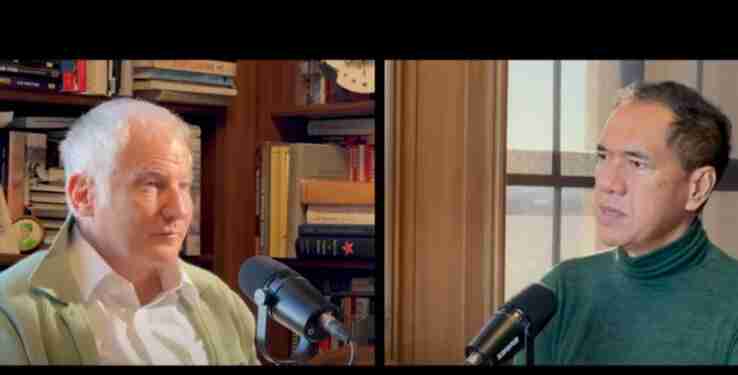
Read the full transcript of Russia’s history expert and author Stephen Kotkin’s interview on Endgame Podcast with Gita Wirjawan (#174), Premiered Jan 31, 2024.
TRANSCRIPT:
Early Life and Academic Journey
GITA WIRJAWAN: Hi friends and fellows. Welcome to this special series of conversations involving personalities coming from a number of campuses, including Stanford University. The purpose of this series is really to unleash thought-provoking ideas that I think would be of tremendous value to you. I want to thank you for your support so far, and welcome to a special series. Hi, I’m honored to have Stephen Kotkin, who’s one of the most famous historians. He’s also a senior fellow at the Hoover Institution and FSI at Stanford University. Stephen, thank you so much.
STEPHEN KOTKIN: Oh, thank you for the time. It’s an honor.
GITA WIRJAWAN: I want to ask you one or two questions about how you grew up. What made you get interested in history?
STEPHEN KOTKIN: You know, I wish I knew. When you’re young, you think you know a lot, but, of course, you know nothing. And it’s only with time that you realize how little you knew, but you’re very confident as a young person. The thing I had going for me was my mom was a big reader, and she would take out books from the library in bulk, several at a time. One of the areas that she liked a lot was historical fiction. She would bring them home, and they’d be sitting around the house. Occasionally, I would pick one up because she was done with it, and it had to go back to the library.
But on the whole, besides my mom’s influence, which was not forced on me, not imposed on me, but just indirect through the books that she took out and read, I was really a science and technology kid when I was growing up, not a reader. I loved math. I loved physics and bio and chem, and that’s what I did mostly in high school and what I thought I was going to do at university.
From Medicine to History
I went to university for STEM and spent the whole first year doing almost all STEM courses. I was in a program that after two years admitted you to medical school instead of the usual four years. I did very well in organic chemistry, which was the hardest course. If you pass through organic chemistry, there was a chance you could get onto the path for medical school. But organic chemistry mostly crushed people and ended their aspirations. I did well. I moved on. I got into this molecular biology class, which was a seminar for twelve people, very exclusive, and part of it was in the hospital.
I had to go to an operation. Back then, they had a carotid artery operation where they cut open your neck to scrape the plaque that had built up in the carotid arteries that threatened heart attack. Now we have Lipitor and other generic versions of Lipitor statins which remove this plaque and reduce the risk of heart attack. Heart attack risk is way down as a result. But back then, they didn’t have them yet. So when I saw the operation in the hospital, I got a little queasy from the blood, and I passed out.
GITA WIRJAWAN: And it ended your quest.
STEPHEN KOTKIN: My medical career quest. Exactly. And I foolishly gave up the science in addition to the aspiration to go into medicine. I didn’t have to. I could have just stayed as a scientist doing research in a lab in any of the various fields I was interested in. But I just gave it up, so disappointed, gave the whole thing up, and I went into British poetry, wrote my senior thesis on John Milton, did a lot of Shakespeare.
But crazily, the concentration in English at the school I went to had a requirement that you did eight courses in your concentration and then four courses in an allied field. So I said to my adviser, “Well, I didn’t know that.” And he says, “Well, you need four courses in an allied field now to finish the concentration.” I said, “Well, you know, I have four semesters of math, and the math that I did is like poetry. There are no numbers in it. It’s topology and all this fabulous math because I was a math kid.”
And he said, “No. That’s not considered an allied field for English literature. You have to take some history courses.” So I took almost all history courses immediately the next semester, and they were fabulous. And then I did it again, and then I did it one more time. So I had a history major in addition to the English major before finishing. Only because I was told I needed an allied field for English. And then I went on for a PhD in history.
So if you had looked at me at any point in the trajectory I was on, you would not have predicted where I ended up. Despite the fact that my mother read historical novels, historical fiction, you would not have predicted that I would have ended up on that path. So therefore, accident, contingency, and recalibration are really important for the way that I write history since that’s how I came into the history field myself.
From French History to Soviet Studies
GITA WIRJAWAN: Amazing. But you started studying the history of France before you switched on to that of the Soviet Union.
STEPHEN KOTKIN: I had a lot of great influences on me, fortunately. University of Rochester, where I did my undergraduate work as a step kid and then switched, had a nice roster of fantastic historians. They had Christopher Lash in American history, Eugene Genovese in American history, and one of my favorites, William McGrath, who did Central Europe and Western Europe. So they were my primary influences, America and Europe.
I ended up going to Berkeley for a PhD in European history.
But I was not on the left, didn’t have a goatee, and I’ve never had a cup of coffee in my life. So French history didn’t really work with me. My first major assignment was a paper on the Paris Commune, which was a leftist seizure of power during the Franco-Prussian war in Paris that was not supported by the Parisian countryside and was overthrown by force. And I did a critical analysis where I didn’t support the Paris Commune seizure of power, and everyone was a little bit shocked.
GITA WIRJAWAN: Really?
STEPHEN KOTKIN: So French history wasn’t really for me, and then I moved into Central Europe, Habsburg history stuff. And that was really exciting, but there was no major mentor. I started learning the Russian language in my third year of the PhD program, which is the time you’re supposed to take your exam. Instead, I started learning the Russian alphabet that year. And then I took intensive Russian for quite some time. And four years later, I was assistant professor of Russian history at Princeton University.
Why Russia?
GITA WIRJAWAN: Why Russia?
STEPHEN KOTKIN: You know, it’s hard to say exactly, but when I was in Habsburg history, I studied Czech language, one of the major languages in the Habsburg empire. German, Hungarian, Czech, even though it was a dual empire, the Czech part was very substantial. So Czech was my first Slavic language.
I got to Prague in the summer of ’83 maybe for the first time. I was behind the iron curtain, saw a communist regime, and it was incredible how interesting it was. It was nothing like the stereotypes that we had growing up in the US about the system. Everything was gray on the outside. But on the inside, there was this fabulous entrepreneurialism and resistance to communist way of life and trying to create your own way of life inside the limitations of being stuck with the censorship and the lack of travel permission and everything else.
But the people were very inventive, and the system was alive as a black market, second society, secondary economy inside the formal structures that were hard to see. But when you lived there, you understood how exciting and interesting and inventive the whole thing was. So it was very impressive, of course, but it also had this entrepreneurial inventive side. And so I thought that’s interesting.
Intellectual Influences
And then I had a teacher. I was very fortunate. Many Europeans came to Berkeley in the eighties. So I met, for example, Habermas, Jacques Derrida, Claude Levi-Strauss, and Michel Foucault. And so I was a student of Foucault’s.
GITA WIRJAWAN: Wow.
STEPHEN KOTKIN: This is me and Michel Foucault in my house in Berkeley.
GITA WIRJAWAN: You look a little bit younger.
STEPHEN KOTKIN: I was forty plus years younger. But, anyway, he said to me at lunch one day, “Wouldn’t it be great if someone studied and used my analysis of power to study the Stalinist system?” Because he had applied this theory of micro power to the Western system, Western Europe, especially France. But how does it work for a totalitarian system?
So I thought, yeah, that’s really exciting. I was young, impressionable, twenty-something years old. I didn’t share his view that Western society was kind of like a prison or imprisoning in many ways, that the enlightenment was a negative thing entirely, the eighteenth century European enlightenment. But I loved the way that he was able to connect individual identities and behaviors in a micro setting with the larger structures of a system.
So this “little tactics of the habitat,” actually a phrase I got from Michel de Certeau, who was another French intellectual who came to Berkeley, was very exciting. So on the one hand, Foucault’s prompt to use micro power techniques to study Stalinism, and on the other hand, my trip to Prague, which had introduced me firsthand to what the iron curtain, what such a system was like in practice. And so I was very enthused.
I didn’t have a home. The Habsburg history wasn’t working because I didn’t have a thesis adviser at Berkeley. And so why not? There were these fabulous Russian history professors there, Martin Malia, who was the main influence on me, and Reginald Zelnick, both of whom were my thesis advisers, were very prominent professors in Russian history. So that was the piece that was missing in the other areas that I was studying. And then these influences. And so I started learning the Russian language.
Learning Russian
And lo and behold, I had an amazing teacher of Russian who was an émigré who came out in the east. He came out through Siberia in the revolution, his family. He was eighty-something years old by the time he was at Berkeley, teaching a very accelerated Russian to a handful of kids who needed to learn Russian from scratch like me, Sergei Kosatkin. And he had been a translator of Mongolian. He wrote a Mongolian dictionary. He worked for British intelligence in the Far East and knew Japanese. And so he had this amazing East Asian piece that was unusual for Russians. And so he had stories like you couldn’t believe. World War II and intel and just Asia in general was a huge influence on me.
I was there to learn Russian. So grammar and vocabulary and sentence structure. I took accelerated Russian with him a whole semester but one year. So two hours a day, five days a week, I completed a year’s worth of college Russian in a semester. The second semester was a second year’s worth of college Russian. And then the third year of college Russian, took in the summer in Leningrad in 1984.
So I had three years of college Russian in a single calendar year, partly thanks—well, mostly thanks to Sergei Kosatkin and then thanks to this summer language program in Leningrad where first time to the Soviet Union, Konstantin Chernenko was the general secretary. The place was clearly stagnant and everything else, and I experienced that firsthand. But I had enough Russian so that after just one calendar year I was able to start reading with a dictionary coming back from the Soviet Union in that fall of 1984 and embarked soon enough on dissertation research, finished my dissertation a few years later, and then started at Princeton University, my first job.
GITA WIRJAWAN: Yes. September 1989 at Princeton.
Historical Timing and Luck
STEPHEN KOTKIN: And the wall fell in November in my first semester. The Berlin Wall fell. So I just caught this wave, this wind, you know, from that molecular biology class where I fainted in my own vomit on the floor of the OR. From that, through Shakespeare and Milton through the fall of the wall. And all in just a really short period of time, the French intellectuals at Berkeley. Berkeley was just fabulous in the eighties. And so I was really lucky, really privileged. Things just kept falling my way.
Gorbachev happened. I chose to study the Soviet stuff before Gorbachev, remember. So I’m there, Konstantin Chernenko, learning Russian in Leningrad, and then the Gorbachev thing happens. So it was one thing after another that I got very lucky, extremely lucky, but it was not foreseeable. Looking back, it makes sense. I can tell a story that seems to make sense. But looking forward, you know, prospectively, was like, what was I doing? Where was I going?
And so life is like that. You have to be ready to be lucky. You have to perceive these moments of good fortune and seize them and take advantage of them.
GITA WIRJAWAN: So you believe in luck?
STEPHEN KOTKIN: There’s—I’m living embodiment of luck. For sure. Hard work, no substitute for hard work, but a lot of people work hard. Not everybody has good luck. Some people have the other kind of luck.
Understanding Russia and America
GITA WIRJAWAN: You had quite a number of lucky events earlier on. But you’re one of the few that have written so much about not just Stalin, but Russia, the Soviet Union. What has changed? And I want to put this in the context of how I’m seeing so many people don’t understand each other. You’ve written so much, but what is it that the Americans need to have a better understanding with respect to Russia?
The Challenge of Big Countries and Global Perspective
STEPHEN KOTKIN: It’s a problem of big countries. Big countries are so big, they can get self-absorbed in their own story.
GITA WIRJAWAN: Mhmm.
STEPHEN KOTKIN: And their own story is substantial. It’s really large. American history is consonant with global history at this point. That’s not how American history is written for the most part. It’s not studied and written as global history. It’s studied and written in a nationalist sort of navel-gazing internal view, even though America’s effect on the world is colossal. This is true of the way China works.
It’s true to a certain extent the way Russia works. Although Russia is somewhat different because it had this giant Eurasian continent folded into its story. America had an assimilation approach so that lots of newcomers became American, wanted to become American as soon as possible. My generation, I’m fourth generation American. So in other words, my ancestors came a long time ago before the First World War, my father’s side from Belarus, my mother’s side from Poland.
But by the time it got to me, nobody was speaking foreign languages at home. Already, the second generation was extremely eager to assimilate, become as American as possible. And so by the time it got to me, there was almost nothing left of the origin story.
Russia’s a little bit different because folding in the Tatar Khanates and folding in all sorts of other peoples, Ukraine, Belarus, the Baltic states, the Caucasus. Russia had a larger world than just Russia inside Russia for a really long time. It was much more of an empire in its mentality and makeup than the US or China were in terms of their sinification in the Chinese case and Americanization in the American case.
That’s not to say that they’re completely sinified or completely Americanized. There’s an ability to retain one’s culture, one’s language, one’s identity inside a larger story, but that’s much more prominent in the Russian case. But nonetheless, it’s typical of places like America to think that America is the world. And so the American version of English, American institutions, American food, American way of life, that either the whole world is like that or it has a desire to become like that. No.
The whole world is not like that, and it doesn’t have a desire to assimilate into some larger global Americanism. So it’s something you gotta push against. You gotta get out there in the world. You gotta live in foreign countries. You gotta learn foreign languages. You gotta live and learn to think like the people who are not Americans. And this goes for any culture, any part of the world.
It’s very valuable. And we don’t do enough of that because America is too big, too self-contained, too self-satisfied on occasion. We don’t encourage it enough. We encouraged it after we got scared with the Soviet Union sending up the first artificial satellite in 1957, the Sputnik, couple years before I was born.
And so America had a panic and invested massively in trying to understand the rest of the world. That was really beneficial for several generations. But now, we need that again. We need that boost again where we all want to send our young people out there so that in the formative years, they begin to understand just how big the wide world is and how it’s necessary to have empathy with how other people live and work and think and their viewpoints. We like empathy. Empathy is the hardest thing to achieve.
The Value of International Experience
GITA WIRJAWAN: You’ve been talking about that as most powerful. Is that doable, though? The ability to send a bunch of one country’s citizens to the rest of the world and vice versa.
STEPHEN KOTKIN: Sure. It’s possible. It just doesn’t happen naturally.
GITA WIRJAWAN: You’re right. It doesn’t happen naturally.
STEPHEN KOTKIN: It doesn’t just happen automatically or organically, Gita. You have to be proactive. You have to encourage it.
So both of my kids are in college now. And I try to let them find their own way. Not to make them guinea pigs for disappointments in my life to make them do some of the things that I didn’t do. Or not to make them do exactly what I did. Right? So encourage, facilitate, but don’t impose on them.
But it turns out that one of my kids who’s a chemistry and economics double major decided he wanted to go to France. He learned French in college, and he went to France for study abroad. Now he speaks French. He loves French culture, and he understands America much better as a result.
And our daughter, who’s two years younger than him, who does visual arts, anime, poetry, creative writing, so very different profile, but she’s also very enthusiastic about Japanese culture and wants to do her study abroad in Japan.
Now remind you, my wife is a South Korean passport holder. My wife is Korean, so the kids grew up with Korean school and Korean culture. On the weekends, they went to Korean school, and they got introduced to K-pop and other influences besides the language. And K-dramas. And my wife was chief curator of the Korean art section at the Metropolitan Museum of Art. And so she did a number of really gigantic Korean-related exhibitions, and we had Psy from Gangnam Style come, and the kids met Psy and took videos with him.
So they had some international influence. But nonetheless, they took the initiative themselves, like my son to do the French stuff and my daughter to do the Japanese stuff. And we think that makes them much better Americans and gives them a much deeper understanding of America. We travel with them as much as we can. Tourist travel.
Usually, I’ll be invited to give a lecture or attend a conference, and my wife will come along to do museum work, and the kids will tag along just to see what that culture is like. So we’ve done some family travel that way, opening up vistas for them, but not telling them, again, that they should do this or they should do that, but showing them what’s possible. And so we think that that can be done.
Of course, you know, we have resources now. When I was growing up, we weren’t rich, and I was a working-class kid. And first time I traveled abroad was a subsidized trip for language study to Vienna when I was in graduate school at Berkeley, where they paid my way to go study at the Goethe Institute in Austria to study German. But now that I worked really hard and got lucky and been rewarded, we have some resources to be able to travel, and my kids started traveling much earlier than I did traveling abroad. But now it’s part of their studies.
So it’s really exciting, and we can do more of that. It’s important to bring it here. And have it available inside American culture, and we do have a gigantic population of immigrants, green card holders, foreign students, and it’s indispensable for our economy, and I would argue indispensable for our way of life, but we also need to get the Americans out there.
And especially the ones who are going to be in decision-making capacity, officials, positions of authority. It’s not just that they gotta have passports and plop down at some five-star hotel in luxury and spend a couple of days there talking to some brilliant people who got a PhD at Harvard or MIT or LSE. Right?
GITA WIRJAWAN: Not that kind of travel abroad. Let them go to the villages, the trenches, and all that.
STEPHEN KOTKIN: See how the transport system works, see what the school system is like, see how ordinary people live with families around the world, and how they think and what their aspirations are.
The Importance of Teaching History
GITA WIRJAWAN: You alluded to a song by Sam Cook, don’t know much about history. I get the sense that the kids nowadays, they tend to, over social media, communicate amongst themselves, to themselves, as opposed to their predecessors, the hundred and seven billion people that have died. We call that history. Isn’t it a concern that the kids nowadays don’t study history the way you did or most of your peers did?
STEPHEN KOTKIN: So, yeah, we have a lot of complaints that our young people don’t know history. And so I say, well, whose fault is that? Is that their fault? Or is that our fault as history teachers? We have to do better. We have to teach history. We have to write history and teach history in ways that attract their attention. It’s on us, not on them. You will complain till you’re blue in the face, walk around the Stanford campus, “Oh, they don’t know any history.” Well, do something about it. Teach them some history, but in a way that sparks their curiosity, sparks their desire to learn more when you’re not there anymore.
So I’m not a complainer about people not knowing history. I try to be a doer about that. But that’s true, not just of our young people. That’s true of people in positions of authority.
What I’ve discovered in my travels and in my advisory capacity with private sector or public sector officials is that the demand for history is really high. It’s not a demand problem. It’s really a supply problem. When I go to Washington or other government institutions, our allies, Five Eyes, they’re all dying to know history from me. That’s all they ask me about. Historical how did it happen the last time? Or, you know, what are the lessons? What can we learn from previous episodes? So demand for history in the government sectors is huge. Same thing I discovered in the private sector.
Okay, there’s sometimes the history is financial history, economic history. The tech people want to know how innovation works. They want to know history of technology and history of science. And so demand is off the charts.
It’s just we’re not supplying the big picture history, the tour of horizon, the connect the dots, the history that is exciting and gives you insight into how the world works now and where it might be going, you know, what the drivers of change are.
History never tells you what the future is going to be. Nobody can do that. But what history can tell you is that the present’s not going to last. That things are going to change because that’s happened many, many times over. Who living in China in the 1960s or 1970s was going to think that China was going to be the second largest economy in the world? Per capita GDP was two hundred dollars a year under Mao. And so if you projected that forward, you would have looked like a fool.
Because the China that unfolded was nothing like that time period that people were living. So you gotta do that with your own time period, with your own set of institutions, with the reality that seems permanent. Because it’s the reality that you live in, and you gotta say, it’s very likely it’s going to change. I don’t know how it’s going to change, but it’s going to change, and therefore, let’s be ready for the changes. Let’s even try to shape the changes somewhat. And so what are the levers of power, the levers of agency onto large systems?
How do you affect change? Not giving a lecture, giving a speech that something should happen. But how could it happen? What role does agency play? And you only can do that if you understand systems, systems theory, complexity theory, and if you understand the drivers of change. So history is really empowering for agency.
There’s perverse and unintended consequences often. You think you’re trying to invent one type of world and you get the opposite result because you don’t understand how nonlinear causality works and you get these perverse and unintended consequences. But nonetheless, history is enormously empowering if you take it seriously and study it well for you to understand the could and therefore how to intervene and not to assume and project forward.
So you take the models for climate or the models for economic growth or all those models are built have built-in assumptions that are then projected forward twenty years, thirty years, forty years. And we know that those projections are bunk. Because if you look at the previous projections, they were generally off.
The ambassador of the UK in Germany in the twenties. So Germany is a great power. The UK is the biggest power in the world in the 1920s. And this ambassador is not a dumb guy. And he writes this report that Adolf Hitler is finished as a politician. He’s done. He’s toast. And yet, a few years later, he’s chancellor of Germany.
Not because the ambassador was a moron. But the ambassador was projecting forward from the circumstances in which he was living, not understanding larger dynamics at work that became visible retrospectively. And so how do you see some of that prospectively? Once again, there’s contingency. There’s accident. There’s a lot of things that you didn’t think were going to happen, and then, wow, they happen.
Economics vs. Geopolitics
GITA WIRJAWAN: I like how you’ve always compared yourself with the economist, you know, who would always use the assumption, everything else being equal.
STEPHEN KOTKIN: Economics is a very powerful profession. I like economics a lot. I studied economics. I have a lot of friends who are economists. Their models are very impressive. But they always have that line in them just like you said, Gita. “All other factors held constant,” comma, and then you’re off to the races with this economic model. In geopolitics, nothing is held constant.
And so we have this policy advice that goes like this. The economists are dominant. Economists have the ears of officials. Economists have the ears of policymakers. And then one day, bad stuff happens. And everyone discovers that people are not maximizing utility.
Geopolitics and Economics: Finding Balance
STEPHEN KOTKIN: They’re murdering each other. And so then the geopolitics gets let back in. Right? And all of a sudden, it’s geopolitics twenty-four seven. Geopolitical risk and all sorts of great power rivalry this and that, and the economists for a time get eclipsed. Right.
Because we’re not maximizing utility. We’re having war or there’s a pandemic or whatever it might be. But that’s wrong also. Right. That’s another extreme.
So economics is really important. Prosperity. Yeah. Trade. Yeah. Opportunity. Right?
So it’s peace and prosperity. It’s geopolitics and economics, and we can’t let one occlude the other. Right. Just because it seems to be a happy time or just because it seems to be an unhappy time. Right? So I try to keep a balanced perspective knowing that it’s never as good as people say.
It’s never as bad as people say. Economics is just as important as geopolitics even when it doesn’t seem to be the case and vice versa.
Winning the Peace in Ukraine
GITA WIRJAWAN: I want to take you to the present, and we kind of talked about this few months ago. This is on the topic of Ukraine. You’ve asserted a few times the importance of winning the peace as opposed to winning the war. Talk about that.
STEPHEN KOTKIN: All wars are about winning the peace. Yeah. Wars are generally a miscalculation.
They generally don’t turn out the way people hope or expect. They rarely deliver the advantages that the people who start them think. But it’s not the war per se, it’s the peace that you should focus on. So for example, the United States and Afghanistan won the war, but then we lost the peace. I think it’s pretty clear.
We ousted the Taliban really quickly. Yep. Helped another an alternative Afghanistan political system form. But in the fullness of time, Taliban came back and we lost the peace. Iraq is a little bit more ambiguous.
We certainly won the war. Looks like we lost the peace, although the fullness of time, we’ll see. In Vietnam, the United States lost the war, and it won the peace. Vietnam is a remarkably pro-American country, as you know, despite the atrocities that the Americans committed there. Vietnam has this amazing museum of American atrocities.
It’s really moving to see that museum. Made a very big impression on me. And at the same time, the people were incredibly warm towards me as an American. Same towards South Koreans, and the South Koreans, as you know, were on the American side in that horrific war in Vietnam. And so that’s really interesting.
You can not only win a war and lose the peace, you can lose the war and win the peace. So kind of how do you win the peace in Ukraine? No. That was my question early on. I understand that we need to talk about the war, and I have talked about the war.
But what about after the war? Is there an after the war, and what should it look like? And therefore, how should we define victory in the war if our goal is to win the peace?
Redefining Victory for Ukraine
So Ukraine defined victory as recovery of all their internationally recognized territory, which is under Russian occupation now, war crimes tribunals for those who launched the aggression against Ukraine, and reparations for all the damage that was caused in Ukraine. So those are fully understandable at an emotional level, at justice level.
This is a criminal aggression under international law, what Russia has done. But in order to achieve those war aims, to achieve a victory defined that way, you have to take Moscow in order to impose that kind of peace. So Ukraine is not taking Moscow. And, therefore, that version of victory is just not reachable. As much as it is understandable on an emotional level, you can’t achieve that in reality.
So what’s a better definition of victory? A better definition of victory, at least for me. Now remember, we’re sitting here in an office at Stanford University, Palo Alto, California. We’re not under bombardment. Yeah.
Haven’t had our sons or our husbands or our brothers or our sisters, aunts and uncles killed. We’re not victims of rape and atrocities here. So it’s a lot easier for us to talk about the war in Ukraine than it is for the Ukrainians living it day to day as we sit here and speak. But I think we can talk about the peace or a victory as Ukraine getting into the European Union and Ukraine getting some sort of security guarantee.
Now why does Ukraine need to get into the European Union? Well, because it needs that mechanism of European Union accession to transform its domestic institutions, to go from a poorly institutionalized, weakly institutionalized, extremely corrupt state. Yep. To more like a European state with rule of law. Yeah. Open society, free and open media, and prosperity because Ukraine is remarkably poor by European standards. Okay.
And then a security guarantee so that Ukraine, if they rebuild, it then isn’t destroyed again. What might that EU accession process look like? What might the security guarantee look like? I think those are worthy of debate and need to be debated, and they are being debated. So that’s very positive.
The Path Forward: Armistice and Transformation
But to get to that road, you need an armistice. Yeah. You need the fighting to stop. Meaning, you don’t need to get all of your territory back in order to start the process of European Union accession, transformation of institutions, rebuilding the country in a new economy with some security arrangements. Right?
It would be better if you got your territory, but it would be much better if you started the process with an armistice of gaining a Ukraine that the Ukrainians need. Right? Ukraine needs Ukraine. Russia doesn’t need Ukraine. They have Russia already.
And so getting however much of Ukraine you can control and transforming it into a European country, joining the West is how we would put it. Ukraine wants to join Europe. That’s why they opposed domestic tyrants in 2003-4, and 2004-5, that orange revolution. That’s why they overthrew that domestic dictator in 2013-14, Yanukovych, who fled to Russia. Right?
They risked their lives to join Europe before Russia took Crimea and then the full scale invasion of February 2022. So that, I think, it means how do you get an armistice? How do you get to that point where you can start that process? That’s a better definition of victory, and that’s how you win the peace.
The Korean Peninsula Model
So if you look at the Korean peninsula, of course, it’s a very unsatisfactory outcome. Yeah. It’s only an armistice. Yeah. It’s not a peace treaty. They’re technically still at war.
But there’s not large scale fighting. Yes, the families were separated. Some never saw each other again because the border was closed. And, yes, North Korea does a lot of things that the South Koreans regard as provocations, and so it’s unsatisfactory. But still, on the other side of that demilitarized zone, with the American security umbrella, in the absence of a peace treaty, they’ve got an American security umbrella.
They built or rebuilt one of the most successful societies on the planet, as you know, South Korea. It’s unbelievably impressive what they did. Yeah. Again, it’s not perfect. It’s not satisfactory.
It would’ve been much better to get a peace treaty. Better than nothing. But, hey. Yeah. Look what they’ve achieved.
Yeah. And so an outcome like that for Ukraine would be a miracle and would be a gift and would not necessarily involve Ukraine acknowledging loss of territory. Right? South Korea doesn’t acknowledge. No. That the Korean peninsula is divided forever.
Quite the contrary. But in the meantime, they rebuild.
Security Guarantees for Ukraine
GITA WIRJAWAN: You’ve mentioned the EU, but you’ve not mentioned NATO. You’ve talked about bilateral plus in the context of Ukraine. Yes.
STEPHEN KOTKIN: So right now, what’s on the table for a security guarantee of Ukraine is not a treaty where someone else will come to Ukraine’s aid if they’re attacked, but instead a promise to arm Ukraine and enable it to defend itself. What’s happening now during the war. Yep. On an ad hoc basis could be institutionalized. That’s the guarantee they’re talking about.
Next level up would be some type of treaty, probably not with NATO because NATO works by consensus, and there isn’t a consensus to extend the article five security guarantee to Ukraine while it’s still at war.
Or even if the war stopped, we’re not sure. Right. That there would be such a consensus. So we have to live in the world that we live in. Sure. Ukraine would love to be in NATO, and sure, many officials in NATO have promised Ukraine.
But is it feasible? And if it’s not feasible, what do we do then? And so some type of security guarantee with the United States would have to be sold to the American people the same way that the one with South Korea, the one with Japan, the one with Australia, right, is supported by the American people. It would have to be sold by them. That hasn’t happened yet.
Right. But that could also be joined if it were to happen by others. This is why I call it bilateral plus. For example, Poland might wish to join. For example, the Baltic states. Yep.
Estonia, Latvia, Lithuania, maybe one or two of them would like to join. Maybe the Scandinavians would. So it’s a kind of proto version of the fuller NATO, more than just what South Korea has, which is a lot, but less than the full NATO. So that would be a big step forward. We’re not there yet.
We would have to prepare the US public and the US congress, the senate especially, to ratify a treaty like that. We don’t we’re far away from that now. But at least let’s discuss these terms publicly so that people understand how Ukraine could win the peace.
The Crimea Question
You think about Crimea. Crimea internationally recognized Ukrainian territory because in 1991, when the Soviet Union broke up, it was part of Ukraine, had been since 1954.
Well, does it make sense for winning the peace for Crimea to go back into Ukraine? First of all, how would they get it back? You’d have to take it because Russia has it. People say that this is like Munich in 1938 if you allow if you give Crimea to Russia. And I say, well, nobody’s Hitler was given the Sudetenland at Munich in 1938.
He didn’t have it yet. It was handed to him for no compensation. Putin has taken Crimea. Nobody’s handing it to him. He’s got it now.
Yeah. And if you can’t take it back, it’s your potential bargaining chip to get a larger deal. Moreover, if you do try to take it back and you’re successful, what does that give you? It gives you a bad choice of the necessity maybe of ethnic cleansing. You have two and a half million ethnic Russians in Crimea now.
Are you going to remove them all in an ethnic cleansing? Otherwise, you have two and a half million Russians inside your state who might not want to live inside Ukraine and might be available for insurgency or sabotage manipulated by Moscow, by the Kremlin. And so incorporating Crimea back into Ukraine might be detrimental for your EU accession process, for your security guarantee, for your overall stability.
Plus, it incentivizes a regime in Moscow, whether the Putin one or the one after that or the one after that or the one after that, it incentivizes Russian rulers to come back and do this again. Yeah. And get it back because Crimea was part of the Russian empire since Catherine the Great in 1783.
And for Russia, it’s mother’s milk, and it’s hard to see how they would accept the loss of Crimea. So it has all sorts of potential negative consequences for Ukraine. The final argument Crimea does is that, well, if they don’t get Crimea back, Russia can use it to attack Ukraine. And that’s true. That’s what they’re doing now.
But Russia can use Russian territory that borders Ukraine to attack Ukraine even without Crimea. And it’s also possible to demilitarize Crimea even if it was not regained in some type of bargain. No. And so you have to win the peace. No.
And you have to think about all of the ways that you don’t incentivize this to happen again. Yeah. Or you don’t have an insurgency inside your country that’s more or less permanent, or you don’t get yourself involved in ethnic cleansing. Right. To stabilize because ethnic cleansing is not a ticket into the European Union. Minority rights are. Yeah.
But minority rights can be manipulated by Russia. Yeah. The other way. So this is complex. It’s fraught.
You have a lot of emotion understandably involved in this. And I’m not trying to underplay all of those dimensions. I’m just trying to say, how do we win the peace so that we don’t get an endless war, a permanent war, a renewal of the war, but instead we get a stable Ukraine that can aspire to become something like South Korea’s success?
The “Pivot to Asia” Concept
GITA WIRJAWAN: I want to switch to China, but before then, I want to make reference to your earlier statement about the fact that a transatlantic alliance could be deemed as a pivot to Asia. Yes.
Explain that to some of us in Southeast Asia to better understand that.
STEPHEN KOTKIN: So many people in the United States were talking about a pivot to Asia. Right. Which is an absurd concept. Yeah. Because the United States has been an Asian power for a really long time, has huge investments, financial investments throughout Asia, including Southeast Asia, it’s just a colossal investor, Technology transfer, people to people exchange like we were talking about earlier. Right?
America is in Asia. No. Deeply already. But the pivot to Asia was meant as a transfer of some of the resources from the Middle East to the Indo-Pacific. Right. Okay.
So that was the intention. And that also implied maybe Europe should take care of itself and the US shouldn’t expend as many resources, especially military with NATO, why can’t Europe defend itself, they’re rich countries? And so the notion of pivot to Asia became tied into a kind of zero sum, take it from here, put it over there. Because we have limited resources, the world is changing, we have deficits, we have demands at home, we can’t be everywhere on the same scale anymore. So it’s understandable.
The Revival of Transatlanticism
STEPHEN KOTKIN: But it turned out that the war in Ukraine galvanized America and its allies. Galvanized, resuscitated NATO and the EU, and also brought Europe and the US much closer on China policy. Because China, as you know, initially rhetorically and now more than rhetorically has supported Russia’s war effort. And so the Europeans had been attempting to distance themselves from the United States to a degree on China policy. China and the US were going to be antagonistic, two great powers, one the status quo power, one the rising power.
It was inevitable that there would be friction. But, hey, we’re Europe. We don’t like conflict. We love trade. So let’s distance ourselves from the US and have a more friendly face towards China and have mutual enrichment, the trade with China.
And then they discovered that, well, jeez, the dependency on Russian energy blew up in their face. Maybe it’s not so good to be that intertwined with an authoritarian regime that mistreats its people at home and might therefore behave abroad in similar ways to the way it behaves at home. Throw its weight around, bully, coercion. Cheat, undermine the rules-based order.
So the Europeans came much, much closer to the Americans on China policy as a result of the revival of transatlanticism sparked by Russia’s aggression against Ukraine and Ukraine’s ingenious and courageous resistance to Russia. So Ukraine gave Europe a gift. It gave the United States a gift, which was a revival of the institutional West, which turns out to be really important for American China policy. So the pivot to Asia was the revival of transatlanticism because Germany and France and the UK and all the rest are crucial for any China policy.
The Institutional West
Now we have to remember that the West is not a geographic term. It is an institutional term. Russia is a European country culturally, but it is not Western institutionally.
Whereas Japan is not European culturally or ideologically. But is Western institutionally. Japan looks like a Western country institutionally. That goes for Japan’s former colonies, South Korea and Taiwan. It goes for Australia.
GITA WIRJAWAN: Yep.
STEPHEN KOTKIN: And one could argue it’s appropriate for Indonesia.
GITA WIRJAWAN: Yep. It’s a little more complicated there, but you know better than I do.
STEPHEN KOTKIN: But there’s a larger non-geographic West that’s institutional. That’s a club of like-minded rule of law, open economies, open societies, democracies in the sense that they feel they have a shared lot in common whether they’re culturally European or not, and many of them are not. And so that’s really valuable to have. Whereas Russia, China, Iran, they’re not institutionally West, nor in value terms do they identify with the West.
They’re Eurasian ancient civilizations, land empires with a millennium or in the Chinese case, claiming five millennia of history before today. And so there’s a big difference in that non-geographical institutional West where if you’re going to confront China, it’s nice to have friends and allies, and it’s nice to have the most successful countries and countries that share your values and institutions be your friends and allies.
Sharing the Planet with China
I agree that we have to share the planet with China. China has been here a long time. They’re going to be here a long time going forward. They’re just a remarkable civilization. Their achievements are breathtaking. My wife, for fifteen years, worked in the Asian art department at the Metropolitan Museum of Art.
And I used to take the kids to pick up mom after work. I used to go meet my wife on my own at the Metropolitan Museum, and she’s in the Asian art department. And I have to tell you, it’s just breathtaking every day to see it again and again. There’s more and more and more to discover even if you’ve seen it every day for fifteen years.
So China just takes the breath away. We have to share the planet with China. That’s not the point. The ocean is wet. We have to share the planet with China. The point is what are the terms of sharing the planet? And how do we negotiate those terms so that we preserve the free and open societies, the rule of law, the institutional West that accounts for our peace and prosperity?
Yes. We make a lot of mistakes. Yes. There are a lot of policies and actions that one could criticize from the Vietnam War to many others that you could name. There’s a lot of agony that comes from mistakes and more than mistakes on the western side. It’s very imperfect.
But we live in a world of reality where what’s the better alternative? Is it better to make the West live up to its promises, or is it better to undermine the Western order and get something else that maybe would be more coercive, more hierarchical, less free and open?
And so I’m all in favor of sharing the planet. I just want to negotiate the terms, and I want to have leverage to negotiate those terms so that we can defend our values and institutions while we’re sharing the planet. We can recognize China’s greatness. We can recognize China’s achievements, but we don’t want to live under Xinjiang. We don’t want to live what happened to Hong Kong. We don’t want that to happen to places outside of China because China has a huge influence and power as a result of its commercial success.
We want to push back not against the commercial success. We want to share in that commercial success because that’s win-win in many cases. We want to push back on use of that commercial leverage by China to enforce a different world order that’s suitable for an authoritarian regime, that is safer, more secure for an authoritarian regime, but not for the kind of values and institutions that we cherish.
US-China Relations in Hindsight
GITA WIRJAWAN: You’ve expressed this view that would have been slightly different with respect to Kissinger’s outreach to China, right, in early seventies. With the benefit of hindsight, how do you think the United States could have done it differently to make the two largest countries or economies in the world share the planet a little bit better? You’ve given description of some of the things that should have been instilled in the process.
STEPHEN KOTKIN: Hindsight is a lot easier than foresight, and being a critic from an office at Stanford is a lot easier than being secretary of state or national security adviser, where you have imperfect information, a flood of unpredicted events, lots of pressures from interest groups, and negotiation is hard. So we have to be careful not to be the kind of armchair think tank critics where we know better, we’re smarter, fullness of time, things have happened.
I would just say it this way. We’re a lot stronger than we think, the United States. We’re just a lot more powerful than we think. And in addition, we have a lot of friends. And our friends are amazing. They’re so capable. They have such incredible achievements, and they’re voluntarily our friends. We don’t coerce them to be our friends.
So that’s how we have to approach China. We have to approach China with a sense of self-confidence in our strengths, not arrogance, not hubris, but a sense of our own leverage and self-confidence, why we are successful, what makes for our success and encourage that, but also with our friends and allies in step.
A bilateral US-China won’t work to our advantage because we need to have the strength of our friends and partners taken into consideration in those negotiations and in that deal-making and in that sharing of the planet. The whole point of the American world order is that it provides opportunity for others, not just for Americans. That’s what we’ve got to reinforce. That’s the message. And therefore, our friends and partners have to be in that room.
And our actions that may be unilateral, we have to understand what the effects are for our friends and partners, as well as those whom are not yet our friends and partners, but might want to be one day our friends and partners. So self-confidence plus humility, a larger room rather than just a bilateral room, and making sure that we don’t undermine the interests of our friends and partners in the deals that we might make as superpowers bilateral.
And so that’s much harder. It requires more work, more patience, more knowledge, more talking, not just with the Chinese, but with everybody to understand what the effects might be, whether it’s in Indonesia or Japan or Germany or Brazil or South Africa or any other place you could name. UAE. We could add in many, many other places. We have to understand the secondary and tertiary effects. We have to understand the aspirations of those places. And sometimes, we have to compromise.
Middle East and Southeast Asia
GITA WIRJAWAN: Steven, I know you’ve got to go, but I’ve got two questions. The first one is with respect to the unfortunate event that took place in West Asia recently. You’ve talked about how the Middle East could be the battleground between China and the US. And the second question is with respect to this perception of this increasing hegemony of China with respect to Southeast Asia, which is kind of inevitable. I’m just curious as to what your thoughts are with respect to these two situations.
STEPHEN KOTKIN: Again, we have to be careful to understand places on their own terms. What their challenges are, what their aspirations are. We can’t refract everything through America-China. So in other words, let’s have a conversation with Saudi Arabia because it’s important for China policy. No. Let’s have a conversation with Saudi Arabia, or let’s have a conversation with Indonesia, or let’s have a conversation with ASEAN because it’s important in and of itself. Not predominantly so, not solely and not even predominantly because of its China-US implications. I think that’s a mindset that we sometimes fail at, that we have to overcome.
The other piece I would say in answer to your question is, we can’t be naive about China’s aspirations. They want a world that works for China, which means works for an authoritarian regime that doesn’t threaten or undermine a regime, which lacks a mandate with its own people, which doesn’t submit to regular elections, which imposes censorship. For them, the world is dangerous right now because America and its friends have a different system, which is appealing not just to our populations, but appealing to Chinese people.
And, of course, Taiwan has an alternative model of governance under Chinese language. They don’t think of themselves as ethnic Chinese. They think of themselves as Taiwanese predominantly. But nonetheless, it’s an important alternative model of how a Chinese speaking entity could govern itself.
And so we need to remember that the more leverage the Chinese get from commercial relations, the more interdependent we get with them, the more leverage they can have over our systems, over our sovereignty, over our institutions, over our interest groups. We’re free and open societies, and they can take advantage of that.
And so we just have to be careful to protect our sovereignty, to protect our institutions, our way of life, our well-being, while benefiting from the commercial relations. So, again, lack of understanding that the Chinese are building leverage over us through commercial relations that they may choose to use and in some cases already are choosing.
So I’m all in favor, just to conclude, of sharing the planet. I’m all in favor of win-win commercial ties. But what are the terms? Are the terms reciprocity? Are the terms free and open? Are the terms actual win-win? Or are the terms more coercive, more influenced by, more subversion, more turning the world in a direction that’s safer for an authoritarian regime and corrosive for democratic rule of law regimes.
GITA WIRJAWAN: Anyway, thank you so much for your time.
STEPHEN KOTKIN: Thank you. It’s really a pleasure to talk to you. More questions, but next time maybe.
GITA WIRJAWAN: We’ll revisit for sure.
STEPHEN KOTKIN: Thank you. It’s a great pleasure that we have you here at Stanford, Gita, and that we raise the interest and the understanding of Southeast Asia here in America.
GITA WIRJAWAN: Thank you. Amen.
STEPHEN KOTKIN: Alright.
GITA WIRJAWAN: That was Stephen Kotkin from Stanford University. Thank you.
Related Posts
- Neil deGrasse Tyson on UFO Files, Trump & Alien Existence (Transcript)
- Professor John Lennox: AI Is Humanity’s Attempt to Make God (Transcript)
- What’s Changing, What Kids Must Learn w/ Sinead Bovell @ SXSW (Transcript)
- How Emotions Are Made: The Secret Life of the Brain – Dr Lisa Feldman Barrett (Transcript)
- The AI-Generated Intimacy Crisis – Bryony Cole (Transcript)