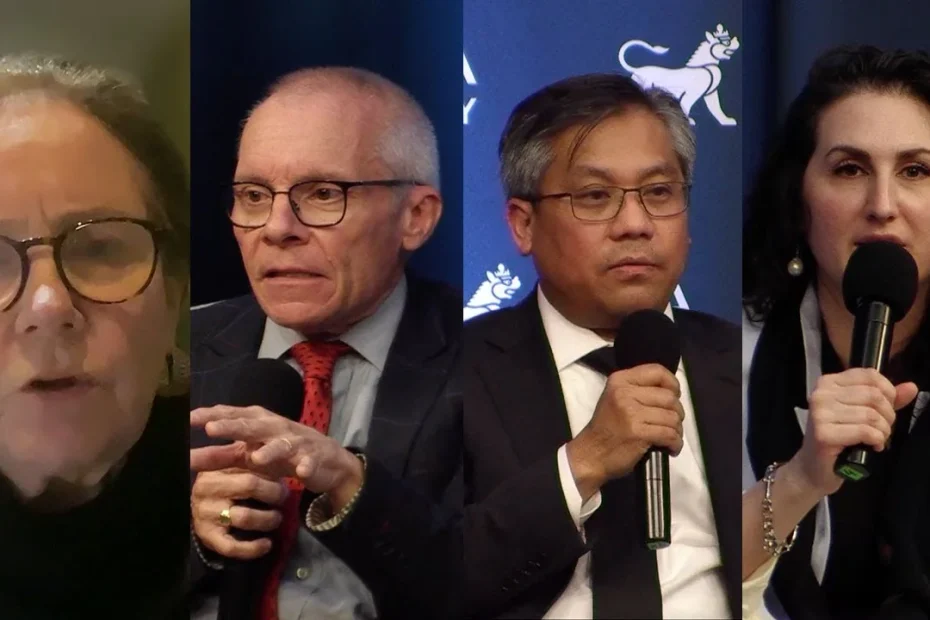
Read the full transcript of a discussion on the ongoing situation in Myanmar titled “Myanmar/Burma 2025: Challenges and Opportunities.” [March 6, 2025]
Listen to the audio version here:
TRANSCRIPT:
Introduction
DEBRA EISENMAN: Hi, everybody. I’m Debra Eisenman. I’m the Asia Society Executive Vice President and COO. I’m also the founding director and a senior fellow of the Asia Society Policy Institute. I’m delighted to be with you today and to introduce the panel we have, who have such deep expertise on and in Myanmar, as well as some really interesting associations with the country.
You have their bios, so I’ll be pretty brief. Dr. Sean Turnell is an economist who’s focused on Myanmar’s development for 30 years. From 2016 to 2021, he officially served as the senior economic adviser to Aung San Suu Kyi’s government. Following the military coup in February 2021, Sean was arrested and imprisoned alongside Myanmar’s democratic leadership. After nearly two years of incarceration and ill treatment in Myanmar’s prisons, he was released in November 2022.
He’s written about his time as a political prisoner in this book, which I believe we have here today, and it’s called “An Unlikely Prisoner.” Ambassador Kyaw Moe Tun is also with us tonight. He’s the permanent representative of Myanmar to the United Nations. The military coup happened while he was serving here in New York. So he represents the overthrown, democratically elected civilian government.
He’s also served in diplomatic posts in Switzerland, Indonesia, Singapore, as well as to the World Trade Organization. And Priscilla Clapp, on the screen with us from Washington, is a retired minister counselor in the US foreign service. During her 30-year career with the US government, she served as chief of mission at the US embassy in Myanmar during a time when the military government was still in control from 1999 to 2002. She’s also held posts in South Africa, Russia, and Japan, and she remains active in her focus on Myanmar.
Background on Myanmar’s Recent History
DEBRA EISENMAN: Now before I get to our conversation, I want to start with about a 30-second scene setter on what’s happened in Myanmar in the last four years.
In 2011, after five decades of military rule, a top-down managed transition began in Myanmar, which paved the way for a fragile balancing act with a democratically elected civilian government and a long-powerful military government. The latter of which held on to significant institutions of authority. And as I said, in February 2021, the military retook control of the country in a violent coup.
So it’s been four years since the overthrow of the nascent civilian government. Many of these leaders remain in jail. Some are abroad. Some have passed. Some formed a national unity government in opposition to the junta. And in these last four years, COVID has wreaked havoc on Myanmar. The country’s economy, once experiencing significant reform and growth, has tanked.
Investment in education and health care has withered. The country has been mired in civil war for the last 75 years, which has wrapped up, as has a People’s Defense Force, all fighting against the Junta and its army called the Tatmadaw.
Life Under Military Rule
DEBRA EISENMAN: Now Sean, I believe of this panel, you’ve been to Myanmar most recently having left as a prisoner in 2022. You learned the tangible effects of the coup from behind prison walls. Can you share with us a bit of what that experience was like?
SEAN TURNELL: The decline of the economy was very apparent to us in the prison. Conditions when I first was taken in there were really bad, but they declined across the period. So it was really interesting even though we were denied any access to information or contact with the world or anything like that. But we could observe what was going on.
We could hear what was going on. Actually we could hear the protests. We could hear the sounds of gunshots as well as sort of more hopeful banging of pots and pans in that early period. But, yeah, there was a gradual decline in the quality and quantity of the food that the prisoners were getting, which was one sort of very sincere indicator of where things were going wrong.
The other thing that was quite interesting across the period was the declining morale and material circumstances of the prison guards and the police, who were always poor, I hasten to add. So it meant there was often a very interesting dynamic between us prisoners and the prison guards and, even at times, actually, you know, some of us helping them in food and things like that. But over time, that became quite pronounced.
And then, you know, right to the end of the time that I was in the prison in late 2022, it was very, very visible. As I say, the quality quantity of food provided. But likewise, yeah, just a broad feeling of morale. I think in that initial period, a lot of the police, prison guards, etcetera, were very severe and so on, but that had slackened off quite dramatically by late 2022.
DEBRA EISENMAN: And just following on that, from the heyday of the transition before COVID and before the coup, obviously, what did you see as the most harrowing changes for the average citizen in Myanmar following the coup?
SEAN TURNELL: By the time the coup took place in 2021, COVID had had a negative impact on the economy, but that had been prepared for. In fact, the day of the coup, I was meant to be delivering to Aung San Suu Kyi something called the Myanmar Economic Resilience and Reform Plan. And it was basically the original reform plan but with a little bit of extra element, if you like, to get the economy back after COVID.
But before COVID, of course, the economy had been strongly growing and most importantly, transforming into something else.
There were some rocky elements along the way, which I’m sure we’ll get to. But nonetheless, there was a vision, and it was quite clear that the country was going in that direction. Following the coup, all that’s gone. I mean, it’s been totally reversed. Somebody asked me at Duke University the other day about what reforms remain. I said none. They’re gone. I mean, all the reform areas are gone.
And all the old travesties of economic policy making in Myanmar from money printing, for the Tatmadaw just being let loose on the countryside, just expropriation. There’s no confidence. The currency has collapsed. The inflation’s high. Unemployment’s high.
Of course, people are conscripted, so the ultimate economic freedom over your own body, your own person is gone. So overall, it’s just that entire view that people in Myanmar could look forward to a better economic and broader future for their kids, gone. And in fact, now the expectation is that another generation is going to have to suffer under military rule.
DEBRA EISENMAN: And, you know, you have a whole book that you’ve written with the Lowy Institute talking about the economic transition and the next steps you plan. So some more banking sector reform, mobile payment networks. Where do you think the country would be today if the civilian government remained in power?
SEAN TURNELL: Well, actually, we know reasonably precisely because the World Bank still does some economic analysis on Burma. It’s about the only institution that does anymore. With their very conservative approach to projections of where the economy would be, the number they come up with is that GDP or the gross domestic product, the overall wealth of the society would be 50 percent greater today had the coup not taken place. And again, that’s a very conservative projection. In fact, in their projections, they picked the lowest trajectory to make that projection.
So there’s a little bit of science to it in other words. And, of course, Burma was already the laggard amongst the tiger economies, one of the poorest countries in Southeast Asia. So that’s where it is now. But, you know, the vision, if you like, of the whole reform program was to make Burma, we used to always say, the last and best of the tigers because the vision was not only strong transformational growth like most of the countries of ASEAN, but one with democracy attached to it as well and that’s what’s been lost.
The Current Situation and Opposition Forces
DEBRA EISENMAN: Thank you. Ambassador Kyaw Moe Tun, how do things stand today in terms of how opposition groups to the junta are faring, whether it’s the NUG or ethnic armed groups or the People’s Defense Force? What’s happening in that regard in the country?
AMBASSADOR KYAW MOE TUN: Thank you so much. First of all, I’d like to thank the Asia Society for organizing this event, because this is what we see is very good for us because we always mention that we need serious attention from the international community. This kind of event is really helpful to bring the attention of the international community.
I’d like to spread serious attention from the international community. So we of course, we don’t use the word opposition. Of course, the people always look at the National Unity Government as our government because we are fighting for democracy. We are fighting for ending this military dictatorship, and we are fighting for ending this military junta. So that is what we are doing.
Definitely, as Sean also mentioned, because before the military coup, even though we are in the very difficult situation because of COVID, but the government itself and We, the People, ourselves, we are very resilient to fight against the COVID. But of course, after February 2021, again, We The People are very resilient to fight against this military junta. So that is what we are.
And especially at this moment, of course, the situation back there in Myanmar, including the humanitarian situation, is really dire. Look at everywhere. As Sean said, everything is minus. So that is why it is a very sad story for all of us, especially the young people before the coup. They have high expectation for their future, but it’s everything were taken away by this military coup.
So as I mentioned, the situation back there in Myanmar is really dire. That is why we really need help from the international community to end this military junta, to end this military dictatorship.
Of course, let me give you some numbers as you already know. Since the military coup, more than 28,000 people were aberrantly arrested. More than 23, including our leaders, Aung San Suu Kyi, President Win Myint, are still detained. More than 6,380 people already being killed, more than 3.5 million people are displaced and almost 20 million people are in need of humanitarian assistance. So half of the populations are now living under the National Poverty Line.
In addition to that, more than 100,000 private properties were burned down or destroyed by the military junta. These are the same figures. But again, in addition to that, because of forced conscription by the military junta, all who live in Myanmar don’t feel safe. They are living with fear. Nowhere is safe and secure. This is what Myanmar is now.
So that is why we really need help from the international community. Of course, the people are resilient. People fight back their military junta. Because of the people’s strength, we are winning. The military junta is losing.
I definitely can say that because if you look at our revolution, started with zero. Now where we are, more than 50 percent of territory have already been under the control of the democratic forces, including ethnic resistant organizations. And then also the people, the resilience of the people are getting stronger and stronger. So that is what we need.
But we want to end this crisis as quick as possible because the suffering of people is really, really huge. We need to end it. That is why we look at the international community. We look at the regional organization for help. But everybody knows it is not secret. We haven’t had sufficient effective action from the international community yet because the effective action from the international community definitely save lives of the innocent people in Myanmar.
That is what we need. So there may be a question of what are the affected actions. We persistently appeal the international community to help us whatever way that they can. But at least do not support the military junta whatever way is definitely helps us save lives of the people of Myanmar. That is where we are and we really need help from the international community.
Even though our revolution is homegrown, people-led revolution, but still we need help from the international community.
DEBRA EISENMAN: Thank you, ambassador. I definitely want to ask about some things related to what the international community can do. But before that, you know, we’ve seen the news that Min Aung Hlaing was in Russia this week, talking about the loss of territorial control that the junta has had. Do we know what they’re trying to do to reassure up power?
AMBASSADOR KYAW MOE TUN: Of course, the news is not good news for us, for the people of Myanmar. That is why we need strong support from the international community. Because if that kind of visit may give some momentum or some moral support to those within the military junta, but it’s definitely not for us. But again, we are resilient.
We know that they have their friends who are in line with their policy. Of course, we have our friends who are for the democracy, who are for saving lives of the people. So our partners, our friends, they show that it needs more help to be extended to the people of Myanmar. So that is very important for us. On the one hand, the military junta were doing whatever they want.
# Myanmar/Burma 2025: Challenges and Opportunities (continued)
Political Dynamics and Territorial Control
AMBASSADOR KYAW MOE TUN: But on the other hand, we the people need to protect ourselves, but at the same time, what we are calling for the international community is they also need to play a responsible role to save life of the people of Myanmar. Thank you.
DEBRA EISENMAN: Thank you, ambassador. So Priscilla, I know you follow what happens on the ground in Myanmar’s ethnic armed groups and fighting on the battlefield. I’d love to hear from you about what is happening with the civil war, but also do you feel that resistance groups are really in strong enough dialogue, political dialogue, to unite for a road map for the future?
PRISCILLA CLAPP: Yes. There’s been a lot of work done within the NUG, which consists of both former elected officials and leaders from three or four major ethnic groups. So it is a mixed group, and they have been working on transition plans for a long time. They started this towards the beginning of the creation of the NUG, the National Unity Government.
But I would say that a lot of the future is being determined on the battlefield itself because you have a number of very powerful ethnic armies, some EAOs, EROs, who have managed to grab large parts of the territory. They now control all the country’s borders with the exception of maybe two small border crossing points, one in Thailand, one in China.
And they control a lot of the country’s resources now, and they have kicked the military out of their areas. So it’s turned the country upside down. The military only controls a narrow swath of the country down through the middle with Mandalay, Naypyidaw, and Rangoon. The Arakan army is moving in on the Irrawaddy area, and the Karen are moving in towards Bago, so they’re kind of moving in the direction of the center of the country. And they continue to take more territory.
But on the battlefield, there’s been a lot of integration of the fighting forces. The ethnic groups are doing strategic planning together. These are not haphazard battles. They know what they’re doing. They planned it for a year before they even started moving decisively.
They also partner with the People’s Defense Forces, and so there’s a lot of interaction between some of the powerful People’s Defense Forces and the EAOs. And I would say that on the political side, they haven’t achieved quite that degree of integration with the ethnic groups, and they need to do more. That is something that is hard to do when you’re under fire the way they are because people have trouble actually meeting, coming together face to face, and a lot of that takes face to face meetings. So we will see in the future. But they are working on transition plans.
They have a lot of that laid out already. And I think when the time comes that we will see a very rational plan rolled out. But there’s going to have to be a long period of dialogue to put the country back together again.
DEBRA EISENMAN: Thanks, Priscilla. You say when the time comes, you know, analysts predict a lot of different things. Do you see the junta falling in the near future?
PRISCILLA CLAPP: It’s very hard to say. I wouldn’t predict it, but it’s very similar to what happened in Syria where the army just got hollowed out. And finally, they were so fed up with Assad himself that they just faded away, and he had no defense left. And the way the troops are treated in Myanmar is very similar, and they are in the process of fading away.
How quickly it will fall is another question because they’re using their jets and drones and long range artillery to attack civilian populations, trying to intimidate people into agreement with them. It’s not working. So they’re doing a lot of destruction, but they can hold out for quite a while doing that. It depends also on how quickly these major ethnic groups and PDF alliances actually move into the center of the country.
For example, if the AA begins taking weapons factories in the middle of the country and they’re headed in that direction, I think we’re going to see the military start to fall apart, but I don’t know how soon that will happen.
The Rohingya Crisis and Aung San Suu Kyi’s Response
DEBRA EISENMAN: Thanks, Priscilla. You know, as we talk about ethnic groups, I don’t want to omit the Rohingya. The Rohingya are a stateless Muslim people who lived primarily in Myanmar’s Rakhine state until a horrific campaign of violence against them by Myanmar’s military and local militias spurred the exodus of about a million people in 2017. Many, particularly in the international community, awaited Aung San Suu Kyi, the country’s de facto leader and an icon of democracy and human rights, to publicly condemn the violence and the forced displacement, even if she was powerless to stop it. That didn’t happen. And, Sean, you write about this in one of your books, given your role as a government adviser at that time. What are your thoughts on her role in response?
SEAN TURNELL: It was an impossible situation she was in. It’s important to remember that she came to power, but actually, there’s a question mark around that very word. She came into office with an incredibly narrow mandate, if you like, of being able to exercise any authority.
So under the 2008 constitution, the military had complete control over the military itself, of course, and including their own budget. So whatever they wanted was presented to the parliament, and that had to be agreed to by the civilian government. It wasn’t allowed to discuss it, let alone change any of the numbers. The military in the form of the commander in chief also had complete control over the home affairs ministry, the police, border affairs.
At any point, the commander in chief could declare martial law, a state of emergency, and extinguish the civilian government. So in other words, and then, of course, on top of all that, because you might ask the obvious question is why didn’t they try and change that constitution, right, the 2008 constitution? But under the 2008 constitution, 25% of the seats of the parliament were given to the military. Parliamentary change required 75% plus one, which, of course, then gave the military a veto over any constitutional change. So it was very much a mixed sort of government with the major areas of kinetic violence, if you like, very much under the control of the military itself.
So against that, what Suu Kyi had were two things. She had suasion in the form of her international reputation, Nobel Prize winner, etcetera, icon of democracy as you mentioned, Debra. She also had a degree of internal suasion, not only over the general people but, of course, over the military itself. And I think her political calculation was to try and exercise that suasion over the military. How could they be controlled?
Because she’d always suspected this. From the very get go, we’d speculated a lot about what the military would do to try to undermine the civilian government, what they would do to try to drive a wedge between the international community and the civilian government. How could they bring Daw Suu down? How could they lower the cost, if you like, of a coup and of reassuming power? So they’re incredibly successful at that.
So in a sense, the political calculation that I think Daw Suu made, which was to try and influence the military turned out to be a calculation that didn’t work out. That damaged the other aspect of the suasion as well but that again lowered the cost of actually conducting the coup. So, if you like, the fall of the very high standing that Daw Suu had amongst the international community then made it so much easier for the military to come in when they ultimately did.
But I’d have to say that apart from the difficulties she faced, there were many things that she was trying to do to actually stop the violence. And in the book, one of the things I talk about is that I was commissioned, for instance, to set up financial instruments against the military officers committing the abuses in Rakhine State. That was under her direct authority and direction. And there are other things going on in the background as well. So just to say that there were things being done, but her path was an extraordinarily narrow one.
DEBRA EISENMAN: Thank you.
AMBASSADOR KYAW MOE TUN: I’d also like to add the perspective of a civil servant who was working at the Ministry of Foreign Affairs at that time. Once Aung San Suu Kyi government came in 2016, I was DDG, Deputy Director General for International Organizations and Economic Department. Starting from April 2016, they started to establish a number of committees with regard to Rakhine State.
Then after three, four weeks, I think the government realized that they need to have the input from the international community. Then the Kofi Annan Commission was established. Even before the establishment of the Kofi Annan Commission, I was assigned to go to Rakhine to establish an early warning system.
So I, together with colleagues from EU delegation in Yangon, we went to Rakhine, especially northern part of Rakhine. We saw with our own eyes that there are issues. Then the main purpose of going there and trying to establish the early warning system is that because the Aung San Suu Kyi government relied on the information coming from the General Administrative Department, GAD.
So that is why we asked the EU to help us to share the information with each other because we know that there are a number of organizations, INGOs, NGOs, working on the ground. And we told them that we will share the information we got from the GAD, and we asked them to share the information that they have.
But it didn’t work out. So we lost the opportunity to establish the early warning system in June 2016. Then in October 2016, the first incident happened. So it’s very sad for me because we know that something is happening because the Aung San Suu Kyi government definitely didn’t want to put all the rubbish under the carpet. So they’re trying to open it and they’re trying to solve that problem.
That is where we are. But at the same time, because of the 2008 constitution, all the information related to security is very limited. The information that comes to the government is filtered information. So it’s very difficult.
So that is why to have informed decisions or to make the right decisions, we need to have the right information. We need to have the situation on the ground. But at the same time, the challenge that the NLD government has is that in Rakhine, the chief minister is from the NLD, but the majority of the members of the state parliament is from the local political parties. So that is also the big challenge for the NLD.
Organized Crime and Regional Security
DEBRA EISENMAN: Thank you, ambassador. Can you hear me? Okay. Good. I want to turn now to the other border.
In these last few years and, Priscilla, hopefully, you can hear me. I’m going to come to you first.
PRISCILLA CLAPP: Yeah. Great.
DEBRA EISENMAN: In the past few years, Myanmar has turned into a real hotbed of international crime. It’s reported to be the biggest nexus of organized crime in the world. Opium production, it’s now number one. Big manufacturer of synthetic drugs, factories for cybercrime and human trafficking, the illicit trade of natural resources from gemstones to rare earth. Priscilla, what, if anything, are Myanmar’s neighbors doing to combat this?
PRISCILLA CLAPP: Well, first of all, let me point out, Debra, that this is Chinese-led international crime in Myanmar, but it’s also in Cambodia, Laos, and other parts of the Southeast Asia region, and it’s spreading around the world now.
But the main locus is in Myanmar right now and Cambodia. It is a byproduct of the coup because the military has so destroyed the economy that they’re desperate for funds, and they are raking off the top of these scam centers. They have allowed their border guard forces, which are under the military, to host Chinese organized crime that has grown out of the Chinese triad system, to build large high-rise cities, first along the Thai border and then along the Chinese border.
And in these high-rises, they have barred windows. They have hijacked about hundreds of thousands of hostages into these centers to run scams against people all over the world. The main victims of these scams to begin with were Chinese citizens because most of the scams were focused on China. And when that became enough of a problem and there was a public outcry in China, the Chinese forced the regime to oust the scam centers up in Kokang and along the Chinese border. There were a lot in Wa as well.
And the Chinese police came in, and they cleaned them out. And they took a lot of the kingpins back to China where they’re being prosecuted. But then they allowed the MNDAA, which was the alternative Kokang force, to take over the territory that the Kokang border guard had been in, and they fled. Some of them—the ones that didn’t get taken back to China—fled south to Karen State and even to Laos and probably Cambodia. So they all are part of the network, and they move people around.
The big operations now are along the Thai border, and they have spread drastically in the last year. The main perpetrators are the Karen border guard force under Saw Chit Thu and the DKBA, which is actually like a criminal militia.
# Myanmar/Burma 2025: Challenges and Opportunities (continued)
The Growing Criminal Enterprise
PRISCILLA CLAPP: And they have built these huge high towers of cities all the way down along the Moy River. The Chinese have still been victimized by it, but they have worked with the tide and moved in on them recently. Thousands have been released, but they’re still in a very bad situation because they don’t know how to return them home. They don’t know what to do with them. And there are still probably as many as a hundred thousand left in these scam centers, and the crime goes on.
But it’s not just scamming that’s happening there. There’s prostitution. There’s a huge drug problem now. The opium production, and the meth production, fentanyl, everything is back at levels that we’ve never seen in the past, and lots of people are participating in it. It’s really like it’s falling apart. It’s becoming a criminal empire. And the military is raking off the top of it. They’ve been very reluctant to move against it and had to be forced by the Chinese to do that. They’re still reluctant.
US Strategic Interests in Myanmar
DEBRA EISENMAN: Thanks, Priscilla. You’re talking about how there’s rampant opium production, fentanyl production, or precursor to fentanyl. Obviously, US interests and US strategic interest in foreign policy have changed over the years and have really ebbed and flowed on Myanmar anyway. But given these issues you mentioned and current US policy interests, what strategic alignments do you see? And I know Sean is also off to Washington soon. I’d love to hear from both of you about where you see some levers for the US government to be involved on Myanmar in a beneficial way.
PRISCILLA CLAPP: Well, there are many levers, but it’s difficult to give them attention when all the attention is going to some of the big issues like Ukraine and our alliance relations. I think this administration is still very new in office, and they’re sort of involved in a revolution of their own, both domestically and internationally. And they haven’t gotten around to looking at the strategic value of Myanmar.
But Myanmar is the largest Southeast mainland Southeast Asian country. It’s the size of Texas with a population that is larger than fifty million, and it’s very rich in natural resources. So it is a big target for China. China would like to establish total hegemony over that country. It’s not only for the wealth that’s under the ground or for the resources, both the agriculture and the mining in the country. It’s also access to the Indian Ocean. And they want to build roads and railroads and so forth through the country so that they can give the southwestern part of China direct access to the ocean.
And now it seems that the Russians are interested in building a special economic zone in Douai. So I suspect that the Chinese are promoting that as well, because that then puts them on the Andaman Sea. Anyway, that is of strategic interest to the United States, the fact that the Chinese are moving in the whole region in different ways to spread their hegemony over the region and claim it as part of China.
DEBRA EISENMAN: Thanks, Priscilla. Sean, what messages are you bringing to Washington?
SEAN TURNELL: Just further to that, one of the big policy moves of the civilian government was to try to push back against China’s big belt and road initiative programs. And there was a particular one that Priscilla had alluded to, which was a giant port development on the Bay of Bengal at a place called Jiapu. Ten point eight billion dollars made no economic sense at all, and had it been built, it would have ended up into the sort of debt diplomacy disaster of the sort that we’ve seen in Sri Lanka and Pakistan and other places as well. So one of the great successes of the civilian government was actually pushing back against that and coming up with a much more modest proposal, which benefited China, benefited Burma as well, and would have set the country up quite well. Since the military’s taken over, that’s back.
And so exactly what Priscilla spoke about, of pulling Burma ever deeper into China’s sphere of influence is becoming more and more of a fact. But having said that though, China’s also got the tiger by the tail a little bit because the military are giving permission to China to come in more and do these big BRI projects, but they don’t have control over the territory. As has been stated here, the country is not controlled, particularly in these port areas, by the military regime. So China faces a difficult choice over that issue. Burma also has a lot of rare earths and, of course, that’s an issue of some discussion in recent times.
So, yeah, a really important strategic place. There it is wedged between China and India, critical access as Priscilla said to the Bay of Bengal. That allows China access to oil and other energy from the Gulf, etcetera. So, yeah, enormously important for America. And then, of course, you’ve got in Myanmar, I think, a population who are naturally aligned to the United States and to the West.
That whole time I was in the prison, we would get rumors often of initiatives that were coming from the US. And I remember particularly once, a rumor went round in Insein prison that two US aircraft carriers had been sighted off Yangon. And this young Burmese friend of mine came running up to say, “Sean, all you got to think about is pack your bag because the marines are going to be here by the end of the week.” I had to sadly suggest to him that that was unlikely, but it tells us something, I think, about the excitement and the view that this young man and many others hold towards the US.
ASEAN and International Support
DEBRA EISENMAN: Thank you, Sean. So we’ve talked about what the US can do and what’s in their interest. Ambassador, you’ve been talking about the international community. Myanmar is right there in ASEAN. When the coup happened or soon after, ASEAN wrote a five point consensus plan that really lacks teeth in terms of how it can help Myanmar. Now Malaysia has the presidency of ASEAN. It’s been a stronger proponent of supporting Myanmar. Do you see a path ahead for ASEAN support or, you know, you’re just coming from the UN today – UN support for Myanmar to get back on its feet?
AMBASSADOR KYAW MOE TUN: Thank you. I’d like to start with what Sean said, in terms of how the people ourselves are looking at the international community. That’s like he rightly mentioned, those in the prison, how they look at us, how longing for the help from the international community.
That is where we are and that is why I myself also keep on appealing to the international community to help us. Of course, we always look at our regional organizations. This is our family. The five point consensus was adopted in April 2021. Look at now almost four years. What we had, in my view, there’s no progress at all with regard to the implementations of Five Point Consensus. Definitely many of my fellow Myanmar here will agree with me with regard to the Five Point Consensus.
And also, we are urging ASEAN to look at Myanmar, to look at the issue of Myanmar based on centering the people’s desire. That is what we always mention to our friends from ASEAN. Of course, now the Malaysia chairmanship, we have hope that the Malaysia chairmanship will bring light to the people of Myanmar, but we have to see.
But until now, we are still keep on appealing to the international community because we always value the role of ASEAN because we are part of ASEAN. But look at the issue, look at the positions of ASEAN as a whole. Definitely ASEAN alone cannot address or cannot solve the problem of Myanmar. So we need ASEAN Plus. So when we are talking about ASEAN Plus, that may be a different definition because some people may say that ASEAN plus means ASEAN plus our neighboring countries.
To be very frank, we are not that lucky with our neighboring countries, to be very frank. Everybody knows that. So that is why we really like to urge our neighboring countries to look at the people of Myanmar. Sometimes, I really like to ask them to share the suffering of the people of Myanmar are experiencing. In this way, they will look at seriously the people of Myanmar.
They will look at seriously the suffering that we are experiencing. That is what we really need because until now many members of the ASEAN still look at the military as a sole stakeholder for the issue of Myanmar. This is totally wrong. That is why we have various stakeholders. All the members of ASEAN need to engage with all relevant stakeholders to understand the situation better.
But, definitely, our family members, they understand the situation. But the problem is they always look at from the political point of view. Sometimes I really like to urge, look at the issue from the humanity point of view, look at the issue from the people to people contact point of view. That is what we really need for solving the problem in Myanmar.
United Nations Response
AMBASSADOR KYAW MOE TUN: Of course, it’s come to the United Nations. Of course, the Security Council, we have the resolution 2669 adopted in December 2022. But resolution doesn’t have enforcement. So that is why those provisions contained in the resolutions are not being implemented by the military junta.
What is the reaction from the Security Council? None. Nothing. So that is why we urge the Security Council to have a follow-up resolution of the 2669. In January, at the media stakeout, our colleagues from UK mentioned that the draft resolution was circulated in September. It’s already more than six months. Nothing moved yet. But look at within six months, how many people on the ground being killed. That is why the life of people of Myanmar is not cheap. Please.
That is why we really ask the international community, especially UN, to do something. But until now, we don’t see anything yet. So in the Security Council, it’s stuck there. So we need to find a way in the general assembly. General assembly itself is also busy with so many issues.
So sometimes we feel like we’re being ignored. But, of course, there are the number of member states who are really paying attention to the issue of Myanmar because I have colleagues from Canada. So Ambassador Bodrey, he really takes the leading role to bring the Myanmar issue back to the international agenda. But it’s really not enough yet. We really need something concrete action from the United Nations.
But still, it’s very difficult. Within the Security Council, it’s because of the permanent members’ positions, it is still very difficult to move in. But the General Assembly, we need to do something. Before I came here, I was at the consultations on the draft resolution on the high level conference on Rohingya Muslims and other minorities in Myanmar. What we stated that general assembly members of the UN is discussing to have that conference in sometime in September.
But we’re still discussing. We haven’t finalized the modality resolution yet. But somehow, it’s Myanmar issue being discussed. But what we need is really concrete action to save lives of the people of Myanmar.
China’s Role and Regional Dynamics
PRISCILLA CLAPP: I just wanted to talk a little bit about the neighbors. ASEAN is not an effective organization for political resolution because there’s so many different forms of government and political philosophies within ASEAN itself that they have trouble coming together on a consensus, and they have to do everything by consensus. So they can’t really move decisively on political issues. They’re more of an organization for working out regional boundary issues and relations among themselves.
The second thing is that China has really sort of captured ASEAN in many ways. And so ASEAN tends to defer to China including on this issue. For the first couple of years of the revolution in Myanmar, the Chinese sort of stood back waiting for the military to win. They thought the military was eventually going to regain control. All of the neighbors, especially China, are afraid that if the military doesn’t retain control of the country, it’s going to splinter. I don’t agree with that. I don’t think it could happen. But because of that belief, they’ve been reluctant to throw their support behind the opposition, the resistance forces.
And recently, at the end of last year, the Chinese began to realize that the military was falling apart and that it was going to lose. And they threw their weight behind the military decisively, trying to get the EAOs on their border to stop fighting so that the military could regain the territory that they lost there. It hasn’t worked. So now China is sending its own security forces in to help the military hold control of things. The forces just arrived today in Chunk View, but they’re going to place them along their investments.
They’re going to be sitting ducks for attack. Until now, the resistance forces, particularly the PDFs, have been careful not to target the Chinese, including the pipeline. But now that the Chinese are coming in with armed forces in defense of military, that dynamic is going to change. It’s inevitable, and this will add a new dimension to the fighting.
DEBRA EISENMAN: Well, that’s incredibly interesting, Priscilla.
# Myanmar/Burma 2025: Challenges and Opportunities (continued)
Audience Q&A Session
DEBRA EISENMAN: And I feel like I’ve now lost my moderator’s prerogative as well because I’m looking at the time. So I will turn it to the audience to ask any follow-up questions or anything that they haven’t heard yet. And we have microphones coming around, but if anybody wants to raise their hand.
AUDIENCE QUESTION: Thank you. So why do you think India is not paying any attention given that they should feel very threatened if China is basically trying to control Burma?
PRISCILLA CLAPP: India is paying attention. India is harboring a lot of the refugees out of Chin state, in that area, even some Rohingya. And India has been providing humanitarian assistance across the border into both Arakan and Chin states.
But they still maintain relations with the military because they want to offset Chinese influence, and they’re still continuing to develop their corridor through the western part of Myanmar. So India is very much involved, but you’ve got to take into account the fact that the Indian border with Myanmar is one of the most distant parts of India. It’s the northwest. And the northwest is not necessarily in line with New Delhi. So there are lots of internal problems there.
And the Chin – there are tribes in the northwest of India that are relative to the tribes in Chin state. So it’s always been a very porous border. But the Indians are definitely on the job there.
AUDIENCE QUESTION: Thank you. So this is a question for Sean. You were imprisoned for two years after the coup. What crimes were you accused of? Did you have a trial? Did you have legal representation? Did you have the chance to appeal? How did this play out?
SEAN TURNELL: Well, I had legal representation, and I did have a trial. The trial was a complete farce, I might add.
I should identify the crime first. So I was basically accused of being a spy. Right from the word go, actually, they declared that I was a member of MI6. Not ASIO Australia’s organization, not the CIA, but MI6, which I was sort of a bit happy about that actually.
The accusation was that not only had I been accessing secret documents and things like that, but that I was directing this espionage activity using Aung San Suu Kyi and the other ministers. So I was pulling the strings, and they were my agents was the central allegation. And all of this proceeded to a trial. And the trial included myself, three other government ministers, and Aung San Suu Kyi, again, in that sort of vague accusation.
But it was completely farcical. At one point, I was presented with a document that had “confidential” written on it, and I was asked, “Where did you get this?” And I looked at the document. I recognized it. I recognized the author because the author was me. And I’d put confidential on it. But the interrogator looked at me, didn’t hesitate, and just said, “Doesn’t matter. You shouldn’t have had it. You shouldn’t have read it.”
From that moment on, the trial more or less continued in that vein. Many other farcical elements – I had people come along who I’d never seen before in my life declaring themselves witnesses to my nefarious activities, that I’d met them, that I had confessed to them, that I tried to recruit them. So, a total farce.
But I was charged. And then, of course, under the military regime in Myanmar, once you’re charged, you will be found guilty. So I was given three years for being a spy. But funnily enough, because I was a spy, that meant I also breached my visa conditions. So I got four years for breaching the visa conditions.
Luckily, they were to be served concurrently and then, even more luckily, international pressure meant that after a couple years they just wanted to get rid of me, and I was allowed back to Australia.
DEBRA EISENMAN: And you can read about his Kafka-esque and Orwellian escapades in “An Unlikely Prisoner,” which is a very lovely read about a horrible thing, but an easy read. Our very own Sean Bond.
AUDIENCE QUESTION: This is for Priscilla and Sean. And I apologize if it comes off as a bit cynical, but from someone who left after the ’88 coup, this is big emotions. But do you have any concern that the current administration may throw its weight towards what Russia may want, that the international help that we’re seeking may go the other way given how other major issues have been playing out in the last month?
PRISCILLA CLAPP: Well, I can start with that. Russia doesn’t have the bandwidth to provide anything substantial right now. It’s play acting.
I see Min Aung Hlaing following in the footsteps of Ne Win. If you remember what happened during the Ne Win years, the country was in great turmoil. There was a communist rebellion going on, and it was supported by China. PLA forces were behind the fight inside Myanmar. And he wanted to distance himself from China. So he favored Russia. That’s why he had a socialist government because the Russians were socialist while the Chinese were communist.
I think that Min Aung Hlaing is now sort of playing the Russia card to balance the pressure that he’s getting from China. That’s my reading of it. It may be wrong, but that’s what I see happening based on history.
But Russia itself is terribly weakened by the war in Ukraine. And they don’t have the resources. They don’t really have much to do. I think that what they’re doing in the country has the blessing of China, because it makes the military feel good and look more important than they are. And the Chinese have an interest in that.
SEAN TURNELL: And just to add, I agreed with everything that Priscilla said, but also just the observation, it’s all so pathetic. Right? I mean, right at this moment, Min Aung Hlaing is over there in Moscow presenting Vladimir Putin with a book that said Vladimir Putin in the past was a rat, but who’s now been reincarnated as a king, and that there was some great prophecy that the rat king would come together with the Burma king. And what happens after that’s a bit unclear, but that seems to be what it is.
And, yeah, just to echo another thing Priscilla said. Russia’s obviously greatly weakened through Ukraine. But it’s not much to begin with. I mean, that old thing about Russia being “Upper Volta with missiles,” right, it’s more or less still there. I’m from Australia. The Australian economy is bigger than Russia’s economy. It’s not a major economic power. Obviously, it’s still got nuclear weapons and all that. But it’s not serious except that it is serious, if you know what I mean.
And Russia doesn’t give anything away. All the weapons that’s provided have cost a lot. They’ve either gotten cash, international currency, particularly dollars, or gold for whatever they’ve provided on the military side.
AUDIENCE QUESTION: I have a question to Ambassador Kyaw Moe Tun. So the military is losing. I agree. Definitely agree. But the question is, who are winning? There are resistance groups, but there are so many types of resistance groups with so many different interests. Then my concern is those who are making so much advance in the past few years are basically Arakan and Kokang and Ta’ang. They are aiming for one-party state. I have talked with someone in the Arakan and they said they’re aiming for one-party state. And they’re taking the model of Wa, who are taking the model of Chinese Communist Party. So there’s a big question – are they pro-democracy forces? The NUG is definitely aiming for democracy. How is NUG going to assure that this movement is for democracy?
PRISCILLA CLAPP: We’ve been talking to all of them about these very issues, and I can say that there is coordination among them. It’s unusual. They’ve really sort of created a new paradigm in the country. They’re not so separate anymore. Yes, some of them talk about autonomy, but they’re growing a federal state. It’s not really a federal state right now. What they want is a federal union where they would have relatively autonomous regions.
But that’s very similar to what we have in the United States. The US states have a lot of autonomy. They have their own constitutions, their own legislatures, their own police forces, and their own rules. They are bound by our constitution to certain national rules, but they’re very different in their compositions.
And I think that’s what they’re looking at. They’re looking at developing federalism, and that is developing, I would say, from the ground up right now because in the liberated areas, you have a lot of local administration. The NUG and all of these groups are engaged in – they have civilian wings that are trying to introduce relatively democratic local administration.
I would say the ones on the Chinese border are the least democratic of them. They would be the more problematic. But I think the AA ultimately will come around to a more democratic situation. It’s difficult to do that in the middle of such a bloody war.
AMBASSADOR KYAW MOE TUN: Thank you. Priscilla answered quite extensively on the questions. I’d like to add that the engagement that we have with all the EAOs and the other groups, the impression that we have is they all are on the same page. That is what we understand. That is why we are very much hopeful that the future that we are heading to, definitely, is what we, in general, agree – that we are heading to the Federal Democratic Union.
So that is what we all are understanding. But, of course, there may be different levels of understanding on federal democracy. But now all the groups are doing the bottom-up federalism. So that is also a good thing, but this is a very difficult time for us. We are working on it.
But, definitely, even in that issue, we need help from the international community because there are quite a number of organizations meeting with different organizations. If we all understand federalism at the same level, I think the negotiation or the discussion will be much easier for having a Federal Democratic Union in the future.
So for me, I’m quite positive with regard to coming together. That is why sometimes I mentioned that we all need to work together. We all need to build Myanmar back better. That is what we really need.
I think that’s the way, especially with Arakan Army, people worry about this because sometimes, because of press statements or interviews. But the understanding that we have, we are on the same page.
AUDIENCE QUESTION: I have a question that’s kind of an obvious follow-up to much of what we’ve been hearing about the need for the international community to act. So let’s just suppose that the NUG had carte blanche. It could get from the international community what it wanted. Going beyond UN resolutions, which probably are not going to have much practical effect, what can the international community do right now to make a positive impact?
SEAN TURNELL: There’s a few obvious things in the economic and financial area. So the United States, for instance, levy sanctions on Myanmar and they’re the best around, best in class. But they’re not quite enough. There were various loopholes.
So right at this moment, for instance, to its great credit, the US sanctions a couple of the big state-owned banks that are funneling – that used to funnel foreign exchange to the regime. And because Myanmar doesn’t have too much of an industrial base, foreign exchange is absolutely critical because they get advanced weaponry with the foreign exchange. So those sanctions blocked off those two banks. But the regime has just moved to another bank. And plus there’s some other private banks that are part of that process as well.
So one thing the US can do, but then other countries join it, is sanctioning those banks and choke off those foreign exchange reserves. Another element to it as well, again, to the great credit this time of the Federal Reserve, it froze the assets that Burma had at the Fed, just part of the normal reserves framework, froze those against the military regime from accessing them. Those reserves properly redeployed to the resistance could really make a material difference. It’s a big ask, but it’s been done before in other countries.
So these are a couple of really practical things in the financial sector. Right now, US could take the lead and in fact, the US lead would just about determine the outcome frankly, but other countries could then come in behind it. So, yeah, just in that financial area alone, there are some things that could dramatically weaken the regime’s ability to wage war.
DEBRA EISENMAN: Priscilla, ambassador, do you want to add to that?
PRISCILLA CLAPP: Yeah. I have some thoughts.
# Myanmar/Burma 2025: Challenges and Opportunities (continued)
International Support and Regional Coordination
PRISCILLA CLAPP: On the political side, I think the US needs to be careful not to position itself in such a dramatic way that it makes Myanmar more of a battlefield for US-China competition. We should be working quietly with all aspects of the revolution—all of the different groups that want an international connection. We can help them talk about administration, how to set up local administration, and all of the things that need to be done to ensure that the people are taken care of.
We should also be working with them on plans for the transition because that’s when a lot of international assistance will be needed. Once the battle is over, they’re going to need humanitarian aid, money, advice, and all sorts of things because they’re going to inherit a country that’s in tatters and needs to be put back together again. We can help with that.
But we need to be thinking about it now.
AMBASSADOR KYAW MOE TUN: I think we already have the existing tools imposed by a number of countries. We need to strengthen those tools. Also, it needs to be coordinated among each other. Most importantly, we need to make the countries in the regions cooperate or coordinate with those countries who have imposed sanctions, especially—I’m not talking about China, but even the ASEAN member states.
If there is cooperation or coordination from the ASEAN member states, then I think it would be very, very helpful because now the hope lies in the countries in the region. If those countries who have imposed targeted sanctions against the military junta can push a little bit harder to the countries in the region to cooperate with them, that would be helpful for pushing the military junta to come to the table.
What we see is that 2025 is an important year for the people of Myanmar. We want to make something change in this year. So many within us, among ourselves, we have some sort of agreement that we all together push harder to make something change in 2025. Thank you.
Q&A Session
DEBRA EISENMAN: Priscilla, there’s a question behind you.
AUDIENCE QUESTION: Thank you so much. I’d like to direct my question to Ambassador Kyaw Moe Tun. You mentioned the upcoming high-level conference on the Rohingya Muslims. Of course, granted, no one disputes the fact that that situation is very important to talk about in an international forum, but I do believe there are so many other stakeholders involved in Myanmar that also deserve as much attention. The political concessions at the GA notwithstanding, are there specific elements that you would like to see within the GA discussed more actively? Or even within the current situation, are there other topics that you would like to see within the GA? Thank you.
AMBASSADOR KYAW MOE TUN: Actually, we want to have a discussion on Myanmar at the General Assembly, together with having some sort of actions from the General Assembly. This high-level conference on Rohingya Muslims is based on the mandate given by the third committee resolution. That is why the high-level conference is going to take place.
The outcome, we don’t know yet—they’re still discussing. It is very premature to mention what kind of outcome it will be and what elements will be included. So we need to wait and see. But at the same time, we need to make sure that the high-level conference will bring something for Rohingya and something for the people of Myanmar.
Of course, we need something concrete. In addition to the high-level conference, we need something concrete from the General Assembly because we already have a resolution in June 2021 from the General Assembly where we also talk about stopping the flow of arms to Myanmar. That sort of language or that sort of push is what we need from the General Assembly. Thank you.
DEBRA EISENMAN: Thank you. I think we have time for one last question. Sure, all the way in the front.
AUDIENCE QUESTION: Thank you very much. This is more of a historical question, because we’ve heard some mention of the ’88 coup and then there’s the 2021 coup. Was the new one a carbon copy of the old one? What are some of the similarities? What are some of the differences? Maybe somebody could talk a little bit about that.
PRISCILLA CLAPP: The old one was a coup within the military, whereas this one was a military coup against the civilians, against an elected government. In ’88, there wasn’t really an elected government. Ne Win stepped down on his own in ’88.
’88 was a rebellion against Ne Win and the fact that he had impoverished the country. It was just people coming out on the street. It wasn’t a coup. But then Ne Win stepped down, and a new group of military took over. And then there was a coup within the military that brought Than Shwe to power.
SEAN TURNELL: Just to add to Priscilla’s comment, it seems to me that under the latest coup, what was similar to previous ones is a very strong personal element. In this case, the great fear that the commander-in-chief, Min Aung Hlaing, would not be protected by the civilian government from being dragged off to The Hague. His retirement was coming up, and any sort of status or protection that he might have automatically enjoyed was about to be removed. So I think there was a really strong personal element there and also amongst the cohort around him.
That’s a sort of narrow trigger, if you like. If you then broaden it out a little bit, I think some of the economic reforms, some of the structural changes that I mentioned to Myanmar’s economy and society were creating pressure. Some of the crony interests, for instance, in the business community were coming under pressure. Some of the big military corporations were increasingly coming under pressure. There was a financial economic incentive in a sense to resist what was the opening and democratizing of Burma.
So it seems to me that there’s a sort of very narrow personal element which is consistent with the past. But as Priscilla said as well, a much broader element in this case which also had an economic dimension.
AMBASSADOR KYAW MOE TUN: Yes, I think there are similarities and differences. From the people’s point of view, of course, the revolution is people-centered, so there is similarity. But from this 2021 revolution, what we see is the involvement of the young people and also the contribution of social media and technology. It has really moved the revolution forward a lot.
Taking this opportunity, since this is the last question, I’d really like to thank the people of Myanmar who are inside and outside the country, especially our young people, also our fellow Myanmar citizens here. The resilience that we all have, the contribution that they all make within these last four years has kept the revolution alive and made the revolution successful so far.
So I’m taking this opportunity to thank all people of Myanmar, including my fellow Myanmar citizens here. Thank you so much for all your support, but we still need your support and your contribution in whatever way that you can. Please do continue supporting the people of Myanmar, supporting the revolution. Together, definitely, we will win this fight. Thank you.
Closing Remarks
DEBRA EISENMAN: I think that’s quite a nice closing note. We’ve unfortunately hit the end of our evening. I cannot thank our speakers enough. Ambassador Kyaw Moe Tun, Sean, Priscilla, thank you for joining us this evening, for your candor and for sharing your expertise.
I also want to thank my colleagues, particularly Rachel Cooper, for helping convene tonight’s program, as well as a longtime friend of Asia Society, Maureen Aung-Twin, for her support in bringing this evening together. Thank you all.
Have a great night.
Related Posts
- Transcript: President Trump Addresses the 81st Session UN General Assembly
- Maggie Haberman: Trump’s ‘Unreality Bubble’ Meets the Midterms (Transcript)
- Transcript: President Trump Remarks on Healthcare, Sep. 18, 2026
- Transcript: Jonathan Swan’s Dive into Trump’s Reality: The Weekly Show
- Transcript: President Trump Remarks in Dublin, Ireland – Sep 12, 2026