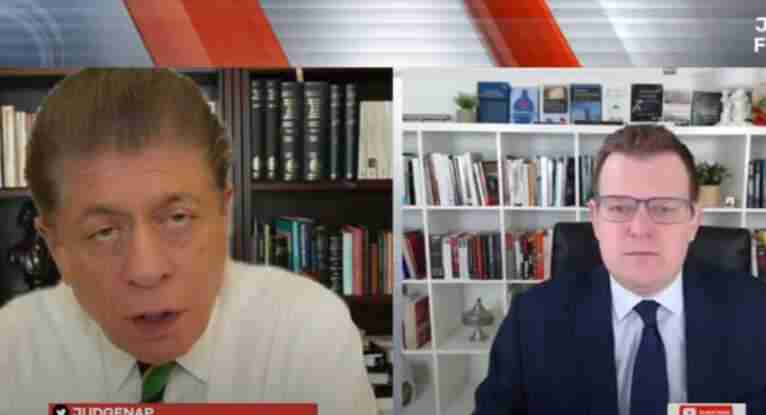
Read the full transcript of a conversation between Judge Andrew Napolitano and Norwegian political scientist Prof. Glenn Diesen on Judging Freedom Podcast titled “US Attacks Yemen, For What?” premiered March 26, 2025.
TRANSCRIPT:
Introduction
JUDGE ANDREW NAPOLITANO: Hi everyone, Judge Andrew Napolitano here for Judging Freedom. Today is Wednesday, March 26th, 2025. Professor Glenn Diesen joins us now.
Professor Diesen, always a pleasure. Professor, you are an internationally recognized scholar of geopolitics. Is the United States any safer today because it bombed Yemen the other day?
Yemen Bombing Analysis
PROF. GLENN DIESEN: Well, I wouldn’t say there’s a lot of evidence supporting that. Indeed, I think it was quite clear from some of these text messages which came out in a very embarrassing way that people like JD Vance was critical of it. I think he called it a mistake. And indeed, it really did make the question what the purpose was and also to what extent is actually successful.
Now, I think that the purpose was obvious in terms of attempting to open the sea lanes, but the extent to which that is actually possible is a different question. And it also puts the United States right back into one of Israel’s wars. Given that this is a conflict which is not in America’s interest, and also knowing that Israel would like to pull America into one of its wars, I would say, no, it’s not in America’s interest at all.
Trump’s Peace Promises vs. Reality
JUDGE NAPOLITANO: The president is supposedly a man of peace. He has stated many times before and after his inauguration, he hopes to be awarded the Nobel Peace Prize. He is continuing to fund the war in Ukraine, which Ukraine is bound to lose almost literally any day. He’s continuing to fund even accelerate the slaughter in Gaza. Now he’s bombing Yemen. Can anybody take him seriously when he says he’s a man of peace? Or alternatively, does it appear from your vantage point that the Trump administration even knows what it’s doing?
PROF. DIESEN: Well, in Ukraine, it makes sense to pull a military support intelligence right away because they are in the middle of negotiations. So they don’t want to give up an important hand because there’s not much leverage anymore. That is that the Russians have won this war.
It’s not much if they give up supplying the weapons, then not only do they lose an important bargaining card with the Russians, but also a key point of pressure for the Ukrainians. Keep in mind that Zelensky is quite reluctant to make any real compromises. So I think it’s quite important that he continues to have this card.
But I agree he was voted in for being a peace president. He was going to end the forever war. To call for ethnic cleansing of every man, woman and child in Gaza, or even now actually bombing Yemen, I think this is something that will disappoint many of his voters.
And it’s even worth noticing that from these leaked calls, it was quite evident that there were some of them which belonged to the America First club, such as Vance, who saw this as a European problem. But there’s still neocons there, so they’re driving not all in the same lane, it seems.
America First vs. Neocon Influence
JUDGE NAPOLITANO: Is it fair to conclude that notwithstanding the America First aspirations of President Trump, notwithstanding his talk about the grand reset, a big reset involving the United States, Russia, China, Brazil, and India, the president has surrounded himself with old-fashioned neocons who think that freedom comes from the barrel of a missile and who regard, Tulsi Gabbard said this under oath just two hours ago, Russia as an enemy, not as a likely trading partner to enrich both of us. Take it from there.
PROF. DIESEN: Well, unfortunately, it does appear that a lot of evidence coming in to suggest that one should be skeptical about the ability of Trump to actually follow through on what he said. Again, this is, I think it’s distinctively different though from the different presidents. But that being said, this is a common trend.
That is, Clinton, he was going to be the president after the Cold War to bring about some peace, but he ended up starting this nation building. Then the American people voted for Bush, which was going to, he was criticizing the nation building of Clinton, and then he took it on a much greater level in Afghanistan, in Iraq. He had people voting for Obama because he was going to offer change.
Then they voted for Biden because he was going to bring the adults back. And instead, he almost took America to war with Russia. So I think time and time again, people tend to vote in America for reducing or ending the wars, but they rarely get what they want.
So I think this is a good indication that there’s a very strong neocon element within the US. And I think this is very problematic because the main issue for the United States, if it does recognize that the unipolar order is over, that is, it should then stop wasting too many resources as it might run into some real economic problems. And it should take a more modest position in the international system, because if it attempts to be all powerful, that is, reestablish a unipolar order, then all the other major powers in the international system will try to balance the United States.
So a lot of what Trump said seemed to make a lot of sense. But we have to question why the policies aren’t actually reflecting what he said.
Democracy and Foreign Policy
JUDGE NAPOLITANO: Your recitation of the foreign policy foibles of modern American presidents reminded me of what George Galloway, who was just on this program an hour and a half ago, said, if voting changed anything, they’d abolish it. I mean, it almost sounds literally true when you can promise to be the man of peace and you’re funding all of these wars.
Do you see a connection between Donald Trump’s impatience with Vladimir Putin and his patience with Bibi Netanyahu?
PROF. DIESEN: Well, it is always a bit of a difference when you look at the American leaders and the relationship with Israel. But it also goes back to what you said about them banning democracy, or as Galloway said, because I think a lot of the democratic institutions have been hollowed out.
That is, we still have the rituals. Everyone can go and vote. But while one can change the people in power, there’s often less and less ability to actually change the policies.
So I don’t doubt that a lot of the people who genuinely believe in the platform they’re running on, but once they come into power, I think there’s a recognition that they have to adjust to the actual power structures. Now, Netanyahu, I think, obviously, gets much more loyalty from the United States. So whenever you see Netanyahu around Trump, you do question what happened to America first.
Now, I’m not sure if Trump would like to also reconsider America’s close relationship with Israel to the extent it doesn’t serve American interests. Maybe it’s something he wants to do, but it would be too bold to take on the entire Israeli lobby at the same time as he’s trying to do a huge gift with Russia. Again, it’s a possibility.
Or he might just be very much beholden to Netanyahu, like others.
Is Israel Safer?
JUDGE NAPOLITANO: But Netanyahu himself, in my view, and please push back or reinforce or modify as you see fit, Professor, from your vantage point in Norway, Netanyahu isn’t even making Israel safer. Is Israel safer because the IDF slaughtered a thousand civilians in Gaza in the past week?
PROF. DIESEN: No, and I think that’s why often we get into this difficult dichotomy of either support Israel or before Israel or against it. But really, this is not good for Israel either. You see, domestically, it’s becoming very, very divided. Society itself can fragment.
We see the army being very much exhausted. Indeed, one of the reasons why they accept the ceasefire is because the army has been overstretched. That is, they bogged down in Gaza. They have exhausted themselves against Hezbollah. Now they have the additional occupation of Syria. And if you see this issue with Yemen, this is not a recipe for success either.
That is, they can’t really hit the weapons which are underground. Indeed, the missiles and drones which they use tend to be a lot cheaper, which means that they can exhaust the American ones. And I’m not sure exactly what can be achieved.
And all of this appears to only be building up to the big war which they’re working themselves up to and trying to bring the Americans in, which is against Iran, which would just be a complete disaster. So I think Israel is on a very dangerous path, a very suicidal path. And again, I would caution the Americans not to go down with the Israelis.
Indeed, as a good friend, one should try to steer them away from this dangerous path.
Gaza Death Toll
JUDGE NAPOLITANO: It’s almost as if Netanyahu controls Trump rather than Trump controlling Netanyahu. Last week, the Hamas or Gaza, I’m not sure what they call themselves, health ministry, announced the burial of the 50,000th civilian in Gaza. Does the world even take note of the enormity of that slaughter? How does that number, 50,000 dead, these are people that can’t shoot back, how does that number resonate in Europe where you are?
PROF. DIESEN: Well, I think that all this killing has sadly become normalized. It’s just this news come out every day. But within the European Union, it appears that all of the violence, which all of the women, indeed, the EU leadership, as well as the German leadership, tends to be very supportive of Israel.
And again, I don’t see how this impacts any of that solidarity. So it is, yeah, no, it’s truly horrific, horrific numbers.
Zionist Influence in Europe
JUDGE NAPOLITANO: So there’s the Israeli donor class, as we call them here in America, the very, very wealthy Jewish and pro-Jewish, they’re not all Jews, pro-Jewish people who donate to American politicians with the quid pro quo that they will support whatever the government of Israel wants. Does that exist in Europe? Does Frederick Mertz owe his chancellorship to the Zionist lobby in Germany?
PROF. DIESEN: Well, it is an interesting group because, well, not all Zionists are Jews. Indeed, there’s a lot of Zionists among the Christians as well. And again, you also see that a lot of the people who oppose and criticize Israel are Jewish as well. So I think they fall most in the Zionist camp. But if you want to look at the donor class, it’s quite huge in Brussels. It’s become a very concerning trend.
But over many, many years now, which is that you have the lobbyist more or less penetrating the EU structures. The Germans are a bit interesting, though, because they have their history. And because of this, it appears that the way of making amends for the Holocaust is by allowing Israel to do whatever it wants and support it, which is a very strange thing because it’s effectively the Palestinians now have to pay for the crimes of the Germans in World War II. So it’s quite remarkable.
The Signal Scandal
JUDGE NAPOLITANO: You mentioned at the outset of the conversation, Professor Diesen, the signal scandal in which President Trump’s senior most national security officials were engaged in a group texting. People say it was a chat, it was texting. And somebody either intentionally or inadvertently included a journalist, a person well known. Some people like him, a lot of people don’t. He’s a former IDF member himself. He’s a former prison guard at Israeli prisons for Palestinian prisoners. But he’s an American and he works in Washington, D.C.
And now because the leading intelligence officials, the director of national intelligence and the director of the CIA testified under oath that they saw no military plans. Now he has posted the transcript of this conversation up to the point where he stopped copying it. And it shows that military plans were in fact posted. This is a very serious, potentially criminal issue. And I’m not going to ask you about the federal criminal law. It’s not your field. How does this resonate in Europe? All the Americans are cowboys. They can’t keep their phone calls straight. Or is it serious? Is it perceived as serious in Europe? I mean, think about it. The plans to attack another country were revealed to a journalist an hour before the attack took place.
PROF. DIESEN: Yeah, no, it is. Well, it did take the media, but a little bit by storm. The angling is, of course, usually aimed at presenting the Trump administration as incompetent because, as you know, the European political class is very much, well, almost a copy paste of the Democrats. So they don’t care much for Trump.
Indeed, they don’t care much for the Republicans. So they tend to be a little bit gleeful as this happened. Of course, it’s not a good look at all. Not only how they actually had the war plans when they said they didn’t. Again, the legal issues, as a judge, he would be much better at addressing this than me. But I think it is maybe a little bit of this cowboy feeling to it that it’s not done quite professionally.
And again, I think some of the criticism is fair because I think Trump put together a team such as Hegseth, which doesn’t necessarily have the right background or the sufficient experience.
Congressional Testimony
JUDGE NAPOLITANO: Here is a senator from Georgia, a young man that I really didn’t know, but I was quite impressed with his questioning. John Ossoff is the senator’s name, questioning John Ratcliffe. Now, Mr. Ratcliffe is the director of the Central Intelligence Agency and, of course, he is under oath.
SENATOR OSSOFF: And they were discussing the timing of sending U.S. air crews into enemy airspace where they faced an air defense threat, correct?
RATCLIFFE: I’m going to, Senator, defer to the other principles that you’re referring to about what the meaning and the context of what they were on.
SENATOR OSSOFF: The timing of U.S. airstrikes, correct?
RATCLIFFE: Yes. Yes.
SENATOR OSSOFF: And therefore, the timing of sending U.S. air crews into hostile airspace, correct?
RATCLIFFE: Yes.
SENATOR OSSOFF: And therefore, the time period during which enemy air defenses could target U.S. air crews flying in enemy airspace, correct?
RATCLIFFE: I don’t know that.
SENATOR OSSOFF: You do know that. Let me ask this question, General Hawk. You lead America’s signals intelligence collection. Would the private deliberation of foreign senior officials about the wisdom and timing of potential military action be a collection priority for you and the U.S. intelligence community?
GENERAL HAWK: Senator, it’s our job to do indications and warning for both the plans and intentions of adversary leaders and for military commanders.
# US Attacks Yemen, For What?
Pentagon Communications Blunder
And would not information about the timing of airstrikes allow a military to pre-position or cue air defense systems to shoot down enemy aircraft?
“I think, Senator, from our perspective, any advance warning is something that we certainly are trying to protect.”
JUDGE ANDREW NAPOLITANO: This, of course, was all before the actual transcript was released. That was from yesterday.
This morning, and I don’t blame him, people were calling this reporter a liar. He released the transcripts, and it showed that he was not lying, that he was telling the truth, and that, if anything, the person we just saw, Director Ratcliffe, his colleague, Director Gabbard, who’s a friend of mine, their colleague, Pete Hegseth, with whom I worked for 10 years at another network, were not being truthful.
A Diplomatic Disaster
PROF. GLENN DIESEN: Oh, this is a huge embarrassment. And it’s also coming from the U.S. leadership. This is the largest army in the world. You would have thought there would be some more professionalism here.
I’m not sure how this is going to play out. But again, this is not just a massive embarrassment. Trump has a knack for getting out of scandals. But overall, given how this was done, and all of the political capital which Trump has put into this, given that he was supposed to be the peace president, and now he’s using this very aggressive language to destroy Yemen or the Houthis, and obviously, he’s not going to be able to deliver on the massive threats he made, because this simply won’t work on them. They have been bombed since 2015.
I think this idea that he can just use very brutal language, and then somehow the Houthis will be fearful and bend to his will, I think this is a huge mistake.
And it can also get not just dragged into Yemen, but dragged in closer to war with Iran. And on top of it, what we’re seeing now with this, I guess, poor execution with them essentially texting each other and adding one of the journalists, which don’t even like them, who leaks these things.
Now they have also been caught lying to the public. So it’s an unmitigated disaster. So again, one has to see if Trump is able to get out of this one as well.
Potential War with Iran
JUDGE ANDREW NAPOLITANO: What will be the international economic consequences if the United States and Israel wage war on Iran?
PROF. GLENN DIESEN: That would be hard to predict. Iran can shut down important waterways. It can make energy prices go through the roof.
Indeed, if the US and Israel would attack Iran, they would probably use the airspace of different Arab states, like Saudi Arabia, which would then get retaliatory strikes as well. So there would be massive disruptions. And that’s just if they’re able to contain it to Iran.
And also, there’s no clear exit strategy. They’re not going to be able to defeat Iran. So how are they just going to bomb Iran and tell Iran when they’re done? No, I think Iran would hit back in a massive way. So they would set a dangerous precedent.
And also, keep in mind that Iran’s becoming very deeply integrated into more Eurasian, also BRICS economic system. So the Chinese and Russians, I don’t think, would want to sit around and do nothing. So I think it would be an absolute disaster for Trump to go down this path now, especially at this point in time when he’s trying to bring peace to Europe.
And on this, I commend him. And if he’s pulling it off, I hope he gets the Nobel Peace Prize. But what he’s doing now in the Middle East is beyond reckless.
And as we saw from these videos, it also appears to be done by amateurs. This is no way to run an operation.
Zionism and U.S. Politics
JUDGE ANDREW NAPOLITANO: You were talking earlier about how not all Zionists are Jewish. True. And how not all Jews are Zionists.
Here is some back and forth between Senator Tom Cotton, who’s a strong supporter of the administration and is the chair of the Senate Intelligence Committee, which means he has the highest intelligence level of clearance, and his good friend, Pete Hegseth, the Secretary of Defense.
SENATOR COTTON: “During the Biden administration, I want to give you a chance to respond to what they said about you. I think the first one accused you of being a Christian Zionist. I’m not really sure why that is a bad thing. I’m a Christian. I’m a Zionist. Zionism is that the Jewish people deserve a homeland in the ancient holy land where they’ve lived since the dawn of history. Do you consider yourself a Christian Zionist?”
PETE HEGSETH: “Senator, I support. I’m a Christian, and I robustly support the state of Israel and its existential defense and the way America comes alongside them is a great help. Thank you.”
JUDGE ANDREW NAPOLITANO: The only thing worse is Mike Huckabee, who is another former colleague of mine from Fox, who is the nominee to be the U.S. Ambassador to Israel, referring to people that are opposed to Zionism. Zionism, of course, is not democracy. It’s apartheid, as Satan. But I guess you’re right. The influence of the Zionists is all over the place. Now you tell me it’s even in Brussels. I’ll give you the last word.
The Contradiction of Zionism
PROF. GLENN DIESEN: Yeah, well, Zionism could be fine if it’s a Jewish nation state. But if that Jewish nation state would be full of Jews, it would be one thing. But the problem is when the Zionist state denies a separate Palestinian state. Because if Israel will now be a Jewish nation state in which it then encompasses greater Israel, that means half the population will be non-Jewish.
How are you going to have a Jewish nation state if half the population is not Jewish? Well, then you either have to have them live under apartheid rules, such as they do in the West Bank. Or you’re going to have to ethnically cleanse or genocide a large part of it, which is what you’re seeing in Gaza. I think this is the danger of Zionism.
Again, when they say Israel has a right to exist. Yes, but if they don’t accept that same right for Palestine, then there’s not many more options. No one really explained to me what the alternative is. If you’re going to have only half the population being Jews because you deny a Palestinian state, what is the alternative to either apartheid or ethnic cleansing? I don’t really see what the option, what the alternative would be.
JUDGE ANDREW NAPOLITANO: Nicely put. It is a disaster. Professor Diesen, always a pleasure, my dear friend. Thank you for joining us. We’ll look forward to seeing you again back here soon.
PROF. GLENN DIESEN: Thank you, Judge. Of course.
JUDGE ANDREW NAPOLITANO: And coming up later today at two o’clock Eastern, Aaron Maté on all of these things. At three o’clock Eastern on all of this, Phil Giraldi. Judge Napolitano for Judging Freedom.”
Related Posts