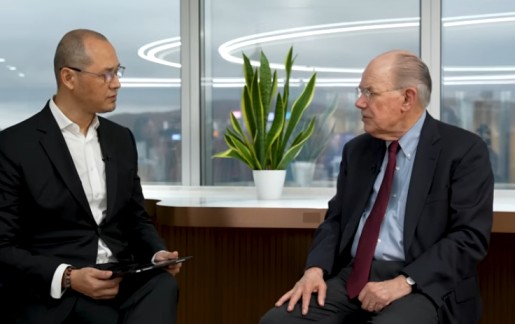
Read the full transcript of political scientist John Mearsheimer’s interview on Talking Post with Yonden Lhatoo, June 17, 2026.
Editor’s Note: In this episode of Talking Post, political scientist John Mearsheimer joins host Yonden Lhatoo to provide a candid analysis of the current global geopolitical landscape. Mearsheimer discusses the intense security competition between the U.S. and China, the evolving nature of the international order, and the impact of the U.S. involvement in conflicts in the Middle East and Ukraine. The conversation offers a critical perspective on American foreign policy and the role of international alliances in today’s multipolar world.
US-China Relations: The Big Picture
YONDEN LHATOO: You’re in Hong Kong now. We’re in China. And I’d like to start this conversation by asking about China, particularly in relation to its ties or conflicts with the US. We consider that the most important geopolitical relationship in the world right now. You’ve seen the presidents of China and the US meet and talk. There was nothing much substantial to show in terms of deals, and contracts, etc. But it was the two of them talking after a very long time and the president of the US making a state visit to Beijing. Can we see, do you see any turning of the tide in how relations will go forward? Or is this just Trump, Donald Trump, making his personal relationships?
JOHN MEARSHEIMER: Well, I think that at its root, at its base, the US-China relationship is deeply competitive. I believe that there is and will continue to be a serious security competition between the United States and China. But what’s happening at this juncture is that the United States is deeply involved in a war in the Middle East against Iran, and it’s deeply involved in Europe in the Ukraine-Russia war. And given American involvement in those two conflicts, the United States cannot afford to have a crisis with China in East Asia.
So what you see when President Trump comes to Beijing is that he comes looking to smooth the waters with China, to have as good a set of relations as possible with China now because we are — we meaning the United States — bogged down in the Middle East and bogged down in Europe. But I believe that once the war in Iran is settled and once the war in Ukraine is settled, then the United States will concentrate more on pivoting to Asia and the competition, the security competition between China and the United States will heat up.
YONDEN LHATOO: It’s like going back to the main course, which is actually to contain China, isn’t it? In a way, you could say the wars going on that the US is fighting or is involved in, in some way or the other, they are ultimately aimed at the hegemon asserting itself and containing the other parties, the rising power, per se.
JOHN MEARSHEIMER: No, I don’t think that’s the way to look at it.
YONDEN LHATOO: I think China’s partners like Iran, Venezuela, he’s going after each one?
JOHN MEARSHEIMER: I don’t view them as China’s partners. I don’t think that what’s happening with regard to Venezuela or even what’s happening with regard to Iran is the United States going after China. I think the United States has a broad agenda. The United States is interested in running all the different regions of the world, or it has been, since the unipolar moment or during the unipolar moment. But I don’t think this is a case of the United States going after countries that are allied to China.
YONDEN LHATOO: So it’s just distracted at the moment by other business, but the main course is China, right?
JOHN MEARSHEIMER: There’s no question about that. China is a peer competitor to the United States. And in my opinion, China is determined to dominate Asia. China wants to take Taiwan. China wants to dominate the South China Sea, and it wants to dominate the East China Sea. And the United States is interested in preventing that. The United States doesn’t want China to be a regional hegemon. So you have this security competition between the two of them. But at this point in time, there’s a lull, right, in that security competition because the United States is bogged down in these other conflicts.
Offensive Realism: Can China’s Rise Be Peaceful?
YONDEN LHATOO: You have a very interesting theory regarding geopolitics between superpowers, the offensive realism. When you talk about this, you mentioned that China’s rise therefore cannot be peaceful in that sense. When you say China’s rise cannot be peaceful, do you mean it in the sense that China has no choice or it will be in confrontation, security competition and all that with a power like the US? Or do you mean that China’s intention cannot be peaceful?
JOHN MEARSHEIMER: My argument is that because there is no higher authority that can protect states in the international system, and you can never know the intentions of other states, you have a deep-seated interest in making sure that you are much more powerful than all of the other states in the system. In other words, I think that the best way to survive in a system where there’s no higher authority is to be the most powerful state in the international system.
Now, in practice, what that means is that any particular state should try to dominate its region of the world. It should try to be a regional hegemon. And there’s only one regional hegemon in modern history, and that’s the United States of America. That is the ideal situation for any great power, because by definition, if you’re a regional hegemon, there is no other country in your region that can threaten your survival. That’s as good as it gets.
However, there’s one caveat, and that is you don’t want another country to dominate its region. You just want to be the only regional hegemon in the system.
So the United States will go to great lengths to prevent China from dominating East Asia the way the United States dominates the Western Hemisphere. That’s point number one.
But from China’s point of view — this is my second point — China will, like the United States, want to be a regional hegemon. I think from China’s point of view, it makes eminently good sense to be a regional hegemon in East Asia. But from an American point of view, that’s not a good thing. That’s the principal source of the security competition between the United States and China. That’s what makes this rivalry so dangerous. China wants to dominate East Asia the way the United States dominates the Western Hemisphere. And China should want to dominate East Asia. But again, my point is the United States will go to great lengths to prevent that from happening.
Has the Global Order Changed Under Trump?
YONDEN LHATOO: Has the global order changed now as a result of what the United States is doing openly? Now, we do know that the United States, the US being the superpower, has acted in this way for decades, but now it’s out in the open. You have the President of the US standing in front of a mic facing the whole world and threatening to wipe out an entire civilization. I mean, the Trump official administration officials openly say, “What international order? There is no international order, it’s what we make of it.” And might is right. So is this an aberration just as long as Trump is in the White House, or has the US approach to being the dominant power changed to this now? It’s open assertion. There’s no pretenses and there’s no fancy talk about rights and spreading democracy.
JOHN MEARSHEIMER: Well, look, the United States built an order after World War II in the West, right? And then when the Cold War ended and the bipolar world went away, we moved into the unipolar world where the United States was the most powerful state on the planet. It was the unipolar moment. And what the United States did was it took that order that it built during the Cold War in the West and it extended it all over the globe. And indeed, it integrated China into that international order during the unipolar moment. That’s the principal reason that China grew so powerful. It was integrated into this capitalist world system that the United States dominated.
Then what happened was the unipolar moment went away in around roughly 2017, and we moved into a multipolar world, which is the world that we live in today. We have three great powers: the United States, China, and Russia. And as we moved into this multipolar world, the existing order was basically that international order that the United States had put in place during the unipolar moment.
What’s happened under President Trump is that he has come to the conclusion that the institutions that comprise that order are basically useless, that international law Congress has no real meaningful role to play, and that he, Donald Trump, should decide what’s good or bad for the United States and other countries in the system. This is unprecedented because all presidents, all President Trump’s predecessors privileged institutions and privileged international law.
It’s very important to understand that we created — we meaning the United States — created these institutions. We created international law. We wrote the rules that underpin these institutions. And we did it because it was in our national interest. But President Trump, who is a real anomaly here, he’s a really unusual president, he believes that those institutions and international law just don’t matter very much.
YONDEN LHATOO: Can he fundamentally change that American approach to all this, or this will just be as long as he is in power?
JOHN MEARSHEIMER: Just as long as he’s in power, I believe.
YONDEN LHATOO: Do you believe that America will then shift back to its —
JOHN MEARSHEIMER: Yes, I think that once President Trump leaves office, there will be a renewed emphasis on international institutions and international law.
Rumors of America’s Decline
YONDEN LHATOO: The almost wishful thinking of America’s adversaries is that this is — Trump is symptomatic of the decline of the American Empire, America will no longer be the superpower in the near — in the foreseeable future. This is all just rumors of its demise have been greatly exaggerated, isn’t it? America is still the dominant power in our foreseeable times.
JOHN MEARSHEIMER: During the unipolar moment, there was by definition one great power on the planet. It was the United States of America. Then we moved into the multipolar world, the world we’re in now, and China and Russia are also great powers. And China is almost as powerful as the United States. So there’s no question that when you go from being the unipole to being one among three great powers, there’s going to be a decline by definition, and how much relative power you control. So the United States of America has declined somewhat in terms of power, but in terms of absolute power, it remains as powerful as ever.
It’s a very powerful state, and it’s going to be a very powerful state for the foreseeable future. In fact, the two most powerful states in the world today are China and the United States, and they’re going to be the two most powerful states moving forward. And what I’m saying is that these two states are going to clash, not necessarily fight with each other, and hopefully they won’t fight with each other, but there’s going to be an intense security competition between China and the United States because China is going to want to dominate East Asia and the United States is going to want to prevent China from dominating East Asia.
America’s Allies: Did They Get the Memo?
YONDEN LHATOO: Do you think America’s allies have, following the traditional mode of the West, the Western alliance, and how they deal with countries like China — do you think they’ve been left behind in a sense? If you look at the Shangri-La Dialogue that just happened recently, we had Pete Hegseth, Secretary of War from the US. He didn’t mention Taiwan at all. He talked about the strategic relations between the US and China in terms of military, there is a competition, but his entire language was very different, say, compared with the Australian defense minister at the same forum. He went back to the traditional thing: China must abide by international law, the world order, etc. So I got the impression that the Australians didn’t get the memo from the US on how foreign policy is going to be carried out now.
JOHN MEARSHEIMER: Well, let’s just talk about Hegseth, who represents, I think, Trump’s thinking. On institutions, international law, and also allies. We talked before about the international order, and there we were talking about institutions and international law. And the point was made that President Trump has little use for international institutions, little use for international law, which is another way of saying he has little use for international order. He also has little use for allies. And that’s reflected in Hegseth’s comments, right?
President Trump treats America’s allies worse than he treats America’s adversaries, right? The thing you want to understand about President Trump is he is a unilateralist par excellence. Institutions by definition are multilateral in nature. We sometimes refer to them as multilateral institutions. But President Trump is not a multilateralist. He’s a unilateralist. He wants to run the world. He wants to run the United States. And I think Pete Hegseth reflects President Trump’s view of international politics.
And the point I made to you before is that this is extremely unusual in American history. All of Trump’s predecessors placed great emphasis on institutions and on international law. We wrote the rules that underpin those institutions. We wrote the laws. And with regard to allies, his predecessors treated allies with great respect because they understood in a complicated world like the one we live in, you need allies. You don’t want to make those allies adversaries or turn those allies into adversaries. But that’s not the way President Trump sees the world. He’s a very unusual president, right?
The Iran Deal: A Victory for Tehran?
YONDEN LHATOO: Talking about his problems right now, you can see he’s desperate for a deal on the Iran war because the US and Israel’s war against Iran, the way it’s gone about, I mean, it’s pretty obvious that in many senses of the word, victory is the Iranians, you give it to the Iranians, they basically won.
Trump seems to be hell-bent on putting language in that document that Iran promises not to pursue nuclear weapons. But they already had that. They had that 11 years ago with Obama and John Kerry. And there it was very specific that they would not do this. Not only that, the Iranian leader, who was the elderly guy who was murdered in his bed eventually, he actually issued a fatwa against nuclear weapons in Iran, Iran pursuing a nuclear weapon.
So now we’re looking at a new agreement which is being shown to the world as a success in Trump and his deal-making, but he’s trying to get the Iranians to say what they already signed on paper, and now we all have to accept it. I do accept that, I do have to say it’s a relief that the Straits of Hormuz will open hopefully as a result of this, and that the world can go back to uninterrupted commerce. So that is to be welcomed, but in terms of what he’s actually showing the world, he’s lost a war, and now he’s putting something down on paper and hailing it as a triumph, which he already had, and he walked away from himself.
JOHN MEARSHEIMER: Do you want me to disagree with you?
YONDEN LHATOO: Absolutely.
JOHN MEARSHEIMER: I can’t.
YONDEN LHATOO: You can’t.
JOHN MEARSHEIMER: I think you summarized the situation perfectly.
YONDEN LHATOO: How reliable do you think is this peace deal that Trump and the Iranians will show the world in terms of its lasting impact and also in terms of the big elephant in the room, which is Israel’s refusal to accept clauses like ceasefire with Lebanon?
JOHN MEARSHEIMER: I think if you look at the agreement that has been put on the table at this point in time, and it’s very early because this memorandum of understanding has just been made public and it’s not going to be signed for a few days, but if you look at the agreement, it’s quite clear that the United States has suffered a significant defeat. That the Iranians have won this war based on what’s in that document. And the Americans are going to end up making a whole variety of concessions to the Iranians.
And really all the Iranians are doing is saying they’re not going to develop a nuclear weapon. But as we both know, the Iranians have long maintained that they were not going to develop a nuclear weapon. So there’s nothing new here. So the United States gets very little out of this deal, hardly anything. And Iran gets a great deal.
YONDEN LHATOO: So what has been achieved? I mean, this was— is it a colossal error because it was at the behest of the Israelis that he went into an alliance with them and didn’t think long-term? So do we blame the Israelis for this, what’s happened, the current situation with the Iran war?
Israel’s Role in Drawing the US into War
JOHN MEARSHEIMER: Well, there’s no question that the Israelis coaxed President Trump into going to war. They convinced him. Prime Minister Netanyahu and the head of Mossad, David Barnea, those two individuals played a key role in convincing President Trump that he could win with the Israelis a quick and decisive victory against Iran and solve all our problems with Iran. In that sense, the Israelis bear much responsibility for dragging us into this war.
But President Trump is in charge of the United States, and he could have said no. The fact is he said yes to the Israeli argument that it was time to attack Iran again. And you want to remember, we together, Israel and the United States, attacked Iran in June 2025. So this is the second time the Israelis and the Americans went to war against Iran, although this time our ambitions were much greater. President Trump foolishly went along. It was a massive miscalculation on his part. And the end result is that here we are today, and if you look at the memorandum of understanding between the two sides, it’s quite clear that Iran won the war and we lost.
Patriotism vs. Criticism: Are They Mutually Exclusive?
YONDEN LHATOO: When you say something like that, I know you describe yourself as a nationalist, and a lot of what you say solidifies that. But when you say things like Iran has won this war, this was a colossal mistake, nationalism, you described it yourself as it’s the most powerful ideological force in the world right now. All of us are nationalists in some sense or the other, whatever countries we live in. But given the current climate in the US, especially against critics of the Trump administration, do you sometimes, are you sometimes a little nervous or a little concerned about being branded as anti-American?
JOHN MEARSHEIMER: Well, if you’re talking about nationalism, right? You’re talking about a particular citizen of a country and how he or she thinks about what their government is doing. There’s nothing wrong with criticizing your government when it’s doing something foolish. In fact, one could argue that that’s the highest form of patriotism, that you’re willing to criticize your government, you’re willing to subject yourself to being criticized for being anti-American or not a good American.
But that’s not my idea of what a good American is or a good Chinese person. If I’m Chinese and I think my leadership is pursuing a foolish policy by doing X or Y or Z, I think it makes eminently good sense for me as a Chinese national to tell the government that I think that this is a foolish policy. So I think anybody who argues that for an American to be patriotic or to be a good nationalist, you have to applaud or support everything your government does, is making a foolish argument. You, as a good American, should be able to tell your government when it’s pursuing a foolish policy.
YONDEN LHATOO: I see that foolish argument used a lot against people speaking out these days.
JOHN MEARSHEIMER: Yeah, but the point is that people who are pushing a particular policy don’t want other people saying the policy doesn’t make sense. And the best way to silence people who are critical of the existing policy is to accuse them of being anti-American or anti-Chinese, depending on which country we’re talking about here. In effect, you’re smearing people. You can’t beat them on facts and logic, so you call them names. You say they’re un-American, that they don’t love the United States, and so forth and so on. But this is a foolish argument, and it’s an argument that people make when they can’t win an argument on the basis of facts and logic.
Understanding the Israel Lobby’s Power Over US Foreign Policy
YONDEN LHATOO: When you mentioned Israel, basically coaxing and leading the US into this war. In this part of the world, many people struggle to understand the Israeli influence on US governments. I mean, this is a small country in the Middle East of just over 10 million population. And in ways like this, where you are dragged into a war like Iran, which can be catastrophic, this little country and its influence, its lobby in the US is able to dictate the destinies of hundreds of millions of Americans. How does this work? Help us to understand this. What is the power that Israel holds over the US?
JOHN MEARSHEIMER: The fact is that the American political system is set up in ways that allow interest groups or lobbies to have enormous influence. So if you look at how American politics works, you’ll see lots of different interest groups that wield great influence in the political system. I believe that the Israel lobby, which is comprised of American citizens, is the most powerful lobby in US history. It has huge influence on American foreign policy. And what the Israel lobby does is it pushes the United States to support Israel unconditionally. In other words, no matter what Israel does, the lobby insists that we support Israel.
And this is unprecedented in recorded history. There is no evidence of a country— and here we’re talking about Israel— operating through the lobby, can get a great power like the United States to support that smaller country no matter what it does. But the key mechanism that allows this to happen is this lobby inside the United States. And as I said, lobbies in the United States, or interest groups, another name for lobbies, they have a huge amount of influence and the Israel lobby is able to affect American foreign policy in remarkable ways.
A Sea Change in American Public Opinion on Israel
YONDEN LHATOO: As a result of the Iran war, it started first with the genocide in Gaza. Now as a result of what’s happening with Iran, I don’t know how substantial it is, but it seems to be out in the open. There used to be a time when people would not dare criticize Israel, except for fringe people or maybe some real liberal-leaning people. Now there’s a lot of open talk about it, that enough of this. So, and then if you look at Trump right now, he is openly upset with the Israelis and he is saying things like, “You wouldn’t exist without us.” Do you see this again as just an anomaly while Trump is around, or is there going to be a kind of change? Are more Americans aware of this and questioning why should we? Just because Israel says so.
JOHN MEARSHEIMER: There’s no question that since October 7th, when the Palestinians in Gaza attacked into Israel, this is October 7th, 2023, that since then, because of Israel’s behavior in Gaza, its behavior in Lebanon, its behavior in Syria, and its behavior towards Iran, that public opinion in the United States has undergone a sea change, and there is much more criticism of Israel in the body politic than there has ever been.
And furthermore, the lobby has been exposed in ways that was not the case in the past. Huge numbers of Americans now know about the Israel lobby. Even when you go outside the borders of the United States, people like you talk about the lobby and its tremendous influence. And I think since October 7th, more and more people are talking like you about the lobby and its influence, and more and more people are critical of Israel in ways that were not the case in the past. So things have really changed.
And it’s a big question in the American discourse about what kind of influence Israel is going to have through the lobby in the future. Is it going to remain the same? Is the lobby going to remain as powerful as ever, or is the lobby going to be weakened because of what Israel has done in Gaza with the genocide and what it’s done in Iran? Remember, the Israelis played the central role in dragging us into the war. Again, Trump was the ultimate decision maker. He was the ultimate decider. I understand that. But he was heavily influenced by the Israelis. So Israel’s reputation and the lobby’s reputation in the United States has suffered greatly since October 7th.
YONDEN LHATOO: They’ve actually hurt themselves a lot. They’ve hurt themselves the way they’ve conducted this, right? This is the first time I’m seeing so much open criticism of what they’ve done.
JOHN MEARSHEIMER: There’s no question about that. Inside the United States and outside the United States. No, as I said to you before, I believe there’s been a sea change in how Americans think about Israel’s behavior and think about Israel just in general. And there’s been a sea change in how Americans think about the lobby. The lobby is now out in the open.
Steve Walt and I wrote this famous article on the Israel lobby in 2006 in the London Review of Books. And then a year later we published a book called The Israel Lobby and U.S. Foreign Policy. This is in 2007. And back then not many people knew about the lobby, and even those who knew about the lobby didn’t think it was all that powerful. And there were a good number of our friends who said that they believed we exaggerated how powerful the lobby was in both the article and the book. And as I would say to people at the time, I think really what you’re getting here is the tip of the iceberg. We’re not exaggerating the power of the lobby. The lobby has awesome power. But I think that’s now clear to large numbers of people. That’s what’s changed.
The War in Ukraine: Reality vs. Western Narrative
YONDEN LHATOO: What about the war in Ukraine? That’s another war that’s not going the way the US or the West wants it to go. From the time it broke out, I was reading Western mainstream media reports of how the Russians are losing and the Ukrainians are really doing an amazing job. It’s 4 years later and I still see that kind of story where Ukraine’s— a lot of setbacks for Ukraine, for the Russians, and the Ukrainians are really holding on. That’s not the reality, is it?
JOHN MEARSHEIMER: No, the Russians are winning the war more slowly than most people, me included, thought would be the case. I thought the Russians would win more quickly. But I think drones, drone technology has allowed the Ukrainians to hold on to territory much more successfully than I anticipated. But nevertheless, the Russians are rolling up the Ukrainians. The imbalance in manpower, or to put it slightly differently, the imbalance in soldiers on both sides, the imbalance in artillery and so forth and so on, so decisively favors the Russians that they will end up winning what I would call an ugly victory.
The Lessons of History and Looking Ahead
YONDEN LHATOO: Don’t you think it’s something to do with, you know, they say those who cannot remember the past are condemned to repeat it. This seems to be the failure on the people instigating these wars or supporting these wars seems to be not remembering history. When you fight Russia, you’ve seen how it works out. You know, they have an endless supply of people they throw to the cannons, cannon fodder. Same thing with the US invasion, the war against Iran right now. If you look at Iraq, if you look at— go all the way back to Vietnam. All these things seem to be repeated because people don’t seem to care about what happened in history.
JOHN MEARSHEIMER: But you’re assuming that every time you go to war, you lose. And the fact is that sometimes you go to war and you win. You know, the Japanese went to war against Russia in 1904, and the Japanese won. In 1991, the United States went to war against Iraq, the famous Gulf War, after Iraq invaded Kuwait, right? And we won.
YONDEN LHATOO: But against the Russians, I mean, you saw what happened to Napoleon, you saw what happened to Hitler. I mean, they know how to— they can carry on.
JOHN MEARSHEIMER: But you’re forgetting World War I.
YONDEN LHATOO: Okay.
JOHN MEARSHEIMER: The Germans lost, I mean, the Russians were defeated in World War I. They surrendered to the Germans. And you actually had the Soviet Revolution, Russian Revolution, which ended up leading to the creation of the Soviet Union in 1917. So sometimes states win and sometimes they lose. And the problem is when states go to war, they invariably think they’re going to win. They may end up losing, that’s your point, but they don’t go to war thinking they’re going to lose.
YONDEN LHATOO: No, they never do that, yeah, but they often end up losing as history has shown.
Final Assessment: Iran, Ukraine, and What Comes Next
Anyway, last question, Professor. The Iran war right now, it’s uncertain. There’s a peace deal going on, but we don’t know when it’s going to go back to bombing. You have a full-blown war still going on in Ukraine. Given the situation right now, and the disruption to commerce and everything else around the world, and given the way that if there’s any appetite or none to stop these wars, the way the affected parties are going about it, I know you don’t have a crystal ball, but in your opinion and your assessment, what do you think might happen?
JOHN MEARSHEIMER: Well, I think with regard to the Middle East, I think that the Iran war will be shut down. And I don’t think you’re going to have a situation where Iran, Israel, and the United States live in harmony and it’s highly peaceful or very peaceful. I don’t think that’s going to happen. But I think the United States has a vested interest in making sure this war is ended, the Strait of Hormuz is opened, and that the international economy doesn’t go off the precipice, right?
I mean, the reason that the United States is going to enormous lengths to shut this war down right now is because we understand— we meaning the United States— we understand that the economic consequences of continuing this war would be disastrous. So I don’t think the United States and Israel are likely to go back to war against Iran. If they do, if I’m wrong, the economic consequences will be disastrous. But again, but again, that’s why I don’t think that will happen. So I think that war will come to a messy end, but it will end. That’s my view.
And I think with regard to the Russia-Ukraine war, I think that, you know, probably over the course of this year, maybe early next year, the Russians will win an ugly victory. I think the Russians are winning the war. They’re slowly pushing back the Ukrainians, more slowly than I anticipated. But I think in the not too distant future, the Ukrainians will surrender and you’ll get a frozen conflict, right? There’ll be some sort of armistice. And you’ll have a frozen conflict, and relations between the Russians on one side and the Europeans and the Ukrainians on the other side will be terrible for the foreseeable future.
YONDEN LHATOO: So, all right, on that very optimistic note, I know you’ve been really busy in Hong Kong. You’ve been going from one speech to the other, and we won’t take up any more of your time, but thank you very much for joining us and for sharing your wisdom with us.
JOHN MEARSHEIMER: It’s my pleasure.
YONDEN LHATOO: Thank you very much.
JOHN MEARSHEIMER: You’re welcome.
Related Posts