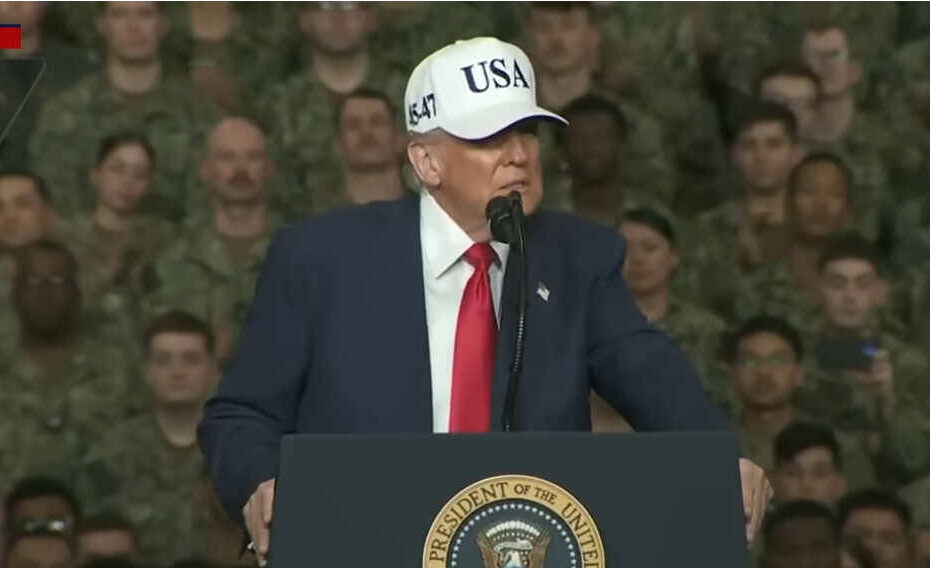
Read the full transcript of President Trump’s remarks to troops on the USS George Washington in Yokosuka, Japan, October 28, 2025.
Welcome and Opening Remarks
PRESIDENT TRUMP: What a group. What a group. All champions. Well, thank you very much. A big hello.
This is a special group of Patriots, champions, winners. You are winners. Oh, I’d love to have your job. And a very special hello to the greatest sailors anywhere on the seas, the incredible men and women of the United States Navy. Very special people.
Thank you very much. It’s great. Great honor to be here. But I’m thrilled to be here among thousands of proud American patriots aboard the one hundred thousand tons. That’s a lot of tonnage.
Forward deployed symbol of legendary USS George Washington. This is some ship. They don’t make them this way anymore, but we’re not supposed to say that, but they really don’t. This is great stuff. This is really an incredible GW, they call it.
GW, right? And we’ve come this afternoon to celebrate the strength and the skill service of everyone on this ship. So we’re going to all relax. We’re going to have a good time. We’re not going anywhere.
You know, if you go back to Washington, it’s like two o’clock in the morning. But I want to just tell you that you are special people and we’re going to have a little fun. And I’m going to tell you how great our country is and how well we’re doing because a year and a half ago, we had a different country than we do right now.
Now we’re the most respected country in the world. We’re the hottest country anywhere in the world, and it hasn’t taken too long. But I had no doubt. I just didn’t know we were going to do it this fast. We’ve done it fast because of people like you. So I want to thank you very much.
Recognition of Secretary of Defense Pete Hegseth
And I want to recognize a man that you all know well, and he’s a tough cookie. Defense, but now he is proudly known as our secretary of war, Pete Hegseth. You know, I don’t say this. He gave up a hell of a job. They were going to pay millions of dollars. They didn’t want him to leave.
That crazy fox said he wanted to leave, but he wanted, you know, every time I’d go on that show, all he wanted to talk is the military. And I said, you know, if I ever do this, I’m going to bring this guy along with me. He knew more about it than anybody. He didn’t want to be doing the other stuff. And he had a chance. He could have made so much money. He wouldn’t have known. He didn’t want that. This is what you wanted, Pete. He’s so happy now.
Those drug ships aren’t coming in anymore. We can’t find a ship. There’s no ships coming in with drugs. You know, it’s like he’s been incredible. So thank you very much, Pete. You gave up a lot. We appreciate it. Thank you.
New Defense Policy and Commitment to Victory
And unlike past administrations, we will not be politically correct. You don’t mind that, do you? When it comes to defending the United States, we’re no longer politically correct. We’re going to defend our country any way we have to, and that’s usually not the politically correct way.
From now on, if we’re in a war, we’re going to win the war. We’re going to win it like nobody ever before. You know, we’d go in. We’d blast the hell out of countries. Shouldn’t have gone in. By the way, if you don’t go in, that’s even better. We don’t have to go in, peace through strength.
But, you know, we’d go in with win and then we’d leave. They used to say to the victor belong to spoils. Well, we’d be the victor that would leave because we had people that didn’t know what the hell they were doing.
The U.S.-Japan Alliance
But we’re also very honored to be joined by hundreds of our incredible Japanese partners, and they are incredible. Thank you very much. This woman, this woman is a winner. So, you know, we’ve become very close friends all of a sudden because their stock market today and our stock market today hit an all time high. That means we’re doing something right.
But the cherished alliance between the United States and Japan is one of the most remarkable relationships in the entire world. Really, there’s never been anything like it. Born out of the ashes of a terrible war, our bond has grown over eight decades into the beautiful friendship that we have. It’s a foundation of peace and security in the Pacific. You see it?
So on behalf of all American sailors stationed in this country, let’s hear it for our allies and the Japanese Self Defense Forces and all of the Japanese people that we love and respect. And I have such respect for Japan and the country. And now I have a really great respect for the new and incredible prime minister. And I have to say this, the first female prime minister in the history of Japan. Madam prime minister, please say a few words.
Remarks by Japanese Prime Minister
JAPANESE PRIME MINISTER: Thank you, Mr. President, and thank you all. This year marks the U.S. Navy’s semi quincentennial anniversary. As we celebrate the important milestone, I’m truly honored to have this opportunity to deliver remarks with President Trump aboard the aircraft carrier USS George Washington, a symbol of protecting freedom and peace in this region.
First and foremost, I would like to express my deep respect and sincere gratitude to all the men and women in uniform from Japan Self Defense Forces and U.S. Forces Japan for your dedication and commitment to safeguard peace and security of our nation and the region day and night. Thank you.
Six years ago, at this same place here in Yokosuka City, the late Prime Minister Shinzo Abe and President Trump stood side by side and demonstrated their resolve that Japan and the United States would join hands to ensure peace and security in this region.
Now as the two Commanders in Chief of Japan and the United States stand together once again, I have renewed my determination to carry forward that resolve and to make the Indo Pacific free and open so that it will serve as the foundation of peace and prosperity for the entire region.
Now we are facing an unprecedented severe security environment.
From where we stand, we can see Maritime Self Defense Forces, Mogami and Maya. Vessels of Japan’s Maritime Self Defense Force and USS George Washington have conducted numerous joint exercises. Just as importantly, there are so many community here. Those are what have been supporting the activities of U.S. Navy over the years.
There’s no doubt that such multilayered Japan U.S. Cooperation is what makes it possible for us to ensure the credibility of our two nations’ deterrence and response capability.
So let me reiterate my unwavering determination here. Japan is committed to fundamentally reinforce its defense capabilities and Japan is ready to contribute even more proactively to peace and stability of the region.
Through these efforts, together with President Trump, I am determined to elevate the Japan U.S. Alliance, which has already become the greatest alliance in the world, to even greater, greater heights.
Japan and the United States will advance together with our sales raised high across a free and open sea. And I am very confident that the sea route from Yokosuka will make our bond even stronger and stronger and bring our two nations on the path to a shining future. Thank you.
Missile Delivery Announcement
PRESIDENT TRUMP: That was beautiful. Thank you very much. And we will have a long good relationship and we’ll have fun doing it. You know, you have to have fun. Although sometimes it’s never fun. She’s tough to negotiate with, I want to tell you.
But I’m delighted to report that I’ve just approved the first batch of missiles. You saw a couple of them coming down with me. I hugged them. We need them. They’re the best in the world. Nobody has them like we have them. They all want our missiles. That’s the problem. Everybody wants it.
But it’s the first batch of missiles to be delivered to the Japanese Self Defense Forces for Japan’s F-thirty five. They’re coming this week. So they’re ahead of schedule. So I just want to tell, Madam Prime Minister, they’ve been waiting for those missiles and we got them here right away as soon as I heard about it.
Recognition of Officials and Military Leaders
I want to thank senator, former senator, a great gentleman, by the way. He was so popular, but I took him out and I made him secretary of state. I think he was born for it. Marco Rubio. Thank you very much, Marco. Where are you, Marco? Great job. Great job. He was born for it.
Ambassador George Glass. Thank you very much, George. Good job you’re doing. Thank you.
And many of our outstanding uniformed leaders with us today, including the head of the Indo Pacific Command, Admiral Samuel Paparo. Where is Samuel? Hello. Good. But he’s a good looking people. Make a movie with these guys. They’re like central. Look at this group of people.
Commander of the U.S. Forces, Japan General Stephen Juste. Thank you, Stephen. Thank you very much.
The commander of the seventh, oh, that’s a big deal. I think you want to switch jobs for one week. Only for one week. All right. Seventh Fleet. Big stuff. Vice Admiral Fred Kacher. Fred, thank you very much.
And the commander of carrier strike group five, Rear Admiral Eric “Pappy” Andose. Yellow Pappy. That’s great. Good. Thank you very much.
And of course, we can’t forget about your command triad aboard the George Washington. There’s nothing like this one. This is a beauty. And I hear your commanding officer is a big Alabama football fan. You know, I love Alabama. I love Alabama.
Captain Timothy Waits. And let me just say roll tide. You know, I love Alabama. Roll tide. Where’s Timothy? Where’s Timothy? That was a hell of a game this week. I don’t know how the hell you pull that one. If you didn’t win, I wouldn’t have mentioned it. I would have just introduced you. I wouldn’t have. But you came back from oblivion. Isn’t it nice coming back? You know, coming back is good.
Thanks as well to your exo captain, Patrick Blind. Where is he, Patrick? Patrick, thank you. Highly respected person. All of these people are the best. Look at them. I mean, you look at them. They could have any job they wanted. They could walk down to Wall Street, make a fortune. They wouldn’t do that. They like what they’re doing and nobody does it better.
As well as really one of the most important people on the ship. Have you ever heard of Command Master Chief Tony Roberts? Have you ever heard of him? Wherever you are, where is Tony? Thank you. Thank you, Tony. He’s a popular guy.
Celebrating 250 Years of the U.S. Navy
And as many of you know, this month, we’re celebrating a truly momentous anniversary. Two hundred and fifty years of courage and pride, honor and victory by the United States Navy. Two hundred and fifty years. Can you imagine?
And three weeks ago, Melania and I flew to naval station Norfolk. I think many of you probably know that and witnessed an unforgettable display of pure American dominance. It was incredible to watch. They gave us some. Then I said, slow it down, cost a lot of money. Let’s save it. You know, let’s just let’s relax a little bit.
They gave us some great display from the thunderous roar of the guided missile destroyers. Never saw anything like it to the spectacular sight of nuclear submarines all over the place to the unstoppable force of another great American aircraft carrier.
One thing was clear that no enemy will ever even dream of threatening America’s Navy. There’s no Navy even close, not even close. You hear about some of them doing ships, but nobody can do what we do. Nobody has what we have. And we also have the best equipment that rides along in those ships. You see that nobody makes equipment like we do. Nobody makes the ammunition, the weapons, the missiles, the planes, none of it.
And if they do, the American sailor stands ready to crush them and sink them and wreck them and blast them into oblivion. Right? And that’s a terrible statement for me to make. That’s the end of it because everybody said that I should immediately get the Nobel Peace Award with that statement that takes me out of the running. But that’s the way, that’s the way it is.
America’s Military Strength
The United States is blessed with the strongest and most powerful military in the history of the world. There’s no military like our military, not even close. Nobody has our weapons, and it’ll be stronger and more powerful than ever before. Very soon, you know, we just approved the biggest budget in the history. Over a trillion dollars. Over a trillion dollars.
We have the best ships, the best airplanes, the best submarines, the best technology. But above all, we have America’s military. It’s the best people. It’s all about the people. Ultimately, you have to work all of that fancy stuff that we make better than anybody else. The fact is, we do make the best weapons. But if you don’t have the right people to operate those weapons, they don’t mean much.
Despite that, as commander in chief, I never forget that our ultimate strength does not come from equipment. It comes from the men and women of the rank and file. That’s true. It comes from you people, incredible looking people. Too many good looking people. I don’t like good looking people. I never liked good looking people. I’ll be honest with you. I’ve never admitted that before. But, yeah, I’m allowed to see, you know.
Merit-Based System
We wanted the Supreme Court to think based on merit. You know about that, right? Merit. Everything now in our country is based on merit. And that’s why I look at you and I see nothing but merit. It’s great to have a country back where we can go by merit. Now we don’t go by anything else except for talent and work and hard work. And it’s such a big win. That was such one of the most important wins.
Unmatched Strength and Spirit
And the will, patriotism, and spirit in your heart is our single greatest weapon. The strength that you have is unbelievable. That’s why as we make a record investment in our military, we’ve never spent so much and we’ve never spent it more wisely because now we watch, spend it properly. I’m also supporting it across the board. Pay raise for every sailor and service member in the United States.
Now, if you don’t want it, you want to give back to your country, just let us know. We won’t give it to you. Is there anybody in that category? But now, all we really have to do is get the Democrats to approve it, but they’ll come along. They always do.
You know? They always do. And because I heard that the sailors on the George Washington took a hit to your family separation pay. You know what I’m talking about, right?
You took a little hit to be here, right? By returning to the port, you returned early for this event. I am delighted to announce that as your sort of boss, I don’t feel like your boss, but I guess I am. At least you’ll be happy about this one.
At my direction, we’re going to make sure that you receive the full amount that you were owed for the deployment. And we’re not going to deduct anything because you came in to listen to your commander. I’d like to be an admiral. I always wanted to be an admiral, to be honest. Don’t tell the other people that I love so much. You know, they sit around table, have all those beautiful stars and stripes.
But I’ll tell you what I love. I always love the admirals. I love those uniforms. And I look at these guys. I don’t think I would have done very well if I had to compete with these people. They’re too good. But I always felt that the Navy is a very special group of people.
Record Recruiting Success
And I see it when I see you. I see it over the past eleven months. The spirit of our military has been soaring like never before. You know that the spirit of our country has been soaring after years of recruiting shortages. We had bad ones. It was embarrassing, frankly. During my campaign, before the election, November fifth, after that, it all changed. After we won, it all changed.
And now we have waiting lists with record numbers trying to join the U.S. Navy and all of the armed forces. We have literal waiting lists. And I’m pleased to report that 2025 was the Navy’s single best recruiting year in many generations. That’s pretty good, isn’t it?
But, you know, think of it. It seems like I’ve been up here so long, and it seems like I’ve been doing this for a long time and I have. We had a great first term, but nothing like what’s happening now. We had the greatest economy in the history of our country. I rebuilt the military in the first term, and then they gave a lot of it away to Afghanistan.
But it was really just a tiny speck, but it was the concept of what it was. But we rebuilt the military and we did so many things in the first term, but we’re blowing it away right now. But think of it, just one year ago, I was in the middle of a campaign. Can you believe that? It doesn’t feel that way.
I said, you know, you’re right. It’s not November fifth yet. We have another week or so to go. I was campaigning one year ago. And look at all the things that we’ve done since this unbelievable day, November fifth. That’s when it all changed.
When we won on November fifth, it all changed. And we went from a country that wasn’t respected and a lot of people that had no spirit. That includes joining the police, the fire departments. They didn’t want to join. After that, they started joining.
And it seems like ten years ago, not less than a year. Think of it. Less than a year ago, I was campaigning. You know, we won the second election by a lot, so we had to just prove it by winning the third by too big to rig. I called it. It was too big to rig. And it was an amazing victory. And thank goodness we won because we were in big trouble. We were in big, big trouble.
Defending Freedom in the Pacific
But the new recruits, every sailor aboard this ship has answered a sacred call of duty to cross any ocean, fight any battle, and defend America and its allies with unwavering resolve. As you know, the George Washington is the only aircraft carrier on Earth that is permanently stationed overseas. It’s permanent. Now, if you’d like to take a trip back to America, let’s do it one time. Well, I’ll join you. I’d love to join you.
You know, when I landed on this, it doesn’t feel like a ship. It’s solid. This is a solid piece of stuff. These four point five acres of power and steel are the front line of American freedom in the Pacific. Every day, you’re taking risk to keep our country safe and to defend peace and security in this incredible part of the world, working with Japan, working with other nations.
I just left Malaysia. We stopped a big war. You know that we stopped eight wars. Can you imagine? In eight months, I stopped eight wars. Like, I stopped the war. Think of that. That’s pretty good. But I just left Malaysia. Thank them because they helped us very much with one of them. And actually, for even a second, they’re great people. And they said their regards. I spent a day there with the prime minister and we had a good time.
But you carry out your mission bravely. You carry it out brilliantly. And on behalf of all Americans, I just want to say and I came over to say it loud and clear. Thank you very much. Thank you. Thank you. Incredible people. You are incredible people.
They actually have the best location because if they’re really good looking, they end up in Hollywood. You know, you have a great look, but you’re not going to end in Hollywood. They can just see the back of your head, all the media. Look at all the fake news back there.
A Hero Among Us
But two years ago, naval air crewman, third class James McCall was just a few months into his first fleet tour with the Golden Falcons helicopter squadron when he and his crew were called on a search and rescue mission to find three missing Navy divers. Incredible brave guys, the divers. But they were stranded at sea right off the Japanese coast. They were exhausted and assuming they were going to die. They assumed they were going to die.
But with unbelievable focus and skill, Crewman McCall was able to find and help rescue all three divers in the water below, saving his fellow sailors. And James is with us today as a shipmate on this carrier. Crewman McCall, thank you very much for your incredible bravery and we salute you. Where is James? Where are you, James? Come up, James. Get up here, James. Come up here. Look at this guy. He’s a good looking guy. Get out of here, James. I don’t want you up here. Don’t come here, James.
JAMES MCCALL: I just want to say I appreciate all my fellow shipmates. What I did back then in Iwakuni, it was heartbreaking for losing those loved ones down there, but we brought some back whenever we went down there. And just God bless America and all my fellow shipmates. Appreciate it. And stay at Bad Larry.
PRESIDENT TRUMP: I was wondering, maybe he almost stayed up. He could have been up here for a while. You did that very well. He’s going to be running for office next week. Great job, James. A lot of bravery too.
The Navy Family
But as James’ story reminds us, the Navy is a family and a team, and each of you has a vital role to play. Gathered here this afternoon are some of those whose toil and sweat gets our magnificent planes in the air and brings them safely back home. And we have the shooters and the gear dogs and the paddles and the white shirts and, of course, the blue shirts, the yellow shirts, the red shirts on the flight deck and all over the hangar bay. I want to thank you all. You’re incredible people.
I saw some of you there. They were rushing to get down here and they want to take pictures up there. You know, they’re very aggressive people. “Sir, can I have a picture?” They’re supposed to be standing in attention. “Sir, can I have a picture, sir?” Yeah. You know what I’m talking about, right? Very aggressive, but I think they’re great.
We also have a real genius who’s, and these people are incredible, who maintain the largest and most complex machine ever built, our amazing mechanics and engineers.
Steam vs. Electric: A Technical Discussion
And I asked you, captain, you know, I’m building the aircraft. I’m building a lot of things. But I said, captain, you got to tell me something. I know a lot about these ships. I know a lot about these things building. I want to know catapults. Which is better, the electric or the steam? Okay. Ready? Are you guys, that’s what you do, right?
This is so much better. You know, they go out and hire a consultant for millions of dollars that was never on an aircraft carrier before. So they switched to electric. I disagree with it, but that’s alright. Let me ask you. We’re going to go steam first and then electric. Catapults, which is better? Electric or steam? I’m going to put it in an order.
Seriously, they’re spending billions of dollars to build stupid electric. And the problem, when it breaks, you have to send up to MIT, get the most brilliant people in the world, fly them out. Ridiculous. The same thing. They said they can fix it with a hammer and a blowtorch. And it works just as well, if not better. And I love the sight of that beautiful steam pouring off that deck with the electric. You don’t have that.
So, you know, we did the Ford and electric, the cost overruns, everything else. But, you know, I hope it’s going to be okay. But I like steam. We’re going to go back to steam. They changed this for the sake of changing. I said to the architect, have you ever designed a ship before? You know, he only did the biggest ship in the world, right. The Ford. But we’re going to go back. Okay.
Now, let me ask you the second question. Hydraulic for your elevators or magnets. You know, the new thing is magnets. So instead of using hydraulic, you can be hit by lightning and it’s fine. You take a little glass of water and you drop it on magnets. I don’t know what’s going to happen.
So, you know, the elevators come up into new carriers. I think I’m going to change it, by the way. They have magnets, not every tractor has hydraulic. Every excavator, every excavating machine of any kind has hydraulic. But somebody decides to use magnets for your elevators, but maybe they’re good. Which is better? Hydraulic or magnets?
What the hell is wrong with these people? Can I ask you the top ranking gentleman right here? Seriously, I’m putting out an order. I’m going to sign an executive order. When we build aircraft carriers, it’s steam for the catapults and it’s hydraulic for the elevators. We’ll never have a problem. Okay? Do you agree? He agrees. Everybody agrees with these people in Washington.
All right. We’re going to do that. I’m serious about it. It bothered me so much. I see the costs come in. They spent nine hundred, this is not on my watch. So, you know, if it was on my watch, I would be very quiet about it. I wouldn’t be talking about it. They spent nine hundred and ninety three million dollars on the catapults trying to get them to work. And they had steam, which works so beautifully and it has for fifty years, right?
So we’re going to go back. Seriously, fellas, I want to make that change. I’m going to do an executive order. I’m not going to let them continue to do this. They’re trying to make it work. They’re trying so hard and they have something that’s perfect. So we’re going to go back on that and the magnets. Thank you very much.
Elite Air Units
And of course, we cannot forget the daredevils and the pilots of the famed carrier air wing five known as Team Bad Men. What the hell is that all about? Who are they? Are they bad?
The elite air units aboard this vessel, squadrons like the Royal Maces, the Diamondbacks, the Argonauts, the Chippies, the Titans, the Tiger Tails, the shadow hawks and the saber hawks. All great, brave people. They’re all incredible. You’re all incredible people.
Do you know they say, and I love it. I love aviation. I actually had a brother who was a pilot. And see Biden used to say he was a pilot. He was a pilot. He was a truck driver. Whatever. Whoever walked in, he wasn’t a pilot. Wasn’t much of a president either, to be honest with you. That I can tell you. That we all know.
But they say the hardest thing to do is landing a plane on an aircraft carrier. You ever hear that? And great pilots can do everything. They’re great pilots, but they can’t do that. It’s a very special talent. So the people that do that that are in this room, you’re a very small group of people. Tremendously talented pilots cannot do it for a lot of reasons. There are a lot of reasons. A lot of it’s right up here.
So I have great respect. The hardest thing you can do as a pilot is land. You know that this ship is so big. But when you’re up there in the Pacific with the Atlantic and the waves are crashing and it’s getting dark or it is dark, which is even worse. Getting dark is better.
Honoring Naval Aviators
But when you’re up there, they say it looks like a little needle in the ocean. It’s just a very little thing, and you’re landing on top. So I have great respect when I see them land. You know, three weeks ago, they were landing and doing it beautifully. They’re very, very talented people, and nobody embodies skill and nerve and swagger and the attitude like a US naval aviator. So I have great respect for you all.
Thank you very much. One of the reasons I’m here. That’s why I’m here, not someone else. I didn’t need this. I didn’t need the whole damn job. I could have been doing—I could have had a nice—I had such a beautiful life. Such a beautiful life.
But you know what? We’re making America greater than ever before. And that’s why I’m doing it.
Economic Revival
And we are doing numbers that nobody’s ever seen, nobody ever even thought possible before. Think of it—a year ago, we were a dead country. We were like a dead country. And now we have the hottest country anywhere in the world. There’s nobody even close. It’s pretty amazing.
I’ll tell you, none of it would be possible. All of these things that we’re doing, all of the respect that we have is really because of people like yourself and the armed forces. Generally, it’s amazing. The job that you all do, none of it would have been possible.
And all of those important missions in the Navy, the devoted members of the food service division serving up to fourteen thousand meals every single day. How’s the food? Good. They say it’s good. Is it good? I hope it’s good. Probably my kind of food. I like that kind of food.
But they don’t get the credit they deserve. I want to just thank them very much and congratulate—fourteen thousand meals.
Let’s also hear it for all the sailors holding the American flag high at CFA as well as the crews from the ferocious Destroyer Fifteen. But together, the sailors here today give your very best to our nation. And as your commander in chief, I’m fighting every single day to ensure that we give you our very best. Also, we do. We do.
We’re giving you everything. We’re giving you more than anybody’s ever given. We’re bringing it up to a standard that nobody’s ever seen before.
Rebuilding American Shipbuilding
We’re starting to make ships. Also, part of our deal with the trade is we’re starting to make ships. We used to be number one at making ships and then we lost our way. But now we’re starting to make ships again and we’ll do it very soon. It’s not going to take that long, but it’s a process. It’s not like making a bullet. It’s a big, long process.
We’ve got it going, though, I think in the right direction. I think within a short period of time, the Philadelphia yards, as an example, is now owned by a group that’s going to be making a lot of ships, a good group of people. And we’re going to be working also with Japan on making ships. We’re going to make a lot of ships again.
Used to make—think of it. We were number one. And then over the years, they just lost their way. They started making other things. They stopped making ships. We’re going to be making ships again.
Record Investment in America
We’ve more than—think of this—seventeen trillion dollars, trillion with a T, pouring into the United States of America from all over the world. And that’s the biggest number in the history of any country. And by the time—and this is in eight months, really, we’re here nine, but this is in eight months—over seventeen trillion dollars.
As an example, the last administration did less than a trillion in four years. We did seventeen, more than seventeen trillion in eight months. And I think by the time we finish up our first year, we’re going to be over twenty or twenty-one trillion dollars of money coming into our country.
And I want to thank Japan because Japan is making big investments into the United States and they’re very happy because the stock market’s gone up very nicely. We’ve made Japan a lot of money. That’s okay. But they’re a big investor in our country and we like that.
But think of those numbers. We weren’t doing it anywhere near. We were laughed at, and now they’re all saying they’ve never seen anything like what’s happened in such a short period of time.
And I was just told by the prime minister that Toyota is going to be putting auto plants all over the United States to the tune of over ten billion dollars. So that’s Toyota. So go out and buy a Toyota.
The Power of Tariffs
And that’s a lot to do with—because right now we have all the AI plants. We have so many things happening in the United States. And it’s because of November fifth, Election Day, but it’s also because of tariffs. The tariffs have been so good. It would take in trillions and trillions of dollars.
I heard them before I came up. I heard you’re all on television now. They’re talking to all the networks, everybody’s covering—and look at these characters back. Look at all of them. And they were talking about the tariffs.
The tariffs have—nobody understood tariffs like I understood tariffs and the tariffs are having people go into our country and spend tremendous numbers like we’ve never seen. And that brings jobs with it. It brings jobs. It brings importance. It brings everything. It brings a strong military. It brings a lot of things to other countries.
I mean, if you look at some of the deals that we did, if India is going to go to war with Pakistan and they go to war, we’re not going to do any trade. We’re going to put big tariffs on both countries. And they said, “Well, I guess we’re not going to go to war”—two nuclear powers. We stopped it.
But we stopped a lot of wars, tariffs. Without tariffs, we wouldn’t have national security like we have it. We’ve never had national security like we have it right now. And literally a year ago, you had very little national security.
Securing the Border
American strength is roaring back like never before. And with your help, America is respected once more, and it is respected at levels that we haven’t seen before.
On my first day back in the White House, I deployed the men and women of the United States military to stop the invasion on our southern border. Right. It was an invasion, losing hundreds of thousands of people to fentanyl and to drugs.
And now we have the most secure border in American history. For five months, they said zero. No people came into our country illegally. They came in through a legal process, but nobody came in through the southern border. Can you imagine? Even I can’t. It’s hard to believe that because—and we do have it tight as a drum, but that’s what we have to have.
If you don’t have borders, if you don’t have a fair media—you know, you need certain things. You need a good, fair media. They’re getting better, I can tell you, but they’re getting better. But you need borders. You got to have borders in a country or you don’t have a country.
And now we have a border that the likes of which this country has never seen before. And people respect us for it.
Fighting the Drug Cartels
With the help of our warfighters, we’re decimating the savage drug cartels that poison our people. Two hundred thousand people, maybe more than that died last year because of what came into our country through an open border policy where twenty-five million people poured into our country totally unvetted, totally unchecked.
They came from prisons. They came from mental institutions and insane asylums. They were drug dealers. They were bad people. Eleven thousand three hundred and eighty-eight were murderers, half of which committed more than one murder. They let them into our country.
We’re getting them the hell out. We’re getting them out. We’re getting them out fast. Is that okay with you?
UNIDENTIFIED SPEAKER: Yes!
Right. I have no doubt. Got to get them out. Just an unforced error.
Restoring Safety to American Cities
And we’re also straightening out our cities. You know, Washington, D.C., our beautiful capital, was a killing mess. People getting killed all the time. It was very high crime. And we sent in our National Guard again, great people. And I don’t say they were totally politically correct. That’s okay.
And now it’s very safe. Now it’s considered very safe. It took twelve days. We got seventeen hundred people, career criminals, many of which came in through Biden’s open border, and they infiltrated our nation’s capital. And we had a very unsafe capital. But for years before that, it was very unsafe.
Now it’s as safe as there is anywhere in the country. You can have your daughter, girlfriend, your wife, your boyfriend walk right through the middle. Nobody’s going to touch them. The crime is down to almost nothing. It’s a whole different ballgame. It took literally twelve days, but let’s give us a month to do it. Really, we had it drum tight and it’s a beautiful thing.
And, you know, people don’t care if we send in our military, if we send in our national guard, if we send in space command. They don’t care who the hell it is. They just want to be safe.
And we have safe cities now. We’re starting in Memphis, and Memphis was a disaster. They’ve been there for two weeks, and it’s a whole different story. Crime is less than half. And within a month, it’ll be gone. Getting rid of all the bad ones.
And we’re going to go into Chicago. We’re going to go into our cities. We’re going to clean them out. We’re going to straighten them out. And we’re going to have safe cities because you want to protect safe cities. We’re going to have beautiful, safe cities. And it’s happening very quickly and very easily, actually. It’s easy for us. It’s hard for them.
And we have to have a little more help. It doesn’t matter, really. We can do as we want to do, but it would be nice to have more help from some of the Democrat governors that don’t mind—in Chicago, two weeks ago, four people murdered, eleven people shot. Weekend, it was like terrible, much worse than that.
And then we have a governor that stands up and says, “Oh, it’s wonderful.” It’s not wonderful. And what we’re doing is we’re going to make it totally safe. It’ll be very safe very soon. And we’re doing that with all of our cities that are troubled.
We have cities that are troubled. We can’t have cities that are troubled. And we’re sending in our national guard. And if we need more than the national guard, we’ll send more than the national guard because we’re going to have safe cities. We’re not going to have people killed in our cities. And whether people like that or not, that’s what we’re doing.
Combating Drug Trafficking at Sea
And you’ve been watching what our missiles do to boats and ships and submarines. How about the submarine? They said, “No, that was just fishing.” The radical left Democrat said, “Well, it was a submarine, but they were just fishing.”
Submarines don’t go fishing, do they? You know more about submarines than I do. You have a beauty parked outside, actually. This is a submarine. And you know what it was designed for? Transporting drugs and it got hit.
But each one of those vessels that we hit kill on average twenty-five thousand people, American people, every single year. They kill—each one of them killed twenty-five thousand people. So we have to stop it, and we have stopped it.
And I want to thank Pete for having the courage to do it. And believe me, people are very honored that you do it. Twenty-five thousand people for each boat.
For many years, the drug cartels have waged war on America. And at long last, we’re finally waging war on the cartels. We’re waging war like they’d never seen before. And we’re going to win that. We’re winning it already.
The sea—I mean, the only problem is nobody wants to go into the sea anymore. Even the fishing boats, they say, “Let’s take a pass.” But they don’t want that. But we’re knocking them out one by one.
And very importantly, we’ve stopped—almost stopped completely—the drugs coming in by sea, and now we’ll stop the drugs coming in by land. That’s going to be very easy.
Ending Wars Around the World
More importantly, we’re ending wars. We’re ending wars all over this planet. And as you know, and I said before, I ended eight wars in eight months, the most of any president in history. No president that we know has ever ended any war. A lot of them go into wars.
But this includes Kosovo and Serbia, the Congo and Rwanda, Pakistan and India, Israel and Iran. You saw that. How about those B-2 bombers? They went in there. They took out that nuclear capability. They would have had—Iran would have had a nuclear weapon within two months. Not anymore.
Egypt and Ethiopia, Armenia and Azerbaijan—that was going on for thirty-five years. Big, horrible war. And just this month, we ended the war in Gaza, the Middle East. We ended the war in the Middle East. Nobody thought it was possible.
And we also just signed a deal in Malaysia between a war that was just starting, Cambodia and Thailand. So we saved millions and millions of lives, and I did it mostly verbally. We didn’t have to get you involved. When we don’t get you involved, that’s a good thing. We don’t want you to get involved.
If I can avoid you getting involved, if I have an ability to do things that maybe other people don’t or we see things—but we stopped a lot of those wars based on trade and tariffs and penalties. And, you know, they’re going to get—they’re getting all ready to fight. And then we tell them, “No more trading with the United States. We’re putting tariffs on your nation,” etcetera, etcetera.
President Trump Addresses USS George Washington Troops
It’s called national security for us, but it’s really national security for the whole world. And everywhere we go, America is actually making peace and it’s peace through strength. When they look at this, when they look at you people, they say we’re not going to mess around with them.
So it’s very important after years of crippling inflation back home, we had the worst inflation in the history of our country. Energy costs are down. Energy costs are way down. Gasoline prices are way down. Grocery prices are way down. We have a little problem with beef. We’re going to get that down very quickly, but the prices are way down.
Mortgage rates are, despite having an incompetent head of the Fed. I call him “too late.” He’s always too late. He’s too late in lowering interest rates. I call him Jerome “Too Late” Powell.
But despite having a totally grossly incompetent guy, we just blow through it because we’re doing so well. Inflation has been defeated and workers’ wages are raising at the fastest pace in sixty years, and that includes your wages. They’re rising at the fastest pace. The workers, I’m not talking about the rich people. Everyone’s doing well. Everyone in our country is now doing well.
Economic Growth and Prosperity
My first term, we built the greatest economy in the history of the world. We had an economy like nobody has seen before. Now we’re doing it again. But this time, actually, it’s going to be much bigger, much stronger.
I told you seventeen trillion dollars, but it’s going to be twenty, twenty-one trillion dollars. And that’s numbers that have never been heard of before. Much bigger than any other country in the world by literally fifteen, sixteen trillion dollars. It’s amazing.
The sailors on this ship sacrificed so much for our country and the president. And I will tell you, the president standing right up here loves you. I respect you and I love you. And I’m giving everything I have to make sure that when you get home, you find an America that is safe and proud and sovereign and free.
Honoring Chief Warrant Officer Will Hightower
One service member who reminds us that we’re working for you and for everybody and for our country is Chief Warrant Officer Will Hightower, who serves on the George Washington in the all-important deck department. Do you know what the deck department is? I have no idea. But they do.
In April 2024, Will sailed away from Norfolk leaving behind his wonderful wife, Megan, their precious six-year-old daughter and their one-year-old son. In the past twelve months, he has only been home for three weeks total, three weeks, an enormous sacrifice, very tough on the family, but an experience everyone on the ship really knows very well.
In February, Will’s tour will come to an end and he will finally be going home just in time for his daughter’s birthday. So, Will, I want to thank you together with all of those people that go through the same thing. I want to really thank, where is Will? Is Will around here? Where is Will? Wow. Look at him. He’s a good-looking guy. That’s great, Will. How does it feel?
CHIEF WARRANT OFFICER WILL HIGHTOWER: Good. Feels amazing.
PRESIDENT TRUMP: That’s good. Feels amazing. That’s fantastic. That’s fantastic. See, in the old days, I’d say, does your wife still love you? But I don’t do that anymore. Does your wife still love you?
CHIEF WARRANT OFFICER WILL HIGHTOWER: Yes.
PRESIDENT TRUMP: Do you still love your wife?
CHIEF WARRANT OFFICER WILL HIGHTOWER: Every day.
PRESIDENT TRUMP: That’s good. Okay. That’s good. So that’s good. Right. Beautiful. Say hello to your daughter, right, and your wife.
America’s Naval Legacy
And just in conclusion, every sailor here today inherits a legacy of valor and grit and glory unmatched in the long history of mankind’s voyage on the seas. It’s a voyage like nobody’s ever had like you have.
For two and a half centuries, America’s Navy has preserved the vision of our first commander in chief who gave this ship its storied name, its righteous soul, and its timeless motto: “First in war, first in peace.” Very famous phrase, George Washington.
After two hundred and fifty years, that is exactly what our country is today. It’s first in war, first in peace, first in wealth, first in power, first in science, first in spirit, and first in freedom. And we went through four bad years, but now America will always be first again.
If you have the right person up here, if you have somebody that understands a lot of different subjects, we’re going to be bigger, better, stronger and, more important, really, to the world. Japan respects us. If you see what’s going on all over the world, they’re respecting us again. They respect us like never before.
The treatment they gave me all over as I go around to different countries is great, but it’s really a respect for me, but it’s a bigger respect for our country. They respect our country again. They didn’t respect our country just a few years ago.
The Gulf of America
From Boston Harbor to Hampton Roads and from Caribbean Sea to the Red Sea, from the Atlantic to the Pacific and from the Persian Gulf to what is now known as the Gulf of America. Is it nice? They say it now routinely. I heard the news today. The Gulf of America weather is one. They don’t say it with a smile. It’s called the Gulf of America. How did that happen? Right.
And it took me, you know, for many years, they said, why is it called the Gulf of Mexico when we have ninety-two percent of the shoreline? So I said, you know, when we make it back, not if, when. Too big to rig, we made it too big to rig. I said, get out and vote, too big to rig. Make it that way. I said, I’m going to change it.
And one of the first things I did is I changed it. Nobody could even fight it. They tried. We got sued all over the place. We won every suit. And it’s now officially the Gulf of America. Isn’t that nice?
Honoring Naval Service and Sacrifice
But our sailors have written honor, greatness and triumph into the pages of history. What you’re doing is incredible. And it’s an incredible time for our country on gun decks and flight decks and torpedo rooms and cockpits.
The men and women of the Navy have poured out their blood and sweat and tears to defend the land of the free and the home of the brave. They’ve crossed icy channels, leapt from burning decks, stormed into frigid waters, soared into deadly skies, and laid down their lives to ensure the survival of liberty.
Now, all of us here today carry on that noble mission. And no matter what challenge comes our way, no matter what danger we face, we hoist our great American flag very, very high. We race into the waves and we rally to that immortal battle cry: “American sailor, damn the torpedoes, full speed ahead.” Right?
Closing Remarks
Together with our incredible Japanese allies and all of our allies all over the world, we stand strong. We stand proud. We will stand taller than we’ve ever stood before. And we will be freer and braver and more brilliant than ever before. And we will fight, fight, fight. We will win, win, win.
And I want to thank everybody at the USS George Washington and the US Forces Japan. God bless our military. God bless Japan. God bless the United States of America and God bless our Navy. Thank you, everybody. Thank you.
Related Posts
- President Trump Remarks on US, Israel Attacking Iran (Transcript)
- President Trump on Economy, Energy in Corpus Christi, TX (Transcript)
- Bulwark Podcast: w/ Susan Glasser on Trump’s State of the Union address (Transcript)
- Douglas Macgregor: US-Iran Diplomacy Fail (Transcript)
- The Truth About Trump’s State of the Union w/ Sen. Bernie Sanders (Transcript)