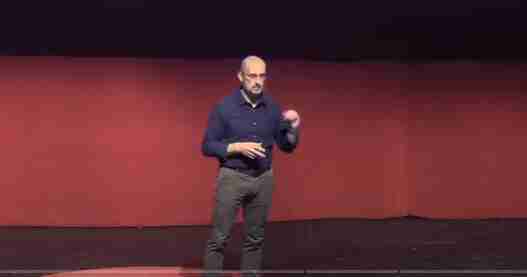
Read the full transcript of Dr. Mark Shrime’s talk titled “Putting Purpose Over Path” at TEDxBostonCollege 2024 conference.
Listen to the audio version here:
TRANSCRIPT:
One of my favorite books was written in 1946. Viktor Frankl was a prisoner in the Nazi concentration camps of World War II, and when he got out, he wrote a book called “Man’s Search for Meaning.” In it, he quotes Nietzsche, saying, “He who has a why to live for can bear almost any how.” If you listen carefully to that quote, there’s a hierarchy implied in it.
The why comes first, the how is second. Figure out the purpose first, and then construct a path to meet that purpose. Unfortunately, many of us find ourselves on a bit of an inverted hierarchy. Instead of purpose over path, we find ourselves on a path, and then we have to shoehorn our purpose into that path, and it shows.
The Modern Workplace Crisis
Dissatisfaction at work is an epidemic. 70% of Americans, 80% of people worldwide are unhappy with their jobs, and we’ve started to vote with our feet. Now I come from the world of medicine, so I’ve seen this exodus most acutely in my profession, and it is true. We just came out of a pandemic that gave 20% of us clinical PTSD, but still, in 2021 alone, 117,000 physicians left the workforce in the US.
That is four and a half years of graduating medical school classes leaving in a single year. But we know it’s not just medicine. There was a great resignation in the pandemic, and that one peaked in 2022 when 50 million people left their jobs. Now experts tell us that the great resignation is over, we can breathe a sigh of relief, but all that means is 40 million people leave their jobs every year.
The Turning Point: A Car Accident in Liberia
The pandemic highlighted something that has been brewing for a very long time, and that is that this inverted hierarchy of path over purpose leads to dissatisfaction, to burnout, and to moral distress, and it doesn’t have to be this way. Today I want to talk about what it takes to flip that hierarchy, to put purpose back over path, what it takes not just to start with why, but to actually solve for your own why, my own why. What are the steps that we have to go through if we want to right that hierarchy? And in doing so, I’m going to tell you a bit of my own story, not because my story has any special insight, but because everybody’s why is deeply tied to their own story.
This was 2008. This was my first time living and working as a surgeon in a sub-Saharan African country. I was living in Monrovia, the capital of Liberia, and this particular weekend, about 20 of us decided that we were going to go from Monrovia to a beach town about three hours to the northwest called Robertsport.
The Life-Changing Journey
The drive from Monrovia to Robertsport is pretty simple, but an hour north of the capital, you turn left. The road north from the capital to that left-hand turn was paved. The road west from that left-hand turn to Robertsport was a single track, red dirt road, pretty flat, pretty well-maintained, but punctuated by these rickety wooden bridges over ravines.
So we hired five taxis that were driven by people who couldn’t have been more than like 17 years old, and you all know that the deal with young men in cars is that we like to go fast. So the minute we took that left-hand turn onto the dirt road, they took off, and those of us in the back were loving it. It was a weekend away, it was going to the beach, the wind was in most people’s hair.
The driver of the car that I was in was the fastest. What he would do is on the straight parts of the road, he would book it as fast as he could. Then he’d get to a bridge, he’d stop, he’d take that bridge responsibly, and then book it again to the next bridge. You can kind of see what this is building up to.
If you drive down a dirt road really quickly and stop all of a sudden, you kick up a whole bunch of dust behind you. The car behind us didn’t see us, smashed right into us, and we fell off the bridge and into the ravine. Now they say that time slows down, and it does. I remember really clearly watching the ground come to meet the windshield, and I remember thinking, “Huh, I guess this is how I die.”
I’m okay with that. We were all fine after that car accident, but that thought, “This is how I die, and I’m okay with that,” that thought bounced around my head for the two days in Robertsport, and it’s continued to stick with me for the 16 years since. I know now that the reason that I was okay with it was that by 2008, I had started to solve for why. The road to getting there was not straight.
See, I never wanted to be a doctor, like actively, adamantly resisted becoming a doctor. Like all little boys growing up, I wanted to be a philosopher or a rock star, but I grew up reading the stories of missionaries, and what I really wanted to be was a linguist. I was going to be the guy that would disappear into the jungles specifically of Papua New Guinea, create the writing system for a language that had never been written, but I’m also the firstborn son of an immigrant family, which many of you know, sometimes it feels like we’ve only got three options: doctor, lawyer, or failure.
The Path of Resistance
So I went to med school, and I hated med school, like so much that not even 12 months after med school started, I left.
I moved from Texas, where I was in med school, to Singapore to put 9,700 miles between me and medicine. I had a one-year contract in Singapore to teach chemistry, and I loved that year so much that at the end of it, I walked myself to the immigration building, fully intending to keep 9,700 miles between me and medicine.
I remember walking up to that building, putting my hand on the door, chickening out, turning around, going back home, going back to med school, going back to hating med school, and at some point, I was going to have to pick a specialty, and I had no idea what I wanted to do because I didn’t like anything. So I figured the best thing for me to do because of all that is to pick a specialty that would allow me to work as little as possible, make as much money as possible, so I could do all of the things that my heart was calling me to do.
Facing Existential Failures
It turns out that is not the wisest way to pick what you’re going to do for the rest of your life, but I want to skip over how terrible residency is because we’ve all seen Grey’s Anatomy, and I want to fast-forward to the end of it. After five years of specialty training, I had literally started saying out loud to people, “I have no other marketable skills besides medicine,” so no matter how much I hated what I was doing, I had to find a way to make medicine work, fully, path over purpose.
Now, I went on to do a fellowship in surgeries for tumors of the head and neck. That period was a lot of things. It was also a period of deep existential failures. I went to med school, didn’t enjoy med school, so I left to start a new life for myself, chickened out of doing that, went back to residency, couldn’t thrive in residency.
This pattern of deep existential failures, let me be honest with you, can get worse as you solve for why. There is a benefit to the inverted hierarchy, to path over purpose. It puts us on a bit of a moving sidewalk that takes us from high school to retirement and takes us to a large degree to a very particular type of success, a narrowly defined success that looks like safety and security.
The Value of Purpose Over Results
One of my other favorite authors is Thomas Merton. Merton writes, “Do not depend on the hope of results. You may have to face the fact that your work will be apparently worthless or even achieve results opposite to what you expect. As you get used to this idea, you start more and more to concentrate not on the results, but on the value, the rightness, and the truth of the work itself.”
We are at a university. It is literally everything that we are indoctrinated to depend on. I told you that the reason that I went on to do a fellowship was because I had no other marketable skills besides medicine, and that’s true, but if I can be vulnerable with you for a second, the real reason I did that was because I was afraid. Afraid that if I stepped off my moving sidewalk without those marketable skills, I would create a life for myself that was apparently worthless.
Lesson One: Embracing Failure
Which brings me to lesson number one in solving for why. If you want to re-invert that hierarchy, to put purpose back over path, the first step, the first phase is the pre-work. Before we can even talk about purpose or path, the first thing you’ve got to do is the work of failure. I’m going to challenge you here to alter your position towards failure, not to see failure as part of the road that you’re on or maybe a detour towards your final goal or something you have to meditate your way through or grit your teeth through.
I actually want to push you even further and to challenge you to find ways to fall in love with it. Find ways to fall in love with the feeling of being not good at something again. It can look like anything. It can look like taking up rock climbing or cross-stitching or cross-country skiing. For me, for six years, it looked like competing on American Ninja Warrior.
Finding Your Path
I’m going to be honest. Some of my ninja friends are here. I was the world’s most mediocre ninja. I was not a good ninja, but what Ninja Warrior did for me is give me this opportunity to fall in love with failure because training for Ninja Warrior is an exercise in failure.
Failure does two things for us. First, it starts to push us up against the edges of that moving sidewalk. One of the reasons that we stay on it for so long is because we’re so good at it. It lulls us into security because we know how to meet its demands. Second, it starts to break this idol of the hope of results. It is not until this idol falls that we are able to start looking at life through the lens of rightness, of value, and of truth.
Chapter Two: The Quiet Moments
I moved from New York City to Toronto to do those fellowships. I did a second fellowship in microvascular reconstruction. Really enjoyed those surgeries, but that feeling of stuckness was still there. I say that because I took a second year off in between those two fellowships, traveled for six months, and then worked for six months as a surgeon in Monrovia, Liberia in 2008 when that car accident happened.
I worked for an organization that I still work for called Mercy Ships. We deliver surgery from the decks of hospital ships. Listen, I could give you an hour-long talk about what it’s like to be a surgeon on these ships, what it’s like to hear the stories my patients tell, what it’s like to walk with V and S from here to here. I could give you a second hour-long talk on the data, the numbers, the fact that 70% of the world cannot access surgery when they need it. I love giving those talks because those talks are my why.
But the fact of the matter is, I didn’t find my why in talks like that. We don’t find our why in the data, in the numbers, in the stories, in the reasoning, in the logic. We find our why in those quiet, numinous moments that I am convinced every single one of us has if we are willing to listen.
The Final Chapter: Making the Choice
For me, that moment came the first time I walked down the hospital stairs. After 15 years of post-secondary education, most of which I tried to quit, took a right-hand turn and a left-hand turn into the head and neck ward, and it hit me. This is what I have been training for 15 years to do.
The second phase in solving for why is to find those quiet, numinous moments. They’re getting harder and harder to find. But we have to find them. We have to do the thing that Maya Angelou writes. “We have to let choice whisper in our ear. Let love murmur in our hearts.” We have to be ready and listen.
You would think that an epiphany like that would change my life, but I am not a brave man. So, instead of staying where, to borrow the words of Buchner, “my deep gladness and the world’s deep hunger meet,” I came back. I came back, finished my fellowships, got my first real attending job here in Boston, and unsurprisingly, I was dissatisfied.
Over 15 years of training, I had heard, “stick it out, it gets better.” And it did, being an attending, way better than being a resident. But I got to better, and I was like, this is not what I signed up for. The dissatisfaction that many of us feel is because we get to better, and we find that it’s not what we signed up for.
The Gary Parker Rule
So against this backdrop, I flew back to the ship and straight into the third lesson for solving for why. A lesson I learned from this man right here, a bit of a mentor of mine. His name is Gary Parker. Gary’s been working on these ships for 40 years, and one day I asked him how he makes big decisions in his life.
Now I’ve since gone back to school to get a degree in the science of decision making so I can tell you that Gary’s answer has a name. It’s the Maximax or Optimist Criterion for Decision Making Under Uncertainty, or the Gary Parker Rule. And the Gary Parker Rule is this: If you’re thinking about what you want to do, think 30 years down the line and find the best possible thing that could happen with each of your two choices. If one of those bests just makes you shrug your shoulders, then you know it’s not the right choice for you, because you’d work for 30 years in the best case scenario for a shrugged shoulder.
As a decision analyst, I kind of have to do this. I’m obligated to do this in terms of trees and numbers, so let’s do this again formally. Let’s say you or I are trying to figure out the next step in writing our hierarchy. The Gary Parker Rule says you’re choosing between choice A and choice B, figure out the best outcome of either choice A or choice B, and then choose the best of the best. The reason that the first lesson in solving for why is to fall in love with failure is because this is an incredibly risky decision-making strategy. Often that deep existential failure is right there in choice B as well.
Conclusion: Making the Choice
I did this. I had to do this to myself, looked at my life over the next 30 years, and that’s when I made the decision to quit my U.S. practice and devote myself full-time to this. Scariest decision I ever made, to see my last patient here in the U.S. A serious decision, but also a deeply personal decision, and this is where I want to end by bringing it back to you.
Do you want to flip that hierarchy? Do you want to stop shoehorning your purpose into your path? You have a choice. You can stay on the moving sidewalk. There is safety on the moving sidewalk. There is no judgment there, or you can dip your toe in, find ways to fall in love with the feeling of being a beginner again. Find ways to listen for those quiet, numinous moments. That will take you some of the way.
You can have a dozen epiphanies. At some point, you’ve got to do something about this. As Morpheus says in “The Matrix,” there’s a difference between knowing the path and walking the path. At some point, you have to apply the Gary Parker rule to your life and make the scary, intentional decisions that it requires. Thank you very much.