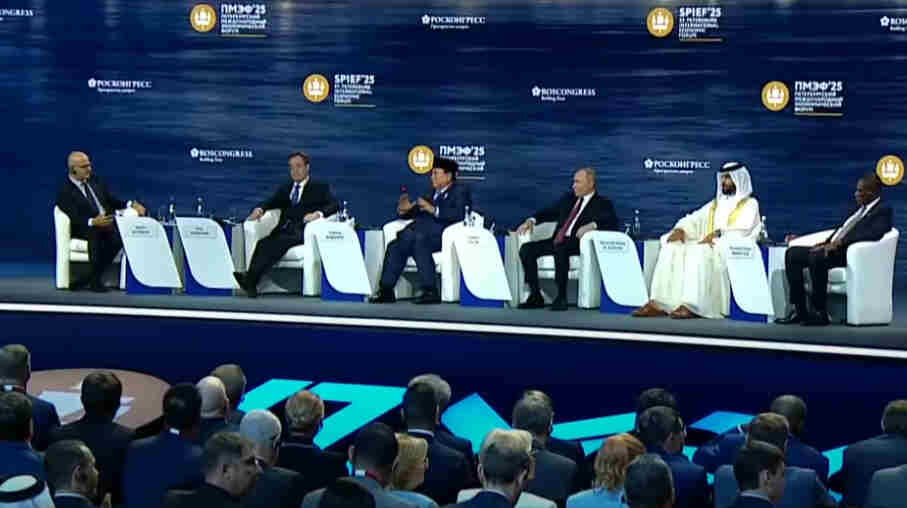
Read the full transcript of remarks from China’s Vice Premier Ding Xuexiang, Indonesia’s President Prabowo Subianto, Russia’s Vladimir Putin, Bahrain’s Sheikh Nasser, and South Africa’s Deputy President Paul Mashatile at the SPIEF 2025 plenary session in Saint Petersburg, June 20, 2025.
Opening Remarks and Russia’s Vision for a Multipolar World
Moderator: Thank you so much for the heavily loaded speeches that will only make my mission more difficult. I’d like to start with President Putin. The overarching theme of this year’s forum is shared values in a multipolar world. This is a very, very high ambitious ceiling. What does Russia bring to the table in that regard?
President Putin: In fact, I tried to bring this across in my intervention. I think whatever Russia is doing is aimed to bring together the efforts of all our partners or friends or those who are willing to work with Russia to address those global civilizational tasks.
First of all, we seek to achieve a balanced global development so that this development is aligned with the interests of as many countries as possible. We seek to build a multipolar world order where the participants of international relations agree among themselves, design instruments and tools that would help find solutions even in the most difficult of conditions, such solutions that would benefit everybody and not just individual groupings or associations, be it military or economic blocks. I think that today’s meeting, today’s event, that as is now arranged by Russia, aims to achieve this.
Objective Trends vs. Resistance to Current Order
Moderator: Sometimes, Mister President, this effort to build the multipolar world seems like more of a resistance of an existing order rather than a genuine, consistent, coherent effort to create the multipolar world that you’re talking about? Is an objective driven effort or it’s only resisting current you know, unfavorable kind of order?
President Putin: I think, and on many occasions and the different locations, I mentioned this, the changes are happening irrespective of whether we help those changes or not. Those are objective trends of global development. You know, in my speech and on many other occasions, including here at the St. Petersburg Economic Forum last year, I mentioned that the changes in the world are happening, and those are fundamental changes.
They are due to the fact that new economic leaders emerge. Just look at what’s happened over the past years. Look at how the share of the so called G7 was shrinking in the global economy. It is shrinking every year. And look at how the share of the countries that got together under BRICS has been growing. Again, this is an objective process. And it has nothing to do with any clashes or military conflicts. No. It’s been on for decades.
And when we’re told, look, you in Russia, you implemented this pivot to the Global South, to Asia, oh no. Those decisions had long been taken because we consider it the trends of the global development. And again, those are objective trends. Our colleague from South Africa just spoke, 2.5 billion of people in Africa. And again, this is a medical fact. This is what’s going to happen, and there is no stopping it.
All those nations, all those continents, all those peoples would seek to improve their standards of living. And definitely, would try to enhance their economic and humanitarian capabilities. And again, those are inevitable things that are happening in our civilization. Our task is to make this process, this inevitable process, a civilized shape.
And altogether, we should take efforts that not only would accelerate those processes, but make those processes balanced so that the decisions are made on a timely basis and the decisions are most effective and would benefit all the participants of the process, including the countries that, one way or another, are somehow losing their positions in the global economy.
Look, we want to agree with them. We are ready to agree with them if they want to. However, if they want to maintain their monopoly at all costs, if they want to keep the instruments of colonial influence in the world, well, they will have to be happy with the situation they are gradually sliding to. Now whatever we are doing at the national level, for instance, given our domestic and foreign policy and together with our friends and partners, this is what we’re doing.
Indonesia’s Non-Aligned Stance in a Polarizing World
Moderator: And obviously, they have the tools to cripple this endeavor that you just summarized, Mister President. So I would ask President Prabowo of Indonesia. Indonesia has always walked a fine line, has always, as you mentioned in your speech, a non aligned been a non aligned state. But as the world becomes more and more complicated, can Asian countries, ASEAN countries stay non aligned or this is more and more not an option or a very, very narrow option as we go forward?
President Prabowo: Thank you. I think in my opinion is it’s not easy, but but it’s a line that we are determined to maintain. As I said, we we respect all the great powers. We respect our neighbors, and we really believe that the only way for prosperity is collaboration, cooperation, and peaceful coexistence, and this is what we try to achieve.
So we want to maintain good relations, and we try to convince all parties that the way the only way forward in this this planet is getting smaller. We cannot afford rivalry that that is going nowhere that can only if it goes into confrontation. So, no, I am I am convinced that we have to maintain this this path of non alignment.
China’s Perspective on Russia-US Relations
Moderator: Mister Vice Premier of China, China and Russia are building with others this new order in the world. But if you look last year, things started to ease up between Moscow and Washington. There is more dialogue between President Donald Trump and President Putin. Is this a source of concern for you in China? And how do you see the developing relationships between the leading powers in the world?
Vice Premier Ding Xuexiang: Thank you very much for your question.
In fact, the reestablishment of contacts between Russia and The United States, restoration of cooperation, this is beneficial for the entire world because this helps stabilize the international situation and helps rebuild the global economy. China and Russia and the relations between the two countries, in fact, have very deep roots. We are neighbors. We’re our largest neighbors, and friendly cooperation between our two countries develops successfully, and it is based on the principle of mutual benefits.
And this is in line with the historic logic, and it is in line with the cultural traditions of the two countries. And besides, it is in line with the strategic interests of the two countries. The friendship between Russia and China is immune to any external influence, and our friendship is not aimed against any third party. Yesterday, President Xi mentioned that under the leadership of President Putin and President Xi, the relations between the two countries had reached the historic high and our relations as well as rock and they are impregnable.
As you said, global powers have a lot of influence on the global world order. And they play a most important role in upholding the world order. On many international fora, President Xi urged the global powers to behave. The way I understand it, that global powers must live up the way to their international commitments. They should preserve the UN centered global order and they should follow the principle of sovereign equality of states irrespective of the size of those states.
And they also should uphold international justice and equality. They should discard hypocrisy and they should help maintain openness in this world. China is a responsible global power that serves as a stabilizing factor despite the global shocks. We are ready to cooperate with many countries and assist in achieving prosperity globally? That would be my response.
Bahrain’s Bridge-Building Role
Moderator: Thank you so much. Sheikh Nasser, Bahrain is a very unique country. We have very good exceptional relations with Washington, yet you are here today representing your country and his majesty as a guest of honor in Saint Petersburg Forum. This is a very unique feature. It aligns with those who know Bahrain would say this will aligns with the history of Bahrain as a trade hub, as a political bridge. But how are you maneuvering and navigating a more and more polar world with the set of skills and experiences you have in the realm of bridging between East and West.
Sheikh Nasser: Well, you have mentioned briefly about history, and let me take you back nearly five thousand years ago, the job of Bahrain where it maintained the relations between East and West. So I believe Bahrain and its geographic position in the region and certain service to the world, we have no choice but to be the arms and the bridges between the East and the West.
We have no choice rather to follow our wise leadership, not just in Bahrain but in the GCC in total, where we all share a new state of mind. It is what’s so called the single issue alliance, meaning by single issue alliance as I do not get my nation, we do not get our region sucked into wars. I might agree with you in 10 points but disagree in eight or vice versa. So we take every point into verticals and we discuss, and most important is how do we build on this relation, how do we maintain our relations, how do we seek to a better future.
I’d always say our past is not better than our present, but I’m sure our future should be better than our present. So this is what we are doing. We have seen great leadership here with his excellency, the president Vladimir Putin, where he showed a stable, long lasting, enduring vision where does he want to take his country and move forward. We do the same. We always say that. We plan for the next generations.
South Africa’s Vision for Global South Development
Moderator: Thank you, Sheikh Nasser. Vice President, South Africa is as well one of these unique historical experiences in Africa and on the world stage. You said something very interesting about St. Petersburg Forum being one of the very, very few places where shaping the conversation around geopolitics and geoeconomics is happening through dialogue. That’s a very solid conclusion in today’s world. I’d like you to elaborate more what did you mean by that and why. What makes this one of the few and unique places for such dialogue?
Deputy President Paul Mashatile: Thank you very much for that question. I want to start by saying I think we should thank President Putin for this great leadership, ensuring that particularly countries of the global South should have platforms to be able to collaborate, share ideas, come up with new innovative plans.
As I said earlier, in South Africa we have taken a position that we should not continue to go to others for handouts. We should not be queuing for aid. But we should focus on development. And that that countries of the global South can can do it. We can see it. We are developing. We are getting stronger. And I think we should keep it that way.
So that’s why I was saying that the Saint Petersburg International Economic Forum is a great platform. And thank you to President Putin for this leadership. We are with you.
Addressing International Law and Conflict
Moderator: Let me bring the conversation from values to closer to the conflict areas and and and the in the world. President Putin, Israel said that they, I mean, the statements are normalizing the fact that a country might kill the president of another country. That’s that’s basically the conclusion of of last week’s statements. Yes. Ayatollah Khamenei is not head of state, but he has enough gravitas to be considered as head of state and to be protected by the articles of international law. But when we normalize the idea no matter where you stand on Iran, when we normalize the idea of a country killing the president of another country publicly and and what kind of new rules are being set, they are obviously contradictory to the kind of values you’re trying to put forward. Isn’t that?
President Putin: Well, know, I was listening to my colleagues speak. I was taking some notes so that later I could react to that and make some references. I’ve also made note of what you were suggesting yourself. And you said the following. When we’ve been discussing it with my colleague from the People’s Republic Of China, you said the following and I wrote it down.
The Russian Federation and China shape new world order. Russia and China are not shaping the world order. We are only identifying the potential shapes of it or the scope of it or the general perimeter. The new world order emerges genuinely on its own. It’s just like watching the sunrise. There is no way you can run away from it or you can avoid it.
And we are trying to create the conditions or rather pave the way for this process so that it is more balanced and so that it is in line with the interest of the global majority. And we very much hope that all of the countries would be aware of it. And after all, would come to realize, as I was saying earlier, that this particular wave of searching for a solution is better than an approach where you try to apply pressure.
And in fact, this neo colonial world order, and I do believe that it is neocolonial in its nature. This is the world order that humanity has existed for many hundreds and even centuries of years.
Moderator: Would you allow, Mister President, to go back to the question about about normalizing the talk about, you know, a country killing the president of another country in the case of Iran and Khamenei and Israel within this conflict. I mean, it it seems that those who are making the new values are not the global South, not obviously, not not Russia, not China. It’s it’s the Israelis. Are you comfortable with that?
President Putin: Well, I really would like the statements that you just cited to stay, but can you please be more specific? What exactly do you mean in terms of Israel? I mean, the new values now is that a, one country is setting the rules for another country that who has or doesn’t have enrichment, for example. One country is threatening to kill the president or the head of that country. Are these values defendable in any way?
Well, first of all, I don’t see anything new in this regard. It’s no new to us at all. And secondly, the Russian Federation has always, and I keep emphasizing that, always supported taking care of security and safety of each single country without damaging safety and security of any other country. That’s our strong principle. So my response is that in general, it may sound as a generic answer, but I promise this is a very practical approach executed by Russia.
Allow me for a very direct question about the situation. Donald Trump is seeking what he calls the total surrender of Iran in terms of the nuclear project. Would Vladimir Putin seek the total surrender of Vladimir Zelensky and the same thing?
First of all, it’s not the same thing. It is a very different situation. And secondly, we are not aiming for unconditional current surrender by Ukraine. We insist that Ukraine recognizes realities that we have on the ground.
GCC Success Despite Global Tensions
Sheikh Nasser, I’ll go back to you. You see this conversation unveils the level of tensions on the global theater. I will go back to the question about how GCC countries keep moving from one success to another end, and Bahrain is one of these successful countries despite all of these turbulences, despite all of these flash points in your close vicinity and globally. How do you do that, and what lessons can be drawn from that by others?
SHEIKH NASSER: Let me start by saying Alhamdulillah for a wise leadership we have in our region. We always say the clever tries to solve the problem but the wise who avoids it. So us and the GCC, and especially in your second home in Bahrain, I love that president Putin loved that quote, and you can use it, mister president. No copyrights on that.
Us in our country, we talk numbers. We talk facts. We project our plans as what we saw today from the president of Indonesia. This is a man who is expediting his KPIs by far. He thinks that he will reach in four years’ time that goal that he reached in one year time.
We are sprinting in our region and if you go back today, during that turbulent and eventful nights, look at the numbers, look at the numbers of our real estate, look at the numbers of our stock markets, there is a lot of confidence from the people, from the investors with our leaderships over there.
Today in that beautiful city I sat with the top chairman and CEOs of your top companies in Russia and we exchanged the same vision, we exchanged the same purpose, and the same spirit during these conflicts. We are only looking forward. We are only looking to de escalate. We are only looking for a peaceful world. We are only looking for a better future.
And, mister president, we in the GCC and especially in The Kingdom Of Bahrain, we live in a constant sunrise like you, but here we are literally in Saint Petersburg. Every day there is sunrise ahead of us. I still haven’t seen nighttime.
South Africa’s Transition Experience
Mr. Vice President, as I mentioned earlier, South Korea has a very unique position in history in terms of how it evolved, in terms of how it fixed its wrongs and mistakes and then fixed its history. One of the things that came to my mind when I was preparing for this is the experience of the clerk, the last president of the apartheidist regime. The thing is that he made himself part of the change, and that saved South Africa a lot of blood and destruction and chaos. What lesson can be drawn from this history when a regime or a state or an idea hits a wall? How can you advise these states or these regimes to change same way South Africa changed?
DEPUTY PRESIDENT MASHATILE: Well, De Klerk is not a good example because he was defeated. He was forced to come to the table by the masses of our people. He didn’t come voluntarily. What we are saying that leaders must recognize that we can resolve our differences through peaceful means. But there are those who need to be dragged today.
And I think the example of De Klerk is quite that. He was dragged to the negotiating table by the masses of our people. And we were quite happy once he came. He had no option. He had to participate. He did try to portray himself like he’s Nelson Mandela. He’s not. He was dragged there by Nelson Mandela to say we are going to negotiate peace.
We want to continue to share this example with other countries. We are quite involved now in the African Continent engaging in peaceful negotiations in the South Sudan, in the DRC, and other places. So yes, there is indeed value in negotiating, discussions, but there are situations where the masses have to stand up and they have to fight for their rights. And that’s what we did in South Africa.
The Power of Reconciliation
Mister president, you were shaking your head when we were exchanging this question. What are your thoughts on, you know, bringing adversaries to the table? Does it require a defeat as a prerequisite for dialogue, or we can, you know, bypass this phase and go to dialogue? And there are so many crises in the world that cannot afford a victorious…
PRESIDENT PRABOWO: Well, I have to say here that Nelson Mandela is one of my greatest icons, my greatest hero. I think he’s an inspiration. He was put in prison for many years. He was sentenced to death, threatened to be sentenced to death, accused of many things. And his famous statement was that he was willing to give his life for the principle of freedom.
But the greatness of Nelson Mandela, when he got out of prison, he worked for reconciliation with his former enemies. So this is the greatness of Nelson Mandela, and this I try also to carry out in my domestic politics. I reconciled with many of my former opponents.
For instance, we had a very long rebellion, separatist rebellion in Aceh. Very long. I think more than nearly thirty years. But can you imagine that the former commander of the Aceh Liberation Army fighting against us for twenty five years more, Now he joined my party. He’s in my political party, and he’s now governor of Aceh, and I’m president of Indonesia. This shows that former enemies can come together, and I think this is the lesson of Nelson Mandela.
I want to say I was a former soldier. And as a former soldier, I really know the value of peace and reconciliation. As a former soldier, I always try now even before, I always try to negotiate. Negotiate. Negotiate. Negotiate. Better to talk than to kill each other. This is my position. Always talk, always negotiate.
Russia’s Role in Middle East Peace
President Putin, on a more practical question concerning the current crisis in The Middle East. Now we will talk about Ukraine in a while. But the current crisis, it touches on geopolitics, energy, and it has repercussions that go beyond the parties involved in the struggle. Is it a test for how the South can play a role in, you know, mending defenses between both countries in putting some good imagination around the solution, architecting a solution that can be acceptable by two parties that are fighting, you know, head to head. Is this a test for what you are proposing and trying to create for political weight for the South.
PRESIDENT PUTIN: Yes. I do believe it is quite probable. And the reality is that many countries of the region, in a way do have sometimes stable or sometimes complicated relations, but anyway relations with both of the parties with both Iran and Israel. And the availability of those ties and relations give us reason to hope that global South as a whole and countries of the region in particular may exercise them impact on this process in a way that the acute phase of the conflict comes to an end.
When I was saying that the principal position of the Russian Federation is to make sure that the security of one country is not paid at the cost of other countries, I’m not going to dwell into the details of that. We all understand what I’m talking about. We’re talking about Iranian enrichment on the one hand and this is Iran’s right. It is Iran’s right to peaceful nuclear program. On the other hand, we know the position of Israel. Israel insists that it is about provision of its security.
But I’m sure that mutually acceptable solution can be found for both sides. That’s my view. And both the countries of the global South and especially so countries of the region have a positive role to play and impact this process aimed at the search of solution. I do believe such a solution does exist.
Actually, today, the Russian ambassador at the UN said that the only way forward is a political solution for the nuclear file between Iran and the Israelis. Is there any, you know, preliminary points about this solution or we’re still too far from that?
Well, in such situations, I would say it’s always better not to rush in order not to harm the process. But in my view, there are potential points of consensus. They are available. We are expressing our position to both sides of the conflict. As you know, we are in touch with Israel. We’re in touch with our Iranian friends. We do have some proposals, including our potential participation.
But I’d like to pay your attention that by no means are we trying to act as a mediator, no. We are simply expressing ideas. We are making suggestions. And should those ideas seem attractive to both sides, we would only be happy.
But I’d like to reiterate that we are in touch with Israel. As you know, just a while ago, had a conversation with Prime Minister Netanyahu. I also had a conversation with President of Iran. I also talked to the President of The United States who is undoubtedly directly involved in the process. We shared our vision. We discussed the potential progress in resolution of this conflict. Well, we’ll see. We’ll see.
So far, our proposals are also being discussed. We are in touch with our Iranian friends on a virtually daily basis, so we’ll see. But I would really like, among others, our ideas to be implemented.
Sheikh Nasser, during the king’s visit to Moscow, he explicitly said talked about the role of Russia in maintaining peace in the Middle East. It was an initiative his majesty put forward during the Arab Summit in Bahrain in Manama. And he was very particular about the role of Russia in achieving that peace as a pivotal role. What role do you think Russia can play now in the current crisis?
SHEIKH NASSER: Yes. You are right. During our previous visit and after the Arab Summit that was conducted in The Kingdom Of Bahrain, we have called out for World Peace Forum to end and to reach to a solution with every conflict. His majesty is a leader of peace. He drives his country towards peace and ending conflicts, and so as president Putin.
As you have heard from the president just now that he continues talking, no mediation. I believe that mediation will always confuse the situation, but any suggestion, any words of wisdom these days are mostly needed. Avoiding de escalation, I think, is the key words of today.
Ukraine Crisis and Global Security
Thank you, Sheikh Nasser. I’ll go back to president Putin about Ukraine. How is the war in Ukraine reflective of the values that Saint Petersburg Forum is trying to put forward to defend, to underscore?
PRESIDENT PUTIN: Very easily. Directly, in fact, there is a regulation to what I’ve been talking about. I said that security of one country cannot be ensured at the expense of security of other country. And since the beginning of the 1990s and for decades, we’ve been hearing that there would be no NATO’s expansion to the East. And we’ve had five or six rounds of expansion despite all our calls not to do this, those were ignored.
And definitely, those are rudiments of the old, if not to say ancient, neocolonial policy. Well, upgraded, of course, given the current context. But nonetheless, this is the action from the position of power. Those are the actions that do not take into account the interests of Russia.
As to Ukraine, again, this is action from the position of power, whatever was happening there. It is a bloody anti constitutional coup that happened in Ukraine. And, again, this is acting from the position of power. In previous US administration directly stated that they spent billions of dollars to support the coup. Well, obviously, was not mentioned in public, but still.
And our action aimed at protecting a part of the population that considers that it had cultural and historic ties with the Russian people. I’m referring to the people living in Crimea. And then there were some attempts on our part to resolve the situation in the Southeast Of Ukraine in Donetsk and Luhansk. We made these efforts.
But again, our in this case, ideological opponents, as I could label them, attempted to act on completion of wars. They started military operations in Lugansk and Donbas. It was not us who started the military operations. And after the coup, part of the Ukrainian population rejected the outcomes of the coup and rejected the those who made this coup happen. Well, they became targets of the military operations.
We attempted to address the situation in a peaceful manner to somehow mend the situation, but our partners, quote unquote, well, it turned out that they started this whole coup just to pump up Ukraine with weapons and to continue combat. In the end, this forced us to recognize independence of the two republics. Look, it took us eight years to do this. We tried to negotiate, but we were forced to recognize their independence.
And then we started supporting them, including providing military support to put an end to the war unleashed by our opponents in the West. And those who they lean upon in Ukraine, those are neo Nazis and ultra nationalists. So whatever that is linked to this tragedy unfolding in Ukraine is not an outcome of our action. This is an outcome of the action of those who are not ready to embrace the global changes happening in the world.
Mister president, I’m in no position to challenge the narrative you put forward.
Putin’s Vision on Ukraine’s Future
Let’s say this is the baseline of what the reality is. Let’s assume this is a reality. Your army is advancing beyond the four areas that are considered Russian by Moscow. So what’s your endgame? How deep is your army going to go and for what effect?
Is that about the four regions that we consider ours? Well, on many occasions, I did mention that Russian and Ukrainian peoples are the same people. And in this sense, the entire Ukraine is ours. But look, we look at the realities on the ground. And obviously, there are people, there are many of such people in your neighboring country who seek serenity and independence, and I wish them all the best.
I mean, we never ever challenged their right, the right of the Ukrainian people to independence and sovereignty. Having said that, the grounds on which Ukraine became independent and sovereign were spelled out in the declaration on independence of 1991. And it stated very clearly that Ukraine is a non-nuclear neutral state and not party of any blocs. I think it would be good to get back to those core values based on which Ukraine obtained its sovereignty and independence.
Second, from the very beginning, when the conflict became really hot, we suggested to the premier leadership to cease all the conflicts. We suggested that we withdraw our troops from the territories, and they withdraw their troops from the territories where people are not ready to embrace the new regime and they want to live independently or become part of the Russian Federation. They said no. And again, those are not political decisions. And now the logic of combat comes into play.
The military look at where they can better advance, they can channel their troops to achieve the best outcomes with the lowest possible casualties. And this is how troops advance. We have an old saying or story or rule, rather: Whenever the boot of Russian soldier stands, it becomes ours.
Look, I would hate this statement to be over militaristic or be viewed as over militaristic. But at every single stage of the unfolding process, and I stress this just for you to understand, and this is truth. I mean, at every single stage of the unfolding process, we suggested to those with whom we were in conflict in Ukraine, suggested to stop, we suggested that we should negotiate because this purely military logic may result in a situation when the whole thing would aggravate, and we will have to negotiate starting from worse positions.
Failed Negotiations and Western Interference
And this happened several times. I will not go into detail now. And the witnesses to this, to our suggestions, are active politicians from other countries. And thanks God, they are alive and healthy. But whenever we suggested something, they would go from Moscow to Kyiv and then would tell us, “Look, they tell us that we are agents of the Kremlin and we wash our hands. We won’t deal with this.”
So each time we heard no, no, no. And we said time and again, let’s do it. Let’s negotiate. It’s going to be worse for you. No. Why? Well, because those who are guided by old and new colonial principles, including and primarily Europe, they thought that they would crush Russia, would destroy Russia and would feast on it.
That’s exactly why, and I’m confident that’s exactly why former Prime Minister Mr. Johnson, and I think this happened due to suggestions by the former U.S. Administration, Biden’s administration came to Ukraine and suggested that they should not reach an agreement with Russia. But the agreement was on the table during the Istanbul negotiations. So we reached a consensus on almost all issues and we had just to finalize the document. We had just to meet with the head of the regime at that time and put an end to this process.
But then Mr. Johnson came and with the support of the U.S. Administration came and he talked Ukraine out of signing the agreements, trying to achieve a strategic defeat of Russia in the battlefield.
Military Developments and Security Concerns
Well, in the end, new territories found themselves under our control. The Russian army advances every day along the whole edge of the battle area. Look, they encouraged into the Kursk region. Well, they lost 76,000 troops there. It’s a catastrophe. It’s a disaster. 76,000. In the end, we drew them out from that region, but they started to create threats for us along the whole border with Ukraine in two neighboring regions.
They lack personnel, and now we have to create a security zone along the border. And they divert their troops there, the troops that they are lacking in other areas. 47% is the current staffing level of their combat units. In fact, they lose their combat worthiness. With their own hands, they extended the battle lines for another 2,000 kilometers. And as I said, they started to create threats for us along our border and then another 1,600 kilometers.
You know, they spread their troops thinly. From the military standpoint, it’s silly. It’s stupidity. They create problems of their own, and they have to respond somehow.
You said that there are some other territories. Yes, of course. Look at the national border. As I said, they incurred into the Kursk region, and they committed a lot of crimes there, including crimes against the civilian population. And we kicked them out with significant losses. And now we have to create security areas along the borders because they keep attacking from there. They use artillery. They use UAVs.
In the Sumy region, it’s about 10 to 12 kilometers. In some places, it’s eight to 10 kilometers. And then there is a city of Sumy, a regional center. But we do not have this task of taking Sumy, but I do not exclude this. I do not rule this out. Now why? Why are we doing all this? Well, because they’re creating threats for us. They keep shelling our border areas, our border regions.
And this is an outcome of their ungrounded and ill thought through actions. The only objective was of political nature, just to demonstrate that they can do something, that they can obtain something from their foreign sponsors. Look, they’ve gotten some $250 billion. Well, not enough. Give us more and more and more. And one half is being stolen, if not more. That’s why we found ourselves in those regions. And again, this is an outcome of this standoff and the nature of it.
Indonesia’s Peace Proposal
I would later go back to some aspects of your answer, mainly about the nuclear aspect of what’s happening. But I’d like to go back to the other participants. Indonesia, Bahrain, and South Africa are three countries actively deepening relationship with Russia. From what I understood, this conflict, unfortunately, and I hope I’m wrong, might go longer, might go for long. How are you planning to mitigate the fallout of this conflict in terms of secondary sanctions, in terms of political reputation in the world, in terms of pressure coming from your other allies? This is a very, very complicated situation. You don’t want to be in in any way, but that’s reality. I will start with you, mister president.
Well, I really don’t understand your question. What secondary sanctions? I’ll make it simple. Yeah. For Indonesia, we are very clear that we have always been on the line. In the Ukrainian situation, I think two years ago, we proposed immediate ceasefire in place. And I think at that time, the reaction from the Russian side was quite open, was quite positive, in fact.
But the reaction from the western governments, no. Not, I have to be fair. Not all Western governments, but many Western media vigorously attacked my proposal. They said that I was proposing the peace of the cemetery. That was what many of these Western journalists accused me of.
So we would always propose a peaceful solution. And at that time, I reminded everybody that even in Korea now, North Korea and South Korea, there’s a demilitarized zone supervised by the United Nations. The war in Korea is officially not yet over, but there’s a peaceful condition. So that was what we proposed, like, to save the people of Ukraine on all sides, people of the Russian speaking areas, just to save them, cessation in place. That was as if we are far from the place, but we want to promote a peaceful solution. So I don’t understand. Who’s going to give sanctions to us?
Bahrain’s Role as Peacekeeper
Sheikh Nasser, same question about the secondary sanctions on the defense of Russia. Let’s agree that this is part of the reality of international dynamics and people take care of that. I mean, attention to that. How are you navigating this in terms of sanctions, in terms of reputation as well?
Well, you mentioned that the friends of Russia, but also the Kingdom of Bahrain being the friend to the world, the link and the bridge between conflicts. We have always opened our arms as I would never say that we are neutral. Neutral means siding with one side or another. I say that we are peacekeepers. We are peace seekers. We are opening our arms. Bahrain is a platform for peace talks.
So what we try to achieve all the time by the guidance of his majesty is we will always welcome. And you remember, mister president, we have actually offered that Bahrain is always ready for whenever there will be peace talks in your conflict, then we are more than happy to host it. So if we can achieve that, then definitely we are benefiting something that we secure the world’s interest.
Because at the end of the day with these conflicts and what’s happening from left, right, and center, I don’t see any benefit out of it. I don’t see one side loser or one side as the winner. No one is going to get out of this victorious if we keep looking at event driven prospect of that whole image. But what we look is how can we end up with a solution that is foresight in the future that builds our economy, that secures our generations, and how will we look and how will our world look in the next generation?
So these are difficult questions to answer today because this is all in the future. But all what I know is today. If I go by every sunrise again knowing what is happening today and what I see around me today in the world, people are readjusting. People are reshuffling, and people are expecting that, hopefully, with the leadership and with the wise leadership of mister Putin, that something beneficial is going to happen.
So I am an optimistic person. I look at these opportunities for my nation and for the better to everyone. So if we seek together how can we bring these issues into solutions, then we are on the right path. If we are not thinking this way, then we are definitely not thinking of a solution. So at the end of the day, let’s not get deep into these issues, but let’s think forward and let’s readjust our posture of today and then this will shape our future together forward. So this is our navigating track, I think.
South Africa’s Stance on Multipolarity
Excellent. Mr. Vice President, same question for you.
Well, we are already facing tariffs as we speak. So if we are going to face secondary sanctions, it is something that we have to deal with. I did say earlier that the road to multipolarity is not going to be easy. All the things we want to do to ensure equality in the world has not been dictated upon, those things are not going to come easy. But it is always important that in times of difficulty, friends must stay together so that we face the challenges together.
I want to recall here the famous words of former President Mandela at a time of difficulties when others tried to say, “Why do you go to this country and that country?” He said, “We are not going to be dictated upon who our friends should be. We choose our friends. We work with our friends even in times of difficulty.” So the countries of the Global South must work together. We are already working together. We will face this challenge together, and I’m sure we’ll succeed.
Putin’s Response on Global Changes
Mr. Putin, your satisfaction with the answers cannot be hidden in any way. Any comments?
Well, first of all, I never doubted that that would be the answers. And it’s not just that somebody is trying to harm someone or that someone is trying to tell others something good and nice and pleasant. No, it’s not about that. And that brings us to the very beginning of our discussion. When I was saying that global changes happen organically just like the sunrise. And that’s what it’s all about.
You were saying yourself Russia and China are shaping the new world order. Well, we are not trying to break or destroy anything to build the new. We are not causing any difficulties to anyone. And our colleague from China was just saying that friendship between Russia and China is not against anyone, any other country and that’s the truth.
We are simply giving shape to the things that evolve naturally in the world and they are going to evolve anyway. But bending your knees under the pressure of someone who is trying to preserve the outdated rules means staying behind and overcoming all the challenges, any kind of challenges, be that tariff wars or sanctions. Overcoming those challenges means moving ahead. And we are friends. We are partners with those countries who are willing to move ahead. And those who are ready for it, those who are ready to accept this challenge.
Nuclear Concerns
In a previous answer about Ukraine, you mentioned the nuclear aspect of Ukraine in a very subtle way. To be honest, I’ve read some reports, most of them are in Russian media that there is an assumption that Ukraine might opt for using a dirty bomb against Russia. Do you take these reports seriously? Do you have intelligence that support this kind of probability?
Nuclear Doctrine and Reciprocal Response
Well, of all, that would be a colossal mistake from the side of those who we call neo Nazis operating on the territory of modern day Ukraine. And potentially, that could be their last mistake because the nuclear doctrine of the Russian Federation, both the common sense and the practice of our actions, always shows that we always respond and react to any threats that are posed to us in the spirit of reciprocity. We always react always in the spirit of reciprocity.
So our response would be extremely harsh and most probably catastrophic in nature, both to the neo Nazi regime and unfortunately to Ukraine itself. I genuinely hope that it will never happen.
From the tone of your answer, I can conclude that you take these reports seriously. Is there evidence supporting these report, like intelligence evidence? No. Thank God we do not have any evidence of such intentions, but we proceed from an idea that in some crazy imagination of some crazy person that kind of ideas may emerge. And I guess I have provided an exhaustive answer regarding our potential response in this case.
Russia’s Role in Middle East Conflicts
You absolutely did. We were talking about friendship a while ago, and the friends of fresher on on in this panel. I will start from South Africa and then Bahrain and then Indonesia, and if China would love to comment on that, I’m I’m the floor is open. Are you surprised that a friend of Iran of of Russia, Iran, is under attack, and Russia did not step up to help that ally? This is at least one of the narratives in the media.
Where is Russia in this conflict? As friends, are you surprised?
Paul Mashatile (South Africa): Well, president Putin has already indicated that he has been in discussions with Israel, also in discussion with Iran on these matters offered solutions. We think that’s the correct way to do it, so are not surprised. In fact, we support that approach that he is taking.
South Africa is one of the non aligned countries. Always advocate for peaceful solutions of this conflict. Our president has already issued a statement in that regard that, you know, there should be negotiations. And that is really the route that we are going to pursue. Let me make it simple to you.
I like making things nice and simple. To prove friendship, if I can make a Russian laugh right now, then I’m a good friend of Russia. I I hear one over there that laughed, so that’s more than enough.
Prabowo Subianto (Indonesia): Mister president, before I go back to you, Putin, on on that question, please. Okay.
My position is this, mister, is the logical position that each country is responsible and will defend its own national interest. So being friends is being friends, trying to cooperate, trying to help each other, but being friends does not mean that every country must give their national interest to another country’s national interest. So it it will be the decision of every country to defend and protect its national interest. That is my position.
Vladimir Putin: President Putin, you’re taking some notes on that, and I would add one aspect if you allow me. And and I’m going to with shoes and pieces. Well, I’m taking notes of everything. We record everything. Don’t worry about that. Don’t even doubt it.
I can assure you that every single step taken is well taken note of. Am I in trouble? Well, I’m sure you’ll be able to overcome those, and we will assist you in doing so.
Addressing Allegations of Russian Unreliability
In Western media, there are reports saying the following, and I I leave the opportunity for you to to comment on that. Actually, the Iran war is a good thing for Russia. A, oil is is up. B, the West has one more problem on its table to to take care of. And three, Ukraine is on the back burner. So all the news is on Iran rather than Ukraine. How do you comment on that?
And what do you say for those who are saying that you Russia is unreliable, a lie because it did not step up for Iran?
Vladimir Putin: Those who promote such narrative about Russia not being a reliable ally are provocateurs. They provoke the situation, and this won’t help them. They won’t reach their goals. Every conflict is unlike any other conflict just on the surface.
But as the former Minister of Defense rightfully stated and the theoretician on military conflicts and military operations, my distinguished colleague, president of Indonesia. By the way, we published his book in Russian on military art. You know, every single country has its own responsibility for what’s happening with it.
Now, about Russia being reliable or non reliable as an ally, We’ve heard that we are supposed to show some solidarity, and this is very true. But each conflict is unique.
Let me emphasize that Israel has more than 2 million people who came from the former Soviet Union or Russia. In fact, Israel is almost a Russian speaking country today. And clearly, in our most recent history, we factor this in. Now traditionally, we’ve had very good, friendly and trust based relations with the Arab world and Islamic world because about 15% of the population of Russia are Muslims. So Russia is an observer in the Islamic Cooperation Organization.
It’s another important factor. We have to consider both factors. Now we have established some friendly relations with Iran. And in this connection, we always fulfill all our obligations. And the same is happening in terms of relations between Russia and Iran.
Russia’s Support for Iran’s Nuclear Rights
We support Iran and its struggle for its legitimate interests, including the interests with respect to peaceful uses of the atomic energy. And this has always been our position. This is our principled position, including in this conflict. It has never changed. And those who claim that we should have done more, well, what more?
You know, starting some military operations or what? I mean, we already engage in military operations with against those who we consider to be opponents of the ideas and concepts we promote. And those who create threats for the Russian Federation. And those are basically the same forces, be it in Iran or in the case of Russia, somewhere hiding behind the scene. You know, is not those who engage in actual combat, but we have some obligations.
And we uphold Iran’s rights to peaceful nuclear energy, and not just with sheer words, despite the complicated situation around Iran, we built a nuclear reactor in Bushehr. We established a contract to build for the two nuclear reactors. And despite the difficult situation despite some danger, we continue implementing the project. We do not evacuate our personnel, our staff.
Moreover, in this case, based on the kind of relations with Israel we have and thanks to the restoration of our relations with U.S, we put this issue on the table for Israel and for The United States, stating that we perform our mission in Iran, being guided by our understanding of Iran’s rights to peaceful uses of atomic energy. And we act in strict compliance with international norms, and we ask that security of our personnel be ensured. And the prime minister Netanyahu agreed to this. And president Trump promised to support our legitimate demands. Isn’t it support of Iran?
I think it’s direct support. Besides, we took a very specific position in the UN, and our position, including in the UN, and I’m biblically convinced of this, is aligned with interests of both Iran and the state of Israel.
Concerns About World War III
I would say probably enough with geopolitics. One more question before we move to economy and other issues about AI and sorry? Well, we’ll stay until morning if we continue the discussion like this.
The the forum this this year coincides with the eightieth anniversary or commemoration of the day of victory, the World War two. Are you concerned that we are heading into World War three in any way?
Vladimir Putin: It does concern me, and there is no irony about it. This is no joking. A lot of conflict potential is out there, and it’s growing.
Right next to our borders, there is one conflict that directly affects us. I’m referring to the conflict in Ukraine. Now see what’s happening in The Middle East. And clearly, we are very much concerned with what’s happening around nuclear facilities of Iran. We’re very much concerned with the possible implications and outcomes.
And definitely, this requires not only very much attention on our part, but also we need to seek solutions to those situations and peaceful solutions along all these lines. And again, I’m very candid here, that’s why we’re here, by the way.
China-Russia Cooperation in Science and Technology
Vice premier, back to you. We’ll talk more about economic endeavors now. It it concerns you more than anything else as as we agreed before this panel.
Sanctions are not only in the realm of politics or military or it’s some countries are even militarizing education, militarizing technology, innovation research. Technology, innovation research. And this is a big worry for China or this is a challenge that China takes very seriously. How are you mitigating that through the relationship with Russia and and dream of your own sovereignty and your own decisions with other allies, I mean.
Ding Xuexiang (China): Thank you for the question.
Let’s look at the world around us. Science, technology, education, these areas are crucial for progress of humanity. Their importance is unprecedented. And let’s give it some thought. I mean, this entire progress would not have been possible without cooperation among different nations and countries, without learning from each other.
Therefore, medication, science and technology are indeed irreplaceable factors for future development of humankind. As you’ve suggested some seven to eight years ago, we saw some attempts of the countries to use power to dictate the interests. In fact, they even started to put barriers to intergovernmental cooperation in science and technology. This is regress from history standpoint, and it harms sustainable development of humankind.
Obviously, it’s reassuring that China and Russia develop their cooperation in science and technology very quickly. The pace is very high. And we can confidently state that our two countries give perhaps one of the best examples of such cooperation. In terms of education, in all areas, including student exchanges, teaching of languages, this cooperation booms. And this is where this cooperation has reached a very high level. More than 800 universities in our countries established 15 associations of universities specializing in specific areas.
As to science, we set up a joint fundamental research institute. We set up high level scientific labs. They incorporate within the framework of mega science projects. And we expand access to scientific equipments. And now we’ve had some impressive outcomes.
And again, the whole world continues to evolve, continues to develop. And even without great powers, we would have been able to develop successfully. Don’t worry about it. Don’t worry about it. Our practice during recent years has demonstrated that wherever you hit the hardest, this is where you would develop faster.
The Americans are trying to block the development of our science and technology. And this is not something that emerged yesterday or the day before yesterday. This is something that they’ve been doing for decades. However, all their attempts only make us stronger in the areas that are trying to hit. Today’s restrictions only create good incentives for our development going forward.
In May of 2025, President Xi and President Putin had a very useful and effective meeting. They charted out some new plans for future cooperation in science and technology. And I think that implementation of those initiatives would only help to further strengthen and expand our collaboration and would expand the scope of this collaboration in such areas as AI, low carbon technologies, biotechnologies, new materials, aviation space. And obviously, we will have some very tangible outcomes in those areas. We improve our cooperation mechanisms.
Our two governments take all the efforts to further expand and strengthen cooperation in those areas. Thank you.
Russia’s Position on Foreign Direct Investment
Mister Putin, I listened very carefully to your speech, and you mentioned investments, but it wasn’t that clear about foreign direct investments. Where does Russia stand on that? Where do you stand on that?
Do you still care about about foreign direct investments? You see that as an opportunity, as a burden. I mean, help us understand where where Russia stands on on in this in this regard.
Vladimir Putin: We absolutely believe that private investment is exactly what we need. And I guess without private investment, Russian economy would hardly be able to successfully develop.
And that is fully applicable to foreign direct investment as well. And there was a whole number of investors who have been doing business here in Russia for a very long while. Well, we never forced them to leave. We were not pushing them away. We were not evacuating them.
Many of them decided to leave on their own with major losses. But our attitude in this regard remains unchanged. Yes, investment potential of our economic operators is fairly large, but undoubtedly, we very much welcome any kind of foreign direct investment. I would say major capital investment of the first quarter of this year amounts to 8.7%. And I know what was happening on the platform of this forum during those days.
I know there was a whole number of discussions during various sessions where well known problems were discussed, certain tension caused by the high policy rate and risks that those investments level will not stay until the end of the year. But nonetheless, the Central Bank of Russia proceeds from an idea that lending to the real sector of the economy would stay at the level of 10 to 11%. We’ll see what will be the outcome. I very much would like those numbers to stay on this level, but foreign direct investment is something that we undoubtedly very much welcome. It’s not that we just welcome it, but we are also going to create every possible term to make this environment favorable and comfortable for our partners.
Here in the room, we have our friend from the Kingdom Of Bahrain. And if we are to look at what Russian Foreign Direct Investment Fund is doing, they already have an agreement to make some early steps in this direction. They’re not too big, just 15 billion rubles, those are the first projects of the kind. But we are also working very closely with The United Arab Emirates that’s worked on by RDIF and the sovereign wealth funds of Saudi Arabia, of United Arab Emirates. Our partners and our friends have taken this decision a while ago, several years ago actually.
Investment Partnership and Trust
They choose to trust their Russian partners and automatically and I’d like to emphasize that they automatically co invest into those projects that Russian Direct Investment Fund chooses to invest. They automatically invest 10%. They co invest with us. This is a token of great trust and we value it very much. And then they keep raising their share of investment.
Well, free to talk to Mr. Dmitryev who would be able to name the exact numbers, but we’re talking about many billions of U.S. Dollars. Obviously, there are other sources of investment and tools for investment available.
There are virtually no limitations to the particular areas where the investor may choose to put their capital in. And this is one of the key areas that I believe we should focus on in cooperation.
Concerns About Buybacks and Nationalization
Having said that, there are two trends that I realized talking to Russian businessmen either here or back in my country, UAE. A, there is kind of rejection of buyback. You know, when when the war happened, there was some foreign investments that were bought by Russians, and now these might want to buy back their investments.
Russia seems to be blocking that because new Russian entrepreneurs bought and invested these operations. The second trend that I realized is that people are a little bit worried about nationalization. There are some nationalization efforts taking place within Russia. I heard I mean, I read about one of the airports being bought back or even taken by by force of court from the Russian owners. So how do you see these two trends impacting the rebound of the Russian economy?
Putin’s Response on Nationalization
Well, as for nationalization, well, obviously, nationalization cannot possibly have a positive impact on the growth of the Russian economy. We are fully aware of it. The case that you referred to, I guess you’re talking about Damodieva Airport in Moscow. Well, I’m sorry, but all the fuss around this particular airport has been going on for a while. It’s not that this dispute emerged yesterday.
No, it has been in place for quite a long while. It’s been in place for many years and the final outcome of that was this very court decision that referred to, but it has nothing to do with nationalization. It was a court decision. Nationalization process is described by law and we do not apply this law. We do not apply those norms.
And I’ve been saying it repeatedly at my meetings with the business community. All I’m saying is that in the course of privatization, there was a whole number of mistakes and unfair steps made. We know cases when something that would cost millions would be privatized for 1 ruble. But in terms of social justice, that was by far not the best type of privatization. But an even worse decision would be to try and take it back now.
So my view is that we do need to elaborate the right regulatory framework regarding limitation periods for events like that and close this issue once and for all, once and for good.
Policy on Western Company Returns
That is why the comments you’ve made, the two trends you referred to, well first of all, there is nothing like deep privatization or nationalization happening. As for the potential buyback options to be used by our partners, well, are some aspects that we need to pay attention to. Number one, we need to understand how exactly those partners were leaving Russia. What were the terms?
If some of those companies or investors were leaving due to political reasoning under the political pressure of the elites of their countries, that means that those partners are not really reliable. They put the companies, the teams of those companies in a very difficult situation. They could have lost their jobs, but it didn’t happen because Russian companies have taken over. They would fill in the niches made vacant.
And in this regard, frankly speaking, decisions of the kind have actually contributed to a better quality of the Russian economy, a certain restructuring of the Russian economy because Russian entrepreneurs were becoming owners of those companies that choose to left.
However, if there are legally binding documents that are agreed on by the partners. And if those legal documents do foresee the buyback option, well, then there is no other way, but Russian companies have to comply with those requirements. We want to make sure that relationship are reliable and stable.
That has not always been the case, which is why I’ve given an instruction to the Russian government. They’re going to act on that and I request the members of the Russian parliament to support those suggestions once they are elaborated and presented for hearing.
But I do believe we need to make a comprehensive decision regarding comeback of those Western companies who are willing to come back to the Russian market. We have to support all the initiatives that favor us.
Indonesia’s Economic Opportunities
MODERATOR: Mister president, how your country is, let’s say, taking advantage of of the current economic situation in Russia? Like, you know, people left, businesses are left back. There are opportunities in the market now for a country like like Indonesia. How how are you leveraging the situation?
PRABOWO SUBIANTO: As I mentioned that I have had good relations with Russian business entities, business groups, but mostly, have to be very frank, they were interested and they are interested in coming into Indonesia. And because I think we have a lot of sectors that are still very, let us say, at the ground level, a lot of way to to grow. And so basically, it’s mostly Russian groups that want to come to Indonesia.
But before, our groups have joint ventures with Russian groups in commodities, commodities trading, oil and gas. So and now we open our markets for Russian agricultural products. So I think it’s not that we’re to take advantage, but we are going to look for all opportunities because we have also been given a very heavy dose of tariffs from everybody knows, right, from the American market.
So we are forced now to look for new markets. Africa, Latin America, Eurasia, we just come we are just concluded. We are we are in the process of concluding free trade agreement with the Eurasian Union, so European Union, of course.
So it’s a matter of for us, it’s a matter of diversity, but, we are confident. We have we have our strengths. We have our ability and our relations also with China. It’s very good and very strong. So it’s not that we are just we are optimistic to this list.
South Africa-Russia Economic Partnership
MODERATOR: Thank you. Aspects for the economic relationship between South Africa and Russia, but one of the main aspects is the energy deficit in South Africa. And you’ve been trying to mitigate this problem or solve this problem by cooperating more with Russia in the realm of energy. So far, this hasn’t been fruitful as much as you would want to or as much as Russia is capable of helping? How do you assess this?
PAUL MASHATILE: Thank you for the question. Firstly, let me say that I have already had good meetings both with the Prime Minister and the President, and we have agreed that we need to increase trade between our two countries. Currently, trade between South Africa and Russia is estimated at about $1.3 billion. We think it’s quite low, we want to triple that number in the next four or five years.
So we’ve looked at various sectors, we’ve looked at the energy sector. Russia is having a lot of good technologies in that space. We are looking at solar, gas, nuclear, and already our ministers are talking about the details. We have also talked about critical minerals, particularly to support our local beneficiation efforts.
We also looked at agriculture. We are exporting citrus fruits to Russia. We are exporting wines, but we need to increase the volumes. We have what we call South Africa Russia Business Council. They are also making deals on what to import from Russia. One of the business people was telling me yesterday that has just signed a deal to import Russian vodka to South Africa and obviously to the African continent.
So the work has started. We all agree that we need to do more. We need to increase trade between our two countries. All what we have to do as well is to also cut direct tape. Some of the business people were talking about the bottlenecks, things that make it difficult for them to be able to trade with their partners in South Africa, the issue of the financial situation, the currency, which our Reserve Bank is looking at, so that we make it easy for business people to do business.
So it is our commitment, and we’ve agreed on all these areas. And as we speak, the ministers are already working on the details, including issues like water as well. They are also dealing with that infrastructure, issues of railways, locomotives, signalling. Really a lot of work is now happening. We are going to see trade increasing between South Africa and Russia. We have started. Thank you.
Putin’s Light-Hearted Comment
VLADIMIR PUTIN: A colleague of mine from South Africa said that imports of Russian vodka are about to happen to South Africa. Well, you know what? It’s a most important and proper step. Why? If you have some vodka, you’ve got to chase it down with something. And obviously, meat supplies will follow.
Related Posts
- President Trump on Operation Epic Fury Update (Transcript)
- President Trump Remarks on US, Israel Attacking Iran (Transcript)
- President Trump on Economy, Energy in Corpus Christi, TX (Transcript)
- Bulwark Podcast: w/ Susan Glasser on Trump’s State of the Union address (Transcript)
- Douglas Macgregor: US-Iran Diplomacy Fail (Transcript)