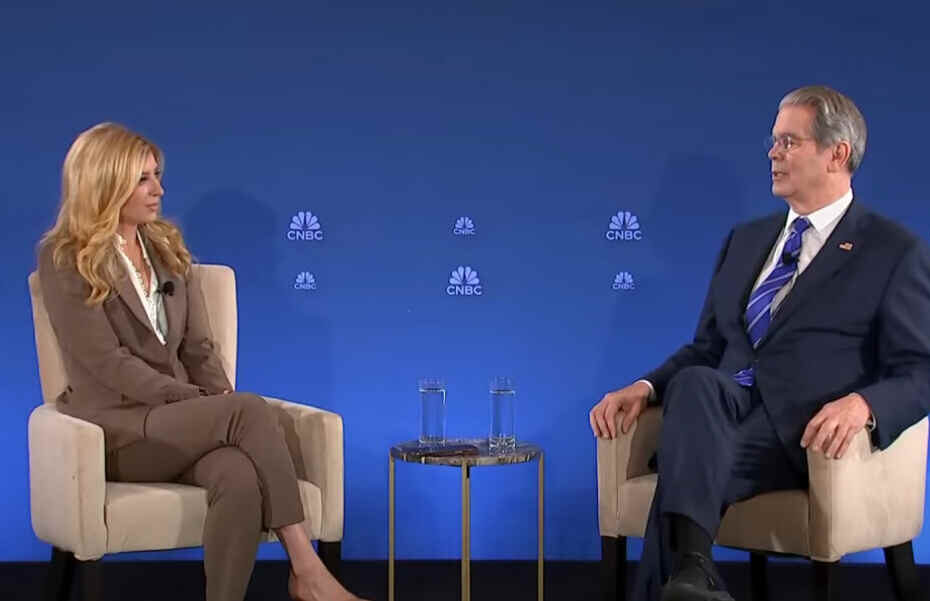
Read the full transcript of Treasury Secretary Scott Bessent’s interview by CNBC’s Sara Eisen At Invest in America Forum in Washington, D.C., October 15, 2025.
Treasury Secretary Scott Bessent on America’s Investment Boom and Economic Outlook
SARA EISEN: And I’m so happy that he’s here also because he’s in very high demand this week for IMF World Bank meetings. So thank you.
SCOTT BESSENT: America first.
SARA EISEN: America first. There we go. So the investment boom, I mean, it feels like every day we either get an Oval Office announcement from a CEO, some of whom are here today, or some massive AI deal. Is this boom that we’re seeing sustainable?
SCOTT BESSENT: Sure, I think we’re just seeing the beginning of it. And if we go back there, I think because there was so much pent up demand, I think the entire Biden four years saw $1 trillion of foreign direct investment, maybe it was $250 billion last year.
So a couple of things. There’s pent up demand, but then President Trump has unleashed this boom with his policies. So whether it is trade, tax, the tariff policy, the great certainty that we have from the one big beautiful bill, and he’s made it known that America’s open for business. Do your business here. We will give you energy tax certainty. We’re the biggest market in the world. We’re going to give you regulatory certainty.
One thing everyone asks me, what was one of your biggest surprises coming into government? And we lost the ability to make things in the United States. And a lot of it was through regulation permitting to get a factory built. God forbid if you tried to cross state lines on a pipeline in terms of drilling. So President Trump has really been all in and unleashed that.
Now on the other side, the only thing slowing us down here is this government shutdown.
And as we can see here, the private sector, that’s going to get it done. We need to get the government out of the way. We need to get it reopened. And I’m calling on moderate Democrats to come across the aisle, reopen the government and you’ll be a hero. You’ll be a hero.
The Government Shutdown and Its Economic Impact
SARA EISEN: I mean, is that how this ends? We’re on day 15 and it doesn’t look like there’s any sign of a deal.
SCOTT BESSENT: Well, there’s a thought out there that they’re at least waiting to this crazy “No Kings” rally this weekend, which is going to be the farthest left, the hardest core, the most unhinged in the Democratic Party, which is a big title. And “no kings” equal “no paychecks.”
We are paying our military. Today the Pentagon went into surplus funds and will be able to make the paychecks. And I think the other problem now is the mainstream media. If this were Republicans who shut down the government, there would have been screaming, there would have been examples of things going wrong. But because it’s the Democrats, they’re complicit.
And like I said, if moderate Republican senators come across the aisle, they will be heroes. They need to break away from the hive, from this radicalism. Chuck Schumer and Hakeem Jeffries, they call them two guys from Brooklyn who are completely detached from America. We are hostage to Senator Schumer’s poll numbers. He did the right thing. President Trump congratulated him in the spring when he passed a clean CR. And what’s changed between now and then? His poll numbers. He has collapsed in the polls.
And now it looks like Representative Jeffries is going to be primaried from the left. And I didn’t think there was any room over there.
SARA EISEN: Some people blame, I mean, people blame the current government for the shutdown. I mean, I know you’re blaming the Democrats, but often the blame goes to who’s in power.
SCOTT BESSENT: How is that? Mike Johnson passed a clean CR. Three Democratic senators have come over. The leader, Thune has a vote every day and they want to negotiate. We’re saying reopen the government, negotiate.
SARA EISEN: Is it hurting the economy?
SCOTT BESSENT: I’ve seen numbers that are starting to hurt the economy. Maybe up to $15 billion a day.
SARA EISEN: Do you expect it to have a material impact on the labor market?
SCOTT BESSENT: Could. I think it’s having an impact on confidence. We saw a drop in small business confidence which had been very strong. So hopefully we can get this, the Democrats will reopen and we can get back off to the races.
US-China Trade Tensions and Rare Earth Minerals
SARA EISEN: Interestingly, the market lately has been more concerned about trade, I think, than the government shutdown, especially this latest flare up between the US and China. So what happened from your point of view? Because I thought talks were going well, lines of communication were open. And then we learned about this rare earth mineral restriction from China. And now it’s back and forth and things are heating up again.
SCOTT BESSENT: They are. And the Chinese are trying to backfill the narrative saying, well, the US did A, B and C, therefore we had to do D and that’s not true. There was a lower level trade person who was slightly unhinged here in August. I think his name is Lee Kuang. And threatening, saying that China would unleash chaos on the global system if the US went ahead with our docking fees for Chinese ships.
And this is clearly something that they were planning all along. I think that things can de-escalate that we don’t want to have to escalate. We have things that are more powerful than the rare earth export controls that the Chinese want to put on. And to be clear, this is China versus the world. It’s not a US-China problem.
Good news is that this is IMF week. A lot of my counterparts, or all my counterparts are here. We’re going to be speaking with our European allies, with Australia, with Canada, with India and the Asian democracies. And we’re going to have a fulsome group response to this because bureaucrats in China cannot manage the supply chain or the manufacturing process for the rest of the world.
SARA EISEN: What is a fulsome response? What does that mean?
SCOTT BESSENT: We have lots of levers that we can pull for products that they need that could be equally damaging. We don’t want to damage their economy, we don’t believe that they want to damage ours. But they are a command and control economy and they are going to neither command nor control us.
And we’re going to assert sovereignty. So are the Western allies. And part of this investment boom that we’re seeing is President Trump wanted to reshore and part of the reshoring is strategic. So we don’t want to decouple with China. I don’t believe they want to decouple. But this rare earth export control is a sign of decoupling.
SARA EISEN: But we need them, don’t we? We need those rare earth minerals, don’t we?
SCOTT BESSENT: We do.
SARA EISEN: I mean that’s leverage that they have on us.
SCOTT BESSENT: We have lots of leverage on them too. We unfortunately, we have semiconductors, right? Aircraft engines. Many, many, many minerals that are also important for their supply system. But what we learned during COVID, COVID was a test run for what we’re seeing now in terms of bringing back strategic industries.
So we have this big investment boom and I would say 10, 15, 20% of it is bringing back five to seven strategic industries that we need, whether it’s pharma, whether it’s semiconductors, whether it’s shipbuilding, whether it’s steel and rare earths. So this rare earth problem was decades in the making. Every past administration should be ashamed. President Trump tried to solve it in his last term and the environmentalists threw a fit.
So here we are. But again, I’m optimistic. We are now communicating at very high levels.
SARA EISEN: Like right now, right now with your counterpart. I think there was an effort to get you. There was a report today there was an effort to get you with your counterpart in China, the vice Premier.
SCOTT BESSENT: There have been many outreaches. And good thing too is China has, as they always do, a large delegation everywhere. They have a large delegation here at IMF World Bank Week.
SARA EISEN: So you’re meeting with them.
SCOTT BESSENT: They’re working level meetings.
SARA EISEN: Okay. Is the Trump-Xi meeting still on?
SCOTT BESSENT: As far as I know, President Trump is a go on that. But again, we’ll see. I think they have an excellent relationship and the reason this didn’t really escalate is the level of trust between the two leaders. So that’s an enduring part of US-China and everything else stems from that.
Market Reactions and Economic Policy
SARA EISEN: Is it also because the market clearly does not want to see things get worse. I mean, we saw a big slide on Friday.
SCOTT BESSENT: Yeah. I think this narrative, terrible Wall Street Journal today article, complete that they’re taking CCP dictation that President Trump, he likes a high stock market, but he, like me, believes that the high stock market is a result of good policies. And it’s the policies that we’re talking about here today in terms of this capex boom.
And so the stock market is a result. And if we have to take strong measures against the Chinese, it won’t be because the stock, we won’t negotiate because the stock market is going down. We will negotiate because we are doing what is best economically for the US.
The AI Investment Boom and Bubble Concerns
SARA EISEN: The other thing that’s keeping the stock market so high is the investment boom we’re seeing in AI. And there’s this question now about whether we’re getting into bubble-like territories just because of the amount of spending and how quickly it’s happening on a technology that’s unproven and hasn’t been profitable yet.
SCOTT BESSENT: Sure. So are we in a bubble? Couple of things. As you may know, I’m not an economist, I’m an economic historian. I have taught the history of booms and busts and…
SARA EISEN: And traded them.
SCOTT BESSENT: And traded them. Thank you. And I think we are. Could we be in the third inning? So I think this is just taking…
SARA EISEN: Off third inning of investment in AI.
SCOTT BESSENT: Oh, sure, sure. An investment in usage. I think there’s a very good chance. We see like in the 90s with the Internet that with office equipment finally having the productivity miracle. So we had substantial productivity increases in the 90s. I think we’re starting to see that now.
When I talk to Silicon Valley investors and to corporate America, they think that the AI implementation is just really going to start in terms of productivity first, second quarter of next year. And I think the other thing too is Biden administration wanted to shackle up AI through this diffusion policy. They wanted to regulate it. Just a few of the biggest companies would have had access to it. So there is tremendous latent demand.
And then on the other side, there’s some bank executives here today. I was talking to them through the financial deregulation that President Trump instructed me to carry out via our regulatory policies. The Financial Times had an article over the weekend that there may have been $2.5 trillion of lending space created, and much of this can go into this capex boom. And you had a very good piece in the Washington Post this morning.
SARA EISEN: Thank you.
SCOTT BESSENT: And what always follows the capex boom is an employment boom.
AI’s Impact on Employment
SARA EISEN: I was going to say, but this time there’s worries that that employment boom might not happen if AI is making us so productive that we don’t need as many people doing the jobs. That’s one of the concerns.
SCOTT BESSENT: It may affect specific jobs, but I can tell you, when you see this level of capex and the pharma executives here, as your article pointed out, the trillions, the tens of trillions of dollars of capex, there are going to be plenty of jobs. All I hear is we’re having trouble filling jobs, so could there be some shuffling in the labor force? Sure.
SARA EISEN: But you’re not worried about mass unemployment because of AI?
SCOTT BESSENT: No, not at all. Not at all. I did a podcast for the fellow who took over from Charlie Kirk yesterday, and I was talking to him afterwards, and he said, well, because they have a lot of young people who follow him. And he said, what should I tell our viewers and listeners?
I said, get educated on AI, because having the AI skills and the ability to use them is what’s going to get you hired. I’ll date myself. My first job in 1984, I got put in charge of a project right out of the box because I knew how to use Lotus Notes and Ashton Tate 123.
SARA EISEN: No idea what that is. Exactly.
SCOTT BESSENT: Do you know what a 45 record is?
SARA EISEN: Yeah, I think my dad had that. No, but it’s interesting.
SCOTT BESSENT: It’s probably worth a lot.
Economic Outlook and Job Market Dynamics
SARA EISEN: Yeah, it’s interesting you mentioned jobs because we’ve actually entered this period now where there’s been a slowdown in job growth. So what do you think is driving that? Some people are wondering is this a supply issue because immigration has slowed down or is it a demand issue where businesses aren’t hiring as much?
SCOTT BESSENT: Well, I think it’s a couple of things. I think with the securing of the border and then maybe between deportations and voluntary deportations, have we seen 2 million people leave the workforce? And I think in terms of Americans having jobs, we’re doing quite well.
And then I think we are starting to see the right sizing of the federal government. So I had always said that there would be a transition period. Federal government got very bloated and as government employment comes down, we’re going to see this capex boom and on the other side private employment will pick it up. So that’s happening. I think that we are right on the cusp of that and government needs to get out of the way, reopen and create the conditions for this boom.
SARA EISEN: And what do you see then for your economic forecast? I mean, Atlanta said it’s predicting some pretty nice growth ahead. Do you feel like we are on an upswing?
SCOTT BESSENT: I think we’re definitely on an upswing because one big beautiful bill was passed on July 4th. And could I just say to this group, could you imagine if we were still negotiating a budget deal in the midst of this chaos the Democrats had created?
The other thing that has gone unnoticed with all the headlines is we actually had a smaller budget deficit last year. Not by much, but it went down. And the way the math works, the deficit to GDP, which is the important number, now has a 5 in front of it.
SARA EISEN: You want to see a 3 though? Yes, still possible.
SCOTT BESSENT: Still possible.
SARA EISEN: How do you get there? I mean tariffs are helping, but not that much.
SCOTT BESSENT: Crawl, walk, run. And it’s like Warren Buffett says, how do you lose weight, exercise more, eat less? So we’re going to grow more, spend less or constrain spending. And the deficit to GDP takes care of itself.
SARA EISEN: So that’s going to come down.
SCOTT BESSENT: Yes.
Inflation and Tariff Policy
SARA EISEN: What about the inflation outlook right now while we’re talking about the economy? Because I know you have said tariffs are not inflationary, but we are seeing inflation firm up here and at least the progress on disinflation has stopped.
SCOTT BESSENT: But Sara, if you look the inflationary component, it’s very disjointed because if you go through the numbers, a lot of the inflation is in services, which has nothing to do with tariffs. And if you get a one time price adjustment that’s not inflationary. And that comes out of spending somewhere else. So I’m not concerned that there is a generalized inflation increase. And we’re seeing that inflation expectations are well anchored.
We are seeing whether it’s a combination of exporters lowering prices. Corporate America, because they have a lot of room elsewhere, because one of the underappreciated things that’s happening with the trade negotiations, all we hear here is tariffs, tariffs, tariffs on the US and we’ve kind of established a minimum 15% baseline tariff. Some countries are higher.
But the underappreciated thing, I know you had Jameson Greer, USTR who is the busiest person in DC besides you. Whenever I feel sorry for myself, I look at Jameson and his team. Not only do they do big picture, they do all the details, they dot the I’s, cross the T’s. But he has done a fantastic job of negotiating for US companies selling abroad.
So we put on a tariff, but we also level, we push down to zero or substantially down the tariffs that other countries have on us. The non-tariff trade barriers. Indonesia made a very good deal, but I’m going to cuff the number. But I think they may have taken down the 9,000 tariff lines and non-tariff trade barriers, domestic content rules so much. So we sell more, we sell more and companies make more when they sell it.
Trade Negotiations Update
SARA EISEN: Right. Which trade negotiations beyond China, which I know is occupying a lot of your attention lately, are you most focused on?
SCOTT BESSENT: I think we are about to finish up with Korea.
SARA EISEN: Oh, is that going well? There was some question about the investment there.
SCOTT BESSENT: Yeah, it’s as I said, the devil’s in the details. But we are ironing out the details. I think there will be again the good thing about IMF and World Bank Week brings a lot of people here. So we’ll be talking about that. The President had a very good meeting with Prime Minister Carney recently. So I think US-Canada is back on track. I know that the Mexican team has been engaged.
SARA EISEN: And India, India is happening soon. Are we going to see more announcements on the trip to Asia later this month?
SCOTT BESSENT: Yes, yes. So very good chance that I will go out early, meet with my Chinese counterpart, the Vice Premier Hui Feng, who I have great respect for. I will meet him before. So there are two conferences. ASEAN in Malaysia, we’re going to do a visit, the President’s going to do a visit to Japan and then move to Korea for the APEC conference where the leaders, as of right now, will meet.
Industrial Policy and Government Stakes in Companies
SARA EISEN: The other big change on industrial policy from the administration has been around taking stakes in companies, private companies that you guys deem strategic and important for the US. I think there have been five now. Are there going to be more of those?
SCOTT BESSENT: I wouldn’t be surprised because again many of these, when we get an announcement like this week with China on the rare earth, you realize we have to be self-sufficient or we have to be sufficient with our allies. So when you are facing a non-market economy like China, then you have to exercise industrial policy.
So on Rare Earths for 20 years, anytime, rare earths are not rare. What is rare is the processing and…
SARA EISEN: Refining which China dominates.
SCOTT BESSENT: Which China dominates. I think they have 70% of the mining but 95% of the processing and refining. And for 20 years, anytime anyone in a market-based economy stood up a processor or refiner, China came in, cut price and put them out of business. So we’re going to set price floors and the forward buying to make sure that this doesn’t happen again. And we’re going to do it across a range of industries.
SARA EISEN: I was going to say though, where do you stop? I mean pharmaceuticals are really important for national security. Defense companies, we have the Pfizer CEO, we have the Northrop Grumman CEO. Are you going to be taking stakes in all of them?
SCOTT BESSENT: I don’t think we have to do that. I do think our defense companies are woefully behind in terms of deliveries. So we may have to, as their biggest customer, may have to prod them to do a little more research, do a little fewer stock buybacks, which is really what got Boeing into trouble because…
SARA EISEN: You’re such a big customer sometimes we’re the only customer.
SCOTT BESSENT: The only customer.
SARA EISEN: Right. But what’s the exit strategy for the government taking an equity stake?
SCOTT BESSENT: Well, the equity stake when you think about Intel, Intel was just the conversion of a grant. I was with President Trump, Secretary Lutnick in the Oval when the Intel CEO was there. And why don’t we have a stake? Why don’t we have the upside? We don’t have any governance there.
And then with these other deals, Mountain Pass would be one of the companies where it’s a rare earth miner processor. But then you see private capital come in. You see Jamie Dimon said that JP Morgan is going to get into the business, they’re going to be lending. They probably set up some kind of an exchange. They’re anxious to work with us on a strategic. We have a strategic petroleum reserve, we’re going to need strategic mineral reserve. And the private sector is coming in and that’s part of the capex boom too.
SARA EISEN: But what do you say to people who say that sounds socialist? I mean for government taking stakes in private companies, picking winners and losers, that’s not how we do it in America.
SCOTT BESSENT: Well, that’s the reason we’ve got this rare earth problem. Again I, that we’re not going to come in and take stakes in non-strategic industries. But we’ve identified seven industries if anyone wants to read it. I wrote a paper on this about 15 months ago for a speech I delivered at the Manhattan Institute.
And I do believe you’re pushing on this in a good way. That we do have to be very careful not to overreach and we need to go back and examine, okay, have we accomplished our goal? And then you can move on. But we have to be vigilant. We have to be vigilant because for 20, 25 years we haven’t been vigilant.
The leading Chinese rare earth company used to be owned by General Motors. Chinese bought it in 1995. CFIUS, which I chair, the Committee for Foreign Investment in the US mandated that it stayed in the US for five years. Guess what happened five years in one day.
SARA EISEN: Went back to China.
SCOTT BESSENT: Went back to China. Nobody was watching. Everyone’s asleep at the switch. So we’re just not going to be asleep at the switch.
Federal Reserve Chair Selection Process
SARA EISEN: The other thing that is keeping you very busy, as if we’re all enough, is the interview process for the next Fed chair, which we’re very eager to hear an update about. So have you narrowed it down to five or three or one?
SCOTT BESSENT: Well, I can tell you 330 million Americans, you’re talking to one who’s not going to be the Fed Chair.
SARA EISEN: Okay, thanks for clearing that up.
SCOTT BESSENT: But it’s been a great process. The 11 candidates we started out with were all strong candidates. As someone again who is a professor of economic history, I’ve learned so much from the candidates and we’ve narrowed it down to five that we will have to push out the next round to after the Asia trip.
So I suspect that that will go on in November and then likely sometime after Thanksgiving in December, we’ll present the President with three or four candidates for him to interview. It’s at the end of the day he’ll take input like he always does from dozens, hundreds of people and then make a decision.
SARA EISEN: Is one of the criteria to be the next Fed Chair to want lower rates?
SCOTT BESSENT: One of the criteria is to have an open mind. Because if we go back and look, I just reread Bob Woodward’s book on Alan Greenspan called “Maestro.” So why was Alan Greenspan the maestro? Because he had an open mind. Because the 90s I just mentioned, I think they’re, when I look at economic cycles, I think that the most analogous period to what we’re seeing now is the 90s.
And it would have been very easy for Alan Greenspan to kill the Internet boom, not be open to the idea that there was a productivity boom and slam on the brakes. Instead, he had a different view and let the economy believe that there could be substantial non-inflationary growth.
So two of the criteria for me, one, do you have an open mind? What’s your theory of the case? Where are we here? And then the other thing too is this Federal Reserve job. We ask someone to be this monetary policy icon. But this is also a gigantic sprawling organization that does payments regulation. So there also needs to be a management level here.
SARA EISEN: Right. So that’s part of the interview process.
SCOTT BESSENT: Part of the interview process.
Gold Prices and Dollar Strength
SARA EISEN: Okay, quickly, what is gold telling you at record highs of more than 50% this year, that there are more buyers than sellers?
SCOTT BESSENT: Does it say something about that we, that for many years gold mining, the amount of actual gold mining went down. And I don’t think it’s necessarily…
SARA EISEN: You don’t think it’s like some sign of anxiety or questions about reliability of the US dollar and US assets?
SCOTT BESSENT: Well, I don’t know why everyone comes back to the dollar. We are the only G7 country. Our 10-year rates are down 50 basis points, everyone else’s are up. And if you look at Chinese, excuse me, the Japanese rates, the percentage move is gigantic.
SARA EISEN: And the dollar’s down 10% this year.
SCOTT BESSENT: It is, it is down 6.7%.
SARA EISEN: It was down 10% three weeks ago.
SCOTT BESSENT: But again, good thing about being a historian, not an economist, that I rely on facts, not theory. So if I go back, are you…
SARA EISEN: Looking at trade-weighted dollars?
The Dollar and Trade Dynamics
SCOTT BESSENT: I am looking at trade weighted dollar. Well, because it’s just a euro move and any currency theory would tell you when you get a bigger fiscal spend, currency strong. So euro should be strong. But what we’re seeing in President Trump’s first term, the dollar bottomed almost to the day that the tax bill was passed in December 2017. Go back and look at a chart. Guess when the dollar bottomed? Right around July 4th, when the one big beautiful bill was passed.
SARA EISEN: Why? Because the outlook for the economy changes.
SCOTT BESSENT: Yeah, the certainty. What we’re seeing flow in. The other thing that happened was to get ahead of the tariffs, there was a massive amount of the US current account deficit ballooned, so more dollars ended up overseas.
Now that we have a more formalized tariff regime, there’s not this big rush. We’re seeing the US current account start to deficit and trade, or the trade deficits start to contract. So that should be very supportive for the dollar.
The Single Most Bullish Factor
SARA EISEN: So we’ve talked about a lot of different policies and a lot of what you’ve been doing. Clearly you’re optimistic. What is the single factor that’s making you most bullish right now on our chances?
SCOTT BESSENT: I’ve got to say it’s exactly the topic of this conference, is that the private sector in the US has been unleashed and the best thing the government can do is put in the guardrails, but stay out of the way. And the substantial deregulation and the focus on business.
And I think that this is exactly what President Trump wanted. It’s what I call parallel prosperity. Main Street does well, Wall Street does well. Because for a long time you can have these jobless stock market booms. And the president is laser focused. We are laser focused on small banks because small and community banks drive Main Street. They do the small business lending, they do the ag lending, they do the commercial real estate lending.
So I’m just very optimistic that after kind of being in hibernation or maybe even the fetal position for four years under the previous administration, that these industries, and again, whether it’s Main Street or our great tech companies, are all coming alive. The energy industry is back on its front foot. We’re going to complete pipelines and we’re going to drill again.
So I think that it is that, and I think we can be in a period like the late 1800s when the railroads came in, like the 1990s when we got the Internet and office tech boom. I think there’s a very good chance here that the US, we’re drawing in all this capital. And when I go around the world, I look and I just, there’s nothing like this in terms of we have energy, we have great regulation, we have great tax policy, we have great certainty in our tax policy.
Because I would go back to this now, imagine if we didn’t have the certainty in our tax policy, and we had not, thanks to President Trump’s leadership, Speaker Johnson, Leader Thune. If we had not gotten the one big beautiful bill done on July 4th, it would be a mess now. So the government shut down, but we can fall back on the tax policy, the 100% expensing.
But then on the other side, there are President Trump’s campaign promises: no tax on tips, tax on overtime, the small tax, if any, or no tax on Social Security. Buy an American car and you can deduct the interest. And those are for working people. So it’s the big companies and working people.
SARA EISEN: Well, it’s a perfect way to end it and a perfect tie in to the conference and to our next panel of corporate executives. Secretary Bessent, thank you very much for the time today.
SCOTT BESSENT: Thank you.
Related Posts
- Colin and Samir Show: with MrBeast (Transcript)
- All-In Podcast: with Scott Bessent on Fed, Tariffs and 2026 Economic Vision (Transcript)
- WTF is Finance #Ep 2: Ray Dalio on Money, Bubbles, and Playing the Game (Transcript)
- The Diary Of A CEO: MrBeast on Building a Billion‑Dollar Creator Empire (Transcript)
- Does The Wild West Of Crypto Still Exist?