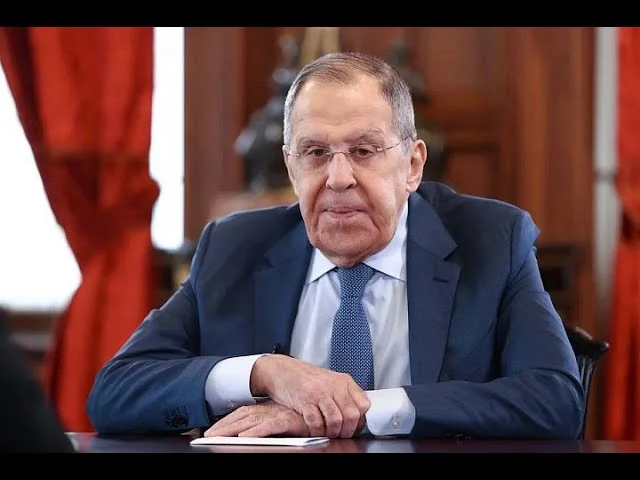
Read the full transcript of Foreign Minister Sergey Lavrov’s interview to the US bloggers Mario Nawfal, Larry C.Johnson and Andrew Napolitano, Moscow, March 12, 2025.
Listen to the audio version here:
TRANSCRIPT:
US Political Changes Under Trump
INTERVIEWER: Mister Minister, it’s a pleasure to speak to you, sir. The first question I have is as I speak to people here in Moscow, there’s a perception that the US has changed. They’re describing the US completely differently under President Trump. Do you think the US as a culture, not only the perception, but do you think it has fundamentally changed in their perception of Russia and President Putin?
SERGEY LAVROV: I think what is going on in the United States is a return to normalcy. The United States has always been the country of two big parties who competed between themselves, who changed ownership of the White House. But the division during my years in the United States, which started from 1981 – I’ve been there several times serving for a long period – compared to that time, the division now is absolutely striking.
On that occasion, the main dividing line between the Democrats and the Republicans was more taxes, less taxes, abortions, things which would be part of a normal Christian life. And within these Christian values, the entire politics were built arguing with each other, but within the values which everybody accepted.
With the introduction of neoliberal ideas, neocon ideas, but mostly neoliberal ideas, the divide became deeper, wider, and culmination was the first election of President Trump, which he himself admitted was a surprise to him, and he wasn’t really getting ready. Now he is ready, and it is clear how many – forty-nine days yet, and such a rich agenda is already thrown into the public domain.
So this split motivated, first of all, by the departure from Christian values by the leadership of the Democratic Party, in my view, by promoting without any limits the LGBTQ, whatever comes next.
You know, I mean, one WC for any gender. I once found myself in Sweden where the OSCE was conducting a ministerial meeting, and it was in a stadium specially arranged for the ministerial meeting. I wanted to go out and saw a WC sign. And I asked the guy who was accompanying me whether this was gents or ladies. He said, “everybody.” I don’t want any of my friends to experience this themselves.
This is just, of course, a tiny manifestation of those divisions, but America as we know it – Rust Belt America – is, of course, not very much keen to embrace those values. And the persistence, fanatic persistence with which those values were promoted to the population, certainly made quite a number of people decide for themselves that this is not what they want, and they supported Donald Trump.
So it’s back to normalcy as we understand normalcy. We are Orthodox Christians. The values are basically the same, though Catholicism now is becoming more and more deviating to the new trends, which we cannot understand and which we would not accept. But the fact that a normal administration without any unchristian ideas came to power, and the reaction was such an explosion in the media, in politics all over the world – it’s very interesting and it’s very telling.
US-Russia Relations
When we met with Marco Rubio and Mike Waltz and Steve Witkoff – hope I don’t reveal any secret – they suggested the meeting, and they said, “Look, we want normal relations.” Normal relations in the sense that the foundation of the American foreign policy under the Trump administration is national interest of the United States. This is absolute and without any discussion. But at the same time, we understand that other countries also have their national interests.
And those countries who have their national interests and don’t play into the hands of somebody else’s interest – we are ready to have serious discussion. It is very well understood. They told us that countries like the United States and Russia would never have their national interests the same. They would not coincide maybe even 50 or less percent. But when they do coincide, this situation, if we are responsible politicians, must be used to develop this simultaneous and similar interest into something practical, which would be mutually beneficial, be it economic projects, infrastructural projects, something else.
And then another message went: when interests do not coincide and contradict each other, this is a risk. Then the responsible countries must do everything not to allow this contradiction to degenerate into confrontation, especially military confrontation, which would be disastrous for many other countries.
We told them we fully share this logic. It’s absolutely the way President Putin wants and does conduct our foreign policy. He always, since he became president, underlines in his context that we are not imposing anything on anyone and that we are looking for a balance of interest. Same logic, absolutely.
And some people would say, “Oh, Russia is now changing and is turning away from the East, from China, from India, from Africa.” It’s an illusion. And euphoria is not what should be guiding us in foreign policy. By the way, China, for decades, has relations with the United States based exactly on the formula which I just described. They sometimes call each other names, which we don’t mind. I mean, we also in modern diplomacy are using new vocabulary. But they never interrupted the dialogue. They would say, “Hands off Taiwan, hands off South China Sea, but let’s meet and talk.”
It’s the same approach, the same logic, which is now accepted by the Trump administration in its relationship with the Russian Federation, and I think it’s only right. There are no two persons who would be 100% alike. And same with countries. And countries who can seriously influence the fate of the world militarily – the nuclear powers, in particular – of course, they have special responsibility not to shout at each other, but to sit down and talk.
More or less like it was handled by cowboys in many of the Hollywood movies: “He said that you know and I know that you know that I know and what are you going to tell me”.
NATO and US-Russia Relations
INTERVIEWER: So Mr.
SERGEY LAVROV: Yes, we have the same day.
INTERVIEWER: No, shortly after. We are the same age. We’re in the same year. And thank you for inviting us here. I want you to talk to us about NATO and the reaction in the foreign ministry to the treachery of NATO and how the foreign ministry will view it if and when the United States leaves NATO?
SERGEY LAVROV: Well, it’s a long story, of course, and it is a story about illusions, beliefs, disappointments, about partnership degenerating into rivalry and then confrontation and animosities.
I wouldn’t recite the story about how Jim Baker and others promised to Gorbachev that NATO wouldn’t move an inch to the East. And when they had to modify this offer, because GDR and West Germany were merging, it was agreed on paper legally. Now they say that there is no legal obligation not to expand. Fine. If you can only be made to implement your promise by court, then, of course, you need legal obligations all over you. But if you are a person of dignity, a man of dignity, if you agreed on something by political commitment, you have to deliver.
But at that time when Germany was reunified, it was written in the legal paper, this two plus four process, that GDR would become part of Federal Republic of Germany and thus would become part of NATO, but there would be no NATO infrastructure whatsoever on the former GDR’s territory. They are backtracking on this one now. They are deploying some NATO command in the East Germany. But Gorbachev believed that this was a serious promise, serious commitment.
Then, we were very much disappointed to watch how NATO not only accepted East Germany, but by 2004, the expansion already included the three Baltic republics, former republics of the Soviet Union, and then this ball was rolling, picking up more and more contenders who wanted to become members.
Foreign Minister Primakov from 1997 was suggesting to have some understanding between Russia and NATO. NATO-Russia Founding Act was negotiated, which was about equality, about mutual respect, about cooperation in various fields – against terrorism, against illegal migration. Actually, on that basis, NATO-Russia Council was created, which was running like 80 to 90 projects annually. There was cooperative program on Afghanistan. The Americans would get the Russian helicopters. We’d pay for them. We would service them on the ground. The Russian Soviet-made helicopters were most appropriate for the Afghan conditions. Counterterrorism, drug trafficking.
And then the expansion continues. And at some point, it was still Yeltsin – Primakov already became prime minister – and in 1999, there was an OSCE summit in Istanbul, and Yeltsin went there. They had meetings with his colleagues from the United States, European capitals, and they decided that to allay any fears about what NATO is and about what NATO’s further plans are, they have to adopt a strong political declaration on indivisibility of security.
And they adopted the Istanbul declaration, which says each country has the right to choose alliances, but no country has the right to strengthen its security at the expense of the security of others. And therefore – the most important paragraph – and therefore, no country, group of countries, or organizations in the OSCE area could ever claim dominance. NATO was doing exactly the opposite.
Ukraine Conflict and Minsk Agreements
So now, after the beginning of the special military operation, which Putin repeatedly stated was the decision because all other attempts, all other alternatives to bring things into some positive dimension failed for ten years after the illegal coup in Kyiv in violation of the deal signed the night before and guaranteed by the Germans, French, and Poles. The deal was about a five-month period to prepare for general elections. And in the meantime, government of national unity would rule.
Next morning, the opposition took government buildings, went to the crowd in the Maidan, and said, “Congratulate us. We created the government of the winners.” Winners and national unity, it’s slightly different.
In Ukraine, when these people who came to power through the coup – and their first statement was that they would cancel the status of the Russian language, their first action was sending armed fighters to storm the Crimean parliament – when they called terrorists the citizens of Eastern and Southern Ukraine who said, “Guys, wait a minute. You came to power by an illegal coup. We don’t want to take any orders from you. Leave us alone.” And they said, “Oh, you are terrorists.” And they started army operations against their own citizens, thus launching the war which ended in February 2015 by signing the Minsk agreements, which President Macron tries now to interpret as something which Putin didn’t want to implement.
It was really a very funny speech by President Macron. It also relates to NATO, by the way, because he was saying, “Okay, let them leave, and I will protect all of you with my three or four nuclear bombs.”
But on that occasion, we spent seventeen hours nonstop in Minsk, and the deal was agreed. And after that – well, I’m deviating from NATO, but you would understand me – and after the deal was agreed, it was endorsed by the Security Council.
And a very interesting moment: when we finished negotiations, Poroshenko, with support of Macron and Merkel or of Hollande and Merkel, said that he would not sign this paper unless it is signed by the “separatists,” as he called them. And the heads of the two self-proclaimed republics, Donetsk and Lugansk, they were in the same city of Minsk in another hotel, and they said they would not sign this because it was negotiated without them. And this was a document providing for territorial integrity of Ukraine with just special status given to these two tiny territories, to be frank, and they had already proclaimed independence. They said they cannot betray their people.
It took us some persuasion to make them sign this paper, which indeed set special status inside Ukraine, Russian language, the right to be consulted when prosecutors and judges are appointed for these municipalities. But their rights, the special status must be consolidated in the constitution, and the exact language must be negotiated directly between Kyiv and these two places. It’s part of the Minsk agreement endorsed by the Security Council.
Very soon after it was enforced, the Germans, the French, and the Ukrainians themselves started saying, “We never talk to the separatists.” And Macron, when he came to Moscow just a week or so before we started the military operation, he was at the press conference. And then during this infamous phone conversation with Putin, which he, the President of France, leaked, he was saying, “Vladimir, you cannot insist on this legitimate government agreeing to talk to the separatists.” And Putin was objecting, saying, “This government came to power as a result of a coup. Let them be grateful to all of us that we are trying to legitimize this entire situation and this entire country. But don’t forget that the Minsk agreements bluntly say direct dialogue with those whom you call separatists.”
It’s a very shameful way which the French and the Germans behaved, and eventually, those who signed on behalf of Ukraine, Germany, and France – Poroshenko, Merkel, and Hollande – being retired already, they stated in interviews, “We never intended to implement this. We just needed to buy time to push more weapons into Ukraine.” And, of course, NATO was playing a key role, this Ramstein process led by the United States during Biden’s time.
# Lavrov’s Interview with US Bloggers (Continued)
On NATO’s Future and European Relations
LAVROV: Now the Americans want to give it to the Brits, I understand, but the Europeans do not stop their efforts. On the contrary, they kind of increase them and call for more and more support, becoming more and more emphatic, and I would even say nervous.
And the question whether NATO can survive without the United States is, I understand, motivated by these observations. I don’t think the Americans would drop from NATO.
At least President Trump never hinted that this might be the case. What he did bluntly say was that if you want us to protect you, to give you security guarantees, you pay what is necessary. It’s still to be discussed what is necessary – 2.5%, 5%, anything in the middle. But he also said that those who fulfill the criteria of the percentage of GNP to be contributed to NATO, then the United States would guarantee that they are safe and secure. But it doesn’t want to provide these security guarantees to Ukraine under Zelensky.
He has his own view of the situation, which he bluntly presents every now and then that this war should have never started, that the pulling Ukraine into NATO, in violation of its constitution, in violation of the declaration of independence of 1991 on the basis of which we recognized Ukraine as a sovereign state for several reasons, including that this declaration was saying no NATO, no blocs, neutral status. And another thing which this declaration also confirmed and solidified, the all rights of Russian and all other national minorities are to be respected, which, by the way, is still in the Ukrainian constitution in spite of the fact that the series of laws they passed since 2019 terminated in total prohibition, legal prohibition of the Russian language in media, education, culture, even in day to day life. If you come to a store and ask the store attendant to be assisted in Russian, he or she might tell you to speak the right language. Such issues happened.
And, of course, this was a very different situation. Since then, they included the NATO membership into the constitution while keeping the national minorities guarantees. They declared that NATO is the future of Ukraine, European Union also. When they started saying these things, European Union still kept some resemblance of an economic grouping. Now it lost it altogether, and Fuhrer Ursula is mobilizing everybody to remilitarize Europe. Some unbelievable sums of money are being mentioned.
And many people think that this is a trick to divert attention of the population from those dozens and hundreds of billions of euros which have been spent during the COVID days and during the assistance to Ukraine, without proper auditing. It’s a discussion which is being raised.
On European Union’s Transformation
EU also lost its independence. It’s lost its economic meaning. Because when a German government spokesperson says, “No. No. We would never restore this gas pipeline, Nord Stream and Nord Stream 2, because we have to get rid of the dependence on the Russian gas.” But this was the basis for the German economy, for prosperity of the German economy. They pay now four, five times more than similar industries pay for gas in the United States.
And business is moving to the US. The deindustrialization of Europe is taking place, and they are ready to sacrifice all this just for the sake of achieving ideological goal, defeating Russia. They were saying in the battlefield, Russia must be strategically defeated. Now they say we would not accept capitulation of Ukraine. It’s a change, almost 360 degrees as Annalena Baerbock says.
But European Union is no longer peaceful economic project. They want their own army, speaking of the future of NATO. There are voices. “Okay. If the United States doesn’t want to be actively involved in European affairs, let’s have our own NATO, our own military alliance,” but this is the game in process. Some statements are intended, you know, just to test the ground what will be the response from the other side of the ocean.
And I think one and a half years ago, European Union, they signed an agreement with NATO, which basically subordinated EU to North Atlantic Alliance, providing this mobility. In other words, NATO equipment, NATO troops can use the territory of non-member, non-NATO EU states. If there are such states still left – yes, Austria, Ireland, but it is not that important because they always think eastward.
And to say, you know, for peace loving people, to say prime minister of Denmark. She said that these days, Ukraine is weak. Ukraine cannot be fairly treated now. Therefore, for Ukraine, today, peace is worse than war. She said this. “Let’s pump Ukraine with weapons again. And when we have shaken Russian position, then let’s see whether we can talk.”
And the chief of German intelligence, a couple of days ago, said that it would be bad for Ukraine and for Europe if the war ends before 2029. And 2030, even better. Yes. They say these things.
And when President Trump was interrogating President Zelensky in the Oval Office, asking him many times, “You don’t want to negotiate.” Zelensky was trying to avoid an answer. And, of course, they are very much concerned that irregularities, let me put it very mildly, by the Biden era, with Pentagon supplies to Ukraine, without possibility to see where this money went.
Elon Musk is trying to do this. We are not taking any pleasure from this, but this is about governments, the Biden administration or Solar Funderland and Fur Commission, the Brits who regularly accuse Russia of corruption, who regularly accuse Russia of violating human rights, and who basically, whatever international issue they discuss, they start with human rights. Iran, Venezuela, Cuba, of course, Nicaragua, South Africa now violated human rights by passing a law on land. Central Asia, whenever they – there are several formats between the West and Central Asia. Human rights are on top everywhere.
But on Ukraine, where the Russian language has been exterminated legally and physically, there is a special agency to watch for this legislation to be fully implemented. Nobody ever mentioned human rights except us. Now Hungarians, Bulgarians, start raising this issue because they also have their minorities in Ukraine, which was carved up, mostly by Stalin after World War Two, cutting through the, basically, like colonial powers did in Africa.
On Ukraine’s Borders and Negotiations
Look at the African map. Just by a rule, they draw the borders. In case of Ukraine and its neighbors, it’s different because it was individually carved out, but divided nations. And therefore, after the coup, when we started talking to Poroshenko, when he was pledging that he would never allow the war between the Ukrainian army and the eastern citizens of Ukraine. And when he was saying that we will be faithful to our commitment regarding national minorities, Federalization was very seriously discussed between myself, John Kerry, Cathy Ashton, who was the EU foreign policy boss at that time and the guy whom Kyiv delegated. It was April 2015.
And we seriously discussed. Nobody mentioned Crimea. It was a done deal already. And we developed a paper saying that there must be some gathering of the heads of the Ukrainian regions, and they have to discuss how to continue to live in a state, which used to be unitary state, but the minority rights mattered. It was February 2014. Then everybody forgot about this.
Zelensky, who also came to power under the slogan that he would implement the Minsk agreements, less than a few months after he was inaugurated, he was saying very different things. “We are a unitary state. There would be no special status. I don’t talk to separatists” and so on and so forth.
And another lie which Emmanuel Macron said in his recent pathetic statement was about a meeting in Paris in December 2019, Macron, Merkel, Putin, Zelensky, which the Germans and the French convened to save the Minsk agreements. And there was preparatory work, which culminated in a draft document agreed by experts, by ministers of the four countries, and then presented to the presidents and chancellor.
And that was, you know, consensus. It was consensus, and it said that there would be disengagement at three areas on the line of contact immediately as the beginning of disengagement of forces along the entire duration of the line of contact agreed. And when it was shown to the leaders, everybody was satisfied. Zelensky said, “No. No. I can only agree to try to do this in three experimental areas, not along the entire line of contact.” Nobody could understand why, but he insisted. But the main thing that he never disengaged even at these three locations, and the military activities continued.
On NATO’s Role and Expansion
So where NATO comes into it, I remember that it was about NATO. Well, NATO was certainly providing him with weapons, with intelligence data. It continues until now. Americans announced that they are withdrawing, maybe temporarily, maybe not. They are withdrawing the instructors and experts who helped guide high-tech missiles, but others remained there.
One more thing about NATO. NATO used to be proud that they are defensive alliance, that the only thing which concerns them is to defend territories of the member states. Couple of years ago at the summit, I don’t remember where that summit was, the then secretary general Stoltenberg already said we need to be more active in Indo-Pacific region. He was asked by a journalist, “But you insisted that you are about defense of your territories.” He said, “Yes. Absolutely. But the threats to our territories now emanate from South China Sea, from the Strait of Taiwan,” and so on and so forth.
And NATO started building there non-inclusive blocks, troikas, quads, AUKUS. Then they encouraged this Indo-Pacific quartet, Japan, Australia, New Zealand, Korea. They developed their cooperation with Japan and South Korea, joint exercises, and with South Korea, the nuclear elements already are involved and discussed.
So NATO, they are opening, as far as I understand, an office of NATO in Tokyo or on some of the islands. They’re trying to pull some ASEAN countries out and to bring them into this limited membership closed clubs. Philippines is case in point. Singapore is case in point.
On Eurasian Security Architecture
And the concept of security was developed by ASEAN through many decades and which included participation of everybody on an equal footing, including China, US, India, Russia, Japan, Australia, New Zealand, Korea. This concept based on consensus is now being undermined quite considerably, which is very interesting because it coincided with the period when we started rethinking our own security and Eurasian security. Exactly Eurasian, not European. Eurasian.
Each continent, Africa, Latin America, they have continental wide organizations, African Union, CELAC in Latin America and Caribbean, and only Eurasia. The biggest, the most prosperous, the most developed and rich continent doesn’t have a continent wide organization. All attempts of Russia to be part of some security cooperation process, worry about Euro Atlantic schemes? OSCE, NATO-Russia, EU became Euro Atlantic very soon, and that didn’t work.
So what we are now trying to discuss, not imposing anything on anybody, is a vision of Eurasian continental architecture without prejudging the shape, but just to sit down and to talk on the basis of openness of this hypothetical eventual architecture to all continental countries.
Let them keep NATO if they so wish. Let them keep OSCE. But there are Eurasian Economic Union, Organization of Collective Security Treaty, Commonwealth of Independent States, ASEAN. There is an organization of the countries of South Asia. Not very active, but still. There is Gulf Cooperation Council by the Arab monarchies who are now normalizing their relations with Iran, and we promote this.
So all these subregional developments, most of them are economic, and it would not hurt if we unite these efforts, organize a division of labor to save money, to save effort, to harmonize the economic plans. Putin called it great Eurasian partnership. And who knows? Maybe many years from now, it would be material basis for some security architecture, which would not be – which must not be close to the western part of the continent. Well, this is not very brief, but…
INTERVIEWER: That was fascinating. Surely, both of you. Let me please… You know what? I’m not sure I trust my own country. And I know that the Russian government is quite sincere in looking to pursue a diplomatic solution. What troubles me and it’s something that I continue to hear now from people in significant positions. Just as the United States cynically developed a relationship with China in 1972 under Nixon, it was for the express purpose of going after then the Soviet Union to try to make sure that they split them apart.
I have heard several people, and I know that this, Elbridge Colby, who is going to be like the number three person in the Department of Defense, that they see China as the enemy, and they want to believe that they can split Russia from China. And, again, use you, not you personally, Mister Minister, but the country, as a wedge against China. Now I’m afraid to say that’s foolishness because unlike the United States, the Russian government takes its agreements seriously and adheres to them. So how do you think – what will be Russia’s approach in juggling this subterfuge by the United States to, on the one hand, offer you a hand of friendship, but at the same time, they have not released their desire to destroy your country and to also use you cynically against the Chinese?
LAVROV: Well, we have been through this, as you mentioned, in 1972 when Nixon wanted this relationship and this triangle to be like this. The relations between the US and China and the US and Russia, both must be better than the relations between Moscow and China. A combination.
[LAVROV:] Well, it’s a nice philosophical construction, but the current situation is radically different. Yes. We never had relations with China which were that good, that confidential, that long-term built, and that would be enjoying support of the peoples of both countries. The Americans know that we would not betray our commitments, legal commitments, but also the political commitments which we develop with the Chinese. We have problems.
We have difficulties in our relations mostly because of the sanctions, because the companies want to avoid being punished. Some of the very promising projects, logistical infrastructural projects in Siberia are being delayed, but we are not in a hurry. And the Chinese, of course, are never in a hurry. They always see the horizon. This is the national character, and we respect this.
Actually, again, I wouldn’t probably reveal a secret when Biden and Putin met in June 2021 in Geneva. It was in the middle of COVID-19 pandemic. And in a brief discussion—and it was only the foreign ministers—President Biden said, “You know, I start rethinking the absolutism of democracy because the countries who have authoritarian rulers, they cope much better with the COVID infection than we are. In our case, each state has some kind of leeway and they decide to vaccinate or not to vaccinate.”
And the Chinese and Russia, he said, acted better than many others. But this is a philosophical discussion. You can argue whether in the same logic, whether four years is enough for doing something long term, especially with these modern, very complicated, sophisticated technologies which require retuning of sectors of economy and whether four years is enough or maybe even two years. Because if you lose midterm elections, the Congress would not allow you to deliver.
I think the answer is let each nation choose its destiny, its future. It will be exactly in line with the United Nations Charter, which says sovereign equality of states, no interference. One example, Afghanistan. The democratic experiment failed completely, and it totally ignored the centuries and centuries old habits and rules, if you wish, unwritten rules of this civilization. So we would be very much cautious regarding any imposition. And Trump is already saying about a meeting at three, US, China, Russia. He mentioned that he would like to discuss nuclear weapons and security issues.
We would be open to any format which is based on mutual respect, on equality, no prejudged solutions. If our Chinese friends would be interested, it would be their decision. But this does not negate the importance of Russia-US dialogue on strategic stability. And the interest in resuming such discussions was expressed repeatedly by Trump and his people. Putin, in response, said that it is the area where we have special responsibility, especially since in one year, the START treaty would be expiring.
So it’s a very different approach from what the Biden administration used to promote. They were saying, “Let’s resume the implementation of the START treaty, and let us visit some of your nuclear sites.” We told them, “Guys, you declared us enemy. You declared the goal to inflict strategic defeat on Russia.” They said, “Yes. But this does not preclude some tactical and technical visits.”
Trump’s position, as I said at the very beginning, is that whatever differences we have, don’t allow them to degenerate into a war. And whatever interests come the same way, don’t waste the chance to develop this into something practical and useful.
On Multipolarity and Future Relations
[INTERVIEWER:] So it seems that Marco Rubio said it himself. We’re walking into a multipolar world. And you said, you know, the Chinese and to an extent, the Russians as well, you always look at the horizon and ignore short-term developments. So in the horizon, do you think—and I know I’m getting ahead of myself—but do you think there’s a possibility in the next, let’s say, ten years of not only normalization of relations between Russia and the US, but back to an alliance between the two countries in the next ten years? That’s something already people are talking about.
[LAVROV:] The alliance means, at least historically, and this is deeply in our mentality, means that you are ally against somebody. Multipolarity, which Marco Rubio recognized, is different. How can you recognize multipolarity without recognizing such giant as China, such giant as India?
Africa is the continent and Latin America, Brazil, and quite a number of others. Multipolarity, in my view, would be evolving for quite some time. It’s a historic epoch probably. And it could be—that’s my vision—composed of superpowers by the size, by the economic weight, by the military might, especially nuclear, and certainly US, China, Russia fit into this category.
Those who are not as big, they can participate in a multipolar world through their subregional structures. ASEAN, for example, GCC, Gulf Cooperation Council, League of Arab States. And African Union, by the way, received the status of full member of G20 last year. League of Arab States wants the same. We are in favor.
G20, by the way, is the format which is now proving to be not only financially and economically useful, but also politically, it might play a very positive role in the process of multipolarity. Yes. There are still remnants of animosity, but the rule of consensus is there. They don’t vote. Therefore, they are more promising than the United Nations General Assembly, who every now and then, whenever somebody cannot get something from the Security Council, they go to the General Assembly, and they stage a show with votes, with accusations, and so on and so forth.
On Ukraine and NATO
But not only Marco Rubio spoke about multipolarity. Donald Trump spoke about NATO, as I referred to his statements, repeated statements that this was one of the reasons. And we insist that any approach, any attempt to approach the Ukrainian crisis, any initiative, and most of them are very vague, should concentrate on the root causes of the conflict. And Donald Trump confirmed that one of the root causes was NATO expansion, which created a threat to the Russian security.
I, by the way, would like to emphasize in these new circumstances after January 20 that the importance of Ukraine for the Russian security is many, many, many times bigger than the importance of Greenland for the US security.
And the second issue about root causes, I also referred to the extermination of the Russian language, media culture, prohibition of opposition parties, prohibition of opposition media even published in Ukrainian language and operating in Ukrainian language, murder and disappearance of journalists, not to mention the military crimes, war crimes against the people in Donbas immediately after the coup when they called them terrorists. And all this grossly violates the UN Charter, which says everybody must respect human rights of every person irrespective of race, gender, language, or religion. It’s on top. It’s article one of the UN Charter.
On Western Accusations Against Russia
I’ve been calling upon the Secretary General of the United Nations, and I was challenging the journalists in the United Nations. When I visit, I have a press conference. By the way, I also challenged those journalists on quite a number of things, which were used by the West to condemn Russia like the worst criminal, starting with the downing of Malaysian Boeing, MH17, July 2014.
The trial was held with only one witness being present in person. 12 other witnesses were not presented. Their names are not known, but the jury said that they are reliable, and they confirmed the suspicion. So it is still very, very murky.
The case of Salisbury poisonings, Skripals, official notes to the United Kingdom authorities about asking questions about the fate and whereabouts of Russian citizens, totally ignored. They raised hell. They accused us. They used this to increase sanctions, and then they forgot about this.
The same is true about Alexey Navalny, who died in prison, serving his term, but who was couple years before that treated after alleged poisoning in Russia. He was taken in less than twenty-four hours to Germany, and he was treated in Germany.
It’s an interesting story. The Germans, we were asking questions. He is our citizen, and we wanted to know the truth what happened to him. They said that the civilian hospital did not find anything, and he was treated in the military hospital of Bundeswehr, where they told us, they found Novichok, this substance, in his blood. We asked to see the test.
It’s only natural. He’s our citizen. We are being accused of maltreating him. They said, “No. We are not giving this to you because you might find out what level of expertise we have in biological substances. And we are giving this to Organization on Prohibition of Chemical Weapons.”
We went to this organization and said, “Look, you are our common entity, and the Germans said that it is now your property.” They told us, “Yes. They gave it to us, but on the condition that we would not show it to you.” It’s childish, but it is tragic at the same time.
And repeatedly, publicly, I asked many Western journalists, “Why don’t you—being a journalist, you want to know the truth, right? And a person who was made a martyr by the West against the Russian Federation, evil—you don’t want to know what happened actually to him and how he was treated and with what was he treated in Germany before he came back to Russia.”
And the last one, Bucha, two days after as a goodwill gesture, for the sake of signing the Istanbul deal in April 2022, we withdrew from couple of villages in the outskirts of Kyiv. And two days after we left this place Bucha, the BBC team broadcast the main street with corpses neatly laid along the route on both sides. We still—and, of course, there was an outcry. We insisted on investigation. Nobody cared about investigation until now.
We want to get the names of the people, just the names of the people whose bodies were shown by BBC. I raised this issue twice publicly in the Security Council in front of the Secretary General. I raised it with him. We sent a formal request to the High Commissioner on Human Rights of the United Nations. No response.
And twice, I raised the issue in New York in front of all foreign correspondents just appealing to their professional drive to no avail.
On Peacekeepers and Ukraine’s Future
And speaking on human rights and on the sincerity of our Western friends, Europe and the UK, they certainly want this to continue. The way they received Zelensky in London after the scandal in Washington, it’s an indication that they want to raise the stakes, and they are preparing something to pressure Trump administration back into some aggressive action against Russia. We are philosophical about this. We know what we are doing, but I am mostly amazed with this peacekeepers obsession.
Peacekeepers. Macron says, “Let’s stop in one month. Peacekeepers would be deployed, then we’ll see what to do next.”
It is not what we say is required for the end of this war, which the West waged against us through Ukrainians with their direct participation of their military. We know this. If NATO expansion is recognized at least by Donald Trump as one of the root causes, then the presence of the troops from NATO countries under any flag in any capacity on Ukrainian soil is the same threat.
[INTERVIEWER:] You won’t accept it under any conditions?
[LAVROV:] Under any conditions. Well, nobody is talking to us. They keep saying “nothing about Ukraine without Ukraine,” but they do everything about Russia without Russia, planning.
Trump, by the way, when asked about peacekeepers, he said, “Well, it’s too early to discuss this, but normally, you need the consent of the parties.” Why should we give consent to the peacekeeping force or peacekeeping group even, not force, though they want force, composed of the countries who declared us an enemy, and they would come as peacekeepers?
And the second thing is, the rights and the fate of the people who live not only on the liberated territories, but on the territories under the control of the regime. They also most of them speak Russian. They were brought as part of the Russian culture, and they want their kids to know Russian and to learn Russian.
My question was whether this law or several pieces of law prohibiting Russian language, whether this would be canceled on the territory which would be left of Ukraine, there is no answer. “We’ll see. We’ll see later.”
And if “we’ll see later,” another question, whether you will still keep this monument to Bandera who collaborated with Hitler and was accused of convicted by the Nuremberg tribunal in absentia. And this monument, for the first time, Israeli ambassador was shown, and he said, “I never suspected that this was the case.”
[INTERVIEWER:] You mean the minister?
[LAVROV:] Minister, for instance. Yeah. Right. So the rest of Ukraine would keep this monument and would keep prohibition of Russia, would stage the Torch Marches with insignia from SS divisions. Then with all respect, this would be not a group, a force keeping peace. This would be a group keeping and protecting the Nazi regime. And this is absolutely unacceptable.
On Gaza and Israel
[INTERVIEWER:] May I ask you about Gaza? President Putin has expressed outrage at the genocide in Gaza. What will be the position of the foreign ministry if the Netanyahu regime attacks Iran as Prime Minister Netanyahu has publicly threatened?
[LAVROV:] Unfortunately, we had used to have good relations with President Netanyahu. Putin always is underlining when he speaks about this region that the solution is impossible without the Palestinian state and without reliable security arrangements for Israel. The two states were created by the decision of the General Assembly, 1948.
Negotiations and Territorial Disputes
And the decision, I don’t remember the exact wording, but the decision, basically conditioned the creation and existence of one state against the creation and conditions of another and the existence of another. Now everybody who wants a Palestinian state speaks about 1967 borders, which is very different from 1948 borders, which was supposed to be the borders of Israel and of Palestine. If you take a look at the map now, 1967 borders is like galaxy compared to what you have, and the West Bank is all in settlements. And the latest developments, I saw so many reports that Israelis decided to annex in a specific way the West Bank by taking it under total control without sending Palestinians out, but concentrating them in several municipalities, not in camps, in municipalities.
INTERVIEWER: Is Iran part of the current negotiations as well? On the peace negotiations when it comes to Ukraine. Does that include other geopolitical issues?
INTERVIEWER: As President Putin and President Trump are talking, is it purely about Ukraine, or could it include other geopolitical interests for Russia?
Iran and Regional Influence
SERGEY LAVROV: We discussed the situation in the Persian Gulf. We discussed the joint comprehensive action program on Iran nuclear issue. We are in favor of restoring the original program, from which the Americans dropped during the first Trump government. There are some contacts on the European side.
We would be in favor of resuming the format which developed the original deal endorsed by the Security Council, which is France, Germany, UK, US, Russia, China, and Iran. We’ll see how it goes, but what is worrying is that there are some indications that the Americans would like this new deal to be accompanied by political conditions, insisting that there should be some verifiable arrangement for Iran not to support groups in Iraq, in Lebanon, in Syria, anywhere, which I don’t think is going to fly.
Look. All countries of this region in The Gulf, all of them have influence beyond the borders of their kingdoms, Emirates, Northern Africa. They undertake quite a number of programs, humanitarian economic programs, they mediate a lot. Sudan, for example, and domestic crisis in Sudan is being handled one way or another by some place in The Gulf. So to say that everybody has this right to project influence except Iran, I don’t think it’s realistic.
Russia’s Position on Ukraine
INTERVIEWER: What about President Putin’s statement June 2024 regarding the conditions for a settlement to even start negotiations with Ukraine. And my reading of it has been, President Putin’s position has been the same. Your position has been the same as the president’s. It’s been also by Vice Minister Ripkoff has said it. And yet I think there are some in the West that perceive that you don’t really mean what you say.
SERGEY LAVROV: Let them be misguided. You know, our conscience is very clear and clean. And it is clean not because we use it seldom. It’s because we have been burning our fingers so many times that on this particular crisis, we know what must be done and that we would not compromise the way which would compromise the fate of the people.
It’s not about the territories. It’s about the people who were deprived of their history by law, who were when Zelensky was asked in September 21, before the operation, he was asked in an interview when the war was still going on in violation of the Minsk agreements. He was asked by interviewer what he thought about the people on the other side of the line of contact. And he said, you know, it’s still on the Internet. You can see it. You know, there are people and they’re auspicious. And if anybody living in Ukraine feels that he or she is a part of Russian culture, my advice to you, for the sake of your children, for the future of your grandkids, go to Russia. Get out of Ukraine.
And this was the man who only few years before that while being an actor and then when running for presidency, he was saying, stop attacking the Russian language. Let people—he was on record. And but the sequence of events, which made us absolutely concentrated on achieving the results, which would be in favor of the people, which would be saving the people.
Those who speak, well, we have to bring Ukraine back into 1991 territory, and Russia must get out. Territories are important only because people live on these territories. And the people who live on the territories which he wants back are descendants of those who, for hundreds and hundreds years, were building Odessa and other cities on those very lands, who were building ports, roads, who were founding those lands and who associated with the history of this land.
By the way, UNESCO announced under huge pressure from Ukraine that the center of Odessa is now the site of world cultural heritage. It was not which it deserved, but the decision was announced one week after the monument to Catherine the Great, the founder of Odessa was toppled and thrown away. And UNESCO just went on as if nothing had happened.
Historical Context of Ukraine Crisis
But just brief sequence of events. February, the two candidates, one is considered pro-Russian, another is considered pro-American. He is married to some American palatologist. The second round of elections in 02/2004, the pro-Russian candidate wins. But the crowd instigated by the Europeans mostly demands reconsideration of these results. And under huge pressure, the constitutional court of Ukraine adopts a decision to hold a third round, which is not provided for in the constitution—constitutional court extended, without any right, the constitutional procedures.
Then the pro-West candidate wins, Mr. Yushchenko. Fine. There was no Maidan, no revolution. Nobody was instigating people to do it. And then at the next presidential elections, the candidate who was considered pro-Russian, Mr. Yanukovych, he is winning in a very clean way. Nobody challenges him.
But then Mr. Yanukovych, in 02/2013, maybe even earlier, but in 02/2013, it culminated. He started negotiations with the European Union on getting the association agreement, and it became known. You cannot hide such a thing. And our experts started explaining to Ukrainian colleagues that if you go to the association status with European Union, you get zero tariffs on many items. And you, Ukraine, have zero tariffs with us because the Commonwealth of Independent States has free trade area. But we have quite a protection in our trade with European Union, which we negotiated when we were joining WTO.
So it might be a situation whereby European goods from which we negotiated some protection would be fleeing into Ukraine, and there is no customs border between Ukraine and Russia. So we would have to close this border. Then he said, well, I have to—we even suggested to the European Commission who was headed by Jose Manuel Barozo at that time. Putin proposed to him, let’s seat the three of us, EU, Russia, and Ukraine, and see how we can handle these discrepancies, you know, so that nobody suffers.
He said, none of your business. We don’t discuss Russia-Canadian trade. You do what you want. And then Yanukovych asked for postponement of the signature of this association agreement. Just said, I want to understand this better. How can we handle it?
This was the trigger for that Maidan, well prepared, hundreds of tents of the same make, the same color, the same everything. And this Maidan culminated in February 2014 when Germany, France, European Commission negotiated between the legitimate president and their position. And that’s how it started.
Had they—and they reached a deal, which, as I said, was disrupted next morning when opposition said we are now the power, the government. Had they delivered on the deal which they signed with the help of the Germans, the French, and the European Commission, Ukraine would be exactly by now where they wanted it to see 1991 borders, including Crimea.
They decided to be impatient because had they waited five months for the elections, for the early elections, they would have won because the electorate in Ukraine was very heavily massaged by USAID and the National Endowment for Democracy. The figures which are popping up now and which Trump was reading out in Congress—
INTERVIEWER: Victoria Nuland actually said—
SERGEY LAVROV: After this coup that we did so much for democracy to win on Ukraine, we spent $5,000,000,000. She said this for this particular revolution.
So then there were Minsk agreements. Had they delivered on the Minsk agreements, they would still have been in 1991 borders minus Crimea because Crimea was never mentioned during the Minsk negotiations. Everybody understood that this was a very clean, fair vote of the people. There were hundreds of Western observers, not official, but from MPs.
April 2022, Istanbul. Macron said that Putin tried to impose something on Zelensky. It’s another lie by Macron. Because the paper which was initialed by us and Ukrainians was prepared by Ukrainians, and we accepted this. It was very straightforward. No NATO, no military bases, no military maneuvers. Instead of NATO, guarantees are provided by permanent five plus Germany, plus Turkey, and the list is open. Anybody who would like can join the list of guarantors. And these guarantees do not cover Crimea and the part of Donbas, which was controlled by Russia at that time.
And they initialed it—it was their thing. And these principles were initialed, and there was an agreement to develop a treaty paper on this basis. Then Boris Johnson said, don’t do it. Continue to fight just like the head of German intelligence now says that we cannot stop until 2029. Maybe they want to sit out Donald Trump.
So had they been cooperative and had they delivered on their own initiative, they would still have 1991 borders minus Crimea, minus some part of the Donbas. They should have taken the deal. Of course, they should. Every time they cheat, they lose, and the process continues.
INTERVIEWER: You know, it’s been said that you’re the Metternich of the modern era, but I think that’s wrong. They should say that Metternich was the Lavrov of his era.
SERGEY LAVROV: Thank you very much. Thank you.
Related Posts
- President Trump Remarks on US, Israel Attacking Iran (Transcript)
- President Trump on Economy, Energy in Corpus Christi, TX (Transcript)
- Bulwark Podcast: w/ Susan Glasser on Trump’s State of the Union address (Transcript)
- Douglas Macgregor: US-Iran Diplomacy Fail (Transcript)
- The Truth About Trump’s State of the Union w/ Sen. Bernie Sanders (Transcript)