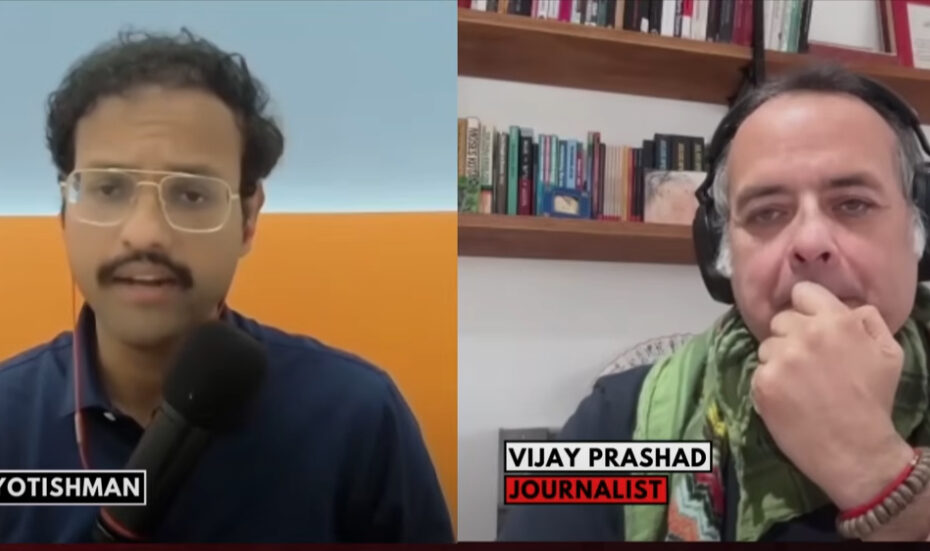
Read the full transcript of historian and political analyst Vijay Prashad’s interview on India & Global Left podcast with host Jyotishman Mudiar on “Palestine, Russia, BRICS & the Fight for Socialism”, premiered on August 12, 2025.
Introduction
JYOTISHMAN MUDIAR: Hello and welcome to another episode of India and Global Left. Without further ado, let me welcome our guest today, Vijay Prashad. Vijay is a historian and a political commentator. He has authored several books and is the executive head of Tricontinental Institute for Social Research. Vijay, welcome back to India and Global Left.
VIJAY PRASHAD: Great to be with you. Nice to see you.
The Current Crisis in Palestine
JYOTISHMAN MUDIAR: Good to see you again. If we could start with Palestine, we are seeing a tremendous mass crisis. Today’s data by Palestinian officials says that 405,000 tons of vegetables have collapsed into just 28,000 tons of production, which means tremendous shortages of food. This is over and above a total destruction of 665 livestock and cattle farms.
We are hearing talks about a reoccupation of Gaza, which no one knows what it exactly means, but people assume that it will be an escalation of occupation and maybe a more longer term occupation. In the occupied West Bank we are seeing tremendous pace of settlement expansion over and above violence.
As a historian, how would you place this moment in this long history of, let’s say more than 100 years since the Balfour Declaration? How would you describe what is happening in Palestine at this moment?
Historical Context: Comparing Partition in South Asia and Palestine
VIJAY PRASHAD: Well, you know, it’s interesting to make a quick comparison with what happened in the Indian subcontinent because in both British Empire in India and in the British mandate in this part of West Asia, the British decided to do the same sort of thing which is to partition what they thought was an intractable problem.
In India, partition the country, create a so-called Muslim country and a so-called Hindu country and let 13 million people go across an imaginary, initially imaginary border. One million people died in the partition of the Indian subcontinent. It was a brutal death toll. A million people. My family comes from Lahore to what is now India and so on. 13 million people made the journey.
But there was in a sense a recognition that there’s now a Pakistan and there’s an India. And there was really no attempt by either side to go and conquer the other. Firstly, scale wise it was perhaps impossible. There was a fight in Kashmir, but that was over Kashmir, not about the fact of Pakistan and the fact of India. And now we understand the fact of Pakistan and the fact of India.
In the British mandate in West Asia, the story is different because just as the British announced the partition of the land into a country for the Jews and the country for the Arabs, which is how they saw it, the not yet created country of the Jews, which had already developed an army, just went and conquered all the land.
Throughout the citizenry, you had 700,000 Palestinians expelled from the land, moved to camps in Gaza, in Lebanon, in Israel, in Jordan and so on and further afield. It’s a very different history. It’s violent, just as the partition in South Asia was violent. But here the new state of Israel fundamentally did not recognize the Palestinians as a neighboring country, as an entity, as a people, and have since 1948 conducted a permanent nakba, attempted to basically annihilate the Palestinians from the area, take all the land from the river to the sea for Israel, from the Jordan river to the Mediterranean and perhaps further.
There are plans to go further than the Jordan river, of course, to take large tracks of Syria. Already if you look at the map, there’s a place called Metula’s Finger into Lebanon, where the so-called line of control between Lebanon and Israel is almost a straight line from the Mediterranean. But then you get to the edge of where the Golan Heights are and there’s this finger of Israel going into Lebanon. Why? To control the water. To control a water source. They just went and conquered that piece. It’s called Metula’s Finger, won’t give it up.
So there is a kind of imagination in Israel just taking the whole thing. Imagine the Indian military in 1947 saying, “forget partition, we’re going to just send the tanks and take all of what is to be Pakistan.” Didn’t happen, but it did happen in Israel. And Israel is continuing to want to annihilate the Palestinians.
The Palestinian Resistance Movement: Unity and Division
JYOTISHMAN MUDIAR: I wanted to ask you something about how do you look at the Palestinian resistance movement or national movement at this point in time? Because I had Mouin Rabbani on my show and I asked him about what could be some of the things to be optimistic at this moment, where it’s impossible to be optimistic in a way, but not to be fatalistic, one has to look for hopes.
One of the things he said that the Palestinian movement seems to be lacking at this point in time, as opposed to maybe in the 80s where the PLO, regardless of all its failures, it was a strong national movement. He said that the divisions have been very striking and the Palestinian cause now lacks a united nationalist movement. What are your thoughts about the divisions within these different factions of Palestinian movement?
VIJAY PRASHAD: Every national liberation movement has a series of groups because there are different views of what’s going on. There is certainly a kind of Palestinian center that used to be very much in the forefront of people’s imagination. And that was the Palestinian Liberation Organization brought together all the factions. Fatah, the Palestinian Left and so on, were all in the PLO.
The PLO fractures at the time of Oslo, the Oslo agreements of 1994.
But 20 years ago, when the leaders of all these groups clandestinely were able to communicate in Israeli prisons – very interesting story. They were in different prisons. They were incommunicado, but they were able to get messages to each other. These are the leaders of the major factions. They wrote together in different prisons a letter which was then secretly smuggled out and then released as the prisoner’s letter where the prisoners argued about 20 years ago saying, “look, we need a new national project. We now come to understand the failures of Oslo and Palestinian Authority has become policeman for the Israeli occupation. It’s not really carrying forward the PLO’s vision. We need a new politics. We need a new horizon.”
But interestingly, when this letter was leaked, the Israelis recognized that’s a threat. The last thing they want is Marwan Barghouti and all these people to be out of prison and creating a new Palestinian national project. So punctually, almost in a timetable, the Israelis kept picking up leaders of the different Palestinian factions, tossing them into isolation. Khalida Jarrar here, Barghouti, already in prison and so on, not allowing Palestinian politics to come together. The west was never interested in this, nor the Gulf Arabs.
Fascinatingly, 2023, the Chinese brought legitimate representatives. This is very important that I use the word legitimate representatives because a lot of leaders are sitting in jail, in Israeli jails, held in administrative detention without allowance of politics and so on. So leaders or representatives of these movements were brought to China. Again, a lot of clandestine work in bringing them there. They met together, they discussed the need of unity. And they released for the first time in about 40 years, released the 14 party statement in 2024. It’s extremely important statement, but they are being effectively eroded their capacity to move as a consequence of Israeli pressure on the ground.
They are extremely having a hard time building the politics further. But I would say optimistically that the 14 party statement is a real opening. And I don’t know what is going on again in the pipes, in the infrastructure of politics, in the clandestine work, in the conversations they’re having. Not sure what they are building, but they certainly have seen the light of the prisoners letter of the 2000s, 2004, where the prisoners said, “Listen, 10 years after Oslo, we need a new dynamic.” And I know that the 14 party statement, 30 years after Oslo has finally brought them together where this will go. Speculate a little bit, but I think we just leave it there and watch it.
The Imperial Core: Official Hypocrisy vs. Popular Support
JYOTISHMAN MUDIAR: The countries that are primarily responsible for what is happening in Palestine are United States to lead and Europe comes second. I mean, there have been some dishonorable exceptions in the global south. India and Azerbaijan comes to our mind. But these are very insignificant countries, frankly, if the west was not giving them weapons, ideological support and all kinds of diplomatic and other kinds of intelligence support and so on.
Lately we’ve been seeing these moral tantrums in a way on part of Europeans saying we would recognize the Palestinian state while maintaining these facade of fighting to eliminate Hamas. So it’s basically gives Israel the green light to keep doing what it has been doing. And the United States has of course gone off the deep end. So that’s something we are seeing at the level of the officials.
On the other hand, and this is something which Mouin Rabbani said is something one should not be fatalistic about. There is a groundswell of support within this imperial core among people in general, including a lot of Jewish people in the United States. If you could comment on these two kinds of contradictory developments that we are seeing in the imperial core with regards to the question of Palestine.
VIJAY PRASHAD: Well, let’s just say what it is, which is that large numbers of people in the imperial core have been taken to the streets pretty consistently and they’ve broken to some extent the wall of the criticism of antisemitism. Look, antisemitism is a real problem. It’s racism. It’s a form of racism. These are real problems. But the argument that critique of Israel is anti-Semitic, that argument has faced now a real challenge and has not been able to sustain itself.
Which is why after all this mass starvation, I mean, look at where you have to get for Keir Starmer to stand up and say, “well, there’s a problem.” Look at where you have to get for Donald Trump to say people are starving in Gaza. I mean, yes, Donald, that’s a factual statement, actually, not outrage. You just said a factual thing. People are starving. And in fact, I think he said, “too many people are starving.” I’m not exactly sure what his words were, but whatever it might be, these people are saying this on the one side because they are facing pressure.
People are speaking to them directly and saying, “what is going on here?” It’s ridiculous, ludicrous that you’re allowing this, you’re funding it. The British have been providing intelligence support, air flights over Gaza of their intelligence planes, directing attacks and so on. They have a direct role in the genocide. Not even sort of passively supporting, even with arms. It’s a form of passive support compared to providing targeting information. You’ve got surveillance planes and so on. Active participation. This is one pressure.
But the other is that it is also true that the Palestinians are facing something that I think people in the west haven’t seen in a long time, this starvation campaign, which even in places like Sudan, when there was a famine related incident, 2011, 2012, 2021, these were not starvation campaigns where somebody has directly said Netanyahu is the most horrendous character. His character is doubtful.
The Iranians just announced, “we have a problem with water.” Netanyahu released a statement drinking a glass of water saying, “we stand with the Iran.” I mean, what is that? That’s a fraternity prank. He’s that kind of character. Remember, a dozen or so people died in the Charlie Hebdo attack in Paris and all the world leaders came, including Netanyahu, to march down the street saying, “we condemn this.” Where is the march now? Where are Macron and all? When are they going to say we’re going to march down the streets of Gaza City, bringing aid with us? Nothing. These are hypocritical people.
So their hypocrisy is on the table. But it’s also true that they are now making some statements pushed by the people. And the terrible circumstance in Gaza.
BRICS vs. NAM: Different Contexts, Different Politics
JYOTISHMAN MUDIAR: Even what happened on October 7th itself is another example. I mean, 800 something people, civilians, were killed, let’s assume all were killed by Hamas. I mean, there are contested reports that some of them might be killed by the Israelis, but let’s say Hamas killed them.
Now more than a thousand people have been killed. I mean, some reports are now saying 2,000 have been killed in the food distribution sites themselves. That’s much more than the number of people killed by Hamas, even if one assumes that everyone was killed by Hamas.
My final question here, since you drew the parallel with the Indian subcontinent. I think one of the key difference in the case of Israel is that we had a settler colonial people. I mean these are Europeans basically coming from there in the Indian subcontinent. These are all people living there. And there was a division within that. And so you didn’t have this “demographic problem.”
And if one looks at history, United States, Australia, I mean places where settler colonial nations became republic or nation states, eventually it has basically been able to do that after erasing the entire people. Now of course, as Ilan Pappe writes that Israel faces a problem because it’s this 18th century settler colonial nation in a settler colonial state in a 21st century, what can be the resolution?
Many people talk about one state. It’s very difficult to even think about once that while I understand, because the argument is that it’s extremely difficult to think about the two states when the settlers have expanded so much and they are the most important constituency for the Israeli state, no matter who comes there. And so no one is going to dismantle them. And that’s the argument behind saying that it should be one state. What is the end result?
The Two-State Solution: Tactical Necessity vs. Long-term Viability
VIJAY PRASHAD: Well, look, the first thing is I very much understand why various countries are calling for the two state or to recognize Palestine and so on. I’m very much in favor of this right now. Why? Because right now the compelling issue is to block the Israeli annexation of Gaza and the West Bank.
If you say the two state solution is junk and gone, you’re basically authorizing Israel to come in and seize Gaza and the West Bank. Yeah, they’ll say sure, the two state solution is over. That is why it’s important for India, China, all these countries to keep insisting we support the two state solution. Because what they are saying is East Jerusalem, West Bank, Gaza is part of Palestine, cannot be seized by Israel. Get the settlers out, it’s illegal.
If you annul the two state solution, then the settlers are not illegal. The settlers in the west bank will say there’s no two state. So at the moment, tactically, it’s very important to continue to hammer on the fact that there is a two state situation and that is established in international treaties. Very important. That cannot be given up in the future.
There is a real debate to be had in the future. A real debate to be had. I’ll tell you why. Because on the one side this is an extremely small territory with extremely contested geographies. Every little town is a contest of conflicting narratives of historical importance and so on. Every area it’s very congested in a sense and dense. It’s congested physically and it’s dense historically and culturally. Everything is contested.
Given that there is no possibility really of two states, I mean you got to find a way to link Gaza to the West Bank. How are you going to do that? Build a monorail? You’re going to allow open borders? What are you going to do? You can have a closed train system where you go from one country to the other. The only other example we have of something somewhat like this is Russia. Russia has an enclave which is effectively, which is in Poland, tiny enclave. There’s no real way to get there. If you are a Russian, you’re basically out there enclosed. There’s no land bridge, you have to fly or go by sea. This is not a well designed project.
Of the three little parts of the Palestinian state, Gaza, East Jerusalem and the West Banks, very poorly designed. One state solution poses a serious challenge to Zionism because the Zionist project argues that Israel is a Jewish state. Now if it is a Jewish state and there’s one state, it will no longer be majority Jewish state. It will be very much near 50-50 and then the demography shows that most likely it will be a Palestinian majority state in time.
Okay, well that’s a problem for Zionism. But it’s interesting that Israel has been rather two faced on this. They’ve never come out and declared we are a Jewish state. On the other hand, their entire legal structure supports the idea that it’s a Jewish state. So you’ll have to annul the idea that it’s a Jewish state, which I think Jewish supremacy in a state is a bad idea. Like Hindu supremacy or white supremacism or any form of supremacy. Very bad idea. But that’s the foundational logic of Zionism.
So the Zionists are going to have to withdraw their claim to a Zionist state and allow a secular democratic state to come in for one state. This is a very complicated debate around Zionism. So I mean the whole thing is unresolved. Yeah, you can’t right now walk away from the two state. Tactically it’s absolutely necessary to maintain the two state solution. Whatever the Palestinians Israelis come up with later, that’s a separate matter because it is also true the two state solution is not manageable in this congested dense population. But the one state solution annuls Zionism. Can Zionism be annulled? I’m not sure about that. I think that’s a big fight.
BRICS and the Global South Response to US Economic Warfare
JYOTISHMAN MUDIAR: Certainly the first condition has to be a shift in the United States itself. I mean, as long as that doesn’t happen, it’s impossible. Also it’s important to say that the West Bank itself is not one. I mean there are several cantons, I mean and they are expanding the E1 settlement which are in contiguous with Malia Dumim, which is kind of trifurcating, you know, Jericho, Jordan valley, East Jerusalem, etc.
So let us pivot to what the Global South is doing at the face of unilateral escalation by the United States through economic warfares. And also sanctions are basically political. So it’s not basically trade, it’s whole economic warfare and political warfare.
And I wanted to start with BRICS. Given you’ve been writing about NAM, you have followed NAM and one of the differences that I felt and tell me what your response to that is that while NAM didn’t have a contingent reserve fund like the BRICS have as an alternative to IMF financing or an investment fund as an alternative to Asian Development Bank or the World Bank, NAM had a very impressive politics at the core of it, which was centrally on the question of decolonization and anti imperialism.
But those countries were also somewhat leaning towards socialism to various degree for a very long time. BRICS didn’t have that kind of unified politics against imperialism. I think there is some kind of a shift there and India, countries like India, Brazil, which have always been problematic and with the kind of shift in the ANC in South Africa, you know, a lot of people writings has been on how they have been. They have accepted neoliberalism. There are these, that there has been these divisions within BRICS.
But lately through the escalation of Trump’s warfare, economic warfare, we are seeing some kind of insertion of politics into BRICS. How are you looking at this shift and how does it affect the relationship between the west and the Global South going forward?
The Bandung Spirit vs. BRICS: Politics vs. Economics
VIJAY PRASHAD: That’s such an excellent question. In April, our institute Tricontinental published a text called “The Bandung Spirit.” It’s available online, it’s freely downloadable and so on. It’s very interesting because it’s exactly your question.
The Bandung Spirit text makes the argument that the Bandung conference of 1955, which generates the energy to create The Non-aligned movement of 1961, the Bandung Conference, comes out of anti colonial struggles. The people who come there, you know, whether it’s Nehru or Zhou Enlai, you know, Nasser and so on, these people come with the power of a anti colonial movement behind them.
They are genuinely leaders produced by movements, you know, even though Nehru might come from an elite background, he represented the Indian National Congress, which was a mass force that had ejected the British from India. Zhou Enlai, he represented the Chinese resurgence, the redemption of the 1911 revolution then now led by the Communist Party of China in 1949. That’s how they come to Bandung. That’s how NAM is created with that enormous political pressure behind them.
And the politics of anti colonialism had a unifying set of features, which was why it was so easy to write the declaration at Bandung. They all agreed with everything. So politics led the way at Bandung. Economics was important. They talked about economic change. And in fact, in 1964, at the urging of the Non Aligned Movement, the United Nations creates the United Nations Trade and Development Conference. UNCTAD, which is the think tank for developing development of the Global South, plays a very important role to this day. But economics was not in the lead.
This, of course, went out of this balloon of the Bandung. The Bandung balloon lost its air in the 1980s during the debt crisis. That’s a story that I tell in the book “Darker Nations” about the balloon losing its air in the debt crisis of the 1980s.
Well, when BRICS emerges in 2009, it’s a direct response to the credit crisis in the western countries in 2007 and 8, the collapse of certain parts of the banking system. The United States pumping an enormous amount of money into the banking system to prevent toxic housing assets from bringing the whole house down and so on.
So the BRICS or the large locomotives of the south come together in 2009 principally on economic grounds, not on political grounds. They are pushed there because of the financial crisis. They are not pushed there by mass movements. So even in 2009, it’s actually forces of the right in many of these countries or center right that are coming to the table, not forces of the left that come to the table in 2009 in China, for instance, at that time you didn’t have the leftist resurgence that you get with Xi Jinping. You had a much more measured approach.
And the Chinese come to the table, which is itself extraordinary. They didn’t say, we’ll just be on the sidelines. They sat at the table. It’s the C in BRICS, but it was on the ground of south-south trade, south-south business cooperation and so on. They are also being pushed into politics, but they don’t have the mass movements behind them.
You know, Mr. Modi is facing an enormous problem in India around voter fraud and so on. In Karnataka and the elections there, so called “vote chore.” He’s facing a lot of pressure there. It is not clear in Brazil that Mr. Lula will be able to prevail in another election in South Africa. It’s a minority government of the, of the left and the right. You know, it’s a minority government. It’s not a, they don’t have a majority. You know, these are very weak countries. China is struggling to, you know, stave off the United States pressure campaign on China.
Nonetheless, all of these pressures and pushes and the tariffs of Trump and so on have driven them into a political direction. In fact, what accelerated the politics of the BRICS was the Russian entry into Ukraine because all these countries faced pressure to condemn Russia and they refused. And then they expanded the BRICS. They brought in almost all the oil producing countries except Venezuela and the United States. Venezuela I’m sure will enter at some point into the BRICS. Then most of the energy producing countries will be in BRICS. OPEC will be inside BRICS. This is a change. They will be politically stronger, they will start to make more.
But it’s not going to have a socialist character. The principal concept that unites these countries is sovereignty. Sovereignty from Western intervention in particular, but also the desire for more south-south trade. And so it’s completely in a way a different context. We argue in this text “The Bandung Spirit” from Tricontinental. We make the argument the context now is different. You can’t say BRICS is like Bandung or BRICS is like the NAM. You’re absolutely correct. The way you frame the question, it is a different context now and we have to take what we get. Not imagine or fantasize that this is something other than what it is.
BRICS and Financial Independence
JYOTISHMAN MUDIAR: Yes, and a big context is that NAM was at a time when these countries have their registrar political economy, by which we mean that they were not dependent enormously on foreign capital. I mean foreign capital used to be there to some extent. They had to buy much needed grains, technology and so on and so forth, but the reliance was much less.
But now a lot of these countries depend on foreign capital. India for instance, has seen enormous outflow of qualified portfolio investment after these escalations of tariff and it’s very difficult to hold on to that for a very long time. And so I think the problem is that on one hand you want to take on the imperial core. On the other hand, you have to continue to remain dependent on that.
Maybe it’s easier relatively to restructure trade in four or five years because lately we’ve seen that, that even after tariffs, Chinese industrial export went up, which means that there is enough room outside this 10 to 12% demand created by the consumption within the United States, which you can replenish to some extent, but you cannot replenish your stock market if you are still dependent on the stock market because the Chinese won’t be able to give you that liquidity because they have capital control and they are not providing liquidity to the outer world.
So I think Professor Patnaik and others have argued that for BRICS to actually go forward with this politics, you would have to need some kind of independence from financial capital centered at the imperial core. I think you mentioned how central Russia has been in whatever strengthening of BRICS.
VIJAY PRASHAD: We agree.
Trump-Putin Talks and Ukraine
JYOTISHMAN MUDIAR: We have seen recently there is a much publicized talk coming up between President Trump and President Putin. A lot of people say that it would not lead to anything given the demands from Russia are very substantive. One is complete rethinking of the security apparatus in Eurasia, which mean almost dumbing down NATO from the borders of Eurasia.
But now there are also questions about the territory in eastern Ukraine. And even Russia might talk about whether it would tolerate the government in Kyiv which came through a coup, and the military industrial complex, the intelligence community and Europe themselves would tremendously veto them. And now that Europe has said that we would subsidize all the military industrial complex, JD Vance said that if they pay for us, we are fine. We will keep providing weapons. Are you hopeful about these talks?
VIJAY PRASHAD: Well, look, we’ve got two people who are very good conversers and negotiators meeting each other. These are very smart people. Don’t underestimate either of them. These are not people who you can walk all over. So I don’t know what’s going to happen. It’s very difficult to predict.
But the Secretary General of NATO, Mark Rutte, just made a comment saying that maybe the division of Ukraine is going to happen. That maybe that’s a signal that they are basically saying, look, there’s going to be some territorial concessions which will have to be made.
JYOTISHMAN MUDIAR: He said, short term, we don’t have to. We won’t accept it long term. But what does that even mean? Who defines these things?
VIJAY PRASHAD: If something is accepted in the short term, I don’t get what that means. I saw that, but I was like, it looks like you’re going to accept it in the short term and in the long term it’ll be a fait accompli because that’s how these things work. I’ve never seen this go the other way.
JYOTISHMAN MUDIAR: One of the examples he gave was some of these Eastern European countries, and he said that we accepted them within the Warsaw Pact, but we knew that ultimately they would come back and they would join NATO. So it’s very hard for imperialists to actually rethink security apparatus. I mean, come on, he’s the head of NATO.
NATO’s Role and US Strategy
VIJAY PRASHAD: Yeah, but the fact that he said short term surprised me because NATO has been adamant that there’s going to be no divide and so on. So that’s a concession from Rutte. So we don’t know what Trump is telling them or what Trump is saying. It seemed to me like a trial balloon that Trump is putting pressure on them, saying, “Look, guys, it’s gone.” Yeah, the Eastern Ukraine is gone, the Mariupol, the land bridge to Crimea, gone. They may withdraw from sections of the north and so on, give bits back as part of a deal, but these parts are gone.
It’s likely that Trump is putting pressure on them, saying, “Wake up, smell the coffee.” Now, the issue for NATO is not Europe, it’s the United States. See, it’s interesting. I did an exercise a few months ago. I looked at NATO expansion and what I was thinking about, and I’m not sure if this is exactly accurate, but it’s very interesting.
Anytime there’s a conversation about the European Union expansion, a country said, “We want to join the EU,” NATO would show up and say, “Why don’t you also join NATO?” It struck me in a way that it was the United States, which uses NATO, its Trojan horse, as a way to continue to expand its own influence. The last thing it wanted was an EU outside US control and interest.
So if the United States just says, “Look, we are not interested in having NATO expand all over, it’s going to create instability,” then NATO doesn’t expand. Then the deal with Putin is easy. If there is that new sensibility in the United States, that’s what we’ve got to look for.
Mark Rutte doesn’t speak for Ursula van der Leyen. She doesn’t speak for the European Commission. Europe doesn’t play a decisive role in NATO. If the US tells the NATO command, “Back off, guys,” they’re going to back off. So I’m interested in what’s happening in the White House.
I thought it was fascinating how JD Vance, in the middle of this debate and contest, goes to Munich and lectures the Europeans about democracy. He doesn’t talk about Ukraine, he doesn’t talk about NATO, he doesn’t talk about these things. Trump goes to the NATO summit and just bathes in the adulation. He doesn’t talk about strategy, he doesn’t say anything about the future of NATO. They are just saying we are here.
And so I would hesitate to put a big point down. I do feel that Trump is going to give Putin a number of concessions. If Ukraine is the main topic of conversation, not necessarily going to be. There’s a lot of things on the agenda. US-Russian relations is a primary issue. Ukraine is on the side of that, US-Russia relations, to start talking and so on.
The Reverse Kissinger Strategy
I don’t know if you saw this, but after Trump came in, I wrote an article saying that the Trump administration is going to try a reverse Kissinger strategy, which was that they’re going to try and attract Russia to break with China because they realized by isolating both Russia and China and by China and Russia building links with each other, they’ve strengthened both of them. It’s backfired.
So trying a reverse Kissinger going for Russia to befriend Russia so that they can isolate China, that’s what I said. I thought Trump was going to go for that. The Wall Street Journal interestingly carried an article recently saying Trump is going to go for a Kissinger where he is going to give the Chinese trade concessions, back off on some tariffs and try to break China away from Russia.
So this idea of the Kissinger reverse Kissinger is not fantasy. When I wrote it, people said to me it’s never going to work. But that’s not the point. Whether it works or not is secondary. Primarily that was the direction of US Foreign policy. It’s always been about dividing Russia and China. That’s how they use the Sino Soviet conflict to their advantage.
So in a sense, I have a feeling that Trump is testing the waters. He’s going to test the waters with Putin, see if the so called reverse Kissinger will work. And then if that doesn’t work, he might show up in Beijing. There was a rumor in China when I was there recently that Trump is going to show up at the September 3rd celebration of the defeat of Fascism. Xi Jinping is going to have a huge event in Beijing. He’s going to give a big speech and so on. The rumors, Putin is coming, Trump is coming.
So I wrote an article and I went on a TV show saying, maybe Modi should come there. And then the Indian press picked it up and said, “Why is this guy Prashad saying Modi should go there.” And then an announcement came saying Modi is going to China for the Shanghai Cooperation Organization meeting.
This is all very interesting. I’m 100% for India and China to have a rapprochement. So whatever happens with Trump and Putin, good luck to them. I hope the war in Ukraine is brought to an end. But my heart right now is beating in the direction of if Trump and Putin can talk, why can’t Modi and Xi Jinping have a straight face to face and say, “Look, we don’t have a border dispute. What we have is a problem of trust between China and India. There’s no real border dispute that’s solvable.”
India-China Relations and Technology Competition
JYOTISHMAN MUDIAR: Yeah, there is one or two pieces, but I agree with you completely that those things should be left for future and then you can talk. And China has been responding very positively. I was very curious because this normalization of India, China relationship after this talk, after a cold point came right after the escalation and de-escalation in Pakistan.
And given there is this perception in India that China directly supported. I mean, the Global Times says that we did, we didn’t do that. We sold weapons the way they buy weapons from France and the United States and Russia, but we didn’t participate. But given there was a perception in India that China directly supported it and normalization came immediately and I was taken by surprise, pleasantly. And then of course, what Trump did ultimately with the sanctions kind of, I think, laid the groundwork for Modi’s travel to China.
I don’t personally agree with the Kissinger thing though, because I think they are very. Washington is very clear also the ruling elite, that our sole enemy is China. And it is about technology in particular, because never in human history the global south created a technological threat to the imperial core.
I mean, the Soviet Union did great, but there have been very serious papers that by 1960s and maybe even before the Soviet Union’s technologically falling behind, even though in terms of itself it was doing great in terms of material production and so on, but in terms of the leading edge, it was falling behind despite all the breakthroughs in space technology and so on, but that’s not China. And I think they are very clear about that.
I think there is a debate about what to do with Russia there, whether we can split Russia on that question. And many people, including Mearsheimer would argue that the main theater is in the Pacific. So don’t bother too much about Eurasia. Although I think the other point is the military industrial complex. I mean, you’ve looked at the labor data, it’s very bad. And the military industrial complex does generate a lot of jobs and they are good jobs. These are part of the labor aristocracy, if you like.
And so that kind of explains your point that why the United States asks everyone to join NATO because then you can sell weapons and so on, so forth. Let me end this conversation with a final discussion on alternatives. So it touches socialism, capitalism, et cetera. We’ve been discussing the more economic side of it. But if I could discuss with you, ask you a general point about socialism. But before that you had a fight with Yanis Varoufakis on the word techno feudalism. What was that fight about?
Capitalism vs. Techno-Feudalism: A Marxist Analysis
VIJAY PRASHAD: I mean, I wouldn’t call it a fight. And it wasn’t just about him. It’s about the whole. I mean, I just sent a tweet, one sentence, tweet, saying two sentences. “There’s nothing called techno feudalism. It’s capitalism.”
I just think that at this view that there are big rent seeking companies, particularly rooted in the global north, that seek rent and they are not making investments, they are just sort of collecting rent or collecting data and then selling it as commodities is wrong.
I mean these companies are spending, these tech companies billions of dollars a month building infrastructure, huge server farms, giant computers, X built a giant computer in Tennessee and so on. They are making enormous investments. They are straightforward capitalists. There’s nothing futile about this. It’s an error. It’s an error to think of it like that.
These are straightforward capitalists and we need to understand them for what they are. They are of course, advancing the productive forces as capitalists have always done, but they are using it to garner, to steal the wealth of the world personally, to make enormous wealth.
Rent is not external to capitalism. I mean, we have landlords collecting rent as part of a capitalist structure. I just think a lot of this stuff, this talk about, “well, we’re in a new situation.” It’s not that new, actually. It’s not that new.
And the problem with saying, “oh well, these are new forms and there are like digital whatever lords and all this stuff.” It mystifies capitalism because capitalism is a straightforward way of collecting surplus value from labor. And that’s exactly what happens.
There are tens of thousands of people who work in these tech farms producing product for people, producing the structure. If you take Facebook, the post I make is not labor. I’m a petty producer in a way, producing something or whatever. The infrastructure made by the workers, even YouTube, you might commercialize a video on YouTube and so on. But there are workers who are building the infrastructure of YouTube. Their surplus value is being extracted. They are producing a commodity.
Marx never said that commodities are tangible things like pencil boxes or whatever. A commodity is also a service. So it’s capitalism. It’s not feudalism or techno feudalism or whatever you want to call it.
Global North vs. Global South Perspectives on Capitalism
JYOTISHMAN MUDIAR: I discussed his book with Yanis Varoufakis and I had a very similar response. I think part of this misunderstanding is because of two reasons. One is, I mean, one should wonder why this literature has picked up so much in the global north and not in the global South.
That’s partly because the global north reaped the benefit of industrial capitalism through extraction of surplus labor from periphery. And so there is this idea that industrial capitalism worked for us. And so they want to kind of go back to that from finance capitalism, which hasn’t worked that well.
But for the global south in particular, there is no golden age of industrial capitalism. So you don’t feel that way, that there was a past of capitalism which worked better and this present is so much worse. But I think that’s the reason why we have seen this literature emerging or getting popularity in the global North. But in the global south, people don’t care about that because you don’t get that phase of golden age of industrial capitalism which effectively happened because you could extract so much surplus labor from the periphery.
Final question. You had a trip to China recently. I am in China, of course. I’m combining two things. What are your hopes about socialism? Why are you still hopeful about socialism? Apart from the fact that we live in a highly exploitative world, what are the positive hopes?
I asked this question to Charles Abu Gray and his African economist. He spoke about what’s happening with Sahel. A lot of people talks about a lot of other things. What are some of the actual movements or actual developments that inspire you to even imagine that socialism is the future? And did China give you something to think that, okay, here is a future where socialism can be real and China gives us some real examples?
Rural China and the Socialist Path
VIJAY PRASHAD: I mean, yes, the short answer is yes. Why? Because it’s not Shanghai, you know, or the glittering towers in Shenzhen. You know, it’s not that. It’s when you go into rural China that you really get a sense of the possibilities of a socialist path.
China is not saying that, you know, we have attained socialism. They still believe that it’s a, you know, it’s a people’s republic. They are on a road, it’s a journey and so on. But I tell you, it’s amazing. You’ve been to rural China, you know what I mean?
You go any of the far western districts of rural China, Xinjiang, any of these areas, and then you go to Bihar and you see the difference. And I don’t just mean poverty of Bihar, I also mean social relations, the wretchedness of caste relations, the feeling of smallness that is placed on non landlords.
There’s no place to go to the bathroom in a rural area because a landlord says, “you can, you’re a Dalit, you can’t use my fields.” And they shoot at people for. I mean, common lands are stolen. Landlordism, the culture of hierarchy in the countryside, places like India is unforgivable. Yeah. And you just don’t see that.
And whatever people may say, you know, China, it’s this, it’s that go to the countryside experience. And if you go to the countryside in China from Holland, you may not see a big difference because that’s a different story. These are global south poor countries. You go to China from Pakistan, from rural Sindh, where the Vaderas rule like they own everything. In fact, they do own everything. You don’t have that in the Chinese countryside. That’s one.
The Sahel’s Quest for Sovereignty
Secondly, you mentioned the Sahel. We just have a report out from Tri Continental called “The Sahel Seek Sovereignty.” You know, very good study produced by a Pan Africa team. Well, the Sahel seek sovereignty, you know, if you say, “well, why did they have a military coup?” Well, because the French didn’t allow politics to germinate in that part of the world.
There’s just no politics, there’s no bourgeoisie, you know, there’s no bourgeois revolution in the Sahel. Whatever elites were created there just were dependent on France, on French culture and so on. It’s these young officers in the military. In 1980s, it was Thomas Sankara leading the coup from the military camps. And then now it’s Ibrahim Tehrore leading it from the military camp.
Why? Because these young officers sitting in the camp says, “what the hell is happening to our country? We are trained to be nationalists, to be part of a National army. We don’t have a nation, let’s go make it.” That’s hopeful to me.
Beyond Liberal Democracy
You know, I don’t get caught up, hung up with this thing. “Oh, why is there no elections in China? You know, why is there military coup in Burkina?” These are not interesting to me. I haven’t drunk the magic portion of fake liberal democracy. I mean, vote chore in India. That’s what Rahul Gandhi has been saying. Yeah, vote chore.
There’s one house somewhere in Bangalore. 80 people apparently live in that quarter. It’s not even a house. It was a quarter. I watched Cora Abraham’s report on that. He goes to this quarter. Apparently 80 people voted from one place. One guy I saw voted in six booths proudly saying, “I voted for the BJP six times.” He said, yeah, I mean, what democracy? What elections?
You know, I don’t feel captivated. It’s not like Ramachandra Guha, you know, my old friend, very good spin bowler Ramachandra Guha, you know, upholds Indian democracy. You know, this great. I’m not such a great believer in the institution.
So the most important thing is whatever government you have, have they solved people’s immediate problems. If we call that socialism, then socialism.
JYOTISHMAN MUDIAR: We’ll leave it there. Vijay, thank you so much for your time and this was as always, a lovely conversation.
VIJAY PRASHAD: It’s great. Nice to see you again.
Related Posts
- Transcript: President Trump Addresses the 81st Session UN General Assembly
- Maggie Haberman: Trump’s ‘Unreality Bubble’ Meets the Midterms (Transcript)
- Transcript: President Trump Remarks on Healthcare, Sep. 18, 2026
- Transcript: Jonathan Swan’s Dive into Trump’s Reality: The Weekly Show
- Transcript: President Trump Remarks in Dublin, Ireland – Sep 12, 2026