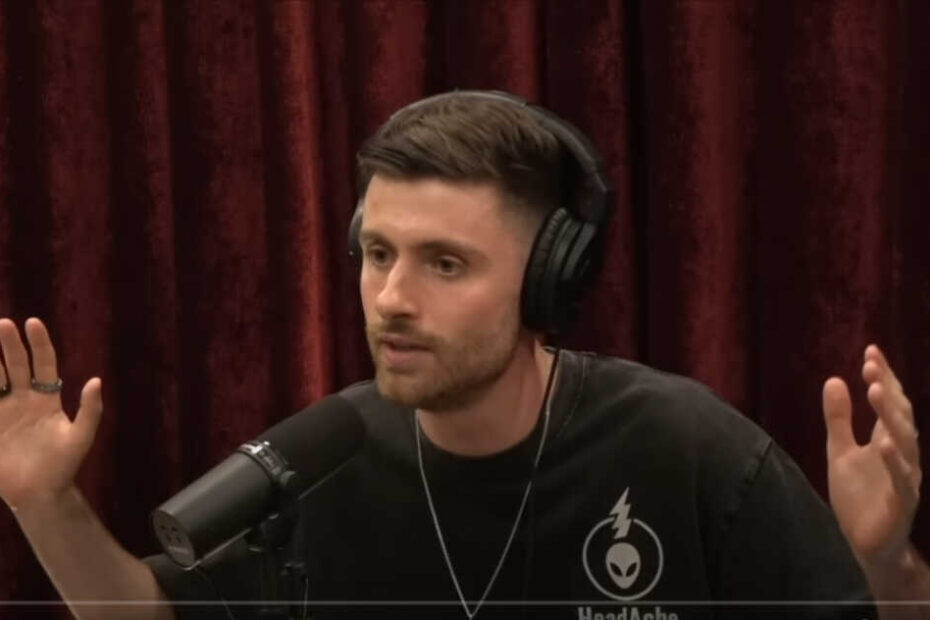
Read the full transcript of YouTuber Michael Button’s interview on The Joe Rogan Experience Podcast #2365, August 20, 2025.
The Beginning of a YouTube Journey
JOE ROGAN: Nice to see you, man. Nice to meet you.
MICHAEL BUTTON: You see, man. Pleasure.
JOE ROGAN: I love your channel, man. It’s really great. You’re really doing some really interesting videos. When did you get started?
MICHAEL BUTTON: Thanks. Well, I only started the YouTube less than a year ago.
JOE ROGAN: That’s crazy.
MICHAEL BUTTON: It’s been a bit of a wild ride.
JOE ROGAN: I don’t even know how I found it. It was like one of them YouTube recommends. Things just popped up and I don’t remember which one it was. It was something on ancient history.
MICHAEL BUTTON: Yeah.
JOE ROGAN: And I was like.
MICHAEL BUTTON: Yeah, it was cool. I mean, yeah, I started just under a year ago, but no one started watching until like March and then I think you see me just after that point. And it’s been a bit of a big journey since then upwards. But it’s been very exciting and very happy to be here today. Very excited to be in Austin and yeah, looking forward to talk about some ancient history.
From Academia to YouTube
JOE ROGAN: So did you start off on a traditional academic journey and then sort of get sidetracked into a YouTube career? How did this work?
MICHAEL BUTTON: Yeah, basically. So I studied ancient history at university for four years and I’ve always been interested in history. I’ve done history all the way through. I was fascinated about history as a kid and got to the stage in my life where it was, you know, thinking about going to university. So I thought I’ll do ancient history at university and study there for four years, graduated, all of that kind of stuff.
But there came a point during my degree where I was kind of, you know, a little bit. I didn’t quite agree with the kind of high level ideas regarding the timeline of history and what we’re taught about our ancient past. And it wasn’t that I disputed anything that I’d been taught. And I have great respect for the people that I met at university and my professors. And I don’t dispute anything that we were taught actually on the course. But it was more the kind of high level macro perspective of history that I found myself having more and more questions about.
JOE ROGAN: What bothered you? What were the questions?
Questioning the Timeline of Civilization
MICHAEL BUTTON: It was kind of the big questions regarding the origins of civilization and how deep civilization goes and how complex human behavior, you know, I thought went way back further into history than what we were being taught. And I wasn’t too. I just didn’t buy this idea that nothing happened for vast stretches of time because it was during my course that they found that modern humans they made this discovery in Morocco in 2017 or 2018, I think, and that was when I was at university.
JOE ROGAN: Was that Denisovans?
MICHAEL BUTTON: No, no. So I can’t remember this. It’s called, like, the Jebel IRUD site or something like that. But they were modern Homo sapien remains. They thought they were Neanderthal initially because they were so old.
JOE ROGAN: How old were they?
MICHAEL BUTTON: They’re 315,000 years old. That’s kind of like the estimate. It goes up to potentially 360,000 years old. So they’re super old. And, yeah, they thought they were initially Neanderthals of this age, but then they discovered a few more, and they were. They classified them as Homo sapiens.
And when I saw that, I was like, how is this not kicking up more of a fuss? Because before them, the oldest Homo sapien remains we had were around 200,000 years old. And that had been the case for a decade or something. And before that, it was like 100,000 years old. So this discovery pushed back the age of our species by another third, like 100,000 years.
So I saw that, and I was thinking, how are we still basing our kind of idea of history around the fact that nothing happened for, you know, 310,000 years, and then everything happened in the last, you know, 10,000 years since the Neolithic revolution? I just thought that was odd because, you know, we’ve been in this anatomically modern form for so long, and yet we were being taught that nothing was. Nothing had happened until, you know, the last 10,000 years. And I just. That just didn’t make sense to me. So that’s kind of where. Where I started thinking about it.
The Late Bronze Age Collapse
And then we did this module at university, I remember, called. It was called something like cataclysms or something. And it was all about how in recorded history, natural disaster had a big impact on human societies and stuff like that, and how it small, tiny changes in climate could massively disrupt human civilization and bring them all crashing down.
And the case study they used was something called the Late Bronze Age collapse. Have you ever heard of the Late Bronze Age?
JOE ROGAN: Yes, yes.
MICHAEL BUTTON: When all these, powerful, influential civilizations at the kind of peak of human progress around 1000 BC all simultaneously came crashing down. And no one was quite sure why it was. But the best theory we have is that it’s a kind of combination of climate factors which led to trade disruption, which led to societal unrest, and then all these empires, like the Hittite empire, the Syrian empire, the palaces of Mycenae in Greece, The Egyptian New Kingdom, all within a 20 to 30, 40 year period, all came crashing down the exact same time.
And I remember being hooked by that. I was like, that’s so crazy. We don’t even know why this happened, but it was like a half degree changing climate. And so I remember starting to research how bad climate had been during history and how bad it had been, these big climactic episodes had been during prehistory.
And I started thinking, wow, if that had caused all these civilizations to collapse, just a tiny half degree change in climate which caused drought, which led to those civilizations collapsing, some of the stuff that had been happening during prehistory was so much worse than that.
And that got me thinking, how do we know that sophisticated human culture hadn’t flourished, you know, 10,000 years ago, 20,000 years ago, 100,000 years ago, 200,000 years ago, and collapsed due to climate change or natural disaster, volcanoes, comet impacts, anything like that?
The Problem with “Prehistory”
JOE ROGAN: The term prehistory is weird, isn’t it? Because it’s like according to what, what we find, you know, I mean, how do we know what historical. If there was a great cataclysm, like if the younger Dryas impact theory is correct, you know, how much history would be written down, what would be left? How would you find it? What would you know?
You know, that’s one of the things that disturbs me the most, is the arrogance that some academics have to having a definitive understanding of the exact timeline of agriculture, civilization and then modern humans.
MICHAEL BUTTON: Yeah, it annoys me. I feel like academics, as opposed to the alternative historians, are kind of more saying, we don’t know, but here’s a potential hypothetical scenario that could be possible. Whereas I feel like more mainstream, for want of a better word. I don’t really like using that because I don’t think there’s such thing as a mainstream. It’s not like there’s a group of people that all collectively decide, but some particularly vocal mainstream kind of historians and scientists seem to claim to know absolute truth about the past.
And that’s just stupid. How can anyone know about what happened 100,000 years ago or 200,000 years ago? And it kind of Gets me a little bit riled up because at the end of the day, none of us know what happened back then. So I think a lot more possibilities are, you know, possible than what many people appreciate.
The Discovery of Göbekli Tepe
JOE ROGAN: Did you ever see. There was a video documentary back in the day, something about the mystery of the Sphinx. And there was this archaeologist that was mocking Graham Hancock’s ideas and Dr. Robert Schoch’s ideas about the timeline, saying, you know, talking about things that existed pre 10,000 years. And he was saying what ev. He was laughing. “What evidence is there of any civilization from 10,000 years ago?”
This was literally, I think, around the same time that they discovered Göbekli Tepe. This guy was mocking it. I think slightly thereafter, they discovered Göbekli Tepe, which threw everything into a tizzy, because now you’ve got something that was absolutely covered, they believe intentionally, somewhere in the neighborhood of 11,000 years ago.
MICHAEL BUTTON: Yeah, I think Göbekli Tepe is the biggest kind of smoking gun for at least for the idea that civilization is older and more complex than the traditional model suggests. Because obviously, as you say, it’s 12,000 years old and it’s massive megalithic pillars. I mean, you know about Göbekli Tepe, probably most people listening to this will know about Göbekli Tepe, but it’s such a clear sign that sophisticated human culture was present way earlier than the conventional timeline suggests.
And I think that at least should throw a monkey wrench into a lot of these people’s ideas, ideas regarding human civilization and when it began, because clearly the toolkit for civilization existed 12,000 years ago. So how. Why couldn’t it have existed a little bit earlier than that? And why, if it existed, then did it then take another 6,000 years for it to emerge in ancient Sumer, which is the kind of traditional thought to be the earliest civilization?
So Göbekli Tepe is fascinating. I love it. It’s a really interesting site. I think it’s will one day be classed as civilization. I’m almost certain that when enough time passes, we’ll kind of look at that. And because it’s a whole culture, the whole Tashtapela culture, there’s 14 sites at least, and they all have this kind of megalithic architecture. They all have shared symbolism. They all clearly connected.
It’s crazy how it’s not defined as anything other than hunter gatherers. And if, even if you think that hunter gatherers built Göbekli Tepe, then you need to massively update the definition of what a hunter gatherer is because clearly they had surplus. They weren’t just building these sites in their spare time. And yeah, it’s a truly paradigm shifting site. But I mean, everyone kind of knows about Göbekli Tepe now.
Only 5% Uncovered
JOE ROGAN: Not everyone, but also as spectacular as what they’ve discovered so far is they have only unearthed 5% of it, which is even more bizarre because you’ve got so much stuff that’s underground, you have no idea what’s on those pillars. They’re speculating that one of the pillars from Göbekli Tepe that is unearthed is some sort of a calendar of events. And they believe that it depicts some sort of a disaster. These, whatever, how they. They’re making these images to be associated with either an impact or something. But there’s a timeline that’s inscribed in these pillars.
MICHAEL BUTTON: Yeah, there’s a study that was written or a paper that was written and they think it’s the pillar 43, I think it is, is kind of a cosmic calendar. And it’s almost a prediction model of an impact that could happen or already has happened. And it’s a warning for the future. I mean, that is still disputed, but I mean, there’s been good research that’s done into that that suggests that’s what it is.
And it’s certainly a site that has cosmic alignments and has been built with the stars in mind, which is something that we can say about so many ancient sites around the world. Which is another thing that isn’t really considered by, you know, quote unquote, mainstream archaeology perhaps as much as it should be. So, yeah, it’s a fascinating site and I really think it displays a lot about how human ingenuity and civilization, I mean, people get a bit stuck with the word civilization because we have this very narrow definition of what civilization is.
Redefining Civilization
And it’s basically based on the old model of Mesopotamia, which is ancient Sumer, because that was the earliest known civilization for so long. We kind of constructed this whole idea about what a civilization is purely based on Mesopotamia. But I don’t see why that has to be what civilization is. Because that was just one civilization. And just because that was the earliest one we’d found for a long time and still is thought of as such, doesn’t mean that that’s the only way that humanity can flourish.
Because humans are so adaptable, we do so many different things and we’re clever in different ways and we, you know, change to different environments. And I think that definition has really kept a lot of people kind of boxed in when thinking about how sophisticated human culture could flourish in different places, in different environments and with different pressures. And I think that’s kind of forced people to not consider what other possibilities are out there.
The Birthplace of Civilization and Ancient Cataclysms
JOE ROGAN: I think it’s even more fascinating if you consider the fact that ancient Sumer and that part of the world from about 6,000 years ago is where they’re sort of hanging their hat saying that this is the birthplace of civilization. But if you do have this evidence of Gobekli Tepe, and then we are talking about some sort of an ancient civilization that lived 12,000 years ago. Like, what happened? What happened?
Like, what was the gap between that and then it took 6,000 years before they started civilization back up again. Sort of a reimagining of civilization, which makes you really. At least, makes me really consider the possibility of a cataclysm. Because if the people that survived, whatever they would be, they would probably be living off the land. They’d probably be barely getting by and barbaric for a long, long time. And if it really took 6,000 years to kind of settle down again, that is fascinating to me.
MICHAEL BUTTON: Yeah. And it all ties into this idea that we’ve had that agriculture leads to civilization. But there’s that bizarre thing that agriculture appears in multiple different places at pretty much the exact same time all over the world. And that’s never made sense to me because if agriculture was such a vital invention for civilization to flourish, then why did no one invent it for 310,000 years?
JOE ROGAN: Right.
MICHAEL BUTTON: And then in South America, in Mesopotamia, in ancient China, and you could argue there’s other different places that. So say there’s South America and there’s Central America. I mean, you could argue that’s potentially connected, but a lot of people say it isn’t. So how can agriculture, if it’s such an incredible invention, be invented by multiple people at the same time? And then. But no one else thought of it before. It doesn’t make sense to me.
JOE ROGAN: It doesn’t make any sense. It doesn’t make any sense. They wouldn’t figure out seeds. How do you not know eventually that these seeds are dropping and then you see seedlings that are coming out of the ground. Just. That seems pretty logical and an easy connection. And then you’d say, “Oh, well, if we gather these seeds and go plant them over there, maybe we can get some fruit trees over here.”
MICHAEL BUTTON: Yeah.
JOE ROGAN: “Oh, look at that. It worked.” Like that doesn’t that seems like you’d figure that out in one lifetime.
Climate Conditions and Ancient Warm Periods
MICHAEL BUTTON: I know, it’s odd. I think the idea is, the idea always has been that it’s because of the climate. Right. So because of the Holocene, which began around 12,000 years ago as we came out of that, and we had stable climate conditions that we still live in today, that’s what enabled the invention of agriculture. Right.
But then the question I always ask is, what about all the other warm periods that have come in the past? If, as the idea is that stable climate led to agriculture, then why couldn’t such a thing have happened in the Eemian period, 120,000 years ago? There’s been four distinct warm periods that have lasted for over 10,000 years, while modern humans have been around at least.
And obviously these Morocco remains of Homo sapiens. It’s unlikely they’re the earliest Homo sapiens that ever lived. They’re just the earliest we found, so we could be even older than that. So considering we’ve been through four distinct warm period before the Holocene, and if the argument is that the Holocene was what led to the invention of agriculture due to the stable climate, then why couldn’t it have happened in the earlier warm periods? That’s a question I’ve always asked myself and been fascinated by.
JOE ROGAN: And the real problem is there would be very little evidence, if any.
The Preservation Problem
MICHAEL BUTTON: Yeah, so this is the preservation problem, and this is something I talk about in my videos. So I always ask the question, what if human culture had flourished in the Eemian, for example, which was from 130 to 115,000 years ago, what realistically would survive? Because it’s such a vast, vast length of time that it’s really unlikely, at least as far as I can tell.
And obviously I’m not a scientist. I’m not a materials. I’m not any kind of. I’m just a guy. I’m not even a historian technically. But as far as I can tell, it’s extremely hard for these, for any materials, but even our modern materials, in our huge civilization that 8 billion people, industrial society, sending rockets to space, all the crazy stuff that we’re doing, even us, if we disappeared tomorrow, I think it would be extremely unlikely that pretty much anything would survive when you get up to these huge timescales of 100,000 years.
And so I’ve been doing quite a lot of research into this, and because I obviously don’t want to get things wrong and put falsehoods out there and mislead people. I don’t look like a dickhead in front of millions of people or whatever. So I’ve been trying to debunk myself or play devil’s advocate to myself on this point because that’s the best way to make your argument airtight. And no one’s really out there debunking me. I don’t know if that’s because I’m right or because no one knows me. Maybe that would change after a show like this, but I’ve been really looking into the degradation of modern materials as much as I can and trying to work out how much would survive from a civilization like ours if we disappeared tomorrow in a hundred thousand years time.
JOE ROGAN: Right, like someplace like London or Manhattan, what would be left in a hundred thousand years?
MICHAEL BUTTON: Yeah, of an actual modern city. And the scary truth is it’s almost nothing. As far as I can tell, and obviously cement buildings.
JOE ROGAN: They would just deteriorate.
MICHAEL BUTTON: They would go. Concrete would crack. And you get CO2 in there and freeze, thaw, weathering. And over these huge timescales of 5,000 years, 10,000 years, it would just crumble down into dust and be absolutely imperceptible.
JOE ROGAN: Just 10,000 years, I think.
MICHAEL BUTTON: So obviously these. I mean, I’m just doing this off the top of my head. I haven’t got any notes in front of me or anything, but as far as I could tell from my research, it’s going to be a few, 10,000 years, 20,000 years max. It’s not going to get up to these timescales of 100,000 years.
JOE ROGAN: So if you do add in, if you think about what Manhattan would look like in 100,000 years, it’s almost nothing.
MICHAEL BUTTON: I would say it was nothing, to be honest.
JOE ROGAN: Nothing. And it would just get overrun by trees again.
Material Degradation Over Time
MICHAEL BUTTON: Yeah, because it’s just such an incredible amount of time that all these materials that we build with are just going to corrode and they’re going to rust away. If they’re metals, they’re going to oxidize, they’re going to flake until they’re just tiny little fragments that just disperse in the sedimentary record and they’re just invisible to see. And same with concrete. Same with even things like glass.
I’ve heard a lot of people say that glass would potentially survive because glass is a very durable material. And glass would survive a long time. But glass in the form of a human made recognizable artifact isn’t going to survive in that form. It’s going to get crushed. It’s going to break away into tiny little nano fragments into silica grains that are just invisible in the archaeological record when you get up to these huge levels of time.
And, yeah, I mean, there’s. I would say almost nothing would survive that long. And again with the caveat that I’m just some random dude who’s investigated this on the Internet and researched this myself, not a scientist. If anyone out there is a material scientist, I encourage them to reach out to me. But as far as I can tell, there are very few things that could possibly survive that long.
I mean, we’re pretty crazy fucking apes. We do crazy shit. So things like nuclear weapons, we test nuclear weapons in the atmosphere, you could argue if we knew when to look and what to look for. We could see traces of plutonium in the atmosphere from our nuclear weapons testing. Or you could see our nuclear waste deposits or things like carved stone. Because stone obviously survives a very long time. Human carved stone, you’d be able to find that.
But we do find that. We find stone tools. But just because ancient humans used stone tools doesn’t mean they didn’t use anything else. It’s just stone is the most likely thing to survive. And the crazy thing is, Joe, do you know how many sites we have? Homo sapien sites from more than 100,000 years ago?
JOE ROGAN: How many?
MICHAEL BUTTON: Nine. We have nine sites, nine glimpses, nine snapshots into over 200,000 years of history. Nine moments in time. And we use that to extrapolate out what every single human was doing.
JOE ROGAN: Nine globally.
MICHAEL BUTTON: Nine globally, yeah.
JOE ROGAN: And where are they? Mostly?
MICHAEL BUTTON: Africa.
JOE ROGAN: And so what do they find? What is the evidence?
MICHAEL BUTTON: It’s usually caves and it’s usually just remains of fire pits and stone tools. And that’s kind of it. And so we see that and we think, “Okay, they just lived in caves and used stone tools.”
JOE ROGAN: Right?
MICHAEL BUTTON: But it’s nine sites, nine moments in time for 200,000 years.
Modern Parallels and Human Adaptability
JOE ROGAN: Well, the problem is there’s people that essentially live like that right now in some parts of the world, which is really weird, right, because we always want to think about technology and advancement of civilization being sort of universal, but it’s really not. There’s people that are living a subsistence lifestyle right now. There’s people that are uncontacted right now.
MICHAEL BUTTON: At the same time as Elon Musk sending rockets to Mars and shit.
JOE ROGAN: Yeah, right. I mean, that’s the weirdest ones is when you see them get invaded in the Amazon, when you see them contact these people and they’re pointing bows and arrows at helicopters and they’re naked.
MICHAEL BUTTON: Yeah, exactly. We’re so adaptable. Humans could do so many different things. And as you say, right now we’re sending rockets to space and people are living in very traditional ways of life. And that just because we find traditional ways of life In, I repeat, nine sites to cover 200,000 years, in my view, that’s just what we can see. That’s just the. That points to my point regarding what would possibly survive.
Because if you think of all the human lives, stories, cultures that have potentially existed for our whole species existence, if we only have nine little glimpses from. And to be fair, that nine is, you could say it’s up to 15 because the sum sites are debated. But either way, it’s a tiny, tiny, tiny amount of human signs of human life. Just because in that fragment, in that snapshot, in that sliver, all we see is some humans with stone tools in caves, doesn’t mean that nothing else was happening.
Ancient Egypt’s Anomalous Advancement
JOE ROGAN: Well, a good piece of evidence to that that would point in that direction is Egypt. Because Egypt, even if you accept the conventional timeline of Egypt, which is 2500 B.C. for the great Pyramid, go look at the rest of the world at 2500 B.C. you don’t see anything like that. Nothing even close.
MICHAEL BUTTON: Yeah, they were clearly. Even if you look at the conventional model of history, the ancient Egyptians were wildly ahead of everyone.
JOE ROGAN: Everyone.
MICHAEL BUTTON: It’s just so weird.
JOE ROGAN: So weird.
MICHAEL BUTTON: And that’s. That’s if you. And the conventional model doesn’t really give us any explanations of how they were.
JOE ROGAN: Doing what they were doing, and they arrogantly dismiss any other explanations, which is really weird when you’re talking about these immense structures that are baffling. Yeah, absolutely baffling to anybody who’s being honest. Yeah. What is your take on these Italian researchers that are looking at the tomography and they’re looking at these things that they believe are underneath the Great Pyramid and some other structures in Egypt?
MICHAEL BUTTON: Yeah, the kind.
The Mystery of Underground Structures at Giza
JOE ROGAN: What they’re saying is 2km deep underneath the Great Pyramid, there’s structures and there’s hundreds of meters of these pylons, these pillars that are in uniform positions with some sort of a coil wrapped around them. Like, what is that? What is that real? And they reproduce it in multiple different scans, but I don’t know what they’re seeing. I don’t understand the technology, understand where the errors could be. Like, what could possibly cause it to glitch like that.
MICHAEL BUTTON: What’s it called? Like SARS Topler. I mean, I don’t know. I’m always a little bit suspicious when you make sensationalist claims with new technology. And that doesn’t mean it’s wrong. I just. That just. Yeah, you have.
MICHAEL BUTTON: Yeah, I mean, I don’t know. I would love it to be true, obviously, because, you know, I would love it.
JOE ROGAN: That’s the problem. The problem is the same problem that I have with UFOs and everything else. You want it to be true 100%. So it really clouds my judgment. And then I have to get my analytical mind to say, shut up. Yeah, let’s look at this honestly.
MICHAEL BUTTON: But I mean, I think there’s definitely something below the Giza Plateau, like, that’s always been written about in ancient sources and these kind of scans. And then people kind of have stories of people going down into labyrinths that aren’t, you know, accepted by Egyptology.
And there’s definitely massive mystery surrounding Giza and the construction of the pyramids and what could potentially be below the pyramids. And this kind of new pyramid scan project has the potential, I think, to, you know, make big progress in understanding what is below Giza. But I don’t know until there’s better data out there. I’m not going to, you know, jump to any conclusions and declare that this is like evidence of, you know, a lost advanced technology, civilization or anything like that.
JOE ROGAN: But I am so excited about just the possibility that they’re right. Because if they are right, that’s the greatest monkey wrench into history that’s ever existed, because explain away that with ancient people with stone tools or copper. Explain that away.
MICHAEL BUTTON: They probably try, mate, because it already doesn’t make sense. Their explanation for the construction of the pyramids being wooden sledges and stone chisels or whatever they say. It already doesn’t make sense. It’s already so ridiculous that I wouldn’t even be surprised if they tried to explain away these.
JOE ROGAN: Well, it’ll discredit them because the problem is if it does indicate that the pyramid is something other than a tomb, you know, there’s not.
Questioning the Tomb Theory
MICHAEL BUTTON: I don’t even see any evidence that the Great Pyramid at Giza. I mean, what’s the evidence that that was a tomb? I mean, I don’t think they’ve ever found a body in there. It’s just a chamber which they’ve called the king’s chamber.
JOE ROGAN: Right.
MICHAEL BUTTON: I mean, I’m not an expert in ancient Egypt by any respect, but it’s always baffled me that they’re so determined that the pyramids are tombs just because some later pyramids have had, you know, mummies and pharaohs and sarcophagi found inside them.
JOE ROGAN: But that doesn’t mean anything. And that doesn’t mean that they built it. That also could mean that the pharaoh decided that it was his and wanted to be buried inside of it. And it had existed for thousands of years before they ever even got there.
MICHAEL BUTTON: And you can find bodies in like, you know, buildings today. And that doesn’t mean the purpose of that building was to be a tomb. Right. It’s just someone buried there.
JOE ROGAN: Yeah, as you said, it’s a weird assumption. It’s a very weird assumption. And did you ever read any Christopher Dunn’s work?
MICHAEL BUTTON: I know a bit. I haven’t read his book, but I know a bit about it. It’s interesting. I mean, he’s like a serious guy, isn’t he? He’s like an engineer. And he has quite serious theories that.
JOE ROGAN: He thinks it’s a power plant.
MICHAEL BUTTON: Yeah. Which would be crazy, wouldn’t it?
JOE ROGAN: Especially if you add into that the Graham Hancock’s ideas and some of these other people’s ideas that perhaps some of these structures are far older.
MICHAEL BUTTON: Well, the kind of Orion correlation in the Sphinx.
JOE ROGAN: Also the fact that the deeper you go into the sand, the more sophisticated the building techniques are, that gets weird. Like larger stones. Like what happened the whole of like.
The Green Sahara Theory
MICHAEL BUTTON: Ancient Egypt and the Sahara Desert in general just doesn’t make sense to me. Because when you look at the Sahara Desert and the fact that it was green for 9,000 years and then it stopped being green at precisely the time that we’re told ancient Egypt emerged, that doesn’t make sense. That defies how civilization works. Why would a civilization only emerge after the climate got worse?
JOE ROGAN: Right.
MICHAEL BUTTON: That doesn’t make sense at all.
JOE ROGAN: And so little research done in sub Saharan Africa where they’ve actually gone into the ground and done like large scale research of these immense areas.
MICHAEL BUTTON: Nothing. Nothing. The Sahara Desert is vast and obviously covered in sand and extremely hot, extremely difficult to survey, politically unstable. And there’s basically been no archaeological work done across the whole. And the Sahara Desert is massive. It’s like the whole of North Africa right down to. I mean, it’s massive.
JOE ROGAN: And you could fit the United States.
MICHAEL BUTTON: You could fit anything in there. Like a whole like preceding civilization for 9,000 years leading up to ancient Egypt. Like, it’s the perfect place. It’s right by Mesopotamia, it’s right by Egypt. And yet we have this blank spot for the 9,000 years before the development of civilization, which is kind of also the gap between, I mean, it’s a little bit less than this, but the gap between Gobekli Tepe and the birth of civilization.
We have this huge area which would have been perfect for civilization, full of rivers, lakes, grasslands, perfect climate.
JOE ROGAN: And it’s just missing also abundant resources where they could establish a stable civilization because they had so much food and, and they weren’t being attacked. So they could kind of set up shop and figure some things out. Yeah, over a long period of time.
MICHAEL BUTTON: Yeah. So my theory is that things were happening in the Sahara Desert when it was green, in the green Sahara for those 9,000 years. And then because it was really quick, that’s what I don’t think people realize is that when the Sahara Desert turned from, you know, green, lush paradise, whatever you want to call it, to a desert, it was like a few centuries. It’s called rapid desertification. And it flipped.
Not overnight, obviously, but in a few centuries compared to 9,000 years is a rapid change. And for any kind of culture that was living there, you wouldn’t have noticed it straight away, but in 50 years you’d be like, “Fuck, it’s getting a bit hot here,” you know what I mean? Like, shit is going on.
And then I think maybe people migrated to the last stretch of green that was still available to them, which was the Nile river, and then the kind of survivors or the migratory populations developed around the Nile river and using the kind of experience and knowledge that they had from their lives and the kind of history of their cultures in the green Sahara period. That is what led to Ancient Egypt. I mean, that’s just a.
JOE ROGAN: Well, it’s also just an assumption that Ancient Egypt didn’t exist alongside that or even previous to that, which is also possible, especially when you consider what Robert Schock thinks about the erosion, the water erosion, the temple of the Sphinx.
Water Erosion Evidence
MICHAEL BUTTON: The kind of explanation away of that also never made sense to me that it’s wind and sand. Because when you see pictures of the Sphinx, even from when they kind of found it in Napoleonic times, it’s buried in sand.
JOE ROGAN: Right.
MICHAEL BUTTON: And there’s records from the Egyptians themselves, who, you know, excavated it effectively because it was covered in sand. So if it quickly gets covered in sand, how could it be eroded by wind and sand? If it doesn’t take very long for it to, you know, kind of get filled up with sand, then how does wind and sand erosion even count? I’ve never seen anyone kind of explain that away.
JOE ROGAN: Well, it’s the walls that are the most fascinating to me because the deep fissures that clearly look like rainfall. It looks like something that water does over thousands of years.
MICHAEL BUTTON: Yeah.
The Valley of the Whales
JOE ROGAN: You know, and when you. Whales. That were the whale. The Valley of the Whales. Yeah, just about, I don’t know how many miles south, but it’s south of Cairo. That’s bonkers, too. That’s crazy. They find whales, hundreds of whales in the desert. That’s so cool. Look at that image. That is so nuts. Some of them had teeth and toes. So crazy. So crazy.
And then it makes you wonder, like, how did those bones survive? Like, why are they there? Like, how quickly did they die? How quickly did they get covered up by sediment that they could find them all these years later? Because that’s the weird thing about fossils and bones in general is that most of them you’re never going to find because they get eaten, they deteriorate, they’re gone. It’s very difficult to make a fossil.
You know, when you think about our quote unquote fossil record, it’s really weird because it’s hard to make a fossil. So we’re dealing with a very small amount of beings that get turned into a fossil. And that is what we’re using as our understanding of like, life.
MICHAEL BUTTON: Yeah, yeah.
JOE ROGAN: It’s weird.
MICHAEL BUTTON: It’s weird.
JOE ROGAN: It’s so limited.
MICHAEL BUTTON: I’m not sure when was the Geno. When the Sahara was covered in water. I’m not even sure when that was. I mean, some people say that there’s like a mass flood during the kind of younger Dryas period, which I think is.
JOE ROGAN: I think they’re talking about millions of years ago for these bones. How old are these whale bones supposed to be? But I think millions of years ago, it’s assumed that it was completely underwater. Right. So are we talking like Pangea times? Like, what are we talking about?
MICHAEL BUTTON: But even not too long ago, like, you know, kind of 12,000 years ago, whatever, they had these massive river systems, like the Tamanrasset river system.
JOE ROGAN: Here it is 40 million years old. Yeah, 40 million years old. About the whales. Oh my God. Primitive whales. Primitive whales documenting. How do you say that word? Cetacean. How do you say that word? Cetacean transition. Is that how you say it?
MICHAEL BUTTON: I don’t know.
JOE ROGAN: Cetacean transition to marine life. Ceridians and reptiles, as well as shark teeth from the Ginahan formation, 40 to 41 million years ago. The strata in. I won’t say that either. Wad El Hitan belongs to middle Eocene epoch and it contains extensive vertebrate fossils within a 200 kilometer area. Fossils are present in high numbers and often show excellent quality of preservation. The most conspicuous fossils are skeletons and bones of whales and sea cows.
MICHAEL BUTTON: What’s the sea cow?
JOE ROGAN: I don’t know. Manatee. You ever see the precursor to whales, like where whales came from?
MICHAEL BUTTON: No, where did they come from?
JOE ROGAN: It was an ancient animal that was like, almost like a hooved wolf.
MICHAEL BUTTON: Sea animal?
JOE ROGAN: No, you mean land animal. That’s why they breathe air.
MICHAEL BUTTON: Of course. They’re mammals, aren’t they?
JOE ROGAN: Yeah.
MICHAEL BUTTON: That’s weird.
The Evolution of Whales
JOE ROGAN: It’s super weird. It’s super weird. It was some animal that supposedly lived on land. And it was real freaky looking, almost kind of like dog, like. And that thing eventually came away. I just like swimming. And then one day it said, “I’m never going back to the land. It’s filled with assholes. I’m just going to live out here in the ocean. All you have to contend with is sharks.”
This article calls it the God of death whale. Wow. That’s what it looked like. That’s what it looked like. But there’s some images of it on land. Some depictions. Yeah, that’s what it looked like. That freaky thing was what whales came from. That thing walked around on the ground and then eventually said, eh, if it’s 40 million years ago, is that what those skeletons are then?
MICHAEL BUTTON: Maybe.
Prehistoric Discoveries and Ancient Civilizations
JOE ROGAN: Interesting. Some of them maybe, right? Because they do know that when whales walked in Egypt. I was watching, I think, I don’t remember whose podcast it was. I wish I could remember, but they were talking to some guy that found definitive evidence of dinosaurs in Egypt. So if you go back far enough, there were dinosaurs living in that part of the world as well.
What’s that one image you just saw right there with the mouth open? Yeah, that one. That’s crazy looking. Prehistoric whale ancestor. Look at that thing. That’s crazy. Here’s the sea cows.
MICHAEL BUTTON: What?
JOE ROGAN: This image says a prehistoric sea cow was killed by a prehistoric croc and eaten by a tiger shark. Boy, life is hard where there’s no doors. That’s the problem with the ocean. There’s no doors. There’s nowhere to hide. So it’s just constant chaos. It is just constant things eating things in this 3D space where they can go up and down and side to side.
MICHAEL BUTTON: That’s just nature, isn’t it, man? Everyone’s just killing everything else.
JOE ROGAN: Yes. We made it, but we figured out doors.
MICHAEL BUTTON: We did.
JOE ROGAN: We figured out walls and doors and that changed the game.
The Timeline of Human Settlement
MICHAEL BUTTON: But when did we do that, Joe? That’s the question. That is the question a lot of people would claim to think. And the kind of consensus always is that we didn’t do that until 12,000 years ago. We didn’t settle down and form permanent communities until the Neolithic revolution.
And I think that’s one of the major paradigms, if you like, that we have regarding our past that simply doesn’t make sense in light of new evidence.
JOE ROGAN: What is that evidence that they found of wood construction from far longer than they thought?
The Kalabo Structure Discovery
MICHAEL BUTTON: Yeah, this is the Kalabo structure. And this is something I talk about a lot in my videos because I think it’s a crazy find and I don’t understand why it’s not kicking up more of a fuss. If I’m the guy that has to kick up the fuss about it, then I’ll be that guy.
Because basically the idea has always been that humans were nomadic hunter gatherers that move with the seasons and lived in caves or just kind of walked around. For all of our history until the Neolithic revolution, the invention of agriculture 12,000 years ago, and no earlier than that did we ever settle down and live in permanent settlements.
But the Kalabo structure was something they found a few years ago in modern day Zambia. And what it is is these pieces of wood. And I’ll get to the point about why this wood has survived in a minute because obviously, you know, wood surviving this long is crazy, but there you go.
The Kalabo structure is these pieces of wood that have been joined together, deliberately cut in notches and connected together, tapered and secured at right angles. And they think it was either a kind of raised walkway, like a kind of raised platform, or a house, a dwelling, a hut, some kind of structure.
And why this is so paradigm shifting is because not only does this kind of scream that humans potentially lived in permanent settlement. Sorry, I haven’t even said this. This is 476,000 years old. So this predates Homo sapiens. So allegedly.
JOE ROGAN: Allegedly as in, what do you mean, allegedly?
MICHAEL BUTTON: Yeah, it could have been us. But what they attribute it to is Homo heidelbergensis, who’s our last common ancestor with Neanderthals. So they’re kind of the human species that came before Homo sapiens. So I guess you’re right. It could have been Homo sapiens, and we’re just not sure how old we are. But it’s kind of attributed to Homo heidelbergensis.
And the only reason this structure survived at all is because pretty soon after its construction, it must have fallen into a bog. And then that bog kind of got solidified over by the sun, and then it was preserved in waterlogged sediment, which protected it from decay for almost half a million years until it was discovered by us recently.
JOE ROGAN: And how recent?
MICHAEL BUTTON: I think about five years ago, maybe. Was it 2019 or something? I’m not sure, but it’s crazy it lasted so long. Yeah, I would say it’s a massive monkey wrench, because not only does it kind of really dispute this idea that we didn’t settle down until, you know, 12,000 years ago with the Neolithic revolution. Because, I mean, it’s a structure.
And it’s just because it’s so unlikely, it’s so unbelievable that this would have survived. But that kind of suggests that it’s not the only one.
JOE ROGAN: Right.
MICHAEL BUTTON: There could have been loads of these structures everywhere.
JOE ROGAN: But as you said, Manhattan wouldn’t exist in 100,000 years. So this is 476,000 years.
MICHAEL BUTTON: Yeah, it’s ridiculous.
JOE ROGAN: And it’s just wood, which is less durable than all the other things that we were talking about.
MICHAEL BUTTON: Yeah. And obviously, people may be saying, well, look, clearly things survive, but this is an extreme edge case scenario where it’s so unbelievably unlikely that this wooden structure would kind of sink into a bog and then that bog be solidified over, and then it would stay in that preserve.
JOE ROGAN: And that they would find it.
MICHAEL BUTTON: They would find it. Exactly.
JOE ROGAN: Because, you know, 476,000 years into the sediment.
Challenging the Cognitive Revolution Theory
MICHAEL BUTTON: Yeah, exactly. Because we don’t dig that far and look for anything sophisticated because we think, you know, nothing happened back then, and then you find this. And it really suggests that humans were living in much more complex societies.
And, I mean, the fact that they had the cognitive capacity to plan, structurally engineer, and build a structure completely flies in the face of what we’ve always thought about ancient humans. Because we’ve always had this very popular idea in kind of mainstream historical thought that humans only got smart around 50 to 60,000 years ago. And that’s just Homo sapiens.
We’ve always thought that other human species never got smart, never achieved what we call behavioral modernity. And this has always been the kind of idea that we went through this cognitive revolution around 50 to 60,000 years ago. And the most obvious proponent of how entrenched this is in kind of academic thought is, have you ever read the book “Sapiens”?
JOE ROGAN: Yes.
MICHAEL BUTTON: Yeah. By Yuval Noah Harari. It’s an extremely popular book. It sells something like 60 million copies worldwide. By far the most popular book about prehistory and, you know, the story of Homo sapiens ever written.
And “Sapiens” didn’t kind of do anything new. It didn’t, I think Harari himself would admit this. It didn’t. It kind of just collected the consensus of academia and presented it in a nice digestible way to the kind of layman audience.
But he took this idea that’s always been present in academia regarding human intelligence, which is that while we’ve been around for quite a long time, we didn’t achieve behavioral modernity until 50 to 60,000 years ago. And that’s when we started apparently displaying complex cognitive traits like abstract thinking and planning and burying our dead.
JOE ROGAN: Art.
MICHAEL BUTTON: Art. Yeah, exactly. And complex language and things like that. But this just completely flies in the face of that, because if we had the capability to plan, construct and engineer a structure 476,000 years ago, that means, you know, mainstream anthropology was off by over 400,000 years regarding the advent of intelligence and the advent of permanent living.
And that’s, I mean, that’s quite the error. 400,000 years. So that kind of suggests they could be off by similar margins about other developmental claims, because I don’t know, it’s a big, big error.
Catastrophic Bottlenecks in Human History
JOE ROGAN: Well, it’s also, when you think about the history of the Earth, there are times that we know that there was, like, there’s great bottlenecks that occurred because of some sort of a massive natural catastrophe. Like the Toba volcano. The Toba volcano, which was 70,000 years ago. Was that what it was?
MICHAEL BUTTON: Something like that, yeah.
JOE ROGAN: Brought people down to a few thousand survivors on Earth.
MICHAEL BUTTON: Yeah. And there’s loads of these bottlenecks. And you look at iconogenic history and, I mean, that suggests that something happened.
JOE ROGAN: Right. Well, you’re thinking about what evidence there is, and then you think about, well, there’s no one left except a few thousand people 70,000 years ago. So it’s possible that there’s been this rise of some sort of a civilization and then massive catastrophe and a rebuilding.
Just like if we’re talking about the younger Dryas, which is in this time period, we’re talking about, you know, when you’re dealing with 476,000 years ago. Fairly recent. Right.
MICHAEL BUTTON: Very young.
JOE ROGAN: Right. And think about the 6,000 years it took for civilization to reemerge from that. Now you think of Toba and you knocked down the entire population of the planet to what did they think it was? See if you can find out what the number was. I think it was very low. I think it was below 3,000 people. On Earth?
MICHAEL BUTTON: Yeah.
JOE ROGAN: On Earth, yeah. Just 1,000 people. One massive super volcano, which is, by the way, just like Yellowstone.
MICHAEL BUTTON: There’s lots. It could all happen again.
JOE ROGAN: That motherfucker is bubbling too. Here it is, potentially almost all of humanity, leaving around 3,000 to 10,000 humans left on the planet.
MICHAEL BUTTON: That’s crazy.
JOE ROGAN: And super volcano isn’t the only thing. There’s so many others.
JOE ROGAN: What time period is this, Jamie? 74,000 years ago.
MICHAEL BUTTON: So that’s quite recent.
JOE ROGAN: Yeah.
MICHAEL BUTTON: In terms of our story.
Lost Civilizations and the Preservation Problem
JOE ROGAN: Well, in terms of your theory that I thought was one of the most interesting ones that you brought up, that in your videos you were talking about how anatomical humans, just based on what we’ve agreed to, based on what we found, 300,000 years, what are the possibilities that there have been civilizations that emerged and were destroyed and then there’s no evidence of them?
MICHAEL BUTTON: Yeah. Because, I mean, aside from the preservation problem, which we kind of already talked about, when you get up to these massive timescales, you know, very little is going to survive. Especially when you think about what early humans were likely building with.
JOE ROGAN: Yes.
MICHAEL BUTTON: It’s probably the things they could find in their environment. Wood, hide, plant remains.
JOE ROGAN: You’d have nothing left. Just look at what we know about the Amazon now because of Lidar and because of, you know, what is his name? Percy Fawcett. Because these people that made these journeys down there looking for these complex civilizations that at one point in time, now we know did exist there.
MICHAEL BUTTON: Yeah.
JOE ROGAN: And just a hundred years later, they called those people liars because they went back to the same place and there was nothing left.
MICHAEL BUTTON: Yeah. That’s always been, you know, thought of as myth or pseudoscience, that it’s kind of. That most popular idea of lost civilizations was civilizations of the Amazon and it was always dismissed.
JOE ROGAN: Well, here’s what’s really crazy. Have you seen Detroit? Have you seen the evidence of Detroit where trees are going through houses?
MICHAEL BUTTON: That’s like 50 years less? Or if you look at Chernobyl, the kind of exclusion zone where no one lives. It’s already like trees everywhere and nature is already taking root after less than half a century.
JOE ROGAN: Yeah. Bizarre.
MICHAEL BUTTON: And then you, 100,000 years, seriously, what’s going to be left?
JOE ROGAN: Very, very little. And then if you go 200,000 years, I mean, if anatomically modern humans, if we’ve discovered them at 300,000 years, what if somebody digs one up that’s 2 million years old? Then what do you do? Then you got to go, oh, boy, oh, boy.
And then there’s also this thought that Neanderthals were stupid. They’re kind of abandoning that now, too. They’re thinking they had language, they had tools, they had society.
The Cognitive Revolution and Human Intelligence
MICHAEL BUTTON: They definitely did. There’s so much evidence. And this kind of puts into the cognitive revolution argument, which is that we were the only smart species like our name that we gave ourselves. Homo sapiens literally means “smart man.” It’s always been the idea that we’re the smartest humans and that’s why we won. And to be fair, we did win. We did win whatever you want to call it.
JOE ROGAN: We might just be the most evil.
MICHAEL BUTTON: Yeah, we might be the most evil or we just might be the luckiest ones.
JOE ROGAN: Well, we’re the weakest. So we probably had to be evil. We had to figure out weapons that would be able to defeat the Neanderthals who had, by the way, larger brain capacities.
MICHAEL BUTTON: I think they were super intelligent as us, to be honest.
JOE ROGAN: That’s nuts.
MICHAEL BUTTON: Well, I mean that’s a claim that probably some people would dispute, but I think there’s lots of evidence that they were very smart.
JOE ROGAN: And well, necessity is the mother of invention. Right. And if you’re physically weaker than these other things that are as intelligent as you and far stronger, like you got to get devious, you got to figure some stuff out.
Neanderthal DNA and Interbreeding
MICHAEL BUTTON: But did we even… I mean, maybe they got wiped out by something like disease or did they even get wiped out? Because if you even look at the DNA of non-African humans, it’s something like 20% in some populations as Neanderthals.
JOE ROGAN: Yes.
MICHAEL BUTTON: They’re kind of still here.
JOE ROGAN: Well, they just sort of interbred. Yeah. Which is also weird because most species can’t breed with other species.
MICHAEL BUTTON: Yeah. But we’re very closely related to Neanderthals.
JOE ROGAN: Yeah, it’s weird. The whole history of humans is weird. And for academics to deny this possibility to me seems so short sighted.
MICHAEL BUTTON: I know it will change.
JOE ROGAN: Silly.
MICHAEL BUTTON: I think we’re on the brink of quite a massive shift in our perspective.
JOE ROGAN: I think so too. And I think it has to happen. Where I don’t mean to say this to be cruel, but the old people have to die.
MICHAEL BUTTON: It’s that quote, isn’t it? “Science advances one funeral at a time.” I hope it doesn’t take that long though, to be honest, Joe. I hope it’s just in the next few years.
The Internet’s Impact on Academic Discourse
JOE ROGAN: Well, the good thing is a lot of scientists don’t take care of themselves, which is also weird. When you see super intelligent people that are obese and eat terrible food.
MICHAEL BUTTON: Health experts that are such.
JOE ROGAN: Yes, air quote “health experts,” not real ones, but it is to me a great disservice. And one of the things that I find very promising is that a lot of young academics are embracing a lot of alternative ideas, whether quietly or whether they’re doing it publicly.
MICHAEL BUTTON: Yeah, well, I think the advent of the Internet and shows like this or the medium of podcasting has really kind of democratized the access to information and allowed people with theories that potentially wouldn’t have been able to get out there in the pre-Internet age where they were kind of… You had to go through a kind of academic institution to get a theory heard or debated.
Now anyone can say anything for better or worse, and that can reach millions of people. And then if it’s an idea that’s popular, then it can kind of be in the public eye and then it can be debated properly. And I think that’s only a good thing. Obviously, there are negative aspects to that, but I think that will increase ideas regarding prehistory, for example.
I think it will increase the rate in which these things will get accepted. Because once the evidence is out there and once you start talking about the Göbekli Tepe structure, for example, and how it completely flies in the face of both these paradigms regarding permanent living and human intelligence, it’s out there now, people can look it up and people can see that this is completely kind of opposed to what we’ve always been taught regarding prehistory.
Assumptions About Ancient Builders
JOE ROGAN: And isn’t it kind of arrogant to assume that they know who built it, too? That’s weird, too, because they’re basing it on this assumption that human beings didn’t exist back then. At least homo sapiens didn’t exist back then, which is also being challenged over and over and over again.
MICHAEL BUTTON: Yeah, the fact they base it on heidelbergensis is literally just because we found some heidelbergensis remains like 200 kilometers away, and they’re like, “Okay, heidelbergensis.” I mean, it could have been, to be fair, but it could have been.
JOE ROGAN: But I mean, right now there’s people that are living in Africa, and 200 kilometers away from them are apes. So if one day they found structures in the future said, “Oh, these are made by chimpanzees.” That’s kind of crazy.
MICHAEL BUTTON: Yeah, it’s kind of crazy. I mean, that’s the thing about history is it’s all based on massive assumptions. It’s not like a hard science. It’s interpreting evidence. And that’s fine. That’s how we do it.
JOE ROGAN: Sure.
MICHAEL BUTTON: That’s why I don’t…
JOE ROGAN: What’s the only way to do it right now?
MICHAEL BUTTON: It’s the only way to do it. So that’s why I don’t get why people make these definitive conclusions and then don’t allow anybody to kind of speculate or hypothesize about anything else.
Academic Gatekeeping
JOE ROGAN: It’s gatekeeping. It’s gatekeeping. It’s academic gatekeeping. It’s also these people that have been teaching this one thing forever, being threatened by the fact they were wrong. The last thing an academic wants to hear is, “You wrote this book, this stupid book. This book misled people for decades. You were so wrong.”
They will fight it with every ounce of their being because it’s essentially their identity. Their identity is being the gatekeeper of their understanding of human history.
MICHAEL BUTTON: Yeah. They built a whole career around it. And they’ve, as you say, it’s their identity. They’ve been the knowledge, the keeper of knowledge on a particular subject.
JOE ROGAN: But it’s gross because it’s ours. It’s the whole planet. It’s that planet. It’s all the human beings. It’s like, do you have a few nerds who you wouldn’t want to hang out with in real life? And these are the guys that are telling us we can’t explore these things.
And those are the people that are attacking Graham Hancock with every possible insult, calling it “the most dangerous show on television.” But it’s also… it’s so revealing because it’s so obvious that if you watch the show, you’re like, “Wait, this is the most dangerous show on TV?”
MICHAEL BUTTON: Ancient Apocalypse.
JOE ROGAN: Yeah. Is that dangerous? He’s just talking about these bizarre structures that exist that seem to defy our modern understanding of how things are built.
Graham Hancock’s Theories in Context
MICHAEL BUTTON: Yeah. And when I… I mean, I don’t agree with absolutely everything Graham Hancock says, but when I look at these ideas of human intelligence potentially stretching back 500,000 years as displayed by the Göbekli Tepe structure or permanent living. And I would argue that it could go back a lot further than that.
So when you look at… when you kind of take into account that these abilities could have stretched back half a million years, when I then look at someone like Graham’s work, it seems so plausible. I don’t see why it’s seen as so outrageous that… because 12,000 years ago, which is kind of when he proposes there could have been a sophisticated civilization that was potentially wiped out by a cataclysm.
When you look at that from the perspective of, “Oh, yeah, we’ve been intelligent for half a million years,” it doesn’t seem very… it doesn’t. It seems very plausible to me.
JOE ROGAN: Not only that, it’s 450,000 years after the first structure now.
MICHAEL BUTTON: Yeah, but no one’s even… no one’s talking about this.
JOE ROGAN: That’s what’s weird is that no one’s talking about that.
MICHAEL BUTTON: It’s just me. As far as I can tell.
JOE ROGAN: It’s like those academics as well, that found it.
MICHAEL BUTTON: To be fair, the guy that found it, the archaeologist that found it, said that he never could have imagined that pre-Homo sapien… And again, it might not be pre-Homo sapien, it could be Homo sapien. But he said it’s completely paradigm shifting that they had the capacity to plan and build something like this. But again, there’s no fuss about it. It’s just a paper was written and it was put out there, and then that’s it.
The Pyramid Structures Discovery
JOE ROGAN: Well, these things take time, I guess. So, yeah. I mean, more of these conversations and more people have to understand that these things are being discovered and that we are kind of confused about so many things about human history.
And we’re being told that, no, there’s people at the universities that have all the answers, and it’s literally not possible that they’re telling the truth. It’s not possible. And that’s why I get so excited about the structures under the pyramid, because it’s a gigantic “fuck you” to all those people.
It would be. It would be the most gigantic “fuck you” of all time if they found out that those scans are accurate. And there’s these pillars that are wrapped in coils that go down like hundreds of meters, and then below them there’s additional structures and the whole…
MICHAEL BUTTON: And they think it’s all connected as well.
JOE ROGAN: Yes. Which is like, if Christopher Dunn is correct about it being some sort of a power plant and that reveals how the thing worked and functioned. That’s way more advanced than us. What is that?
MICHAEL BUTTON: In some ways, they already are. I mean, we can’t explain how they did it, even based on the kind of conventional model of history.
JOE ROGAN: I know, we lied. Yeah, I’ve talked to so many people. When I had Zawi Hawass here and he’s explaining to me, “national project.” It was the national project. Like, oh, that’ll fix it. We should make our national project to breathe underwater and fly through the air. We should make that our national project to go to other planets and live there in case Earth gets blown up. What are you talking about, man? What are you talking about?
Ancient Civilizations and UFO Theories
MICHAEL BUTTON: Yeah, they just don’t want it. And it does kind of make me worry. I don’t really delve into the kind of conspiracy side of things because, I mean, I just… I tried to stay kind of based in…
JOE ROGAN: Not me. I go right in.
MICHAEL BUTTON: I do it in my own time and stuff. I mean, in my own head and stuff. But in terms of my…
JOE ROGAN: What do you dive into in your own head the most?
MICHAEL BUTTON: I sometimes combine the UFO one with the ancient civilization one.
JOE ROGAN: I do too.
MICHAEL BUTTON: And I think what happens if a civilization from a million years ago got so advanced that we can’t see them and then that’s what the UFO thing is. It’s just someone from this Earth that doesn’t really need the space anymore and they’re just watching us.
JOE ROGAN: Yeah.
MICHAEL BUTTON: Sometimes think about that. But obviously I don’t talk about my videos because I don’t need to give anyone any more ammunition to send for me.
JOE ROGAN: Well, there’s also the genetic engineering one.
MICHAEL BUTTON: Oh, you mean like that?
Human Brain Evolution
JOE ROGAN: Yeah, like why humans are so different than everything else in the first place. That’s weird. The doubling of the human brain size over a period of 2 million years is really weird.
MICHAEL BUTTON: What does that refer to? Is that from habilis to erectus? What is that?
JOE ROGAN: I don’t know. Let’s Google it.
MICHAEL BUTTON: I’ve heard people say that, and I’ve always thought, I guess that must be from Homo habilis to Homo erectus from just a billion. It’s just a million years ago.
JOE ROGAN: An immense leap that is… Terence McKenna used to say, it would be bizarre if it was a liver of an otter that doubled over a period of that amount of time. But the fact that it’s the very organ that allows us to contemplate and to understand human existence in the first place, and that that organ doubled over a period of 2 million years… what happened?
MICHAEL BUTTON: Yeah, yeah.
JOE ROGAN: He’s got the wackiest theory because he thinks it’s psilocybin mushrooms.
Ancient Psychedelics and Human Consciousness
MICHAEL BUTTON: I think there could be something to that. I mean, because ancient cultures have always used psychedelic substances and basically all the way up until Western civil society kind of took hold, it’s always been an integral part of human culture and human society. And then us in our modern world have decided to outlaw that. And I think that’s a tragic mistake, to be honest with you.
JOE ROGAN: It is, and I think history will reveal that one day. And I think that is one of the good things about discussions that are happening on the Internet that are kind of unchecked and untethered by academia, so you can talk about these things bigger.
Brainstonian website says it’s actually tripled over the time we’ve tracked it. Slow increase from 6 to 2 million, but a larger increase 800 to 200,000 years ago. And then the article goes, “that’s when the aliens landed.”
MICHAEL BUTTON: Yeah, I don’t even buy that though, because heidelbergensis have the same cranial capacity as us and they go back 900,000 years.
JOE ROGAN: So another thing I saw before I—
MICHAEL BUTTON: But maybe that’s a rexis they’re talking about.
JOE ROGAN: Brains don’t fossilize, deteriorate, leaving a cavity inside the brain case. Part of how they know some of this info. Sometimes sediments fill the cavity harmony. And natural endocast scientists also make artificial endocasts to study like the ones above. Fascinating.
MICHAEL BUTTON: Yeah, we’re a weird creature.
Early Human Origins and Migration
JOE ROGAN: Well, you say it’s 2017, that they discovered modern humans 300,000 years ago.
MICHAEL BUTTON: I think so, yeah.
JOE ROGAN: And where was that?
MICHAEL BUTTON: It’s in Morocco.
JOE ROGAN: So that’s Morocco. Right, you said that. So imagine if they found something similar in China.
MICHAEL BUTTON: Well, that would mess everything up, because Africa thing and that would really mess everything up. But I mean, it could happen.
JOE ROGAN: Well, it wouldn’t really even mess it up. It would just push it back.
MICHAEL BUTTON: I guess so. Yeah. But wait, I mean, we’re not even supposed to have left Africa until this time of the cognitive revolution. And that’s always been the one of the points like, “oh, look, we got smart. We left Africa 60,000 years ago.”
But that’s never made sense to me either because Homo erectus managed to migrate out of Africa and colonize loads of Asia and parts of Europe over a million years ago. And if they’re supposedly inferior to us, then how can they make this massive leap? And Hayden’s this did it 600,000 years ago. And if they’re supposedly inferior to us, how come they did this?
And so, I mean, I don’t know. I try not to delve into the out of Africa thing because, I don’t know, it gets a little bit controversial sometimes.
The Pyramid Mystery and Ancient Intelligence
JOE ROGAN: It does. Well, it gets controversial when you bring in aliens too, because aliens become racist, it becomes racist because now you’re not accrediting the Africans to building the pyramids. You know, just really, that’s never made—
MICHAEL BUTTON: Sense to me that. Because it clearly wasn’t white people that built the pyramids.
JOE ROGAN: Well, I watched this very bizarre discussion between some guy that was trying to claim that it wasn’t Africans that built the pyramid, that it was white people that built the pyramids. So there are people that have this sort of racist idea of the construction of the pyramids.
But you can’t attach that to everyone who’s speculating about the construction because it’s too weird. The things are too weird. And let’s assume that it was Africans that built the pyramids. But if we are assuming that, like, how were they so much smarter than everyone alive today? How were they so much smarter?
Let’s say it’s 4,500 years ago. How were they so much smarter? What was going on? Like, what happened? Did they get visited by aliens? Did they discover something that allowed their understanding of physics to be just so much greater than everybody else who’s ever lived?
Like, what did they discover? Like, what were they encountering? What were they consuming? What were they doing? What were they teaching each other? You know, we lost so much in the burning of the Library of Alexandria, right?
MICHAEL BUTTON: Yeah. Yeah. It’s quite sad, really, isn’t it, to be honest? Like, there would have been a lot in. I’m not sure 100% what happened with that. I’m not sure if it was one—
JOE ROGAN: Burning or just several burnings. Yeah.
MICHAEL BUTTON: Clearly a lot was lost.
Ancient King Lists and Lost Civilizations
JOE ROGAN: But then the question is, like, what did they even know? Like, what if it’s older than that? Like, what if all that stuff. What if. You know, this is one of the things that Zawi Hawass was very reluctant to. He’s like, “what is this?” I was talking about the king’s list that goes back 30,000 years.
MICHAEL BUTTON: Yeah.
JOE ROGAN: What if that’s accurate?
MICHAEL BUTTON: Yeah. It’s the Sumerian one does, too.
JOE ROGAN: Yeah. It gets real squirrely when you only want to accept some parts of history.
MICHAEL BUTTON: And that ties into the green Sahara thing that I was talking about. Yeah, they have king lists that go back this far. And, yeah, we say that some of them are myth. And to be fair, they have kings that reign for, like, a thousand years, which is a bit weird.
JOE ROGAN: It’s a bit weird.
MICHAEL BUTTON: Probably not. I mean, unless you’re talking some kind of alien thing, then that probably wasn’t human. But that might just be because it would have been a long time ago for them, too, when they were writing these king lists.
But it doesn’t mean that their civilization only started with the first dynasty. What we’ve decided is the line between myth and fact, because that’s a modern interpretation after the fact. They never made such distinction.
JOE ROGAN: Yeah. And this idea that they lived a thousand years. Well, have you ever read the North Korea depictions of Kim Jong Un’s first day playing golf?
MICHAEL BUTTON: Yeah. It’s propaganda.
JOE ROGAN: Yeah. I mean, he made like nine holes in one. He was the greatest golfer of all time.
MICHAEL BUTTON: Exactly.
JOE ROGAN: You know what I’m saying? So it’s like you’re writing about kings. “He lived a thousand years. Fire came from his dick.” Like, what are we talking about? We don’t know. We don’t know what they were writing. We don’t know who wrote it. We don’t know how fantastical it was, how much hyperbole was involved.
But we do know that we accept the king’s list. When it gets to around 2500 BC, we start accepting it. But you don’t accept this possibility that it might actually go far, far, far earlier than that.
Stone Monuments and Lost Technology
MICHAEL BUTTON: And the whole pyramids thing kind of plays into the fact that stone is one of the only thing that survives. And pyramids of these massive stone constructions, like, ironically, they would be one of the only things from our. Not they really count as our civilization, but from the modern world. The pyramids would be one of the only things that could survive in 100,000 years.
So it makes you think, like, how long have they been there? And I think the Egyptians definitely undertook some kind of construction project around the time of 2500 BC. Oh, for sure, because there’s records of them saying they did stuff. But that doesn’t mean. Because they have all these records, but there’s no records of how they built it.
JOE ROGAN: Well, they also, the buildings that they made that were after 2500 BC are dog shit, so much worse.
MICHAEL BUTTON: They just immediately forgot how to do it again straight away.
JOE ROGAN: They were trying to copy and they just couldn’t do it. They didn’t have the math, they didn’t have the engineering. The stones are smaller.
MICHAEL BUTTON: And no one’s claimed. They didn’t claim credit for the pyramids, which is weird.
JOE ROGAN: Yeah.
MICHAEL BUTTON: Why would you not claim it?
JOE ROGAN: It’s all weird. It’s all weird. It’s the weirdest. Right? So it’s the one thing that if you’re a logical person and you think you know the timeline of history, you think you understand human civilization. You think you understand how intelligence evolved and how technology and innovation evolved. And you see that, you’re like, “oh, I don’t know shit. I don’t know shit.”
Like how. How’s that statue so big and perfectly symmetrical?
MICHAEL BUTTON: They’re crazy.
JOE ROGAN: How are these just these vases that they don’t understand?
MICHAEL BUTTON: Oh, is that a replica?
JOE ROGAN: This is a 3D. This is a 3D model of an actual vase from Egypt.
MICHAEL BUTTON: Yeah, they’re doing some good work on this, aren’t they? People like Uncharted X.
JOE ROGAN: Did Christopher Don give this to us? I think he did.
MICHAEL BUTTON: It’s probably him. Yeah.
JOE ROGAN: But, you know Ben from Unchartedx, he’s done a lot of work on these things. Those just. Those vases are very bizarre. Very bizarre.
MICHAEL BUTTON: And they appear right at the start of the Egyptian dynasties and they forget how to do that as well.
Precision Beyond Modern Understanding
JOE ROGAN: We have no idea how they made them. We don’t know what tools they used. Anybody that says that they do, you’re lying. You really don’t know. You can’t know. These things are perfectly symmetrical. They weren’t turned on a lathe because they have handles. The way they measure them. When you look at the deviation from round and how it’s. It’s like a thousandth of a human hair. It’s crazy. And it’s made from incredibly hard granite.
MICHAEL BUTTON: It’s the hardest stone to do that with.
JOE ROGAN: So what are we talking about? Like, who are these people? This is kind of crazy.
MICHAEL BUTTON: And then you have the statues that are perfectly symmetrical, perfectly symmetric.
JOE ROGAN: The faces are just incredible and massive.
MICHAEL BUTTON: Yeah, Huge. Unbelievably huge.
JOE ROGAN: So they moved them there and then they carved them perfectly symmetrically. It looks like they’re 3D printed. It’s so strange. It just screams at a lost technology. At least it screams that these people had some sort of information and some sort of education that is on a different path of our.
We went the way of the internal combustion engine and transistors and electronics and they. It seems like they went a totally different way, but maybe even further. But we’re scrambled in. Our pathway to advancement is the only one that the human mind and all its infinite creativity can conceive of.
Alternative Paths of Human Development
MICHAEL BUTTON: And this is another point regarding culture that could have flourished back in 100,000 years ago or whatever. We’re always looking for ourselves in the past, but there’s so many different ways that we could have gone, because why did it have to be mass farming, mass population growth, and then, as you say, kind of industrial progress? It could have been so many different forms of human development and human lives and—
JOE ROGAN: Well, it could have been if they had enough animals. They mostly ate animals.
MICHAEL BUTTON: Yeah. Or fish or something.
JOE ROGAN: Yeah, Mostly ate animals and fish. Which is probably healthier for you anyway. You know, really what grain is. Is survival food.
MICHAEL BUTTON: Yeah. And we all got shorter and less healthy when that happened.
JOE ROGAN: Yeah. Because we didn’t get the right amount of protein and our jaws shrunk because people were eating gruel. If you look at part of the world where people are eating a lot of porridge and shit, their jaws get really small.
MICHAEL BUTTON: Yeah, that’s what. It’s not good for us.
JOE ROGAN: No, it’s terrible for us. We’re devolving because of our diets, which is really strange. But if you think about this time, and especially that part of the world where there was so much abundant natural resources, that animal agriculture seems super simple. You just corral a bunch of animals, you build a fence and then you eat them. And you don’t really have to grow rice.
MICHAEL BUTTON: So many different ways that culture could have flourished.
JOE ROGAN: Yeah.
Looking for Evidence of Lost Civilizations
MICHAEL BUTTON: And yeah, we’re always looking for and we just don’t know where to look as well. On the record, one point people always make in my comments and stuff to try and debunk me is like, “oh, we would see pollution, we would see kind of lead signals in the atmosphere or whatever if there was like a big civilization 100,000 years ago.” But that’s only the case if it was someone on the scale of us.
JOE ROGAN: Now or if they were doing it the way we’re doing it.
MICHAEL BUTTON: That’s the thing.
Ancient Technology and Lost Civilizations
JOE ROGAN: We’re talking about a completely different pathway. Clearly there’s some technology that they had that we don’t understand. When you talk about the drill holes that they find or the way they had carved out these enormous, massive chunks of stone and we’re apparently going to move them. We don’t.
MICHAEL BUTTON: Like the unfinished obelisk.
JOE ROGAN: Yes.
MICHAEL BUTTON: Yeah, it’s crazy.
JOE ROGAN: The unfinished obelisk. That’s bananas. So many of these things that they cut out of the ground and absolutely moved are bananas. So it’s like, what kind of technology? Why are we assuming that it’s going to be some internal combustion engine that sprays out terrible pollution? What if they figured something out?
MICHAEL BUTTON: I would say it’s entirely possible.
JOE ROGAN: It’s entirely possible because we’re going to eventually. If you give us another thousand years, you will not be able to recognize any of this nonsense that we use for technology today. Especially when AI gets involved.
Did you see that thing where a quantum computer supposedly went one second back in time? I did. I was reading that last bullshit. No, they discovered it six years ago though. It’s not new. What, six years ago they had, well, still 2019, but still it went back in time by one second and some way in quantum. What does that even mean exactly? I don’t know exactly.
MICHAEL BUTTON: That’s mad.
JOE ROGAN: But that’s us now. Imagine that technology that was science fiction 20 years ago. Right. Go back to the movie Alien and look at their stupid computers that they had that this is what they thought people were going to have when they were star faring people.
Now think of this quantum computer experiment where it goes back in time 1 second and then go forward a thousand years, which is nothing. We’re talking about 4,500 years ago. We might be off by a thousand. So go to 5,500 years ago, 6,000. If you’re listening to John Anthony West, he thinks it’s 34,000 years. Yeah, that’s what he thinks.
MICHAEL BUTTON: And that sounds so crazy. But then you look at the kind of length of time we’ve been around and it’s still quite recent.
JOE ROGAN: Yeah, it’s still quite recent.
MICHAEL BUTTON: And that lines up with the Sphinx, doesn’t it? With the kind of… That’s the processional cycle.
JOE ROGAN: How much evidence of a quantum computer from 34,000 years ago would be left. Right. So we did get pelted by comets, which we know happened. That’s a fact.
Cataclysmic Impacts and Lost History
MICHAEL BUTTON: I saw an estimate, I think it was from NASA, but I’m not 100% sure. But it was from a kind of scientific journal that Earth is hit by what they define as a cataclysmic impact every 100,000 years. So that’s an impact that’s capable of wiping out a third of today’s population every 100,000 years.
And 100,000 years sounds like a long time. But again, we’ve been around for 300,000 years. So theoretically we’ve been hit by a cataclysmic impact three times already during our story. And that both has the potential to completely wipe out anyone that was doing anything sophisticated, but also to wipe the record clean.
JOE ROGAN: Yeah.
MICHAEL BUTTON: And that’s not the only thing. You’ve got super volcanoes, as we talked about. You got pole shifts, you’ve got solar flares, you’ve got glaciers just scraping across the landscape and just completely erasing the record. You’ve got sea level rise.
Sea level rise is a massive one because, I mean, where have we always lived? By the coasts. And if you look at the kind of fluctuation of sea level rise over the last hundred thousand years, 200,000 years, 300,000 years at sea levels, going in and out by hundreds of kilometers at a time and nothing is going to be left.
JOE ROGAN: Right. Wild stuff. I know, it’s crazy, it is wild stuff. But again, if someone is a historian and they got into someone’s an archaeologist and they got into this because they have this fascination for it. For them to become professors and then start teaching and writing books about this stuff and not still be fascinated by the new stuff is, to me, so weird.
It’s like you missed the whole reason why you got into this in the first place. You got into this in the first place is because you’re trying to figure out what happened, how did we get to this point? And if there’s evidence that shows that we don’t have the full picture and you’re ignoring that or dismissing that or…
Academic Culture and Rigid Thinking
MICHAEL BUTTON: The thing is, when you go through these kind of systems and I’ve sort of got experience of this, obviously I was never a professional academic or anything like that, but I did history for four years. I was kind of inside and I got to the point where it was almost, do this as a career, become a professional academic or not.
It’s very hard to kind of even think this way because everyone around you is thinking within these boxes that we’ve created for ourselves. And so it’s very hard to kind of open your mind. And you kind of have to do it in private as well, because no one else is talking in those terms around you. And you’re surrounded by people that think in quite limited terms.
And I don’t say that to kind of be offensive or doubt anyone’s… The culture. Exactly. It’s the culture. And it means that no one is… It’s very hard to think outside the box when you’re kind of in that culture. And yeah, I think that’s kind of what creates these rigid systems of thought.
JOE ROGAN: It’s also kind of fear based because it’s not just discouraged they’ll attack you.
MICHAEL BUTTON: I mean, they attack each other even when they are within them viciously.
JOE ROGAN: Just to think about the Clovis first issue.
MICHAEL BUTTON: Yeah, I mean, that’s the best example.
JOE ROGAN: It’s the best example because that guy was destroyed. Yeah, destroyed.
MICHAEL BUTTON: Jacques Cinq-Mars.
JOE ROGAN: And they were right. They were destroyed for theorizing that human beings had lived in North America and that arrived in North America far before 13,000 years ago. And that was the established timeline of the Clovis people. And then when they found these footprints in New Mexico that are 22,000 years old.
MICHAEL BUTTON: And they hated that as well. They hated that.
JOE ROGAN: Of course they hated it, but they hated it just being… Because they were wrong. It’s all it is, man. It’s human ego is so gross. And this brings me back to psychedelics, because what do psychedelics do that’s most important. Well, the dissolving of the ego. It’s one of the most important aspects of it. It makes you realize the folly of your ways.
And all these people that are supposed to be the academics, they’re supposed to be the enlightened ones, they’re not enlightened. They have information, and they hold that information like it’s their identity. And they’re right about a lot of things because they have been studying it, and they do deserve credit for that. What they’ve done is amazing.
And the understanding that these academics, these archaeologists and historians can give us of our world and our history is really cool. It’s really awesome. But there’s a whole lot more out there. And for them to pretend and dismiss people like, they should embrace people like Graham Hancock, and then they should correct him when he’s saying something is wrong, but instead of lying and then calling him a racist and saying all these terrible things about him, well, that just shows me that you don’t really have an argument and you’re trying to protect your identity.
Your identity is the gatekeeper of this information that is not yours to gatekeep. It’s for the whole human race to understand what the hell happened.
The Need for Open Dialogue
MICHAEL BUTTON: Yeah. And I wish that we’ve seen a surge in interest in the ancient history and prehistory and the story of our species through people like Graham Hancock, who have kind of created a massive interest in this subject, but instead of embracing that, they see it as a threat. And I think that’s really sad, to be honest.
And yeah, I think it kind of hurts the discipline in general, because if you kind of embrace that and brought him into the table and spoke to him and kind of agreed to have the discussion, then it would create a much kind of more healthy debate around these things.
And when you talk about the Clovis kind of narrative, because we think that we know what happened, and thus we know what didn’t happen, it means that people aren’t even looking for stuff that now we know was there. So they don’t… They didn’t dig deeper than the Clovis layer.
JOE ROGAN: Right.
MICHAEL BUTTON: Until very recently, because they knew that humans weren’t around until Clovis, but obviously that was wrong. So they could have missed so much stuff, and they probably did. I mean, have you seen that? There’s a… To be fair, I think Graham mentioned it on the show, the Cerutti Mastodon site, which is 130,000 years ago in America. I mean, if that’s human, which kind of looks like it is…
JOE ROGAN: That’s debatable, though, right? Isn’t that debatable? Because the way the bones are broken, it could have been from some sort of an accident or an avalanche or something, right?
MICHAEL BUTTON: Yeah, it is debatable, but it’s also… It could be human. It could easily be human because it kind of looks like human markings on bones.
JOE ROGAN: I mean, so it looks like scrapings, like this scraping the marrow out of the bones, or some kind of primitive…
MICHAEL BUTTON: But why couldn’t it have been human? I mean, it didn’t necessarily have to be Homo sapien. But why couldn’t another human species have got to the Americas?
Early Human Migration and Seafaring
JOE ROGAN: Well, it seems like they certainly could have if they were here 22,000 years ago. Like, what exactly… What was that time? Why’d they figure it out then? And how’d they do it? Right. That’s the question. How’d they do it? We know that people were seafaring from what was the earliest seafarer.
MICHAEL BUTTON: You could argue that Homo erectus seafared 800,000 years ago, which is just mental.
JOE ROGAN: Could you, really?
MICHAEL BUTTON: Well, they reached places that were isolated, and some people say they kind of floated there accidentally, which… That is possible, but it seems a bit weird that you’d then survive and colonize a place.
JOE ROGAN: See, that’s where it gets so squirrely. If Homo erectus made a boat, that’s bananas.
MICHAEL BUTTON: I mean, Neanderthals were definitely making boats. And this points to how intelligent they were. They were making sophisticated boats and sailing across the Mediterranean and colonizing places like Crete well over 100,000 years ago.
JOE ROGAN: Well, we know that the North Sentinel people, they arrived by boat from Africa 60,000 years ago. Yeah. And so at least then people were seafaring.
MICHAEL BUTTON: Oh, definitely.
JOE ROGAN: And probably way earlier than that. So why would we assume they wouldn’t get to the Americas? That seems crazy.
MICHAEL BUTTON: I mean, bigger journey, to be fair. But then I guess if you go across the top, that’s the way you’re doing it.
JOE ROGAN: Yeah, exactly.
MICHAEL BUTTON: If you go across the top and kind of hop down along the coast, then not so hard.
JOE ROGAN: Well, when also there’s a problem. It’s like if you go back 12,000 years ago, Canada’s covered in ice.
MICHAEL BUTTON: Yeah.
JOE ROGAN: There’s nothing there. It’s literally all ice. So where are they coming from? They have to be coming from the south, I guess.
MICHAEL BUTTON: I mean, there’s the kind of theory regarding the Polynesian kind of island chain, hopping across the Easter Island and then making one last hop across to South America.
JOE ROGAN: Or that’s a crazy hop.
MICHAEL BUTTON: Going the other way. It is a crazy hop, but people have always done crazy… Just the fact that they did it in the 1400s is bananas.
MICHAEL BUTTON: And they did that with tech that was no tech. They just did it with the stars.
JOE ROGAN: Yeah.
MICHAEL BUTTON: And wood.
The Antikythera Mechanism
JOE ROGAN: But then you get to what, how do you say that ancient Greek symbol, that ancient Greek mechanism that they found.
MICHAEL BUTTON: Oh, the Antikythera mechanism.
JOE ROGAN: I never could say that. Antikythera. I’ll try, I’ll try to remember, but I always forget it. But that thing is bananas. When they first found it, it just looked like a hunk of shit. Like, what is this? And then when they got a better understanding, I think it was a long time after they discovered it that they go, “Oh, wait a minute, these are gears.” Like what? Basically 2000 year old computer.
MICHAEL BUTTON: Yeah, at least. And also that’s not the first one. No one just… Someone didn’t just develop that and was like, “Here we go. Made a computer.” It was clearly a long history of very, very technical stuff.
JOE ROGAN: Right.
MICHAEL BUTTON: In ancient Greece and could well have been the ancient Greeks. But also it could have been like, well, where did you come from? Where’s the history of this technology?
JOE ROGAN: Right. More technical than like this modern automatic watch.
MICHAEL BUTTON: Yeah, yeah.
JOE ROGAN: You know, modern automatic watch. If you look at the inside of them, it’s crazy. There’s springs and gears and it’s all within like this Seiko is like within. I think it’s a couple seconds a day. Like that’s crazy. And it’s all these little gears. And it moves. It has no power source other than the movement of your hand.
MICHAEL BUTTON: Yeah.
JOE ROGAN: And it’s a 72 hour power reserve. So for 72 hours if you let it sit there just from the power of your hand from wearing it. Really? Yeah, yeah, yeah. That’s a cool watch. Nuts. Isn’t that nuts? But that’s normal. That’s a normal thing for a modern watch with these little tiny gears. This thing’s way crazier than that. And it’s 2,000 years old at least. What do they think it was for?
MICHAEL BUTTON: I think they thought it tracked the lunar cycles and the elliptical movements of planets.
The Antikythera Mechanism: Ancient Computer Technology
JOE ROGAN: Have you seen the 3D AI representation of what it looked like when it was fully done? See if you can find that. Because that’s the most eye opening of it because you’re bringing this back to the time of Christ. And someone made a computer during the time of Christ. Like, okay, what are we missing?
Like, Graham’s quote is the best. I love this quote: “We are a species with amnesia.”
MICHAEL BUTTON: 100%.
JOE ROGAN: 100%. Yeah. And there’s another quote that I really love: “Things just keep getting older.”
MICHAEL BUTTON: And things do keep getting older.
JOE ROGAN: They keep getting older. Yeah. And this is something that people resist for some strange reason. And I don’t understand it. I think it’s just because it’s attached to these folks, like Graham.
MICHAEL BUTTON: Yeah.
JOE ROGAN: That’s nuts. That’s what it used to look like. This is a modern reproduction of it. But that is what it used to look like.
MICHAEL BUTTON: Based off of those pieces.
JOE ROGAN: Yeah. So show me the modern reproduction of what it looked like. Just imagine. Okay. Someone 2,000 years ago figured that out. And they have these little representations of the stars and the planets of the sun and then all the planets surround it.
Like, first of all, how do they know all that? How are they seeing these planets? Did they have a telescope? How do they know how many planets are in our solar system? What did you base this on?
MICHAEL BUTTON: And no equivalent technology ever reemerged until, like the century with Swiss clock makers.
JOE ROGAN: Right. So it just makes you wonder, like, how old is that and what’s that from? And what were the other things? You know, was there other stuff like this that we never find? When I googled first sea fairs.
MICHAEL BUTTON: Yeah, I think that’s the…
JOE ROGAN: There’s no evidence that they have for 700,000 years ago.
MICHAEL BUTTON: I think that’s the Homo erectus thing.
Ancient Sea Travel and Human Migration
JOE ROGAN: I googled it. And crossing the Aegean Sea, it says they might have been doing it. Which there was some islands that were protecting it from crazy weather. Potentially made it easier. But I don’t know what evidence there is. That is a crazy thing to read: “Some evidence suggests that man may have crossed the sea as early as 700,000 years ago.”
MICHAEL BUTTON: Yeah.
JOE ROGAN: Aren’t you happy you were born today?
MICHAEL BUTTON: Yeah.
JOE ROGAN: Imagine trying to gut it out.
MICHAEL BUTTON: Take the boys and go cross across some sea in a wooden raft. Yeah.
JOE ROGAN: You wind up eating your friends because there’s no food left. Yeah. It’s kind of amazing that we got as far as we did, but it’s really amazing when they find things like that. The antikythera mechanism. I said it right?
MICHAEL BUTTON: You did. Nailed it.
JOE ROGAN: I’ll try to remember. But just the fact that we found one of those and it makes you wonder, like, what they have in Egypt, you know, what did they have 2,000 years before that? What did we miss?
Ancient Acoustics and Sacred Geometry
JOE ROGAN: Digging into the stone stuff. Before you talk about frequencies, there’s a video I saw recently that doesn’t explain all the Egypt stuff, but there were frequencies coming out of these rocks that I don’t think everybody is currently studying. People have studied it. That’s very basic. But there’s the king’s chamber and the reverberations that happen.
I was reading from Archimedes. I think this quote here: “When the priests sing the hymns of the gods, they sing the seven vowels in due succession. The sound of these vowels has such euphony that men listen to it instead of the flute and the lyre.” So from 200 BC, there’s like…
MICHAEL BUTTON: So many ancient sites that are all built with acoustics and resonance in mind.
JOE ROGAN: Yeah. So that’s what I was getting into this. I was trying to find the proof of it. Someone made a video I saw recently where the somatic stuff shows up all over the place. In some ancient sites, definitely. Obviously in churches and cathedrals. But this is what happens when you put sand on a plate and hum on it or certain vibrations. Yeah.
And how you stumble across this and it just so happens to be the same thing we’re discovering now. What is that image of? What is that, golden?
MICHAEL BUTTON: This?
JOE ROGAN: Yeah. What’s that? It’s a cathedral. I looked at it a second ago. Is that in Canada? No, the article is from… Oh, Spain. It’s in Spain. Whoa. That is wild.
Okay. I was looking into the oldest doors people found. The oldest doors are only like 5000 BC. It was found in Switzerland somewhere. There’s the oldest act of doors in the UK from 900 AD, I think. What are those images of sacred geometry from in that right there? Leonardo da Vinci’s original drawing of the flower of life. What? Da Vinci? What drugs are you taking, son? How is he seeing that?
Well, that’s ancient imagery, right? That’s sacred geometry. Those depictions have been around forever.
Leonardo da Vinci and Human Outliers
MICHAEL BUTTON: He was a crazy dude. Da Vinci, in a good way.
JOE ROGAN: Yeah.
MICHAEL BUTTON: Smart guy.
JOE ROGAN: Bizarrely smart. It’s weird when you have these outliers, these outliers that come out of nowhere and he had a working model of a flying machine.
MICHAEL BUTTON: And he had like three jobs.
JOE ROGAN: Yeah. He’s a guy and he’s an amazing artist. Yeah, it’s kind of, you know, these outliers that just… How many of them we never heard of? How many of them were from 30,000 years ago? How many? Just… We have such a limited understanding of our history.
The Fragility of Modern Information Storage
JOE ROGAN: And I always think, like, if something happened to us right now, what would really be left? The real problem is everything is either on paper, and there’s not a lot of it on paper anymore, it’s on hard drives. And those things would get cooked if there was just a massive solar flare, something huge that took out our power grid and destroyed all of our cell phone towers and all our satellites. No more electricity.
MICHAEL BUTTON: And even if it didn’t get cooked, what would you do with it in 10,000 years? If you found that? You wouldn’t know what that was.
JOE ROGAN: You wouldn’t know what that was. You would have to devise a new version of Windows to read it. You know, it would take so long and it would probably have been corroded and wasted away long before that. Especially if something happened, it was underwater. Especially if, you know, the entire world is on fire because we got hit with a comet. Like, there wouldn’t be much left. And this is like a really shitty way to store information.
MICHAEL BUTTON: It’s a bit. It does feel like a bit of a risk, doesn’t it?
JOE ROGAN: It’s a giant risk.
MICHAEL BUTTON: Everything we’ve ever learned and discovered and thought about is…
JOE ROGAN: You know what happens when your phone dies and you don’t have a backup phone? You’re like, “Oh, no, I don’t know anyone’s number.”
MICHAEL BUTTON: And we do that with our entire civilization’s knowledge.
JOE ROGAN: Right? And so then you would have just stories and myths of what things used to be. Like, “There was an all female flight crew at Delta.” You’re like, “What? What are you talking about? What does that even mean?” You know, “Oh, they had satellites.” “What are you talking about?”
Like, what is the thing is, I wonder how many of the satellites would still be in orbit or whether their orbit would deteriorate and they’d come crashing down to Earth.
Satellite Longevity and Space Technology
MICHAEL BUTTON: I think they would decay, like relatively quickly, I think. I mean, I’m not sure, but lots of them would, I think. And when we’re talking big time scales.
JOE ROGAN: Yeah, let’s think, let’s Google that. How many satellites that are in orbit today? See, if put this into AI. How many satellites that are in orbit around the Earth today will be there in 100,000 years? Does perplexity have an answer for that?
MICHAEL BUTTON: I think it’s unlikely that anyone else was doing space travel and stuff.
JOE ROGAN: Unlikely.
MICHAEL BUTTON: Yeah, Maybe not impossible, but I don’t think there’s anything on the moon, for example. I think we probably see that.
JOE ROGAN: Yeah, that’s the weird one. Right. There’s bases on the dark side of the moon and they’re watching us. Are you sure? I don’t think so, you know. Well then there’s the weirdness of the moon itself. That it’s the absolute perfect size and the perfect distance to completely block out the sun.
MICHAEL BUTTON: That is weird, isn’t it?
JOE ROGAN: Real weird. It’s real weird because it’s not kind of right.
MICHAEL BUTTON: It’s perfect, precise.
JOE ROGAN: It’s very precise. So you would need the precise size and the precise distance.
MICHAEL BUTTON: That’s weird.
JOE ROGAN: And there’s also the fact that it stabilizes our atmosphere, it stabilizes our environment.
MICHAEL BUTTON: Yeah. I guess the argument for that is we wouldn’t be here if it wasn’t right. If it wasn’t the exact right…
JOE ROGAN: The best answer. You might have to read the whole thing. But there’s thousands of satellites burning up each year in the atmosphere is what I got to the end of. Oh, so thousands of them crashed down. I mean they… So how long do they last?
MICHAEL BUTTON: That’s the first…
JOE ROGAN: That’s why I was trying to track that down. The first one only lasted three months. So Sputnik won the Soviet Union in 1957. Three months later it fell out of orbit. Seems like they worked up to about a 25 year rule where they don’t expect it to last that long. Wow. It’s going to crash down. So in 25 years there’s nothing left. But that’s… I was trying to google how long would… Till the last one, if they stop putting them up, how long until the last one crashes down? It seems like 25 years. That’s why then I couldn’t get a good answer that way. Did you put it into AI? I didn’t because I don’t want to.
AI and Information Reliability
MICHAEL BUTTON: I don’t like asking questions you don’t know the answer to.
JOE ROGAN: The AI like asking questions I know the answer… Well, I just like to see how it thinks. I like to see if it’s going to just bullshit you and lie to you or if it’s going to… I want to know when it’s bullshitting me. Yeah, I don’t like know when it doesn’t. Yeah. You have to trust it. Well, it’s also basing all its information on websites.
MICHAEL BUTTON: Yeah.
JOE ROGAN: And I don’t know what year it was trained on. I was watching people talk about sports cards, they’re like, “It’s not updated in the last three years. So you don’t even… You can’t use this data. It’s not good data.” Oh, really? Which one was that? I don’t know which one they were talking about. There’s so many AI opportunities out there.
It’s funny watching people on Twitter use Grok and try to get Grok to say things it doesn’t want to say.
MICHAEL BUTTON: Yeah.
JOE ROGAN: And you realize, oh, there’s an information blockade of what Grok is allowed to talk about.
MICHAEL BUTTON: The thing is, you could just make… You can kind of trick AI to say whatever you want it to say.
AI Echo Chambers and Human Nature
JOE ROGAN: Yeah. I’ve seen people do that. Like, trick it into saying how would you make a bomb?
MICHAEL BUTTON: And that’s almost the bad thing about it is you can. It kind of becomes your own little echo chamber after a while. If you want it to. If you can kind of convince it to.
JOE ROGAN: Well, we’ve done a really terrible job of taking care of most people. And when then you give these people access to the kind of power that AI provides them, they’re going to ask naughty questions.
MICHAEL BUTTON: Yeah.
JOE ROGAN: Because they, you know, it’s great fun, though. They’re not living in harmony.
MICHAEL BUTTON: Yeah. Yeah.
JOE ROGAN: We’re a selfish being. We’re a selfish creature.
MICHAEL BUTTON: It’s a crazy thing, though, the kind of advent of large language models and artificial intelligence is mad.
Witnessing Civilization’s Biggest Change
JOE ROGAN: Well, it’s also. We’re in the middle of it. It’s happening right now, which is real weird. So, like, in our lifetimes, we’re potentially witnessing the biggest change to civilization since the pyramids.
MICHAEL BUTTON: Yeah. Even in my lifetime, like, I was born in 97. Didn’t really have. I had to dial up the Internet. I remember when I was a kid, and then, you know, smartphones came along, and then obviously things like AI, and it’s just. It is pretty ridiculous.
JOE ROGAN: I was 27 years old before I ever got online. That was when I first got a computer and I got on AOL. “You’ve got mail.” It’s like, I’ve got mail. It’s crazy. Yeah. You know, and you could go to chat rooms and read about stuff and you could download information. So I’d print stuff about UFOs, and like, this is the future. I’m living in the future.
And we’re very fortunate, I think, that we got to see what life was like with a primitive use of the Internet to what it’s become now to a quantum computer. Can go back a second in time to, you know, what is coming next. We don’t know.
Now what’s really weird is imagine if this has been done before. We’re assuming that it hasn’t. But imagine if the Egyptians had figured out something similar. It kind of makes sense. I mean, it sounds preposterous that they did. But why? Why if we can do it? Why if we can do it? Maybe it’s just a thing. If you leave humans undisturbed for a long enough amount of time with food, they start figuring stuff out if you can keep them from killing each other.
And maybe that’s the beautiful thing about the way Egyptian technology had advanced. They didn’t split the atom. Maybe they figured out something else that they couldn’t turn into a weapon.
Ancient Egyptian Technology
MICHAEL BUTTON: Yeah, they were definitely doing some pretty mad stuff. And then if you look at those kind of granite boxes they made completely smooth surface. I mean, they clearly had some form of technology that we don’t attribute to them. I think that’s undisputed. I mean, it is disputed, but I don’t think, I don’t see how you can logically kind of look at what they were doing and not think they had some kind of technology that, you know, we don’t traditionally attribute them to.
But whether that means they were like some crazy advanced civilization or it was built by some other advanced civilization, you know, that’s a bit more hypothetical. But they were clearly doing stuff that we can’t appreciate today. So that logically suggests they had, you know, something that we don’t understand.
JOE ROGAN: Right, right. And when you find from 2,000 years ago, it makes you just really think like, okay, what did they have?
MICHAEL BUTTON: Ancient Greece was very inspired by ancient Egypt. So I mean, it could have, well come from there.
JOE ROGAN: Exactly, yeah. And we, you know, we’re just guessing. We’re just lost in guessing.
MICHAEL BUTTON: That’s the thing. It’s all about interpretation, isn’t it? All of history is about interpretation. It’s not a hard science, like, you know, know physics. I mean, physics. This is kind of crazy too though. It hurts my head, man. That’s too much for me, all that quantum physics stuff.
The Silurian Hypothesis
MICHAEL BUTTON: Have you ever heard of the Silurian hypothesis?
JOE ROGAN: No, that’s. What is it?
MICHAEL BUTTON: It’s kind of linked to this. It’s linked to this, you know, ancient civilization stuff is the idea that there could have been an advanced civilization on our planet, you know, 100 million years ago, a non human one that, oh, you know, was advanced and industrial and we just wouldn’t see any trace because of how long ago it was and they could have been here and you know, we just wouldn’t know because it’s been so long.
It’s kind of like where I come from with my kind of human idea. Obviously it’s a further time span, but it’s been, it was proposed by two physicists is why I just thought of it just then. It’s a guy called Adam Frank and.
JOE ROGAN: I’ve had him at him on before.
MICHAEL BUTTON: You’ve had him on?
JOE ROGAN: Yeah.
MICHAEL BUTTON: Adam Frank, Frank.
JOE ROGAN: There you go.
MICHAEL BUTTON: I mean didn’t he might.
JOE ROGAN: We had him on Jamie, right? I don’t know, didn’t we?
MICHAEL BUTTON: Let me see.
JOE ROGAN: That’s a problem. That happens all the time. We’re like, yeah, we’ve had him on. I know we have episode at 11:30. I knew we have.
MICHAEL BUTTON: There you go.
JOE ROGAN: Yeah, I just wanted to check because I have been wrong before where we talked about a guy. I’m like, who’s that guy? And then like I talked to him for three hours.
MICHAEL BUTTON: I thought you were wrong.
JOE ROGAN: It’s happened before but. So this idea is that something else other than human beings, which is the.
MICHAEL BUTTON: Idea that if it had, we wouldn’t know. And because the Earth’s been around for so long and complex multicellular life appeared, you know, relatively early in our like 4 billion year history of the Earth or where, I’m not sure on the dates, but we’ve been around. The Earth has been around for so, so, so long.
And we know that intelligence can emerge because it emerged with us and happened relatively quickly. When you look at the kind of massive timescale that the Earth’s been around and how long multicellular life has been around. So their idea is kind of like, well what, what if, you know, a civilization in the kind of era of the dinosaurs had, you know, become very advanced in an industrial society and they say we would see absolutely no evidence.
Like when I’m talking about human civilization, we would see some potential evidence like, you know, rock carved stone or whatever. But they would say you wouldn’t even see the nuclear waste deposits because it’s that long ago that nothing would survive. And then I think about that and I think, well, isn’t it almost more likely that something did happen considering we know that intelligence can emerge relatively quickly. Multicellular life has been on the planet for so, so, so, so, so so long.
JOE ROGAN: Limited understanding of the fossil record.
MICHAEL BUTTON: Exactly.
JOE ROGAN: Yeah.
MICHAEL BUTTON: Like why couldn’t, why couldn’t something have happened before? And then, then you start getting a bit, you know, stoner about it and you Start thinking, well, maybe they’re still here because they.
Trans-Dimensional Beings and Future AI
JOE ROGAN: Yeah, that’s what I like. I like to go into dimensional because I think like, well, if you do have these quantum computers that can go back one second in time and you, you move forward a thousand years from now, they’re run by AI, like what can they do? Like what do they cease to do? These beings cease to exist in this dimension? Do they develop the ability to be trans dimensional? Do they no longer exist in our space and time? Is that like the emergence of this new life form? And then they observe it? Is that what’s going on?
MICHAEL BUTTON: Well, I feel like if you kind of survive, you know, a lot longer than we have and you kind of get to a different, like, kind of level of intelligence, then why would you need the kind of physical body? Why would you need the physical realm? And why couldn’t you kind of diverge different dimensions, if such a thing is possible?
JOE ROGAN: Like, I certainly can imagine it taking place somewhere else. Another planet with a similar atmosphere that supports life. And given maybe they live in a solar system that doesn’t have an asteroid belt. Right. Because I’m sure they must exist. They’re not getting pelted all the time. We’re basically in a neighborhood that gets shot up all the time.
MICHAEL BUTTON: A shooting gallery.
JOE ROGAN: Yeah, yeah, it’s a shooting gallery. And imagine them achieving where we are at, but then plus a million years and you can go, oh, yeah, well, I guess all bets are off in terms of what’s possible. A hundred years ago, people were freaking out if they saw a car. Now we’re sending video from a tiny little screen on your phone. Yeah. Instantaneously. It’s all nuts.
MICHAEL BUTTON: And we don’t even blink at that. You get pissed off if it doesn’t work. Fuck. I talk to this guy in Australia and instantly like, why is my phone not working?
JOE ROGAN: And you know, people are addicted to staring at it. It’s like it’s pulling you into its gravity. It’s all very, very weird stuff.
MICHAEL BUTTON: Yeah, we adjust very quickly to real quick. Yeah. How technology develops and it’s just getting faster and faster and faster. It makes you think, where will we be in a hundred years, in 500 years if nothing happens?
AI and the Future of Archaeological Discovery
JOE ROGAN: Yeah. Where will we be? I think we’ll be somewhere really weird. But I’m hoping that as we do advance and wherever we’re going to be, it’ll help us understand where we came from. Like, you know, like if AI and super intelligence starts examining the history of the human race, then things can get very interesting and maybe it could give us places to look like we need physical, you know, human beings or drones on the ground excavating certain areas. This is like, prime place to look.
MICHAEL BUTTON: Yeah. I come. I kind of flip between, like, quite a pessimistic outlook and quite an optimistic outlook on these things. Like, sometimes I think, like. Like it’s just gone and we’re never going to know. And we can speculate for as much as we like, but it’s gone. And then sometimes I think, no, like, you never know. There’s so many places that are just completely unexcavated, completely unexplored that we haven’t looked at. Like, you know, believe the Sahara on the.
JOE ROGAN: The.
MICHAEL BUTTON: The ocean floor by these. Could I have some coffee, please? Yes. That’ll be all right. Thank you.
JOE ROGAN: Of course.
MICHAEL BUTTON: And all these places that, you know, we haven’t explored and as you say, technology, like, AI. Thank you. Cheers. Thank you. I think sometimes I think, yeah, maybe we are going to make these massive discoveries that are going to completely shift our understanding of history. And as you say, the kind of Giza, the findings beneath Giza, that could be a moment. And I’m always looking for that. But then sometimes I flip again and think, maybe we’ll never find anything. And I just don’t know. Maybe I’m just speculating for no reason and I should just stop.
Underground Structures at Giza
JOE ROGAN: Have you seen Ben on Uncharted X? He has a very recent video of these. I don’t even know how you describe it. There’s these underground structures in Egypt that he says are bigger than the Giza Plateau, that are underground.
MICHAEL BUTTON: I haven’t seen that. I love his channel.
JOE ROGAN: There’s a historical record of these things where people had talked about them. Like, you know, way back, even explorers had visited them and found them to be more spectacular than what is actually on the ground. That the underground thing was even crazier.
MICHAEL BUTTON: And that begs the question, why? Why underground?
JOE ROGAN: Why.
MICHAEL BUTTON: Why do we find all this underground construction all over the world? Hey, Jamie, was that. That’s his theme music. I even recognized that. Shout out to UnchartedX.
JOE ROGAN: Yes. He’s coming on soon to talk about this very thing. He’s a. He’s really awesome. And he spends so much time down there. So.
MICHAEL BUTTON: He did something. Are you talking about. He did a video on the kind.
JOE ROGAN: Of unknown ancient site. So the unknown ancient site seemed to be greater than the pyramids, confirmed with satellite scans.
MICHAEL BUTTON: Okay. Yeah. I haven’t seen this.
JOE ROGAN: Give us the coming up Just play.
MICHAEL BUTTON: It just so many different techniques. The geoscan in Merlin borrows satellite technologies.
JOE ROGAN: I mean they’re vastly different techniques.
Underground Mysteries and Ancient Discoveries
MICHAEL BUTTON: They seem to be aligned. They’re telling you the same things. So they found something like there’s something down there. What is down there seems to be also quite a mystery. The central object is hard to classify. It appears metallic, not stone or wood. A freestanding 40 meter long metallic tic tac shaped object approximately 50, 60 meters below the ground in a huge big open corridor and atrium.
JOE ROGAN: Come on. Like this is a remarkable claim. It’s a crazy video. And he goes deep into the history of people talking about these sites. And even ancient explorers who wrote about visiting Egypt would talk about how it was even more spectacular underground. Here it is. This is. How do you say his name? Petrie.
MICHAEL BUTTON: Yeah, he’s written a lot because he was like one of the first people.
JOE ROGAN: Flanders. Petrie. Yeah. So are those the names of the sites he’s talking about? Hawara and Arson Arcion.
MICHAEL BUTTON: Yeah.
JOE ROGAN: Hawara was definitely Arseno. So it says “on that space could be erected the great hall of Karnak and all successive temples adjoining it. And the great court and the pylons of it. Also the temple of Mut and that of Khonsu, I guess. Khonsu and Amenhotep III at Karnak. Also the two great temples of Luxor. And still there would be room for the whole of Ramessium.” What does that mean? “In short, all the temples of the east of Thebes” – and I’m sorry if I’m butchering these names, folk – “and one of the largest of the west bank might be placed together in the one area in the ruins of Hawara. Here we certainly have a site worthy of the renown which the labyrinth acquired.”
So this is an ancient explorer who’s talking about. He actually got into this area. The problem now is it’s all submerged, so it’s been flooded and it’s very difficult to do any kind of archaeological work on it now.
MICHAEL BUTTON: Yeah, because he was one of the first people in Western people.
JOE ROGAN: They’re crawling into these holes and swimming in now. It’s real weird. It’s you could die in there. So someone’s got to figure out how to get the water out of there. And what is that? So if this guy is accurate with what he’s talking about again, explain that. Explain how you’ve got something that’s even greater than what you’re seeing above the surface underneath, 50 meters down in the stone.
MICHAEL BUTTON: And why underground? Why so much harder?
JOE ROGAN: Exactly. What were they doing? Were they hiding? Is this what happened when cataclysms took place? They said, “well, we need to develop a way to survive these things. Let’s get underground.”
MICHAEL BUTTON: And there’s so many all over the world as well. People are always more ancient people always building underground construction. And we can’t explain how they did it, who did it, or why they did it today. And again, no one. Well, no one in the mainstream really looks into that.
The Turkish Underground City
JOE ROGAN: Yeah. That site in Turkey, wasn’t it supposed to house 2,000 people?
MICHAEL BUTTON: Yeah.
JOE ROGAN: And is that the number? 2,000 people at least?
MICHAEL BUTTON: I think. I can’t remember off the top of my head, but it’s huge.
JOE ROGAN: Huge. I think it might be 20,000 people.
MICHAEL BUTTON: It’s massive.
JOE ROGAN: That sounds better. Yeah, sounds more exciting. But it is massive. And they don’t know how they did. And they carved it out of stone.
MICHAEL BUTTON: They don’t know who built it.
JOE ROGAN: There’s no evidence of the stone being left anywhere. It’s not there’s a big pile of it outside of it. It’s real weird.
MICHAEL BUTTON: Yeah. 20,000. There you go.
JOE ROGAN: 20,000 people together with their livestock and food stores. So 20,000 people, livestock and food stores extending to a depth of approximately 85 meters underground.
MICHAEL BUTTON: And no one knows who built that.
JOE ROGAN: That’s just crazy nuts.
MICHAEL BUTTON: And their argument is that they built it to protect themselves from an invading army. But that’s never made sense to me. Because if you were attacking those people, you just block the entrances.
JOE ROGAN: Yeah. And then start fires.
MICHAEL BUTTON: Yeah.
JOE ROGAN: Yeah. That seems silly. It seems more likely what they were doing was escaping whatever was on the surface.
MICHAEL BUTTON: And so who built that and why.
JOE ROGAN: And how old is it?
MICHAEL BUTTON: Because again, it’s stone that could survive for so long.
JOE ROGAN: Right. And also, did you build it after a cataclysm? How do you do it? Do you know it’s coming and that’s how you build it? No, you didn’t know it’s coming unless it’s happened, unless it happens regularly. And they realize the only way to survive it is to get underground.
MICHAEL BUTTON: Well, I guess you could, it could be the remnants of an earlier culture that was wiped out and they had a memory of maybe passed down through myths.
JOE ROGAN: Look at how nuts that is. I was thinking too, no one how, leaf cutter ants do it. This couldn’t have been the first one they made.
MICHAEL BUTTON: Yeah, exactly. Exactly.
JOE ROGAN: Figure out how to make all those chambers to breathe and stuff. That’s so bananas, dude. That’s 85 meters into the ground.
MICHAEL BUTTON: So crazy.
JOE ROGAN: And then so crazy.
The Longyou Caves Mystery
MICHAEL BUTTON: Another great one is Longyou caves in China, which is just. There’s just zero explanation of what that is or who built it. There’s no record of its construction. Have you seen Longyou caves?
JOE ROGAN: Yeah, yeah. Pull that up. That’s nuts too.
MICHAEL BUTTON: Absolutely crazy.
JOE ROGAN: How old is that supposed to be?
MICHAEL BUTTON: No, no one knows. They have no idea who built it. It’s just “what is this?” And they don’t know who built it. There’s no record of who built it. They don’t know what it was for. There’s no deposits of stone. There’s no tools found nearby.
JOE ROGAN: Do they have a theory of the timeline?
MICHAEL BUTTON: I don’t think so. I mean, to be fair, it’s in China, so it’s not.
JOE ROGAN: It’s found 1992. Whoa. A farmer. Four farmers.
MICHAEL BUTTON: There’s 24 of them, looking that.
JOE ROGAN: Wow.
MICHAEL BUTTON: 24.
JOE ROGAN: At least 2,000 years old. Go to a video of it so we can see. Because the caves, when people walk around it with a camera, it’s bananas.
MICHAEL BUTTON: And there’s 24 distinct ones that look that. And it’s just “who’s building that?”
JOE ROGAN: Still visit China without going to jail. What happens?
MICHAEL BUTTON: Oh, this is Mike Collins. He’s great. Wondering wolf.
JOE ROGAN: Yes. He’s the one who does all that stuff about that wall in Montana too.
MICHAEL BUTTON: Yeah, the sage wall.
JOE ROGAN: Very weird. That man Montana thing is very weird. I go back and forth on that one. Being man made or.
MICHAEL BUTTON: Yeah, that’s the case for so many of these things. It’s it could be natural, but then.
JOE ROGAN: Not this one, though.
MICHAEL BUTTON: This is definitely not natural.
JOE ROGAN: Can you imagine in 1992, some farmers are just around and they find this.
MICHAEL BUTTON: Find 24 of them as well.
JOE ROGAN: They’re “yo, what did we find?”
Modern Additions to Ancient Sites
MICHAEL BUTTON: I think the carvings are modern.
JOE ROGAN: Oh, they are.
MICHAEL BUTTON: I think so. I think from the parallel lines, they don’t know what they are and they have no idea why the parallel lines are there. But I think the carvings depicting mystical Chinese stuff is a modern addition.
JOE ROGAN: Oh, brand new.
MICHAEL BUTTON: Yeah, since they discovered it.
JOE ROGAN: Oh, really? Even those ones on the wall right there? That’s so gross.
MICHAEL BUTTON: I think so. I may be wrong. Might be worth it. And I’m not.
JOE ROGAN: I hope they didn’t do that. Oh, that would be gross. You imagine?
MICHAEL BUTTON: Yeah, but I always. That site has just always baffled me because again, if you look at the Wikipedia page for that site, it’s just three lines. It’s “what is this?”
JOE ROGAN: Yeah. So the carvings.
MICHAEL BUTTON: Yeah.
JOE ROGAN: Are those really old or those modern? What made you think that they’re modern?
MICHAEL BUTTON: Because I did a little video on. I mentioned this in a video and during my research of that I saw.
JOE ROGAN: Oh, so in the research you found out that they were modern?
MICHAEL BUTTON: Yeah.
JOE ROGAN: Okay, so the lines, it seems to be. The parallel lines seems to be how they dug all the stuff out, one layer at a time. Would you think that?
MICHAEL BUTTON: Yeah, but how and what. Using what?
JOE ROGAN: Right.
MICHAEL BUTTON: 24 of them. And also they’re all so precisely identical. It’s “what tool are you using to make sure this was so identical?”
JOE ROGAN: Right. What tool are you carving stone with to make a giant cave? “One particular cave stands out for its detailed carvings of dragons, animals, people, and figures closely resembling the eight immortals from Taoist mythology. These depictions suggest a deep connection to Taoism. Whether these carvings were a part of the original structure or added later after the caves were rediscovered in 1992 remains a topic of debate. After close examining of the carvings and a noticing of unique method used to chip away at the rock for these images, it seems likely that they were added later, perhaps turning the cave into a sacred place reflecting the religious beliefs at the time.”
Oh, so some gross people carved into it in 1992. That’s so crazy that you did that, guys, because that’s probably what people have done throughout time. I bet that’s probably the people that put their dead body in the pyramid.
MICHAEL BUTTON: Yeah, and that’s the thing with all the other things in Egypt is they. People have carved hieroglyphics onto there, but that doesn’t mean that that’s when the original thing was built.
The Scale of Ancient Engineering
JOE ROGAN: Can you go back to the video please, Jamie, of that site so we could see what it looks when you’re walking around in it? Because the fact that they don’t really know who made it and the fact that these farmers found it in 1994, when you see the scope of it, that’s where it really sets in.
MICHAEL BUTTON: It’s unbelievably big.
JOE ROGAN: Yeah. Because I think images are cool, but the way this guy’s walking around it, you really get it.
MICHAEL BUTTON: And then you have to times that by 24.
JOE ROGAN: Imagine those farmers. “Should we tell anybody? If we don’t, they’re going to kill us. They might kill us anyway.” Was added, then afterwards, if they did the. How much stairs. Oh yeah, all the stairs were added for sure. I bet, right? The stairs that that guy’s on look too new, obviously.
MICHAEL BUTTON: But again, what was this for? Why did they build all that?
JOE ROGAN: Looks new. Yeah. Why did they. What is this? The carvings. Maybe they’re trying to make the carvings to make it seem it was older and people would come wander and just come look and it’d be a tourist attraction. Maybe without art, they didn’t think it would get enough people to visit.
MICHAEL BUTTON: I think it’s also to connect it to more contemporary cultural China rather than. Because, I mean, who knows how old this could be.
JOE ROGAN: That’s crazy.
MICHAEL BUTTON: Because it’s fine.
JOE ROGAN: That’s so crazy, the fact that they just found it, just stumbled on it. That’s what’s the weirdest thing about some of the discoveries. Because that’s the same with Gobekli Tepe. It was a sheep herder, right?
MICHAEL BUTTON: Someone found Gobekli Tepe in the 60s and they didn’t think it was anything, so they left it.
JOE ROGAN: Really?
MICHAEL BUTTON: Yes. That guy missed the boat a little.
JOE ROGAN: No way.
MICHAEL BUTTON: Yeah, some American archaeologists found it in the 60s.
JOE ROGAN: What did he find?
MICHAEL BUTTON: I can’t remember, but they found like a little bit of it and they were like, “Oh, this is clearly just some contemporary Bronze Age society. Don’t worry about that.”
JOE ROGAN: Guy must have shot himself.
MICHAEL BUTTON: He fucking missed the vote a little.
JOE ROGAN: Bit there, didn’t he? Could be a stoic. I could have been the guy instead of a fucking sheep herder. Yeah, because it was a guy who just found like a stone, right?
MICHAEL BUTTON: Yeah, yeah, yeah, yeah.
The 1960s Archaeological Survey
JOE ROGAN: Here it is. 1960s survey conducted by archaeologists from Istanbul University and the University of Chicago found some flint and limestone artifacts, but they didn’t perceive the site as anything more than a medieval cemetery.
MICHAEL BUTTON: Whoops.
JOE ROGAN: Whoopsies, Whoopsies.
MICHAEL BUTTON: Yeah, that was the find of your career.
JOE ROGAN: And you thought, nuts, what a slip up. So the sheepherder that found it, I think he just found like a corner of something and he like kicked it with his boot and was like, “What is this?” And then started looking around and scraping it off. And then I think once he realized it was really big, they started. He was like, “Maybe I should call somebody.” Yeah, somebody who knows how to dig.
The Limited Excavation Problem
MICHAEL BUTTON: The whole like 5% excavation thing is so puzzling at Gobekli Tepe because, I mean, to be clear, that’s kind of how. That’s, like, normal practice, I think, archaeology. But you would think that Gobekli Tepe is like a bit more of a. It’s a special case.
JOE ROGAN: That’s. That should. But it’s also. They make a lot of money off of tourism, people visiting it the way it is, and that would disrupt everything if you had a bunch of eggheads digging into the ground all around you. I see that. But, you know, then they started doing weird stuff like planting olive trees above the ruins. And everyone was telling them, like, “Hey, guys, if you do that, these trees are going to grow roots. The roots are going to destroy what’s underneath them.” Yeah. And they’re like, “No, everything’s going to be fine.” And then they realize, oh, it’s actually destroying underneath it.
Jimmy Corsetti and the Tree Controversy
MICHAEL BUTTON: That’s like a microcosm of the problem with a small section of very vocal kind of mainstream archaeologists. I think the whole. Whole tree controversy regarding Gobekli Tepe is because it was Jimmy, right? Jimmy Brighton’s Corsetti. Yeah, exactly.
JOE ROGAN: He can’t go there anymore.
MICHAEL BUTTON: You know, I’m not surprised.
JOE ROGAN: He might have snuck in recently.
MICHAEL BUTTON: He did a video. Yeah.
JOE ROGAN: But I think he’s banned from the country, from the whole of Turkey. I think he’s banned from the site. At the very least.
MICHAEL BUTTON: It doesn’t make sense because they’re mad.
JOE ROGAN: At him for telling the truth.
MICHAEL BUTTON: Exactly. Exactly. Whatever you think of Jimmy, like, he was right.
Turkey as the Birthplace of Civilization
JOE ROGAN: Let’s find out if he’s banned. I don’t want to get Turkey mad at me, because I think Turkey’s probably the. That’s probably the birthplace of civilization, of what we think of as civilization. I mean, there’s so many different things that they’ve found in Turkey now that’s starting to lean people to think that, like, maybe that spot. Maybe we’ve. You know, there was probably a bunch of places like that in the Middle east where civilization had sort of emerged from whatever had happened before.
MICHAEL BUTTON: Or the Sahara.
JOE ROGAN: Or the Sahara. Yeah. What do you think about the. Richard? Let’s get that in a second here. Oh, yeah. Turkey should have banned me when they had a chance. If my Jimmy’s so crazy, if my prior work on Gobekli Tepe upset them, what I will share in the coming days. Weeks is going to take things to another level, but because we are. We were cunning around various security protocols and aided with. With exceptional timing, we got the footage. Our ancient history belongs to humanity. I agree. Anyone that opposes that has no place controlling our lost history. Good for you, Jimmy.
MICHAEL BUTTON: Yeah. I mean, whatever you think about him, he was right about the trees and the fact that they had these people kind of coming out defending the trees and saying the trees were good for archaeological sites, just.
JOE ROGAN: Yeah. I don’t know what Jimmy has a degree in, if anything, but he clearly knows a lot about ancient history and he’s really interested in it. And this, again, this gatekeeping, like, if you watch his videos and he constantly gets smeared with all sorts of different horrible claims that he’s this and he’s that. It’s like, if you watch his videos, you know that’s not true.
MICHAEL BUTTON: He’s.
JOE ROGAN: He’s just a guy who is very fascinated and deeply informed on a lot of the timelines of all these different things and how interesting they are. And he likes to make videos of them. And that’s a good thing.
MICHAEL BUTTON: Why shouldn’t he be allowed to speculate? He’s just a guy speculating.
JOE ROGAN: And he’s. He’s really fair and balanced with how he talks about.
The Richat Structure and Atlantis Theory
MICHAEL BUTTON: And he’s good at it, man. He puts together arguments really well. And you just mentioned the Richat Structure thing. I’ve watched his videos on that. And, like, it’s interesting, man, the way he kind of connects what Plato was saying about Atlantis and brings it all to the. Richard. It’s. It’s interesting stuff.
JOE ROGAN: It’s very interesting because it’s also. He talks about how Plato would talk about the mountains to the north and the river to the south. He’s like, “This all lines up concentric rings. Concentric rings in the same size as was described is Atlantic.”
MICHAEL BUTTON: And the Tamanrasset river system used to run. So it was surrounded by water. So it could have been.
JOE ROGAN: How come everybody’s like, nah, well, it’s.
MICHAEL BUTTON: Because you can’t prove it in it.
JOE ROGAN: Well, it’s a little bit of that, but it’s also because this YouTube guy’s the one talking about it. If they admit that he was right, that would drive them fucking crazy.
MICHAEL BUTTON: They had to. With the trees. Yeah. To move them.
JOE ROGAN: Yeah. But I think he’s right about Atlantis too. I think he might be right. There’s something about that that’s. It’s weird. It’s also weird if you look at it from a satellite perspective, the satellite imagery where you get to see where it all looks like it’s been washed over by water.
MICHAEL BUTTON: Yeah. Yeah.
JOE ROGAN: Like, the whole thing looks exactly like sand looks when the tide comes in and then pulls back. It’s all rippled, and it looks like it was pommeled by water.
MICHAEL BUTTON: Yeah. Match the sinking into the sea in a single day and night.
Ancient Flood Stories and Myths
JOE ROGAN: Exactly. And also, like, how many stories from ancient history depict floods? There’s so many of them. Like, we can’t. Are we going to ignore all them as myth?
MICHAEL BUTTON: Well, the idea that myth doesn’t hold any kind of use in understanding the past is just ridiculous because the myth is powerful, because it’s the thing we’ve collectively remembered as a species, isn’t it? So why would we dismiss that as a kind of, you know, historical record?
And then you’ve got examples of, like, indigenous cultures that remember the. Remember kind of scientific information through myth. I always go to this example of these kind of islanders during the tsunami in 2004. And they. They went. It was the Andaman Islands. And the kind of, you know, Western scientists or whatever went to the island after the Boxing Day tsunami. And they were like, “Everyone’s going to be dead. Like, they’re all going to been wiped out by this tsunami.”
And they were fine because they had this myth in their culture that when the sea recedes, you get to high ground because then the waves are going to come that will eat men. And that myth, you know, that has encoded scientific information regarding tsunamis and that saved their. Their cultures, lives. And they had, like, no casualties compared to, you know, Western or modern people.
JOE ROGAN: Who weren’t that crazy. Everybody else was like, “Wow, look at all the sand.”
MICHAEL BUTTON: Yeah.
JOE ROGAN: And they were like, “I thought the beach was over here.”
MICHAEL BUTTON: Yeah. And they all got fucking killed. And then these people with their myths, scientific information survived.
The Power of Tsunamis
JOE ROGAN: There’s a guy who was hiking in Russia when the most recent tsunami hit, and he was on a cliff. And you see the ocean come in and, like, reach the top of the cliff where his dog is. See if you can find it. It’s crazy because he films the thing coming in like, this guy is way above the ocean when it starts, and then the water is reaching where he is with his dog.
MICHAEL BUTTON: It’s just further testament to the power of nature. We just constantly underestimate nature.
JOE ROGAN: And that was just a little wiggle in the ocean. That’s just a little wiggle. Just a little earthquake, little eight pointer.
MICHAEL BUTTON: And then you think about some of the shit that’s going on during all time on Earth.
JOE ROGAN: Comet impacts and, like, watch this. So look how high this guy is, right? Way up. Way up, Right? And so as he’s up here, you know, he’s seeing the waves come in. Now, he must have known that this was going to happen, because everybody knew this was going to happen. So watch how it’s coming in now. And now it keeps coming. It keeps coming all the way to the top where he is. It’s Nudge. Look at his dog. Oh, his dog’s like, yo, I would be freaking out. I would be running. I wouldn’t trust it. What if it goes over the top where you’re at? You’re just guessing, bro. Look how high this water gets.
MICHAEL BUTTON: That’s terrifying. Look at that.
JOE ROGAN: The dog’s about to get jacked. I mean, if you get trapped in that like the. You are not swimming to shore. That’s your last life. It’s over. I don’t care if you’re Laird Hamilton. Well, he might swim through that, but isn’t that nuts?
MICHAEL BUTTON: Yeah, you’re fucked.
JOE ROGAN: That water got all the way to the top of that hill. So. And that’s. That is like, doesn’t even register in the news.
MICHAEL BUTTON: Yeah, that’s just like thing that happens all the time.
Comet Impacts and Catastrophic Events
JOE ROGAN: That’s the thing that happened. This is like a thing, like, no big deal. No one will remember that in five years. No one will remember that in 10 years. But if a fucking comet slams into the ocean right there, or slams into a glacier, a comet the size of, you know, a few city blocks. That’s a wrap. Yeah, that’s a wrap. You have massive flooding, like instantaneous. Millions of gallons of water tearing through the landscape. No more ice cap. It’s all gone. Yeah.
MICHAEL BUTTON: And just any kind of culture that was possibly around, it’s just wipes completely wiped clean from the Earth.
JOE ROGAN: Yeah.
MICHAEL BUTTON: No record, Nothing.
JOE ROGAN: You’re Dunnsville. There’s nothing left. And that’s real. This isn’t speculation like that. We look at the Tunguska impact and that was the same sort of comet storm that we passed through the same time of year. And it flattened the, like this enormous chunk of Siberia that still doesn’t have trees on it.
MICHAEL BUTTON: Yeah. And that was quite a small thing.
JOE ROGAN: Yeah. And it didn’t even hit his airburst.
MICHAEL BUTTON: Yeah.
JOE ROGAN: Yeah. So.
MICHAEL BUTTON: And if that happened over a city that’s like millions dead.
JOE ROGAN: Millions. So that could be happening on this planet on a regular basis.
MICHAEL BUTTON: It is.
JOE ROGAN: Yeah.
MICHAEL BUTTON: I mean, it’s kind of fact that we get hit by stuff.
JOE ROGAN: Yeah. We’re always finding a crater. We’re like, “Oh, that’s. This one’s 3 million years old. Look at this fucking crater. 3 million years ago. Everyone’s fucked.”
Ancient Advanced Civilizations
MICHAEL BUTTON: If that estimate is correct, that we’re hit by a cataclysmic Impact once every hundred thousand years, then, I mean, what does that mean?
JOE ROGAN: Well, that’s where it gets really weird. If you’re talking about an advanced civilization millions of years ago, imagine if there was some sort of advanced life form millions of years ago, and then something like that hits.
MICHAEL BUTTON: Have you seen that wheel? That’s like 300 million years old. Or it’s like a preserve. It looks just like a wheel. Have you seen. You have. Jamie, could you please search? 300 million year old wheel.
JOE ROGAN: It will probably be. Where are you getting this one?
Ancient Wheels and Cart Ruts
MICHAEL BUTTON: I’ve just seen it about and it looks like a wheel. It doesn’t mean it is a wheel, but it looks remarkable.
JOE ROGAN: Well, there’s some of the stuff from.
MICHAEL BUTTON: Yeah, that’s the thing. Just kind of looks like a wheel. And they found it in a mine and then they flooded the mine, which is a bit weird, but there’s a couple better images of it. I don’t know if they’ll be on this page, but. Yeah, there you go. That looks like spokes and a wheel. And I mean, could be natural, but I mean, what the fuck is that?
JOE ROGAN: You know, that looks really weird now. What are these? Fossilized tracks?
MICHAEL BUTTON: Yeah, these are also super old. They’re called cart ruts.
JOE ROGAN: Again, found in Turkey. Yeah, right. Including Sofka, where they. Like how I said that? Where they cover an area approximately 45 by 10 miles. And how do you say that one? There’s a lot of words today we.
MICHAEL BUTTON: Don’t know how to say.
JOE ROGAN: Cappadocia, home to several clusters of tracks. The discovery of these ruts around the world has sparked debate regarding their purpose, age and origins in Malta, especially due to the proximity of the tracks to megalithic structures and the fact that some are now submerged beneath the sea.
MICHAEL BUTTON: Yeah, I’ve seen some of them in Malta. I went to Malta and they go off cliffs.
JOE ROGAN: Many researchers suggest these fossilized lines indicate significant antiquity. So if this is mud that they were pulling these things through, or dirt that they were pulling these things through, and then it eventually fossilized into tracks. What else would be the explanation for something that looks exactly like tracks? Is there a natural explanation for those kind of formations?
MICHAEL BUTTON: I don’t see anyone providing.
JOE ROGAN: No one has an. No one has.
MICHAEL BUTTON: No. I mean, I didn’t really know about the ones on Malta because I went there and kind of researched it. But those ones, they don’t dispute they’re definitely man made. They just.
Million-Year-Old Tracks
JOE ROGAN: Well, hold on. They’re definitely man made because listen to what this says. I first saw Tracks in stone, fossilized car or terrain. Vehicle traces, usually called cart ruts on neogen plantation surfaces. Penepline in Phygrian.
MICHAEL BUTTON: Phrygian.
JOE ROGAN: Phrygian. Phrygian Plain. In May of 2014, they were situated in the field of development of middle and late. How do you say that? Miocene Miocene tuffs and tuffites. And according to age analysis of nearby volcanic rocks had middle miocene age of 12 to 14 million years.
MICHAEL BUTTON: Yes, this is Turkey, not Malta. But again, I mean, you’ve got these cart ruts that look like some sort of track and it’s millions of years old. And then you find that wheel nearby.
JOE ROGAN: That’s fucking crazy.
MICHAEL BUTTON: And you’re like, what is this?
JOE ROGAN: I will look at what this says. Koltopin holds. Okay. The region that Dr. Koltepin has studied is relatively obscure, with guidebooks offering little to no information about it. While mainstream researchers argue that the tracks are merely petrified remnants of old cart ruts left by wheeled vehicles pulled by donkeys or camels, Koltopin holds a different perspective.
Rejecting these conventional explanations, he stated firmly, “I will never accept it. I will always remember many other inhabitants of our planet wiped from our history.” His research suggested a deeper, perhaps forgotten history of Earth and its past civilizations. What?
MICHAEL BUTTON: Because if it’s. That’s the Silurian hypothesis. If it was millions of years ago, how would we wouldn’t know?
JOE ROGAN: You imagine millions of years ago, people.
MICHAEL BUTTON: Had the wheel or something.
JOE ROGAN: Something, whatever they were, was pulling things on wheels.
MICHAEL BUTTON: Yeah.
Ancient Civilizations Theory
JOE ROGAN: And they had cart ruts in the ground. So maybe they didn’t have. This is fucking crazy. Koltapin theorizes that the civilization responsible for driving these heavy vehicles likely built the numerous identical roads, ruts and underground complexes scattered across the Mediterranean region more than 12 million years ago.
He acknowledges that petrification can occur relatively quickly, but points to the heavy mineral deposits on the tracks and signs of erosion as evidence of a much older timeline. He also connects these tracks to surrounding underground cities, irrigation systems and wells, which he believes are millions of years old.
MICHAEL BUTTON: Yes. That’s Derinkuyu. So what if Derinkuyu is millions of years old and these tracks are related to it?
JOE ROGAN: This is so crazy. On his website, Koltopin wrote, I hope I’m not fucking his name up. “We are dealing with extremely tough, lithified, petrified sediments covered with a thick layer of weathering that takes millions of years to develop, full of multiple cracks with newly developed minerals in them, which could only emerge in periods of high tectonic activity.” Whoa.
MICHAEL BUTTON: Pretty crazy, huh?
JOE ROGAN: That’s the craziest thing I’ve ever seen in my life. That’s crazy because I knew those cart ruts existed, but I didn’t look into them. I didn’t know what the timeline was. I didn’t know that there’s anybody that’s even speculating. That thing looks like a fucking wheel.
MICHAEL BUTTON: And it’s right in the same place. So you’ve got this fossilized wheel and these fossilized cart ruts from hundreds of millions of years ago.
The Flooded Mine
JOE ROGAN: “The wheel was printed in a sandstone of the roof, guys. Drifters tried to cut away the find with the pick hammers and try to take it out to the surface. But sandstone was so strong and firm, having been afraid to damage a print, they have left it in place. At present the mine is closed and access to the object is impossible. The equipment dismantled and the given layers are already flooded.” Yeah, get in there. Why would you flood that?
MICHAEL BUTTON: I think it was something to do with just. I don’t think it’s some conspiracy hide the wheel, hide the wheel. But I mean maybe I think it’s more just the practice of what they would. They were finished their mining thing and they found this wheel. They weren’t going to excavate the wheel.
JOE ROGAN: Because they were thinking, if that’s a real wheel, if someone can carve that out of there and realize scientists look at it, they get a 3D scan of it and they go, okay, we have to completely rethink everything. If something had a wheel 12 million years ago, 300 million, 300. What, what are we talking about?
MICHAEL BUTTON: I mean it would be the Silurian hypothesis. It would be another. It wouldn’t be human. Unless you mean you’d have to radically rewrite everything if that was right.
JOE ROGAN: But what does that mean then? What are we talking about?
MICHAEL BUTTON: Different intelligence, Some other species?
JOE ROGAN: So maybe there was something us that lived medieval humans.
MICHAEL BUTTON: Yeah.
JOE ROGAN: Millions of years ago.
MICHAEL BUTTON: It’s the same problems we have. If they’re living on Earth, they’re dealing with the same kind of physics. They have to move materials around. Why would you not come up with the same kind of thing a wheel? So simple in that.
The Fossil Record Problem
JOE ROGAN: That’s what’s interesting too. And we’re always finding new dinosaurs. That’s a common thing. Right. And if these were a type of human being or something similar to human beings that buried their dead, what are we going to find? What are we going to find after 12 million years, nothing.
MICHAEL BUTTON: Except for maybe a fossilized wheel.
JOE ROGAN: Yeah. Or these wheel tracks. Yeah. What is the conventional explanation of these wheel tracks?
MICHAEL BUTTON: I don’t know. But all I know about the ones in Malta, they definitely say they’re man made. I don’t know about these ones in Turkey. Haven’t really looked into it.
JOE ROGAN: But those are crazy.
MICHAEL BUTTON: I know.
JOE ROGAN: And the fact that they go to underground structures help me.
MICHAEL BUTTON: I know. Well, they’re near there. I don’t think they directly lead to Derinkuyu or anything, but they’re nearby. And then, so then you start to think, what if Derinkuyu is, to be fair, I think that’s probably man made, but it’s stone, so.
JOE ROGAN: Well, I’m sure it’s man made, but what kind of man?
MICHAEL BUTTON: And it could have been man adapted. It could have already been something there and we kind of changed it.
JOE ROGAN: That would be completely fucked if we found out there was another type of human that existed that did all that 12 million years ago.
MICHAEL BUTTON: It wouldn’t even have to be a human. It could be any kind of life. It’s just intelligence.
JOE ROGAN: Right. But there’s no evidence that anything other than primates have been that capable of manipulating their environment. Other than primates. Right.
MICHAEL BUTTON: I guess so.
New Human Species Discoveries
JOE ROGAN: When we also know that there’s certain. We’re finding new ones all the time. Right. This one that they found, I keep fucking it up. Homo juliennes. Is that it? Antikytheria.
MICHAEL BUTTON: Close. Antikythera.
JOE ROGAN: Antikythera. Somebody get that right? I fucked this one up too, the Homo juliennes. But this one was larger than us. It had a larger brain capacity. And they know that. They just, I mean this was just published in December of 2024. So they know that they’re constantly finding new branches of the human tree.
MICHAEL BUTTON: Yeah. And then you got Denisovans, or Denisovans, however you pronounce that. And they just reclassified that dragon man skull as Denisovan. And that was a huge.
JOE ROGAN: Yeah, so. So Juluensis. Is that how you would say that?
MICHAEL BUTTON: I’ve never heard of this.
JOE ROGAN: Yeah, because it’s really new. A new big headed archaic humans, bigger than us, with big ass heads and big brains.
MICHAEL BUTTON: Well, then you kind of get into the thing of giants and stuff. And could giants have been real?
JOE ROGAN: And seems that’s a giant.
MICHAEL BUTTON: Exactly. And there is giant primates that have been confirmed, gigantic or whatever it’s called. And then you have hobbit humans Homo florensis.
JOE ROGAN: Yep.
MICHAEL BUTTON: How you pronounce that? But you have hobbit humans, you have giant primates. Why can’t you have giant humans?
Giants in History
JOE ROGAN: I think they did. I think that’s why giants are always in the Bible. And I think this thing. How old is this fossil that they found of Juluensis? So this one existed alongside, I believe, alongside at least some versions of man. Does it say how old it is? 300,000 or million.
MICHAEL BUTTON: So that would just overlap with us.
JOE ROGAN: Then, 300,000 years old. Right. But here’s the thing. They don’t have a lot of this stuff. They don’t have a lot of evidence of this creation. Right. So they have. I believe it’s one site. Is that correct? Is there one site where they found this? Partly. On a very large skull found in China. Yeah.
So how many have they not found? That’s the real, real problem with us and this whole fossil record thing is that we’re dealing with a very limited amount of information. It’s very difficult to become information. It’s very difficult to become evidence.
MICHAEL BUTTON: Especially when you get up these. Again, it’s the preservation problem. When you get back this far, it’s so hard to find stuff.
JOE ROGAN: You should see what this thing looks like when they do a 3D image of a depiction. First of all, they make it look super primitive. They cover it with hair and give it jack muscles. It looks this freak. But whatever it is, it’s way bigger than us and it’s a human and it lived alongside us. So David and Goliath. It’s right there.
MICHAEL BUTTON: And there’s also the. I think it’s called Meganthropus, which is.
JOE ROGAN: Yeah, that’s what it looked like. Supposedly. Meanwhile, I probably had a calculator.
MICHAEL BUTTON: They make everything, probably cannon. Everyone’s stupid and walking around in.
JOE ROGAN: Yeah, everyone’s stupid. Everyone has a stick in their hand. When I was looking up that wheel, I came across the London Hammer. Oh, I’ve heard of that too. But I heard that that was. That was dissolved. I did not see. I mean, it doesn’t make sense. I’ll just go with that. It’s. It was found in 1936, I think, but the limestone around the. Is supposedly 100 million years old.
MICHAEL BUTTON: Oh, shit. I never heard of this.
The London Hammer Debunked
JOE ROGAN: Yeah, someone had an explanation. London, Texas, not England. Just so. Yeah, someone had an explanation for that. I don’t remember what it was. Looking over at mysteries, a lot of people discussing it. Why don’t you look up London Hammer Debunked. That’s I mean, wouldn’t someone want to debunk it? I know they would, but I want to know if they’re right. I’m sure someone would want to.
MICHAEL BUTTON: There’s lots of.
JOE ROGAN: I’m just going. There’s lots of people saying it’s real and fake and there’s just not a lot of explanation on how it was.
MICHAEL BUTTON: Found in old limestone.
JOE ROGAN: Okay. Radiocarbon dating of the wooden handle and the geological analysis have largely debunked the idea of extreme antiquity. More details the artifact A London hammer is a metal hammerhead with a wooden handle found partially encased in a concretion. Hard compact mass of mineral matters.
The claim. Some have interpreted the hammer’s presence in the rock as evidence of advanced ancient civilizations or a young earth, pointing to the seemingly anomalous placement of a modern looking tool in ancient rock.
Evidence against antiquity. Radiocarbon dating of the wooden handle has placed its origin within the historical period, not millions of years geological processes. The concretion itself is not necessarily ancient. This is what I read. Minerals in solution can harden around objects dropped or left in cracks or on the surface of soluble rock. According to Gaia. Out of place artifacts. While the concept of out of place artifacts can be intriguing, the London hammer doesn’t meet the criteria of being considered an out of place artifact, as its geological context and dating suggest a more recent origin.
You know, one of the things that I always go to with Egypt is those really bizarre looking things that almost look like a part of a machine. Like that wheel thing.
MICHAEL BUTTON: Just disc, I think.
Ancient Egyptian Disc Artifact
JOE ROGAN: Yeah, something. I don’t remember what it’s called, some kind of a disc, but it looks like a part of something, like almost a fan. You’re looking at that like, okay, what is that thing doing? Is that a turbine? Is that in water? Does something spin? Like what is that? The fact that that’s real. That one drives me nuts.
MICHAEL BUTTON: It literally looks exactly like something.
JOE ROGAN: I mean that’s a replicate, right?
MICHAEL BUTTON: Part of a machine.
JOE ROGAN: Yeah, yeah, yeah. I mean they found the pieces of it. I’ve seen someone put it, they’ve cranked it up in water and it can like displace water in a very unique way. Yes.
MICHAEL BUTTON: I don’t know if that’s the use of it, but that’s. See if you can get an image of the actual one. Not a recreation because I think there’s been some, some of them, they’ve recreated it because I think it’s a very valuable thing. So when people are looking at it, I think a lot of times they’re looking at recreations.
Whatever it was, no one can figure it out. Right. And it’s carved out of stone. So how. What are you doing? What does that thing do? Yeah, that thing looks like a part of a machine. It looks like a part like if you have some ancient machine and you’ve got. Does a bunch of things like it moves. Right.
MICHAEL BUTTON: But I mean, if you go with.
JOE ROGAN: Primaryscu, they need to mix that stuff up somehow. That’s true, actually. Right. But it’s probably. It’s probably just one of many different tools that were missing from back then. If that is just their stuff for making what they call beer.
Brian Mararescu is the guy who wrote the Immortality Key. I don’t know if you ever read any of his stuff, but a lot of it is about ancient Greece and the Eleusinian mystery.
MICHAEL BUTTON: Psychedelics again.
Ancient Psychedelics and Society
JOE ROGAN: Yes. But a lot of it is what we think of as beer and wine. All their stuff was laced. It was all laced with ergot and a bunch of other stuff and different psychedelics that we haven’t really identified yet.
MICHAEL BUTTON: And they combine that with their kind of spirituality and everything.
JOE ROGAN: And that’s why they built the society that they built. Which is the craziest thing about our weirdo technological advanced society is disconnected from that because it’s illegal.
MICHAEL BUTTON: Disconnected from the stars as well.
JOE ROGAN: Disconnected from light pollution. Yeah.
MICHAEL BUTTON: And we’re just all kind of rushing around in this really hectic life of just like, got to do this, got to do this. And just not sitting back and kind of appreciating.
JOE ROGAN: What was that from an unknown author on Reddit. That’s when they put it on a drill. Oh, so they made one of it and put it on a drill. Yeah, that’s great. If you have a drill. So we’re assuming that the Egyptians had a drill. I’m assuming they had a drill.
MICHAEL BUTTON: They definitely. I mean, they have all those drill holes, don’t they? And they find all these cool.
JOE ROGAN: And people are like, well, that’s normal. Yeah, well, I can explain that away.
Ancient Machining Evidence
MICHAEL BUTTON: What’s that spiral thing? I can’t remember what it’s called, but what’s it called? Chris Dunn did like a. He put like a thread around it to show it was a spiral.
JOE ROGAN: Oh, yes, yes, yes.
MICHAEL BUTTON: The groove of it.
JOE ROGAN: Yeah. And he also estimated the revolutions per minute that it would take to do something like that. So you’re talking about something that is going into extremely hard rock and looks like it has some extremely hard tip that can cut that rock. What is it made out of?
MICHAEL BUTTON: Yeah, and these are like serious people. These are engineers that are saying this kind of thing. And the problem is that archaeologists and Egyptologists are all a certain type of person that don’t have the expertise in recognizing machined artifacts.
Academic Gatekeeping and Communication
JOE ROGAN: Also, they’re dorks and they don’t connect with people because they’re so arrogant. And the way they talk about these things, it freaks people out and makes them not want to listen. This is, I think, the thing that frustrates them the most about alternative historians like Graham Hancock. He’s really interesting. He’s compelling.
MICHAEL BUTTON: He’s a great communicator as well.
JOE ROGAN: Great communicator and a wonderful guy. And people love him. And they go, “Oh, fuck that guy. He’s our racist.”
MICHAEL BUTTON: He’s a this, he’s a that, and he’s more popular than them, isn’t he? Yes.
JOE ROGAN: That’s what drives them nuts. But what. It should be exciting to them because it’s stimulating people’s desire to know where we come from. And that’s supposed to be your business. That’s supposed to be what you’re into.
MICHAEL BUTTON: And all he’s doing is asking questions and putting forward. I don’t think Graham would ever claim to be certain or to. He’s just saying this could be possible.
JOE ROGAN: Yeah, he’s got some ideas that I think are big stretch and then he’s got some ideas I think are dead on the head. But he will tell you that himself.
MICHAEL BUTTON: Yeah, exactly.
JOE ROGAN: He will tell you that himself. He’s just trying to figure this out.
MICHAEL BUTTON: And that’s the position he always has come from. Yes, and. But they kind of see it and they say, “How dare you claim that you have proof.” And I don’t think he’s ever said proof.
JOE ROGAN: A nice and sensitive person that this stuff really fucking hurts his feelings.
MICHAEL BUTTON: I can imagine, mate. Must be hard and it must be hard.
The Need for Academic Collaboration
JOE ROGAN: It’s not necessary. Everybody should be working again. They really should. And the academics, everyone knows that. You had a limited amount of information before, and there’s more information now. Like, your students are not going to hate you if you say, “Listen, I wrote a whole book on this. This is so crazy, but I was so wrong.”
MICHAEL BUTTON: They would respect you more.
JOE ROGAN: They would probably respect you anymore. Yeah. The thing about it is that book is still out there. And academics like to point at each other and make fools of each other. They really love to do that. They really love to. I see them do it to each other on Twitter all the time. They’ll dismiss someone’s credentials and say his work is shit. And they’re like, “God, you’re such bitches that Bruce. Bruce.”
MICHAEL BUTTON: Let alone someone who’s.
JOE ROGAN: To each other. Yeah, like high school girls talking shit about each other in chat messages, or high school boys, they do the same thing, but it’s. Or fucking grown men do it, obviously. And these guys are just like that.
But it’s also. I think some of these guys are socially stunted because they spent so much time with their head in academia and their head in books that they don’t realize the rest of the world sees that behavior in a very transparent way. If you’re acting like a bitch online and all you do is say mean things about people, it’s. That’s not. You’re not hiding what you are.
Every reasonable person sees that and instantaneously knows what’s going on. This is irrational behavior. You’re calling people racist because they’re questioning the timeline of human civilization based on evidence, based on really bizarre things that no one can explain, Based on water erosion on rocks. Now you’re racist. Like, what are you talking about?
MICHAEL BUTTON: It’s just a way of shutting down the ideas.
JOE ROGAN: It’s exactly what it is. It’s exactly what it is. But it’s done by people that are socially stunted and they don’t understand that most normal, rational people who see them behave this way are never going to listen to them again.
By doing this bitchy thing, you have discounted your own participation in any true intellectual discourse. Because everybody knows you’re a bad faith actor. Now you’re a bad person. You’re saying things because you’re trying to shut down a conversation instead of saying, “Huh, tell me what you did. How’d you get to this? So what is he saying? Water erosion. Whoa. Show me. Show me the water erosion. Well, fucking hell. That does look like water erosion.”
MICHAEL BUTTON: Okay, maybe we should reevaluate this.
JOE ROGAN: Maybe we should bring you in to teach. What are we doing? We’re gatekeeping. We’re gatekeeping information because it’s protecting fragile egos of socially stunted people.
MICHAEL BUTTON: Yeah, and they’ve always.
JOE ROGAN: Not to say they haven’t done great things. They do deserve the credit for that. We should give them amnesty for fucking up.
MICHAEL BUTTON: But no one. Yeah, I mean, we wouldn’t be able to talk about these things without mainstream, for one.
Academic Rivalries and Human Nature
JOE ROGAN: Imagine with Harry in the math department when You’ve been shitting on a string theory and now it finds. “Oh, look. Look who’s wrong about the timeline. Yeah. Oh, it’s Mike, the fucking genius.” Like, shitting on each other, throwing coffee at each other. They’re a bunch of animals. They’re just like any other group of men.
MICHAEL BUTTON: It’s just a human thing, isn’t it? We’re all just human.
JOE ROGAN: Sure. Chess players cheat.
MICHAEL BUTTON: Yeah.
JOE ROGAN: Like, even genius ones.
MICHAEL BUTTON: And often these people. This is the thing that they’ve worked on and the kind of biggest success they’ve had in their lives.
JOE ROGAN: Yes.
MICHAEL BUTTON: They don’t want that taken away.
JOE ROGAN: They don’t want it taken away and they don’t want to deal with those other academics who are going to stick it in their face. “40 years, Bob. 40 years you’ve been teaching lies. How. How’s that feel? How about all those college kids that left with a real fucked up view of human history because of you? Bob.”
MICHAEL BUTTON: Come on, Bob. Yeah.
JOE ROGAN: I mean, poor Bob. Poor Bob is going to just write a note and blow his brains out.
Hope for Future Change
MICHAEL BUTTON: Yeah. But, I mean, I don’t know. I just. I hope that things are going to shift over time and over the next few decades.
JOE ROGAN: We’re going to see a big one, funeral at a time.
MICHAEL BUTTON: I guess so. That is the Max Planck quote, isn’t it? But I hope it doesn’t have to take that long. I wish people would shift their positions, man, because.
JOE ROGAN: Well, again, I think new people coming in, it’s like a lot of things. New people come in, they have new ideas and the old dinosaurs.
MICHAEL BUTTON: Yeah. But I think it’s. I don’t know. Our adherence to these ideas has kind of distorted our understanding of history and has kind of prevented us for looking for things because we assume that these things. Oh, shit. Sorry. Almost unplugged the microphone.
JOE ROGAN: That wheel is still freaking me out.
The Peruvian Mummies Discovery
MICHAEL BUTTON: Yeah. Yeah. It’s crazy, huh? It’s crazy, but we just don’t look for these things.
JOE ROGAN: Have you seen any of Jesse Michaels stuff?
MICHAEL BUTTON: He’s the UAP kind of guy, isn’t he? Yeah, I haven’t really. I don’t delve into that, but I don’t talk about it.
JOE ROGAN: His latest one is about the tri-dactyl mummies in Peru, where they’ve done scans of them and they have fully intentionally intact bone structure. Looks like an actual creature. Fully intact, three toes, different shaped head than us. Whatever it is. And also 1700 years old. What is that?
MICHAEL BUTTON: So what’s the debunking of that?
JOE ROGAN: Well, there’s some of them that people have made that seem to be a complete fabrication. It seems to be some of them. They’ve pieced together bones and created like a fake artifact and tried to sell it off. But then there’s these other ones that were found that don’t look like that at all. They look like they’re huddled up. One of them has a fetus inside of it. And whatever these things are, show them the video when you see the scans of it. American Alchemy. Jesse Michaels, awesome show.
MICHAEL BUTTON: Yeah, he’s cool, man. I watched his show on here. He’s awesome.
JOE ROGAN: Yeah. M I C H E L S.
MICHAEL BUTTON: Isn’t there also depictions of this in ancient artwork?
JOE ROGAN: Yes.
MICHAEL BUTTON: Yeah. Is that true?
JOE ROGAN: Yeah. Ancient artwork. Three fingered, three toed people with big heads.
MICHAEL BUTTON: Oh, that’s weird then.
The Scans and Evidence
JOE ROGAN: Weird. When you see this thing. This thing looks exactly like these. This is it. This is an actual scan of this mummy. Look at the size of the head, look at the shape of the head, look at all the bones, look at all the ribs, everything. That’s fucking bananas. Now, Jamie, show him what it looks like before they scan it. So they found them encased in, I think it’s dichotomous earth. Is that what it was?
MICHAEL BUTTON: How old do they think these things are?
JOE ROGAN: Some of them are 700 years old and some of them are as old as 1700 years, but they’re not that old. But look at that thing. So this thing, this thing that is ridiculous. That seems to be an actual mummy of a real creature.
MICHAEL BUTTON: Yeah.
JOE ROGAN: And here’s the thing. Jesse is doing real journalism on this. This is what sounds crazy to everybody, including me as it comes out of my mouth. But then when you look at that scan. Not crazy anymore. That’s one of a smaller one, but the bigger one with the big head. That one right there. That one’s crazy. What the fuck is that? If that was a person, you would run for the hills with a head that shape, with three fingers and three toes. And the fact that they have artwork depicting these things, that goes back.
MICHAEL BUTTON: Yeah. Because if it’s a fake, then how are they depicting it?
JOE ROGAN: Right. What is this? It’s almost like it defies the possibility of it being fraudulent. It defies it. It’s like, make that. You show me how you can make that where you can scan it and you see the tissue and the ligaments and the tendons and the cartilage and the joints and they’re not human shaped.
MICHAEL BUTTON: Yeah, but they’re crazy. I haven’t really looked into this, but this is kind of nuts.
Connection to the Nazca Lines
JOE ROGAN: If these were real creatures that existed at one point in time alongside us, and they’re just now finding them now, then you get to ultimate weirdness because what’s the Nazca lines for? Because that’s the same part of the world.
MICHAEL BUTTON: Yeah. And then there’s other weird artwork of things that look alien in South America.
JOE ROGAN: Well, there’s one of the Nazca lines. Looks like a fucking spacesuit. Looks like a guy in a spacesuit. And also, why would you make artwork that you can only see from the sky?
MICHAEL BUTTON: That’s always puzzled me about that.
JOE ROGAN: Weird.
MICHAEL BUTTON: So weird.
JOE ROGAN: The same part of the world where you’re finding these things.
MICHAEL BUTTON: And they’re perfectly done as well. And they’re perfect lines and shapes and weird geometrics.
JOE ROGAN: They keep finding new ones.
MICHAEL BUTTON: Yeah, they do.
JOE ROGAN: Yeah. Yeah. It’s very strange.
South America’s Mysteries
MICHAEL BUTTON: I mean, South America is just, I think South America and Egypt slash Turkey are the two areas that are the most mysterious. There’s so much going on there that I think we haven’t quite acknowledged how much mystery there is still left. And yeah, fascinating. Especially when you throw this in. I mean, I haven’t really looked into this at all, but I’m going to have to start watching Jesse.
JOE ROGAN: What is that?
MICHAEL BUTTON: Yeah.
JOE ROGAN: What if they find out that’s not a human at all?
MICHAEL BUTTON: Well, I mean, it doesn’t look like a human.
JOE ROGAN: No. Right. I mean, it could be a bizarre mutation. Right? Like those ostrich feet people in Africa. Have you seen that?
MICHAEL BUTTON: Yeah. Yeah, I guess so.
The Three-Finger Question
JOE ROGAN: It’s possible that there’s some weird mutation and this is a bunch of people with big heads and three fingers and three toes. But it doesn’t seem like that. Seems like something different also. What are you doing with three fingers? You’re operating electronics only. You ain’t picking shit up. You can’t do anything. You don’t have opposable thumbs. The idea that you have something that looks like us, it doesn’t have opposable thumbs.
MICHAEL BUTTON: Yeah, that’s a big evolutionary advantage.
JOE ROGAN: What is this thing doing? What are you doing? Unless all you do is put your hand on a machine and you control everything with telepathy. And you just control it by touching it. And you don’t need thumbs. Maybe it gets to a point where we stop using our thumbs and they just fucking drift away. We only need a couple of digits.
MICHAEL BUTTON: So what are Jesse’s theories on what?
JOE ROGAN: Oh, their fingers have an extra digit too.
MICHAEL BUTTON: What does that mean?
JOE ROGAN: So you know how your finger bends in a certain way? They have what is an extra phalange. An extra little bone. You have one, two, three bones. They have a fourth. Fourth bone. So you could type quicker with the three fingers. I don’t fucking know. But it’s not us. That’s something weird. The skull shape is weird, but it looks like a real thing.
MICHAEL BUTTON: Yeah, if that’s real, that changes everything.
Media Coverage and Implications
JOE ROGAN: Changes everything. And you don’t hear in the New York Times, you’re not seeing in the New York Post, it’s not in the Wall Street Journal, but they might have actually found a life form in mummified form. That’s not us. That looks a lot like these fucking aliens that people have been talking about since the beginning of time.
MICHAEL BUTTON: And why is no one talking about it except for Jesse?
JOE ROGAN: I don’t know, man. Look at that. Look at the X-rays of them. See how there’s an extra little thing at the end?
MICHAEL BUTTON: That’s an incredible fake.
JOE ROGAN: If that’s a fake, that’s not our fingers, man. That’s a little extra joint. And the fingers aren’t even normal. You’d have to be the freakiest long fingered motherfucker that’s ever lived to have fingers that long. Those are weird. That’s not us. That’s something different. Very bizarre.
Again, anybody who tells you that we know it all, they’re full of shit. If that’s real, you don’t know anything. If that’s real, if that becomes mainstream, if this is from Jesse, and I hope it does, and they do genetic testing on this thing and then someone figures out what it is. And it’s got different chromosomes than us and different DNA than us. Now what?
MICHAEL BUTTON: Yeah, exactly.
JOE ROGAN: Now what?
The Pattern of Discovery
MICHAEL BUTTON: What are the chances we have got everything worked out? Because these people seem to think that we’ve got it all worked out now.
JOE ROGAN: Zero. The chances are zero.
MICHAEL BUTTON: It’s never been the case. And we’ve always thought we’ve had it all worked out all the way through history. It’s always like, “Oh, now we know the answers.” And there’s always a major paradigm shift around the corner.
JOE ROGAN: Exactly.
MICHAEL BUTTON: So what’s around the corner now exactly? This or the ancient civilization thing.
JOE ROGAN: Well, it’s so fun though. It’s really exciting. It’s a really exciting time to find things out. Because if this had emerged 50 years ago, 75 years ago, there’s no Jesse Michaels, there’s no YouTube, there’s no podcast like this to talk about Jesse Michaels and send a bunch of people over to go watch it. More people know, the better. Let’s look at this. This might be real. This is crazy.
MICHAEL BUTTON: And that’s why it probably is coming out in this day and age, because the Internet’s not been around for very long.
JOE ROGAN: But why isn’t MSNBC covering this? Why isn’t CNN covering this? They should all be covering this. They should all be going, “Look at these scans that this YouTuber Jesse Michaels did. If this is true, this seems like something that’s not a human being.”
MICHAEL BUTTON: I know. It’s just too…
Earlier Discoveries
JOE ROGAN: “Aliens are real.” This is from 2017. Someone had found just a hand. It’s obviously the same thing. Bizarre three fingered hand in 2017, mummified hand found in a tunnel in Peru. It said these fingers had six bones. Regular human bone has three.
MICHAEL BUTTON: Mummified hand is made up of bone and skin, suggesting that it’s not fake. Unless it was somehow made using real bones, flesh and skin. But how would you…
The Varginha UFO Incident and Ancient Connections
JOE ROGAN: Do that a long time ago, then mummify it? Yeah. It’s all so strange. And that part of the world. They’ve had stories about these kind of creatures forever. That’s why they have all this artwork about them.
Not only that, that is an exact replica. Like when. If you ever see the movie Moment of Contact, the James Fox movie, it’s about an incident in Brazil in 1994. The Varginha, Brazil incident, where there was a crashed UFO. These police officers went to go and see this crash. There was some sort of electrical storm. And then they found this creature that seemed to have been injured from the craft.
The guy picks it up, takes it in his car, they bring it to a hospital. The hospital refuses to treat it. They bring it to another hospital. That hospital. They don’t know what happened with the records or what happened, but they do know that the guy who carried it physically died of a horrible bacterial infection that they could not cure. They said it smelled like sulfur and it had three fingers and three toes. It looked like that thing, it had a long head.
And this, whatever this creature was that is mummified looks exactly like what these people were talking about from this UFO crash in Varginha, Brazil. Like I said, it’s the entire folklore of the town. They have a UFO. When you enter into the town of Varginha, they have like this giant statue of a UFO. There’s still people alive to this day that live in that town that will tell you the story. And you can go across town, you can go here. They all have the same story.
There’s multiple UFOs in this case. One of them crashed. They found two creatures. One of them was alive. They think one of them was dead. This, whatever this crash site was, they bring in the movie moment. Movie, excuse me, Movie. Moment of contact. They bring this police officer to the site and he starts weeping. Like, if that guy’s. If he’s a liar, he’s the greatest actor of all time. The guy starts freaking out when he starts telling the story of what he found in the 1990s. It like brings him back to that moment.
The women who saw the being, they’re like in their 40s now. They were little girls when they saw it. And they all have the same story.
MICHAEL BUTTON: And it matches.
JOE ROGAN: Three fingered, three toed. Looked like that. Looked exactly like that.
MICHAEL BUTTON: Man, if I wasn’t doing the ancient history thing, I’d love to talk about this stuff as well.
JOE ROGAN: It might be the same thing.
MICHAEL BUTTON: Yeah, I mean, you never know. You never know. I’d love to, like, maybe make some, you know, connection, but thing is, I don’t. I just don’t want to give anyone more ammunition to come after me.
JOE ROGAN: Like they’ll call me a pseudo. They’re coming after you, buddy.
MICHAEL BUTTON: They’re probably coming after me after today.
JOE ROGAN: Yeah, they’re going to after all the nonsense that we’ve talked. But it’s fun to talk nonsense, and this is definitely fun nonsense. But that body’s not nonsense. The Varginha thing I don’t think is nonsense either.
MICHAEL BUTTON: It’s a really weird one. The kind of stories exactly however long ago matched to the mummified bodies, that’s weird.
Biblical Connections and Modern Evidence
JOE ROGAN: Not just that, but biblical stories about creatures that are demons that smell like salt, sulfur. If you’re terrified of something and you think you’ve decided that it’s a demon because it’s actually an advanced life form from somewhere else. And it smells like sulfur. Like whatever they have that got on this guy’s skin that gave him this horrible bacterial infant. It’s all documented. The guy died. He was a young, healthy soldier and he’s dead within like a couple of weeks.
MICHAEL BUTTON: Yeah, that’s not coincident.
JOE ROGAN: They’re giving him antibiotics. This is the 90s, this is not like the 1800s. You know, they’re treating him with modern medicine and he’s fucked and he dies. Yeah. And this is the guy that was carrying the alien. Are you fucking kidding me? Mate?
MICHAEL BUTTON: I need to look into this.
JOE ROGAN: And it smells like sulfur and it looks exactly like a thing. That’s a real thing?
MICHAEL BUTTON: Yeah.
JOE ROGAN: They have a real mummy of these things? Yeah. See if you can get an image, an artist depiction. So they had these kids describe what they saw and they drew this three fingered, three toed, little. It was like almost like a purple looking thing.
MICHAEL BUTTON: Do you think that’s linked in any way to all this kind of mysterious stone construction we find in South America that no one can really explain? And here we go.
JOE ROGAN: What is the image? The thing that was curled up in the ground. There’s like an image. Yeah, that one. That one with the red eyes. No. Yeah, that one. That’s what it looked like. Somebody actually made a sculpture of that, what exactly it looked like and gave it to us. We have it at the mothership.
MICHAEL BUTTON: The thing is, if it was an alien, why would it look so human, if that makes sense. Unless it came from this planet, I suppose.
JOE ROGAN: Right, but does it look human? Maybe that’s just like a con. That’s a maybe that’s a constant thing when you evolve from primates. There’s a thing about the alien gray too, that’s always been like this archetype of what we eventually will become the.
MICHAEL BUTTON: Biggest, like skinny limbs.
JOE ROGAN: So this is how those guys described it? This is how they described what it looked like. Man, that looks an awful lot like that creature. The big eyes, the whole deal. The weird spindly body. That drawing right there where it’s hunched over. The one to the right of your cursor? Yeah, that’s the one that’s my favorite. Because it’s like. What is it, 1996? Like I don’t know. I don’t know what the hell that is. But what if it’s real? And what if those things in Peru are exactly that thing? And what if you Know, this thing has visited human beings multiple times in history.
Origins and Underwater Theories
MICHAEL BUTTON: So would you say it’s from another planet?
JOE ROGAN: And who knows? It might be from here?
MICHAEL BUTTON: I just. That’s what I think. If it’s got the kind of similar, kind of, like, primate form, it might look.
JOE ROGAN: If these things are. They’re finding these mummified remains in Peru. Clearly it was here. Here. Why would we assume it’s not from here? Yeah, like, maybe we just have a really inaccurate timeline of life on this planet, and maybe some things went undersea, which sounds nuts, but then there’s all these fucking videos of things coming out of the water.
MICHAEL BUTTON: That’s where I would hide if I was trying to hide.
JOE ROGAN: Or even, you know, if you’ve mastered gravity to the point where you create, like, a bubble around everything you are, and you travel through it without any resistance whatsoever. And they. They’ve clocked things going underwater that are going, like, 500 knots underwater. You have no idea how it does that.
MICHAEL BUTTON: Yeah, well, it’s all kind of. It’s like this into. I mean, you probably know more about this than me, but my only exposure to the kind of UAP thing was traditionally through. I’m a big fan of Blink 182. And there’s Tom DeLonge.
JOE ROGAN: Is Tom DeLonge. Yeah.
MICHAEL BUTTON: You’ve had him on. You’ve had Travis on as well. He’s the third. Yeah, he’s complete the set.
JOE ROGAN: I love traveling.
MICHAEL BUTTON: I’ve always. I’m in a band. I was.
JOE ROGAN: I don’t love Tom either. I was awesome. I thought he was crazy when I had him on before, and now I’m like, damn, I think he might be on something.
MICHAEL BUTTON: Well, he’s so cool. He’s always been, like, an inspiration for me. Like, I make music and he’s been, you know, a big, you know, inspiration for me. But he always got me into. He kind of got me into the UAP thing from a while ago.
Government Disinformation and Disclosure Strategy
JOE ROGAN: Yeah, he’s all in. But I do have to say that if I wanted. If I was the guard government, and I wanted to, like, spread a bunch of crazy stories about UFOs, I tell them to people like Tom, and I tell them to people like me. I mean, I think people do that on this podcast. I think some of the information that gets shared on this podcast is probably.
MICHAEL BUTTON: Bullshit to kind of, like, you know, muddy the waters.
JOE ROGAN: Yeah. And to prime people for disclosure.
MICHAEL BUTTON: Yeah.
JOE ROGAN: I think the. If I was in charge and if I had done the Hal Puthoff thing, you know what Hal Puthoff was assigned to do? So they gave him a numerical value for all these different things that would be positively influenced by disclosure and negatively influenced. And you assign a value 1 through 10 to like what’s going to happen to religion, what’s going to happen to politics, banking, all that stuff. And this was during the Bush administration.
So Bush essentially said to Hal, put on the Bush administration said, “We have been working on a crash retrieval program. We have vehicles that are not from this world. We are not alone. If we release this information to the general public and disclose it, what will be the negative impact? What will be the positive impact? Is it overall positive or is it overall negative?”
And everyone there was a bunch of different independent, independent people that they assigned this task to. Everyone came up with much more on the negative than on the positive. So they decided to not disclose it. This is how put off story. I can’t tell you if it’s true or not.
MICHAEL BUTTON: Yeah, but why do you think it was negative? Be negative. Just because of like the shock.
JOE ROGAN: The impact. Yeah, the shock. The complete lack of any real faith in authority figures. Like why would you listen to the President of the United States when there’s fucking UFOs reading your mind and traveling instantaneously here from wherever they’re from. Like all of our systems of power and control, they all go away because we don’t. You’re not in control anymore. Clearly the aliens are in control. People would worship the aliens, but do.
MICHAEL BUTTON: You think they’re kind of like drip feeding us and then at some point it would come out, but then isn’t that going to happen anyway?
JOE ROGAN: I don’t think it’s totally organized because I think most things in the government are not totally organized. I think there’s a lot of chaos going on at all levels of the government. I really believe that. And to think that that in this top secret UFO crash retrieval world there’s not a lot of chaos, just humans chaos in everything. There’s chaos in the FBI, they’re having problems. The CIA has its own problems. Every organization has great people and a bunch of clowns and a bunch of nutty people that don’t want to lose their positions of power and these little struggles inter office bullshit in every organization with human beings. So for sure that’s the same thing with UFO disclosure.
MICHAEL BUTTON: Yeah.
JOE ROGAN: And then I think there’s also the problem with if there really is a crash retrieval program and it’s been going on for a long time and it’s been going on without congressional oversight, that means you’ve been lying and you’ve Been misappropriating money and going to jail. Everybody’s fucked. Yeah. So what’s the best way to like, you got to slowly trickle out the information and you got to mix it up with a whole lot lot of bullshit, whole lot of nonsense and then fly some drones over people and see how they respond.
The New Jersey Drone Incident
MICHAEL BUTTON: I remember that thing. There’s something recently about that.
JOE ROGAN: Wasn’t it the New Jersey thing?
MICHAEL BUTTON: Yeah.
JOE ROGAN: There’s giant drones over New Jersey and then they try to find them with fighter jets. The lights would shut off and they would take off.
MICHAEL BUTTON: What was that? How did they.
JOE ROGAN: Who fucking knows?
MICHAEL BUTTON: They just brush over that.
JOE ROGAN: Yeah, they say, “Oh, it’s ours.” Like they didn’t even tell us exactly what was going on, but it was almost like a national emergency. It was a national story. It was. I remember Trump saying that he was not going to go play golf in New Jersey because they were flying in New Jersey.
MICHAEL BUTTON: Was this pre election? Was this before he became president?
JOE ROGAN: I think.
MICHAEL BUTTON: Was it Biden?
JOE ROGAN: I think it was during. Was it during? Yes, I think it was December. January. Ish. I think it was December. I don’t think he was the president yet.
MICHAEL BUTTON: No, he became president in January.
Government Distractions and Advanced Technology
JOE ROGAN: Right, right, right. But was it post election? It was post election. Right. I can’t remember. Is Mike Ben saying that this has happened a couple years in a row and they were waiting for it to happen this year. It did. And then he also predicted it would just disappear a few weeks later and it did.
Like what was that? Maybe it’s just a grand show that they put on for us to distract us from some other stuff. Maybe there’s some banking decisions that were going on at that time that we would have probably paid attention to.
MICHAEL BUTTON: Yeah, look at the drones.
JOE ROGAN: Yeah. No, that’s a real thing. Yeah, of course I would do that. If I had some drones or maybe if I was trying to pull off some shenanigans.
MICHAEL BUTTON: Couldn’t it just be advanced weapons or technology that we have or your government has?
JOE ROGAN: Most certainly.
MICHAEL BUTTON: Because it doesn’t have to be alien just for it to be more advanced than the public knows about, if that makes sense.
Secret Military Technology
JOE ROGAN: Yeah, most certainly. I would imagine that a lot of what we’re dealing with is advanced American military craft and probably done through some top secret research that was real shady. Probably a lot of people spent a whole lot of money doing this stuff.
There’s probably some like this is the people that have gone to S4 and talked about it. You can’t. It’s all anecdotal, so you never really know if they’re telling the truth. But there’s been people that have no reason to lie, that say that they have technology that is 40, 50 years past anything that you can imagine right now, and they already have it.
And they’ve been spending shit piles of money making the wildest things your mind can ever conceive of and they already have it. And it probably looks super alien when they take it out.
MICHAEL BUTTON: Yeah, I mean, why would they tell us what the most advanced thing they have is? They wouldn’t. They wouldn’t. That’s not going to be public information, is it?
JOE ROGAN: Exactly, exactly. So even current history is confusing.
MICHAEL BUTTON: Yeah.
The Mystery of Ancient History
JOE ROGAN: So the idea of you knowing exactly what happened 5,000 years ago. Shut up, bitch. You don’t know. You definitely don’t know. If you find a 12 million year old wheel.
MICHAEL BUTTON: Like 300 million year old wheel, it’s all too nuts. Yeah, exactly. We don’t know what’s going on now, so how could we know what’s going on?
JOE ROGAN: So the wheel was 300 million years, but the cart tracks. The cart tracks are what, 12 million years?
MICHAEL BUTTON: That’s what this guy says.
Closing Thoughts
JOE ROGAN: Anyway, listen, it’s all fun. It’s all fun and it’s very interesting and I’m really glad you’re out there because I have binge watched your show. You do a great job. It’s really informative and interesting and speculative and fascinating because I just love the subject and I think you just do a great job.
So I hope you get a lot of views and you keep doing it and I’m happy that you’re doing it and I’m really happy that you came.
MICHAEL BUTTON: Well, thank you, Joe. I mean, it’s been a great honor to be here, to be out in Austin. I’ve loved it. It’s incredible. One experience and yeah, been really fun talking to you and I’m super appreciative of the opportunity. So thanks so much.
JOE ROGAN: My pleasure. So tell everybody how to find you. Social media stuff.
MICHAEL BUTTON: Just put my name and I’m Michael Button And I’m on YouTube, I guess, and they’ll probably find me if I’m doing my job correctly. That’s me on the screen.
JOE ROGAN: Michael Button one.
MICHAEL BUTTON: Michael Button one. Yeah. There’s someone else out there who’s got my name.
JOE ROGAN: Yeah. So don’t go to Michael Button on YouTube, go to Michael Button1. That seems so silly.
MICHAEL BUTTON: Yeah, talk to the other Michael Button. Come to me.
JOE ROGAN: Maybe he’s a nice guy.
MICHAEL BUTTON: Yeah. Cool name.
JOE ROGAN: He’s got your name? Yeah. All right, well, thank you, brother. Appreciate it.
MICHAEL BUTTON: Thank you for being here.
JOE ROGAN: Bye, everybody.
Related Posts
- Seyed M. Marandi: Israel & U.S. Launch Surprise Attack on Iran (Transcript)
- Joe Rogan Podcast: #2461 w/ Robert F. Kennedy, Jr. (Transcript)
- Tucker Carlson Show: w/ Catherine Fitts on Control Grid, Banks’ Role in War (Transcript)
- Megyn Kelly Show: w/ Tucker Carlson on Epstein, Iran, America’s Gender Divide (Transcript)
- This Past Weekend: #642 with James Li (Transcript)