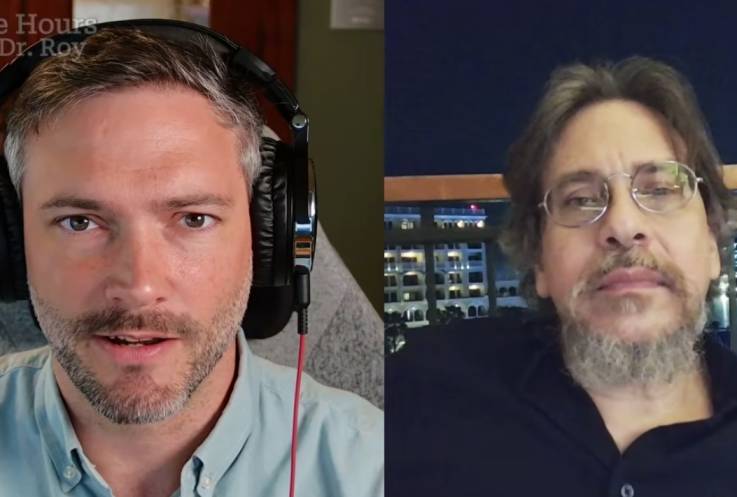
Editor’s Notes: In this “emergency office hours” session, Dr. Roy Casagranda provides a critical analysis of the recent military strikes by the United States and Israel against Iran. Speaking from Abu Dhabi, Casagranda draws historical parallels to World War II and the Iraq War, arguing that targeting infrastructure rather than the government itself could lead to state collapse and long-term chaos. He also examines the potential economic fallout, specifically the threat to the Strait of Hormuz, through which 30% of the world’s petroleum flows. Throughout the discussion, Casagranda explores the motivations behind these actions, including potential domestic distractions for both the U.S. and Israeli leadership. (Mar 1, 2026)
TRANSCRIPT:
Emergency Office Hours: The Strike Begins
JEREMY: Welcome to unexpected office hours, maybe somewhat expected. As we talked about the last time, should we call this emergency office hours? Like we’ve got a test coming up or something and we need some clarification. Roy, where are you right now? What is happening?
DR. ROY CASAGRANDA: I’m in Abu Dhabi. We actually came yesterday because we were going to see friends, and then the excitement started this morning. So this morning, UAE time.
JEREMY: What’s going on?
DR. ROY CASAGRANDA: So the United States and Israel attacked Iran. This is obviously very reminiscent of what happened 12 months ago — sorry, 8 months ago — with the 12-day war. The US and Israel are striking infrastructure targets in Iran, which I think is a serious mistake. I think they should be focused on, if you’re going to do this, you should be focused on decapitating the government, not destroying the state. And I think they don’t understand the difference.
To clarify, because I think people don’t get the difference in the United States usually between a government and a state: you elect the government, the government then takes control over the state. The state is this massive bureaucratic entity. I like how when idiots say “deep state” — there is only state. There’s no such thing as “deep state.” That is what the state is. Calling it “deep state” is just meant to make you feel like there’s some nefarious conspiracy.
At the end of World War II, the United States did not destroy and disassemble either the Japanese state or the German state. What it did was go after the government. There was a denazification program in Germany, but otherwise it left the state intact.
In 2003, because apparently people in the US can’t read and don’t know any history, the US decided that it would be a great idea to destroy the Iraqi state. And of course that plunged Iraq into absolute chaos because it then had to rebuild itself from the ground up. After eight years, the United States was driven out of Iraq in a humiliating defeat, a crushing, humiliating defeat. The reason is because by disassembling the state, you had no mechanism to control the country.
Whereas in the Federal Republic of Germany — it wasn’t created immediately, but the state apparatus was still in place in the period between the end of World War II and the founding of the Federal Republic of Germany. There was still a mechanism by which you had police, you had fire departments, you had somebody running the utilities. The stuff that needs to get done was still getting done.
Even though in that first three years after World War II, we were thinking about exterminating Germany. We had a plan in place called the Morgenthau Plan, and its ultimate goal was to make sure that there was no Germany on the other side. We changed our mind after three years — that’s why we founded the Federal Republic. Even in a genocidal moment where our goal was to get rid of the German people, our goal was literally to murder 25 million Germans. We got 7 million into the project and then lost our stomach for it and quit, which is a good thing. Somebody would be like, “Oh, I can’t believe we backed down.” It’s a good thing to lose your stomach in a genocide. Even in that circumstance, we still left the German state intact.
So my fear is that right now the US and Israel are targeting too much. When you’re trying to clip your fingernails, you don’t want to get flesh, you don’t want to get bone, you don’t want to get muscle. You want to just get the nail. That’s what your goal should be. Get the nail.
Iran’s Retaliation and the Strait of Hormuz
JEREMY: It seems like for most initial assaults on an area, you want to go for their missile defense systems or their offensive capabilities. But obviously Iran has retaliated already, so it doesn’t seem like the US and Israel have taken out those capabilities.
DR. ROY CASAGRANDA: I was just going to say, one of the reasons they haven’t is because Iran’s been preparing for this moment for decades. As a result, a lot of the assets that they have are in really secure locations, buried in tunnels underground. They are prepared for this. This isn’t a surprise to them.
JEREMY: Yeah, I guess we have been telling them to build up for this moment for a very, very long time now.
DR. ROY CASAGRANDA: Netanyahu has said for 30 years, “Iran is one day away from getting a nuclear weapon.” For 30 years. So what is that? What is 30 times 365? That’s a lot of nuclear weapons. I’m surprised — I didn’t know there was that much uranium on the whole planet.
JEREMY: So based off of what you have seen and what you’ve heard, what do you think the next step is here?
DR. ROY CASAGRANDA: Iran has retaliated. It struck US military bases across the region. I can’t off the top of my head tell you how many states have been hit, but I want to say it’s like eight, something like that. And Iran is now warning ships not to use the Strait of Hormuz.
As far as I know, they haven’t mined it yet.
They’ve been threatening to mine it and they haven’t officially closed it. They did actually a few days ago temporarily close a section of the Strait of Hormuz, saying that they wanted to do military exercises and for safety reasons they were temporarily closing a section. What’s interesting to me is they haven’t pulled the trigger on mining the Strait. That would be a big step and it’s sort of an escalation. But as of right now, I think the goal is to just retaliate for the sake of retaliating from the Iranian side.
JEREMY: Do you think the Strait of Hormuz is — I mean, it’s a super important geographical point of entry into the Persian Gulf for both enemies and allies for Iran at this point. So they would want to keep it open so that they can get materials in and out from China or Russia or what have you.
DR. ROY CASAGRANDA: I don’t think that’s their priority right now because anything that’s coming from China or Russia would be a long-term thing. If you don’t have what you need right now, you’re not going to have it. It’s too late. All the prep work for this moment should have already been done.
So I think for Iran the question is how far are they willing to go? About 30% of the world’s petroleum comes through the Strait of Hormuz. So if you shut it down, it is going to have a massive impact on the global oil supply. Even a short shutdown will have a massive impact. 30% is insane. 50% of the world’s proven reserves are in the Persian Gulf, but they’re not at maximum production level, so it’s 30% of the actual material.
Of course Iran’s been discounting its oil for years now and selling to China and Russia, so at the end of the day, anything that they needed to get done needed to have already been done before this moment. And I think after the 12-day war last year, it’s very unlikely that Iran has just been sitting here for eight months not preparing even more than they were before. I wouldn’t be shocked if they have deeper, larger tunnels with even more supplies in them.
Is This Really “For the Iranian People”?
JEREMY: Do you think that the notion that this strike has been to support the Iranian people in order to overthrow the current government still holds? Now that the strikes are on infrastructure — which obviously hampers both the military forces and any counter-military forces or resurgence inside the country, because destroyed infrastructure is destroyed infrastructure, nobody can use it — do you think that notion that this is for the people is still accurate?
DR. ROY CASAGRANDA: Well, there’s a problem, and that’s the history of the United States and the history of Israel. It is impossible for me to ever believe that the United States is going to do something to the benefit of another people. Especially when you have a hyper-transactional government that literally just runs around saying, “Why are we doing anything for you?”
I mean, we have a president that when a hurricane hit the US Virgin Islands in his first term and Puerto Rico, he’s like, “When are these people going to take care of themselves? I need to talk to the president of the US Virgin Islands.” And it’s like, you’re the president of the US Virgin Islands. It’s scary that you don’t know that. It’s this mentality of: the house next door is on fire, it’s not my house, I should let it burn. And then in the case of the United States, it’s, “Oh, let’s go steal the furniture before the house burns down.”
So I don’t buy it for a second. What I’m hopeful of is that the Iranian people will use the opportunity anyway and take out their tyrannical state. The Islamic Republic has just absolutely ground the Iranian people and Iranian society into the dirt.
I’m hopeful that at least something can come out of this. I wouldn’t be shocked if the Islamic Republic survives this, in part because it’s shown so much resilience and durability. There have been so many times that people have gone, “Okay, this is it, this is it.” And apparently, nope, it wasn’t it.
If Israel and the United States sustain this for enough months, maybe they can do it. But if it’s another 12 days, it’s useless. You’re just firing off a bunch of missiles, adding to global warming, killing some people, blowing up some infrastructure. Are you invested in construction company stocks or something? I don’t get what the point of that is.
Distraction Politics and the Real Motivations
JEREMY: Trump invested in construction and real estate.
DR. ROY CASAGRANDA: Shocking. Maybe he’s also invested in Raytheon and General Dynamics, wants to see those guys make some money.
JEREMY: Yeah, I mean, in order to sell more missiles and rockets, you need to fire some. Hopefully that’s not the main reason, but I’m sure they’re pretty excited about that prospect.
Also, we have to keep in mind, the Epstein files are kind of growing here in the US. Clinton is getting — he’s going through the legal process against accusations. So it’s looming. The American public is very focused on making sure that those people in power are held accountable. What better way to distract the American people than by going to war?
I don’t know if this feels like the start of a war, but again, it could just be a less-than-two-week thing. We’ll see. Do you think these motivations — like the distraction angle we talked about in our last office hours — are probably what’s going on? Or is this more of Trump and Netanyahu wanting to finally scratch that itch that’s been bugging them for so long?
The Wag the Dog Hypothesis and U.S. End Game
DR. ROY CASAGRANDA: I think both on, on the one hand, right, there is now this testimony that was not released by Pam Bondi that has still come forward. That was, obviously, an attempt to bury it. And it is an account of a person who says she was in fact raped by Trump and she was interviewed by the FBI in 2019. So the fact that that didn’t come out in the initial release and now it has come out, I think sort of pushes the wag the dog hypothesis.
Now, at the same time, Trump and Netanyahu have obviously been gunning to do this. They wanted to do this. What they find interesting is why didn’t they do it eight months ago? Why did they just stop? And there’s some reason to think that Israel just sort of got to a point where it couldn’t sustain it. You got to remember Israel is a small state, so for it to sustain a prolonged conflict is really difficult. It’s why it uses blitzkrieg tactics when it does war, because it can’t. It doesn’t have the ability to do a prolonged conflict. So it tore a page out of the Bewegungskrieg and does Prussian style war tactics in an effort to make sure that it takes its enemy out quick enough that it doesn’t have to worry about this long.
12 days was a long time. That’s telling. So that’s part of the issue. I think that’s why they didn’t finish the project last time. What’ll be interesting to see is if they have the staying power, if they really are going to go for months. If I was Khamenei, I would just go hide in a tunnel and wait for this to be over and just expect the United States and Israel to quit at some point. Actually, if I was him, I would have flown to Russia and hung out with Bashar Al-Assad by now. But that’s because I have a threshold where I’m like, this is not possible anymore. It’s time to go. And I’m sick of abusing my people.
So, yeah. On the one hand, there is the wag the dog thing, but here’s the twist. I don’t understand what the United States end game is. Is it to bring in Reza Pahlavi? If it is, okay, how are you going to do that? Are you going to put boots on the ground? Is this the precursor to a ground invasion? We don’t have a great track record post World War II of winning wars. By my count, we won the war in Grenada, we defeated Panama in 89. And I think you can count the 91 war against Iraq as a win, but that’s it. Everything else has been a catastrophic defeat. Well, maybe you can call the Korean War a tie. Certainly not a win, and it’s certainly not a defeat. So I guess it’s a tie. But Vietnam was a catastrophic defeat. Humiliating rout. Afghanistan was humiliating. Iraq was a humiliating rout. I just don’t understand — you’re going to attack a country that’s even bigger? I don’t understand what the end game could possibly be.
JEREMY: Yeah, the timing is interesting because they, you’re right. They did stop after 12 days last summer. Now it’s an election year. Primary voting is in a couple days.
DR. ROY CASAGRANDA: Yeah. So early voting’s already started.
JEREMY: Yeah, early voting has ended actually. At least in Texas. It’s March 2nd, which is just on Monday.
DR. ROY CASAGRANDA: Is that right? Tuesday or Tuesday?
JEREMY: Tuesday. Always on Tuesday. And yeah, it’s just odd timing.
DR. ROY CASAGRANDA: I lost track of time.
JEREMY: It doesn’t seem like it’s necessarily a great idea though, because this is something that I think most people don’t want. They don’t want to get into a major conflict and spend money. It’s an interesting choice. So going back to what escalation might look like if this continues on the long run, what do you think will happen in Iran and what do you think will happen on a global scale if this continues past one month?
The Rally Around the Flag Effect and the Unraveling of Pax Americana
DR. ROY CASAGRANDA: So one thing that an expert on Iran was telling me — and we should probably just bring him on the show next time and do a talk on Iran — was that in the war eight months ago, the 12 day war, in the beginning the Iranian people were all excited and they were happy. They were like, “Oh, finally we’re going to get rid of this regime.” But as the war dragged on and more and more people died, their opinion began to shift towards, “We have to support the regime.”
That’s not unusual. That’s exactly what happened in Germany during World War II. 1/3 of the German population actively resisted the Nazis right up until about 1943. So from 1933 to 1943, for 10 years, 1/3 of the German population was in a state of active resistance. They were doing things like not letting their children join the Hitler Youth. They were making sure that they didn’t contribute as much as they were supposed to to the state. But that actually should tell you a lot about the German people and their sense of right and wrong. Because the United States, I guarantee you, it’s nowhere near 1/3 of the population currently resisting when they should be. I bet it’s more like 13% or something like that.
So what ended up happening is the United States began a bombing campaign, a horrific bombing campaign of Germany and actually just Europe in general. We spared six cities, we bombed everything else, including the cities from the countries that we were liberating. And in the process, the German people switched sides. That one third that had been actively resisting went, “Oh my God, we’re going to get genocided here.” And they stopped actively resisting. It actually brought the Germans closer together.
One of the tragic ironies is that when we bomb a city, initially its production, its output would go down, but then as output would shoot up, it would actually end up with more material output than it had before the bombing. Because the population of people who were bakers and schoolteachers and the guy delivering the mail — who just lost a relative, whose house is blown up and whose job is gone — went, “I might as well go work in the factory and make bombs, because it’s the only way we’re going to survive this.”
And that’s my fear for Iran. As the United States and Israel hammer Iran, at some point people are going to start to go nationalistic and they’re going to start to say, “As much as I hate this government, I hate the guys bombing us more.” And in the end, they could actually retrench the government instead of actually bringing it down, which would be really unfortunate. Or they could get really lucky and at some point Khamenei jumps on an airplane and flies to go hang out with Bashar Al-Assad in Russia. And then Trump gets to run around going, “Look what I’ve done. I did something so amazing. Look what I’ve done.”
But here’s another thing to notice. The United States created Pax Americana post World War II. And the idea was that we’re going to have a boogeyman in the form of the Soviet Union. The Soviet Union was going to be sort of like this isolated, trapped thing. It didn’t really work. The Soviet Union managed to spread out and get into Cuba and Nicaragua and Angola. So it didn’t go the way that we wanted it to — Ethiopia too — but nonetheless, that was the idea. The United States would kind of contain the Soviet Union in Europe, and then the rest of the world would fall under the United States sphere. And the hope was that this would create opportunity for the United States to exploit brown and black countries, steal their resources, but it would also mean less war. There would be sort of an order that the United States was imposing on the planet.
When we look at the amount of wars during the Cold War, it really was a period of relative peace. I’m not saying that there wasn’t a Vietnam War or a Korean War. There definitely was. And there was the civil war in Angola and the war between Somalia and Ethiopia. There were definitely conflicts. But when you compare it to the pre World War II period, or just European countries running around the world smashing third world countries and forcing them into their empire, the amount of peace was relatively high. Europe wasn’t in conflict. The conflicts that were happening were proxy conflicts between the United States and the Soviet Union. Countries weren’t in the habit of running around attacking one another.
Now we see wars breaking out all over the place. Azerbaijan attacks Armenia, Thailand attacks Cambodia, Pakistan attacks Afghanistan. The whole order that the United States spent all this time creating is just crumbling around our ears. And I think that’s the real thing that’s at stake here. As the United States keeps doing these random wars, undeclared wars, wars that don’t have international sanction — we didn’t go through some process with the UN, we didn’t go through some process with Congress — at some point we will start to see the entire structure of Pax Americana completely unravel. And I think that leads to the type of chaos we saw before World War I. Then you end up with a situation where one guy makes a mistake and the next thing you know, there’s a big conflict.
So as nasty as U.S. imperialism has been, there was a benefit to it. It was that there was a world that was a little bit less conflict ridden than it is now.
Could This Lead to a New Age of Imperialism?
JEREMY: So do you think this could lead to like a second age of imperialism or third age of imperialism where different states are trying to acquire land? I mean, we’re seeing this with Russia and Ukraine, which doesn’t feel like a news story necessarily, but Israel has been frank about wanting to have its own little empire in the Middle East.
DR. ROY CASAGRANDA: And my company totally agrees that that’s a good idea. They should have the Nile to the Euphrates.
JEREMY: Yes. So do you think this — I don’t want to catastrophize or anything, but we’ve thrown around the term World War III. Do you think it’s to that level or do you think it’s more of a regional empire, proxy war type situation?
The Danger of Miscalculation and the Path Forward
DR. ROY CASAGRANDA: So I think what will happen is at some point somebody’s going to make a mistake. And unfortunately we have a really uneducated government in the United States that has antagonized its allies, alienated its allies, wrecked its alliances, wrecked its treaty system that it created. And it’s talking like the British empire in the 19th century, like, “Oh, we want this. This is ours now. We’re going to go plant our flag there.”
And the United States does do some tone setting for the rest of the world. I honestly think it’s one of the reasons why Thailand thought, “You know what, let’s attack Cambodia. We really want this old temple that they have that the French gifted them. That’s not fair. Let’s go get it.” And I think the United States has sort of set a new tone for the world that it’s okay.
And then Russia hasn’t helped any. Russia’s war in Georgia was — what was that, 2008. And then now Russia’s war in Ukraine that started in 2014 and then got escalated in 2022. Trump running around talking about, “We should annex Canada, we should annex Greenland,” and even going so far as to say, “We should grab Iceland, too.” Although I think he meant Greenland, but we don’t really know what’s going through his brain.
So what we need to be doing is going the other direction right now, and we need to be getting together as a planet and going, “Okay, we have serious crises we need to be managing,” and instead we’re just gone this bizarro path. One mistake, one miscalculation, and next thing you know, we’ve got a real catastrophe.
I mean, think about this — if, when Cortez invaded Mexico in 1519, he had tripped and banged his head on a rock and died, the world would now be a completely different place. It’s the butterfly flutters its wings in Nebraska and there’s a rainstorm in China. I know it’s usually said the other way around, but I felt like it shouldn’t be. And it’s chaos theory.
And unfortunately, that’s the world we live in. It’s a universe guided by chaos theory and complexity theory. And when you have so many variables on the table at the same time and you just start randomly pulling at them, something is bound to happen. And I don’t understand this idea that we need to be doing this. It’s a really strange place to be in.
Historical Lessons and the Cycle of Bad Leadership
DR. ROY CASAGRANDA: Somalia attacked Ethiopia — was it 1979, 1978, I don’t remember the exact year. And the whole reason was that European imperialism had made it so that Somalis were in Ethiopia, Somalis were in Kenya, Somalis were in Somalia, Somalis were in Djibouti. And Somalia was like, “What is this? We need to put our people back together.” And they did this terrible, catastrophic war. It blew up their country. To this day, Somalia is a wrecked place. They never recovered from the tragic error of making this attack against Ethiopia.
It doesn’t take a lot to take what you have and just throw it away. And I think instead of learning the lessons from history, we’re sort of stuck in the cycle of bad leaders making bad decisions over and over and over again.
But again, I’m not going to lie. There’s a part of me that really hopes the Islamic Republic goes down in a ball of flames.
JEREMY: I mean, there’s definitely a silver lining here.
DR. ROY CASAGRANDA: Possible. My theory is it goes down in a ball of flames and then the state doesn’t survive it. That’s my view. If there’s no state, then even Reza Pahlavi isn’t going to have anything to guide and then wants to keep Iran from breaking up. I think the last thing we need is more states on the planet. Breaking up isn’t necessarily going to be useful. So I just wish there was somebody with a three-digit IQ at the helm making these decisions right now. That’d make me feel a little bit calmer.
JEREMY: Yeah, I feel like that’s not in the cards right now, though.
DR. ROY CASAGRANDA: No, it’s not. Especially because Trump’s going to be president for the next 20 years, so. Well, it’s hard to imagine how we’re going to get through those 20 years. This is going to be a really rough 20 years.
Wrapping Up and Looking Ahead
JEREMY: Let’s focus on the next few days at a time and we’ll try and keep everyone updated on what’s going on. You’re in UAE right now. You’re in Abu Dhabi. It’s late there. You need to get some sleep.
DR. ROY CASAGRANDA: I’m sure I probably shouldn’t have been rambling, repeating a bunch of things.
JEREMY: There’s a lot happening right now. You are Dr. Roy Casagranda, so when something like this happens, your brain immediately goes back 100, 200,000 years to analyze —
DR. ROY CASAGRANDA: — when the Earth was being formed 4 billion years ago.
JEREMY: Yeah, when we humanoids first picked up a bone and started hitting each other with it.
DR. ROY CASAGRANDA: I love that movie. Just for the record.
JEREMY: That’s a good movie. It’s still one of the best intros to any film ever.
DR. ROY CASAGRANDA: It’s so amazing.
JEREMY: It is. I don’t know why we’re just talking about this movie. It is such a good movie. It’s hard to watch all the way through because we’re just so used to faster paced stuff.
DR. ROY CASAGRANDA: Oh, yeah.
JEREMY: If you just watch clips of the best parts of that movie, I think you’re going to be fine.
DR. ROY CASAGRANDA: No, you need to watch it slowly and be okay with it not being, you know — I actually think one of the reasons we’re in the crisis we’re in is because our brains have become so frenetic. It’s like, dude, just slow down, take it easy. You’re going to be okay.
JEREMY: I stand corrected. After you watch — 2001. Oh, my gosh. What am I trying to say? 2001: A Space Odyssey.
DR. ROY CASAGRANDA: That’s good too.
JEREMY: Go ahead and watch The Good, the Bad and the Ugly if you want a really slow western. Unrelated.
DR. ROY CASAGRANDA: Oh, anyway, it’s such a good movie. So perfect. It’s the perfect western.
JEREMY: Yeah, it’s the only true western.
DR. ROY CASAGRANDA: Mandalorian is also really good as a western, and so is Firefly. Love that.
JEREMY: Firefly is really good.
DR. ROY CASAGRANDA: Firefly was amazing. The fact they killed it just shows how stupid they are. Yeah, it was on Fox. This is a direct attack against Fox.
JEREMY: Yeah, this was Joss Whedon before everything came out that he was not a good person, so.
DR. ROY CASAGRANDA: Oh, well, what can you do?
JEREMY: It’s still a really good show. So here we are talking about shows again. We’re just distracting people from everything that’s going on. It’s not distraction, it’s comfort.
DR. ROY CASAGRANDA: It’s comfort. Yeah.
JEREMY: We’ll stay informed and we’ll try and meet up again soon.
DR. ROY CASAGRANDA: I think we’re going to have to plan on meeting soon because it’s going to be an exciting next few days.
JEREMY: Yeah, I think so. I think you’re probably on again this week if you’re up for it.
DR. ROY CASAGRANDA: Yeah, let’s do it.
JEREMY: All right. Well, thanks, everyone, for watching. This has been our first and only emergency office hours, because we’ve got a test we need to study for.
DR. ROY CASAGRANDA: Yeah.
JEREMY: I don’t know how far this analogy is going to go. All right. Thank you, Roy. Dr. Roy. Stay safe, and we’ll see you later. Bye, everyone.
DR. ROY CASAGRANDA: Bye.
Related Posts