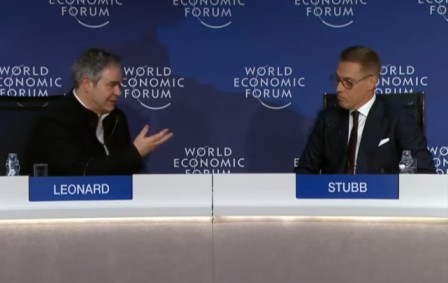
Read the full transcript of Finnish President Alexander Stubb’s interview by Mark Leonard at WEF 2026 in Davos.
Editor’s Note: In this interview from DRM News, Finnish President Alexander Stubb offers a strategic analysis of the shifting global order, characterizing the current era as a transformative moment comparable to 1918, 1945, or 1989. He outlines his concept of “values-based realism,” arguing that Western nations must remain firm in their democratic principles while pragmatically engaging with a complex, multipolar world. Furthermore, Stubb discusses the necessity of a “dignified foreign policy” and shares his perspectives on the future of European security, the war in Ukraine, and the integration of Ukraine into the European Union. (January 22, 2026)
The Changing World Order: A New Historical Moment
MARK LEONARD: ….a lot of the headlines that we are reading?
ALEXANDER STUBB: Yes, sure. I mean, in summary, you could say that the big argument is that for us this is the 1918, 1945, or 1989 moment of our generation. It’s a moment when the world order balance and dynamics are changing. Sometimes they happen after wars, like after World War I, World War II, or sometimes after periods such as the Cold War. And we’re sort of somewhere in between.
And we know that orders usually last, or at least have in the past century, 20 years as they did after World War I, 40 years as they did after World War II, or 30 years as it did after the Cold War. What initiated the change in the current liberal world order, I would argue, was Russia’s war of aggression in Ukraine. So, we’re talking February 2022.
I fully realize that this is a rather Western perspective of looking at things, but I admit fully in the book as well that my identity is Finnish, Nordic, European, transatlantic, so my analysis looks a lot through that lens. And of course, it has now been accelerated, this change and transformation, with the new US administration.
And the triangle of power for me is the global West, which used to be led at least by the United States, trying to preserve the current liberal order; the global East, led by China, which was more supporting multipolarity and a new order; and then the Global South, which unfairly I lump 125 countries into, but for me that is the area and entities of the world that will actually decide what the next order looks like. And of course now things move quite fast.
I think the thesis still holds, but my big idea is that you kind of have a choice which is fairly binary, but probably going to land somewhere in between. You have those who support multipolarity, which is about transaction and deals and actually spheres of interest, so not far from what we saw in the 19th century. And then you have those who support multilateralism, which is about international institutions, it’s about rule of law, it’s about norms, and basically the liberal world order that exists.
And my final point: if we want to preserve the liberal world order, we need to give agency to those countries around the world which feel that the current order was built 80 years ago in the image of the West and especially the United States, so give more power to the rest of the world, because I still think that there are more multilateralists in this world than there are transactionalists. So this is the big idea of the book and in many ways, the defense of the liberal world order and of course, of open societies as well.
Liberalism, Multilateralism, and Values-Based Realism
MARK LEONARD: So it’s a really interesting framework for thinking about what’s going on. And you are positioning yourself against the tide of history on a lot of these different areas. You’re a liberal in a world where there is a kind of big political movement against liberalism, which is particularly advanced in advanced democracies like the US and European countries. You’re a multilateralist in a world where power politics is increasingly defining how events take place. And you say you’re a proud Atlanticist in a world where the meaning of the West is kind of fundamentally changing. How do you find a way of reconciling the world that you want to live in with the one that you’re having to operate in on a daily basis?
ALEXANDER STUBB: Yeah, I mean, so there’s one thing I say in the book, and I’ve said out publicly as well, and also in a Foreign Affairs piece, which I published a little while back, and that is that in foreign policy, it’s important that you deal with the world that exists, not what you want to exist. And for that framework, I then came up a few years back with this concept of values-based realism, which essentially means that you stay true to your values — in my case, democracy, freedom, human rights, fundamental rights, protecting minorities, rule of law, supporting the international world order — but at the same time, you’re realistic that you cannot solve all the world’s problems, like conflicts or climate change or AI, only with like-minded countries. So you need to come together somewhere in a place to deal with it.
I have to admit that when I crafted values-based realism, I wasn’t really thinking about having to do it with the United States, but I have to admit that there is an element of that. So it gives me space. And it’s not a doctrine as such, but it’s an instrument to take us over this period of transition. I know Mark Carney talked about rupture, and he might be right.
MARK LEONARD: You’ve converted Mark Carney, but how do you get beyond—
ALEXANDER STUBB: It’s kind of the biggest achievement in my life, Mark Carney quoting values-based realism, but no, I mean, it’s kind of— the idea is then you have to ask yourself the question, ‘Okay, how do you do this?’ Well, a good starting point in my mind is another instrument I try to outlined there, which is dignified foreign policy, because I feel that we have a lot of conversation about history, about a post-colonial world, about colonialism, and we always look back into history for examples on how we have been treated.
So my take — and of course I come from a rather inoffensive country with a limited colonial past, which means that it gives me kind of street cred to do that.
So I talk about dignified foreign policy. In other words, you have to behave towards the people that you want to work with in a respectable way, which seems to be lacking a little bit in the world right now as well, I have to admit.
The Greenland Crisis: Lessons in Transatlantic Diplomacy
MARK LEONARD: So we’ve been through this extraordinary psychodrama over the last couple of weeks around Greenland. I think without a doubt in my mind, it’s the biggest transatlantic crisis that we’ve seen since at least Suez. It looks like things are kind of being resolved, but I think it is quite important to take some lessons from what’s happened over the last period of time. What do you think the main lessons are?
ALEXANDER STUBB: That we live in an unpredictable world and there will be curveballs coming at you in foreign policy virtually every day. I don’t remember a Davos — and I’ve been here 11 times — where in the first 21 days of the year we’ve had Venezuela, we’ve had Ukraine, we’ve had Greenland, we’ve had Iran, we’ve had Gaza, just to name 5 conflicts that have been tossed around. So we just have to take these curveballs one at a time.
In the Greenland issue, right in the beginning when it started, you had 2 camps — you had those in Europe who wanted to de-escalate and then those who wanted to escalate to de-escalate. I think most of us sort of worked in both of these spheres, so we were looking for instruments which would try to tone down the language by threatening escalation on different types of measures that the European Union has, but the key for me was to look at three possible outcomes or scenarios. One was good, one was bad, one was ugly.
The good one was that we would get an off-ramp and then a process which would strengthen Arctic security. A bad one would be an escalation in tariff wars, and an ugly one would be a declaration of military intervention in Greenland. And I think in the past 3 to 4 days where we pretty much worked around the clock with Mark Rutte and Jonas Stöhr and American senators and others, we were able to escalate to de-escalate, and end up in zone number 1. So, good outcome.
But at the same time, I can’t say that this won’t have an effect. Of course it does, because one of the key principles of the international order and how you treat alliances is that you respect the sovereignty and territorial integrity of each and every one of us. But we were able to deal with it short term and now we have to have a look at what we come up with long term.
MARK LEONARD: So what do you think the— so the short-term lesson is that you need a mix of showing that you’re serious by filling the vacuum both militarily with threats, threatening to use countermeasures— And frenetic diplomacy.
ALEXANDER STUBB: It’s just, you just have to work the phone and you have to do it behind the scenes.
European Sovereignty and the Transatlantic Partnership
MARK LEONARD: And in terms of the longer-term questions, I mean, you’re a very passionate European. You’ve worked for the EU institutions as well as for your own government. You’ve been part of this fundamental transformation of Finnish identity from being a kind of neutral country to being one of the most passionate defenders of European sovereignty and of the EU. What do you think Europeans need to do now in order to make sure they can be sovereign in this new world that we’ve been talking about?
ALEXANDER STUBB: The first, just general observation, is people don’t realize this: Finland is actually the only Nordic country which is 100% EU member, in the sense that we are in the euro.
MARK LEONARD: No opt-outs.
ALEXANDER STUBB: Exactly. We are in the euro and we don’t have any derogations, and I think that the original decision for us to join the Union in 1995 in a referendum was based on security, though we didn’t want to talk about it at the time. We never wanted to be alone again. So we did that. And of course, on NATO, which I wish we would have joined much earlier, we ended up joining it also because Putin attacked Ukraine.
So what’s my advice to my European friends? That is to say that don’t throw the baby out with the bathwater. We’ve been in transatlantic crisis before. You mentioned the Suez Canal. France left NATO, there has actually been regime change or elections have changed leaders in Germany because of placement of different types of military equipment in Germany because of the transatlantic relationship.
So I think be pragmatic, use the values-based approach, be true to your own values, so that means that you look for places where you can cooperate with the United States and the current administration. The war in Ukraine is an obvious one. NATO is another one. In my case, icebreakers, probably not in the case of the rest of you, but we work with the American administration on technology, we work with minerals, but at the same time, we can’t do it naively. We have to be cognizant of the fact that there is a lot of movement in the transatlantic partnership right now, but fortunately Finland’s bilateral relations with the US is really good, so we are in a good place.
But when you do that, realize that there are going to be areas where you’re simply going to disagree, and you can tell that either publicly, which some people do, or then privately, which I do. So it could be issues linked to international institutions, and American withdrawal from the multilateral system, or it could be on US unilateral action, it could be on climate change, it could be on how we defend democracy both at home and abroad. It certainly was on Greenland where you don’t have to be an expert of international relations to understand why Finland staunchly supports Denmark in Greenland.
You just have to be open in this relationship, and when you do that, I think there are 3 levels. One is, of course, for me, the direct contact with the president, but I have no illusions. I mean, Trump whisperer, nice, but I mean, I whisper or text, and most of the time he doesn’t listen, so be realistic about it. Second level is people close to Trump, and the third level is actually the first branch of government — Senate and Congress in general. So you just have to work very pragmatically at it and believe that this transatlantic partnership will survive.
Ukraine and the Road to Peace
MARK LEONARD: So before we all became experts on Greenland and Greenlandic security, the biggest European security question was about Ukraine and its future. And that is something which is very much still on the cards. And we hear that Steve Witkoff is going to fly off from Davos to Moscow. Jared Kushner as well. You know, you’ve been intimately involved in every single stage of the negotiations and discussions around Ukrainian security.
The Peace Process and Ukraine’s Path Forward
ALEXANDER STUBB: How do you see the situation at the moment? Well, I think probably two remarks on that, one on the peace process and one on the narrative of the war.
So on the peace process, I’m carefully optimistic in the sense that ever since, to be honest, Jared Kushner came in, the process became much more concrete. So yes, there was the 28-point plan, but if you look at what happened after G20 in 3 different cities— Geneva, Berlin, and Paris— in Geneva we had national security advisers from the US, from Ukraine, and from Europe trying to suss out and bring it down to 20 points. Then in Berlin we had a number of European leaders and then Kouchner and Whitco Kovtsov, who came to look at common landing zones. And then in Berlin on the 5th of December, we had a meeting of the Coalition of the Willing.
And in a broad perspective, I think we’re almost there. So we have pretty much 5+2 documents, which have to do with the 20-point plan, security guarantees, the prosperity plan, a sequencing plan, and a few others. So the good news is that Europe, Ukraine, and the United States is on the same page here.
Challenging the Narrative That Ukraine Is Losing
Now, my second point is that there seems to be a narrative that Ukraine is losing this war, and I simply don’t buy that. And we have enough information and intelligence to back this up as well. But it’s a Russian narrative which has been also floated a lot in the US.
The first question you have to ask yourself: what were the strategic aims of Putin? Number one was to take over Ukraine and make it Russian. Well, Ukraine is going to become a member of the European Union. Number two was to prevent NATO enlargement. Finland and Sweden joined because of Russia’s war of aggression, and that basically doubles the border of NATO with Russia. So another failure. The third aim was to avoid the remilitarization of Europe. Now we’re spending up to 5% of our GDP on defense expenditure.
And on top of that, you look at Russian projection of power in Iran, loss. Syria, loss. Venezuela, loss. What the United States was able to do in Venezuela in 12 hours in an operation is what the Russian military wanted to do in Ukraine with total failure. So don’t buy into this narrative that Russia is somehow winning this war.
And if you look at it from a military perspective, what is going on right now is remarkable. Not only is Ukraine holding fort, the advancement of Russian forces is less than a percentage point in the past 2 years— of territory. So what was acquired was kind of acquired from 2014 to before the war began. It’s a really slow war of attrition, and the cost of that just to Russia in December, 34,000 dead. So for what? For claiming that you took Kupyansk when you didn’t, and you claim it twice and you didn’t twice.
So people are saying that Russia wants to continue the war because they want more territory. That’s rubbish. Russia has to continue the war because this war is too big for Putin to fail. When you add on to that that the Russian economy is in shambles, which means they’re not going to be able to pay their soldiers, which means zero growth, end of reserves, interest rates and inflation in double digits. So Putin cannot afford to end this war. This is my big worry.
So what do we need to do? We continue to support Ukraine. We continue to put pressure on Russia. That’s the only way in which we can get a deal. This week will be important. There’s Moscow today, and then there’ll be Ukrainian, Russian, and American national security advisers or negotiators in the Arab Emirates for 2 days after that. So have faith. Ukraine is going to win this war.
Ukraine and the Future of EU Enlargement
MARK LEONARD: So I want to give people a chance to ask a few questions. But maybe before we can do that, we could just ask you another question about the future of the EU. You were saying that Ukraine will join the European Union. It’s definitely one of the points in the 20 points. And there is talk of setting a date in the very near future by which Ukraine will join.
But there is this paradox. On the one hand, from a security perspective, it’s totally necessary and clear. It’s an existential issue to integrate Ukraine into the European Union. But from a political perspective, it’s extraordinarily difficult to envisage how it can join in the way that other countries joined. How do you— you’ve, unlike any other European leader, you’ve written extensively in the academic realm on differentiated integration and thinking about the EU in a much more complicated way. How do you square those two circles?
ALEXANDER STUBB: Yes, I guess that’s a little bit nerdy, so I did my PhD on flexible integration— the concept and idea that not everyone needs to do everything at the same time, and a concept which we’ve seen throughout— which everyone apart from Finland seems to be using. Exactly, we’re in the core of Europe all the time. So it’s a concept such as multi-speed and variable geometry and et cetera.
So my big thinking here is that there’s nothing that unifies Europe more than pressure, and now that pressure is coming from both the East and the West, and this means that European Union enlargement has become strategic and existential rather than legalistic and juridical. So we are going to start seeing a more flexible Europe.
For instance, I now don’t differentiate, even though I’m a member of the European Union, with the work that I do with the United Kingdom and Prime Minister Starmer, or especially the 10 conversations I have with the Prime Minister of Norway every week, or the work that we do with Iceland, even though they are not members of the EU.
So then you come to the question on, okay, how do you integrate it into the system? And here, just for everyone— in the Finnish constitution, President does foreign policy and commander-in-chief, Prime Minister does the EU. So I don’t want to step on the toes of the Prime Minister here, so I’m not going to give you any dates.
But I think what’s going to happen is that the Union is going to start looking at enlargement from a different perspective. It’s probably going to turn the whole concept of enlargement around. So instead of you negotiating 35 chapters and 100,000 pages of acquis communautaire, you are granted membership and then you start getting the rights of that membership as you close these chapters. And I think that could be a way out for Ukraine.
I’m not saying it’s going to be easy because Ukraine has what, over 40,000 inhabitants, the agriculture market is bigger than all of Europe combined, but at the same time it has 800,000 men and women in the military. So I think when Ukraine joins the European Union, the military power of the European Union is basically going to double or triple overnight.
So it has a lot of issues, but then there are going to be issues about countries organising a referendum about enlargement and things like that. So it’s not going to be easy. Enlargement is always— it’s about three things. One is institutions, can they absorb? Two is budget, can it be absorbed? And three is policies, can it be absorbed? But I think it would be a travesty and strategic geopolitical mistake if Ukraine were not members of the European Union.
Implications for Countries Outside the EU
MARK LEONARD: And what do you think the implications will be for other countries outside the EU, like the UK, Norway?
ALEXANDER STUBB: Well, as I’ve said, Mark, about the UK, it took you 7 years to negotiate yourself out of the EU. It’ll take you 7 years to regret it and then 7 years to negotiate yourselves back in.
MARK LEONARD: Okay, we got time for a couple of questions before we end. If people could make them short and introduce themselves first. Sorry? Comfort.
ALEXANDER STUBB: Comfort, yes. Comfort is in the room. Comfort is in the room.
MARK LEONARD: Comfort does the first question. Thank you very much, President Stubb and Mark. I think the other lesson I would add to your list, President, is that it does matter to have somebody from one of the Western countries to put very clearly on the table, like you have done— and you’ve brought Mark Carney to do that with you— to recognize the rupture. Because without that, then the rest of the world and what the rest of the world has been saying doesn’t land until one of you accompany that message.
Mark asked you what that looked like in practice, and you referred to a more dignified foreign policy. But can I push a little bit further, within the context of Sudan and Myanmar and Haiti, what does that actually look like in practical terms as well? And I don’t want to look back in history, but I think a number of the rest of the world were very concerned about
Related Posts