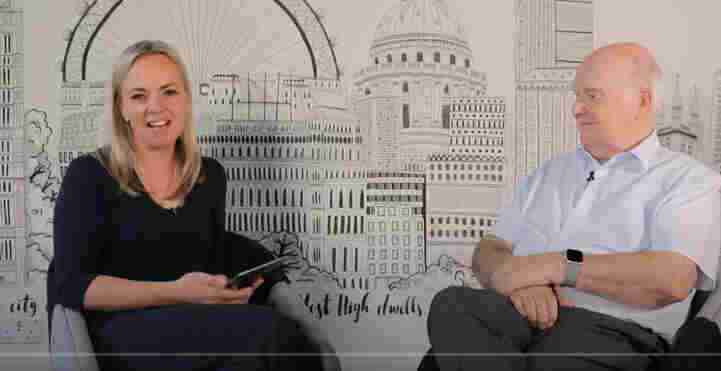
Read the full transcript of a conversation between Mathematician and renowned ethicist, Dr. John Lennox and Oxford-educated theologian, Dr. Amy Orr-Ewing titled “Why I Believe In God.”
Listen to the audio version here:
TRANSCRIPT:
DR. AMY ORR-EWING: Well, hello and welcome to this interview with Professor John Lennox, hosted by Premier. We are so privileged to have Professor Lennox with us today, a renowned professor of mathematics at the University of Oxford, but also an extraordinary contender for the Christian faith in our generation.
So welcome, John, and thank you so much for joining us for this interview.
DR. JOHN LENNOX: It’s my pleasure to be with you.
Personal Faith Journey
DR. AMY ORR-EWING: The first question I want to ask you is just really about your personal faith. How did you come to personal faith in Christ?
DR. JOHN LENNOX: Well, the first impression I had of Christianity was through my parents, and as people will immediately detect, I’m from Northern Ireland.
DR. AMY ORR-EWING: Lovely lilt to your voice.
DR. JOHN LENNOX: Yeah, well, I’m not sure how lovely it is, but our country has not exactly distinguished itself for being an exemplar of Christian patience and peace and tolerance. I grew up in a pretty sectarian, divided community, but the first impression I had, which was very deep, was that my father ran a small country town store, maybe a maximum of 30 or 40 employees, but the interesting thing was he was Christian without being sectarian.
He employed as far as he could equally across the Protestant-Catholic divide and was bombed for it. My brother was nearly killed, and I said to him one day, “Dad, why do you do this? It’s far too risky,” and he said, “Look,” he said, “Scripture teaches us that every man and woman, irrespective of worldview, is made in the image of God, and I intend to treat them like that.” That made a deep impression on me, this evaluation of other people.
The second thing that impressed me was that their Christianity was lived out ethically and morally, and it was shown in the fact that if Dad felt he’d been too tough with us, he’d apologise to us, and that got across the notion that there’s an objective standard of morality that was outside him, you see, and that taught me that this standard, of course, came, in his view, from God.
The next thing was that although he was passionate about his Christian faith, they didn’t force it down my throat. In fact, they encouraged me to think very widely. So my first experience of Christianity, I was interested in everything, was mind expanding, and Dad made sure that he introduced us to reading about the authenticity of Scripture, the history, all this kind of stuff.
But one of the most interesting things he did was, when I was about 14, he handed me a book, and he said, “That’s for you,” and I said, “Have you read it?” And he said, “No.” “Well, why should I read it?” He said, “You need to understand what other people think.”
It was the Communist Manifesto.
DR. AMY ORR-EWING: Wow!
DR. JOHN LENNOX: And that was so unusual, that kind of mere Christianity that he practised, that was open, was promoting thought, and I grew up in a situation where it never would have occurred to me that the Christian faith produced bigotry, you see. And that was wonderful.
And in a way, I responded to the Gospel. There was never a time that I wouldn’t have defended it. Now, of course, I’d been clearly taught that you have to become a Christian. You’re not born a Christian.
But when that actually happened to me, it’s very difficult. I’m nearly 80 years old. And looking back, it’s very hard to distinguish between what you remember as a child and what people told you about your experience. But I can just about remember once wondering how I could be sure.
And I think it was my mum recited to me that statement where Jesus says in John 5, “Truly, truly, I say to you, he that hears my word and believes in him that sent me shall not come into judgment, but has eternal life.” And I think she asked me, “Who is it you find difficult to trust? Look what he’s done.” And that clicked.
And I suppose if you want a starting point, that was it. But starting points are only valuable if they lead to something. And of course, my Christian faith developed very strongly before I went to university. I believed, I came to be convinced that Christianity was true.
I read a lot of stuff. My father also introduced me to C.S. Lewis and that appealed to me the logic of Christianity. So when I got to Cambridge in 1962, I hit the ground running.
Encountering C.S. Lewis
DR. AMY ORR-EWING: Wonderful. So you arrived as an undergraduate at Cambridge and you studied mathematics. But I believe you actually got to hear C.S. Lewis lecture. Is that right? Can you tell us a story about that?
DR. JOHN LENNOX: Yes, I did. I knew he was there. I didn’t know he was dying and very ill. And he hadn’t lectured in the previous terms of that year. But in the Christmas term of 1962, he was put down to give a series of lectures on John Donne poetry. And the maths department was just across the road from the English faculty lecture room.
So I skipped the maths on occasions and went across to listen to him. And I’m so glad I did. He was a legend in his own time. The place was packed, students all over the floors, no health and safety, of course, bother.
And it was very cold. And he was a big burly man and came in with a heavy coat and a big long scarf and a hat. And he’d start lecturing the moment he came through the door. And he would gradually pick his way through.
He would be divesting himself of his garments.
And the last words were uttered as he burst out through the doors. No Q&A.
DR. AMY ORR-EWING: So why do you think 60 years after Lewis’s death, his writings, his work are still so admired and read and relevant to people today?
DR. JOHN LENNOX: Because the Christian message has eternal validity. And that’s one of the evidences for its truth. It appeals to every generation. But Lewis was a master at understanding the implications of the Christian faith. And also, he was a master of analogy and illustration, how to unpack it so that people could grasp it.
And for me, as a scientist, he understood science in terms of the philosophy of science, the implications of science, much better than many scientists, which is why many of them don’t like him. And his book, for instance, on miracles was very important. And the arguments in that are as valid today as they were then. But, you know, in 1940, he was writing The Abolition of Man, which is a book that is entirely relevant in days when we’re questioning the definition of what a human being is, because we’re trying to enhance ourselves and producing super intelligences with AI.
And I find Lewis saw it all. He wrote a science fiction novel, The Last One of the Three, that had his strength. And it is quite amazing to read that book and read it beside Yuval Noah Harari’s book, Homo Deus. He was prescient.
So he helped me enormously. In fact, before I went to Cambridge, I’d read every book he wrote, except for the technical ones in the English language, in which you’re an expert.
DR. AMY ORR-EWING: Wow. Well, yeah, that’s for another time.
Academic Journey and Faith Challenges
Gosh, that’s amazing, John. So tell us a little bit about your own journey as an academic. So you did your undergraduate studies and then you began to emerge as an academic yourself. Can you talk about what it was like being a Christian and an academic mathematician?
DR. JOHN LENNOX: Well, the big lesson was learned as an undergraduate, when a Nobel Prize winner tried to encourage me to give up my faith. That was a very significant moment. I met him at dinner and I asked him about his Nobel Prize and said, did he ever think that there might be a mind behind the universe? Well, he didn’t like that.
And that stopped the conversation. I thought that was it. But after dinner, he said, “Lennox, come to my room.” And up to his room, I went up as a command.
And he’d invited several other senior members of the university, including, sadly, the chaplain of the college. And they stood around. He sat me in a chair and he said, “Now, do you want a career in science?” I said, “Yes.”
“Well, in front of witnesses tonight, give up this naive faith in God, because you’ll never make it.”
DR. AMY ORR-EWING: Wow.
DR. JOHN LENNOX: “You’ll never make it.” And talk about force majeure. The pressure was enormous. Of course, it occurred to me later, if he’d been a Christian and I’d been an atheist, he’d have been out of his job the next day. And I was so thunderstruck. I wondered what to say.
And I believe that the Lord helped me. I said, “Sir, what have you got to offer me that’s better than what I’ve got in Christ?” “Oh,” he said “the philosophy of Émile Bergson.” Well, fortunately, I’d read C.S. Lewis and I knew about Émile Bergson. It was a very bad choice, because before he died, Bergson, who was Jewish, had thought of converting to Catholicism. So it wasn’t a good choice. And I just looked at him and I just said, “If all you’ve got to offer me is the élan vital, the spirit of life that Bergson believed in, I’ll risk it and stick with what I’ve got.”
And I got up and walked out. But that put steel into me.
DR. AMY ORR-EWING: Yeah, that’s amazing, John. You know, I had an almost word for word conversation with my Old Testament professor at Oxford, who said, “Unless you give up your evangelical faith, it’s over for you.”
DR. JOHN LENNOX: Yeah, it’s amazing, isn’t it?
DR. AMY ORR-EWING: And now here you are with your own PhD. Maybe there’s something about needing in apologetics to really face whether we believe this is true or not.
DR. JOHN LENNOX: I think there is. And I think that helped me enormously, because it helps remove the fear of people like Dawkins.
Family Life and Ministry
DR. AMY ORR-EWING: Well, we’re going to come on to Dawkins. But before we do, a much nicer subject, Sally. Can you tell us about how you met Sally and what it was like to building a family life and navigating the journey of your academic work, but also as you were beginning to emerge into ministry?
DR. JOHN LENNOX: Yes, well, I had a mentor who went to Glory a few years ago. He was a classicist, brilliant. And he used to joke a bit and speak in a semi-biblical language. I got to know him in Ireland because he was a professor of Greek at Queen’s.
And when I went to Cambridge, I got advice from him because he was one of the few people I knew who’d been there. And he said, “By the way, my boy,” he said “that there is a man in Cambridge with four daughters.” So I arrived in Cambridge on Saturday, was taken to church by one of his friends on Sunday. And there were these four blonde girls, four, three, two, one.
And the eldest of them was Sally. So I saw her on day two of my trip to Cambridge. And we got married some years after that. And she’s been absolutely wonderful putting up with me, looking after me, especially when I started to get involved in travelling for the defence of Christianity, particularly behind the Iron Curtain.
We can come to that in a moment. But you asked the question, family life, children coming along, I have three children, ten grandchildren now. And people often ask, how did you juggle all that and sort it out? Well, I was given a bit of advice.
I used to think you’d solve that problem by 30 and then you begin to live. And my mentor, he said to me, “You’ve got it all wrong. Solving those problems is living.” And that totally changed the perspective.
Rather than seeing life as a series of problems to be solved and then living, solving them is living. And I think I owe a great deal to my wife because of the support way beyond what any woman should have to put up with. And she became a believer very young. And she had this sense and told me that she would never stand in the way of anything the Lord called me to do.
And that’s a big deal because I sometimes was out of the house, not often, but a month at a time in Russia, where everybody’s saying your husband’s crazy and they weren’t supporting her. So there was that. I got married in the last year of my PhD at Cambridge. And we set up a student flat and she’s very hospitable.
So we had hordes of students coming in because I was already as an undergraduate beginning to run Bible studies in multiple colleges simultaneously. I was all over the place and beginning to develop facing the questions people were asking because there’s another element and it has to do with Irishness. And that is when you come from Ireland and you end up in Cambridge, the very first thing people will say, “Well, of course, you’re a Christian. They’re all Christians there. They fight over it.” It’s a Freudian objection. And I’d heard it many times, but somehow I heard it very early on, first week, I think, and it clicked. You’ve got a chance now, one of the best universities in the world, to interact with people that don’t share your worldview.
Early Ministry and Apologetics
DR. JOHN LENNOX: Why don’t you make friends with some of them and get to understand what their questions are? And I deliberately set out in week one to make friends with people that were agnostic atheists. And I’ve been doing it ever since. And that is what fed my parallel interest that had been inspired by David Gooding, because he taught me to think about scripture, that putting those two things together and relating scripture to people’s questions and to the culture that began to develop in such a way that I started to share it with others very modestly at first.
And they called on. So I started a very big Bible study for those days, intercollegiate, that met for three hours on a Sunday afternoon, where I tried to help them as I’d been helped to think about scripture. And it was marvelously encouraging because many of those people are around the world today. At the same time, I got very committed to mission, not only in the university, but I’d been on Operation Mobilization before that.
George Burwood just died not long ago. And although it was crude and primitive in those days, I started the OM Prayer Group, the first one in a British university in Cambridge. And out of that grew the Bible study. So the two things went together, studying scripture, praying together, being involved in mission, not only in Cambridge, but abroad.
And that was a very important foundation.
Dialogue on Natural Selection
DR. JOHN LENNOX: Natural selection is a mechanical, blind, automatic force. It is, it’s not, I can’t say it’s not guided, but there’s no need for it to be guided. The whole point is that it works without guidance.
DR. AMY ORR-EWING: But it could be guided. Or do you completely shut that out?
DR. JOHN LENNOX: I mean, why bother when you’ve got a perfectly good explanation that doesn’t involve guidance? I mean, the point is, you use words like, you use words like blind and automatic.
This watch is blind and automatic, but it’s been designed. The words themselves do not shut out that notion. And it seems to me that the impression I’m getting is that what’s coming through is that the whole process is so sophisticated, it itself is giving evidence of a rational mind behind it.
Understanding Apologetics
DR. AMY ORR-EWING: Sometimes I think people feel a bit put off by the word apologetics. They think that’s for kind of very professional experts, or they think it maybe sounds like apologising. But what is apologetic?
DR. JOHN LENNOX: Well, it’s not apologetics. The word is a disaster because it’s a transliteration. Straight from Greek apologia becomes in English apologetics. But if they translated the word, it means defence. And Peter puts it brilliantly. The apostle, he said, always be ready to give a defence, an apologia, to anyone who asks you a reason for the hope that’s within you.
Now, I find that fascinating. I’ve actually written a little book about it called “Have No Fear,” to overcome the barrier of witnessing, because people have that impression. They say to me, “You’re into apologetics.” And I say, “Aren’t you?”
“Oh, no, that’s for clever Christians.” And this is nonsense. Let me try to explain. When this word is used by Luke, it is used in the book of Acts, where Paul gives his defence.
What’s his number one defence? I met Jesus on the Damascus road and he turned my life around. In other words, his primary defence was his personal experience of the risen Christ. No one could take that away from him.
And no one can take it away from you or me. So our apologia, don’t let’s use the word, our defence. I like the definition that Peter May set up for it, persuasive evangelism. Because think of the context, Peter, anybody that asks you, that’s not preaching, that’s conversation.
People are asking me a reason for the hope. That means they’ve seen that I’ve got some hope. So I am supposed to live actually in such a way that people say, I’ve got hope. And then they come and say, what reason have you got for that hope?
Now, evidence-based faith, if you don’t mind me putting it that way, is of the essence of Christianity. A person is a fool to trust someone if there’s no evidence to trust them, or a fact. So that when it comes to trusting the person of Christ, I need to know about it. Now we live in a multicultural, pluralistic society.
If you open your mouth about Christianity, people will come up with difficulties, objections, misunderstandings. And you have to clear those away. In other words, you have to say, no, it’s not like that. You have to defend the faith.
And that’s what it is. And all Christians are engaged in it. I simply am sad about the idea that using the word, it sounds like apology as you say, I’m not sorry that I believe the gospel. But getting rid of that word, what we want to do is to encourage people to answer the questions.
And that’s what Premier does brilliantly, I feel. And that’s why I’m sitting talking to you. Because we both are convinced, we’re set for the defence of the gospel, as Paul said. And it’s very important to me, encourage everybody to do it at the level they can.
Starting with their personal experience, but also depending on who they are, beginning to learn how to answer the questions. And we need to work on it and do it. So that’s the kind of approach I take to that.
DR. AMY ORR-EWING: Brilliant.
[Video clip]
Ministry Behind the Iron Curtain
DR. AMY ORR-EWING: So you mentioned a few moments ago about going behind the Iron Curtain. I know that’s been a really important part of your life. And there are so many stories to share from that season of your life. But could you share with the listeners what it was like going behind the Iron Curtain when communism is in full power and control, and you’re lecturing and teaching in your subject area, but you’re also contending for the truth of the gospel. Can you share a bit about that, John?
DR. JOHN LENNOX: Well, there are two distinct things here. There are two phases in this. There’s the before 1989 and after 1989. I first went to Eastern Europe in 1976. And the first country I went to was Hungary. And I wasn’t going to teach mathematics. I was going because I had met some Hungarian believers in Germany. And they invited me to come. And I was a bit scared and all this kind of thing. And there’s a long story connected about me going, but which I’m telling now in an autobiography that’s nearly finished, which is rather too long at the moment.
But it was going in to encourage Christians. The main country I went to was East Germany, the German Democratic Republic. I also went to Poland, Hungary, Poland and East Germany. But because I’m fluent in German, East Germany was the place.
Although in the other countries, I spoke German. Because in those days, because of the war, many of the older people, they spoke German, no English. Now they all speak English. And East Germany was the most thoroughly communist, even Stalinist.
And it was possibly because of my past experience of being interested in meeting people who didn’t share my worldview, diametrical opposite of Christianity’s atheism. Atheism in terms of applied Marxism was all around in East Germany. And one incident will show a very moving incident. I was in a little town and the people used to flock out.
I love to encourage them as a Christian, because very few of them had anything like the education. They weren’t allowed to have it. They were stopped at 13. There was a parody of the confirmation, church confirmation service, where at the age of 13, a child had to stand in front of the huge bust or statue of Marx in Karl-Marx-Stadt, now Chemnitz, it’s an old name, and swear allegiance to the atheistic state.
I can give an example of that that really touched me. I was in the home of an evangelist and his daughter came in, Esther. She was weeping and we were visiting their home briefly. I was teaching.
What’s wrong, Esther? She said, the teacher has just told me today, no more education. I’ve been the top student in the school all the way through. But because I will not swear allegiance to the atheistic state, no more education.
So I said to her, what did you say to him? And she said, I said to him, “Sir, one day you will stand before God and answer for what you’ve done to me today.” And we just stood and wept. It was so moving.
Later years, I stood and married her to her husband in East Germany, still. But that just, in a sense, encapsulated for me what happens when atheism becomes essentially a state religion. And obviously, it made me more and more determined to help these humble people, many of them very bright, who’d never had the chance living in these villages. And they came out in droves to hear me teach.
So it was mainly Bible teaching. The actual doing my own subject began a bit in Hungary, but very much in Russia. Because when the wall fell, my help to knock it down, I was in Berlin on the days when all that happened. Amazing.
God called me, directed me very specifically to get to Russia. And there I went with the Academy of Sciences. And that was a whole different world, equally fascinating. And I was able to interact with all these sort of people.
And they were, yes, interested and kind about my mathematics, but they were much brighter than me, most of them. But what fascinated them was, here’s an intellectual from the West who believes in God. And that’s all they wanted to question me about. So I got immense opportunity to begin to talk in those academic situations.
I gave the first lecture on Christianity in the University of Novosibirsk in 75 years, by invitation of the rector of the university. And that’s all a very long story. But there were two phases then.
Dialogue on Creation and Nothingness
DR. AMY ORR-EWING: Let’s try to talk in your kind of language. If there was a creation, then presumably the something that we now experience was preceded by the absence of something. And I presume that we can call the absence of something or the absence of anything, nothing. So presumably at the creation, somehow or other, absolutely nothing changed into, I use the term rolled over, changed into something. Is that what happened?
DR. JOHN LENNOX: By principles of indolence and ignorance and…
DR. AMY ORR-EWING: No, those come later.
DR. JOHN LENNOX: Oh, I see. I need to read this, you see, Peter. I’m sorry you catch me out. But I think…
DR. AMY ORR-EWING: Let me speak to the point. Let me just finish. So presumably you think that if there was absolutely nothing and it turned into absolutely something, that there was an agent involved in causing that. Is that the creation?
DR. JOHN LENNOX: I wouldn’t quite put it that way. I would say that the universe comes from nothing physical. But it doesn’t come from nothing. God is not nothing. In fact, we get the whole thing upside down. We tend to think, partly because of the way we’re educated in terms of science, that mass energy and material is the basic stuff of the universe.
Of course, now we’ve come down to nothing being the basic stuff. I would want to say about that is, I don’t believe it. But secondly, God is not physical. God is spirit.
And the fundamental stuff of the universe is mind and spirit. It’s not material. So then, if I could finish, the universe comes from nothing physical. But it doesn’t come from nothing.
It comes from God who created it. Let there be light. And there was light.
The New Atheism and Post-9/11 World
DR. AMY ORR-EWING: So it seems like the Lord has taken you into very strategic places and strategic times in world history where there’s great kind of power, I guess, contending against the truth of the gospel, the power of atheism and the communist set up behind the Iron Curtain. But actually, after 9-11, the world changed here as well. And you were in a position, I think, to speak into the rise of the new atheism in the most amazing way. Can you share a bit with us about how 9-11 changed the discourse around God and atheism and your experience of taking on some of those four horsemen of the new atheism?
DR. JOHN LENNOX: Yes. It’s the new atheists themselves that, well Dawkins particularly, who said that 9-11 radicalised him. This is religion. So we must get rid of religion. And it was just throwing everything out, all religion.
He modified his tone after a while. It was pretty obvious that there’s a big difference between Islamic terrorists and the Amish, for example. And it’s very foolish to put them all together. You’ve got to look at religions one by one, actually, and what they do.
The New Atheism and Its Aggression
DR. JOHN LENNOX: But it certainly radicalised them and made them very aggressive. The thing that characterised the so-called new atheism, which has been its downfall, actually, is its aggression. It’s very interesting. From time to time people cross the street in Oxford and say, “Oh, are you Professor Lennox?”
“Yes.” “Well, thanks for taking him on. Now, I’m an atheist, don’t get me wrong, but I can’t stand for this aggression.”
Dialogue on Faith and Evidence
DR. AMY ORR-EWING: Faith is rational and evidence-based.
DR. JOHN LENNOX: I mean, if that were true, it wouldn’t need to be faith, would it? If there were evidence for it, why would you need to call it faith? You’d say just evidence.
DR. AMY ORR-EWING: When you said that faith in relativity, in Einstein’s theory of relativity, is evidence-based, that, of course, it is. But the evidence is all-important. Einstein’s predictions fit in with observed fact and with a whole body of theory. Whereas we only need to use the word faith when there isn’t any evidence.
DR. JOHN LENNOX: No, not at all. I presume you’ve got faith in your wife. Is there any evidence for that?
DR. AMY ORR-EWING: Yes, plenty of evidence.
Debating Richard Dawkins
DR. JOHN LENNOX: The debates with Dawkins came about not through me at all. I had never done any debate. But a friend who became a friend in America was in Oxford trying to find someone who would help him reach some of the circles in Birmingham, Alabama, four places. He had a real passion. He was a history teacher, a very good one, leading young people, teaching the Bible.
But he wanted to reach parts of the culture there that the church wasn’t reaching. And he was looking for someone who might help him to do this. And the very last talk he came to was a talk in the refectory of all places at Wycliffe Hall. And it was hot. He almost didn’t come. And he thought, well, I’m going home tomorrow. My whole mission has failed. So I might as well go to this talk.
And he said, within five minutes, I knew I had the answer. So he comes to me afterwards, he’s very tall. And he said, “Would you ever think of coming to Birmingham, Alabama?” And I said, I was exhausted. And I just wanted to go home. There’s a long line of people asking. I said, “It would have to be really serious.” And he said, “Thank you.”
A few weeks later, I had this long list of things. I can organize this and this and this. So I went. And then he came back. And he went to hear Dawkins read one of his books. And I got this invitation, copied to Dawkins and vice versa. Would you come to Alabama and give us a taste of the Oxford debate on God and science? So that’s how it came to pass.
And I’d never met Dawkins before. And we were put up in a lovely hotel and a huge conference center to debate. And it was a confrontational debate. And that’s another thing that has really passed.
Short introduction, 15 minutes, 15 minutes, 10, 10, all this kind of thing. But the idea was to divide the thesis of his book, The God Delusion, into six theses. And we’d each comment on them and so on. And just before the debate, I met him and we got on reasonably well.
And he said, “I don’t debate.” Well, I said, “If it’s any consolation, I don’t either. I’ve never done one.” But I said, “What I intend to do, Richard, is I want to put into the public space tonight a credible alternative to your atheism.”
And he said, “I’d buy that.” So the rest is history in a sense, because the thing has been viewed millions of times. And it had a side effect for which I’m very grateful. It catapulted me onto the world stage and gave me an audience that’s global.
And it’s interesting looking back. I’m sad at the aggressiveness. And I did my best to read and study. It took an awful lot of preparation because these things are very expensive on time and preparation.
It’s much better to do a moderated discussion or have a discussion like we are having now. But talking about a subject. So that is how I got into it. It was quite a terrifying experience.
Science and Religion
DR. JOHN LENNOX: Now, Richard has just contrasted science and religion, religion being content with not understanding, whereas science is unravelling the understanding of the universe. And I understand and feel the force of that objection very strongly because sometimes Christians, I admit, have been guilty of a lazy God of the gaps kind of solution. I can’t understand it. Therefore, God did it.
And of course, God disappears as the gaps close. But I’d like to point out that there are two kinds of gaps, ladies and gentlemen. There are gaps that science closes, and I call those the bad gaps. But there are also gaps that science opens.
And we may come to some of those later. But as for the idea itself, Richard referred to the very important fact that science, modern science as we know it, exploded in the 16th and 17th centuries, and it arose out of a theistic background. And many philosophers of science have studied this and come to the conclusion, that’s now called Whitehead’s thesis, that human beings became scientific because they expected law in nature, and they expected law in nature because they believed in a law giver.
I think that is profoundly important because it means, far from religion hindering science, it was the driving force behind the rise of science in the first place.
And when Isaac Newton, for example, discovered his law of gravity and wrote down the equations of motion, he didn’t say, marvellous, I now understand it, I’ve got a mechanism, therefore I don’t need God. In fact, it was the exact opposite. It was because he understood the complexity and sophistication of the mathematical description of the universe, that his praise for God was increased. And I would like to suggest, Richard, that somewhere down in this you’re making a category mistake, because you’re confusing mechanism with agency.
We have a mechanism, it does x, y, and z, therefore there’s no need for an agent. I would suggest that the sophistication of the mechanism, and science rejoices in finding such mechanisms, is evidence for the sheer wonder of the creative genius of God.
Debating Peter Singer
DR. JOHN LENNOX: One of the most interesting was Peter Singer in Melbourne. He’s Australian, but he’s got a chair at Princeton.
We’re talking, ladies and gentlemen, about two diametrically opposed world views. And the easy way to see that is, Peter will say, look, he accepts the universe, as I understood you, Peter, as a brute fact. It’s there. So in that sense, it’s for you ultimate reality.
Everything else is derivative, including mind, intelligence, and the idea of God, because there isn’t a God. I take the exact opposite view, that the mind is primary, not derivative. In the beginning was the word, in the beginning was God, and the mass energy, the universe, or multiverse, or whatever we think of it as, is derivative. That is the issue between us.
And as someone once put it, the question is not whether there is an ultimate fact. The question is, which ultimate fact do we believe in? And Peter believes that the universe, in that sense, or as his ultimate fact, and I believe in God. And my argument simply is here, that far from, I can’t speak for other religions, Peter, I can speak mainly for my own faith.
They must defend themselves. But it seems to me that Christianity makes far more rational sense, and I did mention it does seem to have been the foundation for modern science. I explain to the audience, as I always do, my background, my parents, Christian, all this kind of thing. So we were talking about the existence of God, the big audience, Melbourne Town Hall, and Peter started, and he said, “Well, there you are. John has just given my main objection to religion, that people stay in the faith in which they’re brought up, you see.”
And I thought when I heard that, this is going to be wonderful, because when he ceded to me, I said, “Now Peter, I told them about my parents, and you have made a point about that, but tell me, were your parents atheists?” And he said, “Yes, they were.” “Oh,” I said, “so you’ve been kept in the faith in which you were brought up.”
And he said, “Oh, but it isn’t the faith.” “Peter,” I said, “I’m really sorry, I was under the impression you believed it.” And it brought the house down and cyberspace went viral. Here’s one of the world’s leading philosophers who doesn’t see that his worldview is a belief system.
It was staggering. But afterwards, we had a long chat. And I was deeply moved by what he said to me, because he is an ethicist with some very extreme views. And I had some awful letters before I debated him.
I should eviscerate him intellectually and all this, but I didn’t. I started off by saying, many of you would be aware of his extreme ethical views, and I do not share them. But I think they proceed from his atheism. And that’s what we’re going to discuss.
But first, before we start, I want to recommend one of his books to you. And it’s called “The Life I Can Save.” And I said, as a Christian, I learned a lot from it. Afterwards, he came up to me, stuck out his hand.
He said, “I want to thank you.” I said, “What for, Peter?” He said, “No Christian has ever treated me like that.”
DR. AMY ORR-EWING: Wow.
DR. JOHN LENNOX: And it was deeply moving. And he said, “I want you to be the guest of honour at a lecture I’m giving, private, tomorrow night.” And it was very difficult, but I went. And, you know, I was deeply moved by that, because what I learned from the slides he showed was that his family had been desperately damaged by the Holocaust.
And once you discover that, you understand. But the really funny thing was, I had a friend who organized that lecture. And he comes from a Hungarian Jewish family, exactly like Peter Singer. So he went up to Singer, and he introduced himself.
And he said, “We’re from the same background.” Singer was delighted. And then this chap says, “I’m a Hungarian Jew, and I became a Christian. I changed my worldview.”
So the very first person that spoke to him was a person that had changed their worldview. Now, for me, looking back historically, experiencing the power of the gospel to change people’s worldview was crucial to me. Because coming from Ireland, where people just said, well, you believe it because you’re born that way, and Singer saying the same thing, the fact that the gospel can help people to change their worldview is very important. And of course, I’d experienced it in Cambridge and so on.
But I look back to that with some fondness. And of course, you can see it on the internet.
DR. AMY ORR-EWING: Yes, that’s amazing, John. And listeners can see your debates with Christopher Hitchens and with Michael Ruse as well.
Current Questions in Faith and Culture
DR. AMY ORR-EWING: Yes. So, in a way, your ministry, your career, if you like, debating, especially in that era of new atheism, has been very strategic. But I guess we’ve kind of moved a little bit in the culture now, haven’t we, away from some of that anger. What do you think the big questions are right now that people are asking and facing with regard to whether the Christian faith is true or relevant?
DR. JOHN LENNOX: The question of meaning is probably number one. And I think it always has been a deep question of meaning and significance. People want to know what the good life is. And a number of universities, famous ones, are developing courses on the good life, what it is, and so on.
And I think that’s very important. I’m actually very interested in the recent work of Ian McGilchrist and his book, “The Matter with Things.” He’s a neuroscientist. And his analysis I find fascinating.
That is, roughly speaking, we’ve got two brain hemispheres, the right and the left. And we’re all used to describing people as left-brained or right-brained, according to whether they’re very scientific and rational or they’re artistic and musical and so on, and literary types. But what he is doing with hard neuroscience is arguing, he’s quite controversial, that there is a real difference, that there’s substance in this. And he’s used it to analyze cultural history.
And he quotes, I think it’s Owen Barfield, one of the Inklings, who made the point, how is it that we’ve come to the space where we understand how many things work and we know the meaning of nothing? And that’s a very interesting insight because that’s where we’re at. We’re full of understanding of science, technology, all kinds of things, but meaning is evaporated. And he makes the point that for several hundred years, we have unconsciously allowed the left side of the brain to dominate.
And it cannot, he argues, from neuroscience, it cannot see meaning. Now that, to my mind, is fascinating. It’s only a comment on what I believe to be true for other reasons, so we don’t need to depend on neuroscience for it. But it’s very important.
The Search for Meaning in Modern Society
DR. JOHN LENNOX: Jonathan Sachs read McGilchrist’s early book, “The Master of Zemistry,” and he had a light bulb moment. And he wrote a book because of it called “The Great Partnership.” And he says, science takes things apart to see how they work. Religion puts them together to see what they mean.
And the interesting thing about McGilchrist, and I mention him because he is a representative of a new generation of people that are not theists yet, but have a great sense there’s something more. They’re searching for that meaning. What is this something more? And the most important chapter of his huge book, 2,000 pages with 200 pages of references, the most important chapter, and the hardest he found to write, is Space for the Sacred.
We’ve got to do God, to put it in the Tony Blair-ism of the past. And that is very interesting to me, precisely because it’s written by someone who, and here’s the problem with his thesis, he feels we’ve emphasised the left side. We need to get to the right side. But that means he becomes suspicious of claims to truth, and doctrine, and dogma.
And you need both actually, because he’s a hard scientist. He uses the left side of his brain all the time. So this amounts for me to looking out on folk today, and there’s several of them. One person who’s much nearer to theism, he may well have become a theist, is Jordan Peterson.
I had a lengthy interview with him just recently. And it’s fascinating to watch him interact with the Bible. He had a long series with Os Guinness, you know, discussing the book of Exodus right through. And I welcome that, because it’s a very good start.
There must be something more. And I believe that we have the task of explaining what that something more is, and leading people to God.
The Conflict Between Atheism and Human Reason
DR. JOHN LENNOX: A leading philosopher, Alvin Plantinga of Notre Dame, says, “If atheists are right that we are the product of mindless, unguided natural processes, then they have given us strong reason to doubt the reliability of human cognitive faculties, and therefore inevitably to doubt the validity of any belief that they produce, including their atheism. Their biology and their belief in naturalism would therefore appear to be at war with each other in a conflict that has nothing at all to do with God.”
Yet my atheist friends still insist that it is rational for them to believe that the evolution of human reason was not directed for the purpose of discovering truth. And yet it is irrational for me to believe that human reason was designed and created by God to enable us to understand and believe the truth. Curious logic.
By contrast with that, biblical theism asserts that ultimate reality is personal and intelligent. And the reason science works, and this was the motivating force that drove the great pioneers of science, is that the universe out there and the human mind in here that does the science are ultimately the product of the same intelligent divine mind. Human beings are made, we are told, in God’s image. And that means that science can be done. That makes infinitely more sense to me as a scientist than atheism does.
The Question of Identity in Modern Society
DR. JOHN LENNOX: So that question of meaning is important. But the other thing that’s related to it is the question of identity, who am I as a human being? And we live now in perhaps the second or third generation that has no sense of an objective moral standard. And that’s creating all sorts of difficulties with identity, with gender fluidity, all these issues. And it’s very complex to grow up in a world where you’ve got no normative indicators, no clear moral dimension, and you’re living in a vacuum.
And we have to address that. So it’s a different set of parameters. I do still believe, though, that because of the power of science, and especially technology and the latest AI technologies, we still have to talk objectively as far as we can about the God and science questions. But we need to bring these other things in and become much more personal and not be ashamed to talk about our experience.
And I often say, look, when you’re looking for evidence for God and Christianity, there are two levels at least. There’s the objective, there are the basic facts, I’m speaking loosely. But then there’s the question of personal experience. You can call that psychology if you like, I don’t mind.
But we need to look at that as well because we’re persons. God is not simply a theory, he’s a person, and we’ve got to relate to him with our whole personality. And that holistic approach, I think, is one of the things that I notice most of. And that indicates to me I’m growing old because I can’t really relate to young people that are finding their identity being glued to a tablet all day long, and social media beginning to really unravel their capacity to think.
So there are positives and negatives in the technology that needs a lot more exploration.
The Mind-Brain Connection
DR. AMY ORR-EWING: The mind and brain are connected, but the scientific data doesn’t enable you to establish the nature of that connection or the relationship. Just because science can’t demonstrate that physical processes and mental processes are the same thing, that in and of itself doesn’t give you any evidence that that’s not the case either.
We talk about seeing deceased relatives and communicating with them. This idea of floating up out of your body and watching things happen and being able to describe it afterwards, that could be formed in your imaginative mind. Conscious experience and brain processes are two fundamentally different things. I wonder if we’re talking about… Would you like me to go out for a bit?
DR. JOHN LENNOX: You guys seem really happy.
Artificial Intelligence: Narrow AI and AGI
DR. JOHN LENNOX: I wrote the book because there’s a mixture of confusion, fear and excitement, as you say, about artificial intelligence. In order to understand it, the first thing to realise is there are two kinds, very different. First is narrow AI, and a narrow AI system is a computer, a big database and an algorithm.
Typically, it does one thing and one thing only that normally requires human intelligence. For instance, your database may be a million x-rays of human lungs and they’re labelled with the diseases that they represent. Then an x-ray is taken of my lungs and the system compares the picture of my lungs with a million and produces a diagnosis. Normally these days will be better than I get in my local hospital, and it is marvellous advance.
It is, in a sense, visual recognition technology. Now, that has been developed to a great degree, so it then becomes surveillance technology. With closed circuit cameras that are now so sophisticated, they can recognise you not only from your face, but from your walk and from the back. Of course, wonderful if you are a police force trying to pick a terrorist out of a crowd.
I often say to people, AI, like any other technology, is like a knife. A sharp knife can be used for surgery or murder. Now, think of the surveillance technology, the very same technology is being used to suppress the Uyghur population in China. That is terrifying.
It’s really scary, the depth of intrusion and control of an ethnic minority. Of course, the argument is, you’ve got to give up your privacy in order to have security. That argument is being used in the West as well. We need to think about these things very seriously.
The AI that’s working now is raising massive ethical problems. Now, you probably have a smartphone, you’ve got a tablet, I’ve got a smartphone. So the two of us are voluntarily allowing ourselves to be tracked. All that’s being recorded, where we’ve been and possibly what we’re saying, and all the rest of it.
Many people don’t realise that when they, say, buy a book on Amazon, Google or something, what’s being harvested is a great deal of data about our habits and so on. That data is being sold to third parties without our permission. And more sophisticated things, ChatGPT is wonderful as a sophisticated look up on Google kind of thing. And it’s very useful, but it can be used to, it’s not always accurate, and it can help very rapidly disseminate misinformation.
And we’re into the world of deep fake technology already. Where a clip, an audio clip of you plus a video clip, and they can make you say anything. Now, these are serious things. And the problem with technology is, it advances and develops far more rapidly than any ethical underpinning.
And that’s why there’s a scrambling among companies and nations. How are we going to police this? Because it was Vladimir Putin who said some years ago, the person of a country that is the leader in AI will control the world. And that is a serious thing.
Now, this is all narrow AI, the stuff that’s working, and there are dozens of other examples, and I give them my book. The second kind of AI is AGI, artificial general intelligence. And that’s the attempt, and it’s much more speculative, and there’s a great deal of science fiction in it, to produce a super intelligence in one of two ways. Either enhancing existing human beings by cyborg engineering, by implants, by all kinds of things like that, or by constructing an entity that can do everything a human being can do and more, based on a non-organic substrate like silicon.
The idea is that we eliminate aging, disease, all this kind of thing. Now, the hype around that is colossal, and one needs to investigate what is hype and what is fiction and what is genuine. The problem is, it’s not just the science fiction writers and historians like Harari that are writing about this. It’s serious scientists, very serious, like our Astronomer Royal, Lord Martin Rees, who says that the intelligence in the future will not be remotely like ourselves.
We’ll only have a dim memory of how we functioned. And that kind of thing raises a deep question, which really is why I wrote the book. What is a human being? Because a lot of this, now, there are many wonderful Christians working in AI.
One of the most brilliant is Rosalind Picard, who’s using it to develop a whole field of AI called affective computing. And she’s developed smart watches that can recognise when a child or an adult is about to have a seizure, a fit in the savings of people’s lives. Now, this is marvellous stuff. I encourage scientifically minded young Christians to get into this field because we’re going to need them there.
People with knowledge of the science and also people with an ethical sense who are able to develop this kind of thing. So that’s hugely important.
Transhumanism and the Christian Response
DR. JOHN LENNOX: My impression is that a great deal of this is actually driven by atheist thinkers. And they are focusing, and a lot of it’s coming straight out of Oxford, where I am, is transhumanism.
That is creating the super intelligence, going beyond the human with the idea that humans model 101, that we are only a point in a whole spectrum. And we’re going to develop super humans, we’re going to eliminate ageing. And Harari’s agenda for the 21st century is two things. One, solve the problem of physical death, it’s just a technical problem.
And we’ll get a technical solution. And that will mean that humans may die, but they don’t have to. The second agenda item in his big book, “Homodeus,” bestseller, The Man Who Is God, that tells you everything, is enhancing human happiness by genetic engineering all kinds of things. Okay.
Now, when people come, to cut a long story short, because this is a really big issue. When people tell me about this, this glorious prospect, I say it’s far too late, you’re far too late. And they say, what do you mean? I say, look, both of these problems have been solved.
First of all, the problem of physical death is solved by God raising Jesus from the dead 20 centuries ago. And as to the enhancement of human happiness, which some of you think is going to happen when we upload our brains onto silicon, there’s something far better than that and far more credible that because Jesus has been raised from the dead, that means he’s conquered death. That he promises to everyone that trusts him, who repents of their sin, that is, turns away from the mess they’ve made of their own lives and probably sadly, the lives of others, and trusts him as saviour and lord, they’re going to be uploaded one day. If I might use that vocabulary, because they will be raised from the dead.
Death is not the end for them. And there’s going to be a realm which we will enter called heaven, where we will be with him and it will be utterly glorious, no dying, no pain, all those things that the AI proponents think they’re going to get rid of. But all I say to them is, it’s interesting, you have all these scenarios and many of them actually mention God when they talk about a super intelligence in the future. And I say, but just a moment.
The Bible has been talking about the future for centuries and actually it is some things to say that are eerily close to some of the scenarios that you take seriously. One, for example, I mentioned is by a brilliant physicist, Max Tegmark of Princeton. And he has this notion that one of the possibilities, and it’s the main one he details in his book “Life 3.0,” is the Omega Project, where this vast corporation takes over the world. And it runs the world.
It starts with Amazon and develops and develops, runs the world. One single government. But everybody’s required to wear a thing like an Apple Watch, which is a smart bracelet, which has a device that if you don’t follow the ideology of this world government, it injects a lethal toxin into your hand. And it controls all the economics.
And the book of Revelation, centuries ago, talks about a world government run by something called a wild animal, which we’re told is a human being behaving like a wild animal, utterly brutal, and controls the economy by insisting that everybody has a mark of some kind on them, some kind of recognition implanted. And I say, look, if you’re going to take Tegmark’s scenario seriously, before you reject Christianity, please look at what it has to say, because actually the evidence for the Christian scenario is much greater than the evidence, totally speculative, that we’ll ever reach this kind of omega. Because there’s strong evidence, which I can’t go into now, that Jesus actually rose from the dead and can transform lives. And that is what you’re looking for.
You see, a lot of it, as you interjected and pointed out quite rightly, the name Homo Deus says it all. The man who is God. The first temptation to humanity was, if you disobey God, you rise and you’ll be as gods knowing good and evil. And that idea of becoming gods is run through the whole of history, with the Caesars, the Babylonian Empires, Ceausescu, and now we have Harari openly saying we’re going to turn humans into gods.
The Deification of AI
DR. JOHN LENNOX: And the interesting thing is that some aspects of AI are becoming very like a deity that people not are going to worship, but are beginning to worship. Because omniscient knows everything. GPT is trained on billions of books, including probably yours, and certainly mine because I’ve checked it. And the ability to write scriptures, to answer every question, and so on and so forth.
And we’re starting to see in the world today, AI religions. And we’ve got to take stock about this. And I am amplifying the book massively, because there is a need, I believe, to inform the public, not only Christians, so that they can see what’s good and benefit from it. But so that they can prepare their minds.
Long-termism and Effective Altruism
DR. JOHN LENNOX: I am really concerned about what’s called long-termism. And that’s the idea, again, coming mainly out of the Oxford Institute for the Future, run by Nick Bostrom. And it sounds like altruism. In fact, the original idea is called effective altruism.
Now we all know altruism is being concerned with the other, other people and so on, reaching the homeless, the impoverished. But now they’re saying that history is going to move towards a scenario where there are going to be billions of entities, they won’t be human, that will live in some sense. So that we ought to, today, to be preparing that they won’t go extinct. And so instead of giving money to help the poor, we should concentrate all the money on the intellectuals who are developing AI systems.
And well, let the poor go hang. I mean, it is terrifying what they actually say explicitly, because that’s long-termism. You live for the long term. So if a few generations of humans model 101 have to die out, so be it.
That is very terrifying. So the value of a human being, we’re getting back to the question of meaning, which is partly why I wrote the book. So we’re into territory that’s new. AI is as significant as the Industrial Revolution.
And I just want to try to think about, I mean, I have developed no AI systems, but I’m interested in the philosophy of technology, and the ethics of technology, and of course, the biblical dimension to it. And I do believe that one of the most important things now for me to emphasise as a Christian is to bring back into the centre, the teaching about Christ’s return. That was the central hope of the early Christians. And we’ve neglected it because it sounds so crazy.
It is not crazy anymore. So I want to try and be in on that.
The Problem of Suffering
DR. AMY ORR-EWING: That’s wonderful, John. Can we segue into another really significant apologetic question that has always been with us, and I think always will be with us, and it’s something that you’ve written about and spoken about a lot, and that’s the question of suffering, and how God could be loving, and this is a world that is.
And we’ve talked a little bit about the image of God and the significance at the heart of the Christian faith of human identity being rooted in that sacred image. And I know you’ve spoken a lot about then how the reality of our lived experience of suffering kind of fits with that. Could you share with us a little bit how you speak to people who are really suffering, who’ve gone through horrific things? I know you were in New Zealand around the time, just shortly after the earthquake that happened there.
How do we speak of Christian hope and the truth of the gospel in this awful suffering world?
DR. JOHN LENNOX: Well, with great sensitivity, because it’s a heart problem. But it’s the hardest problem for any worldview to face. And you mentioned the goodness of God, the power of God, and that’s what people come up against.
How can we reconcile those when the world’s in such a mess? And my brief response to it, which is inadequate, and one needs to take time, is, first of all, there are two perspectives on it. There’s people who are actually suffering, and there are people who watch suffering. And the reactions vary.
People have watched the earthquake, said, well, of course, there isn’t any God. That’s one possible solution, but it doesn’t get you very far. Because actually, philosophically, it raises the problem of how you define evil. And I take the view that the existence of God and actually having moral categories belong together.
And that’s a philosophical topic, which you didn’t ask me about. You asked me about how do you approach people who are actually suffering, which is a more important question. I believe there are answers to the first one. I’ve written about them.
I’ve even written about them in a little book I wrote about the coronavirus. Where is God in a coronavirus world? But in the earthquake situation, it happened just a few days before I got there, and that’s all people wanted to talk about, if God is good, all powerful, why doesn’t he stop this? Now, the earthquake is what we unfortunately call natural evil, because it’s not really moral.
It’s to do with the fact that there are tectonic plates on the earth. And there’s a huge dilemma there, because if it weren’t for the existence of those plates, no life would be possible, because it has things to do with the atmosphere and so on. And ironically, on my way to New Zealand, I was reading a book on the necessity of tectonic plates that move for life. So here you have the construction of the earth that’s necessary for life, destroying life.
So the problem is not the tectonic plates, but building houses unconsciously above an earthquake zone. Now, that’s very problematic. And it raises the question, couldn’t God have made a world where that didn’t happen? And then there’s the moral problem, which is separate in a way.
Couldn’t God have made a world where humans don’t do bad things to each other? So you’ve got the natural world going wrong, disease, cancers, earthquakes, tsunamis, and then you have the moral world, people doing bad things, and people suffer for both of those reasons.
DR. AMY ORR-EWING: Often at the same time.
DR. JOHN LENNOX: Often at the same time.
DR. AMY ORR-EWING: So you often have a natural event.
DR. JOHN LENNOX: Absolutely. And one thing can lead to another.
DR. AMY ORR-EWING: Yeah.
DR. JOHN LENNOX: An actual disaster can be caused by a moral disaster. People deforest the earth, create a desert, and then people suffer. So it’s very complex. And my first response to it is to say, on the moral evil side, of course, God could have created a world in which there were creatures that didn’t damage each other.
We can. We have. They’re called robots. But in that world, you wouldn’t exist.
I said, actually, wishing for a world like that is wishing yourself out of existence because a robotic world, a world of automata, lacks love and morality. Now, I say, God took a risk in creating a world where people had a certain range of choice, but that introduced the wonderful possibility of positive things like love and morality. Now, I said, I have three children, and I remember holding the first one, a little girl, and thinking, I don’t know why I thought it, but I didn’t think it. You know, you could grow up to reject me because you’ve got the capacity to do that.
Why have children? Well, most parents would say, well, having a child is a wonderful thing because I hope that with my nurture and love, they will grow up to respond. Well, perhaps we should allow God that. In other words, there’s a real risk.
Now, that raises another question, and it is granted that there’s a risk. Has God made provision if things go wrong? And that’s what brings you near to Christianity. So let’s hold that there and then come back to the other problem.
Only a good and all-powerful God ought to, etc., etc. And we argue about that, particularly as students, all night, and no one ever gets a satisfactory answer. I am a mathematician, and when we try for a few hundred years to answer a question, we get nowhere. We have the sense to stop and say, are we asking the right question?
Now, I think there’s another question. It’s equally hard, but it gets us further, and that is this. Every worldview, in light of the suffering and evil, has got to face the mixed picture that our world presents to us. I call it beauty of bombs, and that says it all.
We look at the sky, the stars, magnificent. We look at what’s happening in Russia, Ukraine, and the Middle East today, and it’s horrific. How do you come to terms with that? And here’s my hard question.
Granted that it’s like that, we’ve all got to face that. Is there any evidence anywhere that there’s a God that we could trust with it? Now that’s a big question. I think there is, and it starts with the fact that the central claim of Jesus Christ is to be God incarnate, and as we see him on the cross, which is the heart of Christianity, it raises the question, what’s God doing on the cross?
Well, at least it says that he’s not remained distant from suffering, but has become part of it. Now, if that were all, we’d never have heard that story. But Christ was raised from the dead, and that changes everything, because it means that death is not the end. And that begins to show me.
I don’t say this is the answer, but I do believe deep down it’s giving us an insight into where we can accept with all our questions that remain, where we can have confidence that God knows how to deal with this, and that we can trust him with it. Because he understands our suffering and our pain, and he promises those of us who trust him that there will be a day when we will experience the end of all of that. Now, I can remember just a little anecdote. I spoke on this in Christchurch, a huge audience, church, one of the biggest for years.
And there was a note waiting for me as I went out the door. And it said, “I’m sorry I couldn’t stay, I couldn’t face the people. I lost my husband earlier in the week. But this has given me a window into hope.”
And that’s where I want to start, is the essence of Christianity, is God so loved the world that he gave his son. Now, if my wife were here, she’d say, I’m going to go to heaven with loads of questions about this. There’s a lot of it we don’t understand, but I deeply sense that once we see the whole picture, the other side of the tapestry, if you like, we’ll not have so many questions. But that gives me real hope.
Atheism is a hopeless philosophy. It has nothing to say. So I think here we are. We have to decide if there is evidence that there is such a God.
And one thing that encourages me is that the Bible tells us about both these sources of suffering. It’s very interesting that the biggest book of scripture, one of the longest anyway, the book of Job, deals with both problems from the beginning. Because Job’s family was attacked by Sabaeans, that’s moral evil, but also there was lightning and winds, the two. And Jesus, as he stood on the temple, it’s very interesting, was faced with both simultaneously.
He was talking to the crowd and they were discussing the fact that Pilate and his soldiers had murdered some people when they were sacrificing. And Jesus refers to this, do you think they were sinners above all people? Which some people think, you see, if you suffer, you’re sinning, the doctrine of karma and all of this, which I met in New Zealand. No, he said, they aren’t.
You must not necessarily feel it because a person suffers. And that’s very important, it’s because it’s their fault. But unless we all repent, we shall likewise perish. And then he introduced, he said, or do you think that the 18 people on whom the tower of Siloam fell were sinners above all?
He refers to a natural disaster in almost the same breath. And that shows me that it takes this business seriously. And the main story that helps us get into this is in John 11, the story of Lazarus, who Jesus was told he was ill by his sisters and he didn’t come. And it brought the sisters very near to doubting the love of God.
He who you love is ill. We’ve got to read that story in light of the Lord loved Mary and Martha and Lazarus, but he didn’t come. He let the man die. And when he arrived at the graveyard and Martha met him, if you had been here, my brother would not have died.
She didn’t doubt his power, but why wasn’t he there? That’s the problem in a nutshell. Why does God allow this to happen? And he says, you will see the glory of God and he’ll be raised.
Yes, I do. He’s going to be raised at the last day. Oh no, Martha, it’s more than that. I am the resurrection.
And you see the two reactions there. She was very bright, theologically trained, obviously, and entered a vigorous discussion. The other sister just wept and Jesus wept too. That shows a sympathy of God’s heart to the two reactions, the intellectual, how are you going to sort this out, and the other, the emotional thing.
And the interesting thing is that Christ then revealed who he was by raising the man from the dead. And they had to live through the suffering and the pain of losing their brother and he had to die. And yet in the end, it was the resurrection that did it. And I believe that that is true in the general sense.
Approaching Suffering with Sensitivity
DR. JOHN LENNOX: Now there are all kinds of hundreds of fringe questions, but that’s how I start. But I do believe that we need to approach this with immense, because some people have suffered unbelievably. I have friends who’ve lost all their relatives in the Holocaust and all this kind of stuff. We must understand why they feel as they do about God.
Miracles and the Laws of Nature
DR. AMY ORR-EWING: Can I ask you one final question and it’s related to what you just said. So you talked about the hope of the resurrection and that being an evidence hope. So my last question to you is, as a scientist who held a professor’s chair at one of the greatest universities in the world, don’t you think that miracles are violations of the laws of nature?
DR. JOHN LENNOX: No. I think David Hume, whom you’re quoting, was wrong. And it’s very interesting looking back because when I was younger, the world’s greatest interpreter of David Hume was Anthony Flew. And I met Anthony Flew sometime before he died, but not long before he died. And I asked him about this and he said, “You know, I was wrong and all my books would have to be rewritten and I’d never get to do it.”
It was the most honest, modest, humble statement. And I probed this. And Lewis, so long ago, why Hume was wrong. In fact, you were talking about the debates, Christopher Hitchens challenged me of this in public and said, “Well, Hume has put the final nail in God’s coffin” or something like this.
And I said, “Nonsense.” I said, “Miracles don’t violate the laws of nature. Let me explain to you why.” And I stay in a hotel, say in London here tonight, and I put a hundred pounds in the drawer and then I put another hundred the next night, that’s two hundred.
Wake up on the third morning and I find fifty pounds in the drawer. Now what do I deduce from that? Do I deduce that the laws of arithmetic have been broken or the laws of England? I think about that.
Clearly I deduce the laws of England have been broken. But how do I know that? Because the laws of arithmetic have not been broken. My mistake was to think that the drawer, the room was a closed system of cause and effect, but actually it was open to a thief putting their hand in.
The laws of arithmetic can’t forbid that. They helped me to see that that has happened. And so Hume is just totally wrong here. The problem is that the word violate laws sounds like jurisprudence.
It sounds like law in terms of the law of a country. The laws of nature are not like that at all. The laws of nature are our descriptions of what normally happens. The law of gravity says if I drop an apple it will fall towards the centre of the earth.
That does not stop you sticking your hand out and catching it.
DR. AMY ORR-EWING: Exactly.
DR. JOHN LENNOX: And God has made regularities and built them into the universe. And it’s our knowledge of them that helps us to recognise when God does something special.
He’s not breaking any laws. It’s just total misunderstanding that has been perpetuated by Hume and Dawkins and Hitchens and all the rest of them. And after the debate he said “That was heavy stuff about Hume.” And I said “It wasn’t. It was elementary logic Christopher. You’re listening to the wrong scientists.” He laughed. But the point is very important.
Lewis got that right. Antony Flew could see that. That science deals in that sense with laws of nature and all the rest of them and it’s our knowledge of them. Now Hume made several other objections and one of the biggest is silly.
He said it was possible to believe in miracles in an age when people didn’t know the laws of nature. And you read the New Testament and you have a man born blind. Jesus heals him. He points out to the theologians that investigated, the religious authorities, he said “From the very beginning of the world it’s never been heard that a man born blind.”
He knew the norm that if you’re born blind you don’t get seeing. And so when he was cured he recognised an intervention. Similarly Joseph knew exactly where babies came from. And when his fiancée Mary came and said “I’m pregnant,” what was he bound to do?
To divorce her because he knew exactly where babies came from. He didn’t believe her story and it took a massive intervention of God speaking to him by an angel and everything else before he got beyond that prejudice that was based on a knowledge of the laws of nature. So it’s sheer nonsense to say. They knew exactly also that dead bodies don’t normally rise, which they recognised because of the evidence before them of the appearances of Jesus and all the rest of it, he’d risen from the dead.
So I feel that this objection is very weak indeed but it’s made again and again and again. And well there we are. Actually David Hume appeared to have a residual belief in God as creator which is a bit remarkable that people usually lose in the fog of this whole discussion.
DR. AMY ORR-EWING: Wow, thank you John. Thank you so much. I think that’s such a critical point to end on. Miracles are interventions by the author of the laws of nature and we can only recognise them as his interventions because we know those laws.
DR. JOHN LENNOX: Precisely.
DR. AMY ORR-EWING: So helpful. Thank you so much for joining us for this interview with Professor John Lennox hosted by Premier and goodbye.
Related Posts
- Scott Ritter: Full-Scale War as Iran Attacks All U.S. Targets (Transcript)
- Seyed M. Marandi: Israel & U.S. Launch Surprise Attack on Iran (Transcript)
- Joe Rogan Podcast: #2461 w/ Robert F. Kennedy, Jr. (Transcript)
- Tucker Carlson Show: w/ Catherine Fitts on Control Grid, Banks’ Role in War (Transcript)
- Megyn Kelly Show: w/ Tucker Carlson on Epstein, Iran, America’s Gender Divide (Transcript)