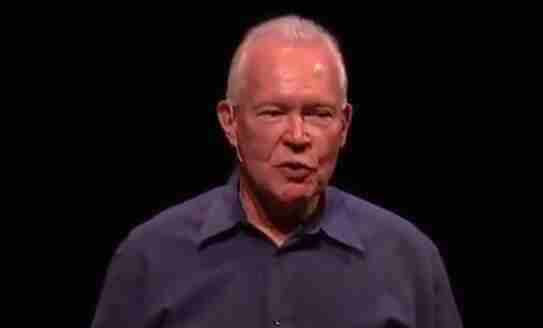
Here is full transcript of writer Terry Brooks’ talk titled “Why I Write About Elves” at TEDxRainier 2012 conference.
Listen to the audio version here:
TRANSCRIPT:
I want to start out by offering a small disclaimer. I have spent 35 years as a professional published author writing fiction and, in fact, writing about elves all 35 of those years. If this troubles you in any way, or in fact if elves should trouble you the way clowns do some people, now would be a really good time to step out into the lobby because that’s what this talk is about.
But if you’re still with me, then I’m going to talk a little bit about the fact that I expect to spend the next 35 years writing about elves also, and that I have a good reason for doing this. I’m hoping to offer some explanation to you today about not only why I’m compelled to do this, but why I think it’s valuable.
The Challenges of Writing Fantasy
Writing about elves is not something for the faint-hearted. You are viewed with skepticism and a certain amount of suspicion in many quarters when you announce that this is what you do. It is less of a problem these days because J.K. Rowling has made the world safe for fantasy writers like myself.
But in the early days when I was starting out and writing in my first three, four books that took about ten years for those, I was interviewed repeatedly and the same question came up over and over from almost every interviewer. And I could tell by the nature of the question what was coming and it went something like this: “Mr. Brooks, you’re a lawyer. Why don’t you write legal thrillers like John Grisham?”
The unspoken comment there was somehow what I was writing was diminishing me as a writer and that if I just wrote something important like legal thrillers, I could raise my status on the literary scale. Now who made this up and decided that legal thrillers were less fantasy than elves? I don’t know. But I’m here to tell you as a trial lawyer that it’s a short putt.
Childhood Influences
At any rate, yeah, I’m moving on with this and I’m not going to back away from it and I don’t want to write legal thrillers and I never have wanted to. I write exactly what I want to do. I could trace this back, as many writers can, to their childhood but I’m not going in that direction to offer up a sad tale of being raised a lonely boy in a cellar.
So instead I’m simply going to tell you that I was a lonely boy in my bedroom instead where I spent a lot of time reading, bookish kind of kid, and I read a lot of adventure stories because boys read adventure stories in those days and science fiction and all kinds of Boys’ Life and all kinds of stories that took me out of my boring life and into a much more interesting and exciting existence where I had a chance to explore the possibilities of what life could really be like if only I could be something more than what I was.
Imaginative Play
And when I wasn’t reading those books I had boxes full of these little plastic figures. I know you did too, some of you. And in between the reading experiences I would take those figures out and I would put them up and line them across my bedroom floor and I would march them from one wall to the other on quests and adventures and all kinds of experiences. I would recreate the stories I was reading frequently or I would extrapolate stories and offer those up as new experiences.
And while this was going on I have this mental image I carry with me to this day of my parents sitting downstairs with their faces in their hands wondering if there was any hope at all that I would become a normal human being when I grew up or in fact even if I would ever grow up because I did this well into middle school. I’m not kidding, I did.
And my mother tried intervention and she was pretty good at it and she did it on a regular basis and it went something like this: “Terry, you have to go outside. You cannot stay in your room all day long. You have to get out of your room, you have to go outside and play with the other kids.”
Outdoor Adventures
I would do this and we would go outside and I would immediately organize the kids into some kind of role-playing experience where we would pretend to be knights so we would pretend to be this, that, and the other thing and soldiers and we would, you know, go out and for a couple days or however long we would enjoy these adventures together.
Me more than them, I think, but they were good about it. And mostly this worked out except I will give you one example of what happened all too frequently and that was that at one point we decided we would be knights of the round table or it was Ivanhoe, I can’t remember which, but we wanted a more authentic feel to things. So what we did was we took brooms and we cut off the bristle end of the broom and wrapped it in tape for a good grip and then we went down to the alleyways and pulled those big lids off of the old metal garbage cans, shield and lance.
Childhood Escapades
Then we would go to the opposite ends of the streets and get on our bikes and ride at each other. True. This particular endeavor lasted all of about five minutes until about the third time that the poles met the metal garbage can lids and could be heard reverberating three blocks away and faces began appearing in the windows and my mother got phone calls and came out and broke up the knights of the round table thoroughly and sent me to my room.
Which by and large seemed okay with me.
Reading Influences
At any rate, while I was reading, as I said, I was reading a lot of science fiction, boys read science fiction in those days, that’s what there was, and I read of course knights of the round table and things of that sort and moved on to European adventure stories when I was in my high school years reading Alexandre Dumas, Sir Walter Scott, Robert Louis Stevenson, Prisoner of Zenda, you know all of that and being quite interested in it but by then I was writing.
And I started writing when I was about 10 and I was writing all the time at that point and I never finished much of anything but I got excited for about five minutes and then I’d work on it and I’d write some more and so on and so forth. And you would think that if I was reading books and being impressed by people, the seminal writer in my life would be J.R.R. Tolkien and indeed he was a huge influence but I didn’t get to Tolkien until I was a junior in college. The writer that really got to me when I started reading him in high school and then on into college and on whom I did my senior thesis as an English major was William Faulkner.
Now William Faulkner for me was the answer to the puzzle. Reading books of adventure and so forth was great. On the surface it was a great story but it had no weight. I wanted to do something that had some weight as a writer, something that would mean more than what the surface story had to offer. And when Faulkner’s books appeared with the stories of the Yoknapatawpha County, that little Mississippi county, fictional county, with the Compsons and the Snopes, the Compsons, the rich bluebloods, the aristocracy of the county, the ones with the money and the land and the prestige and the Snopes who were the carpetbaggers, the trailer trash, the people who came from nothing and decided to take everything away from the Compsons which eventually they did because they had no moral code.
Incorporating Depth into Fantasy
Whereas the Compsons were saddled with a moral code that crippled them, they were saddled with a series of dysfunctionalities and secrets from within that when revealed destroyed them. And I thought why can’t I take that and put that in a world of fantasy and use it as a mirror?
Well, how in the world do you do that you might ask? Cutting to the chase here.
The Equation of Writing
If you think for just a minute about the way that books work, books are an equation. On the one side of the equation we have the writer. The writer through use of imagination and through the use of writer skills and hopefully some experience and practice creates a story by putting words on a page. And it’s like a million pieces of a giant puzzle.
If the words are fit together in the right way it creates a picture. It creates images. It spills out the plots. It tells about the characters. It describes the setting. All of the elements that go into making up a book. And at some point the author’s done everything the author can do. The book goes out to the reader.
The Reader’s Role
The reader as the other half of the equation brings to the experience his or her own imagination which interprets the words on the page and the images in an entirely different way because of course books are personal to every single person who reads them. And so for each person it’s a different experience. And the balance of the two when it’s just right creates the kind of reading experience that every writer and every reader hopes for when they pick up a book. It comes alive.
The Challenge of Fantasy Writing
You become invested in it. It becomes what’s important. Nowhere is this challenge greater I will tell you than with fantasy because everything has to be created from scratch. If you’re working in epic fantasy in an imaginary world it all has to be spelled out and it all has to be laid out on the page and it has to be done so in a way that the writer knows will connect with the reader so that the reader will feel a part of this imaginary world.
And because fantasy must approximate reality in order to work given the parameters of the world and because the characters within the fantasy must behave in rational believable ways in recognizable ways to the reader the story has to resonate in a way that makes it seem like it’s possible. So I decided what I was going to do was take issues from this world and put them in my imaginary world. I’ll give you a couple of quick examples here. How about global warming?
Exploring Real-World Issues in Fantasy
Everybody knows about global warming. So what if global warming becomes in another world a scheme of magic that underlies the entire environment and something is eroding the magic, something is undermining its ability to keep everything in balance, and everything is falling out of shape.
And if you knew about this and you could do something about it, maybe but maybe not but you might be able to how much of your life would you be willing to give up to make a difference, part of it, all of it, what? If I want to look at religious strife, religious struggles throughout the world, what if I write about gnomes that are involved in tribal struggles over the worship of spirits that they believe to be real and perhaps are?
It took me six books — this is how nutty you know I am frankly — it took me six books to write my way to an answer about transgression and redemption, because every time you pick up the paper somebody who has transgressed badly in the public eye immediately announces “I found Jesus” or “I’ve been redeemed and forgiven by my wife”, or whatever.
And I thought you know it’s not that easy and I want to know what it means to really be transgressed so far down the line that there maybe is no hope for you. It took me as I say six books to get the answer to that one, and I may not have it yet. But the point of all this is that putting this into books of fantasy for me gave it purpose and gave it that weight I was talking about.
It gave me an opportunity to explore the questions that trouble me and maybe this will resonate I thought with some of the readers. Every time I sit down to begin another book, or I sit down to continue a book, or I sit down to write it’s exciting to know that I get a chance to look at something dressed up in different clothes and find a way to make it come alive in a different way.
And that’s the thing that keeps me doing this. And that’s why I write about elves, because I find the answers to life’s mysteries in that fashion. What works for you? Thanks very much.