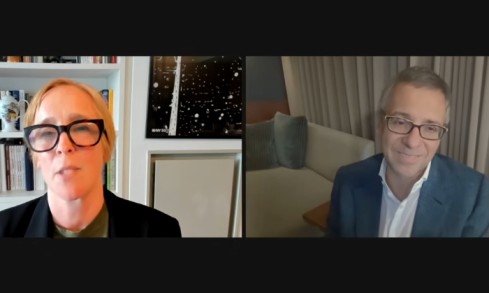
Editor’s Note: In this episode of TED Explains the World, political scientist and Eurasia Group founder Ian Bremmer joins Helen Walters to discuss the art of gathering trustworthy geopolitical analysis in an era of polarized media. Bremmer shares his approach to vetting sources, building deep-networked trust with global leaders, and filtering through the “noise” of daily headlines to focus on high-impact global developments. (May 20, 2026)
TRANSCRIPT:
Introduction
HELEN WALTERS: Hello everyone. It’s May 20th, 2026, and we are doing something a little different today. We are going behind the curtain to talk about how reliable, trustworthy analysis and reporting actually happen.
So as the founder of Eurasia Group and GZERO Media, Ian Bremmer is one of the most closely followed voices in geopolitical analysis. He has access to the rooms, the conversations, and the world leaders who make and respond to the news of the day. You have seen him on this very screen talking about everything from Iran to Israel. And today we are going to get a better sense of how he does what he does.
I am Helen Walters. I am the head of media and curation at TED. And here is Ian. Ian, thank you so much for being here. A pleasure as always.
IAN BREMMER: Helen, very good to see you.
What Makes a Source Trustworthy?
HELEN WALTERS: So I mentioned that word trustworthy. So let’s start with that very small topic of trust. So what public sources of information and analysis do you trust the most? And what makes a source trustworthy?
IAN BREMMER: Public sources? Well, it’s getting harder. First of all, I think we all feel that. I mean, I used to trust what I would read in the newspapers a lot more than I do today. So much of that is framing. It’s not that the journalism is wrong, but the stories that are being picked and the way that they are being reported and the angles on them are much more politicized than they used to be.
I would say 10 years ago, I felt that the op-ed pages of the New York Times and the Wall Street Journal had clear slants, but that the coverage in the general news did not. I think that’s changing. I probably still see the Financial Times as, in terms of their news coverage, both politically and economically around the world, as quite good and objective. It is not the most serviceable website and it’s pretty dry and it’s pretty technically detailed. But frankly, I think in part because they don’t care necessarily about having the broadest distribution and subscriber set, it’s more doing what they do well for the people that need them. They’ve probably been most true to that over the last 10 years, 20 years.
I think that there are plenty of places that you can turn to for good global coverage outside the US. So one thing I try to do all the time when I’m adjusting my own media diet is spending some time with NHK in Japan in English and Deutsche Welle from Germany. And the CBC in Canada and the BBC in the UK and Al Jazeera in the Middle East. And all of them have their specific biases, but their worldviews are generally pretty good. And of course, they’re interested in a lot of the same stories in terms of global coverage that American media is. And they’re also all very consumed with what’s happening in the United States. But they’re trying to figure it out, and they’re usually doing that with less of a structural bias. I would say that’s particularly true for Germany and Japan.
And so that is something that most of my friends in the United States don’t do. Most of my friends in those countries don’t consume the media outside their countries. I think that’s an increasingly smart way to go.
And then the final thing that I do — and again, in terms of public consumption, we’re not talking about private consumption of our own analysts and our own network and who we talk to and how we engage — is I probably have among the 2,000 people that I follow on Twitter, which is the platform that I personally spend more time on to get information. And I don’t do the “For You” feed at all. I do the “who I’m following.” That’s been pretty carefully curated to be a broad political spectrum of people that have a great deal of expertise covering most of the issues that I think are important globally. And if anyone wanted to go into my file and look at the people I’m following, I think you’d get a pretty good basic — here it is, with the recognition that it doesn’t show up chronologically in your feed, which is annoying and makes more people want to go to the “For You” feed. But I still think that when you refresh it a few times, you usually get a pretty good sense.
Getting Access to the Room: Building Trust with World Leaders
HELEN WALTERS: Interesting. Okay, so that was the public side. Now let’s talk about the private side. Often when we have spoken, it seems to me like you’ve been having conversations with the people who are actually involved in making the important decisions. You’re in the room or you’re close to the room. Now, how do you get those people to trust that they can share information with you? Because a lot of it, I’m sure, is confidential. And so how does that work?
IAN BREMMER: One, it’s taken a long time. You don’t build a relationship of trust like that in a day. You do it over years and years. The conversations usually are pretty one-sided to start, and when one-sided, I mean I’m doing the briefing and not much is coming back my way.
And because they’re already giving you something — if they’re important, if they’re already some form of global leader, a head of state, a key minister, or CEO of a major corporation, what have you — they’re giving you the most valuable thing they have, which is their time.
Secondly, I think it’s important that they don’t really see that I have a driving political or commercial agenda. I’m not doing comms work or lobbying work for an organization. And I’m really trying to understand the world. And that’s something that a lot of these leaders — they love the macro, they love the big picture conversations, but they don’t actually have much time for it because they spend so much of their time on very high stakes, very specific short-term decisions, many of which are domestic and political, many of which are international. But they’re not thinking about where the world is going. They’re not thinking about what their legacy is and how they fit their country, their company, their organization into a radically changing planet. It is a content set and a topic set that they like. So those are a couple of things starting off.
And then I’ve also been writing my own little weekly update that goes to those leaders for 28 years now. And if they’re reading it carefully, they will occasionally find things that certainly reflect or are informed by conversations that we’ve had, but never in a way that would bring it back directly to that person. Not by quoting them, not by saying something that could only come from that conversation, not at all.
It’s kind of like when you have a clearance — like you have a top secret clearance — and suddenly you get a whole bunch of information, almost all of which, like 99% of which, is in the public sector. But suddenly, the fact that you know that that is what the real actor collecting the intelligence knows means you can go back, find it in the public sector, and now it is a filter that is extraordinarily valuable knowledge. The same thing is true for conversations with people that are decision makers for these global issues.
And then finally, when you continue to do that — to provide that role over a long period of time consistently, authentically, honestly — and you’re going to get things wrong, but that’s okay. Everybody gets things wrong. It’s how you handle that and how you continue to stand for the principles that motivate your conversations, your analysis, and your questions. All of that builds trust.
And by the way, it doesn’t hurt when someone that you went to a conference with 20 years ago suddenly has grown up with you, and now that person that you’ve always liked and trusted is — how do you like that? — in a position of real power. That also matters too. So the network is essential, and the network is something that you cannot substitute anything but content and time for.
How to Avoid Getting Spun
HELEN WALTERS: So how do you avoid getting spun?
IAN BREMMER: Well, one is time. The more you know somebody, the longer you know somebody, the better a track record you can assess. In the same way that they’re assessing whether or not they trust you, you need to understand what their perspective is. Now, the fact that everyone has a perspective is very different from being spun. I assume that any leader you’re talking to comes from the context and background that is informing their job, that their worldview is very heavily linked to that. So clearly, if you are the Prime Minister of Japan or if you’re the Foreign Minister of Saudi Arabia, you have very different contexts. That doesn’t mean that they’re spinning you, but their perspectives are wildly different.
Spinning for me is when someone is trying — usually not to convince you of a broad argument, but to convince you of a specific point that has relevance and time duration to something that is happening in the news or is about to happen in the news. That usually isn’t the most important part of a conversation. So already when that comes up, it kind of rings some bells. And if it’s not consistent with what you believe because you don’t have one data point, you’ve got lots. You’re not getting one set of inputs from one leader. You have many, and they’re different, which allows you to connect those dots.
I mean, I remember when I found out that Trump was having essentially an informal bilateral meeting in plain view at a G20 summit with Putin. He was sitting next to, at the time, Shinzo Abe’s wife, who was pretending not to speak much English because she didn’t like Trump and didn’t want to talk to him. He went across the table at a very long dinner in Germany and had a 45-minute one-on-one with Trump that nobody talked about.
Now, I bring this up in part because someone ran into me in Washington, DC the other day and reminded me of the story. And he said, “Oh, you got that scoop.” And I was thinking, it wasn’t really a scoop because I’m not out there trying to break news. I’m trying to understand what’s happening in the world. But in this case, several of the leaders from around the world were people that I know, and I was hearing the story from them because they were so startled that Trump had done something that was so dramatically different from what people understood an American president in a G20 setting would do.
And this was especially at the beginning of the Trump administration, the first one, when the Europeans were worried — “Oh, do we have a strong alliance? Can we trust this guy? Is he all talk but he’s going to be fine?” — and then suddenly they see it. So they’re talking to their national security advisors, their chief of staffs, and the rest.
But the point is, once you’ve built a network, it’s a matrix. It is a whole bunch of people that are interconnected with each other. They meet constantly. They share information constantly. They have different perspectives, but they do have a general shared understanding of what’s happening in the world, much of which they’re not necessarily saying to other people. And if you build those relations over time, the ability of any one individual leader to spin you — that’ll be a problem for you if you only talk to that leader. But if you have a broader set of relationships, that one person spinning you isn’t going to be very effective at all.
And I see this happening all the time with media sources who are deep journalists, but they are deep journalists on the basis of a very strong connection with one individual leader or government that gives them all their information. And that’s a problem because then even if the journalist is really good and really professional, all of the scoops they’re getting, all of the analysis that really feels like it is not in the public domain but needs to be out there, is only from one perspective and one filter. And so they’re at risk of being spun. And even if they’re not being spun, they likely are promoting a very narrow worldview, which does not really help the readers get what’s happening globally.
Political Scientist vs. Journalist
HELEN WALTERS: What do you make of the changes that have happened to the media industry over the years? So I’m imagining that when you’re in these rooms or when you’re talking to people — do you call yourself a journalist, for instance?
IAN BREMMER: I’m a political scientist.
HELEN WALTERS: Right. So you’re a political scientist. So that actually gives you a kind of a different credibility from a journalist who is there to report on the topic. Do you feel like —
IAN BREMMER: I’m not there to break news or write stories. I’m really there to try to understand —
The Role of Political Scientists in Media Access
HELEN WALTERS: But then the media company that you have, GZERO Media, is reporting on these stories all the time. You have a team of people who are writing and analyzing and giving context about all of these things. I’m just curious because the press has got such a bad rap at the moment, and we can argue about whether it’s warranted or whether it’s not warranted. In some cases it is, in some cases it isn’t. But access is becoming harder, it seems like, for people to be able to report about what is happening at the highest level. So how do you think about that topic? And does the fact that you’re a political scientist and kind of there in a different context as an advisor. Like, is that the way in? Is that kind of the future?
IAN BREMMER: I don’t know. Again, I think that Fareed Zakaria is someone I consider almost an alter ego of mine. And I say that in the most friendly and respectful way. I mean, we know the same people, we do the same speeches, we talk constantly, we’ve written together. I mean, all of this sort of stuff, right? I’ve been on his show, he’s been on my show. His show’s a lot bigger. And he started out as a political scientist. He’s a PhD in political science. He’s written a lot of books, right? And most people think of him as a journalist, not a political scientist.
But I think that his access, and certainly among Americans that are recognized as journalists, he has better and more trusted access to world leaders than anyone that I know. And I think that that access comes because he’s approached his relationships with all of these people over the years more as a political scientist. I do believe that. I think that it’s more about his “post-American world.” It’s more about he is seen as, yeah, he’s writing columns, but what he’s really doing is trying to figure out where the world is heading. And those leaders value his views on that. He’s not there principally just to interview them. To the extent that they’re interested in coming on his show, sure, they’ll try to spin him. But let’s face it, cable news, CNN on the weekend is not the biggest thing these leaders could be doing to get their voice out there. What they really want is access to him. And I think that is different than journalism.
And my firm, Eurasia Group, of which GZERO Media is a part, is principally 250-plus people who are political scientists, and some of them are economists, and some of them used to be journalists, and some of them have other skill sets. There’s a couple tech folks, but they’re people that are all working to accomplish the same thing, just mostly with a narrower target set. So their expertise is principally about a region or a country, or it’s about a sector, or it’s about a component of geopolitics or a lens on geopolitics. And they are building out the same relationships with those leaders, those stakeholders, the decision makers, that I am in their space.
And if GZERO were driving all of this and we were hiring principally journalists that were just trying to get access to people so they could write a story, yeah, I do think that you probably get less that way. I’m not saying it’s not valuable. Of course it’s valuable, though it’s become less so and it’s also become commoditized. But I think that is probably not the future.
How Information Flows Internally at Eurasia Group
HELEN WALTERS: So let’s talk a minute about the process that you have internally when everyone is getting this information. Everyone has their network of contacts and people, and so there’s stuff flying around, right? Very nuts and bolts, what is the way that internally you share information so that you guys are all kind of keeping each other in the loop as things are happening, as news stories are breaking, as things are developing? What is your system internally?
IAN BREMMER: So it used to be principally, and we still do this, but we now do something else as well. We used to have a morning meeting every day at 9:00 AM Eastern time. It’s half an hour. In advance of that meeting, all of the analysts across the firm who have anything that they believe deserves to be written about, deserves to be commented on that is not in the collective consciousness of the organization will say, “I want to present on issue X.” It can be a breaking story. It can be a new piece of information that we have, a new analytic take we have, whatever. And on any given day, there will be between 6 and 15 such things. And they’ll be prioritized from most important to least so we can spend the most time on them. There’s a very active chat going on while that conversation is happening.
I try to attend that meeting every day. When I am on the wrong time zone or when I have a meeting that is happening at the same time, then I will dial in and I’ll listen to the call-in on tape of that half an hour. So that’s essential and that’s every day. And some people do that remotely. Some people actually, if you’re in the office, you usually come into the main conference room and everyone’s there in the room together, which is kind of fun. London, for some reason, always seems to all be in the boardroom. New York is a little bit more remote. Washington’s kind of in between, and smaller offices around the world do what they do.
Now, that’s the way we used to do it principally. That is still true. But in addition to that, we now have a significant number of internal chats. Some are our regular sort of online chats, real-time chats, and some that are more sensitive, our smaller group. And I would say that those now, especially for things that are happening real time — so the Trump-Xi Jinping summit during the last few days of preparations and while it’s going on, or today, with a potential for a new agreement, on-again-off-again, between the Americans and the Iranians on the Strait of Hormuz that the Saudis are talking about — there is real-time information and “what does this mean” coming from relevant analysts all over the world.
And if I didn’t have access to those chats, I’d feel like I was missing an arm. I wouldn’t know how to go into a top-level meeting today, especially in a heavy news cycle day, without for 5 minutes, 10 minutes before that meeting dipping into the chats and making sure I am current on everything happening around the most relevant issues.
By the way, it’s very similar to the way the National Intelligence Council in the United States used to be set up, and I have had many people come to me, like the Prime Minister of New Zealand, for example. I’ve had the Foreign Minister of Canada, for example, others that have said, “We want our shops from Nordics. We model our in-house sort of political analysis, intelligence gathering on the way you guys do it.” Because in many cases, many of these countries, we’ve got a larger group that’s working on it.
How to Decide What’s Worth Tracking
HELEN WALTERS: Yeah, it’s so interesting. It reminds me of the morning meetings that newspapers and media organizations often have too. But it also relates to the idea, and I think maybe the answer is in there, of how do you know what not to track? There’s so much going on. There’s like 60 conflicts happening around the world at this moment. How do you know, or how do you manage not to treat everything as burning and urgent?
IAN BREMMER: We have the product that we put out — and I say product, but I mean, we actually put it out publicly and we don’t charge for it — that we’re most well known for is the top risks piece, which you and I do at the beginning of the year as well. And it’s out at the beginning of the year and it looks at what we think the biggest, most consequential risks are globally. And there’s only 10 of them. So it’s a completely artificial number, but it means that we don’t have a number 11. And we also do the top herrings, usually 3 or 4 of those. We don’t do 10 of those, which are the things people think are going to matter but actually don’t.
And we have a methodology that kind of creates some rigor around the process. And that methodology is we rank these risks on the basis of likelihood, imminence, and impact. Likelihood — if it’s really likely to happen, it’s a baseline risk, then it’s more impactful. It matters more. We’re going to pay more attention to it than if it’s like, “Oh, this could happen, but it’s 0.1%.” So when people are talking about a tactical nuke is going to go off in Ukraine, incredible headline, very, very unlikely. Don’t talk as much about it.
Then you look at imminence. Getting the story right and getting the timing wrong is a disaster in the marketplace, but it’s also a real problem for policy. I remember 10 years ago I put out a tweet that said that I believed within 10 years’ time that the U.S. would have a closer relationship with Iran than Saudi Arabia, in part because Saudi Arabia is all about OPEC and oil production, and the U.S. is a massive oil producer, and so Saudi Arabia would be more tilting towards China, but in part because I believe that the Iranian government was not going to last 10 years and that if there was a revolution, or a breakdown, a new Iranian government would be radically more interested in engaging with the United States.
Now, I still think that that is likely over time, but it wasn’t 10 years. I think the 10 years actually comes up in 2026, so maybe I still have a few months on this, but it’s very unlikely to now happen. The fact is that when you talk about anything intrinsically, we all have a discount factor in our mind. We all think, “Well, if it’s going to happen in 10 or 20 or 30 years, we don’t care.” You have a 250-year lease on a home in the UK, you feel like you functionally own it even though you don’t. You actually don’t have the whole title to it. You’re renting it. Somebody else does. And if it’s going to happen tomorrow, you treat it as if it is real time.
And then you have impact. And impact is why so much is made of Iran and the Strait of Hormuz, and so much is made of Russia-Ukraine, because it affects the Europeans and it also affects global food, in a way that Sudan, with lots and lots of people, far more humanitarian impact on the Sudanese than Russia-Ukraine on the Ukrainians, or Gaza-Israel on the Palestinians, and yet Sudan gets virtually no coverage. And not only because there are no journalists there, but why aren’t there any journalists there? Because the knock-on implications for other countries, both geopolitically, economically, in terms of human flows, all of these things, just isn’t very significant.
Now, if we actually valued all human beings having equal importance, which I certainly believe as a core value, and you do too, but we don’t act that way. And certainly the world doesn’t act that way. The world’s not structured that way. So I, as a consequence, and Eurasia Group spend a lot more time on the things that we think are more likely to affect the state of the world, that are going to change how humanity collectively organizes, is governed, develops, or fails. And that means that you have a much smaller windscreen for a lot of this stuff than you otherwise might.
There’s also the issue of not getting distracted by headlines that are bullshit. So when the Qataris offer a plane to Trump, the value of which is a rounding error compared to the billions and billions that he is making off of crypto, for example, then don’t spend time on that even though it’s a salacious headline. And I do think that frequently the news has everything Trump as automatically an 11. But if you recognize that long-term Trump is a symptom and not the cause of the GZERO world, the geopolitical recession, and is also strictly term-limited, that reduces the volume and the noise.
Also, if you recognize that a lot of things he tries to do, he ultimately fails at. Also, if you recognize that a whole bunch of the stuff that is making headlines is stuff that’s meant to make headlines but isn’t actually changing the way that things are governed, isn’t changing impact. So that immediately brings you down from Trump, Trump, Trump, Trump, Trump to there are a few stories that are relevant that you should be talking about, like his decision to escalate or to cut a deal with Iran, which is incredibly important, and on and on and on. I mean, that’s kind of an extended answer to your question. But it’s a tough one that manifests in so many different ways every day.
Advice for the Curious Non-Expert
HELEN WALTERS: No, I thought that was incredibly insightful. So thank you. I’m also interested in your tips. So obviously, you’re in this. Your team is in this. You have a kind of a nose for understanding what is, as you say, bullshit, and in other people’s terms they may call misinformation, disinformation. It depends on the kind of intent of some of that information. But what is your advice for someone who is smart, who is interested, who is curious, and who doesn’t work in this world but wants to understand what to take on and what to ignore?
Long-Form Content and Managing News Bias
IAN BREMMER: Well, look, first of all, understand that everyone is different. I think that one of the reasons I gravitated towards political science and international relations is because I don’t get very worked up by nationality. I am an American. I love my country. I consider myself patriotic. But I don’t in any way think that the United States is a repository of truth in ways that other countries cannot be and are not. And I think that’s essential to be effective as an international relations specialist.
There are a lot of people that don’t feel that way. And those are people that would not make good political scientists. They should do other things, right? Because everyone has different skill sets. I would not be a great economist. I wouldn’t be a great accountant. I’m not a great manager of people. I’m not a great chef, right? I’m a horrible basketball player. You go on and on and on. So first of all, recognizing what you’re good at.
There are a lot of people that are actually very good at being thoughtful and considered on a whole range of issues, but aren’t on a few that they feel really personal about. I’ll give you a small example. My mother was of Armenian lineage, and I used to study the Soviet Union and then the 15 countries that came out of the Soviet Union when it collapsed. And I never focused on Armenia. And the reason I didn’t write about Armenia is even though I was writing about all these other places for a long time, because I felt like I was kind of biased. And I felt that way because when my family members were talking, like my grandma would talk about Turkey, that was like a country that committed genocide against her people, our people. Even though I didn’t feel any enmity, I kind of felt like, well, I’m rooting for them to win. They’re kind of like the home team, the Armenians.
And so until I got to a place that I felt comfortable, that I understood that bias, that I could pack it away and that I could talk objectively about it, which I think I’ve gotten much better at on that issue, though it’s a very small issue at the end of the day. I didn’t want to engage on that issue professionally.
And I think that if you are trying to not have your hair on fire on the news, it is important to understand if there are areas of the news that you have a very strong bias on and don’t consider that part of the news. Just consider that’s part of your identity, whatever it is, right? And try not to spend as much time following the news on that. So for example, if you’re trying to set up your social media feed so it is useful for you on news, avoid the people that are experts on the topic that you are super biased on because you’re not going to get anything from that. All you’re going to do is like the people that already agree with you and hate watch the people that don’t, but it’s not going to help you at all. So stay away from something that is a structural bias, right?
The Case for Long-Form Content
And then also longer form, longer form. It’s why, when they say kids don’t read and they’re worried that everything is a headline, kids listen to podcasts all the time. I’ve got folks, 80-year-olds watch my show on PBS. 20-year-olds are listening to the same thing on a podcast. In fact, sometimes it’s an extended version and they’re getting more out of it. So it’s not like young people can’t do long form, but they digest it in different ways.
And long-form content is better because when you’re talking about serious and complicated issues, it doesn’t lend itself to a short pithy answer. Like, the world, the next order, is it going to be unipolar? Is it going to be multipolar? Is it going to be tech companies that run it? The answer is it’s a very complicated discussion that you and I would have over 30 minutes or an hour. I can’t do it in a tweet. I can’t do it in a Fox News or CNN soundbite.
And so you have to give yourself time when you want to digest information. Don’t do it in 5 minutes unless you’re doing it constantly, so it’s truly an update. For those of you that the news is a hobby and it’s a civic commitment and it’s something that you’re interested in, you care about, but it’s not your profession, don’t do it constantly in little bits. Instead, give yourself a half an hour or an hour where you say, “I’m going to digest this long-form feature. I’m going to read this thing that is going to help me out on a big issue that I care about.”
And then go and grab 10 of those articles or find everything you can from your AI bot. And Claude and ChatGPT are incredibly useful if you prompt them properly to say, “Here is the way I would like to digest news on the following issues, and I wanted to have all of the analytic balance and the pushback and the smart people on all sides. And don’t kiss my ass. Don’t tell me I’m awesome. Push back when I’m asking you for something that feels like a bias.” Give it all of that, the training that you would to a very precocious toddler to learn how to help you. And suddenly you have an incredible tool that can get you a better media diet, but you have to digest it correctly. You can’t use the tool incorrectly, because you end up killing the patient.
HELEN WALTERS: I love that answer, and I should say that this very show that we have concocted together, which is always more than 45 minutes and does incredibly well for us. So I think that the kind of the myth that everybody can— everyone’s attention span has become 25 seconds or less is just not being proven out by the data at all.
IAN BREMMER: The fact is that TED was always known at the beginning of having these short sort of speeches where you could get the expertise on a topic and you’re out in whatever it was, 12 minutes. And the reality is you and I have done how many, 10, 15 of these now? And they’re basically 45 minutes, an hour, sometimes longer. And they’ve been all over the world. The feedback I’ve gotten is fantastic. They’re deep dives. And this time around, it’s a deep dive on doing analysis.
I don’t think I could have this conversation in 5 or 10 minutes, and I wouldn’t want to try, right? Because I don’t think I could do the topic justice. I’d much rather have someone come back to this. They see it, “Oh, that’s interesting, let me come back to this on a Saturday afternoon or when I’m on a bike ride,” whatever it is, that I can actually listen to it. Because we’re capable of multitasking. When I’m at the gym or I’m running on the river in New York, I see people that are listening to their books and their podcasts. It’s like 90% of the folks. So they’re actually all super intellectually engaged. That’s when you do something like this.
HELEN WALTERS: And it’s interesting too, I feel like sometimes people get mad at TED, mad at us, because the TED Talk doesn’t necessarily encompass everything about a topic. And I’m always just like, well, of course it doesn’t. It’s just the start of a conversation. And if you’re interested, what an incredible opportunity for you now to go and learn more, to dive more deeply into these ideas, to find out other perspectives. And so I think our insights are rhyming here, which is always gratifying.
IAN BREMMER: Completely. Yeah, the best TED Talks that I have watched are talks that have interested me in a topic that before watching that talk, I had very little exposure to and then made me proactively go and engage with that kind of content when I saw it before and I would flip through. Because when you just see a reasonable article on something, but you haven’t seen the best person in the field opine on it in a sharp way for 12 minutes, you don’t know that you’re really interested. And TED is like this sudden, “Ta-da, you should really care about this topic.” You don’t care about all of them. They don’t all resonate with you. But of those that land, you’re more likely to start digesting that news and that content better than you otherwise would have. What an incredible service. I think it’s a great thing.
Would Ian Bremmer Ever Work for the US Government?
HELEN WALTERS: Well, thank you very much. We do too. Okay, so we canvassed our community to ask for questions for you, and I think you already answered this one a little bit, but I think it’s a pertinent question, which is, have you ever or would you ever work for the US government?
IAN BREMMER: Well, I work for the US government all the time in the sense that I’m not charging them for my analysis and I’m giving them advice, and sometimes they’re listening and sometimes they’re not. But I certainly feel like a part of my existence as an analyst is to try to help government leaders that at the end of the day I want to do better. And that means most government leaders, even governments that I don’t really agree with, I’d much rather that they would be ultimately successful than fail. I mean, would I do that with an incredibly repressive government? That’s probably not. But for most, generally I would say sure, and opposition too.
But I don’t think that— when I was a kid, I was in second grade and Mrs. Criticos was asking the class, they were telling us about what it was like to be the president and the importance of the job and the decisions you had to make. I was thinking about, and she asked the class, “Okay, everyone that would like to be president when they grow up, raise your hand.” And so I raised my hand and I’m thinking about how cool it would be and all this stuff. And she calls on me, and I remember this, and there’s not much I remember from being in second grade. I was a little annoyed that she was interrupting my little fantasy land about being president. And then I looked around the class and I realized that I was the only one in this public school class that had their hand up. And that quite surprised me because I would have thought that everyone would have wanted to be president. That sounded like a great thing. Of course, that’s because I was in second grade and had no idea how horrible the job is.
And I did later in life, high school, college, grad school, I think I would have said that being national security advisor would be a great job. Not so much Secretary of State because that’s running a big bureaucracy. But being the top foreign policy advisor to the president is a job that I think I could be quite good at. And Lord knows I have the network for. But I think I would be really bad at some pieces of that job, like not being able to publicly speak my mind much, particularly if I didn’t fully respect and was not fully simpatico with the president.
I also think the United States presently stands for some things that are kind of problematic, and a lot of those things would have to really change before I would feel comfortable having a full-time job in a role like that. The level of kleptocracy in the US right now is not something I would want to be associated with directly, frankly. And so I feel quite strongly that the answer is no. But I also feel strongly the answer is no, because I now feel that having done what I’ve done for the last 30 years, I can have a lot of impact and influence, but be myself, be authentic to me in a way that lots of other people have a harder time.
So this is something that I can— if I were a national security advisor, I’d be in the job for 2 or 4 years and I’d get really frustrated and I would lose a lot of hair, and I don’t know if I’d accomplish what I’d want to accomplish, and people would be angry with me, and they’d think I was partisan, all those horrible things that would stick with me afterwards. And then I’d be out, and then I’d always have that legacy issue. Where here, if I stay in good health and confidence, mentally, I can do this for another 30, 40 years. And that’s pretty extraordinary. So I really have, I would say, really no ambition to serve in public office.
I would love to be UN Secretary General because I think that that’s an extraordinary organization that the US has created. I’m very proud of it. I love that it’s in New York. I love the quality of all the ambassadors that are sent by different countries around the world to engage in multilateralism and try to improve governance and create and move forward sustainable development goals. But an American is not going to run the UN. So that’s a non-starter. So I kind of think that I’ve, over these decades, created the job that really fits well for me.
HELEN WALTERS: I’m fascinated that you say that about the UN, given that the UN does not get such a great rap these days for its influence or for the way that it actually, for any effect that it has in the world. So that’s fascinating. It’s fine. We don’t want you to be the head.
IAN BREMMER: Different conversation. But yeah.
Separating Analysis from Personal Preference
HELEN WALTERS: Different conversation. So one of the things that’s always stood out to me when we’ve been talking is the way that you are able to be nonpartisan and basically give us the facts as you see them. I guess again, you’re digging into the actual data that are happening and reporting on that, but it must get to you, Ian, the person. Some of these stories are, or some of the things that are going on in the world are harrowing. What do you do when you’re exhausted or when you’re emotionally invested in something that you’re looking at?
IAN BREMMER: I mean, I obviously do vote. So when you say that I’m seen as nonpartisan, I still have preferences. The point is that your preferences are not your analysis. Now, if my job were to advocate or lobby or be a policymaker or be a partisan tribal part of that process, that would be a different story. That’s not my job. My job, my professional avocation, and what I do publicly is analysis. It is not personal preference.
I never could have written about the GZERO World if my analysis were my personal preference. More often than not, because we are in a geopolitical cycle and we’re in a downward portion of that cycle, we’re hitting the geopolitical recession. Most of the things that I see coming geopolitically are not things that I like, but nobody cares what I like, or at least they shouldn’t. Maybe people that follow me may like me personally, but they still don’t really care what I like. They really care what I think. And those things are very different.
Now, I did not vote for Trump. I would not vote for Trump. I believe he is unfit as president. I believed he was unfit as a human being when he was a Democrat, and I said that publicly. So this is not an ideological thing. I don’t think Trump is a Republican. I think he supports himself. And if he had had a way to become president running the Democratic Party and making it into a cult of Trump, he would’ve done that. So it’s not a partisan thing for me to say that.
Having said that, a lot of people in America are worked up over that issue. What I can say, though, is that when Trump succeeds at things, frankly, it’s an emotional relief for me to be able to say he succeeded at these things. Like the Abraham Accords, for example, or USMCA, for example, or Venezuela, for example, and a number of domestic policies as well. There are all sorts of areas where Trump has been successful. And the fact that I don’t think he’s fit doesn’t change the fact that those policies are successful. It’s analysis.
And that also makes it much easier to be wrong, because when I’m wrong about something, it doesn’t mean that my desires are bad. It means that I got the analysis wrong. Or the world changed. I got the analysis right and the world changed. And so now let’s address that. So it’s not personal.
So many people take it personally because they align who they are as a human being with what they think is happening in the world. And the reality is those two things have nothing to do with each other.
Letting Go: Lessons from Buddhism and Global Politics
The great Buddhists — and I’m not a great Buddhist, I’m a Catholic, which is almost the opposite of being a great Buddhist — but I’ve met some great Buddhas, and they’ve taught me a little about meditation, which I can sometimes do for 10 minutes at a time. And for me, that’s pretty good. And what they say is, don’t try — it’s not like you’re going to stop thinking about things. You let your mind think about things, but then let it go, let it go, let it go. Just let it go, let it pass over you.
And the same thing is true in global politics. You can’t change how you feel about something, but you can let it go because that’s not what’s happening in the world. And while you can’t change how you feel, the only thing you can change is how you react. You can’t change how other people feel. You can’t change how other people react. You can’t change what policies they’re putting in, but you can change how you react to the way the world is moving.
And I think if you handle that with a lighter touch and with the ability to recognize that analysis and you, the world and you, are not the same thing, then it makes it a lot easier to engage with people that you might have disagreements with. But the disagreements come from things you like, not things that you’re trying to understand that are true.
Those things, I think, are all useful skill sets. And I try to teach all of those to my students in our classes. And those students come from 50, 60 different countries every year. And we cover the hottest topics. And we did it at Columbia in the middle of the Gaza demonstrations. And we talked about those issues, too. We never had a fight. Not once. I never had a student demonstrate or try to shout someone else down. Not once in 12 years, 13 years of talking. It has never happened. Once. So that tells you it is doable. And these are grad students, for Christ’s sake, right? I mean, all they have is time to argue.
Do You Ever Turn Your Phone Off?
HELEN WALTERS: If anyone is going to be argumentative, it’s a grad student, for heaven’s sake. It’s what they’re there for. So that is very gratifying to hear. I’m also grateful for prompting me to now sing the song from Frozen for the rest of the day. So thank you very much. And that shows you what a bad Buddhist I am. Okay, last question, Ian. And I like this one a lot. Do you ever turn your phone off?
IAN BREMMER: Oh yeah, all the time. I turn my phone off when I’m in meetings. I turn my phone off when I’m at meals. I turn my phone off at night. My focus — I have 3 speeds: fast, faster, and sleep. And all 3 are important. And those speeds are true intellectually, they’re true emotionally, they’re true physically. And if I have my phone on during a meeting or during a social meal, or in the middle of playing tennis and then check it in the middle of a tennis set, I’m completely distracted because I’ll then be all in on that. So I just shut it off. Just shut up.
But when I have it on, I’m focused on it. So if I have it on and you’re talking to me, I’m not paying attention to you. For me, it’s very much feast or famine when it comes to the phone. I certainly spend more time on it than I would like, but knowing that makes me shut it off more, and that is a helpful thing.
Also, I like the fact that with an iPhone, it actually takes a fair amount of time to turn on an iPhone from scratch. And that is also useful because occasionally if someone is like, “Can I — I want to give you my number, exchange information,” and I’m in an important meeting, I will visibly show them, “Oh, give me a second, I need to turn my phone on,” telling them I have had my phone off for the last half an hour, hour, when I’ve been meeting with you. That is intentional.
HELEN WALTERS: I love that. There’s no do not disturb mode for you. And I love that if anyone catches you now with your phone in your hand with the screen on, then we know that you’re not paying attention to us.
IAN BREMMER: Then you know I’m not paying attention.
HELEN WALTERS: That’s right. Okay, Ian, we have now talked for nearly an hour, which shows if you listened all the way to this point in this video that you have an incredible attention span and you are clearly a very smart person. Ian, thank you so, so much for being here, for sharing the tips and tricks that you have. I will look forward to seeing you again soon. Thank you so much.
IAN BREMMER: Great fun, Helen. This was quite enjoyable.
Related Posts
- How to Stand Out in an AI World by Thinking Better, Not Faster: Sol Rashidi (Transcript)
- Modern Wisdom: w/ Alex Petkas on True Story Of The Odyssey (Transcript)
- Reconstruction: Malcolm Gladwell Interviews Barack Obama (Transcript)
- Transcript: “How to Win Without Crushing Your Soul” – Graham Weaver
- Why Early Legal Action Matters After a Cryptocurrency Investment Scam