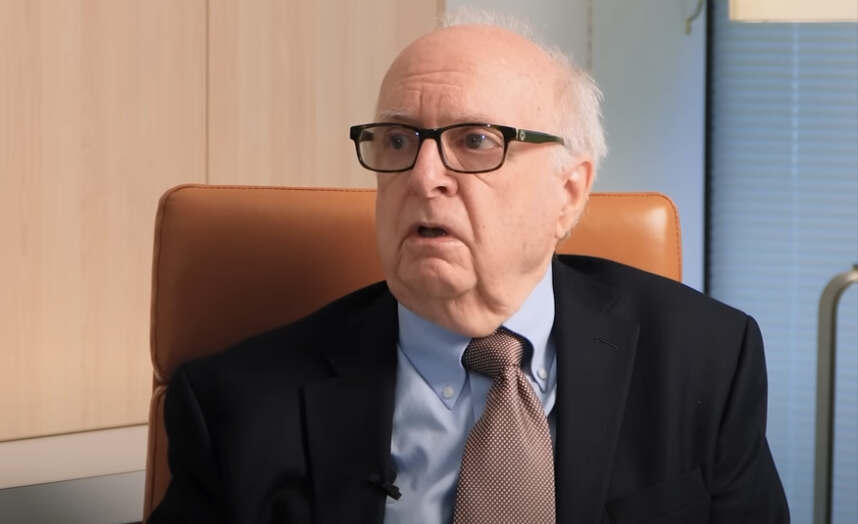
Read the full transcript of political scientist Robert Lee Suettinger in conversation with former Deputy Prime Minister of Australia John Anderson on “Will Xi Jinping’s Maoist Vision Cause China’s Collapse?”, July 18, 2025. Robert Lee Suettinger is a historian of contemporary politics in the People’s Republic of China.
The Survival of Chinese Communism
JOHN ANDERSON: Robert, thanks so very much for your time while you’re here in Australia and we’re in Sydney.
ROBERT SUETTINGER: My pleasure.
JOHN ANDERSON: Can we kick off? Why is it that communism, which was seen off really, by effective leadership in the West – I think it’s fair to say America and Britain in particular, with a lot of help from the Pope of the day.
ROBERT SUETTINGER: Yes, indeed.
JOHN ANDERSON: You know, really with the collapse of the Berlin Wall, democracies won out and so on and so forth. And no one quite realized that just a few short decades down the road, you’d see an icy grip on power by communists in Beijing. How’s that happened?
ROBERT SUETTINGER: Well, in part it happened because they got rich. You know, in the wake of all of this, the amount of damage that was done to the Chinese economy was relatively minor. In the wake of Tiananmen, the demonstrations elicited some sanctions, but they didn’t last very long and the Bush administration didn’t want to carry them out for very long.
So even though there was a lot of international outrage and it became a political issue, there wasn’t really much that was done to try and turn anything back. And the other thing was that of course the regime acted in ways that many of the European regimes would not have done in terms of the levels of violence, in terms of the crackdown that was done against anybody that was involved in the demonstrations or afterward.
So the party had decided that it had to do something and they had to do something violent in order to make sure that they were listened to. Because I think they were very concerned about the fact that the demonstrators seemed to pay them no heed, at least in the early phases. So it was the strength of the crackdown. It was almost as if they decided, “We have to overdo this in order to make sure that people don’t miss the message.”
And the demonstrations were going on all around China and so they knew that they had to make a very strong statement in order to not lose control. So that kind of gave them the jump. And of course, Gorbachev came there during the demonstrations which reinforced their opposition to his policies.
The Scale of the 1989 Protests
JOHN ANDERSON: You mentioned all over China, how many incidents, how widespread was it, how many people were really involved? Do we have much of a feel for that?
ROBERT SUETTINGER: We don’t have the numbers to any degree of precision. Even the regime has admitted that there were 400 plus cities around China and there are a lot of large cities and they had demonstrations of one sort or another. Some of them did become violent. Probably the number of cities that actually had demonstrations against the regime was probably in the neighborhood of a thousand.
JOHN ANDERSON: It says something very profound, doesn’t it, about both the Chinese people. Like most of us, freedom actually matters to them. And the brutality of communist dictatorship.
ROBERT SUETTINGER: Yeah, it does. Indeed. When you give, there’s a lot of people who would make the statement that the Chinese people are not ready for democracy, and that’s wrong. And it’s also true that when you give people an opportunity to have freedom of speech, they’ll take it.
And this government, this regime has no shortage of detractors amongst the Chinese people. The party only constitutes less than 10% of the population. That leaves a lot of people to be there to look on with disfavor and dissatisfaction. So we have a tendency to not see that. One, because we don’t get out into the rural areas where those people live, and two, because it’s inconvenient for a lot of people in some cases to recognize and point out the public dissatisfaction that we can see in China.
Distinguishing Between People and Government
JOHN ANDERSON: It does seem to me to be very important because we often blunder into the mistake probably of offending a lot of very good Chinese citizens by not distinguishing between the form of government that Beijing represents and the people more broadly.
ROBERT SUETTINGER: Exactly. And my wife and I have been doing this for a number of years of trying in all of our public discussions to differentiate between China, the people of China, and the government of the People’s Republic of China, which is led by the Communist Party of China.
So that government does not want anybody to do that because they like to think that they speak for all of China and they act for all of China, but they, in fact they don’t. They are a party, a one party state, a Leninist one party state that does not allow any opposition. So they don’t want us to be seen as trying to differentiate between them and the people that they supposedly rule.
JOHN ANDERSON: It does seem to me that the evidence for what you’re saying can be seen in the brave protests in Hong Kong when the Chinese were clamping down. There were people prepared to risk everything for the freedoms that they thought mattered, for the sake of their children, if you like, for the well being of their society. Just as we have, in our higher moments, defended our freedoms.
ROBERT SUETTINGER: There was a period of time in the early part of the demonstrations, both in 2014 and 2019, where it almost seemed as if Hong Kong had developed a new way of doing protests.
But eventually the PRC provided assistance, if that’s the right term, both in terms of extra police that came down from Guangzhou and in terms of extra thugs that they brought out from other places within the society. And there was an increasing level of violence and it just kind of all spiraled downhill. And once it was over, it was over.
JOHN ANDERSON: There should be a warning to us all at the same time as it crystallizes in our minds that it’s not a people that we have concerns with, it’s a form of government.
The Ideological Nature of the Chinese Communist Party
ROBERT SUETTINGER: Absolutely, absolutely. I mean, there is a tendency to kind of think, well, we can deal with whatever government it is that they have there and if they have a democracy, they’ll act in much the same way as the Communist Party of China acts. And that’s just a fundamental error in judgment.
This is a government that is highly ideological, the party, highly ideological, very anti-Western in some of their fundamental views. And I think we have often deluded ourselves into thinking we can make a deal with them or we can do business with them, or we can make a profit from them without paying much attention to the way that they treat their own people. And that has not led us to a good place.
JOHN ANDERSON: Naivety and leadership is not really excusable.
ROBERT SUETTINGER: Shouldn’t be, but often we get away with it anyway. There is a propensity, I think, among many American leaders to want to enable American businesses to profit and prosper off the Chinese market. This is an old one – “Inch onto the shirt tails of the average Chinese person and you’ll make a million dollars.”
But there is a tendency to look the other way when large businesses such as international tech corporations are making big investments in Chinese industry for the sake of making their profits and their products more affordable by taking advantage of cheap Chinese labor. It’s cynical and it’s unfortunate and it’s begun to, I think, have an impact on a larger political scene because that government, the Chinese, the PRC government, is now taking advantage of those situations to drive a harder bargain in our current negotiations.
China as a Product of the West
JOHN ANDERSON: It’s an irony in a way. It often strikes me that modern China is a product of the west in more ways than might immediately meet the eye. Communism is a bastard offshoot really, of the European Enlightenment. Europe’s turned its back on it, but it’s got an icy hold. As I mentioned a moment ago, in China they’ve been made wealthy by the West.
And in a sense, probably that determination to hang on to power may be in part born of fear from the dislocation and the damage done to China, frankly, by irresponsible behavior from the west in the 19th century.
ROBERT SUETTINGER: I think that’s exactly right.
JOHN ANDERSON: We forget the Opium Wars. We forget, oh indeed, you know, the four powers, the partitioning of China, the destruction of its leadership models.
ROBERT SUETTINGER: There’s very little to be gained in the United States by looking back at the 19th century or even the early 20th century and saying, “Well, we did that better back then.” I mean, I was just reading a book not long ago about the Roosevelt years and the fact that we got China wrong at that time had a huge consequence. And it was one of those things you say, “Boy, I wish they had listened to Admiral Leahy instead of George Marshall.”
But there has been a consistent tendency in the United States and I think also in Europe to kind of look down at China as this poor country that doesn’t have any education and so forth, which doesn’t take note of the fact that for thousands of years the Chinese civilization was the world’s leader in any number of areas. And in terms of their own governance, it was pretty good back in the earlier dynasties.
So we have a short time frame in which to look at China and try to understand it. And we haven’t done very well at that, quite frankly.
The Conscience of Hu Yaobang
JOHN ANDERSON: Well, you’ve set out to correct this – ten years writing a remarkable book which we’ve just referred to: “The Conscience of Hu Yaobang, China’s Communist Reformer.” So you’ve described him as a tragic hero, I think, as the conscience of China. Tell us a bit about who he was and why you saw him as so important. It was worth spending ten years of your life understanding him and writing up his story.
The Tiananmen Square Protests and Their Origins
ROBERT SUETTINGER: Well, there were a number of factors involved in it. One of them was I did a book at the Brookings Institution in 2004 which was about U.S.-China relations in the post-Tiananmen crackdown phase. The United States relationship with the People’s Republic of China went into a nosedive after that. Didn’t stay in it very long, but it was there and it affected the political discourse in the United States about the People’s Republic of China. And I thought that was an important topic to focus on.
The reason why Hu Yaobang was important is because the original demonstrations in 1989 began when he died. There was a fair amount of turmoil within the society because Hu Yaobang was actually removed from office in 1987 by an utterly kangaroo court kind of situation that was engineered by Deng Xiaoping. They allowed him to stay on the Politburo Standing Committee, but it gave him no power and he essentially became a non-person at that point. People noticed that, but they didn’t make much of a big deal out of it.
By 1989, the failure of that government, the post-Hu Yaobang government under Zhao Ziyang, to be able to bring about any sort of satisfaction within the society for the demands that were growing there was beginning to simmer and bubble, particularly in the universities. So when Hu Yaobang died, many of the students and faculty decided, “Well, we have to pay respect to this man because he actually did care about us. He did try to institute reforms.”
So they began to put up posters and they marched down to Tiananmen Square. And eventually it grew and grew and grew. And then it began to attract a lot of other people who were discontented with other aspects. You know, the food at Beijing University was terrible, or the rights that they were getting as students were not being respected. And they began democracy forums in universities. So there was a lot of discontent that was brewing when the Hu Yaobang death took place.
Government Division and the Crackdown
The government was increasingly divided between Deng Xiaoping and Deng Xiaoping’s opponents, particularly Chen Yun and Li Peng. And they couldn’t agree on how to respond to this growing number of people that were filling up Tiananmen Square and challenging their right to respond to it. And of course, Gorbachev by that point was scheduled to arrive. And so they wanted to have the main street of their city clear of student demonstrators so they could show Gorbachev a good time or whatever.
And it became a sort of head-to-head confrontation between some elements of the Communist Party, in particular the mayor of Beijing and the Premier, Li Peng, and the students who began to organize themselves and they began to show up in the hundreds of thousands. So the government was paralyzed. They didn’t know what to do about it. And finally they declared martial law and said, “You either get out of the square or we’ll throw you out.” And eventually they had to throw them out.
And it was a very violent confrontation. There was a lot of firing at innocent civilians and students. Casualties are still unknown in terms of how many people were actually killed. But it was filmed, the films were sent out, and people were able to see this violent demonstration on their own television set. It was horrifying, just brutal crackdown on students.
And then it got worse afterward when they went out and took the films that they had taken during the demonstrations. And they went out and said, “Who’s that? Oh, we know him.” And they went out and arrested them, put them in jail for years, often without any kind of trial. So it was sort of Marxism-Leninism at its worst. And that is that, you know, if you won’t obey, then we’ll just put you away. And they did that for many people, for many years.
JOHN ANDERSON: What sort of reforms did he really believe in? What was he pursuing? You say he was. You provide some very interesting illustrations, I think, on moments when he went against his own conscience. He believed, though, that there was a better way. How do you think if he’d had his way, China might have progressed?
Hu Yaobang’s Vision of Reform
ROBERT SUETTINGER: That’s an interesting question, because he was really beginning. Usually when we talk about reform in the People’s Republic of China, we talk about economic reform versus political reform. And we say, “Well, they did economic reform, but they didn’t do political reform.” Neither of those is really completely true, but that’s been kind of the consensus of opinion about what happened.
Hu Yaobang was actually much more in favor of ideological reform. He was an ardent Maoist in his early days, and during the Great Leap Forward, he knew things were going badly, but he didn’t say. And when he had an opportunity to comment on it, he supported the chairman. So he was sort of caught.
When the situation got worse and it got more radical in the early 60s, he was sent out to Shanxi Province, and he was only there for about 200 days, and at least 120 of those days, he was under attack by some elements or another of the provincial party structure. So he then came back just in time for the Cultural Revolution, and he was one of the first of the victims of the Cultural Revolution.
He was in charge of the Communist Youth League at that point, and he got dragged out, taken down to his headquarters, criticized, and eventually began to beat him with sticks and belts and all kinds of other things. So he had, I think, during that period, from 1966 to 1976, he had a lot of time in which he was absolutely miserable because he was being beaten and harassed and interrogated and so forth, and then was sent to a prison camp in 1969. He stayed there for three years.
A Philosophy of Correction and Atonement
When he came back, he was essentially isolated in his own home, where he had a chance to think over. He could read finally. He’s a big reader. He loved to read everything. And he got a chance to read books and think about his experiences and give consideration to what is it that went wrong here, what happened?
And his idea of reform was a recognition that reform is a means of correcting your mistakes. Mistakes are inevitable, but you don’t need to make them worse. You need to try to make them better. So first, recognize that you made them. Second, apologize for them and own up to the people that you’ve punished that this wasn’t the right thing to do, atone for them, if that’s the right word for it. And third, don’t make them again. So change your way of governance. Change your way of treating prisoners. Change your way of treating ideology. So that you don’t keep making the same mistakes over and over.
And that was not a popular idea amongst his fellows. One of the things that Hu Yaobang did in the early part of his return to governance in 1977, when he was in charge of the organization department, which handles everybody, all your personnel records and so forth, was he brought back from jail or from incarceration or from isolation, hundreds and hundreds of thousands of Communist Party members who had been mistreated. And by doing so, he brought back a lot of his own opposition. But his perspective was, “This is the right thing to do. They were treated badly, and we need to correct these cases so that we can stand before the people and say, we’re trying to do the right thing.”
So that was his idea of reform. Deng Xiaoping’s idea of reform was “let’s make the economy run better.” Zhao Ziyang’s ideas of reform were, “let’s do this gradually and take one policy at a time and see if we can’t make it work.” Well, neither of those approaches worked ultimately.
After Tiananmen, of course, Zhao Ziyang was gone, and Deng Xiaoping was chastened. But he was also stuck with a government that he didn’t really like very much. So eventually he had to threaten that government. And Jiang Zemin was the president at that or was the chairman or the general secretary at that time. And Deng Xiaoping eventually had to say to him, “You either reform and go back to reform or you’re gone.” And he could still say that. And Jiang Zemin went along with him.
So a lot of those reforms came back, but Deng Xiaoping took credit for them, whereas, in fact, they were Hu Yaobang’s reforms. So it’s, you know, it’s a very complicated situation, and I apologize for going on so long.
JOHN ANDERSON: No, it’s very important.
A Leader Who Listened
ROBERT SUETTINGER: But it’s an important factor in contemporary politics as well. I mean, Hu Yaobang is remembered by Chinese people very fondly because one, he wasn’t corrupt. He didn’t put on the airs of the big leader. You’ve seen these guys when they walk out amongst the crowds and they stand before them and they lecture them and they count on their fingers and so forth. And everybody said, “Oh, great, we’re so happy to see you,” and so forth. But it’s not really respect, it’s just fear.
Hu Yaobang went out among those people, and he talked to them and he listened to them, and he said, “What are you doing here that you need to do better?” And he had plenty of advice, but he also listened and talked about what they could do to better their lives. And people remember that.
JOHN ANDERSON: You’re painting a stark picture really between the hardliners for whom power is everything. All power resides in the Party. It is the body that determines what’s right and wrong. And someone with a deep sense somewhere anyway, at least of humanity.
The Party’s Corruption Problem
ROBERT SUETTINGER: I think that is, I mean, I think you’ve put your finger on one of the important divisions within the Party then and now. You know, not every member of the Communist Party of China and there are 90 million of them or more. They’re not all good citizens, they’re not all honest people. There are many. And one of the reasons why they’re so resilient is because people can make a lot of money by being members of the Party.
And they often have anti-pollution or anti-corruption campaigns to weed out the corrupt members of the party. But those almost always turn into personal vendettas whereby you can just accuse somebody of being corrupt and chances are you’re going to be right because most of the party members are corrupt in one way or another. And the people who are actually dedicated to the commonwealth and to the people’s interests are a relatively small minority and they usually don’t rise very high.
Hu Yaobang was the exception to that because he was a poor peasant by birth. He joined the revolution when he was 15 by going up and joining Mao in his mountain redoubt in Jiangxi Province. And he went through all of that stuff and maintained his integrity and his honesty. And people could see it. And when he was gone, they missed him.
The Post-Tiananmen Compact
JOHN ANDERSON: Do you buy the theory that’s often put about that? After Tiananmen Square, what developed was an uneasy compact whereby the people said, “All right, well we’ll leave you there if you improve our living standards.” Sort of a two-way compact, but hell will pay out if you don’t keep raising our living standards.
ROBERT SUETTINGER: Yeah, I think Deng Xiaoping understood that and the things that he did in terms of the reforms, particularly the special economic zones and in some of the easing of. I mean the biggest reform that Hu Yaobang undertook was the abolishment of the commune system which had caused such devastating losses to the farmers of China in the 1950s. And he understood, “You’ve got 600 to 900 million people here, let’s make their lives better by getting rid of this awful system,” which they did.
And Deng Xiaoping also saw the benefits of the special economic zones in terms of their ability to capitalize on Western business practices, investment, overseas investment and so forth, bringing that money into China and enabling and teaching Chinese factories and Chinese enterprises how to do things better. And that’s the part of reform that is often mentioned, but that learning by example that came in from Hong Kong and from Southeast Asia and so forth, and the money that came in with reform, because people in the west were optimistic about reform, they thought they need to do this and if they don’t do it, they’ll fail. So they brought in a lot of money and people’s livelihoods were improved. So yes, I think that was.
Xi Jinping’s Rollback of Reforms
Interestingly enough, I mean, I may digress here, but one of the things that has been a hallmark of Xi Jinping’s regime is that he’s rolled back all those reforms, ideological reforms, economic reforms, banking reforms, business reforms. He’s gone back to pouring money into the state-owned enterprise system and shorting out the so-called private enterprise system that has been so successful in China over the last couple of decades.
And people have noticed that and there has been part of the resistance to Xi Jinping has been founded on the notion that we need to go back to that reform and opening system. We need to not close our markets, we need to not close our minds and our pocketbooks to Western investment. So that’s still a factor.
The Jiang Zemin Era: A Diplomatic Encounter
JOHN ANDERSON: We’ll come back to it in the moment and explore a bit more, but a little story first and then I’ll be interested in your reaction. Way back in early 2001, when China was really starting to expand and Australia was starting to see great opportunities, President Jiang Zemin at the time indicated to a colleague of mine who was in Beijing and they apparently met somewhere, that he was looking forward to the impending visit of the Deputy Prime Minister. That was me, to talk about gas sales and I was approached by the Prime Minister’s office. “We didn’t know you were going to China.” I said, “I didn’t know either.” They said, “Well, you are now.”
So off I went and we had three or four very interesting days in China. We were very well looked after. It was very interesting and a lot of fun, I must say that. And eventually met personally with President Jiang Zemin and he smiled, he was very warm. I’d met him actually in Australia as well. He came out here and quite engaging. He had a certain presence about him, I have to say, which I felt was a little more than just because he was one of the most powerful men in the world. There was a dignity about him.
But he said to me, he smiled enigmatically and he said, “I want Australia to win this gas sale from the northwest shelf of Australia. But now you need to understand China. We are still socially communist, but we are economically free enterprise. So you must sharpen your pencil” and smiled gently again. You’re not surprised?
ROBERT SUETTINGER: No, no, that, I mean, Jiang Zemin was a very interesting man. He kind of came to that job by accident. As a result of the Tiananmen demonstrations, he was thrown out. And Deng Xiaoping was sort of, it wasn’t in bad odor at this point, but he had ordered that crackdown. And his principal adversary was a man named Chen Yun. And Chen Yun teamed up with another man named Li Xiannian. And they said, “You’re not getting to choose the next party leader because your last two have not been very successful.” They didn’t say this directly, but they said, “We would like you to think about Jiang Zemin.”
Jiang Zemin was the mayor of Shanghai and the party secretary there. And he had dealt with the protests in Shanghai without violence, without a lot of violence. There was some. And he had a solid reputation. He knew economic kinds of issues. And so he was chosen. And he had no idea that that was going to happen. But he adapted and Deng Xiaoping took him under his wing and sort of taught him the ropes.
But Jiang Zemin also had a certain air about him of amicability, and he exercised it best with foreign delegations. I mean, I met him as well when I was on President Clinton’s staff. And he loved to recite the Gettysburg Address, which he had memorized in English. And every opportunity that he could with an American audience, he would trot that out and we would say, “Oh, that’s very impressive.” The other thing that he did was that he would sing Broadway show tunes from the 40s and 50s. And he was quite, I mean, as you say, he was quite an amiable chap.
But as you discovered, he had an idea that he was going to use his charm to put forward. And he did that a lot. He was fairly successful as a, he was not dour or nasty the way Li Peng, for example, was. And so by contrast with some of the rest of the ogres in that leadership, he came across as being a good fellow and a good friend. So he was fairly successful in doing that kind of thing and under his watch, reform and opening. After he got prodded by Deng began to reassert itself and China’s business went forward by leaps and bounds, not just in Australia, but in the United States and in Europe.
So he was fairly successful at that. It began to catch up with them a little bit later. But that was the operative ethos at that point. And everybody thought, “Yeah, there’s some hope for China because they seem to be willing to go down this Western track in order to do business.” What we didn’t notice was that underneath that velvet glove was an iron fist. And underneath that pleasant demeanor was a hard bargainer that was going to take you for everything they could and did. So one should be careful about those kinds of negotiations to not be too optimistic about the outcome.
JOHN ANDERSON: Well, we did win the contract. I have to tell you, I did not do any of the final negotiating. Others can judge as to whether it was the right thing to do. But the point is, of course, you can see how people were lulled into a sense that this was a different China. Because to leap right back now, we should never forget just how brutal the communists actually were. Can just remind us because we have a lot of younger listeners. The Cultural Revolution and the Great Leap Forward under Mao.
The Brutal Reality of Communist China
ROBERT SUETTINGER: Yeah, well, even going back, even before then, I mean, if you go back to the period right after the Communists took over in 1949, Hu Yaobang at that point was working with Deng Xiaoping in the southwest, and he was the first secretary of a quarter of Sichuan Province. They divided up four administrative districts and he headed one of them, had about 17 million people.
The first thing that they did down in the southwest because the Communist Party had really just sort of breezed through there during the Long March, but they didn’t stay because they couldn’t. So after the war was over, they had to go down into Sichuan in the southwest and clean up the area that had been left over. Deng Xiaoping was probably responsible for the elimination, is the term that they use, of around 800,000 people during about a two year period that categorizes counter revolutionaries, bad elements, landlords, rich peasants and so forth. And they were ruthless. There were no trials. They just took them out and shot them in the square.
There were several other campaigns that were followed at that point. So there was really the Communist Party of China made very clear that violence was their game and they got very good at it. So beginning in the 1950s, when they began to have an orderly administration, it was always backed up by the desire to do things faster and better.
So the Great Leap Forward was the result of Mao’s going to Moscow, listening to Khrushchev, who was bragging about how they were going to pass the west as soon as they could. And Mao felt, “Well, I can do that too. So we’re not going to pass the United States, but we’ll pass Great Britain.” And so they instituted changes in the commune system, the communalization of agriculture. They instituted changes in their industrial system whereby they thought, “Well, we can make steel anywhere.”
So they had what they called clay Bessemer furnaces, and they couldn’t reach very high temperatures, but they produced something that looked like iron. Slag was utterly useless, but they got on these tangents. So everybody was going out into the wilderness to cut down wood for the blast furnaces. They weren’t planting their fields back in their hometowns. And the secretaries in the communes were saying, “We have to produce more and more and more and more.”
And you always had a quota of grain that you would produce and give to the state. If you didn’t produce enough, they’d take the amount that you said you would give. And if you didn’t have any left at the end of the planting cycle, too bad for you. So that is what caused the deaths of the estimates go between 40 million and 80 million, which includes not only people who died of starvation or overwork or were executed or otherwise maltreated, but also women became barren and weren’t able to have children. So the overall loss of population was somewhere between 80 and maybe even some people would say 100 million.
So that’s that one that was over. That was from a period of from 1958 to 1961, and it was enforced by Mao. I mean, he basically said, “You will do this and you will do that.” So it was all run by the center, and the public security apparatus arrested people in the thousands and put them in concentration camps, labor reform camps. Many people died there. We have no count of that.
After that was all over, there was a competition for power between Mao and his second in command, a man named Liu Shaoqi. And that one also developed into the cultural revolution in 1966, when Mao brought out all the Red Guards and students and so forth and basically sent them against the Party, said, “You know, bombard the headquarters.” And that’s what they did for the next 10 years. There was virtual chaos in China.
And again, we don’t have an accurate count of the casualties, but they were high. They were at least 10 million people were killed. Many others were imprisoned, and the country was impoverished by the Cultural revolution. And in 1976, when Mao died, that was finally the end of it. But they spent the next several years cleaning up the messes. And Hu Yaobang was involved in cleaning up the messes. He spent most of the Cultural Revolution either in prison or at home under house arrest.
And everybody can look back on that and say what a horrible time that was. And when you give people the right to speak, that’s what they talk about. They say, “Well, my grandfather and my brother and my uncle all died during that period. And the Party owes me life, owes me a blood debt.” So a lot of people in China look back on that, and they’d say, “We need to move on.” But the Party will not let you move on. And the Party doesn’t even want you to talk about the Cultural Revolution. Hu Yaobang wanted to talk about the Cultural Revolution, but the Party decided, “That’s over with, we’re done. We’ve atoned for that, and that’s the end of it.” And so you can’t even write an article about it anymore.
Western Naivety and the Appeal of Authoritarianism
JOHN ANDERSON: Astonishing, isn’t it? I mean, it rolls off the tongue. 10 million dead, 40 million dead, perhaps 80 million dead. And yet at that time, we touched on naivety, being, I think, in leadership, a pretty unforgivable sin. Our universities, our academic places were full of Mao’s Little Red Book. You know, I remember it.
ROBERT SUETTINGER: I bought one. Why?
JOHN ANDERSON: What is the matter with us? So we know now that many people think perhaps socialism is a better form of government than what we have in the West. For example, why are we so susceptible to turning a blind eye to the atrocities, to the failures, to the miseries of extremist regimes, of dictatorships, and not willing to defend what we have?
ROBERT SUETTINGER: Now, that’s actually a very good question. And, you know, I’ve asked it, and my wife has asked it on any number of occasions. How can we be so blind and so stupid in the, you know, the Little Red Book came out as a result of the army chief, not the Chief of staff, the Minister of Defense, Lin Biao, who decided that either Mao didn’t have enough money or we needed to have a better education system within the military to inculcate loyalty.
So they first started with the selected works of Chairman Mao, and then they brought out a shortened version of that, which was these pithy little phrases that, you know, I don’t think any of the articles in it were longer than a page. And they were just selections of foolish quotes from Chairman Mao. Why anybody would want to, but they had to memorize the entire book. And everybody took it. It was a badge of loyalty. They have that little red book in hand and to wave it on every occasion. And it was the excuse for the punishment of lots of people who missed the quote or didn’t do the right thing.
Why did we do it? One, they were cheap and they were a form of protest. And this, of course, in the sixties in the States when I was finishing up my undergraduate education, it was just we were all anti war at that point. And to be anti war was to sort of support Ho Chi Minh and Chairman Mao and so forth. And it was kind of a chic thing to be. I don’t think anybody, there was an English language version. Mao made millions of dollars on this, by the way, just by copyright. But it was the thing to do.
And everybody thought until they read any of it, this was pretty cool. And then they said, “What, you know, what is this?” Because it was sort of in a non CCP context, it didn’t seem to make much sense, but it was a way of enforcing loyalty.
Xi Jinping does much the same right now, except he’s more long winded and he has these ideological campaigns, they’re still doing them as a way of enforcing loyalty to the party because you have to memorize this stuff. There’s going to be a test. And so ideology is still the bedrock on which this regime stakes its legitimacy, even though that bedrock is gobbledygook and nonsense of slogans strung together that basically mean just shut up and be loyal.
Economic Challenges and Internal Dissent
JOHN ANDERSON: I think you’ve commented to the effect that while they were talking of reform, while President Xi Jinping is there, there will be no reform. He’s 71. I think there must be restlessness, there must be concern, particularly at the way economic policy has been turned on its head. The Chinese people are very good at free enterprise. And suddenly their innate capacity to make free enterprise work has been curtailed again at enormous cost, I would have thought.
ROBERT SUETTINGER: Their economy is in a bit of a mess actually right now. And they’re trying to figure out, because he’s rolled back all of the reforms that Hu Yaobang stood for and Deng stood for in many cases. Even Deng is really no longer in vogue in China. It’s not looked on very fondly by people these days.
Essentially Xi Jinping has tried to eliminate potential sources of competition. And so during the period of reform and opening when there was… Free enterprise is a term you have to use quite loosely in China because you can’t have a free enterprise system when you can’t own the land that your factory is on.
JOHN ANDERSON: No private property, so there’s no private…
ROBERT SUETTINGER: Property, but these guys are allowed to lease the land. And they have been very successful in meeting market demand in the west, in Australia, in the United States and so forth. And some of them have made a good deal of money.
Jiang Zemin actually had a campaign which was called oddly “the three Represents,” but it essentially meant that businessmen who are successful are allowed to join the party, even though they might not know the first thing about Marxism-Leninism, but they can join the party and contribute some of their money to the party’s coffers.
And some of them became very wealthy and some of them became quite influential and many of them began to move out into sort of the Western business environment and develop some expertise and some reputation. And Xi Jinping apparently found that a little bit threatening.
So people like Jack Ma and others who began to be spokesmen for the private sector in China began to sort of act as if their voices should be heard and economic decisions should be made with their recommendations in mind. And Xi Jinping wasn’t having any of that.
Xi Jinping’s Declining Popularity
So the bottom line is that whether you’re talking about economic policy, whether you’re talking about the real estate market, whether you’re talking about local taxation, whether you’re talking about COVID-19, whether you’re talking about any number of things, everything that Xi Jinping touched has not been very successful.
So there are rumors right now that he is under question and that the elders have come back in the last couple of years and have attacked his policies and his overall approach, including to the anti-corruption campaign, as being counterproductive and an embarrassment.
So Xi Jinping is not the most popular fellow in China these days in the People’s Republic of China. And I’m told by academics who have come back with stories that even amongst the taxi drivers in Beijing, they haven’t got a good word to say about Xi Jinping. They just sort of cuss him up one side and down the other, but they don’t go public with it.
And as you know, one of the other questions that you’ve got involves the social media and we’ll come back to that. But there’s a lot of unhappiness in China right now. Even the government has had to admit that their growth rates have sunk, that their local debts have become unsustainable. The former Premier basically said that a couple of years ago.
And so there’s a lot of people who are looking at Xi Jinping and saying, “Why does this guy get to be General Secretary for life?” Because they had a two-term limit that came from the Deng era. And Xi Jinping managed at the 22nd party congress to get that eliminated. So he’s now in his third term.
And people are saying, “Wait a minute, if he was successful, that’d be one thing, but why have a third term or a fourth term of a guy who is a demonstrable failure?” So there’s a lot of people who are otherwise loyal members of the party who are looking at Xi Jinping and saying, “Enough already.”
And whether or not they are making any progress is an open question at this point. There are media outlets outside of China that are run by Falun Gong and from Taiwan and from other places that don’t have a lot of credibility because they’re known to be opponents that are basically saying Xi Jinping is toast, that he isn’t going to last much longer, that he’s lost military power and so forth. We don’t know whether this is true or not.
And this comes back to a point that you raised earlier. Why didn’t these academics know what was going on? Well, the reason they didn’t know was one, because they couldn’t really go there. If they did go there, they had a Potemkin Village tour which they relied on shamelessly. And the third reason was they didn’t want to believe it. There was a propensity to say, “Well, you know, they’re good progressive people and we should support them with whatever they’re doing.”
JOHN ANDERSON: So at the same time, 1930s in relation to Russia.
ROBERT SUETTINGER: Exactly, exactly. But willful blindness is a symptom of a deeper disease in some ways. And so that’s still with us. The American newspapers and I’m sure Australia as well have withdrawn reporters from the People’s Republic because one, there’s no news there that the party will let you report on and the environment is quite hostile. So it’s a hard place to go.
Social Media Control and Surveillance
JOHN ANDERSON: You touched on it. Social media in this day and age is pretty much impossible to filter anything in the West. There must be a lot of stuff getting around in China and they managed to organize themselves pretty well against COVID brutalities and in the end Beijing had to back off. But as we understand it and let go of it. But what implications for the grip on power that the party has, does social media, attempts to restrict social media have?
ROBERT SUETTINGER: Well, they’ve been very good at restricting social media. I mean they own all the networks and all the nodes and so forth. And so if you want to get news from outside of China, you have to have a VPN. And if you have a VPN, the party knows you’ve got it and if they don’t want you to have it, they’ll arrest you for having it.
So they have the ability technologically to keep social media under much tighter control than western governments are, because Western governments, one, don’t want to pay the money that’s involved in it, don’t want to pay the staff. They have hundreds of thousands if not millions of people who have no other business but to listen to social media and try to squelch whatever.
They have a whole list of words that are not allowed to be used. And it’s a bit of a game of cat and mouse with many of the dissidents who will make up new terms for, you know, for example, Xi Jinping is known as “baozi,” which is a Chinese meat bun. And so that’s one of the terms that’s now… the number of terms that are now forbidden within the Chinese media, both in terms of using their search engines and in terms of using your own phone to talk to your friend, runs to the thousands.
And it really is… The CCP has been very effective because they put a lot of money into it. I mean, people who look at government expenditures have concluded for the last several years that the government expenditure for internal surveillance and security is greater than the national security budget that the military gets.
JOHN ANDERSON: So that massive defense buildup, huge as it is, is being matched or eclipsed with internal surveillance.
ROBERT SUETTINGER: Eclipsed. They’re very afraid of their own people and that’s why you see cameras are everywhere in every city. And they get a lot… Sometimes some of these films manage to get secreted out and we get to see how brutal the repression of ordinary people, you know, people selling bowls on the street or other kinds of things. It’s just the amount of repression by the security apparatus in China is beyond comprehension.
So they’re very effective at overkill, if that’s the right term, to make sure that people don’t think that they have the right to protest without paying a price for it. It’s a very rough place to be.
JOHN ANDERSON: You know, there’s a bit of a view amongst a lot of historians that sooner or later repressive regimes will always be overthrown. But one wonders whether a repressive regime has ever had that capacity to control its people that modern technology actually gives Beijing.
ROBERT SUETTINGER: Yeah, I don’t think so. I think this is… We’re in a new… We’re in a brave new world in some ways. And I mean, the only good news, if there, if that’s the right word for it, is that in terms of computer literacy, Chinese college graduates are right up at the top of the scale.
And they are very inventive in finding ways to get their messages out amongst themselves and to keep their own secrets out of the hands of the government. The government wraps a lot of them up and we don’t even know the scale of the numbers of people who are put away without trial without any notification. But the opposition is there. We know it’s there. We just can’t always hear it because we don’t have access to those webs.
China’s Economic and Demographic Future
JOHN ANDERSON: You put together a command economy starting to stifle economic growth, massive debt, partly as a product of that, but also of that unbelievable levels of government expenditure that have to be involved in internal security and the buildup of their military.
ROBERT SUETTINGER: Right.
JOHN ANDERSON: And you couple that with a stratospheric collapse in birth rates. What sort of future is China really looking at?
ROBERT SUETTINGER: That’s a very good question. And I don’t think, you know, demographers and people who, and social scientists look at this and say, “Well, they can’t sustain this.” And even the premier of China a couple of years ago said our government expenditures are not sustainable. But somehow or another they managed to get it across.
One of the ways that they’re doing it is by selling everything and manufacturing everything. I mean, the tariffs that are being instituted in the United States are not without cause because the Chinese are capable of flooding the markets in any number of low technology and even high technology products. Electric motorcycles, electric motor cars.
And I don’t know if you’ve seen any of these motor cars, but they’re pretty impressive, actually. You know, they may not get… you may not want to be in one when somebody hits you, but technologically, in terms of the things that you’ve got at your fingertips, they’re really quite state of the art.
So they don’t take long to catch up in these various industries, they have a way of maximizing competitiveness and bringing out the best kinds of products. And of course, most of the, many of, if not most of their engineers and their research staff are trained in the west. So they know what the west can do and they know how to duplicate it in China.
And the government knows how to find the best producer and give them the money. That’s how Huawei, for example, has been so successful is that it was… There were four big tech corporations back in the early part of the 21st century, and Huawei was the one, ZTE was the other, and the others sort of just slipped away and disappeared. But those winners are big winners.
And if you go to one of Huawei’s factories or plants in China, they’re just mind boggling. They’re so sophisticated. We used to think of Chinese technology as low technology. Not anymore.
JOHN ANDERSON: Not anymore.
ROBERT SUETTINGER: Not anymore.
JOHN ANDERSON: If they win the AI race, I suspect we’re all in trouble.
The Challenge of AI and Information Control
ROBERT SUETTINGER: Well, there are a lot of people who will argue that point with you. Can a government that is that repressive and that unwilling to allow the freedom of expression of ideas, can it win the AI race?
And I use AI occasionally for translations because when I started my book, Google Translate was just a train wreck. It was no good at all. And now it really is extremely good and give you a very good translation until and unless you talk about something that criticizes China and then somehow or another your AI goes silent or it’ll give you a mistranslation. And I sort of look at that and I say, “What is going on here?”
Because, you know, the problem with AI, at least from my perspective, and I’m not a substantive expert by any stretch of the imagination, is I don’t know where that work comes from. When it summarizes the literature on a certain subject or another, I say, “Oh, that’s well and good. Where are the footnotes? And where can I find out more about this without asking the AI to go through it again?”
I mean, they’ll give you a very polished product written in good idiomatic English or French or German or whatever you want. But the problem is that you haven’t done that research. The AI has done it for you. And so you don’t know in any sort of depth what it is you’ve got in your hands. Most people don’t raise that issue when they talk about AI. Everybody wants to do AI. And AI is with us. There’s no way we’re going to turn it down.
JOHN ANDERSON: There’s nothing. It’s a race and we can’t afford to lose it. Mind you, our energy policies in this country will probably mean we never really capture it because it’s a high user of energy and affordable energy becomes important. That’s one of the issues that young Australians have not yet focused on. They’re worried about cost of living. Yeah, unless we can have a server farm.
ROBERT SUETTINGER: That’s right.
China as a Wounded Bear: Military Implications
JOHN ANDERSON: But back to. You’ve made the observation, surely correctly, that if you want to understand a country’s foreign policy, you’ve got to understand what’s actually happening in that country, what the policies are, how they’re playing out. So we’ve talked about that.
Does this make China. In some ways, you could say it’s a wounded bear. It really does face some massive challenges. It’s not as healthy as it might look. That make it more or less dangerous militarily and in particular in relation to dominance in the Western Pacific, Taiwan, the South China Seas, so forth.
ROBERT SUETTINGER: It’s one of those questions that nobody has really come up with a good answer for. You can make the case that somehow or another, if Xi Jinping is in trouble, then Taiwan will be a little bit more secure. I wouldn’t want to make that case because I don’t know enough about how military decisions are made inside the PRC. I don’t know what the transmission belt is. If Xi Jinping says “go tomorrow,” whether the military will say, “Right, boss, we’re on our way,” or whether they will say, “No, wait a minute, let’s hold off. We’re not quite ready yet.”
We just don’t know enough about how that system works to be able to say with any degree of confidence that we understand how this is working. Why? Because we don’t have the access to the information about how that system works that we would like to have. I mean, American politics, Australian politics, most Western democratic politics, are pretty much open. There’s nothing open about the PRC’s political system. And that’s not by accident, that’s by design. They don’t want us to know and they don’t want their own people to know. Probably that latter factor is more important than the former.
Control and Surveillance of Chinese Students Abroad
And they worry about students in the United States and in Australia, there’s a lot of students, and what they do is they send people to keep an eye on them, and you aren’t going to know who they are. And the students probably aren’t going to completely know who they are, but they’re going to be on their best behavior.
So their concern about students in Western countries is that they don’t come back and lead a revolution when they get home. And so they are very careful to make sure these students understand when they’re at the University of Sydney or any of the other universities here, “We want you to know that we’re keeping an eye on you, and we know where your parents live.” So that’s not an ineffective means of monitoring the situation.
Why do they attack American and Australian journalists when they’re in China? Because they don’t want them to report. And they do whatever they can to prevent them from having access to Chinese audiences or to Chinese intellectuals or to anybody that might be in one way or another against the regime. They don’t miss a trick.
And then, of course, they’ve got the propaganda apparatus which tells you everything they want you to know, and they send people overseas to consult with their American colleagues and they give them the government line almost without fail. Some people would like to pretend that, “Oh, my friend told me that this isn’t going well, or that that statistic might not be completely correct,” but by and large, all those people are party loyalists, party members, and they’re not going to tell you something that they can’t, that they don’t have permission to say.
So it’s a very controlled system. And even though some of the strands of that control are beginning to fray and things aren’t what they would like them to be, it is quite likely that that situation is going to get worse for them. That as if this situation develops, as some of the diaspora media are suggesting, and Xi Jinping is in fact getting weaker, then people are going to start to talk more and there’s going to be more dissent and more protest and more dissatisfaction expressed. Because the fact that we aren’t hearing about this dissatisfaction doesn’t mean that it isn’t there. And surely it is because people that are treated the way that the ordinary Chinese people are treated, if they have a chance to protest, they will.
Japan’s Military Response and Historical Tensions
JOHN ANDERSON: Despite the way the Communist Party actually treated its own people. We’ve touched on that. They seem very good at stigmatizing the Japanese because of, you know, the rape of Nanjing and the horrors of the 1930s. The antipathy between those two countries seems very high. And Japan, it was one of the very few Western countries that has really taken rearmament seriously. It’s built quite a formidable naval capacity, for example. Is it your judgment that the China, that the Japanese would feel they had no option but to have a go if China starts to misbehave militarily.
ROBERT SUETTINGER: I think there’s probably a collection of motivations that are involved in that. For one, the United States has been pushing on Japan to up its investment in defense because United States wants to have allies when you’re meeting with, you know, the 800 pound gorilla and without question the buildup of Chinese forces, particularly naval forces, rocket forces, nuclear forces, has been formidable and one that American defense planners have stressed we need to have alliances, which is why there’s been talk with Australia about closer integration of forces and so forth with Japan, with Korea, with the Philippines, and we even patched up that relationship.
So it is, I think a hallmark of American defense thinking these days that better to have alliances that can take some of the burden off when you’re facing an adversary that is as aggressive and as formidable as the PLA is. So Japan has taken this very seriously and as you point out quite correctly that there, it’s not hard to get Chinese animosity toward Japan up to a fever pitch.
You know, when you look at the places where Chinese students are going for STEM research, for example, science and technology and so forth, they do go to Japan in large numbers, but they go to United States, Germany, France, UK, Australia, and probably one or two more. But they are very focused on where they want to get their expertise and they don’t probably feel that they want to put themselves in jeopardy with the Japanese in order to go there in large numbers.
So that relationship has always been and probably always will be easily scratched into hostility. So Japan is deciding that they aren’t necessarily going to depend on the United States to come to their aid. And so they’re building up a formidable force on their own.
JOHN ANDERSON: More formidable than people have realized, I think.
ROBERT SUETTINGER: So I don’t study it, but my sense is that it used to be when I was in the Clinton administration and watching it before, it used to be hard to push on that door to get defense expenditures flowing out into reasonable places. Now it seems to be much easier to open it and Japan is willing to spend the amount that they need and they are beginning to develop some of the high tech weapon systems and so forth that may be needed to confront the PRC at some future date.
Managing the China Threat: Final Thoughts
JOHN ANDERSON: Any final thoughts? You’re a very polite man, so I know you’ll be diplomatic with it. But on how the west, including Australia, might do better, better in managing China, the threat, frankly, that they do pose.
ROBERT SUETTINGER: I think we need to, and I’m using the royal we here, I think we do need to be much more conscious of the nature of the threat. This is particularly true in places where there is an immigration issue, shall we call it? As I said before, the PRC is not unafraid to send police and ideological minders into foreign systems in order to keep their eye on their own people. And we should not mistake that necessarily for hostility against the government or a desire to have a more hostile relationship. They just want to keep their eye on their own people.
But the fact of the matter is that there is an element to PRC defense and security policy that is fundamentally hostile toward the West. Xi Jinping has accentuated that by sort of one turning to Russia as one of his principal alliances. And a lot of Chinese people are not happy with that. But also he has been ideologically backward looking in terms of turning to returning to the Soviet model of economic development, heavy industry and so forth.
There is an ideological dimension to the relationship with Australia, with the United States. There is a belief at the top levels of that system that these, that these Western governments are inimical to the PRC and always will be. Therefore, “We should not let ourselves be fooled by them. Therefore, we will take a harder stance than we should perhaps than we need to in order to prove that we’re not going to succumb to them.” And we saw that with the response to the Trump tariffs. “We’re not going to bow down, we’re not going to give in here.”
So there are deep elements to this within the Communist Party structure. I don’t think it’s necessarily an ethnic issue so much as it is a political one, that this is a government. “We will not be fooled by you again.” And so they’re taking steps to make sure that they are one step ahead and one step further in terms of being able to know what these Western governments are doing and thinking.
JOHN ANDERSON: Well, it’s a tip of the iceberg conversation. There is so much underneath in terms of your wisdom and experience and insights. I just recommend the book. Again, thank you so much indeed for a really interesting conversation.
ROBERT SUETTINGER: Good questions.
Related Posts
- Transcript: President Trump Addresses the 81st Session UN General Assembly
- Maggie Haberman: Trump’s ‘Unreality Bubble’ Meets the Midterms (Transcript)
- Transcript: President Trump Remarks on Healthcare, Sep. 18, 2026
- Transcript: Jonathan Swan’s Dive into Trump’s Reality: The Weekly Show
- Transcript: President Trump Remarks in Dublin, Ireland – Sep 12, 2026