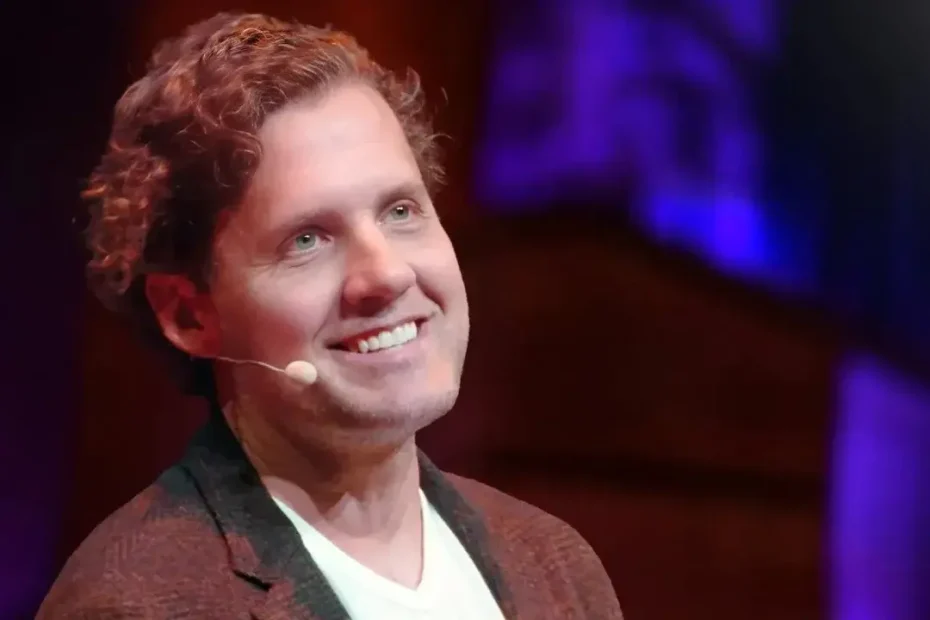
Read the full transcript of author Mark Manson’s talk titled “7 Harsh Truths to Unf*ck Your Life”, July 21, 2025.
MARK MANSON: This is your moment. You ready? I love doing tours like this because it’s a chance to actually meet fans face to face, hear their stories and just remember why I do this. The talk is about the trade offs we make in life.
It gets a little philosophical, but there’s a lot of fun stories and jokes and, you know, typical Mark Manson content. So it’s a good time. What’s up, Gilbert? How are you? It’s so good to be back here.
It’s been about five years since I’ve been here. I traveled over 7,000 miles to come desecrate this fine establishment with f-bombs. So thank you for joining me in this festive occasion.
Introduction: Why Harsh Truths?
So today, I’m going to be sharing with you seven harsh truths to help you unfuck your life. Now you might be asking, “Why harsh truths, Mark? Why do the truths always have to be so harsh? Why can’t they be flowery, pillowy truths? A truth like a daisy sprouting on a spring morning?”
Well, my answer to that is the famous quote from David Foster Wallace, which he said, “The truth will set you free, but only after it’s had its way with you.” Which when I think about that, I see this.
So for the next forty five minutes or so, I’m going to have my way with you, Melbourne. Bend over and get ready.
So tonight, we’re going be talking about a lot of things. We’re going to be talking about the one mental mistake – I don’t even know if it’s a mistake. It might be like a mental flaw that I think leads to probably ninety nine percent of our bad decisions in life. It’s something that we’re all susceptible to, and I don’t think it’s particularly obvious.
We’re going to talk about why we blame others for our bullshit and hopefully how we can try to stop. We’re going to talk about an unexpected definition of evil, which is quite appropriate today. We’re going to talk about why World War II survivors make the best psychologists, and we’re going to talk about the importance of living an unbalanced life.
So are you guys ready for this? Yes. Awesome. Let’s get into it.
Truth Number One: Everything in Life is a Trade Off
Now, this is one of those things that when you first hear it, you’re like, “Well, yeah, so?” And it’s true. A lot of trade offs in life are very obvious and mundane. You go to a very overpriced coffee shop in Melbourne, and you pay your $10 and they give you your coffee. And that’s like a very clear, obvious trade off. You’re giving $10, they give you coffee. You move on with your life.
But then there’s very abstract, intangible, long term trade offs – the sort of trade offs that we make when we’re making major life decisions, when we’re choosing goals and dreams, when we’re defining our identities. And these abstract, intangible, long term trade offs, we tend to mess them up. And our minds don’t seem naturally well equipped to handle them.
And that’s a problem because it’s these long term abstract trade offs that are the most important things that we do in our lives, are the most important decisions that we ever make. So tonight, I want to talk about those trade offs, how we can identify the ways that we mess them up, and also how we can hopefully be a little bit better at them.
# The Rocco Scenario
So I’ve put together a nice hypothetical scenario here. Let’s say you are deeply unsatisfied with your relationship, with your marriage, and you decide to elope to the beach with Rocco, the coconut vendor. Now, obviously, this is a major life decision, and clearly, there are trade offs. So let’s go through some of them.
The benefits of Rocco the coconut vendor: You get to live out your romantic fantasy. All those romance novels that you’ve read, it’s finally coming true. You’re in this exotic location, it’s so beautiful, he treats you like a king or queen. What could be better? You get to live the beach life. I mean, it’s sunny every day, life is easy, there’s breeze. What could be better? And you get free coconuts. A lifetime supply. Rocco is very good at his job.
Now, let’s talk about the drawbacks: Poverty. I don’t recommend poverty, in case you were considering it. Your kids hate you and never want to speak to you again. And, of course, the beach is full of mosquitoes.
Now, how many people actually know someone who’s blown up their life dramatically in this way? Is anybody – yeah? Yeah? Like, 10 of you, maybe? I’ve known a few.
And I can kind of sympathize where people like this come from because we tend to make our worst choices when we overvalue short term emotions and when we undervalue long term commitments. And if you’re a person who, say, has been unsatisfied in a marriage for a very, very long time, those emotional needs go unmet for many, many years. They start building up. It’s kind of like a pressure system that’s about to explode, and you finally reach a point where it actually feels rational to completely blow up your life and all of your commitments and go live on the beach with an AI generated Rocco.
So I kind of understand it. But we’re here to figure out how to be better about this, how to not fall into that trap, how to not make those mistakes.
Truth Number Two: Our Mind’s Natural Tendency is to Deny That Any Trade Off Exists
This is where we start running into trouble. And there’s a real psychological reason that this happens, and we’re going to dig into that. But it’s important to understand that we all experience this to a certain degree or another.
None of us are immune to this trait in life.
And I’ll let you in on a little bit of a secret, which is this is basically why I have a career. Like, my books, everything I post, I write about, it’s kind of just revealing to people the trade offs that they’ve been in denial about.
I’ll give you an example. So like this post: “The person you marry is the person you fight with. The house you buy is the house you repair. The job you take is the job you stress over. Everything comes with an inherent sacrifice. Whatever makes us feel good will inevitably make us feel bad.”
Well, no shit, Sherlock. There are trade offs, but we forget these things. When we get excited about the marriage, we don’t think about the fights that we’re going to have. When we dream about a house, we don’t think about all the repairs and bullshit that we’re going to have to deal with. When we start pursuing our perfect career, we don’t think about all the office politics and whatever hazards come along with it.
# Mental Hygiene
So I see self help very much as it’s almost like hygiene. It’s like mental hygiene. It’s not that you’re learning – it’s not the learning of anything that is supremely valuable. It’s the reminder of the stuff that you kind of already knew, but you’re in denial about, that you push below the surface.
Now, why do we do this? Well, the truth is we’re primates. And, you know, earlier, I was talking about how there are some very obvious tangible trade offs. And the thing about obvious tangible trade offs is they’re very measurable. They’re quantifiable. You can put them in a spreadsheet and you can sit there and you’d be like, “Is that coffee really worth 18 Aussie dollars or whatever?” I don’t know. Let me – yeah. Yeah. Maybe not. And then you can make a decision.
But when you’re thinking about running off to the beach with Rocco, there’s no spreadsheet for that. There’s no easy cost benefit analysis. And in fact, because it is such a personal values driven, emotional driven decision, it becomes very emotionally overwhelming.
# The Primate Brain
And when we get emotionally overwhelmed, that’s when we fall back into our primate brain. We fall into the animalistic side of ourselves. And the animalistic side of ourselves does not do a good job of weighing pros and cons, positives and negatives at the same time. The animalistic side of ourselves is like, “I either want to feel good or I want to feel bad. There’s no in between here.”
Freud had a great term for this. He called it cognitive dissonance. And he noted that when people have contradictory feelings about something, they experience a lot of stress and anxiety, and they look for the easiest way to alleviate that, to escape it. And usually, they escape it by doing some bullshit or coming up with unrealistic perceptions of the world.
This is where we get black and white thinking. Black and white thinking, in many ways, it’s just simply the inability to hold cost and benefit in our minds at the same time. We see things as either all benefit or all costs. And in both cases, we’re being inaccurate in terms of our perception of reality. We’re not seeing what’s actually in front of us.
# The Consequences of Black and White Thinking
And this causes a ton of problems. I mean, not only does it get us into awful life decisions, but it can make us an asshole. It can drive wedges between groups of people. It can prevent you from learning things, from experiencing new ideas, new places, new perspectives.
And the worst thing, and this is the thing that I tend to worry about these days, is that fighting black and white thinking requires a certain amount of cognitive load. To override the animal brain with our more rational human brain, that takes a lot of effort and energy. It takes time. You have to sit and focus and really think through what you’re perceiving and what feels real and true to you.
And the more distracted you are, the more you’re bombarded by information and news stories and social media and all the stuff that’s going on with all your friends all the time, the less cognitive horsepower you’ll have to fight against the black and white thinking. And I think we obviously see the repercussions of that across society.
Black and white thinking is ultimately a distorted version of the world, and it drives poor decision making. It’s the root of prejudice and bigotry. It starts wars and keeps them perpetuated unnecessarily for many generations. And it makes stupid people famous, and it makes TikTok profitable.
But wait, there’s more. It gets better or worse.
Truth Number Three: We Blame Others for the Costs, and We Take Credit for the Benefits
So when we’re in this distorted view of reality of something that’s either all cost or all benefit, the way we escape cognitive dissonance, the way we relieve the tension of our cognitive dissonance, is that we just outsource the cost to somebody else. We’re like, “Well, it’s not my fault that I blew up my life to go live on a beach with Rocco. You know, I think it’s my piece of shit husband’s fault or my piece of shit wife’s fault. You know, I never really liked my kids anyway.” There might be something to that.
# The Actor Observer Bias
But I think in psychology, this is known as the actor observer bias. The actor observer bias basically finds that when I run a red light, it’s because I’m in a hurry and I have a really important meeting to go to. And when you run a red light, you are an irresponsible, psychopathic piece of shit, and you should be put in jail and never let out.
The comedian George Carlin had a great quip about this. He said, “Have you ever noticed that everyone driving slower than you is an idiot and everyone driving faster is a maniac?” It’s this amazing effect that somehow you are always the one driving the perfect speed. It’s incredible. You’re so talented. How did you do that?
# The Problem of Entitlement
Now this relief of cognitive dissonance leads into one of the main themes of “The Subtle Art” – entitlement. Because to perpetuate the belief that other people are responsible for your problems and you’re responsible for your benefits, you have to start believing that you are somehow uniquely privileged or deserving or you are somehow uniquely victimized by the world.
It’s essentially believing that you deserve to receive benefits in life without giving up any costs. Entitlement is the natural consequence of denying that we have trade offs, and it necessitates black and white thinking because it forces you to delude yourself about reality.
And I think this is kind of a place where we’ve gotten, where it feels like there’s more entitlement going on every year across society. It seems like we’re being exposed to it more and more. I think there’s a couple arguments. You know, there’s some research, some data sets that are showing that narcissistic traits have been rising over the past few decades. There might be something to that. There might not.
You could also make the argument that we’re simply exposed to narcissistic people more often. There’s probably something to that as well.
But I think a really important point is that entitlement is not learned. Entitlement is unlearned. Entitlement is our default state as animals. It is the monkey side of our brain, and it is something that we have to be trained out of.
I mean, anybody here who has been around little kids knows that they are really entitled. Like, no kid is like, “Hey, dad. I want ice cream, but I’m considering the long term consequences of my decision, and I was wondering if maybe we could compromise on…” No kid says that.
The Training Out of Entitlement
Every kid is like, “I want ice cream now.” And if you don’t give it to him, “I hate you.” Sound familiar? Entitlement has to be trained out of us. And I think if it is becoming more prevalent across society, I do think that some of that onus falls on the leaders of society.
Because ultimately, the role, whether it’s parents or teachers or leaders, community leaders, politicians, their role is to train people out of entitlement, to civilize them, help them think long term, help them consider trade offs, help them consider their fellow man. And so if we are losing that capacity as a society, then some of that must fall to us.
Now, Big Daddy Wallace had another great quote. He said, “Evil people never believe that they are evil, but rather that everyone else is evil.” I think this is kind of the end state of an entitlement mindset.
Because once you have truly come to believe that every pain in your life is the responsibility of someone else, it’s only logical that you start seeing everyone else as an enemy. And I think, as you go through the world and you’re exposed to certain people and ideas, at least for me, this is the best litmus test I have found for detecting if there’s character there. And you can invert this as well. You could say, good people rarely believe that they are good people, but rather they see good in everyone else. And so I think that’s something for us to aspire towards.
Now, I have a really important question for you guys. As you know, I’m American, which kind of means I represent the world and freedom and God. So on behalf of the world, explain yourself. What is this? How could you let this happen? You guys are so mild mannered. How could you let this happen? I don’t have a point for this slide. Just wanted to ask you that.
Truth Four: The Enemy of Growth is Not Stagnation but Delusion
I think we tend to assume that if we want to grow and get better, that we need to find some sort of new perspective, new information, new life changing habit or hack or whatever.
And the longer I do this, the more I just kind of come to the conclusion that personal growth is just a long struggle against our own nonsense. I don’t know who made that. It’s not a question of learning more information that’s going to set you free. It’s learning the false beliefs, the false patterns, and just understanding the things that don’t work for you.
Because if you think about it, if you knew exactly what was worth doing, motivation wouldn’t be an issue. If you knew exactly what was going to have the most impact in your life, you had the correct information about it, then finding purpose wouldn’t be an issue. If you knew if you had an accurate view of yourself and the world and the people around you, you’d probably stop messing up most of your relationships. I think ultimately, a lot of personal development is just developing an understanding for yourself and having a clear, honest vision of the world.
Make Experiments, Not Changes
So how do we do that? Well, if there’s one piece of practical advice or a takeaway from this talk that I’d like you to take, it’s this: Don’t set out to make changes. Make experiments.
It’s typical in my industry that you’re supposed to here’s the model or framework, and it’s going to change your life, and now you’re going to be a new person. And I think that that model of a clear before and after moment in your life is not only unrealistic, it usually doesn’t happen that way, but it’s also I think it puts unhelpful pressure and expectation on you. When you read a book or take a course and you have this expectation of “okay, now I’m supposed to be different,” it can be very counterproductive. Then you feel like an idiot if you’re not.
Or if you try to do the thing and you mess up a few times, or you’re not really liking it, or you feel worse, you feel like something’s wrong with you. But when you approach things like an experiment, you basically approach things in terms of gathering information. Because the truth is that the only personal development advice that works is personal. It’s different for everybody in this room. And so nobody can tell you what’s right for you or what’s going to work for you except for yourself.
And so therefore, your project is to try things, set parameters and boundaries of “okay, I’m going to give up alcohol for thirty days, and I’m going to see how it affects my life,” with no expectation of “I’m going to be a new person now.” It’s like, let’s just see what happens. Because when you that seeing what happens, that’s when the costs and the benefits are actually revealed to you. And you discover that all of the benefits you thought you were getting from drinking alcohol weren’t really that big of benefits. And all the costs that you thought were there from giving up, well, actually, they’re pretty big costs.
And it’s going to be different for everybody. Give up social media for a week. Stop talking to that friend who treats you poorly. Just see what happens. And these experiments, they can take place. They can be behavioral changes, they can be difficult conversations with people in your life, they can be any number of things. But I think when they’re framed as an experiment to discover information about you and yourself and the world around you, it removes all of the shame and pressure and judgment.
Truth Number Five: All Trade Offs Cause Pain. Bad Trade Offs Cause Suffering.
There’s a great story about or an allegory that was supposedly taught by the Buddha that I really love and I find very inspiring. The Buddha said that there are that getting hurt is like getting struck by two different arrows. The first arrow is the actual arrow piercing your skin. There’s the physical pain, the sensation. And the first arrow, it can be excruciating, but it’s always temporary. It always goes away. It eventually heals.
The second arrow is the meaning that we put around the first arrow. It’s the “why was I the one who got shot the arrow? Why didn’t Jim get shot by the arrow? Jim’s an idiot. He should have gotten shot by the arrow.” It’s all the excuses or the demands. Like, “well, I got shot by the arrow, people need to be nice to me now because I got shot by the arrow. Why aren’t people nice to me? Well, maybe I deserve to get shot by the arrow.” It’s like that mental game that we start playing with ourselves, that endless narration that goes on around the pain.
And the problem with the second arrow is that those stories and that narration, it doesn’t go away easily. It can last and persist well into the future. In fact, in many cases, we forget that it’s a story. We forget that we invented a narration around our pain. And because we forget that it’s just a story, it sticks with us.
Finding Your Secret Struggle
This is why, I guess, kind of like the central takeaway of subtle art of using instead of thinking about what benefits you want in life, thinking about what costs, or as I put it in the book, what pain you want to sustain, this is the closest thing I have found to a mindset hack. Because it’s essentially asking yourself, what is the first arrow that I actually kind of enjoy? We’re all secretly a little bit masochistic. We like the harsh truths. Or maybe that’s just me. I don’t know.
But we all have something in our lives that some pain, some struggle that secretly kind of enlivens us. It makes us feel alive. It’s like we enjoy the challenge and we enjoy the process of overcoming. And if we use that as the starting place, we become immune to the second arrow. And if we use that as a starting place, then we’re always aware of the costs that we’re incurring. We know what we’re getting into before we do it.
Writing a book is hard. It’s grueling. It’s isolating. It’s full of self doubt. And sometimes you just want to crawl under your desk and start crying. But there’s a part of me that likes that. It’s like, I don’t know. It enlivens me. And that’s probably why I’m an author.
It’s funny because before I even thought about writing anything, I went to music school. I initially aspired to be a musician. And I remember I was really having a hard time with it. I was really, really frustrated. I remember I went to I was practicing probably four to six hours a day, and I went to one of my guitar lessons. And I remember the teacher just looked at me, and he was like, “stop playing. You don’t practice enough.”
I was like, “what? What is wrong with me?” And I remember there was one kid in my class. His name was Chris McQueen. He was the one guy in the music program that everybody was like, “okay, that guy’s going to make it. We’re all just trying to get by.” And I cornered him in the cafeteria one day, and I was like, “okay, he’s got to know something. He’s got to have a secret or a hack or a method or something.” I corner him in the cafeteria. I started talking to him.
“What’s your practice routine? How do you warm up in the morning? How do you approach a song? What’s your process?” And he just kept looking at me and shrugging. He was like, “I don’t know. I just play for a while.” And I’m like, “great. Thanks.” All right.
And it took me a long time by the way, I dropped out. Chris McQueen has two Grammys. But it took me a long time to figure out that, ultimately, he didn’t have to think hard about practicing because he just liked practicing. And I had to think hard about practicing because I hated practicing. And ultimately, the real cost of being a musician was practicing.
Because if you’re a professional musician, the vast majority of your time is spent practicing. And you don’t think about that when you’re watching like a Taylor Swift concert or whatever. You’re just like, “oh my god, it would be so cool to be on stage.” But the reality is you’re spending most of your life practicing. And so I think, ultimately, it’s about finding that secret struggle that only you seem to be able to bear.
Because aside from being kind of the hack to, you know, delusion and black and white thinking and making you immune to the second arrow, the thing that you enjoy struggling with is going to be your competitive advantage in whatever you pursue in the world. The stuff that you like to eat that nobody else will touch, yeah, they’ll pay you for that. That’s my money advice.
Truth Number Six: The More Downside You Can Stomach, the More Upside You Will Enjoy
This is kind of logical. I mean, this isn’t like I’ve got two points to make around this. One is going to be kind of obvious, and then the other one, I think, is very unobvious. So I could have used a lot of examples for this. I chose Arnie. Because look at those biceps.
Schwarzenegger was an interesting guy back in the ’70s when he was doing the bodybuilding thing, and he won Mr. Olympia seven times. If you ever go read his biography, it’s pretty astounding, the stuff that he put himself through. His daily routine at the time was he would wake up at around 6AM, he’d go to the gym, he’d work out for two hours, then he’d go work a full shift as a construction worker, go home, take a nap, go back to the gym, do another hour and a half in the gym, go home, eat, go to sleep, wake up at six a.m. the next day. He did that for like six or seven years straight.
Now here’s the obvious takeaway, and this is probably the takeaway that is in everybody’s head right now. It’s like, “goddamn. That’s why he looks like that. He can suffer a lot.” And there’s some truth to that, right? There’s like some crazy story. Like, Bill Gates apparently didn’t take a vacation or weekend for twenty years. Okay. That’s a lot of suffering. Clearly, that paid off for him. That’s the obvious takeaway. No pain, no gain, whatever.
The Hidden Cost of Success
Here’s the unobvious takeaway. During this period, when our friend Arnie here was doing this, he had a failing marriage. He basically had no friends. He barely spoke English. He had zero hobbies. He was broke. He had no life. There are an infinite number of possible identities and trajectories that he could have been on that he wasn’t because he was on this one very intense, semi insane trajectory.
And I think that’s what that’s what we don’t consider. The no pain, no gain is like the first arrow takeaway. It’s like, “oh, if I can take more arrows, I’ll get more benefit.” Great. What we don’t think about is that there’s an identity, a self definition that has to go as well.
When you choose a new career, you are choosing to give up another part of your life. You’re giving up old coworkers, you’re giving up old skills, old habits. You’re giving up old routines. When you choose to move to a new city, you’re giving up certain relationships. You’re giving up certain lifestyles. There’s a void that happens anytime you change yourself. And this gets missed a lot. Again, change and growth is usually marketed as this kind of euphoric, “oh my god, I’m a new person,” when the reality is that there’s a component of grief to it because you are losing your former self.
The Grief of Personal Growth
And the same way you grieve a lost friend or a lost family member, you grieve that former self. Even if your current self is better than that former self, there’s a certain loss to it. And so I think that that kind of existential identity-based loss of self-definition is what messes people up.
I’ll give you an example from my own life. I’ve spent most of the last five years trying to actually be healthy. And like most people, I sucked at it. I’d lose, I don’t know, six or eight kilos, plateau, gain it all back, get frustrated, lose it again—like did the yo-yo thing that we all do.
And initially, my approach was very much the first arrow approach. It was like, “I just need to get to the gym more. I just need to eat less cheesecake. Just suffer a bit more, Mark. You can make it.” And that approach, that attitude is always unsustainable.
Eventually, what I figured out after two to three years of trying and failing is that you have to take the second arrow approach, that this isn’t just about short-term suffering or sacrifice. This is about identity.
I had to start looking really hard at my lifestyle choices. I realized that alcohol and food was a huge part of my social relationships, that food was a huge part of how I medicated my anxiety, that alcohol was kind of how I dealt with my family. Okay. My mom won’t hear this.
And so until I started addressing that, nothing actually changed. I actually had to lose friendships to lose weight. That sounds crazy, but it’s true. Because I had to drink less, and then when I drank less, I realized that some of my friends, I had nothing in common with other than we just like to get wasted together. And that’s just that was part of my life.
And so again, it’s the self-definition. It’s the willingness to let go of a past self and to grieve that past self. Another way of thinking about this is that I think we gain more—we improve by not gaining more, but simply focusing on less, narrowing our identity.
Truth Number Seven: There’s No Such Thing as a Balanced Life
Because you’re naturally going to love certain costs and sacrifices more than others. And because you enjoy them more than others, when you start investing yourself into them, that’s where you’re going to get the most returns in terms of happiness, meaning, purpose, good relationships. And so it makes sense to actually specialize your life.
This conventional wisdom of like, “Oh, you need to be balanced and you need to have lots of hobbies and friends and do lots of things and go home early.” I think that’s kind of stupid, especially in this day and age. Because, look, we’re exposed—today, we are unique in human history in that we are exposed by exponentially more cool things that we would like to do than we will ever have the opportunity to do.
And so the challenge for us psychologically is developing the ability to turn down and let go the things that don’t make sense to us. Like, you can’t excel in your career and be a great parent and learn French on weekends and go to every new restaurant opening and have a vibrant social life and win in pickleball every week and read two books every day and visit your parents more often and post on social media. Like, you can’t do it. You’ve got to pick one or two things to go all in on, and that’s what’s going to get you further.
And sometimes people hear this, and they’re like, “Well, that’s nonsense, Mark. I don’t think I should have to make all these trade-offs. I think I should be able to have everything I want and be happy all the time.” To which I say, refusing to accept trade-offs is a terrible trade-off.
Trade-offs are like Michael Myers. You cannot escape. Every time you think you’ve defeated them, they come back even harder.
Heroes and Inspirations: World War II Survivors
I want to wrap this up by talking about some of my heroes and honestly, some of the great thinkers who inspired a lot of these ideas. It was funny. While I was putting this talk together, I had the realization that most of my deepest held philosophical beliefs or beliefs around human nature, psychology, were all originated with World War II survivors.
So you probably recognize probably at least one of these guys. We’ll start with Freud. Most people know Freud for—you know, Freud’s funny. He had like an early period and a late period. And in my personal opinion, Freud’s early period sucked. It’s mostly—it’s like kind of what he’s known for. Like, everything you’ve heard about Freud that involves dicks comes from his early work. You know, it’s like, “You want a dick. Your mom wants a dick. Your mom’s dick.” It’s all early Freud.
That is professionalism. What was I talking about? Oh, yeah. Freud’s early period, you know, all the old psychoanalysis stuff, he got a little weird, he got a little bit out there.
But an interesting thing happened. So when the Nazis took over Austria, he barely escaped Vienna. Freud was a Jew, if you weren’t aware. He barely escaped Vienna. He didn’t want to leave. His family and friends literally physically made him leave a couple days before the Nazis came in.
And he escaped to London, and he became intensely depressed. He lived the last five or ten years of his life there. And the work that came from that period was incredibly profound. He wrote a book called “Civilization and its Discontents.” And in that book, he talked about how people don’t realize that we are mostly animal, that most of our psychology, our mind is animalistic, and it’s only a very tenuous, rare, civilizing force that helps us defer gratification and weigh cost and benefits and care about our fellow man and think in more abstract principles.
And that can be lost very, very easily. He saw what was happening during World War II as what happens when short-term emotions take over.
Viktor Frankl: Finding Meaning in Suffering
Now, the guy in the middle is Viktor Frankl, who I’m sure most of you have heard about and read his book “Man’s Search for Meaning.” If you’ve not read it, it is, I feel like, an obligatory read for humanity. But he was a psychiatrist. He was sent to Auschwitz, and he survived.
And he wrote a memoir about it afterwards where he noted that the prisoners in Auschwitz who had found a reason to survive, a meaning or a purpose to the grueling work and the violence within the camps, were actually the ones who lived longer. He noted in the book that he could predict which prisoner was going to die next by the ones who lost hope.
Jean-Paul Sartre: The Burden of Freedom
And finally, the man on the right, Jean-Paul Sartre. Most people don’t know his story. He was a playwright and novelist in the ’30s in France, and he was drafted into the French army when the Nazis were invading. As you probably know, it didn’t go very well, and so he ended up a prisoner of war for a number of years.
And he was in a prisoner of war camp, not quite a concentration camp, but still not exactly a spa retreat. And during that time, he was in isolation for almost the entire period, and he journaled furiously.
And he noticed something as he spent more time in the camp, that there was a certain kind of almost relief that he started feeling at the fact that he didn’t have to make choices for himself anymore, that even though he was imprisoned and his life was completely controlled by somebody else, there was a certain kind of relaxation that happened because he was no longer burdened by having to make significant decisions for himself all the time, day after day.
And this freaked him out. And he eventually wrote those journal entries that eventually became “Being and Nothingness,” which was the foundation of the existentialist philosophy. And he has this great quote where he said that, essentially, people are afraid of their own freedom because it comes with the burden of responsibility. It comes with the burden of accepting the costs of your own choices. It comes with the burden of accepting that anything you pursue, it means you are giving up an infinite number of alternative selves that you will never be.
Carl Jung: The Secret Agent
Last guy I want to talk about is Carl Jung. It’s a nice little quote here: “I am not what happened to me. I am what I choose to become.”
Carl Jung was different than these other guys. It’s kind of funny, actually. The Nazis really liked psychoanalysis, but the problem was that all the psychoanalysts were Jewish. So they had to go find a pure blood German to do their psychoanalysis for them. And so they found Jung. Jung was not Jewish.
And Jung worked with them. He went to Berlin. He gave lectures. He was involved with some of the top level Nazi leadership during his career. He even met Hitler a handful of times. And he was roundly criticized for this his entire life. For the rest of his life, people ripped into him for not taking a stand, not saying no, not standing down, not speaking out, whatever. He was Swiss, so he could have if he wanted to.
Well, something really interesting happened about ten years ago. Allen Dulles, who was the first CIA director and was the head of counterintelligence during World War II for the Allies—his memoir—he passed away, and in his memoirs and diaries, he wrote that Carl Jung was one of the most important spies for the US and UK, that he was delivering the medical records, not only of the Nazi leadership to the Allies, but Hitler himself, and that he actually participated in a couple plots to get Hitler declared as insane to try to get rid of him.
And the crazy thing is he never said anything. He never tried to defend himself. He never said, “Wait. I was the secret agent. No. I was doing all this stuff.” He just let it go.
And I find that so inspiring because the first three guys, they had everything taken away from them. And when you have everything taken away from you, it opens up a space to really see kind of the bare reality of your mind and of human nature. And all three of those men discovered really incredible things about our nature.
But Jung didn’t lose anything. Instead, he risked everything. He chose to potentially give up everything. And to me, that’s what’s so powerful about “I am not what happened to me. I am what I choose to become.”
Thank you. Thank you, Melbourne. It’s been a pleasure.
Related Posts