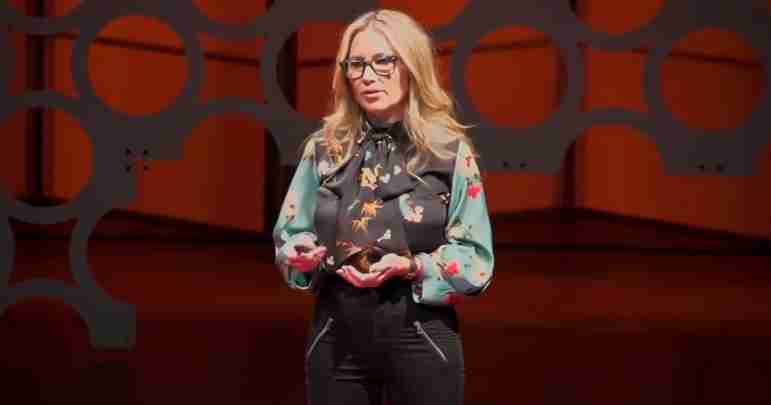
Full text of Reisa Pollard’s TEDx Talk titled ‘The Surprising Truth About Making Babies Late’ at TEDxVancouver conference.
Listen to the audio version here:
TRANSCRIPT:
Reisa Pollard – Lead designer at Beyond Beige
Now, I want you to picture a gumball machine. Imagine that machine has ovaries, and the gumballs as eggs. When a woman is born, that gumball machine is full. It has all the gumballs she’ll ever have for her entire life.
As she gets older, that gumball supply starts to diminish, and the leftover gumballs are getting a little stale. By 40, that supply is getting really low. And by 44, any stragglers left, they’re well past their prime. The chances of turning one of those gumballs into a baby, even with in vitro fertilization, is less than 2%.
Now, if you’re an educated, professional woman, who’s used to accomplishing anything she sets out to accomplish, this news can come as quite a shock. Yes, it can. Especially if you take good care of yourself, and you think you still got it. Maybe your mantra is 40 is the new 30 and all that. Yes.
But here’s the thing. Your eggs don’t subscribe to that motto. They’re not in there doing Botox and hiring personal trainers. No, those eggs are just sitting in that gumball machine aging the exact same way your great-grandmother’s eggs did.
Men, on the other hand, are producing about 219 million fresh sperm every day. So, I had to do the math. That’s about 525 billion swimmers in a lifetime. Ironically, men are still off in the culprit when it comes to infertility.
I was dumbfounded when I heard all this news. I mean, my first thought was, why didn’t I know this? Why wasn’t I taught this about fertility in sex ed class or from my family doctor?
With this countdown to gumball annihilation, I learned some other surprising facts at the same time. For the first time ever, 30-something women are having more babies than their 20-something counterparts. That means young moms, they’re the outliers now.
If you’re 40 and you’re thinking about having a family, even in the distant future, under 40 I should say, if you’re under 40 and thinking about having a family in the future, you can stomp on your own biological clock by freezing your eggs. If you have the funds or you work for companies like Apple or Facebook or Google to offer this, you can have yours extracted when you’re fresh and dewy, and you can put your little gumball on ice until you’re ready to have kids.
For the first part of my life, I followed the rules. I was a big kid. It was after university that I went a bit sideways. When my friends were building careers or having families, I was off, I was traveling the world, starting like a rock star, falling in and out of love, and I was doing a whole host of jobs.
I was trying to find that thing, that career that would define me, that would make me a something. I worked as a salesperson, a property manager, a retail furniture store manager, an assistant librarian, and a marijuana grow-up consultant.
At 32, though, I finally found my calling. I was passionate about interior design. I loved it. So everything else took a backseat as I solely focused on making a successful business out of it. I never really thought about my age before. I mean, why would I?
I haven’t really thought much about kids, either. I thought that they would fit into my future, not as part of my present. I got married at 40 to a guy seven years younger than me, and, snap, that was it. I wanted them.
So I set out to have a family, but I was clueless about fertility. I knew only all the ways not to have one. Now I have to figure out how to do it obviously. I honestly thought my chances of having a kid were the same as a 25-year-old’s. I thought having a baby must be a guarantee by now. I mean, even if I did have some sort of age-related problem, I figured that all I had to do was throw money at it.
Well, I was in for a really deep learning curve. What I discovered opened my eyes about the misconceptions regarding delayed childbirth, that there is a huge conspiracy of silence about the challenges, and there is a gap between what we perceive and the reality of the ground.
The same year we got married, I had my first miscarriage. We had told everyone who would listen that we were pregnant. We prepped, we planned, talked about baby names, we had the room ready, and then we went for a routine, ultrasound, and found out there was no heartbeat. Oh, this news was shattering.
It was the first time I had to reflect on decisions I had made in my life. I was no longer confident that my body was going to do the right thing, so I made an appointment in the fertility clinic. I was already pregnant, but I didn’t know it yet, so when I went in and then they gave me the test results that were positive, I was like, wow, that was easy. You guys were good.
I carried that pregnancy to term, and I had a healthy baby boy. From the first moment I held him in my arms, oh, I knew, oh no, I want another one. Any joy or accomplishment I had felt in business was nothing compared to this.
I was now 42, and that’s when the comments started. Are you crazy? You want another one? You want to be the oldest mom at soccer practice? Or you’re going to be going into diapers when your kids are getting out of them. Secretly, I thought, just one more.
So we kept trying, and the following April I got pregnant again. We anxiously waited until those 12 weeks were up, and then we told people the good news.
At 12 weeks and two days, I had my second miscarriage. All I could think about was the embarrassment of having to retract our announcement to people.
In November of the same year, I got pregnant again, but before the year was over, I would have my third miscarriage. It sucked as much as the first two, but at least this time we kept things totally under wraps, so it was just my husband and I that breathed privately over the Christmas holidays. It was a new year, but it’s a new hope.
In the following February, I thought, oh, this is it, when I confirmed my suspicions that I was pregnant again. On my 44th birthday, my present was my fourth miscarriage. My grief was now twofold. I was grieving the loss of the pregnancy, and I was grieving the loss of my usefulness.
I wondered if I was going to pay the ultimate price for inadvertently putting my career ahead of a family. Was it going to end with failure, or was my tenacity and risk tolerance that I learned in business going to help me persevere? Either way, that baby seemed like an insurmountable feat.
I went back to the fertility clinic, and despite being told the odds, I went the in vitro route. Now, these were odds for a long shot, like a Powerball water long shot, I was told, but to me, a long shot was better than no shot. The way IVF worked is that you pump yourself up full of drugs by giving yourself hormone injections every day. Oh yeah, this causes mood swings that any husband would find completely adorable.
Mine stood by while I laughed at things that were really sad, and I cried at things that were funny. Oh, and his favorite was when I, like, laughed and cried at the same time for no reason. So, about through that, after ten days, they harvest your eggs and fertilize them with his sperm.
After that, it’s survival of the fittest. The strongest one makes the cut, and the rest are discarded or frozen. Incredibly, I got pregnant with IVF on my first try. And the amazing part was, is normally they harvest about six to twelve eggs, but with me, they’d only find one, and it took. Things were looking good. We had a heartbeat.
We had made it past the first round of testing. We felt confident enough to tell people the good news. Then we went for more tests and found out there was chromosomal issues.
Before we had time to react, the heartbeat vanished, and that was that. The miracle baby turned into miscarriage number five.
Let me tell you, thinking that you’re pregnant one minute and finding out that you’re not the next is a real mindfuck. It’s like you’re trying to process the news, but you can’t because your body still feels pregnant. You’re tired, you’re puffy, your boobs still hurt. It’s all you can do just to try to figure out how to grieve the hope of a baby. You don’t feel entitled to breathe openly, that’s for sure.
You’d think that this would be the end of the road, you really would, but no, there was no stopping me now. I was like chasing the dragon, I needed that baby fix.
It was turning out to be the biggest challenge of my entire life. So, now I decided to go the egg donor route. Let me tell you, this is surreal. You go online shopping for what you hope will be your next annoying teenager. For anonymity, you click through pictures of potential donors as children. I was told that the good eggs go fast, so when you find one you like, you have to put it in a shopping cart. Then, you click checkout and pay and they send it in the mail.
I was like, what? I felt like I was doing some deal on the black market, but I swear this was totally legit. For my husband, the egg donor was the limit. He didn’t want to look at little girls in Christmas dresses to find out who he was going to be having his next child with. No, he just left that part to me.
I went through the whole drug prep again, but I figured once they impregnated me, that would be the last step. I went for the implantation, that was easy, it went well. I waited for the call. No day. How could this be possible when the getting pregnant part wasn’t even my issue?I had never felt like I had accepted defeat before, but I knew this was it.
I’m now 45. I’m 5 miscarriages deep. I wouldn’t even be able to calculate the odds, but I know that they’re way less than 1%. We had invested over $50,000. I was physically and mentally exhausted, and my husband, well, he was done. He gently told me we had to let it go.
I knew we did, but I couldn’t because I just had this profound feeling of failure. With that said, I couldn’t fear of any way to move forward, so I gave myself one month. I would wallow, work through it, and I would put the whole thing behind me, and I’d move on.
Then, I got a surprise call from the clinic. It turns out that my donor was showing a very low rate of return. What? This is normally a conversation that I would have with my financial advisor, but this is a business, and this is how they talk. So, they were suggesting that I did a do-over. They would pay most of the costs and pay for the egg donor, and we would just have a few costs.
I felt like I was being given this next lottery ticket. I told my husband, and he was like, really? Really? Oh, but he didn’t try to talk me out of it. I went through the whole procedure again. I went online. I did the drugs. I scheduled the implantation date.
Three days before that day arrived, somewhere somebody in the world was having a miscarriage with my same donor egg. I would have to wait until they did an autopsy on the fetus to rule out genetic issues. Another waiting game.
Three weeks later, we got the all-clear. We were good to go. I did the whole hormone prep rigmarole again, or at least I was trying to, but I had to wait for my period to come, and it just wouldn’t come. So, I called the clinic to explain my predicament. The receptionist, she told me I should take a pregnancy test first. Seriously? I was like, what?
Is this some sort of like, fragility clinic joke? I felt like punching her in the face with a ball. I casually do this pee test, and I look at it, and my eyes bug out of my head. And it’s not because I’m ecstatic. No, no. I’m way too scarred and jaded. She’s always been excited. What I’m thinking is, holy shit, now I have to have a whole miscarriage again before they can implant this stupid donor egg. But I didn’t have a miscarriage.
At 46, I naturally had my second beautiful baby boy. Isn’t life weird? I mean, a fertility clinic term for a natural pregnancy is a spontaneous one. Well, I thought this was hilarious, as if anything about my pregnancy had been spontaneous. I had just gone through six years, seven pregnancies, five miscarriages, a round of in vitro, two donor eggs, and a couple of lucky rules of the dice to win this baby lottery.
So today, there is no longer just one window or one way to have kids, but that doesn’t mean it’s easy. Many women are going to risk choosing to have kids later in life for the hope of having it all. IVF is now a common fertility treatment, and more kids are being hatched with donor eggs or story gifts every day. It’s equal opportunity.
You can be gay, straight, single, married. As the price of freezing eggs comes down and more businesses are going to offer it, it gives women a much wider window of opportunity to start a career before the family. But despite all this, there’s a huge taboo that exists around talking about this stuff.
Many women aren’t comfortable telling anybody, even close friends and family, what they went through. I talked to a fertility doctor whose waiting room is jammed with women like me, and she told me that most of her patients are reticent to talk openly. They’re ecstatic with the results, but they’re still only willing to do an anonymous online review.
Doesn’t that seem kind of crazy? I mean, I for one, I’d like to see that change. We need to start sharing our stories, all of them. It’s true, I wouldn’t be standing here if I hadn’t beat the odds, but I am here, and I’m bearing my soul because along the way, I garnered some valuable insights.
The more we’re able to talk openly about our experience, the more comfortable people will be with the challenges that we face. Whether it’s assistance with conceiving, having a miscarriage, or maybe five, it’s not something to be ashamed of. It’s part of the journey, and you’re not alone.
The more we understand about fertility, the more we can make timely, informed choices, even if your choice is not to have kids. But if you have any inkling, any at all, that you might want them in the future, educate yourself, because nobody is going to do it for you.
We should be teaching fertility in adolescence and continue in adulthood. Not everyone wins, but there are lots of ways of increasing your odds at winning that lottery with the ultimate prize. Thank you.