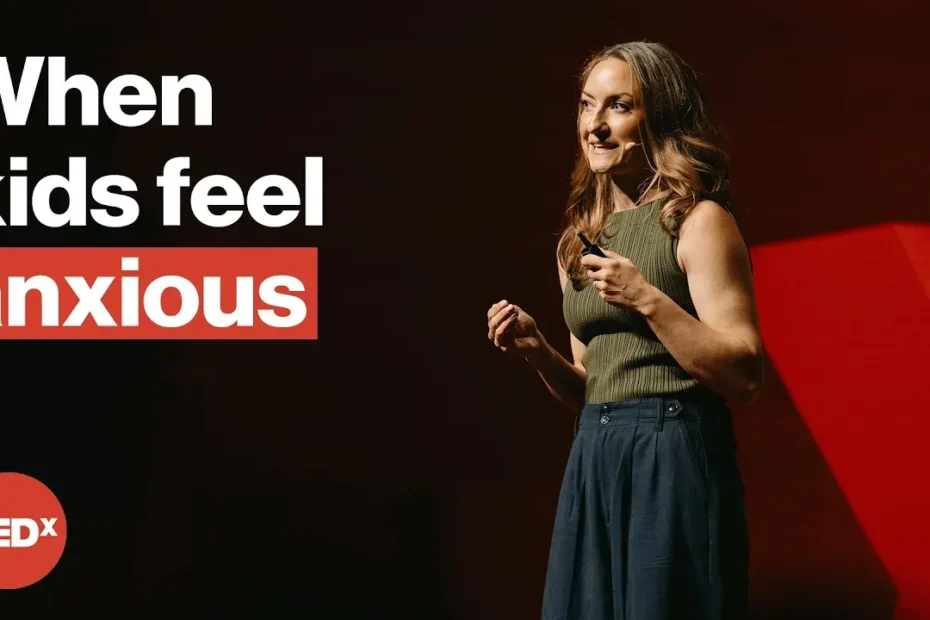
Editor’s Notes: In this compelling TEDx Talk@ TEDxMinneapolis, pediatric anxiety expert Kathryn Hecht explores the vital shift from “parenting for comfort” to “parenting for confidence.” Drawing on her extensive clinical experience with exposure therapy, she explains why protecting children from all discomfort can inadvertently hinder their ability to handle life’s challenges. By sharing powerful stories, like that of a boy overcoming his phobia of bees, Hecht demonstrates how “brave parenting” helps kids build “handleability”—the deep-seated belief that they can cope with whatever comes their way. Ultimately, she offers a secret playbook for raising resilient children who are equipped to thrive in an increasingly uncertain and complex world. (Feb 7, 2026)
TRANSCRIPT:
The Ground We Walk On
KATHRYN HECHT: I’ve walked a lot in these shoes today. These soles have ground into the pavement of downtown Minneapolis, the rubber mats of my car, the linoleum of a gas station bathroom, and the play-doh-crusted carpet of a daycare. Embedded in the tread, smear a toddler booger, a little leftover norovirus, maybe. Maybe if I’m really lucky, a little dog poop. Each is sick just thinking about it, right? So yeah, that happened. And while you may not have tasted what I just tasted, you felt what I felt. Your sympathetic nervous system activated, increasing your heart rate and tensing your muscles. Your anterior insula flared, creating a feeling of disgust, a little nausea, a slight gag reflex. Am I going to get sick now? I don’t know.
But I do know this, I am so glad you’re uncomfortable. Congratulations, truly, because that discomfort, that is the first essential step to creating confident kids. And you can trust me on this one, I make kids uncomfortable for a living.
A Professional Bravery Coach
This week, I had an eight-year-old stab me with a needle, twice, took a kid into a basement on a spider safari, and played Uno on the bathroom floor with an understandably reluctant teen. It’s only Wednesday. Now I’m not doing this stuff because I’m an evil psychologist. I’m doing this because as a pediatric anxiety and OCD expert, I’m a professional bravery coach.
Meet Sammy
I’d like to tell you about a kid that I worked with years ago named Sammy. Sammy was this sweet little third-grade string bean who lived for adventure, bright, curious, optimistic, could tell you everything you honestly never needed to know about airport design. But Sammy had a fear, bees. His brain appreciated bees, vital pollinators. His body, however, reacted like they were flying yellow needles with some anger issues. As soon as those leaves turned green, Sammy would initiate his own personal bee safety protocol. No sweets outside, social distancing from the flowers, even staying inside during his family’s cabin trips.
When Sammy got to me, he and his parents had tried everything to get rid of this anxiety. Deep breathing, distraction, no luck. They had also debated the fear endlessly. His parents would reassure him, “You won’t get stung.” Sammy reminded his parents they were not fortune-telling wizards in four words, “How do you know?” This phobia was stealing Sammy’s childhood, one sunny summer day at a time.
Method to the Madness
When I sing happy birthday with a cringing 12-year-old as loudly as possible in the grocery store produce section, when I rank order photos of vomit by chunk level, or yes, when I lick my own dirty shoes, I don’t just do it for fun, although believe it or not, sometimes it’s very fun. I do it for kids like Sammy, because there is a method to this madness, and after a decade of clinical practice helping kids be brave, it’s become clear to me that the method, exposure therapy, isn’t just the gold standard treatment for child anxiety and OCD. It is a secret parenting playbook for raising kids that thrive. I want to share that secret playbook with you today.
A Wild Worried World
But before we talk about what to do, we need to talk about what we are up against. It’s a wild worried world out there, folks. According to the National Survey of Children’s Health, pediatric anxiety diagnoses rose by nearly 30% from 2016 to 2019. And that was before COVID. Globally, anxiety in youth has doubled in the last 30 years. But you don’t need stats or lists. You have felt this, because thanks to evolutionary biology, when kids get anxious, adults get anxious too.
Now I have two girls, and home is the hardest clinic that I have to work in. When one of my little gals looks up at me with the big, teary eyes, aka the mommy bat signal, my nervous system does the same thing that yours does. It responds as though I have discovered that the kitchen is on fire. The amygdala, the watchdog in our brain, starts barking, and the fight or flight system kicks in, and adrenaline surges, and there is this instant, magical transfer of distress.
Her emergency becomes my emergency. And in an emergency, what do you do? You rescue the child. Now I am proof that professional degrees do not make you immune to this. In my eldest daughter’s four short years of life, I have become a one-woman emotional SWAT team more times than I can count. I have answered questions for my daughter when she clams up with a new adult. I have sacrificed my sleep and allowed our little human space heater into the big bed for the night. I have forfeited all privacy while peeing, because even that closed bathroom door feels too far away.
Parenting for Comfort: The Natural but Flawed Approach
Now all of this is what I call “Parenting for Comfort,” and it is the single most natural and well-meaning and deeply flawed thing that we do. In the anxiety treatment world, Parenting for Comfort has another name, accommodation. In my office, it looks like the parents who removed everything green from the house, because green meant vomit.
In Sammy’s case, it looked like kind, loving parents who altered family plans from outdoor fun to indoor fun. No picnics at the park. No meals on the deck at the cabin.
Parenting for Comfort is not limited to the parents of anxious kids. It’s also the common thread in the last 30 years of parenting trends, from the helicopter parenting of yore to the gentle parenting of today. All of it is rooted in this idea that healthy is a synonym for happy. But I have watched this approach play out hundreds of times in my office, and I can tell you, there are three big problems with Parenting for Comfort.
Three Problems with Parenting for Comfort
First, it places an incredible burden on parents. It turns us into this stressed-out member of the feeling secret service, tasked with controlling something we just can’t. Another person’s emotional experience.
Second, it teaches kids that hard feelings are an emergency. When we cancel that picnic in July or open the bathroom door midstream, we may not say it, but our actions shout, “This feeling is a problem.”
Third, it doesn’t work. We can’t eliminate the pain or mistakes of childhood. They’re a part of the process of growing up. We cannot guarantee emotional comfort when discomfort is a side effect of being alive. If life won’t promise comfort, our parenting can’t either.
The Shift to Parenting for Confidence
Instead of Parenting for Comfort, we need to be Parenting for Confidence. When you Parent for Confidence, you flip the script. Our goal is not to get rid of anxiety, uncertainty, or distress. Our goal is to build coping efficacy, what I call “handleability,” this deep-in-your-bones belief, “I can handle it.” That is the heart of exposure therapy and the key to raising kids that thrive. Not avoiding hard feelings, but experiencing them and still saying, “I can do this.” Our kids don’t require a comfortable life. They need comfort with discomfort.
The Exposure Therapy Formula
So how do you do this? How do you Parent for Handleability? When Sammy got to me, all that he and his parents had tried hadn’t really worked, and he was waiting to see if I would waste his time too, but I surprised him. Rather than reassurance or relaxation or distraction, with Sammy and with hundreds of other kids, I used the recipe that exposure therapists have relied on for decades. A plus B equals C. Anxiety plus bravery equals confidence.
Notice anxiety is not the problem. It’s a core ingredient. It’s actually central to how the brain learns safety through what’s called inhibitory learning. Anxiety only rewires the brain when fear is present. No one gets confident they can handle hard stuff without handling hard stuff.
I explained to Sammy that Worry is a bossy bully, but bullies stop messing with you once you say no. In order to shrink Worry, he needed to show that bully who’s boss through practice being brave. Now of course, Sammy was immediately convinced by my explanation and was like, “Ah, yes, Kathryn, absolutely. Give me some bees.” No, oh my gosh, he was like, “Thanks, hot take. I will consider that.” But this is where grownups come in.
A growing body of research from Yale Child Study Center and others shows that we as parents can change child anxiety just by changing our own behavior. If we parents go from prioritizing comfort through accommodation to prioritizing confidence through practice, we can make it much more likely that kids will take that leap into brave action.
Supporting the ABC Recipe
Parenting for confidence means supporting kids at each step of the ABC recipe. It means creating opportunities for anxiety through adventure. No kid jumps off the high dive if you never take them to the pool. I asked Sammy’s parents to give him some confidence building opportunities by resuming their family’s summer fun. Walk to ice cream, smell the flowers, eat the watermelon on the cabin deck.
Parenting for confidence also means be the bravery you wish to see in your child. Show your kid that they can handle this by modeling it. Do the scary thing. Sammy’s parents didn’t make Sammy go outside on the deck, but they did go out there and enjoy some watermelon despite the wasps. This is jumping in the pool and showing the water’s fine.
Third, we need to celebrate confidence building actions. Cheer for and reward those brave steps. Brave is hard work, and hard work deserves reward. Sammy built a bravery ladder to face his fears. It went from bee pictures to videos to Dan. Dan is a dead bee in a jar in my office. And finally, real bees. Each step earned brave points, which Sammy cashed in for trips to new restaurants.
The Courage Required of Parents
Now at this point, a warning. Parenting for confidence is brave parenting. It asks for bravery from kids, yes, but it requires bravery from parents. Having your kid panic before the hockey game and sending them out onto that ice anyway, asking them to eat in the den of snakes that is a middle school lunchroom, or, if you are me, peeling your protesting one-year-old off your body, passing them to a teacher at daycare, and then walking out the door before bursting into tears. This is incredibly emotionally hard.
These actions ask us to place a bet on our child’s ability to cope when they themselves are screaming, “don’t bet on me.” But here’s the secret. The same way that anxious kids can transfer their anxiety to adults, adults can transfer their own confidence to kids. Thanks to social referencing, or how kids look to adults to gauge safety, if we stand our ground and remain calm, we can lend our kids a nervous system.
Our job during that wave of anxiety is not to get kids off the ride, but to be their warm, steady anchor, a lap bar on the roller coaster of distress, the secure base that says, “come what may, I love you, I will always love you, no matter what.”
Practice Over Protection
So, you want confident kids? Let them struggle, not suffer, struggle. Because confidence doesn’t come from praise or protection. It comes from practice, practice being scared and doing it anyway. It is hard, but it’s worth it, because here’s the best part, bravery is contagious.
One act of courage lights the way for the next, not just for your kid, but for the people around them. The kid who faces their fear of bees doesn’t just play outside again. They raise their hand in class, they try out for the school play, they speak up when something is wrong, because they start to ask, “what else am I capable of?” And when they do, someone else gets a little braver too. By facing fear to do what matters, you give others the faith that they can do the same.
A Legacy for the Future
That is why this work matters, not just so your child feels less anxious, but because all of our children are inheriting a world of hard, complicated problems. Polarized communities, economic disruption, global uncertainty. These challenges won’t be solved by people who need to feel good before they act. They’ll be solved by people who can say, “this is hard, but I can handle it.” In short, brave people.
Parenting for confidence is not a luxury, it is a legacy. Because brave parenting creates brave kids.
And brave kids are the ones that will change the world.
So what happened with Sammy? That is the kid that wouldn’t take an apple on a walk. He looks good in the suit, doesn’t he? There he is. But actually, here he is. And he is not alone.
Friends, meet your world changers.
And while you look up here at all of this bravery, think of the kids that you know and love. What sign do you want that child to be able to hold six months from now, or ten years from now? What sign will you hold to show them the way? What shoe are you ready to lick?
Starting a Revolution of Brave Parenting
Revolutions begin with one person doing something hard on purpose where others can see. So please, let’s get uncomfortable together. Let’s thrive together. And let’s raise them brave.
Thank you.
Related Posts