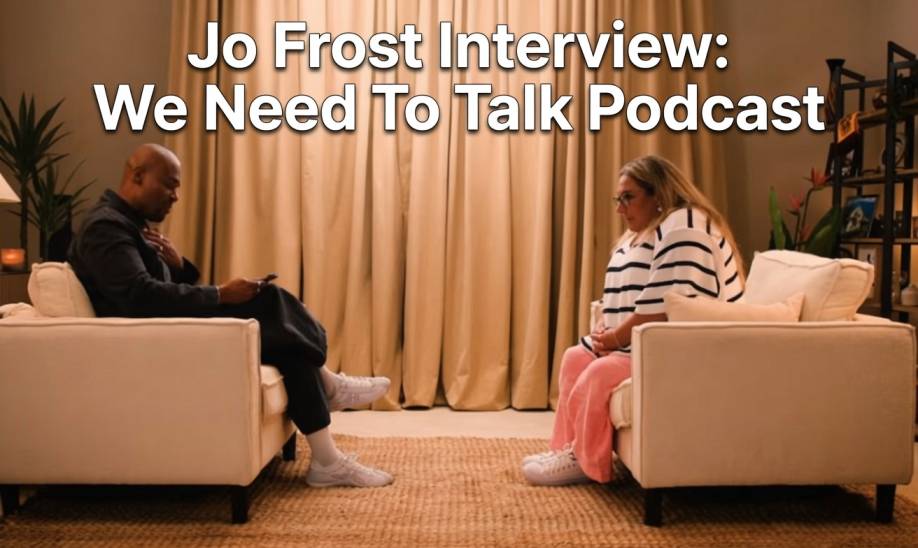
The following is the full transcript of global parenting expert Jo Frost’s interview on We Need To Talk podcast with host Paul C. Brunson, July 7, 2026.
Editor’s Note: In this compelling episode of We Need To Talk, Jo Frost returns to dive into the most pressing challenges facing modern families, from the dangers of social media to the complexities of teen behavior. Frost offers candid, expert advice on navigating “teen takeovers,” addressing cyberbullying, and establishing firm yet nurturing boundaries in an increasingly digital world. This conversation serves as a powerful call to action for parents to prioritize emotional connection and reclaim their roles as the primary guides for their children’s well-being.
Jo Frost Returns: Celebrating Impact and Addressing Teen Takeovers
PAUL C. BRUNSON: One of the things that I’ve seen with you coming on the podcast, and I’m going to talk about how big that was, how big of a moment that was, but I think one of the top reactions that I’ve seen is the hope that you have given so many people in a time that feels bleak and dark. And I think your work— I always knew your work was important, but now I understand it’s necessary. That’s different.
JO FROST: It is. And like you said to me when we spoke the other day, you said to me on the phone, “There’s no— I realize there’s no other job for you. There’s nothing else. This is it. This is what you— this is it.”
PAUL C. BRUNSON: Yes. And there are, Jo, there are millions of people who already knew it, but there are millions of people who watched you on We Need to Talk. So I just want to start with this because your conversation here is one of our most viewed and downloaded conversations in all variations and formats. So millions of views in the full length, tens of millions of views in terms of the clips, tens of thousands of comments that we received.
And I think it’s important just to take a moment because that was just a few months ago. Yeah, we met here.
JO FROST: Of course, it was only several months ago. It was just a— That’s right.
PAUL C. BRUNSON: Just a few months. So you were— our conversation, it resonated in a way that we have not yet seen. And I just wanted to take a moment and ask you, why do you believe that’s the case? Because I have many ideas, but why do you believe that’s the case?
Why the Conversation Resonated
JO FROST: Because I speak the truth. And I think people smell bullshit in 5 minutes because I think people realize that this is my work and I don’t hold back on what I believe is true professionally, because I’ve been in people’s living rooms. I’ve sat down with families. I’ve gone through their trial and tribulations. People have watched me for 20 years inside homes doing the nitty-gritty work. You know, it’s not cut and edited to look polished or to look wrapped up, because life is not wrapped up.
But if you think about predominantly from 2012, I was then doing other shows in the UK and a few in America.
PAUL C. BRUNSON: Okay.
JO FROST: But there’d been a very sort of large gap, right, where people were like, “Where is she?” It’d been several years. “Where is Jo? What’s she doing? Is she gone? She retired.” Like, I hadn’t retired. I was still doing the work that I do. But I think there’s this sort of sense that if you’re not immediately on television rolling out every week consistently, that maybe you’ve gone. And I hadn’t gone anywhere. I was still helping families, still doing charitable work and doing the work that I do.
PAUL C. BRUNSON: Yes.
JO FROST: But I’m not somebody that will rush and do something because everybody else does. I’m not going to rush and buy the latest Apple because everybody’s— I don’t follow the herd. I just don’t follow the herd.
PAUL C. BRUNSON: And that, I think, is the core reason why your conversation here resonated so much, is because people can see that this is life work for you. People can see you live and breathe this.
JO FROST: I do.
PAUL C. BRUNSON: And people can also see that you are willing to speak truth to power. But one thing that I have to do—
JO FROST: Yes.
PAUL C. BRUNSON: —is we have to celebrate you. Could we please? Jo, can we celebrate you?
JO FROST: Yes. All right.
Celebrating Jo: Tens of Thousands of Comments
PAUL C. BRUNSON: What I want to do is I want to bring something out, right? We received tens of thousands of comments across the various posts from our conversation. So we have here, and Katie’s going to bring this out. Take a look at this, Katie.
JO FROST: Oh, stop it, you’ll make me cry.
PAUL C. BRUNSON: These are— thank you, Katie. Look at that. Thank you, Katie. This represents the comments, the volume of comments that came. And not only did we get a heavy number of comments, but the sentiment. The sentiment is everything. So if I could, can I read some of these to you?
JO FROST: Yes, please.
PAUL C. BRUNSON: So these are the actual comments. This person said, “I grew up on Supernanny and the work she did gave me the ambition of being a child psychologist. I couldn’t explain her impact at the time, but hearing her talk with such passion and authenticity on this podcast tells me everything I needed to know. It’s impossible not to love her.”
JO FROST: That’s beautiful. And it continues, Jo. To inspire people to go into the profession, because we need more social workers, more therapists, more counselors. We need so much more. So yes, that’s good news.
PAUL C.
We’re still going, Jo. We’re still going. Let’s do 2 more. “If we thought we needed her then, oh Lord, we need Jo now.” Double heart emoji.
And let’s just do one last one. “Thank you, Jo. I started watching you back in ’04 when I only had 1 baby. I was glued on every episode and I bought some of your books as well. You helped me become an effective parent on the same parenting page as my partner. 5 kids later, all of them knew and watched Supernanny. They all learned how to stay in timeout. The hardest for me was waiting by their door as they learned to fall asleep. I learned so much from you. I want to thank you so much for doing the show and helping a family in Arizona. You are a blessing.” That’s beautiful.
JO FROST: That’s really lovely.
PAUL C. BRUNSON: Look at all these. It’s beautiful. And the comments go on and on and on and on and on.
JO FROST: But I think that’s why I do the work, Paul, because you know what, that’s the power of using television in a way that it becomes that vessel. You have the experience to give back, and then these shows get to help. They go out worldwide, and then they help families.
And there are moments, you know, traveling 48 weeks a year, a couple of weeks here and a couple of weeks there. That’s quite a grueling schedule, 48 weeks on the road. And then randomly somebody would just knock on the trailer, or you’d get a message delivered from down the road from where you were, or just something right at the time when you just felt really exhausted. And it was just that little sparkle of, “Yeah, remember why you’re doing what you’re doing. Yes, here it is.” There’s the little reminder. Not that I never forget, but I’m human too. You need the reminder.
PAUL C. BRUNSON: And I think that was what was so refreshing to me, to see those comments because—
JO FROST: They were beautiful. I read some of them and then they went on for so long. I was like, “All right, I’m going to need some time.” I read and I thought, “Oh, this would be the end.” And it wasn’t. It was huge.
And I want the opportunity just to say, because obviously I know people are going to be watching, just to thank everyone. I’ve been embraced— oh God, I feel so emotional. I feel emotional. I’ve been embraced for 20 years doing the work that I do publicly, and it really matters to me, children and families. And what I receive from people, the love that I receive, is just so beautiful.
Turning to Teenagers
PAUL C. BRUNSON: You know, Jo, there are so many thoughts that I have, but just to reflect on how the world embraces you is— I find that also to be somewhat unique. Because I go back and forth between the US and the UK and travel to different countries, and it’s rare to see someone embraced in so many different places.
But I ultimately think that when it comes to children, the disproportionate amount of us love and adore children. We’re all looking for instruction. I’ve got boys who are basically teenagers. I have a 15-year-old and a 12-year-old. I’m looking for instruction. We’re all looking for—
JO FROST: Yes, and guidance.
PAUL C. BRUNSON: —inspiration and guidance and inspiration. And you provide that. And I think that is why your work is so important.
The last time that you were here, we talked about your career, but we talked a lot about children, young children. But a place that I would love for us to ensure that we’re addressing are teenagers.
JO FROST: Yeah. Absolutely.
PAUL C. BRUNSON: And I saw a video that you did on teen takeovers. And this is me admitting something that is not good. That was the first time that I’d heard of that phrase, teen takeover. I wasn’t familiar with the phrase. And I want to read some statistics that I know that you’re well, well aware of.
JO FROST: That clip resonated. That clip did.
The Teen Takeover Crisis: The Statistics
PAUL C. BRUNSON: So in May 2026 in Oklahoma, a Sunday Funday promoted on social media led to a shootout between rival gangs that left 1 person dead and 20 injured. That’s CNN. In May 2026 in New York, over 400 teenagers invaded a park in a multi-day takeover, having several physical fights. That was at a car park. In the UK, this is recent. We know that this is April 2026. Over 100 officers were called to Clapham High Street.
Teens in the US have responded in favor of teen takeovers, saying that they have few places to gather and see friends that are free and offline.
So first, what is a teen takeover? And from watching your video talking about it, why do you believe it’s so dangerous?
Social Media, Moral Compass, and Parenting Standards
JO FROST: Well, let’s just go back to that last thing you said, which was they feel that they have nowhere to go and that there’s nowhere for them to gather and to meet up with other young peers to be active. Right. Yes, that’s true. I absolutely validate that. That is true. I’ve watched for 20 years in both countries those centers, those youth centers, be shut down, closed, shut down.
But then we look at social media and we look at the sensation and the hype that it creates. Because there is repetitive loops of behavior that entices. It feels novel, it’s exciting, right? To then gather all these teens into a place where they just erupt and then cause trouble. And then you have the FOMOs, right? And the crowd who, you know, what’s going on, and they’re filming everything.
But still, what does that have to do with having a moral compass? What does that have to do with having a moral compass and raising your children to understand about respecting themselves, respecting other people, respecting property, right?
So we live in a world in social media where I think people want to polarize everything or just blame it on one particular thing, and it’s not. There’s nuance, and on Instagram there’s no room for nuance, right? Everything you can watch feels very much in a space where it’s polarized to create controversial conversation. Right? But there’s no conversation that talks about the nuance of what our teenagers need.
So do we need to look at social media and its influence, its bad influence? Absolutely. I mean, some of these that you mention, they look like video games. Right. Like the kids have taken the virtual world now into the real world and in mass hysteria now are showing up and excited by it. And I just feel like at the time when I made the Instagram post, I was seeing so much of this that I was like, yes, we do need to get a grip on social media and what we’re allowing.
But at the end of the day, also, what are parents doing with respect to how they’re raising their own children? Your boys ain’t out there. Your boys ain’t gallivanting out there because you’re a parent with standards. You and Jill are parents with standards, with values. You understand that your two boys could actually get themselves into life-threatening situations, so you protect your family.
So what the hell is going on? What the hell is going on that teenagers— not young adults, teenagers— are now out on the streets loose, now gathering in herd mentality, mob mentality, right? And now jumping on cars, smashing, looting shops. Like, you can’t just blame it on the fact that there’s nowhere for them to go, because you should be raising your children with a moral compass as well to understand.
Not every child is born with a silver spoon in their mouth. There are children born on council estates, and you know what, there are kids that are also raised with a moral compass. They know right from wrong. So the clip really was about saying to parents, like, get a grip on your teenagers. Like, for a start, if they’re showing all of this and they’re being rewarded because they’re filming it, why do they even have phones in the first place? Like, clamp down.
So again, when you’re dealing with crisis situations, you can’t just go in with normal parenting. You can’t. You have to be able to step back and go, right, what’s happening with all these teens now? How am I going to protect my teenager? I’m going to tell people right now, you need to be sitting down and talking to your teenager, and you need to be having a curfew with your teenager. And right now you need to be saying, “This is where the phones are going right now.” Like, no. And where are you going and who are you going with? And actually, I want to back that up and find out as well. Because right now I’m not having you a part of that.
Now, if every parent was on the same page and they all did that, we’d see something different. Would it change the fact that we still need to have centers and youth centers and apprenticeships for kids to start getting involved in something that they really love and hobbies? No. I mean, we still need the money for that, right? Because it’s not always easy as well for families to do outside extra-curriculum stuff either. That costs a lot of money. But can we look at that being cheaper so that kids do have something to do?
But this is about standards and values and how you’re raising your children. I’m not going to have someone just blame it on social economics. “Well, you know, they were brought up in this area, so what do we expect?” No, there’s a lot of families that were brought up poor, living in subsidized housing, and they still had a moral compass. They still understood their values and their standards.
So again, for me, if we’re in a situation where our teens are taking over and they’re behaving this way, then who are the parents? Who are the parents? And how is this okay? And I do stand by the fact that I do believe that parents should be part of that wrap as well. If your kids are going to get in trouble and they are going to vandalize property and start stealing stuff, then as a parent, you should forfeit that too. Like, mind your teens, mind your children.
PAUL C. BRUNSON: So you’re suggesting— this is interesting— you’re suggesting that if a child is vandalizing and then is caught— pay the fine. The parent should be responsible for that, okay.
JO FROST: Yeah, absolutely.
PAUL C. BRUNSON: What about if the penalty— let’s say that unfortunately it’s not vandalism, let’s say that they’ve stolen a car, a child, a teenager, stolen the car, the penalty is a prison sentence. Do you think the parent is equally responsible, should serve time for that?
Early Intervention, Connection, and the Role of the System
JO FROST: Well, I think you have to look at the nuance in those circumstances. I don’t want to black and white everything. Because I know from the work that I do, again, early intervention would really help a lot of families. And again, that’s funding, training, programs out there for families. So you’ve got to look at both ends, right?
I’ve been saying this for years— you cannot strip a society of what once was available. You can’t strip them bare and then expect them to stand up and be okay. I’ve watched families have just very subtly had things removed, taken away. Homestarts, which are fantastic organizations for families with young children, they were taken away in the hundreds, and now they’re coming back.
But it does start at home. I don’t think you can have a blanket rule because you do have to look at a family, but I feel that for many families, the first time that externally we get to see what’s happening is if we have health visitors and social workers, and then that first point is normally the teacher. The teacher is able to say, “Hey, we’ve recognized this behavior in the school. We’re a little bit concerned about that. We’re troubled by that behavior. We want to be able to bring in a specialist that can intervene between school and home and give them the support that they need.” We need that everywhere.
Every family needs that because we’re in challenging times and some families don’t know. They don’t have the education. They don’t know. They weren’t raised that way. Some of those families come from deep trauma, complex trauma, come from addiction. They weren’t given that upbringing themselves, so they know no different. Imagine having two very influential educators to be able to help them.
So is the system letting down a lot of families? Absolutely. But how do we change that? It’s got to be grassroots. Punishment alone is no good. Consequence, punishment, whatever the word you want to use— I believe does not work on its own. You have to have the yin yang.
In the same way that you see me help families, you might be correcting behavior, but if you’re not connecting with the child right, then how are you really shaping your relationship with the child to eventually eliminate less and less of that correction because you have more and more connection?
So when we look at teenagers right now, is this the impact of not enough connection? Because the connection they’re getting is on social media, and that social media that they’re looping in and repetitively seeing, that’s dangerous. That’s harmful. And you know how strong I stand with that— raise the age to 16.
Phones as Pacifiers: The Loss of Presence
PAUL C. BRUNSON: Can we talk about that? Because this is what I find interesting. The addiction to it is what I find to be so interesting. And also how social media, but phones are used as almost— you know how we call it— it’s a pacifier in the US?
JO FROST: Yes. Dummy. Yeah, dummy pacifier. Yes. Yes, true.
PAUL C. BRUNSON: So we were at my niece’s graduation. And so she’s graduating, right? We’re in this massive auditorium. In front of us is a family, right? Now, while their loved one is getting ready to graduate, I see clearly the mother, father, and 2 children. One child looks to be about 12, 13. Another child looks to be about 5. Jo, they were all on their devices.
JO FROST: I’m not surprised.
PAUL C. BRUNSON: And they were all playing like some mindless game. All of them, the mother, the father, the two children. And I pointed it out to— I was sitting next to Kingston and Liam, and I pointed it out to them and I said, “This is fascinating.” And to me it was— I felt like perhaps they were addicted. It was a bit of a pacifier/dummy. The children were modeling what the parents were doing. It was mind-blowing, but at the same time not shocking.
JO FROST: Because we all can’t believe, we’re like, how are we not raising our children to fundamentally be present and in the room? With the experience of these wonderful things that happen in life, and instead they want to film it, or they’re watching something else rather than enjoying being physically present in the moment of a graduation or a wedding, or together talking about what they’ve just been sightseeing because they’re on holiday somewhere, right? Or in the presence of friends together.
It’s one thing to talk to your friend even on FaceTime, right? Teenagers will say to me, “Oh, I can connect with my friends on the video games and stuff, and then we do a FaceTime.” But there’s nothing better than being in front of someone, right, and laughing together. The energy, hanging out together, listening to maybe a set of music, and everyone’s vibing, you’re all together. That is golden.
Are we losing that? Are we losing the value of that, the true value of that? I believe we are. If we do not value it as parents, then we’re not going to be teaching our children how to even recognize it and respect that.
So it’s mind-blowing to everyone because we are sitting there saying, how have they allowed this? How have parents allowed, in a moment like this, how have they allowed them? Because what you’re basically saying is, “Oh, you know where you are? Well, you don’t have to value it. You don’t have to respect where you are. You can just bypass it and just look here on the screen.”
Imagine if you were talking to me and I went, “Yeah, no, I get what you’re saying, Paul. Yeah, no, I get what you’re saying. Uh-huh. For real. Yeah. Yeah. No, definitely. Yeah.”
PAUL C. BRUNSON: It’s horrible. No connection. And also that word that you just used is so interesting. Value. To me, it suggests how little value you have, you would then have in our interaction.
JO FROST: Exactly.
The Phone Problem: Parenting, Social Media, and Protecting Our Children
JO FROST: And, you know, mothers will say to me, oh, you know, my child doesn’t really make many friends. And I’m like, but you had 3 of them round for lunch and they were all on their phones. What was there? No phone put away. All right guys, hey, sit them there, sit them there. Oh, but they’ll be bored. Not for long. 3 teenagers are not bored for long in a room. They’re going to be talking about something, they’re going to be playing something, they’re going to be doing something, they’re going to be playing some music, they’re going to be talking about something.
So again, why are we doing this? Why are we doing this as parents? Why are we just handing over the phones to them? You know, that’s the question I want to ask parents so that they can be truthfully honest with themselves. And most of them will turn around and say to me, well, you know, they’ll start complaining, or they’ll have a kind of hissy fit, you know, and I just don’t want trouble. I just don’t have the energy. You’re missing the point. You’re missing the point.
Put your phones down. That has become now the pacifier of “I need a break.” Take a walk. Take a walk. Pick up a book. Why are you constantly on here? Because that is addiction. That is addiction. For myself, I can literally look at my phone, I might answer a text and put it down and not pick it up for a couple of hours. And then I realized there was a text back from that person. They must have thought, what happened here, right?
PAUL C. BRUNSON: Why don’t you respond right away?
JO FROST: Why don’t you respond straight away? Yeah, because I refuse to be attached to my phone to the point that I become a slave to it. Now that’s not to say that if something’s going on and I need to be present, I need to be receiving in that moment, and I know that I’m not, but I refuse to do that. And I think as families, we have to understand what rules will we put in for our family.
Smartphones in Schools: The Case for a Legal Ban
PAUL C. BRUNSON: The statistics support everything that you’re saying here. So in the UK, 2019, 79% of children age 11+ in the UK had their own smartphone. That blows my mind. And that’s 2019. So it’s higher now. Also in the UK, 20% of 10- to 15-year-olds have experienced some form of cyberbullying, which we’ll get to. But in England, the government has said it will introduce a legal ban on smartphones in schools. While most schools already encourage pupils not to use their phones during the school day, this would be an outright legal ban. Now, I know you have an opinion on this.
JO FROST: I do. About time. About time. What do you think those kids are doing in the classrooms? The same thing. We have educators who are passionate about the subjects they teach, and they are constantly having to fight the attention of a smartphone. Because those kids now are wanting to get out their phones, texting, parents calling in, and interrupting. And what happens to recess? Are they mingling? Are they socializing? And we’re wondering why teenagers feel anxiety because they can’t say hello to somebody and hold a conversation because they feel awkward.
That’s the beautiful breeding ground, right, that we hope for a lot of people. We’ll talk about later how it wasn’t for me so much, right? But we hope that that is a space where, you know, you as a teenager get to meet friends and discuss different interests, or just talk about something maybe outside school. But it’s the learning ground of the modeling of kinship, friendship, right? And how who’s different and who’s alike, and just the raw sort of experiment of just kind of throwing yourself in there as teens.
I don’t think there’s a right or a wrong, to be honest with you. Teens just get together, and there are some that are more shy than others, but it’s a moment, I think, of being able to provide the opportunity for teens to come together and to be able to spark up conversation.
PAUL C. BRUNSON: So your suggestion then to parents is to what? Is it to take away the phone or is it to modify the use of the phone?
JO FROST: In schools, I think it’s a great idea. They’ve said, look, we’re going to ban the phones in schools because we want our children present, and we want them present to learn. They are here to learn and to make friends and to enjoy the experience of being at school. And may I remind parents that there are thousands of young girls who don’t have the privilege in the world of having an education, and there are millions of children that do not have that privilege of being taught every day. It is a privilege that we have that in the UK and the US. We don’t want interruptions at all. So I think that that decision was well needed, and I’m really pleased that that’s going to go in.
Big Tech, Bereaved Families, and the Cost of Social Media
However, Big Tech are making big money because they have platforms that are exposing our children to challenges and to content that’s harmful and dangerous, period. And for me, that cannot be. Over the last several months, I have had the privilege of speaking to several bereaved families that lost their children to social media. And it’s devastating. And their children ain’t coming back. You and other families get to have the summer of 2026. They’re not going to have it. They’ve got photos, they’ve got videos. They’ve got memories. That’s what they have. They’ve been robbed of everything, Paul.
PAUL C. BRUNSON: Can I ask you what happened with these children?
JO FROST: Cyberbullying, cyberbullying challenges, you know, on TikTok.
PAUL C. BRUNSON: Oh, I see. Challenges where they succumb to— okay. Yes, you’re right. Very popular. The challenges. Yeah, yeah.
JO FROST: And many other different things as well. Suicide. It’s devastating. It’s really devastating what it’s doing for our teenagers. So raising the age is the least that the government can do to give our children a childhood and to protect our children. We already know the content that’s out there and the misogyny that’s out there, influencing our young boys, right? And the pornography that our young boys are watching because it pops up, right? And then the influence of body dysmorphia for our young boys and for our girls as well. There’s too much harm on social media.
And the argument’s been, people have said to me, “But Jo, they’ll find their way around it. Australia’s done it, but they’ll find their way around it.” You can find your way around most stuff. Having a cigarette, an alcohol, anything, you can find your way around it. That’s not the point. Parents need to take responsibility. They do need to understand what their children are watching, what the parental guidelines are. They do need to have an ongoing conversation with their children about what they’re being exposed to, and to be able to have open dialogue that we hope those children will say, “Hey, Mum, hey, Dad, this came up on my screen, and I want to share that with you.”
But this is beyond what families can do. This is tech companies with billions of dollars that have our kids doom scrolling, constantly putting our children in front of material that should be protecting the innocence of their childhood. In China, the material that their children are watching is all aspirational. Not in the UK or in the USA. It’s all aspirational stuff to build them up, to empower them. In the US and the UK, make that make sense.
PAUL C. BRUNSON: I remember seeing a report on this. So is that the case? Are the algorithms serving up inspirational content in China?
JO FROST: In China, the children are watching something completely different. That’s all censored. Those platforms are not existing. But in the UK and the USA, look at the stuff our children are exposed to. It’s a massive no-no.
Ditch the Text, Make a Call
VIDEO CLIP BEGINS:
UNIDENTIFIED SPEAKER: Hello, my name is Daniel and I have taken this lovely seat bequeathed by Paul to tell my wife Lydia, love of my life, fire in my veins, to call me. Welcome to iD Mobile, please leave your message after the tone. I don’t care if it’s you at home asking me where the remote is, I don’t care whether you’re on your way back from work and you’re literally calling to tell me that. I just prefer a call. It lets me know that you love me.
Listen, Paul himself, relationship guru, they call him Ugo of relationships, he just said that phone calls will boost all the chemicals we need for extra loving. Okay, if you remember, basically our whole relationship was built on phone calls. We started dating when you went to uni, and so we long distanced for 3 years. We probably fell asleep on the phone together 4 nights out of a week, which was incredible and really formed our relationship. So I’m just trying to bring a little bit of that love and spontaneity back.
Let me paint you a picture of the kind of call that I’m hoping that I get. Hey boo, how are you?
UNIDENTIFIED SPEAKER: Just a quick one. Do we have cheese?
UNIDENTIFIED SPEAKER: We’ve got cheese. Great, thank you.
UNIDENTIFIED SPEAKER: I’ll be home in 2 minutes.
UNIDENTIFIED SPEAKER: Even that, ooh, that would get me. It would just be nice. That would just be amazing. And it’s 10 seconds. What do you think?
VIDEO CLIP ENDS:
PAUL C. BRUNSON: Tell me if I’m wrong, but you were not necessarily saying that there are words that you want to hear, but it’s how you want to hear them.
JO FROST: 100%.
PAUL C. BRUNSON: You know what’s so interesting though, is I think you’re married to me. Because I’m Lydia, right? I’m like, “Uh, Jill, where’s the remote?” Yeah. I’m super, super, super texter. And all the research supports what you’re saying. It sounds like Lydia does too. So Lydia, she should just call you.
JO FROST: I’d love that.
PAUL C. BRUNSON: And you know, you’ve inspired me. I’m going to call Jill at least once today.
JO FROST: Oh, listen, we’ll shake on it.
PAUL C. BRUNSON: I’m going to call her. We’ll shake on it. Yeah, I’m going to call her. You know what? I should call her right now. And of course, we’re in partnership with iD Mobile and Mental Health UK. We want you to ditch the text and make it a call. You could see how the phones then lead to bullying. And this is going back to—
Cyberbullying and the Mental Health Crisis in Children
JO FROST: Ongoing bullying, the constant emotional abuse. The constant verbal abuse. For a child, that’s heavy. That’s really, really heavy. I have personal experience with that.
PAUL C. BRUNSON: Yeah, can we talk about this? Because the connection between the phone, cyberbullying, and then the mental health of our children is a connection that I don’t think many people spend enough time understanding.
When you just look at the percentages, 20% of 10- to 15-year-olds in England and Wales have experienced some form of cyberbullying. That’s not just bullying, that’s cyberbullying. But then when you specifically look at bullying, these are the stats that are just incredibly sad. 40% of young people were bullied in the last 12 months. That’s in the UK. So nearly half in the last 12 months. 21% of children in the UK who had experienced bullying daily had skipped school at least once in the 12 months.
In the US, 1 in 4 students will be bullied. 1 in 3 will be cyberbullied. And this is the statistic that I think everyone needs to sit with: in the US, 160,000 students will miss school every day due to the fear of being bullied. Now that you’re not surprised at all about.
Jo Frost’s Experience with Bullying
JO FROST: That number, that number is grave for me. I mean, that number’s huge. That’s nearly 2 times Wembley Stadium field. Nearly 2 times.
For the fear, I have so many thoughts on that because again, on a social media level, right? If we’re talking about social media, we are seeing this increase, and yet again, tech are doing nothing about that, and those people need to be held responsible, and they’re not, right? So it’s continuing. And so at what point are we really helping anyone? The parent, the child who’s the victim from the bullying, the teachers who feel they have their hands tied.
And from my perspective, as someone who goes in and does this intervention work, it starts back at home again. Because I see two children, and when two children are in pain, one’s the victim, one’s the perpetrator. This one here is going to be bullying this one over here, right? But this one here is also in pain. So we have two children, one who’s receiving the projection of pain that that bully is in, and we have to look at both.
We have to protect the child who is being victimized by this bullying, but the root cause is to understand why is that child showing up the way they are. Why are they continuously going into school and bullying that child? Why are we not intervening? Now they can continue via the phones and then spread malicious word. We’ve now got AI deepfakes. You see what happened with the school that was blackmailed because they took some pictures online — the school put up pictures of the kids and they deepfaked all the children and then was going to blackmail the school. “If you don’t give us money, we’ll put out all of these images.”
PAUL C. BRUNSON: Jo, do you have experience with bullying?
JO FROST: I have, yes, absolutely. 3 years, secondary school, for 3 years I was bullied. I’m a social butterfly really, I love to talk and meet people, just get to meet people and talk and enjoy. I’ve always been that way. Even my parents would say to me, “You always made friends wherever you were. You talk to people and you just make friends.” In secondary school, for me, it was very hard because I started and then I was verbally bullied by 3 girls, and that went on for 3 years.
PAUL C. BRUNSON: For 3 years?
JO FROST: 3 years. And it’s definitely — I definitely have an emotional scar from it, absolutely, because I can pull it up like it was yesterday. It was a very hard time at school because I enjoyed school and I enjoyed what I was learning at school, but when I wasn’t in the classroom, the behaviour would happen. And even though the teachers were aware, they would contain it in the classroom. But then what was happening when it was breaks or lunchtime, there wasn’t that sort of supervision. I was kind of just out there on my own as such.
And then those 3 girls threatened the whole class that if anyone spoke to me, that they’d get it, right? So they were all like, oh, you know. And actually, one girl — the behavior was so bad for these three girls that they were then not in the school. So they were then sent to a sort of school for behavior, like a center, right? We would now know that as a center for children that may be having difficulties. So perhaps others would have got involved.
PAUL C. BRUNSON: But during that 3 years, I mean, that’s a long time. Did you dread going to school?
JO FROST: Yeah, absolutely. My parents were very supportive. My parents were emotionally — in my teen years, it didn’t matter what choice I’d made. “If I’d hit shit street, call us. Call. Didn’t matter if it was 2 in the morning, 3, whatever it was, call. We’ll come pick you up. Call.” That was sound. But I had that dread on a Sunday. That Sunday doom. It was doom. It was real dread and real doom that I was going back to school on Monday.
My parents would go up the school and they would talk to the teachers — “What are you doing about this behavior?” And they weren’t letting go of that, right? My dad had a different standpoint. My dad was like, “If they touch you, then you might have to handle it. If they punch you and you’re defending yourself, then you do what you need to do.” My dad was like, no, you defend yourself.
PAUL C. BRUNSON: But what was your mother’s take on it?
JO FROST: I think my mum’s take would have been the same. My mum never said that. My dad’s from Brixton, my dad’s from South London, he’s brought up old school. “If someone comes and they hit you, you defend yourself.” But as a child, I was very empathetic and very sensitive. And so even when these girls were being rude to me and verbally saying things to me, I’d be hurt that they said that, but then I’d be like, “Oh, that’s really sad that they’re like that.” I feel empathy for them, which is nice, but it meant that that behavior was continuing.
PAUL C. BRUNSON: Right. So then did things ever get physical?
JO FROST: Yeah, they did. I remember going into school one day and there would always be these threats — “We’re going to beat you up after school, we’re going to do this after school.” And I remember thinking, I just don’t want to get into any of that. But I just remember one time one of the girls in the changing room said something to me. I f*ing hit her.
PAUL C. BRUNSON: I hit her.
JO FROST: I didn’t even realize I did it. She went away.
PAUL C. BRUNSON: It all stopped.
The Nuance Between Theory and Real Life
JO FROST: Mm-hmm. So I sit as a professional educator very conflicted because what we want as professionals is to get to the root of all of this before it gets to that point. And I think at that moment it was so intense with what was happening, I must have gone into some kind of fight or flight. Because I don’t even realize I did it until I looked at the girl’s face and her lip was bleeding.
I do sit conflicted because I do feel that if we had the intervention, if we had people like myself that were in homes, we could early intervene with the hurt that those young girls must have been feeling growing up in the families that they were growing up in, in the circumstances that were adverse for them, and that they felt that they needed to empower themselves by domineering over somebody else, right?
And I think that in itself is a lesson in itself. I don’t condone children going out there and hitting other children. But I also think — and I’m going to say this very truthfully, so I hope it really lands the way that it’s intended — that there’s the goodwill to say do this, and then there’s life, and then sometimes that is what needed to happen. You understand what I’m saying?
PAUL C. BRUNSON: I’m living this because with my boys, both myself and Jill, we’ve been adamant to not initiate, but we’ve also been adamant in ensuring that they understand how to protect themselves physically. So they’re in Muay Thai. And one of the reasons for that is life.
JO FROST: I just don’t think people are talking about the bit in between, Paul, that you and I are actually talking about now, right? There’s the professional — I am not professionally saying go out there and start hitting kids, right? But the conversation I’m having to you from human to human is that the nuance in the in-between is that the uncomfortable, inconvenient truth is that sometimes you do fire with fire because you try to do everything else, and the only way that somebody was going to back off is when you said, “Stop, stop.”
And in my case, that’s what happened. And I’m being really honest with you — if that was happening to my kid and my kid said, “I did that, Mom, I did that,” I’d be like, “Well, then you did what you needed to do.” I’m being really honest because life, yeah, right? And how it is in schools and life sometimes does not correlate with theory.
Corporal Punishment: Where Do We Draw the Line?
PAUL C. BRUNSON: I want to look at, and I’d love to get your opinion on corporal punishment and physical punishments because —
JO FROST: Well, we’re going here today, Paul. We are going. We’re going here today.
PAUL C. BRUNSON: We’re going because this was shocking preparing for you to come in. I was looking at some of this data, right? So in the UK — and you’re aware of this, this is for everyone else — the use of reasonable punishment by parents is legal in England and Northern Ireland, which can include smacking if it does not leave a mark. However, in Scotland and Wales, it is illegal to use any form of punishment. So just so everyone understands, corporal punishment is physical punishment of children by hitting or smacking them with a hand or object. Physical punishment can involve other methods, such as putting soap in a child’s mouth.
JO FROST: Seen it all. The soap one — no, no, no, and no. It’s always the corporal punishment. Like, that’s a human being. A child is a human being. If you do that to another human being, that’s aggravated assault and you’re doing time, as you should.
There is enough collective evidence scientifically for us to recognize that the damage, the long-term damage of corporal punishment, does not create good relationship. It doesn’t. And there’s a very fine line that nobody really talks about between parents who will justify that behavior every day to actually hit kids. So the silent epidemic of child abuse — and that’s in America and the US.
PAUL C. BRUNSON: How prevalent do you think that is?
JO FROST: Corporal punishment is still in 19 states in schools. In schools. In America. America still legally has corporal punishment in 19 states. Make that make sense. Not in the UK. But in America, 19 states still. And those children — the statistics show more Black kids, more children with neurodivergence. Absolutely.
Again, can we just bring in the social workers, the early intervention, the psychologists? Can we just go into the families? Can we just peel back the layers there gently with nurture? And educate so that this isn’t going on. Because again, what we see is then that behavior on the outside of family. You’re not going to make that go away by caning, whipping. It doesn’t make sense. None of it makes sense when we also have the data as well. But just morally, it’s wrong.
I’d like to ask you as a Black man — we still see in Black culture jokes of Black parents saying, “Oh, my grandma used to say to me, ‘Go and get the switch, go and get the branch.'” “I’ll get licks from my parents behaving that way.” It troubles me. It just doesn’t —
Corporal Punishment and the Need for Family Support
PAUL C. BRUNSON: And so to this point, essentially for me, I’ll give you my experience, is that my mother is from Jamaica, my father’s from South Carolina. The family environment — so they grew up under conditions in which it was exactly that. “Go get the switch. Go get the piece of the tree, basically.” Go get the belt. “You’re going to get the belt.” This is what they grew up under. And the idea was that this is going to help you to be disciplined. This is going to — straighten. Exactly.
JO FROST: So that the police didn’t have to handle your kids.
PAUL C. BRUNSON: Exactly. This was the protection. Yes. The “quote unquote” protection of them. And I think that — I don’t know what the statistics show, but I would imagine that that’s evenly distributed across ethnic and racial groups. Agree. But I think the intention, though, within the Black families that I was aware of is that it was, “Let me try to protect you.”
JO FROST: Correct.
PAUL C. BRUNSON: I agree. Because you’re going to get worse out here on these streets. So let me try to protect you.
JO FROST: I think that’s for any family. I think that’s for any family who feel and were raised with — it was about protecting them from something else that would be stronger and more harmful for them. Yes.
But then explain “spare the rod, spoil the child,” because Paul, I have a problem with that. I have a problem with human beings hiding behind the Bible to justify hitting their kids. You know, a rod is a guide. A shepherd holds a rod to guide his sheep, to guide, not to whack, not to hit. I have a problem with that, Paul. Professionally, that doesn’t sit with me.
PAUL C. BRUNSON: I mean, religion plays a strong role, strong, strong role in this. And this is, I think, another topic, but I’m glad that we’re here on this topic that you see more and more discussion around today.
But I just don’t feel as if the numbers are drastically reduced. I think that people have just talked less publicly about it. They’ve just kind of gone underground with it, if you know what I mean. They’re not posting online that they’re spanking their children, but they are spanking their children.
I mean, look at some of these stats. A 2021 survey showed that 62% of adults in the UK had said that they had physically punished — an example of that would be a smack — their child at least once. 42% of adults in the US the same year, 2021, had said they had used physical punishment with their children at least once a month. And 79% of adults in the US said that they were spanked or hit by their parent more than once as a child.
JO FROST: So a lot of unregulated, emotionally unregulated adults and a lot of emotionally immature adults in the world right now, right?
PAUL C. BRUNSON: Yes. Yes. And so this hasn’t gone away.
JO FROST: No.
PAUL C. BRUNSON: Corporal punishment, physical punishment. It has not gone away. And so — what is your — we know what your stance is.
A Call for Leadership That Values Children and Families
JO FROST: To educate. We have to keep educating families, and we must come to a point where leadership in countries are empathetic and value our children, full stop. Full stop. If we want a future and a world and a society that are more empathetic and kind and compassionate, we have to have leadership that values its children. We have to.
And by valuing your children, you support their parents, their carers. And we have so many issues that we’re fighting right now. Yes. So many, right? As families. Affordable housing, affordable childcare. Yes, right. Yes, yes. You know, when you keep stripping funds because you don’t see how funds need to go here because they need to go into the military or they need to go for this cause, you’re leaving your families — well, they’re feeling broke. Yeah, yeah. You know, yep.
PAUL C. BRUNSON: Yes, I’ve seen many comments that say that you should become the Minister of Family. They should create a position.
JO FROST: They need it. They need a department for children and families, a ministry for children and families. Yes. Yeah, give me a call. Yes. But I’ve been trying to knock on Number 10 for a long time to sit and discuss about our families right now, and I’ve not had the invitation yet.
PAUL C. BRUNSON: Okay, so you would like it? So you would take that task?
JO FROST: I would take, yeah, a conversation, right, with the Prime Minister to discuss truly the grassroots support, the conversation of how we truly support our families and what that takes, because that’s no skipping a jump. No, you know, and I do things properly, right? I want it done properly. I want a system in place that truly does support, not talk. I walk the talk, Paul. So I want it done properly to truthfully be a framework, you know, and an internal scaffolding to help these families and children.
PAUL C. BRUNSON: I believe there will be a lot of people behind that petition. Can we talk about some practical parenting advice? Why not? Of course. This is — I feel like everything we’re touching is on controversy today.
JO FROST: But you know what, I think we’re having a conversation that needs to be had because we are talking about not fluff, but we are talking about things that are at the heart of family. Yes. And I do think the heart of family is about having these sort of awkward or uncomfortable conversations.
And I hope that us having these conversations and the respect that we have for each other and the things that we learn from each other in this conversation allows people to have those conversations with their own family members and their friends or in the office or at the school gates or wherever they are as well.
PAUL C. BRUNSON: Absolutely. It goes to this whole idea of the more challenging the conversation, the higher quality of life that you get.
JO FROST: And I think people are sometimes scared to have that. I don’t know everything. You know, I’m learning every day. Yeah, same, same. You know, I’m learning every day, but I’m open to ask those questions. And I hope that if I’m asking those questions, I can learn. And I would like families to see this as an opportunity to have those conversations with other people in their circles. Right.
The Dangers of Unverified Parenting Advice Online
PAUL C. BRUNSON: But then the question becomes, who should families be receiving their information from? Because there’s this growing trend of people seeking out parent advice online that I know that you know. But this is what I find to be interesting. So a study found that 97% of parents use the internet for child health or development questions. Okay, so not bad. It’s okay, right? They’re using the internet.
JO FROST: No, because there’s a lot of information out there and not enough wisdom, Paul.
PAUL C. BRUNSON: Okay, so yet — this is exactly where I’m going, Jo. Exactly where I’m going. You got it. Another study found that of the parents who searched online for parenting information, only 26% of that information came from verified sources. So what we have here is we have parents now going online at disproportionate numbers. Almost all parents going online for advice, but most are getting their advice from non-verified sources, which creates a lot of issues.
JO FROST: But that’s in everything. It creates a lot of issues, and that’s in finance or in health. Yes. And in the medical world — I mean, again, going there as well, it’s not just in the parenting world. I think probably what you’re talking about is recently what’s happened with the information with infants being laid on their tummy, on their stomach.
PAUL C. BRUNSON: Yeah, absolutely.
JO FROST: And the outcry there because the safe guidelines with the NHS Lullaby Trust — those safe guidelines that have worked for decades and prevented SIDS, sudden infant death, right? That information is not about laying your infant on their tummy. It’s about laying your infant on their back and having a very clean, clear, and firm mattress and area, sleep space, for their infants so that it’s clear and clean away from any toys or bumpers. Maybe 3 inches from the bottom of the cot. Yes. So that it’s safe. Yes. You know, in room temperature, that’s somewhere between sort of 16 and maybe 19 degrees, something like that.
Safe Sleep Guidelines and the Risks of Unregulated Baby Sleep Experts
PAUL C. BRUNSON: Okay. So this is exactly a piece of this — sudden infant death, SIDS, in England and Wales was reduced by 81% since the back to sleep message. Absolutely. Right, placing a baby on their back was launched in 1991. But then a BBC report released just this month stated that there are lots of dangers around unregulated baby sleep experts. This report found that baby sleep experts were providing unsafe or even dangerous advice on social media during consultations. And the dangerous advice included suggesting placing infants on their fronts to sleep. Correct. So you have refuted this?
JO FROST: I have, because it does not support the safety guidelines for sleep for infants. And so I would ask people to go to the NHS for those guidelines and the Lullaby Trust, and we should as professionals stand by those standards and that safety for our infants.
But we also — I spoke in that Instagram of the importance of having our sleep safety standards in daycare, in nurseries. Okay. You know, because little Gigi — the Gigi campaign — she was a young infant who was murdered, basically. Because she was placed tummy down on a bean bag. Yeah, yeah, it’s horrific. You go off to work, your child is in nursery, daycare, and now no child because we don’t have trained staff. Right, in daycare, where are the sleep safety standards? There should be a gold seal standard, period, for every daycare. Gold seal standard. It’s horrendous here in the US too. Our children need to be protected. They need to be safe. So the fact that we have one child dead is enough.
PAUL C. BRUNSON: We live in this society where society feels like it’s in the business of covering your ass, right? But not — yeah. Let’s figure out how the incident doesn’t happen. Correct. You know?
JO FROST: That’s how we should be going into any circumstance or business. You know, we think about safety. I mean, we wouldn’t have had Grenfell Towers. Oh yeah, we wouldn’t have had that happen if somebody was not pulling cheap on money. Yeah. And oh, just put that up there.
When that happened, my dad straight away was like, “Oh, that’s a cladding” — before they even knew — before they even said anything, you know. That was my father’s business. Yes, you know. And he’s like, “Oh, straight away.” You know, why are we not looking at prevention with the materials that we’re using and safety of alarms and sprinklers and how to keep people safe in the world?
PAUL C. BRUNSON: Yes. I think for everyone not familiar with Grenfell Towers, there’s a phenomenal documentary on Netflix that I saw on it. So for every American that doesn’t know about it, it’s so important. Yeah.
The Cry It Out Method: Is It Right for Infants?
PAUL C. BRUNSON: Can we talk about the cry it out method? We can. Because this is — and just for me to label it — this is a sleep training technique where a baby is placed in their crib awake and left to fall asleep independently with parents intentionally not responding to crying.
JO FROST: Correct. The Ferber technique. It was called the Ferber technique. Now people have just reduced to saying “cry it out.” Because the infants are being left to cry it out, and I’m glad it’s gone.
PAUL C. BRUNSON: Okay, but this is controversial because some are saying that it’s unnecessarily stressful, but others are saying this is the right way to do it. It’s not. No, I’d like to say that it’s not.
JO FROST: I don’t believe in it. I’ve never believed in it. I’ve never practiced it. The Ferber technique, I don’t feel is healthy for infants. It leaves them in a situation where there is no sporadic comfort, right? No sort of intervening from the parent. And I think that’s most important in that first year of attachment in your relationship with your infant. Okay.
So I use something called the Controlled Timed Comfort Technique. Okay. And that technique — normally I’m practicing that with infants that are around sort of 8, 9 months old, when they’re already eating puree foods and finger foods. And then parents want to sleep train. Okay. Right.
I will depend on the family. A lot of questions need to be asked. I’m not going to say, “Right, just do that technique.” An assessment is necessary. Assessments are very necessary. But that technique requires all the comforts and nurturing of the bedtime routine, and then you double the time. So you may go in 2 minutes and then come out, and then 4 minutes you go in, your hand is on their tummy. You come back out again, they see you, and then go back in again and you double the time. So there is always a connection. I see it. Always.
The Browns: A Supernanny Success Story
PAUL C. BRUNSON: It’s not the same. Is this— so I know on Supernanny there was a couple called the Browns. Yes. You remember the Browns?
JO FROST: I do remember the Browns.
PAUL C. BRUNSON: Okay. And they were struggling to get their son. He was a toddler. Yeah.
JO FROST: Yes. To sleep.
PAUL C. BRUNSON: In his own room. That’s right.
JO FROST: You see the size of that bed? Yeah.
PAUL C. BRUNSON: Yes, I would like that myself. Yes, massive. Yes. So you, do you remember them?
JO FROST: I do remember them. Okay. I do.
PAUL C. BRUNSON: Do you remember the technique?
JO FROST: I do. What did I do with them? Stay in bed technique. I did the stay in bed technique with them. So, you know, it was set up where a bedtime routine supported the connection, right? And the nurturing and these sort of stable comfort ritual and routine of bedtime so that everybody is calm. There’s no anxiety flying around, no nervous systems like this needing to regulate. The work is set up several hours before the child actually goes to bed. I see it. That’s all part and parcel. All right. And then the technique in, right? Then the technique that I do then with the family, and that was very quick for them. That was— yeah, right, because the child was comfort.
So I want to point out, because I think this is a really interesting conversation, that we have a lot of mothers, right, who have to go to work, right? They’re single parents and they say to me, “I have to go to work, right? I don’t have an option. I have to go to work, right, to support my family.” And their children are in daycare for hours, 7 hours, hours. And when that child comes out, that mother is in space of production line, right? A little bit of food, okay, get the showers going, pack what I need to do in the morning, okay, come on, come on, come on, come on, come on, come on, come on, come on.
And the child has had no emotional connection with their parents. And so if you’ve not made time to just put things down for a moment and connect with your child, your child is going to bed emotionally starved. So you’re putting food in their mouth, but emotionally you’re starving them, right? And a child is going to get hurt because they miss you emotionally. You have that attachment and they need that. So it’s really important. But there is parameters in making sure that correct assessment is made when you’re doing anything like that. I don’t take that lightly.
PAUL C. BRUNSON: On that point, yes, I have something that I want to show you which further supports everything you’re saying here. Let me pull it up. The Browns.
VIDEO CLIP BEGINS:
JO FROST: Hey, Nanny Jo, I love you. I miss you. Oh no. I thought the best way to show you how much you mean to me and that you’re missed here is to just show you. Okay, so it’s time for bed and come on, let’s take a peek. Go on, gal. No one is in our bed. First up, Michael Joe. Same boy, just bigger in size. What are you doing? He’s fast asleep in his own bed. I saved the best for last.
UNIDENTIFIED SPEAKER: I’m so glad that our kids are not in our bed anymore.
VIDEO CLIP ENDS
JO FROST: Michael!
PAUL C. BRUNSON: That’s so good. Love them.
JO FROST: They’re so nice. Did you hear their deep Southern accent? Yes. I used to go in and go, “Well, we’re going squirrel hunting.” I’m so glad. “Oh, Nanny Jo, don’t leave Nanny Jo. Please, Nanny Jo.” You know, they’re a great family. It’s so good. So many families.
Audience Questions
PAUL C. BRUNSON: So good. I tell you what, with the time that we have left, here’s what I would love to be able to do. I would love to be able to go to questions. Okay. That we received. Okay. Because I know that last time we had questions and everyone loved that. So let’s see if we can do that. We’ll almost make it quickfire. All right. Okay. Because there’s lots of questions here. All right. So these are questions that came in via Instagram. So here’s the first question. Okay. My child is shy. Does he lack self-esteem? Now he says he is no good at most things. How can I help him with self-confidence? Okay.
JO FROST: So I don’t know how old the child is, okay? But personality doesn’t necessarily have anything to do with self-esteem. But if you do want to build your child up to have more confidence, then we got to give them more opportunities to be capable of doing things and the practice of doing that over and over again. Okay. So let’s not do everything for our children. Let’s let them accomplish. Do a task, finish it, do it again, you know, because then it’s genuine self-esteem. They feel proud of what they’ve accomplished, what they’re capable of doing. And in society today, we’re doing everything for our kids. We’re doing everything for them. We’re just kind of not really building a sense of, “Oh, I thought I couldn’t do that and I can do it. I did do it.”
PAUL C. BRUNSON: What about how do we applaud our children in these moments too?
The Power of Descriptive Praise
JO FROST: Because sometimes I think when a child is younger, so when they’re like sort of 3 or 4, we might turn around and say, “Wow, like you thought you couldn’t do that, but you did. Look at that. Look how you finished that all and you managed to do this,” right? So it’s descriptive praise, right? And we’re a little bit more animated, right? We’re like, “Wow.” See the face, a little bit more animated. My tone, right? Tonality is important, right? Slightly higher in our pitch, like, “Wow.” Right?
When we get to like teenagers, they’d be looking at us if we were like, “Wow!” You know, they’re like, “Mum, please. Dad, like seriously, Dad?” You know, so we would then still have descriptive praise, but we may turn around and then say, “That took real patience,” you know, “and I’m really proud that you stuck to the end.”
Like I remember my grandson with his friend did a puzzle, right? Now he’s used to doing puzzles. That takes time, but it’s a beginning and a middle and an end. It took 3 hours for them to do this big puzzle, right, that they were doing, lots of pieces. And his friend wasn’t used to doing it. And he was encouraging his friend. And when they finished, I was like, you know what, guys? You worked together. There were moments that were difficult. But you know what I’m proud of? You stayed in it. And then you focused more. You came away, and you came back again. I was still descriptive of what it took for the effort for them to accomplish. That’s important.
PAUL C. BRUNSON: I have never heard that phrase— and I’m going to use this all the time now— descriptive praise.
JO FROST: Yes, because it’s not like, “Well done, good job.” Right? It’s descriptive. You’re actually mentioning what it was. What is it? The patience? Was it the focus? You know, what was it that actually led to them pushing through? Because if you don’t teach your child how to push through adversity to accomplish, right, what the focused goal is, then they’re going to give up. They’re going to give up.
PAUL C. BRUNSON: Descriptive praise. That’s gold. That is gold. All right. Another question. Have I made my child a fussy eater?
Have I Made My Child a Fussy Eater?
JO FROST: Maybe.
PAUL C. BRUNSON: They only eat what they want. How do I change it so they eat other foods?
JO FROST: I’m going to say that for all those that will find excuses, right? Or for those that really do have circumstances that are very challenging and do seek medical help, right? That it is important to answer this, not ignoring what I’ve just said. Okay, okay. So have I created a fussy eater? Maybe you have if you only give your child everything that they want every time, right? And you enable that every time. So if you’re not encouraging your child very nonchalant, right, and not sort of making it a battle, right, that can become a problem. So it’s a very nuanced area because I’m aware that a lot of families do have challenges with their children not eating a variety of foods.
But I also want to say that it takes a lot of repetition, right, in recognizing how you get past behavior where maybe a child is being very stubborn about not wanting something, right? So I’ll give you an example. I remember helping a family in Holland. Okay. This child would only want to eat a burger, fries from McDonald’s. You know, wants the McDonald’s burger with the fries, right? All the time, right? We’ll only eat certain foods, this, this, and that. I had the mother make a homemade burger. I took a wrapper from McDonald’s and I went, “There you go, let me just prove to you.” Because she was like, “No, he can taste the difference, he knows the difference.” I said, “Make a burger.” I went and got the wrapper, I wrapped it up. There you go.
I remember another child in the UK would only eat beige food, like white food, but only eat white food. I took little Rio outside on a trampoline. I said, “You know, between me and you, like, you know why? Like, why? Why?” “Because I can.” Now that’s not— again, I’m not disregarding those families that are seeing repetitive behavior or anxiety around food challenges.
But am I making my child a fussy eater? Maybe. Maybe you are. Okay. If you are not providing variety, if you are only succumbing to a child that says, “I’m not going to eat it,” because most parents, they get kind of like— what do I call it? You know, it’s like cuckoo syndrome of like, “Oh, if they don’t eat, then they’ll wither away. They’ll wither away and they’ll go down the plug hole. They’ll wither away.” Yes. You know, it’s like opposite to anything that we would feel, right, as a parent, to make sure that our children are fed.
But I go in and I study that behavior. I remember helping a child that the mother said had eating problems, real issues. And I wanted to test the boy, trying all different types of foods to see if there was any sensitivity, right, or texture, all right, around his behaviour. And, you know, he was a bit reluctant at first, but then he would eat just a spoonful here and a spoonful there. But when I saw the mother’s face, it was disgust. So it wasn’t him. Actually, what was happening is that they got themselves into such a battle that the only word I could use to describe her face every time her child sat down to eat was disgust. So I took her out the room. I said, “I need to show you your face and exactly what you do.”
So again, it’s not something that’s— there’s nuance there, and it’s not black and white, right? But the truth is you have to question whether you are creating a picky eater, a fussy eater, right, with respects to recognizing, do you just lose patience? Do you just want it now? Do you just want your child— every child pushes boundaries. Every child gives a little bit of pushback. Every child would rather have the things that they like to eat more of. But are you introducing them differently? Okay. You know, like a child might like a French fry and not like mash, or the other way around, or a raw carrot rather than a cooked carrot, right? But ultimately, you got to look at yourself first and the repetitive behavior of that child first.
The Great Apple Skin Debate
PAUL C. BRUNSON: All right, so now can you solve the most controversial debate in my household? All right. Between myself and Jill. Okay. When the boys were little. All right, go there.
JO FROST: You ready? Yeah.
PAUL C. BRUNSON: Jill would cut the skin off the apples and put it into their little lunchbox. Now, when I was making the lunchbox, I would keep the skin on the apples.
JO FROST: That’s like the cross thing, right, with the bread? Yes, yes.
PAUL C. BRUNSON: And she told me, “Come on, take the skin off.” And I said, “No, keep the skin on.” Was there a right or wrong there?
JO FROST: There is no right or wrong. I think the behavior—
PAUL C. BRUNSON: Come on, Jo, I was right in that. I was right.
Co-Parenting and Consistency
JO FROST: I think the— I think there was no right or wrong. What there was was an emotional, an emotional response to that, because skin is a little bit shiny and a little bit tougher. Yes. Right? Yes. And taking the skin off is a little bit more easier for them to bite. Look at the mother with the emotional response to it, and you’re like, nope, let them eat it, let them eat the crust, let them eat the skin, the skin will be good for them.
You know, whereas Jill might be, let’s just put a few knee pads on, and you’ll be like, no, they fall off the bike, they’re going to get back up on the bike, they’re going to, they’re going to learn a little bit of knocks, right? And, and, and you know what, you pick your battles with your wife. Pick your battles.
PAUL C. BRUNSON: So you’re right, and I started cutting the skin off. That’s exactly—
JO FROST: But now they eat ham sandwiches with crust.
PAUL C. BRUNSON: Yeah, it’s like cutting— cut it. All right, I think we have time for one more. One more. I am— oh, I like this one too. I’m separated from my partner. Yes, but we are wanting to co-parent. Okay, big one. How do I ensure there’s consistency in how we parent?
The Difference Between Co-Parenting and Parallel Parenting
JO FROST: Hear that line right there. We are wanting. So I have two parents now who are wanting. They are both willing to come to the table and parent their children, right, with strong values and standards. The next step is to sit down and to talk about that together, right? What does that look like for you both, right?
That’s co-parenting, when you both come to an agreement of like, look, we think that, you know what, our children need X amount of sleep. We know that that would be healthy and fundamentally good for them. So what we’re going to do is on the weekends or the weekdays, we’ll come to agreement as that, we’ll stick with that. Okay.
Parallel parenting is not the same because parallel parenting, there is a volatile relationship there, it’s not amicable. And so you don’t have any control, you don’t have any control, right? Because what a mother or a father is choosing to do, yeah, when that child goes to bed, or how they handle behavior, is out of your hands. It’s out of your hands.
But what you mustn’t do, yeah, is then go, well, if they’re getting it in one place, then you know what, sod it, I’m not going to do it here. You must still remain to do it. Is it unfair? Absolutely, because it means every Monday morning you’re back to base one again, right? You’re back to base one. But you kindly air the frustration of that with your friends and your family, right? If you can, you might have to go through an app, right, to do that. Bring up the importance of having those conversations, right?
Again, but it could be, and I’m going to say this because this is the world I’m living in, sometimes those kids are used as pieces on the chessboard. You know, because sometimes— and it’s mainly, it’s mainly women that I hear from, right, that have the child used on the chessboard because the father that they’re no longer with because of the volatile or abusive relationship that they got out of now uses the child, right, to get to the parent. Yes, right. So I hear a lot of those circumstances.
You can’t— with parallel, you can’t, you can’t control it. You can’t, you can’t change that, but you can, you can, you can control your values and your standards in your home, and you can have conversations with your children, right? Like, yeah, I know. And those, and those parents get a lot of flack, you know. Those parents, you know, will get a lot of stick, right? They’ll come back and they say, “Oh, but Dad allows me to do this,” or “Mom allows me to do that,” right? Yeah.
“Well, that’s not something that I agree to. That’s not something that we do in this home. As your parent, these are our rules because they support us as a family. And this is what we are going to do as a family.”
So it’s very heavy for the one who’s doing the right thing. Yes. Right? And the one who is adverse to that and the one who is thinking of themselves and not the children, right? The child pays the price for that. And that’s what’s sad.
The Most Memorable Conversation — A Bajan Story
PAUL C. BRUNSON: Yeah. Okay, so now our last question is always the most memorable conversation that you’ve had. But here’s the remix for you, Jo Frost. Okay.
JO FROST: Oh, you don’t want the Bajan stuff. Do you know how well that— you know how well the Caribbean community, they were like, “Jo, let me tell you, I got to share this with you.”
PAUL C. BRUNSON: I told you.
JO FROST: I got to share this with you.
PAUL C. BRUNSON: Jo, I told you. I told you.
JO FROST: For all the Caribbean, for all the Caribbean, for all the Caribbean families, okay, that sent such love, right? You know, big up to all the Caribbean families, right? But you know my heart, a little bit special there, right, with Barbados, right? Yes.
So I’m going to tell you this, I’m going to tell you this thing that happened, right? So there was a time that I lived in Barbados for a while, right? And I was conversing with the hotels ’cause they were looking at their kids’ clubs and how they could improve their kids’ clubs and things like that when I was very young. So a couple of friends came out to see me and one of my friends called Lynn came out to see me and we’re hanging, or as the Bajans will say, we’re liming out, right? So we’re liming out and we’re hanging out on the beach, just liming out.
And she went away and then she comes back again. She sits down and she says, “My brother’s just had a baby boy.” I said, “Oh, that’s fantastic!” She went, “Yeah.” I said, “What do they call him?” And she said, “They called him Russell.”
Well, we were sitting with our Bajan friends as well, and one of my Bajan friends turned around and said, “Weh, she brudda? She brother call she baby Russell. Wait, she brother call she baby Russell, man.”
PAUL C. BRUNSON: Oh no, that’s— oh my God, I said no.
JO FROST: Her brother had a baby and called him Russell. Russell, you know, like you hear in Barbados, they be shout Russell or Johnny Russell. Russell. Russell. Her brother had a baby and called him Russell. Yes, Russell, not Russell.
PAUL C. BRUNSON: Oh my gosh, it’s so good. It’s so good. Yeah, I tell you, I think when— I think you endear— there’s a— there were some comments I saw that said, “I always knew she was one of us.”
JO FROST: Somebody reached out to me yesterday and said, “Man, I knew the Bajan Queen.” And I’m like, actually, the Bajan Queen used to be a ride on, on the ocean in Barbados, you know.
PAUL C. BRUNSON: Oh my gosh. Yeah, it’s so good. So good. It was brilliant. Yeah, it’s been so good just to have you back. Last question. Yes, is this now— so opposed to the most memorable conversation you have had, we did talk about that. Yep. What do you believe is the most important conversation a parent can have with their child? So in essence— Oh God, there’s so many. But what is so currently today? The one that’s not—
The Most Important Conversation a Parent Can Have
JO FROST: You know, the conversation that you have with your child is not one that you necessarily speak. It’s one that you exempt through your behavior. Okay. So you know, through example, if we behave as parents, as adults, that leave our children knowing that they can come to us and talk to us, then we get to support them or to protect them, right, from what they may be telling a neighbor’s mom and dad. Or a friend, right? We want to be able to stay connected to our children.
So sometimes it’s non-verbal, it’s in the way that we show up with our teenagers, okay? Yeah, that allow them to recognize that they don’t have to have this sort of fixed notion because it happens a long time. So for example, you can say to your teenager, “You know you can come to me, right? I mean, you know you can come to me, right?” And they’re thinking, but can I? Because for the last like 3 years, like if I go, “Hey Dad,” you’re like, right, you know, so they judge silently. Can I talk to them about this or only about that? They’re already making up their mind. Yes, you know, teenagers are already making up their mind.
And there is— I believe there are, there are many, and not one is more important than the other. But I do believe that as parents, if we have a conversation, it’s normally the one that we’re having before we had the conversation. Okay. In the way that we show up.
PAUL C. BRUNSON: I know, I hear that. I mean, the lesson that I— the number one lesson that I took away from you in our first conversation, and it has been supported today, is the importance of maintaining emotional safety, knowing that our children must know that they have emotional safety with us as the parent. And if we’re doing that, then everything else becomes better. Everything else flows from there.
JO FROST: And we have to care enough. And enough means going above and beyond today. Okay. It does mean going above and beyond. Above and beyond. Because we are living in circumstances that are out the park. They’re out the park. Which means that we have to, you know, really come together, right? As parents or as a single parent, with your supported family members or friends. Yeah, in the way that we choose to raise our children so that we can protect them, love, nurture, and raise them to be teenagers that have a rite of passage but have their wits about them and common sense about them, right?
So that they’re not— I’m going to go back full circle going with the herd. Okay. Right? Going with the herd or can sustain the peer pressure in that moment because they said no. Yes. When everyone said, “Oh man, what are you talking about? Oh, look at you, look at you.” “Sorry, no thanks.”
Closing Thoughts
PAUL C. BRUNSON: Yeah. Well said, Jo Frost. Thank you for coming in again. Thank you. Every time we come to LA now, you have to come.
JO FROST: I will, I will, absolutely. She’s back. Jo Frost.
PAUL C. BRUNSON: There’s several aspects to this conversation that touched my life specifically, directly. Everything from cyberbullying, the use of phones, the corporal or physical punishment. I distinctly remember my boys telling me about a teen takeover in South London. But it wasn’t called a teen takeover. It was just like, hey, a bunch of teens are getting together. And I distinctly remember making it clear that they were not going.
And I think that speaks to what Jo was saying around the responsibility that we have as parents. Because I remember some of their friends were considering going, and I wonder, did those friends have conversations with their parents? Did they just not and go? So there were many topics that spoke to me directly.
Jo is everything we need right now. We need to ensure that Jo sees the Prime Minister and sits down and discusses the possibility of a ministry or an office around family. Truly, that stands out as one of the most important parts of this conversation. Every time we come back to LA, I believe we all want Jo Frost back.
Related Posts
- On Purpose: Dr. Becky Kennedy Interview (Transcript)
- Tucker Carlson Show: w/ Terry Schilling on Family and Fatherhood (Transcript)
- Transcript: How I Parent Around Smartphones—As A Psychologist: Martha Deiros Collado
- A Surprising Way To Boost Your Child’s Confidence: Kathryn Hecht (Transcript)
- What Kids Know About Motivation (And We Don’t): Betsy Blackard (Transcript)