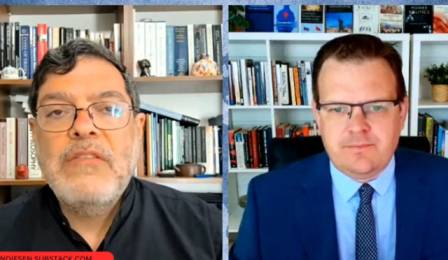
Read the full transcript of Professor Seyed Mohammad Marandi’s interview on Greater Eurasia Podcast, July 7, 2026.
Editor’s Note: In this interview, host Glenn Diesen sits down with Professor Seyed Mohammad Marandi, a former advisor to Iran’s nuclear negotiation team, to analyze the escalating tensions in the Middle East. The conversation covers critical geopolitical issues, including the ongoing conflicts in Lebanon and Gaza, U.S. efforts to renegotiate the Memorandum of Understanding, and the potential for shifting diplomatic ties between Iran, Turkey, and other Arab states. Providing deep insight into Iranian foreign policy, the discussion offers a timely perspective on the stability of the region amidst these complex developments.
INTRODUCTION
GLENN DIESEN: Welcome back. Today we are joined by Professor Seyed Mohammad Marandi, a professor at Tehran University and a former advisor to Iran’s nuclear negotiation team. So thank you for coming back on.
SEYED MOHAMMAD MARANDI: Thank you, Glenn. It’s always a great pleasure being on your show.
The Situation in Lebanon and Iran’s Red Lines
GLENN DIESEN: So I’ve been wanting to ask you how the relations between Iran, the Arab countries, and Turkey could change after this war. However, I first wanted to ask about Lebanon because we see that the killing still continues in Lebanon in violation of the Memorandum of Understanding. It’s unclear to me if this is a sequencing strategy, that is to knock out Hezbollah while the US is in talks with Iran. I was wondering, how do you see the development in Lebanon and how long do you think Iran will sit on the sideline? And yeah, what could trigger Iran’s direct involvement in this conflict?
SEYED MOHAMMAD MARANDI: Well, actually, as far as I know, the Israeli regime hasn’t been able to murder any members of Hezbollah. Yesterday, they murdered a family, a woman who was the principal of a school and her husband and their maid, which is part of the Israeli tradition of just killing ordinary people all the time. And as we all see every day, they’re murdering Palestinians in Gaza. Yesterday, they murdered a large number of people, even though there’s a supposed ceasefire. No one in the West, in Western mainstream legacy media, or among diplomats and the elite seems to care.
So on the whole, the ceasefire in Lebanon is still in place. Though murdering 3 people is a big deal. But on the different fronts, it’s been somewhat quiet, but they’ve been violating the agreement, not just by murdering these 3 innocent people, but also by bombing different areas. But still, it’s a lot less than what we saw before.
Iran is going to continue to put pressure on the United States. And Iran will not negotiate the nuclear program at all, which is a part of the second phase of the MOU, until the issue in Lebanon is resolved. And we saw last night two tankers struck in the Strait of Hormuz. That is a part of Iran’s — although Iran hasn’t accepted responsibility, but of course, we know it was Iran. But the Iranians are going to put pressure on the United States, continue to put pressure on Trump, until the issue in Lebanon is resolved.
Iran’s Three Levers of Leverage
SEYED MOHAMMAD MARANDI: So Iran has 3 means of immense leverage. One is the nuclear program. Trump wants a deal. There won’t be a deal unless Lebanon is resolved. And of course, the other issues as well, but Lebanon first and foremost, like Iran’s assets that were stolen and were supposed to be handed over.
The second is the Strait of Hormuz. The number of ships that pass through are much smaller than what we saw 4 or 5 months ago. And Iran is supposed to normalize the number of ships that pass through the strait in the second month of the MOU. If the United States doesn’t abide by its commitments, there’s no reason why Iran should do that. Now there’s a disproportionate number of tankers that go through the strait compared to other ships, but still the number of ships that go through are roughly 2/5 to 1/3 of what they were 4 or 5 months ago. Iran has that leverage too, the nuclear program and the Strait of Hormuz.
And Iran has been using the ceasefire and the MOU to prepare itself for war. There were lots of Iranian tankers in the Persian Gulf which were trapped. And then as soon as the MOU was signed, all these tankers left for their markets in Asia. And ships have been moving, going to Iranian ports. So Iran has been preparing itself, militarily and Iranian society, for further confrontation. Not that we want confrontation, but it’s Trump and it’s Netanyahu, so Iran has to be prepared for war.
So Iran is more prepared for war today, militarily speaking, than it was at the beginning of the war. It’s manufacturing new missiles, more advanced missiles, more advanced drones, expanding its underground network of missile and drone cities, command and control centers, and so on, incorporating new technologies into the armed forces.
The Funeral and Popular Legitimacy of the Islamic Republic
SEYED MOHAMMAD MARANDI: And then of course, we have today the ongoing funeral, which we saw yesterday too, that well over 10 million people attended yesterday, the largest funeral in human history, which is ongoing today in the city of Qom. You have a couple of million people there. It shows the high degree of popular legitimacy of the Islamic Republic. No one can deny it anymore. For the first time, this crowd is being somewhat acknowledged in the West for what it really is and what it means.
I would claim that Iran has much more popular legitimacy than Western regimes do. And the evidence is in front of us. In the heat of summer, at a time when the country has been under economic siege for decades, it has just gone through two wars of aggression, its infrastructure damaged, and a siege on Iranian ports — it’s hurt the economy significantly.
Yet you see these people come to the streets.
And the depth of that popular legitimacy is another issue as well. Coming out in the heat of the summer, it took me almost 3 hours to get there. And we had to walk hours in the sun. And then it took me a couple of hours to get home. So I was exhausted. I had to go to sleep. So it just shows the strength of Iran. It has the support of the public. Its armed forces are capable. All of this is leverage.
And so ultimately, if the United States refrains from forcing the Israeli regime out of Lebanon, things are not going to get any better for Trump. The economic problems will persist at a time when the US economy is in deep trouble. And he will not get a nuclear deal at all, despite the fact that he promised to get a much better deal than Obama did.
Iran’s Military Strategy and the Strait of Hormuz
GLENN DIESEN: So Iran’s tactics will likely then be to focus its pressure on the Strait of Hormuz as opposed to engage the Israelis in some kind of a direct exchange of missiles.
SEYED MOHAMMAD MARANDI: Well, if the Israeli regime starts — I can’t say what the Iranian military strategy is. But no doubt if the Israeli regime, for example, intensifies the slaughter in Lebanon, strikes Beirut, or carries out other atrocities, the Iranians will ultimately strike the Israeli regime. I mean, Iran was on the verge of firing missiles at the regime when after Netanyahu bombed Beirut, Trump then immediately gave the concessions that Iran demanded to get the MOU.
And one of those concessions was on Lebanon. It was the first article or the first part of the MOU. When you read the MOU, the first part is about Lebanon and about the region, which includes Gaza, but Lebanon was named because of this genocidal war that was going on.
So I think that the Iranian military will definitely be used if the regime pushes too far. But if the regime pushes, Iran can also increasingly make the Strait of Hormuz more difficult for ships to use. So Iran can use its military, it can use its presence in the Strait of Hormuz. It has different means to put pressure on Netanyahu both directly and indirectly through Trump.
Renegotiating the MOU: Iran’s Firm Position
GLENN DIESEN: And well, also the Americans made a proposal that they would do some partial sanctions relief on Iran in return for Iran not imposing any toll or fee on the Strait of Hormuz. From the Memorandum of Understanding, the Americans were supposed to drop the sanctions altogether. But so they already seem to be attempting to renegotiate some of the terms in the Memorandum of Understanding. Now, I guess this was kind of predictable. They weren’t just going to implement everything they agreed to, but rather do this gradual renegotiation. Do you see any scope for renegotiation or finding a new status quo, or was this proposal just way over the top?
SEYED MOHAMMAD MARANDI: Iranians will not accept any renegotiations at all. They won’t be flexible at all. I think that Ayatollah Khamenei — Ayatollah Sayyid Mojtaba Khamenei — in his statement with regards to the agreement, has made that clear. That he felt, my understanding is that he wanted the agreement to be, let’s say, stronger for Iran. And that sends a clear message to the United States that whatever we have now, the MOU, we’re not going to be flexible about it. We’ve been flexible enough, more than enough. That’s my interpretation of what he meant in his letter.
And second, the funerals, I think, give the Iranian negotiators and the state, the armed forces, a clear mandate that the people are behind them. People support them. And so Iran will definitely be very tough.
Now, Iranians are not going to give up the Strait of Hormuz and control over the Strait of Hormuz, whether it’s fees or control. I mean, it’s not just about fees. Those are important. But it’s also about security. Iran will no longer tolerate the Israeli regime using the strait or US military vessels using the strait.
And in fact, now that the Americans can’t use the Strait of Hormuz for its naval vessels, they have to use more planes to bring in supplies. And that costs, I’ve heard, like 4 times more than when they use ships. So Iran has already made it more costly for the Americans to maintain their presence.
Control of the Strait of Hormuz is not just a financial issue, it’s a security issue. After all, we suffered as a result of a war that was launched against Iran primarily from the Persian Gulf region. I mean, the Israeli regime’s capabilities are infinitely less than that of the United States. Even the Israeli regime’s capabilities are dependent on the United States. Israeli aircraft that would strike Iran use American fuel. They’re refueled in the air by American planes. So the Persian Gulf is the center and has been the center of the aggression against Iran, and Iran’s not going to accept that anymore.
The State of the Strait of Hormuz Since the MOU
GLENN DIESEN: What is the state, though, of the Strait of Hormuz? Because when Trump initially agreed to the MOU, he explained it as them only having 4 weeks left of oil. I thought that was brutally honest. But again, he was under great pressure to explain why he would sign such a document, which obviously should be interpreted as an Iranian victory. But given that the situation was so critical, how much is opened up since then? Because JD Vance also explained that one of the purposes of the MOU was to get the oil flowing and, well, how I interpret it, at least buy America some time. But how much has the situation actually improved?
Iran’s Control Over the Strait of Hormuz and U.S. Violations
SEYED MOHAMMAD MARANDI: The United States is being very foolish by opening their own corridor through the Strait of Hormuz — they’re violating the deal. Because according to the MOU, Iran is in control of the Strait of Hormuz during the duration of the MOU. And by the second month of the deal, the number of ships that pass through the strait should go back to normal, meaning commercial ships.
But since the United States is violating the deal, Iran has no incentive of doing that. And I would advise the Iranian government not to allow humanitarian ships to pass through the Strait of Hormuz during the second month, because when the Americans are not abiding by their side of the deal, why should Iran do so?
The number of ships that passed through have increased, but disproportionately, they are oil tankers. But we saw two of those tankers — two very large tankers, I think supertankers — struck last night. So nothing is for certain. There’s a lot of uncertainty. There is more fuel coming out, there is more energy coming out. And if you include the Red Sea and the Fujairah, then it’s not as high as it was before the war, but it is much higher — and it can go down very swiftly.
A lot of the oil, by the way, was Iranian oil because, as I said, there were lots of Iranian tankers stuck in the Persian Gulf and they were able to leave after the ceasefire was agreed upon, after the MOU was agreed upon. So Iran disproportionately was able to take advantage of this opportunity. But again, I don’t know what’s going on now after the two tankers were struck. Iran can easily decrease the amount of fuel that goes through, and the number of ships are still down. And that means all sorts of products — petrochemicals that are produced in this region and other products that are produced in this region because of the low cost of energy — are not reaching global markets and the American market either.
So this is all up to the United States. If they had carried out their obligations in Lebanon and the Strait of Hormuz — and repeatedly, by repeatedly attacking and threatening Iranian leaders — Trump and the United States are violating the deal. And that’s not allowed according to the MOU. The Americans have also not released the stolen Iranian assets, which they are obliged to do so in accordance with the deal.
So the Americans are pushing Iran to limit the amount of cooperation, or the degree to which it implements its side of the bargain. If the Americans had committed themselves to the deal in full, the Strait of Hormuz by now would have had, I think, more than 100 ships passing through it.
Regional Realignments After the War
GLENN DIESEN: I think the frustration for the US is that given that the war failed, they hoped that the plan B would be simply to go back to the old status quo. But as we see from Iran’s actions, it’s not possible. And it’s very hard for the US to adjust to these new realities.
But another area where the previous status quo or the former realities are changing would be between the regional actors — that is, the divisions we see between the Arab states, Turkey, and Iran. Some of this obviously is due to the US-led alliance system. Some is caused by conflicts unrelated to the United States. But how may — and I stress may — relations change after the war? We do not have a crystal ball. There are a lot of different variables at play. How do you see the relations possibly improving between Iran, Turkey, the Arab states? Or do you think they will remain more or less the same? Because this war has been an earthquake for the entire region, it seems.
SEYED MOHAMMAD MARANDI: It’s complicated and it’s difficult to really see the situation in the months ahead. Turkey increasingly needs Iraq because it is vulnerable to the Israeli regime, and the regime is making more threats against Turkey. And even though Turkey continues to cooperate with the regime — I mean, most of its oil, or at least roughly half of its oil, I think, goes from Baku through Turkey and to Tel Aviv, to the Israeli regime. So Erdogan is doing — Netanyahu has been doing him a great favor during the last 2 and a half, 3 years of genocide. And during the crisis in the Persian Gulf region, that energy continued to flow. But still, tensions are increasing, and he needs Iran. So I think that is a strong incentive for relations between Iran and Turkey to improve.
On the other hand, the five countries in the Persian Gulf that assisted the United States in the war, I think they are following somewhat different trajectories so far. The Saudis, the Emiratis, and Qatar have mended their relationship with Iran to a degree. That’s why during the last few ceasefire violations by the Americans — where they attacked Iranian positions and Iran hit back hard — they hit Kuwait and the US assets in Kuwait and Bahrain and in Jordan, but not in these three countries. I think there’s a reason for that.
But at the same time, Iranians just recently broke the siege on Yemen and the international airport in Sana’a, the capital of Yemen. They sent a commercial airliner there, but the Saudis harassed it — from what I’ve read — and tried to prevent it from landing. And Yemeni air defenses apparently forced them to leave. But the fact that they would harass an Iranian civilian airliner is not a good sign. And the tensions between Yemen and Saudi Arabia are also on the rise.
So what does that mean for the future? It’s unclear. What is clear is that these countries in the Persian Gulf — these family regimes — recognize that the United States won’t protect them, can’t protect them. And when they hopped on the bandwagon to attack Iran, it didn’t go well for them at all. It went very poorly and it continues to go poorly, because the situation in the Strait of Hormuz hasn’t normalized.
Anticipating Further Military Conflict in the Strait of Hormuz
We’re probably going to have some military conflict between Iran and the United States pretty soon over the Strait of Hormuz. Not massive, but probably there will be strikes and counterstrikes. I think the Americans will probably attack Iran and Iran will strike back. And if ships again fail to abide by Iran’s rules according to the MOU, then they will be attacked. So this is not good for those countries in the Persian Gulf. They have an incentive to evolve their relationship with Iran, to have better ties with Iran, to tilt away from the United States.
But all of them are very closely bound to the United States. Their elites study in the United States. The ruling families spend a lot of time in the United States — their summer vacations there, palaces and mansions and apartment blocks and investments in the West and the United States, huge amounts. And I’m sure many of them are deeply compromised. We’ve seen the Epstein files where major figures, especially in the Emirates, are named.
So it’s difficult to envisage what will happen, but there is an incentive for them to tilt away from the United States as the United States declines. I think relations with Pakistan will improve slowly. Pakistan has very bad relations with Afghanistan, and of course there’s India. I think that Türkiye will need Iran more now than before because of the threats being made by Israel, despite the fact that Türkiye hasn’t done anything really against it.
And Trump just today, I think, said that Türkiye is “very faithful, is more faithful than other countries that he expected to be faithful.” Read into that whatever you want. For me, that’s not something to be proud of. And with these countries in the Persian Gulf, I think it’s a mixed bag. But Saudi Arabia, Qatar, and the Emirates are more important than the other two, meaning the ruling families. So we’ll have to see how this plays out.
I don’t have an answer to your question at all. I’m just sort of thinking out loud. But at the end of the day, if there’s another conflict between Iran and the United States, these countries will not be able to pretend that they’re not involved or that they’re neutral. Because if the Israelis attack Iran, their jets have to be refueled by the Americans, and those American planes will be flying over these countries. If the United States attacks again, the United States has a military presence in all of these countries. So if they really want to improve relations with Iran, there’s a lot that they have to do.
Israel’s Strategic Options After the Conflict
GLENN DIESEN: How about Israel though? How do you see their role and options in the region as affected now? I get the fact that this conflict is not over — we’re not quite sure yet where the pieces have landed. But given that the objective was to knock out Iran as the main adversary of Israel and essentially reshape the region around Israel backed by the United States, a lot of this has had a significant setback. And also, as you said, even if a lot of these Gulf states aren’t that interested necessarily in improving relations with Iran, at some level they have to adjust to new realities. How does this affect, do you think, the strategic thinking in Tel Aviv? I know you don’t have a window inside their heads, but how do you see their options being shaped by this?
Iran’s Relations with Gulf States and the Israeli Regime
SEYED MOHAMMAD MARANDI: Well, I should add that Iran is carrying out one-on-one negotiations with these five countries in the Persian Gulf. And there has been some progress.
If we go back to the 1980s, these countries assisted Saddam Hussein immensely in his war against Iran, his war of aggression, which the Americans encouraged. They gave him hundreds of billions of dollars, I think well over $200 billion. Back then, a dollar was worth much more than it is now. They helped him create his war machine and to kill many Iranians.
But after Saddam went and invaded one of them, meaning Kuwait, these countries moved to fix their relationship with Iran. And Iran accepted. And even though they are heavily indebted to Iran for what they’ve done. And I think that is a model that can again be used now. We could look back to the past and there is a possibility to have much better relations with these countries, especially since the United States is much weaker than it was before. So there is a possibility for improved relations and for the normalization of relations. That’s possible. But we’ll have to see.
With regards to the Israeli regime, I think that Netanyahu has been the greatest catastrophe that Zionism has ever experienced. He has destroyed the regime’s image across the world. It is seen by anyone who has any degree of knowledge about the region as a genocidal regime. It is seen as the reason for this war that has caused a global economic downturn.
This is not over by any means. He needs perpetual war to stay in power. And all of this is causing huge tensions inside the regime, from what I’ve read, from my understanding. And of course, as we all know, the polls inside show that overwhelmingly, like roughly 90%, believe that the Israelis lost the war. And of course, Iran is much stronger today. Iran is preparing itself militarily, and the funerals are an extraordinary show of force. Across the world, people are seeing how powerful Iran is as a result.
So I don’t think any of this is a good sign. I think people in Tel Aviv are monitoring the situation in Iran and seeing all of this as bad news. If the regime intensifies its aggression in Lebanon, Iran will punish it and it will punish the Americans. If it retreats from Lebanon, there will be greater humiliation. And then there’s the issue of Gaza. The Iranians are not going to be quiet about Gaza. Gaza is very much on the table for Iran.
So Iran has many means to put pressure on Netanyahu. But Netanyahu is fighting for his political survival and he’s fighting to stay out of jail too. And this is, I think, the reason why all these wars have taken place. Because he needs them to stay in power, he and his wife.
So we can’t exclude any scenario. If he wants, he may wage war against Iran. That’s possible. It would be very difficult for him. It would end very poorly because he needs the US to refuel his jets, but even during the 12-day war, he lost the war. It didn’t even last 12 days. And with the United States, they failed too. So he doesn’t have any good options. And yet he needs war and death and destruction to help him stay in power.
That’s perhaps one reason why now they’re talking about taking more of Gaza, all of Gaza, 70% of Gaza, and then taking the whole of it. And then what’s going on in the West Bank, where the West is quiet and they allow them to do it. It’s probably to compensate for his defeat against Iran. But at the same time, what it does is that it makes the Israeli regime more despised across the world because people are seeing the daily killings and the disgusting sadistic behavior of their soldiers in the West Bank and so on.
So I don’t see Israel as having any good options, but a desperate regime can carry out desperate acts and that could change the situation across the region.
But Glenn, if there is war in our region, I think a global economic depression would be really inevitable because things are bad now and there’s no way that the global economy is going to normalize any time soon. Even if the production and export of oil in our region goes back to normal, the shortages are extraordinary. And it’s not just oil, it’s the other products where those shortages continue to grow. So if something happens in the next few weeks or the next couple of months, the global economy will go downhill very fast.
I’ve seen you speak with experts on the economy. The US economy, the global economy is already in very, very bad shape, not just because of the situation in the Persian Gulf, but because of a host of different issues. So I don’t think that any sane person in Washington would want a war. But Netanyahu is not sane and is desperate to stay in power. And Trump is Trump. So you can’t rule out anything, no matter how outrageous it may sound.
The Possibility of a Diplomatic Shift Between Israel and Iran
GLENN DIESEN: What are the possibilities though of a fundamental shift in relations between the Israelis and the Iranians? Because one can imagine — it’s not very hard — that Netanyahu will be forced to go away. I recognize that most likely he will be replaced with someone even more hawkish, but there seems to be a massive shift in the international system. That is, the unipolar era is over, and as we’ve seen since the 1990s, the Israelis essentially decided, well, now we can just dominate, we don’t have to make any compromises because the Americans are behind us.
But if they start to recognise the new realities — that is, they’re a relatively small country, small population, small piece of land, limited means — they recognise the military defeats they suffered, the diplomatic standing in the world falling apart. If they would seek to essentially embrace a completely new foreign policy, do you see any possibilities of this conflict, not coming to an end, but being mitigated?
Because I remember three years ago in 2023, the former Mossad chief, Efraim Halevy, he was making the point that as the Gulf states were trying to improve relations with the Iranians, he said, “Oh, you know, maybe we should too. There’s no reason — they don’t have a border with the Iranians.”
Is it possible that — well, they’re not going to become allies, obviously — that some of the problems could be resolved and to some extent put an end to this conflict? I know this seems like fantasy at this time, but again, it’s either that or a fight till the end. So do you see any diplomatic pathway, or what would be required from Iran’s perspective?
Iran’s Ideological Consistency: Anti-Empire and Anti-Zionist
SEYED MOHAMMAD MARANDI: You know, Glenn, Desmond Tutu, after apartheid — Bishop Desmond Tutu — he traveled to Palestine. And when he left, or maybe he was still there, he said that the situation in Palestine is far worse than anything that he had ever seen in South Africa. And he was, of course, South African. For the younger viewers, he was South African and he suffered under apartheid. And he was one of the major public figures, alongside Nelson Mandela and others, who were leading the struggle against apartheid. He said that the situation in Palestine is far worse. And this was many years before the current genocide.
So this regime is really intolerable and it is ethnosupremacist. And thus for Iran, it has no moral legitimacy. And as Shia Muslims — and I’ve said this before on your show, and sorry for being repetitive — supporting the oppressed, the disenfranchised, is key.
I mean, look at the funeral ceremony of Ayatollah Khamenei. Who are those millions of people? Many of them are struggling because of the wars and the sanctions, but Ayatollah Khamenei, as a very, very high-ranking religious figure, his duty and responsibility has always been to support the disenfranchised, the oppressed, at home and abroad.
Different administrations came to power in Iran with very differing views. The electorate has differing views at different times. And he’s always stressed and always pushed to make sure that the disenfranchised, the oppressed, those who are vulnerable, that they be supported. That’s why they came to the streets. Of course, the educated came to the streets, some people from all walks of life came, but there’s a reason why the Islamic Republic has this legitimacy despite all the problems that it has. Not a utopia. And of course it’s under enormous pressure. So there are certain ideals that exist in Iran, and those ideals are very important for the Islamic Republic. And one of those is the Palestinian cause.
It’s not just Palestine. Iran supported the resistance in South Africa. Ayatollah Khamenei, when he was president, traveled to the frontline countries in Southern Africa to help them. His support for all countries in Latin America — Communist Cuba, Iran helped Communist Cuba. Iran helped Catholic Venezuela. Iran, of course, helped Bosnia. Iran saved Bosnia.
In Afghanistan, Iran helped the Taliban expel the United States. Some people would say that in Syria, those who were supporting the US Empire and proxies of the US Empire were saying that Iran is supporting the Syrian government for sectarian reasons. It had nothing to do with that. It was because the empire was trying to undermine Syria and that’s why Iran was standing against it. It doesn’t matter who the president of Syria was for Iran.
And the evidence of this is that Iran did the opposite in Afghanistan. In Afghanistan, many of the Tajiks, who are Persian speakers, and the Hazaras, who are Shia, and the Uzbeks, and even Pashtuns who are against the Taliban, they became angry with Iran because Iran helped the Taliban expel the United States. Without Iran, the Taliban couldn’t have done it.
Of course, the Taliban now is different from the Taliban that first took over Afghanistan. They were truly genocidal. But after the collapse of their government and the US occupation and new leaders coming to power, Iran began to engage with them. They began to evolve in a limited way. I mean, we have big differences over women’s education and other issues, but it is still different. So the Iranians helped them.
So the Shias in Afghanistan, some of them, and the Persian speakers and the Uzbeks are angry with Iran. They say they are supporting the Taliban. But Iran is consistent in its policy. It’s anti-empire and anti-Zionist.
And so Iran can never normalize with the Israeli regime. It’s just not possible. And Iran is not anti-Jewish. I think everyone knows that by now. In fact, the Israelis bombed a synagogue in Tehran during this war and destroyed it. And when the head of the synagogue asked the Iranian government not to use cranes to help rebuild and to take away the rubble — because they found old Jewish texts from hundreds of years ago — he said that contrary to his expectations, the Iranians agreed and they began to remove everything by hand. So that’s the degree to which Iran respects its Jewish community.
They have a Jewish MP. If you go to a synagogue in Tehran, if you walk by — and friends, mutual friends of ours have been to synagogues, Max Blumenthal, George Galloway — if you walk by a synagogue in Tehran, you would never know that there’s a synagogue there. Because there’s no guard standing in front of it. Because there’s no need for any guards. Because they’re safe and secure, just like any mosque or any church in Tehran. So for Iran, Judaism is not a problem.
GLENN DIESEN: At all.
Zionism, Iran’s Ideals, and the Future of Palestine
SEYED MOHAMMAD MARANDI: But Zionism is. And Zionism has no moral legitimacy. Now the world is beginning, is understanding what Iran was saying all along. And to the massive credit of young Jews in the United States, and older Jews, I’m sure, you saw in the Democratic Party’s primaries in New York, where you have the largest Jewish population outside of Palestine, and most of them are Democrat, traditionally they supported the Democratic Party. They voted against the Zionists, the Zionists. And that says a lot because America is the most propagandized country in the world and Jews in the United States get double propaganda, both from within the Zionist, the Jewish Zionist community and the general propaganda. But they see right through this.
So I think a lot of people across the world are being persuaded that what Iran has been saying all along is correct, that ethnosupremacism is unacceptable. But at the same time, the relationship between Zionism and Judaism is the same as Zionism with Christianity and is the same as ISIS and Al-Qaeda is with Islam. They’re not the same. Christian Zionists do not represent Christianity. They believe, they claim that Christ supports genocide. Jewish Zionists believe in genocide. ISIS and Al-Qaeda believe in genocide. But Christians, Muslims, and Jews all ideologically oppose genocide.
So I think Iran’s point of view is gaining traction. And the Iranians believe that ultimately the Israeli regime has to be dismantled. And we saw that happen in South Africa. When I was young, I was an activist for both Palestine and apartheid South Africa. Although I wasn’t an expert, I was at school and I would, in the evenings, do part-time work in high school for translation work. No one that I knew of, this was before the internet era, no one believed that apartheid South Africa would collapse the way it did. Everyone thought that this would be going on for many years to come.
So I’m optimistic about the future. I think we’re going to have very difficult days and months and perhaps years ahead, but I think that Iran will stick to its ideals where Jews, Christians, and Muslims have to live side by side equally in Palestine.
Iran’s Relations with China and Russia After the War
GLENN DIESEN: Well, let me just, yeah, one final question. After this war though, how do you see the impact on Iran’s relations with China and Russia, because I’m assuming the sanctions won’t go away completely if Iran gets an elevated role in the Middle East. Both the Chinese and the Russians are, I guess, developing their own, let’s call it a parallel international economic architecture with their own tech bases, industrial bases, their own supply chains, their own physical transportation corridors, their own development banks, using national currencies, their own payment systems, insurances. Well, you can go down the whole list. How do you see Iran adjusting to this, I guess, Eurasian powers?
SEYED MOHAMMAD MARANDI: Well, one reason actually why Iran will not give up the Strait of Hormuz is that it helps Iran break the sanctions regime. Imagine all these different ships that pass through. Some of them are Chinese. They do business with Iran. Some of them are Russian, but many of them are affiliated to countries that obey US sanctions. If they want to pass through the Strait of Hormuz, they have to pay. And that is it. That violates the sanctions regime. So I think that’s very significant.
But Iran is definitely going to improve its relations with Russia and China and Asian countries in particular. There’s no doubt about that. The relationship with Russia is quite good, and the relationship with China is quite good as well. Probably with Russia in some ways it’s more developed, and with the Chinese it’s more developed in certain other ways.
The chief Iranian negotiator, the Speaker of Parliament, Dr. Ghalibaf, is planning to go to China soon. On behalf of Ayatollah Sayyid Mujtabā Khamenei and President Pahlavi, he is in charge of the Iran-China file. So that means there’s going to be special focus on the Iranian-China relationship because the Speaker of Parliament will be personally in charge of helping to develop that. And I think that sends a very powerful signal. I don’t know exactly when he’s going to go, but I think he will be in China in the not so distant future. That I think says it all.
So Iran will continue to improve its relationship with Russia. The Russians need Iran. Iran needs Russia. And China needs Russia and Iran. Iran and Russia need China. So the United States has helped improve this relationship. And I think that with intensification of the war in Ukraine, which is imminent or somewhat imminent, it’s already intensified, but the war is going to grow more intense. So Russia needs Iran. And as I said, Iran needs Russia. This cooperation will continue to grow.
I think that in 4 or 5 years from now, if things go as planned, the economic relationship between Iran and Russia will be significantly greater than now. The North-South Transport Corridor as it evolves, it’s going to bring about a great deal of trade and exchanges. The economic relationship with China and investment by China in Iran in the oil and energy sector, and Russia in the energy sector, because the Russians are being expelled by the Americans from other places, Iran will welcome them to invest in its energy sector. So I think in 5 years’ time, if things go as planned, we’ll see a much larger presence of Chinese companies in Iran as well as Russian companies in Iran.
Closing Remarks
GLENN DIESEN: Well, thank you for taking the time. I wish you more peaceful times there in Iran, and I hope to see you again soon in Tehran in the not too distant future. So thank you.
SEYED MOHAMMAD MARANDI: I very much hope so, Glenn. Have a very good day, and thank you very much for having me.
Related Posts