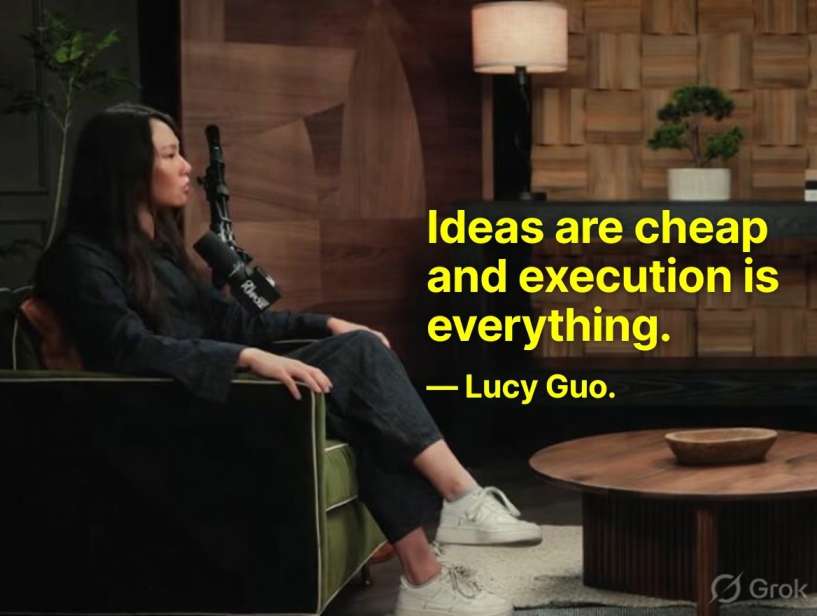
The following is the full transcript of entrepreneur Lucy Guo’s interview on On Purpose Podcast, July 6, 2026.
Editor’s Note: In this insightful episode of On Purpose, host Jay Shetty sits down with Lucy Guo, a successful entrepreneur, investor, and co-founder of Scale AI. Together, they explore unconventional rules of success, discussing why speed, gut-driven decision-making, and high-quality networking are essential to building a venture-scale business in the age of AI. Through their conversation, Guo challenges common wisdom surrounding traditional education, perfectionism, and the pursuit of passion in one’s career.
Lucy Guo on Success, Speed, and AI — On Purpose Podcast with Jay Shetty
JAY SHETTY: Hey everyone, welcome back to On Purpose. Today I’m sitting down with Lucy Guo, entrepreneur, investor, co-founder of Scale AI, and one of the youngest self-made female billionaires in the world. Today we dive into the new rules of success, why speed has been her greatest advantage, and how AI is reshaping opportunity. Please welcome to On Purpose Lucy Guo.
Lucy, I am so happy to be with you here because not only do we know each other a little bit offline, we’ve been to some pretty crazy places together. So I saw you last year on Luminara on the yacht trip, which was amazing.
LUCY GUO: Yes.
JAY SHETTY: And then I saw you at my house where we did a fundraiser event. Then I saw you at the Dior party. It feels like our lives have just been meshed.
LUCY GUO: We’ve been worldwide, and now we’re seeing each other in Cannes next week.
JAY SHETTY: Yeah, exactly. It’s awesome.
LUCY GUO: Thank you for having me.
JAY SHETTY: Oh, no, I’m so excited for my audience to learn from you. I think that right now we’re living at such an exciting time where so many young people are driven, they’re ambitious, they want to do incredible things. You’ve already lived that, you’ve done it, you’re going on to do more. I know you’ve shared some ideas with me, so I can’t wait to get inside your brain today. This is going to be fun. Yeah, let’s do it.
LUCY GUO: Yeah.
Outdated Advice About Success
JAY SHETTY: I wanted to ask you, the first question I have for you is, what advice are people being told about success today that you think is outdated?
LUCY GUO: I still think that college is extremely outdated. I think that we’re taught to go study and then get a traditional job, but especially in the world of AI, I think that college is no longer needed.
That being said, I believe that your network is your net worth, and there’s no better place to go than college to expand your network because college is really the first time and only time in your life where you’re going to be thrown into a world where everyone wants to make friends. No one knows each other, right? So everyone’s open to this emotional connection.
I always tell people, I actually think 1 to 2 years of college is extremely useful because that is where you’re going to build your network and you’re going to build the deepest network because their most talented friends are always going to get these multimillion-dollar job offers straight out of college. But if you’re able to have that emotional connection, everything is sales from retaining your employees to selling them to get them to join your company. And college is the best place where you can really build that emotional connection because everyone is open to it.
Afterwards, you may go work at a company, you may join different interest groups, etc., but it’s just not at the same density as colleges.
JAY SHETTY: So you’re saying go to college, but don’t go there for the degree.
LUCY GUO: Exactly.
JAY SHETTY: Right. Go there for the networking, the groups of people, the emotional connections, practicing things.
LUCY GUO: And I think college is a really great place, especially in classes, to learn a lot and learn how to think. But you should apply those skills to practical skill sets, or you should apply the skills that you learn into practical use cases. So I would learn how to think in these classes, and then I would start using AI tools, right? And really accelerate what you can do and be that 10x executor. Computer earlier on in life.
JAY SHETTY: Where did you go to college again?
LUCY GUO: I went to Carnegie Mellon.
JAY SHETTY: Did you go to college with anyone that you’re still friends with? What are your peers doing now? Like what else have they done?
LUCY GUO: Straight out of college, I had actually hired the smartest people that I met. So my TA, my computer science little, had this — it’s not a sorority little, but within the CS program — because they were just top of their class, right? So that was a perfect example of, hey, this is emotional sales and this is emotional retention.
When I had dropped out, I had actually met a lot of people within the college network, not my specific university, but within the United States through hackathons. So I’m still friends with them and these are people that I’ve actually invested into after hiring them. They went on to go build their own companies.
JAY SHETTY: Wow.
LUCY GUO: So I think that’s just a perfect example of how they were ready to open up and be friends with me. And by maintaining those connections, I was able to hire them as my employees, retain them, and then support them when they went to go build their own companies.
JAY SHETTY: Wow. That’s so fascinating that you were able to not only maintain those relationships, but they’ve become mutually beneficial for everyone. And it’s a really unique way to look at college actually, because I think right now you have the anti-college agenda.
LUCY GUO: Mm-hmm.
JAY SHETTY: And then you have people saying you have to go to college because of the old reason.
The Habit That’s Actually Holding Ambitious People Back
JAY SHETTY: I also wanted to ask you, what’s a habit that you think ambitious people think is going to make them successful, but actually is slowing them down or holding them back?
LUCY GUO: So this is actually probably an interesting one. I think that ambitious people have this mindset, I want to learn from the smartest people because that makes sense, right? So they gather all the mentors that they have possible, and then they enter paralysis when it comes to decision making. So they ask all the mentors around them instead of listening to their own gut.
And if I had done that, Scale actually would’ve never started because I had a decision paralysis when I was deciding whether to leave Snapchat versus go build a company. I gathered all my mentors, I asked them, do you think I should stay at Snap or go do my own thing? And every single one of them, and I mean every single one of them, told me to stay at Snap because Snap was in its hypergrowth stage and it was about to go public. People thought I was absolutely insane given that I was on this extremely special team with only 10 people.
And I think I would’ve entered decision paralysis if I were to have listened to my mentors. So I ended up just listening to my gut and optimizing for learning instead because I did feel like my learning had become stagnant at the company. But I think that extremely smart people constantly want to learn from others so that they find the smartest people and they ask almost too many questions. It’s better to make an imperfect decision but move forwards because you can change your path than to enter decision paralysis.
JAY SHETTY: I feel like any good decision I’ve made in my life has often been opposed to some of the smartest people in my life because you feel it internally.
LUCY GUO: Exactly. And I think investments are very similar, right? Because you have to go against the grain to make a good investment. Airbnb, I think, is a great example and Uber is a great example. No one thought it would work, but the investors that thought it would work, they went against the grain. And I think that’s when the best decisions are made.
JAY SHETTY: Did you have to give up equity? Did you give up stock shares? Were you giving up a ton of money too to go and do your own thing?
LUCY GUO: So I was giving up a lot of money. I wouldn’t call it life-changing money for me per se, but I think it was life-changing money for other people, especially because Snap’s vesting schedule at that point was like 10, 20, 30, 40, which is a very unique vesting schedule. So that meant that I was leaving the majority of my equity on the table.
JAY SHETTY: Wow. So you would’ve had to really feel a sense of inner confidence that you had an idea.
LUCY GUO: This goes back to you are the average of the people you hang around with. And because I was in this Thiel Fellowship network and all my peers were founders that had either raised tens of millions of dollars or had built billion-dollar companies, I really did believe that I could be one of those people.
I think that being delusional is necessary to be a founder because if you are building a venture scalable business, you really have to believe, I’m going to make it, I’m going to be part of the 0.01% that is actually going to build a unicorn. I do think that there are other businesses like lifestyle businesses that are much more easier to become successful because you’re not shooting for the stars, right? Like if you’re making less than $100 million a year for venture, that’s not great. But if you’re doing $10 million a year as an individual, that can support you for the rest of your life.
Starting From Zero: What Lucy Would Do in 30 Days
JAY SHETTY: If you were 22, you had no money, no followers, and you felt like you had no connections, what would you do in the next 30 days to change the trajectory of your life?
LUCY GUO: If I were 22, I would actually go live on campus at different colleges because I feel like I would be young enough to do so where I could pass off as a college student. That’s actually how I was able to gain a network outside of just Carnegie Mellon. I had lived on Menlo Avenue at USC and kind of just hung out at USC as a student. I was in San Francisco and I was hanging out at Stanford as a student per se. And when you blend into the college community, you will just start getting invited to things, whether it’s fraternity parties or hackathons, etc.
I would also definitely continue to go to hackathons because hackathons are great. It attracts a certain type of student that wants to do something over the weekend that doesn’t involve partying, right? They are side questing to build and learn. And when you go to these hackathons, generally all the surrounding colleges go as well. So MHacks attracted pretty much all the East Coast colleges. So did PennHacks, so did HackMIT. So you’re not only meeting people from that college, but all the smartest students from different universities.
JAY SHETTY: So wait, you weren’t pretending to go to other colleges, you were just hanging out at other colleges.
LUCY GUO: Pretty much, yeah.
JAY SHETTY: And so then you got the benefit of building your network in those colleges too.
LUCY GUO: Yeah.
JAY SHETTY: Did you do that because it was fun or did you do that because you knew it would pay off in the long run? What was your mindset as a college student?
LUCY GUO: Specifically when I had dropped out and this app completely failed before the Thiel Fellowship, I was going to build DoorDash actually. I built DoorDash at a hackathon and then in between the hackathon and when I decided to go build a company, DoorDash got built. So I was like, great, I need a twist on it, right?
So the twist was, okay, let’s have people cook food for other students and deliver it versus restaurants. This has many, many issues starting from food safety. It’s completely illegal, whatever. But I launched at Carnegie Mellon and it did well and I was like, great, I need to expand to other colleges. So that was the mindset in going to live in other colleges and really get in the community so I can convince other college students at these universities to cook food for their fellow students.
And college is a really great place to do it because it’s so high density, you could just make a batch of cookies, for example, and run around campus and deliver it to hundreds of students. People were making $100 an hour. It was great.
JAY SHETTY: Wow.
LUCY GUO: Yeah. That’s crazy. That’s very illegal. Don’t do it. Don’t build it anymore.
Ideas Are Cheap, Execution Is Everything
JAY SHETTY: How did you feel when you create your version of DoorDash at a hackathon and then you see the real idea happen?
LUCY GUO: Honestly, I think that ideas are cheap and execution is everything. So for me it’s like, okay, cool, whatever. Right? Uber wasn’t the first, but they executed extremely well. So I didn’t feel any resentment. I was just like, okay, cool. This is a great app I can use. Let me think of something else.
The Value of Execution Over Ideas
JAY SHETTY: Yeah, I think that’s what’s so fascinating about high achievers like you, where a lot of people think that the idea is the value, and when you see someone do it, you’re like, oh, I could have done it. I could have done that. And it’s like, well, no, not really. Because actually what it showed you is you had a good idea. Someone went and did it already, but that means you could find another good idea.
LUCY GUO: Exactly. There’s literally billions of people on this earth. People have ideas all the time. People execute all the time. You can easily hire a developer in India, et cetera, get it done cheap. Now you can use AI and use Lovable, Replit, et cetera, and develop your idea. But execution is everything.
Where Young People Waste Their Time
JAY SHETTY: Where do you think young people waste most of their time when they’re building their career?
LUCY GUO: I think young people are wasting most of their time working at these larger companies, because they have golden handcuffs. Because when you’re smart, you’re literally getting paid millions of dollars per year, right? Which is extremely hard to let go of. When you want to leave, they add in stock, they add in cash, they add in bonuses.
I know some of the most talented people that I think could have built unicorn companies that ended up just staying at Snapchat for 10 years because they just kept on getting equity packages, which I understand from the perspective because it is life-changing money over the course of 10 years. Like you’re making like, what, 8 figures? I don’t want to say they’re sold because the work is still interesting, but they’re trading off what is like extremely life-changing money, like generational wealth and like working on something that they want to do, like that one project, passion, idea that they have in exchange for cash.
JAY SHETTY: But do you think everyone could be an entrepreneur?
LUCY GUO: I think everyone can be a certain type of entrepreneur. It just depends on how much of an entrepreneur do you want to be. Like, are you trying to build a $5,000 a month business? Like, yeah, anyone can do that. My friend literally prompted a chat to create a business with like a $50 budget and it actually created a business that makes, I think, a few thousand a month.
JAY SHETTY: Wow.
LUCY GUO: Yeah. The research, it found a domain name, it designed a really crappy logo. I think that anyone can be an entrepreneur, but what kind of — what level are you trying to shoot for in the sky?
Navigating Golden Handcuffs
JAY SHETTY: I guess the people that you’re saying, like, they could have quit their job, and golden handcuffs, of course there’s different levels of it.
LUCY GUO: Yes.
JAY SHETTY: So even where I grew up, I remember I was trying to leave my consulting job, which felt like golden handcuffs at the time. I was making like £45,000 a year. And that felt like golden handcuffs at the time. Because I was like, that at least pays my bills and pays for my rent. I don’t know what I’d do without it. When someone’s in that position, how should they consider the next move? Like, do you just quit and go all in? Do you come up with an idea first? Like, how do you think about the phases and trajectory of building something when you have golden handcuffs?
LUCY GUO: What I had personally done was I was working on side projects, and after I received investor interest, that’s when I said, I’m going to quit and go build. I think that when people hedge too much as an investor, I don’t think they’re serious, where they want the money inside their bank before they actually quit their job.
So I would say work on weekends or after work, work on side projects, get some traction because that traction will turn into investor money. But you don’t really want to tell investors like, “I haven’t really quit my job yet,” because it will make them feel — or you can say that, but you should make it known that whether or not you get the money, you will quit your job. Or at least just say that. I don’t know, because I think you don’t want them to think that you’re not serious.
JAY SHETTY: I think people always get caught between that kind of catch-22 of like, do you quit first and then you find what you want to do, or do you find what you want to do and then build it?
LUCY GUO: It is a sacrifice to de-risk, but de-risking does make sense. So if you’re able to work on your side projects over the weekend, after work, et cetera, yeah, you won’t be spending as much time with your friends, but you’re also de-risking your life essentially. And I do think that once you have an MVP with traction, which you don’t need to quit your full-time job to get, you will be able to fundraise.
Finding the Best Ideas
JAY SHETTY: How do you think the best ideas are found?
LUCY GUO: I think the best ideas are found when you’re solving a problem for yourself because there’s so many people in the world that if you’re building for yourself, other people are going to have that problem. And then whether or how large of a company it can be is just a function of how many people also have your problem and how much are they willing to pay. But you’ll know exactly what to build and then you’ll be able to use the product yourself and be able to figure out which features to build, what needs to — how to innovate, etc. So I think the best companies that I’ve invested in and the best companies that I have built have all been problems that I’ve solved for myself.
JAY SHETTY: And that’s where people should start. Absolutely. I think today everyone’s now thinking, how do you build the next billion-dollar company?
LUCY GUO: Mm-hmm.
JAY SHETTY: And that’s almost like the most challenging —
LUCY GUO: And the next billion-dollar company might just be like a small problem that you’re solving for yourself, but you decide to expand on the idea afterwards.
The Power of Speed and Shipping Fast
JAY SHETTY: I’ve heard you say, Lucy, that your biggest advantage is your speed. And I wanted to ask you, what’s a decision that people waste 6 months on in business that they should figure out in 6 minutes?
LUCY GUO: So I think the thing that people waste the most time on is actually just product development and design. Because when you go to a large company and you see how long it takes to design small features, it can be months to years because they want the UX to be perfect. But a common misconception is that the UX needs to be perfect for a product to be adopted. I actually highly disagree. People will go through bad UX, people will deal with bugs if they want the product badly enough.
For example, let’s say there’s the new iPhone, right? And you’re checking it out and it just keeps on bugging, and it’s like, okay, cool, the payment didn’t go through, the payment didn’t go through. You’re going to keep clicking that payment button like 100 times until it goes through. You’re dealing with the bad bugs because you want the product badly enough.
So I believe the best thing to do is just release 90%. You can design, I think, 90% good UX in 1 to 2 days, and then just have the engineers build it, ship it, and then see if it’s adopted. If it’s adopted, then iterate on it until it’s a good product. There are very, very few products I think that need perfect UX for it to get adopted. Most products out there, if people want it, they will buy it.
People feel like they need to build the full product in order to sell it, but my philosophy has always been like, create landing pages. If you’re building a B2B SaaS product, make a landing page and start doing calls. See if you can get LOIs signed. If it’s like a low enough price point, see if people enter their credit cards to save a spot on the page. If you’re building even a D2C product, I say sell it and then see how much you actually need to, and if you’re late on orders, just give the customer another free t-shirt or something or whatever you’re building to make them feel happy and not be upset that the order was late. That way you’re actually testing demand for the product before wasting so much money and so much time developing just for it to flop.
JAY SHETTY: So many people I see when they’re launching something, they’re spending all the time on the logo and the font and the color and all these types of things. And actually you’re saying, well, put it out there and see if people even sign up.
LUCY GUO: Yeah, exactly.
JAY SHETTY: And even care about it.
LUCY GUO: Yeah.
JAY SHETTY: And if they do, then you’ve got all the time and money now to actually go and build the real thing. What’s our addiction to perfectionism? Like, why do we do that?
Perfectionism as an Excuse
LUCY GUO: I almost think it’s an excuse. I think that people believe that something needs to be perfect in order for it to work. And when it’s not perfect, they blame it on the fact that it’s not perfect. And I see this with tech founders all the time too, where it’s like, okay, cool. We just need to A/B test our way into it being perfect for the product to work. But sometimes the sum of all parts doesn’t equal a whole, right? Like you can A/B test to have higher signup rates, higher engagement, etc. But at the end of the day, there’s only so much that I can fix. You probably need an entirely new feature, which is not really A/B testable. I think that it really is just an excuse.
Evaluating Good Risk vs. Bad Risk
JAY SHETTY: What’s the difference between a good risk and a bad risk?
LUCY GUO: I mean, I think it’s all a function of what are the consequences, right? I generally believe that a lot of products could not have been created without taking risks. So, for example, I think Uber obviously didn’t really listen to anyone and they became so big that now it just exists. I was actually talking to Stripe founders and I don’t remember what rule they broke, but even Stripe apparently broke some rules and then they just became too big to fail and they just had to make it work. So yeah, it’s a function of just consequences.
JAY SHETTY: But how do you evaluate that when you don’t know? Because I guess we all start thinking, oh God, if I do this, then the opportunity cost is this, or this is the risk level?
LUCY GUO: I generally evaluate just based on two criteria, which is: is this going to be life-changing for me? And am I optimizing for learning? Because if I’m not optimizing for learning, I’m just not going to do it because I think that the knowledge I gain doing the next thing, even if I lost a few million at Snap, for example, I was going to learn enough being a founder that I can take those skill sets and either go get a new job that pays me better and I’ll be more successful in my role or build another company. And then the life-changing money thing was also just kind of that where I was like, okay, this doesn’t necessarily change my life, so it’s not worth my time.
JAY SHETTY: There’s something that we can all use in pretty much any decision.
LUCY GUO: Always optimize for learning.
Optimizing for Learning Over Success
JAY SHETTY: That’s such a big one because it’s almost like we want to optimize for success.
LUCY GUO: Mm-hmm.
JAY SHETTY: But you are saying optimize for learning and that would lead to success.
LUCY GUO: Exactly. Like everyone always complains like, “Oh, it’s such a big risk to quit college,” or “It’s such a big risk to quit this job to build a company.” But it’s not like you are losing your knowledge and skill sets, right? If anything, you come out the other side and you have more skill sets. Like, yeah, you might have given up, let’s call it like a $10 million a year job, but guess what? You’ll probably get a $20 million a year job.
And I also think that people underestimate how much people want talent, which obviously we saw it with Meta, right? Paying like 9 figures for AI employees. I think that even if your company fails, if you hire talented people and you yourself are talented, there will be someone that will buy your company for more than your investors invested it at a valuation because they know you want to make your investors whole and they know that you want money. And for the talent, they’ll overpay.
JAY SHETTY: I keep thinking about my life and it was much smaller than that. Like I said, the amount I was making, but making a pivot, companies were so good at making you feel like, “No, but you built a network here, you should stay here.”
LUCY GUO: Yeah.
Fear vs. Logic: Why People Stay Stuck
JAY SHETTY: There’s such a culture of making you feel like you’re going to fail if you move on. And I think people believe that, people buy into that. How do we break out of buying into the fact that we actually think if we lose a $100,000 a year job, then we’re going to end up with a $70,000 a year job? We don’t think we’re going to be able to triple it or quadruple it.
LUCY GUO: Yeah. I mean, I think that is just, again, your network is your net worth and you are the average of the people that you hang around with. So I was really lucky to hang out with founders that have done it before. So I knew how it actually went. I was lucky enough to hang out with investors who, you know, they would give exploding term sheets, but they would also tell me, “Oh, exploding term sheets aren’t a thing. Like, if the founder came back, we would just give them the term sheet again.”
People’s fear is overcoming their logic. Because logically it’s like, why would I not be able to get this job back? Like, if I was valuable to the company, they’re going to want me again. And let’s say for whatever reason the role is filled. I mean, companies find roles for people all the time when they think the person is a Swiss Army knife and smart and will be able to help the company. They’ll make a role for that person, right?
But also there’s so many companies out there that will hire you based off of the fact that you did a great job at Company A. Company B is going to want you and Company B will fight for you and understand that now you have more knowledge and more skill sets, so they’ll pay you more. This is really people’s fear overriding their logic.
Find Your Passion — Or Find What You’re Best At?
JAY SHETTY: Everyone says find your passion. What’s your take?
LUCY GUO: I think you should do what you’re best at to have the highest impact on your passion. So for example, I really like nonprofits and supporting charities, but at one point in time I thought I was going to start my own nonprofit and charity and foundation. And you know, that might still happen, but I also realize that at this age, in this state of my life, I’m really good at making money. So my time is probably best spent making money and then donating to causes that I care about and being run by people that actually know how to run an organization or a foundation.
I don’t know how to run a charity. And I had actually looked into this where I was like, “I’m going to start a foundation, I’m going to do X, Y, and Z.” And I realized how much work it is, right? And how it’s quite literally another full-time job. Maybe when I’m older, I’ll learn skill sets and I’ll decide my time is best spent doing that as my passion. But I think optimize for fun. Fun doesn’t necessarily need to be your passion, but optimize for how you can make an impact in whatever you’re passionate about.
JAY SHETTY: But that feels hard, right? Because people are like, for example, when I was growing up, I was passionate about soccer.
LUCY GUO: Mm-hmm.
JAY SHETTY: What do I do with that? Because I can’t be a soccer player because I’m not good enough. So then what do I do?
LUCY GUO: But you can make enough money to buy a soccer team and then you can have a soccer game and have so much fun.
JAY SHETTY: Right. So you are saying that it doesn’t have to be your career, but you may go build a career doing something else, but then use the fruits of that labor to then be closer to your passion.
LUCY GUO: Exactly. Because if you’re able to experience your passion, that’s what’s going to make you happy, right? Like it doesn’t have to be your full-time job. Well, I guess now music is my career-ish, my side quest, but I just used everything that I had succeeded in and the money I had created to go experience music and live events. And that made me extremely happy. I use what I’ve been able to create to help support causes that I care about, which has made me extremely happy. I don’t think that needs to be your full-time career.
And for most people, it’s not going to be their full-time career because in certain fields, even no matter how talented you are, some of it is just luck, right? I’ll never really understand the music industry or the acting industry because I have so many talented friends in it and it just, for whatever reason, they’re not making it. And I really do think it’s because there are other factors like network, luck, et cetera.
JAY SHETTY: Yeah. But I like what you’re saying that people often say pursue a passion or make it your work. But actually what you’re saying is just go work, do the thing, and then connect to your passion. And that feels much more realistic for most people. I think for the majority of people, there are very few people who can do what they love and it makes money. But actually being free to the idea that you can do something — not hopefully that you don’t hate —
LUCY GUO: Yeah, that’s what they want me to say.
JAY SHETTY: Hopefully that you don’t hate, but you do something and that something gets you to be able to be closer to all of these things that you love, which I think is a much more genuine, authentic path for most people. Like people can aspire to live that way.
LUCY GUO: Exactly.
JAY SHETTY: And like you said, now you’re closer to music, charities. What were you passionate about? Like if you could have done something — for me, I would have been a soccer player if I could have, if I was good enough. What would you have done if you could have?
LUCY GUO: Well, it’s changed over the years. So when I was younger, I wanted to be a singer, but I realized I’m basically tone deaf and I can’t sing for my life. So that was out the window. And then I remember when I was choosing colleges, et cetera, I was like, “It would be really cool to be an FBI agent and fight the bad guys.” But then that’s unrealistic because I’m this tiny woman and, you know, maybe I could learn some kung fu skills.
JAY SHETTY: Yeah.
LUCY GUO: But overall, let’s call it unrealistic. And then I got really passionate about music and I finally learned I can actually DJ. You don’t need to be able to sing or play the instruments to be able to DJ. So it’s been a very cool thing that I’ve been able to do.
Separating Self-Worth from Net Worth
JAY SHETTY: How do you, at this stage in your career, separate self-worth from net worth?
LUCY GUO: This is really interesting. So I was not a confident person until I went to Miami. And then when I went to Miami, I just became friends with all these people because they just liked my energy, right? I would just be standing in an elevator and people would come in and be like, “Wow, I felt your energy from far away.” It was the first time in my life where I met people that were just like mi casa su casa with no questions. There’s no agenda.
And I think in the past, in LA, San Francisco, New York, there’s always some sort of agenda. People want to know who I was. It was like, “Oh, you’re a Thiel Fellow, let me be friends with you.”
JAY SHETTY: Or you’re a founder. Oh, you have fun.
LUCY GUO: Miami was the first time in my life where no one asked what I did and they just wanted to vibe with me because I gave off good energy. So I became extremely happy there. And I think my self-worth is based off of that where I have a close relationship with my family again. I’m close with my friends. And every time I meet someone that’s a stranger that has no idea who I am, they’re just like, “Wow, your energy is so vibey, let’s dance.” And that makes me happy because it shows people like me for me versus my net worth. I don’t think I had that purity before I had experienced it in Miami.
Facing Rejection and Staying Optimistic
JAY SHETTY: Entrepreneurially and professionally, what’s something that you thought would go your way but turned into a rejection or a failure?
LUCY GUO: Honestly, I’m not someone that sits and weeps. I’ve never really sat and felt sad. Unless a close friend is hurt, like I hear bad news from a close friend, but for myself, whenever I face rejection, I’m like, “Okay, cool, onto the next.”
JAY SHETTY: Next.
LUCY GUO: So I’ve never felt extremely hurt. One of the more sad ones might have just been when I was so close to my top VC choice. I was like, “I’m 100% going to get a term sheet.” They were wining and dining me, they just flew out to meet me, and then out of nowhere it was a no, right? And I was like, “What in the world happened?” I felt a little bit led on, but also I didn’t really sit and feel bad about it. I was like, “Okay, cool, onto the next. Let’s find a new lead.”
JAY SHETTY: Do you think that mindset’s integral and important at that level?
LUCY GUO: I think being an extremely positive person that’s constantly optimistic is what has gotten me to where I am today. I think the worst thing you can do is think, “Oh, the world is unfair. Why did this happen to me?” Stop thinking that way. Everyone is born with advantages and disadvantages. You kind of just have to take what you have and go forwards. And if you face rejection, just learn from it and immediately go and fix.
What Money Solves — and What It Doesn’t
JAY SHETTY: That mindset obviously worked for you. You’ve made so much money. You’ve become such a success story. What problems did money take away and what problems stayed or got worse?
LUCY GUO: When I first started out before I had any money, I was couch surfing all the time, but I actually love couch surfing. It was fun. You get to meet a lot of people. I found couches extremely comfy, to the point where I had an apartment, I had a bed, and I would sleep on the couch. So any stresses of money went away, right? But I also think that what it can cause is you become a little bit too comfortable, which isn’t great.
What the People at the Top Are Really Like
JAY SHETTY: You’ve been in so many rooms now with so many successful people, incredible entrepreneurs, people that you’ve worked with early days at Snap. What do you think is the most surprising thing you’ve noticed about the people at the top — something that we’d be surprised or shocked to know?
LUCY GUO: I think the people at the top are actually not the smartest people in the world at all. I think that they lack frameworks, and because they lack frameworks, they don’t understand a concept of how the world works, which is actually very good because startups are built when you break frameworks because you innovate, right?
Which is why when you take someone in an industry that’s been in that industry for decades and hire them in, oftentimes they don’t innovate because they’re like, “Things have to be done this way because things have always been done this way.” And again, Airbnb, Uber — great examples of this. They weren’t transport experts, they weren’t real estate experts, so they didn’t have a framework of how things are supposed to be.
I think the people at the top completely lack frameworks because they didn’t have decades of experience. And because of that, they were able to innovate. But also they tell their employees — their employees might be like, “That’s impossible.” And they’re like, “I don’t care.” And their employees might be PhDs and they’re like, “No, literally, I’ve been doing this for 20 years, I have multiple PhDs, this is impossible.” And they’ll just say, “No, it’s not, go do it.”
And they say things like, “Whoever does it gets this giant bonus, whoever does this gets promoted,” et cetera. And when people see that prize, that’s when people really force themselves to break the framework that they know because they’re so desperate to get that thing that was offered to them.
I would say when you look at the people at the top, they’re not the most educated really. I think that in general they have high EQ. Some of them don’t have high EQ, but they force the impossible to be possible.
The Visionary Mindset and Leadership
JAY SHETTY: You’re reminding me of that great conversation between Steve Wozniak and Steve Jobs. And so Steve Wozniak goes up to Steve Jobs and he goes, “What do you even do? You’re not a coder, you’re not a marketer, you’re not a salesperson, you’re not an engineer. What do you even do?” And Steve Jobs replies, he says, “Musicians play their instruments. I play the orchestra.” And it’s such a powerful statement because he doesn’t know how to do all the bits and bobs. He’s like, “All I know how to do is put it all together and get it to all work in harmony, but I don’t really know everything.”
And I think people, when they’re on their journey, they feel like I’m not smart enough, I don’t know enough, I should be more experienced. So what’s that balance then with, you know nothing about an industry, which is a, not having a framework is a positive thing, but then what is different about that entrepreneur that you don’t know anything about the industry, you break all the rules, that’s what makes you successful?
LUCY GUO: I think it’s also being visionary. I think Steve Jobs is actually a great example of this where he told his team like, “I don’t care if it’s impossible, you’re going to figure it out.” I think Elon Musk has seen this, etc., because they lack the frameworks to really understand, like, this is impossible. And it might have been impossible at the time, but obviously innovations do happen in technology, and they force their employees to innovate and break those frameworks to make their vision possible.
But I think it’s being open to the possibility of things like lacking frameworks. And they had knowledge in technology in general, right? But they might not have been an expert in real estate, in transportation, in industrial design. But I think that you need just enough knowledge and then just enough grit, just enough persuasion to get the smartest people in the room, convince them to innovate.
JAY SHETTY: It’s almost like having that undeniable belief that we can find a way.
LUCY GUO: Exactly.
JAY SHETTY: And it’s almost like we have to find a way.
LUCY GUO: Yeah.
JAY SHETTY: Because I’m not going to accept anything less than that.
LUCY GUO: Exactly. And I can literally tell you like this did happen at Apple. Obviously this happened at SpaceX and look at Elon now.
JAY SHETTY: Where does that kind of leadership zeal or approach can often burn a lot of people as well.
LUCY GUO: All leaders are extremely controversial and polarizing. There’s no leader out there where everyone loves, right? But I think that being polarizing makes you interesting, and the people that are on your side are going to work their hardest to make you happy and to bring that product idea that you have to life.
Challenges in Building a Company
JAY SHETTY: What were the biggest challenges you had? Did you have any friction when you were rising up the ranks and building your company? And where were the points that you hit difficulties?
LUCY GUO: This comes down to hiring the right people. And again, all leaders are polarizing, but we were all hands on deck. I think that every single company I’ve been at, it’s been all hands on deck where you’re not just going to be doing what your job description is.
So at Scale, we had the engineers labeling data. I had my engineers talking to creators and doing customer support because I think that when you are deep in the weeds, you’re going to really understand, especially when you’re working with customers, you can understand what needs to be built, what bugs there are, what’s critical, what’s not. So I think it’s extremely important to be in the weeds, especially early stage, and talk to customers and do things outside your job description.
Even our investors were doing things outside their job description where they were on LinkedIn helping us find new employees to hire. They were cleaning our office for us when we didn’t have time to, because we were constantly on sales calls. You can imagine that that can create a very polarizing environment because people are like, “I didn’t get hired to do this.” But the right people that you hire are going to be willing to be all hands on deck.
3 Skills Humans Should Develop in the Age of AI
JAY SHETTY: Right now in this AI world that we’re living in, what are 3 skills that humans should develop knowing that AI’s going to be able to do pretty much everything?
LUCY GUO: So I think the number one skill they should develop is human connection, like being able to have high EQ, being able to do sales, etc., because that’s never going to disappear. AI might be able to reach out to agents, negotiate a contract for you, write the contract for you. But how you’re going to close the deal is through human connection and how you are able to even win over deals is through human connection, right?
And this goes back to “your network is your net worth” — things are emotional sales, emotional retention, like even extending a contract, for example. So I think that’s definitely the number one skill in the AI world.
Number two is I think develop really good taste in whatever you are doing. For example, AI is going to replace a lot of designers, but the designers with the best taste are going to be able to pick out, “Okay, this is the best design that this AI has generated. So let’s go with this.”
And then I think number three, figure out how to scale your time with AI. And if you’re able to do this sooner than everyone else, let’s say you have an idea and you decide to make an app with AI or you create these bots and that helps you scale your time and be 10x more efficient than everyone else. And then you sell that bot to help other people in your world be 10x more efficient than everyone else. You’re going to be able to create that wealth before — I don’t want to say it’s too late, but I do think that AI is going to make a lot of people rich. But the people that fall behind, it’s not going to be great for them.
AI Tools and Hiring in the AI Era
JAY SHETTY: Are you a ChatGPT, Claude, Perplexity? What are you using?
LUCY GUO: I use different tools depending on the use case. I think anything I want to say consumer-related, and this can be anything from helping me think of music ideas to researching the best hotels out there, I use ChatGPT. And then for anything enterprise business focused, I use Claude. Nothing really beats out Claude Code, and Claude’s new design tool is absolutely phenomenal. And what’s cool is that you could literally design something in Claude Design and then import it into Claude Code, which is great.
Even little details, like Claude is really good at designing full-scale applications. So UX, UI, etc. But if I want a simple graphic edit that I would normally use Photoshop to do, ChatGPT’s actually better at that. There’s different reasons to use different tools.
JAY SHETTY: How has AI changed the way you are hiring for your new companies versus your old one?
LUCY GUO: I actually include AI questions in every single role right now. And right now I am actually asking my entire team to give take-homes to non-technical roles. So for example, with the AE roles, so sales, it’s like I want you to figure out how to use Cursor, Replit, Claude Code to create a bot where you take an Instagram profile and guesstimate how much a person will earn. Because A, that’s extremely simple to do using AI tools. And B, I can see how you think based on how you prompt it, like what metrics are you looking at? What are you scraping on the internet, etc., to get this number out there?
I think that every employee needs to be using AI to be a 10x employee now. So if they haven’t taken the proactiveness to actually do that themselves, I want to see how quickly they can learn over a weekend. Because I do think that some people just haven’t decided or haven’t been in a role where they’re like, “Let me learn.” But it’s so quick to learn. I think learning trajectory is everything. So if someone can learn quickly, they could easily become a 10x employee versus someone that might have had more experience but is stagnant and resistant to learning. So I think take-home challenges are really great for this because within 48 hours you can see, okay, how much did you do?
Jobs at Risk and the Biggest AI Mistakes
JAY SHETTY: What job do you think looks safe today but won’t exist in 10 years?
LUCY GUO: I think that there are certain creative jobs that look safe today that won’t exist in the future. Let’s call it like being a videographer, photographer. That is a very human job that’s not very analytical. It’s very artistic, etc. But I actually think that most models are going to be AI-generated. A lot of humans are going to license out their likeness. So AI is going to generate a bunch of different videos and photos. Editors might still exist, right? The tastemakers will go in and choose the right one and edit it to be what it should have been. Certain jobs like that, like even writers, right? AI is going to get extremely good at writing.
JAY SHETTY: But editing will still exist. What’s the biggest mistake people are making with AI right now?
LUCY GUO: The biggest mistake would probably just be assuming that AI works really well. They’re just assuming everything outputted is true, right? AI is really only as good as the data that you give it. So if you feed a model the sky is red, it’s going to output the sky is red. This happens everywhere, even with engineering, right? If AI makes one mistake and then it continues to create more and more bugs, but you trust AI to code for you, that’s not great.
Which is why right now, if you take a great engineer and give it AI, it becomes a 100x engineer. But if you take a mid-level or entry-level engineer and give it AI, you’re just going to actually end up with a lot of tech debt because they’re not fixing the problems that AI is generating. And I think this exists across the spectrum.
Learning AI and What’s Coming Next
JAY SHETTY: When did you first start learning about AI?
LUCY GUO: I would say probably started with Scale. Scale is the picks and shovels of the AI industry, right? We weren’t creating these innovative new foundation models. We were literally labeling the data. So we would have self-driving car companies send us LiDAR data, images, videos, and we had labelers around the world say, “That’s a car, that’s a pedestrian, that’s a stop sign on the road.” That was what we were extremely good at, and that’s always going to be needed because it goes back to your model is only as good as the data that you feed it.
That was when I really started learning how important data is, because even with generative AI, if it generates something wrong and it thinks it’s correct, you’re going to get more wrong generations, and that’s not great, which is why reinforcement learning is always going to be a thing. But yeah, I would say back in 2016 was when I first started understanding AI.
JAY SHETTY: You learned about AI in 2016. 50 to 60% of the current US population have used AI at least once. And that shows that we just feel like AI just came around 2 years ago. What’s the thing that people like yourself are talking about right now that the world is only going to catch up with in 10 years? You were talking about AI 10 years ago and the average person was not talking about AI. They didn’t even know it was coming.
LUCY GUO: Yeah, 10 years is a really long time, but I think that right now what I’m thinking about constantly is what’s going to happen to college students. Because AI can make someone exceptional, really, really great. But when you take someone entry level, AI does their job better. Claude just shut down Fable, so it’s no longer accessible, but Fable is as good as a staff engineer. It’s absolutely incredible. So if you’re a really great engineer, holy crap, you’re going to be like a 1000x engineer. And the better you are, the more useful AI is. But again, if you’re entry level and you’re using it, you’re not going to be able to utilize it in the same way and it’s not great.
I think in general with new technologies, new jobs are created. Prompt engineering is a new job, right? And it’s an extremely important new job. And now we have a bunch of people labeling data because that’s a new job and that’s a huge industry. For people who don’t know, what does a prompt engineer do? They basically prompt the AI to output what you want it to output.
JAY SHETTY: Okay. So having somebody who’s so good at writing a prompt.
AI, Entrepreneurship, and the Future of Work
LUCY GUO: Yeah. So good at writing prompts that you get the output that you want. Because everyone’s just putting in these average prompts.
JAY SHETTY: Exactly.
LUCY GUO: My best guess is that AI has actually democratized being able to start companies and be an entrepreneur. So I think more people are going to become entrepreneurs because before you would need to raise a ton of money, then hire engineers and a huge team and then go build the product. And now AI’s building products like that for free really, or extremely cheap.
So I think ideas people are actually going to be able to execute way better than before. Like in the past, it was like, okay, cool, if you’re not an engineer, I don’t want to invest in you. But now someone that’s an ideas person can literally use AI to generate something and get traction on it and then be able to fundraise. And you can now raise significantly less money to get to metrics that you would need to get to, to before you can raise a Series A.
So because it’s a lot cheaper to start companies and run companies, I do think it’s going to democratize the access to being an entrepreneur. And that is going to be a middle ground people are going to take when students realize like, oh s*, what do I do? I can’t get a job. They’re going to figure out how to use AI to start their own companies.
Always Meant to Build
JAY SHETTY: Did you always know you’re going to be this successful?
LUCY GUO: I always knew I was going to start companies. And the reason why is because when I was younger, I was always just figuring out how to make money and build things. I really enjoyed building things and seeing people use my products.
JAY SHETTY: What would you build as a kid?
LUCY GUO: So I built a virtual pet site. I don’t know how I convinced a bunch of engineers, designers, artists to work for me for free. I built out virtual pets. I think I was in like 5th grade or something. Yeah, like 5th, 6th grade. Really, really young. I built arcade game websites. I built Twitter bots, internet marketing tools.
But what was really exciting to me was just, it could be like a really crappy website, based off of WordPress, but I would submit it on StumbleUpon and I’d be like, oh my God, there’s 10,000 people on my website. I just love seeing people use my products.
And then I would say in college when I discovered hackathons, which is very early on, like my freshman year, I was like, I’m going to build a company because my first time seeing that there was so much more to the world than just building internet marketing tools. I was like, wow, I can build extremely impactful companies that really change how someone lives their day-to-day life.
But in terms of being successful, I think that it goes back to probably after I joined the Thiel Fellowship. I didn’t necessarily think like, oh, I’m going to be a billionaire, but I looked around and everyone around me was raising tens of millions of dollars. They were shooting to really change the world with their companies. And obviously I think valuation is a direct measure of how impactful your product and your idea has been to the world. So did I think I was going to impact the world? I guess yes. I didn’t know to what scale.
On Being the Youngest Female Billionaire
JAY SHETTY: How does it feel to be the youngest female billionaire in the world?
LUCY GUO: How does that feel? I’m still the same person as I was when I was younger, right? I think the difference is when I was maybe 20 years old, I was literally skateboarding to Barry’s Bootcamp, and now I have someone that drives me to Barry’s Bootcamp.
JAY SHETTY: But you’re still at Barry’s Bootcamp.
LUCY GUO: But I’m still at Barry’s Bootcamp every single day at 6:00 AM. I still wake up at 5:30 AM every day. I’m still in the office until late. I always try to be one of the first people in the office and one of the last people to leave. Although Brittany might have me beat here. What do you mean the first, not the last to leave?
What Made Her Different
JAY SHETTY: What do you think you had that was different about you that made you design sites when you were in 5th grade? Or what did you have that people around you didn’t have?
LUCY GUO: I didn’t have friends. Sorry, I have to say that. That was like you were feeding it to me. But no, I had extremely strict Asian parents, right? So my parents didn’t really let me have sleepovers and I wasn’t allowed to do sports, et cetera. So I didn’t really have friends. I was not cool, right. I was just — no one wanted to be my friend. And I wasn’t allowed to have pets either.
So I think it all started really with Neopets. I started messing around with the internet, and then I was like, wait, this is really cool, I want my own version of this. As for why I wanted my own version, why I love building things, I learned how to use Photoshop pretty early on. I was learning PHP, how to build WordPress sites and edit them. I don’t really know why I had that desire. That was almost like innate in me.
I would have been a professional athlete if I didn’t have Asian parents. I think that was really it.
JAY SHETTY: What sport?
LUCY GUO: I was really good at swim. I had a lot of medals. I was very good at basketball. And then right now I have Olympic qualifying times on the treadmill on a very good day, but not in the US. I’d have to go move to Singapore and compete for Singapore where I have no competition.
JAY SHETTY: Still any dreams? Are we going to see an Olympic run in the future?
LUCY GUO: I have Olympic friends that are very upset I’m not sidequesting to be an Olympian because they’ve seen me work out and they’re like, you should absolutely train for the Olympics. You got to do it. I’ve been recruited actually by Olympic training groups.
JAY SHETTY: Really?
LUCY GUO: Yeah. But no, my sidequest is currently DJing.
JAY SHETTY: Yeah. I love that.
On Parenting and Raising Prodigies
JAY SHETTY: I don’t know if you decide or plan on being a parent ever, but how do you feel about that? You had strict Asian parents. Do you agree with that? Did it work? Would you do it the same way? What would you change?
LUCY GUO: Yes, I think the thing I would change is that I wouldn’t force my kids into a passion. And my parents actually didn’t force me into my passion per se. They actually wanted me to be a pharmacist because they’re like, oh, you can work 3 days a week. You’ll be able to find a good husband, get married. And I was like, that sounds like my worst nightmare working 3 days a week. I would be so bored. I don’t know what I would do. So clearly that didn’t happen.
But I think that prodigies are made and I would want to throw everything at my kids and find what they’re passionate about. And I think people are generally passionate about what they’re good at. So I would figure out what they’re good at and what they seem to enjoy. And then really accelerate their development in that one thing, whether it’s math, whether it’s being an F1 racer. Because if you’re able to get a multi-year head start, you’re just going to be above everyone else. So I don’t want to force them into a passion, but once I find it, I want them to be the very best in their passion.
The Final Five
JAY SHETTY: Lucy, honestly, whenever we spend time together, I laugh a lot. I learn a lot. You’re exceptionally sharp and smart. I could tell just how much you thought about the questions that you gave me, answers that surprised me, or ones that I’ve definitely not heard before.
LUCY GUO: Oh, I’m glad. Thank you.
JAY SHETTY: I hope we end every episode of On Purpose with a Final 5. These have to be answered in one sentence maximum. So Lucy Guo, these are your Final 5. The first question is, what is the best advice you’ve ever heard or received?
LUCY GUO: I mean, this is pretty simple, but I would say the best piece of advice I ever received is just ask. Because the worst thing that can happen is that you get a no. And I do this for really everything in my life still. And you have to be able to handle rejection. So be able to handle rejection and just ask.
JAY SHETTY: Perfect. Question number 2, what is the worst advice you’ve ever heard or received?
LUCY GUO: So I think the worst piece of advice I’ve ever received is that you need to hire executives with decades-long experience to have an adult in the company. Because especially early stage, when you have an adult in the company, what they end up doing is bloating your team up. And that’s not great for early stage, obviously, because you end up burning a lot more money.
JAY SHETTY: Yeah. It’s so interesting, isn’t it? Because you always go through this, like, do you need a young team? Do you have to bring an adult in?
LUCY GUO: You want a young team.
JAY SHETTY: Very, very emphatic.
LUCY GUO: I’m in trouble.
JAY SHETTY: Question number 3, what’s something that you learned at 30 that you wish you knew at 20?
LUCY GUO: I think when people believe that you’re wealthy, it is a lot easier to move around in this world. And I say this as someone that used to take pride in dressing in SHEIN, Walmart, etc. I realized how much easier life gets if I just present myself nicer. It opens a lot more doors. And this goes back to your network is your net worth, but you actually do want those doors open oftentimes.
JAY SHETTY: And what if people say things like, oh, but that doesn’t feel authentic to me and that’s not real. What’s your take when people say something like that?
LUCY GUO: I think there is a way to be presentable and still feel authentic. But it also depends on, are you down to have that trade-off, right? But I just remembered the change and how much easier life got and the connections I’ve been able to make since I stopped taking pride in dressing like a hobo. And those are great connections that have opened a lot of doors for me.
JAY SHETTY: Question number 4, who are your entrepreneurial heroes?
LUCY GUO: I actually really admire Whitney Wolfe because we all know the story of how she was kicked out of Tinder, right? But instead of sitting and having victim mentality and being sad, she literally went, “F* you,” and created a direct competitor that’s doing better, which is just awesome. I love that mentality of a fighter.
JAY SHETTY: Fifth and final question, we ask this to every guest who’s ever been on the show. Lucy, if you could create one law that everyone in the world had to follow, what would it be?
LUCY GUO: I mean, this is so basic, but I think just be nice to every human being, right? I think kindness makes the world go around.
Closing Thoughts
JAY SHETTY: Lucy Guo, thank you so much. As I said, I’ve learned so much. Look forward to spending lots more time together. Excited to see what you’re going to go build next.
LUCY GUO: Yeah, lots of things. Thank you.
JAY SHETTY: And this is such a joy. Thank you so much for giving my audience so much of your time, your guidance, and your energy. I’m so grateful.
LUCY GUO: Thank you for having me. Thank you. This is fun.
JAY SHETTY: If you love this episode, you’ll love my conversation with Airbnb founder Brian Chesky on how to tap into your creative potential and the number one thing people get wrong about success.
LUCY GUO: The best people in your life will be people who see potential in you that you didn’t see in yourself. And I often wonder
Related Posts
- Transcript of Communication Coach Vinh Giang Interview: On Purpose Podcast
- Transcript of Seth Godin Interview: Diary Of A CEO Podcast
- Transcript of David Senra Interview: 14 Patterns Behind the World’s Greatest Minds
- Transcript: Dr. Marc Brackett Interview on Emotional Mastery – Mel Robbins Podcast
- Transcript of Seth Godin Interview: Mel Robbins Podcast