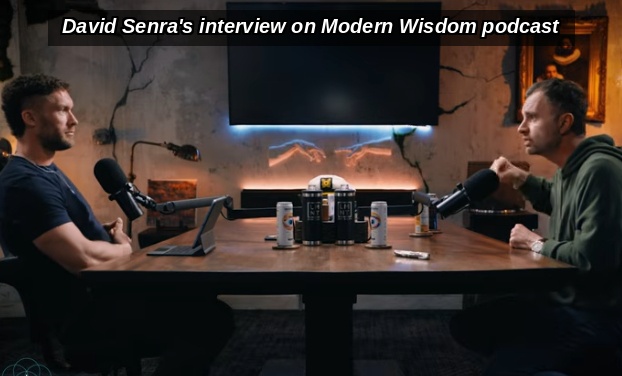
The following is the full transcript of investor David Senra’s interview on Modern Wisdom podcast, July 20, 2026.
Editor’s Note: In this episode of Modern Wisdom podcast, guest David Senra breaks down the recurring habits, mindsets, and patterns behind history’s greatest minds and entrepreneurs. The conversation explores the psychological challenges of high-level creation, the role of self-education, and the drive required to achieve world-class success. They also discuss how top creators and founders navigate ambition, deal with isolation, and use an internal scorecard to measure true fulfillment.
The Lazy Workaholic: Rick Rubin’s Surprising Confession
CHRIS WILLIAMSON: I’m a lazy workaholic. I have to force myself to do it. My demeanor would be to do nothing. What’s that mean?
DAVID SENRA: Okay, this was shocking. So I’ve been a massive fan of Rick Rubin for probably decades. I grew up listening to rap. He founded one of the most important hip-hop record labels in his dorm room when he was like 18 or 19. I think he’s 63 now and he’s still making incredible music. So I’ve done a bunch of episodes about him. Going back like 5 or 6 years ago on my other podcast, Founders. So I read biographies about him. I read his book, Creative Act. Have you read Creative Act?
CHRIS WILLIAMSON: Yes.
DAVID SENRA: And so then I had the opportunity to meet him and then record an episode with him. And I thought, you know, I’ve read his biography over and over again. I’ve watched every interview with him. I thought I kind of knew what to expect. And that was when he said, “I’m a lazy workaholic.” You can even watch the clip on the show where it’s like, this, you’re lying to me, Rick. Like, what are you talking about? Because out of anybody in the world that gets paid to be themselves, you would say like Rick Rubin’s got to be towards the top of that list, right?
And I thought he was just completely obsessed with music. I thought he was just obsessed and absolutely loved his work. And his whole point, he’s just like, no, I have to force myself to do it. Like, I like the act of creation. I like finishing the creation. But the 5 months of us doing thousands of takes, he goes, I don’t like that. He said, “It’s not like I wake up every day and I’m like, oh my God, I get to go to work today.” He goes, “Oh no, I have to go to the studio.”
And what was the reason I wanted to talk to you about that was because when you put that out, I got thousands of messages from people in all walks of life saying, “This is exactly how I feel. Like I love after I’m done working, I like some parts of it, but I feel that I have to force myself to do it.” And Rick’s hilarious because he’s just like, it’s a beautiful day. We filmed at Shangri-La, his recording studio in Malibu. And he said, “I’d rather just be out here butt naked in the sun instead of in the studio.”
CHRIS WILLIAMSON: “There is a part of me that doesn’t want to show up for anything, and I have to overcome that every day.”
DAVID SENRA: Yeah, that’s a direct quote from him, which is again, shocking considering — because I understand if you’re trying to do something, you do it for a year, maybe 5 years, maybe you struggle through that for a few years, but this guy’s been in the same industry, the same business, likely doing the same trade for 4 decades. And he says he’s felt like that forever. He’s like, now he just has a little bit more control over his life. He was telling me that the first 25 years of his career, it was essentially 7 days a week, 16 hours a day in a dark recording studio.
CHRIS WILLIAMSON: It’s tough to do if it feels like a burden, if you have to make yourself do that and you’ve got this tiny bit of enjoyment at the end once you’ve shipped the product.
DAVID SENRA: Part of my heart sank a little because he is like somebody I admire and somebody almost like a hero of mine. And I feel the opposite. Like I wake up and I was like, I cannot wait. Right now the team, we took a 2-week break from the new show because the team was in Italy. One of the team members is getting married and it was like close to depression. I was like, I miss not being able to podcast and have these conversations and just do the things that I’m doing every day.
So it’s completely opposite. How I felt is how I thought Rick would have thought. So it was very surprising. You see somebody that is literally the best in the world at what he does. He maintains a singular position and he’s telling you, “No, it’s a f*ing struggle for me too.”
CHRIS WILLIAMSON: What’s driven him to keep going if he dislikes the process that much?
DAVID SENRA: He loves the magical act of creation when something is not going well and they’re failing and they’re failing and they’re failing and they’re experimenting and experimenting. And then they just do one little tweak. It’s like, oh, now we got it. He says he’s addicted to that moment of creation, of figuring it out. That’s what he likes.
CHRIS WILLIAMSON: High-level problem solving. Basically, the context window that Rick Rubin has is bigger than anybody else’s for music. And he’s just able to take all of this stuff in and —
DAVID SENRA: I think you just nailed it. And this is something very common with anybody who gets to the top of their profession. You’re going to notice that they have this encyclopedic knowledge of history in their head.
There’s this great documentary about his recording studio called Shangri-La. I think it’s a 4-part documentary. And if they’re struggling, he’s got this massive library and he’ll just go in there. He’s like, “Hey, we don’t know what we’re going to do.” He’ll take one of the musicians he’s working with, they’ll just pick a random book off a shelf, open to a random page and read a paragraph. And then they’ll just talk about the paragraph. Did that spawn any kind of thought? And so yeah, he’s got this incredible knowledge in his head.
Chips on Shoulders Put Chips in Pockets: The Power of Having Something to Prove
CHRIS WILLIAMSON: Chips on shoulders put chips in pockets.
DAVID SENRA: So this is a quote from this venture capitalist named Josh Wolfe. And I think about this maxim all the time. It reappears throughout entrepreneurship history, it still reappears for people building companies today.
This comes from the founder of AppLovin, this guy named Adam. Adam is probably the best founder no one’s ever heard of. He’s running like a $170 billion market cap company. They’re going to print something like $6 billion in cash this year, and he’s got 400 employees. And the context of this discussion we were having is that he won’t — if you just have this normal background, you know, you grew up wealthy, you went to great prep schools, you got into Harvard easily — he doesn’t hire those kind of people. He looks for dysfunctional people that have something to prove.
His number 2 is this guy named Raf. And Raf has worked for Adam over half of his life. Raf is a high school dropout, started working for Adam when he was 17 years old, got kicked out of his house, had to live inside of the office. There’s pictures they’ve showed me where he built bunk beds in the office. He’s now the 2nd largest shareholder in AppLovin. The guy’s in his early 30s and he’s got $5 or $6 billion worth of AppLovin stock.
And when you hear Adam and people like this talk about, “Hey, these are the people I want to hire” — they have something to prove, they’re very hungry, they tend to work a lot harder, they’re a lot smarter, they’re a lot scrappier. But then I think what’s also interesting is they’re also telling you about themselves.
So one thing that drove Adam to build his company — because like I said, it’s a $170 billion market cap company — when he started the company, he tried to sell. He went around to all the top VCs in the world, tried to raise money. He’s like, “I will give you a quarter of my company. I will give you 25% of my company for $1 million.” It means he valued his own company at $4 million. Every single top VC in the world turned him down. Then they went and funded his competitors. And once they did that, he goes, “Then it was our company goal to drive those people out of business.”
And you go from saying my company’s worth $4 million, to 15 years later, I took my company public. It’s now almost $200 billion. I think the top it went to is like $220 billion. And he thinks there’s a path to a trillion-dollar company. And he wants to do that by essentially having this island of misfit toys — these people that were looked over by other people, they failed over and over again, they would not be hired by the big firms. It’s a weird company, full of unusual business practices. You have to be an unusual person to thrive in that kind of environment. And he feels those are the single best employees that you can find.
CHRIS WILLIAMSON: What is it that you think drives somebody to keep going through that situation with that chip on their shoulder?
DAVID SENRA: I mean, dude, me and you have hung out a bunch. We’ve had crazy conversations off — very personal conversations, some of which we should have recorded. We were talking before here. I mean, you have this — grew up working class, this random part of the world. I think I obviously have this too. I think both you and I, and I think Adam fits into this, and I think Raf I just talked about — it’s like the feeling I had is like, man, I was just born in the wrong spot. Like this is not my peer group. This is not going to be the destiny of my life.
Like this is why me and you read so much, why we listen to podcasts, why we’re huge into self-education and self-improvement. It’s just like, well, this is the station I was born into, but the world is very malleable. And if I go after something with maximum effort and drive and intensity, I can change the world around me.
I remember the first time we recorded, I think you were still living in the UK. This is probably like 4 years ago. And then you just gave me this tour of this crazy, insane studio you’ve built out. It’s like you did this exact thing yourself. It’s like, I didn’t like my life, so I’m going to use that chip on my shoulder as fuel to prove that I’m not subject to these circumstances. I can actually influence this.
Belief Before Ability: The Kanye West Story
CHRIS WILLIAMSON: There’s a Kanye West clip. Have you seen this before? It’s him on The Breakfast Club talking about 2013 versus 2023.
DAVID SENRA: No, I’d love to see it though.
CHRIS WILLIAMSON: Dude, it’s not quite the edit that I wanted because a lot of the B-roll and stuff of all of the things that he did, but this is f*ing spectacular.
VIDEO CLIP BEGINS:
UNIDENTIFIED SPEAKER: The interview for me from 10 years ago, everybody says, I love that interview. People didn’t love it back then though, because I was speaking to the future. I’m 10 years ahead mentally, and I’m trapped in today’s time. And every now and then I crack you a smile for 2013, but I’m cracking you a frown for 2023. And I’m focused on what it’s going to be. Just mark my words, as I’m Kanye West, you’ve seen my execution. Did I not become the biggest rock star on the planet? Did I not influence all musicians? Did I not go and get the exact girl that I wanted? Did I not start my family? Did I not ruffle the feathers of 2 presidents? Did I not get a chance to operate, work with my idol? Did I not make Louis Vuittons? Did people not line up at the Yeezy store? Did I not make the College Dropout, Late Registration, Graduation, 808s, Blueprint 1, Blueprint 3, Watch the Throne, Cool Summer, and Yeezus — if you like it or not.
VIDEO CLIP ENDS:
DAVID SENRA: I love that. It’s funny you bring that up because have you seen the documentary on Netflix where this guy’s poor, he’s living in a shitty apartment in Newark, New Jersey at the time, and he has a filmmaker follow him around as he’s trying to sell his beats in New York City? Have you seen this?
CHRIS WILLIAMSON: Mm-hmm.
DAVID SENRA: It’s in terms of the biggest bet on himself, the hero’s journey. In fact, I transcribed, I think the first 2 episodes of that documentary — you could skip the 3rd episode — it’s like the perfect illustration of this idea of, we talked about last time I was on the show, belief comes before ability. And you see, he’s walking to the train and he’s practicing his Grammy acceptance speech. He’s never even rapped a bar. He does not have a single out. It was so good that I was transcribing those 2 episodes and I was going to make it into a Founders episode. And then he did that huge antisemitic rant. I was like, oh, I’m just going to put this —
The Lonely Chapter: Growth, Isolation, and Finding Your Tribe
CHRIS WILLIAMSON: We’ll shelf that for a while. We’ll wait till he comes back around. Yeah, you’re right, dude. I mean, this is the topic that’s probably the most likely thing that I write my book about will be the lonely chapter. And it’s moving from a place where you don’t belong to one where you feel like you do.
You’re so developed that you no longer fit in with your old set of friends, but you’re not yet sufficiently developed that you build the new ones. And you’re stuck in this messy middle and you’re thinking, well, the Rocky montage is 3.5 minutes in the movies, but it’s been 4 years for me. And what the f* is going on? You’ve got all of this doubt and it’s tainted by uncertainty about what the future holds for you. And everybody that’s around you doesn’t understand what you’re doing or doubts what you’re doing or actively stops you from doing the thing that you’re doing.
And it’s a selection criteria. Very few people are born into an environment that is supportive for rapid change and growth because people don’t like that. It feels like chaos. It feels like uncertainty. And if you make a lot of changes, it throws into quite harsh contrast all of the ways that I’m not changing. If you grow a lot, that means that my lack of growth is potentially on me.
It’s the same reason that in the black pill and the incel community, ascending, as in being liked by women, is one of the— you become outcast if that happens because you’re not a true cell, you’re a fake cell. One of the reasons for that is if you can get laid or if you can get a phone number from a girl, maybe I can too. And hope with disappointment is way more painful than apathy with acceptance. And chips on shoulders put chips in pockets.
Shia LaBeouf, Kanye, and the Power of Self-Belief
DAVID SENRA: It’s funny, you never know where you’re going to resonate with. And I think that out of all the— think about how many short-form videos we’ve probably consumed in our lives, like tens of thousands. And there’s like this 1-minute, maybe 30-second clip of Shia LaBeouf — I don’t even know if I’m pronouncing his name, the actor. Shia, whatever his name is.
And he said something where it’s just like when me, you, and George were talking right before we started recording — you’ll feel this like when you read somebody else’s life story or book, you’re like, “Oh, I feel like I’m reading about myself. Like, this is exactly how I feel.” And he was talking about — he’s another person that chips on shoulders puts chips in pockets. He was talking about, he’s like, “Hey, I don’t care what you think.” Because he goes, “I grew up in an environment where there’s like no support.” So the defense mechanism and the tool that he used was, he’s like, “I had to convince myself that my opinion about what I was doing in my life was the most important opinion.” And he would cut everybody else out of his life that gave him counter evidence that, “Hey, you’re not going to make it as an actor.”
Go back and watch the documentary on Kanye. There was nobody around him that he was — he was not going to keep you in his life if you said, “Hey, just be a producer.” That was a great Kanye clip that you played. One that I watch all the time, it’s a minute long, it’s called Kanye West Spazzing Out. This is before he put out his first album. And the clip starts, he’s hitting his hands. He goes, “Don’t compare me to any other producer rapper.” Because at the time there were other people that started in production and then started rap. And he went over and over again. He goes, “Hey, you understand, at one point my beats were whack, dog.” He goes, “I taught myself how to make hot beats.” These are his words now. And he says the same thing with rapping. He goes, “I don’t know how to rap. I’m going to teach myself how to do it.” That growth mindset. And the clip ends and the great thing goes, “And I have a leg up because I hear my beats first.”
CHRIS WILLIAMSON: “The mind is a powerful place and what you feed it can affect you in a powerful way.”
Tobi Lütke, Inner Monologue, and Brainwashing Yourself for Success
DAVID SENRA: Okay, so that is a line from another rapper, this guy named NF, who’s one of my favorite rappers. And that reappears throughout not only the books I read — like all these books on history’s greatest entrepreneurs that I’ve read for my other podcast — but when I start sitting down and talking to some of the best entrepreneurs in the world like I do for the new show.
This came from Tobi Lütke, founder of Shopify. And it was the most surprising conversation I may have ever had in my entire life. Because you go in, if you’ve never met somebody before, there’s going to be some kind of typecast, right? It’s like you’ve got this German engineer who built a $200 billion company and one of the most successful technology platforms that has ever been created. And he started by himself with a single laptop in his wife’s childhood bedroom because he had no money and they literally had to be supported by his wife’s family at the time.
And so you think this guy’s a German engineer, he’s going to be super analytical. And then you talk to him and he’s all about intuition and vibes, for lack of a better word. And his whole thing was just like, “Well, the way you view yourself is very important and you should know that you can change the way you view yourself and what you tell yourself. The inner monologue that you have is very important.”
And so for a long time, he told himself that he was afraid of public speaking. “I’m afraid of it. I’m bad at it. That’s just who I am.” And what he would do — again, this sounds like willy foo foo nonsense, but it actually works — he’s like, every day for 10 minutes for a week or two or however long it took, he would sit there and write 100 times, “I love public speaking. I love public speaking. I love public speaking.” There’s nothing else to that. Just the same positive affirmation. And he was literally brainwashing himself. Now he’s phenomenal on podcasts. He can give a presentation in front of his thousands of employees. He can go on stage. He loves public speaking. He literally changed his brain.
And so I think this is really important — not only like the people you keep around you, we just touched on it. It’s like, I don’t have anybody in my life that’s pessimistic or negative. These kind of people are cut out root and stem. My information diet is like I read old books and I talk to smart, interesting people. The way that I choose who I talk to is like the conversation we had. How do I feel after I just had an hour or 2-hour conversation with Chris? F*ing alive. Excited.
CHRIS WILLIAMSON: Like you heard George’s idea about sofa friends and treadmill friends?
DAVID SENRA: You should. Yeah. Repeat it though. Yeah.
CHRIS WILLIAMSON: Yeah. Just that after some people you feel like you need to go lie down on a sofa and stare at the ceiling for a while. And after spending time with other people, you feel like you want to go and run on a treadmill.
The post-content clarity — the equivalent of post-nut clarity, but for after you watch a piece of content on the internet from a creator that keeps on popping up in your feed, or that maybe you’ve subscribed to for a while or not so long of a while. How do you feel after that? Do you want to go outside and ring your mom? Do you feel like you can achieve more? Do you feel like the world is against you or for you? Are you bitter and looking for enemies or are you positive sum and thinking about abundance?
Guarding Your Mind: The Information Diet
DAVID SENRA: And again, I think people are just way too cavalier about what they put in their minds. “I’m just going to sit on X and the algorithm is going to push whatever it wants into my brain and I’m going to sit there and receive it.” That’s crazy to me. It’s like you’re influenced by everything. You should be very careful. The mind is a powerful place. What you feed it affects you in a powerful way. It’s just like you don’t put sh in your body if you care about your health and the way you look. Why wouldn’t you do that same thing for your mind?
CHRIS WILLIAMSON: Yeah, someone once described Modern Wisdom as spirulina for your soul in a sea of fast food for your amygdala. And I was like, yeah, that’s quite nice.
DAVID SENRA: But okay, so this ties to, I think, a large theme of the discussion that we can have today and a lot of discussions we’ve had in the past. It’s like, man, you get one life. You get one life. You have to do something. I do think work for most humans is like a source of meaning, at least for you and I. It’s like, I feel really freaking good about the podcast I make and the information I put out there. And to play on this other end where it’s just like, you’re just like junk food for the mind — this is your one shot at life and this is what you did. You have to feel good when you hear stuff like that.
CHRIS WILLIAMSON: I really think if people could go to the end just for a moment — if they could speedrun 2 alternate universes forward. One where they did the equivalent of selling their soul and getting all of the success but not resonating with what it was that they did, or speedrunning it in a way that meant that the success came but it came without effort and without personal sacrifice and without investment of yourself. And the other one where you had 50% or 10% of the success, but it was spoken truly from you.
I’ve been around enough people who have done something that resonates and that they love, who are way less successful than others that have got bigger platforms. But the people that have got bigger platforms are way more miserable, way more miserable, because they don’t feel it. You don’t want to achieve success — you want the feeling that being successful gives you. And you can get the first without getting the second if you’re not careful. You can achieve success and not feel it, especially if you do something that you don’t really care about.
Joseph Pulitzer, Yellow Journalism, and the Origins of the Attention Economy
DAVID SENRA: I would say though, the benefit — to tie this together — the benefit of reading old books is like, I just finished rereading this biography of Joseph Pulitzer from the Pulitzer Prize. And he built one of the most successful media businesses, and he was doing this around the time of the Civil War. That’s how he got to America. He was a very poor Hungarian immigrant. By the time he’s 17 years old, his father and 7 out of his 8 siblings have died from disease. And so he has to come fight in the Civil War because he has no money.
There was a bunch of wealthy American businessmen that were trying to seed the Union Army and they figured, “Hey, we’ll get a bunch of European men — we’ll pay for your passage over here and if you survive, you’ll get X amount of money. You can start a new life in America.” That’s how Pulitzer got his start.
Now he built his media — at the time he had 2 of the most successful newspapers in the world, including the most successful newspaper in the world. Now the negative part of his legacy, and where he kind of laundered his reputation by seeding the Pulitzer Prize and the Pulitzer School of Journalism, is that he is also credited with the invention of yellow journalism. All yellow journalism is now is exactly what we see when we open up Instagram or X. It’s just sensationalism, violence, sex — things that for hundreds of years, thousands of years, have piqued human interest. Not that it’s good for you, it’s just that you’re interested in it.
CHRIS WILLIAMSON: It’s compelling.
DAVID SENRA: So if you read this book — because I always get sh because people are always like, “Hey, you don’t know anything about current affairs. Like you don’t pay attention to news, you don’t read newspapers, you don’t look at any of that stuff.” And my thing is like, if you just read Joseph Pulitzer’s biography and William Randolph Hearst, who copied his career off Pulitzer — you’ll see the connection. You’ll be like, “Why am I doing this?” Do that first and then say you should redline this negative information about things happening 3,000 miles away or 5,000 miles away over and over again for your brain.
The Cuban Connection: Immigration, Capitalism, and Simple Ideas
CHRIS WILLIAMSON: Speaking of poor immigrants that come to the United States, do you know what that cigar is? No. Do you know where it’s from?
DAVID SENRA: Cuba?
CHRIS WILLIAMSON: It’s the last factory that’s still hand-rolling cigars in El Titan de Bronce, Calle Ocho, the Little Havana in Miami. And that’s the same street that your grandfather walked down.
DAVID SENRA: Oh, that’s funny.
CHRIS WILLIAMSON: When he arrived in Miami with nothing.
DAVID SENRA: That’s incredible. Yeah, that’s incredible. There’s a, I guess like it goes back to chips on shoulders, chips in pockets. I have basically 4 interests. It’s history, podcasts, reading, and entrepreneurship. And the entrepreneurship thing is really, really important to me because like you said, my grandfather was a poor, uneducated person in Cuba. He was 38 years old. He had a newborn son, which is my father. He had 2 jobs. He was a butcher and he worked in a shoe factory. And Castro takes over.
And somehow a man who had no education, did not speak English, and had no resources realized what was happening and realized, I have to get me and my family out of this country right away. And he comes to America, he’s an immigrant to America, and rebuilds his life. Now, he made a bunch of bad decisions once he got here too that I’ve learned from and avoided. Like, I didn’t ever go to prison like he went to prison.
But that one decision, I’m always fascinated by this because that one decision of a man that I don’t remember meeting because he died when I was really, really young, so I have no memory of him, literally changed the trajectory of my life. And one of the most important things about growing up in South Florida as the son of a Cuban immigrant is I would constantly, 9, 7, 10 years old, meet people that came over here on rafts. I was like, this is such a weird thing. That’s a one-way trip. Where are the Americans going to the end of Miami Beach and putting their kid on a raft and hoping to get to Cuba?
So I kind of inherently understood that I was born into a very special environment. No control of him. I didn’t make that decision. His decision changed the trajectory of my life.
And I do think one thing I’m trying to do with the new show is like, hey, I’m very pro-capitalistic. I’m against crony capitalism. I like people that build products and make other people’s lives better and then spread those products and services to more people. And as a result, they can generate wealth for themselves, for their employees, for shareholders of public companies like John Mackey, founder of Whole Foods.
I’ve spent a bunch of time with him. We’ve become friends. He was one of my first guests on my new show. And his whole thing, he grew up in, he was a hitchhiking hippie dropping acid in Austin where we are today, right? And he’s just like, hey, I think that Safeway is poisoning us. I’m going to make a Whole Foods grocery store, right? And then do that for decades.
Fast forward 2 decades of him just having that idea. It’s like, I just want a place for people to shop to get healthy food. And as a result of the appreciation of his stock, he was telling stories on the podcast. He’s like, “These are normal people. They were stocking shelves, they were checking you out, they were bagging your groceries, and they got stock options. And because Whole Foods was successful and they played a role in that, they were able to send their kid to college. They never thought they’d be able to pay for college. They were able to buy a house.” Those things should be celebrated. We should be giving a platform for people to tell these freaking stories.
CHRIS WILLIAMSON: Find a simple idea and take it seriously.
Todd Graves and the $20 Billion Chicken Finger Dream
DAVID SENRA: Oh God. So you even, I think, have made fun of me, the fact that I won’t stop talking about this guy named Todd Graves.
CHRIS WILLIAMSON: Chicken guy.
DAVID SENRA: Okay. I have some hilarious stories. I don’t even know if some of these I can’t tell on the podcast, ’cause now me and Todd have become friends. So Todd Graves, I think the episode I did on him was like Todd Graves and his $20 billion chicken finger dream. So this is going to take a while, but this is worth it.
So Todd Graves has this idea. His initial idea is I’m going to remake what In-N-Out did for cheeseburgers. I’m going to do for chicken finger meals, right? He’s like, I’m going to have a super simple menu. You go to Raising Cane’s, you have basically an option. Do you want 3 chicken fingers, 4 chicken fingers, or 6 chicken fingers? People are like, oh, you should make a chicken finger sandwich. Okay, that’s fine. I’ll take 2 pieces of bread and put my chicken fingers on it. There’s your chicken finger sandwich.
He’s been running this business for 30 years. The menu has not changed in 30 years. He’s like, oh, In-N-Out is successful in California. Why can’t I be successful in, he started in Louisiana, Baton Rouge, and LSU was his first restaurant, just selling one item, but doing it better than anybody else. Just like In-N-Out tries to be the best hamburger than anybody else when Harry Snyder founded the company.
And that idea of find a simple idea and take it seriously is a maxim from Charlie Munger, who’s a hero of mine, who I talked about the last time I was on your show. And what Charlie spent 6 decades, 7 decades studying is he wanted to study extreme business success. And what he realized is like, oh, what we find in business, and I would say in life, because me and you are doing this with podcasting, is the winning system oftentimes goes ridiculously far minimizing or maximizing one or a few variables.
All the people that we’ve talked about, all the people I’ve had on my show, all the successful entrepreneurs that you’ll talk to or study, you realize they have very simple businesses, even if what they’re doing is super complex. What’s more complex about shooting a rocket and landing it? But if you read about Elon, all he talks about is simplifying, taking the idea very seriously, deleting, reducing complexity.
So Todd Graves, his whole thing was like, well, I’m going to sell, his original idea was I’m going to sell chicken fingers better than anybody else, and I’m going to do it to drunk college kids. That’s what he thought was the total addressable market that he had. And then he realized, so he thought, I’m going to be able to sell it to you when you’re out drinking. But he was also open during the day. He starts getting busy during the day. And because he just focused on doing one thing and doing it better than anybody else, if you wanted the best chicken fingers, you’re just going to go to him.
And so even when he breaks down, he’s got 3 or 4 moving parts on the menu. It’s the chicken fingers, it’s the coleslaw, it’s Texas toast, it’s the fries, there’s nothing else. And then he doesn’t separate himself from the customer. He’s got 900, when I talked to him a few months ago on my show, he had 915 stores, all owned, no franchises, by the way. He was growing faster in year 30 than he’d ever grown in his history. He is adding like another 100.
CHRIS WILLIAMSON: How old is he?
DAVID SENRA: 52. No, no, he’s 53 now because he started the company when he was 23 years old. And you can drive into a Raising Cane’s and place an order, and everyone — and Todd Graves is the one giving you the order. His business card says fry cook, cashier, CEO. So sometimes he’s handing you the order out of the drive-through, sometimes he’s literally dumping the chicken into the oil and doing it because there’s no separation between him and his customer.
And his idea was just like, well, it’s served in boxes, right? And he goes, “As long as that box that I give the customer is the best box they ever get, they’ll just keep coming back and back and back.” And because he’ll never sell the company, the reason I say it’s a $20 billion chicken finger dream is because he owns over 90% of the company. It’s valued at least $20 billion. He’s rejected multiple, multiple billions of dollars in acquisition offers. He says, “I can’t sell it,” because he believes, this is going to sound crazy, but he truly believes that God put him on this earth to be good at chicken fingers. And he’s building this business so he can build a lot of wealth and then help people. And so he does a ton of charity work, supports a lot of people, and that’s what he does with his money.
The Billion-Dollar Idea You Wouldn’t Sell
CHRIS WILLIAMSON: One of my favorite stories about billion-dollar ideas, Joe Hudson, his daughter came bouncing down the stairs after he’d been talking about businesses for a while over the last week. He was a VC for a good while, has raised, I think, maybe $100 million over his career. And his daughter came bouncing down the stairs and she said, “I finally got it. I’ve got my billion-dollar idea.” He says, “Oh my God, it’s an idea that you think is worth a billion dollars.” She says, “No, no, that’s what? I didn’t think that’s what it was. No, I’ve got an idea that I wouldn’t sell for a billion dollars.”
Isn’t that cool? It’s such a better way to frame a billion-dollar idea. What is something that you would do that you could build that you wouldn’t sell if somebody offered you a billion dollars?
DAVID SENRA: I get a lot of shit for this because obviously a lot of entrepreneurs listen to both my shows. And listen, it’s none of my business what you do. I’m not concerned with what other people do for their lives. I don’t give advice. I just like build the life that I want to build, but I’m not interested in like start, scale, sell. And in some cases, like I’ve had good friends of mine, so they know it’s a joke, they’ll call me like, “Hey, I sold my company.” I’m like, “Oh, sorry to hear that.” Because it’s like what the whole point in my opinion is like, you want to get to your last company. You want to get to the idea that you want to, what did I say when I was on your show last time? That if you love what you do, your exercise should be death. Like I just got done saying, I get sad when I don’t podcast. It sounds f*ing ridiculous to a lot of people, but I took 2 weeks off of not having these conversations. My life is deficient.
CHRIS WILLIAMSON: Some people do grow. Some people have phases and periods. I loved running nightclubs for a while. I’m not going to love running nightclubs forever. And that was time. There was a time and a place for that to happen. Everybody goes through periods. Now, some people manage to land on the thing, which is an infinite game for them. And also fits their personality across time as they age and mature and change.
Finding Your Path: It’s Never Too Late
DAVID SENRA: But I would say, and that’s the key, all the experiences that you had, you couldn’t, I think you use the word speedrun all the time. You couldn’t speedrun that. You have to go. I was 32 years old before I found my path. It was another 5 and a half years before it was able to pay my bills. Like some people, Kobe Bryant found it at 13. Could you imagine how crazy that is? Like finding your life’s work that early.
I read a bunch of biographies on the founder of Cadillac, Henry Leland. He founded Cadillac when he was 60. He founded Lincoln Motors when he was 70. Took him 60 years to find his path. That’s the point. It’s like, there’s not a time you have to do it by, but all these experiences should, in my opinion, be getting you to the thing where it’s just like, it’s not about a dollar amount. It’s not about an acquisition. It’s not about a sale. It’s like, you literally, I love this so much, you couldn’t pay me to stop.
CHRIS WILLIAMSON: Yeah. The loudest boos come from the cheapest seats. Making mistakes is the privilege of the active.
Dana White and the Privilege of Making Mistakes
DAVID SENRA: So I had this incredible conversation with Dana White. And I’ve been a massive fan of the UFC for a decade, but even a maybe even a bigger fan of Dana, to the point where I’ll watch the press conferences, his press conferences that he does. They’re usually like 20, 30 minutes long after fights of the fights I didn’t even get to see. He’s just a phenomenal communicator.
And one of the things I most admire about him and his life story is, I think it’s very important, the way he is on camera when you’re watching press conferences or on a podcast — he is exactly, there is no difference between the person you’re seeing and the person interacting with him in private, which is really, I think, really admirable and fascinating, personally fascinating to me.
But what you realize about him is, man, he built the largest combat organization in the world and he’s got tens of millions, maybe 100 million followers throughout all different platforms. And he just gets so much shit about the way he’s running his business. And so you sit down with him and “the loudest boos come from the cheapest seats.” That’s from this guy named Russ who you had on your podcast.
CHRIS WILLIAMSON: I love Russ.
DAVID SENRA: That episode was excellent, by the way. I love Russ too. I actually just talked about him a bunch on this episode I just did with Steve Stowell. Steve Stowell’s done a bunch of phenomenal interviews with Russ as well.
But what you realize about Dana and really anybody is, if you’re going to do something in the world, it’s like Dana could put on a fight like the fight he just did at the White House. That card was incredible, right? 5 fights, I think it’s the only time in UFC history it was 5 knockouts. There’s still people complaining. It’s still, you should have done XYZ, you shouldn’t have done this, you should have done that.
And his whole thing is he just cuts all that stuff out. And the second part of that quote where it’s like “making mistakes is a privilege of the active” — he, on the episode and in other interviews, will talk over and over again. It’s like, oh yeah, I f*ed that up or I made this mistake. It’s like, if you’re going to do anything, it’s reframing the mistake — it’s not something to avoid. It’s like, yeah, that means I’m trying.
CHRIS WILLIAMSON: Well, it’s very high trust. It’s one of the best things that you can do as an employee. If you mess up, own it as quickly as possible. Yeah, I f*ed it. It’s when someone starts to hedge and control. Even when Dana got pinned for that situation with him and his wife in the nightclub, immediately he just took it on the chin. And I think that you can tell a lot about somebody by what happens when they’re backed into a corner socially like that. He just owned it. It’s like, yeah.
Inside Dana White’s Office
DAVID SENRA: So after we recorded — he’s got this insane setup in his office. He’s got his office, which has like all these crazy art and little pieces from his career, memorabilia, and these crazy quotes on his walls, which I’ll get to in one second. Then on the other side, he’s got this insane, professional, like professional sports team level gym that only he and his friends work out in. And then the other side we record, he’s got a bar because he loves smoking cigars and drinking whiskey.
And then he has entrepreneurs come in every day. I think he took, I forgot what the number, like over 100 meetings, maybe 200 meetings last year of entrepreneurs coming in. And he loves entrepreneurship more than he loves fighting. He just gives them advice. Sometimes he does investments. He just wants to bullshit and hang out with people building companies. He’s just obsessed with that.
So we spent a bunch of time afterwards and he’s showing me throughout his office and he goes, “You might have heard about this little dust-up I had with my wife.” I’m like, yeah, I’m familiar. And so he goes, after that happened, I put that on the wall. And right when you’re walking out of his office, it says, “May God have mercy on my enemies because we won’t” — or “I won’t.”
CHRIS WILLIAMSON: There’s a clip that I’ve just sent to Jared. It’s my favorite Dana clip.
DAVID SENRA: “You can bet against me. Bet against me. Tell me it’s not going to happen.”
CHRIS WILLIAMSON: “Tell me it’s going to fail.” I love it.
DAVID SENRA: I love every minute of it.
The Pattern of Using Doubt as Fuel
Okay, so there’s a reason — you and me were talking about the episode I did with Dana before this, and I kept bringing up Todd Graves because when I sit across from somebody, I have this thing where it’s like natural pattern matching. So Dana’s talking, I’m like, oh, that’s kind of like what Rockefeller did or Henry Ford did. And I kept getting Todd Graves vibes because Todd Graves said the exact same thing where he’s just like, “I need people to tell me that I’m going to fail.” And he’s like, “I just use it as fuel and energy. I love people telling me they can’t — that I can’t do what I want to do.”
And Dana’s the same way. Dana has another great quote that I was watching when I was prepping for the episode where he’s just like, he goes, “I’m the world’s best friend. And if you want to be friends, we can do that. But if you want to be enemies, I can do that too.”
CHRIS WILLIAMSON: F*, that’s good.
DAVID SENRA: Yeah, he’s really, really good. I mean, I told him, I was like, listen, I’m just going to drop in with this film crew every 6 months because I could talk to him an hour over and over again. The guy never runs out of stories.
The funniest thing that’s ever been said on my podcast came from Dana White. Because if you think about how much struggle went into building UFC into what it is today — they bought it out of almost bankruptcy for $2 million. They dumped another $40 million into it. This goes back to what we were just talking about. You love it so much that they couldn’t pay you to stop. They lost money for like 7 years. He wasn’t making any money.
And he tells this great story of his partner, one of the Fertitta brothers — the first year they get into the black, meaning they’re making profit, they’re writing out all the revenue on the board and Dana’s like, “What does that say?” And he goes, “It says you’re going to make $1 million this year.” He’s like, wow, that’s incredible. Dana’s a multi-billionaire now, like multi, multi-billionaire now. But he was just happy to make $1 million after 7 years of failing. He’s like, “If I just do that, I could do this forever.”
Successful People Listen
DAVID SENRA: Okay, so this is shocking because if people know, that’s a quote from Michael Jordan. So if you’ve ever seen The Last Dance, people think, oh, Michael’s this tyrant. He’s this dictator. He thinks he knows better than anybody else.
And there’s this great book called Michael Jordan: The Life. It’s like 700 pages long. It’s by this guy named Roland Lassiter. And I’ve read that book twice. It fundamentally changed my life. And in that, I found that quote in that book. And what you realize is, no, Michael’s a sponge and all he wants is useful information that’s going to help him accomplish his goals.
And so a lot of this, and this applies to business — it was like, I went to Ed Catmull’s house to record a podcast. Ed Catmull is the founder of Pixar. Pixar invented the first computer animated film. They make some of the best films for families and for kids and even adults. And he worked with Steve Jobs longer than anybody else. He worked with Steve for 24 consecutive years and he speaks a lot about it. He’s like, “The way Steve Jobs is described in the media compared to the person I knew, it’s not the same person.”
So he always tells these stories and adds this color and he goes, “Pixar was a public company for 10 years before Disney acquired it for like $7.6 billion. In that 10-year period” — this is Ed telling me a story now — “Steve fired 2 members of the board of directors from Pixar. What most people don’t know is why he fired them.” And so I asked Steve why he fired them. He goes, “Well, those 2 people, they never disagree with me. And so therefore, if they never disagree with me, they’re not adding any value to the company.”
“Successful people listen. Those that don’t listen don’t last long.”
What Steve understood, what Michael Jordan understands, what all these people who get to the top of their profession understand — there’s no upside in being wrong. And so it doesn’t matter if you give me — you’re the reason I started doing video podcasts. Do you remember having this conversation years ago? You’re like, we don’t have to like—
CHRIS WILLIAMSON: “You’re retarded. You’re not doing video.”
DAVID SENRA: Exactly. So it’s like, I could have been like, oh, what does Chris know? Well, he’s got the 8th biggest podcast in the world. Maybe he knows some stuff. Maybe I should benefit from the fact that I get access to him and we’re friends and he can give me advice. Because he’s not doing it to criticize me. He’s like, hey, you could be doing better here. You’re holding me accountable. It’s like, you should be doing this. You can be doing a better job here.
CHRIS WILLIAMSON: I think people get confused a lot of the time when it comes to taking feedback, taking criticism. And they assume that committing yourself to one thing, being on this path, disregarding the chip on the shoulder — they incorrectly pattern match, or they ignore advice and think that it’s self-belief. And that’s pretty dangerous because you’re just stuck in local maxima there. You’re never going to reach outside of that.
And I think an awful lot about looking for humans who are able to update their worldview — like “strong opinions loosely held” as opposed to “loose opinions strongly held,” which is what most people have. They haven’t really arrived there with conviction and vigor. They’ve just kind of tumbled backward. They’ve been sliding, not deciding, into whatever their worldview is.
Charlie Munger and the Art of the Counterargument
DAVID SENRA: There’s actually an interesting story in one of these books I read where Charlie Munger, when he was trying to convince you of something, he would first state the best counterargument. And with that — he’s very verbose and he would talk for probably like 30, 40 minutes before he’s going to let you talk. I had dinner with him and I’d say he spoke 99% of the time, which is good. He has all the information. What the hell am I going to say?
But what I thought was interesting is, what does that imply? It means he thought about this so much that he could start with the best counterargument and then essentially rebut that counterargument and say why he believes something different. And I think that’s an excessively valuable skill. I’ve never even heard of anybody else doing that.
CHRIS WILLIAMSON: “Wise people don’t solve problems, they avoid them.”
Wisdom Is Prevention
DAVID SENRA: No, wisdom is prevention. That is lit. So that’s a Munger quote. “Wisdom is prevention.” And he had a, this is the experience of when I went and had dinner with him. And this, what you realize is like, anybody, if you live long enough, I think he has another quote where he’s like, “If you live long enough, bad shit’s going to happen to you.” It’s like inevitable.
And you read his early life and it’s like, he had the worst possible thing that could happen. He was going through a divorce. His 9-year-old son had leukemia before it was curable. And so his 9-year-old son’s like literally wasting away and he has to watch his son die slowly and he would leave the hospital. And walk around the streets of Pasadena just bawling, crying his eyes out. He’s like probably 35, maybe 38 years old when this is happening.
And yet you spend time with him and you realize like he is just like, nothing can faze him. He’s like, problems are inevitable. And his whole thing was like, “Well, you’re not smart because you solve problems. You’re smart or you’re wise because you avoid them.”
And so the advice that he gave us was like, if you just focus on being around really, really great people, like a handful of really great friends. You don’t need many. There’s probably a limit to how many you could have, maybe 4 or 5, really like people you’re going to do life with for your entire life. You know they love you, they’re high-quality people, they’re not shitty people. He has this other side of this — this is another Charlie Munger quote. He says, “Most people are rat poison.” He’s like, there’s a lot of just evil and low-quality people out there. You should avoid them.
So you build relationships with great people, people that you love and you can do life with. And then you find great work. And once you find the great work, you stay in that great work. You don’t jump around. You do that for the rest of your life. And by surrounding yourself with great people and having work that you feel is great and beneficial to the world, that avoids, that eliminates most of the problems that are under your control.
And then life will still throw up problems that are outside your control. Your kid gets sick, you get cancer, whatever the case is. But the smart thing is not to solve the problems. The smart thing is to prevent them from occurring ever.
CHRIS WILLIAMSON: Yeah, there’s an insight that it’s far easier to date somebody who compensates for your shortcomings than it is to fix them. That you are the sort of person that likes to go to bed early and you’ve decided to get into a relationship with someone that wants to go out partying until 3 in the morning. Maybe your 9:00 PM bedtime is a personal failing because you feel like you need to have more control over your life than you actually do. Maybe it would be beneficial for you to work through that in some way and loosen up and you could go to bed at 11 o’clock and 12 o’clock or something like that. Or you could just get into a relationship with somebody who compensates for your shortcomings and is like, “Actually, do you know what it is? I’m not going to make you feel insecure about that thing. I want to go to bed at 9 o’clock too.”
So many of the situations that we end up having to — we have basically a frustration budget in life every single day, and it gets sapped out of you by all of the different interactions. Let’s say you’re going to dinner and your friend that you’re hanging out with is just really annoying. And every single time you go for dinner, you’re super annoyed by them. And then the next morning you wake up and you’ve got to deal with some real things at work that you can’t get away from, or that’s part of a mission. You’re like, “I have less in the tank to be able to deal with this issue because of the situation I went through last night,” or because of the fact you had to stay up till 3 in the morning because the girl wanted to go and watch some f*ing DJ in some nightclub or whatever. And now you’re tired and you didn’t even want to go, but you did it because you’re going to compromise.
It’s really important to compromise. Wisdom is prevention. Just avoiding problems altogether where you can. Problems are inevitable and they’re going to come and smash you in the face. There’s no nobility in meaningless suffering. There’s nobility in meaningful suffering, but there is no nobility in meaningless suffering.
Ruthlessly Edit Who Gets Access to You
DAVID SENRA: And I would say like, there’s a great quote in Spanish that I’ll translate. It’s like, “This person will drown in a cup of water.” And this is what I mean. Like the first part of that is before you find your life’s work and hopefully you’re doing something that makes the lives of other people’s lives better. It’s like you have to ruthlessly edit who gets access to you.
Like the first episode I ever did of the new show was Daniel Ek, founder of Spotify, right? And everybody always asks me like, “Oh, if you could have a personal board of directors from all the people you’ve read about, all the dead entrepreneurs, who would you be?” And I have an answer for that. And then they’re like, “What about for living? Who would your personal board of directors be?” I was like, “I’d only need one.” And it’s Daniel.
The reason he was the first guest is because the relationship we’ve been able to build and the friendship we’ve been able to build — he’s one of the wisest people I know. I call him Swedish Buddha. He built one of the greatest apps and technology companies in the history of the world, right? And had to endure unbelievable struggle to do so. But he’s just very wise.
Almost all of our conversations — I was just with him a few months ago, we were racing cars outside of Stockholm. We stayed up late one night and his whole thing was just like, I still have notes from the conversation. He’s like, “Man, you just have to ruthlessly edit who’s around you.” The mind is a powerful place. Would you feed affection in a powerful way? He’s like, “Especially you, you have a huge platform. I can’t imagine what your text messages or inbox look like.” Because you coming on your show could literally change some people’s lives. And so the problem is they’re going to act in a way to you that’s not their real self.
And so Daniel’s point about this was just like, if you feel you’re developing a friendship with somebody, have other people you trust, then go and spend time with this person because the way they act with you might be different from them. But I’m telling you, all these people, and I’ve built a lot of friendships with a lot of the guests I’ve had on my show, the amount of times they have told me — it just all comes down to the quality of people that you have around you. Your life is your relationships. That’s another great maxim. “Your life is your relationships.” If you have a bunch of shitty people around you, you’re going to have a shitty life. They’re going to cause drama unnecessarily because they will drown in a cup of water.
CHRIS WILLIAMSON: And wisdom is avoidance. Wisdom is prevention.
DAVID SENRA: I’ve cut a couple of these people out of my life and way less than I have to now because I’ve been so — I have a very small circle. I would say my natural tendency is not to have 1,000 shallow relationships. It’s just to talk to the same half a dozen people over and over and over again. And when I’m not doing that, I can be by myself. I’m very comfortable reading a book. Making a solo podcast. I don’t give a shit. I don’t need to go out and constantly socialize and expose myself to the vagaries of other people’s corrosive and destructive behavior. I’m not interested in that.
Create According to Your Own Taste
CHRIS WILLIAMSON: Create according to your own taste, not for applause, critics, algorithms, or market demand.
DAVID SENRA: This is Rick Rubin. You and I, we just talked about this. We just both read his book, Creative Act. And towards the end of that book, he has this thing called the House on the Mountain test. And here’s the great thing about reading books about people and then getting to talk to them — you get to go deeper. And I want to tell you a story about James Dyson. We can get there in a little bit. I think it’s really important about this.
But what Rick Rubin’s point was just like, your North Star in whatever you’re doing — the metaphor he uses, he goes, “Let’s say you bought a house. It’s on a mountain. It’s so remote. No one is ever going to see it but you. Do you not put in your best effort to decorate it and to design it just like you would want it done? You’re the only person that’s ever going to see it. No one’s ever going to visit. What do you do?” And the answer to that question — that is your revealed preference. That is what you actually want to do.
And so when you look at Rick Rubin’s career, what does he do? He just makes the music that he wants to listen to. He says over and over again, “Don’t think about the audience. Don’t think about the customer. Don’t think about the end user.” Me and him talked about this. You’re not that unique. So if Rick Rubin likes this song by Johnny Cash with a guitar and just this guy’s voice, what’s the chance that he’s the only person in the world that likes that? Probably 10 million people like the same kind of music Rick Rubin likes.
Just like me and you — we talked about this before we started recording. We make the podcasts that we want to listen to. We both are obsessed with podcasts. They’ve benefited our lives immensely. I’ve learned more from reading and podcasts than I ever did in school. I’m just making the stuff that I’d want to listen to. I listen to them before they come out. Could you imagine, your life is making a podcast and you have to listen to it before it goes out and you don’t like it? Doesn’t make any sense.
So I think the idea of the metaphor of you’re designing a house on the mountain, no one else is going to see it — you should design your life that way too. There are parts of your life that you share with other people, but there are huge swaths of it that only you know. You should design those parts of your life the same exact way as the parts that other people see.
CHRIS WILLIAMSON: A rule of thumb for anybody that makes things on the internet — would you consume your own content? If not, don’t post it.
DAVID SENRA: I was with you one time and you asked somebody and there was a 30-second pause.
CHRIS WILLIAMSON: Yeah, yeah. And after 30 seconds of time—
DAVID SENRA: You know the answer.
CHRIS WILLIAMSON: I’m like, “Dude, if it takes more than 5 seconds, the answer is f*ing no.”
DAVID SENRA: Yeah.
Raid Your Own Life
CHRIS WILLIAMSON: Raid your own life. Create a grand theft life.
DAVID SENRA: Okay. So you told me before, I missed this episode of yours, but you just did this roundtable. What do you call these roundtable episodes? Rabbit Hole. Rabbit Hole with Tim Urban.
CHRIS WILLIAMSON: Yep.
The Grand Theft Life Framework: Stepping Outside Yourself
DAVID SENRA: Tim Urban, about 10 years ago, wrote this crazy essay on Elon and SpaceX and Tesla. He kind of predicted a lot of the s* that occurred in the last decade. And he had this thing called Grand Theft Life. And what he realized about Elon was his ability to step outside of himself.
Me and you are going through life all the time and we’re kind of like, right now I’m looking at you. My view is a lot better than yours is. Like you’re a lot more handsome than I am, but this is my experience and you kind of get siloed into, “I’m just experiencing it as it happens.”
And this started because Tobi Lütke — I’ll get back to Elon in one second — I sat down with Tobi Lütke, founder of Shopify, which again is probably my favorite conversation I’ve had on the podcast so far. And he has this idea, again, when he says this, he’s running a $200 billion company, and he goes, “I like to take the view that I’m a corporate raider. I did not start Shopify. I do not run Shopify. I have now extracted it from the owners and now I’m the new owner and the previous management was crazy. And then I go through and look at every single other thing that I would change.”
Why do you need to step aside? Because if you’re just going through your day-to-day, there’s so many problems you’re not seeing. You have to step back.
In Tim Urban’s Grand Theft Life essay that he was writing on Elon, you see that Elon does that. Me and you were talking about this before where it’s like, okay, if you look at yourself as if you’re playing Grand Theft Auto — like your character — you play Grand Theft Auto, my character needs money. So my character goes and does jobs. Now he has more money. My character, his stamina, he’s running from the cops. He needs better cardio. So I take him to the gym. You just literally say, from the outside…
Me and you — I hope you don’t cut this from the podcast — we were in Hawaii together and we had many, many late night conversations about issues with women that me and you were both having, that I swear to God, if there was just a casual observer just listening, they would be like, “Chris, David, these are simple solutions. You just can’t see them.” Because I could see what was wrong with yours, and you could see what was wrong with mine.
So this idea of just stepping outside — and I love the idea that, putting it into entrepreneurial terms, it’s like some guy is now taking over my business or taking over my life. What would he change?
CHRIS WILLIAMSON: Yes.
DAVID SENRA: You need a pause and you need to wait, step back and go through this argument right now.
CHRIS WILLIAMSON: George has got this idea where he talks about imagining that there was an evil version of you, a man with a mustache. What would he do to beat you? What would another version of you with the mustache do to beat you? Or that question of, if you had 10 times the agency, what would you do?
But with that situation, you know where your biggest shortcomings lie. There’s going to be this person. Okay, they would be way more decisive. They wouldn’t need as much certainty in order to reach conviction. Because I know that I spend too much time vacillating and flip-flopping back and forth and I don’t commit so quickly. And I know that the version of me with the mustache, he would arrive at the outcome way quicker because he wouldn’t be doing the flip-flopping, or he would be more cutthroat when it comes to not giving people 3rd and 4th and 6th and 7th chances because I keep doing that and it keeps on burning me. That’s what he would do. And then you just go, okay, just do that.
DAVID SENRA: What would your answer to that for your own life be right now?
CHRIS WILLIAMSON: The decisiveness thing I think is probably not far off. My required level of certainty in order to make big decisions, it’s quite a high bar. And that’s led to me making very few mistakes. Every business that I’ve started has succeeded. Almost all of the projects that I get involved in are very good, but if you’re not failing, it’s probably an indication that you’re not moving quickly enough. Because you could move a little faster — the headroom for moving more quickly is probably still quite high and you would still end up with a pretty good hit rate. So something like that. How about you?
Staying Away from the Circus
DAVID SENRA: I think especially the last year, the biggest mistake — you get distracted. Especially because there was a slow build to Founders Podcast. It never — it’s like I was a frog in boiling water because it took 5 and a half years to break through, and then another, like, it was about 8 before it was any substantial thing.
CHRIS WILLIAMSON: 3 and a half, 4 for us.
DAVID SENRA: Yeah. So that was great. It was actually, in hindsight, I wouldn’t change anything because it’s just like, oh, I’m still the same person. I don’t feel any different. Where the new one, because I had an existing audience, it was disorienting how fast my life changed. And this goes back to Daniel Ek and why he’d be my sole person on my living board of directors. He’s just like, “Just stay away from the circus.” That’s the advice that he would give me over and over again.
CHRIS WILLIAMSON: So the evil version of you that’s trying to beat you with a mustache would just get less distracted. He’d be more simple.
DAVID SENRA: And this is what I’ve gone back to doing. Daniel’s advice is just — we had this phenomenal dinner in New York, and then he was driving me to a friend’s house, and he’s just like, “Your life is very simple, man. If you just sit in a room and make podcasts and don’t do anything else — obviously spend time with your friends, take care of your health — but you don’t have to go to f*ing dinners. You don’t have to go to conferences.”
CHRIS WILLIAMSON: He had this conference called Just Sit in a Room and Make Podcasts, says the guy that owns Spotify. Do you think that might have been somewhat of a—
DAVID SENRA: No, because he just stepped down. I promise you it’s not like—
CHRIS WILLIAMSON: Yeah, he’s done.
DAVID SENRA: No, no, no. Because my shows are always going to be somewhat niche. Your show will always be 10 times bigger than anything I do because I’m just narrowly focused on entrepreneurship. But the advice that he’s — I remember texting him, I was like, “Hey, are you going to Brilliant Minds?” Which was his conference. And I don’t think he was there this year. He goes, “No, and neither should you.” And that’s when he just said, “Hey, just stay away from the circus.”
CHRIS WILLIAMSON: Well, this is similar to if you do everything, you will win.
DAVID SENRA: Okay, we can get to that in one second. So let me finish this because I think it’s really helpful for me to now do Grand Theft Life and step back and say what I would do. I have work that I really like to do. I really like to read books. I really like to make podcasts. I like one-on-one conversations, maybe one-on-two. I can’t do group stuff. I’m very introverted. It makes me very uncomfortable. And then I’ve got to figure out the dating part, the girl part.
Expansive Personalities and Relationships
CHRIS WILLIAMSON: But other than that, didn’t you talk about something to do with this last time — that so many of history’s greatest entrepreneurs have been totally bad with women? Like they’re just pussyhounds or they’re unable to hold a relationship together. But I wonder whether part of it is less that they’re bad with women and more that the traits that make you a very successful elite-level entrepreneur, the kind that you study, probably give you some traits that make it difficult to be in a relationship with you.
DAVID SENRA: So I wasn’t expecting to talk about this, but I have some interesting ideas. There’s this great book that was written by Arnold Schwarzenegger’s girlfriend. He had a — he lived with his girlfriend when he was 21 to 26. So he’s still dominating this weird niche of bodybuilding, but he’s not the Arnold that he’s going to become — though he’s the same person, so you can see it’s coming.
And it’s 300 pages of her just being like, “Why is this guy not acting normal?” It’s like, because it’s Arnold. He’s one of the most driven people in the world. I could have solved that for you in 10 seconds. And the end result when I made the episode on that book was like: a successful entrepreneur, or anybody chasing after somebody, you need a supportive spouse or no spouse at all. And that’s the key there.
What I would also say is I’ve been talking to this guy who considers himself a consultant to some of the most famous people in the world. And what I find interesting is he can essentially pattern match across, let’s say, 100 of the most famous people in the world. These are mainstream celebrities — this is not like me and you. And some of these people also happen to be captains of industry because Elon’s one of the most famous people on the planet.
And he goes, “The problem that these people have is when you’re really successful like that, you have an expansive personality.” That’s the word that he used — expansive personality. Which means the more you succeed, the more you want to succeed. Napoleon said this in French, and it translates into: “Appetite comes with eating.” Usually you eat and you’re full. These kinds of people, the more they eat, the more they want to eat.
So his point is these people also usually have bad relationships because there’s a ton of infidelity. It’s just that they’re expansive in every element of their life — they’re increasing their skills, maybe their movie’s getting bigger, maybe their business is getting better, expanding. But in this very narrow but very important part of your life, which is your romantic side, you’re expected to not have those same personality traits.
Now, I don’t have that issue. I can stay with one person at a time. The issue that you have is like whether it’s a very close friend, a business partner, or a spouse, these are all very similar relationships. They’re very deep partnerships. And so you have to be very careful to make sure you’re picking the right person.
And especially you, because you’re handsome, rich, super famous. I’ve seen some of your DMs. Like you have so many people trying to get to you that want something from you — that doesn’t mean they’re good for you. And that’s where you have to be careful. That’s where you have to be somewhat paranoid.
CHRIS WILLIAMSON: That’s what discernment is, right? Being able to distinguish between good and not good, between somebody that’s got your best interests at heart and doesn’t.
The Four Buckets of Failure: Lessons from Jimmy Iovine
DAVID SENRA: The advice I’ve gotten from some of the most successful people in the world about this, they’re just like, make sure that she’s a good person. That’s it. They just have to be a good person, but good people are few and far between. And what I mean by good is like not selfish, not doing this just because of what they get out of it, and willing to.
And in many cases, dude, Jimmy Iovine. Okay. Jimmy Iovine. We got to talk about this because this guy’s the best. So when people used to ask me, “Hey, who did you want to meet? You haven’t met Jimmy Iovine.” I’d have a list and Jimmy Iovine would be in the top 3. And people are like, “That doesn’t make any sense.” Most people don’t know who Jimmy Iovine is. But one of my favorite documentaries is this documentary called The Defiant Ones. Have you seen this?
CHRIS WILLIAMSON: No.
DAVID SENRA: You gotta watch it tonight. So it’s a 4-part documentary. It’s technically supposed to be about the relationship, the working partnership between Jimmy Iovine and Dr. Dre that’s been going on for decades. It is really one of the best documentaries about entrepreneurship and these kind of wild personality types. Dr. Dre is a wild boy. He was probably highly likely a child prodigy, the best in the world at what he does. Jimmy, same thing.
He has been in the music business for 5 decades and has succeeded from engineer to producer to record label executive to building a business and selling it for $3 billion to Apple. And so Jimmy was on my show. We live close to each other. He’s nice enough that I get to hang out with him and talk to him on the phone and hang out with him all the time now.
And what’s fascinating is when you talk to these older guys — I think Jimmy’s probably 70 years old by now — he’s got more knowledge about life in his pinky than I do in my entire body. Like he’s just lived through, he’s just seen everything. And his biggest thing was, he’s like, “If you want to be successful, you probably don’t want to be successful for a year, for 5 years. You want to do it for a long period of time.”
And he’s like, “I’ve been around some of the most gifted, talented people in the world.” He’s worked with everybody from John Lennon to Bruce Springsteen to Tom Petty to Dr. Dre to Eminem — literally everybody. And the advice he gave me is like, “Most people cannot handle success. You’re not destroyed by a competitor. There’s not going to be another Chris Williamson coming in here and outcompeting you in podcasting. If you’re going to fail, you’re going to do it to yourself.”
And what Jimmy said is they fall into 4 buckets, which I thought was interesting.
Number 1, drugs. I don’t do drugs. Not going to be an issue. I avoid them.
Number 2, alcohol. I don’t really drink.
Number 3, megalomania. Because remember, he’s in the music industry. He’s like, “Listen, you start out—” I mean, Kanye — I think he’d be a huge fan of his first 4 albums. I think this is what happened to someone, in my opinion. It’s like, and Jimmy was saying, it’s really hard that you get on stage every night and there’s 80,000 people telling you, screaming your name and telling you how great you are. The problem is to come off that stage and then still be dad or husband — put the socks on, friend, take the trash out — and not think you’re above all that. And what happens, the reason he calls it megalomania, is because they loved you because of the work you put in. The megalomania makes you think you’re not even human, you’re like some kind of God. So therefore you just show up and it happens, and they stop putting in the work. Then it shows up in the work, and then there’s just the death spiral.
And then the 4th thing was women. And Jimmy Iovine has been very open about this. It’s in the documentary — his dad was his best friend, like best friend, talks every day. Jimmy was dating a Playboy Playmate, and his dad dies suddenly, unexpectedly. They did not see it coming. And right after his dad died, he decided to get married. And he says in the documentary — we’ve talked in longer detail privately — but it’s just like, “I married the wrong person.” He’s very mindful of all the kids, and he’s got a great relationship with his adult kids now. He talks to his kids every single day. But he’s just like, the wrong woman in your life, the wrong man in a woman’s life, can literally destroy you.
And so I think this is like, we should have an entire podcast next time you come here where we just talk about the stuff we’ve talked about privately.
CHRIS WILLIAMSON: Yeah, f* me.
DAVID SENRA: But it is a very hard part of your life because I do consider it almost like a drug. Like these people don’t start out, “Hey, I’m going to get addicted to pills or heroin or alcohol,” and they’re smart and successful. It’s arrogant to think that wouldn’t happen to us. So that’s why I think it’s so important to talk about it.
What You Are Praised for in Public, You Will Pay for in Private
CHRIS WILLIAMSON: Agreed. Yeah. I had this line from earlier this year: “What you are praised for in public, you will pay for in private.” And a lot of the time, the single-mindedness, the resilience, the motivation, the permanent growth mindset, the attention to detail, the unwillingness to compromise, the hypervigilance, the anxiety, the dedication — all of these things in the business world, it’s called reliability, consistency, non-quitness. Fantastic in the boardroom can often make you a forgotten person around your kitchen table.
I had Andy Stumpf, Navy SEAL, on the podcast, and he said, “I built my entire identity around being a guy that doesn’t quit. So that made me an amazing SEAL team member. Also made me stay in a marriage for a decade longer than I should have done. I don’t quit. Not the sort of guy that quits.” There are certain domains in which the things that you do publicly aren’t meant to be applied. And a lot of those are the ones that happen privately. And then when public and private begins to sort of mesh and blend together, that’s what we get with modern social media, right? You can’t see the distinction between the two.
DAVID SENRA: And the problem is you’re constantly comparing your relationship to other people’s ideal relationship, which is very destructive. And what I would always say about this is, you talk about being hyper-rational. I think you approach your business very rationally. I actually don’t think we should, and I don’t want to and will not, approach your romantic life that way. I think you have to be a little bit irrational. It is definitely a more irrational, emotional thing. That’s why I think the advice that I keep getting over and over again is just like, make sure the person that you’re letting into your life, the one that you have a serious relationship with right now, is just a good person, that they actually care about you, that they actually want good things for you. Because it’s not going to work if you try to approach it with a rational mind. It is default irrational.
And what I would say — so we have a good friend, Sienna LaRocca. And one of the conversations I had with her was just like, “What are you lying to yourself about?”
CHRIS WILLIAMSON: Yep.
What Are You Lying to Yourself About?
DAVID SENRA: And this could be an entire discussion at dinner because everybody’s lying to themselves about something. And what I didn’t understand about myself, especially until I started the new show — because I was just sitting in a room by myself for a decade, talking to myself, like no one was around — I always thought I didn’t need anybody and I’m a loner and other people aren’t that important to me. And I realized, no, that’s a lie. I just had a lot of low-quality people around me. But if I could have access and develop relationships and friendships with high-quality people, that is my drug of choice.
I remember when I went to record with Todd Graves, we flew into Baton Rouge and recorded in the very first Raising Cane’s that he built with his own hands. He built it with his hands. It’s insane. And I remember calling a good friend of mine — he’s like an older brother, like a mentor, like a coach. And I called him and I was like, “I’m in trouble.” And he goes, “Why?” I go, “Because I’m already addicted to doing this. I feel like I’m high as a kite right now. I’ve never done ecstasy. Never done MDMA. I have to imagine this is what it feels like. I want to do this all the time.”
And so I guess what I didn’t understand, what I was lying about myself, was that relationships weren’t important to me, where the truth is they’re more important than anything else.
So I’m sorry to monologue to you, but let me just get this out real quick if you don’t mind. I desperately did not want to be a loser. And that’s why I’m a workaholic and I’ve worked full-time since I was 15 years old, because I saw up and down my family tree — I was just f*ing terrified of winding up just like them. And this is the chips on shoulders, but chips in pockets. I’m not a strategic person. I genuinely just throw a lot of hours and effort. I don’t think I have any strategy.
And so I thought forever, my work is how I protect myself because it gives me my independence. It allows me to build a world that I can control because I didn’t have control when I was younger. It allows me to take care of family members and other people. And it’s my thing. It’s more important than anything in my life. And I realized that that’s a lie.
If you ask what’s the most important thing in my life right now, it is my relationships. It’s building and maintaining and deepening the relationships I have with people that are very high quality, that I love with everything. And now right underneath that, my work’s bumping up against it. But relationships are still my number one priority.
And I think also you’ll see for people like you — you’re super driven just like I am — you forgo some professional success if you want a deep romantic relationship. And I would say that’s what makes life worth living. You should do that. You should make the irrational choice.
CHRIS WILLIAMSON: How do you square that circle with the single-mindedness that most great people have?
DAVID SENRA: I don’t think you can. I think there’s an ebb and flow. If you look at a snapshot of my own life, undoubtedly I think I would be even more successful if you didn’t take out those huge chunks of time to build these relationships, both romantic and friendship-wise. But that’s not the kind of life I want to live.
Now, I’ve met people like that. I know some of these people have been on my show. You get around them and you literally think, “Where are all your friends, dude?” That’s not important to them. That’s not what they’re going for. They’re playing a different game. What I’m saying is that’s not for me. I’m not saying a balanced life because I’m definitely not balanced, but relationships are more important than my work. That’s just how I feel.
CHRIS WILLIAMSON: Far fewer people than think it are introverts. Like you’re probably not an introvert. Your friends just suck.
DAVID SENRA: That’s a great way to think about it.
CHRIS WILLIAMSON: And if you had better friends, you’d want to hang around them. Everybody has been at a dinner table and adored the conversation and not wanted it to end. Okay. Well, what happened there? Did you change for the evening? No, I was just around people that resonate. I was around people who I usually don’t resonate with, but for some reason they were really on form that night. Well, you can just get friends that are kind of on form all the time. And you can also hang around with people who are never on form.
DAVID SENRA: I’ve had friends of mine tell me this. It goes back to what we were saying — the mind is a powerful place, what you feed affects you in a powerful way. They’re like, “Man, you got to be real careful about the way you describe yourself.” And I think around this, I kept saying I’m introverted, I want to be alone, all this other stuff. And you’re like, “That’s not how you are.” To your point, I think it’s more of an energy thing. The conversations we have — I leave George Mack’s treadmill energized. But if you put me in a big party with a bunch of strangers, I’m like, there’s no energy and I gotta run away. So it’s more like, am I getting energy from this, or is it draining my energy?
CHRIS WILLIAMSON: If you go to sleep on a win, you’ll wake up with a loss.
The James Dyson Story: Failing Forward
DAVID SENRA: So this is actually a Conor McGregor quote that he said. I’m pretty sure it’s in the documentary called The Notorious, which again, he did the whole Kanye thing where he is like a poor kid in Ireland. He’s in collections, not paying his credit card bill. I think he’s working part-time as a plumber, and somehow he had the foresight to have a camera crew follow him around, document his life, because he was just so convinced that he was going to be the champion one day. He’s going to be one of the most successful professional fighters of all time.
And it’s interesting that some of these people don’t take their own advice because they get to Daniel Ek’s point, they entertain the circus. They go to the events, they start buying, loving the material rewards, the drugs, the women, all the stuff that comes with success.
And one of my personal heroes is this guy named James Dyson. One of the best days of my life happened, I think it was last maybe October, maybe November in New York City. I got to spend a few hours with James Dyson. I did an episode with him. And the reason this was so important for me, people are like, “The vacuum cleaner guy? Like, what the hell are you talking about?” It’s like, no, no, no.
Out of every single biography and autobiography I’ve ever read in my life, and I think as of today it’s like 425 or something like that, because it correlates with the founders episodes I’ve done. If you only read one book, it’d be his first autobiography, which is called Against the Odds: An Autobiography by James Dyson.
Because it’s not about— today you fast forward, he’s 78 years old. He owns 100% of one of the most successful private companies in the world. He wouldn’t sell it. I had a friend that tried to buy it. He guessed, my friend that tried to buy it, that if James would sell, it’d fetch between $60 to $80 billion. James has no outside shareholders. He has 100% of it. My friend put a flyer out to him saying, “We want to buy your company.” He paraphrased the response that came back from Dyson, which was, “F* you. This is a family heirloom.” It’s not about the money. He’s an engineer, he’s a designer, he’s obsessed with the work that he’s doing.
So that book is not about this. It’s not the 78-year-old James Dyson. It is the Dyson in his 30s and mid-40s that is just failing for a decade and a half over and over and over again. 5,126 failed prototypes. The 5,127th one is the one that worked. It’s the James Dyson that’s going to bed because he’s working in a carriage house, which I guess is like a garage in England. What is a carriage house?
CHRIS WILLIAMSON: No idea.
DAVID SENRA: Yeah.
CHRIS WILLIAMSON: Never heard that word.
DAVID SENRA: I had to look it up. Well, I thought it’s in the UK, so I figured, you know, so it’s like a detached little workshop outside of your main house. I think it’s in Bath, England, where he is. Where he’s failing all day long, walks inside, passes his little— his kids, gets into bed, cries himself to sleep. Then his kid is 4, sees him failing. His kid is 7, dad’s still failing. His kid is a teenager, dad is still a failure.
And so the reason this was so important to me is because I knew I wanted to podcast. I knew I loved it more than anything else. I have this irrational love of podcasting that people make fun of me for, and I’m fine with, but I was having no success. It was not that I wasn’t making any money. It was costing me money to do this. My savings went down every month and I, for some reason, wouldn’t quit.
And one of the reasons I don’t think I quit is because episode 25, the very first time I read James Dyson’s book, is I read this book and I’m like, “Well, this guy struggled for 14 years. I can give it a go for a year.” Wound up being 5 and a half. I didn’t think it’d take that long. But just knowing that story and rereading that book over and over and over again, I was able to relate to him. I was like, “He didn’t give up. Why do I have to give up? Do you know how good you’re going to feel if you get to the other side of this?” And I did have a lot of faith that I would get to the other side of it.
And so when you meet James Dyson though, I read his first autobiography at least 5 times. I’ve read the highlights from that book hundreds of times. This is not a joke. I’m not exaggerating. I read his second biography, which he wrote when he was in his 70s, twice. I read, he wrote an encyclopedia when he was like 45 or 50 about, he’s obsessed with inventions. It’s called A History of Great Inventions. It literally is like somebody printed out a Wikipedia page of like 200 inventions with hand-scrawled notes. There’s a picture of me and James going through the book and me showing him, like me annotating every single thing.
And so to be able to sit with him, I thought I understood him completely. And there was still— this is why it’s so powerful to be able to talk to these people. First of all, he sits across from you and you realize that he’s built, he doesn’t, he’s not an absentee executive. He does the work. He’s on the manufacturing line. He’s in the engineering meetings. He’s in the design meetings. So you sit across from him. He’s a very thin guy. His fingers are probably twice as wide as mine are.
CHRIS WILLIAMSON: Why?
DAVID SENRA: Because he’s been working with his hands. It’s like if you look at your biceps, like how many curls did you do to get those biceps? Him tinkering with his hands, that he’s got massive fingers. They don’t fit the rest of his body because it’s like a lifetime of tinkering. It’s incredible.
But then the reason I say if you go to sleep on a win, you wake up with a loss is like most people that have success, they’re like, “I f*ing made it. Look at me. I’m the best.” And they forget it’s the work that got them there, not them. It’s tied to the megalomania thing where Dyson’s not like that at all.
I didn’t understand his organizing principle. And so this is what he said. He said, “Okay, I pick up a product, right? I look at it. I think about how can I make it better? I make it better. I put it back down. Short while later, pick it back up. How can I make it better? I make it a little bit better, put it back down.” And he went through this over and over again. I think he used a coffee cup in the episode. It’s been 6 months, so I don’t remember. And he goes, “And I just did that for 45 years and never stopped.”
That’s the antidote to going to sleep on a win. He never slept on a win because he likes the activity itself. He has an engineering mind. Everything around him, he says it doesn’t torment him, but he’d see this table. He’s like, “I think I could shave off a little bit there. I could fix that. I could do that.” That’s how his brain just works. And he just loves it. It’s like a giant puzzle to him.
And that’s, I think, the way to do it. Where it’s just like, man, if you just love the activity for the sake of itself and you never stop improving it, you’re not going to fall prey to the failures and disasters of like a Kanye or a Conor McGregor or any of these other people you see.
CHRIS WILLIAMSON: It’s fascinating that that was a quote from Conor McGregor, somebody that’s had one of the biggest fall-offs in history.
DAVID SENRA: Yeah, unfortunately. Yeah.
The Fear of Falling Off
DAVID SENRA: I would rather never make it. I am— this is another thing where you’re surprised. I’ve talked to Michael Dell about this, Daniel Ek about this, Todd Graves, Brent Jacobs, like all these— every single person I just mentioned is worth tens, Michael Dell’s worth like $200 billion. And he’s just like, it’s not the love of success, it’s the fear of failure. It’s like, for me, that is my worst nightmare. I do mean that. I would rather never make it than make it and then lose it.
And so this is why I wanted to say something earlier that you just prompted this thought. It’s like, it’s weird because I’ll meet with young entrepreneurs a lot, right? And I feel like the middle child because I’m not in my 20s anymore, but I’m not 70. And so I’m in both of these worlds.
And the advice I give to these like 25-year-olds, I go, “You should go and spend some time with like a 65-year-old, 70-year-old. Like try to get an afternoon with Jimmy Iovine, who’s in his 70s, who’s seen everything in the world, or a James Dyson who’s seen everything in the world.” We have this guest list that we want to get, and it’s in reverse chronological order by age because some of these guys, like I got to sit down with Charlie Munger, never got to record a podcast with him. Now that opportunity’s gone. Same thing, got to sit down with Sam Zell, never got to record a podcast with them. They have all this knowledge and all you have to do is just sit down and they’ll— they’re already down the path that you want to go on. And they’ll say, “Hey, watch for that pitfall there. Don’t turn right when this is going to happen to you.”
Because you realize like everything that happens to us is not us. If somebody else was sitting in your position, they’d be getting those DMs too. Like they just would. It’s not you. It’s the position that you’re holding. And yeah, I think it’s super important. People say I have a fetish for old people. I don’t have a fetish for old people. It’s just like, I want to avoid the failure, the success, and then the decline and failure that you see so over and over and over again.
CHRIS WILLIAMSON: There’s this interview in 1999. Eminem said, “I ain’t in this for the money. I’m in here for the respect. If I had a trillion dollars and I fell off, I’d be the most miserable person in the world.” He grew up in poverty, but he favored status over money.
The Internal Scorecard: Pride, Craft, and Positive-Sum Thinking
DAVID SENRA: He favored skillset. So he has a line that I think fits into how I view my own work. And he says, “A plaque and platinum status is whack if I’m not the baddest.” And what he was saying at that point — this is 2003 when I think The Eminem Show came out, 2002 maybe — his whole point at that time is like every rapper had the same goal. I want to go platinum because then you get a plaque. So that’s “a plaque and platinum status is whack if I’m not the baddest.” His contemporaries, his peers were like, I’m good because I sold a million records. It means I’m popular and it means I’m making a lot of money. And his thing is like, I want to be the best. I don’t want to be the biggest. I want to be the best.
And this is why you and I have talked about the craft of podcasting so much. We had a 30-minute discussion with George before we started recording about like, how do you pick guests? How do you think about things? We are obsessed with this stuff. It’s like, I want to make something that I could point to. Jeff Bezos has this great line. He’s just like, “We’re trying to build something that we can tell our grandkids about. And such things are not meant to be easy.”
So in his case, he should be very proud of building Amazon. It’s one of the best companies ever created. I am very, very proud of some of the things that I have made. And I have a daughter — she’s 14 now. I just recorded this episode with MrBeast, which won’t be out for several months. But she was a huge fan, so she got to come with me and meet him. And MrBeast is a massive fan of my first podcast, Founders. His Spotify Wrapped, he’ll screenshot and send it to me. It’s like Founders is number one on there.
For her, I’m very proud that somebody she admires is saying, “Hey, your dad’s work is really valuable to me.” She came with me to record with Todd Graves. She loves Raising Cane’s and she knows Spotify — her favorite app is Spotify. And my friend runs her favorite brand, Mad Happy, and all these people are telling her, “Your dad’s work is really important to my life. You should be proud of him.” That’s worth more than money. It’s worth more than $1 million or $10 million that you’d get if you sold 10 million records.
CHRIS WILLIAMSON: I do think it’s more addicting, and it’s certainly more fulfilling to be admired by people that you admire. And it’s one thing to just seek status. It’s another thing to seek money, but to seek status and respect in the eyes of people who you have judged to be worthy of admiration?
DAVID SENRA: Inside — and I would say outside your industry for sure. And even more important inside.
CHRIS WILLIAMSON: Yeah. Because they have the highest amount of taste.
DAVID SENRA: I think you opened the last episode we did together. You’re like, “Did you hear my Q&A where I said you’re the podcaster’s podcaster?”
CHRIS WILLIAMSON: Correct.
DAVID SENRA: It’s like, I do this to this day. I go around and collect more data on podcasting than anybody else. And we share it. We don’t hold anything. And in one case, I remember my friends David and Ben who do the Acquired podcast. I was on a walk with David, I don’t know, like 3 months ago in San Francisco. He’s actually taking me to the airport because we’re just good friends. And I had found an idea from Rob Moore and Andrew Huberman that I gave to them in terms of like, you have a SKU, you have an asset in your podcast that you’re not currently monetizing. And it’s very valuable to advertisers and this is what they might pay. And I told David this idea and on the walk he’s like, “Hey, by the way, thanks for that idea. We’re going to make $3 million from that idea this year.” And it’s just like—
CHRIS WILLIAMSON: I stole the same thing from Rogan back end of last year.
DAVID SENRA: Yeah, exactly. So the point is it’s all positive sum with us. The historical analogy for me and you is like the filmmakers. If you study the early days when George Lucas and Steven Spielberg and Francis Ford Coppola and Brian De Palma and all these guys were in their 20s, they were friends, they hung out, they traded secrets, they watched each other’s movies, they gave themselves feedback. Because at the end of the day, if you go watch Steven Spielberg’s Jaws today and George Lucas’s Star Wars tomorrow, what did Steven Spielberg lose? Nothing. What did George Lucas lose? Nothing. It’s all positive sum.
CHRIS WILLIAMSON: It kind of is pointless doing the big journey thing if you don’t get to share it with people. And if people are in tangential industries or even in the same sort of an industry, just being able to see the impact that you’ve had on somebody that you respect and admire and know that, “Hey, that idea — that was the reason that David paid so much attention to video.” That was a little contribution. Isn’t that nice? A nice ripple.
DAVID SENRA: Our mutual friend, John Coogan — they just had this phenomenal acquisition with TPBN. But well before even that, I’ve been working with John and talking about podcasting with John for years before he even started TPBN. And he was one of the first viewers of the new show. And he’s just like, “Why are you guys only shooting on 3 cameras? Why don’t you shoot 5?” And he explained why. And then me and Rob made the change immediately.
CHRIS WILLIAMSON: You should try 7. 7.
DAVID SENRA: There you go. But we made the change immediately. And then we’re all in a group chat together. And Rob had mentioned we had a good shot. And I think John was like, “Hey, this shot looks good,” because again, it’s both, “Hey, you could improve here, but this is also dope. I like this.” And Rob’s like, “Yeah, you’re the one that told us to do this.”
CHRIS WILLIAMSON: Yeah, this is the idea.
DAVID SENRA: Yeah, exactly.
CHRIS WILLIAMSON: Jari, can you pull up on the main TV? Can you just throw the profile shot of me up so that David can look at why you need 7? I’m going to explain to you. I’m going to commit you to 2 more cameras. So we’ve always had medium tight and then the wide. It’s like kind of classic, I guess. If you’ve only got 3, you’re going wide, medium, medium. But this shot where you go very side on — it’s beautiful, it’s really, really nice. And what you can do, you can reverse frame it. We haven’t done it here, but if you move — so in fact, I can do it by doing this. So if I go like that there, you actually end up with a complete opposite framing. And that’s used in documentaries typically when there’s going to be a pivot in the story.
DAVID SENRA: Yeah.
CHRIS WILLIAMSON: So someone’s talking, someone’s talking, someone’s talking, and then there is a moment where things are going to take a turn for the worst or something. It’s the minor chord that somebody plays on the guitar and you’re like, “Oh, something’s about to happen.” It just feels very intimate. So that’s why you need 7.
The Constitution for Success
Season 8 winner of The Biggest Loser was this dude called Danny, just to round out the difference between having never made it and having fallen off. I was watching the documentary about The Biggest Loser — accusations of it being predatory and bullying and dangerous, and people were getting f*ing cardiac arrests and being helilifted out of there, probably a big helicopter, I guess. And he said that there is an extra special shame when you feel being a failure. There is an extra special shame you feel being a failure after you’ve been a success.
And yeah, there is a huge, huge ick that people have — and this is going back to what you said — that some people are just not built for success. Lewis Capaldi is my canonical example of this, and I’m so glad that he actually managed to fix his issue and come out the other side of it. But he had all of the singing ability to be this billions and billions and billions of record sales artist, and he didn’t have the constitution for a long time to be able to handle the attention. And so many people think that the problem, the reason that they’re not famous and they’re not where they want to be, is because they don’t have enough talent. To be in the camp of people who has enough talent but lacks the constitution to be able to handle the side effects of being that talented — it just has to be like, whoa, it’s got to be very uncomfortable.
DAVID SENRA: I also think we should say something about — I don’t think success — I think you should have an internal scorecard, not an outer scorecard. What I mean by that is some people let society or other people define what they are successful. Not that I have less downloads in the future — I don’t even know how many downloads I get. I don’t care. The definition of success that I use, I actually got from Steve Jobs, which was like, “Did I make something I’m proud of?” That’s it. As long as I keep making things I’m proud of.
The alternative of this is — you know how much time it takes to make a great episode, the amount of prep that you have to do. And for my other podcast, I have to read an entire book. The danger there is that I give into the circus, give into the distractions and say, “Oh, I used to put in 30 hours of reading. I can do like 6, or I can read the CliffsNotes version and still be as good.” That, to me, is when I consider myself a failure — when I’m no longer making things that I’m proud of. Now, you have to make things that you’re proud of. And also the other side of it is you have to get it in front of people, and there are smart and dumb ways to do that. But there is another element of it.
CHRIS WILLIAMSON: Yeah, it doesn’t make sense to be the super cool underground band that nobody actually listens to. “Oh, it’s because they don’t get it. They’re not sophisticated enough.” I think eventually you need to listen to the market. You can be as proud as you want of the thing that you do, but your opinion in terms of taste might not be on the money.
DAVID SENRA: There’s a great line from David Ogilvy, who is one of the greatest advertising agency founders in history. And he says, “You can’t save souls in an empty church.” And if you feel that Modern Wisdom is good for people, then you have a moral obligation to get it to as many people as possible. If you truly feel that — which I think you do.
I truly believe that people who are interested in building a business, creating a product, changing their lives in some manner — which is what the word entrepreneurship means, it’s French for “has ideas.” Entrepreneur is “has ideas and does them.” So that’s why I consider a podcaster an entrepreneur, a filmmaker an entrepreneur, a person building Amazon an entrepreneur. It’s all the same thing to me. An athlete, an entrepreneur. Somebody has an idea that they want to see take shape and actually exist in the world. And so I would say, if you believe that the work that you’re doing is good for the world, then I would consider it a moral obligation to get it to as many people as possible.
CHRIS WILLIAMSON: David Senra, ladies and gentlemen. Dude, you rule. I appreciate the heck out of you. Where should people go to keep up to date with everything you do?
DAVID SENRA: Just search David Senra in whatever podcast player or YouTube that you’re listening, subscribe and listen.
CHRIS WILLIAMSON: Join us. The podcast is podcast and listen to Founders as well. All right. Goodbye, my beauties. Bye.
DAVID SENRA: Dude.
CHRIS WILLIAMSON: Yes, yes, you did it again. So good. Thank you very much for tuning in. If you enjoyed that episode, another one that I know you’ll love is just here.
Related Posts
- Transcript: Modern Wisdom w/ Spencer Greenberg – 12 Levers
- FO571 Raj Shamani: w/ Neuroscientist Nikolay Kukushkin (Transcript)
- FO565 Raj Shamani: w/ Robert Greene on Power, Influence & Human Behavior (Transcript)
- Mel Robbins Podcast: w/ Oprah Winfrey – How to Find Your Unique Purpose (Transcript)
- Transcript: Dr Sahar Yousef Interview – Guide To 10X Your Focus & Memory – FO559