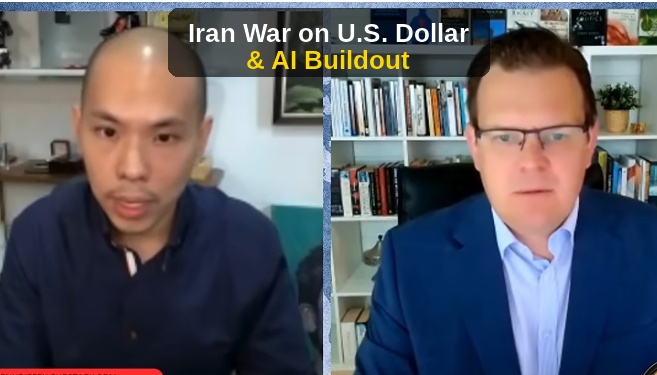
Read the full transcript of China expert Sean Foo’s interview on Greater Eurasia Podcast, July 20, 2026.
Editor’s Note: In this insightful interview hosted by Glenn Diesen, market analyst and China expert Sean Foo discusses the profound geoeconomic impacts of the ongoing conflict with Iran on the U.S. dollar, national debt, and the broader global economy. They explore how military escalation and energy disruptions in the Gulf are threatening global oil prices and accelerating de-dollarization efforts by BRICS nations. Additionally, the conversation highlights the vulnerabilities within the U.S. AI buildout, shifting geopolitical loyalties, and the fragile state of domestic stock and bond markets.
Introduction
GLENN DIESEN: Welcome back. Sean Foo joins us today, our market analyst, China expert, and the go-to guy for gold. And I will leave a link in the description. So thank you for coming back on the program.
SEAN FOO: Hey, sure, Glenn. Always glad to be here.
The Iran War and the U.S. Dollar
GLENN DIESEN: So the war against Iran, like most of America’s wars, have a very strong geoeconomic purpose. That is to strengthen the US position in global markets. And as we know, a key source of America’s economic power derives from the exorbitant privilege of having the US dollar as the world currency — sorry, the world currency.
And I was wondering, how do you see the role of the dollar in the war now against Iran? Well, for that matter, also the war against Venezuela, Russia, and others, but especially with Iran, how is the US dollar attempted to be enhanced?
SEAN FOO: Well, I think the US dollar is not going to be enhanced. It’s actually going to be devolved over the coming months and the coming years.
Now, the problem with the war in Iran is that firstly, the US doesn’t seem to want to end it. We have seen a lot of cases where Trump said that the Iranian military is destroyed, the deal is going to be signed, but yet just over the last 48 hours, we have seen them pummel Iran for the next, for over 5, 6, 7, 8 times.
Now, the issue with this is the amount of war spending is just going to escalate. That’s only one side of the equation, right? The US national debt just currently crossed over $39.5 trillion, and that is simply unsustainable.
Now, the problem with the war is it directly invites Iran to escalate. And as we all know, Iran holds the Hormuz Strait. And they’re going to replay what they have done over the first 60 to 90 days. They’re going to hammer the entire Gulf states, all the oil-producing regions over there. And that’s why we are seeing a lot of attacks on Kuwait, Bahrain, as well as on the oil infrastructure.
Now, what happens when you decide to shut down the strait again? You’re going to spike oil prices. And that’s why we have seen crude climb from $70 all the way back to $90, and very likely we’re going to push towards triple-digit oil.
Now, this is where I think Trump really doesn’t understand how precarious the situation is. The issue with higher oil prices now is that it just invites the threat of a consumer collapse where people get poorer, they can’t really spend, and at the same time, it invites higher interest rates throughout the world.
Now, on one hand, higher rates is just going to invite the US Central Bank, the Federal Reserve, to hike rates even higher down the road. And secondly, as you see rates go higher, what is that going to do? It’s going to push the national debt towards closer and closer default.
So over time, this is just going to destabilize the dollar throughout the world. And countries, well, we just need to look at the bond yields, right? They’re rising. So investors, they’re saying, if you want us to hold US paper, US debt, you got to pay us more and we are on an unsustainable path towards eventual default.
The U.S. Bond Market and Erosion of Trust
GLENN DIESEN: Well, I think these are the 2 most painful things the Iranians are doing, that is destroying the US bases in the region. That is Saudi Arabia, Qatar, UAE, Kuwait, Jordan, Iraq, will hit Oman as well, but also shutting down the Strait of Hormuz, of course, which impacts oil, fertilizers. But how is it impacting — you mentioned the lack of trust now in US debt. What is happening in the US bond markets?
SEAN FOO: Sure. I think there are 2 fundamental areas we need to talk about when it comes to US debt.
Now, firstly is the confiscation of Iranian assets. I think we have seen what happened back in ’22 and ’23, what happened with the Russian assets. So that was one incident with $300 billion gone. And next, we have seen a lot of confiscations happen. Iranian crypto was confiscated as well, as Scott Bessent just famously said. As well as there are very weird terms when it comes to the frozen assets. You know, Trump, he was saying that, oh, we will release Iranian funds and those funds will be used to purchase US agricultural products, right? So now there are terms and limits being set on Iranian assets. They have been frozen, and in order to get that unfreeze, you need to buy US products. So that alone creates a lot of resentment and a lot of fear in countries around the world.
Now, on the second hand, we are starting to see a lot of trust breakdown when it comes to the dollar, right? It’s not just the weaponization, it’s the continuous amount of debt being piled onto the current national burden, as well as the US just can’t seem to stop propping up the markets by continuing their AI buildout.
And what’s happening right now is that the deficit is going much higher and the tariff war is collapsing at the same time.
So the US is really caught in a very bad spending doom loop where they can’t stop, but at the same time, they have to pay more. And Trump can’t stop the war at the same time because he just wants to get his maximalist demands and Iran is not letting off the gas pedal as well. So all this does not bode well for the US economy, for the dollar, as well as the markets.
Scott Bessent’s Admission: The Dollar’s True Role
GLENN DIESEN: You mentioned the Scott Bessent comment and I thought this was interesting because you sent me an interview with him. Well, the reason I found it interesting is our political media elites, they tend to sell all wars as some, well, like a new civilizing mission that is an altruistic effort to defend the human freedoms around the world. This is how all wars are pushed to the public.
But Scott Bessent, when he was talking about the Iran War, he also made comments to the war on Russia and, yeah, the kidnapping of Maduro and, well, a neo-colonial project they have going on there. What was your takeaway from this interview? Because he did mention the role of the dollar, why this was a key goal.
SEAN FOO: Right. I think Scott Bessent just gave a very big admission and I think he’s just exposed the whole plan. Yeah, I think he just exposed the whole exorbitant privilege of the dollar and why at the end of the day, trying to maintain the petrodollar system is still very important.
Now, during the interview, he did say about how future peace deals with Iran would require them to price their oil exports in dollars and not the Chinese RMB or any other currencies for that matter, as well as how he plans to get the Russians to price their oil as well in dollars, get them back into the global dollar system.
Now, the issue with this is the more dollars, the more oil trade as well as global trade gets priced away from dollars. This just breaks the entire recycling project where countries get their trade surplus, they get the dollar surplus, and then they recycle it back into US Treasuries. Now, in the past, that is a catalyst for US growth, but it’s even more urgent right now.
Now, most recently, Bessent went on interviews saying that he believes that the US is going to win the AI race and the US is going to corner AI compute. Right now, the US has 60% market share, but he said that the US wants 80%. Now, the only way to get 80% is you need to build a tremendous amount of data centers. But the issue comes, revolves around the money. Where are you going to get the money? Where are you going to get the funds?
Now, the US is flat broke and they can’t possibly print the money without a disaster happening. So there are only 2 ways to do it. One way is to really get your own domestic investors to pour money in, but the more popular way is to get money from the rest of the world to put money into the entire US markets, especially the bond market, to buy the bonds.
Now, this is where things get a little tricky. Now, if you’re a foreign investor and you want to invest into US assets, not only must you look at the yield, right? You know, US bonds, they yield anywhere from 4 to 5%, especially on the 10 and the 30-year, the long-term bonds. But at the same time, you need to look at the strength of the currency. There’s no point buying a bond for 4 to 5% yield when it’s dropping by 3, 5, or 10% every single year, right? You need to protect the strength of the currency.
And that’s why Scott Bessent just revealed the entire game. The US wants to protect the strength of the dollar, and that’s why they’re trying to reassure the world that oil will get priced in dollars once again.
Trump’s Demands and the Petrodollar Agenda
GLENN DIESEN: Yeah, I’m going to leave a link to that video in my Twitter feed because I thought that was kind of extraordinary the way he essentially argues that the key goal of the war on Iran is to force them to use the dollar in their energy trade again.
But it had another interesting component though. Trump made some comments about forcing the Iranians to invest in US agriculture. And I guess this is also tied into the main problem, that is, the Strait of Hormuz being shut down created an oil and fertilizer crisis. Now, if America can win this war, I guess they can force the Iranians to sell their oil in dollars. They can compel them to, well, I think Trump used the word, give the US exclusive rights to sell them agricultural products. Again, this is the peace they’re looking for. How are you seeing this?
SEAN FOO: I think this is a pure act of desperation. We can trace this back over the last 12 to 18 months when we saw Trump actually beg or maybe request China to buy more soybeans, buy more wheat from the Americans.
Now what we are seeing is a global geopolitical shift as well as geo-economic shift from the BRICS nations away from the American system, especially what the US exports. Now we are beginning to see a lot of the BRICS countries — Russia, China, Brazil — beginning to trade with each other, especially China. They are buying a lot of food products, beef, agricultural products, soybeans from Brazil.
So right now the US is caught in quite a quagmire. They’re caught in a very dire situation. On one hand, their farmers, they are facing a lot of costs, a lot of escalating costs. Let’s not forget the farmers, they were whacked with 30 to 40% tariff over the last 12 to 18 months. So all their costs are elevated. And right now, the price of gasoline, the price of diesel is flying up, as well as the prices of fertilizers, which are up at least by 20 to 40%. So the price of US food is also climbing.
Now this just leads to quite a bit of a disaster, right? Either consumption would drop or the farmers, they would just close their farms and the US will lose even more of their food-producing base.
So what we are seeing right now is the last-ditch attempt by Trump to assure his base, a lot of them are the farmers, that yes, we are going to win the war. At the end of the day, the Iranians, they’re going to use dollars to buy your farm products, but that is not a long-term solution.
Even if the US does win the war, it doesn’t solve the problems that BRICS is getting more advanced. They’re lowering their cost of production. However, for the US, everything is just getting more and more expensive. So even if Trump does win this war, even if he does get Iran to purchase US agriculture, it does not really solve the structural problems inherent in the US economy.
Saudi Arabia, BRICS, and the Future of the Dollar
GLENN DIESEN: Well, again, yeah, but if the goal here is defeating Iran as a way of reviving the US petrodollar, obviously this is also seen as an effort to weaken BRICS. And Trump, he never shies away from explaining how he has defeated BRICS. BRICS is irrelevant. At some point he made the comment that Spain was a BRICS country, I think. I mean, I don’t think he’s got his facts straight completely, he seems to be missing some of the details here.
But all of this is premised on the idea that the US will defeat Iran. If the Iranians win, again, one can discuss how you define victory, but at the moment, as you just said, the Iranians are destroying all the bases from Saudi Arabia, Qatar, UAE, Kuwait. You would think that the reason why a country like Saudi Arabia is sitting on the fence — I mean, it didn’t join BRICS in 2023 because it’s tied, you know, joint at the hips with the United States because of the security. But if the US bases are destroyed, if the US security arrangement is seen as a liability rather than a benefit, that is, Iranians come out on top, the Saudis are going to have to make some peace with them.
What would happen if the Saudis would then get off that fence and start aligning closer with BRICS, wouldn’t that be a very big nail in the coffin of the dollar?
Iran’s Leverage Over Oil and the Dollar
SEAN FOO: Yes, it would. I mean, right now we could see the Iranians actually show how dominant they are over the strait and how they can actually control US inflation. Now let’s talk quickly about that first.
Now we can see that June CPI dropped from around 4.2% down to 3.5%, and everyone was cheering, right? The inflation crisis in the US is over. But that only came predicated that oil prices crashed from around $100 all the way down to $70 because of the promise of the temporary ceasefire. I think we can all remember that, right? Because of the ceasefire, both the Iran and US so-called committed not to strike. Obviously that has been blown to bits today, but that shows that just from the commitments of the Iranians themselves to let some ships pass through Hormuz, oil prices did drop.
Now, which actually means that Iran has a lot of leverage over the Saudis right now. The Saudis, it is true that they can swing their oil away from Hormuz to the Red Sea using the Red Sea Corridor. They have managed to swing, I think, 40 to 50% of it over so the oil can actually go through the Suez Canal up north and it can go through the El Madab Strait. But we have reports that the Iranians have told the Houthis that you might want to close that down if the US keeps hammering us. So that is under threat as well. So it’s not impossible for the Saudis to actually eventually side with the Iranians in an indirect way.
And what did Iran actually want to do, right? Apart from just charging $2 million per ship toll, they also want Gulf countries to price their oil in Chinese RMB. Now, if that does happen, that means a lot of the Gulf countries, a lot of the Gulf states, not just Saudi Arabia, they will need to start accepting less dollars and to price their oil in Chinese RMB.
Now, if that happens, there’s only so many ways you can actually use the Chinese currency, right? You can buy stuff from China, you can buy Chinese bonds, you can buy Chinese stocks, or you can buy an international reserve asset, which is gold, which China sells themselves. Now, all of that is totally separate from the dollar system. You don’t see any of the money actually going back into dollars unless they do really change it, which is going to be quite weird if you don’t really need dollars to buy oil anymore.
So if Saudi Arabia does go with Iran, this is just going to be devastating for the dollar. It might not be the final nail, but it could really trigger a cascading effect, which won’t be good at this precarious time.
US Desperation and BRICS Pressure
GLENN DIESEN: Well, you can see the desperation in the United States. So for example, when Marco Rubio gets up in front of the journalists to make a passionate speech about the importance of the United Nations, that we can’t have blocking international sea lanes — I mean, this is the same country who put blockades on Cuba, Venezuela, engage in piracy, steals the sovereign assets of countries, continuously bombs countries, topples their leaders, to suddenly appeal to the UN and international law and maritime law — it reeks of desperation because it’s so obvious hypocritical.
But how do you see now the US putting more pressure on BRICS? Because this looks like, as you said, this is the key institution that could facilitate the de-dollarization and, well, dethroning of the US. Again, it’s almost now like a law of physics, that is, BRICS doesn’t need to come up with a very brilliant scheme. It only needs to facilitate something because it’s the US that’s bearing the dollar on its own, essentially. All that BRICS has to do is to facilitate alternatives in terms of trading in national currencies, bringing back some gold format or internationalizing the yuan or whatever it might be. But how do you see the possibility for the US to threaten BRICS?
The AI Card: America’s Last Leverage
SEAN FOO: Right. Now, when it comes to the confrontation between the US and BRICS specifically, I think we need to admit that the US has lost a lot of cards, right? They’re losing the currency card right now. The US is causing a lot of inflation problems around the world, not just with BRICS but the entire Asia as well. So a lot of countries, they’re not very happy with how the US runs statecraft and how they’re actually squeezing the world for their own geopolitical objectives.
Now, the only card the US has right now is the AI card, is the semiconductor card. And if the US manages somehow to control the world’s AI compute power, the capabilities of the AI models, and to really ring-fence the latest capabilities away from BRICS and other countries, then perhaps the US might stand a chance to arm twist BRICS.
But the issue with that is it is rapidly collapsing. Now, the entire US plan of ring-fencing AI, to build big walls to basically prevent the world from accessing some of their latest models, whether that be Claude, whether that be ChatGPT, some of the more powerful AI models that the rest of the world simply can’t develop, that has been shot into pieces over the last 48 hours.
Now, I’m not sure if you saw the news, but China just came out with their own AI model that just broke through all the parameters, all tests. It’s called Kimi K3 by Moonshot. Now, the big issue with this is that this AI model is open source, it’s open weights. So you don’t really need any government permission. You don’t need Washington’s approval. You don’t need to be subjected to the threat of sanctions by any country, whether that country be China, whether that country be the US. You can simply download that AI model into your own computer organization and just have it run by itself.
Now, this just disrupts the entire US ecosystem of, “We’ll just create our own AI models. If you want to access, you either got to pay an exorbitant amount of money, maybe we’ll force you back into the dollar system, or maybe you do have to give us geopolitical concessions.” Now, all that has been blown into pieces.
So when the conversation comes to what leverage the US might have over BRICS, I think economically, there isn’t much. When it comes to supply chains, there obviously isn’t much. When it comes to AI, well, China has just dismantled that fallacy that the US has some leverage over it. I guess the only thing left is the US military, but using that is also going to be very problematic.
The Gulf States, AI Investment, and the Iran War
GLENN DIESEN: Well, the AI component of this whole thing is interesting. Indeed, you can say there is even more directly involved in the Iran war because the Gulf states, they invest a lot of their proceeds or their income from energy sales in — well, first they sell the US their oil in US dollars, and then they invest a lot of this in American AI, which keeps this AI bubble alive.
But what is the — how is the destruction then, or the uncertain future of the Gulf states impacting this rivalry then between the US and China? Because there’s already a huge amount of investments now in the US, which is focused on AI. All of this can’t simply be subsidies. There will have to be some return on investment here. How do you see this?
SEAN FOO: Well, I think the issue with the Middle East right now is a net negative for the US. Now, firstly, the US has a very big energy problem when it comes to the AI buildout. Now, this is something that we all know by now. China has the ability to really create limitless energy at a very cheap price. Compared to the US, they’re anywhere from 33% to even 70% cheaper in certain regions of China.
Now, the entire idea before the war started — I think it was even as early as 2024 — was that the US was going to invest a lot of AI compute, build data centers within the Middle East itself. There were talks going on that maybe we’re going to build some in Saudi Arabia, maybe we’re going to build some in the UAE. Well, obviously that plan has now evaporated. You’re not going to build data centers where missiles are flying around, where the whole region is unstable, and where the Gulf economies, if things get nasty enough, they could plunge into a recession, right? So that is not good.
Secondly, unlike China, the US still relies a lot of their power generation on oil. So prices of natural gas is going up. Prices of oil is going up as well, and the US is just draining their SPR reserves, the Strategic Petroleum Reserves, down at a very alarming rate. So the longer this war goes on, well, the entire structure of AI, big tech, and all the hyperscalers is going to get even more precarious.
Now, the entire US economy itself is really riding on the idea, the hope that this buildout is going to continue. Now, over 2% of GDP relies on all this AI CapEx expenditure in order to keep the US economy away from a recession. Now, if this unravels, the first thing to fall will be all these fantastical valuations of US stocks, which a lot of the wealth funds in Saudi Arabia, a lot of the wealth funds in the Middle East, they hold. So they’re going to get impacted as well. Now, this is not going to end well unless the war in Iran really comes to a nice conclusion. But as it stands, I don’t really see it happening.
China’s Chip Development and the Semiconductor Race
GLENN DIESEN: How is China’s chip development impacting all of this? Because again, this is why it’s difficult to follow some of the developments here because there’s too many variables, too many things happening at once.
The whole part of this drama began, of course, also with the United States putting bans on chip imports from China, encouraging the Europeans to do the same, because this was assumed that would tear down the whole Chinese tech industry. But it did the opposite, it seems. The Chinese simply began to develop much more fast their own capabilities. And it creates some problems now. It hasn’t reversed a bit now. The US market realizes they can’t really survive without the Chinese market. I mean, they cut off a massive consumer who’s the Chinese are now feeling themselves. And well, the US did this to themselves. But how long can you do this? Because if a key problem is the AI bubble not being able to bring in proper return on investment, how is this impacting the bubble?
SEAN FOO: All right, so here’s the funny thing, right? I want to start off with this fact, which is quite interesting. So over the last 1 to 2 months, US imports from China soared to the moon, right? It was an astounding amount of increase. I think it was 30 to 40% increase, and most of these amounts came from electronic parts and inputs needed for the US AI buildout. So you just think about it, the US AI bubble is supported by imports of electronics from China. So as this bubble continues to grow, the US is actually making China richer.
And what is China going to do with this trade surplus? They’re going to just invest it back into their own companies, into their own economy, especially as the tech race continues. Now, let’s not forget that China has announced they’re going to spend around $290 billion specifically for the AI race over the next 5 years. So that’s around $60 billion a year. And money really stretches further in China, right? So let’s say you spend $1 in the US, maybe you’ll get $1.50 worth of output if you’re lucky. Now, if you spend a buck in China, you might get $2, you might get $3 worth of output.
So China is now creating their own chips. They have come to the point that they don’t really need high-tech lithography machines from the Netherlands, from ASML, to really leapfrog the US. They are investing a lot into talent, into creating better software code. Huawei themselves have created a kind of logic folding technology that allows the chips to just fold, make the transistors closer together so that you don’t really need to have the latest and the greatest AI chips from Nvidia, for example. So China is closing the gap that way.
Now, the issue with the US is that they can’t really close this gap because they are lacking a lot of revenue from China. Now, China consists of 40 to 60% of the entire semiconductor market. And with China’s new investment of $300 billion in the next 5 years, there’s a very interesting clause in there that we need to pay attention to, and that is 80% of the materials there will need to come from domestic Chinese companies, right? So maybe China will source 20% from the Koreans, from the Japanese, just to keep trade relations up or whatsoever. But the majority of it will be coming from Huawei. Those AI chips will be from that company. Memory chips will be from the Chinese CXMT, which is the Chinese equivalent of Micron in the US.
So the money is just going to be locked in a circular economy within China, building it up. And the US won’t even get a lick of that revenue, which is not very good, especially when you need money to win the race.
East Asia’s Security Dilemma and Dollar Dependence
GLENN DIESEN: Well, I guess another problem here though is geoeconomics is often tightly linked to the military as we see with the Iran War, but the frontline states, the security dependence they have on the United States, it converts into economic or geoeconomic loyalty. You see this with the Gulf states, the reason why they trade in the US dollar, why they reinvest all their profits into the US market is because they’re highly dependent on the US for security. You see the same in Europe, you see the same in East Asia.
Now, if this, well, I guess security dependence is weakened or they don’t see the US being reliable, they see the US as inviting wars instead of preventing them, that can unravel a lot of this geoeconomic loyalty. Obviously, the Gulf states is a concern now. I think the Europeans, they’re, well, they’re still doubling down, hoping to preserve the political West.
But how do you see it in East Asia being impacted by all of this? Because one thing I noticed in the war against Iran was the first thing the US did was it started to pull out a lot of its missiles, both interceptor missiles and well, other missiles from South Korea and other countries in East Asia and send it to the Middle East or more specifically send it to Israel. And how do you see countries in that part of the world now responding to this? So what is the Japanese doing? I mean, at some point they will have to hedge their bets, won’t they?
SEAN FOO: They will have to. I mean, there’s a lot of talks about how Japan plans to build up their military as well as we have seen a lot of the missiles being pulled away from Korea as well, right? All the way to the Iranian front. So the Koreans are also freaking out.
Now, the issue with these Asian economies is that they’re caught between a rock and a hard place. Now, obviously the US is, if not abandoning their allies, they’re just making things worse with the entire war in Iran. They’re making prices go higher, and all these economies, they’re getting squeezed, right? Now, if we take away all the advantages of more semiconductor demand, the underlying economies there are actually getting weaker and weaker.
I just came back from Japan, and things are like 30 to 40% cheaper compared to where I’m from. So you can see that locals there, they’re not exactly living the high life. But the problem is that they also face China, and China is so-called the big brother over there. So who are you going to listen to? Are you going to listen to China, who you have a lot of historical issues as well, right? Staying all the way back to World War II. And China has the ability to cut off your rare earths. They have the ability to constrict your imports.
So are you going to listen to China? But if you do listen to China, you’re going to incur the wrath of Washington. And a lot of this, a lot of Korean economy and the Japanese economy is stuck with the US. They export a lot of stuff there, and Japan holds like $1 trillion worth of Treasury bonds. So all this kind of legacy heritage connections just can’t be easily unraveled.
So I believe that they’re all trying to hedge their bets. They’re trying to wait things out. And I believe that trying to unravel their loyalty to Washington is not going to be easy. I don’t even think it can happen in the next 5 to 10 years. I think they’re just waiting for someone else more rational, if that’s possible, to replace Trump over the next 2 to 3 years.
The Weakening Dollar and U.S. Financial System
GLENN DIESEN: Yeah. Well, that’s definitely the European strategy these days. It seems to be hope. Let’s hope Trump goes away and somehow we’ll magically return to the ’90s. I think they put too much focus on the person, the leader, and not so much of the economic situation in the US because, well, the US situation is changing quickly. And again, as you said, they can’t really win the tech race. They can’t keep control of these maritime corridors around the world. Their banking, international banking systems, they’re not, you know, the monopoly position anymore.
But also the strength of the currency though, the whole financial system, it’s weakening because the US is increasing now its money supply at a huge rate, which is, well, it’s a form of taxation, isn’t it, on the whole world? Because everyone holding dollars now will see their, well, their current holding reduce value by having the United States continuously just grow and grow the money supply. What is China now doing as a way of, well, avoiding this tax?
SEAN FOO: Sure. Well, I think China is actively de-dollarizing. They are getting rid of their treasury bonds almost every single month. And a big reason is to avoid confiscation, of course, right? If it can happen to Russia, it can happen to you.
But another problem is holding US Treasuries, recycling your money back into US debt is fundamentally not a good idea. Even though the US is paying 4 to 5%, as you said, the money supply is increasing by 6 to 8% every single year. And the US just keeps spending even more. They’re going to spend more to rebuild the military. Trump has pledged like $1.5 trillion. They have to build more data centers in order to keep the bubble moving. And the war with Iran is costing anywhere from $500 million to $1 billion a day. That is not going to stop.
So China eventually sees the writing on the wall. Eventually, if things do not stop, the US will default on the debt. And there’s only 2 ways you can default on the debt. Now, the first way is to outright not pay the debt, right? You owe $100 to the bank, you tell the bank you are not going to pay it. But likely that’s not going to happen, right? You’ll just unravel the global economy just like that. So the most expedient way to do it is to print money and to pay off the debt through inflation, and suddenly the whole world gets inflated away.
So going forward, we’re going to see a lot of countries within BRICS, they will find alternative ways to invest, whether that’s buying Chinese bonds or whether that’s buying gold. They have to secure the reserves. And that obviously is not good for the dollar or the Treasury market. And for countries who have manufacturing economies like China, maybe even like Japan themselves, they have to spend the money productively. So they’re going to invest in their own economies, whether that’s building new factories, whether that’s building more chip capabilities, they will have to do it. And this is going to leave the US in a lurch, right?
Now, I think a lot of people are saying that countries in the world, they’re still buying US Treasuries net on net. That’s true because the money supply keeps going up, right? So if people buy a few more billion US Treasury bonds, you can technically say the amount is going up. But on a percentage basis, central banks, they’re holding less. The amount has been dropping since 2008, right after the big bailout by Ben Bernanke. After the 2020 money printing from the lockdowns, the world is just losing more and more confidence.
So they’re just going to find alternative assets to put into. And well, gold is obviously a big avenue, but we’re going to see a lot of investments into their own economies. We’re going to see countries like Japan, even Europe, Germany, they’re going to spend a lot on their own military, in order to boost their GDP as well.
China’s Push to Internationalize the Yuan
GLENN DIESEN: Well, how about the internationalizing the yuan though? Because it appears that the Chinese, they didn’t mind having, to some extent, the US dollar as a reserve currency. They didn’t necessarily want this role, that is, for their own currency to have too large of a role in international markets. But on the other hand, of course, putting all— investing so much in the US dollar when it’s not sustainable, and also the dollar is weaponized against China, it doesn’t really make much sense. But what are the Chinese doing though in terms of strengthening, well, their own currency and their own financial systems?
SEAN FOO: I think China, as you said, is going to internationalize the yuan to a much greater degree as the years go by, as the decades go by. Now, we’re not saying that they’re going to replace the US as the reserve currency, because to be a reserve currency, there’s a lot of disadvantages as well. But China’s ultimate goal is to create a situation where they can buy all their inputs from the world in their own currency.
Now, China is able to do that around 50 to 60% of the time right now. Sure, 100% of their imports from Russia is settled mainly in the Chinese yuan and to a smaller degree rubles. But with the rest of the world, they are still using dollars in quite a serious degree, right? At least 20-30% of their trade is still settled in dollars. Now China doesn’t want that, so the only way is to internationalize the yuan.
Now the issue with internationalizing the yuan in the past is you need a stronger RMB, right? You don’t want countries to collect a lot of yuan, then over the next 5 to 10 years, the Chinese currency loses quite a bit of value. That’s just self-defeating. However, if you do appreciate the RMB, the Chinese currency, that will also damage your own export value as well. You know, the higher your currency goes, the more expensive your exports become.
However, we have shifted to a whole new world where the import costs of all of China’s competitors are going up at the same time because their currencies are collapsing. When Japan’s currency collapses, when Korea’s currency collapses, and when prices in the US go up, their manufacturing costs rise as well. While China is rising, and the US is rising higher than China. Why? Because they are all very dependent on the price of oil. However, China has diversified their own energy mix. So in a sense where everyone is collapsing, China is collapsing less, and that makes China more competitive. And this ironically allows the Chinese to just appreciate their currency, which has been going on for the last 18 to 24 months.
Now suddenly the RMB becomes a more attractive store of value, right? Not only are you getting a bond yield, at least your currency is not dropping, so you can reliably hold on to the Chinese RMB.
Now what’s going to happen in the next 4 days is also quite groundbreaking. China is going to cancel gold trading. Now this is a big one. China, they don’t really want their gold market to be full of paper derivatives, to be controlled by all these paper contracts, unlike what’s happening in the US. Now, why do they want to do it? It’s because they want the world to see China as a gold hub where you can put your money in and the price of gold is predictable. And that just gives countries around the world even more avenue to invest their earnings from China. You get Chinese RMB, you can put it into Chinese bonds. If part of you doesn’t trust the Chinese government, fine, you can buy gold with it and that gold will be sitting in China itself.
So China is firing on all cylinders here. And yes, the Chinese RMB is really going to be a big part of this equation going forward.
U.S. Bond and Stock Markets Amid Escalating War
GLENN DIESEN: Yeah, because of all the criticism against the US dollar, a common argument is always that it’s, yes, it’s a flawed problematic currency, but it’s the cleanest shirt in the hamper, that is, although the alternatives are worse. I think that’s something that’s definitely not true anymore.
But I just wanted to ask you lastly about how you see the development of stock markets and, well, the international stock markets, because there’s a tendency for Trump to essentially go back to fighting wars on a Friday evening. Escalate against the Iranians, and by Sunday night tell how peace has broken out and how wonderful everything looks, but before the markets open again to calm them. At least this seems to be a key trend now.
And again, it’s for good reasons, as you have outlined. Now, the US control over international markets, its economic situation is quite fragile. And this is a key thing they have to take into account when they fight their wars. But what does the US bond market and the stock market look like now? Because I think, well, diplomacy is more or less dead. The Iranians don’t really see much point even talking to the US anymore because diplomacy is just one long deception and the war is escalating, it’s widening. What do you see in the future now?
The Stock Market Trap and the AI Narrative
SEAN FOO: All right, right now we’re in a very interesting period in time where the US stock market is going up but the US bond market is collapsing. Now, this used to be the exact inverse, especially in a time of war. Stocks should be collapsing while US bonds should be rising in value because of demand. So what investors are telling us right now is that we know the dollar’s going to get debased down the road. We know the US is going to spend much more, and we likely believe bond yields are going to go up. So we are fleeing from debt.
But the issue with global capital is that it always needs a place to run to. And right now, a lot of people still believe in the US AI story, and that’s why a lot of money is still flowing into US stocks, especially the NASDAQ, as we speak.
Now, the big problem with this is that it relies on, as you say, the AI buildout and Trump constantly hyping the markets up. Now, Trump is almost every week talking about how the stock market is hitting all-time highs, how a lot of investments, $19 trillion worth, is going to enter the United States, which is factually impossible, but he still keeps hyping it up. So the market still laps all this up because they do have an underlying hope that the war in Iran is going to end. And when it ends, oil prices are going to crash, inflation is going to come down, and US stocks, they’re going to benefit from it.
The K-Shaped Economy and Trump’s Market Dilemma
SEAN FOO: However, the big problem is you cannot have US stocks collapse without the threat of a recession coming. Now, a lot of the people — a lot of US consumption is being done by the top 10 to 20%. We call this the K-shaped economy, right? Where the lower earners, they are losing a lot of money, they’re getting poorer. However, the high-income earners, especially the stockholders in the United States, they’re spending more.
Now, what happens if the market suddenly drops by 10 to 20%, or God forbid, 30%? Suddenly you’re going to feel poorer, you’re not going to spend, and everything just grinds to a halt. And this is where Trump is really caught. He has really created a prison of his own making. He cannot afford for stock prices to come down, so he needs to keep hyping the entire stock market game. However, the more he does it, prices need to keep rising, rising, and rising. However, the fundamental situation doesn’t really warrant that.
You know, companies, they can’t keep borrowing when rates keep going up. US AI is facing the threat of China, and he just recently re-escalated the war with Iran. So all this, all these conflicting situations is just hammering down the entire US economy. And if he doesn’t get a grip on this war, I think markets are — they’re not going to stay stable for much longer.
Leaders Bragging About Their Vulnerabilities
GLENN DIESEN: Yeah, they see that. They say that political leaders tend to obsess or brag about their vulnerable — about areas where they’re very vulnerable. So for example, the EU at the moment, at a time when freedoms are falling apart very quickly, the EU leaders can’t stop talking about how wonderful freedoms they have. And the same is in the United States. Trump and a lot of US politicians can’t stop saying how great the United States is, how it’s the most powerful country in the world, how the stock market and economy is better than it’s ever been. Usually this reflects some insecurities that things aren’t going very well.
Well, before you go, do you have any last thoughts? And also, where can people find you?
Final Thoughts and Where to Find Sean Foo
SEAN FOO: Sure, yeah, people can find me at my YouTube channel. Just type in “Short for Gold,” Short for Gold. And yeah, I cover everything from economics, gold and silver, stock markets as well, and quite a mixture of geopolitics as well, especially when it relates to the economics.
Well, I think my last words are — right now we are in a very unprecedented time. Things are getting very, very risky. A lot of people in the markets, they are really rolling the dice. We can see it from the recent SpaceX IPO. You know, it flew to the moon. After that, everyone got rug pulled and the prices are now collapsing back to earth. So I guess the lesson is not to follow the hype, do your homework. And the only thing we can do right now is to pray for the war to be over.
GLENN DIESEN: Well, thank you so much for your time. And yeah, I definitely follow your channel, so I would advise everyone else to do it as well.
SEAN FOO: Thanks again. Great. Thanks, Glenn.
Related Posts
- Pepe Escobar: Rise of a Post-Western World at the SCO Summit (Transcript)
- Alexander Mercouris: Ukraine Unravelling – War Enters New & Dangerous Phase (Transcript)
- Transcript of Nepal Floods: China’s Silence, Medog Dam And India’s Himalayan Nightmare w/ Abhijit Iyer-Mitra
- Chas Freeman: U.S. & Iran Back at War & NATO’s Abuse of Ukraine (Transcript)
- Transcript: ‘China Had 20 Minutes to Warn People’ – Lobsang Sangay on Nepal–Tibet Floods’