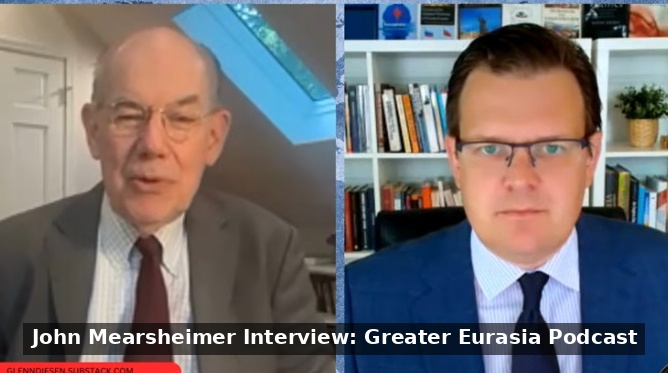
Read the full transcript of political scientist Professor John Mearsheimer’s interview on Greater Eurasia Podcast, July 30, 2026.
Episode Notes: In this interview, political scientist Professor John Mearsheimer joins host Glenn Diesen to examine the latest developments in the Ukraine war. Mearsheimer discusses how Ukrainian drone strikes on Russian targets, conducted with NATO support, prompted a strong Russian response that has effectively rendered Ukraine landlocked by closing its Black Sea ports. The conversation critiques prevailing Western narratives about the conflict’s progress, analyzes the deteriorating situation on the Donbas front, and explores Ukraine’s mounting manpower, economic, and political challenges. Together they consider the broader strategic implications, the limits of escalation, and potential paths toward a negotiated outcome.
Ukraine’s Drone Campaign and Its Consequences
GLENN DIESEN: Welcome back, everyone. Today is July 30th, 2026, and Professor John Mearsheimer joins us to try to make some sense of the world. So thank you for coming back on.
JOHN MEARSHEIMER: My pleasure, Glenn, and I’ll do my best, although it’s a very difficult task at this point in time, as you well know.
GLENN DIESEN: Yes, I agree. No matter where we look, things just appear to be getting more crazy. I wanted to start a bit with what has been celebrated so very widely in the West, which are these new attacks by Ukraine into Russia, with what appears, of course, to have extensive support from NATO.
They’re hitting deep inside Russia, but instead of just going after refineries, they’re also now — the main big targets are these warehouses owned by Wildberries, this e-commerce giant. And essentially the claim one gets is that by hitting civilian targets, it will not only hurt the economy, but it will also make Russian civilians feel the war themselves. And as a result, it would put more pressure on the Kremlin. And I was wondering how you assess this strategy and the assumptions it’s based upon.
JOHN MEARSHEIMER: Well, I think that there’s no question that these Ukrainian attacks caused the Russians problems. I think the results that you just described are true. People will be unhappy and they’ll put pressure on the government to do something about that. But there are two big questions you then have to ask yourself. What will the Russian government do, number one? And number two, what effect will these Ukrainian long-range drone attacks have on the outcome of the war? Those are the two questions you have to ask yourself.
Well, to start with the first question, the end result of this campaign is that it has caused Putin to wage the war more aggressively against Ukraine. And most importantly, the Russians have shut down the Odessa port complex on the Black Sea, and they’ve shut down all of the Ukrainian ports on the Black Sea, which effectively means that Ukraine is now a landlocked country. This is disastrous for Ukraine.
Before the war started, about 90% of Ukrainian exports went through the Odessa ports. 90%. And no, I take that back. 90% of the agricultural goods went through Odessa and about 70% of the overall exports went through Odessa. These are remarkable numbers.
You remember the Russians shut down Odessa, they shut down the Black Sea between February 24th, 2022, when the war started, and July, a few months later. And during that February to July 2022 window, the Russians caused enormous damage to the Ukrainian economy. And fortunately for Ukraine, a deal was worked out under the auspices of the UN and Turkey that led to the reopening of the port, or the ports, in the Odessa area in July of 2022. That was manna from heaven for the Ukrainians.
Well, fast forward to the present. What the Russians have done is they’ve shut down the Odessa port complex. They’ve shut down all of the Ukrainian ports on the Black Sea. This is going to have devastating economic consequences. And it’s not like Ukraine is a country that is in good economic shape at this point anyway. In fact, enormous damage has been done to the Ukrainian economy over the course of this war. And this will just make a horrible situation much worse.
So there’s no question that the Ukrainian long-range drone campaign has inflicted pain and caused problems for the Russians. No doubt about that. But the Russians have retaliated and they are able to cause much more pain for the Ukrainians than the Ukrainians can cause for the Russians. So this escalation does not work to Ukraine’s advantage. In fact, I would argue it works to Russia’s advantage. And I often wonder why the Russians didn’t shut down the Odessa port complex earlier. Why did they wait so long? Well, thankfully, the Ukrainians have prompted Putin to do it now.
So to get to my second question, this is not going to improve Ukraine’s prospects of winning the war. In fact, this is going to work to Ukraine’s disadvantage. And by the way, it’s not just the shutting down of Ukraine’s ports on the Black Sea that matter here. The fact is, if you look at what the Russian air offensive against Ukraine is doing, it’s also targeting all sorts of infrastructure, all sorts of places where drones and military equipment is produced inside of Ukraine. It’s shutting down gas stations all across eastern Ukraine, making it almost impossible for a vehicle to drive from point A to point B because there’s no gas available. The Russians are targeting railroads and locomotives and so forth and so on.
So the end result of this air campaign that the Russians are now escalating because of what Ukraine is doing is to speed up the process of Ukrainian defeat. So I think there’s no question that Russia will suffer some pain, but in the end, the Ukrainians will suffer more pain, and it will speed up Ukraine’s defeat.
Ukraine Becomes Landlocked: Strategic and Economic Fallout
GLENN DIESEN: I guess the whole logic of increasing the pain on Russia, hoping that they will somehow capitulate, it doesn’t — it seems to be flawed for the same reason that measuring success in terms of death and destruction is — yeah, it’s the same flaw.
But I thought it was interesting though that Ukraine began to attack all these ships, Russian ships in the Sea of Azov and the Black Sea. I thought it was strange because the whole — not a complete Black Sea ceasefire, but all the remnants of this grain deal, that is not to attack each other’s ships — it looked like it was a good deal for the Ukrainians. It was just strange to see them opening up this massive front, and also the celebration across the Western media that all these Russian ships were being hit. One could have predicted what would be the consequence. That is, it looks as if now Ukraine has become a landlocked country de facto. I was just wondering, what is the next play here then for NATO and Ukraine? Will they look for a ceasefire in the Black Sea, or because Ukraine is a landlocked country, it’s not going to do very well?
JOHN MEARSHEIMER: No, it’s a disaster economically. There’s no question about it. And as I said, Ukraine is a country that was in desperate straits economically even before this Russian campaign against Odessa ramped up. I mean, what’s going to happen here is that as a result of the air war, Ukraine’s economy and its infrastructure is going to be wrecked. And at the same time, the Russians are going to steadily improve their situation on the battlefield. They’re already doing that.
It’s quite clear that they’re going to control all of Donbas by the end of this year. And I think at this point, the only interesting question is how much territory the Russians ultimately end up taking. I think in the end they’ll take Odessa, and the incentives to do that are clear from what we were just saying about the effects of turning Ukraine into a landlocked country.
You want to remember here, the Russians, I believe, are not in a position to win a decisive victory and conquer all of Ukraine. They would be remarkably foolish to attack into Western Ukraine. And the end result is you’re going to get, I believe, in the end, a rump Ukraine state. And you want that rump state to be as economically weak as possible if you’re the Russians. You want it to be a dysfunctional rump state.
That will be Russia’s goal. Russia’s goal will be to conquer lots of territory and not get bogged down in territory that’s mainly populated by ethnic Ukrainians. And then make sure that rump state that’s left, that rump Ukraine, is dysfunctional. And taking the Black Sea ports is a major step in that direction.
So I think what’s going to happen here is that the war is going to play itself out. It’s going to be settled on the battlefield, and the Russians are going to win an ugly victory, not a decisive victory. They’ll win an ugly victory, and you’ll get a frozen conflict at some point in time. I think that’s the direction that you’re headed in, and I don’t see how the Ukrainians can turn this around.
As you know, Glenn, there is a huge amount of attention paid even in the Ukrainian press to the fact that the army is suffering significant manpower problems due to draft dodging and to the large number of soldiers who run away from the battlefield, who are AWOL, as we say here in the United States. So they don’t have much manpower up on the front lines, and everybody admits that this is a huge problem.
And when you look at the state of the decision-making process inside of Ukraine, it looks like it’s a total mess. Zelensky has just gotten rid of the Minister of Defense. He’s just gotten rid of his commanding general. They have new people in place, and it’s not clear how this all fits together. I mean, the last thing you want to do if you’re Ukraine is, at a critical point in the war like this, have this political fiasco that leads to the firing of — aside from Zelensky — the two key decision makers in the national security process. But that’s where they are.
So I think when you look at what’s happening on the battlefield, the fact that the Ukrainian frontline is buckling, and that the bombing campaign has now been ramped up and is working in major ways to Russia’s advantage, and then you look at the political situation inside Kyiv, especially with regard to the commanding general and the Minister of Defense, you can’t help but conclude that Ukraine is in really deep trouble.
The Donbas Endgame and Ukraine’s Deteriorating Position
GLENN DIESEN: No, deep trouble indeed. But it looked as if across the West, there was this huge push in the media to sell the idea that Ukraine had turned the tide. And indeed, it appears to have at least been successfully sold to Trump. He seems to have gotten on with that assumption that Ukraine is now winning. He made some comments towards this end and also signaled that the US would support Zelensky to a greater extent.
But it’s kind of strange because as we see this “turn the tide” narrative, it appears to have lost some of its momentum, because I think, if not a collapse, at least a decline now is becoming quite evident. This could have been reinforced, it seemed, by a speech by Putin recently, which you probably watched, in which he looked very confident, arguing that Russia would likely move a lot faster now.
Do you see then the front lines — as you said, of course they’re cracking, the political situation isn’t good within, the foreign support is also becoming problematic — do you see an endgame, or things escalating or spiraling, going worse for the Ukrainians at this point?
The Role of Drones in Ukraine’s Defense
JOHN MEARSHEIMER: Well, let me make one point and then ask you a question. I think it’s hard to say exactly how this ends and when it ends. And the reason is drones. I think if there had been no drones in this conflict, the Ukrainians would’ve lost a long time ago.
What’s really saved them is the appearance of huge numbers of drones up on the front line that have basically forced the Russians to move very slowly and very carefully, and have allowed the Ukrainians to compensate for the fact that they’re badly outnumbered in terms of troops on the front line. And furthermore, that they don’t have enough troops to thickly populate the forward lines. Absent drones, this would be catastrophic for Ukraine.
But given the presence of large numbers of drones up on the front lines, the Ukrainians have done a quite good job, especially when you take into account the fact that they’re so outnumbered, in holding off the Russians, or let’s put it this way, slowing down the Russians. So given the presence of drones, the Russians are making progress for sure, but not rapid progress. Now, Putin would like to see rapid progress. Whether that happens remains to be seen because of the presence of drones. But nevertheless, I think that the Ukrainians are doomed up on the front lines. So that would be my main point.
Trump’s Support for Ukraine: Is There a Magic Formula?
The question I have for you is, you talk about Trump sort of deciding now that he is going to once again support Ukraine. As we both know, he’s gone back and forth on this issue. But if you look at what happened at the G7 meeting in June in France, and then in early July at the NATO meeting in Ankara, it looked like Trump was impressed with what the Ukrainians were doing. He had bought into the propaganda campaign that said Ukraine had the Russians on their back feet, and he sort of threw his lot in with the Ukrainians.
Okay, but the question I have for you is, so what? What is Trump going to do? Is he going to give the Ukrainians more weapons? Is he going to give them more Patriots? That’s meant as a joke, right? What are we going to do? Do we have the weaponry to give the Ukrainians? Is Trump showing any interest in giving them many, many millions of dollars? No. I mean, he’ll continue to give them intelligence support. But we’ve been doing that all along, as you well know. So even if Trump has changed his mind, does it matter?
And with regard to the Europeans, are they going to up the ante and do more to help Ukraine? What are they going to do? They’ve been giving them as many drones as they can. They’ve been giving them intelligence. They’ve been egging them on. They’ve helped formulate this propaganda campaign that’s designed to help Ukraine, but as you and I were saying at the top of the show, has basically backfired.
What are they going to do? The situation, not to talk about the Middle East now, but the situation is analogous to the problem that Trump faces with Iran. What is he going to do? What’s the magic formula? There is no magic formula. We can talk about this later, of course, but there’s no magic formula that Trump can turn to to win the war against Iran. And there’s no magic formula that the West, to include the United States, can turn to to help Ukraine win its war.
In fact, all we’re doing in this whole process, as you and I have argued for God knows how long, is making sure that Ukraine loses more territory, suffers more casualties, and ends up as a truly dysfunctional state. We’re incentivizing the Russians to really wreck Ukraine. So I think that there’s no question that the West will do everything they can to keep Ukraine in the fight, but it’s not going to produce a victory unless you could tell me what the magic formula is that I’m missing. And it’s going to end up doing enormous damage to Ukraine.
America’s Limited Capabilities and the Iran Connection
GLENN DIESEN: No, I think that’s a good point. That is actually a key problem often in Europe — the assumption about America’s involvement. It’s always assumed that America would have well close to unlimited capabilities, and the only thing that matters is American intentions. That is, if you can just get the Americans to commit to defeating Russia, then it would be a done deal.
They seem to forget all those years of Biden where he had that intention. But the capabilities obviously have become a huge issue. I think before it was well almost sold as Russian propaganda that Americans had limited missiles, interceptor missiles. But now, of course, after what we’ve seen in Iran, I think it’s become accepted. It’s actually moved away from this Russian propaganda to be accepted as reality.
But yeah, also a lot of the things the US is doing now, such as the licensing to Ukraine for developing their own Patriots, I just can’t see that happening anytime in the near future, or even in the medium to long future. So I just don’t see it happening, which makes it seem like this is all theater. I’m not sure what the point would be.
But what I did want to ask you about is how you see the linking now possibly of Ukraine to the Iran War. As I mentioned, with the American limited capabilities, it obviously is something that links these two wars. But as you probably saw as well, this attack by Ukraine on an Iranian vessel in the Black Sea — it looked as if this would spark Iranian retaliation. They said this cannot go unanswered. It’s not clear if it has gone away, but Ukrainians signaled clearly they wanted to de-escalate and that it was not intentional. Did you see the possibility of again all these wars, which seem to be different front lines of the same larger war, merging to some extent?
Would Ukraine and Iran Risk a Direct Confrontation?
JOHN MEARSHEIMER: I don’t see much chance of the two wars becoming linked in terms of the fighting. They are linked in the sense that we’ve used so many precious weapons in the Middle East that we don’t have them available to give to the Ukrainians. As you know, Glenn, the one weapon the Ukrainians really want is the Patriot missile. Well, if you look at our inventory of Patriot missiles before February 28th — that’s when the Iran War started — and where our inventory of Patriot missiles is now, we have used up roughly two-thirds of our Patriots. Just think about that. And it takes a long time to produce Patriots. So we have no Patriots to give to Ukraine. And in that sense, you could see how the Iran War has had an impact on the war in Ukraine.
But I think that the argument that because Ukraine attacked an Iranian vessel, that’s going to tie the two wars together in terms of the actual fighting — I don’t think that’s going to happen. And I think you just have to ask yourself two questions.
One, do you think Ukraine has a vested interest in getting into a war with Iran at this point in time? Does that make sense from Ukraine’s point of view? I do not think so. Ukraine is barely hanging on in its fight against the Russians. It would be, to put it bluntly, nuts to pick a fight with Iran.
And as far as the Iranians are concerned, the Iranians would be nuts to pick a fight with Ukraine. The Iranians have their hands full, to put it mildly, dealing with the Americans and the Israelis. And in many instances, what we see is that the Iranians prefer to rely on their allies — let’s say Hezbollah, the Houthis, and now the Iraqi militias — to do a lot of the heavy lifting against the United States and its allies in the Middle East. So the Iranians don’t want to do any more fighting than they have to, and that means that they’d be crazy to pick a fight with Ukraine. So I think this incident will not cause any serious escalation.
The Fall of Donbas: What Comes Next?
GLENN DIESEN: I was wondering though — you mentioned before that the front lines aren’t doing very well and that the Donbas could fall this year. And it does seem like what remains of the defense will be Sloviansk and Kramatorsk. And we see the Russians now not just getting close to it, but especially from the south after taking Kostiantynivka, it’s become — well, not encircled yet, but they’re getting there.
And also west of Kostiantynivka, they’re moving north now quite fast, which means that they could well begin to block it not just from the east and the south, but also from the west. The one place they’ve kind of struggled a bit was from the north. I think they were supposed to come down from Krasny Liman and essentially do a full encirclement. But the Ukrainian counteroffensive has slowed down this northern pincer for now at least.
But yeah, I guess my question is, when this happens — because it looks like it’s only a question of time now — how do you think the Americans and the Europeans will respond? Because it looks like the political class here is very committed to the whole “Ukraine turned the tide” propaganda to again keep the war going. So when this narrative falls apart, you only kind of have two options: either you escalate, or you go to diplomacy to try to rescue the situation. What do you think? Do you think the Americans and the Europeans will agree on this, walk in lockstep, or do you see them fragmenting on this issue?
The West’s Dilemma: Escalation or Defeat?
JOHN MEARSHEIMER: Let me add one other dimension to the basic scenario that you described, and that is that the Europeans especially, but the United States as well, or at least key elements in the United States, believe that Russia is a mortal threat to them. So we’re not only talking about the Russians defeating Ukraine and threatening the future of Ukraine — we’re talking about the Russians being in a much better position to threaten a conquest of Eastern Europe, or maybe even more of Europe. And I don’t believe that’s true, but many in the West believe that that’s true. That makes the situation that the West will face when Ukraine eventually gets defeated in Donbas all that more scary, all that more dangerous. And that then feeds into your question: what will the West do?
What will the West do if the Russians find themselves in a position where the Ukrainian army is beginning to crumble? This is a very real possibility. I mean, this often happens in protracted conflicts. This is what happened to the German army in the late summer and early fall of 1918. It was a formidable fighting force when it launched the Ludendorff offensives in March 1918. In fact, people worried that the Germans would win the war in March 1918. And of course, the war ends on November 11th, 1918 with a devastating defeat for the Germans because the army just eventually fell apart. It crumbled. And I think that could very well happen to the Ukrainians.
And then the question is — your question — what does the West do? And what can we do militarily? You say we have maybe two choices: one is to escalate, and two is to turn to diplomacy. But what does escalation look like? What’s going to happen? Is NATO going to enter the fight at that point in time? I don’t think so.
I think that we do not have the capability. Number one, the European armies are pathetic fighting forces for the most part, especially the British and German armies. The idea that they could go up against the Russian army and defeat the Russian army — I would not bet a lot of money on that.
But the more important point, Glenn, as you well know, is that the Russians have many nuclear weapons. And do we want to get into a war where we provoke the Russians into maybe using those nuclear weapons? I do not think so. So I don’t think that the West has a military option. I don’t see how the West can escalate in any meaningful way.
And then you turn to diplomacy. But the problem with diplomacy from the West’s point of view is that basically what you’re doing is negotiating your own defeat. You want to remember that this war is not just Ukraine versus Russia — it’s Ukraine plus the West against Russia. And if the Russians roll up the Ukrainian army, conquer a lot more territory, and you decide that you want an armistice, you want to produce a frozen conflict, you want to produce something akin to what happened in Korea in 1953, you’re basically pursuing an agreement that reflects the fact that you were defeated.
So the fact is that the West and the Ukrainians have no good options whatsoever if the Ukrainian army falls apart at some point, or if the Russians just push them back at a much more rapid pace than has been the case so far.
The Trap of Demonization: Why Diplomacy Becomes Impossible
GLENN DIESEN: Yeah, well, this is the— what I find mind-boggling about NATO’s position. That is, if there’s a real fear of an expanding Russia that is pursuing territorial expansion towards Europe. Why no diplomacy though? Because if there is no peaceful settlement, some deal which the Russians can get some security guarantees, the only way they see it possible as having peace in terms of pushing NATO back would be through territorial conquest. That is ensuring that Donbas, ideally Sumy, Kharkov, and of course Nikolaev, Nikolayev and Odessa would be under Russian control.
If this is the case, then the danger of having Ukraine into the NATO orbit, it would be less of a threat. So it just looks as if by not wanting to do any diplomacy with the Russians, we’re handing them the only option left, which is, well, seize territory. This is how you will have your peace. It’s just very strange if that is our main concern.
That is, especially when you see the war going the way it is. And even if we do want to escalate, I think, as you said, the Russians— how much more direct involvement by NATO would they accept? And we saw only— was it yesterday, last night, or this morning— we saw these reports from Poland. They argued that this Russian missile, the Kh-101 cruise missile, apparently had violated Polish airspace. Again, I don’t have any way of affirming whether or not this is correct, but it looks like the Russians are taking a bit more freedoms than they did in the past. I saw they, for example, bombed the Latvian honorary consulate in Sloviansk. It just looks as if they are signaling to NATO now that enough is enough.
And so even if we could escalate on the side of NATO, we had the capabilities to do so, and our politicians would be mad enough, it would probably get up where it wouldn’t get the same soft response as it did in the past. It just none of this makes any sense to me, though. So please.
JOHN MEARSHEIMER: Well, I was listening to you and Alastair Crooke talk the other day. And the two of you were making the point, I think you made it and Alastair was agreeing with you if my memory’s correct, that when the West fights wars, it has a powerful tendency to demonize the other side, to make the argument that you’re up against the devil incarnate. Vladimir Putin becomes Adolf Hitler, Russia becomes Nazi Germany.
And the point that you guys were making, which of course is exactly right, is that if you pursue that path, if you describe your adversary in those terms, when it gets time to negotiate with the adversary, it’s almost impossible because you’re then talking about negotiating with the devil, with Adolf Hitler. And you remember, Glenn, in World War II, we pursued with regard to Germany, Nazi Germany, and with regard to Imperial Japan, a policy of unconditional surrender. Just think about that. Unconditional surrender. Well, if you’re pursuing unconditional surrender as your goal, you can’t have diplomacy. What you’re saying is that the other side has to completely capitulate.
And of course, that was because we thought Imperial Japan and Nazi Germany were the devil incarnate. And again, once you believe that, and I’m not arguing it wasn’t true in the case of Adolf Hitler, you’re not going to get negotiations. And this is what has happened here, as the two of you were describing on your show. We have, especially I think in Europe more so than in the United States, ended up in a situation where we have described, we in the West, the Russians as the devil incarnate and Putin as the font of all evil. And that makes it, I don’t want to say impossible, but it makes it extremely difficult to negotiate.
Walter Lippmann, Propaganda, and the Dangers of Demonizing the Enemy
GLENN DIESEN: No, my reference there was to Walter Lippmann because he did a lot of work on political propaganda and he made that point that a key part of propaganda is of course shaping the stereotype of us, the in-group versus them, the out-group. And again, when things are framed as good versus evil, it’s a great way of mobilizing the public for war, but it makes it impossible to accept a workable peace.
Initially, his first work organized around the Bolshevik Revolution because the Bolsheviks were presented as pure evil, but when it was evident that they would come out on top, you needed a good deal. It proved that it was quite difficult to tell the same public that you would make a deal, that actually your opponent has some reasonable arguments.
And again, I think people like Trump might be able to pull it off. I saw him, after saying that Iran is pure evil, he suddenly suggested that, well, the Iranians have a legitimate concern. They have reasons to want to have ballistic missiles. I don’t know any other politicians who could pull that off.
But with Walter Lippmann, I think he extended it also to World War I, because in order to get the Americans into World War I, you really had to paint the Germans as just pure animals. But the problem then was, there were a lot of possibilities to find a diplomatic path out, that is a peaceful settlement before, as opposed to having to defeat the Germans completely. And even when the Germans were defeated, Lippmann’s point, if I’m not mistaken, was that once you defeat evil, it has to remain defeated. So it became this very humiliating defeat, which laid the foundation for another world war. It’s always dangerous. It’s not in your own interest to demonize your opponent. And we don’t seem to learn that from history, it seems.
JOHN MEARSHEIMER: Glenn, 2 points on this of a historical nature. When the United States went into World War I, we declared war in April of 1917. There were huge numbers of immigrants in the United States at that point in time. And of the big 5 European immigrant groups, the most immigrants, the number one country that produced immigrants to the United States was Germany. And the number 2 country right behind it was Ireland. So it was guaranteed that the U.S. Army that went to fight in France would be filled with Germans. German Americans and Irish Americans.
And Woodrow Wilson’s great fear was that the German Americans would not fight against Germany and that the Irish Americans would not fight with the British. That caused us to ramp up the propaganda campaign against Germany in truly extreme ways. To make sure that German Americans and Irish Americans joined the fight with enthusiasm. And by the way, the anti-German campaign in the United States during World War I is really hard to believe. If you go back and look at what actually happened, there’s a huge literature on this because again, German Americans were the largest of the big 5 European ethnic groups that had poured into the United States from roughly the 1830s up until World War I. That’s point number one.
Point number 2 is I think Lippmann graduated from Harvard in 1909, and of course we get into the war in 1917. And he had been a very active participant in public debates, and he was a big public intellectual in the United States before World War I. And he was clearly identified as a progressive. And he had great faith in human nature and so forth and so on. But witnessing the propaganda campaign in World War I fundamentally changed his thinking about the world. He was truly amazed at the extent to which propaganda squeezed out logical thinking and basic recognition of simple facts. He was really taken aback, and that had a profound influence, as I said, on his future thinking about his fellow human beings and how to think about politics and just relations in general among people in a particular country or between different countries.
The Mechanics of Wartime Propaganda
GLENN DIESEN: Well, it was an interesting generation because up until then, political propaganda hadn’t become such a dirty word yet. I mean, I think it was the Germans who made it very dirty after, well, especially the First World War, but also the Second. But when Lippmann and Bernays and all of them wrote all their work on political propaganda, essentially the argument was that this was a necessity. That is, as the world became more complex, you expand voting rights, how would democracies be able to function? How would you get everyone to have a common understanding of the world and march intact and agree or have a consensus on these matters?
So the idea that the average voter would have a good comprehension of everything from Brazilian agricultural policy, human rights in Indonesia, the political issues between Russia and Georgia, it’s nonsense. No one’s going to know this. But we see yet in conflicts such as when Russia invaded Ukraine, suddenly the entire collective population of the West suddenly knew exactly what this war was about. They didn’t need to know where it was on a map or the history or context, but everyone kind of had the magical formula. This is a struggle between liberal democracy and an autocracy. And we were all told it’s a struggle between good and evil. It’s an unprovoked invasion. And it’s just like Hitler. And once you have that formula served, everyone marched in line.
And I think this was why initially people like Lippmann thought political propaganda was a requirement. But of course, after seeing the uglier side of it, I think people like Lippmann shifted.
JOHN MEARSHEIMER: I can make another point on this because I actually teach a course called War and the Nation State, and I have a whole lecture that deals with this general subject. If you look at propaganda in World War I, what you see is that there is much more use of propaganda in the Anglo-Saxon countries, and here we’re talking about Britain and the United States, than there is in France, Germany, and Russia.
And the reason for that, in my opinion, is because Britain and the United States, and especially the United States, are physically separated from the European continent. And you’re going to find many people in both of those countries, both of those Anglo-Saxon countries, who believe that what happens on the continent does not affect them because they’re protected, in the British case, by the English Channel, and in the American case, by the Atlantic Ocean. This is the logic that underpins isolationism. Why does isolationism grab hold of so many people in the United States in the 1930s and the early 1940s? We don’t want to go to Europe. What happens in Europe doesn’t threaten our security. We’ve got the Atlantic Ocean between us and Europe. And a similar logic applies in a place like Britain, where many people talk about splendid isolationism.
So the end result is, if you’re the United States or you’re Britain and you go to war against Nazi Germany in World War II or Imperial Germany in World War I, you’ve got to motivate the people to fight and die because that’s what’s required here. You’re talking about fighting and dying in huge numbers. And you’re going to need a propaganda campaign if you’re Britain, and especially if you’re the United States, to get people to cross a large body of water, go onto the continent, and fight against the Germans or whomever.
Now, if you’re France or you’re Germany or you’re Russia, the bad guys are right next door. There’s no water separating you. And in fact, in most cases, the bad guys are in your territory. You don’t have to propagandize to motivate the French in 1914. The Germans are sweeping through France with the Schlieffen Plan. And of course, you can make analogous arguments regarding the Eastern Front in World War I.
So it’s very important to understand that these 2 liberal democracies, Britain and the United States, are the 2 countries that are top-notch at propagandizing. And in the case of the United States, that has really never gone away.
Laundering Political Messaging: The Anglo-American Advantage
GLENN DIESEN: Yeah, there’s some other literature as well that suggests that the US and UK had much more effective propaganda during the Cold War than the communists, because a key component of political propaganda is also to sell the information as being altruistic and credible. That is, as they also teach in the literature, in communication theories, it’s very important who sends the message. That source credibility has a lot to say.
So when all your media is state media, all the narratives come from the government, such as it did from the Soviet Union, people know who’s telling you these things, so it becomes less convincing. The Americans and British, they had more, they could use private corporations. They established the NGOs, which are actually financed by governments. So they had a way of laundering the political messaging, which made it much more convincing. But on that though, how the heck—
Countering Propaganda and the Path to Peace
JOHN MEARSHEIMER: Can I make one more point? Just because I don’t want it to slip out of my mind. If you think about what we are doing, with the shows that we’re on, basically what we’re trying to do is counter propaganda, right? Our basic worldview is that if you look at what the U.S. government and the West European governments say about Russia and the Russia-Ukraine war, this is propaganda. That’s our view. And we’re trying to counter that with facts and logic.
And I would argue that if we were in a real war with Russia, right, we would be taken off the air immediately and we might even be thrown in jail. And by the way, this happened in World War I and in World War II. There were real limits to what you could say that was critical of the government. And if you were trying to undermine the propaganda campaign that the government was waging, the government would throw you in jail. And as we both know, the state is enormously powerful and states grow even more powerful in wartime.
So we should understand that we’re fortunate at this point in time that we can make our arguments and avoid getting thrown in jail. But that would not be the case if we were involved in a full-scale war with Russia.
GLENN DIESEN: No, I agree. Well, that we’re officially not involved in the war yet does give some space. Otherwise, yeah, the freedom of speech would be shut down fairly quickly. But again, the whole point though is that, well, again, to build on the ideas of Lippmann is that war propaganda eventually doesn’t serve our interest. I mean, from his perspective, you could see the benefit and the disadvantage. The good thing about propaganda is it’s a good way of mobilising the public for war to get that consent. But the negative point he argued is it’s impossible to get a workable peace.
And again, I think that’s a good reason to counter the propaganda because, whether you’re looking at Iran, as you often say, there’s no good deal, the MOU, horrible, but the best thing, the best option on the table. So one has to take it. But it’s impossible to make a real deal with a country like Iran because it’s been demonized to such an extent where people are convinced it’s just this country of radicals who spend all their day thinking about how to destroy America. This has become normal. And same with Russia, how it seems to be now a continuation of the Soviet Union.
And I think that was something you saw toward the end of the Cold War. You had people like Solzhenitsyn who was worried — why aren’t you distinguishing the hatred of communists with Russians? Because the Russians could be your greatest friend. They don’t want the communism either. And George Kennan, of all people, said the same thing. Why are we going after the Russians? We wanted an end to the communist system. The Russians were the main ones who got rid of it, and now we’re going after them.
My point is I don’t think the propaganda is in our service, or it benefits us in any way at the moment. But I agree — if we would directly get involved in this war, yeah, this little podcast would probably come to an end fairly quickly.
I did have a last question though. I wanted to ask: what do you think this Russian victory will look like? You mentioned before it would be an ugly peace. I know the Russians would either like regime change so they won’t have a NATO satellite state which can be used for future attacks. If they can’t get this, something they can trust — a permanent neutral Ukraine — they would probably want a landlocked, dysfunctional rump state. But with this possibility — well, it’s a dual question. If this is the likely victory, what could be an alternative? If we still have time essentially to find some diplomatic path, what would be a possible way of resolving this without an ugly victory? Because it looks like the Russians would demand something greater. If they want to feel secure, they would need a whole new agreement on European security, it seems.
What a Russian Victory Could Look Like
JOHN MEARSHEIMER: I think the best deal for the Ukrainians — and of course the West as well — that could be gotten at this point in time is where the Russians only annex the four oblasts that they have now annexed, and they don’t take places like Kharkiv, or oblasts like Kharkiv or Odessa. And the quid pro quo is that Ukraine commits, and the West commits, to Ukraine being a completely neutral state. And that would remove the Russian incentive to take more territory.
And I think you might — and I underline the word “might” — be able to convince the Russians to stop their acquisition of territory after those four oblasts that they’ve annexed, plus Crimea, of course. But you’d really have to go to enormous lengths to assure the Russians that Ukraine was going to be a truly neutral state. And if there were going to be economic relations between the West and that remaining Ukrainian state, the Russians would also have to be able to have decent economic relations with that Ukrainian state. You really have to fundamentally alter the direction that both the West and Ukraine are headed in, in terms of their thinking about Ukraine’s future — that rump state’s future, that is. I think that’s the best possible deal that you can get.
But if you look at what’s happening — this gets back to our earlier discussion about Ukraine and the West ramping up the long-range drone program — all that does is incentivize the Russians to escalate themselves. And we talked about how they were escalating in terms of shutting off the flow of imports and exports at the Odessa port complex and other places along the Black Sea, and turning Ukraine into a landlocked country.
But it’s more than that. If you’re the West and you’re Ukraine and you’re escalating, you also incentivize the Russians to take just more physical territory, more oblasts. And you incentivize the Russians to go to great lengths to make sure that Ukraine is a truly dysfunctional rump state. You cause the Russians to go to great lengths to wreck its economy. And of course, that’s why you want Ukraine to be landlocked, because that’s a good way to wreck its economy. And the more territory you take — the more grain-producing regions, the more industrial regions, the more big cities that belong to Ukraine — the more damage you do to Ukraine, the weaker that rump state.
And what we’re doing is incentivizing the Russians to just take more territory and make that Ukrainian rump state as dysfunctional as possible. This is why I was saying I think the best deal you could get is if you accept the fact that they’ve annexed these four oblasts, and then do everything you can to create a neutral Ukraine. But we don’t seem to be going in that direction. So I think in the final analysis, the Russians — assuming that they have the military capability, and I think they do, despite the drones — will end up taking much more territory than they’ve already annexed.
The Problem of Neutrality in Europe
GLENN DIESEN: Yeah, I think the wider problem though of having a neutral Ukraine would be that the whole of Europe has kind of gone against the whole concept of neutrality. I mean, many people foresaw that we would have possibly some conflicts — as we do now in Ukraine — already in the ’90s, because the argument was: where’s the natural stop of NATO? It just continues and continues until it reaches some countries on Russia’s borders. And then at that point, it’s going to be difficult to explain why they would be left out.
And I guess that’s the problem of a neutral Ukraine, because we don’t have a concept for neutrality really in Europe anymore. We agreed that we would have a new Europe which would be organised around NATO and the European Union, in which all countries would eventually become members except for Russia. And within this format, we see neutrality essentially become a dirty word. If you listen to politicians in Sweden, for example, they refer to the previous era of having been neutral as having been naive — now they’re on the real path to security. But anyways, my point is the commitment now to bloc politics seems to be absolute. There’s no dissent, there’s no challenge at all.
I mean, these ideas of indivisible security, which was a key word at the end of the Cold War — you don’t hear these terms anymore. So it’s very hard to solve the Ukraine issue within this format of neutrality when we no longer accept neutrality in Europe. It’s seen as some kind of appeasement to Russia. So I’m a bit pessimistic about the ability of European leaders to agree upon something like this. But I’m happy to hear if you have any final thoughts before we finish off.
A Challenge to Write the Definitive Book
JOHN MEARSHEIMER: Yeah, I’d like to make a suggestion to you. You’re a young guy and you’re a first-rate political scientist. I think you should write a major book that tries to explain how it is that people in the West think so foolishly from a strategic point of view. This is truly puzzling. It just seems to me that so much of what you and I think should be done is commonsensical and is in the interest of Ukrainians.
You know, as we’ve talked about before, you and I are not anti-Ukrainian at all. If people had listened to us along the way, the Ukrainians would be much better off today than they are. And the same basic logic applies moving forward. You and I both scratch our heads all the time and say, what are these people in the West thinking? And by the way, you can apply the same logic to Iran. But let’s leave that aside.
What happened here? What’s happened in the West, especially in Europe? I just don’t understand it at all. I mean, I can make some surmises, but this is a subject that really deserves a long and thoughtful book. And I would suggest that you’re ideally suited to write that book. Of course, you won’t have any time to do it because you spend so much time doing podcasts and just trying to keep up with the news, which is moving so fast. But at some point, hopefully things will slow down. And when they do, I would urge you to write a first-rate book dealing with this question that perplexes the two of us.
Closing Reflections: Missed Opportunities
GLENN DIESEN: Yeah, well, like you said, imagine if we could have done things over again in 2014. If we hadn’t toppled the government in Ukraine, the Ukrainians would still have even Crimea. Everything — it would have been the best possible outcome. But again, at that point, it was considered to be anti-Ukrainian to oppose the toppling of Yanukovych, even though most Ukrainians didn’t support it.
Imagine if they hadn’t done this. If they could have changed course between ’15 and ’22, if they would have implemented the Minsk Agreement — give some autonomy to Donbas, which would have been enough to pull them out of the NATO orbit. No, that was also considered to be an anti-Ukrainian argument. But imagine that one — the Minsk Agreement — how great that would seem to the Ukrainians today. Or even 2022, the Istanbul Agreement. But it keeps getting worse and worse. But the one thing that stays constant is the idea that any deal is somehow anti-Ukrainian, and the biggest crowd of pro-Ukrainians keep just pushing the country towards destruction. It’s quite frustrating to see. But yeah, that’s a good topic for a book, so I might actually—
JOHN MEARSHEIMER: I’m counting on you to explain why this happened.
GLENN DIESEN: Yeah, that will be challenging, but I will look into it. Anyways, thank you so much for your time and your insights.
JOHN MEARSHEIMER: My pleasure as always, Glenn.
Related Posts
- Joe Kent Interview: Iran Trap, U.S. Ground Invasion & Israeli Deception (Transcript)
- Transcript: Laura Loomer Interviews Volodymyr Zelenskyy
- Transcript of Lawrence Wilkerson Interview: Iran War Escalates Toward Global Crisis
- Transcript of Robert Pape Interview: Diary Of A CEO – Mass Casualty Attack
- Michael Hudson: The U.S. Plan to Revive Geoeconomic Dominance (Transcript)