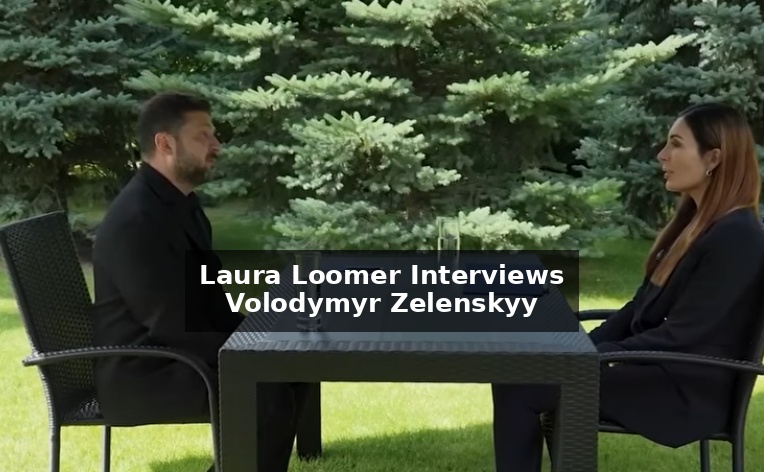
The following is the full transcript of Ukrainian President Volodymyr Zelenskyy’s interview with political commentator Laura Loomer at Mariinsky Palace, Ukraine, July 24, 2026.
Interview Notes: In this unexpected sit-down interview at Mariinsky Palace, political commentator Laura Loomer sits down with Ukrainian President Volodymyr Zelenskyy. The conversation addresses sensitive topics, including American tax aid, Russian disinformation, and the shifting geopolitical relationship between Ukraine and the United States. Zelenskyy emphasizes the resilience of the Ukrainian people and outlines potential strategic defense partnerships moving forward.
Arrival in Kyiv
VOLODYMYR ZELENSKYY: So you brought sun.
LAURA LOOMER: It’s good. Yeah, I brought it. The weather’s been great since I’ve been here. So are you planning on releasing this interview, or can I release the interview? Because it’s very unexpected. I was hoping to ask you to do a sit-down interview, but this is actually the perfect location to do it. So I’d be happy to release the interview in full if you allow me to.
VOLODYMYR ZELENSKYY: I think— I don’t know. I think that our teams will speak about it. Yeah? How to do it? You will make discussions, I think. Yeah. But you didn’t want to sit? You want to walk or something?
LAURA LOOMER: No, this is perfect. I said this is perfect, actually. The location’s great.
VOLODYMYR ZELENSKYY: So how was the trip to Kyiv, by the way?
LAURA LOOMER: The trip? It was very long.
VOLODYMYR ZELENSKYY: Very long, yes.
LAURA LOOMER: Because there’s no airspace. There’s no way to fly here. So I had to take the train from Poland, which was nice. It was an experience. Yeah, it was fine. New experience. Yeah, it took about 30 hours to get here though. Took a very long time.
VOLODYMYR ZELENSKYY: From the United States?
LAURA LOOMER: Yeah.
VOLODYMYR ZELENSKYY: The car is not comfortable but quicker.
LAURA LOOMER: Yeah, so it was fine. It was a good experience. I got to see a lot of the destruction when I was coming in, so it gave me a good idea as to how much of Ukraine has been destroyed by Russian missiles and drones.
Visiting Lukyanivka and McDonald’s
VOLODYMYR ZELENSKYY: Absolutely. And thank you so much. And I saw, by the way, very cool video where you are in Lukyanivka. Yeah, you went to McDonald’s.
LAURA LOOMER: I went to McDonald’s, yes. President Trump’s favorite fast food restaurant.
VOLODYMYR ZELENSKYY: But they destroyed this place and they destroyed it so many times. I was there after attacks several times. I was there and it’s so strong people, really. I can’t even imagine how it would be. They lived there. And of course, after alarms, they go to bomb shelters, but really with children, with dogs, with animals.
LAURA LOOMER: So it was very sad. But it’s really shocking to me. And I guess I’ve been to Israel, so I’ve seen people in other countries respond this way as well. It’s just how resilient the people of Ukraine are, because if that were to happen in the United States, the police would block off the entire street and nobody would be able to access it for safety reasons. It would be like a criminal zone, right? A crime zone.
And so it was very interesting to see the McDonald’s sign and then, eating my burger and my French fries and my Coca-Cola with a blown-out building from a ballistic missile. And people couldn’t believe it. I’m sure you saw the comments online, but it’s a testament to how resilient people are ordering their food, walking around, going grocery shopping, taking their dogs out. People, they don’t— it’s almost like they’re so used to it, it doesn’t even affect them.
But it’s an American business, and I think that a lot of Americans need to see that it does affect our country. Because I’ll admit I’ve said some pretty terrible things about Ukraine and terrible things about you as well, openly on social media. I mocked you. I was part of the group of people in the United States who was very frustrated by the state of my country. I’m a Republican, I’m not a Democrat, and so I was very unhappy with the United States sending billions of US tax dollars to Ukraine when our own country is suffering.
And so if you could please explain to the American audience, how is supporting Ukraine with US tax dollars America first? And what are the benefits of the United States supporting Ukraine and recognizing the struggle of the Ukrainian people as a struggle of America’s future?
Why Ukraine’s Resilience Matters
VOLODYMYR ZELENSKYY: Thank you very much. You know, first of all, about your McDonald’s, it’s important. First, you know, it was always for me very important, even during the first Oval Cabinet with President Trump. I always try just to say only one thing, that it’s so important for us that American people, if they can come, if they can find— I mean, these 30 hours. Yes, it’s too long, but in any way, if they can come and just live with us a little bit, 1 day, 2 days, not too much. I understand everybody is busy, but just to live and to see the life, to see it’s a pity, the death, to see this difference like you saw here, everything is destroyed after missiles and near McDonald’s and near children are smiling.
Yes, so it’s the resilience of our people, but it’s also very symbolic that Russia brought to us this war. But why we fought? The answer with this situation with McDonald’s, the answer about all the war is that we are not ready to die. That even after attacks, we want to survive, that’s all. We love where we live, with the people whom we love, kiss, and our children. And this is our resilience. Resilience because we love the life.
Maybe it’s not, in today’s world, maybe it’s very— how to say— naive.
LAURA LOOMER: Right.
VOLODYMYR ZELENSKYY: It’s not about, you know, big heroics.
America’s Struggles and the Case for Supporting Ukraine
LAURA LOOMER: Well, and we can appreciate your desire to protect yourself and proclaim your right to survive and exist as a people. But what do you say? What is your message as the president of Ukraine to the people of America who are also just trying to survive?
We have nearly $40 trillion of debt in our country. Americans are still trying to recover from Bidenflation. We have closed borders now, but we had an invasion of our country, over 25 million illegal aliens who came in. There’s an estimated 100 million foreigners, right? 65 million illegal aliens and over 50 million people who could qualify for deportation living in America, driving up the cost of living.
And I think when Americans are struggling to put gas in their cars and pay for food for their children, they want to know, why should I care about funding Ukraine? Why should I send my tax dollars overseas? So if you could explain to the viewers how protecting Ukraine ultimately protects America in the long term.
The Soviet Union Threat and America’s Strategic Interest
VOLODYMYR ZELENSKYY: You know, at the very beginning of the war, nobody was with us really. With all respect to partners, I mean, it’s their internal decision to support or not. It’s true, we began the war. Before the war, we didn’t have any kind of weapon, any money from the United States. It’s understandable. I mean, it’s okay, no question.
When we defended, when everybody in the world understood that Russia will not stop with Ukraine, so they began this, you know, massive narratives that Ukraine and others who’ve been invited to NATO before, and they said, we’ve been not in NATO, but they tried to occupy us because they wanted to build USSR, Soviet Union.
I think between us, I think that Soviet Union is the most dangerous enemy for the United States, not only for your democracy, way of life, for all these things what you said, for private sector, for business, and et cetera. It was during 70 years and it will continue because the most global idea of Putin is to take everything back. Soviet Union, republics who’ve been in Soviet Union, past Soviet Union republics, and also Europeans. Of course, not the United States. It’s far away. But the United States has business in Europe, influence, and et cetera. It’s a global war.
Then if Russia will be a Soviet Union again, and they had a chance until now, they had this mission and idea. If they will have Soviet Union, you will get China and Soviet Union, the biggest empire, the biggest army in the world, and they will be really bigger than the United States, and it will be dangerous for you.
LAURA LOOMER: That’s why— Well, that’s our goal with multipolarity.
VOLODYMYR ZELENSKYY: Yeah, but I think this is important to understand that Ukraine by ourselves been the wall of all these dreams of Putin. That is the first. This is during the first period. And we’ve got money from the United States, but we’ve got not— it’s not about money, it’s weapon, but it’s money. In any way, it’s expensive for you and expensive for Europe, but you paid for this wall.
The second point, of course, with all the things about how to save freedom and et cetera, I’m not speaking, not even speaking about all these values, which are also very important, but there is a practical way. This is the wall. You paid the wall, and that’s why they can’t get USSR again. This can be the biggest enemy for the United States.
The second point, nuclear weapon, nuclear enemy. The second point is after Biden’s presidency, when President Trump came, he said, “I will not give you something without money.” Yes, it was the new page, the new page of our relations with the United States during the war. And he said, “I will sell weapons to Europe because all of us is NATO countries and also it’s business, it’s big business really.” And we created with Americans program Pearl. And each day from the first day of presidency of President Trump, we bought everything from the United States.
LAURA LOOMER: Weapons?
VOLODYMYR ZELENSKYY: Weapons, yes. And the United States sold it not only to us, to different countries. It’s business. It’s good. What Americans got back? There is a big difference when America sold to us or to some other countries in different continents. The difference is next. America got the experience. All the experience of this war. All the generals of the United States, they accepted it already. I think that President Trump knows it with details. America has exclusive without paying for this experience, but their lives, yes, we paid. And this is because of the war. Yes, not because we wanted it, but we have the greatest innovation experience, especially in drones.
Drone Technology and the US-Ukraine Partnership
LAURA LOOMER: And I know, congratulations, I saw this week that the United States just signed their partnership with Ukraine for drones. I know that at the Pentagon, at least I’m a Pentagon correspondent, and Secretary of War Hegseth recently announced that they’re actually creating a new position at the Pentagon called the Drone Czar. And I think that Ukraine is really leading the way in a lot of the drone innovation and a lot of the drone technology. And you said you would be willing to have an exclusive partnership with the United States as it pertains to drone technology. Perhaps you can further elaborate what that exclusive partnership would look like.
And why is it that you think that the United States is, I would say, somewhat behind Ukraine when it comes to our drone production output? If you look at the numbers, the United States is on track to produce about 300,000 drones this year, and Ukraine is about to produce 8 million. And personally, I think that that is something that more Americans should learn about.
I think that there’s a messaging issue in the communications that I’ve seen here in Ukraine, and I’ve spoken with your staff about this extensively. I don’t think that the Ukrainians and your office does a very good job at messaging how supporting Ukraine could be America first or how it’s beneficial for America’s national security. I think that emphasizing more of the exclusive relationship with drone production could benefit the United States because we’ve seen that drone technologies and drone warfare is the future.
And we saw just right before 4th of July, there was an attempted drone attack on the White House. And you have civilians now who are trying to buy drone materials on the dark web, or they’re buying them online, or they’re buying them from China so that they could make handmade drones themselves to launch attacks in civilian areas. And so do you foresee that military partnership expanding? And how do you think that’s going to benefit the United States long term?
VOLODYMYR ZELENSKYY: So, first of all, we want to make the biggest drone deal, especially with the United States. They already got this experience from us. Then we push and send some kind of sea drones, air drones, long-distance drones, middle strike, deep strike, a lot of things just to try and train. I will not tell you, sorry, I can’t share publicly where they tried it and et cetera, but we did it without any documents because we are— then this experience, when we share this experience of modern technological war, when we speak with the soldiers, with Americans, with generals and officers, they said, if without your experience for America, they can get to this level, I mean, this experience, this knowledge, they had 10, 20 years. So America got back absolutely exclusive things.
The second point, when we will sign drone deal? We already signed, as you said correctly, first step. The second step, I want to do it as quick as possible with President Trump. I know the document is almost ready. So what we know, what is very important, now you have drones. And now already Russians and we have drones 3,000+ kilometers. And this year we will have 4,000 kilometers. Next year from 5 to 10. So with all respect, 10,000 kilometers, it means that United States is, I mean, it’s closer to the potential enemy.
Drone Technology and US-Ukraine Alliance
LAURA LOOMER: Yeah.
VOLODYMYR ZELENSKYY: And it’s been told the distance is the second question will be. The most important technology, this is what we have. And America has great technologies. So our drone deal, it’s win-win. We will build great factory in the United States. We want to be alliance of productions because drones just can’t be in shelter. It’s not artillery, it’s not missile, you know. Drones are changing each 6 months on the battlefield, sometimes each 3 months.
LAURA LOOMER: So when you say we, you’re talking about Ukraine. Are you saying that the Ukrainian government under your direction is going to send teams of drone manufacturers to America? Free of charge to help Americans boost their drone manufacturing?
VOLODYMYR ZELENSKYY: We want to do joint manufacturing and I don’t know, free of charge, I’m not sure because it’s private sector. But from our side, this idea, and of course it’s just signing and acceptance, and then private sector will do it together. They will make business and etc. Our goal from the government is not to allow them send it to some dangerous countries. Yeah, this is very important to hold it for the United States, for Europe, for Ukraine.
US-Ukraine Relations and the White House Meeting
LAURA LOOMER: That’s all. I want to get into US relations with Ukraine. You’ve kind of had a tumultuous experience over these last— it’s almost been 5 years now, right? Since the war broke out, by the end of this year at least. And so you’ve had to deal with the Democrats and the Biden administration when the war broke out. And then of course, you’re now dealing with the Trump administration. You came to the United States a few months ago and you had what was perceived in the media to be not such a great meeting with the president and the vice president. It appeared that you were escorted out of the White House and it created quite a sensation in the United States. But as of recent, it looks like your relationship with President Trump and America in general is improving and it’s looking like it’s moving in a positive trajectory. Can you explain how that relationship has transpired over the last few months since your not-so-great meeting at the White House and why you find yourself on better terms with the president?
VOLODYMYR ZELENSKYY: Yeah, I think that now our relations are better and really good. We had the last several communications already and they’ve been positive and very productive. I love when really when leaders can meet and when we can meet with President and have some outcome, some result. Not only that we support and we support, we thank you and we thank you. I mean, this, etc.
LAURA LOOMER: Yeah. So, but it really seems like the tone has changed. Yeah. When you got yelled at by the vice president in the Oval Office and the media was reporting that you were asked to leave. And so my question to you is, what happened? Because it seems like the relationship has greatly improved. Is there something that you could share with the viewers about maybe your conversations with the president and—
VOLODYMYR ZELENSKYY: Conversations are better. Absolutely changed. You are right that the tone has changed. Absolutely. We had first, like, changing moment in Rome, in Vatican. Yes, it was not long meeting, but I always said that is, I think, historic moment because we changed the relations during 15-20 minutes. So nobody was around us. We’ve been only 2 of us. And I was very happy to hear President, and I hope, and I was, and he called me and I called him. And I think it was, let it be between 2 of us, but it was very good. We come down and it was very good.
And I’m so happy because a lot of lives depends on such relations and dialogue. And then we had meetings in G7, then we had meetings in NATO in Ankara, in Turkey, and G7 in France. And I think in the United States, I’m sorry. And yes, in some conversation by phone, by the way, good conversation, very good. I think that the president first—
Russia-Iran Sanctions and the Path to Peace
LAURA LOOMER: Well, I mean, you just had General Cain speaking before the Senate the other day. He was asked by Senator Kennedy, I believe, “General, who do you want to win the war, Ukraine or Russia?” And he said Ukraine. And then you had Secretary of War Hegseth inside the Oval Office, giving everybody a lecture about how Russia and Iran are not our friends. And so we saw that about a week or so ago, President Trump, after the death of Senator Lindsey Graham, tweeted that he wants Iran to be added to the Russia sanctions bill. And by posting that on Truth Social, it seems like the president is willing to sign that Russia sanctions bill when it reaches his desk. So how does that make you feel? And why do you think the American people should get on board with a Russia and Iran joint sanctions bill?
VOLODYMYR ZELENSKYY: First of all, I think that president exactly understood that who really doesn’t want to stop the war. I think so. Even not this way. So he understood that we want to stop the war. He understood that we really want peace, that there have been before a lot of voices that Ukraine doesn’t want to stop. And they said, of course we want to win.
LAURA LOOMER: Right.
VOLODYMYR ZELENSKYY: Yeah, of course it’s understandable. We are people and we are right here on our land, etc. But first of all, we are focusing on the human lives. So if tomorrow we can stop the war to make ceasefire, it’s better than to fight 10, 20 years for the victory and to lose your people. Of course, ceasefire is better. And I think that President Trump began to trust me. And this is what’s important. And I think this is the key when you ask how the tone changed. And I think that was the key. I don’t know in what moment, maybe in Rome, but step by step I tried to explain. And I think that he understood me very well. And you said something else also.
LAURA LOOMER: He posted on Truth Social.
VOLODYMYR ZELENSKYY: Oh yeah, I think this is a great idea.
LAURA LOOMER: I said, do you think that Americans should encourage their lawmakers to support the Russia and Iran sanctions?
VOLODYMYR ZELENSKYY: Yeah, Lindsey really was involved in this bill and he was, I don’t remember, about 2 years, 1 year and a half, something like this. And I think the idea of President Trump to join the sanctions on Iran, we support this idea, of course. Very good idea. I think that this idea is strong because you can join maybe different people in Congress, Senate. You can join people who are— somebody is supporting Iranian sanctions, somebody is Russian sanctions. So this is the idea, if I understood well. Yeah, but I’m right.
Russian Propaganda and Ukraine’s Image in America
LAURA LOOMER: Sorry. So I want to transition now into why I’m in Ukraine and my concern with Russian propaganda. I’m just going to be very honest with you, so you might be offended by what I say or what I’m asking you, but I think it’s really important to have this conversation. I was very anti-Ukraine. I said that I didn’t have a problem with Vladimir Putin. I was very angered when you came to the United States— I believe it was 2023 or 2024— and you campaigned with Democrats. And there was an image of you and there was video of you signing I believe it was either a rocket or some type of drone in a factory in Pennsylvania, and you were campaigning with the Democrats in Pennsylvania. Do you think that you were ill-advised by your advisors, and do you regret campaigning with Democrats in the United States, or do you think that you were set up to participate in campaign events with the Democrats?
VOLODYMYR ZELENSKYY: I really, we didn’t think about it. I didn’t know anything about it. I didn’t want to be involved to any campaign. Even in September, I was in New York. I had a meeting with President Trump in September, I think before it was 4 months or something like this before he was elected. So no, no, it was not about politics and elections. I came to the— my team, they prepared factories. I needed very much artillery rounds. We had deficit. Now we have prophecy, but we began to produce it. But those time, it was a big problem. I have a deficit with NATO standard artillery round, 155 caliber. So we didn’t have. It was a big problem, huge problem.
I tried to find and find solution that we will produce in Ukraine, to have some licenses or to buy. And I asked Europe, and I was in different factories in Europe, in Germany, in Czech, different countries, in France. And also I was in the United States. It was not just United States, it was also United States. I came to Pennsylvania, there they have this factory, our female factory. Believe me, if I knew that this is something connects with the elections, no, of course.
LAURA LOOMER: Kamala Harris and Josh Shapiro. But now looking back, now that you realize that they use that opportunity to make it seem like you were campaigning for them, do you regret participating in that experience? Because that’s one of the reasons why a lot of Americans came to dislike you.
VOLODYMYR ZELENSKYY: No, I didn’t want to be involved in any conflict.
LAURA LOOMER: So do you regret that that meeting took place?
VOLODYMYR ZELENSKYY: I do not agree that I was, because I think that I’m involved maybe, I mean, this, I don’t know, I really am. Sometimes people want to use opportunities and this is elections and this is the war. But even that’s what I wanted to say to you, that nobody could tell me that I can’t meet in New York with President Trump when he was a candidate. Yes, they also, Democrats could say that, “Look, you’re now in the campaign because in September and the elections will be only, the results will be only in January.” So I’m not, so I don’t agree that me personally, maybe situation, but me personally was involved to elections. In Pennsylvania, or I was— other side was involved to elections in New York. So I couldn’t support any candidate. And that’s why I had official visit though.
LAURA LOOMER: Yeah, I just want to convey, because I think sometimes I saw that there were some internal polling from Ukraine that showed that only 17% of Ukrainian people have a favorable view of the United States, which I’m confused it’s not higher because we send them so much aid in defense against Russia. And also the opinion towards Ukraine in the United States is not very favorable. And so I just wanted to share with you, as somebody who was anti-Ukraine and who did consume a lot of Russian propaganda— I used to write articles for RT, I wrote about 5 articles for RT, and I regret doing so. And I’ve come to realize that I was bamboozled by Russian propaganda, and I came to believe a lot of untrue things about Ukraine. I used to think that this was a country full of Nazis. I’m just trying to convey to you how sometimes optics, if things are not done in a very precise manner, how it can be conveyed and how much damage can be done to your country’s image. Because the Democrats, I think they really exploited your visit. I want to ask you—
VOLODYMYR ZELENSKYY: But can I tell you honestly? Yes, honestly. Sorry for this, what I tell you, what I will tell. I think if I knew or if I really could be involved to elections, maybe Democrats could have a little bit better results.
LAURA LOOMER: Well, we don’t want that. We don’t want that. We don’t want Democrats winning.
VOLODYMYR ZELENSKYY: I understand.
LAURA LOOMER: I think that—
VOLODYMYR ZELENSKYY: I’m just joking.
Trump vs. Biden: Who Is the Better President?
LAURA LOOMER: I mean, I think President Trump. Who do you think is a better president, Donald Trump or Joe Biden?
VOLODYMYR ZELENSKYY: Had great results, 70-70. The best president is, first of all, the president for your country.
LAURA LOOMER: I—
VOLODYMYR ZELENSKYY: Donald Trump for today.
LAURA LOOMER: Donald Trump, you believe he’s the best president?
VOLODYMYR ZELENSKYY: The best president of the United States?
LAURA LOOMER: Yeah.
VOLODYMYR ZELENSKYY: Now history will answer, because I think that Lincoln.
LAURA LOOMER: Yeah, he freed the slaves. But after Lincoln, who do you think is the best?
VOLODYMYR ZELENSKYY: Ah, you, I know a lot.
LAURA LOOMER: President Trump is going to watch this interview.
VOLODYMYR ZELENSKYY: No, Trump is good. He gave you a MAGA hat.
LAURA LOOMER: I heard a story, I heard a story that he gave you a MAGA hat when you were in the Oval Office.
On Evaluating Leaders and Historical Legacy
VOLODYMYR ZELENSKYY: Yeah, Trump is a strong leader. Is he the best or not? Of course, history will answer. Sometimes we live and we don’t know. Sometimes we have monuments for somebody and then we understand that it was not a great person. So it’s really— I think that it’s not right to evaluate persons during their life because after— I wish him long, long years. But after, the people will say, and of course this is the most important thing really, because difficult moments, right, difficult historical pages, difficult wars in the world and big influence of the United States.
Addressing Russian Propaganda and American Influencers
LAURA LOOMER: So I want to give you an opportunity to speak directly to an American audience and especially the MAGA conservatives, some of whom have been consuming a lot of Russian propaganda. You’ve seen that there are American influencers. There’s people like Tucker Carlson. I call him Tucker Katarlson, or people like Candace Owens. You like it?
VOLODYMYR ZELENSKYY: No, I can’t smile.
LAURA LOOMER: It’s a good nickname.
VOLODYMYR ZELENSKYY: I have to be serious.
LAURA LOOMER: He interviewed one of your previous staffers and she accused you of doing cocaine on his podcast.
VOLODYMYR ZELENSKYY: Crazy people.
LAURA LOOMER: What do you have to say to those accusations? Because that was amplified a lot on social media. I’m sure you saw one of your former staffers was interviewed by Tucker. And she was making a lot of very wild accusations. She accused you of doing cocaine on taxpayer dimes. And so what is your response to that?
Because there was also an image— and again, I told you some of these questions might be provocative, but I want to help counter some of the propaganda in real time since we have you here. There was a photo, I’m sure you saw, in a video, and it was highly amplified by Russia Today. It’s you and Macron hanging out in some back room, and they said that you were all doing cocaine. So true or false? Were you doing cocaine with Macron or were you not?
VOLODYMYR ZELENSKYY: Of course never. Of course not. But about Tucker Carlson, if I can—
LAURA LOOMER: Tucker Carlson.
VOLODYMYR ZELENSKYY: Tucker Carlson, yeah. If I can answer you. So there are different people— different TV viewers and bloggers and so on. Some of them are good, some of them are too hot, too tough and dense. Some of them popular, maybe not. Different people. But there are people smart and there are not smart. For me, I watch smart people and I never watch not smart people. Because it doesn’t help, right? So I didn’t watch the interview of Tucker Carlson—
LAURA LOOMER: So we can agree he’s not very smart.
VOLODYMYR ZELENSKYY: With anybody.
LAURA LOOMER: Yes, good.
VOLODYMYR ZELENSKYY: With anybody.
The Nazi Accusation and Ukraine’s Jewish Community
LAURA LOOMER: President Trump has condemned him. And then, lastly, one of the big conspiracies, or forms of propaganda, that I believed— and I’m Jewish, you’re Jewish, we share that in common— is that Ukraine is a country full of Nazis. And I really opposed sending my taxpayer dollars to Ukraine because I was under the belief that you had an army, the Azov Battalion, full of— And I was shocked when I came to Ukraine and I met with your chief of the national police, and I met with the chief rabbi, Rabbi Azman, at the Chabad Center, and I met with some of your other officials here, and they told me that you have a law that makes it illegal to be antisemitic here in Ukraine. And we don’t even have a law in the United States to make it illegal.
VOLODYMYR ZELENSKYY: We have a strong law.
LAURA LOOMER: We don’t have laws in the United States that ban antisemitism, and I’m not advocating for that. We have the First Amendment. I feel that that is one of the main lines used by Vladimir Putin to justify his invasion and continued aggression in Ukraine— this idea that we need to denazify Ukraine.
And even just being here, meeting with Ukrainians, talking about this— Russia Today, today, accused me of being a Nazi. Russia said that I was a Nazi collaborator because I’m coming and meeting with some of your staff and visiting Ukraine. As a Jew, as a Jewish president leading your country in their defense against Putin’s terrorism, how does it feel to be called a Nazi? I’ve been called a Nazi as a Jew before as well by the Democrats in America. How does it feel to be called a Nazi?
And what is Ukraine doing to better combat this lie? I just think you guys need to do a better job, maybe, emphasizing to the international community that it’s illegal to own Nazi paraphernalia here, that you’ll go to jail if you have Nazi paraphernalia, that it’s illegal to be an antisemite. And I think that a lot of people believe that your army is full of Nazis because we’ve seen images online of Azov members holding swastikas and then your badges. I think you guys need to change the logo on the Azov badges.
VOLODYMYR ZELENSKYY: So, first of all, we have a special law, a very strong law. Nobody in Europe has such a strong law. So it is illegal— antisemitism. We did it during my presidency. Yes, we voted this law.
The second point, people have to understand that Ukraine was under total occupation, not Russia. It’s interesting. Yes, Russia very partially, but Ukraine was totally occupied during the Nazi period of the Second World War. And this is important— 8 million Ukrainians were killed, just killed, 8 million. And before this 8 million, it was not the war, it’s genocide. Where Russian people, Soviet people, they killed 6 million. So that’s why— this is a big tragedy for Ukraine because all period of time, millions of people were killed. That’s why the big territory and millions of people were killed.
And Ukraine— maybe you are right, we have to speak more about the fact that there is no Nazism in Ukraine and never was. We have hundreds of minorities, different people, Jewish minority, minorities, different Jewish people.
LAURA LOOMER: Well, you say there’s never been Nazis in Ukraine, but what do you say about the mass slaughter of Jews in Ukraine? The previous mass slaughter of Jews in Ukraine? Hundreds of thousands of Jews were slaughtered in Ukraine. So what is your— when you say there were never any Nazis in Ukraine?
VOLODYMYR ZELENSKYY: Yeah, they’ve been kept.
LAURA LOOMER: Yeah, well, prior history— you, you spoke about this yourself when the Russians had a drone strike on the monument to honor all the Jewish— they killed the— how do you pronounce the name of the monument in your language? Yes. So that’s what I’m referring to.
VOLODYMYR ZELENSKYY: Yeah, it’s—
LAURA LOOMER: You condemned Vladimir Putin. I remember you issued a statement. They accused you of doing it yourself. They said that you did it. They called you a Nazi. They said that it was basically self-inflicted, like a false flag as we call it. By the way, that’s what I’m referring to.
VOLODYMYR ZELENSKYY: But yeah, that was— I think maybe you will have time to go there.
LAURA LOOMER: Yeah, I would love to.
VOLODYMYR ZELENSKYY: It’s not far. It’s not far away.
LAURA LOOMER: Yeah.
Babyn Yar and the Memory of the Holocaust
VOLODYMYR ZELENSKYY: And they attacked by missiles Babyn Yar.
LAURA LOOMER: Yes.
VOLODYMYR ZELENSKYY: In Babyn Yar, fascists killed 130,000 people. Just— it was lines of people, children, Jewish people and Ukrainians, but mostly— and Gypsies as well, but mostly Jewish people.
LAURA LOOMER: Yes.
VOLODYMYR ZELENSKYY: And we built the monument. It’s a big park. Sorry that I said big park, but it’s not about, you know, something, some rest and so on— but our children have to remember, have to know what’s going on. And I wanted to say— the number of synagogues, the number of such tragedy monuments, the number of such stories, and the number of such millions of people— this is, and the law and everything, this is the answer to Putin. What about him? What’s going on there?
Russian Propaganda and the Persecution of Religion
LAURA LOOMER: Well, they persecute Jews and that’s the irony of it. And the problem is they say that they have religious freedom. He loves to point to the fact that Russian is the second most spoken language in Israel. He likes to create this false image that he’s an ally to Jews. But I went to the Lavra yesterday and I noticed that they literally tried to drone strike Jesus. They tried to drone strike Jesus through the Lavra. And you can’t call yourself an ally to the Jews or an ally to Christians when you are using your police forces and using your state entities to terrorize people and crack down on religious freedoms.
But we’re now seeing— this is a form of Russian propaganda, this idea that Russia is the protectorate of Christianity. And we have podcasters in America— we have a very big problem with Russian disinformation. I personally believe that Russia is paying American influencers. If you ever get evidence of that, please give it to me.
VOLODYMYR ZELENSKYY: Okay.
LAURA LOOMER: Because— or please give it to the proper channels at the DOJ and the FBI, because I think that more Americans need to admit that they’ve been duped by Russian propaganda. I think that my hope is that coming here to Ukraine will open people’s eyes— that, oh well, maybe they aren’t a country full of Nazis. Maybe our national security is going to improve if we have a strategic drone partnership with Ukraine. Well, maybe the Russians are paying off influencers who are pushing communism and anti-American sentiment and falsely accusing Donald Trump of being a pedophile. That’s what Russian media is doing. And I just want to know what your answer is to the American people. How do we combat this?
The Soviet Legacy and Russian-Speaking Jews in Israel
VOLODYMYR ZELENSKYY: Look, just a little bit to read about it. For example, I can tell you— you said about Israel and Russian-speaking people who are the second or the biggest minority. So first of all, when mostly Russian-speaking people— and from where they went to Israel and got passports, when was it? It was during the end of the Soviet period. From Russia, Ukraine, and by the way, mostly from Ukraine, because there were a lot of Jewish people here. But they were in Ukraine, but it was Soviet Union, Soviet Empire.
Why did these people— from Russia, Belarus, Ukraine, Kazakhstan, Lithuania— Jewish people from these countries, why did they speak the Russian language? Because first of all, during 70 years plus of the Soviet Union period, they killed all the languages. So it’s understandable when you know a little bit of history— just 100 years, 100 years. They came, occupied the territories, then killed your traditions, killed churches. The churches were closed. They made offices and other things out of these historical buildings that had been churches. So what did they do? Killed religion. There is no religion, only the Communist Party. This is the only one religion.
Then traditions and language. Of course, after 70 years, people of course all spoke Russian language. They of course knew Ukrainian or Belarusian language, but mostly they spoke Russian language. These Jewish people, they went to Israel because Israel said, “Come to us if you have Jewish roots.” And people with their families went away, right?
After that, we got the independence, and all these republics began to be sovereign countries and began to return to their traditions, roots, and their language. And now when they speak about 1.5 million Russian-speaking people who are in Israel— people have to know they’re not from Russia. They are from different countries, but they are not Russian-speaking. They know Russian, but they also know another language. They also have to know the Israeli language.
LAURA LOOMER: Hebrew. Hebrew.
VOLODYMYR ZELENSKYY: Hebrew. Sorry.
A Message of Gratitude to the American People
LAURA LOOMER: Last thing I wanted to say— and you’ve been very generous with your time. The United States has given Ukraine upwards of nearly $200 billion of aid. Do you have a message of gratitude for the American people? And what are your hopes for the future as it pertains to the future alliance of the United States of America and Ukraine? And what would you like Americans to know as we continue to have hopes for an end to this war?
VOLODYMYR ZELENSKYY: First of all, we want to end this war. The second— I think for us it will be difficult if we do it without the United States. The third point, if Americans didn’t help us, we could not be so strong to have a voice during any kind of negotiations. This is very important.
Then— America got its independence many years ago and paid for this with American lives. Europe helped the American people. Of course, American people fought for their independence, but Europe helped. France helped. Now we are fighting for our independence. And of course, America is helping us with Europe. And in the history of this great country, of this great nation, of the American people, there will be a page that reads: the United States helped the Ukrainian people, will save their lives and save their independence.
Signing the Peace Deal
LAURA LOOMER: Would you be willing to sign the peace deal with Russia in the Oval Office?
VOLODYMYR ZELENSKYY: Yes, I’m ready. I’ve always said to President Trump that I’m ready to come to the United States, to Oval Office or to Mar-a-Lago. It depends on—
LAURA LOOMER: Which do you prefer, Mar-a-Lago? If you could sign it anywhere, Mar-a-Lago or the White House?
VOLODYMYR ZELENSKYY: I don’t know. It depends on President Trump.
LAURA LOOMER: Very beautiful, Mar-a-Lago. Have you ever been to Palm Beach?
VOLODYMYR ZELENSKYY: I was. No, I was. I was in Mar-a-Lago. We had a good conversation. I didn’t see Mar-a-Lago between us, but I mean everything. But what I saw, it was nice.
LAURA LOOMER: Maybe they’ll sign it there and you’ll get to get the tour.
VOLODYMYR ZELENSKYY: It doesn’t matter between us when, not where.
LAURA LOOMER: Well, I really appreciate you taking time to meet with me.
VOLODYMYR ZELENSKYY: Thank you so much. Thank you very much. And for coming.
Related Posts
- Ambani vs Musk, Trump’s Hostility & India’s Foreign Policy w/ Meera Shankar & Zorawar Singh (Transcript)
- Scott Ritter: Trump vs. Zelensky – End of Ukraine, NATO & EU (Transcript)
- Seyed M. Marandi: Egypt Joins Saudi War – A Wider War Is Coming (Transcript)
- Joe Kent: Why the U.S. Proxy War in Ukraine Must End Now (Transcript)
- John Mearsheimer: Russia’s Existential War & the Rise of a Post-Western World (Transcript)