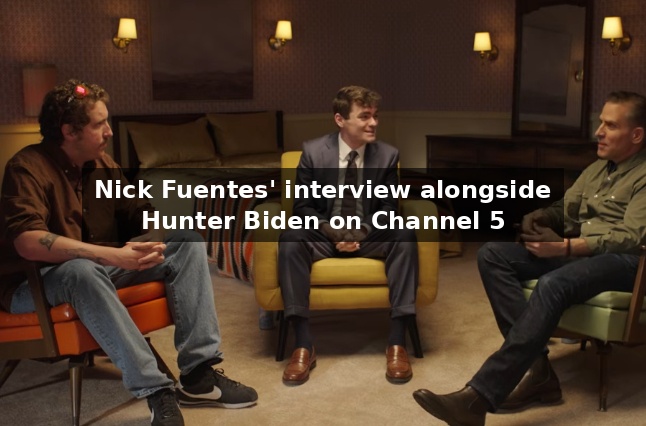
The following is the full transcript of political activist Nick Fuentes’ interview alongside Hunter Biden on Channel 5 with Andrew Callaghan, July 24, 2026.
Episode Notes: In this interview from Channel 5 with Andrew Callaghan, Andrew sits down with political activist Nick Fuentes alongside Hunter Biden for a wide-ranging and unconventional discussion. The conversation delves into the psychology of political cancellation, modern tech platform censorship, and the growing disillusionment among younger generations. Ultimately, the dialogue shifts toward finding common ground, recognizing shared humanity, and discussing the future of political discourse in America.
Introduction and Setting the Stage
ANDREW CALLAGHAN: Okay. The kind of first question that I had whenever I caught wind that you wanted to do an interview like this is, why now? What made you want to sit down for this kind of interview?
NICK FUENTES: Well, I think it’s an interesting conversation to have all of us here. And I think it’s a moment in our country when there’s a lot of realignment. I think that people recognize, especially in the past couple of years, I’m like a non-conventional critic maybe of what’s happening. And so I think it’ll be an interesting, productive conversation. I think it’ll be different.
ANDREW CALLAGHAN: But I mean, specifically because we kind of share a publicist, I heard that you wanted to do it. Okay, we have a publicist that you hit up, and you said that you wanted to talk to someone who would give you kind of a fair shot to clear up some things and maybe some misconceptions about you and the things you believe.
HUNTER BIDEN: Absolutely. Yeah. Yeah.
NICK FUENTES: I think that I’m somebody who, I think, maybe we have this in common, is kind of pigeonholed in a certain way for things that we’ve done in the past or things that we’ve said.
HUNTER BIDEN: Yeah, I’m a crackhead.
NICK FUENTES: But I’m racist, right?
HUNTER BIDEN: I got pigeonholed there. Mine is true. Yeah. Yeah.
NICK FUENTES: Mine’s a little true. Maybe a little no. But yeah, so I think it would be good to clear up some of the misrepresentations and put out something accurate.
Misconceptions and Public Image
ANDREW CALLAGHAN: So what do you think is the most misrepresented thing about you?
NICK FUENTES: Well, I think really the whole image everybody has about me. When you mentioned me, I think on a recent show, you said you want to ask me, “Why are you a Nazi?”
HUNTER BIDEN: Yeah.
NICK FUENTES: And that’s how everybody knows me. Everybody thinks of me as a white supremacist Nazi. And I don’t think that’s really true at all. I think that we definitely have different values. I mean, you’re more from the left. I’m more from the right. But I don’t think I’m a hater. I’m not a hateful person. “It is Heil Hitler Friday. Heil Hitler. All my n*as Nazis.”
ANDREW CALLAGHAN: “Morgan, Hitler was very f*ing cool.”
NICK FUENTES: Yes, I do. One of those. And I’m tired of pretending he’s not.
ANDREW CALLAGHAN: So what’s the thing about, I guess, traditional Nazism that you think you disagree with the most?
NICK FUENTES: Well, it’s a non-Christian ideology. So, I mean, look, I believe that race is real, as the Nazis did, but I don’t think it utterly defines a person. As a Christian, I think we’re all created beings. I do believe there’s such a thing as a universal human community. And so I think it’s a cruel ideology. I’ve said this on my show, by the way, but I mean, that would maybe be the fundamental.
ANDREW CALLAGHAN: Did you always feel that way?
NICK FUENTES: Always. Yeah, absolutely.
ANDREW CALLAGHAN: So even whenever you were younger and stuff?
NICK FUENTES: I did. I did. But you got to recognize times have changed. 10 years ago, we had a totally different political world. The regulation and policing of speech — what you would call wokeness — I think was at an all-time high when I got started as a very young man.
HUNTER BIDEN: What you would call wokeness?
NICK FUENTES: Yes.
HUNTER BIDEN: Yeah, exactly.
NICK FUENTES: Well, and I think — would you not say there were some excesses maybe in those days?
Hunter Biden’s Perspective and the Anger of a Generation
HUNTER BIDEN: Yeah. In those days, I wasn’t doing too well, so I wasn’t paying much attention. Anyway, I would love to hear — and I’m not asking you to retract everything that you’ve ever said or anything. But I said that I would love to talk to you because, number one, I told you this, is that I think you’re really smart. And I think that with that comes a real responsibility. And you have an audience.
I have a friend whose son is my daughter’s age, maybe 28, your age. And he’s really smart and he is a big fan of yours. And so by virtue of the relationship, I got to learn what it is that he — why he is a fan of yours.
NICK FUENTES: And none of it has to do with, I would hope you agree, like really egregious things that you’ve said in the past about the Holocaust or about — “Do the Jews ever talk about the 100 million whites that died in World War II, or do they just b and moan about the so-called 6 million Jews that died? And so it’s just nice to poke holes in it and say it’s not 6 million. 6 million? I don’t think so.”
HUNTER BIDEN: And I don’t even know. I think I’ve heard you since kind of rescind a lot of that.
NICK FUENTES: You concede that 6 million Jews died in the Holocaust? Possibly more.
HUNTER BIDEN: Possibly.
NICK FUENTES: Well, we’re discovering all the time, so it could maybe even be more than that.
HUNTER BIDEN: But what he agrees with is kind of the anger — the anger about the situation that particularly your generation finds yourself in.
I just wanted to hear from you. When you say you’re canceled, you’re canceled by the right in 2016.
NICK FUENTES: Yes.
HUNTER BIDEN: I almost felt like, in preparing to meet you now, is that your reaction to that was to just dig deeper and deeper into kind of the outsider, kind of radical, say anything for the purpose of generating the attention to build an audience. Is that true? And it’s not an accusation. I really mean it. I want this to be a conversation as much as possible.
Deplatforming, Cancel Culture, and the Rise of Radicalism
NICK FUENTES: I mean, there’s certainly some truth to that, but I think that might be overstating it a little bit because I really got canceled by the right and the left.
HUNTER BIDEN: Yeah.
NICK FUENTES: And back in those days in 2017, you had these far-left journalists at Huffington Post, Right Wing Watch, ADL, SPLC, and I really believe they were on a mission to find extremist rhetoric, the white nationalist, neo-Nazi boogeyman, all that kind of stuff. And they would look at someone like myself, 18, and if I was being serious or joking, things taken out of context, they would clip it, post it, and they wanted me to be the villain.
And I think they wanted a lot of people to be the villain. I think the left in a way kind of created this climate where I think they pushed a lot of people farther to the right.
HUNTER BIDEN: No, by the way, that very well may be true, but you gave them a lot of ammunition.
NICK FUENTES: That’s true.
HUNTER BIDEN: I hope that some of those things that you’ve said in the past are not things that you believed in and that you meant just to engender a really radical kind of response. I mean, is that true or not?
NICK FUENTES: Well, again, I think that back in those days you could not say anything. In 2017, 2018, cancel culture was so in overdrive. Any joke, any edgelording, anything like that, they would — first of all, there was no sense of humor.
HUNTER BIDEN: I don’t even know what that — I’ll break it down for you.
ANDREW CALLAGHAN: So the dawn of wokeness, as it’s known today, I think was in the post-Trump era. After Trump won the election in 2016, there was a big movement to deplatform and kind of push away those who, I guess, the left felt like had galvanized him into the presidency. So there was this big idea that if you push people off mainstream social media platforms, they would go away. Now we know through Trump’s reelection that’s not even true. But at the time, that was the mantra. Problematic viewpoints needed to be silenced, tucked away somewhere, and they would just sort of die in isolation.
So I think that that was the climate where you first got started — 2017, that time period — was crucial for getting people off mainstream platforms. Is that correct?
HUNTER BIDEN: Yeah.
NICK FUENTES: And I would say that you got to get into the psychology of those days. It felt like anybody that wasn’t on board with the most progressive agenda had no options. There was just no alternative. It was going to be progressive, liberal, feminist, BLM, all that kind of stuff. And if you were to the right of John McCain, you’re no-platformed, censored, banned from all the platforms. You’re fired from your job, you’re ostracized socially.
And I think what happened really in 2021 when Trump got banned from the platforms is it felt like 70 million people got canceled. 70 million people had voted for Trump, or 60, 70 million people. We all felt like, oh, so if Trump is out of politics and we’re all banned from the platforms, then how is there any redress for our grievances? Do we just have to shut up and get with the program and we’re all going to be progressive?
And I think that that drove people to a far more radical place where people said, well, what really is a solution? We can’t talk, we can’t express ourselves, we can’t participate in the process or run for office. And I was one of the people saying that’s exactly what’s going to happen. It’s going to drive people to extremism. If you don’t talk, if people don’t feel like they have a seat at the table and enfranchisement, I think then they start exploring options outside the system, outside of the political process, the democratic process. So I think it’s self-inflicted in many ways.
ANDREW CALLAGHAN: So you feel like after the mass deplatforming in 2021, whenever people on the right got pushed to platforms like Parler, Gab, Rumble, etc., the lack of discourse and the political singularity of those platforms created more extremism?
NICK FUENTES: Absolutely, absolutely. Because look, you take Trump off of Twitter, Facebook, Instagram, YouTube, and I predicted this in ’21. I said, watch, you’re going to see alternative social media rise because some venture capitalist is going to see there’s a huge market of 70 million people that are going to follow Trump because Trump is no-platformed. And that’s exactly what happened. Rumble blew up, Elon bought Twitter.
And what happened when you had total free speech on these platforms? Well, Twitter now resembles 4chan. And now there’s no gatekeepers. And I think it did push people in a radical direction. And honestly, people are even blowing past me. Now there’s mainstream normie types that are even blowing past me in terms of how radical they are. People start saying things like, “There’s no political solution, there’s going to be a civil war, we need a revolution.”
And I think that’s because the message from the left was, “You’re crushed, you have no options, you can’t win, there’s no alternative. Trump is going to be indicted and charged and can’t run. You can’t be on Twitter, you can’t have a job.” And so people started to say, “Okay, well, we still exist, we’re still here, we still have these concerns. What do we do now?” And then people start to say, “Well, we need a revolution.”
And I’m one of the only people saying no, we should still engage in the process and talk with each other. And it’s not all one-sided. I think there’s problems on the left and the right, but I certainly think it takes two to tango.
Drawing the Line: Free Speech vs. Hate Speech
HUNTER BIDEN: Okay, so there we agree. I think that there are problems on the left and the right, and I don’t disagree with some of the things that you just said. I guess I just came to a different conclusion that there are some things that people should be deplatformed for — not that they can’t say it where they want to say it — but I think that it’s a right of anybody.
ANDREW CALLAGHAN: Okay, top 3 things. What do you think?
HUNTER BIDEN: There’s a difference between being able to say that you’re proud of your white heritage and also being just a flat-out racist. I think that there’s a difference between saying you’re proud of your Christian heritage and the white culture from what you come from, and Nazis, or that you adopt Nazism as a legitimate ideology. I think that there’s a difference between saying that you disagree with the United States policy as it relates to Israel and saying that the Holocaust didn’t exist.
NICK FUENTES: “That was like, Mom, Dad, Hitler was awesome. Hitler was right. And the Holocaust didn’t happen.”
ANDREW CALLAGHAN: “And my parents were like, we cannot believe —”
Whites-Only Communities and the Question of Ethnic Enclaves
HUNTER BIDEN: Those are my— those would be top 3 things in my mind. I know that you believe that some people took you out of context, and I do agree. Look, on both the right and the left, there are these gatekeepers, 100%. And look at me, mainstream press just destroyed me for 7 years without any real kind of reflection about what they were doing.
I do think that some of those things are legitimate reasons to say, you know, we don’t want you on our commercial platform. Would you agree with that? I mean, you just said, for instance, people calling for an armed revolution, like people calling for actual violence, you’re opposed to.
NICK FUENTES: Oh, absolutely. Yeah, I’m against violence. And I do think those are one of the legitimate things that should be taken from the platform. You know, there’s a lot of this stuff on social media I don’t agree with.
But again, what started to happen is there was this editorial censorship where certain ideas were banned and they just— it was such a broad brush and also totally opaque and ad hoc. You’d be on YouTube like I was, for example, they banned me for life and didn’t even give me a reason. Not a specific quote, not a specific infraction. And so you don’t know what the rules are. You don’t know what the process is. They just take you down.
And especially now, when everything is digital. That’s not just the social platforms, it’s the other ones like Uber, Airbnb, whatever. It feels like you’re being denied almost something like a civil right. These social platforms are the modern public square. Increasingly with Uber, Airbnb, the banking apps, you can’t live your life without the tech platforms. And it felt like if you just simply had the wrong opinions or you were the wrong kind of person, you were being deprived of a basic civil right or being able to participate in society.
So I think maybe that’s an area of collaboration where we recognize maybe it is a civil right to use the digital platforms, but here are the rules. Here’s what you can say, here’s what you can’t say, here’s the process. Maybe there’s a reconciliation mechanism, but the censorship was just out of control. I don’t think anyone disagrees there’s a reasonable limit though.
HUNTER BIDEN: Yeah, and I guess what I’m saying is that I don’t see that as a result of left-wing or right-wing ideology. I view that kind of level of deplatforming— look, I was debanked. I was debanked before I was ever even charged with anything. I lost every bank account. Took me 9 months once the Trump administration said that they were starting an investigation into me to be able to actually get a bank account again. And I still— I don’t want to tell you the bank because tomorrow they may debank me again.
But my point is, is that those people are incredibly identifiable. I keep saying things like, I don’t think we are nearly as divided as they’re telling us we are, because I do believe that there are an identifiable group of people that are responsible for an enormous amount of the discord and division because they make money off of it.
I think that these social media companies that are controlled by, what, 3, 4, 5 individuals have made it clear that they only care about one thing. They only care about how much money they can produce for themselves and the people that hold stocks in their company. Even to the degree where we know for certain that they’re driving teenage girls to the highest levels of suicide by exponential factors directly related to the content that they’re being pushed, and they won’t do anything about it, right?
And so to the same degree, I think a lot of what you call wokeness was a maybe an illegitimate but a financial decision based on a lot of these corporate psyop— maybe corporate psyop. Thank you. I mean, by the way, exactly.
The Whites-Only Community in Hardy, Arkansas
ANDREW CALLAGHAN: I just wanted to back up real quick. So you talked about certain people going too far. About 2 and a half months ago, I visited a whites-only community in Hardy, Arkansas. And I don’t know why, I guess coming from a more left-wing place, I’m from Seattle, I kind of assumed there was a united front on the right for some reason.
So I’m out there, I’m chilling with these dudes. They’re sword fighting, having barbecues. I mean, overall it was a good time for them. I had a hard time connecting with them because I don’t agree with them, but it’s all good. I was having fun for a couple days. And then right as I was there, I guess you had hit them up on X or something and said like, hey, I don’t want to associate with you guys. What happened there?
NICK FUENTES: Well, that was really more of a personal disagreement with the guy that founded it. But I do think it’s an interesting project, and it’s interesting that that got so much pushback, this whites-only community, because you know what, if you go to a lot of these different neighborhoods in major cities, there are ethnic enclaves. And it’s not like there’s an explicit rule that you have to be a certain ethnicity, but we all know in Chicago and New York and LA, you got certain neighborhoods where it is 80, 90% one ethnicity. And I think there’s a lot of white people that say, we kind of want something similar. I don’t think there’s anything—
HUNTER BIDEN: But Nick, what is this?
ANDREW CALLAGHAN: Okay, let’s back up. If you want to talk about the histories of New York and Chicago, I feel like that was also a conscious decision that was made after the Civil Rights Act.
HUNTER BIDEN: I’ll tell you where it’s not Blacks only. It’s in Cabrini-Green, where Mayor Daley made everybody that was Black live in Cabrini-Green. I mean, that wasn’t by choice. It’s not by choice that these ethnic enclaves are 80% or 90%, whatever that ethnicity is. It’s because that’s the only place in which they had an opportunity to live unbothered. Or where they were told that they had to live because of the historical fact that they could not move into other neighborhoods. You could not move into parts of South Chicago without, you know, being stoned.
NICK FUENTES: Right.
HUNTER BIDEN: Literally. Right. So it’s not as if those ethnic enclaves are there by choice, you know? And so that—
ANDREW CALLAGHAN: Also, ethnic enclaves do exist for specific variations of different Europeans. Like, you know, South Philly is full of Italians.
HUNTER BIDEN: There’s a Little Italy, and there’s a Little Korea.
ANDREW CALLAGHAN: I think the issue— what confused me the most about the whites-only community is there’s just so many different kinds of white people in America, you know? So to establish a unified white culture with a place so diverse and full of different regional flavors just kind of felt confusing to me because that can mean a different thing depending on what part of the country or what European enclave you originated from.
Like, are Irish people from the Philly area comparable to surfers in San Diego or Italian Americans in Staten Island? I don’t know. Everything just feels so different. So when I got there, I was trying to identify what they meant by white culture. It wasn’t really based on shared cultural practices, but more the exclusion of people who weren’t white. So they weren’t stoked on being European necessarily. They were more just like, “Oh, we’re here because those people aren’t here.” So it just kind of felt more negative than constructive.
NICK FUENTES: I mean, like I said, I’m not really involved with that project in particular, but I think that, look, you talk about the anger that’s out there and the frustration, and I think part of the frustration, let’s be honest, is that white people do feel like we are being boxed out in major cities in the country. And it feels like, look, there’s a Little Haiti and there’s these various ethnic enclaves where you get that local culture. And they do their cultural festivals and that sort of thing. And white people feel like they’re being pushed out and they want a space where things are familiar.
HUNTER BIDEN: Do you feel the same way about the Italian festival that happens in every city?
NICK FUENTES: Well, here’s a good example.
HUNTER BIDEN: Or St. Patrick’s Day.
NICK FUENTES: Well, you know, there’s no Irish neighborhood in Chicago. There’s Little Italy.
HUNTER BIDEN: There is.
NICK FUENTES: I mean, there’s some remnant in Bridgeport.
HUNTER BIDEN: Yeah.
White Flight and the Suburbanization of America
ANDREW CALLAGHAN: It’s important to note that— and I’m not trying to get into a shouting match here— but coming from a family who did leave Philadelphia in the ’60s because of Black migration from the South after the Civil Rights Act was passed, there was a sort of mass flight of white people into the suburbs, and that kind of led to a homogenization of different cultures because they rushed so fast to build these identical strip mall suburbs that it was very hard to maintain cultural bonds that made different European and white neighborhoods unique around the 1950s and before. So I feel like the mass suburbanization is also a big factor that led to those cultural bonds breaking.
NICK FUENTES: Yeah, but why did that happen? I mean, a lot of the suburbanization is because of the race riots in the 1960s. People moved out because of the violence. You know, my grandfather was in the National Guard in Chicago when, after MLK got assassinated, the whole West Side burned to the ground. People didn’t want to be around that anymore.
HUNTER BIDEN: Why were the riots?
NICK FUENTES: Yeah, MLK Jr. was assassinated.
HUNTER BIDEN: Yeah, yeah.
NICK FUENTES: And so does that justify burning down the city?
HUNTER BIDEN: No, I didn’t say it justifies it, but it sure justifies an enormous amount of the anger. The same kind of anger that you feel about being left out. The same kind of anger that you’re expressing right now about the idea that you’re culturally irrelevant, that you don’t have a place in society. Imagine if you were a 26-year-old Black man in 1968 and saw your hero be assassinated.
NICK FUENTES: I saw Trump get shot in the ear.
HUNTER BIDEN: And did he?
NICK FUENTES: And I saw Charlie Kirk get shot, and I didn’t see any cities get burned down. It’s funny how that works.
HUNTER BIDEN: It’s a very, very different thing.
NICK FUENTES: I think it’s that different. Charlie Kirk got shot in the neck. And liberals celebrated all over social media. By Tyler Robinson.
HUNTER BIDEN: Who is what?
NICK FUENTES: Who is some liberal guy.
HUNTER BIDEN: He is? What?
NICK FUENTES: He’s got a transgender boyfriend.
HUNTER BIDEN: Does that make him liberal? Because he’s transgender? Because he’s gay?
NICK FUENTES: Well, because he’s got a transgender boyfriend. Yeah, I think so.
HUNTER BIDEN: Does that make him liberal?
NICK FUENTES: I think he was liberal. Yeah.
HUNTER BIDEN: Okay. Well, he didn’t come from a liberal family. He didn’t come from a liberal enclave. He didn’t come from a liberal background. He’s not a minority. He was a Mormon, correct? And grew up in a Mormon household. And he went to a largely Mormon college. And he ended up committing an act of violence according to the FBI and the authorities in Utah that charged him.
How does that in any way compare to what we’re talking about? I’m not justifying the violence that occurred after the death of Martin Luther King, but you’re saying that this Tyler, whoever his name is, was as disenfranchised as the African-American community in 1968 in inner cities?
NICK FUENTES: Well, the question is who we want to live around. I’m not living around Blacks. Sorry, I want white kids and I don’t want my white kids bringing home Black people to marry. And in the 1960s, the West Side burns down. We don’t want to live around that. We don’t want to live around a city that’s burning down.
HUNTER BIDEN: That’s not when the white flight happened.
NICK FUENTES: It is.
HUNTER BIDEN: No, it is not.
NICK FUENTES: It was a big response to it.
HUNTER BIDEN: Absolutely. No, 100% not.
NICK FUENTES: Absolutely.
The Reality of Segregation and White Flight
HUNTER BIDEN: You make these historical connections that don’t exist. Part of it was potentially, but before that, what Mayor Daley did is made Chicago the most segregated city in the entire United States. When you would come from the South to Chicago, African Americans from the South, Blacks in the South coming to Chicago would say that Chicago was twice the level of segregation and racism that occurred in the South. And so it wasn’t as if you’re coming into a situation in which you’re feeling in any way enfranchised by the community and the situation that you’re in.
And as many people left simply because of the idea that someone was Black moving into their neighborhood as the violence that occurred after the assassination of Martin Luther King, the King. So the numbers actually, pre-1968, when King was shot, you had more people leave the city because of the desegregation, because of the 1964 Civil Rights Act, than you did after the riots.
NICK FUENTES: I think that’s just not true. I think that the race riots were a huge driver of white flight to the suburbs. I think it’s just dishonest to say that’s not the case.
HUNTER BIDEN: Okay. So what’s your point about all of this?
NICK FUENTES: Well, we’re talking about where people want to live.
HUNTER BIDEN: Yeah, I know. So what, in 2026? Well, okay.
NICK FUENTES: How about in 2020 when Minneapolis burned to the ground. Or how about in the summer of 2020 in Chicago?
HUNTER BIDEN: Minneapolis didn’t burn to the ground.
NICK FUENTES: It didn’t? No.
HUNTER BIDEN: I mean, there were parts of Detroit.
ANDREW CALLAGHAN: If you guys need a physical witness to what happened in Minneapolis, there were many structures that burned to the ground. Not the city, but there was, I would say, between 40 to 50 buildings off of Lake Street in the South Side that did burn to the ground. But most of the city was intact. But it was quite an intense situation.
Crime, Race, and the Debate Over Chicago
NICK FUENTES: People don’t want to live around that. You know, in Chicago, it rolled on into the summer and it wasn’t, let’s say, the anger of the oppressed and the disenfranchised. They were looting and carjacking. The criminals—
HUNTER BIDEN: Are you saying that the problem with the 26-year-old white kid living in suburbia outside of Chicago and his feeling of being disenfranchised is because there was looting and rioting in Minneapolis by Black people and it’s Black people that are doing it?
NICK FUENTES: Yeah, I mean, the problem with Austin Metcalf was that he got stabbed in the neck at a track meet. And the problem with our city in Chicago is that the Magnificent Mile is gone. Water Tower Place is gone because of all the crime.
HUNTER BIDEN: Nick, in the time of an entire generation of African Americans is that they’ve been getting killed by cops for decades. What are you talking about, Nick?
NICK FUENTES: Because they commit crime. Listen, listen, it’s not—
HUNTER BIDEN: Nick, what? That’s not true. It’s not true. Are you saying that police brutality as it relates to racism in the police force, in the way in which police treat African Americans— Nick, you could grow up here like I did between Wilmington and Philadelphia. And if you were a Black dentist and you lived in Wilmington and you commuted to Philadelphia, the chances of you being pulled over by a state trooper, either Delaware or in Pennsylvania, are about 50 times that what it would be if it was a white guy. 50 times.
And so what you’re trying to tell me is that the problem in America right now is that a 26-year-old white kid who lives in suburban Chicago doesn’t feel like he has access because he’s been canceled or he’s been woke. And the problem is Black people.
NICK FUENTES: I didn’t say the problem’s Black people.
HUNTER BIDEN: Well, you just did, Nick.
NICK FUENTES: You just said the problem is crime, and we know who’s doing the crime in Chicago. The carjackings, shootings, teen takeovers. We know why there’s no business on the Mag Mile anymore, and it’s because they steal cars, they drive them through windows. And listen, Black people are some of the biggest victims of the Black crime, but we’re not allowed to talk about it because of the racial dimension.
HUNTER BIDEN: We’re talking about it right here. You have a platform in which millions of people listen to you.
ANDREW CALLAGHAN: I think, I think—
NICK FUENTES: Well, after Elon had to buy Twitter and open it up, it wasn’t like that before. I was banned from everything for many years. So no, you weren’t allowed it. You’re right, we could talk about it now, but that’s only because the good guys won.
Trump, Disenfranchisement, and the “Other”
HUNTER BIDEN: You went from being banned on Twitter to being on YouTube to creating an entire show. I know you’re not, but now you have Kick and now you have all of these other things. You have an enormous platform. I want to find common ground of how much of a shithead Donald Trump is. We can get there. We can get there. Okay. What I don’t understand is how you didn’t recognize that in 2016 and how you didn’t recognize that in 2020 and how you didn’t recognize that in 2024. Because Donald Trump—
NICK FUENTES: I did in ’24.
HUNTER BIDEN: Because Donald Trump hasn’t changed. Donald Trump hasn’t changed at all. Donald Trump has been Donald Trump since he came out of the womb of a woman that was an immigrant to this country. And so what I want to know, though, is that I don’t know how we get past this idea that the biggest problem that you have with your personal situation and how you extrapolate that to the situation of other white kids that are your age that feel disenfranchised, that feel left out, that feel they don’t have a shot at the American dream is because of Black and brown people, because of Mexicans, because of Venezuelans, because of Haitians— it’s always other, Nick, with you, it seems to me. And I’ve listened to a lot of this stuff. It’s always them. We need to build a wall. Where’s the wall, Nick? He never built the wall. Why’d you vote for him in 2020? Why’d you vote for him in 2024?
NICK FUENTES: I didn’t vote for him in 2024.
HUNTER BIDEN: Well, okay, my point being is that whenever you identify your problem as being something that is other, that you can point to, that’s a minority, that is a group of people, that’s the Jews— I mean, before, remember, all of us, it was the Irish Catholics who were committing the crime, who weren’t allowed into bars, who weren’t allowed into— because you know why? Because they were dirty poor non-Europeans. They were Irish. Every time it’s wrong. Every time history has proven that to be wrong in the United States of America. Every time inclusion has been our greatest strength, diversity has been our greatest strength.
And I hear you talk about this idea of white culture. What f*ing white culture are you talking about, man? What? Literally, what?
NICK FUENTES: Shakespeare, Dante, Mozart. We’re in Philadelphia. The Founding Fathers. Yeah, that’s your white culture.
HUNTER BIDEN: How about The Count of Monte Cristo? Would you consider that part of our white culture? Sure. Okay, well, it was written by a Black man in France in the 1700s in a milieu of European civilization. So what?
NICK FUENTES: Because you’re picking out one example.
HUNTER BIDEN: What an example.
NICK FUENTES: It really is.
HUNTER BIDEN: Listen, Nick, I’m not. I really am not.
Shifting to Israel and Community Collapse
ANDREW CALLAGHAN: Hey guys, I think we’re reaching what’s called a rock and a hard place. Let’s talk about Israel.
NICK FUENTES: Well, let me respond to this because you’re telling me I’m always blaming the other.
HUNTER BIDEN: No, no, Nick, for real. For real. Here’s the thing is that the way that you talk and throw out these historical facts, which by the way aren’t f*ing facts.
NICK FUENTES: Which ones aren’t facts?
HUNTER BIDEN: Well, as it relates to the civil rights movement in 1968 and the reason why we are in the problem that we’re in is because the Civil Rights Act passed in 1968. 1964. Dr. Martin Luther King was killed and shot by a white racist, white supremacist in 1968 on a balcony of a motel. That’s the root of our trouble, because an entire people that have been disenfranchised and enslaved for over 400 years—
NICK FUENTES: We’re sick of hearing about that though. It’s 2026.
HUNTER BIDEN: You may be sick of hearing about it, but you know what? They aren’t. And I’ll tell you what, Nick, get over it.
NICK FUENTES: Get over it. It’s America.
HUNTER BIDEN: But Nick, you keep— you can say stuff like that, okay, without having to say it like that.
NICK FUENTES: And we— look, this is not how it started though.
HUNTER BIDEN: This is a legitimate argument, but it’s—
ANDREW CALLAGHAN: Oh, guys, Nick, Hunter, what do you guys make of the concept of community collapse? Have you guys heard of this?
HUNTER BIDEN: No.
ANDREW CALLAGHAN: So it’s got nothing to do with race, got nothing to do with money, but this is kind of a crazy stat. So in 2019, before COVID, 76% of Americans said they were part of an in-person community that gave them some kind of value. After COVID and this year, it was 19%. So I think that politics and race aside, one of the biggest issues is the collapse of social bonds, third spaces, communities, in-person engagement, which comes with loneliness, more time online, and more division. I understand that. I feel like you guys aren’t going to agree. I want to talk about what you guys think can be done on an individual and community level to stop people from hating each other and to create more belonging and engagement.
Finding Common Ground
HUNTER BIDEN: Well, number one, I think this— okay, for real, podcasting. No, no, not podcasting. This discussion. For me to be able to sit down with someone who I so vehemently disagree with and find some kind of common ground—
ANDREW CALLAGHAN: But I mean, look, guy at home, guy at home who’s watching us on his phone just thinking, I wish I could go outside, I don’t know anyone.
The Oligarchy, Community Collapse, and Social Isolation
HUNTER BIDEN: Okay, well, here’s what I’m talking about. It’s about connection. It is all about actually connecting with people. And I’m not talking about digitally connecting with people anonymously online. I’m talking about actually going out and connecting with people. And I don’t have an answer to that. I don’t— any of us. We are in a— look, man, I just think that you are targeting the wrong problem, Nick. I think that our biggest problem right now doesn’t have to do with this cultural divide or racial divide or religious divide or the idea that America is becoming less white or culturally relevant anymore. I think our biggest problem is literally an oligarchy that is inflaming every single division that we have. And by the way, they’re out for you, man, just as much as anybody else.
NICK FUENTES: Well, and I agree.
HUNTER BIDEN: So those platforms that we talk about that you’re not allowed to be on because Elon’s out on the platform, Elon doesn’t give a s* about anything other than one thing.
ANDREW CALLAGHAN: Wait, Hunter, I just want to say—
HUNTER BIDEN: Money.
ANDREW CALLAGHAN: Real quick.
HUNTER BIDEN: Money. It’s his money.
NICK FUENTES: Well, I don’t necessarily even agree with that.
HUNTER BIDEN: Okay. Well, you may not agree with that because you don’t want to piss off Elon Musk.
NICK FUENTES: Elon doesn’t even like me. But I just disagree.
ANDREW CALLAGHAN: You’re talking about the oligarchy, right? Like these billionaires, right? The goal of corporate capture of these industries is community collapse. They’re trying to engineer things to make it antisocial. They want to eliminate every single small business. They want to make everyone a single-person shopper, no carpooling, to be a lonely consumer who only buys things for themselves online and doesn’t talk to anyone in real life. That’s what they want in real life. All this data center stuff, everything they’re doing is in a way trying to break up in-person engagement.
And I feel like for you guys, it might be hard to answer because both of you guys are what they call controversial public figures. Like there are places that— in 2018, if you were to go to a dive bar in, let’s say, Poplar Bluff, Missouri, you would’ve been in danger. You know what I mean? At that time. For you, you were in danger physically in a left-wing city. It’s just the truth. So I feel like you guys have been deprived of the ability to have normal lives, you especially. But I mean you in general. I feel like your controversies came a little bit later in life. For you, I feel like you haven’t even been able to grow up as a normal person. Is that accurate to say?
The Loss of Spontaneous Human Connection
NICK FUENTES: Yeah, that’s true. Well, and in terms of building community back and everything like that, the data says that really the loss of society is the fact that we don’t encounter people anymore. For example, on your way to work or in ways that are unexpected. People wake up in their house, which is separate from everybody else. They get in their car by themselves, drive to work by themselves, and then they meet with their colleagues. But then they go right home, have a beer, watch Netflix until they go to bed. Next day starts all over again.
And so I think it has a lot to do with maybe how we structure the cities. I think honestly, a big part of it, there’s like this abundance mindset with liberals. Liberals want to have prosperity and everything like that. How can you have that when the cities are not safe? I think that one of the ways, for example, if you want to have those encounters that are unplanned or spontaneous, they’re going to happen maybe on the subway, on the bus, on your way to work. People don’t want to ride the subway anymore. People don’t want to ride the bus.
ANDREW CALLAGHAN: They don’t feel it’s safe. I just feel that if you look at the data, right now in 2026, I think 2025 had the lowest homicide rate of any year in America for like the past 40 years. If you compare data from the ’90s, the cities, I get what you’re saying, but the cities I have noticed are a lot safer. They’re also becoming more expensive as well. It could have something to do with that.
HUNTER BIDEN: You’re absolutely right. What you’re saying, Nick, is impossible to refute, right? Because everybody has an experience with violence or witnessing crime, whether it’s just in their local newspaper or not. But I don’t think that that is in any way limited to only urban environments. Take the top 10 poorest red states in the country and their crime rates are 10 times what many urban centers are.
ANDREW CALLAGHAN: So you’d be comparing like West Virginia coal country disenfranchised to like an urban neighborhood?
HUNTER BIDEN: Yeah. In terms of per capita crime, in terms of per capita murder, in terms of per capita child sexual abuse. The things that people really care about, like their own personal safety, it is not limited to African-American urban or Latino-American urban environments. It exists. Carjackings do happen. But you know where they happen? They happen in Biloxi, Mississippi, just as much as they happen in Chicago.
NICK FUENTES: I’m skeptical of that.
ANDREW CALLAGHAN: I just think the idea of safety, like safety at risk, crime has been— I feel like media has overblown the level of danger.
HUNTER BIDEN: Everybody’s going to fact-check both of us on this, but I agree with you. But my point about all of it is that you can always point to a reason, Nick. There’s never been a time in which there hasn’t been crime in major urban areas where you pack a lot of people in. You’re right though, is that the difference between us feeling like each other are neighbors and that we can find some common ground is the fact that you can live in existence now and by the time you’re 56 years old and never really have to leave your house to make a living. You don’t go to the community center anymore. And I don’t know how to fix that. And I certainly do not fix it in politics.
Loneliness, Radicalization, and the Search for Community
ANDREW CALLAGHAN: It all connects back to page 6, right? Because community is an essential human need, if not the most important thing. So when you are deprived of that, you’re more likely to look for a radical solution and be like, everything’s broken. We need to try something radical. Really out there. So you might embrace something more reactionary on left or right to be like, f* this, we need something new. And I’m not trying to draw this like male loneliness, incel pipeline that the media tries to do all the time, but do you see a connection there between people being lonely and having less friends and some cultural choice taking over community value systems or community engagement and people just driving to the extreme?
NICK FUENTES: 100%. I think social dislocation is probably the number one problem of our times because you look at the young people and you’re right, it is one of those essential human needs to connect and have that sense of familiarity, to really be seen, to see and to be seen. And that’s something young people don’t have.
And by the way, you look at the way young people socialize and even the mentality. I think a lot of young people have this absolute drive to go to college. Why? It’s an extension of high school. And what do high school and college have in common? It’s a community. You’re in the quad, you can see and be seen. There’s a status reputation. You’re constantly involved with other people. And I think everybody, young people, look at when they graduate from college like falling off a cliff and now life is over because now you just have your job, the gym, and going back home, and that’s it.
And this is why a lot of young people then want to move to the big cities. Gotta go to New York, gotta go to Chicago or LA where it’s happening. And they want to get a condo or an apartment downtown because they want to go to the bar scene, extend college a little bit longer. And I think that’s just not really a sustainable way to have a society. There has to be a way for people to still have that sense of community outside of college and high school, even into their adulthood and then into their old age.
So yeah, I mean, that’s one of the biggest problems going on. And I agree. It drives, even to your point about the whites-only community in Arkansas, I think it is driving these, let’s call it ghettoization or insulation of people going into these artificial values-based communities.
HUNTER BIDEN: Yeah.
NICK FUENTES: Because where are you going to find people? Go online. Go online, start spouting about politics. Or even not just for incels and right-wingers, but even on the left. Someone like Tyler Robinson, he’s on Discord with all of the Overwatch players and all the LGBTQ or whatever. And I think there’s a tendency there where everybody kind of amplifies some of the resentment or feelings there. So I agree, that’s a huge driver.
Nick Fuentes on His Own Online Journey and Social Isolation
ANDREW CALLAGHAN: So for you, like back in high school when you were first starting to use the internet and all that, did you build most of your community in person outside Chicago or was it mostly online?
NICK FUENTES: When I was in high school or college?
ANDREW CALLAGHAN: High school.
NICK FUENTES: High school, I had real friends in Model UN. That was my favorite thing. So that was—
ANDREW CALLAGHAN: But you were still creating some kind of content at that time?
NICK FUENTES: Not in high school, no.
ANDREW CALLAGHAN: Okay, so you went to BU?
HUNTER BIDEN: Yes.
ANDREW CALLAGHAN: Were most of your friends classmates there? Like when did you start to kind of build your online persona and community around your content?
NICK FUENTES: It wasn’t until I left college. To that point, I had friends in college, and then when I left college and started my show independently, then it was all people online, and everybody I knew was people from my community for the most part.
ANDREW CALLAGHAN: But your cancellation from mainstream platforms was effectively the same thing as a community collapse for your personal life, right?
NICK FUENTES: Yeah, well, I wouldn’t even say it was just the cancellation, but even more just returning home from college.
ANDREW CALLAGHAN: What do you think would’ve happened to you career-wise and personal life-wise if you never would’ve been removed from major social media platforms?
NICK FUENTES: A lot easier to make friends, because being banned on Instagram, you might as well be dead in Generation Z. That’s how everybody sees each other, meets each other, talks to each other. So I think I probably would have a wider, livelier circle.
ANDREW CALLAGHAN: Do you feel like you had less friends after that?
NICK FUENTES: No, I’d say it’s about the same.
ANDREW CALLAGHAN: No, but I mean, you said that you feel like it would have been easier to make friends.
NICK FUENTES: It would have been easier to make more friends. Yeah, sure.
ANDREW CALLAGHAN: So aside from your career, how was your personal and social life affected in those following years?
NICK FUENTES: Well, it’s brutal. Because everybody that I knew from high school is on Instagram, on Facebook, and I’m just not on there. It’s almost like you’re removed from the earth for Generation Z. I understand for older people, for a different generation, people still meet up or stay in touch in other ways. But if you’re not online as a young person, you might as well be dead.
ANDREW CALLAGHAN: Do you think you would have said some of the more extreme things that you did say if you were allowed to remain on the mainstream internet?
HUNTER BIDEN: Absolutely.
NICK FUENTES: Yeah.
ANDREW CALLAGHAN: Looking back, and I’m not trying to get you to take something back necessarily, what’s one thing that you said when you were younger where you’re like, f*, I wish I could take that back?
NICK FUENTES: I don’t know if I regret what I’ve said.
ANDREW CALLAGHAN: It’s just how you say it. Like, can you think of an example of when you listen back to something, you’re like, geez?
The Holy War Comment and Its Fallout
NICK FUENTES: So I did this rally in 2023 called Fuentes Rally Two, and the one comment I said, we’re talking about a spiritual battle between Christians and everybody else. And I said, we’re in a holy war. I said, and we’re going to make them die in a holy war. And the second I said that, I was like, didn’t mean to say that. It’s an extemporaneous speech, so you don’t rehearse it. You just say things, and I was like, didn’t. Didn’t mean that, shouldn’t have said that. So it’s always the how, it’s always in the delivery that I—
HUNTER BIDEN: Nick, I can think of about 4 things that I really wish you would take back right now. The cookies in the oven.
NICK FUENTES: Hmm, well, that’s a joke.
HUNTER BIDEN: But it’s not, Nick. My wife is Jewish, my son is Jewish. No, no, no, Nick, Nick, Nick, Nick, Nick, Nick, Nick, I promise you, don’t get mad.
ANDREW CALLAGHAN: I’m not mad.
HUNTER BIDEN: I know, I know, but okay, but you gotta understand how incredibly, incredibly, whether it’s a joke or not, it’s a lived experience passed down from generation to generation, whether or not it— and by the way, not just from the Holocaust, not from— not just from 1939 on, 2,000 years of history. Okay, forget about Israeli politics and Netanyahu, because I think we agree about Bibi Netanyahu. I’m positive we do, and I’ve listened to you talk about it. But you got to understand, look at me, man.
NICK FUENTES: I see you.
HUNTER BIDEN: It hurts. It hurt. Doesn’t it? Nick, I promise you it does. When you compare my wife’s family to cookies going into an oven, it hurts. And you’ve got to understand that. And by the way, I’m looking at you.
NICK FUENTES: Yeah.
HUNTER BIDEN: And I believe that you do know that.
NICK FUENTES: See, that’s where you lose me. That’s where you lose me.
HUNTER BIDEN: Okay, Nick. Okay, I’m telling you.
NICK FUENTES: Well, listen, are we here to talk or are you here to lecture me and preach to me?
HUNTER BIDEN: Okay, no, you’re right. Let me listen.
NICK FUENTES: Okay.
HUNTER BIDEN: So you’re right.
The Appeal of Outrage and Edgelording
NICK FUENTES: You’re right. So this is the thing because, and I think this is a disconnect. I think that the left and even people on the right, they’re losing the young people. People love me not in spite of, but because of the outrageous things that I say? Not in spite of, but because I say offensive things, because I, let’s say, drop the N-word on a video or something. It’s because people are sick of the preachiness, the lecturing.
HUNTER BIDEN: Okay, I’ll listen to what you have to say. But Nick, I disagree. I think that you’re appealing to the lowest common denominator of thought. If you’re hating on the people that they think are the reason for their suffering, then you must be on their side. I don’t think that you believe that about the Holocaust. I think you think the Holocaust did happen. But forget about whether or not you think that it is used politically in a way that is obtuse and wrong. But I think that you do believe that, and I think that you have to. Like, what’s your cultural heritage?
NICK FUENTES: I’m Italian, Mexican, and Irish. Mexican.
HUNTER BIDEN: How— when, when did they come? And Italian, when did they— when did the Mexicans come? When did the Irish come?
NICK FUENTES: Mexicans came turn of the last century. Italians came in the 1860s.
HUNTER BIDEN: Irish came in the early— okay, so maybe you wouldn’t care about something that is, like, grossly offensive just on the face of it and think that, oh, why can’t people just believe that that’s funny? But you gotta understand, from the perspective of somebody that has the trauma— and I think that there is such a thing as generational trauma, and those stories are passed down generation to generation— when you say something like that, it just— they completely shut off. They can’t hear another thing that you’re saying about this cultural disconnect, about losing communities, about the feeling of being left out or left behind.
Left behind in a world in which there no longer is this sense of community. All the other things that you say, everybody else is left. And what you do pick up, you pick up the ones that hear the dog whistle. You pick up the ones that say, uh-huh, yeah, that’s the way that I feel. Because it’s radical. It’s like he’s willing to say the thing that nobody else will say in this environment. And then you get an enormous amount of niche, but love from that.
And I don’t— but I just don’t believe that you believe that. I don’t, I don’t believe that you think that it was appropriate for you to say something like that. I don’t think it’s— you believe that it’s appropriate to say women shouldn’t vote.
ANDREW CALLAGHAN: Let’s give Nick a second to respond to the first thing.
HUNTER BIDEN: I know I talk—
NICK FUENTES: Well, constantly.
HUNTER BIDEN: That’s how I—
ANDREW CALLAGHAN: That’s how I do this. It’s all good.
HUNTER BIDEN: It’s all good. I apologize.
NICK FUENTES: I get it, and I understand that perspective. And I, it is offensive and it is provocative, and that’s sort of what makes it funny. I mean, what we would say in our generation is edgelording. We’re being edgy. We’re being provocative. And I think that it is that kind of overbearing sense for our entire—
HUNTER BIDEN: I’m the king of edgelord.
ANDREW CALLAGHAN: Well, let’s let Nick explain. I know the psychology.
The Evolution Beyond Edgelording
NICK FUENTES: It’s that overbearingness that my generation’s had our entire lives. That’s not appropriate. That’s not funny. Think of the trauma. That’s racist. That’s white supremacist. That makes it funny. That makes it different, interesting. And let me grant, by the way, I think that now— and this is maybe a concession towards you— now that my kind of humor has become mainstream and popular, I don’t even think that that’s funny anymore. People do the edgelording thing, it’s become so commonplace and so tired, I don’t think it’s that funny or impressive. That’s a big part of why I kind of moved past it, because 10 years ago it was treated like sacrilegious.
And there’s something funny about the fact that you could say a word or make a joke and make people lose their minds and freak out, and it was like an international incident if you said the wrong thing. And I think that’s what made it tempting, especially for a young person. You want to rebel, you want to be defiant. You want to be a little revolutionary or something. Now, as time has gone on, I think that’s become a fad. Everybody does it. It’s lost its power.
And I think that, by the way, part of why we’re getting less of it is because instead of getting the preachy lecture from the left saying that’s not appropriate, people just roll their eyes. Now, when an edgy white person says the N-word, people roll their eyes and go, really? You know, that joke again? People hear someone wears a Nazi costume, makes a Holocaust joke, people go, really? That joke again? It’s not impressive. It’s not funny anymore. We’ve seen it before. And ironically, that is what makes you get less of it when you disempower those things by not giving them this over-the-top reaction pretending like it’s some great travesty.
ANDREW CALLAGHAN: So you think the new counterculture is going to be to be woke again?
NICK FUENTES: No, I think it’s a synthesis.
ANDREW CALLAGHAN: A synthesis of post-edgelordism and wokeism?
NICK FUENTES: Yes, because I think that wokeism had its excesses. Edgelording also has its excesses. And I think now we’re finding a middle ground between saying the edgiest thing we can think of with no regard for anyone and saying everything is racist. If you say something, you should lose your job. We’re finding a middle ground where, maybe it’s tastefully offensive in small doses. Less is more.
ANDREW CALLAGHAN: So it sounds like you believe in the survival of the American experiment.
NICK FUENTES: Yeah, I really do. And listen, I don’t think everything about wokeism was bad necessarily.
ANDREW CALLAGHAN: What’s the best thing about wokeism?
Finding Common Ground on Culture
NICK FUENTES: I think that genuinely it has made people more respectful and empathetic because let’s be honest, 20 years ago, let’s say I was growing up, I think there was a lot of cruelty, and I think there were some hateful attitudes. And I think as time has gone on, this younger generation, they may not be even left-wing, they may not be what you’d consider woke, but I think they are respectful of people that have different ideas or, different way of life or from a different culture.
You know, we make jokes all the time about the fact that I’m like a far-right guy and I’m Mexican. People say I’m a white supremacist, I’m Mexican. And people make a joke that a lot of far-right people are Hispanic. And I think that’s a consequence that there’s very little genuine racial hatred in anybody’s DNA anymore, or any kind of hatred. And I think that’s positive, but that went too far. I think some of the other stuff went too far as well.
Background and Heritage
ANDREW CALLAGHAN: Hablas español?
NICK FUENTES: No, not a little bit, I guess, from high school.
ANDREW CALLAGHAN: Can you do a little bit?
NICK FUENTES: No, un poco.
HUNTER BIDEN: Okay.
NICK FUENTES: I don’t speak it from my dad.
ANDREW CALLAGHAN: So did you grow up like around a lot of Mexicans?
NICK FUENTES: No, all white people for the most part.
Race, Identity, and the Model UN Incident
ANDREW CALLAGHAN: Did they know you were Mexican?
NICK FUENTES: They did. And I’m not going to lie, I mean, people made fun of me for that.
ANDREW CALLAGHAN: What’d they say?
NICK FUENTES: Well, for example, one time when I was in Model UN, I was entering high school as a freshman. They looked at my name on the roster without knowing me, and they told me this after the fact. The leadership of the club, they said, “Oh, we thought you were just some Mexican kid, so we gave you a bad committee assignment.”
HUNTER BIDEN: Wow.
NICK FUENTES: But see, I heard that and I laughed. I said, “That’s funny,” whereas a lot of people would say, “Oh, that’s traumatic, I’m a victim of racism.” I think it’s just a human thing.
ANDREW CALLAGHAN: Yeah. I always felt like growing up as a white kid in America—
HUNTER BIDEN: Wait, what if you were and identified as being Mexican and they came to you and they didn’t tell you that’s the reason that they gave you all the bad committee assignments?
NICK FUENTES: That would be unfair.
HUNTER BIDEN: Yeah.
ANDREW CALLAGHAN: It’s interesting. I’m just saying.
HUNTER BIDEN: That’s the whole point, isn’t it?
NICK FUENTES: And I’m not—
HUNTER BIDEN: Some of you may find it funny because you pass as a white Anglo Christian.
NICK FUENTES: Do you think I pass?
ANDREW CALLAGHAN: What?
NICK FUENTES: Do you think I pass as a white Anglo Christian?
HUNTER BIDEN: Well, I not only think you pass, I think you identify as it. Yeah. Yeah. Yeah.
NICK FUENTES: I’m kidding.
HUNTER BIDEN: Yeah.
NICK FUENTES: Let’s go.
On Cruelty, Trump, and the Disaffected Generation
HUNTER BIDEN: Yeah. No, but really, for real. And my point is, I heard you do an interview, okay? And I literally on the write-up here, I was like, you were talking about how you were raised on Mark Levin before in high school, right? And the thing that you liked the most about Mark Levin is how cruel he was to the callers.
I don’t get that. I like the joke about the cookies. It may be a joke and it may be edgelording and you may not really mean it, but you got to realize the cruelty to it. And without going like, people got to stop crying about the past. And that’s the thing, is that I think that you have such an opportunity to talk to a generation of disaffected, angry, legitimately angry people in a way that is positive without having to do that s*.
And by the way, I’m not holding you responsible for the end of my conception of Western civilization, which is different than yours, but I just don’t get it. I don’t get why you find the cruelty. And I think that, by the way, that’s why you like Trump. His first instinct is cruelty. His first instinct is to find the fault in the other about everything, by the way.
It’s not his fault that we’re in a war with Iran that he’s ended 38 times and started 39. It’s not his fault that inflation’s high. It’s not his fault that the wall didn’t get built. It’s not his fault that ICE is killing people on the streets in these places. It’s the cruelty of it.
Maybe it’s a generational thing. I got friends who are Jewish that are going to be really, really f*ing pissed off that I’m sitting next to you. And what do I tell them? What do I tell them why it’s okay for me to sit and have this conversation with you?
NICK FUENTES: I guess I just have such a different opinion of that. Why should we have to explain ourselves to talk to anybody? And why is it that saying the wrong words or making a particular joke makes it so the Jewish person wouldn’t want to watch my show?
I have a lot of Jewish fans. Some of my best friends are Jewish. I’ve had Jewish employees, and they recognize that just because I’m not necessarily nice all the time doesn’t mean I’m hateful. I don’t even think they see it as cruel. I think they see it as a little rough around the edges.
And maybe that’s the difference — attributing this weight to something that can be considered a joke and maybe doesn’t have a cruel intention behind it. Mark Levin, you got to remember, at the end of the day, it’s an entertainment show. It’s entertainment. People call in, he gets frustrated with them. It’s part of what I do on my show. And it’s not always nice, but it’s funny. And I don’t think it’s mean-spirited necessarily, and I don’t think it’s that big of a deal.
So the thought that I would — like, for example, with you, people would say, “Why do you talk to Hunter Biden? His father and his DOJ froze your money and put you on a no-fly list.” I’d say, “So what?” It’s just talking. I don’t think talking’s a big deal.
HUNTER BIDEN: Froze my money and put me on a no-fly list too.
NICK FUENTES: There you go. See, so we got that in common.
October 7th, the Pro-Palestine Movement, and the Online Right
ANDREW CALLAGHAN: So different question that I have that kind of weaves everything together. How do you think October 7th and the subsequent pro-Palestine movement and the online worlds it created led to a growing audience on the right?
NICK FUENTES: October 7th in particular? Well, I think it highlighted and brought to the forefront how captured the right wing is by Israel, which is very unique. I think the Democrats and the Republicans are pro-Israel, but the Republican Party has this inextricable institutional connection with the Israel lobby, with this Likud government in particular. And I think people just started to see the hypocrisies. The hypocrisy was brought to the forefront, which is America first, but not with Israel. No new wars except for with Iran.
VIDEO CLIP BEGINS:
HUNTER BIDEN: Under Trump, we will have no more wars. No more wars. No more wars. They said he will start a war.
NICK FUENTES: I’m not going to start a war.
HUNTER BIDEN: I’m going to stop wars. Tonight, Iran’s navy is gone.
VIDEO CLIP ENDS:
NICK FUENTES: We’re going to be racist and all these things, but don’t you dare be anti-Semitic. Don’t even think about it.
VIDEO CLIP BEGINS:
ANDREW CALLAGHAN: I see good things about Hitler also.
HUNTER BIDEN: Every human being has something of value that they brought to the table, especially Hitler.
VIDEO CLIP ENDS:
Anti-Semitism, Influencers, and the Post-October 7th Discourse
ANDREW CALLAGHAN: So I think that on the right wing, it made it unignorable that there’s this ideological institution. I just feel like a lot of straightforward anti-Semite influencers were taking advantage of the post-October 7th discourse to push other ideas, broader ideas about Jewish people as a whole.
NICK FUENTES: To come out and say it — I think that Jews are causing a disproportionate amount of problems in the United States. Well, I mean, I think it’s hard to ignore some of those other conversations. I know that it’s now become maybe in vogue to say that the Israel issue is very narrow. It’s just Netanyahu, it’s just the Likudniks, it’s just the Israel lobby. But what would you say about someone like Larry Ellison? I mean, somebody like that, I don’t think fits neatly into this, let’s say, problem of Netanyahu as far as installing Bari Weiss and whatnot. Yes.
ANDREW CALLAGHAN: Gotcha, gotcha, gotcha.
NICK FUENTES: Because this is somebody who’s not Israeli. He’s not even a religious Jew, but he’s ethnically Jewish and has this deep affinity for the state of Israel. “I feel a deep emotional connection to the state of Israel and the Israeli people,” and is using and mobilizing his power and resources and connections to benefit Israel in the private sector.
And so if you were to say, what’s a law that we could pass to prevent that kind of influence, what would it look like? He’s an American citizen. He can buy a media company and hire Bari Weiss to run CBS News. And yet we recognize that’s a big problem.
ANDREW CALLAGHAN: I just feel the conflation of anti-Zionism and Holocaust denial played into the hands of the Israeli propaganda apparatus because then they can say, “Hey, look, these people that oppose what we’re doing in Palestine also don’t think the Holocaust happened.” It’s a big jump in the public perception.
HUNTER BIDEN: It was almost to me as if that was your intent — to lose any legitimacy about any argument as it relates to Israel and the Likud government, is to say those edgelording things or whatever.
NICK FUENTES: “Jews are money changers, bullshit artists, psychopaths, charlatans, grifters, manipulators.”
HUNTER BIDEN: I don’t know anybody that can hear you after you say that. Including myself, it delegitimizes everything because I don’t think that you — a little bit more compassion.
ANDREW CALLAGHAN: Let’s try to stay a little — I don’t want to do any character attacks on Nick.
HUNTER BIDEN: I’m not attacking his character. I promise you, I’m not.
ANDREW CALLAGHAN: But as far as compassion, I’m more just being straightforward. Do you feel like the rise in antisemitic online influencers post-October 7th has given Israel more ammunition to work with in terms of casting everyone who opposes what they’re doing as just a rabid Jew hater?
NICK FUENTES: In some cases, yeah, sure. But I also think that’s overstated because, look, let’s just be honest. I do believe the political left wants to make the Israel issue very narrow. And they want to say that the issue is this genocide in Palestine. And on some level, they think that the Israeli government is racist.
VIDEO CLIP BEGINS:
UNIDENTIFIED SPEAKER: You fing baying pig. You fing bloodthirsty, violent pig dog.
VIDEO CLIP ENDS:
And I think that ignores that there is a broader conversation and it does have to do with the Holocaust and it does have to do with Jews as such and Jewish nationalism and Jewish identity. So to try to shoehorn it in and say, “Well, if anybody goes further than this very narrow critique of Israel, well, they’re actually helping Israel” — I don’t agree with that. I think we have to unpack the whole conversation.
ANDREW CALLAGHAN: Well, do you care a lot about Palestinians?
NICK FUENTES: Not more than I care about anybody else.
ANDREW CALLAGHAN: So I guess that would be why they would be like, “Okay, you’re just taking advantage of this discourse.”
NICK FUENTES: I don’t think it’s taking advantage. I think that we can sympathize with the Palestinians while also realizing that, look, I’m an American. And so it’s a tragedy what’s happening in Palestine. But there’s tragedies happening all over the world. My problem is that Israel has this influence over our government.
VIDEO CLIP BEGINS:
HUNTER BIDEN: I’m a newcomer to politics, but not to backing the Jewish state.
VIDEO CLIP ENDS:
NICK FUENTES: And we’re paying for the genocide and we’re furnishing them with the weapons to commit the genocide. And by the way, America is going to be held liable for this genocide morally, but also politically and diplomatically and otherwise. But I think that people on the left, they may be guilty of maybe caring more about Palestine than they do about America.
Who Really Canceled Nick Fuentes?
HUNTER BIDEN: Nick, but the left didn’t cancel you. The right canceled you first. The right canceled you first. Ben Shapiro and The Daily Wire — those were the people that canceled you. They may have utilized the tools of the left or what you call the left to be able to do that, but it was the right that canceled you. And by the way, what I would consider a radical right — The Daily Wire is a radical right.
NICK FUENTES: I don’t think they’re even reactionary. I don’t think they’re that conservative at all. Ben Shapiro — he’s in favor of mass migration.
HUNTER BIDEN: In 2016, they were alt-right.
NICK FUENTES: No, they were not.
HUNTER BIDEN: Ben Shapiro and Daily Wire weren’t. They were to the right of Mitt Romney.
NICK FUENTES: Yes.
HUNTER BIDEN: You know what I mean? That’s what I mean.
ANDREW CALLAGHAN: And that’s what I’m saying. Conservatives.
HUNTER BIDEN: Yeah. My point was, that’s who you were canceled by.
NICK FUENTES: I was also canceled by the left.
HUNTER BIDEN: No, I know. They came along because of some of the more egregious things that you said, that you said is edgelording, they came along. And whether you call it canceling or saying, “What the f*?” — this is what I call it.
NICK FUENTES: What the f*?
On Donald Trump’s Authenticity
HUNTER BIDEN: What the f? I don’t find it funny. And just like you’re able to say, well, I just think it’s funny, I’m able to say I don’t find it fing funny. I didn’t find it funny then. I don’t find it funny now. I didn’t find it funny that some of the things that you said about me. But I’m willing to sit here and listen to you because I want to get to this. And this is my whole point. What about f*ing Donald Trump?
NICK FUENTES: Yeah, we can get to that. Yeah, we can go.
HUNTER BIDEN: How did you get— how of all the people in the world where you could look at and say he doesn’t believe anything.
ANDREW CALLAGHAN: So for context for the viewer, Donald Trump is currently the sitting president of the US. For our audience abroad, the war with Iran was supposed to be over. Now we’re back in business baby. Khomeini had a pretty sick funeral if you saw the video. So you guys don’t like Trump? You used to like him. I did. You’ve always hated him. He’s tried to destroy your life.
HUNTER BIDEN: Yeah.
ANDREW CALLAGHAN: You guys were cool. You guys hung out once at Mar-a-Lago with Kanye. You’ve never hung out with Trump, right? Would you want to?
HUNTER BIDEN: No. If you do— I want to. Yeah, I did. Look, man, I would— can we get him? Can we get him in the hotel? So I want you to imagine—
NICK FUENTES: Let’s get him in there.
ANDREW CALLAGHAN: I want you to imagine he’s in the motel with us. Yeah, that’s Trump. What do you want to— how about, what do you want to ask him?
Trump’s Lack of Authenticity
HUNTER BIDEN: Oh, you know, put me on the spot. I don’t want to ask Donald Trump anything because I know, and I think you would agree with me, is that Donald Trump isn’t going to give me an authentic answer. Donald Trump never gives an authentic answer. He gives what people refer to as being authentic, but it’s not authentic. It’s audacious.
It’s like the example that I give that is the best metaphor for this is that he says he’s 6’3, weighs 225 pounds. And everybody laughs because that’s a little bit like edgelording, right? Everybody knows that he is maybe 6 feet and weighs maybe 300. 285?
NICK FUENTES: He’s a big guy. He’s a pretty big guy.
HUNTER BIDEN: Yeah, big guy. But by virtue of every picture ever taken of anyone that’s 6’3, he’s not 6’3.
ANDREW CALLAGHAN: I am.
HUNTER BIDEN: Okay. Yeah, I know you are. Thank you. You’re 6’2½, maybe. That’s f*ed up.
ANDREW CALLAGHAN: Maybe.
Trump’s Broken Promises and Blame Game
HUNTER BIDEN: But my point is, is that the reason I don’t have a question for him is because I’m absolutely certain that he is not going to give me an authentic answer.
Look, he came into the Oval Office in the transition this time, and he told my dad that he thought that he did an amazing job. He did an amazing job with the economy. He did an amazing job with NATO. He did an amazing job, and that he got a raw deal from his side, and anything he could do, particularly for Hunter— Hunter got screwed— whatever I could do, you let me know. Bullshit.
He then went out, and he has now since then done nothing but blame Joe Biden for every single one of his problems. 11 months ago, I inherited a mess. Joe Biden handed us over a country that was in very serious trouble. Biden gave us a horrible economy. And I really mean this, I think the good parts are the Trump economy and the bad parts are the Biden economy.
He mentioned my dad’s name or my family’s name 6 times a day in the first 100 days of this administration. 6 times a day. He does it maybe 4 times a day now? Because he has no answers. All he has is a finger to point, and that’s all he does. My point is, I don’t know what to ask him. Why are you such a dick?
ANDREW CALLAGHAN: What does your dad think about the war?
NICK FUENTES: Right?
HUNTER BIDEN: I’m not going to get into what my dad thinks about the war. Is it really? Because I don’t want to get into— I don’t put words in my dad’s mouth, just like I wouldn’t ask you what your dad thinks about the war. But your dad wasn’t the president of the United States. I’ll answer you.
ANDREW CALLAGHAN: I don’t even know if you know what’s going on.
On Iran and the Straits of Hormuz
HUNTER BIDEN: It’s Eagle’s Head. Look, all I can say is this, is that every single Israeli prime minister since Jimmy— at least Jimmy Carter was president— has walked into the Oval Office or picked up the phone and called the president and said, we have to attack Iran. And every single one of them has said no.
And they may not all have had the same exact reason, but one of the reasons they did is because they knew what the consequences would be as it relates to the lifeblood of the economy, is petroleum in the Straits of Hormuz. Every single one of them knew that, and every single one of them knew that there is no way unless you send in ground forces to end with certainty the nuclear program that the Iranians have supposedly been building.
Every single one of them knew that the existing Ayatollah, the Ayatollah at that time, had put out a fatwa, an edict saying that they would never turn their nuclear technology into a bomb. The Supreme Leader of Iran issued a fatwa: “Having nuclear weapons is forbidden. It’s haram,” which means we can never have nuclear weapons. It was a religious edict as strong as if the Pope had released an encyclical.
But what did he do? He kills the Ayatollah. We get a son that now has far more radical and far greater ties to the IRGC. And what do we have? The Straits of Hormuz are still closed.
Trump’s Empty Promises
HUNTER BIDEN: He said that they’re brilliant people. I find that that’s Donald Trump on everything. He said he’d end the war in Ukraine on day one. That is a war that’s dying to be settled. “I will get it settled before I even become president.” And I didn’t hear anybody on the right say, that’s just bullshit. It’s just bullshit. He said he would build a wall. I don’t believe in building a wall, but everybody said that’s bullshit.
And then when he got into office, the corruption, the level of the corruption. I mean, people believed or led to believe that there was this thing called the Biden crime family, right? I know that you know is that I didn’t do a single piece of business when my dad was president. I made basically $200,000 a year selling paintings. I picked the thing that was the furthest possible thing away from politics that I possibly could.
Don and Eric have done over $1.3 billion in contracts, just in contracts for underlying companies that they have an ownership stake in with the Department of Defense. Don Jr. got the largest loan ever given by the Department of Defense of a company that he bought into like 3 months before they got the loan because Peter Navarro picked up the phone and called DOD to get it done.
My point is, I don’t have anything productive to say to him that I know of. And when I listen to you and I listen to what you do, my question is, how did you not see that before? He was a disaster. A disaster in 2020, a complete and utter disaster as it related to what he did with COVID, regardless of whether you think we were supposed to be wearing a mask or not.
ANDREW CALLAGHAN: The question for Nick is, how did you not realize 6 years ago that Trump would be this sort of letdown?
HUNTER BIDEN: Because he doesn’t hold— there’s no ideological core to Donald Trump.
Nick Fuentes on Why the Right Embraced Trump
NICK FUENTES: No, I agree with you. Well, you have to realize in 2016 where Republicans were at. We had John McCain, we had Mitt Romney, and the perception on the right is that they were insufficiently conservative. That they were losers. All they do is lose because they don’t fight. There was this perception that the Democrats are ruthless fighters. Obama crushed in 2008, crushed when we thought he really should have lost in 2012. That was a Republican perception that Romney let us down.
And so when Trump came on the scene in 2016, it was new, it was refreshing. He seemed like somebody that was really going to take on not just the Democrats but also the media on our behalf. And what’s more, you have to think about the mood of the moment in ’16 as well and the message Trump was giving. Trump said in ’16, it’s just me and my son and my wife. We don’t have any donors. We don’t have any special interests.
HUNTER BIDEN: “More than $100 million put in of my money, meaning I’m not taking all of this big money from all of these different corporations like she’s doing.”
NICK FUENTES: We’re going to put America first, make the country great again. This is a very appealing message. And I talk all the time on my show about it and realizing now that it was obviously a scam and now obviously unfulfilled completely. And you’re right, Trump is non-ideological.
The message was brilliant because it said, one, the system is broken. America’s not great anymore, but it used to be. We can make it great again, but in order to do it, we need to actually bypass the system. Why is it that we never have victories? Why is it that things don’t change? Because of money, he said. And that’s why I’m different. I’m rich. I’m a billionaire. If I self-fund my campaign and don’t take super PAC money, then I won’t have to listen to the lobbyists and the special interests. I could fire the people I need to fire, do the things I need to do. That was a very powerful message in 2016.
Fuentes Turns on Trump
NICK FUENTES: And after 4 years, I was one of the people even back then that said, look, it never materialized. He did wind up taking super PAC money. He took AIPAC money for that matter, Sheldon Adelson money at that time in ’16. Even in the first term, bombed Iran. In the first term, didn’t build the wall. In the first term, didn’t even reduce illegal immigration until 2019.
And I remember the timeline perfectly because I covered it every day. It was like in May and June 2019, 20-year illegal immigration high in terms of month over month. But why did I go for him in 2020 at the height of the pandemic? We all thought on the right that if anyone other than Trump was president, you were going to get a vaccine mandate, which we really didn’t want to be forced to take the vaccine. We thought the lockdown might never end. We thought that censorship would kick into overdrive. And so we said, really, it’s unacceptable that anyone other than Trump would just be a disaster.
And then obviously Biden came in, and I don’t think it was as bad as we thought it would be, to tell you the truth, honestly. But by 2024, I mean, I was out in 2024 because everything you’re saying is totally true. And I was telling people on my side, I was saying, he’s not going to build the wall. And I know you’re against that. He’s not going to do the mass deportations, promising that he’s not going to start no new wars. I said in ’24, he’s going to take us to war in Iran and the Ukraine war. I said, that’s not going to end in one day. Too complicated. We’re already in it.
And so I didn’t vote. I didn’t vote in 2024. And I told my followers not to vote for Trump for that reason. And it was only until a year later, after all the exuberance died down and people saw the bearing of the Epstein files, the war in Iran, people said, you know what? You were right. You were right about Trump. Even Alex Jones told me, you were right about Trump. I was all in on him.
So, as far as him being vaporware is concerned and a scammer, and fundamentally you’re 100% right. No ideological core. It’s all about him. He’s not an ideological guy. Yeah, it is.
HUNTER BIDEN: He’s literally all about him.
NICK FUENTES: And I agree, he’s a cruel narcissist. Yeah. And you said, I like the cruelty. I do not like the cruelty.
HUNTER BIDEN: No, no, no. By the way, no, I didn’t say you like the cruelty. I said, I’m listening to your thing and you said one of the things that you liked about Levin was the cruelty and not for the cruelty’s sake. It didn’t seem to me like this is because it was raw. Yeah. And so I’m not saying that.
NICK FUENTES: No, but I agree. I think he is cruel. And even what he said on Easter, I mean, we’re Catholic on Easter Sunday. He says we’re going to annihilate Iran. And then he made fun of Allah on Easter Sunday. So that kind of stuff, which has totally turned me off entirely.
ANDREW CALLAGHAN: Is there anything that you think Trump can do to, like, regain the support of the Gen Z and millennial right?
Trump, Vance, and the Future of American Politics
NICK FUENTES: No, it’s over. People see what he’s made of. And Hunter’s right. He’s a liar. He is a liar. He is a bullshit artist. And especially you look at what he did with the Epstein files, with the war in Iran, what he did to Thomas Massie.
HUNTER BIDEN: This guy named Thomas Massie, there’s something wrong with him. They just vote no. They love voting no. They think it’s good politically.
NICK FUENTES: You realize that if you are America First, you have no place in this Republican Party because he said it. He said our Republican Party, or rather he said MAGA is Mark Levin, Laura Loomer, Randy Fine. He said, and who is not MAGA? Megyn Kelly, Tucker, Alex Jones, Candace. And I think most Republicans said, well, we’re with those other people. We’re not MAGA anymore.
HUNTER BIDEN: So what do you think happens, Nick? I believe that we need radical change. And I’m not talking about violence or revolution or things like that. I’m talking about the only ways that you’re going to have this kind of radical rethinking of the system. Like, there’s so many questions. What do you think about the Epstein files? What do you think about the accountability? Do you think that he’s broken the system to the degree that we now are basically in a dictatorship light?
NICK FUENTES: No, I actually have a lot of confidence only because I think the Democrats are going to take the House in ’26, which I support. I’m telling my people, vote Democrat. We want the Democrats in the House because what they’re going to do is they’re going to use the oversight powers to bring all the corruption to light. Because I know Republicans will watch this and when you say we didn’t commit crime, they’re going to be skeptical.
However, for the sake of argument, let’s say the income you made during Biden was ill-gotten. For the sake of example, it just doesn’t hold a candle. It doesn’t even come close, doesn’t even touch Jared Kushner, Howard Lutnick, Steve Witkoff, Don Jr., Trump himself. It’s just a different sport. It’s a different game entirely.
And I want all that corruption to be revealed. And I think the Democrats are going to do it. I hope they get impeached. I don’t think they’ll be removed from office, but I think it’ll basically drag this administration to a halt. And then ’28, I think there’s an opportunity for a clean reset with both sides, right and left.
The J.D. Vance Question
ANDREW CALLAGHAN: Whenever you talk about Trump, sometimes you explain this like nightmare scenario that revolves around a Vance presidency. What about J.D. Vance being in power scares you so much?
NICK FUENTES: If Trump doesn’t have an ideological core, then Vance really doesn’t, because Vance is a chameleon. That’s not his real name for openers. Never had a real job. These are all sinecures given to him by Peter Thiel. Six years ago, he’s a never Trumper.
ANDREW CALLAGHAN: I’m a never Trump guy.
HUNTER BIDEN: I never liked him.
ANDREW CALLAGHAN: I think that he’s leading people in a very dark direction, and that’s ultimately what worries me the most. Terrible candidate.
HUNTER BIDEN: Idiot if you voted for him.
NICK FUENTES: Might be America’s Hitler. I was wrong about Donald Trump.
ANDREW CALLAGHAN: I didn’t think he was going to be a good president, Brett.
NICK FUENTES: He was a great president. Now he’s a national conservative, national populist, and so we don’t even really know who he is. I mean, to me, this is basically a Manchurian candidate. This is a shell. And who is the power behind him? It’s the oligarchs. It’s the little tech oligarchs in bed with the CIA, especially at this fever pitch with AI. I think that’s really dangerous. So to me, him being president is just the worst scenario in my mind.
The Palantir-Vance Connection
ANDREW CALLAGHAN: For the uninformed viewer, what is the Palantir J.D. Vance connection?
NICK FUENTES: Well, Palantir was founded by Peter Thiel, and Peter Thiel’s very close with David Sachs. J.D. Vance was given his first job in Silicon Valley by Thiel. Thiel hooked him up with it. The CEO of that company said it was a personal favor to Thiel that I hired him. And then Thiel got him all his jobs at these various venture capital firms, including his own, and then funding J.D. Vance’s venture capital firm.
Peter Thiel gave $15 million to Vance when he ran for Senate in Ohio in ’22. Peter Thiel secured President Trump’s endorsement for him in ’22, which basically got him the nomination and the seat. So, as far as anybody’s concerned, Vance owes his entire political career to Peter Thiel, who derives his fortune from Palantir.
HUNTER BIDEN: And now he’s a Catholic like you and me. Well, he’s a convert, so beware the convert.
Was Trump Always Compromised?
ANDREW CALLAGHAN: So do you think that Trump’s unfulfillment of his campaign promises was a result of him being compromised by somebody connected to that structure, or do you think he always just never cared?
NICK FUENTES: I don’t know that he never cared. I just think that me, I’m an idealist, so I think about the idea and the concepts. Trump is a businessman. And so I think with him, everything’s transactional. And I said this in 2024, he knew, Trump knew the voters would swallow anything. The voters could not, would not walk away from the table because they were enamored with him.
HUNTER BIDEN: “I could stand in the middle of Fifth Avenue and shoot somebody and I wouldn’t lose any voters.”
ANDREW CALLAGHAN: Okay.
NICK FUENTES: It’s incredible. So he knew he could break every promise with them in order to fulfill promises for the donor class. Which is little tech, the Israel lobby, and Wall Street, the bankers, Tim Mellon, the big asset managers. So I think with him, everything’s business, everything’s a transaction, and that’s why you can’t trust him. You have to do business. And in ’24, I said we should all collectively say we’re not going to vote unless he makes certain commitments. And not enough people did that. But that’s fundamentally his flaw.
Capitalism, Power, and the Nation-State
ANDREW CALLAGHAN: Your critique of this elite power structure sounds vaguely anti-capitalist?
NICK FUENTES: It’s not anti-capitalist. Capitalism says the capital, large amounts of capital will be held in private hands, which I believe in. I am a capitalist. But I think what is happening is that it’s the way that money is used in government. There needs to be a distinct and separate national power that subordinates the money power to it. The problem is the billionaires buy all the elections, buy all the media, control public perception. And so really we’re all subsiding then to the market. So I support capitalism, but it just has to be underneath the nation, underneath the state.
Looking Ahead to 2028
ANDREW CALLAGHAN: It seems like you have a pretty optimistic perspective on the year 2028.
HUNTER BIDEN: Well, he’s going to get a third term. So Trump ’28, Trump is going to be president in ’28.
ANDREW CALLAGHAN: Kind of keep coming back to this like clean election year. Do you think that’s going to be like a renaissance year for outsider candidates and outside media channels like this one?
NICK FUENTES: It can be. I think it certainly can be because I think there’s frustration on the right and on the left. You see even in the primaries on the Democrat side, it’s all DSA progressive types that are winning. You ironically have the same frustration on the left with their establishment as we have on the right. And so I think in 2028, it’s going to be a year where there’ll be a competitive Republican primary and Democratic primary, and hopefully the people make their voice heard and we get some new options that reflect the will of the people more.
The Mondaire Jones Question
HUNTER BIDEN: Yeah. And so what do you think about somebody like Mondaire?
NICK FUENTES: Personally, I don’t like him. I don’t like some of the things that he said. Like, for example, on 4th of July when he takes the opportunity to sit there with, let’s be honest, not a single white person in the room and says the founding fathers would look down on us, the working people with their dirt-streaked hands against the billionaires. I think it’s a little too divisive. I like his energy. I like that he’s young. It’s ironic. Yeah. Okay, fair enough.
HUNTER BIDEN: That’s rich, buddy.
NICK FUENTES: But no, it seems pointed at me.
HUNTER BIDEN: I know, but I— yeah, but the thing—
ANDREW CALLAGHAN: He was dissing you in that video?
NICK FUENTES: Yeah, a little bit.
ANDREW CALLAGHAN: Staring down the camera like, “It’s for you, Nick, you son of a b.”
NICK FUENTES: People like me.
ANDREW CALLAGHAN: Yeah.
HUNTER BIDEN: But what I see is somebody using government for exactly the purpose that you just said, is to break the oligopoly, to target the anger towards a tiny, tiny, tiny percentage of the population that has controlled the levers of government from the White House down to the mayor’s office in New York City, or Peoria, Illinois, for that matter. And even more so as you go further down that chain.
And so I look at somebody like Mondaire, and regardless of his delivery, which may be off-putting, particularly for somebody coming from your side, he’s delivering, man. You know what I mean? He’s really delivering. I saw somebody going after Mondaire for some of this stuff, and particularly about rent control. I was like, how do you think that the middle class was built after World War II and the GI Bill and rent-controlled buildings that created those communities that we were talking about an hour ago?
ANDREW CALLAGHAN: The GI Bill provides returning soldiers and veterans a range of benefits, including mortgages to purchase homes, loans to go to school, and this really was instrumental in creating the new American middle class.
Healthcare, Politics, and Finding Common Ground
HUNTER BIDEN: Created the availability for somebody that was 26 years old that had a job with the MTA to be able to live and work in the city and put the kid in a school with the idea that they would be safe walking there and go to a park where the water fountains worked. That’s what I see him trying to do.
I mean, by the way, it’s just so tired. He’s a communist. Communist. Like, it’s about the communists. Like, who even says that anymore? Nobody. Like, we’re just 1981, and we’re watching Rocky IV and worried about the communists. You know what I mean? Rocky IV. My whole Philly legitimacy was just blown right there.
But I look at somebody like Mamdani, I think, well, he’s just talking about good government. What do you think about healthcare? Don’t you think that there should be a single-payer system? Don’t you think that there should be some guarantee as a right? Because I don’t know how you make it in this country and aspire to a middle-class life and be able to afford a catastrophic event as it relates to your health. I mean, it’s over, you’re done.
NICK FUENTES: Yeah, I don’t support single-payer, but I do believe that everybody should be entitled to some minimum level of coverage, catastrophic insurance.
HUNTER BIDEN: So in principle, I agree, which is Medicare for All to a certain degree, right? I mean, because that’s all that Medicare does right now. But why is that radical?
NICK FUENTES: See, I don’t think that’s necessarily radical, but I—
HUNTER BIDEN: To them it’s— because we’ve been convinced that it’s to them.
NICK FUENTES: Yeah, those others.
HUNTER BIDEN: Yeah, no, them— I mean the insurance companies. Sure. And their lobbyists who control 55% of Congress regardless of who’s in power, right? Yeah.
DSA, Radical Candidates, and Political Extremism
NICK FUENTES: Well, and I don’t think that’s necessarily the most radical. I think though he is with the DSA, the Democratic Socialists of America. He backs all these DSA candidates, and let’s be honest, a lot of them are radical. Like, I saw one of these candidates that just won in New York a couple weeks ago, this Chevalier candidate. There’s a picture.
HUNTER BIDEN: She hates my dad.
NICK FUENTES: Yeah, I know.
HUNTER BIDEN: She said about my dad, she said awful things about him. Yeah.
NICK FUENTES: And she says, oh, I didn’t have a napkin to wipe my hands, so I used the American flag. Yeah.
HUNTER BIDEN: Yeah. By the way, I think it’s crazy, but like the same way that I thought a lot of the stuff that some people that got elected in 2016, 2020, even during the Tea Party movement, was egregious.
NICK FUENTES: “If it’s a legitimate rape, the female body has ways to try to shut that whole thing down.”
HUNTER BIDEN: So what do we do? What do we do, Nick?
ANDREW CALLAGHAN: I think a better question—
HUNTER BIDEN: I mean, for real, what do we do? Can you at least come a little bit to this way?
NICK FUENTES: If you can come a little this way.
HUNTER BIDEN: I can. Here’s where I can come, is this. Do you get what I’m saying? About the Holocaust thing?
NICK FUENTES: Oh, about that?
HUNTER BIDEN: No, I mean really.
Reflecting on Past Rhetoric and Growing Up
NICK FUENTES: I do. And listen, here’s what I’ll say. Now that I’m older, I do think that’s not the best approach. So I agree with you on that. And I see it as I get older, because let’s be honest, saying those things when I’m a younger guy, when I’m 18, 20, it’s like you gotta think that’s just the age. “Jews are running society. Women need to shut the f* up. Blacks need to be imprisoned for the most part.” And a lot of young people think that’s funny and everything like that. I think that it also goes with the medium as well. Live streaming, social media. That’s just what it rewards. So yeah, I think that people should try to move past some of that.
HUNTER BIDEN: I’ll try. But if you try— yeah, okay, absolutely real. And as it relates to when you talk about Israel and Netanyahu, the Likud government, what’s happening now, what’s happened for the past 20 years in terms of the funding to Israel, whether you think it’s really important that you make a distinction between that and Jews.
Because here’s the thing, okay? Zohran Mamdani has a higher favorability rating in the United States among Jews than Bibi Netanyahu does. I think 65% of American Jews disagree with the approach that the Israeli government has right now. They don’t disagree with you, but they completely turn off when they hear the conflation of Jews, Zionism, Israel and think automatically antisemitism, whether it’s fair or not.
But you have to understand it and you have to understand it from a cultural perspective in which the recent history is only one data point in 2,000 years of history as it relates to what it means to be a Jew, of which there is what, 1%, 0.5% of the entire world’s population? Because I don’t know what it adds to your argument about Miriam Adelson being able to give $300 million to Donald Trump and commit to giving another $300 million to get her way, and we end up in a war with Iran.
The Question of Loyalty, Foreign Influence, and American Interests
NICK FUENTES: Yeah, well, and I think that’s a valid point. I do think though that the issue’s broader than just Netanyahu.
HUNTER BIDEN: Oh, maybe, by the way, obviously Netanyahu has a base within Israel, within the Jewish community here in the United States with Jared Kushner. Jared Kushner, who’s unelected, not a member of our government, has more control over the direction of the everyday lives of American people right now than anybody that I know of. And meanwhile, all he’s doing is building a $6 billion private equity fund with the people he is negotiating for.
And I always say, look who’s paying him and wonder whose interest he is advancing. He’s getting paid by the Saudis and getting paid by the Emiratis and getting paid by the Qataris. He’s getting paid, go down the list. And for some reason, he is in control along with Steve Witkoff, who is also not elected by anybody, of deciding whether or not the Straits of Hormuz are going to open up and whether or not our gas prices are going to go down.
It may not matter to the 3 of us necessarily, an extra dollar or 60 cents or 85 cents. But you know what? To 85% of the people that live in America, it means it’s the difference between whether or not they’re going to be able to pay rent, whether or not you’re going to be able to actually put the gas in your car in Montana to drive to your job on the ranch.
NICK FUENTES: Well, and here’s what I’ll say to you, and this is something kind of why I want to do this interview, is emphasize the message that as far as Jews are concerned in general, I think that it’s the same standard that applies to everybody, which is as long as you’re patriotic, as long as you believe Americans should be put first by their government, I have no problem at all. And I think that everybody in the country should be treated with dignity and respect and have their civil rights. It’s just this acute problem of these people like you mentioned, like Larry Ellison and Miriam Adelson and Jared Kushner, they’re putting some other country before the interest of our own. And that in principle is what I have a problem with.
Accusations of Moderating for Mainstream Appeal
ANDREW CALLAGHAN: There is going to be some people who watch this and feel like, all right, no take-backsies. And they might feel like you’re just kind of trying to moderate and that now that you’ve achieved your goal and got a lot of support, you’re kind of moderating because your main aim has already been achieved, which is to sort of have a generational run and pop off. So now you’re trying to kind of make your way more into the mainstream discourse, but you’ll just go back again into the same sort of reaction rhetoric once you’re back in the number one spot?
NICK FUENTES: Well, I don’t even think I’m moderating. And I even told our mutual friend, it’s not even a moderation, it’s not even an apology, it’s clarifying. Because all along I’ve been saying this message, it’s just that the way that I’m saying it changes and evolves. And I also think how people respond to it changes as well.
Because let’s be honest, 10 years ago there was a very different kind of conversation about Israel. You could not mention it in a negative or critical way without being utterly annihilated in politics. We all know that ever since October 7th, that’s not the case anymore. So I think that there’s sort of something reciprocal happening, which is that people are receiving me differently. And as someone that’s growing older and more mature, I’m even representing myself differently. So I wouldn’t even call it moderating, just clarifying. People are more receptive and I’m maybe better able to articulate it.
ANDREW CALLAGHAN: And you think that’s because you’ve kind of gotten older and been able to have a longer career in media to reflect on different changes in your perhaps brain chemistry and lifestyle?
NICK FUENTES: That’s a huge thing. I mean, I know it’s 27. I have a very different mentality than I did when I was 20.
ANDREW CALLAGHAN: What’s the main difference you think?
NICK FUENTES: Just more even keeled. And I think every— you know too, it’s like when you’re 20, you’re just like a maniac and then you hit 25 and you’re like, all right, you know.
Personal Growth, Sobriety, and Accountability
HUNTER BIDEN: I was a maniac when I was 49.
NICK FUENTES: Yes.
HUNTER BIDEN: My brain chemistry has definitely changed in the last 7 years too. And I do believe that people can grow and they can change. And I’m not asking you to, and I’m not asking you to say things, but there are certain things that I just hope that you can hear without feeling attacked, that some of the things that you said, whether it’s edgelording otherwise, are really hurtful. And then people completely turn off to the idea of being able to listen to you about anything. And then you get dug in more and you’re like, “Go f* yourself. Can’t take a joke” kind of thing. And that’s not what it is. It’s not just wokeism. It’s just people being really, really hurt by it. And I accept your apology for all the mean things you said about me.
ANDREW CALLAGHAN: Yes.
HUNTER BIDEN: Yeah. I’m on my apology tour. Is that the one thing you did say? You said I was a degenerate crackhead.
NICK FUENTES: Me?
HUNTER BIDEN: The problem with that— not you. Me? Yeah. Yeah.
NICK FUENTES: And I also said you were cool though.
HUNTER BIDEN: Yeah. No, by the way, you said a degenerate crackhead. And you know what? I’m not even mad about that because I was a degenerate crackhead. I spent more time on my hands and knees smoking anything that even remotely resembled crack cocaine. It’s true.
ANDREW CALLAGHAN: And now you’re sober. Yeah. I find it interesting you also said that you’ve never drank before.
HUNTER BIDEN: Right.
NICK FUENTES: Yeah, I’ve never had a drink, never done drugs.
HUNTER BIDEN: That’s because you grew up with me. You’re like, don’t be that guy.
ANDREW CALLAGHAN: I grew up with you too, and I was doing—
HUNTER BIDEN: Yeah.
ANDREW CALLAGHAN: Yeah.
HUNTER BIDEN: You’re not as smart as he is. My brother never drank. My dad too.
ANDREW CALLAGHAN: And I was going to ask you, Nick, what kind of prompted your choice to just be sober for life and never drink?
NICK FUENTES: Well, a big part of it is I had a lot of addiction in my family. My grandfather was an alcoholic, committed suicide. Uncle died from an overdose from crack cocaine. My mom, 2 of her uncles, heroin addicts for their entire lives. And it just devastated my family, devastated both of my parents.
And so I know I have that addictive personality, and probably have the genetics for it. And not only that, but I like being rational. I like having my sober mind. I think that’s actually a sacred thing, to have unimpaired reason. So the thought of losing control and even being tempted to get into worse things, I just thought it’s just not worth the risk. So it’s just never for me.
COVID’s Impact and the Loneliness Epidemic
HUNTER BIDEN: Well, how much— by the way, sorry, do we have time? Is it— how much do you think COVID warped not just your generation, but everybody? Because I have this theory that there was this thing that broke for us with COVID and that nobody’s really come to terms with how traumatic that was for everyone.
NICK FUENTES: And especially for the younger generations. I think severely less for the older generations, but for the younger people missing the graduations, missing critical years in school, that’s when the socialization happens. That’s when you learn to get along. And so you think about how this generation is going to grow up having 2 to 3 lost years, no sports, no school, no extracurriculars, vacations. It’s devastating. And we already had a problem with that isolation, social dislocation, loneliness. I can’t even imagine. So it’s going to be devastating, I think. But that’s the lockdown.
ANDREW CALLAGHAN: So maybe if you’re watching this video after this, put your phone or computer away, go outside and make a friend, just do anything but scroll to the next video. Back in the day during Nickelodeon, they had Go Outside Day.
HUNTER BIDEN: Oh yeah.
ANDREW CALLAGHAN: I feel like we need like one day a week where it’s mandated in a tech oligarch sense that no one can go on their phone or use the computer.
HUNTER BIDEN: Man, I would love that. I mean, that’s one thing, if we could— the one thing we could all agree on. The way I see it now is you’re all carrying around a bag of heroin in your pocket. Everybody is. And it’s probably even more dangerous in some ways.
Would Either of You Run for Office?
ANDREW CALLAGHAN: Would either of you guys ever run for office?
HUNTER BIDEN: You asking me for real? Yeah. No, I think that politics, the way that my dad engaged in it, and I’m obviously incredibly biased, is an incredibly noble thing. But that’s not where my head is in terms of what I want to do.
My whole thing is, forget all of this. I want to reach a million people in addiction. I think one of the biggest things about addiction and one of the reasons why it continues to be this epidemic is that we don’t talk about it, is that you don’t even talk about it around your dinner table. And what you realize if you’re coming from my particular unique situation is that everybody comes to me and they tell me their story. And sharing that breaks that cycle of shame. And so I want to reach a million people in addiction.
ANDREW CALLAGHAN: How about you, Nick? Would you ever run for office?
NICK FUENTES: I don’t think so, no. Just because you can’t— I don’t think you can fully be authentic when you’re running for office. Because it’s a different role. And I think my role, they say, according to the Overton window idea— ideas that are inside the Overton window are ideas that are politically safe. The public is ready to accept them. They say that if you want to change people’s opinions and what they consider acceptable, you kind of have to be the first to the punch and maybe considered a bad person or evil or whatever in order to promote your view. And so that just doesn’t lend itself to that kind of politics. So I think to protect my own integrity and authenticity of the message, I have to not run for office.
HUNTER BIDEN: See what we just did? We just made probably the entire audience happy. One half is glad I’m not running. The other half is really glad he’s not running.
Looking Ahead to 2028
ANDREW CALLAGHAN: If not you guys, then is there any candidate or prospective candidate that you feel like could run in 2028 that would have a fair shot that y’all support?
NICK FUENTES: Nobody in particular for me. I honestly haven’t really been too impressed with who’s come out of the Republican Party. So I’m hoping there’ll just be somebody we haven’t heard of, somebody maybe that has been in office before.
HUNTER BIDEN: He’s voting for Gavin Newsom in 2024.
NICK FUENTES: That’s right. Yeah. Well, if it’s Newsom advance, I’d certainly think about it.
HUNTER BIDEN: Yeah.
ANDREW CALLAGHAN: How about you? Anybody that creates a twinkle in your eye?
HUNTER BIDEN: No, I think that there are a lot of people. I mean, I know that you think you’re going to laugh at me, but I personally like Gavin Newsom a lot. I think that he’s authentic in those beliefs, whether you agree with them or not. Thomas Massie’s principled stand as it relates to the Epstein files was incredibly courageous.
NICK FUENTES: “Do not let the Senate muck this bill up.”
ANDREW CALLAGHAN: “I am sorry if one of your billionaire donors is going to get embarrassed because he went to Rape Island.”
HUNTER BIDEN: And that’s why he’s not going to be a congressman anymore. But that’s why he could potentially make a really strong national candidate.
ANDREW CALLAGHAN: And you guys think America will exist in a post-Epstein capture freeway?
NICK FUENTES: Will America exist?
ANDREW CALLAGHAN: Yeah, like, will America survive the current power structure’s stranglehold on the media, the political system and all public affairs?
AI, Power, and the Future of America
NICK FUENTES: I don’t know. I think AI is going to really be transformative. It’s interesting, nobody seems to be talking about that.
ANDREW CALLAGHAN: Transformative in what sense? Like for bad?
NICK FUENTES: Concentration of power. That’s the single biggest thing. And I’m actually on the liberal side on this with Anthropic, because there’s this battle between these effective altruists and effective accelerationists. And I really am nervous about what’s going to happen, especially in the next 4 years, because they’re racing towards this artificial general intelligence, artificial superintelligence. And that without a doubt is going to be the single biggest influence on the country. And so I’m really worried about that.
ANDREW CALLAGHAN: And what about that concerns you? Is it surveillance?
NICK FUENTES: It’s the concentration of power in the hands of whoever controls it. Whichever firm is the one to develop ASI, that could confer dictatorial-like powers upon the CEO of that company. So whether that’s Sam Altman or it’s Dario, if the artificial intelligence is aligned with its creator, that person will become the most powerful person in the history of mankind on planet Earth.
HUNTER BIDEN: It’s almost an inherent truth. In my opinion, what he just said, is that the greatest leap in human evolution is going to happen within our lifetimes. AGI, let alone superintelligence, is everything that we think about — the way in which we exist in the world completely changes. And I don’t think that that’s in any way hyperbole. And if you listen to the people that are developing these technologies right now, they are the most alarmist.
ANDREW CALLAGHAN: I think AI will probably most likely sort of lead to the end of the world.
HUNTER BIDEN: If you want to know what life’s like when you’re not the apex intelligence, ask a chicken. And now, by the way, I think that there’s an enormous possibility for incredibly beneficial things to society, like being able to cure cancer.
I just think of this one thing: everything that AI is built on is ours, belongs to you and you and you, all the way back through human civilization. That’s what they’re stealing from us. And they’re putting it into the hands of literally a handful of people, all of that human knowledge and the value that comes from it. And I think that that’s ours. So any AI that is developed, particularly that goes to AGI, it should be communal. It should be shared — not just in the beneficial offshoots of it, but the actual money of it should be shared.
NICK FUENTES: Yeah, I totally agree with that. I think it’s like nuclear bombs, but it’s also a commodity at the same time. The weapons potential, the economic potential, I think that’s going to be the biggest thing. And I hope on some level that liberals win that argument because what Trump is doing with the Pentagon, Anthropic, and OpenAI, the way they’re handling it is so reckless and sloppy and just honestly unbelievable. So we need somebody, adults in the room, on that one.
Final Thoughts and Closing Words
ANDREW CALLAGHAN: Well, it’s been a great conversation. I appreciate you guys for coming. You guys have any final questions you want to ask each other, or maybe a message you want to give to the American people?
HUNTER BIDEN: I still believe in America, and I truly believe in these conversations. And I think everyone that’s watching would think that I would not want to sit down with Nick. And I guess what I’m getting at with you is that I hope you see the humanity of me. And so when the way that you talk in the future, take that into consideration. And what I’ll do is I’ll see the humanity in you.
NICK FUENTES: Yeah, I agree. I think it was a great conversation. And I think that we have to come together on the things that we agree on, which is, for example, that we love the country. We both believe in America. We both want the country to succeed. And I like what you said, that we see the fundamental humanity in each other.
And I think that especially in the events of the last year, the killing of Luigi Mangione— you realize that’s actually not something that people on both sides share. I think there’s people on the right and the left that don’t see the humanity in the other side. And so maybe that’s the new consensus, or that’s where we can come together, is on the basis that we disagree on fundamental issues, and even sometimes it gets heated and we yell at each other, but that we do ultimately want the best for each other. We love each other, we want the country to succeed. And I think that’s a starting point for any solution in any conversation.
ANDREW CALLAGHAN: American brothers, thank you guys so much for your time. I really appreciate it.
HUNTER BIDEN: Thanks, buddy.
ANDREW CALLAGHAN: After interviewing Hunter and Nick about a variety of contentious topics, not limited to but including the Iran War and ongoing conflict in the Middle East, I thought to myself, you know what, maybe I should just go. Maybe I should apply for a visa from the IRGC and fly to Tehran to go to a Death to America rally, after which I’ll scour the scene to find the underground culture of the city and figure out how unveiled Tehran street folks actually feel about the government, and eat some great food and see some sights while I’m at it. So I did just that with the help of the OG Vice News Group.
Related Posts
- Transcript: Trump Remarks at White House Correspondents’ Association Dinner
- Transcript: President Trump Remarks at Wheeler High School in Marietta, GA
- Transcript: What It’s Really Like Inside Trump’s World w/ Maggie Haberman & Jonathan Swan
- Transcript of Rolling Stone Interview: Zohran Mamdani
- Transcript of Tucker Carlson Interview: The Mishal Husain Show