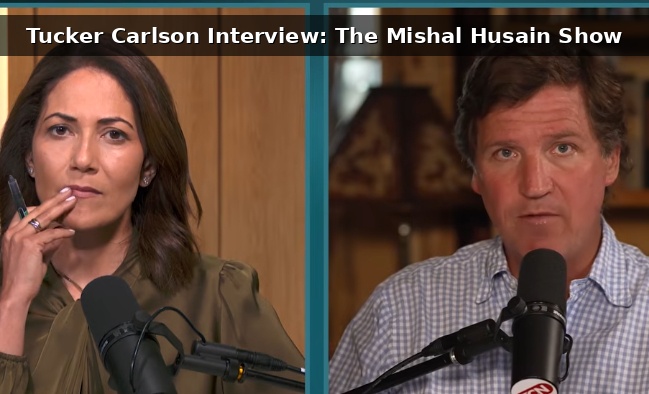
The following is the full transcript of political commentator Tucker Carlson’s interview on The Mishal Husain Show, July 17, 2026.
Editor’s Note: In this intense and wide-ranging conversation for The Mishal Husain Show, commentator Tucker Carlson breaks down his dramatic fallout with President Donald Trump over the United States’ recent military actions against Iran. Carlson offers a stark critique of the current state of American leadership, arguing that the administration has allowed foreign interests to override the nation’s own priorities. Throughout the interview, he also reflects on his personal ideological evolution, his views on the decline of the American political system, and his vision for the future of conservative thought.
Introduction: Tucker Carlson and the Iran War
MISHAL HUSAIN: What was envisaged as a short but overwhelming war against Iran by the United States and Israel has turned out, 5 months on, rather differently. Ceasefires have proved fragile. Iran’s power over the Strait of Hormuz is still apparent. And the war may yet have a significant political fallout in the United States. A president who promised no more wars has in fact repeatedly used force in his second term.
But it is the Iran war that has sparked a spectacular fallout between Donald Trump and one of his most prominent allies, the former Fox News host and conservative commentator Tucker Carlson. He worked hard to get Donald Trump re-elected. He was dismayed when the first strikes against Iran took place last year. Nevertheless, he stayed close to the White House until this February when the current war began and the Carlson-Trump relationship imploded.
Since then, in episode after episode of The Tucker Carlson Show, he has gone after what he’s portrayed as a betrayal of America First, and he’s gained a larger audience along the way. Episodes now get tens of millions of views across social media and podcast platforms each time, and Tucker Carlson has more than 17 million followers on X.
He has long been a polarizing figure, disliked on the left from his bowtie-wearing Fox News days. Now, though, he has lost friends and allies. That’s partly because of his rift with the Republican Party, but also because of the way that he talks about Israel, amplifying narratives and stereotypes, his critics say, that cross the line into antisemitism.
Our conversation was recorded between London and Maine, where Tucker Carlson lives. And we do go into some tough territory. There are a number of responses and some extra information that you’ll hear at the end. In fact, for this episode in particular, please do read my notes, which you’ll find at bloomberg.com/Mishal. That’s where you’ll get a sense of why a question was asked in a certain way, what might have been left out of an answer, how I prepared, and indeed what I read afterwards, the places where I’ve added context. So that’s the background. And here’s how my conversation with Tucker Carlson began.
So thank you for talking to us.
Tucker Carlson’s Father and Early Influences
TUCKER CARLSON: Oh, of course.
MISHAL HUSAIN: You know, I was thinking about your home in Maine because I was reading the last bit of this book where you write quite emotionally about tidying up the house at the end of the summer. And I was thinking that you don’t have to do that anymore, right? Because you live there all year round now.
TUCKER CARLSON: That’s true. That’s true. I’m grateful.
MISHAL HUSAIN: Yeah. Tucker, you know, in this conversation, we are going to range far and wide— how you see the US, how you see the rest of the world, especially the Middle East right now. But before we do that, I really wanted to understand your influences, because I think you’re clearly in the midst of a really intense time in your life as well as in the news. Can we talk a little bit about your father, first of all?
TUCKER CARLSON: Of course.
MISHAL HUSAIN: I was reading, as I prepared for this, what you and your brother wrote about him when he died last year. And I was just struck by what an unusual life he had, and obviously curious about how that influenced you. A difficult start to life in many ways he had.
TUCKER CARLSON: Well, it influenced us enormously. He had the most interesting life of anyone I’ve known personally. He was born an orphan, grew up in an orphanage and foster care, then was adopted. Never finished high school, joined the Marine Corps, went into journalism, started working for the government, traveled the world, knew everybody. It’s just a fascinating, self-educated person, intensely curious, very smart, very honest, kind of swashbuckling, complicated, and just a great guy.
And my brother and I had the privilege of growing up alone with him when we were little. Our mother left when we were small, and my father got custody because she wasn’t there. And so we grew up with them in this kind of eccentric— not kind of eccentric, extremely eccentric environment, but a happy and wholesome one. And for many years, I really never told anybody other than my wife about my childhood because it sounded so bad. But it wasn’t bad. It was great. And we really sincerely enjoyed it.
But it was not mainstream at all in the sense that my father never felt like he had to believe something because everyone else believed it. He came to his own conclusions. He wasn’t always right. But he was very often right, and he was consistently more right than the majority of public opinion in the United States. He was just an independent thinker and very American in that way. And there’s so little of that left.
MISHAL HUSAIN: And I also thought particularly internationally minded. He had, you know, seen a lot in the ’60s in the US. But then you wrote that he was involved in intrigues around the world in the last 25 years of his life.
TUCKER CARLSON: He was.
“Who Dares Wins”: The Break with Trump
MISHAL HUSAIN: There was another part of what you said about him that jumped out to me, which is that his motto was, “who dares wins.”
TUCKER CARLSON: Yes.
MISHAL HUSAIN: You know, people in the UK will know that well as the SAS. But I wondered if that has come to you in this period because you have had a very public break with President Trump, with the Republican Party. At the same time, you’ve seen a big increase in the reach of your show since the Iran War began. Has that spurred you on and given you more conviction that the path you’re on now is the right one?
TUCKER CARLSON: No. I’ve never been business-minded. I mean, I was fired 3 and a half years ago. I probably could have retired. So I’m not thinking about our ratings. I’ve never thought about my ratings. Again, you don’t have to believe me, but it’s just true. Ask anyone who’s worked for me. I don’t even know what they are.
I was in agony when I criticized Trump. I like Trump. I didn’t want to— and I endorsed Trump and campaigned with Trump and spoke at the Republican National Convention. And I’ve defended Republicans for 35 years in public. And I had zero interest in having a spat with them. And so I felt driven to my positions. Trump allowed the U.S. government to be completely steered by this tiny little country in the Middle East, Israel, to our great detriment. And I watched it happen. I was offended by it. I argued against it directly to him. That had no effect at all. And then we wound up in a war with Iran that has gravely hurt the United States. And it was out of my frustration that I said that, but not some calculation that I’m going to get rich or something by saying it. That’s just true.
MISHAL HUSAIN: Yeah, but it must be energizing to have a greater reach right now than you did a few months ago.
TUCKER CARLSON: I look at it differently. It’s funny, I don’t know that we do have a— I mean, I really don’t know if that’s true. But from my perspective, the year that preceded this war, I spent pretty— I don’t know, tireless is the right word, but I mean, I was very focused on preventing a war with Iran and wrapping up the war between Russia and Ukraine, which is also damaging the United States gravely and Europe gravely. And from my perspective, I had no effect at all. Like nothing I wanted to happen happened. I had no power, I had no influence.
And I think I’d kind of talked myself into believing I could have some effect. And at the end, I didn’t. And so that part of that was my vanity and my silliness. And, you know, men tend to think they’re more powerful than they really are. And I think that happened to me to some extent. But I felt like all of my efforts came to naught and I didn’t feel like a winner. I felt like a loser.
Accountability, Power, and Israel’s Influence
MISHAL HUSAIN: At the point that we’re talking right now, President Trump, all by himself, without Benjamin Netanyahu by his side, has said the ceasefire is over. And the United States in the last 24 hours has hit more than 80 Iranian targets, right? So isn’t the more honest and direct thing to do hold him fully accountable for his actions as the most powerful man in the world?
TUCKER CARLSON: I don’t think he’s the most powerful man in the world. I have held him directly accountable. It’s his fault. He’s the U.S. president. He was elected. That’s his job. And a huge part of the job is resisting pressure from outside forces. And many presidents have to varying degrees resisted attempts to control them from outside. And he didn’t. So he’s weak. I’m not pretending otherwise.
But it’s also just a factually verifiable statement that Israel pushed us into this and Trump allowed them to do that. The secretary of state himself said that on camera. So this is not like a conspiracy theory. It’s a fact. The United States is unwilling to, or maybe unable, who knows, to restrain Israel. I’m on the outside. I’m not talking to Trump anymore. I haven’t spoken to him since late February. So I don’t really know. But I have a news feed. So I know that we did not restrain our ally and partner in this war, Israel. And so, of course, it was never going to work.
MISHAL HUSAIN: Okay. But it’s one thing to seek to influence the US president. Many countries have done that, with greater or lesser success over the years. It’s another thing to look at the elected leader of the world’s only superpower, only real superpower at this point, and say he is not the most powerful man in the world. Are you really saying that Netanyahu is a more powerful figure than Trump?
TUCKER CARLSON: No, I don’t.
MISHAL HUSAIN: And the United States is not the world’s most powerful man in the world.
TUCKER CARLSON: The United States is not the world’s only superpower. China has a larger economy. China didn’t just lose a war to Iran. So, you know, who knows what Chinese military strength actually amounts to. We are much less powerful than a lot of us thought we were 4 months ago. So we’re not the only superpower at all. And that assumption is actually part of the problem that leads to hubris and overreach. And it’s a very familiar path, but you overstate your powers.
I would say that there are all kinds of forces in the world. One of them is China. There’s also the international business community. We have a globalized economy, so there’s no such thing as an American business or a British business or a German business. These are all interconnected, and global capital is more powerful than any voting bloc in the United States, period.
And Israel as a nation— I’m not just including the 9 million people who live in Israel, but also its many agents in the United States— are enormously powerful because so much of the money that funds campaigns in the United States comes with the express purpose, the intent, of tying American foreign policy to Israel’s foreign policy. So it’s a complicated thing, but the closer you look at it, and I’ve looked pretty closely, the more you understand that the elected president of the United States has power for sure, but he does not have sovereignty. He does not have unlimited power or full freedom of motion to act on behalf of his voters. He just doesn’t. I mean, we’re watching it now on this and many other topics.
Looking Back: Trump in 2016
MISHAL HUSAIN: We will come back to all of this. I want to go back in time, though, to this remarkable 10 years. President Trump came to power 10 years ago. You also got your primetime show on Fox News 10 years ago that made you a household name in the United States. So tell me about 2016, because you wrote this piece in Politico, which is also in this book, at the start of that year, in which you said that Trump was not your ideal candidate for president, but that he did have things to teach the Republican Party. Amongst them, that the depth of anger on immigration, and also the fact that Washington really is corrupt, you said, and you saw Trump as being someone who could address that in some way. So tell me first about how you saw him then and why you wrote that.
Tucker’s Political Journey and Disillusionment with Trump
TUCKER CARLSON: Well, I hate to sort of delve into my own personal psychodramas because they’re not that interesting, but they’re inextricable from the rise of Trump because I was a product of the system in Washington very much. And I believed in the system. And the rise of Trump was one of the reasons that I was forced to confront the fact that the system was not serving the population of the country that put it there and was paying for everything and in whose name all these things were being done.
There was just too wide a disconnect between what people wanted and what they were getting. Really simple. And I couldn’t really see that. And Trump’s rise forced that question. And I just noticed that everyone around me, people I liked and respected, hated Trump in an irrational way. And I didn’t understand what the hate was about. And I understood ultimately what it was, which was he was threatening them. He was threatening their hegemony over our system — like they were benefiting. The country was withering. They didn’t want a conversation about that. They didn’t want to change course.
And in the end, I just took Trump’s side because I thought that he was an alternative to this system that we had that had grown sclerotic or corrupt, whatever word you want to use. It wasn’t working as intended, and I was really upset about it. I mean, Trump was running against not just the Democratic Party but the Republican Party, and I thought we needed that.
And so that’s why it was so heartbreaking. In fact, it was almost paralyzing for me to see what happened in February. And you wake up and you realize this guy you think is taking on both parties has joined the consensus of those parties, the uniparty, on economics and foreign policy. And like, wait a second, if Trump can’t fix the system, can it be fixed? That was really scary. It’s still scary when I think about it.
MISHAL HUSAIN: Yeah. You had, though, before 2016, seen him as a difficult personal character. At one point you said he was interesting but horrible, right? I think you didn’t like the showmanship. You didn’t like the gold everywhere.
TUCKER CARLSON: No, I mean, culturally it was always just a huge stretch. I just come from a culture that’s so different, and it was just beaten into me as a child: don’t talk about yourself, don’t brag about yourself, never boast. And here’s a guy whose entire life, whose brand is basically bragging, and that was difficult. But I thought to myself, okay, I don’t like that. I don’t have the same taste. I don’t have the same affectations. I don’t have the same instincts about a lot of things, but this is a guy who’s brave enough to take on a system that really needs to be reformed and cannot be reformed from within. I still think that. I’m just so shocked and disappointed that he joined the people he hated.
Tucker’s Influence and Relationship with Trump
MISHAL HUSAIN: You did have this extraordinary influence yourself, didn’t you? Even in the first term, because when you put someone on your show, someone like Chris Rufo, for example, talking about critical race theory, within hours they could — and he did — get a call from the White House saying, come in and talk to us. He ended up drafting an executive order. How did that feel? Because you must have gained a sense of your own power through that.
TUCKER CARLSON: Well, I tried to ignore it. In fact, I don’t even remember that, to be totally honest with you. I don’t read about myself. The second you start thinking like, “I’m in charge now, I’m an important person,” that’s when your soul rots. And I just always wanted to remember that in the not famous enough words of Conan O’Brien, “In the end, every grave goes unvisited.” That’s the perspective that people need — we do our best, but in the end, nobody cares. And we’re not in charge of history. We’re not God.
So anyway, no, I really fought against thinking, “I’ve got a cable news show on some stupid cable news network that takes prostate health and pillow ads.” I would try to not think about that at all. I never visited the White House. I never went to the movies or dinner there.
MISHAL HUSAIN: He called you, didn’t he? In the first term — President Trump used to call.
TUCKER CARLSON: Yeah, I talked to Trump all the time.
MISHAL HUSAIN: I mean, that doesn’t happen to just anyone.
TUCKER CARLSON: Well, but I knew him. Trump called me before he announced in 2015. I’ll never forget it. I was in the car and he’s like, “I’m going to run for president.” And I made fun of him because he did this in 2000, so 26 years ago. He faked a presidential campaign to sell a book. So I laughed and I said, “Oh yeah, you’re going to sell another book?” And he goes, “No, actually, I think I’m going to surprise you this time.”
And I just want to be clear, Trump is one of the most entertaining, charming, insightful, fun-to-be-with people in the world. And anyone who’s ever had dinner with Trump can tell you — I don’t care how much you hate him or dislike his policies or whatever — you have dinner with Trump, you’re going to have a great time. So no, I always liked him. Always. But anyway, I didn’t expect this.
The Iran War and Tucker’s Break with Trump
MISHAL HUSAIN: So summer of 2025, when Israel began military action against Iran and the US then joined in and bombed the nuclear sites, you were clearly publicly upset about what you called warmongers. But you did patch things up with the president.
TUCKER CARLSON: Correct.
MISHAL HUSAIN: How did that happen?
TUCKER CARLSON: I mean, it got so intense. I don’t work for Trump. I’ve never worked for Trump. I’m not in any business deals with anything related to Trump. I’m not beholden to Trump. So I always tried to be honest. I wasn’t always as direct with him as I probably should have been. But on these questions, I was very direct and I said, “You’re getting led around by the nose by Israel. Everyone can see it. Nobody cares about the Iran nuclear program. There are a lot of bad people with nuclear weapons. We don’t want more of them. But this is not about nuclear weapons. This is about sucking us into a regime change war against Iran.” I flat out told him that a bunch of times, and he’s like, “No, no, no, that’s not true.”
But it was true, and it turned out to be provably true now. So that was extremely upsetting to me. I was supposed to meet with him in the White House. Israel bombed. We allowed them to bomb. We paid for it. Of course, we paid for their missile defense when the response came into Tel Aviv — like it was our war with Israel prosecuting it for us.
So I was so mad that I didn’t go. I was supposed to meet him at the White House and I didn’t go. And then he called me and we had this kind of intense conversation. And I was very upset. And I just said, “Look, it’s demeaning for the United States. You’re the president. I’m not even — I don’t even hate Netanyahu. It’s not even about that. We’re the United States. We’ve got 350 million people. You cannot be led around by a tiny country. What are you doing?”
And he really hated that I said that because it’s true. It was true. It is humiliating. This whole thing is humiliating to the United States and to me as an American whose family’s been here for hundreds of years. It’s outrageous. And then he said I was crazy. He gave some statement — “Tucker Carlson’s crazy.” Well, obviously I’m half crazy. I mean, I know that.
And so somebody pushed me and said you should call him. And so I called him and he picked up first ring and I said, “Yeah, I’m kind of crazy. I’ve never denied that. I mean, look at me.” Well, anyway, he laughed, and then our relationship — that was like one day. But when we actually killed the Ayatollah, bombed a girls’ school — like, this whole thing was so nuts that I was like, I’m out. I can’t. This is too much. It’s too damaging to my country.
Conversations Within the Trump Circle
MISHAL HUSAIN: Who else did you call? You’ve been friends over the years with so many others who are in that circle. J.D. Vance, for one. Stephen Miller, another. What are the other conversations you’ve had? If you’re as exercised as you clearly were and are, I can’t believe your only conversations were with the president.
TUCKER CARLSON: Between the 12-day war in June and the regime change war on February 28th, I talked to everybody. I mean, I visited the White House — I don’t know how many times. I know I went 3 times in the month preceding, but I went many times and saw Trump. It’s a very small building, so you run into people. Yeah, I talked to everybody about it constantly.
I think that my views represent the views of most Americans. My views are not ideological. They’re not radical. What’s radical is taking orders from Netanyahu to enter a war that’s going to hurt your country. That’s crazy. That’s extremism. It’s religious extremism, by the way. I’m not a religious extremist. I’m just kind of a garden variety Christian. So I’m not the crazy person here, actually. I’m representing common sense. And I know that. And no amount of screaming at me or calling me a Nazi or an anti-Semite — which I’m obviously not — none of that is going to change my view.
And I told Trump, “You’re going to destroy your legacy, your administration. Your name will never be uttered except with reference to this disaster that you’re about to start. So don’t do that.” That’s what happened to Bush. I knew Bush well. And Bush had all kinds of plans in 2000 when he got elected to do this, do that, improve America. What’s Bush remembered for now? The Iraq War and the financial crisis. That’s it.
MISHAL HUSAIN: You supported the Iraq War.
TUCKER CARLSON: I certainly did support the Iraq War. Oh yeah, I bought into it completely. And I not only supported it, I argued against and attacked people who opposed it. And I’m sorry, and I remain sorry. But I also was chastened and I learned something, which is you can get carried away by propaganda and you can end up lying. I didn’t mean to lie, but I did. And so don’t do that again. And I resolved I’m never going to allow that to happen to me again, ever. I will never do that again. And I haven’t.
Israel’s Influence on US Foreign Policy
MISHAL HUSAIN: So in that period when you’re arguing to anyone who will listen, or anyone you bump into in the White House, against the war with Iran — do they say to you, “We’re doing this for Israel?” Like, why are you so convinced that Israel has actually controlled this, not only influenced it, but controlled it?
TUCKER CARLSON: Well, because again, there’s a ton of pressure from Israeli agents, the neocons, whatever you call them. We’ve watched it for 4 months. The United States, the president himself will say, “No, no, we’re doing this.” And Israel will just immediately do the opposite and destroy the peace negotiations. I’m not even attacking Israel, by the way. They have a different view of what the end of this should look like. They have a different set of interests. They’re a different country. They have a different goal.
MISHAL HUSAIN: But this suggestion that you’ve made on Israel’s goals — that the Israeli goal is chaos, it’s dysfunction — what would be the natural, obvious, well-documented effects of this? Migrant crises in Europe, further destroying Europe. That’s always been an Israeli goal. Destroy Europe.
TUCKER CARLSON: Yes.
MISHAL HUSAIN: Do you really mean that?
TUCKER CARLSON: Well, I don’t know. Netanyahu means it. He said it. No one watches. See, the thing is, nobody watches.
MISHAL HUSAIN: Where has he said his goal is to destroy Europe?
TUCKER CARLSON: “Rome is the enemy.” Rome, meaning Christian Europe. The prime minister of Israel has said this on camera. I would refer you to the internet. You should watch it. It’s fascinating. Why would Rome —
MISHAL HUSAIN: Don’t you think he’s talking — don’t you think he’s making a reference to history and the Romans destroying the temple rather than present-day Rome in Europe?
The Gaza Conflict: Genocide or War?
TUCKER CARLSON: Why would— well, I don’t know. Why would something that happened in 70 AD be relevant for a secular modern head of state? I don’t understand that. What is he saying? I mean, look, the worldview here is totally different. That same prime minister has said repeatedly that we are fighting Amalek. And people are so biblically illiterate, they don’t know what he’s referring to. He’s referring to the Amalekites. And there are a couple of different stories in the Hebrew text, in what we call the Old Testament, that describe what he’s talking about. And what he’s talking about is the elimination, truly the genocide, of a group commanded by God and described in great detail called the Amalekites.
So this is not a Western view of war. The Western view of war is, you know, we punish the wrongdoers and most people have nothing to do with this, so we don’t kill them too.
MISHAL HUSAIN: So Israeli leaders and many ordinary Israelis as well reject the idea that this is a genocide. I hear that that is your view. I will just say that the idea of fighting a war in a just way is not simply a Western idea. It’s not only a Western Christian idea that there are limits to war and you only strike in self-defense. I’m a Muslim, and I can tell you that actually, if you read the Quran, that idea is there as well. So it’s not a purely Western concept.
TUCKER CARLSON: Oh, I wouldn’t claim that it is a purely Western concept. My point is it’s the basis of Western civilization, and to the extent that other civilizations share that view, I applaud it, of course. And by the way, you say that the Israelis, some Israelis don’t think it’s genocide. Well, everybody else on the planet, so far as I can tell looking at the facts, concludes it’s genocide. I don’t know if there’s any other group on planet Earth who doesn’t see this as genocide.
MISHAL HUSAIN: Many governments don’t see it that way. Your government doesn’t. The British government doesn’t.
TUCKER CARLSON: Well, your government and my government are paying for it, so of course they’re implicated in the genocide and they share the guilt of this genocide. It is happening. There’s no excuse for it. We should do everything we can to stop it immediately.
Trump’s Use of Force and Foreign Policy
MISHAL HUSAIN: The bigger picture of the use of force in this second Trump administration is that the president, quite apart from striking Iran with the help of Israel, has used force many times. Yemen, Venezuela, Nigeria, Syria, Iraq, Somalia. This has actually been a very frequent phenomenon of the last year and a half, and he’s been comfortable with it.
TUCKER CARLSON: Oh, I’ve noticed.
MISHAL HUSAIN: This is the man that you worked really hard to get reelected.
TUCKER CARLSON: Yes.
MISHAL HUSAIN: Perhaps you didn’t pay attention to something that was always there.
TUCKER CARLSON: Oh, I paid close attention to it. I mean, that’s why I was so involved. I knew that he was under enormous pressure to do the things that he has since done. I knew exactly who was pressuring him. And I was arguing the counter-case and doing everything I could to make the right case.
MISHAL HUSAIN: So who pressured him? Who pressured him to hit Nigeria or the targets in Syria or Iraq or Yemen? Who was pushing him on Venezuela? Was he pushed into all of these things?
TUCKER CARLSON: Well, of course. I mean, obviously. By the way, every president is pushed in different directions on all kinds of different topics, not just foreign policy and not just by the Israeli lobby or whatever. And again, the whole job is figuring out who to listen to, when to bow to the pressure, when to resist the pressure. That is the job.
Okay, so none of this is new. Every part of American Middle Eastern policy is driven by donors to both parties. Of course. I mean, it’s a lie to pretend otherwise. Some of that is just inevitable. You take money from people. You need money to run a campaign. I’m less judgy maybe than I sound. I understand how it works. You have to listen to everybody, by the way. People should listen to the Israeli lobby. They’ve got a perspective. You should listen to the Muslim lobby. I mean, it’s a big country. Everyone gets a say. I get it.
And ultimately, when you’re looking at the potential of a Third World War, which we are— I was obviously very distressed by what he did in Venezuela. I thought it was crazy and embarrassing and immoral. You can’t just roll in and arrest a president and say, “I own your oil.” That’s crazy. And I thought that, and I said that to some extent, but I didn’t lose control of myself on camera because I felt like what really matters are the biggest things. And maybe my calculation was wrong. It wouldn’t be the first time. But I just wanted to avoid this war because I knew that once we got into this, we wouldn’t get out until we were gravely diminished. Gravely diminished. I don’t think that’s good for us or for the world.
Political Fallout and the Case for a Third Party
MISHAL HUSAIN: What do you think it’s going to do to the Republicans in the midterms?
TUCKER CARLSON: I mean, they’re going to be spanked. Yeah, they’re going to be punished for it, of course. But the question is, does that make the country better? No, I mean, not really. I don’t see any political leader right now speaking for the majority of Americans. I mean, the American economy is so lopsided at the moment that younger people are legit struggling, at least by American standards. And I don’t see any political leaders really thinking about how to fix that or moving their priorities from a whole suite of different foreign conflicts back to the United States and spending the time thinking about how do I elevate my people? How do I help the people who put me here? So I don’t see that mindset.
MISHAL HUSAIN: Is your third-party idea a real one? You floated it. You’ve said you want to help build one. What are you thinking?
TUCKER CARLSON: Well, I just want to be clear, I’m not running for any office ever, okay? I’m not being coy or pretending, and then I’m going to announce for— I’m not announcing for president. I’m not running for president. That’s a nightmare, and I’m not doing that. But I just want to help. I want the promise of democracy to be real, that you vote for someone and that person makes a good faith effort to represent your interests. It’s not complicated. Self-government is not that complicated. It’s disappearing.
But there are a lot of very ominous trends in the United States domestically that are just completely being ignored. And I would like someone to address them. And after Trump’s performance over the past year, it’s hard to believe that he’s the guy who’s going to reform. I mean, he is closely allied with the leaders of both parties and this whole partisanship thing. And this is true in the UK, too, with respect. It’s kind of a ruse, actually. They fight over these issues. They’ll pick an issue, transgenderism, and they’ll tell you that they’ve just got completely different worldviews on transgenderism. And that’s like the most important thing. But what that cloaks, what it hides, what it’s designed to obscure is the fact that on economics and foreign policy, the big questions that determine the fate of nations, they are aligned.
MISHAL HUSAIN: I don’t think that’s true, Tucker, in the UK of the big parties on economic issues. There are very distinct differences.
TUCKER CARLSON: I mean, I’ve made this mistake so many times. I have family there. I spent a lot of time there. And I imagine that I understand the system that I don’t understand very well. So I should probably shut up about UK politics.
MISHAL HUSAIN: Okay. But tell me about the third party. I’m wondering whether you’re watching the rise of Nigel Farage, someone you’ve talked to, you’ve had him on your show. Is that some kind of a model? And are you serious about a third party or are you just throwing it out there?
TUCKER CARLSON: Yeah, I know Nigel very well, and I was just with him in London not long ago. But I will say, yes, I’m watching the rise of Reform, and with some amazement and delight. Not that I think Reform is the answer necessarily, but an option is a good first step.
And I do think that there are meaningful differences between the Democratic and Republican parties to the extent that their voting bases do disagree in real ways. I’m saying that the people who run the parties are fundamentally aligned. And one of the ways you know that is because Trump brings us to war on February 28th without making the case to the American public, without convincing even the majority of Americans this is a good idea. No one was for this from day one. So you would think, given that this is a country with a long history of boisterous public protests, that there would be massive protests against the war. None. Zero. Well, why is that? Where were the Democrats on this? They could mobilize 1 million people and put them on the National Mall in Washington, but they didn’t because they’re for it. That’s why. Because Chuck Schumer is 100% for this. There may be details he disagrees with, but basically he’s wanted regime change on behalf of Israel in Iran for many years. So that’s not acceptable. It’s not acceptable to have a system where the average person has no representation.
MISHAL HUSAIN: He’s just one Democratic leader and there are others who have very different views on the war, much more aligned to yours.
TUCKER CARLSON: Name a Democratic leader who has a sincere— he’s the mayor. He’s the mayor of New York. He has no foreign policy portfolio.
MISHAL HUSAIN: That is a prominent and arguably very influential position right now to hold as a Democratic politician. But let me go back to the Republican Party because—
TUCKER CARLSON: —famous person with no power to affect foreign policy. So he’s kind of— I’m sort of in that category, so I kind of know what that is. He doesn’t have a vote on these questions, but the people who do are aligned, and that is not democracy. And it would be nice to have a democracy. We had one. I would like it again. Okay, that’s it.
J.D. Vance, Betrayal, and the Future of the Republican Party
MISHAL HUSAIN: The Republican Party, the fact that you’ve left it, does that mean you’ve given up on J.D. Vance leading the Republican Party, being the next presidential candidate, and it being a different Republican Party to what you see now?
TUCKER CARLSON: Well, I think if J.D. Vance were president, of course we would not be at war with Iran. It’s impossible for me to imagine J.D. Vance standing up and saying we need to have 2 wars to defeat a phantom nuclear program. It’s too insane. I think he has too much self-respect to say something like that. I don’t think he believes it. I think J.D. Vance would have led the Republican Party into closer alignment with its own voters. But he was not the president. He’s the vice president, and he doesn’t have the authority.
MISHAL HUSAIN: Yeah, but he could be the next presidential candidate.
TUCKER CARLSON: Yeah, I mean, we’ll see. I mean, I wish he had been elected president in 2024, but that didn’t happen. I love JD. I’ve never been shy about that. I’ve taken a lot of abuse for saying that. I probably haven’t helped him at all by saying that. I don’t agree with him on everything, of course, but I think he’s an honest, very smart, decent person. That puts him above almost all politicians I’ve ever met. And so I’m on some basic level rooting for him.
But it’s just hard to imagine how the Republican Party after this, after truly betraying its own voters— betrayed its own voters. It told them Washington is an inside game. A small number of people are getting very rich. They commit crimes with impunity. They’re protected by the U.S. government. It’s called the deep state, and we’re going to uproot it. And then not only did they not uproot it, they attacked anyone who asked to see the Epstein files. Betrayal is the worst thing.
So if my neighbor leaves his wife and kids and runs off with a stripper, I disapprove of that. If my dad leaves me and my siblings and my mom and runs off with a stripper, I never get over that for the rest of my life because that’s betrayal. And that’s exactly what happened. Trump betrayed not just the country, but the people who vested their hopes in him. And that is low and wrong. And every culture, every people, every person intuitively recognizes betrayal as the worst thing. That’s why Judas is remembered, why his name lives in infamy for all eternity, because he— not because he took the wrong side, but because he betrayed. So yeah, that’s what this is. It’s betrayal. And I think it’s very hard to get past that in the short term.
MISHAL HUSAIN: Have you been in touch with J.D. Vance in recent months? What’s the state of play between the two of you?
Tucker Carlson on Loyalty, Democracy, and the Future
TUCKER CARLSON: No, I haven’t. I mean, I haven’t been to Washington. I’d love to go see him. I can’t. Trump’s all mad at me. They’re all mad at me, calling me an anti-Semite or what. It’s just so ludicrous.
Look, I think at this point it wouldn’t be good for me to contact anybody. I’m seen as disloyal. Disloyal? First of all, loyalty goes two ways. Second, the loyalty that matters is the loyalty of our leaders to the country they represent. And they’re disloyal. Trump has been disloyal to the United States, totally disloyal to the United States. He cheated on the United States with a foreign power. So I’m not the one who’s been disloyal.
MISHAL HUSAIN: So what are you going to do next?
TUCKER CARLSON: I don’t know what I’m going to do. I don’t know where I’m having lunch today. But I would say I am open to any alternative that serves or makes a good faith effort to serve the American people above and really probably to the exclusion of foreign interests and corporate interests. It’s an orientation.
What makes a good parent? Loving your kids. It’s not reading some book on it or knowing the instructions or some esoteric knowledge that makes a good parent. No, it’s just the desire to help your kids. And that desire comes from love. And if you have leaders like that, they don’t always make the right decisions. They’re not perfect. But over time, their people will thrive, just like a family presided over by parents who love their kids will thrive.
So we don’t have that. We have leaders who have contempt for us, who take us for granted, who use us, who lie to us, who really don’t care about us at all. And we know that because when life expectancy declines, when people die younger, when the middle class disappears as it did 11 years ago and nobody says anything about it. So I’m just looking for an alternative to that. That’s not hard. We should be able to find that.
On Democracy, Civil War, and Political Violence
MISHAL HUSAIN: It’s a really bleak picture you paint.
TUCKER CARLSON: It’s not a bleak picture. It’s a normal human picture. Look, you have successful systems. It happens in companies. It happens on sports teams. It happens in any human organization. Success breeds decadence, which spurs collapse. This is a very recognizable cycle. And the United States has been the most successful country in the history of the world.
And so needless to say, just like in successful families, 4th generation affluence — you have an entire ruling class that is living testament to this. This is what happens when you succeed over time. You get flabby and you get decadent and you become contemptuous of the people you lead, and you forget the qualities that made the organization successful in the first place. And then you have a reset, and hopefully it’s a non-dramatic reset where people just kind of come to their senses and recall why they were successful in the first place and do those things. That’s my hope. I don’t want revolution, but we’re going to get a revolution if this continues.
MISHAL HUSAIN: And you have talked on your show about America heading towards civil war.
TUCKER CARLSON: Yeah, obviously.
MISHAL HUSAIN: Do you really believe that? Because that is — I mean, not just bleak, it’s also a really inflammatory thing to say. And I can’t help thinking about political violence and the awful ways we’ve seen it in the U.S. within the last year.
TUCKER CARLSON: Is it inflammatory?
MISHAL HUSAIN: When you say words like that to millions of viewers and listeners, how much do you weigh up the responsibility that you have given your reach today?
TUCKER CARLSON: Well, the responsibility is 100% on the people who are perpetrating political violence. I abhor all violence. I abhor the violence of war. I abhor the violence of abortion. I abhor the violence of euthanasia. So there’s no chance I’m going to take credit for political violence. I’m against it.
What I’m saying is that if you convey to people that their vote does not matter, that there’s no nonviolent way to be heard, they will by definition over time resort to violence. I don’t want that. Democracy was supposed to be the answer to revolution. We’ve never had a revolution in the United States despite a couple of world wars, a civil war, a Great Depression, the antiwar movement of the ’60s, the civil rights movement. We’ve had a lot of drama in the United States, the murder of several presidents. We’ve never had a revolution in the United States. Why is that? Because democracy is the pressure relief valve that keeps people from storming the Bastille.
On Marriage, Gender, and Feminism
MISHAL HUSAIN: We’re nearly at the end, Tucker, and we started talking right at the beginning about your dad. I know your family’s important to you. You’ve mentioned them. So I’m curious about one more thing, which is that I heard you on a recent episode talking about marriage, wives respecting husbands, husbands’ authority resting with the man as the final decision maker. You are a father of daughters, and so I just wanted to understand what you believe, whether you think in their relationships their husbands should always be the final decision makers.
TUCKER CARLSON: Well, obviously I’m never going to talk about my children. That’s like an insane question that I’m going to ignore without being offended, but I can give you my views.
In a happy marriage, everything is symbiotic. I don’t really think anybody’s in charge of a happy marriage at all. I think people — at least I know in my own, I’ve been married 35 years next month — I wouldn’t say I have more power than my wife at all. And I think any happily married man feels that way. There’s no one whose opinion I care more about. There’s no one whose bidding I’m more anxious to do. If my wife wants something, I’ll just do it. And I think most men who love their wives feel that way. So it’s certainly not a matter of bossing anyone around.
But yeah, somebody ultimately has to make the decision. And women in general want the man to make the decision, as you well know. And the women who won’t admit that are not telling the truth. In fact, the thing that I have noticed that women dislike most is men who won’t make decisions, and they have contempt for them. I’ve never met a woman who didn’t feel that way. I’ve met a lot of women who pretend they don’t feel that way, but in real life, I think that women see that as weakness, which it is, and they despise it. They have contempt for it.
So I don’t think we should lie about the way people are. Men and women are not the same. They’re not even close to the same. They’re incredibly different. And that’s not bad. I think it’s a good thing. It’s a source of endless wonder for me. I didn’t grow up with any women at all. I had no mom, I had no sister. So I’m still learning. I find women the most interesting sort of thing about life, is trying to understand women. And I really have tried my hardest. I’ve probably gotten to about 60%, but it’s fascinating to me.
But I do think the pretending that men and women are the same, which has kind of been mandatory — it’s wrecked the UK, I can say, and I think really hurt the United States also — that’s going to end. The rest of the world makes fun of it. It’s too stupid. It’s a denial of gender and biological sex. Well, it’s just the whole thing. In every part of our society, there is an active effort to deny that there are any innate sex differences. And until you know that and grapple with it honestly, you can’t have a happy relationship with a member of the opposite sex.
And that’s one of the reasons we don’t have very many happy relationships between members of the opposite sex, because liars have told us that acknowledging innate sex differences — sex differences determined before birth — leads to the oppression of one of the sexes. And in fact, it’s wound up resulting in the oppression of women in the United States. I’ll speak for my country, by big companies. Our economic system has applied a lot of pressure on young women to choose working over having kids. And I think women should be able to choose whatever they want. If you want to work at Citibank and not have kids, that’s up to you. I don’t believe in coercion. However, I do believe in honesty.
And most people, men and women, find the deepest expression of joy in their lives in their families, in their spouse, and in their children. And if you lie to them and wind up denying them that greatest source of human joy, you are evil. And so I just want to say that out loud, that feminism is an op run by big business to lower the price of labor and to free up a massive and incredibly productive female workforce. And that’s been bad for the country.
MISHAL HUSAIN: I’ll tell you why I asked this, because I was curious about your views. And it is really hard for young women figuring this out, having a family, as most but not all want to do. And trying to reach your full potential in the workplace. And I know that my life chances have been fundamentally different from my mother’s, and a lot of that is because of the feminist movement. She had aspirations to work outside the home. It just wasn’t possible. There was more of a patriarchal system. There wasn’t childcare. It would have been frowned upon. And I’ve been really lucky to be able to have a marriage and children and contribute to my family’s economic well-being. And I would say I do owe that to the feminist movement, that balance.
TUCKER CARLSON: Yeah, a lot of women feel that way. And by the way, congratulations. I’m all for happy endings and people getting what they want and people being content. I’m totally for that, so I would never in any way criticize your choices.
But are women in the West happier than they were in 1972? And the answer is no. And the second fact we should grapple with is that, yes, there are all kinds of different views about how a family should be organized. And there are people who take the traditional side and we talk a lot about them. But there’s another side to this that is an economic interest in convincing women that their loyalty belongs to a company and not a family.
And I think there’s going to be a real change. I notice it now among young people. I employ a bunch. And they’re all getting married way younger than kids did when I was just out of college. And they all want to have kids way more than young people did in 1991 when I got married. So I do think people are starting to realize that the government doesn’t care for you. Your employer, they don’t care about you. They told me at Fox they love me — “We love you.” And then one morning they fired me without notice. It’s fine. I’m happy they did. But they didn’t care about me. Of course not. Or my family, which is fine. I never thought they did. But if you tell young people the company is dad and the company really loves you, you’re lying to them. Don’t do that.
Looking Ahead: The Next 12 Months
MISHAL HUSAIN: It’s been an intense 6 months in the news. This has been quite an intense conversation. Before I let you go, can you just cast your mind ahead 12 months to summer of next year? Donald Trump will still have 18 months left in the White House.
TUCKER CARLSON: My hope is that the Iran situation will be resolved. I would like people to come to their senses. I don’t think Trump is as big a factor now. Trump is weak. It’s obvious he couldn’t restore peace. The strong leader restores peace. That’s what strength looks like. It’s order and peace. He hasn’t been able to achieve that. So I’m not sure how even really relevant he is, but I just hope all global leaders wake up to the fact that we’re kind of on the precipice of something awful and walk it back.
MISHAL HUSAIN: Tucker Carlson, thank you very much.
TUCKER CARLSON: Thanks for having me. I enjoyed it.
Closing Notes
MISHAL HUSAIN: And before we go, a few notes here in addition to those that you can read at bloomberg.com/mishal. We did approach the White House for comment on what Carlson said, accusing President Trump of being disloyal and controlled by foreign power. A White House official said, “Israel is one of our strongest allies. No country or leader pressures President Trump to do anything. He makes decisions based on what serves America’s interests and will never allow our country to be taken advantage of.”
You’ll also have heard Tucker Carlson suggesting that Benjamin Netanyahu has said Rome is the enemy. This appears to be a reference to a video in which the Israeli prime minister is asked what book he is reading, and he names one called Jews Versus Rome. It’s about Jewish revolts in ancient Rome, and Netanyahu adds the words, “We lost that one, I think we have to win the next one.”
Carlson also references the story of Amalek in the Old Testament. This is a complex area because there is more than one biblical mention of that tribe which attacked the Jews in ancient times. Netanyahu’s office have said that where he has compared the present day to fighting Amalek, he means Hamas rather than all Palestinians.
The way Carlson talks about Israel has been criticized by the Anti-Defamation League, which says he regularly legitimizes the idea that Israel or Zionist actors exert hidden malevolent control over the US government. And similarly, the Nexus Project, which describes itself as a Jewish watchdog organization, has called Carlson one of the most important enablers of antisemitism in the United States today.
Finally, on Senator Chuck Schumer, his position on the Iran war is detailed in my notes. He has spoken of confronting Iran’s malign activities, but when the strikes began, he said vital questions on the administration’s plans were not being answered. He also pushed for a Senate resolution that would have curtailed the president’s war powers. That failed because senators largely voted along party lines, and the Republicans have the numbers on Capitol Hill.
Related Posts
- Transcript: President Trump Speaks at FIFA Reception in New York City
- Transcript: Marco Rubio’s Remarks On Far-Left Political Terrorism
- Transcript: Xi Jinping’s Keynote Speech at World AI Conference 2026
- Transcript: President Trump’s Primetime Address To The Nation – Jul. 16, 2026
- Transcript: Trump Remarks At Pennsylvania Defense and Innovation Summit