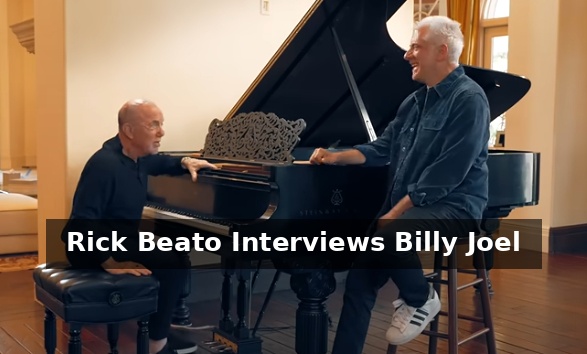
The following is the full transcript of American singer-songwriter and pianist Billy Joel’s interview with YouTuber Rick Beato, July 13, 2026.
Editor’s Note: In this deep-dive conversation, legendary musician Billy Joel joins host Rick Beato to discuss his creative process, musical influences, and the stories behind some of his most iconic tracks. Joel reflects on his early love for classical music, the “lazy” method of learning by ear, and how he successfully transitioned from intimate club performances to playing massive arenas. He also offers fascinating behind-the-scenes insights into his collaboration with producer Phil Ramone and explains why he eventually made the conscious decision to step away from recording new pop albums.
Introduction and Classical Influences
RICK BEATO: Billy, thank you for inviting me.
BILLY JOEL: Welcome.
RICK BEATO: Okay, you just played the opening when you were just warming up of the 6th Symphony, the Pastoral, Beethoven.
BILLY JOEL: That’s right.
RICK BEATO: That is my favorite Beethoven symphony.
BILLY JOEL: Me too.
RICK BEATO: Maybe you should demonstrate a little bit of it so people know what we’re talking about.
BILLY JOEL: Just me playing it by ear.
RICK BEATO: That was amazing.
BILLY JOEL: The 6th Symphony to me is happy Beethoven. He was shacked up with some Hungarian countess when he was writing this. He was obviously in a good mood because the title of it is something like “Walking Through the Woods, On Waking Up in the Country.” And he was in a good mood.
And it didn’t happen a lot to Beethoven. He was a temperamental guy, but when he was feeling good, he could write something like that. It’s so beautiful. Yes, 6th Symphony.
RICK BEATO: Incredible.
BILLY JOEL: Gorgeous. Everybody knows the 5th, real happy music. Not—
Playing by Ear
RICK BEATO: Now, things like that, did you just— you just play that by ear, right?
BILLY JOEL: Yes, I didn’t learn it notation-wise. I don’t read music.
RICK BEATO: You would just sit down with a record, or you can just play that kind of out of memory, right?
BILLY JOEL: Pretty much.
RICK BEATO: That’s amazing. Could you always do things like that?
BILLY JOEL: Probably. It’s like a lazy way to learn.
RICK BEATO: Okay.
BILLY JOEL: I didn’t always want to read the dots. I wanted to see if I could figure it out by ear. It was a challenge. And we had music all the time in my house, mostly classical music, some jazz, some show tunes, rock and roll, but classical all the time. And I would wander over to this piano we had, which was a Lester upright. Real piece of junk. Half the keys didn’t work, but I would start poking out and figuring out classical music on it. And it was fun.
RICK BEATO: Did it immediately speak to you as a kid? Classical music?
BILLY JOEL: Yes, yes, it did. It was my first love, was classical music. It made me feel good. It’s just something I related to.
Practicing Piano as a Child
RICK BEATO: Now, I asked you about your mom making you practice, and she would make you practice every day?
BILLY JOEL: Yes, every day, whether you liked it or not. After school, all the guys go out and play stickball or football or soccer or something, and I had to practice as soon as I got home from school. Do your lesson. Because my mom, she had a tough time. She’s a single mother. It cost $10 a lesson, and I didn’t want her to waste her money. And if I didn’t learn the piece for the piano teacher, she’d get mad, and my mom would get mad. So I practiced every day for an hour. Didn’t always want to, but I did. And I have to credit my mom.
Rachmaninoff and Classical Influences
RICK BEATO: You’re also working on a piece by Rachmaninoff that you kind of were showing me that you’re, what, 12 bars into it?
BILLY JOEL: Yeah, I love the Rachmaninoff Piano Concerto No. 2. It’s insane how good it is. And I wondered, can I learn this by ear? And I started, and I said, okay, you can get the beginning, because the beginning is supposed to be the bells. Got that much. Then it goes— you can’t really learn that by ear. You have to read the notes. So I gave up, but at least I got the beginning.
RICK BEATO: That’s amazing. You have a lot of classical influences in your music, along with things like R&B and blues and jazz. But the classical parts of it, the use of dissonances— we were kind of talking about this earlier— to me, these are the things that give your music emotion. I think that gives music in general emotion are things like dissonances.
The Power of Dissonance
BILLY JOEL: Yeah, I think it’s a great tool to have in the toolbox if you’re going to write music. You need those tools. You need to know the different colors and what things do, what dissonance does, what atonality does, how to play chords differently. Like, if I didn’t have the dissonance in the song “And So It Goes,” it would sound like this. Which is kind of boring. So I threw in some dissonance notes, suspensions. Suspensions are very effective because you want them to resolve, but it creates a tension in the chord where it’s like, okay, yeah, it does convey emotion in music.
RICK BEATO: And those spacings, you have the B and C with the G on the top there, and that one in the chord as it’s passing through, and the E in the bass as you’re walking up. Those brief dissonances. Then when you get to the A minor, the 4th resolving down to the minor. And I mean, that to me does so much work to help the melody too.
BILLY JOEL: Yes, I agree. It supports the melody in a way where without the dissonance it wouldn’t be the same thing.
RICK BEATO: Would you say that you get these ideas from listening to classical music? Because this is very much in classical music.
BILLY JOEL: I think so. There’s a great piece by Samuel Barber, the Adagio for Strings, which is all suspension, all suspension, building and building. I was listening to it in a car once, early on in my life, and I had to pull over, and it was so emotionally moving I started to weep. I said, what’s going on? What’s happening? And it was because of the suspensions. And it’s so moving because of those dissonances. And I realized I have to learn how to use that. I have to learn how to do that.
Summer, Highland Falls and the Sound of Fifths
RICK BEATO: Songs like “Summer, Highland Falls,” that has almost a Copland-esque feel to it. Almost like an American sound to it, but the openness of those bigger intervals with the fourths and fifths and things like that.
BILLY JOEL: Yeah, the left hand is fifths.
RICK BEATO: Yes.
BILLY JOEL: It goes up and down and up and down, which is kind of like manic depression. Up, down, up, down, down, up, down, up. And then the right hand is the manic part. So I introduced the song to the audience, and if it gets applause, I said, “Oh, a lot of manic depressives out here tonight.” Now they call it bipolar, I guess.
RICK BEATO: There’s a lot of power when you play fifths in the left hand as opposed to octaves. Talk about that.
BILLY JOEL: It’s that extra tone. Instead of going— something powerful about it, and it resonates. I always love fifths. I love tenths. They’re very effective chords to use.
RICK BEATO: On that tune, you have a lot of longer notes in it to go along with the moving line. Do you look for things like that? It’s like, okay, if I have a moving line, I’ll have more sustained notes.
BILLY JOEL: I think things like that give balance to a piece. I don’t want it to all be movement, movement, movement, movement. There should be some sustain, sostenuto as they call it, and legato to break up the staccato aspect of the right hand. I kind of like variations in music. I like fast against slow, loud against soft. Anything that is one thing, too much of one thing, I get tired of it. Maybe it’s my attention span, I don’t know, but change it up, give me something else.
The Songwriting Process and Vowel Sounds
RICK BEATO: Do you have vowel sounds and things like that when you’re coming up with a melody? Is that—
BILLY JOEL: Absolutely.
RICK BEATO: Talk about your kind of process of writing a song and where the lyrics come in.
BILLY JOEL: This is the Keith Richards school of songwriting. It’s vowel movements. That’s what he calls it, vowel movements. And it’s like, “Stop me up, would you stop me up? I never stop.” Now, it couldn’t be like “Brenda Lee.” It just doesn’t sing the same. “Brenda Lee’s memory.” No, “stop me up.” It’s the tough words, and it works with the chords. And the vowels are very, very important.
Like, there’s a song you talked about called “Honesty.”
RICK BEATO: Yes, perfect song.
BILLY JOEL: You actually resurrected that song for me because I had discarded it. “If you search for tenderness, it isn’t hard to find. You can have the love you need to live. If you look for truthfulness, you might just as well be blind. It always seems to be so hard to give.”
And as I’m writing this song, “Honesty”— like, who the hell am I to preach to somebody about being honest because I’m a lying sack of crap. I felt like such a hypocrite. But the problem was when I started to write the song, I didn’t have lyrics and it had to be something with an E vowel sound. So my drummer Liberty DeVito at the time comes up with “Sodomy, it’s such a lonely word.” Oh crap, I have to come up with lyrics right away because otherwise it’ll forever be “Sodomy,” right?
RICK BEATO: That— that wouldn’t be good.
BILLY JOEL: It was like an emergency lyric. The word “Honesty” sounds similar to “Sodomy.” So yeah, vowel sounds are very important when writing music.
Melody, Modulation, and the Chorus of “Honesty”
RICK BEATO: Talking about the melody of that song, when it gets to the chorus, there’s a couple things that happen. The transition to the chorus, there’s that little kind of modulation just before the chorus happens. What is it? Is it E-flat major 7, F major, D over F sharp, right? And all these little key changes that happen in there in addition to that give the song lift. And then I love the way that the song jumps up. Those leaps like that to me make the melody so memorable, and it’s beautiful. Are those things that you just kind of naturally gravitate towards?
BILLY JOEL: I think playing the chords inspired the melody. Yeah, it was— it seemed like a natural thing to go. It just worked. So you’re just thankful for that. So thank you wherever that came from.
Writing “Allentown” — A Melody Without a Lyric
RICK BEATO: Billy, what’s the longest you had a melody without a lyric? What’s a song that everyone would know that was sitting around forever and you couldn’t come up with a lyric?
BILLY JOEL: “Allentown.”
RICK BEATO: Okay.
BILLY JOEL: I had an idea, and originally it was called “Levittown.” “Well, we’re living here in Levittown, and there really isn’t much around.” Well, I know that can’t be the lyric. “And the grass is green, the dirt is brown.” So it was a bailout lyric, just to carry the melody. And I said, well, one day that’ll get written as something else.
And then I played in the Lehigh Valley, which is where Allentown and Bethlehem, the steel mills are. And I realized what was going on there was they’re all out of work.
RICK BEATO: Yeah.
BILLY JOEL: And they’re closing down all the steel mills and the kids are having a tough time because they thought they could inherit a job that their old man had. I said, this is a good subject for a song because this is what’s happening in America, the deindustrialization of it. So I was in Allentown, which is the bedroom community for Bethlehem, which is where the steel mills are. “Living here in Allentown, and they’re closing all the factories down. Out in Bethlehem, they’re killing time, filling up forms, standing in line.” Which is what was really going on. It was kind of a look-out-the-window song.
RICK BEATO: And was this a thing that all of a sudden it just came— that all the lyrics just came at once?
Writing Process and Lyrical Inspiration
BILLY JOEL: I think the lyrics came in one sitting, but it was a whole day of writing lyrics. I had not really written a lot of, I guess, socially conscious topics before that. It was usually personal stuff and romantic and emotional things, but not talking about social issues. So I thought, you know, who was I to write about unemployment and the steel mills? I’m just a stupid piano player. But I decided to take that step with that album. That was The Nylon Curtain where I was looking outward a lot, and it made me write a different way, and it really lent itself to an interesting type of writing.
Writing for Bigger Venues
RICK BEATO: We spoke earlier about writing as your career is progressing and you’re starting to play bigger and bigger places. Almost in a lot of ways, I think all artists do this, tailor their songs to fit in the kind of places they’re playing. That’s definitely something that everyone that I’ve interviewed says, yes, that’s true. Can you talk about this?
BILLY JOEL: The first song most people know from me is Piano Man, and I was playing in clubs, I was playing in auditoriums, theaters, smaller places, nothing above 2,500, 3,000 seats. And that music is okay in a small place because it’s a small melody. “Sing us a song, you’re the piano man, sing us a song tonight.” It’s almost like a folk song. “And we’re all in the mood for a melody.” But in a big room, it’s like we get lost. You just felt like you were lost. I need something bigger.
And the first really big hit I had was a song called Just the Way You Are, which was a ballad. “Don’t go changing to try and please me, you never let me down before.” It’s a nice soft ballad, love song. I didn’t even want to put it on the album because I thought it was too mushy. And then we were in the studio, I thought it was too soft, too mushy. Linda Ronstadt and Phoebe Snow were in the studio and we played the song for them. I said, I don’t like this song that much. Linda Ronstadt goes, “Are you out of your mind? That’s a hit record! You gotta put that on the album, that’s a great song.” She talked me into it. So I have to thank Linda Ronstadt for that song.
RICK BEATO: Well, it’s interesting, when I watched your documentary, Paul McCartney said it’s one of the only songs that he wishes that he wrote, and that’s one of the highest compliments that anyone could ever have.
BILLY JOEL: That blew me away.
RICK BEATO: I mean, that’s amazing.
BILLY JOEL: He’s like the melodic king. He can do no wrong with melody, Paul. He’s got a show tunes background, definitely. His dad was in a show band, I think. Yeah, a theater band. And Paul’s got a lot of that, but his melodic sense is incredible. He could do no wrong melodically.
John Lennon’s Approach to Lyrics
RICK BEATO: John Lennon has a very different kind of melodic sense.
BILLY JOEL: Yes, John liked macabre lyrics. He didn’t like what he called granny tunes. “I am he as you are me, you are she, and we are all together.” He wrote words to screw people’s minds up. It didn’t have to make sense. It was about the sound of the words.
RICK BEATO: Yes.
BILLY JOEL: And a lot of lyric writing has to do with the sound of the word, the impact of the actual sound of the word, rather than what the meaning is. I noticed this when I wrote We Didn’t Start the Fire. Which is not a very good song musically. It’s like a dentist drill. But lyrically, it was fun to say, “Harry Truman, Doris Day, Red China, Johnny Ray, South Pacific, Walter Winchell, Joe DiMaggio, Joe McCarthy, Richard Nixon, Studebaker, television, North Korea, South Korea, Marilyn Monroe.” It’s fun to chew on those words.
Roger Daltrey told me that when he wanted me to write a song for him. He goes, “I like you, you write these chewy lyrics.” I said, really? I never thought of it like that, that you can chew on them. And I think Lennon did that a lot. I even wrote a song trying to sound like John Lennon called Laura.
RICK BEATO: Yes, that does sound like John. Your song, that does sound like John Lennon. Even your vocal delivery.
BILLY JOEL: Yeah, the vocal delivery was very much like John. Yeah, he had been shot just recently when I was writing that song, it was 1980, ’81, and I started singing it and it sounded to me like John Lennon. Yeah, but I was channeling him. And my producer Phil Ramone says, “You know, you sound an awful lot like John Lennon.” I said, you know what, it feels right to me. I was trying to channel John with that because I was a big Beatles fan to begin with anyway. But sometimes the sound of a voice, the sound of a word, is more important than the meaning of it, just because sound is what music is. It’s the manipulation of sound.
Cataloging Song Ideas
RICK BEATO: When you would have ideas that you’re working on, how did you catalog them? Are there Billy Joel cassette demos that are sitting around somewhere?
BILLY JOEL: Yes, I used to have a little boombox that I kept on the piano to record an idea I had.
RICK BEATO: Okay.
BILLY JOEL: I tried doing it at night while I was sleeping because I know a lot of times I dream music.
RICK BEATO: Yep.
BILLY JOEL: And I may wake up and try to remember it, but the next day it sounds like I can’t make any sense. I would write down song ideas and give them bailout titles, like Allentown was Levittown, All About Soul was the motorcycle song. But for some reason or another, I remembered these titles. And that’s how I got to write the song.
RICK BEATO: Would you drive around in your car and listen to them and work and say, oh, this works, and kind of hum melodies and work on the lyrics?
BILLY JOEL: Yeah, driving in a car is helpful to write. I don’t know why that is. It’s some kind of zen. You’re focused on the road and you can start to get into what the lyrics should be when you’re listening to the music. I mean, I always write the music first, always. Except for We Didn’t Start the Fire, which is why it goes like this.
RICK BEATO: That’s literally the only song that you wrote the lyrics first, right?
BILLY JOEL: Literally the only song I did that.
RICK BEATO: Are there things sitting around though, Billy, that— do you have boxes of cassettes somewhere that would have these demos of songs on them?
BILLY JOEL: Yeah, there’s a cassette tape where I have unfinished songs. I just found it recently. Let me think of an example of a song. It’s called Every Time. That’s how I remember it. Every time, like an Irving Berlin kind of song. Anyway, there’s a couple of songs like that. “All the guns are silent on the Western Wall, and we clean the rifles that we’ve never fired at all, and we eat Dutch chocolate and we drink French wine, and the days go by on the Siegfried Line.” Sounds better on the guitar, actually.
RICK BEATO: That’s something you wrote on the guitar, right?
BILLY JOEL: I wrote it on the guitar. I love that open sound. I was writing about German soldiers. This is weird because I’m a Jew and I’m writing about these soldiers fighting for Germany, waiting in France for D-Day. These guys were screwed. I mean, the irony of that— they thought they were these great conquerors, and then D-Day happened to wipe these guys out. The whole United States fleet and the English fleet was right in front of them. It’s like, oh, we’re doomed. And I just wanted to write a song about soldiers. And okay, they were German soldiers, shouldn’t have a lot of empathy for them, but I did.
Glass Houses and the New Wave Influence
RICK BEATO: When you made the Glass Houses record, it was really interesting to me because it’s like a new wave record. Did you consciously say, I’m going to make a guitar-oriented record that is kind of of that time?
BILLY JOEL: I know I was influenced by what was going on at the time, which was new wave and punk. Yeah, I liked the guitar approach. I was kind of tired of the piano sound approach, so I wanted it to be more guitar forward. And I had a great guitar player, a guy named David Brown, really talented guitarist. He had that fluid touch, that kind of Hendrix-y thing going on. He interpreted a lot of the chords I showed him onto electric guitar.
And this is again like what you were talking about before, playing bigger rooms. I realized I needed to have louder, bigger, stronger songs to fill these rooms I was playing in. We’re playing in Madison Square Garden, and Piano Man— okay, when the audience sings along, it works, but if you’re by yourself, it’s kind of— and you needed something strong. So it’s almost like a Beatles riff. Yeah, okay, that’s what we should do. So I wrote a lot of songs like that for that album. It was fun. I just had nothing but fun making that album. And so let’s just rock the joint. And essentially, I recognized what new wave was. It was power pop.
RICK BEATO: Yes, absolutely.
BILLY JOEL: It was the same thing as, “Oh baby, we gotta go.” It’s the same thing, power pop. It wasn’t necessarily new, but it was pop. It was like strong pop music. And we had fun making that album. We had a blast.
The Making of Turnstiles
RICK BEATO: Going back to Turnstiles, I was curious about this. You made a record first, I guess, with the guys from Elton’s band, and then you came to New York and remade the record. Is that correct?
BILLY JOEL: Well, we— I recorded with them. It was more of a rehearsal.
RICK BEATO: Okay.
BILLY JOEL: And they recorded it just so I could hear what it sounded like.
RICK BEATO: What did it sound like?
BILLY JOEL: It sounded like Elton’s band.
RICK BEATO: Okay.
BILLY JOEL: So I was put together with these guys who I like personally. Yeah. But Jim Gersio, it was his idea. He was a producer from Caribou Management. He said, okay, Billy Joel, piano player, let’s put you together with Elton’s band, which I thought was a terrible idea.
RICK BEATO: Yes.
BILLY JOEL: I want my own band. I have my own Long Island, New York sound guys. I played it— it was Nigel Olson and Dee Murray was the bass player, not the guitar player. But we recorded some stuff and I listened back to it. I said, no, this is halftime, like Nigel would play with Elton.
RICK BEATO: Yeah.
BILLY JOEL: I said, no, I want something rougher. I want something harder. And my guys were road dogs, and that’s who I wanted on the record. Yeah. So I actually fired Jimmy Gershio.
RICK BEATO: Okay.
BILLY JOEL: And now the record company— you got to realize, the record company’s looking at me, wait a minute, his wife is his manager and he fired Jimmy Gershio? Yeah, that’s his producer. So a little red pencil goes through your name. That’s the music business.
RICK BEATO: That’s the music business.
BILLY JOEL: And then I had the opportunity to be produced by George Martin, who was one of my heroes. He produced the Beatles. George Martin wanted to produce me, but he didn’t want to work with my band. He wanted to use session players, which you had done on your earlier records.
RICK BEATO: You had some— you had session players.
BILLY JOEL: Yeah, yeah. But I really liked how my band worked, my guys worked. They weren’t the most smooth, the most professional, but there was something about their energy that worked with what I was writing. My drummer was like banging the crap out of the drums. Bass player was taking my left hand and amping it up. The guitar player was throwing in a lot of rough-sounding, distorted chords. Yes, yes, yes, that’s what I like. And it just seemed like a natural way to go, and it worked better in the big rooms. As soon as we started doing those songs in places like the Garden or arenas, the audience response was totally different. Wow, they loved it, and we liked it too.
Building a Live Set
RICK BEATO: Yes, The Stranger album was really where you were playing huge arenas with that record when that blew up. When you were making up your set, you had, what, 4 records before that, 5 records before that? How did you decide what to play live?
Building the Set and Trial and Error
BILLY JOEL: We did change the set as we kept touring. Yeah, we weren’t sure what songs were getting airplay, what songs were going to be hits. We knew that most of the audience we were playing for wasn’t familiar with the Stranger album until it’d been out for a while.
So we’d play kind of an atmospheric song, and maybe that would go over and maybe it wouldn’t. And “Just the Way You Are,” all of a sudden people started clapping. You said, “What’s this? What’s this? Whoa, they know this song!” It was becoming a hit record. Yeah. And we were looking at each other like, “Well, this is cool. We got a hit record. Crowd likes this song.” So we’d add that to the set.
“Scenes from an Italian Restaurant,” which is kind of a tour de force to pull off live, that got a great hand. So we said we’ll keep that in. Whatever songs worked great live, that’s what we put in the set. And I put “Piano Man” in the set. I put other songs— “The Entertainer.”
RICK BEATO: Had to do those. Those are huge, huge songs live, and they’re big songs.
BILLY JOEL: They were radio-friendly songs. People knew them. And we would mix it up like that. We would add a little bit of the Stranger album every time we’d play a new gig. “All right, well, let’s try this one out. Hey, they like that one too. Okay, we’ll keep it in.” It’s a lot of trial and error.
RICK BEATO: And would you guys talk about it after the shows? “Hey, that really worked there,” or “This song is not quite working, maybe we should leave it out for the next set.”
BILLY JOEL: Always. We do a postmortem. Yeah, we do an autopsy on the set. “You know what died? That died. Take it out.” But we’ll keep this one in because that worked.
RICK BEATO: Did you ever think though, “Well, maybe we need to rehearse it at sound check a little bit more and tighten it up?”
BILLY JOEL: Yes, we would try stuff at sound check that we hadn’t played live before, just to see, “Okay, how’s this sound in this room? Do you think this will work?”
The Story Behind “Scenes from an Italian Restaurant”
RICK BEATO: Worked right away, no problem.
BILLY JOEL: And now I think I told this story before. I originally wrote it as a different song.
RICK BEATO: Okay.
BILLY JOEL: I wrote it— “Anthony works in the grocery store saving his pennies for someday. Mama Leone left a note on the door.” Now what is that? It’s a Neil Sedaka, “Laughter in the Rain.”
RICK BEATO: “Laughter in the Rain.”
BILLY JOEL: So I brought it to the band. Yeah, it is a good song.
RICK BEATO: Yeah.
BILLY JOEL: And I said, “Here’s this song I got. Anthony works in the—” The drummer threw his sticks at me. “That sucks.” “Why?” “Because it’s a Neil Sedaka song.”
RICK BEATO: Really?
BILLY JOEL: Oh crap. So I got to write a whole new song. And I wrote all these lyrics, which is a pain in the ass. I had words and everything, and now I got to write a new melody. How do I do that? So I flipped it around and I used it. The band said, “That’s okay, you can do that.” Thank you very much.
RICK BEATO: Now, songs like that that have those moving, really natural accents— those are things that really work live with a full band.
BILLY JOEL: Yes, they do.
RICK BEATO: And would you search for those kind of things for that reason?
BILLY JOEL: Well, it’s sort of the same thing as what’s the effect of the “too hot can give you a heart attack.” It has a sound to it. It sounds like a heart attack. Yeah. We would look for things like that.
RICK BEATO: A song like “Big Shot,” that would be to me something that would always work live, right?
BILLY JOEL: Very percussive.
RICK BEATO: Yes.
BILLY JOEL: I think Elton thinks I stole it from him. “Benny and the Jets.” It’s similar. Rachmaninoff. Maybe I stole that from him. I find this out all the time. “Oh yeah, maybe that’s from this.”
Working with Phil Ramone
RICK BEATO: You worked with different producers. You started working with Phil Ramone. You did a number of records with him. What are the things that he brought to it?
BILLY JOEL: Phil heard a particular kind of energy with my band, with me, with the band. Before Phil, producers always wanted me to work with session guys. Now, session players are good musicians. Yeah, but they’re not necessarily the right guys. You need to find a chemical interaction to make it work. And my guys had chemistry with me, and I had it with them. Phil saw that.
He didn’t want smooth. He didn’t want polished. He wanted the rough edges. He wanted the rock and roll that we did live, and he brought that to the studio. He knew how to get it. He knew how to mic things. He knew where to put the drums. He knew where to put the guitar. He knew when I should do my vocal. He made it natural.
Sometimes when I was working with session players, I wasn’t really doing the live vocal, and I would do the vocal afterwards, which always kind of felt weird to me. I don’t like singing without playing because I sing a certain way when I play. And Phil did that. He wanted me to sing live while I was playing the piano, with all the leakage going on— the sound coming out of the piano into the vocal mic. It was a pain in the ass. But they dampened the sound somehow and they got it to work.
Phil was able to do that. He knew how to work microphones. This guy was a genius. You know the famous Marilyn Monroe singing “Happy Birthday” to JFK? “Happy birthday, Mr. President.” You know who the engineer was then?
RICK BEATO: Who’s that?
BILLY JOEL: Phil Ramone. Wow. “Happy birthday, Mr. President.” That was Phil Ramone doing the mixing.
RICK BEATO: Amazing.
BILLY JOEL: Yeah, I mean, this is what this guy’s been doing, so he knows microphones.
RICK BEATO: But he tried to get the live sound of the band by actually recording it live in the studio.
BILLY JOEL: Yes. He used the leakage as part of the sound, which was something we weren’t used to at all. We were always told, “No, you got to be quiet over here, you can’t leak over there, you got to dampen this, knock that noise down.” And he went for the noise.
Session Players and Early Records
RICK BEATO: When you did the early records, like on “Piano Man,” a lot of the session players I recognize, I know them. I saw Michael Omartian and Larry Carlton, Dean Parks— guys that are friends of mine.
BILLY JOEL: Good players.
RICK BEATO: They’re amazing players and everything. How much interaction would you even have had with them while you were making it? Would they just come in and play on a track? What were those early records like, how did you track them?
BILLY JOEL: Well, I was impressed with the people I was working with at the time. I mean, Sneaky Pete on the pedal steel.
RICK BEATO: Yeah.
BILLY JOEL: Larry Carlton on guitar. I worked with the Roy Rogers Band, the Sons of the Pioneers. These are bluegrass experts, these guys. And I would play banjo type of music with them. We’d have a little jam session going on. I just wanted them to know that I know how to play, because I didn’t want them looking at me like I’m some dumb rock guy.
But there wasn’t a whole lot of interplay when I was recording these things. It was a session. And you paid money every time you went over the time period. It costs a lot of money.
RICK BEATO: Sure.
BILLY JOEL: So the producer was aware of that. “Okay, that’s the end of that.”
RICK BEATO: But that was very common for making records back then in the early ’70s. People would use session players.
BILLY JOEL: Yes.
RICK BEATO: So you started using your band— what would be on Turnstiles, is that correct?
BILLY JOEL: I actually had my own band from the beginning because I was playing live in clubs and playing the early stuff like Cold Spring Harbor music, “Piano Man.” There was a whole other band— different bass player, different drummer, different guitar player. There was a different sax player, there was a pedal steel player, there was a banjo player. I had a couple of bands before I had the lineup on Turnstiles.
RICK BEATO: Yeah.
BILLY JOEL: And I know people think I only had this one band my whole life, but I had a couple of them.
RICK BEATO: Yeah, but it wasn’t common necessarily to have the guys that were your road band play on records. I think that’s something that people don’t realize— that when records were made back then in the early ’70s, it was very common to use session players like that.
BILLY JOEL: Yeah, it was usually the producer’s call. You usually trusted the producer’s sense of, “Okay, well, we got to get some guys to play this.” And from time to time, Phil would recommend session players, like on “Just the Way You Are.” Phil Woods playing the solo. But I’ll give you some interesting information. Phil Ramone concocted that solo. It was 6 takes by Phil Woods.
RICK BEATO: Okay.
BILLY JOEL: And Phil figured out how to splice, cut it up and splice them together. The solo was created by Phil Ramone.
RICK BEATO: Oh my God. Phil Woods playing, but Phil Ramone’s composition.
BILLY JOEL: Incredible. Did you hear it afterwards? I was there when he was doing the cutting and the splicing.
RICK BEATO: Okay.
BILLY JOEL: And I was scared to death. “What are you doing? You’re going to cut that?” “Just don’t worry. I know what I’m doing.” He had a razor blade and he cut the tape.
RICK BEATO: That solo is perfect— so the multiple solos that Phil plays in that are perfect.
BILLY JOEL: Yes.
RICK BEATO: I mean, perfect for the song and like incredible jazz solos.
BILLY JOEL: Yes.
RICK BEATO: That also work melodically.
BILLY JOEL: Yes. Phil Ramone combined them.
RICK BEATO: Wow.
BILLY JOEL: And cut them to pieces and put them together in a way that worked.
RICK BEATO: You would have no idea. That blows my mind that that’s comped like that. That’s really amazing.
BILLY JOEL: He knew what was going to work. Like in a song like “She’s Always a Woman,” Phil said, “Yeah, yeah, yeah, go to the high note.” So I said, “Okay,” and he directed me to go to a higher— change the key.
RICK BEATO: Yes.
BILLY JOEL: And it worked. Anyway, Phil was very, very helpful for me musically. He had a great ear.
Jazz Influences
RICK BEATO: How much background do you have in playing jazz? I mean, you have such a good ear for this kind of stuff.
BILLY JOEL: I always liked jazz. Yeah. And I liked the great pianists and the jazz pianists. I liked Oscar Peterson, Art Tatum.
RICK BEATO: Yeah.
Jazz Influences and Musical Sophistication
BILLY JOEL: Bill Evans, Dave Brubeck, Erroll Garner. I have a lot of respect. It’s like the same as respecting classical musicians. These guys really know what they’re doing, and I always admired that. I knew I wasn’t going to be a great concert pianist. I didn’t have the Rachmaninoff hands, and I didn’t have the commitment to reading the music as much. But jazz guys knew how to improvise. That was a real talent, knowing how to do that.
The first album I ever bought was Time Out by Dave Brubeck. It just killed me when I heard that album. I didn’t buy a rock and roll album. I bought a jazz album, Dave Brubeck. And I used to make believe I was Dave Brubeck when I would be alone in my piano room. And I loved playing jazz.
Although one time I was playing the Moonlight Sonata. My father was in the house. He was sleeping upstairs. Came down the stairs and one step knocked me out. Bam! And I woke up. Well, you heard that, right? I got through to him somehow.
RICK BEATO: How important is it to you as a writer to be able to improvise? Because it seems like a lot of your ideas you come up with are just by sitting down at the piano and improvising it.
BILLY JOEL: A lot of composition is serendipity. You get to a place and you don’t know where to go. You have to improvise. Where do I go now? I don’t want to do the regular thing. I don’t want to do the expected thing. How can I do something weird? And I like stuff like that. I like something jarring, something different. I don’t want to play rote.
RICK BEATO: Is there an amount of sophistication or dissonance or something that is just at the level of what people would accept on a song that would be on one of your records?
BILLY JOEL: Yeah, there’s a song on the last album, River of Dreams — “Blonde Over Blue.” It’s almost like Psycho.
RICK BEATO: Yes, yes.
BILLY JOEL: And it’s jarring and it’s atonal and it’s unpleasant, but it’s effective. And sometimes you got to go there. Beethoven did it too. He used a lot of atonalities in his later stuff, in his string quartets. And you have to know when to use it and also know when not to use it. I’m not a big fan of 20th century atonal music, but I do respect compositions by guys like Stravinsky and Copland.
RICK BEATO: Yeah, that are more— and Barber.
BILLY JOEL: Samuel Barber.
Favorite Albums and Productions
RICK BEATO: Yeah. If I said to you, Billy, what record of yours do you feel like the production and the songwriting were perfectly matched?
BILLY JOEL: I guess you could say the first album I thought that was The Stranger. The production was just right. The band played just right. The material was just right. It all worked. But 52nd Street was very similar to that. We were kind of getting jazzier. We named the album 52nd Street because we were recording in a studio on 52nd Street, which is a famous street in New York City where all the guys had jazz clubs.
After that was Glass Houses, which was a blast to do. We just had fun. It happened so fast. When things happen fast, you just— oh, thank you. It’s like a drop from heaven. An Innocent Man was my tribute to the old ’50s and early ’60s music. And that all came together really well.
But I think the album that I’m most proud of, where everything came together, was The Nylon Curtain. The production of it and the writing of it and the playing of it was difficult. It was a hard album to do, but it was worth it.
Singles, Radio, and the Record Business
RICK BEATO: How were the decisions of what singles were going to be on records made — how did that happen back in the early days of your career?
BILLY JOEL: It was usually the record company that decided what was going to be released as a single. I basically handed them an entire album. I said, “Here, now it’s your turkey.”
RICK BEATO: Would you go on tour immediately?
BILLY JOEL: We’d go on tour.
RICK BEATO: Yeah.
BILLY JOEL: Play the songs from the album that got more airplay.
RICK BEATO: Yeah.
BILLY JOEL: And the record company would have their listening sessions and their A&R meetings, and they would decide what was going to be a single. They knew what they were doing because a lot of those songs became hits. And I couldn’t pick a single if you asked me.
RICK BEATO: Okay. How soon after a song would be out at radio that all of a sudden you could tell, “Oh my gosh, people really know this now?”
BILLY JOEL: When you hear it on the radio, it’s different than when you’re hearing it back in the studio. For some reason or another, there’s something different about a disc jockey playing your song on the radio in a car on a crappy stereo system. But it’s great. There’s something great about it. You got to pull over on the side of the road. “Hey, that’s me! Hey, that’s me! Look, I’m on the radio!”
Madison Square Garden
RICK BEATO: Billy, when you’re playing at Madison Square Garden — how many times have you played there? 150 times or something like that?
BILLY JOEL: Sold it out all the time.
RICK BEATO: Does it ever get old?
BILLY JOEL: No, that never wore off. Playing at the Garden was a blast from beginning to end. I didn’t even want it to end, but I thought, I’ve been here for 10 years. It’s time to move over. Don’t overstay your welcome, or leave before they kick you out, right? It’s a wonderful room.
RICK BEATO: It’s a great room, and it sounds amazing, right?
BILLY JOEL: It does. It sounds great, and the audience is great, and it’s hometown. I mean, how can you lose?
The Decision to Stop Recording
RICK BEATO: River of Dreams was really — you made a conscious decision that that was going to be your last record.
BILLY JOEL: Yes. When I got to the end of writing River of Dreams, I felt like I was done. I’m thinking about what am I going to do next? Wait a minute, I’ve got to sit down and write a whole new album’s worth of songs. I didn’t want to do it. I was married. I had a child. I didn’t want to lock myself in a cave and devote myself like a monk to writing anymore. I had done it 12 times and I thought, the Beatles had 12 albums and that was just enough for me.
RICK BEATO: Yes.
BILLY JOEL: And I decided I was not going to do it anymore because I’ve heard artists who keep putting out records and they really—
RICK BEATO: Do they dilute their catalog in that way, or do they lose their legacy?
BILLY JOEL: Their legacy, yes. Maybe they’re not as good as they used to be, or they’re not as motivated as they were, but it ends up trailing off. I didn’t want to go like that.
RICK BEATO: I respect that so much. I mean, to me, that’s a really—
BILLY JOEL: It’s not easy to do. Saying no sometimes is really hard to do. But I did a whole album of classical piano pieces.
RICK BEATO: Yes.
BILLY JOEL: After that. That’s where I wanted to go. I was ready to do that, and it’s something I had to get out of my system. I didn’t want to just keep beating a dead horse and being played because I was Billy Joel. I wanted it to be good, and I recognized that I didn’t have the same motivation I used to have. So I said, stop, don’t kill it.
The Classical Piano Record
RICK BEATO: We talked briefly before we started about your classical piano record. And I said, “Billy, you don’t read music” — even though you do read music — but you had a pianist that played on the record.
BILLY JOEL: Yes.
RICK BEATO: Which is common. People compose things and they have— I mean, that’s pretty much how it usually happens. And I said, “Well, how did you show him the things? Did you teach it to him?” You said yes, you taught him how to play it and then he performed it.
BILLY JOEL: Yes. I didn’t play it all in one fell swoop, because if you listen to that record, it’s pretty complicated playing.
RICK BEATO: Yes.
BILLY JOEL: And I wasn’t able to do it from beginning to end all in one piece, but I would play sections of it. And then the pianist strung it all together into one piece. He was a virtuoso pianist, so that’s what I wanted. I wanted it played by a virtuoso. That’s why I composed it.
RICK BEATO: Did he go out and perform it after that?
BILLY JOEL: He did. He did a couple of performances of my stuff. And he said it went over well in Europe. He was doing this in Germany and in Austria and in Spain. So I thought that was great.
“Angry Young Man” and the Piano as a Percussion Instrument
RICK BEATO: When I was in high school, people that were piano players tried to play “Angry Young Man” — the intro, the repeated note. That was kind of like a rite of passage. If you could play that, if you could play the intro to that, you could play the piano. I mean, that was literally— Can you play that? No, I can’t. I can’t do it fast enough. Billy, how’d you come up with that?
BILLY JOEL: It’s actually the same pattern as the drum pattern in “Wipeout.” It goes— hey, “Wipeout!”
RICK BEATO: Are certain pianos easier to do that on? They have the right rebound?
BILLY JOEL: If you get the right rebound on it, then it’s okay. But if it sticks a little bit, no, it’s not good. Well, you know, there’s another one — “Eyewitness News?”
RICK BEATO: Yes.
BILLY JOEL: Basically the same, it’s thrumming. And the piano is a percussion instrument. People think it’s a string instrument. It’s like you hit it like a drum.
“The Longest Time” Vocals
RICK BEATO: That’s right. On “The Longest Time,” is that you doing all the vocals together? Are you overlaying those?
BILLY JOEL: Yes, I ended up having to do all the vocals.
RICK BEATO: Okay, tell me about this.
BILLY JOEL: Well, I wrote this song and it was like an a cappella doo-wop song. And I pictured voices singing this, so we had hired a vocal group — I don’t know if it was the Persuasions or some other group — to come in the studio and sing the doo-wop a cappella harmonies. And these guys came in and they had Crown Royal all over the studio, and they were drunk and bombed, and it didn’t work. It was a mess. So Phil looked at me and he goes, “You’re going to have to do this.” So I did one part each time.
RICK BEATO: Would you double each part and then do the next harmony?
BILLY JOEL: I would try to method sing. I call it method singing. I’d be a skinny Italian kid, and now I’m a big, big bass. And you got to adopt this attitude when you’re singing so it sounds different. I don’t want to sound like the same guy all the time. I want to sound different. And that’s how I did the vocals.
Billy Joel’s Voice
RICK BEATO: I always thought to myself — is Billy a tenor? Do you think of yourself as a tenor historically?
BILLY JOEL: If you go back far enough, yes, I was a tenor when I started, but I became a baritone. And I’m able to jump into falsetto. I don’t know how — thank you, however that happens — but I’m able to go to high notes more than a lot of other people. I’m very lucky like that. I don’t even like my own voice. I don’t. I think there’s other people like that too.
RICK BEATO: Did your voice change? To me, around The Stranger, that’s when your voice really opened up and had more distortion to it, or something — it wasn’t as clean and as pure?
BILLY JOEL: Different timbre.
RICK BEATO: Different timbre. Yes, yes.
BILLY JOEL: Probably around the late ’70s my voice was changing. There was more resonance from the chest. I like my voice better as I got older. I didn’t like the young Billy voice.
RICK BEATO: Did you do anything different, or is it just from singing a lot that it—
BILLY JOEL: I didn’t approach it differently.
RICK BEATO: It just—
BILLY JOEL: That’s the way it happened. Yeah.
RICK BEATO: More of a mature sound.
Favorite Vocal Performances and the Art of Songwriting
RICK BEATO: If I were to say, Billy, what’s one— what’s your favorite vocal performance that you did?
BILLY JOEL: Favorite vocal performance that I did?
RICK BEATO: That you did?
BILLY JOEL: Yeah, that’s a tough one.
RICK BEATO: Where you’re like, yeah, I definitely got that, I nailed that.
BILLY JOEL: Blackout Heat Wave, .44 caliber homicide. And Bronco Man and Pax on the West Side. No, no, that’s not it. I love that song. I was very emotional when I was writing that song, and I love the vocal on that song. It’s very simple, very plain, straight ahead, not a lot of vibrato. But that was the way it should have been sung. And it was all sung live, just playing and playing and singing at the same time.
RICK BEATO: Okay, so you sing that song, you do a take, maybe a couple takes, whatever. Do you go back in the control room and listen to it and say, okay, that’s good?
BILLY JOEL: Yeah. I rarely go back and listen to myself and go, “Yeah, that’s good.” I always tear it to pieces. I mean, I’ve been criticized up and down, but nobody’s worse than me in tearing apart what I do. And I would go into the studio and go, “Oh no, it’s that guy again. Oh, I don’t want to hear him. I’m sick of his voice. I don’t like his voice.” But that time I went into the studio after I sang it and played it maybe 3 times most, and I said, “That’s it, just leave it alone. I did it and that’s good enough.”
The Recording and Mixing Process
RICK BEATO: Things like mixing of records, are you there for this stuff?
BILLY JOEL: Yes.
RICK BEATO: And how much input do you have? A lot? Are you like, “I don’t like the sound of this, can you change this? I need more reverb on my voice, or I need this.” What?
BILLY JOEL: Well, I’m not always there for the EQ part, because that could be tedious. That’s for engineers and producers to work on. I try to save myself till almost the end of the mixing process so I can hear what they’ve got to date. And then I go, “I really want to hear a little bit more of this. I would like a more slap effect on that.” And that’s how I would do the mixing.
RICK BEATO: Do you get better at making records by making records?
BILLY JOEL: Yes, the more you do it, the better you get. You don’t always understand what the hell is going on. A lot of times you watch a producer — like I said, when he was splicing tape with razor blades — you’re killing the recording. “No, no, I know what I’m doing.” And he’d tape it together. I couldn’t do anything like that, but a good producer or engineer could. And you really respect these guys because they know what they’re doing.
On the Art of Songwriting
RICK BEATO: The same goes for songwriting. The more songs that you write, in theory, you get better as a songwriter. Do you agree with that?
BILLY JOEL: Yes, but you also get hypercritical because you set your bar higher and higher and higher every time you do it. There was a guy from a new band recently called me up. He wanted to talk to me about songwriting. He sent me a song. I said, “It’s fine.” He goes, “Can you help me improve this song?” I said, “No, I can’t.” He goes, “Well, I want to fix it.” I go, “Well, you’re going to have to fix it because I can’t do it anymore.”
I said, “You better learn how to stop songwriting because it’s going to drive you crazy. You’ll go insane.” I said, “You get to a point you can’t do it anymore. You’ve tapped it out. You’ve reached such a high level that you can’t stand not reaching that level anymore, and you hate yourself. You beat yourself up.” And I didn’t want to put myself through that anymore.
The Perfect Song
RICK BEATO: Okay, so last thing here, Billy. If I were to say, what is a perfect song that you didn’t write — a song that’s perfect by any artist?
BILLY JOEL: How about that? What a great chord progression. “And I need you more than want you, and I want you for all time.” And the Wichita Lineman — however it goes. It’s such a beautiful song. Jimmy Webb. Perfect. The perfect song.
RICK BEATO: Perfect song.
BILLY JOEL: Yeah, it is. To me, that’s one of the best written songs ever.
RICK BEATO: Billy, thank you so much for spending time with me. I really appreciate it.
BILLY JOEL: Thank you, Rick.
Related Posts
- Call Her Daddy: w/ Kenzie – Love Island Tell All (Transcript)
- Call Her Daddy: w/ Emmy Rossum – Shameless, Motherhood & Knowing Your Worth (Transcript)
- How to Create a Deck That Truly Suits Your Clash Royale Playstyle
- Call Her Daddy: w/ Olivia Wilde on Dating, Double Standards (Transcript)
- Actor Robert De Niro’s Speech at First Amendment Rally (Transcript)