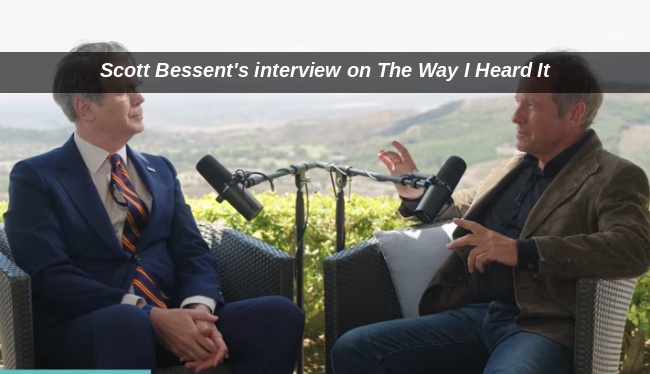
The following is the full transcript of Treasury Secretary Scott Bessent’s interview on The Way I Heard It with Mike Rowe, #494, July 16, 2026.
Editor’s Note: In this episode of The Way I Heard It, Mike Rowe sits down with Treasury Secretary Scott Bessent at the Reagan Library to discuss the current state of the American economy and the importance of rebuilding domestic industrial capacity. The conversation covers a wide range of topics, including the administration’s approach to balancing AI innovation with safety, efforts to reinvigorate the trades, and the introduction of “Trump Accounts” designed to foster financial literacy and long-term investment for children. Throughout the interview, Bessent emphasizes a vision of an “awakened” America that is actively working to secure its supply chains and restore the American dream for all citizens.
Innovation, Imitation, and American Strength
MIKE ROWE: I sure appreciate you making the time.
SCOTT BESSENT: Glad to do it.
MIKE ROWE: Are you really? Because I’ve been to these things before and everybody is pulling you in every direction at the same time. They all want to tell you a story and they all want to thank you and congratulate you for this, that, or the other. It’s got to be exhausting.
SCOTT BESSENT: I tell you, it’s exhilarating being here at the Reagan Library. I was 18 when I met Ronald Reagan. Just where’d you meet him? Next to the Yale campus. Only 5 of us went to see him speak when he was candidate Reagan. I shook his hand and he was the first presidential candidate I ever voted for. So it reminds me of my youth and just the photos of him and the First Lady are so hopeful.
At the Reagan Library
MIKE ROWE: Oh my gosh, it’s amazing. Have you been through the ranch before? I assume you’ve been up there.
SCOTT BESSENT: Once. Once.
MIKE ROWE: It is so stunning. I mean, it’s so shockingly modest. People don’t believe it. You know, that little single tiny bed and the— it’s all extraordinary.
SCOTT BESSENT: Well, it’s an incredible American story. I’m sure a lot of your viewers know, but his nickname was Dutch because he used to get a Dutch boy haircut with a bowl because they did it at home. And then he was in the White House and one of the most transformative presidents in history.
MIKE ROWE: Well, I’ve been to a few presidential libraries. This wins partly because of that, but it’s just mostly because you can just, just walking through it, you can still get a sense of the guy and a sense of the footprint he left.
SCOTT BESSENT: Well, I mean, it was so consequential when you look at whether bringing down the Iron Curtain and just bringing America back.
While America Slept: The Keynote Speech
MIKE ROWE: You were on the TV when I fell asleep last night. You were on it when I woke up this morning. You were here when I showed up. What is happening? I mean, are you on a kind of tour of sorts?
SCOTT BESSENT: No. Well, I’m out here for this keynote speech here at the library, which was called “While America Slept.” We printed away our sovereignty and our industrial capacity for about 25 years. We’re bringing that back. I did do the weekly White House press conference yesterday, which was fun. There are a bunch of animals there in the press club.
MIKE ROWE: Okay, okay. Hey, he said it. No, but it was really going to be one of my first questions. When you’re standing there and the press is all clearly so eager, maybe even desperate to ask a question, are you actually calling on them? Does the loudest question get your attention?
SCOTT BESSENT: No, no, no, no. Well, first of all, I walked out and 3 weeks ago, I went back to my home state in South Carolina. University of South Carolina gave me an honorary PhD. So I walked out and I said, “If you want to get called on, you got to call me Dr. Bessent.”
MIKE ROWE: And it worked.
SCOTT BESSENT: And it worked. So whoever yelled “Dr. Bessent” the loudest, I just went kind of symmetrically through the crowd.
Addressing American Concerns: Markets, Media, and the Economy
MIKE ROWE: Well, let’s just jump into what’s most important to you right now. I know you’ve been talking about the Trump accounts. You’ve said a lot of things that I think are really relevant to my audience, which is kind of eclectic. But there are a lot of people — they’re concerned about AI, they’re concerned about the market, they’re concerned about not being in the market. They’re just concerned.
SCOTT BESSENT: They’re concerned.
MIKE ROWE: Yeah. So how do we mitigate that concern?
SCOTT BESSENT: Well, someone said to me, “Are you surprised the market’s going up on bad news?” And I said, well, it’s that the news is bad — that the quality of the news that people get is bad — that whether it’s newspapers or the television, that people now present opinion as news.
And I have perfectly asymmetric information on what’s going on with the Iran conflict. We’re kicking their butts. But if you were to read, if you were to listen to some of these crazed Democrats, if you were to read the front page of the New York Times, you wouldn’t get that. So I’m not surprised by what’s happening, but I can understand how it causes anxiety in the American people.
And look, I was in the investment business for 35, 40 years. To the extent that I had success, it was looking on the other side of things, thinking about the medium to long term, the saying, “This too shall pass.” That this conflict will end, that gasoline prices will go down.
But I don’t know if you remember last year — it was eggs, eggs, eggs.
And you don’t see that anywhere now. Egg prices are down 90%. The president posted on his Truth account the other day, there are 12 big grocery items that are all down. And look, beef prices are up — an unfortunate disease in the Mexican cattle supply, coupled with some problems in the beef cycle. So beef prices are going to be tough to get down, but chicken’s down. A lot of other goods are down. And we’re working every day on that.
Tax Cuts, Energy Policy, and Certainty for Americans
MIKE ROWE: What would you tell then the average American who’s willing to give the president the benefit of the doubt, but who is genuinely concerned and who really feels we have no control, whether it’s eggs or whether it’s beef or whether it’s policy? People feel untethered, I think, from that. What is the administration doing and what can you, as Secretary of Treasury, do or say to just bring a little perspective?
SCOTT BESSENT: What we can do is we can give certainty. So we passed the Working Families Tax Cut, also known as the One Big Beautiful Bill, last year. So the tax cuts are permanent. It’s not student body left, student body right anymore. And that had something for everyone.
On the business side, whether you’re a big business or a small business, you can fully deduct any capital expenditures. Factories, for the next 5 years, can be 100% deducted from taxes. And then on the other side, you have the president’s 4 signature policies — no tax on tips, no tax on overtime. They reduced taxes on Social Security. 85% of our seniors didn’t pay taxes on Social Security. Deductibility of interest for American-made cars. Tax refunds were the biggest they’ve ever been. They were up 11% last year.
So I think that there is great certainty there. We have great certainty on energy policy — it is choppy now because of what’s happening in the Gulf and in the Middle East. But we never produced so much oil in the US. We’re the number one energy producer in the world.
Now, for you all here in California, California has made the decision to be the energy poverty state, which means high prices. And California is the only state that depends on foreign imports. I think California imports 40% of its energy.
MIKE ROWE: What’s the matter with us?
SCOTT BESSENT: I don’t know, because I can tell you there’s plenty of energy off the ground and offshore.
MIKE ROWE: We grow more timber in this state, I think, than anywhere else in the country, and yet we import more. I don’t know. I don’t know why. If I’m confused and I live here, I don’t even know how to explain it to somebody in Pennsylvania. What can you do about that?
SCOTT BESSENT: Well, what can we do? We can put in good national policies. In California, a Californian leaves the state — one person leaves every 2 minutes. So they’re voting with their feet. Which is too bad. I mean, look at this. Doesn’t get any better. But eventually you have to believe the democratic system will take over, that there will be some stream for normalcy.
I remember seeing Jerry Brown at an event, and it was his second time in office, and it was when Democrats got the trifecta — both houses and the governorship. And he said, “It’s like running China. It’s one-party rule. We’re going to have one-party rule for a long time.” And this is what one-party rule does.
Reinvigorating the Trades and the Defense Industrial Base
MIKE ROWE: I’m not a political animal and I’m certainly not a journalist, but there is an issue that is most central for me. It’s workforce. It’s reinvigorating the trades. For the first time since I’ve been running my foundation, I’m talking to the administration — the Department of War is keenly interested in making a more persuasive case for hundreds of thousands of great jobs in the defense industrial base. I would love to know your thoughts on how you think about that in terms of its importance to the country, to a balanced workforce, and all that entails.
SCOTT BESSENT: I just gave my speech here today, and you can go to the Treasury X account and either watch it or read it. And that’s what my speech was called — “While America Slept.” And like 2 things happened. We lost our sovereignty because we were in real national danger because of the things we no longer produced.
A country that doesn’t produce its medicines, its semiconductors, its steel, critical minerals — which we’ve seen the Chinese cut us off on and are essential for military production — becomes very vulnerable on one side. But on the other side, you lose those good jobs and you lose the knowledge that goes with those jobs. People who work in a factory, who work with their hands, who understand manufacturing process — if we were to get into another conflict, they can immediately move and they’ll work on that.
So we are seeing a manufacturing renaissance. Everyone says to me, “Oh, we haven’t seen that many manufacturing jobs happen.” Well, that just says they don’t know much about how industry works. What we are seeing now is a boom in construction jobs, and those construction jobs will turn into manufacturing jobs. And we are seeing whether it’s the pharmaceutical industry bringing jobs back, we are reshoring our auto supply. Arizona, next door here, is going to be the semiconductor capital of America and one day the semiconductor capital of the world.
Workforce Enthusiasm and the American Dream
MIKE ROWE: Are you worried that creating jobs and creating opportunities is different than having a workforce that’s either enthused or skilled or willing or excited to avail themselves to it? That to me is where the disconnect is. And trying to push those 2 things together seems to be the job.
SCOTT BESSENT: I think what happened was people thought the system was rigged against them. I have given 2 graduation speeches in the past month. One was University of South Carolina. One was a high school graduation where my son used to go. And I told these kids, I said, “Look, you are resilient because the college kids were children during the GFC. The high school kids were born then, then they saw COVID.” So they’ve got a lot of resiliency.
And I really think it’s up to us to let people know that the system does work for them. If you do the right thing, if you want to work hard, if you want to make good decisions, then there is still the American dream. And you’ve got to make sure that they are good paying jobs on the other side where people can move up.
MIKE ROWE: What is the American dream exactly? How do you think of it?
The American Dream and Trump Accounts
SCOTT BESSENT: I think the American dream is no matter where you start. Look, I’m a small town kid from— I think there were 500 people in my town when I was growing up in South Carolina, Little River, South Carolina. A fishing village right on the North Carolina-South Carolina border, and you get to be Treasury Secretary.
But the other American dream is you want to be able to pursue your goals. You want to believe that there’s a level playing field. You want to be able to— if you want to start a family, if you want to own a home, and you want to be able to have good medical care, like see what is waiting at the end of your career. We passed these Trump accounts, which I think are the most important government benefit for young people since the GI Bill.
MIKE ROWE: Explain how it works and who they’re for primarily.
SCOTT BESSENT: Well, they’re for any child under age 18. trumpaccounts.gov, you can go on. Any child who was born during President Trump’s term who has the account will receive $1,000 from the Treasury as a seed investment. Families can put in money, relatives, anyone can add. We are seeing some of our great philanthropists who want to give back. Susan and Michael Dell have donated $6.25 billion to the Children of America. Works out to about anyone who registers for an account, it’s $250.
38% of American households own no equities, so they have no exposure to our great stock market, the American innovation, our capital markets, our great management teams. And people talk about there being food deserts where you can’t get nutritious food. I think that there are financial service deserts where people haven’t been able to get access to accounts like this. And frankly, they don’t know about them.
So I think this is going to create this financial literacy boom because it will be a real-time experiment. It won’t be a— there’s a street in New York, it’s called Wall Street. There’s a stock exchange. People are going to be able to look on their phone every day and watch things go up and down. At Treasury, we’re very committed to financial literacy. We’ve got 5 or 6 modules for different age groups. And I think that it is going to create a new class of shareholders and it’s going to bring people into the system. So when you were talking about the way people feel, I think that people feel outside the system. So the more people we can bring into the system—
Bringing Americans Into the Financial System
MIKE ROWE: Well, that was my thought when I was watching you do the press conference yesterday. The ticker is in the lower right-hand corner. And I’m looking at the stock market at 50,600. I feel pretty great about that. I’ve been involved in it for a while, but I’m thinking of the 30 or 40% of Americans who must look at that and either not quite understand what it means or resent the fact that they’ve got nothing to do with it or say about it. And the thing is, it’s right in their face every day, right?
And so I think if I understood you right, what you’re saying is, kid gets $1,000 at birth and that starts to grow. I assume it’s vested in—
SCOTT BESSENT: It’s vested in low-cost index funds. And when they turn 18, they can— it’s compounded for 18 years. They can either take it out to start a business, the down payment on a home, for education, or they can roll it into a retirement account tax-free. And then it can keep compounding in. And again, they can keep adding to it.
And one message that I would want to get to people— and I think it’s a great point— that if you look at the stock market doing well and think you’re not participating, if you are working anywhere in the economy, the fact that the stock market is doing well is good for you. Because when companies are doing well, and a huge amount of the companies aren’t listed on the stock exchange, they’re small business, but it means the economy’s doing well. As the economy does well, people will do better.
In President Trump’s first term, the bottom 50% of households did better than the top 10% in terms of the increase in net worth. Hourly workers did better than supervisory workers. And I think we can do that again.
Housing and the American Dream
MIKE ROWE: I was talking to the CEO over at Home Depot, Ted Decker, who said that he reckons the amount, the percentage of the GDP represented by housing right now is something like $50 trillion. And again, vis-à-vis the American dream, if you’re renting, if you’re not really in that, how can you feel as if you’re participating above and beyond the Trump account? How broadly are you trying to pull people into this through the lens of a financially literate citizen?
SCOTT BESSENT: The problem we have now is a lot of people have very low mortgage rates. They don’t want to move. There’s probably a group— I’m not going to speak for you, but my age— who would like to downsize, but the mortgages are so low they don’t want to do it. But this will eventually work its way through the system.
One thing that we’ve done, there’s a bipartisan bill up on the Hill to keep institutional investors out of housing. And everyone says, well, they’re only 3% of the market. Markets are made on the edges. And in many of the growth markets— Atlanta, some markets in Texas, in the Sunbelt— they can be 20 or 30% of the market. So we’re trying to push institutional investors out. We’re trying to work on schemes for first-time homebuyers, and we’re working with the builders to see what we can do.
Critical Minerals, Rare Earths, and Supply Chain Vulnerabilities
MIKE ROWE: You mentioned metals, rare earths, along with energy. And I just think of the things that we rely upon, even timber to the earlier point. What can we do to make ourselves more independent with all of that critical metals, rare earths, all of that? If you could just talk a little bit about the relationship with China, why we need them, and is there an impact on the average citizen?
SCOTT BESSENT: Oh, there’s a huge impact on the average citizen. I mean, anyone who has an iPhone, there are rare earth magnets in that. If you go in for an MRI, there’s nothing that uses more rare earth magnets than an MRI. And guess what? 95% of them come from China. And we weren’t paying attention. The largest rare earth magnets company used to be in the US. The Chinese bought it, took it to China, and now they export back to us.
So what we are doing, the Trump administration is committed. We have a list of supply chain vulnerabilities where things are a single point of failure, and we are working to bring those back. We are securing— so rare earths, there are 2 parts to it. There’s the mining, and rare earths actually aren’t that rare.
MIKE ROWE: Or earth, really.
SCOTT BESSENT: Yeah, we have them in the US. There are certain ones that are only in certain locations around the world, and we are accumulating mining assets, but we have to be able to process it here. So we’re standing up facilities to process here. We’re going to set up controls to avoid the Chinese predatory pricing. And we’re seeing which of our Western allies— whether it’s Japan, Canada, Europe, Australia, South Korea— want to join us in this and kind of taking back our sovereignty.
The real thing that might freak you out, freak me out, is 90% of the precursor chemicals for our medicines are made in China. Anyone who’s had a child has given them amoxicillin, that we could be cut off from amoxicillin. So we made a decision. We turned a blind eye because it was cheaper to do it offshore. We worshiped efficiency and gave up resiliency. We wanted consumption, but we didn’t focus on production.
Efficiency Versus Resiliency
MIKE ROWE: Huxley said the greatest threat to freedom was total anarchy, but the second greatest was total efficiency.
SCOTT BESSENT: I like that. I may use that, so thank you.
MIKE ROWE: Well, it’s— you’re ripping off Huxley, not me.
SCOTT BESSENT: Okay.
MIKE ROWE: But I mean, how do you think about efficiency versus effectiveness?
SCOTT BESSENT: Well, there’s a trade-off, and a lot of it’s invisible because with efficiency there’s a bottom line, and you can add your bottom line, but you’re accumulating a risk over here. It’s kind of like, you know, if you think about good health, you could eat a lot of red meat. It’s good. You’re getting a lot of protein. You’re strong, but you’re also building up cholesterol. And it’s a silent killer. And I think if you’re not paying attention to efficiency and resiliency, in a way, it’s a silent killer.
AI, Data Centers, and America’s Technological Future
MIKE ROWE: Can I ask you about AI?
SCOTT BESSENT: Of course.
MIKE ROWE: And data centers?
SCOTT BESSENT: Yeah.
MIKE ROWE: I mean, neither one of those things existed when Huxley wrote that in, I think, Brave New World. But it feels to me like 75% of the country is uneasy about AI and nervous about data centers. Larry Fink at BlackRock says that we’ve got a $10 trillion infrastructure that has to be built out in the next 7 or 8 years. It’s not really negotiable. But I think a lot of people look at that and they feel like we’re doing it in the name of efficiency because we have to somehow compete with China in order to get the AI first, which means the data centers, which we don’t quite understand either. So we’re like in some kind of crazy race and we don’t know where the finish line is. We just know it’s really expensive and unnerving. So make everybody feel better about that.
SCOTT BESSENT: Yeah, I’m mercifully not an economist. I’m an economic historian. So the history of new technologies, people are always worried. There were people who wouldn’t get into cars when cars first came out. You had somebody at night who walked in front with a lantern and kind of did that. And people who owned a horse and buggy maybe weren’t happy. 20% of the jobs that people have now didn’t exist in 2000. So we’ve got to keep innovating.
The people who’ve built it out have done a terrible job explaining it. And when you use AI, when you go on Google, Google’s AI. When you do spell check, that’s AI. It is just growing. It’s growing and it’s going to be able to do more for you.
The optimistic view of AI— I am very optimistic for small business on AI because it’s going to let small business compete with big business. You could start a business that used to take 10 people to start. You can start with 1 or 2 people. And we’ve seen no job loss from AI yet. I don’t think we have to. I talk to corporations. We see one large credit card company— maybe we’ll be able to figure it out when I say this— they move people from collections to the travel department. And AI is going to make people more efficient. It’s a tool and it is to be used.
Just like Google didn’t exist in 2000. Now it’s a verb. When I was in college, you’d look up when something had been written in the newspaper, in this book. Then you’d go get a microfiche, you’d have to print it out. It was like an all-day project as opposed to what’s happening now. So that’s a good kind of efficiency. And you can use that kind of efficiency to make you more resilient.
And what I will say is we are the AI superpower. We are ahead of China. I think we’re about a year ahead. I think we will continue moving ahead. We probably used to have 50 or 60% of the compute power in the world. We’ll probably soon be at 80%. And that is an incredible national advantage. And I think that the best thing that the AI labs can do is do a much better job of educating people on how to use AI, how it can work for them, either at home or in their business.
I was on a call the other day, they have something for my son, and the person on the call said, “Do you mind if my AI agent is on the Zoom with us?”
MIKE ROWE: Right.
SCOTT BESSENT: And I’m like, okay, this is different.
MIKE ROWE: Yeah.
AI, Innovation, and the Race Against China
SCOTT BESSENT: And we went through some things and then I got a 6-page report 3 days later, beautifully written, and it covered everything we’d done. And this is someone who just started a business 2 years ago.
MIKE ROWE: It really is a tool. And I think of it sometimes like a firearm. It can be used for extraordinary virtue and extraordinary mischief. And I think we just don’t have our heads around yet precisely how to wield this thing and who ought to have it.
SCOTT BESSENT: Well, so that’s what we’re doing. I’m running a lot of the AI effort for the administration. And what we are trying to calibrate is, there’s an innovation race between us and the Chinese that we just cannot lose. If the Chinese were ahead of us in this, I can tell you the mischief and the havoc that they would wreak, and that the leverage they would have over us would just be— I don’t even want to think about it. It’s unconscionable.
But we are ahead. We want to stay ahead. We want to balance innovation with safety. So we are trying to find the right equilibrium for the best combination of innovation and safety. And we’re going to get there. And these AI labs, they are cooperating and they want to be part of the solution.
MIKE ROWE: Why is it that so many truly consequential things, and by that I mean things that we really all depend on, could be fossil fuels, could be AI, it’s a long list, but they all seem to be beset with communication problems. At some point, the very industries most responsible for providing these things that we rely on so profoundly have failed to remind us why we ought to be grateful maybe, or why we ought to at least understand their actual impact on us. It’s a colossal failure. Yeah.
Innovation vs. Imitation
SCOTT BESSENT: Look, I don’t know what it would have been like to be around Thomas Edison. Like, I don’t know.
MIKE ROWE: He was cranky from what I’m told.
SCOTT BESSENT: Yeah, very cranky and ruthless businessman. Like General Electric, monopolistic.
MIKE ROWE: Litigious.
SCOTT BESSENT: Litigious. Very litigious. Just ask Mr. Tesla. Yeah. And nothing’s different. I think it’s just more widely known, widely transmitted. So just because you’re good at inventing something doesn’t mean you’re good at selling it. Look, just about every American at some point has touched a Microsoft product. I don’t think Bill Gates was an especially great salesman. He was a great inventor.
MIKE ROWE: What’s more important? In this modern age? Innovation or imitation?
SCOTT BESSENT: Over the long run, innovation. Over the long run, it’s got to be that you can’t steal your way. You can have knockoffs, you can have— but Coca-Cola is still number one.
MIKE ROWE: Sure, but the miracle of getting it bottled and into every refrigerator in the exact same way, in the exact same quantity, with the exact same taste, that’s kind of a miracle too. The guy that was just sitting there has a company called Apex, and they’re mass-producing satellites for the first time. And I didn’t make this point to him because I think he’s looking at what he’s doing as very innovative, and it is, but it seems like the root of his success is going to hinge upon his ability to imitate himself perfectly over and over and over.
SCOTT BESSENT: Well, mass production, you make more of something, price goes down, right? So the usage goes up. So that’s what we’re seeing. I got into the job market in 1984, and you might remember Lotus Notes and these spreadsheets and everybody was, what’s going to happen to bookkeepers? Demand for bookkeepers went through the roof because it was so cheap to hire a bookkeeper.
MIKE ROWE: Right.
SCOTT BESSENT: Right. And they were much more efficient. So imitation, sometimes imitation can set off very good competition and competition brings down price.
Scott Bessent’s Personal Journey
MIKE ROWE: Since you mentioned your resume and your past, how did you wind up here? And I don’t mean that through an American dream lens. I mean your own philosophy, your own politics, your own ideology. You seem to have arced. In a way.
SCOTT BESSENT: Give you a little history. Our family, early days in South Carolina, and we’d been prosperous for 200, 250 years, same spot. And my dad had some financial troubles. I got my first job when I was 9. So 9 years old, 9 years old, busing tables.
MIKE ROWE: Yeah.
SCOTT BESSENT: So from biggest house in town to busing tables. And I can tell you, and also putting out umbrellas on the beach in Myrtle Beach. I can tell you, when you get a W-2 when you’re 9 years old, you worry about money. Like, I had spending money. So I could save my paycheck and spend my tips. So that’s why I like no tax on tips.
I wanted to do public service. I think we have a great country. But I was always probably like a lot of your viewers. I was very leery of the conventional wisdom. And to the extent that I had success in the markets for 30 or 40 years, it was not going along with the crowd.
MIKE ROWE: The reverse commute.
SCOTT BESSENT: The reverse commute. Like, why that— what does everybody believe that could be wrong? Or why can you be ahead of the curve? Like, a lot of times I was just too early. I, in my private business, I think I had a critical mineral stock that I owned from ’09 to 2015 and it went bankrupt.
My worldview has been that there is a path where the system works for everybody. And the great thing about our democracy is it’s self-regulating. If we go too far one way or too far the other, thus far, Ben Franklin said, “You got a republic if you can keep it.” And the way we’ve kept it is by moving back and forth.
We’re here at the Reagan Library. The ’70s were the great malaise. Huge inflation, national spirit. Jimmy Carter was a very nice man. You might remember that speech he gave. Sitting in front of the fire and he had his sweater on. We’re all going to have to do, have a little less and suck it in. And then Ronald Reagan came and just kind of reignited the national spirit. And I think we have a great national spirit, a great platform, and we got to make sure again that we keep everybody believing in it.
Trump Accounts and Financial Literacy
MIKE ROWE: What would Scott Bessent have done with $1,000 in a Trump account when he was 9 years old? Setting up umbrellas in Myrtle Beach.
SCOTT BESSENT: Yeah, I used to have the— I’m dating myself— I used to have a passbook savings, the Christmas Club. So I used to put my money into that. I would have just put more money into the Trump account.
MIKE ROWE: So I understand it. If I have a kid, I can open an account, feds put in $1,000.
SCOTT BESSENT: Well, if they’re born during President Trump’s term. Otherwise, you can open the account. You can contribute up to $5,000. Your business, businesses, a lot of employers are going to put in a couple hundred up to $1,000 for their employees’ children. About 20 states are going to contribute. So the most important thing is to get the account open, get it open, get it open. And a lot of good things are going to happen. Accounts are going to go live July 4th, which is the 250th anniversary. Monday, July 6th, they’re going to go live and then it’s going to start compounding.
MIKE ROWE: And if the index is any indication, that compounding is going to basically double every 7, 8 years.
SCOTT BESSENT: Exactly.
MIKE ROWE: Right. So you contribute as you go, you go from 0 to 14 years old, your money’s doubled twice, at least.
SCOTT BESSENT: At least.
MIKE ROWE: And now you look at that little ticker in the lower right-hand corner and you feel like you’re a piece of it, part of it.
SCOTT BESSENT: And you want to learn about it. You want to be much more financially literate because financial literacy, I always tell people there are 2 sides to it. There’s a great program, my hometown in Charleston, South Carolina, College of Charleston. A lot of kids, they’re first-generation students or they’re on financial aid. And all the credit card companies are waiting out on the freshman lawn. “You want a credit card? Here you go.” And they’ve never had a credit card before. And boom, they max out and they’re not in college anymore.
So there are 2 sides. There’s making it and then there’s managing debt responsibly. And I can tell you now, there’s so many of these programs, buy now, pay later, that people can really get sideways very, very quickly.
Core Financial Advice
MIKE ROWE: If I were to ask you for one bit of advice, and I know I hate cookie-cutter advice, but as a man in your position right now, if you could just flick your fingers and get America to understand, really understand, one core financial truth about their own personal economy, what would it be?
SCOTT BESSENT: Gauge your personal risk level. So a young person should take more financial risk than somebody our age. And the worst thing you can do is to get out over your skis. And then the power of long-term compounding. Like, people used to come up to me and said, “Well, how do I make money fast?” I said, “Rob a bank,” because that market might go up. It might go down, might stay the same. But over time it goes up.
Warren Buffett said, “Never bet against America.” And what is your risk tolerance? I always tell people that you don’t want to panic at the bottom. You don’t want to be euphoric at the top. The main thing is it’s a long game. It’s a very, very long game. Patience. Patience and predictability and resiliency too.
A lot of people can’t afford to put money away for a rainy day fund, but it’s good to have that cushion. It’s good to have the cushion. And I think what’s going to be very interesting about these Trump accounts is like, they’re going to be sitting there and compounding and these children are going to know that they have it.
MIKE ROWE: And the place to go?
SCOTT BESSENT: trumpaccounts.gov. The site went live yesterday. We are number one in the app stores now. So everyone’s downloading it.
MIKE ROWE: Amazing.
SCOTT BESSENT: Yep.
While America Slept
MIKE ROWE: All right. You got a treasury to run and the wind is going to blow us off the mountain. I really appreciate your time. And the speech was called, “While We Slept?”
SCOTT BESSENT: “While America Slept.” So it’s a takeoff. Winston Churchill wrote a book, “While England Slept,” and what Nazi Germany was doing during that time. And he said England was ill-prepared for what the Nazis were doing. And my point is that if we let this go on much longer, we were ill-prepared for what non-allies were doing. We, we, we—
MIKE ROWE: Terribly political of you.
SCOTT BESSENT: Yeah, I’m trying to be diplomatic. There would have been a point of no return. There would have been a point of no return where it’s just too big a project to bring back. And I tell you that there’s a group of us in the administration and we are just all out, pedal to the metal. And we believe if we leave in January 2029 and we haven’t accomplished a lot of the goals that I talked about in my speech today, we will have failed.
MIKE ROWE: Well, the most optimistic thing about your speech is the title, because it implies that we’re no longer asleep.
SCOTT BESSENT: Nope. It’s that we slept at this. We slept at this and America has awakened and not woke.
MIKE ROWE: What? Not woke. Not woke, but awakened.
SCOTT BESSENT: Awakened, awakened and full speed ahead. And when we put our mind to something, nobody does it like we do.
MIKE ROWE: I sure appreciate your time.
SCOTT BESSENT: Glad to do it.
MIKE ROWE: Pleasure.
SCOTT BESSENT: Good to see you.
MIKE ROWE: Thanks.
Related Posts