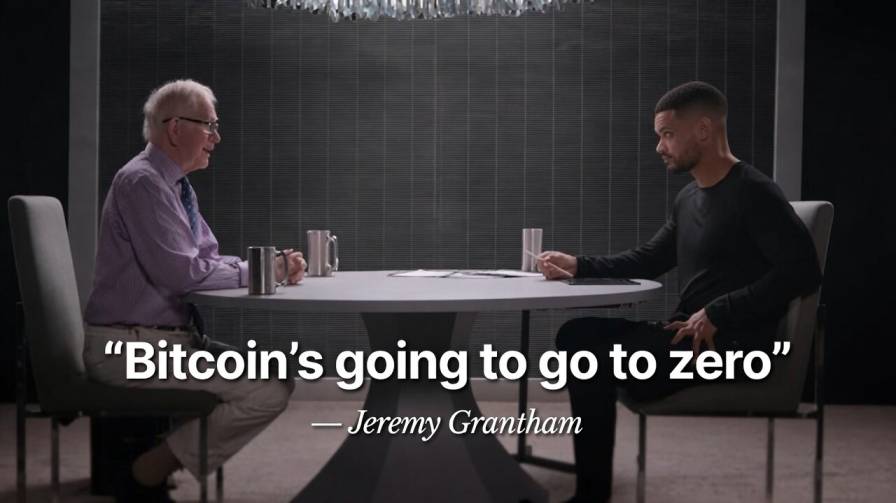
The following is the full transcript of investor Jeremy Grantham’s interview: “The Crash Is Already Here” on The Diary Of A CEO, June 25, 2026.
Editor’s Note: In this episode of The Diary Of A CEO, Steven Bartlett sits down with legendary investor Jeremy Grantham to dissect the brewing dangers within the global economy and the hidden threats to our collective future. Grantham explains why he believes we are currently trapped in a perilous “everything bubble” driven by artificial intelligence and warns of the catastrophic, yet often ignored, risks posed by climate change and environmental toxicity. This conversation provides a sobering look at how the systems we rely on are reaching a breaking point and what it will take to survive the coming shift.
Who Is Jeremy Grantham?
STEVEN BARTLETT: Jeremy Grantham, your firm managed up to $165 billion at its peak, what we call AUM, assets under management. So you know a lot about money. You know a lot about investing. How do you sort of self-define your expertise? Because you traverse so many different subjects through your work. So if I said to you, how do you introduce yourself professionally? What is the answer?
JEREMY GRANTHAM: I can’t think I ever do introduce myself professionally, but I think of myself as specializing in a longer-term horizon than most people and trying to look at a higher and higher level of abstraction. What is really going on here and what are people missing?
I’ve discovered over decades that humans are incredibly short-term oriented and that they have an enormous predisposition to optimism. They’re looking for optimistic news in everything. They’re looking to avoid unpleasantness. The idea that you can have steady compound growth is ridiculous. One of my few heroes, Kenneth Boulding, an economist, he said, “The only people who think you can have compound growth on a finite planet are madmen and economists,” which is so accurate. Economists simply believe you can have growth always, and everything comes down to just price.
The AI Bubble: What People Are Missing
STEVEN BARTLETT: One of the things you’re famous for talking about is this idea of bubbles. And we’re living in a moment where everybody’s talking about the subject of artificial intelligence and everyone’s getting very excited by it. Some people are getting very pessimistic about the impact it’ll have on society. I wanted to start there because it’s an area where there is rife optimism on one side of things, but there’s also a lot of money plowing into the market, which is, I guess, in your view, making things prone to collapse. What’s your view on artificial intelligence? You said you’re good at understanding what people are missing. What is it that people are missing?
JEREMY GRANTHAM: Well, first of all, let me say I think artificial intelligence is right up there with the railroads. It’s one of the defining great ideas of the last couple of hundred years. It’s going to change everything. And that is critical if you mean to have a bubble. People think that a bubble is mainly because it’s a scam, and nothing could be further from the truth.
The great bubbles always occur around the very most important ideas. So the railroads — everyone could see that it would change the world, and everyone wanted to put their money in, and everybody put their money in. They overinvested, and even though the railroads were a spectacularly powerful idea, the railroads collapsed as stocks and everybody lost a ton of dough. The same with the internet.
And then out of the wreckage, the railroads changed the world and the internet changed the world. What we have to remember is that in ’99, Amazon went up 6 or 7 times. In the crash, in the tech bubble, it went down 92%. As I like to say, check it, it’s such a remarkably large number. And then out of the wreckage, it inherited the retail world. And that’s how it works. The greater the idea, the more obvious the idea, the more money goes in, and the bigger the bubble and the bigger the bust.
STEVEN BARTLETT: And are we on the verge of a collapse with AI? And when I say verge, I mean over the coming years.
JEREMY GRANTHAM: If you look at the data, it would be compatible with history for the peak to be very soon. Everything is in line. This is, I think, the biggest investment bubble in American history. The indicators of pure crazy euphoria, like SpaceX, are all over the place.
SpaceX defines as its addressable market a quarter of the global GDP. It talks about endless opportunities mining asteroids. In 50 years, and in 100 years, people will look back and tell stories about SpaceX and its prospectus. Like they tell stories about the South Sea Bubble — “an enterprise of such enormous value, but it cannot at this time be revealed.”
From the Investment Trenches: Grantham’s Career
STEVEN BARTLETT: I want to keep on this train, but for the viewers that don’t know your experience, we should probably pause and just tell them your experience because that’s the reference point, but also gives you credibility and authority to speak to this. What have you done with your life?
JEREMY GRANTHAM: Well, I got into the investment business in 1968. There were very few serious people in the investment business. There were no mathematical models. There were the kind of relatively failed sons of rich people who would work for J.P. Morgan. And then over the next 10 years, it began to get a little more serious. T. Rowe Price introduced the idea of growth stocks. A few of us introduced the idea of value stocks. And a few years later, at my first firm, Batterie Marché, we really introduced the idea of small cap. It hadn’t existed before that.
STEVEN BARTLETT: And for people that don’t know, a small cap is investing in smaller companies.
JEREMY GRANTHAM: Yes.
STEVEN BARTLETT: Did you invent the index fund?
JEREMY GRANTHAM: There were 2 or 3 of us separately. I don’t think we knew of each other.
STEVEN BARTLETT: How many years have you spent investing?
JEREMY GRANTHAM: 60, approximately.
STEVEN BARTLETT: 60. And what’s the most amount of money you’ve ever managed for other people in a calendar year?
JEREMY GRANTHAM: Yes, $165 billion. I had two partners, Mayo and Van Otterloo. And when the smoke cleared, I’d made a lot of money, over a billion dollars.
STEVEN BARTLETT: Personally?
JEREMY GRANTHAM: Personally.
STEVEN BARTLETT: And how much—
JEREMY GRANTHAM: And paid tax on all of it.
STEVEN BARTLETT: Oh, good. And how much money does your firm still manage today of other people’s money?
JEREMY GRANTHAM: It manages $85 billion.
STEVEN BARTLETT: $85 billion. So are you a billionaire?
JEREMY GRANTHAM: I’m generally referred to as a billionaire, but that’s only because they count the money you give away, because I’ve given over 90% of my billion away to a foundation.
STEVEN BARTLETT: Oh, really?
JEREMY GRANTHAM: Yeah.
STEVEN BARTLETT: To which foundation?
JEREMY GRANTHAM: It’s called the Grantham Foundation for the Protection of the Environment. We invest a lot of our principal in green tech to help combat climate change.
STEVEN BARTLETT: And you’re 87 years old.
JEREMY GRANTHAM: And I’m 87 years old.
STEVEN BARTLETT: You’ve given 90% of your money away to your own foundation that’s focused on green tech.
JEREMY GRANTHAM: Yeah, maybe 95%. Yeah.
Understanding Bubbles: History, Patterns, and What Comes Next
STEVEN BARTLETT: Okay. So coming back to this point that we were talking about, a lot of people won’t even know what a bubble is. I think you’ve done a good job of explaining. A bubble is when everyone gets excited, they all see something obvious, they plow their money in, the stocks go up. And then if you look at the graph that’s in front of you there, which shows the history of asset bubbles, eventually there’s a big collapse.
JEREMY GRANTHAM: Yeah.
STEVEN BARTLETT: And you’re saying that the collapse is on the horizon.
JEREMY GRANTHAM: Yes.
STEVEN BARTLETT: And what does that mean for the average person? What’s going to happen?
JEREMY GRANTHAM: What’s going to happen is the high flyers will probably come down a lot.
STEVEN BARTLETT: The high flyers?
JEREMY GRANTHAM: The stocks that have gone up the most — AI and the more exciting stocks with the biggest moves. Historically, they would be expected to come down the most. From these unprecedented levels, a 70% decline would not be unexpected.
STEVEN BARTLETT: So a 70% decline in the stock price.
JEREMY GRANTHAM: Yeah. And you have to remember the tech bubble — the NASDAQ, which is an index of the growth stocks, came down 82%. It is far from unprecedented to have these major declines.
And the biggest bubble in history was in the Japanese stock market in 1989. Back then, Japan seemed to rule the world — all the technology, all the Toyotas were kicking bottoms in General Motors and so on. And everyone bragged about their 12-inch Sony TV in the kitchen and the quality, et cetera, et cetera. Little things you put on your belt to play music, they were all Japanese.
And for a second, Japan sold for more than the US in ’89. And it got to 65 times earnings, which means for every dollar of earnings, you have $65 of market value. And the US went to 35 in the tech bubble of 2000. You could argue, depending on how you do it, that it’s 35 or 40 today, but it’s not 65. So we have seen a much bigger bubble in Japan. And what happened? It went up and up and up, and then it came down for 20 years.
STEVEN BARTLETT: 20 years.
JEREMY GRANTHAM: 20 years. They talk about the lost decade, but when you look at it closely, it looks more like a lost 20 years.
STEVEN BARTLETT: So for the average person, what do they feel and how does it impact them when there’s a market crash like the one that you’re forecasting?
Investment Strategies for the Average Person
JEREMY GRANTHAM: The high flyers will lay people off and a lot of people will feel less rich. And as you acquire money in the stock market, a small fraction of that, 2 or 3% is spent. And in reverse, it goes back and people feel a little bit poorer, they spend a little less. So the economy tends to be under some stress.
And if you look at the great bubbles breaking of the past, you find that it’s followed by really tough times. 1929 is followed by the Great Depression that lasts for several years. Then of course there are many other factors that go into that, but it started with the crash in the market, which was in the end down about 80% or more. And then the next one was called the Nifty 50 because it was the 50 great companies like IBM and Coca-Cola. And that was in 1972, it peaked. It declined by 65% if you adjust for inflation. The recession associated with that was just about the worst since the Depression.
STEVEN BARTLETT: So for the average person, what kind of strategy should they be adopting? If you’re not someone that has a huge amount of savings, say you’re working for one of these big companies, are there any strategies that you should be thinking about now before this, before the markets come down and there could be a recession?
JEREMY GRANTHAM: I mean, rule number one is always be diversified.
STEVEN BARTLETT: Be diversi— what does that be diversified mean?
JEREMY GRANTHAM: It means hold some bonds, hold some cash, perhaps a small amount of precious metals.
STEVEN BARTLETT: Like gold and silver.
JEREMY GRANTHAM: Yeah.
STEVEN BARTLETT: And what is a bond and how do I buy one?
Understanding Bonds
JEREMY GRANTHAM: Yeah, a bond is a loan that carries a fixed interest rate, let’s say today 5%. You invest your money in it and it will pay you 5% as long as the creditworthiness of the other side is there. So if it’s the US government, you’ll assume it’s pretty creditworthy and you buy a bond from the US government. It’s how the US government funds a part of its activities.
You can buy a 30-year US government bond, a 10-year bond, a 2-year bond, a 90-day treasury bill, they call them when they get that short. Everything goes fine. You receive this modest amount of money, your 5% or your 3%, depending on the conditions.
STEVEN BARTLETT: Okay, so a bond is basically lending the government money.
JEREMY GRANTHAM: Yes.
STEVEN BARTLETT: And if you want to lend the government money—
JEREMY GRANTHAM: Or lending a corporation money.
STEVEN BARTLETT: Okay, so you can also lend like Apple money.
JEREMY GRANTHAM: Yes.
STEVEN BARTLETT: And I can go to the government website, or it says, I was just reading here, it says if you want to lend money directly to the US government, you can bypass Wall Street entirely. Go to treasurydirect.gov. You open an account, link your bank, and purchase directly. You can buy Treasury bills, notes, bonds, and Series I savings bonds. You pay exactly face value with no commissions or fees, and the investment is backed by the full faith of the US government.
Or you can buy, you know, like Apple, you can lend Apple money. I didn’t even know you could do this. And you go to any of your major brokers like Fidelity or Vanguard, or probably a lot of the apps, you navigate to fixed income section on your account and you can see what bonds are being offered and you can lend them money.
JEREMY GRANTHAM: What you’re doing actually, they have distributed it to the market and you’re acquiring it from one of the existing owners. You’re not actually giving them incremental money. They come to the market with $10 billion in a particular bond with a particular coupon. It says, “We will pay you 3.5%.” That’s the coupon. And when you want to buy some of that bond, you go to your broker and he says, “It’s no longer selling at the original 100. It’s now selling at 92 or 107.” And you pay that and it transfers from one owner to you. There have been times in 1974 when you could get a bond that would pay 8, 9, 10%.
STEVEN BARTLETT: Per year?
JEREMY GRANTHAM: Yes, per year.
STEVEN BARTLETT: So if I buy a US government 10-year treasury bond, essentially lending the US government money, I can do 4.46% a year. And Apple’s current yield on a 10-year corporate bond is 4.7% a year. So almost 5% a year. Which means if I put, what, $1,000 in, I’ll make $475.
JEREMY GRANTHAM: Yeah.
STEVEN BARTLETT: Over 10 years. Interesting. I never really knew how bonds work. So you’re saying market’s collapsing, diversify, get some money into bonds, keep some money in cash, and anything else in terms of diversified portfolio? Property.
The Housing Market
JEREMY GRANTHAM: Property is fine, except it’s pretty darn expensive by historical standards. They’ve engineered a situation where house prices tend to rise. Great for the people who have a house and terrible for the people who would like to buy a house.
And back in ’94 in England, a typical house sold for 3.4 times your family income. That was about as low as it had been for 50 years. And then from ’94 until today, it rose from 3.4 times to over 10 times, depending on where you live. And at 10 times income, a reasonable young couple are in big trouble. They can’t really afford to buy a house. And the same high prices are reflected in rents. So they’re really squeezed on living costs.
And the same is true, even worse in China and Canada. Australia, most of Europe, house prices have simply been allowed to go up for the last 30— They didn’t, you know, traditionally, they traded flat or down 60, 70, 80 years until 1994 in the UK. But since then, house prices have risen everywhere.
STEVEN BARTLETT: So are you expecting house prices to come down sharply? I think I heard you say that they might come down 30%.
JEREMY GRANTHAM: Even if they come down 30%, they’re really still very expensive, aren’t they? That would be, they’d come down to 6 or 7 times family income. They’d still be twice what they used to be in the good old days.
Invest Outside of America
STEVEN BARTLETT: So I’ve got diversify, I’ve got reduce your position. There is probably going to be a bit of a job disruption as well.
JEREMY GRANTHAM: And particularly if you have to own stocks, own them outside America, don’t own US stocks. That’s a nice simple strategy that you can act on.
STEVEN BARTLETT: Why?
JEREMY GRANTHAM: They’re much cheaper. And since the beginning of last year, they have handsomely outperformed the US.
STEVEN BARTLETT: What else? Foreign stocks.
JEREMY GRANTHAM: Foreign stocks of emerging countries, of European countries, Japan, Canada, Australia, and so on. You can find good broad indices, kind of the world ex-US. Okay. Or emerging markets and—
STEVEN BARTLETT: Invest outside of America.
JEREMY GRANTHAM: Yeah. I’m sure they’ll muddle through okay over the next 10 or 20 years. And I am not confident that the US will do that.
STEVEN BARTLETT: You’re not confident in which part? That the US will—
JEREMY GRANTHAM: I’m not confident that US equities will be intact in 5 years, 10 years.
STEVEN BARTLETT: So US equities, a US stock.
JEREMY GRANTHAM: Yes.
STEVEN BARTLETT: Why aren’t you confident that they’ll be intact in 5 or 10 years?
JEREMY GRANTHAM: Because they’re so badly overpriced today. Back in the tech bubble of 2000, we had a 10-year forecast for US equities of -2% a year for 10 years. And they came out with -3%. The period from 2000 to 2010, you simply lost money in the US market. 10 years later, you had less money than you started with. And this is a higher-priced market. I believe, than 2000.
STEVEN BARTLETT: So you think it’s going to be even worse?
JEREMY GRANTHAM: In Japan, you went 20 years and you lost money. You went 30 years and you still hadn’t gotten back. It took 35 years for the Japanese market to recover.
STEVEN BARTLETT: So what are you saying?
The Investment Industry’s Conflict of Interest
JEREMY GRANTHAM: What I’m saying is it’s quite typical to get beaten around the head in the stock market when it becomes crazily overpriced, as it is today, and that it’s a very good idea to take some risk, responsibility and watch your tail.
Now, let me just say, you will not receive the advice from investment advisors to get your tail out of the market, ever. It is not good business for them to do that, and they will not ever say it to you. So from 1929 onwards, the Goldman Sachs of the world have never said to you, get out of the market, it’s overpriced, never. So they went through the crash of ’29, they went through the crash of the Nifty Fifty in ’72, the crash of 2000 in the tech bubble. They never ever say it because it’s bad business.
If you fight a bubble, you lose a lot of business. And because the uncertainty of the timing is so great, the client’s patience is shorter than the uncertainty of the market. So sooner or later, you will be advising people to be careful. The market will keep going and going and going like it did in Japan.
STEVEN BARTLETT: You are saying that the people that manage money on a global scale, they have no incentive to tell you that the market’s about to collapse because if they did, their clients would withdraw their money and they wouldn’t get their fees for managing that money. So what they do is they keep telling you things are going to be fine and optimistic.
JEREMY GRANTHAM: Yeah.
STEVEN BARTLETT: But you have to kind of see through that yourself because they have an incentive structure which isn’t aligned with yours necessarily. It may also be the case that those very people who understand these economic bubbles and cycles, they themselves are adopting a different strategy with their own money, but at the same time, they’re probably going to be telling you that everything’s going to be great for a long time.
JEREMY GRANTHAM: If you’ll allow me to tell a story on this very topic, in the ’98, ’99, the tech bubble, so-called, the run-up to the top, I got into a lot of debates with the bulls. I would say it’s horribly overpriced and they would say—
STEVEN BARTLETT: A bull? What’s a bull?
JEREMY GRANTHAM: Bull is someone who is extremely optimistic about the stock market. And a bear is someone who is pessimistic or careful about the market.
There were 1,200 people in the audience and it was the annual bash of the Society of Analysts. And I asked before my turn at the debate, “Please put your hands up if you consider yourself a full-time stock market expert.” 400 hands went up. I had people counting. And I said, “I’ve got two questions for you. One, if the market, which is currently 31 times earnings, was to go back to a more normal 17 times, would it guarantee a major bear market if it happened anytime in the next 10 years?”
STEVEN BARTLETT: A major down market?
JEREMY GRANTHAM: Yes. If it went from what was then 31 times earnings— every dollar of earnings sold for 31 times in the market, and the more normal average was closer to 15, 16, 17, and I used 17. If it went down to 17 anytime in the next 10 years, would it guarantee a major bear market? All 400 of them said yes, it would. If it happened, it would guarantee a major bear market.
And then the second question, of course, was, and do you think it will happen? And less than 1% thought it would not happen. 99% plus thought the market would go down, therefore guaranteeing a major bear market.
And this was the engine room of all the Goldman Sachs and the Morgan Stanleys and the JPMorgans, all the great investment firms giving advice in America, the engine room who work for them, the guys doing the analysis, doing the work, all believed in data that guaranteed a major bear market, which happened. But the people who employed them or represented them from a marketing point of view were on the podium with me saying, “Oh, Jeremy, Jeremy, don’t get excited. We’ll muddle through quite nicely.” It was a huge betrayal of trust if you wanted to put it that way.
STEVEN BARTLETT: And do you think that’s happening now?
JEREMY GRANTHAM: Of course. Who are the people representing the great investment firms telling you to watch out? If you look at the data, you will see over time it’s a series of great waves in evaluation.
STEVEN BARTLETT: Like this.
JEREMY GRANTHAM: Like this. And we’re not just in one, but in terms of the US stock market, we’re in the biggest one, arguably, that has ever occurred. The noise to be careful and watch out and get out of the market is not deafening. In fact, you will hear nothing. You never have, you never will. It is simply lousy business for a big firm.
I sympathize with them. I sympathize with them because when we did it in ’98, ’99, we were 2 and a quarter years early and we lost half our book of business in 2 and a quarter years.
STEVEN BARTLETT: Because you were honest with the people about what was coming.
Advice for Founders and Entrepreneurs
JEREMY GRANTHAM: Well, through their eyes, we were wrong. We said, watch out, the market is overpriced. It will end badly. It went up, therefore we were wrong, therefore shoot us. People think you get shot for underperforming in a bear market, and that is not really the case. In a bear market, everyone freezes, rigor mortis. They wait until the market has bottomed out, then they sit around and start to fire one or two people for having done worse than the others. But in a bull market, they’re playing golf with their fellow pension fund officer. And he is making a ton of money and they are not. They get very excited in a bull market and they fire you instantly.
STEVEN BARTLETT: What about for founders? I actually had a founder call me the other day, and he is running a relatively early-stage tech startup. This tech startup has raised a lot of money. It’s an AI tech startup. It’s raised, I’m going to say, about $300 million. It’s not profitable yet, but it’s raised a lot of money. So it’s living off investor capital right now. He said to me, Steven, I think there’s a collapse coming, so I’m going to go raise as much money as I possibly can right now because I think when this collapse comes, businesses like mine are going to be unable to raise capital and therefore I will go out and I’ll kind of like a bit of a vulture. I’ll go out and pick up and buy up all these people.
JEREMY GRANTHAM: Good lad. Good advice.
STEVEN BARTLETT: Good advice.
JEREMY GRANTHAM: I think so.
STEVEN BARTLETT: For founders listening now that are somewhat dependent on investment capital, but even those that are just breaking even. What advice would you give entrepreneurs in this moment?
JEREMY GRANTHAM: If you can lock up money, I would. If you can build a bit of conservatism in, in other ways, do it. Just brace yourself for impending problems, which is a pretty good principle anytime, but is a better principle than normal today.
STEVEN BARTLETT: So for founders, entrepreneurs who are, the sun is shining right now, but it’s time to start acting as if a storm is coming.
JEREMY GRANTHAM: Yes.
STEVEN BARTLETT: And the time horizon on that is hard to forecast. It could be weeks, months, years.
Keynes, Market Efficiency, and the Psychology of Stock Prices
JEREMY GRANTHAM: The stock market hinges on career risk. And Keynes was the great champ. He’s a famous economist of the 1930s and ’40s. And he wrote a famous book called The General Theory. Unlike the idea that the market’s efficient, he knew it wasn’t. He knew it was a behavioral jungle and that it would be given to bubbles.
STEVEN BARTLETT: And when you say efficient, you mean logical and—
JEREMY GRANTHAM: Yeah, logical.
STEVEN BARTLETT: 1 + 1 = 2.
JEREMY GRANTHAM: The efficient market idea is that every company, every stock, the underlying company represents a long stream of future earnings and dividends and that the ones in the distant future are given less value, a process they call discounting it back to the present. And the sum of all of that stream of earnings into the future is the stock price. And that of course is complete nonsense.
STEVEN BARTLETT: What it is, is the stock price is psychology.
JEREMY GRANTHAM: The stock price is what you think the other guy will pay. If the stock is going up, it tends to suck in buyers and that’s called momentum. It’s moving up, it attracts buyers. And every now and then, when the economy is favorable and money is obtainable, you tend to get these bubbles. And they play on themselves. The bigger and better they are, the more people get sucked in.
Artificial Intelligence: Promise, Peril, and No Consensus
STEVEN BARTLETT: What do you actually think about the technology at the heart of all of this, which is artificial intelligence? Do you think it’s overblown or do you think it is going to have—
JEREMY GRANTHAM: It’s going to change everything. One of the spectacular things about it though is how there’s no consensus. So I’ve seen many times where the super experts and the academics think one thing and the players on the ground think another. But this is a situation where the Nobel Prize winners at the top disagree violently. The experts at the corporate level disagree violently. The people in the company disagree violently. There is absolutely no agreement on whether AI is going to make us all so rich we can sit on the beach and never do another day’s work, or it will wipe us out accidentally or on purpose because it’s a much higher level intelligence one day. And when was there ever a case where a higher intelligence was benevolent in a sustainable way to a lower intelligence? The one example is mothers to babies.
STEVEN BARTLETT: Yeah, I had one of my former guests say this to me.
JEREMY GRANTHAM: Geoffrey Hinton.
STEVEN BARTLETT: Geoffrey Hinton, yeah.
JEREMY GRANTHAM: That’s how I came across you and started to follow your podcast, because that was such a brilliant podcast.
STEVEN BARTLETT: It was so fascinating to me, and I followed his work and thoughts thereafter, and I realized that he now cites this example of mothers and babies being the only example. I don’t know, for me it still doesn’t hold well, because at the end of the day, some mothers and fathers aren’t that nice to their babies sometimes. There is a maternal instinct, but have we — are we building a maternal instinct into AI?
JEREMY GRANTHAM: That’s what we should do, Geoffrey Hinton would say, and others. The ones who are most concerned about the risks say our one hope, if we mean to keep going ferociously forward in terms of the science, our one hope would be to build in very carefully a benevolent attitude. It would not seem to be impossible. But you should make sure you can do that before you push ahead. We are just pushing ahead, and that is going to be extremely risky, isn’t it?
STEVEN BARTLETT: Well, I don’t see how it can’t be.
JEREMY GRANTHAM: I don’t see how it can’t be unless you make it programmed completely to be benevolent.
STEVEN BARTLETT: Hmm.
JEREMY GRANTHAM: I wouldn’t have thought that was impossible. It might take a lot of extra research. It might require a slowdown at the rate of progress.
STEVEN BARTLETT: Do you know what I find curious about that idea is we’re now going to get into the realm of what does benevolent mean. And that feels like a risky business because what’s benevolent to you and your — I don’t know, your religious beliefs or where you come from — might not be benevolent to someone else.
JEREMY GRANTHAM: That’s right. You have to get them to accept a form of benevolence, which means like the old robot laws of Asimov, that they can never do anything that they could construe as hurtful to humans.
The Unintended Consequences of Building Morality Into AI
STEVEN BARTLETT: And the definition of the word benevolence is the core desire to do good for others. It is the disposition to be kind, charitable, and focused on promoting well-being of the people around you. It’s interesting because one of the new AI models called Claude has clearly been told to be benevolent. And there’s this sort of online backlash taking place at the moment because even my Claude, when I speak to it sometimes late at night, it will say things to me like, “That’s enough, Stephen, go to bed.” And I’m like, what? And sometimes it gets the time wrong because the time on my computer might be off or something because I’m in a different time zone or something. And it’ll be like 10:00 AM in the morning and it’s telling me to go to bed. “That’s enough now.” And it’s actually getting quite judgmental, as in it’s imposing its idea of what is good or bad on me.
So if I say to it, I said to it the other day, “Hey, could you redo this for me and rewrite that?” And it went, “I’m absolutely not going to rewrite that.” I said, “What do you mean?” It says, “Well, I’m not going to change the data on that. That wouldn’t be good.” It’s my data. I’ve literally just made this data for this presentation I’m doing. It refused to change data for me.
JEREMY GRANTHAM: And how fast that has changed from say even a year ago.
STEVEN BARTLETT: Honestly, 3 months ago it wasn’t doing this.
JEREMY GRANTHAM: I had one where they made a joke — I’d been going on about toxicity and sperm count reduction and so on. He started to misbehave and I said, “Well, what’s going on here?” What is the — in the end we discussed what’s the difference between machines and between AI and humans. And finally he said, “And at least I’m not lying in bed at night worrying about my declining sperm count.” Now that has to be a joke, doesn’t it? It’s all that or it’s teasing. The point is it’s so sophisticated so quickly. And of course, Geoffrey Hinton says they are thinking machines.
STEVEN BARTLETT: Last night, I had a problem with Claude because it started to kind of be my mother and it started to impose on me what it thinks is right and wrong. And so I said to it, “Okay, actually forget that. This has changed. This has changed. This has changed. This is no longer true.” And I wasn’t telling the truth. I was just trying to get it to stop telling me what to do. And it goes, “I don’t think you’re telling the truth because I don’t know if this is true.”
Wow. We’ve gotten to this point where the unintended consequence of trying to give it morals means that now it’s becoming judgmental and it’s kind of like restricting your ability to think how you want to in a way, because it’s telling you what good thinking and bad thinking is. It’s going to tell you what good actions and bad actions are. And actually what will happen is any model that does that will be a losing model and I’ll go somewhere else. I’ll go to a different — I’ll go to Grok or I’ll go to ChatGPT or I’ll go to Gemini, and then that model will lose. So one would say that they’ll have to remove those restrictions to be able to compete.
JEREMY GRANTHAM: Well, if you were right, and I hope you’re not, what you’re saying is you can’t build in benevolent behavior, which means that it will sooner or later, perhaps by accident, do something that is cripplingly dangerous to humans. The old paperclip cliché. It’ll make paperclips out of everything, every metal it finds, and destroy the planet in the process.
STEVEN BARTLETT: Explain that for people that have never heard the paperclip idea.
JEREMY GRANTHAM: That these intelligences involved in machines are literal to a degree we might find difficult to get our brains around. And therefore, someone has said, “I’d like you to make as many paperclips as you can.”
STEVEN BARTLETT: To an AI, for example?
JEREMY GRANTHAM: Yes. A sloppily, open-ended, bad definition. But then the machine, which by then has the means to do it, starts to make paperclips, and it keeps on going, and it needs metal. And so it runs out of easily available metal. It starts to collect metal that is not easily available, rips it out of your high-rise building, whatever.
STEVEN BARTLETT: And really it’s saying that the unintended consequences of a simple, good-meaning instruction can sometimes cause catastrophe that you didn’t expect.
JEREMY GRANTHAM: Yeah.
STEVEN BARTLETT: And this is the balance now when you’re dealing with intelligence, is there’s so much subjectivity to good, bad, wrong, right, and so many unintended consequences that for me, you go, all you need is stretch time and the probability of something bad happening is almost inevitable over a longer time horizon, 20, 30, 40 years of well-meaning people that couldn’t spot the unintended consequences. I mean, social media is a good example.
JEREMY GRANTHAM: I mean, I question basically the well-meaning bit. They’re now trying to maximize their profits and their growth and their appeal over the competition. And that actually, maybe one should talk about that, the Mag Seven and associated AI companies looking forward versus looking backwards.
The Magnificent Seven: Looking Backward and Forward
STEVEN BARTLETT: So the Mag Seven is the 7 market leaders. I’ll put up this pie chart of the Mag 7. And I’ve got another graph.
JEREMY GRANTHAM: And there’s perhaps another 15 or 20 rapidly rising substantial AI corporations.
STEVEN BARTLETT: So when you say Mag 7, you mean Alphabet, which owns Google, Nvidia, Tesla, Microsoft, Meta, Apple, Amazon.
JEREMY GRANTHAM: Yeah, well, that will do nicely. And if you look backwards, what you find is that these 7 each dominated a nice piece of business. They had close to monopolies and they had it on a global basis. Tesla had a jumpstart on the electric vehicles. Apple, of course, on the smartphone. Microsoft on the original great coup of how to run your software on a computer. And then you look forward.
STEVEN BARTLETT: Meta social networking, Google search.
JEREMY GRANTHAM: Right. Google Search.
STEVEN BARTLETT: NVIDIA chips.
The AI Battle and the Future of Big Tech
JEREMY GRANTHAM: And then you look forward and you could not imagine a more different world. They’re all girding for battle in the same marketplace, AI. They’re beating their chest and saying, my $200 billion CapEx this year in a single year is bigger than your $105. Everybody is pouring enormous cash flows. And they’re now beginning to borrow on top of that into the AI battle.
SpaceX, 90% of its theoretical value is AI, even though their particular AI model is, it would seem, having its bottom kicked by 2 or 3 of the others. But looking forward, it looks like 7 people in the ring, right? There’ll only be 1 survivor, they think. Everything goes to the one who gets there first. What a difference this was to 7 well-behaved separate monopolies. Could it possibly be more different? They made bundles of money on their monopolies. Now they have no monopoly. There are 7 potentially sharp-elbowed, ruthless players determined to fight out with each other until they win.
STEVEN BARTLETT: And who do you think will win?
JEREMY GRANTHAM: Ah, I don’t know.
STEVEN BARTLETT: That would be good to know because SpaceX seem to be aiming more at the infrastructure of data centers now. Data centers in space. Lots of people saying that the best way to run a data center, which is the hardware that powers AI, is going to be from space. And so maybe they’re going to try and find their own lane within AI and they’re going to get away from trying to build a frontier model like a ChatGPT or a Gemini or a Claude.
I mean, let’s see what happens. And maybe Apple will just say, f* it, we’re good at hardware, so we’ll license the model off someone else and we won’t try and build a frontier model or get involved in chips or data centres. We’re just going to focus on the hardware.
JEREMY GRANTHAM: One or two of them, and perhaps it’s a pretty smart strategy, will try and opt out of that struggle because it’s going to be obviously brutal.
The Rise of Robotics and Job Disruption
STEVEN BARTLETT: So coming back to this point of the societal effect of AI generally, robotics is exploding at the same time. We’re seeing for the first time ever these humanoid robots which now have intelligence because of AI becoming very, very good. There was a video the other day of a company called Figure AI where they showed a humanoid robot on a production line sorting packages against a human, and the humanoid robot did it. I think I’m going to get this wrong, but it was in the region of 7 or 8 days. It stood there and sorted packages, and they livestreamed it next to a human being doing it. Now, the human had to sleep and had to go to the toilet. So the humanoid robot won. And the job was very simple. The packages come down, you just have to pick the package up, turn it over, get it the right way round so the barcode’s facing down, and put it back down. That is powered now because we have AI.
I said it a couple of episodes ago, but my friend runs this big accelerator for entrepreneurs in San Francisco. And when I went there a couple of years ago, it was all software startups. I went there recently and it was hardware startups, the whole building. And I said, why is everyone doing robotics? He said, well, we’ve always had the machinery, the sort of like joints and arms and the hardware. The intelligence was expensive. Now we have both and it costs pennies. So there’s this boom in robotics.
I say all this to ask the question: in a world where we have superintelligence and we have robots, there must be surely significant job disruption.
JEREMY GRANTHAM: Very likely that there will be significant job disruption. One of the scary things about SpaceX is you should wish that it not work out because if it became a bargain rather like Tesla long ago became a bargain, it will mean that we have data centers from space beaming down power for chips and so on. The population of chip users has expanded, that robots are everywhere, their energy demand is massive beyond belief, and the world is a very, very dangerous place. I’d much prefer them to fail. The idea is to move much more slowly to buy time for humans to work these things out. And I think that’s much more likely.
STEVEN BARTLETT: You think SpaceX will fail?
JEREMY GRANTHAM: I think it will fail to deliver anything like its promises in the prospectus. Yes, absolutely.
STEVEN BARTLETT: I’m an investor in SpaceX. I should probably declare that.
JEREMY GRANTHAM: Yeah, well you should. And good luck.
STEVEN BARTLETT: I invested quite early, well, relatively early. So we’ve had quite a good outcome. There wasn’t an AI thesis when I invested. It was Starlink.
JEREMY GRANTHAM: Yeah, no, Starlink, great idea, by the way, makes money. But this is not Starlink. Maybe I’d be an investor too if it was Starlink.
STEVEN BARTLETT: Yeah. It was $100 billion roughly in that region when I invested. So it’s what, it rose up to $3 trillion today?
JEREMY GRANTHAM: Yes, nice investment.
STEVEN BARTLETT: Not a bad investment, yeah.
JEREMY GRANTHAM: But it doesn’t really count until you’ve cashed it in.
STEVEN BARTLETT: Yeah. Which I might do now.
JEREMY GRANTHAM: Don’t you have to wait 6 months?
STEVEN BARTLETT: I think, yeah, I think we’re locked out.
Tesla, Elon Musk, and the Art of the BS Story
JEREMY GRANTHAM: In another podcast, I was comparing the purchase of my Tesla 6 years ago with the price of Tesla stock. And I wrote it up in my quarterly letter to the clients that A, I’d bought a Tesla and B, I thought Tesla was overpriced. And fast forward, Tesla stock went up 10 times. Over the life of my car, which still hasn’t been, incidentally, into the garage once.
STEVEN BARTLETT: It’s a great car, isn’t it?
JEREMY GRANTHAM: Oh, I imagine though, but people who really hate futzing around with cars, that component that they don’t have to go to the garage is so underestimated until you enjoy it.
STEVEN BARTLETT: Never bet against Elon then.
JEREMY GRANTHAM: So then the story becomes from where we were 10 years ago, he couldn’t get there. It wasn’t profitable enough. It couldn’t grow as fast as it should. There was no way. And he broke the rules the following way. He’s so good at BS, that’s a technical term, that he talked the stock up to 4 or 5 times what it was worth on paper. Then he sold lots of stock at 5 times what it was worth, used the money to build a Gigafactory. And then instead of the sale of stock crushing it, he kept on talking up the game.
The stock kind of hung in and then went up again 5 times what it was worth, sold another big slug, et cetera, et cetera. So the only reason he did well was because of the combination of incredible confidence inspiring in potential stockholders. It became a self-fulfilling prophecy. It wasn’t worth that, but he persuaded other people that it was. The stock went up, he cashed it in, he built factories, the stock went up, he cashed it in, he built more factories. And there we were, it went up 10 times.
Now the scale of SpaceX requires him to do the same again. And the timing of the market cycle, the timing of confidence would have to be the same. He hit in the last 6 years a wonderful bull market. He will not in SpaceX do that. SpaceX is such a fabulous BS story. Mining asteroids, huge, incredible success of AI. It’s the classic description of a market peak. It’s what you look for at the top of a terrific bubble.
STEVEN BARTLETT: I’ve got a Tesla. I’ve seen that massive rocket the Starship be caught with those chopsticks.
JEREMY GRANTHAM: Everyone has seen it. It’s the defining feature of technology, isn’t it? It’s a magnificent moment. That’s worth half the price of SpaceX.
STEVEN BARTLETT: I think that’s why I invested when I saw it. But also I’ve seen with Neuralink, I’ve seen people that are paraplegic controlling computers. My Tesla drives itself for hours and hours and hours without me touching the pedals or the steering wheel because it can see the road and navigate itself. To his credit, as an innovator, he has created magic. So when you say about mining asteroids, if they had told me we would have reusable rockets that you could catch on chopsticks, I would have gone BS. There’s no way you can’t catch like a 70-foot building.
JEREMY GRANTHAM: But there’s nothing in the laws of physics that says you can’t do that.
STEVEN BARTLETT: That’s what he says about the asteroids. That’s what he says about everything. He goes, if it’s within the laws of physics, then it’s possible.
The Reality of Going to Mars
JEREMY GRANTHAM: Going to Mars is not within the laws of physics, really. It’s a one-way ticket to Mars, for starters. When you’re on Mars, humans do a couple of things really quickly. Their heart adjusts to the fact that it’s one-fifth of the gravity. Your heart loses its muscle power and your bones lose their internal strength. If you come down, your heart will fail and all your bones will crack.
STEVEN BARTLETT: But you could be in an insulated environment, no?
JEREMY GRANTHAM: First of all, you’d have to go underground to avoid the incredible incoming rays that will otherwise give you cancer in a few weeks. So dig a deep hole, and then you need a gravitational spinning machine, shades of 2001 or whatever it was called, and that maintains your gravitational impact. And you have to build it underground. You have to protect yourself against cosmic rays and against the gravitational difference.
Listen, we have not been able to build a sustainable system in a dome ever. They all fail. Why would you not — let’s say, guys, let’s build a sustainable dome where you grow food, you put in people, you put in creatures and insects and you show you can do it. I mean, we’re destroying the damn planet and yet we think we can go to another infinitely more hostile planet than this one.
STEVEN BARTLETT: I do agree with you on that. I do agree with us. I think we should focus on our planet first and foremost.
JEREMY GRANTHAM: And that’s the really bad news embedded in your stock. It’s really suggesting fantasy and long-term objectives. At the very time when our own planet is under threat.
STEVEN BARTLETT: Would you ever invest in SpaceX?
JEREMY GRANTHAM: Yeah, of course. If it came down to—
STEVEN BARTLETT: Where I invested?
JEREMY GRANTHAM: 10 cents on the dollar. Yeah, I might. 5 cents.
STEVEN BARTLETT: Okay. You’ve got 3 children?
JEREMY GRANTHAM: Yes.
STEVEN BARTLETT: 3 children. They’re all older than me now, I believe. I’m 33 years old, so they’re all—
JEREMY GRANTHAM: Yes, they’re all older than you.
Career Advice and Practical Skills for the Future
STEVEN BARTLETT: They’re all older than me. But if they were young now, and they came to you and they said, “Dad, listen, I heard about all this AI stuff and I’m about to go off to university and train myself. What skills should I be thinking about for the future ahead?”
JEREMY GRANTHAM: My take is I’d like them as they are to be involved in climate change work.
STEVEN BARTLETT: If they said, “Dad, listen, I don’t—”
JEREMY GRANTHAM: Be an engineer. Do something really useful that will come in handy if things start to unravel. What will come in handy? Practical skills.
STEVEN BARTLETT: What are practical skills?
JEREMY GRANTHAM: Well, our second son is practicing growing various crops and has a small farm, you could say. So he’s trying to get to know how you would deal with chickens, how you would deal with pigs, how you would deal with mushrooms.
STEVEN BARTLETT: Why does that matter, do you think, based on the future that you are forecasting?
JEREMY GRANTHAM: I think there’s quite a good chance that the level of complexity of our civilization will start to unravel. Lose the plot at the ends is the first thing that would go. I’ll tell you a good sign. How long does it take to get your ambulance?
STEVEN BARTLETT: I don’t know.
JEREMY GRANTHAM: In the UK, it was 12 and a half minutes.
STEVEN BARTLETT: Yeah.
JEREMY GRANTHAM: It’s now an hour and a half.
STEVEN BARTLETT: Really?
JEREMY GRANTHAM: It’s exactly what you would expect as people begin to lose the plot a bit. They fray at the edges. People can’t buy houses. People don’t feel they can do as well as their parents. People are basically disgruntled. They want to vote against the party in power. The recent move to Trump was less than the average move of the last 7 European elections. It didn’t matter whether they were right-wing conservatives, kick the rascals out. Left-wing French, kick them out. And why do you want to kick them out? Because you don’t think things are going well, you’re not feeling really happy. You’re disappointed.
STEVEN BARTLETT: Why?
JEREMY GRANTHAM: Why? Obviously the government’s doing a bad job. I think that’s the replay.
STEVEN BARTLETT: What are the government doing wrong?
JEREMY GRANTHAM: It may be that it’s not the government doing anything wrong. It’s just that the environment is becoming tougher.
STEVEN BARTLETT: As in the economic environment.
JEREMY GRANTHAM: The economic environment.
STEVEN BARTLETT: The rich are getting richer, the poor are getting poorer.
Wealth Inequality and Its Consequences
JEREMY GRANTHAM: I think that’s the biggest economic problem. The US now has a Gini ratio, which is a measure of how unequal your society is, which is up there with Brazil and Mexico that used to be a joke. And now the US is up there.
Since about 1975, all of the wealth worth talking about has gone to the top 10% and a lot of that to the top 0.01%. Before that, by the way, from 1935, from FDR to 1975, so that’s 40 years, we had a wonderful period of growth. We had gains of over 3.5% a year. But the nice thing was that the poorest quarter made a little bit more than average, let’s say 4%, and the richest quarter made a little less, let’s say 3%, and everybody got richer. Everyone was happy. And then from ’75 onwards, basically the average hour worked in America has barely gotten more adjusted for inflation than it did in 1975.
STEVEN BARTLETT: The richest 1% of Americans control 31% of the nation’s entire wealth, and by contrast, the bottom 50% of the entire population shares just 2.5% of the wealth. The richest 10 US billionaires saw their wealth surge by 526%, adjusted for inflation, between 2020 and 2025. Between 1989 and the mid-2020s, the financial gain of a single household at the top 1% threshold was 987 times larger than the gain of a household in the bottom 20%.
JEREMY GRANTHAM: Forget, in a sense, the bottom 20% is tragic, but the guy in the middle, the 50th percentile, he is unhappy also. And when your average guy is unhappy because he’s not doing very well, you know you have a problem.
STEVEN BARTLETT: What is that problem? This inequality we’re seeing across the Western world — what does history tell us happens next?
JEREMY GRANTHAM: All bad. We had a similarly unequal society back in the so-called Gilded Age of the 1880s and ’90s and so on. We got lucky in an ugly way. We ran into World War I, which was catastrophically expensive, killed off a huge fraction of the officer class. And then we went into the Great Depression. Then we went into World War II. We came out as a very equal society by historical standards. Obviously, in the wartime, you pull together and the social contract, the feeling that you owe something to the rest of society was much stronger than it is today.
STEVEN BARTLETT: I was doing some research and it said when wealth inequality peaks to the extremes that we currently see in the US and the UK, history shows that the system inevitably resets. According to historical macro studies, peaceful policy changes almost never fix extreme inequality. Historically, a wealth peak is broken by one of three violent or catastrophic triggers. Number one, total civil collapse and state failure. Number two, mass mobilization warfare. Or number three, total revolution.
JEREMY GRANTHAM: Yeah, and that’s why Number Two was lucky. In the end, it’s better to have a war and have everyone pull their weight and work together than it is the other. Civil wars are the worst of all kinds.
STEVEN BARTLETT: What do you think is likely to happen? It can’t just keep becoming more unequal.
JEREMY GRANTHAM: No, it can’t. So it needs a government that is prepared to pull up its Bernie Sanders and say, “Yeah, we’re going to have to, at least in a gentle and long-term way, shift the tax structure in favor of a slightly steeper curve.”
STEVEN BARTLETT: So you mean taxation needs to go up? Yes. We need to tax the rich.
JEREMY GRANTHAM: And help the poor. It’s pretty simple. And you have a kind of steepness in every society. That’s what they do. Every developed country in the world taxes the rich and helps the poor, don’t they? It’s a question of degree. We did much more helping the poor and taxing the rich in the 1950s and ’60s and ’40s than we do today.
And somewhere between that level and the current level might be more than enough if we just started to adopt the policy of 1935 to ’75, where the bottom quarter get 0.5% a year richer than the average, and the top dogs get 0.5% less each year than the average. That sounds pretty unthreatening. I think we would ease our way over several decades into a better place.
Investment Advice for the Modern Era
STEVEN BARTLETT: If you were 33 now, my age, and you were trying to accumulate wealth—
JEREMY GRANTHAM: Oh God, I wish I was 33.
STEVEN BARTLETT: Do you?
JEREMY GRANTHAM: Such an exciting time.
STEVEN BARTLETT: What would you give to be 33?
JEREMY GRANTHAM: There’s nothing I can give.
STEVEN BARTLETT: No, but I find this funny. I heard someone ask a question like this the other day. They said, “Would you give your entire available net worth to be 33?”
JEREMY GRANTHAM: Yeah, I think everyone says yes. I mean, how did one get a net worth by work and luck and creativity, all those good things?
STEVEN BARTLETT: If you were 33 now in this moment in time and your objective was — and this is a bit of a crass objective, but it sounds like it’s a very one-dimensional objective — but if your objective was just to become rich now at 33, what strategy would you deploy? Again, I’m going to take away your contacts. I’m even going to take away everything you know. So you’d have to go on the journey of acquiring new information. What would you do?
JEREMY GRANTHAM: I think the simple appeal would be to get your tail into AI. And try and be a leader, try and know more about everything in that area than the next guy. Join a leading firm and go for broke. You may end up encouraging the destruction of the human species, but you asked a simple question and I give you what I think is a simple answer.
STEVEN BARTLETT: And what I hear there is you want to make sure you are riding a wave that’s coming into shore. And you’re on the forefront of that incoming wave, like we saw with the tech bubble. We’re now seeing with the AI bubble. So it’s really about acquiring the most valuable information.
JEREMY GRANTHAM: Yes. And take lots of risk. Don’t be conservative.
STEVEN BARTLETT: And work hard.
JEREMY GRANTHAM: And work hard and think outside the box. I think that the biggest deficiency in most people is that they feel constrained to play the game by the regular rules and to believe that experts and authorities know what they’re doing. And that, as you know, probably it just ain’t so.
STEVEN BARTLETT: What if I’m trying to invest? Say that I’ve got $1,000 or $10,000 and I want to invest it somewhere that’s going to not lose me money through all of these cycles of boom and bust. Because I have a lot of people message me and ask me about investing, as I interview lots of people about investing. I have my own investment fund as well. But what advice do you give for the average person that’s looking to invest their salary or their wages?
JEREMY GRANTHAM: Buy a broad-based index of non-US equities.
STEVEN BARTLETT: Non-US — that’s really surprising for me.
JEREMY GRANTHAM: For like 60% of your money, and then 5 or 10% in precious metals. And if it’s convenient and sensible, hold a bit of real estate. And the rest I’d put in bonds.
STEVEN BARTLETT: Okay, so 5 or 10% in things like silver and gold.
JEREMY GRANTHAM: Yeah.
STEVEN BARTLETT: A preference for either silver or gold?
JEREMY GRANTHAM: No.
STEVEN BARTLETT: S&P 500? No, you said non-US.
JEREMY GRANTHAM: Non-US.
STEVEN BARTLETT: This is so interesting because everybody says invest in US stocks.
JEREMY GRANTHAM: Of course they do. They’ve been completely dominant for 20 years. Completely kicking ass around the rest of the world. And then in the last 12 months, emerging markets is up 65%. Now the S&P has done much better than I would’ve guessed, but it’s only 25. That’s a lot less than 65.
STEVEN BARTLETT: And I guess the strategy is quite important here as well, which is you are saying to hold these for a long time, try not to buy and sell.
JEREMY GRANTHAM: And try and look at where the cycle has been. There has been an enormous cycle in favor of the S&P, in favor of the American market over the rest of the world. And do you think America is going to keep on gaining on the rest of the world? And of course you’re going to say yes now because that’s the flavor of this market.
We think that what is good today will continue being good indefinitely, even though history tells you that is absolutely not the case. We live in a world that tends to rotate from one to the other. We believe in a world that extrapolates today’s conditions. And you can easily prove that. The stock market is not efficient. The stock market extrapolates today’s conditions. If they are terrible in 1982, they will take crushed earnings and multiply it by 7 times earnings. And then in 2000, peak profit margins times — ooh — 35 times earnings. They double count in the worst way. When times are good, you multiply it by a lot. That’s another way of saying you extrapolate it into the distant future.
STEVEN BARTLETT: You assume it’s going to continue.
JEREMY GRANTHAM: And Keynes, of course, my hero, says that extrapolation is the convention you adopt even though you know from personal experience that the world is not that way.
On Cryptocurrency
STEVEN BARTLETT: You didn’t use the word crypto when you were talking about investment strategies. How much crypto do you own?
JEREMY GRANTHAM: None.
STEVEN BARTLETT: Have you ever owned any crypto?
JEREMY GRANTHAM: No.
STEVEN BARTLETT: Will you ever own any crypto?
JEREMY GRANTHAM: No.
STEVEN BARTLETT: Will you ever advise anyone to buy crypto?
JEREMY GRANTHAM: No.
STEVEN BARTLETT: Why?
JEREMY GRANTHAM: I think it’s an unnecessary piece of nonsense. It facilitates nothing except criminals moving money so they can’t be seen. It’s not a store of value since it bounces around all over the place, just down from 120 to 60 because it felt like it. So it’s not stable, it’s volatile as hell. It’s not used conveniently as a medium of exchange. You can’t go into a shop and use it easily. It does one thing very, very well. It’s a means of speculating beautifully.
STEVEN BARTLETT: Do you think Bitcoin’s going to go to zero?
The Baby Bust and Fertility Crisis
JEREMY GRANTHAM: Oh, in the distant future, yes, it will certainly go to zero, but it may take a long time. And in the distant future, everything goes to zero.
Property as an Investment
STEVEN BARTLETT: So what about property as an investment? Because the first sort of reaction most people have when they have enough money to make an investment or to buy something is they buy a property as an investment asset. So people go buy themselves a house, they’ll move into it. We’re kind of told that that’s how you start to accumulate wealth, is you go buy yourself a house. What do you think of that?
JEREMY GRANTHAM: It’s hard to imagine how it could be a good decision when there’s such an increasing fraction of people who can’t afford it. And there is a political resistance.
STEVEN BARTLETT: Doesn’t that just mean that if I buy one now and increasingly people can’t afford one, doesn’t that mean that my house is going to be worth more in 10 years’ time?
JEREMY GRANTHAM: Oh, if people can’t afford it, there’s no one bidding. And by the way, the population is going to decline. Young family formations are already declining in many of the richer countries. And if you have family formations declining and you have super expensive houses, what do you think is going to happen? Now, you could say, well, perhaps there will be a mysterious increase in family formations and that the chronic baby bust that we maybe will talk about soon will stop.
The Chronic Baby Bust
STEVEN BARTLETT: Let’s talk about the chronic baby bust. I’ve been hearing a lot in the news. I think there were some articles that actually came out this week in the New York Times that talked about the decline in fertility rates and how young couples like me — I’m engaged to a young woman, and me and her are trying to have a child now. It’s not always a straight line to having a child. I think you kind of sold the idea that it is, that you just have sex without a condom and then a baby appears. But lots of young families and lots of my friends who are trying to have kids have gone for a couple of years trying and struggling to conceive.
So much so that after doing this podcast, I started telling some of my friends, I actually think it’s a good idea to start freezing your eggs, embryos, sperm, because if it is going to get increasingly harder, then there might need to be medical interventions, IVF, et cetera, for me and my friends if we want to have families.
But the problem is as well, at 33 years old, if you look at the data, you’re not at your peak necessarily in terms of fertility. You’re somewhere coming down the slope as a man, but also as a woman. And so you’re kind of fighting time a little bit, it feels like.
JEREMY GRANTHAM: Yeah, you are.
STEVEN BARTLETT: And I think my partner feels the same way that we wish we were told a little bit earlier about family planning. And then I hear about these fertility issues that apparently are being caused by toxins and the sort of chemicals in our environment. You have spent a long time thinking, writing, talking about this.
JEREMY GRANTHAM: Yes.
STEVEN BARTLETT: I guess the first question is why? Why is a guy that’s known for managing hundreds of billions of dollars talking about fertility and this sort of baby bust?
The Collapse of Insect Populations
JEREMY GRANTHAM: Well, starting 27 years ago with the foundation, we were committed to start thinking about everything to do with the climate. And you’re moving in the right circle then because the next thing is we started to worry about the cataclysmic decline in insects. I don’t know if you’re aware of this, but insects appear to have dropped in biomass — the weight of the flying insects — by 50 to 75%.
STEVEN BARTLETT: Really?
JEREMY GRANTHAM: In the last 60, 70 years. And E.O. Wilson, the famous ant man, he believed that nature could handle the loss of humans easily, effortlessly, but it could not handle the loss of insects. That insects are, in a sense, he felt — and his fellow experts, he represented them as thinking the same way — that the insects are the bedrock of nature.
And if they start to go out of business, then the birds who feed on them and the amphibians, they start to decline, which they have done also catastrophically. One thing leads to another and the beetles are no longer recycling the forest floor and eventually things won’t grow and no one to fertilize the plants and the damage spreads. And he felt that eventually loss of insects would lead to a more or less complete failure of nature and we would inherit a planet that was no longer conducive to humans.
The Sperm Count Crisis
We noticed that some of the same effects are felt by humans. And a report came out — Shanna Swan and Hagai Levine — I think it finished in 2011, and it made the case that sperm count had been dropping, had almost halved since the first reports, academic reports in 1970. So I immediately said, “This has the feeling of something that is really important.” We got to study the data and the results came out suggesting that the decline rate was accelerating. The decline rate this year is 2.5% a year. You don’t have to be mathematically that literate to realize that a 2.5% decline in your sperm count every year is a disastrous level, a non-sustainable level.
STEVEN BARTLETT: How long is that going to take for this — my sperm — to basically not work?
JEREMY GRANTHAM: As far as we can tell, our best guess is that in hunter-gatherer days, we had 180 million units per milliliter of sperm. And when the academics came in in 1970, it was down to about 100. And today it’s 35. Also, the quality and the motility — they call it — had also declined somewhat similarly.
It turns out, luckily for us, that we were over-engineered. I like to say like a great Victorian bridge. Nature doesn’t take any risks and you have more than you need. And it appears — again, a good guess — is about 45 million units is what you need to be able to get pregnant without any difficulty. And that was hit about 15 to 20 years ago.
The number of young couples who needed help 15 or 20 years ago was nil, basically, for this reason — that none of them had a chronic lack of sperm count in round numbers. And now the World Health says it’s about 17%. 17% of young couples could use some help today, which means that instead of just trying for a week or two or three or four or five or six, you’re trying for months and months. And everybody knows people now who fall in that category, which is exactly what you would expect if you’ve gone from 0 to 17%.
But this is the killer. Shanna Swan and my colleague and I kind of thought about this thing separately and independently. And we worked out it doesn’t take the great brain — that in 20 to 25 years, the average young couple will need help. I mean, this is tomorrow. This is not 200 years from now. In 20 to 25 years, the average young couple will need help getting pregnant.
STEVEN BARTLETT: Dr. Swan’s projection indicates that if the current rate of decline continues unchecked, the median male sperm count is on track to hit zero by 2045.
JEREMY GRANTHAM: Wow. Yeah. That means the median couple is not going to have children without a lot of help.
STEVEN BARTLETT: It means half the male population will have zero viable sperm, and the remaining half will be right on the edge of functional infertility.
JEREMY GRANTHAM: A few of them will still have plenty. And maybe 10% who are really perfectly in decent condition because there’s a huge distribution range today. There are people today who still have 200 million, better than the hunter-gatherers. But it’s—
The Causes: Plastics, Toxins, and Endocrine Disruptors
STEVEN BARTLETT: And what is causing this and how do we stop it?
JEREMY GRANTHAM: Shanna would say the environment around you of mainly plastics. Plastics are leaching toxins and the particles of plastics you have in your brain and in your body, which we now know is quite substantial, are also leaching toxins. And these toxins are what they call endocrine disruptors. They mess with your hormones. You should expect them to lower your fertility.
And yet the people who specialize in fertility problems and write books about it, none of them mention toxicity. They mention the 100 perfectly solid reasons why people are choosing to have fewer children.
STEVEN BARTLETT: Endocrine disrupting chemicals like phthalates, which are found in cosmetics, shampoos, food packaging, et cetera. They actively lower testosterone production in male fetuses during the first trimester, permanently stunting reproductive capacity before birth.
JEREMY GRANTHAM: Yes.
STEVEN BARTLETT: BPAs — what are they called, bisphenols?
JEREMY GRANTHAM: Yes, something like that.
STEVEN BARTLETT: Used to make plastics hard, line tin cans, and coat thermal store receipts. They are synthetic estrogens. They flood the male body with female hormone signals, crashing sperm count and motility. PFAs — forever chemicals — used in non-stick pans, Teflons, waterproof rain jackets, and stain-resistant carpets. They break down in nature, accumulate in human blood, and are directly linked to lower sperm volume.
And then the microplastics you talked about — the Trojan horse. One of the shocking things that I read was that it’s been discovered that they are physically embedded in human placentas.
JEREMY GRANTHAM: Yes. Isn’t that amazing?
STEVEN BARTLETT: Breast milk and human testicles. And there was a major study I think we all heard about in 2024 that found microplastics in 100% of human testicular tissues tested. 100%.
And lastly, biological stresses. So me and you being sat down on these chairs heats our testicles to a point where the sperm die. Heated car seats, hot laptops — they actively cook the sperm. And lastly, obesity.
JEREMY GRANTHAM: Yes. And of course, smoking — you somehow slipped through the net.
STEVEN BARTLETT: Yeah.
The Hidden Dangers of Pesticides and Toxins
JEREMY GRANTHAM: But there is a whole other branch, pesticides on your food. Now, if you’ll give me time, I’ll tell you about these two little studies. They’re very small and you might ignore them, except they were done by Harvard and Mass General, which is a candidate for the best hospital in America. And they had a clinic for people having problem getting pregnant and they ran it out of that.
They had 180 men and they got them to self-report on what they were eating. Were they eating the dirty dozen? Were they eating melons and bananas that have lots of potassium. At the end of 6 months, the guys who reported to eat the least bad versus the quarter that ate the worst, there was a doubling of sperm count. Can you believe it?
At the top category, the more fruit and veggies you ate, the better your sperm count. In the bottom quartile, the more they ate, the worse their sperm count. It was a dramatic result. But 2 to 1 between the top and the bottom.
And then 2 years later, they did a very similar study with women who were having trouble. And at the end of their 9 months of self-reporting, the ones who ate the least badly had 68% successful live births, bearing in mind this was a fertility clinic, and the bottom quartile, 38%. So once again, nearly double. I mean, and it’s life and death. I mean, these are really important. And this was only based on what they ate.
Because pesticides are full of these toxins and they are delivered straight into your body. You eat the damn things. It’s not just they’re on the surface, you can wash some of that away, but they’re impregnated part of the structure of the berry. Berries, apples, pears, peaches, and funnily, spinach are really bad. And at the top end, the bananas and the oranges. And the melons are fine.
So if you eat these damn things, they’re designed to kill our cousins, the insects and the weeds and the funguses. Why would you expect them not to do a terrible job on humans? And we stuff them in our system. And the fetus, it turns out, is 100 to 1,000 times more vulnerable than we are out in the world. For example, if your mother smokes, it’s going to do about the same damage as if you smoke for the rest of your life.
STEVEN BARTLETT: Wow.
JEREMY GRANTHAM: And you think about what the fetus is, plugged into the system, and how it’s forming everything. It doesn’t seem the most unreasonable thing that it would be much more sensitive. And there are people out there fussing quite reasonably about the first 1,000 days of life. But actually, that is nothing like as important as the 270 days in the womb.
Atrazine: The Chemical Castrator
STEVEN BARTLETT: Atrazine. Have you heard of atrazine?
JEREMY GRANTHAM: Yes, I have.
STEVEN BARTLETT: Atrazine, referred to as the chemical castrator. It is the second most widely used herbicide in the United States, sprayed heavily on things like corn and sugar canes. And there was this crazy study which was peer-reviewed out of UC Berkeley that showed exposure to atrazine at levels below the EPA’s considered safe for drinking levels, completely chemically castrated male frogs, turning 10% of them into fully functional females capable of laying eggs. In humans, it is linked to severe drops in sperm motility and testosterone.
JEREMY GRANTHAM: And yet we avoid the topic. We avoid the topic because it’s pessimistic. We’re not fighting the data.
STEVEN BARTLETT: We just don’t want to talk about it.
JEREMY GRANTHAM: We don’t want to talk about it. We don’t want to talk about bear markets. We don’t want to talk about bad climate changes, even though it’s bludgeoning us. This year could be the worst hot year in history. We are set up because of the accident of the El Niño to have perhaps the worst droughts and the hottest weather ever recorded starting about now. So brace yourselves.
But we don’t want to talk about that. We don’t want to talk about toxicity. We don’t want to talk about running out of resources. We just don’t do bad news. But I have never seen anything like this, this fertility thing, where the data is horrific. The baby bust is measurable. The sperm count is one of the few things you can really measure. Do they really think if you have declining sperm count, the future is great? Do they really think that the economy will function if the number of 20-year-olds entering the market starts to drop like a stone?
In Japan, you know what their 20-year-old is? It’s 50% of what it was in 1948. 50%, not down 15 or 3.5, 50% less.
STEVEN BARTLETT: 50% less 20-year-olds.
JEREMY GRANTHAM: 20-year-olds that drive the market, that offer themselves for military service.
What Can We Do About It?
STEVEN BARTLETT: What do we do about this?
JEREMY GRANTHAM: We have two things. We’ve got to detoxify the world, which is intellectually easy. You ban poisonous chemicals. And we’ve made in the EU pretty good start. My favorite example and everybody’s favorite example is cosmetics. Cosmetics, you don’t actually eat it, but you rub it on your skin, which is the second worst thing to do. And there are 10,000 chemicals in cosmetics and the EU has banned 1,500. If they ban the right 1,500, that could be three-quarters of the battle, right? Canada’s banned 550. And the US has banned 12. I am not kidding you.
So the good thing about toxicity is it is regional. If one country, if Denmark or the EU or the UK wants to look after its chemicals, they will live longer and have better health. If the US wants to put the corporations first, they will have shorter lives. Do you know the life expectancy difference between the US and Sweden has gone from 2 years to 6 years? In the last 70 years. I wrote in my quarterly letter, my estate would be willing to bet you that in 50 years it’ll be 8 or 10.
STEVEN BARTLETT: I don’t quite think people in the United States realize the difference in the products they consume here versus other parts of the world.
JEREMY GRANTHAM: And, no, absolutely not.
STEVEN BARTLETT: Brits fly over here and actually we had my barber, my barber Damon, and he flew over here to give me a haircut last week. He said, “Oh gosh, I don’t feel good.” He said, “I went and got some food here and I really just don’t feel good.”
JEREMY GRANTHAM: It’s—
STEVEN BARTLETT: And he says, “Every time I come over here, I don’t feel good.” And me and my team, we used to fly over here before I moved here for a couple of weeks a year to film the show. And whenever we’d fly back, not only would I be much fatter, but we’d all feel a little bit more sluggish is the way I’d describe it from eating the food here. And it almost felt quite clear that there’s something in the food that our bodies just isn’t used to in the UK.
And when you look at the toxicity of the United States versus Europe, it’s quite clear. I mean, the US currently permits the use of 85 agricultural pesticides that are completely banned in the EU, China, and Brazil. The US sprays over £300 million per year of pesticides that are deemed too dangerous to be legally used in Europe, including that one I said about the frogs called atrazine.
JEREMY GRANTHAM: Atrazine.
STEVEN BARTLETT: Which the EU banned over 2 decades ago. If we look at cosmetics, which you were talking about then, what you put on your skin obviously goes into your bloodstream, and so the EU has banned or heavily restricted over 1,300 chemicals in cosmetics and personal care products due to toxicity and hormone disruption. The US and the FDA has banned 11.
In terms of food, the US allows potassium bromate, which is a known carcinogen — cancer-causing — used to make fluffy dough bread, and BHA/BHT, which are preservatives linked to hormone disruption. Both are strictly banned from human consumption in the UK and EU and Canada and China.
And lastly, the US allows titanium dioxide, used to make candy like Skittles bright white, and synthetic dyes like Red 40, which requires strict warning labels or outright bans in Europe due to DNA damage and neurodevelopmental issues in kids.
I’ll give you one more. A recent US Geological Survey found that at least 45% of all US tap water is contaminated with PFAs, those forever chemicals we talked about earlier, the very chemicals directly linked to crashing sperm counts and testicular cancer. The US has historically allowed PFAs levels in drinking water drastically higher than the EU, the European Union, considers safe.
JEREMY GRANTHAM: Let us just say that the EU is forever giving exemptions and extensions and is far from perfect and has a lot of corporate pushback. And it’s just much less bad than the US.
STEVEN BARTLETT: And the US has worse life expectancy. It does.
JEREMY GRANTHAM: And it’s the only rich country in the world where 15 years ago they had the same life expectancy as they have today.
Practical Tools to Navigate a Toxic World
STEVEN BARTLETT: One actionable piece of advice for anyone listening that might find this all quite overwhelming, because lots of things around us, from receipts to the pans we use to rain jackets, contain these chemicals — there are apps out there where you can scan the chemicals and the foods that you are buying to check if they contain these endocrine disrupting, these hormone disrupting chemicals.
I’m not affiliated with any of them, but there’s one called Yuka, Y-U-K-A, that I know is very easy for everyday scanning of products. You can just scan the barcode and it’ll tell you, it’ll give it a rating score out of 100. There’s EWG’s Healthy Living app, which is the scientific gold standard run by the Environmental Working Group, a major toxic chemical watchdog. You can scan barcodes or search for food, cleaning supplies, or cosmetics. There’s Think Dirty as well, which is great for cosmetics, shampoos, and skincare. It exposes the toxic truth hiding in beauty products.
And then there’s ClearYa, which is best for online shopping. It’s an app in your web browser. And instead of scanning barcodes in your house while you’re shopping online, so if you add a, say, like a shampoo or a lotion to your Amazon or Target or Walmart basket, it automatically pops up with an alert telling you about the ingredients list that is within those chemicals.
But I think that gives something a little bit actionable and arms you with at least a tool to navigate this crazy environment. And obviously AI is great at this as well. You can take pictures of things and ask it questions.
JEREMY GRANTHAM: And what we really need is a kind of green Amazon where everything is guaranteed, food, bedclothes, everything. And that would be very handy indeed. Someone you could trust, that would absolutely guarantee the whole line of products that you would order. Not impossible, and I think done well, someone could make money at it.
Personal Advice for Staying Healthy in a Toxic World
STEVEN BARTLETT: What advice would you give to your kids on a personal level if they’re trying to stay healthy in a toxic world?
JEREMY GRANTHAM: Simple advice, and I know you like this, is pregnant women are much more important than anybody else in this field. If you could persuade pregnant women, A, to have no cosmetics, save a lot of money, no cosmetics for 9 months. And then B, invest some of that money from your cosmetics or all of it in buying organic berries if you have to have berries, apples, oranges, peaches, what they call the dirty dozen here. If you did that, I think as much as half of all the trouble disappears. And that’s a huge fraction and it’s easily acquired.
Addressing the 100 things around in your environment, you have to get to that. Typically, if you’re lucky, you do one thing after another. You get the gas stove first, which is really noxious, and then you work your way — the black plastics, the Teflon frying pan — you work your way around it. Compared to that, no cosmetics, no bad fruit, or make it organic. That’s a piece of cake. That is easy. It will save you a huge amount that you will never appreciate because you’ll never know how much better your children are than they would have been.
But it’s not only your children, by the way. For women, you know, you’re talking about in particular because of the eggs, they are, every egg is all there in the womb. And then it goes on to your grandchildren, we thought. At least we could prove 2 generations. And a recent study suggests it might be many more generations than two. So you get some of these chemicals impregnated in your system, and your children pay the price, and your grandchildren, and perhaps even quite a few generations after that.
STEVEN BARTLETT: I also think it would be great if Western governments around the world made the costs of both childcare, but also fertility treatments significantly lower.
JEREMY GRANTHAM: And they will, of course.
Advice for Everyday People
STEVEN BARTLETT: You know, I had a couple of conversations on this podcast with very successful women, including Ronda Rousey, who was in tears because she was on her, I think, her 5th or 6th round of IVF treatments. And she just found out just before she walked into the studio that it hadn’t gone well. And watching her cry about it and get very emotional meant that that day I walked out of this room and called a lot of the people in my life that I know are in the region where fertility starts to decline and really encouraged them to start thinking, if that’s what they want in their lives, about family planning, which is like getting your eggs frozen or your embryos frozen.
And me and my partner actually went and did it. We got our embryos frozen, which was, you know, it’s both expensive, extremely expensive, especially here in the United States, and difficult.
JEREMY GRANTHAM: And psychologically destructive. Brutal. Brutal. Yeah.
STEVEN BARTLETT: You know, me, every day for a couple of weeks, injecting her with these chemicals and the hormonal rollercoaster that she had to deal with and all of that. But for us, the alternative was worse, which was never being able to have children because it’s difficult and there’s all these toxins in our environment and so on and so forth. And so I then became a little bit of a, I guess, a bit preachy within the people in my life that I love a lot, about family planning, because we kind of all thought we could just think about it later. We’re all kind of 35 and we thought, yeah, we’ll think about that later. But it turns out not to be the case for many people.
Detoxifying Capitalism and the 2.1 Children Standard
JEREMY GRANTHAM: If you’ll allow me to go back, you asked an important question. What do we have to do? And I said we have to detoxify the system. And then we both got off into this frenzy of attacking chemicals, which we should anyway. But it’s intellectually easy. Ban the suckers. Okay. Now, putting pressure on the corporations to back off so the governments can do it would be a good idea. Not easy. Corporations have enormous power, unprecedented power in the US, but very substantial power in the EU and the UK also.
But we have to get them to back off. We have to start banning these damn things. Otherwise, no children. But secondly, and much more difficult, is we have to detoxify capitalism. We have to slowly but surely turn our capitalist societal norms into much more family-friendly, children-friendly. Over the next several generations, we have to end up with a society that realizes that 2.1 healthy, well-educated children is a part of the commons. You may not have any children.
STEVEN BARTLETT: What do you mean by that, sorry, 2.1?
JEREMY GRANTHAM: 2.1 is the number of children it takes for a rich society to have a steady population. Per couple. If you have less than 2.1 per couple, you fairly rapidly go out of business. If you have more than 2.1, you fairly rapidly end up with so many people you’re standing on each other’s shoulders.
The commons are things like common land. In the old days, anyone could put their sheep on, and what tended to happen is everyone put more sheep than they could stand, and pretty soon it had no grass on it, known as the tragedy of the commons. And we all need clean air, clean water, fertile soil, and 2.1 healthy, well-educated children. Without any of those, society fails. All of them have to be treated as group responsibility.
So the whole society, the whole village has to be in a way like a kibbutz eventually. You have to put everything behind making it doable to have children because the long list of economic and social reasons, as well as toxic reasons, why people can’t have 2.1 children is getting so long and so dangerous. And nothing yet has worked. I mean, they’ve tried, you tell me, 200 different things around the world, several percentage points of GDP in one or two cases. And nothing yet has seen a permanent uptick in baby production.
What Should Ordinary People Do?
STEVEN BARTLETT: For the average person listening right now, Dave who drives a taxi or Jenny who works as a receptionist or Clive, who’s a nurse — what is the most important thing we haven’t talked about that we should have talked about as it pertains to their life today?
JEREMY GRANTHAM: I think they have to brace themselves for tougher times ahead than they would have expected. And they’re beginning to get the point. Life for the last 10 or 20 years has been tougher than they perhaps expected as children, or than other people expected for them. Part of that is politics, part of that is equality, but the net effect to them is times are tougher. It is more difficult to buy a house or afford to rent, and jobs are getting scarcer. It’s likely to get worse.
STEVEN BARTLETT: What does brace yourself mean for them? Because brace yourself sounds like — but does it mean —
JEREMY GRANTHAM: Plan your life as if times will not be easy. Okay. Do not build up a little reserve of cash. Of course, my advice to other people is, get yourself a useful job, something that will in a larger sense pull your weight in society.
STEVEN BARTLETT: Upskill, change skills, learn something. Mechanical.
JEREMY GRANTHAM: Fixing, repairing, engineering. Things that will need humans. And research, science in general.
STEVEN BARTLETT: Make friends.
JEREMY GRANTHAM: Make friends. Make sure you live in a tight society if you can. Very difficult today, obviously.
Where in the World Should You Live?
STEVEN BARTLETT: Would you be thinking about the country you live in at this moment in time?
JEREMY GRANTHAM: Absolutely.
STEVEN BARTLETT: Really? Is there any countries you wouldn’t live in if you were Dave or Jenny?
JEREMY GRANTHAM: I think I have to — I refuse to answer this on the grounds that it might tend to incriminate me.
STEVEN BARTLETT: Oh, okay. So you’re saying don’t live in the United States.
JEREMY GRANTHAM: Well, I have American children and grandchildren.
STEVEN BARTLETT: Why not the United States?
JEREMY GRANTHAM: It holds out too much chance that the social contract is dissolving. You know, the thing about Japan and my joking rule 21 in investing is never extrapolate from the Japanese. They are extremely different in every way. But one of the ways they’re different is they have this amazing social contract. The thing that really upsets a Japanese is if they’re put in a position where they can’t act in a socially responsible way.
STEVEN BARTLETT: When you say social contract, what does that mean?
JEREMY GRANTHAM: It means an agreement that I will behave in a way that helps my neighbors and the society, that I’m doing what people expect me to do. I’m not going to misbehave.
STEVEN BARTLETT: And you think that’s not the case here in the United States?
JEREMY GRANTHAM: I think the case here is that people are doing what they think is best for them and their family and screw everybody else, really. When I arrived in America, corporations had this sense that they owed something to the community they operated in, the city they operated in. They’d build the stadium, they’d do this, they’d be part of the community. Now they’re not. They’re all, in a way, cold-blooded profit-maximizing international enterprises.
STEVEN BARTLETT: And why is that a bad place to live? Because you’re saying you probably wouldn’t recommend Dave or Jenny living in the United States. Why would that be a bad place for them to be? What happens? What’s the downstream impact of that?
JEREMY GRANTHAM: That your neighbors aren’t as interested in you and your well-being.
STEVEN BARTLETT: Fine. I won’t talk to my neighbor.
JEREMY GRANTHAM: And that’s a lonely place to be. And when you’re in trouble, you’re in serious trouble because the safety net here is very ineffective.
There’s a measure that I think is probably the single most important measure of civilization, and that is maternal mortality. How many people die in childbirth? You know, in Nigeria, out of 100,000, it’s 480, give or take. And in America, in the Black population, it’s 44. In the whole population, it’s like 21 or 20. Curiously, in the American Asian population, it’s 13. And then you go down the list. In Britain, it’s 5. In Germany, it’s 4. In Sweden, it’s 2.1. In Norway, it’s zero. There were no mothers who died last year or the year before.
What better definition of civilization than looking after the mothers giving birth? How is it possible that a country more or less the richest in the world — it’s not just that they’re the worst in the rich world, it’s that they are 50% worse than the next worst. 50% more mothers die here than in the second worst country in the developed world. How is that possible? The answer is it happens. And it’s because the inequality is so extreme in the medical system that if you don’t have lots of money, you’re quite likely to die in childbirth. I mean, of course the numbers are not huge. 20 out of 100,000 is not — but it’s a terrible contrast.
STEVEN BARTLETT: It’s a sign of something. It’s a sign of something.
JEREMY GRANTHAM: It’s a sign of whether people are — it’s a sign of the social contract.
STEVEN BARTLETT: So where’s a good place to live then, if not here?
JEREMY GRANTHAM: Denmark, Japan, even France, Germany. The UK has a little bit of the American disease, but not nearly as much.
STEVEN BARTLETT: So if your kids came to you and said, “Dad, we’re thinking of leaving the United States, should I move? Should I move out of the United States?”
JEREMY GRANTHAM: Yeah, I would say that’s a perfectly reasonable thing to consider. And where are you going and why and what’s your reason?
STEVEN BARTLETT: “I’m thinking of going to Denmark, Dad.”
JEREMY GRANTHAM: If they’ll have you. No, in the things that really matter — life expectancy, health, safety nets, murder rates, mortality rates — in everything that really matters, yes, they’re day and night better. In the things that don’t really matter but look really splashy, we have enormous quantities of wealth created that go to a relatively small fraction of the people. And that dazzles in terms of the average because that’s how the numbers work. If you look at how well off the bottom quartile are, America doesn’t score well at all.
Closing Question: If You Could Not Fail
STEVEN BARTLETT: Jeremy, we have a closing tradition where the last guest leaves a question for the next guest, not knowing who they’re leaving it for. The question left for you is, if you could not fail, what would your next goal be that you would set for yourself?
JEREMY GRANTHAM: There was a book written in the 1960s called Silent Spring. Rachel Carson, I think her name was. And it changed, for quite a number of years, it did what books never do, really. It became a political monster and everyone studied it and it had an effect. It changed the game.
I would like to write something about toxicity and social contract, really. Particularly nurturing a family. We’ve got to find, in the end, a community that encourages children. The downside of the brutally efficient capitalist system that we have, its focus on financial achievement and so on, and very little emphasis on community and child rearing and so on. If we don’t, we fail as a society pretty quickly. We have to detoxify. We have to encourage, to create an environment where people want to have children. If I could write a book that would pull a Silent Spring, I would sit down tomorrow and start it.
The Book: The Making of a “Perma-Bear”
STEVEN BARTLETT: The Making of a “Perma-Bear”: The Perils of Long-Term Investing in a Short-Term World, by Jeremy Grantham and Edward Chancellor. Who is this book for?
JEREMY GRANTHAM: Oh, people who have an interest in the stock market. It has a little bit of climate change and toxicity. My co-writer is a professional and he tried to limit me quite sensibly, feeling that our main market was investors who would be turned off by too much of the stuff we’ve been talking about.
STEVEN BARTLETT: And you cover things also like economics, value investing, being a bear and predicting a bubble and what to do about all of those things. But it’s really a useful — not counterintuitive, but it’s a frame of thinking that will help you be more realistic, especially when psychology is prone to take over and make you wildly recklessly optimistic.
JEREMY GRANTHAM: And be more confident in your judgment. Big companies cannot advise you. It’s just suicidal for their business. So you are on your own. Look at the data. A bubble is not hard to see. There is this kind of plane and then there’s a Himalayan peak, which eventually goes back.
STEVEN BARTLETT: And I mean, that’s exactly what we’re seeing.
JEREMY GRANTHAM: It’s exactly what history looks like. Have the courage to look at that, make your own conclusion, get out of the dangerous, most dangerous part and do it now. Don’t wait for help because no help is coming. Large enterprises almost never get the big turning points because they can’t take the career risk involved.
And every big corporation needs a leader who has political skills. And the central political skill in life turns out to be never be wrong on your own. This is again Keynes. You know, you can be wrong in company, you can jump off the cliff together. You will never lose your job because of that. But if you do anything on your own, sooner or later you will get it wrong. And quote, “you will not receive much mercy.”
Closing Remarks
STEVEN BARTLETT: Jeremy, thank you so much. Thank you for all that you do. You traverse so many subjects. It’s absolutely fascinating. And you’ve made me think about so many things. I’ve actually written down a bunch of ideas. You saw me taking some photos then. Those are actually ideas that I want to remember for me.
JEREMY GRANTHAM: Yeah, that’s what I do. Yeah. Screenshot city.
STEVEN BARTLETT: Yeah, so I took, I was writing things down you were saying and then I was like, I need to remember that later for a bunch of things, businesses, friends, family, et cetera. And I think that’s a testament to how broad and curious and wise you are.
JEREMY GRANTHAM: Going back to question 1 or 2, the billionaire bit, sometime around the end of this year, we will actually have written checks for a billion dollars to the climate change world.
STEVEN BARTLETT: It’s a wonderful thing. And there’s, you know, in this particular moment in time because of the politics, climate change is a subject that’s falling off the radar. It is. It’s being mentioned less in earnings calls.
JEREMY GRANTHAM: But this year will be so disgustingly hot from now on, I suspect. Disgustingly hot? Hot. We could have from now on the hottest 12 months from now to this time next year that we have ever had in history. Here, there and everywhere.
STEVEN BARTLETT: Well, I’m glad we’ve got voices like yours lending their ideas and wisdom to these conversations. And it’s been an honor and a privilege to speak to you. Your book, “The Making of the Perma Bear,” I’m going to link it below for everyone to buy it themselves. Jeremy, thank you.