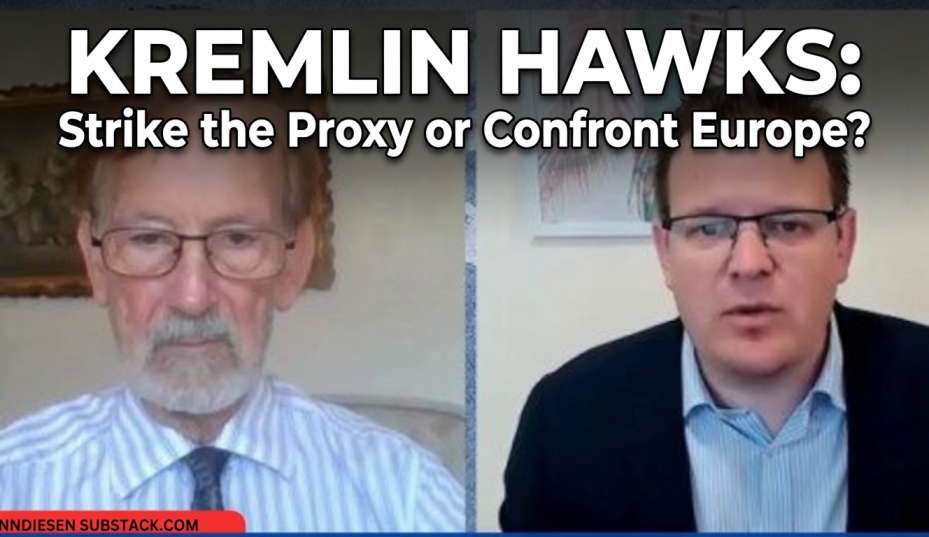
Editor’s Note: In this interview, historian and political analyst Gilbert Doctorow joins Glenn Diesen to discuss the escalating complexities of the ongoing war in Ukraine and Russia’s current geopolitical stance. Doctorow shares insights from his recent time in Russia, detailing the growing war weariness among the populace and the increasing pressure on the Kremlin to shift its strategy. Together, they analyze the risks of direct escalation, the impact of Western involvement, and the difficult choices facing leadership as the conflict persists. (June 28, 2026)
Introduction
GLENN DIESEN: Welcome back. We are joined again by Gilbert Doctorow, a historian, political analyst, and author of the War Diaries volumes. So thank you for coming back on the programme.
GILBERT DOCTOROW: Well, my pleasure.
NATO’s Growing Role and Russia’s Strategic Dilemma
GLENN DIESEN: So it appears that Russia has painted itself into a bit of a corner. That is, over the past 4+ years, NATO gradually increased its direct role in the attacks on Russia. Now initially they were minor, then growing, and Russia seemed to make the decision that it was better to absorb the pain and rather focus on just defeating the Ukrainian proxy through this war of attrition.
And I think, well, the reason I say it painted itself into a corner is two things appear to have happened. One is that the NATO attacks are no longer small pinpricks, that is the long-range drones and missiles that are, well, supplied by West and also, well, targeted, picked by the West, and of course Western satellites directing the attacks. The second is that NATO countries, as a result of this, are no longer deterred. That is, there seems to be a very firm belief that they can strike Russia with impunity. Anyone who disagrees are seen as someone who’s coming to Russia’s defense and has to be, well, purged from polite discourse.
So this creates a very dangerous position for Russia. That is, it must escalate in a big way. Otherwise, the attacks will only increase in intensity and NATO will become even more convinced that Russia would never dare to respond. Hence, the Europeans can talk openly about going to war with Russia without any consequences. I was wondering, how do you see the situation? You spent quite a bit of time in Russia. What is happening in Russia at the moment?
War Weariness Inside Russia
GILBERT DOCTOROW: Well, I spent a month in Petersburg and I met with people in all walks of life. I don’t mean taxi drivers and hairdressers. I mean all walks of life. I was there on business as well as my journalistic activity and fact-finding activity. And I met with one of St. Petersburg’s leading notaries. I met with an outstanding member of the real estate brokerage company that is the successor to Century 21 in Russia. These are people who have their fingers on the pulse of the middle classes, people who are buying and selling apartments, not as speculators, but for their own use, and who are following mortgage rates and all kinds of things. So they listened to people.
And what they had to say was exactly the same thing that I’ve heard from a moving company head of team. This is a really working class by definition, who I spent 12 hours with. This is not a cursory, because he was moving things out of our apartment, which we had to adjust and sold. And so we talked and he, this fellow was saying, “Why is Putin dragging it out?” That’s to say he’s thinking the same way as academics and professional geopoliticians. It is everywhere. It’s everywhere except in the Russian polls because they’re asking the wrong question. “Do you like Putin?” Yeah, people like Putin. People like their increase in their pensions and so on. That’s not the question to be asked. The question is, “Do you approve of the conduct of the war?” And I think if that question were asked today, you’d get like 20% in favor of what Putin’s doing and 80% against it.
Now, I heard, as I said, from everyone more or less the same thing. This doesn’t mean that anyone is going out in the streets to demonstrate. Nothing of the sort. But they talk among themselves. And you have the experience of real hardship being imposed on the border provinces that are not being supplied necessarily by Western drones, but by Ukrainian-manufactured drones in vast quantities, and are making life quite miserable for people in the oblasts that are just adjacent to Ukraine, not to mention in Crimea, which has been particularly targeted.
I’ve spoken in the past about having friends who have a tiny house that they bought for $100 in 1995, ’96 when it was still Ukrainian. And they go back every summer and they’re 25 summers in a row they’ve gone there. Now they have very few neighbors who came. Because of the risks, the fears of drones, which are omnipresent, and the problems of transport, getting there and what you do once you’re inside there. Getting there, they shut down the Crimean Bridge at times. Today’s news from Russia says there are 1,000 cars waiting to pass the bridge.
Our friends are on a hill. You don’t get for $100 an apartment in Theodosia. They got a little shack on the hill. And a hill is a hill. It’s a long climb. They don’t climb. They’re senior. And so they had for years a Crimean Tatar driver. Not a personal driver. He does taxi services for people in the area. Who took them up and took them down. He doesn’t have any gasoline. And so they are stuck up there with limited provisions and with no ability to enjoy the beach, which is down below. And they’re cut off from communications because that also is rather come and go. Telephone was WhatsApp and the rest of it. So they’re not having a good time.
And this is widely known in Russia.
That’s not to say that all life is miserable. I took a photograph when I was in Petersburg which I entitled “War in Russia?” It was in the very center of Petersburg, a street that runs down to the Church on the Blood just off Nevsky Prospekt. And it’s a pedestrian street along the canal, the canal which leads to the church because that’s where Alexander II was blown up along next to the canal. And it’s all restaurants and it was a lovely day. It was a temperature in the mid-20s centigrade and street life, the restaurants were busy. The waiters were attentive. The food is excellent. And you could imagine there’s no war whatsoever.
Except that if you knew it, the week before when the International Economic Forum opened, the Ukrainians had drone attacked a fuel storage and refinery at the end of Vasilyevsky Island, which is a part of central Petersburg, sending black plumes up into the sky, which were unmistakable that they had reached Petersburg with their drones. So the awareness of the war has come home. War weariness is omnipresent.
I don’t speak about the increasing numbers of amputees and other people mutilated by the war, whom you see. I was in a bank branch and twice — I was there twice doing some transactions — and twice there was in the reception a double amputee, whose affairs were being handled by the bank. The war is there. The Russians are tired, and they don’t like what they see in terms of the present handling of the war by the administration of Vladimir Putin.
Zelensky’s Strategy and the Hawks in the Kremlin
GLENN DIESEN: Well, that seems to be the objective though, as the Finnish Prime Minister Stubbe said, he made the point that the only way for this war to end is when the people turn on his government. So for this to be achieved, they have to kill more Russians, they have to also bring the war to Russia, make it being felt by Russians. So the purpose of this, they’re quite open about it.
But where does that leave the options now for the Kremlin? Because it does appear that the former strategy of restraint, as you said, it’s not working. It’s only emboldening its adversaries. On one hand, they do know that Zelensky is trying to bait them into a direct war with NATO. On the other hand, they do know if they don’t do it, then their deterrence is essentially useless.
Again, where would that leave Russia? I saw Zelensky make a speech, by the way, that he will do a major strike on Crimea. He just first has to consult with the G7 countries, just to make it very clear that the NATO countries are all in on these attacks on Russia. But again, this dilemma — being recognized for being baited by Zelensky to pull NATO into the war versus simply making European NATO countries a safe zone for industrial production and the logistics, while the Europeans are now very openly striking Russia. I mean, this is a very dangerous situation.
So where are the discussions going? Because I see there’s a lot of uproar among — well, we can call them the hawks in the Kremlin — who want Zelensky to be killed. They want the government districts of Kyiv to be bombed. If the Europeans get involved, cold use of tactical nuclear weapons. There seems to have been — maybe not among Putin yet, but among the hawks, they’re growing in numbers and the rhetoric is becoming more fierce. Do you see any shifts though?
The Risk of a Palace Coup and Putin’s Changing Posture
GILBERT DOCTOROW: Well, I see the big shifts, but let’s come back to the strategy of Zelensky and Western backers to bait the Russians. To bring home the war to Russians, and the belief that that will make them revolt against Putin, bring down his government, and so forth. Russia is not in a pre-revolutionary situation. Even Zyuganov, the Communist Party leader who should know something about revolutions, when he spoke 3 months ago about the dangers facing the government from its policy. He was speaking about economic policy, which is a safe thing to talk about in the Duma. Whereas if he had touched upon the real issue that’s creating a political crisis in Russia — the war — that would have been less well received among his peers in the Duma.
But what he was describing was a pre-February 1917 situation. Which I believe is the case, that is a palace coup situation, where it is the people in the immediate vicinity of the Kremlin who overthrow President Putin. That is one possible outcome.
The main point I want to make is that in getting the public excited and putting pressure on President Putin, the consequence within Russia is exactly the opposite of what these grand strategists advising Zelensky or pressuring Zelensky and leading the European Union towards a war with Russia anticipate. The Russians who expressed their dissatisfaction with the slow, imperceptible movement towards a conclusion of the war — they want — they’re not defeatists. They expect Russia to win, but they don’t want it to go on for 10 years more. They want Russia to win very much.
Now, we didn’t go into this question that you just raised of the advice from the hawks. I didn’t hear from anyone, frankly speaking, that we should bomb the hell out of — I was saying that. The people I talked to were silent on the point. So I don’t know how keen they are to end the war by a violent escalation. That question never really came up directly in our conversations. But my surmise is, where else can you go if you say you want to end the war tomorrow without capitulating? It can be by a major escalation.
I don’t know whether there will be a palace coup. It’s not unthinkable. People say, “Oh, well, President Putin has the full support of the military and this and that.” Well, I think Gorbachev wasn’t exactly walking on eggs when he was retained on his vacation in Crimea and was more or less moved out of power. That was by classic definition, a palace coup. Now, whether it fails is another issue. But that there’s a possibility in a place like Russia, with the stability, the calm of the people and the rest of it, for there to be a coup — of course there is. So that is one possibility.
The other possibility, of course, is that President Putin, as an accomplished politician, will come around to changing his policy. Now, I’ve been asked about what he said recently in his address to the cadets that were graduating, that a war with Europe is coming, and it sounded like he’s getting tougher.
Frankly, Glenn, for more than 15 years, I have closely followed speeches by President Putin. I analyze them. I try to make sense out of them. I listen closely to his remarks at his annual direct line conversations with the public and to his speeches at Valdai. And I was very admiring of him for his intellectual capacity, his fantastic memory, command of the facts. And I gave him all due credit for that, as well as, of course, for reviving the Russian economy and Russian military.
At a certain point, I lost my enthusiasm for that type of exercise. And frankly speaking, it’s hard to listen to any of his speeches now. He has gone into the late Gorbachev phase of speechifying constantly. He has gone into the late Gorbachev phase of — let’s call it by its proper name — cult of personality. Every news program has to begin with 10 or 15 minutes of speeches from Putin. Every talk show has to begin with 10 or 15. This is ridiculous.
And the worst of it is nothing comes out of his speeches. Just as I stopped listening to Trump, I only see what he does. So it is with my view of President Putin. I only look at what he does, and what he does has been utterly inadequate to the challenges that Russia’s national security is facing today. And still worse to the threats that Russian national security faces at the end of this year, when still more damaging missiles and drones will be ready in serial production to be supplied by the West to Kyiv.
Zelensky’s Threats Against Belarus
GLENN DIESEN: Now, it might be a bit too early to assess though, because this is a similar situation as Russia was in towards the end of 2021. That is, NATO was essentially putting Russia, posing a dilemma on it by building up Ukraine and preparing it to retake Crimea, essentially, you know, capitulate or choose war. And essentially chose war.
It just seems that the situation this dilemma is faced with, it’s not stable. There’s no holding on to a status quo because that it’s disappearing. And I just feel that it’s going to go the other way at some point, or this whole strategy of NATO, that is Russia’s to capitulate or go to war. I see that Putin doesn’t want to go with the war option, given that this means this will be outside Russia’s escalation control. This can quickly escalate to the use of tactical nuclear weapons. But that being said, I haven’t read a history book where the Russians are capitulating either. So it just seems like this is where we’re headed.
But I wanted to ask about another issue. That was Zelensky’s threats against Belarus. That is, he threatened he would go to war against Belarus. I thought, you know, either it’s just pressure or to show some more relevance for the NATO members, or it could be a way of pulling NATO into the war. Again, I’m not sure, but either way, he seems to have been walking this back now. Do you think this is the end of it, or is Belarus being pulled into this war as well?
GILBERT DOCTOROW: Well, most of major Western media, to my knowledge, did not pay much attention to this issue, to my surprise. La Libre Belgique, the second most important French-speaking daily newspaper in Belgium, gave two full pages to this very issue about three days ago. And still more curiously, they were putting in as their own analysis, analysis of the situation that I had read in Russian news. So they were without credit taking up talking points from the Russians on this very issue.
The most important relevant item here is that the Russians were saying, and La Libre Belgique repeated, that the threats that Zelensky made were imposed on him when he was in the meeting with the G7. The European members of the G7 told him, “This is what you’re going to do next. And if you don’t do it, we can’t guarantee your personal security.” That’s a pretty clear message. And so he did it.
Now what did he do? He threatened that if within one week Lukashenko, president of Belarus, doesn’t deactivate the electronic devices at the Belarus-Ukrainian border, which according to Zelensky are enabling Russian drones and missiles to properly target objectives in Western Ukraine as they fly past. If he doesn’t deactivate them, then Belarus would deactivate them by force and also attack 500 sites that he said in Belarus are labeled as targets for Ukrainian forces.
For several days, there was no response from President Lukashenko. We know that a day ago he went for consultations with Vladimir Putin, but that he went to them after he did make a statement. He apparently met with two emissaries from Zelensky. I just saw it, must have been on Thursday. And he told them that “If you start a war with us, or if you do what you’ve said, under the threats, then the whole nature of this war will change.”
Let me decode those three dots. That means he’s going to attack Kyiv. He will do what Putin is not ready to do. Lukashenko is not Putin. Lukashenko, 6 years ago, stood up to violent demonstrators in the streets who were supporting Tikhanovskaya, who was the failed presidential candidate that was backed by Lithuania and Poland, and he went out to the streets with a machine gun and with his son also holding a machine gun. Well, I don’t picture Vladimir Putin doing that, nor did the Ukrainian president do that when he was challenged in Maidan.
So I think it is entirely credible that the three dots in the subtle threat of Lukashenko meant, “We will decapitate you. Even if our brethren in Moscow aren’t up to doing it.” That was the end of that. I don’t believe that Zelensky will dare attack Belarus.
The Erosion of Russian Deterrence
GLENN DIESEN: So this is the absurd situation now, that as if someone doesn’t respect your deterrence. That is what the NATO countries are doing against Russia. They probably wouldn’t dare to do against Belarus or a country like North Korea, a tiny country. Exactly because the response would be unpredictable. Russia made itself very predictable by being cautious.
I mean, I’m a European living in Europe, I got happy about the caution, but on the other hand, I also see the danger in a great power not having its deterrence respected anymore. It’s not sustainable, and at some point Russia will have to do something very drastic. The things it could have done in 2022 when the first HIMARS and all of these weapons were sent, it could have done something minor and restored its deterrent.
Now, essentially the Europeans as well as the Americans already set up a narrative that is, “Oh, the Russians are considering striking Europe in a hybrid war.” So all of this will be unprovoked. This is essentially how they’ve set up the narrative already, that this is a continuation of the war against Ukraine. Essentially, the prophecy is true that Ukraine was just the beginning. So this is very dangerous as well.
But my point is the fact that they are deterred by Belarus and other minor states, but not the world’s largest nuclear power. It shows that some decisions have been not made correctly, I think, in the Kremlin.
But on the American participation in all of this, I think one of the reasons for Putin’s restraint, at least in 2025, was the belief that it would be possible to make a deal with the Americans. That is the spirit of Anchorage. That appears to be dead in the water. Was this diplomacy all nonsense, or are the diplomatic paths essentially now absent?
Putin’s Accommodation with the West and the Road Ahead
GILBERT DOCTOROW: Well, the reasons why that policy was put in place, let’s be frank about it. Vladimir Putin always wants some accommodation with the West. How did he come to power? How did he enter politics? He was Anatoly Sobchak’s man for bringing Western investment, particularly German investment, because he was a fluent German speaker, and invited many high guests from Germany to Petersburg. So he was, from the very start of his career, deeply involved and interested in accommodation with the West and Western investment. And that never went away.
His government team has always been balanced between some hardliners and a very significant minority of powerful liberals with a capital L, that is coming out of the Yeltsin period. That remains to today with Siluanov, the finance minister, being in that category, with Nabiullina, who’s the head of the central bank of Russia, in that category of holding a lot of power and running in absolutely the opposite direction of the geopolitical ministers within the cabinet.
Well, where do we go from here? A lot of my colleagues are of the belief that when Russia reaches the Dnieper, which is entirely possible at the end of the summer, early autumn, although the progress has been vastly slowed down. Progress of Russians in Donbas has been slowed down by the fierce drone attacks on the field of battle. Nonetheless, let’s assume that they find a solution and Russia does take Konstantinivka, does take Kramatorsk, Sloviansk, and reaches the Dnieper.
Well, that doesn’t mean the capitulation of Ukraine. Not at all. Even if they take Odessa, it doesn’t mean the capitulation of Ukraine. This is a fiction that my colleagues seem to maintain for reasons that I don’t understand. Ukraine is receiving $95 billion in aid. It will receive still more aid from the EU, military and financial aid. It has no reason to capitulate, and it will be exactly what Putin didn’t want to have, and what prompted him to initiate the special military operation, that Ukrainian territory is used as a base for attacking Russia.
Russia now is not just what Russia was in 2014. Russia is now what it is after 2022. It is the Donbas, which is now also Russia. And there are people whose lives are being made miserable and untenable in Crimea and in this now Russian-controlled part of former Ukraine, who will be under constant attack as they were before 2022. And the NATO military installations and supplies will be running in full steam.
Is that what Russia has achieved by 5 years of war? I think I would call that a Pyrrhic victory. That is not a victory. The only thing that could prevent a full-scale NATO installation in Ukraine would be if Russia finally declared war on Ukraine and made a claim that anything coming in from outside will be subject to devastation. That could happen, but this is not an end of war the likes of Colonel McGregor or other colleagues have been describing on programs like this.
It is an ongoing draining of Russian resources and infrastructure destruction in a period that allows Europe to rearm and to prepare for a real war on Russia in 2030 or 2029. That is a very miserable legacy for President Putin to leave behind.
Kremlin Hawks: Strike the Proxy or Confront Europe?
GLENN DIESEN: But just as a final question though, what do you think are the main options now for Russia? Or what are the hawks in the Kremlin demanding? Because do you hit the puppets or the proxy here, which is Ukraine? Because without Ukraine, the Europeans can’t continue, and it’s a good way of avoiding a direct war with NATO, which could lead to nuclear war. Or is it time, do they see, to go after the Europeans?
I can’t imagine retaliating against American territory, not at this point at least, but where are they pushing the hardest? Because it seems like it can go both ways. And at every round of escalation, it’s the Ukrainians which are getting the punishment. But again, this doesn’t mean anything to the NATO states. I mean, they’re not counting Ukrainian losses. If anything, they’re continuing to block every pathway to peace. So what are we looking at here?
GILBERT DOCTOROW: Well, I support the first scenario that you described. I see no reason for Russia to attack any of the European countries that are producing these munitions, although there’s a logic to it, and although it would be permitted under international law. I think it would be counterproductive and it would be entirely violating the prudence and risk-aversity of the Russian side. So I think it’s improbable that scenario would play out.
Although, let me be frank about it, more passionate colleagues in the alternative media are saying that it’s a nice coverup for anybody who might suspect weakness or timidity, or shall we say cowardice on the Russian side. Like, “Oh no, the Russians are preparing to brutally attack Germany and so forth.” That’s their latest talking point on these podcasts. I don’t agree.
I think the Russians would be following the first course that you described, that is, concentrating their efforts on the proxy for the very reason that you gave. You eliminate the proxy and Western Europe will have to stop all of its preparations for war because their boys aren’t going to be going against the Russians. Just as Biden was very happy to fight Russia to the last Ukrainian, that’s exactly what the Europeans have taken over. They don’t have the boys to send in. And if they did, they’ll have a revolution on the streets in Paris, finally, over geopolitics, if Macron or a successor would dare to put in a draft and send people off to fight against the Russians. They want a war that the Ukrainians are fighting.
And if Russia, by devastating all of the military centers, coordination centers, the military intelligence centers, if they reduce them to ashes, end of game. People will say, “Oh yes, and the Ukrainians will fight on a guerrilla war.” So what? Russia is not afraid of a guerrilla war on the other side of the Dnieper. It has every reason to fear military installations and military supplies coming from the West, which enable and guide Ukrainian attacks on Russian critical infrastructure ad infinitum.
The former 10-year-long Minister of Energy in Russia, presently of a higher title as Deputy Prime Minister, Novak, said it 2 days ago, the situation with fuel in Russia, that’s fuel for cars and agricultural equipment, is under serious threat, but manageable. When this man says that there’s a serious problem, there is a serious problem.
Today’s news on the Russian ticker tape, which I just read this morning, says that there’s a record demand for gas canisters in Russia today. People are running out to the streets to buy gas canisters across Russia. Not just in Crimea. That tells you that the effect of these attacks on Russian refineries is real. Not just a pinprick. If this is just the beginning, if this type of war goes on, Russia’s economy will suffer greatly. And Europeans will be preparing nicely for a war in Russia in 2029. That has to be stopped by removing the proxy now.
Closing Thoughts and Political Tensions in Russia
GLENN DIESEN: Yeah, it’s amazing that there’s not more discussions about this in Europe. There seems to be always this celebration. “Oh, look, now the Russians are on their back foot. Oh, look how much pain we can bring to their economy.” Or, “Let’s try to increase the amount of dead Russian soldiers to put pressure on Moscow.”
But the idea that they can control what’s coming — I mean, if this goes out of control, Putin — yes, there’s a lot of power concentrated in the president, but it just seems like it’s not going to be very sustainable anymore. I mean, the only reason I think there’s been so much restraint, as I said in the opening here, was because they were minor pinpricks. But as you say, if this will now bring serious pain on the economy, I think restraint is not a luxury anymore.
But it’s just limited options. I think that is either accept, go very hard against Ukraine — that means really doing heavy bombing of cities which doesn’t really count collateral damage — or attack any European NATO countries. If not, it’s capitulation. And again, that’s the destruction of Russia. That is an existential threat. I just can’t imagine any great power capitulating at the end of the day. But no, the longer this goes on, I think the more radical the response will be. I don’t know. Do you have any final thoughts before we wrap up?
GILBERT DOCTOROW: Yes, Moscow is worried. The United Russia Party is worried. I say there haven’t been any polls. There will be a poll. On September 20th, there are the Duma elections. And I think it was worthy of note, though nobody’s noted it, that there was a scandal this week in the Duma when a speech by Zyuganov, the Communist Party head, was distorted by a Duma member of the United Russia Party.
They put words in his mouth saying that Zyuganov had just declared, “The banking system is terrible. It’s making enormous profits. We have to — there are 2 years worth of Russian budget, volume of Russian budget sitting in the time deposit accounts of Russian citizens and businesses. We have to confiscate them.” These words were put into Zyuganov’s mouth. Well, I tell you, that is political death for the communists. And it is the most alarming thing you could put into the mouth of the head of the Communist Party.
Zyuganov threatened to take to court the Duma member for defamation. A day later, there was an apology, an official apology issued by the United Russia deputy that they had distorted his words. So they’re really reaching for anything to save themselves. And that they would do something as vile as that indicates that they are deeply worried about losing the elections.
GLENN DIESEN: Well, thank you very much for taking time out of your weekend. I always appreciate your perspective. So thank you.
GILBERT DOCTOROW: Very kind.
Related Posts