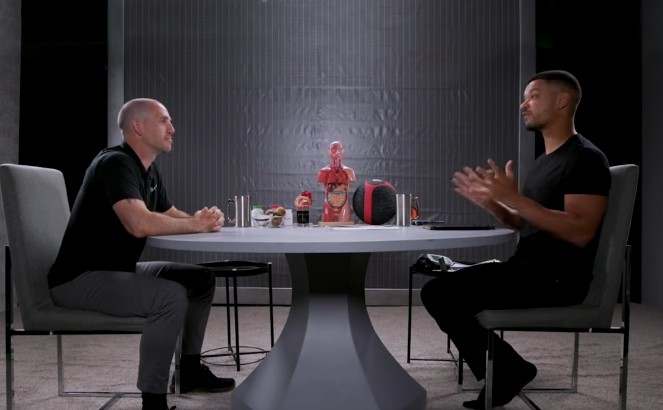
The following is the full transcript of performance scientist Dr. Andy Galpin’s interview on DOAC Podcast, August 13, 2026.
EDITOR’S NOTES: In this episode of The Diary Of A CEO, Steven Bartlett sits down with performance scientist Dr. Andy Galpin to uncover the biggest sleep mistakes silently ruining health and energy levels. Galpin explains why millions suffer from undiagnosed sleep disorders, why trackers and over-optimization can backfire, and reveals the simple truth about fat loss—why it’s easier than most people think, yet so few actually succeed. Together they share practical, science-backed strategies for better rest, sustainable weight loss, and long-term performance.
Why Andy Does What He Does
STEVEN BARTLETT: Dr. Andy Galpin, before we started recording, you said you want to do scientific research, coaching for your clients, and education. You also kind of alluded to the fact that you were less interested in money and these kinds of things. So the question is, why do you do what you do? And what is it you’re doing? And who are you doing it for?
DR ANDY GALPIN: The most concise way I can say it is, I want to give every person listening to this the opportunity to reach their goals and dreams. You want to look this way or not look this way, and you want to perform this way. How can we get you there? I want to remove those barriers. And if you get there or don’t get there, it was because of you. It was not because something was holding you back that was in your way. And so that’s why I get equally excited to work with the best linebacker in the NFL and some person who just wants to wake up and not be in back pain tomorrow.
STEVEN BARTLETT: So tell me who you’ve worked with then. Who has been a client of yours?
DR ANDY GALPIN: Yeah, I’ve been fortunate to work with the world’s most elite athletes for 20 years at this point. So this is your number one draft picks in every major sport, Hall of Famers, Cy Young winners, MVPs, Olympic gold medalists in many sports, world champion fighters. We’ve worked with hemiplegics and paraplegics individuals. We’ve worked with the cliché executives, the mom and pops, the person dealing and struggling with perimenopause. We’ve really done most of it.
STEVEN BARTLETT: And what kinds of symptoms or goals do they come to you with?
DR ANDY GALPIN: So I’ll give you broad categories and specifics below that. Broad categories, we tend to say it’s either rebuild or upgrade. Rebuild is there’s something wrong, hurt, broken, damaged. I’m overweight, I can’t fix it. I’m dying from sleep restriction, I have a clinical sleep disorder. I have some injury, I have some huge clear limitation that needs to be resolved.
The second half is what we call upgrade. I don’t have any of that. I feel pretty good, feel okay. Now I just want to get the best possible out of my life. So this could be energy, it could be metabolic, it could be cognitive function. Why I can accomplish that, and our folks I work with can, is because I’m after the physiology.
STEVEN BARTLETT: What do you mean by that, physiology?
DR ANDY GALPIN: It’s your biomolecular signature. Do you have a muscle imbalance that’s creating neck pain, that’s making it hard to sleep, and that’s giving you a hard time regulating your emotions. It could be classic things like inflammation, everything that is inside of your body in both the way that it is running and expressing itself.
STEVEN BARTLETT: And what are your credentials?
DR ANDY GALPIN: So my PhD is in what’s called human bioenergetics. I started my lab in 2011.
STEVEN BARTLETT: Your lab?
DR ANDY GALPIN: So I’m an active scientist, I’m a professor, that’s my real job for the most part. So we conduct and disseminate research there that enhances human performance. And then I’ve started a number of companies and privately coach people. That’s what I’ve been doing for over 20 years.
STEVEN BARTLETT: We talked about the different personas and the types of problems they come to you with. If you had to, and this might be quite difficult, order them in terms of the frequency in which people come to you with these issues, what would that sort of top 5 be?
DR ANDY GALPIN: I’ll break them from our professional athletes, and I’ll probably spend more time on non-professional athletes, assuming most of your audience is probably not a professional athlete.
STEVEN BARTLETT: I wouldn’t take that.
DR ANDY GALPIN: Pretty close.
STEVEN BARTLETT: I want to take that, guys.
DR ANDY GALPIN: 50/50? Yes, we’ll say 50/50.
STEVEN BARTLETT: Yeah, right.
DR ANDY GALPIN: The athletes typically come to us under two circumstances: frequent injuries, or tanked energy, bad sleep. They deal with the same human problems we deal with, right? The other one is what we’ll just say is the upgrade, the optimizer. Feel great, feel young, I just want to get ahead of things and I want to catch things before they start.
The general public is a similar breakdown. Because we have a lot of people who are like, I do feel pretty good, I’m great, but I don’t want to play the game backwards. I don’t want problems to come up and then I’ve got to go scrambling and figure it out. So let’s collect baseline data now. Let’s get ahead of things. Let’s predict problems before they arise. But I’ve only got a few minutes a day, right? I’m not trying to take over my whole life with all this stuff. Probably the most common ones are things like sleep and energy, performance goals, can’t seem to get stronger, can’t seem to lose that little bit of weight, maybe a touch of brain fog. I don’t feel as sharp.
STEVEN BARTLETT: Well, I’d love to go through all of those: sleep, energy, performance, strength struggles, weight.
The Hidden Epidemic of Sleep Apnea
DR ANDY GALPIN: This is a great question. In fact, I think this is a nice framing of everything we’re going to talk about. We want to be wary of what we call health anxiety. This is over-fixation, over-concern, worrying too much about little things, with your blood work, with your sleep, everything. You’re in a really great spot, so we can look for some upgrade, but we want to be careful of pushing that line.
Why that also matters is if we look at the 8 billion or so person population, we probably need more people to pay attention to their health than to not pay attention to their health, right? We’re not in an abundance of people caring too much. But if you’re listening to this show, you are probably not representative of the general population. And so I want to be really careful of everything I’m about to say for the next couple of hours. I don’t want to create health anxiety. I don’t want you to be so terrified to touch a receipt that it sends you into a three-day tailspin.
Anytime we’re talking about health or performance, we want to run the spectrum of disease to optimization. We should not be playing around with optimization and performance if we’re in the presence of a medical disease. And why I say that is sleep is probably the biggest place of clinical disease that exists that no one knows about. Somewhere in the neighborhood of 70 to 80% of people who have clinical sleep apnea will go undiagnosed.
STEVEN BARTLETT: Wow.
DR ANDY GALPIN: If that existed for a broken bone, right, if that existed for diabetes, you’d be like insane. It gets worse. 50%, depending on which study you look at, of athletes have a clinical sleep disorder. For women, it’s somewhere in the neighborhood of 90 to 95% of women who have clinical sleep apnea will go undiagnosed.
STEVEN BARTLETT: Why?
DR ANDY GALPIN: If you were to look at me and I said, Steven, do you think I have apnea? You’d say no, right? If I were to bring in a whole table of 10 people and I said, pick the person in here least likely to have sleep apnea, you’d find the smallest girl.
STEVEN BARTLETT: True.
DR ANDY GALPIN: You don’t think about apnea as something that can happen unless you’re big and fat. Women also are less likely than men to complain. They’re less likely to think about it as an anatomical issue. They’re going to charge it to hormones, to their menstrual cycle, to their cognitive load, to the demands that it is to be a mom. All these are true, by the way. It is also, at the same point, true that you could have apnea that has nothing to do with body composition.
STEVEN BARTLETT: And let’s define apnea for a second.
DR ANDY GALPIN: You stop breathing at night and that wakes you up. Sometimes it doesn’t. That’s the problem — it won’t necessarily wake you up, but it is deleterious to your health. It’s highly associated with consequences from long-term death risk to short-term cognitive function, emotion, mood regulation, performance, recovery, metabolic health. It’s really, really nasty. It’s in fact one of the larger things that can go wrong in your health — not breathing at night.
STEVEN BARTLETT: This might be a silly question, but does sleep apnea disrupt your sleep?
DR ANDY GALPIN: It can.
STEVEN BARTLETT: So it doesn’t always?
DR ANDY GALPIN: Doesn’t always. This is why it’s so poorly diagnosed. So the classic giveaways — if you’re that person who wakes up four counties because you snore so loud — snoring doesn’t necessarily mean you have sleep apnea, but it’s a really strong indicator. That’s one form of it.
So apnea happens for a bunch of different reasons. Evidence recently has suggested neck size was this kind of original thing that we say, like, a big neck is just a problem. Doesn’t look like that’s as true, but certainly it is true that as you increase obesity rates, you’ll see an increase in apnea as well. So what’s happening here is now you’re talking about, I’ll call it anatomical, or physical — something physically is landing on your neck and your tongue and your throat, your larynx and esophagus, and it’s stopping your breathing.
And why this matters is when you’re standing here or sitting here in this chair, you’re in this vertical position. And as you go and lay down, anatomy shifts. You also have a lot of research showing that the larger the human being, the more fluid they have, which is pretty normal, right? So a person who’s twice your size will have twice the amount of water in their body that you do.
Imagine if you had — well, we’ll take this beverage right here. You see the water is sitting vertically, right? If I were to shift this cup horizontally, the water would shift and it would balance horizontally to where the gap and the air would be on the top, right? That happens in your body. So imagine this top piece right up here, that’s your neck. Now when you lay down, your neck is over here — that fluid then shifts up into your neck. So it’s not even necessarily a physical size thing, but it’s the fluid associated with being a larger human being that the fluid shift can happen.
What we’re now finding is a whole series of other types of apnea. Now there are neural causes to it, there are environmental causes, there are positional causes. And so as a classic example to round the story out, traditionally, if you’re told you have apnea, you’re going to be given one of about three choices: medication, what’s called a CPAP device — the big, Darth Vader breathing machine — or potentially what’s called an oral appliance, a mouthpiece that repositions your jaw and neck. I’m for all of those treatments. Why they all have such low success rates is because they’re given out generically. You come in, you have apnea, you get the same stuff. Now what the field is moving towards is precision, saying, you have this specific type of apnea, an oral appliance won’t help here — you actually need this surgical intervention.
STEVEN BARTLETT: I was looking at some of the data here, and it says that sleep apnea is very common globally, much more common than I expected. It says men who are middle-aged have a 24 to 34% prevalence of apnea. Women, 9 to 17%. Seniors, 30 to 60%.
DR ANDY GALPIN: That’s right.
STEVEN BARTLETT: Postmenopausal women, 25%. So rough numbers — that means, listening now, if you’re a middle-aged man listening, if there’s three of you listening right now, one of you statistically might have apnea.
DR ANDY GALPIN: Now that’s clinical sleep apnea. That doesn’t even count subclinical.
STEVEN BARTLETT: And if you’re a senior listening now, which is 65 or older, there’s a 30 to 60% chance. Wow.
DR ANDY GALPIN: Depending on some numbers you see, Steven, you’ll see a billion people across the globe.
STEVEN BARTLETT: Yeah, that’s what it says. A billion people.
DR ANDY GALPIN: Now, that’s only apnea. That’s not insomnia. That’s not all the other sleep disorders. That’s simply the one variant of it.
STEVEN BARTLETT: Why is this happening? Because again, from an evolutionary perspective, sleep apnea couldn’t have been great for survival.
DR ANDY GALPIN: Yeah, three primary reasons why this is happening. The first is the fact that our environment is physically changing. Our ancestors never had to deal with this. Second, our current solutions for testing are either insanely outdated or incredibly difficult to get to. The third major one is our solutions that we provide people in public communication are wildly generic, thus not helpful. In fact, if you were to poll everyone listening right now, sleep comes up and you go, oh great, they’re going to tell me to sleep in a quiet room that’s cold and dark. And they’re like, I’ve heard it all. And you have. Where we need to get to next is how do we help people find these precision solutions based on their type of sleep issues? But that’s the three-part reason why this stuff is happening.
STEVEN BARTLETT: I’d like to go into all three of them. I also would like to just pause on the diagnosis part, because there’ll be people listening here that might have a suspicion that they need help. But again, they’re going off their feelings. How can they know for sure what help they need and what their problem is?
DR ANDY GALPIN: Yeah, I always start with subjective. How do you feel? If you feel good, let’s now immediately take a breath. You have good energy, you wake up, you feel good. Everyone’s going to be a little bit tired. We’ve had a — I’ve been working with for several years, a very close friend of you and I. We constantly have to battle ’cause he’ll get honestly terrified because he gets sleepy at the end of the day. And I’m like, bro, that’s the point. People that are hard chargers, high performers, are actually afraid of being tired. We have to recognize and realize that is natural and needed. You need to feel a little bit sleepy in the early afternoon, and you should feel tired, unmotivated, lack of focus at the end of the day.
STEVEN BARTLETT: What if I didn’t used to? Because that’s what people will — they compare it to an old version of themselves.
DR ANDY GALPIN: Sure. Again, we can say natural. When you are sub-25, you’re just a powerhouse, right? When you’re past 25, we shouldn’t just accept frailty. We shouldn’t accept a permanent decline, but we do have to start to realize we’re not going to have the energy of a 20-year-old. It’s just not typically super realistic. And if you do, you’re probably getting there exogenously, right? Stimulants and other things, which have a place, but we just want to be a little bit careful of those things.
STEVEN BARTLETT: We’ll talk about stimulants, melatonin, and all these things. But going back to this point of diagnosis — so Jenny, who doesn’t have much money, how does she get help?
DR ANDY GALPIN: So one thing we can do, and we can put these in your show notes for you for free, there are a ton of completely free short questionnaires that are scientifically validated. You can do these for RLS, you can do them for insomnia, you can do them for apnea, you can do them for circadian disruptions and disorders, you can do them for chronotype — are you a morning person or not. And I’ll put as many of these for free. So my answer there would be start with one of those.
If you flag that and you want to move up to the next step, then you have a couple of different ways. Your two options are what we’ll call wearables, at-home tech. These are typically in the $100 to $600 range. Then past that, you have a true medical option, which is a sleep hospital. This is when you would go into the hospital, into that weird room, and you sit there, you get all the wires, someone looks at you through a window, you sleep for one night.
You can see from the look on your face already, you’re just like, all right, who wants to do that? If you have a true disease at this point, for the most part, a sleep hospital, depending on the disease, is where you need to get to. Now, what our group is working on and others is, can we bring this sleep hospital into the home? It’s not super affordable at this point. We’re going to get it there, but that is the clear future. If you have insurance, take that validated questionnaire I just mentioned, go to your doctor and say, here’s what I scored on this thing, will you order me that sleep study? It is a giant pain, I know it, but it is probably worth it.
If you want to use the wearable, you can do that. The problem with wearables is numerous. They are awesome at things like awareness, at accountability, right? They’re pretty good for things like total sleep time. They’re really, really bad — a major pitfall for wearables — at predicting things like deep sleep and REM sleep.
Wearables, Data, and Sleep Environment
STEVEN BARTLETT: Do you know what I was thinking about? I was thinking about certain times where I’ve done certain things behaviorally, and then I got in bed, woke up feeling terrible, and my wearable said to me, you had a really bad night’s sleep. And I could kind of put two and two together and establish cause and effect. And I could almost test that going forward and say, okay, don’t do that, or maybe get in earlier, or the heat was too high, whatever it might be. And I could sort of A/B test my way to a better outcome.
DR ANDY GALPIN: Yeah, so they can give you things like total sleep time, as I said. What you want to be careful of is the aggregate sleep effectiveness score, sleep quality score — that’s the stuff that directionally won’t be there. But you actually said something interesting a second ago, which is you felt worse. That’s the only directional thing we need to pay attention to. If you go, wow, I feel worse today, and then you can go backwards and go, yeah, that’s because I did A, B, and C yesterday, or I felt better today — that’s not the only metric.
And to be really clear, I’m not advocating to ditch all the wearables. We use them extensively. It’s just being careful about what data from those we pay attention to and what we don’t. So stuff that we do now is find big themes that are oftentimes missing. Here’s a good example: we had 1,200 days of data from, I think it was an Oura Ring, and we were actually able to find that in one of our clients, for every one drop in resting heart rate — so his resting heart rate, say, went from 65 beats per minute to 64 — he got six more minutes of sleep. And so we were like, okay, great, you want to add an hour to your sleep, let’s continue to work on your cardiovascular fitness. Every time he got more fit, his resting heart rate dropped, he slept more. Additionally, every time you invest in downregulation, you’ll lower your resting heart rate going into bed and you will sleep longer.
So he was a classic case of, I try to go to bed, I do all the things, but I just can’t stay in bed. The key there to get him more sleep is to put his physiology in a position that would allow him to have more sleep. And for him, that was the canary in the coal mine. That’s the type of stuff where wearables can be — you can’t replace that, not only from a data perspective but from a coaching perspective. It was so easy for me to communicate to him: here’s your data, this is our target. And he’s an extraordinarily busy person. He’s like, great, I got one thing to pay attention to. Do whatever it takes to keep that heart rate low going into bed. Copy that.
STEVEN BARTLETT: What in his case was making his heart rate high?
DR ANDY GALPIN: When it comes to something like sleep, anything that is in your physical environment, that’s in your lifestyle, that’s in your physiology, can impact it. I mentioned earlier one of the reasons why sleep is getting worse is because of these physical changes in our environment. Annual spend on sleep is like $600 billion right now, but yet we have seen a 60-minute drop in total sleep time over the last 60 years. So you’re seeing an inverse — we’re spending more on sleep and sleep is getting worse.
I think your team printed out some cards here, and we can go through them. The first one is a really good one: the world is physically brighter. In fact, there’s data from NASA, satellite data that shows the world is physically brighter now. You’re expected to be communicating with Singapore and Australia and the US, which means you’re going to be up later. Your business is going to be on, your lights are going to be on. There’s also a phenomenon called skyglow, where the light from Earth is going up, hitting the clouds and being shot back down. So it’s keeping our world brighter. So when you hear people talk about things like you’ve got to have these blackout curtains and masks, and you’re thinking, I never did that when I was a kid, what’s the big deal — it’s because of this.
STEVEN BARTLETT: I mean, there’s some graphs that I found here which kind of demonstrate this, which I’ll put up on the screen.
DR ANDY GALPIN: Yeah, more people are moving into urban environments. And if you look at some of the studies, not to be dramatic, but some of the studies have found things as high as anxiety and depression are up 20-plus percent when you move into the city. And that’s largely attributed to things like light and sound. It’s extremely bright and extremely loud in cities. It doesn’t mean they’re bad or you can’t live in them — it simply means that’s why you have to take extra steps.
STEVEN BARTLETT: I think a lot of people listening to this will think, well, Andy, my bedroom’s very dark.
DR ANDY GALPIN: Great.
STEVEN BARTLETT: But that’s actually not what you’re saying, is it? Because the way I was thinking about it is we are here in New York City now. And if I walked to the shop last night at 10 PM —
DR ANDY GALPIN: Yeah.
STEVEN BARTLETT: — and walked back, I was exposed to so much light outside at a critical time when my body should not be exposed to light, so that it’s going to impact me even when I get into that dark room.
DR ANDY GALPIN: It goes even better than that. There’s evidence now that the light exposure you have both in the morning and throughout the day dramatically counteracts what you just mentioned. So yes, you went for that walk when light was still out and you had a brighter light exposure in, we’ll just call it, the 3 or 4 hours before bed than you would have had ever in the past. But you can mitigate that damage by seeing light appropriately during the day and in the morning.
STEVEN BARTLETT: Oh, okay.
DR ANDY GALPIN: And this is actually something my friend Andrew Huberman has talked about for years now. And I’ve always joked and laughed at him, but then I’m like, damn, he nailed this — he was way ahead on this one. Light exposure in the morning will impact your sleep at night the next day. He always explains it as setting your circadian rhythm, but it’s more than that actually. That’s the part where I was like, yeah, whatever, I’m in the same time zone, what do I care? But now I’m like, oh, because if you’re exposed to high amounts of light later in the day, exposure to light earlier will help reduce that damage.
STEVEN BARTLETT: How?
DR ANDY GALPIN: There’s this whole cascade of things that influence when it is time to be awake and when it is time to go to sleep. And this is both hormonal-based as well as neurally-based. Your brain will shut down or activate in response to light, in response to exercise, in response to arousal, in response to food, in response to stimulants, and a whole host of other things. That light earlier in the day sets that rhythm.
STEVEN BARTLETT: Okay, so it’s like starting the—
DR ANDY GALPIN: It starts the clock. It starts the sleep pressure. This is — oh, this is the graph of rural versus urban plot. Yeah, I mean, you can see that pretty clearly. The red line here is the noise in a rural environment, and this is the noise here. The typical number you want to see for sound at night is like 35 decibels, right? So if you see the rural environment, you’re cruising at about that, and you see the urban environment, you’re looking in the 60 to 70 range as a baseline.
STEVEN BARTLETT: And it really matters, sound, when you sleep?
DR ANDY GALPIN: Tons.
STEVEN BARTLETT: Really?
DR ANDY GALPIN: Yeah, as much, if not more, than any other factor. The big thing with sound is inconsistency. A lot of people will do things like put a sound machine in the room. Most people put them too loud. A pretty common default is like 40 to 50 decibels for a sound machine. More of the data suggests sub-40, especially for kids. If you’re using a sound machine for your children, most people put them too close and too loud.
STEVEN BARTLETT: What’s a sound machine?
DR ANDY GALPIN: Just a little device that makes white noise. What that does is it cancels out a bunch of low-level inconsistent sounds.
STEVEN BARTLETT: Oh, okay.
DR ANDY GALPIN: So the dog getting up, the window creaking, the car driving by — it can kind of cancel that noise level out.
STEVEN BARTLETT: How come I can have a great night’s sleep listening to a podcast falling asleep, whereas my partner can’t? She needs silence. And I almost feel like I need to listen to something to fall asleep.
DR ANDY GALPIN: Most likely you would do better if you didn’t do that.
STEVEN BARTLETT: Really?
DR ANDY GALPIN: Yep. You turn them off before you go to sleep, right?
STEVEN BARTLETT: No.
DR ANDY GALPIN: Okay. That will never lead to your best sleep. What happens is you get to bed and something is happening cognitively, and you’re like, I need something to switch me off, to distract me. If we took that away from you, you might sleep worse because you’re going to sit there and struggle through that moment. If you wanted to upgrade, we would say, let’s figure out what is actually a way for you to downregulate cognitively, give you that same thing that won’t then disrupt your sleep throughout the night.
STEVEN BARTLETT: Have you dealt with people in that situation before?
DR ANDY GALPIN: Super common. Podcasts are an incredibly common one, along with TV and books. My philosophy is let’s step back and solve causes. Let’s solve constraints rather than mask them. You’ve got a host of different supplements over here — everything you see on this table has moderate to strong scientific evidence that it will help us sleep.
STEVEN BARTLETT: What are those things?
DR ANDY GALPIN: So, lovely, delicious-looking tart cherry juice, and I’ll go through why that is there. You’ve got some chamomile tea — you would see this in the supplement form of apigenin. It’s a really common way of that; that’s kind of like distilled chamomile.
Look at these lovely kiwis. What’s funny here is this is actually what happens in research. They will give people 2 to 3 kiwis, they will eat them right before bed, and you will very routinely see people sleeping better after ingestion of kiwis.
Other things that are high on the evidence-based list are, of course, magnesium in various forms. More of the research now on magnesium for sleep is turning to a particular form called magnesium bisglycinate rather than threonate — that’s up there as well. You will also see things like omega-3, your common fish oil. Oh, this is actually interesting because this popped up on your labs as something we have to work on.
STEVEN BARTLETT: Oh, my test.
DR ANDY GALPIN: Yeah, we’ll come back to that in a second. And then, of course, you’ve got melatonin. The issue with all these is the same as with your podcast — they’re doing the exact same thing. So one thing we could do is say ditch the podcast and go with one or multiple of these options because they’re doing the same thing — they’re a cognitive turnoff. Apigenin or chamomile specifically will play that role. It’s a reasonable switch that says frontal cortex, turn off. So you’re getting there through the podcast where you could get there through food or supplements if you’d like as well.
STEVEN BARTLETT: Kiwis have scientific evidence that they improve sleep for some people?
DR ANDY GALPIN: It’s really common. If there’s levels to this, you’d have level 1, 2, and 3. Level 1 being things like — actually surprising enough — magnesium, chamomile, melatonin, of course, with lots of randomized controlled trials.
STEVEN BARTLETT: Level 1 being the best, the highest quality. And you’d say what, magnesium, kiwis?
DR ANDY GALPIN: Yeah, kiwis would probably be like a level 2 or level 3. There have been good studies on them, enough to put them on this table, enough to say there’s data there. So you’re getting some product below it — in this case apigenin, in this case other phytochemicals — that either reduce a little bit of cognitive function, they reduce arousal, they put you in some sort of checkout state.
Melatonin: What It Actually Does
STEVEN BARTLETT: And then there’s this one over here, melatonin. A lot of people are aware of it. What level is melatonin?
DR ANDY GALPIN: So melatonin probably has more evidence than the rest of these things combined because it’s a medicine, it’s a drug. There’s a ton of research on it, from children to aging to bone health and tons of other stuff. It’s a hormone. Nobody is going to be super concerned about risk factor profiles with eating 2 kiwis, but you start getting to the level of something like melatonin, and now you have to have real conversations about risk versus benefits.
We typically don’t use melatonin at the dosage that’s normal. A common dosage for melatonin is like 5 milligrams, sometimes even up to 10.
STEVEN BARTLETT: Wow.
DR ANDY GALPIN: We will typically use like 0.3, maybe 0.5 — about a tenth of that dose. A lot of times we’re trying to find like 1 milligram, cut it in half, kind of things like that. The only real reason we use melatonin, outside of some fringe cases, is when we actually legitimately need to reset circadian rhythm — travel, jet lag, things like that. It is effective and useful there. It is safe in small doses. Where people mistake melatonin is using it every night to go to sleep, and/or waking up in the middle of the night, unable to go back to sleep, and grabbing a melatonin.
STEVEN BARTLETT: Why is that bad?
DR ANDY GALPIN: It doesn’t work.
STEVEN BARTLETT: It doesn’t work?
DR ANDY GALPIN: No, because the thing that melatonin is supposed to do is realign circadian rhythm. If you’re in the middle of the night, you’re already in that rhythm — it’s not going to do anything. You would actually be better off reaching for something like chamomile, because if you’re having a hard time getting back to sleep cognitively, this is not going to do it.
The other issue is we’ve done a lot of morning urine testing. There are enough studies that look at the dosage that’s actually in the pill versus on the label, and they can be up to 100x higher.
STEVEN BARTLETT: 100x.
DR ANDY GALPIN: And we see this in morning urine. We have seen people who are consistently tired. Their sleep doesn’t look horrible. They’re doing all the right things — it’s cold, it’s dark, they’re meditating, they’re doing all this stuff. They’re popping in even a moderate dose of melatonin, and the amount of melatonin the next day in their urine is 100x the upper end of the reference range, which means they’re spending the rest of their next day in a hyperdose melatonin state. So they have to live on stimulants to compensate.
STEVEN BARTLETT: How would they feel?
DR ANDY GALPIN: Horrible.
STEVEN BARTLETT: They would feel sluggish?
DR ANDY GALPIN: And you wake up the next day and you’re like, man — it’s what we call sleep inertia. You’re wildly groggy, you can’t get out of bed, or you’re just dragging throughout the day. This is like, don’t talk to me until I’ve had my coffee kind of response. This is not a normal waking physiology that you should be going through.
STEVEN BARTLETT: Presumably, that’s just melatonin from cheap sources that haven’t been tested.
DR ANDY GALPIN: That’s going to knock off a huge part of your problem. This is why we’ll always say no one needs supplements. No essential person needs to have any supplement to live a great, happy, healthy life. If you choose to use supplements though, just buy them from third-party tested, transparent companies that place their testing on their websites and give you open access to it, for these exact reasons. Vitamin D has a similar profile of inaccuracy.
The other issue then, simply — let’s say you’re buying it from a high-quality source, you’re dosing it too much, and you’re taking it too late. So take it earlier than you think before bed so that your body has a chance to break it down before the next morning.
STEVEN BARTLETT: What kind of time, and how quickly acting is it?
DR ANDY GALPIN: It’s person-to-person dependent, but a lot of times you’ll see things like an hour before. Some people will feel a response in 10 to 15 minutes. Some people will feel it closer to an hour, but that’s a pretty good window.
STEVEN BARTLETT: Hang on, if it’s 2:00 AM in the morning and you’re getting in bed, don’t take it?
DR ANDY GALPIN: Don’t take it at all. We’re going to use this in very specific situations, and then we’re coming off of it. This should not be a part of your nightly routine most of the time.
STEVEN BARTLETT: What exactly is going on in my brain when I take melatonin? Because a lot of people take it, and we know that it makes us feel tired, but understanding the mechanism, I think, will help us understand the application.
DR ANDY GALPIN: So it actually doesn’t really make you feel tired. That’s part of the issue.
STEVEN BARTLETT: Oh.
DR ANDY GALPIN: The mechanism is a circadian shift. It’s telling your endogenous system that this is nighttime. It doesn’t hit you with, like, oh, my eyes are heavy. It hits you with a shift in cortisol. It hits you with a shift in a whole cascade of epinephrine, norepinephrine, serotonin that are moving around, saying, this is the milieu that you need to be in that is consistent with a sleep pattern.
STEVEN BARTLETT: Okay, so I take it and then it regulates my other hormones, which would be getting in the way of me feeling tired.
DR ANDY GALPIN: Theoretically, that’s probably more appropriate to what it does.
STEVEN BARTLETT: Okay, because yeah, I’ve taken it a couple of times, always for jet lag issues. And within about 30, 45 minutes, I feel a bit drowsy, and then I find my eyes shutting and I’m off.
DR ANDY GALPIN: Great. And then you get out of that two or three day window, put it back away, and you’re off and going. That’s a good use case for it. The mistake is when this becomes, “I can’t go to bed without it.”
STEVEN BARTLETT: I’m generally scared of all these things because honestly, anything that’s effective, I’m more scared of. And so it’s really effective, which makes me hesitant to use it frequently.
DR ANDY GALPIN: It’s a good default position to be in, by the way. It’s a good strategy.
STEVEN BARTLETT: Yeah. Because one of the things you learn from doing a podcast like this is you just learn that everything has a trade-off. Always. And again, this might not be logically sound, but I assume that the bigger the upside, the bigger the trade I’m making on the other side as a general rule. So do you know the only thing that I’ve still not been able to understand the full trade-off of? Coffee. Because the upside is so significant. No one can articulate to me the downside other than they say if you have it after midday, it’s going to impact your sleep. But I’m like, come on, there’s got to be more.
Caffeine, Sleep Debt, and Performance
DR ANDY GALPIN: A phrase that I’ll say in my class all the time is: there’s no free passes in physiology. With coffee specifically, we have a meta-analysis led by my colleague Dr. Ben House. If you look at the research on caffeine and sleep, it’s very interesting, because if you go through sleep deprivation, your physical and cognitive performance goes down — no surprise there. Coffee can offset that, caffeine specifically. But what it doesn’t do, at least the data and the meta-analysis suggest, is put you back into the augmented spot. Meaning — did you sleep great last night?
STEVEN BARTLETT: I think so, yeah.
DR ANDY GALPIN: Full night? Okay, let’s just say you’re there. If we took you out and had you throw a medicine ball and did a grip strength test, or some sprints up and down, whatever you wanted to do, you would perform well. And then if we gave you caffeine, you’d perform better. It’s why we call it an ergogenic aid — a performance enhancer. Caffeine is really effective primarily at endurance-based events, but it’s a stimulatory thing that people will use.
So let’s just say you have normal baseline performance, then caffeine augments that performance. If you go into sleep debt, the sleep itself will reduce your performance, and the coffee can bring you back to normal, but it won’t bring you back to that augmented state that you had when you were rested and caffeinated. This is important because a lot of people will be like, ah, I’ll throw away the sleep, I won’t worry about it as much because I’ll just take more stimulants tomorrow and I’ll feel great. You will feel as good, but you will not perform as well. So what you need to perform at your best, if you’re a caffeine user, is to be both well-rested and then caffeinated.
Another thing you want to pay attention to in your sleep environment — labeled ergonomics here — is your pillow, your bed, your mattress. This is mostly based on feel.
STEVEN BARTLETT: Is there any no-gos in this regard?
DR ANDY GALPIN: Not really. Unless, let’s say, you have a sleeping partner and you’re sleeping in a bed that is too small, and that results in you hitting each other or touching each other and you don’t like that. Other than that, there’s really nothing to be concerned with.
STEVEN BARTLETT: What about these Eight Sleep beds?
DR ANDY GALPIN: Eight Sleep is fantastic. It’s not a bed, it’s a cover, which regulates temperature. If you’re in a bedding situation where you’re getting hot, then that’s a problem, and something like Eight Sleep will help you regulate that temperature — it’s a great solution. If you’re not in that situation, then you’re going to be just fine. Temperature regulation is a really big deal, and you’ll quite often see people who do that, whether that’s getting a product like that, or a cooler sheet, or a mattress with better ventilation, sleep a little bit better.
Next on our list is screen usage. Everyone has been told that perhaps nothing’s more destructive to your sleep than your screen. What’s more interesting here is the stuff that people generally don’t talk about. It’s not necessarily the fact that screen usage is shooting your face with a bunch of blue light — what’s more dangerous about your screen is the arousal associated with the search for novelty.
STEVEN BARTLETT: The search for novelty — what does that mean?
DR ANDY GALPIN: You’re engaging in a podcast, social media, a game. It is puzzle-driven, it is solution, it is interest, it is engagement, it is search for the next. That’s the stuff that more likely than not causes sleep disturbances. In studies that have looked at things like TV time versus tablet versus phone versus reading, those can all be equally dangerous to sleep.
Here’s the example: I am a TV-before-bed guy, a giant TV with a blast of blue light — I sleep great with that. My wife really struggles with light before bed. She will read, and yet she chooses to read things that I don’t think she should be reading before night, and then she’ll wake up because of the topics she’s reading. Where I’m watching things on TV that are documentaries on Ulysses Grant or something, and you’re just like, that is the least engaging thing ever. So it’s not the fact that the light is there. I use that stuff much like you use your podcasts, which is, my entire day is so driven by somebody wanting my attention and time, I have to have something that gives me a cognitive switch that says, you get to turn off.
Social Media, Novelty, and the Search for Purpose
STEVEN BARTLETT: I wanted to add something to this, which I’ve been thinking about this week. So Meta — Meta owns Instagram and Facebook and WhatsApp, et cetera — in Meta’s earnings call this week, Mark Zuckerberg talked about how they’d changed the recommendation algorithm on social media apps using AI. And this was something that we’ve always forecasted would happen. And we’ve been thinking about the creator economy and how it would impact it.
But specifically for people listening, what he essentially said is every time you post something on Instagram, whether it’s a reel or a normal post, they now feed it to a large language model, an AI. And the AI effectively — and again, I’m summarizing here — watches it, and it can now understand the full context of what it’s watching. So if it’s watching a clip of you and me right now, it’ll understand that that is Andy Galpin. He’s holding a card. He’s wearing a black t-shirt. It’ll look at the transcript, it’ll know what you said. And this is all pertinent because it then can, without needing to look at the caption and the hashtags like in the past, decide, with way more context than ever before, exactly who would want to see that.
And the net impact of that for the user of Instagram, or these other social media apps, or TikTok, or whatever it is, is you’re going to be more retained now than ever before. And as you were talking about that, I thought, I wonder if they think about timing of day. I wonder if they think at 11:00 PM there’s a certain thing that’s going to keep Andy scrolling versus something at 9:00 AM when you’re off to work. And of course they do. Because they were talking on the earnings call about how it’s increased retention by, I think, 15 basis points.
There’s a quote where Mark said there are already two large sets of content to draw from: first, from your friends and people you follow, and second, from creators you don’t follow. But now there’s going to be a whole new and nearly infinite universe of personalized content — from which I infer they’re saying, with their new large language model called Muse, we’re actually going to make new content to show Andy Galpin that no one made, no humans made. We’re going to make stuff that we know Andy will like.
So I say all this to say that in this sleep conversation, we’ve been talking about it as creators — we’ve been saying it’s going to get really difficult if you’re a creator, because now if you have a million followers, it doesn’t matter. If Jenny has zero followers but makes something that is contextually more interesting than the million-follower guy, Jenny’s thing is going to be seen by everyone. But now you’re also going to be competing with an AI that’s churning out super personalized Andy Galpin content — content that Andy would just love at 11 PM. I said to my team this week, just take care of yourself. Just be aware, you know, when you open your phone, that the AI is doing everything it can to retain you.
DR ANDY GALPIN: Yeah, I mean, just don’t be on your phone. We’ve been making this argument for years, but geez, you’ve got every disadvantage possible coming your way. And look, we’re all human. I think I remember last time I was here, you were talking about how you wake up and your phone’s right there, but your fiancée doesn’t touch her phone for the first hour of the day, it’s just on the charger until noon or something. You’re just like, what? I’m more like you, where my phone is in my room, not three rooms away. I’m just not doing any desktop stuff.
And we started this entire piece by saying the environment you’re in is just different than it’s ever been before, and it’s not getting any better. And at some point, you have to make that decision of, do you care about your own health? Do you care about the thing the next day that you didn’t do well? And do you care more about that than you cared about that next reel?
STEVEN BARTLETT: What is it that’s causing us to understand everything you just said but to ignore it and pick up our phone anyway?
DR ANDY GALPIN: You are hard-driven through the entire biology of our species to search for novelty. In fact, I look at this from the lens of sports. Why do you care about high achievement? Why do I care about performance? There is direct translation. When someone breaks a barrier, we all benefit from that.
You want to go to Joseph Campbell, the Hero’s Journey. You want to go back to Hercules, the story of the marathon. You pull any story from history out, and what are you actually looking at? You’re looking at somebody who did something that no one has ever done before. You care more about records than you do regular wins and losses. Why? Because they’re novel. Why are you more interested in watching Messi break that record than you are the other team winning in the exact same shot? It’s because you saw something — you got to be there when someone did something for the first time in human history.
STEVEN BARTLETT: I get more of a dopamine hit from the novelty, from the new thing.
DR ANDY GALPIN: It’s more than the dopamine hit though. It’s a sense of purpose. Your life mattered because you got to be involved in something no one else has ever seen. And even as that bystander on TV, 30,000 kilometers away, you got to be a part of that. And that all comes down to — we are so wired to reward novelty. So then that comes back to your life, and you have to be thinking, how do you walk away from that core drive?
STEVEN BARTLETT: I’m thinking about a study I read in psychology class in school with pigeons getting variable rewards. I’m going to butcher this, but bear with me. They took a pigeon and gave it a little lever to press, and every time it pressed the lever, sometimes it would get a reward. And they found that if they made the rewards variable — it couldn’t predict when it was coming — the pigeon was more likely to keep pressing the lever, i.e., it was more addicted to the behavior, if it didn’t know when the dopamine hit was coming, or the treat in that case. Scrolling on social media is kind of like the slot machine of variable rewards. I just don’t know what I’m going to get, but every fourth scroll, I get something that—
DR ANDY GALPIN: Or every fortieth.
STEVEN BARTLETT: Yeah, or fortieth.
DR ANDY GALPIN: Which is even better, right? Because the more unpredictable it is, the more likely you are to be like, one more, one more, one more. If it actually comes too quickly, you care less. So you’re going to scroll through all the boring stuff, boring stuff, boring stuff, for the one out of every 40 that gets you. That’s what you’re actually there for. I mean, if I gave most people the choice — you can have $10,000, or you can have $10,000 in equity in a startup — look at your face, I know what you’re doing. It depends on where you’re at, right? But it’s just like, okay, and if I said right now, the most likely scenario is that $10,000 goes to zero—
STEVEN BARTLETT: Yeah.
DR ANDY GALPIN: Which is what happens, right? You’re like, can I hedge? Can I go 5 and 5? You don’t, unless you need the 10 grand, which a lot of people do, but you get the point. Because walking away from belief, walking away from hope, walking away from what-if is insanely hard to do.
STEVEN BARTLETT: I deleted one of these social media apps completely from my phone. And honestly, you always think that you’re going to have FOMO, you’re not going to know what’s going on, or there’s going to be some huge loss to your life if you don’t have an app on your phone. And it’s just remarkable how positive of a net impact it has on your life when you delete some of these social media apps.
DR ANDY GALPIN: I have a friend named Sean O’Malley, a famous UFC fighter. He was sitting at his pool, and his daughter was like one or two years old, and he was scrolling Twitter and was like, what am I doing? My daughter’s over here in front of me, she’s two years old, and I’m just scrolling, not doing work, not making a post, just scrolling. Dumped it and was like, team, you guys handle it, not on any social media more.
STEVEN BARTLETT: So that screens.
DR ANDY GALPIN: That screens, my friend. Another one to think about, which we’ve sort of touched on, is the presence of other beings. This is our classic sleep divorce. I assume you, as I do, share your sleeping environment with your partner.
STEVEN BARTLETT: Yes.
DR ANDY GALPIN: Tough to make the argument of, like, get a sleep divorce, right?
STEVEN BARTLETT: Yeah, I’m not telling her. You can tell her.
DR ANDY GALPIN: It’s funny — if it was up to my wife, we would have a sleep divorce.
STEVEN BARTLETT: You’re joking. No.
DR ANDY GALPIN: She’s like, get away from me, don’t touch me. If we could have separate beds in separate rooms, she would. I don’t smell or anything, but she’s just like—
STEVEN BARTLETT: My fiancée is the opposite.
DR ANDY GALPIN: It’s not super realistic, but it is true — there are data behind it. People generally don’t sleep as well when they’re in the same bed as others. The realistic solution: try to get sheets or a sleeping situation in which, when one partner moves, it doesn’t roll the other person.
STEVEN BARTLETT: Oh, like separate sheets.
DR ANDY GALPIN: Separate sheets, or simply the type of sheets. My wife loves to be really constricted, so she likes the sheets tucked in tight — she likes the bed, and I hate it. I feel like I’m in Shawshank, like, break me out, rip it all out of there. So there are little things like that that don’t require you to buy anything — we can just change the setup and scenario so that their movement doesn’t impact you as much.
Noise would be the same. If you’re sleeping with somebody who makes a lot of noise, tosses and turns a bunch, you could put a pillow in between so when they roll over and move, they don’t hit you. Earplugs, things like that. That one’s pretty straightforward, but it’s pretty impactful — it can really make a big difference. And if you’re really struggling, maybe do a partial sleep divorce.
Optimizing the Sleep Environment
DR ANDY GALPIN: Next: sleeping in a new environment. This would oftentimes be called the first night effect. Your first night, whether it’s back home, in a hotel, or somewhere else, you don’t feel as comfortable and as safe, and your circadian rhythms — the things that set your timing — aren’t there. This is sound, this is light, this is feel, this is temperature, this is smell.
What you can do if you travel a lot — our athletes travel every 3 to 5 days, this is what they do — is try to mimic your sleep environment at home on the road. Some people will take their pillows. Other things on this similar list are smells like lavender. Lavender is moderately associated with helping people fall asleep. None of these is going to knock you out — what you’re looking to do is stack wins.
Next is temperature. You want to be cool — generally you’re looking at 64 to 68 degrees. This is personally dependent; some people actually like to be a little bit colder so that they can have a heavier blanket because they like that feeling. When this idea got popular a few years ago, people just started racking the ACs — get this room as cold as you possibly can. That can become a problem, because we’re seeing this somewhat consistent pattern where when people’s air conditioners kick on, it actually wakes them up. And as we talked about earlier with noise, it’s not necessarily always about the volume, but the change in sound. So you have something kicking on, kicking off, kicking on, kicking off.
The other thing we see is because of air quality situations — we’ve seen quite often, when we have environmental sensors and stuff, that if your air conditioner isn’t clean and the fan isn’t clean, you can kick a bunch of dander and particulates into the air. Then you start breathing those things in overnight, your nose starts to get a little stuffed up, you can’t breathe through your nose, and then boom, you have this hypopneic or apneic event.
The last component that comes up pretty often is fans. This can make your mouth dry. So if you’re waking up needing a drink of water, maybe consider not having the fan blow directly at your face.
STEVEN BARTLETT: An interesting thing I was thinking about there — there was a viral experiment done in 2009 by a MindLab sleep study, where they conducted the experiment at the University of Sussex. Researchers hooked men and women up to an ECG machine to measure their brain waves and played a variety of ambient sounds while they slept to see which noises triggered an immediate wake response.
The top wake responses from men and women were completely different. Men’s top trigger was a car alarm. Women’s top trigger was a baby crying. Men’s second trigger was wind howling outside. Women’s second top trigger was a dripping tap. Men’s third top was a buzzing or flying mosquito. Women’s was shouting outside. And both of their fourth top trigger was snoring. It was interesting that the thing that woke most men at their top trigger in that study was an alarm outside, but women’s was a baby’s crying.
DR ANDY GALPIN: Yeah, every mother out there has gone, yep. In fact, one of the largest causes of sleep disorders in women is having children. What happens after childbirth — and it’s a whole interesting field here — postpartum care is really poor for women. We just sort of start paying attention to the baby and stop paying attention to mom as soon as the baby comes out.
I’m saying that because it’s obvious and clear that the last trimester can present a lot of sleep challenges for women. And then especially as soon as the baby’s there, you’re just going to have some known period of sleep deprivation, whether it’s delivery or having a newborn — all that stuff. And that can cause patterns: this can cause insomnia, this can cause irregular sleep schedules, circadian disorders. Natural thing, totally fine. In some percentage of women, those patterns will persist. So you’ll see women who have sleep disorders even with adult children that started because of childbirth. We are advocating at all times — yeah, get through it, I’ve got two kids, I’ve been there — but then just make sure you’re providing care and going back to try to fix those things. And why that is difficult is because of the study you just mentioned.
STEVEN BARTLETT: It’s worth saying there is an evolutionary theory behind this that says men and women are attuned to different things. But there’s also a counterargument that says the difference in who actually wakes up and who gets out of bed is often heavily driven by social roles, parenting expectations, and individual sleep depth rather than a biological inability for men to hear the baby. So how do we close off on the subject of sleep? Is there anything that we haven’t touched on that we should have, as it pertains to having incredible sleep?
DR ANDY GALPIN: One thing that I think will help everyone, whether you’re at any of those stages — free, a little bit of money, or you’ve got to go the full end of the spectrum and use a hospital or a service like ours — is everyone has the ability to run self-experiments. We have a free guide that anyone can use, a quick tutorial about how to run your own self-experiment for sleep specifically. This is up and available for free on our website. Anyone can check it out. There’s a lot of stuff in there we’ve covered, and you can get more into it, but the short answer is we don’t want to make people think sleep has to be the center of their life.
I oftentimes, when sleep comes up, hear people say, I’d love to sleep more, but I’m too busy. Hey, I’m in the same boat — I can’t afford to have a 12-hour sleep routine. Where we should be paying attention to is sleep resilience. I want you to be as resilient to bad sleep as possible. I don’t want you optimizing your sleep, because optimization turns into that giant routine before bed — I’ve got to take 12 different supplements and 4 different cocktails. And I get it, if you have to do that along the way, great. But the endgame should be resilience — meaning you had a bad night of sleep, cool, and you still performed. We had this challenge, flight got delayed, great, we still executed. I want you to know how to get a good night of sleep so you can feel as refreshed as possible, execute the next day, and get right back onto it.
The way you get there is — and that’s the way our company works — we’re just going to run a series of experiments, and everyone can do that. Start by changing one thing. Your trackers, your data, are going to tell you how you’re sleeping, but they’re not telling you why you’re sleeping that way. So that’s your quest — go figure out why you’re sleeping that way. Is it your bedroom temperature? Is it your partner? Is it that you’re sensitive to light? Is it that you’re exercising too late? Are you eating too late? All these things are possible, one at a time.
Energy: The Number One Complaint
STEVEN BARTLETT: I guess one could argue that the antithesis of sleep is being awake. And when we’re awake, the thing we care about is energy. If someone is trying to improve their energy levels, and that’s what they come to you with in terms of a symptom they self-describe, where do you aim? We’ve talked about sleep, but where else do you aim?
DR ANDY GALPIN: Energy is probably the number one thing on our list of reasons people come to us.
STEVEN BARTLETT: What do they say?
DR ANDY GALPIN: I’m tired all day, can’t figure it out. Or, I don’t have the energy I used to have. Or, I can’t sustain output like I used to — whether this is physical, my recovery is longer than it used to be, or I just can’t hang, working as many hours as I used to. I get fatigued at the end of the day cognitively.
I’m not of the camp that this is entirely mitochondria, but I certainly will agree that energy would be the number one effect. Probably the most common question I’ve ever gotten in my career is, what separates these world performers from the rest of us? And people want me to say things like, they work harder. They don’t. They are categorically better at energy management. That is the one thing that seems to be most consistent with the world’s highest performers — athletes, entrepreneurs, leaders, executives, however you’re defining success. When you get better at managing energy, you’re more effective.
This is everything from cellular energy to understanding things like your own interpersonal communication. What type of relationships gives you energy? What type of relationships take energy from you? What type of activities give you energy? What types give you back? When can you be more efficient? When are you running for the sake of running and not actually running in a direction — and I mean this figuratively, not literally. This is all energy management. And what you’ll see is these world-class performers get incredibly good at going, 80% of my energy suck comes from here for 20% ROI, I’m going to switch that out. They’re better at choosing what matters and what doesn’t matter.
STEVEN BARTLETT: Okay, so if I try and put this into an analogy — the high performers wake up with 100 energy chips, let’s say, and they’re really good at allocating them against the most important thing.
DR ANDY GALPIN: Yes.
STEVEN BARTLETT: Whereas maybe Jenny and Dave listening kind of let it seep out.
DR ANDY GALPIN: They put 20 on Instagram, 20 over here — and they spin their wheels.
STEVEN BARTLETT: They spin their wheels.
DR ANDY GALPIN: They go, okay, great, I listen to this podcast and got super excited about Zone 2, I’m going to go hop into a bunch of Zone 2. And then I listen to this other podcast and get super excited about journaling, let me add journaling to my mix. And what ends up happening is you look at their daily routine and it’s like a 20-hour routine, and at some point, you didn’t actually do anything that mattered.
What is the one thing that can get you to that goal in the most effective way possible? And then everything else has to actively be stripped away. The traditional thing we like to do is we give one to two “active movements” per week — this is something you have to actively remember to do. You don’t actively remember to brush your teeth. You don’t have to actively remember to shower. You might not have to actively think about your gratitude practice or your meditation time — you’ve probably been doing those things for years, great, I don’t call those additive because you’re going to get those in anyway. But I might ask you to do one thing different. I always look at this and say, here’s your constraint. I’m not going to ask you to do five new things — it’s too difficult. Maybe it’s a change in what time you eat, your training style. What’s constraining you from your energy?
STEVEN BARTLETT: What things could it be?
DR ANDY GALPIN: It could be sleep. It could be mismanagement of relationships. It could be that you’re working too much. It could be that you’re underfueling — not eating enough. It could be that you’re overusing stimulants, sleeping poorly, and you’re in that cycle. It could be that you’re not seeing sunlight. So what you need to do is run a quick analysis and think, what is the single biggest thing in your way? Is it that you’re in pain? Great — maybe the only thing I want you to go after then is figuring out why that knee hurts.
Reading the Blood Work
STEVEN BARTLETT: Okay, so for me — you’ve seen my blood results.
DR ANDY GALPIN: Yeah.
STEVEN BARTLETT: So what things might improve my energy from the blood results that you saw?
DR ANDY GALPIN: Okay, great. What are you, mid-30s, early 30s?
STEVEN BARTLETT: I’m 33.
DR ANDY GALPIN: 33. All right, you’re lean, you’re active. The first thing that jumps out on your report—
STEVEN BARTLETT: Yeah, can we skip that page first?
DR ANDY GALPIN: I think, skip the fridge — you’re going to see quickly the difference between medicine and performance. This is medical. We’re looking at cholesterol and cholesterol-related markers. You’ve got, I don’t know, a dozen of them or so. Not one’s good. This is incredibly actionable.
STEVEN BARTLETT: Can I ask a question about this? What does it mean? And then I was going to ask a secondary question, which is I was going to try and self-diagnose why I think this is the case.
DR ANDY GALPIN: I would love that second question — that’ll actually tell us where to go. So when you look at things like blood work, these are secondary measures of physiology. They’re trying to predict what we’ll call an outcome, meaning in this case, we’re looking at your heart health.
STEVEN BARTLETT: Okay.
DR ANDY GALPIN: There is an association — and I choose that word carefully — between cholesterol and cardiovascular disease.
STEVEN BARTLETT: Okay. High cholesterol, low cholesterol, good cholesterol, bad?
DR ANDY GALPIN: All the above. Very traditionally, excessively high cholesterol is going to be associated with earlier heart disease, heart attack, could even manifest into strokes and things like that. So if we were to zoom all the way out and say, all right, your cholesterol is extremely high, I’m concerned about your heart health — there’s way more to the story, but at the top of it, that’s where we’re at.
STEVEN BARTLETT: So the second question I was going to ask is, at the time that I did these blood test results, I was frequently on a ketogenic diet.
DR ANDY GALPIN: Yeah, I know there’s a lot to unpack here, and a lot of people are going to get mad online. Cholesterol has lifestyle, dietary, and familial causes. Oftentimes you might have high cholesterol and all these various markers simply because that’s a familial genetic inheritance, and there’s not a lot of action behind it. When you see these things independent of obesity, now we have a different connotation.
If I were to look at all this stuff and go, oh, sure, you’re 35% body fat, I know you drink alcohol, then I’m like, okay, this is true, but let’s tackle those things first, because those have so many robust implications on your health — that’s the starting place. You don’t drink alcohol excessively. I don’t even know if you drink alcohol at all and haven’t in years, I assume. You don’t smoke. All those things are checked off the list. This means this is actionable.
STEVEN BARTLETT: I should give you some context here. My uncle died of a heart attack and my dad had a heart operation last week.
DR ANDY GALPIN: Ooh. Do you remember what kind of heart operation?
STEVEN BARTLETT: He had a pacemaker put in. But he’s been on statins, I think, for a long time — to lower his cholesterol. I think he’s been on statins for about 15, 20 years, if I had to guess.
DR ANDY GALPIN: Yeah. So when I look at this, independent of your obesity, with your familial history, do you remember what advice you got when you got these results, about what to do?
STEVEN BARTLETT: Do you know, I did two tests. I did one with Function Health, who I believe are a sponsor, so I should say that, and I did the second one with Nico Health, where I’m a big investor in the company. They both said to me, Steve, stop eating steak all the time, stop eating bacon all the time. The way that I heard it was, damn, this ketogenic diet you’ve been on, Steve, you need to just take it easy.
DR ANDY GALPIN: And have you done blood work since then?
STEVEN BARTLETT: No.
DR ANDY GALPIN: All right, first thing that would pop up, and this is the order I would do this in — when you get something like blood work, the value is not in the data, the value is in the interpretation. What they’re talking about, why you heard that as steak, butter, bacon, is because those are food items high in saturated fat. Saturated fat is not evil — there are no evil foods, only evil context.
So in your particular case, if we had your baseline before that test, and then we had this, and we saw that when you changed your diet and increased your saturated fat intake, these numbers increased — most ethical people in this space would look at that and say that’s not a positive thing. That does not mean ketogenic diets are bad or unsafe, not at all. It only means, if we had those theoretical data for you, it’s probably not healthy for you specifically.
You stack that on top of the fact that you have your uncle and your dad in there, then I would triple down and say, talk to your doctor. I’m not your medical doctor, but I’d be really concerned about that. Then what I would do would be go to the next step — let’s run the experiment and see. This is an indirect marker, and remember, what is it trying to predict? Your heart health. Have you had your heart scanned?
STEVEN BARTLETT: Yes, I have.
DR ANDY GALPIN: And?
STEVEN BARTLETT: They said that I had a thick wall.
DR ANDY GALPIN: Okay. Exercise-induced cardiac remodeling — if it’s especially left ventricular, it’s a good thing. If your heart has four chambers, two on top, two on bottom — the two on top are called atria, ventricles on the bottom. You can look at this as a maze. Can you see how the left ventricle is much larger than the right ventricle? There’s a reason. The right ventricle only has to kick blood to your lungs, which are physically quite close, a few inches away. The left ventricle has to kick it out through your entire body, down to the tip of your toes, all the way back up against gravity, and then back into your heart.
So what you’re seeing here is strength training — this is resistance exercise. Your left ventricle is lifting weights. It has to be bigger, has to be stronger, so it can contract really hard and shoot all that blood up and down and out. If you have a thicker wall, either naturally or exercise-induced, just like when you lift with your biceps more, it’s larger — the same thing is happening in the left ventricle. Incredibly common and healthy adaptation.
STEVEN BARTLETT: Okay.
DR ANDY GALPIN: What we would be concerned about is if there was any type of blockage or plaque buildup.
STEVEN BARTLETT: One of the things I remember them saying is there’s kind of two types of plaque buildup in my veins, or my arteries, whatever. They said the bad type, I haven’t got. But the other type, I have got. I think they were referring to the bad type as being more sticky.
DR ANDY GALPIN: Yep.
STEVEN BARTLETT: And it doesn’t go.
DR ANDY GALPIN: It’ll dislodge.
STEVEN BARTLETT: Oh, okay. And that can cause a risk.
DR ANDY GALPIN: Yeah.
STEVEN BARTLETT: They said I didn’t have the bad type, but I had this other type that is temporary but could turn into the bad type or something.
DR ANDY GALPIN: Yeah. One thing you want to be really careful of — this happened to a dear friend of mine, Joel Jameson — young, super fit, all the things, no stress, doesn’t smoke, doesn’t drink much, like you. Family history. Didn’t think about it. Blood work came back totally fine. Still asked to get a CT angiogram, a scan of his heart. His cardiologist said, no, you don’t need it, you’re young, you’re all the thing. Got it anyway. And he had, I think, a 50% blockage of what’s called the widowmaker. You’re flipping the dice whether you’re going to die here. This is a classic case to me where he’s doing all the right things, but imaging saved his life.
Let’s not live in fear — let’s go look. You went and had it looked at. I’ll just trust your physicians. Then I’m less worried about this, because this could be a direct response to your ketogenic diet, which it almost certainly was. And if it’s presenting no risk to the place we actually care about, then I’m less concerned about your cholesterol.
STEVEN BARTLETT: But if it carries on like this, could it create a risk?
DR ANDY GALPIN: Absolutely could.
STEVEN BARTLETT: Okay, because they all did tell me to fix this.
DR ANDY GALPIN: Yeah, just keep getting it scanned every few years, and if you see any aggressive buildup at all, then I would manage it.
Now, what you’re seeing over here is that client of ours. As an example, I’ll give you a specific number: his total cholesterol was 347. We got him down to 223.
STEVEN BARTLETT: What did you do?
DR ANDY GALPIN: Fiber.
STEVEN BARTLETT: Why fiber?
DR ANDY GALPIN: Stress reduction, too. Fiber, depending on the type of cholesterol, will actually bind to the cholesterol and clear it from the system. It will physically reduce it.
STEVEN BARTLETT: That’s why one of the supplements I was told to take is a fiber supplement.
DR ANDY GALPIN: It’s not always going to solve things, and I want to be really clear — if you have numbers like you had, you need to work with a doctor and get screened. Don’t just be like, I took fiber, I’m fine, this guy said on a podcast. That’s not what I’m saying. But it can be effective. The other thing we did was massive stress reduction. This guy was a very hard-charging CEO for a large company.
STEVEN BARTLETT: How is stress reduction going to impact my cholesterol?
DR ANDY GALPIN: Things like cholesterol can be what are called acute phase reactants — some parts of them, not all — meaning they respond to acute stress and stimuli. When you look at blood work, it isn’t static; it’s responding to the entire system. So if you were stressed, and cortisol is elevated, you are in a heightened alert state. This causes short-term inflammation. In fact, your inflammation was a little bit nuts. This guy’s was as well — probably your most classic inflammation marker is called CRP. His was at 2, which is really high. We got him from 2 to 0.2 — a 10x reduction. That then allowed cholesterol to normalize.
The easiest, most technical way to get into it is it’s an acute phase reactant, meaning it changes in response acutely to inflammation. Some markers go up and some go down in response to that — vitamin D goes down.
STEVEN BARTLETT: If what? If you—
DR ANDY GALPIN: In a stressed environment, some go up, some go down. Blood glucose goes up.
STEVEN BARTLETT: So you got his stress down, you got his fiber up, and that took him from 347 to 223, which is still high.
DR ANDY GALPIN: Went from 223 to 163. Now that took a statin.
STEVEN BARTLETT: Oh, so you did give him a statin?
DR ANDY GALPIN: We didn’t, but his medical team did.
STEVEN BARTLETT: Okay.
DR ANDY GALPIN: And so this — I want to draw this point out — we were able to go a long way with lifestyle, but he wanted to go further. He wanted to be green, green, green, green, green. So that’s when medicine came in. And to me, this represents a great marriage of the two. Some people are very anti-medicine. Some people are — that’s not my decision, that’s up to you and your medical provider. But I think it’s unfair to tell people things like all of it can be done with lifestyle and there’s no need for medicines ever, or the opposite, just take the drug, don’t worry about it. He needed all of it. He needed stress reduction, he needed changes in his diet, and that made a huge change in his biological health.
So if you were to say, look, this is so complicated, how can I make actionable advice out of all this stuff — just run the experiment. Try more fiber. Try to regulate your stress. If you want to go the opposite route and jump right to the medical side, that’s fine too. But it doesn’t need to be super scary or super daunting, because these are not — especially if your heart has been scanned — I’m not concerned about an acute emergency.
Vitamin D, Omega-3s, and Common Deficiencies
STEVEN BARTLETT: The two things on here that were shocking to me are my vitamin D levels and my omega levels, which I was told were deficient. I thought I was smashing it with those two because I think I was living in LA at the time.
DR ANDY GALPIN: Yeah, so your vitamin D was borderline low. Fairly traditionally, people of African heritage are going to be lower on that marker. You’re at 37 — the kind of lower end of that number is 40. That might actually be fine.
STEVEN BARTLETT: I think I heard you say something about vitamin D — again, I don’t want to butcher your words if this wasn’t what you said — but you kind of make the assumption that most people are deficient.
DR ANDY GALPIN: Yeah, it is true.
STEVEN BARTLETT: Why does it matter?
DR ANDY GALPIN: So vitamin D is a nice microcosm of overall health. What I mean by that is you’ll tend to see people low in vitamin D who are also tending to make poor health choices. It’s a little bit like grip strength and all that, where it’s kind of a one-snapshot way of saying, are you generally healthier or not.
Why is it needed specifically? It’s involved in every reaction from your brain to your gut to your hormones, your immune system, metabolism, and everything in between. It’s critical to maintaining bone health. It’s critical to being able to grow skeletal muscle. It’s also clinically low in a high percentage of the population and even subclinically low in a vast majority of the population.
STEVEN BARTLETT: So should we be supplementing if we are low?
DR ANDY GALPIN: The real world will always win. Whole foods, sunlight, positive social environments — that’s always the place to start. Do you want to supplement with it? That’s up to you. I would much rather you get sunlight if possible. Now, if you live in the UK, there’s no sun up there — fine, if you want to choose a supplement because you live in those situations, that’s absolutely fine.
STEVEN BARTLETT: Or I work in an office for 12 hours a day. It’s interesting because there is a bit of a paradox here — we’re all in search of very natural solutions in a very unnatural way of living. I had this conversation with my fiancée a couple of weeks back, where in one area of our life we’re trying to be really natural, but I’m like, babe, look at the rest of our lives — it’s so unnatural. We get on planes, we have these smartphones. Almost forcing this one part to be natural is arguably going to cause a bit of a problem.
DR ANDY GALPIN: I mean, it happens to me too — putting in the entire hours of the day and not even realizing I didn’t step outside. Yeah, it absolutely happens. So what I think you have to do is, number one, give yourself grace. You’re not going to be perfect. I’m especially thinking about single parents — you’re not going to go out and spend 30 minutes in the sun.
STEVEN BARTLETT: Night shift workers, totally.
DR ANDY GALPIN: Boy, that’s a really hard thing. We’ve dealt with a lot of nurses and surgeons and things like that, where you’re on call, you’re out, and that’s when we can lean towards modern medicine, modern supplementation. That’s why those things are not trash, not garbage, not fake. Our strategy typically is, can we find one actionable thing — one thing you’re focusing on that you’ve got to go out of your way and do. That might be, you have to go outside today — that might be your one thing to pay attention to. When you start asking for more than one to two active things per week, you start to end up failing.
STEVEN BARTLETT: Okay, fine.
DR ANDY GALPIN: So with your omegas — your omega score at 5 is low, you want that to be 8. But you probably didn’t notice your mercury was right on the line of high as well. Those things will typically track together — the more omega-3s you consume, the more mercury goes up.
STEVEN BARTLETT: Oh, really?
DR ANDY GALPIN: Because most omega-3 sources are going to be filled with mercury.
STEVEN BARTLETT: But I was low omega and high mercury.
DR ANDY GALPIN: So what that tells us is if you were to jack your omega-3s up, your mercury is going to get into the range we don’t want it to be in. So the solution: you need to alter the source of your omega-3s, get it from a higher quality place. I’m not sure where you were getting them from.
STEVEN BARTLETT: All over the place.
DR ANDY GALPIN: Yeah, but you would want to either choose your supplement more carefully or choose better quality foods.
STEVEN BARTLETT: What actually moves the needle on this subject of energy, which is what we’re talking about here? Is there anything more consequential for people who are trying to get more energy in their life, who feel lethargic? We talked about sleep as being a real foundation here.
Energy: Hidden and Visible Stressors
DR ANDY GALPIN: If you’re looking for more energy, I would divide everything into two buckets: hidden stressors and visible stressors. Visible stressors are things like you’re not exercising — we know from excellent databases that physical exercise enhances energy.
STEVEN BARTLETT: Why and how?
DR ANDY GALPIN: Mitochondrial health is one of many aspects. You’ll have more mitochondria if you exercise more.
STEVEN BARTLETT: Generally, not only will you have more, they’ll be larger and healthier.
DR ANDY GALPIN: And mitochondria basically process your energy, so you get more efficient energy production. They’re one of the ways you can make it — you can make energy a lot of different ways. It’s the end path of all aerobic exercise; in other words, anytime you’re using oxygen as a byproduct to make fuel, mitochondria have to be there. So it’s central and core to that. But it’s more than mitochondria — you’ll have more total blood if you exercise. It’s one of the primary adaptations to endurance: you’ll physically have more blood in your body, which means you carry more oxygen.
STEVEN BARTLETT: Oh, okay.
DR ANDY GALPIN: You have more red blood cells, so you’re able to carry more oxygen to fuel those mitochondria.
STEVEN BARTLETT: Is that a certain type of exercise that gives you more?
DR ANDY GALPIN: Generally, anything that demands blood flow will increase blood supply.
STEVEN BARTLETT: Cardiovascular exercise?
DR ANDY GALPIN: Can be, can be anything. Stress equals adaptation, meaning if you put a demand on your heart to pump more blood, it’ll get better at pumping more blood. If you put a demand on bone to resist tension, it’ll get better at resisting tension. You run the whole cascade of connective tissue to cellular health. It’s called the SAID principle — S-A-I-D — specific adaptation to imposed demand.
STEVEN BARTLETT: And also, is it fair to say then, if we take the word “exercise” out of the traditional definition — like in a gym doing a thing — and broaden it to work or just cognitive performance?
DR ANDY GALPIN: Remember, exercise is a novel, made-up term. This is a new thing to us. Historically, humans have carried, have sprinted, have jumped, have climbed, have grappled, have done all those things. Putting that into a structured, non-daily activity is a last-75-year phenomenon. It wasn’t until we started to realize that stress reduction to the end of the limit is a bad thing that we had to recreate stress into our lives. One form of that was what we call exercise.
So yes, if you think about exercise as either running, cycling, swimming, or lifting weights, you’ve left a bunch on the table. I don’t care how you’re challenging yourself, even if that structured exercise is more vocationally based — it’s the stress being provided to the system. So when you start to look at things like what’s the best exercise protocol for A, B, and C, one of the things you start to realize is all of them can have equal responses given a few constraints. And if they hit that constraint, they work. So if you have a movement practice — you skateboard, you play pickleball, you walk, you garden, fine — all those can have equal clinical outcomes: mortality, joint pain, body composition, because they’re getting to the same spot.
STEVEN BARTLETT: Does this make sense then? Say I’m a podcaster and I want to have more energy to podcast — I should podcast more?
DR ANDY GALPIN: Yeah, you’ll be more resilient to it, right?
STEVEN BARTLETT: Okay, so you could apply that to any vocation or activity. If I want more energy to lift my kids up and run with them in the garden, then I should lift things and run with them?
DR ANDY GALPIN: Stress inoculation.
STEVEN BARTLETT: And then in the future, my body will adapt and it’ll give me more energy for that particular activity.
DR ANDY GALPIN: Yep.
STEVEN BARTLETT: So sometimes when people say they don’t have energy for a thing, it’s because they haven’t challenged themselves in that particular activity enough to expand and adapt.
DR ANDY GALPIN: It’s really difficult, right? If walking up the stairs is a VO2 max test for you, how likely are you to walk upstairs?
STEVEN BARTLETT: Oh, okay, so it’s like a downward spiral.
DR ANDY GALPIN: It’s too difficult, right? So then what happens?
STEVEN BARTLETT: You don’t do it.
DR ANDY GALPIN: And you get less able to do it, right? So when we start thinking about energy, and I started talking about hidden, invisible stressors — I’m looking for constraints. Do you have an undiagnosed pathogen in your body? We have a Major League Baseball player who felt horrific — I’m talking, can’t make it through a baseball game, legs are shot, no energy whatsoever. In his particular case, we were able to confirm in his blood, in his physical bedroom, and with a bunch of other tests — we tested his eyes, we tested a bunch of other stuff — he had a very gnarly exposure to mold.
STEVEN BARTLETT: Oh yeah.
DR ANDY GALPIN: All we had to do, in large part, was get that cleared, and his energy came back. That’s an example of a hidden stressor. But one of the things we’re always looking for is, are you in energy toxicity? Meaning, are you eating too many calories — which is not the same as being obese — or are you in low energy availability? You’re sleeping fine, but you have low energy. Are you eating enough calories? Oh, you’re not — like, we have to go no further on this train, you are underfueled for what you’re asking.
So there are hidden stressors like that, and there are visible stressors, which we just talked about — you’re not actually doing the thing. Another easy way to explain this is cognitively: if you want to write a book and you don’t currently write, and you sit down to write, it’s going to be exhausting. Then you talk to a writer, and they’re like, oh yeah, I need 45 minutes so I can crank out 1,000 words — not exhausting at all. Stress inoculation is exactly what you said before: you can build up endurance in those things.
STEVEN BARTLETT: This is one of the things I’ve learned from this podcast and meeting all these exceptional people — this use-it-or-lose-it principle. Because I’m getting older and you start to feel the odd pain, so you start to not use that part — your back, for example, or bending down — and you find ways to not bend down properly so you can avoid the pain. And what’s happening there is because something is difficult, you do it less, which then means it becomes more difficult, so you do it less. There’s this downward feedback loop to decline.
DR ANDY GALPIN: Atrophy leads to atrophy.
Aging Isn’t Always the Excuse
STEVEN BARTLETT: Yeah. And I think the critical idea that got in my head a couple of years ago, from someone I was interviewing on the podcast, was that aging isn’t always the excuse. I think we assume it’s just aging, so we accept it and don’t fight back. When I sat with one of the exceptional PhDs I interviewed, she showed me a DEXA scan of a 70-year-old who was a pentathlete, and then a DEXA scan of someone who was 30 years old. This 70-year-old was just phenomenal — their bone, their muscle, et cetera. She basically proved to me — I’ll put up the scan on the screen — it really is a mind-blowing scan, I’ve actually sent it to my best friends — that you shouldn’t accept everything as an aging problem, because the minute you do, you go on this downward cycle. It blew my mind. That was such an important idea to get in my head at my age, at 30 years old. So when I feel a pain in my back, my solution isn’t, oh, okay, Steven, you’re getting older, stop bending down and protect the pain — it’s, go to the gym and start squatting and bending.
DR ANDY GALPIN: There are some things that will go down with age. Sleep is actually one of them — we typically see you will sleep a little bit less as you age. Fine, there are some aspects of that, but I think you can resist and fight as much of that as possible. You’re seeing a turning of the tide right now that’s just starting to emerge with longevity. Longevity is currently being positioned as this anti-aging phenomenon, and people are already bored of it. Is your goal to just not age, or is your goal to dunk a basketball at 70? Do you want to have the 4×4 truck with the best off-road package ever, and it just stays in your garage? Probably not. You want to be able to say, no, I want to live because I want to experience life. And so you want to be able to take advantage of those capacities and functionality.
STEVEN BARTLETT: Someone said to me, you want to extend your healthspan, not necessarily your lifespan.
DR ANDY GALPIN: It’s not healthspan though — that’s what I’m pushing back on. Healthspan, cool, lifespan, fine, great, we’re all past that. But healthspan is still like, I don’t want to be in pain, I don’t want to be — I’m saying performance span. I’m saying I want you to be focused on having the most skill. I want you to be crushing cognitively. I want you to be able to do anything you want physically for as long as we possibly can — not just being like, well, that’s going to go away, let’s just stay alive and be out of pain. I want you thinking, no, I’m going to be doing awesome stuff in whatever venue you like to do it in for as long as you possibly can.
STEVEN BARTLETT: I think people want both.
DR ANDY GALPIN: Yeah, of course. But let’s not leave that end of the table off and assume the performance has to go away.
STEVEN BARTLETT: So on this point of energy then, I think we’ve covered a lot of it, and you’ve given me some really actionable principles for how to have more energy. I do notice — because I travel quite a lot — that on occasion my gym routine will be impacted, and there’s quite a clear correlation for me between the amount of times I’ve gone to the gym in previous weeks and how I feel in terms of energy today. I was thinking about this this morning — we’re in New York here, and over the last couple of weeks I’ve probably been going to the gym like 3 times a week, if I’m being honest, whereas usually I’d go almost every day. And I have felt a difference in my energy, and I wasn’t sure if that was just psychological or if that was supported by science.
DR ANDY GALPIN: Both. If you go and do a moderate to light, lower-intensity exercise session, those are generally going to provide energy. If you go to the death — you pegged it, went all the way, whatever that is with your lifting weight intensity, whether you’re getting your heart rate all the way up — then you might walk out of those and be like, whoa, I’m exhausted. But on aggregate, those will provide more daily energy. If you’re traveling, sick, super busy, do the former — just get in some motion, you’ll feel better, you’ll get a sweat in. If you’re healthy and looking for long-term adaptation, then that’s when you can start to push the pace on the training.
Grip Strength and What It Really Tells You
STEVEN BARTLETT: A lot of people told me that grip strength is the single biggest predictor of — I think they said longevity and stuff like that.
DR ANDY GALPIN: I wouldn’t call it the number one predictor of mortality. It is a really nice scientific test. In the late 1980s, Stephen Blair and his team started looking at giant databases and started to realize that cardiovascular fitness — VO2 max, VO2 peak, things like this — was predicting how long people are going to live. And in fact, they started to realize it was out-predicting what we call traditional clinical markers, blood pressure, your cholesterol levels, things like that. This launched an entire 45-year field that we’re in now, which is these performance-based markers are actually predicting health more than these indirect markers.
The unfortunate problem is that got taken too far. So when you hear things like people, and my colleagues who have been on your show, say things like, oh, grip strength is an important predictor of mortality — it’s good, it’s great, it’s an important message, but we have to be careful of what that means. Getting a grip strength device like that, which is probably under $40, is amazing, and what you will see consistently is that those people who are really, really weak are in worse health on average. Where we become false is saying, okay, therefore you need to alter your lifestyle to maximize grip strength.
STEVEN BARTLETT: I did do my grip strength test actually — do you remember how it was? It was good, it was high.
DR ANDY GALPIN: You know what that tells me about your health? Nothing.
STEVEN BARTLETT: Okay.
DR ANDY GALPIN: Why wouldn’t it be high? You’re young, you’re fit, I have all those other markers. It’s not going to tell us anything. You know when these things are really powerful? Somebody who doesn’t have blood work, doesn’t have a body composition test, doesn’t have anything else. It can give us a crude strength or crude metric — let’s say this person’s probably at a health risk.
STEVEN BARTLETT: So I’ve always been quite confused by this — is grip strength a proxy for my overall strength of my entire body, and therefore it’s just indicating my overall strength is low, or is it actually just my arm?
DR ANDY GALPIN: It’s both. Here’s why. You know what you’re really testing right there?
STEVEN BARTLETT: What’s that?
DR ANDY GALPIN: Your nervous system.
STEVEN BARTLETT: Oh, really?
DR ANDY GALPIN: You’re testing your brain.
STEVEN BARTLETT: So you’re not testing your strength as much?
DR ANDY GALPIN: You are.
STEVEN BARTLETT: But it’s both.
DR ANDY GALPIN: There’s an overlap. That’s why — does your grip strength indicate general poor health?
STEVEN BARTLETT: Yes.
DR ANDY GALPIN: That’s the value. Does it tell you anything directly about — it can. So you see two camps here. Camp one is, great, I’m going to open up a gym down the street and test your grip strength, and then focus all your training on grip strength training — that’s exaggerating the point. The other camp is it doesn’t matter, it’s all indirect — that’s not true either. It’s an actionable, useful thing. What you don’t need to worry about is optimizing it, maxing it. If you’re in the 80th percentile, going to the 90th percentile probably doesn’t make you live a day longer.
Over the last probably three years, I would imagine there have been over 20 to 25 studies published on a very specific type of grip strength — grip strength asymmetry. Do you know why that matters?
STEVEN BARTLETT: I don’t, but I know that I’m stronger on my left side than my right.
DR ANDY GALPIN: It’s not uncommon. Typically your force-dependent limb is not your neural control limb — you write right-handed because you have to have fine motor control.
STEVEN BARTLETT: Okay.
DR ANDY GALPIN: Gross strength can be on the opposite side. I’ll go like this — keep it in here, don’t touch your arm to the table at all, keep it at 90 degrees like that. Yep. And then you’re just going to squeeze, one good effort, as hard as you can.
STEVEN BARTLETT: Wish me luck.
DR ANDY GALPIN: All right, don’t blow out now. All right, let’s see. 130 — so you’re above average.
STEVEN BARTLETT: So now can I try this side? Yeah, this is my weaker hand.
DR ANDY GALPIN: All right, here we go. You’ve got to beat it, though, now.
STEVEN BARTLETT: Oh, gosh, it’s a little bit slippery.
DR ANDY GALPIN: I think you did.
STEVEN BARTLETT: Did I beat it?
DR ANDY GALPIN: Oh my god. Wow. 160.
STEVEN BARTLETT: You’re joking.
DR ANDY GALPIN: 160.
STEVEN BARTLETT: What the—? I heard a lot of crunching there. Wow!
DR ANDY GALPIN: 130 on that side.
STEVEN BARTLETT: OK. And your left side?
DR ANDY GALPIN: Alright, let’s see. 110. Crushing, man. That’s really good.
STEVEN BARTLETT: But what it taught me is that it doesn’t correlate to overall strength, because Geoff is definitely stronger than me.
DR ANDY GALPIN: For sure, for sure. It’s a very specific type of strength. The asymmetry actually matters because most of the work in that area is in groups with neurological disease — you’re trying to look at early predictions of Alzheimer’s, Parkinson’s, and things like that, which ties into my earlier point: it is not simply an overall proxy of your health. It can tell us direct things like nerve denervation and overall neurological health. So to me, it’s a great tool, but we don’t want to optimize for it.
STEVEN BARTLETT: What is a better marker of my overall health?
DR ANDY GALPIN: There’s not a single marker that will tell you everything.
STEVEN BARTLETT: What about muscle power?
DR ANDY GALPIN: Muscle power is great as well.
STEVEN BARTLETT: What is that?
DR ANDY GALPIN: Power is defined as force multiplied by velocity.
Force, Power, and “Power-penia”
STEVEN BARTLETT: So if I throw this—
DR ANDY GALPIN: Is that muscle power? That wasn’t much power because you did it slow. Okay, so think about it this way. This is 12 kilos, right? That is mass — kilos, pounds is a unit of mass. Force — that’s what you think when you think of strength — that’s force. Force is defined as F equals ma; mass times acceleration is force. So it’s the mass multiplied by how well you can accelerate it. Power is your force multiplied by your velocity.
So here’s the difference: if I were to take this 12 pounds of mass, or 12 kilos, and hand it to you slowly, that is an expression of 12 pounds of force, is how I’ll think about it. Now if you hand it back to me at the exact same speed, that is the same amount of newtons of force. How I create power is now I do that same thing with speed. So the two ways you can get more powerful: more force, more velocity. You would use an implement like that because you’re trying to say, give me a little bit of mass — you can obviously lift more than 12 kilos — but now I’m going to emphasize the velocity in the spectrum.
Where people make the mistake in training for power is if you go slow, the mass is too light to do anything, so you don’t get stronger and you don’t get faster. Why this matters in the current conversation is you see power, and what some people will call power-penia. The term we’ve been using for a long time is sarcopenia — this is the accelerated loss of muscle, probably muscle strength, with aging. You’re going to drop some, but sarcopenia is, are you dropping faster than you should? And now there’s a turn of scientific attention to power-penia, which is, are you losing power faster than you should be losing power? That matters because it’s everything from prevention of falls, catching yourself when you slip, to being able to move and accelerate quickly. That’s highly associated with breaking of bones, fractures, dislocations, which are incredibly impactful to health, especially post-age 60 or 65.
Training Frequency, Volume, and Rest Periods
STEVEN BARTLETT: I think a lot of people listening, and me too, so I guess one of the questions we have as it relates to the gym and working out is we often think that in order to get better results in the gym — and you can define that however you want, fat loss, muscle gain, strength — we need to go more often. I was curious, someone who spends so long with athletes, is that a bit of a myth? Because even me — I’m thinking, well, if I want better results in the gym, I probably just need to go back to going 6 or 7 days a week instead of 3 or 4.
DR ANDY GALPIN: You could go either way. It’s generally true that if you train more, you give yourself more opportunity to create stress, which is more opportunity to create adaptation. But that said, depending on the marker, the answer could range from yes to no. Let’s use muscle growth as an example — as long as you hit the same volume throughout the week, the amount of times you go to the gym doesn’t matter that much, in theory. Volume — how much load did you lift?
STEVEN BARTLETT: How many times — does time period matter? I.e., if I lifted 4 weights in 1 hour versus lifting 4 weights in 20 minutes?
DR ANDY GALPIN: Nope, because now all you’ve changed is really the rest in between. Does that matter? It does, in the sense that if you take a short rest interval and that leads to excessive fatigue accumulation, and that compromises how heavy you can lift, how many reps you can do, or how many sets you can do, that will have compromised your volume.
STEVEN BARTLETT: Wait, so — because everyone talks about taking shorter rests in the gym to build more muscle.
DR ANDY GALPIN: Not consistent with the evidence.
STEVEN BARTLETT: Really?
DR ANDY GALPIN: Yep. But this is the game you’re playing at all times — who has the time to wait 2.5 minutes between every set? You’re going to be in the gym for an hour and a half.
STEVEN BARTLETT: I mean, a lot of people are on their phones.
DR ANDY GALPIN: Totally. And then because of that, they’re like, I got to get out of here, so they do half the amount of stuff and leave because they’re out of time. So the battle is, in an isolated world, if you were to probably spend 60 to 90 seconds, or maybe up to 2 minutes, resting between each set, generally you recover enough to have a higher quality set the next one.
STEVEN BARTLETT: So is that the most important thing to be optimizing for — making sure the next rep you do is high quality?
DR ANDY GALPIN: In my world, quality is always number one.
STEVEN BARTLETT: So you’re saying take a bigger break as long as you can recover and are stronger for the next rep?
DR ANDY GALPIN: As long as it doesn’t put you in a position where you’re in the gym so long that you won’t do all the stuff you needed to do.
STEVEN BARTLETT: But in a world where you had unlimited time, really?
DR ANDY GALPIN: Generally depends on what adaptation we’re working for. If we’re working on endurance, then we don’t necessarily have to do that. But if we’re working on speed or skill or flexibility or balance or muscle growth or fat loss, now we have options. So depending on the outcome you’re looking for, you have tools.
I think the biggest point we want to make here is where the field struggles right now is making a little bit of information get in the way of motivation. If you’re going to the gym 3 days a week, I’m clapping — done, we’re winning. I don’t want you to hear messages and go, oh, I’m doing it all wrong, I’m not going to get any results, I’m tanking my metabolism, I’m breaking my hormones. That’s the stuff that drives us nuts. You’re motivated, it’s hard enough to get to the gym, and when you get there and try really hard, we’ve gotten over the hill.
Now, if you’re past that point, we could start tinkering with some things, but I hate it when people leave conversations like this and go, oh, did you know that if you don’t rest more than 60 seconds you’re not getting anything? That’s not true. So we can get upgrades, but in general, I think most people should pay attention to quality as the biggest thing, because this is going to reduce your likelihood of injury. There’s even evidence that whether you’re trying to get stronger or grow muscle, the quality of the repetition — as defined by your technique, your range of motion, your intent, what we call your mind-muscle connection (if you’re trying to contract your shoulder, are you really contracting your shoulder) — all these things start to matter. So what you’ll see is you can get more results with less work and shorter time, because each individual repetition is of higher quality and more focused intent.
Supplements: Creatine and Andy’s Personal Stack
STEVEN BARTLETT: Everyone’s talking about creatine at the moment. Do you have your athletes taking it?
DR ANDY GALPIN: Yeah, of course. Everybody. Do you take it?
STEVEN BARTLETT: Yeah. What’s in your supplement stack?
DR ANDY GALPIN: My personal supplement stack, same with all of our clients and athletes, there are two things: correct physiology, and performance enhancement — totally separate categories. Correcting physiological deficiencies is, in your case, your vitamin D — what is low, what is high, what is off track based on blood work. We try to solve this through food, but what this oftentimes looks like is a high-quality multivitamin, oftentimes fish oil.
Now you have performance accelerators on the other side of that equation — this is when creatine can come in. If I’m traveling, I’m going to take things like fiber, because it’s harder to get vegetables when you travel. You probably know this, but airplanes, airports, restaurants — vegetables are nowhere to be found. So I know that’s going to be a struggle — I’ll take fiber there, but I’m generally not taking it as much when I’m home because I can control my diet. Performance enhancers are things like creatine, beta-alanine, sodium bicarbonate. Depending on what fitness training goal I have at the moment, I’ll alter those based on whether I’m looking for muscle growth or endurance. What are you taking right now?
STEVEN BARTLETT: Zero.
DR ANDY GALPIN: Zero vitamin D, like this week?
STEVEN BARTLETT: No, no, summertime.
DR ANDY GALPIN: I live in—
STEVEN BARTLETT: I live in the forest. Omega-3? Nope. Why?
DR ANDY GALPIN: I have full control of my diet and we get a lot of fish right now, so we’re good there. I’m also fortunate — I get to harvest my own meat, and one of the things you’ll see pretty consistently is even in red meat sources, they’re higher in a lot of nutrients wild-caught versus farmed. So we’re in a pretty good spot, plus I have my blood work, I know where my omega-3 numbers are. If I don’t have to take those things, I don’t.
Weight Loss: Cooks vs. Bakers
STEVEN BARTLETT: A lot of people, I imagine, come to you with weight loss goals, whether they’re trying to cut weight for a fight or if it’s just mom and pop looking to lose a few pounds. What are the big misconceptions about weight loss?
DR ANDY GALPIN: Yeah, it’s the magic of it — there’s one specific element you can’t eat, or one way you have to train or can’t train. That is the biggest misconception around fat loss — the specificity. It is categorically quite simple to lose fat. It’s practically hard — it’s a difficult human endeavor — but categorically it’s incredibly simple. We only have a few things we have to do, and now you have a billion choices of how to get there. So if you are the type of person who struggles with moderation, then I’m not going to give you moderation. Do you know the difference between baking and cooking?
STEVEN BARTLETT: Uh, yeah, I guess so, conceptually.
DR ANDY GALPIN: Baking is chemistry. You mix something together and put it in the oven — you can’t just fake the amounts, because it won’t rise, it won’t set, it won’t do the things right. If you’re cooking on a stove, you could just be like, okay, what’s in the fridge, put it in there — you can’t do that in baking.
We will address this fat loss problem by trying to identify, are you a cook or a baker personality type? Here’s what I mean. If you came to me and we were going to help you lose some fat — you’re already pretty lean, but let’s say you wanted to get super lean — my first question would be, how do you want this to operate? You get one of two ways. One way is I tell you exactly what to eat, you weigh and measure every single thing, you do not deviate, you check your weight every single day and follow exactly what I tell you. The other option is I give you concepts — we have 1 to 3 rules, you’re going to check weight maybe daily, maybe once a week, and I want you to stay airtight to those concepts.
STEVEN BARTLETT: I prefer the concepts.
DR ANDY GALPIN: Great. Concepts are cooking. Baking is weigh and measure everything. Here’s why this matters — you are a concept kind of guy. Why? Because you do not want to be thinking about all that little stuff, because you have other stuff you’d rather be thinking about. It’s great because it’s freeing. The downside is if you don’t know exactly what’s in your food, and you don’t have a really good eye and calibration, someone like you might have a hard time losing fat because you’re already lean — we need to be weighing that olive oil, measuring that rice cup, we can’t just be like, a little bit of rice over there. If you’re trying to lose 100 pounds, we can probably eyeball a lot of things and get really far. But personality type is what I’m really getting at. If I gave that concept to some people, they’d be going, how many meals am I eating, what’s the fiber — they want the detail.
STEVEN BARTLETT: What’s the concept? Give me an example.
DR ANDY GALPIN: I want you eating fresh vegetables at every meal, and I want you to have a dedicated protein source every time you eat. That might be the only rule I give you.
STEVEN BARTLETT: Could it be an eating window?
DR ANDY GALPIN: Could be, sure. I could say eat whatever you want, but you’re only going to eat between these hours. I could do whatever kind of 1 to 3 rules I want. I could say none of those things and just say, cut out all your junk food — I’m not even going to tell you what to eat, I’m just going to give you a list of things not to eat. I prefer to do the opposite — give you things rather than take things away, because you’re going to take those things away anyway. So I could play with your meal timing, meal frequency, meal composition — what types of food you’re eating, the combinations of them. Why do all those work? Because they’re simply different strategies to likely reduce food intake. That’s all we’re really doing. But some people hate that because it’s not enough detail, there’s no specificity, no precision — they get anxiety from guessing.
I’ve had plenty of athletes just be like, okay, but 6 ounces of chicken or 7? And I’m like, 6.3. Like, who cares, it doesn’t matter — but they don’t want to make any decisions. With concepts, you have to make decisions about what you’re going to eat. The nice part about the way you measure is you have no choices.
STEVEN BARTLETT: I think the average people listening would rather have the concepts — it’s much easier for me, they have busy lives, they don’t want to be weighing 6.3 grams of protein.
DR ANDY GALPIN: So you’d be stunned. Most people want that — the detail — because they don’t have to think, they don’t have to guess, they don’t have to worry, they don’t have to go, God, I like maybe ate too much today, maybe I didn’t.
STEVEN BARTLETT: But that’s hard to measure. Super hard.
DR ANDY GALPIN: So here’s the recommendation: do the baking approach first for 2 weeks.
STEVEN BARTLETT: And by that, you mean measure everything, understand what’s in it?
DR ANDY GALPIN: 100%. Then you can back off and start to go, okay, I have a better sense of what a tablespoon of peanut butter looks like, a cup of rice, 3 ounces of this — and now I can start toning things back.
STEVEN BARTLETT: I think this is really great advice, because the big shifts I’ve seen in my own diet have been in that exact order — for one particular week I did calorie counting, or some of these apps where you scan the food by barcode and it tells you what’s inside. Through that, it only took me a week or two to discover that the things I ate frequently weren’t what I thought — both in quantity and in nutritional profile.
DR ANDY GALPIN: I think it’s super important for as many people as possible to spend at least a week doing that.
STEVEN BARTLETT: And then I could make informed decisions about what I wanted to keep and what I actually didn’t really like that much anyway.
DR ANDY GALPIN: I used to run this experiment in class every year — graduate students getting master’s degrees in this particular field — we’d have them do a 7-day diet recall, just measure and weigh everything they ate for 7 days. Consistent themes popped up: almost everyone ate way more fat than they thought. Is that a bad thing, if you’re eating more calories than you need?
STEVEN BARTLETT: Oh, so it’s the calories that are the problem versus the—
DR ANDY GALPIN: That’s not bad for you — there’s no evil foods. People ate way more carbohydrates than they realized. Same answer. People ate way less protein than they thought.
STEVEN BARTLETT: What about sugar?
DR ANDY GALPIN: Everyone knows they’re eating sugar. Where they’re always stunned is, they thought they were eating a small percentage, say 20% of their calories from fat, but they didn’t realize they were at 40%.
STEVEN BARTLETT: This is why the keto diet actually did help me, because it forced me to check everything for a while. It was really learning what was in all these things that I loved, and keto forced me. The principle of a concept I had when I was on keto was that I could have about 50 grams of carbs a day, roughly.
DR ANDY GALPIN: And stay in ketosis?
STEVEN BARTLETT: Yeah. So I would think about it like a budget — I’d be like, oh, I’d spend 23 grams of carbs on this particular thing. But to do that, I had to look at everything, research everything. And now I have an intuitive idea.
DR ANDY GALPIN: Exactly. The point is simply your awareness and consciousness of what is actually in the elements that you want. And then if you want to change and tweak, you can do that because you know. But if you don’t have the knowledge, you can’t even play the game.
Exercise’s Role in Weight Loss
STEVEN BARTLETT: What are the big misconceptions about exercise’s role in weight loss?
DR ANDY GALPIN: It is valuable. Forever we’ve been telling people burn more calories than you ingest, right — and that’s still true. Then a bunch of research popped out that was sort of like, hey, exercise is not playing the role we think it is in fat loss. Those data still hold true in the sense that you don’t burn as many calories in your workouts as you think. Most of the time, if you hop on a piece of exercise equipment and it tells you you burned X amount of calories, you burned most likely significantly less than that.
It’s also true that there are places you can get to with adaptive thermogenesis, meaning if you burn, say, 500 calories with exercise, depending on how lean or fit you are, your body will change how many calories it burns throughout the day in response to that 500 calories from exercise. Meaning you could theoretically be in a situation where you burned 500 calories in your workout, but your body downregulated your energy expenditure by 300, 400, or even 500 calories to make up for it, so it was neutral. When you’re lean, that can happen quite often. So then what do you do? You pull more calories, you train harder, you get more of a response.
This led to a big push of, exercise is playing no role in fat loss, which was fundamentally also not true. Because now we have meta-analyses in recent years, as well as more studies, showing probably the fairest way to say it is: exercise is a fantastic way to burn some calories. It is not the only thing you can do to lose weight — you can handle weight loss entirely through nutrition if you want. That said, people who exercise during their weight loss journey consistently are better at keeping that fat off over the weeks to years after the diet.
STEVEN BARTLETT: You have a 5-4-3-2-1 method.
DR ANDY GALPIN: Oh sure — 5-4-3-2-1 was just a little thing I came up with that says, all right, can we help people with fat loss rules? Five days a week, be active — this can be exercise, walking, your vocation, I don’t really care. But what has to happen with fat loss is you have to be able to produce caloric expenditure, and you’ve got to do a lot of it. This is my way of saying be active, and also I’m saying it’s cool to take a rest day too — it’s totally fine to just veg. You can do that, but be as active as you possibly can.
Then from there, I want 4 days a week of structured exercise. One of these days can be a super hard day, one can be light, one could be a yoga day — not all 4 days have to be head-to-the-gym, volume-11, train-as-hard-as-you-can. But 4 days a week where I want you doing structured exercise, and at least 3 days a week, I want you training hard enough to sweat.
If you’re doing all that — active 5 days a week, structured exercise 4 days a week, 3 of those sessions hard enough to get a really good solid sweat — you’re probably doing enough to burn enough calories to give yourself a chance from the exercise perspective to lose weight. If you’ve done those first 3, we could even call it the 5-4-3, you’re in a pretty good spot. If you want to get more granular, I would love a couple of days a week of strength training, and at least 1 day where your heart rate’s getting really, really high.
Programming, Progressive Overload, and AI Coaching
STEVEN BARTLETT: So a lot of people, including myself, often think, you know, I’m going to the gym 3, 4 days a week, but nothing’s changing. I feel like I’ve stagnated.
DR ANDY GALPIN: What is going on there typically? Typical solutions for this are lack of focus — and I don’t mean in your training, I mean in your programming. So if you’re going to the gym 3 or 4 days a week, my first question would be, okay, what type of training program are you on?
STEVEN BARTLETT: I’m kind of just winging it. That’s why.
DR ANDY GALPIN: Okay. If I said the same thing to you with any business analogy, you would look at me in the face and smile. You have a plan. Why would you expect, without a plan, to get to any particular direction?
STEVEN BARTLETT: That’s a good point.
DR ANDY GALPIN: 80% of the time, that’s the answer. Now, here’s the thing, and we have literature on this — good evidence that the plan itself isn’t the biggest factor, it’s actually just having a plan. Because you have the ability to progressively overload.
STEVEN BARTLETT: What does that mean?
DR ANDY GALPIN: Meaning you’re able to increase your number of repetitions from what you did last week. You can do a few more sets than you did. You can increase the load. You can increase the range of motion. There are all kinds of ways we can overload the system progressively. You can’t do all of them.
STEVEN BARTLETT: This, I think, is really the heart of it — most of us go to the gym and do the same thing. We do the same thing we did last week, we put the StairMaster on level 8 and do 10 minutes, and we did that for the last 7 months, whereas we should really just put it up one — but in order to do that, we need a plan.
DR ANDY GALPIN: Because you can’t just go up one every time. How many weeks in a row can you add 5 pounds — 3, 4? It’s not going to be very long. This is the entire reason exercise is a scientific field.
My strong recommendation would be: if you’re an absolute beginner and you’re not going to the gym at all, you can probably use AI tools to give you a basic starting program. In fact, people send these things to me all the time, like, hey, I prompted my thing with all of your content and I have a complete personalized training program from Andy Galpin. I look at them and think, pretty reasonable. They’re good enough to get you started — they’ll get you the basics, get you going, and then you have something to follow for 6, 8, 10 weeks.
STEVEN BARTLETT: Let me ask AI for Andy Galpin’s formula.
DR ANDY GALPIN: So put in your constraints — tell it how many days a week.
STEVEN BARTLETT: Okay, let’s do it so everyone can hear. “Hi, I want to go to the gym 4 days a week, and I want Andy Galpin’s formula for me to gain muscle. What are the principles I need to apply, based on Andy Galpin’s work, over the next 4 months in order to gain this muscle?”
[AI response]: “To gain muscle and strength over the next 4 months, you’ll want to focus on a few key principles from Dr. Galpin’s work. First, prioritize progressive overload by gradually increasing the weight, reps, or sets over time. Second, use a variety of repetition ranges, incorporating both heavy low-rep work for strength and moderate-to-high-rep work for muscle growth. Finally, ensure you’re taking adequate rest between sets, usually 2 to 5 minutes for heavy compound movements, to allow for full recovery and maintain high-quality effort.”
Pretty good.
DR ANDY GALPIN: That’s not — there’s a little bit of hallucination in there, which is AI, but that’s pretty close.
STEVEN BARTLETT: A lot of people aren’t doing this now, are they? They’re using AI as their—
DR ANDY GALPIN: We saw a huge pendulum in the last 5 years. 2020 almost ended health and fitness — gyms went out of business, everyone went home, everyone bought their own exercise equipment. And as soon as AI came online, online coaching tanked and online companies got crippled, because everyone was like, why am I going to pay you $100, $200, $300 a month for that? And they were right. It’s going the exact opposite now — it’s already swung back. In-person training is way more in demand.
STEVEN BARTLETT: I’m not surprised, because everyone’s tired of that. It’s also — personal trainers don’t just tell you what to do, they make sure you do it.
DR ANDY GALPIN: So how do I do it? It’s the emotion, it’s the connection, it’s holding me accountable. What you’re seeing is people going, it was never about the information.
STEVEN BARTLETT: Yeah, we always had the information.
DR ANDY GALPIN: We always had it. Nothing I’ve said today was made up. That stuff’s been around forever — it’s funny, every time I talk about exercise prescription, somebody will hit the comments and say, why don’t you give credit to blah blah blah, they’re the one that invented that. And I’m like, none of us invented this stuff — dumbbells, barbells, rep ranges. It’s not the information, it’s never been the information.
STEVEN BARTLETT: So what is it then? Why do people keep listening to these conversations when they kind of already know the stuff?
DR ANDY GALPIN: I don’t know what’s happening on your platform, but a lot of people aren’t listening to podcasts anymore — you’ll probably see this in the comments section, “Hey Grok, tell me the 10 actionable things from this 3-hour conversation” — because they just try to extract the data, and then they don’t do anything. You know who’s going to take action from this? The people who listened.
STEVEN BARTLETT: True. Yeah, because it’s not the information. In part, it is the story. And I say the story in particular because one of the most compelling things we see on these podcasts is when you tell me real case studies of real people — you talk about what Jenny did, and you were training Jenny, and she had this thing, and she was perimenopausal, and she did this thing with this thing. People go, ah, okay — those stay with me.
DR ANDY GALPIN: You know what I’m willing to pay for? You know what the world is willing to pay for? Have you done it before?
STEVEN BARTLETT: Oh yeah, true.
DR ANDY GALPIN: Human experience, lived experience. When you see a story, you’re able to go, okay, I believe that person’s done it, and now I trust that opinion, because I could just go grab the program, or I could be like, yo, I’m just going to go pay Andy, I know he’s done it before, I trust him — and now I’m going to go spend my time on this other thing I care about learning about and spending my time on.
Catalyst Moments and Behavior Change
STEVEN BARTLETT: Are there any commonalities in the catalyst moment that causes behavior change in people who are otherwise stubborn? Everyone I sit with, and even myself, there was a moment in my life where I heard something or something happened, and I went, “fuck yeah,” and that was the day — it was like a before-and-after moment, I call them. That was the day I decided to take this shit seriously. Do you see any commonalities in what that is for different people?
DR ANDY GALPIN: It’s such a fabulous question, and I don’t have a good answer for you, because it’s always so different. It’s so hard. I would love to say it was the rock bottom moment — I mean, it can be true, it’s not always true. Can I suggest another?
STEVEN BARTLETT: Please. Maybe like big life changes, like kids.
DR ANDY GALPIN: Death. Friend, family, life becomes real.
STEVEN BARTLETT: I’ve heard that a few times on this show, actually. My dad had a heart attack in Dublin.
DR ANDY GALPIN: You know what’s crazy? The threat of death doesn’t motivate anybody. If it would have, we wouldn’t have a 40% obesity rate. Who doesn’t know obesity is dangerous? Everybody knows — it’s not an information issue. You know the risks associated with alcohol, smoking, social media — that does not change behavior. You get closer, though, when it’s at home. Somebody died in the car accident — fuck, I’m going to stop looking at my phone when I drive because my neighbor just died. That’s the thing that makes you go, too close to home.
STEVEN BARTLETT: That’s so true. I was saying to my fiancée when I was driving the other day, because I’m notorious for asking everybody to put their seatbelts on. If we get in a car, I’m the guy in a black cab or a taxi who’s like, everyone, could you put your seatbelts on, please? My team knows this as well — if we’re going anywhere, I look around at every single person and make sure they have their seatbelts on.
When did this begin? When I was 10 years old, and they came to my school — I remember being sat in the front row, I almost remember my seat number, it was that vivid for me. Two things I remember from 10 years old: they brought in a mother who had lost her child in a car accident, and then they brought out a police officer who described going to the scene of the accident, looking down at the person who’d just been in a car accident, realizing they were deceased, and then looking down and seeing their phone ringing, and it said “Mum.” And I’ve never forgotten it. It was somewhat traumatic, but it’s meant that for the rest of my life, I’ve policed seatbelts. That’s what I mean by these catalyst moments — an idea gets in your head and it just completely changes you. So I’m wondering what those ideas are for people as it relates to weight loss and health. We ticked off some of them — someone gets ill in your family, maybe a diagnosis.
DR ANDY GALPIN: From the performance perspective, this is when we’d argue for data. We’ve had this happen earlier in my career with a professional athlete who wasn’t fast enough and was convinced he was fast. We put him on a force plate and started collecting objective data. At the same time, I had some of my students around, and I had them do it too — kind of like what you did with your grip strength with Geoff. And it was like, you see how they’re as fast as you are? And he was like, oh — everything changed. He was totally bought in, made every training change we asked. He had to see it in front of his face — he had to see his data.
So my other answer to that would be, now that we’ve democratized health in this sense — the ability to see your own data — I would be willing to bet, had I pulled up a blood panel with the cholesterol levels you saw and said, oh, this is a client of mine, you would be like, oh, okay, great, uh-huh. But then when I pull up yours and say, this is you — you’re like, okay, this is over, we’re done with that. There’s no question.
STEVEN BARTLETT: I was looking for some research, and there’s some evidence backed by research that answers this question, and I think we actually hit most of them: an acute health shock or diagnosis, which is the primary catalyst. Vicarious health events, which become wake-up calls — someone else, a peer, a friend, a sibling — you touched on that as well. Number three, you touched on as well, which is this quantitative biometric feedback — data.
DR ANDY GALPIN: Yep. Yep. Yep.
STEVEN BARTLETT: It says major life transitions, this one we didn’t touch on — such as becoming a parent, turning a landmark age like 30, 40, or 50, or reaching retirement. You see that a lot?
DR ANDY GALPIN: Yep. You know what, actually, that made me think — here’s one we’ve seen the most: sold my company.
STEVEN BARTLETT: Oh.
DR ANDY GALPIN: That one changes everyone’s life. It’s similar to post-Olympic depression.
STEVEN BARTLETT: Oh, you’ve lost purpose. Oh, fuck, what do I do?
DR ANDY GALPIN: I need to do something. Now I’ve got money, now I have time. Interesting — I’m investing in my health now, like, I sacrificed my health the last 20 years. Ding, da, ding, da, ding — now I’ve got to turn around and I’m like, okay.
STEVEN BARTLETT: But is it also just like, I need a new purpose, and my body then becomes the project?
DR ANDY GALPIN: That’s exactly what it is. Where in the past I had the excuse of sacrificing for the company, I couldn’t focus on myself, it was selfish, it wasn’t fiduciarily responsible to do that — and now I have no more excuse.
STEVEN BARTLETT: Well, looking at this list then — listen, we’re going to pray no one in your family or no one you know gets sick, so let’s stay away from that one. The two of them that can be quite motivating — and again, we don’t want to motivate you if you’re completely fine — but this actually answers the question: go and get your health checked. That’s a simple solution, because maybe you’re fine, and that’s great, maybe you’re doing everything right. But also just saying, oh, I want to lose a bit of weight, or I want to do this, isn’t as solid enough as going and finding out how you’re doing.
DR ANDY GALPIN: One thing also I think is important — because I will default to performance and optimization and getting the best and excellence, that’s just the language I use — but that’s not the opposite of what you just said. To be really clear on that point, not everyone gravitates to the idea of being the best possible ever, and that’s totally fine. But that still doesn’t mean it’s okay to check out on your health. You can have it both ways. You can be like, look, I’m not an optimizer, I’m not a maximizer, that doesn’t live with my ethos — cool, we can still say you still want to live that life for as long as possible. Let’s just make sure we’re paying enough attention that nothing catches up, and we’re not waking up one day being like, oh my gosh, now I’ve got to go invest all this time and resource and energy to go backwards. So pay attention enough.
STEVEN BARTLETT: How important is it to get clear on your why?
DR ANDY GALPIN: You’re not going to love the answer, because traditionally when people approach me, they already have that figured out. They’re getting to me because they figured out why they’re here, or if they haven’t figured it out, they at least have had the motivation to seek outside counsel. So now they’re getting to the what and how part.
STEVEN BARTLETT: What about bad goals? I look back at my life and I had some bad goals that set me up for failure.
DR ANDY GALPIN: That’s more realistic to what we deal with. You’re aiming at the wrong target.
STEVEN BARTLETT: I was aiming at — my goal when I was 20, I think it was 27 — was to go to the gym every day, and I failed. I failed 6 months later, but once I’d failed, it was catastrophic for me.
DR ANDY GALPIN: And how were you not going to fail? Were you going to go every day for the rest of your life?
STEVEN BARTLETT: It was a terrible goal, because the day I missed one day because of some flight, it was like my entire motivation was over. And then I was like, how do I get back on the horse now?
DR ANDY GALPIN: Here’s an example. You want to lose fat — your goal is fat loss. Why aren’t you leaner right now? You automatically think, I have to exercise more and diet. And I’m like, great, that’s the tactic — I want to know why you’re not there right now. What is really in the way? A lot of times people will say things like, I’ve got to lose fat so I can get healthy, and we will generally say, you need to get healthy first, and then the fat loss would be a whole lot easier. That’s the bad goal.
So we’ll ask this question: what would success look like? What would failure look like? And when we hear things like, oh, success is I lose these 25 pounds — all right, great, let me ask you this: if we lost 12 pounds, and then your shoulder pain went away, you have normal bowel movements now for the first time in 10 years, your energy’s way up — is that all a failure? No, that’s success. So then we didn’t define success properly. That’s a huge focus of how we help people actually make progress in areas they’ve struggled with.
Closing Question
STEVEN BARTLETT: Dr. Andy Galpin, we have a closing tradition where the last guest leaves a question for the next, not knowing who they’re leaving it for. The question left for you is: if you were sure to fail, what would still be worth doing?
DR ANDY GALPIN: What a great question. Fantastic question. I am ultra competitive, but I really don’t mind losing. So my answer to that question was — it sounds like a cop-out, but it’s all of it. Because I actually don’t care about failing that much, it just doesn’t bother me. I just like the competing thing, I like the doing thing. So my initial reaction was, God, being around my kids — you fail at anything you want there, and I’m like, winning. And then I went to business things, and I don’t even really care about losing those, because you get to do it, you get to be active, whatever. So kind of a cop-out, but my answer would be all of them, man. The process is dope.
STEVEN BARTLETT: The podium is the process.
DR ANDY GALPIN: Yeah, man. Or the process over the podium.
STEVEN BARTLETT: Dr. Andy Galpin, thank you so much. You’re held in such high regard by everybody. I think there are two reasons — I think you’re so deeply obsessed with this subject matter, for reasons we talked a lot about last time. But also, I think the essence of your motivations is so unbelievably pure. Before we started recording, you were saying how you’re really not that concerned with the business side of things, because what you’d love to do is just focus on the research, the education, and the coaching. I think that says a lot about you, and it comes through — people understand that you’re just deeply obsessed with this stuff, in a way that allows us to benefit tremendously from all the work you’ve done. And you’re a wonderful synthesizer of very complex things. So please carry on doing what you’re doing. If people want to go and listen to your show, or consume more of your stuff, if they want to continue this journey with you, where do they go? Where’s the best place to send them?
DR ANDY GALPIN: Well, first of all, thank you for those kind words, and for having me back — it’s a huge opportunity, and I will never be ungrateful for it. My podcast is called Perform with Dr. Andy Galpin, available everywhere. And then andygalpin.com and social media — Instagram and all that stuff — is probably the easiest way to follow along.
STEVEN BARTLETT: I highly recommend you go and subscribe to Andy’s channel — we’re going to link it down below. You’re incredibly rigorous with all the work that you do. Having spoken to Andrew Huberman, who’s a good friend of both of ours, he’s also told me just how utterly obsessed you are with truth, and also your mission of helping people become who they could be — and that shines through in all of your work. So please go and subscribe to Andy’s podcast as well, Perform, and I shall link all of his other resources below, including some of the ones we’ve mentioned today, including the tests and questionnaires we talked about. Andy, thank you.
Related Posts
- Transcript: Harvard Scientist David Sinclair Interview: FO562 Raj Shamani
- Transcript: Diary Of A CEO Interview w/ Neuroscientist Andrew Huberman
- Mel Robbins Podcast: w/ Gut Specialist Dr. Rajsree Nambudripad (Transcript)
- Transcript of FO556 Raj Shamani Interview: w/ Andrew Huberman
- Transcript of Tukaram Mundhe Interview: Nation Wants To Know With Arnab Goswami