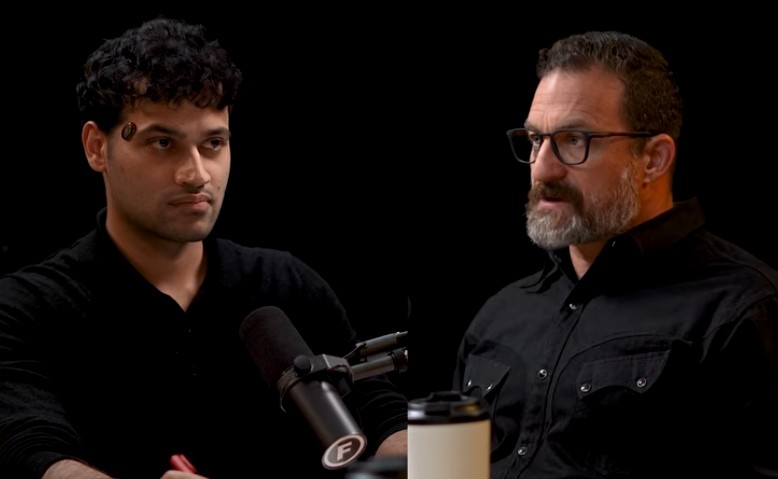
EDITOR’S NOTE: In this episode of the Figuring Out podcast (Sep 1, 2026) Raj Shamani sits down with Stanford neuroscientist Andrew Huberman to explore how daily habits can rewire the brain for focus, resilience, and high performance. Huberman explains practical tools such as morning light and cortisol timing, breathwork to raise heart-rate variability, a simple method to stop overthinking, and Yoga Nidra for better sleep. The conversation also covers a three-stage career framework—grind, regulate, and master—and how winners and losers often feel the same despair but respond in opposite ways.
TRANSCRIPT:
Welcome
RAJ SHAMANI: (00:02:26 – 00:02:54): Welcome on our show, Andrew Huberman.
ANDREW HUBERMAN: (00:02:54 – 00:02:55): Thank you for having me.
RAJ SHAMANI: (00:02:55 – 00:02:57): Thank you. It’s an honor to have you here.
ANDREW HUBERMAN: (00:02:58 – 00:02:59): Oh, well, thank you. Well, delighted to be here.
RAJ SHAMANI: (00:03:00 – 00:03:14): So tell me further, if someone’s watching you for the first time and they have never heard or seen you or they have no clue who you are, how would you explain them what you do and why they should watch this podcast?
Andrew Huberman’s Background
ANDREW HUBERMAN: (00:03:14 – 00:06:11): Okay. Two sentences of history just to orient people. I’m 50 years old. I spent nearly 3 decades as a neuroscientist. I’m still a tenured professor at Stanford School of Medicine. I now teach neuroscience to medical students and do some other teaching as well. Until very recently, I ran a research laboratory. So that was really my life from about age 19 until fairly recently.
Studying how the brain wires up during development, how it can change, so-called neuroplasticity and learning. Also some interest in neural regeneration and diseases of the eye of the nervous system. So that’s my academic grounding and my hands-on experience.
I’ve had a longstanding interest in health and fitness, both running, resistance training, a bit of martial arts, a number of different things that I’ve been very consistent with for the last 35 years. So while I’m not a certified expert trainer or anything of that sort, I like to think I’ve tried many of the things that do and don’t work, and I have thoughts both about the science around those and what I’ve found works best for me and that I think could be of value to people.
In 2021, I decided to start a podcast called Huberman Lab. Turns out I also had Huberman Lab at Stanford School of Medicine, but Huberman Lab Podcast, which is myself and a few other guys who put cameras in front of me and I started talking about how the brain wires up, how you can change it, how sleep works, how you can optimize it, mental health, modern treatments for mental health issues, everything from depression to OCD to anorexia, covering the scientific literature and offering what I call protocols, which are scripted ways to improve something or optimize something or reduce a pain point, using behavioral tools — some things you do, behavioral tools, some things you avoid.
We do talk about nutrition, supplementation, and prescription drugs as well. So I cover all of it. So I’m happy to talk about peptides, both of the conventional and unconventional kind. I’m happy to talk about hormone therapies. I’m happy to talk about behavioral tools. So the podcast encompasses all of that.
And I’ve largely done solos where I talk about these things in sort of university lecture style. But I also host expert guests in these areas because my network of science and medical doctor — scientists, excuse me, and medical doctors is pretty vast. And I know some of the best in the world. I don’t know all of them, but I’m very blessed to know many of them. And they have incredible knowledge that I feel the world should have. So I think that’s probably how you found me. That’s why I’m here. And my real love in life is learning and teaching. Things that I believe can be useful to people.
RAJ SHAMANI: (00:06:12 – 00:06:14): Perfect. That makes two of us. Yeah, yeah, yeah.
ANDREW HUBERMAN: (00:06:14 – 00:06:16): We share a kinship in that. Absolutely.
Building a “Mentally Dangerous” Mindset
RAJ SHAMANI: (00:06:16 – 00:06:41): Based on everything that you have learned, experimented, watched it fail, acquired knowledge from other people on — and your own experiments and everything, right? I want to know if I give you a 25-year-old someone, okay, right now today, and your only job is to make them mentally dangerous in next 10 years?
ANDREW HUBERMAN: (00:06:41 – 00:06:42): Mentally dangerous?
RAJ SHAMANI: (00:06:42 – 00:06:42): Dangerous.
ANDREW HUBERMAN: (00:06:43 – 00:06:44): Like, could you define dangerous?
RAJ SHAMANI: (00:06:44 – 00:07:33): Like, how can they have this unbreakable, unshakable mindset, like an elite performer mindset, that they will never collapse under pressure? Like someone who can handle everything in their life and they can choose and pinpoint what to do and then be able to do that?
Here’s a problem, what I feel. A lot of young people like me, we watch people like you, we understand and learn everything from you. And then half of the things — Monday we’re excited when we watch you, and then by Thursday we’re done. Like nothing works out. We don’t change our lives very easily, right? A lot of people don’t do that. So if I give you someone like this, 20-year-old right now, and your job is to make them mentally extraordinary or mentally dangerous in next 10 years, where would you begin?
ANDREW HUBERMAN: (00:07:34 – 00:09:31): That’s a great question. So my answer is at first going to sound a little basic, but I think it’s very important to understand the principles behind what I’m going to say as opposed to just the specifics.
In fact, this is a broader theme I believe people should take to any discussion about health or performance, which is there are going to be many, many protocols.
The most important thing for this 25-year-old hypothetical person to do is to understand that there are a few non-negotiables in their physiology and psychology that are directly linked that they have to obey as often as possible. Notice I didn’t say every single day, but as often as possible in order to get the most out of their life.
What are those? Well, as weird as it may sound, the most important thing to do is to ensure — and there are ways to do that we can talk about in a moment — to ensure that you have high morning cortisol levels, the so-called stress hormone, which is not a stress hormone. We’ll talk about why it’s involved in stress, but cortisol is involved in much, much more. You want to take steps, simple steps that I’ll describe, to amplify your morning cortisol in the first hour or two of your day. And to make sure that in the last hour or so of your day, most days, your cortisol is low.
Why Cortisol Rhythm Matters
RAJ SHAMANI: (00:09:32 – 00:09:32): Now, why?
ANDREW HUBERMAN: (00:09:33 – 00:12:32): What, what, what in the world? Like, okay, but if you were going to build a human machine, okay, and I’m not talking about psychology now, but you wanted to build a human machine — actually, let’s make it a happy, quote unquote, dangerous machine — you would say get that morning cortisol peak as high as you can, get your nighttime last hour before sleep cortisol level as low as you can.
Why? When you do that, it sets this person up to have vastly higher levels of daytime energy, focus, ability to learn, resilience to stress when stress comes along, and ease in falling to sleep, deep sleep, rapid eye movement sleep. These are the things of repair of the body, repair of the mind, consolidating learning, removing the emotional load of previous day experiences that might have been difficult or stressful, taking off the emotional load so they can go into the next day and they can continue to show up for their family, their work, their health, and so on and so forth.
It also turns out this pattern of high morning cortisol, low nighttime cortisol is the pattern that men, women, people of all ages should have to optimize their immune system function. So we’re talking about getting sick less and on and on and on. In fact, I’ve never really discussed this on the podcast, but if I only had 5 minutes to talk to somebody, I would say, look, this is the best thing you can do for your health and well-being and performance. High morning cortisol, low nighttime cortisol.
So how do we do this? People are probably immediately wondering. Before I answer, I’ll just add one additional fact. Most people have heard of melatonin, this hormone that we secrete at night in darkness that light suppresses. It helps us fall and stay asleep. Most people don’t realize that in order to get sufficient melatonin release, you need limited light exposure to your eyes. So that’s why it’s good to dim the lights. You also want your body temperature cooling. Your core body temperature going down is what brings melatonin up.
Cortisol and melatonin are on opposite cycles. High cortisol inhibits melatonin indirectly, but it does it. So if your morning cortisol is high, your morning melatonin from the night before will be lower, more alertness. If your nighttime cortisol is low, your melatonin peak can go higher. Many issues related to falling and staying asleep become trivial under those conditions. They just kind of disappear.
So we should ask ourselves, what are the things to do to boost our morning cortisol levels? And notice I’m saying morning, I’m not saying 6 AM, because one thing that is very important is, given the flexibility, some people really do best waking up between 8 and 10 AM and going to sleep later. Some people do best waking up between 5 and 7 AM and going to bed earlier. And some people are kind of someplace in the middle. Like for you, for instance, what is your — if you could control everything about your sleep-wake schedule, what time would you go to sleep?
RAJ SHAMANI: (00:12:33 – 00:12:36): Like 2, right? Yeah, like 1 or 2.
ANDREW HUBERMAN: (00:12:36 – 00:12:37): And what time would you wake up?
RAJ SHAMANI: (00:12:38 – 00:12:39): 9, 10.
ANDREW HUBERMAN: (00:12:39 – 00:12:53): Great. So let’s call 10 a.m. is your morning. 6:30 a.m. is my morning. That doesn’t make me a better or worse person. Doesn’t make you a better or worse person. We’re just different. But when I say morning, I’m not giving a clock time. I’m giving a within the first hour or two of waking.
RAJ SHAMANI: (00:12:53 – 00:12:53): Okay.
ANDREW HUBERMAN: (00:12:54 – 00:12:59): All right. How do you boost your morning cortisol? We’re building this ultra dangerous person.
RAJ SHAMANI: (00:12:59 – 00:13:05): Okay, great. But before we actually build this, why did you start with morning and not the night before?
The Morning Cortisol Protocol
ANDREW HUBERMAN: (00:13:05 – 00:17:23): It’s a good question, but the answer is that this peak in cortisol, because it’s on a what’s called a negative feedback loop, it actually inhibits itself so that once you create that peak, it ensures that the afternoon and evening cortisol is low. And I’ll explain why that is in a few minutes, if that’s okay.
So getting that morning peak going, it’s like a wavefront that starts the 24-hour cycle. So let’s assume you go to sleep anywhere from 6 to 8 hours the night before. When you are in your deep, deep sleep, so 2 or 3 hours into your sleep, your cortisol is at its very lowest just naturally. Your cortisol intrinsically, with no input from the world, starts to climb in the hours afterwards slowly, slowly, and then faster and faster and faster so that in the third phase of your sleep, if we just divide your sleep into 3 blocks, in that last third, your cortisol is rising very fast, and so is your body temperature. And then at some point you wake up. Now, it could be because of an alarm clock, it could be because you wake up naturally. That is literally called the cortisol awakening response, and it is the reason you wake up.
So when people say cortisol is a stress hormone, you don’t want your cortisol too high — that’s true for the evening and nighttime. It’s not true for your morning. You want your cortisol basically spiking first thing in the morning. So you get up, cortisol is now elevated. Cortisol’s main job is not to deal with stress. That’s just one of its jobs. Its main job is to deploy glucose and lipids from areas in your body that give you energy. It’s an energy-deploying hormone.
So that cortisol peak is rising very, very fast. The best way to spike that morning cortisol is to get bright light in your eyes within the first 30 to 60 minutes of your day. In fact, you have a unique opportunity at that time to spike your cortisol up to 50%. Five-zero.
Now, there’s 2 ways to do it. The best way to do it is to go outside, take off any brimmed hat you might have or sunglasses. Eyeglasses and contacts are fine. Look in the direction of the sun. Now, you wake up later than I do, so when I wake up, the sun is just coming across the horizon. That’s great. If it’s higher in the sky, that’s fine too. Never look at the sun in any way that makes it too bright to look out. Blink, in other words, to protect your eyes. But you can squint, you can look a little bit off and away from the sun.
But that bright light from the sun is full spectrum. It includes the short wavelength, medium wavelengths, and long wavelengths that are optimal for getting this cortisol peak. In fact, if you do that, you’ll get a big peak in cortisol within 5 to 10 minutes. On cloudy days, on overcast days, it’s especially important to do that because you’re going to likely be spending more time indoors on overcast days.
Ideally 5 minutes or 10 minutes. Keep in mind, you can drink some water during this time. You can drink your morning tea or coffee if you like. You can do other things that, believe it or not, hydration boosts cortisol. Caffeine further boosts cortisol. If you can exercise in that first hour, great. Most people don’t jump right into exercise, but this simple behavior is going to boost your morning cortisol levels. That essentially establishes the relationship between cortisol, melatonin, and your circadian clock. So the next day, your morning cortisol will start to rise in anticipation of this peak. It becomes what we call entrained.
So I’m listing off some protocols: morning sunlight, but it takes 5, 10 minutes, and you hydrate and you drink some caffeine. Maybe you move your body a little bit, take a walk, some jumping jacks or something light like that. You can bring your spouse or your kids or whatever, and you can just enjoy that time. Try not to look at your phone during this time. Do not stay in bed and look at your phone, okay? This has also a forcing function on not doing certain things.
Now, if you are able to get some physical exercise in this hypothetical situation, I’d take this 25-year-old and I’d say, “Listen, I know you don’t like to work out first thing in the morning, but you’re going to either do some cardiovascular training or some resistance training, one or the other, for 6 days a week. One day a week you can get complete rest.”
RAJ SHAMANI: (00:17:24 – 00:17:24): Okay?
ANDREW HUBERMAN: (00:17:24 – 00:24:01): And I can explain later what the optimal protocol for exercise, I believe, is for the typical person wanting to be strong and have endurance and build resilience as well, brain plasticity and so on.
The long and short of this is if somebody were to do that in the first hour to 2 hours of the day, the cortisol then starts to drop gradually around, let’s say, about 4 or 5 hours after they’ve been awake. Drops, drops just naturally, just drops. Now let’s say you get a disturbing text. Oh, you’ve got a deadline, you’re stressed. Cortisol will get deployed, but the peak in cortisol will be very brief.
Now, as that person heads into the evening, probably still working — we’ll talk about this — maybe some bright lights, you can’t control the environment, you are now buffered against some of that. You’re protected. And then at night, in the final hour before sleep, it’s dim the lights. Obviously avoid caffeine in the final 8 hours before sleep. Most days I’m drinking a little caffeine now because I got up very early today and it’s late in the day now, but I can have a little bit. That’s me. Some people might not be able to.
You want to really emphasize lowering your cortisol. Long exhale breathing is great if you find yourself too stressed and you’re kind of getting ready for bed.
Breathwork, HRV, and the Nervous System
Why long exhale breathing? There’s so much that’s been made of breathwork and meditation, but just to encapsulate all of breathwork, which long before it came to the United States in scientific form, people in India have been doing breathwork of various forms. So I want to acknowledge that.
But there’s something called respiratory sinus arrhythmia, which is just a fancy term for when you inhale with vigor and you extend your inhales, it speeds your heart rate up. Why? Because the diaphragm moves down, the heart gets a little bit bigger in volume, blood within the heart moves a little more slowly, and the nervous system sends a signal to speed the heart rate up every inhale. When you exhale, especially if you deliberately extend the exhale, because the diaphragm moves up, the heart gets a little bit more compact or smaller in volume, blood in there moves more quickly in that smaller volume, and the vagus nerve, which connects the body and brain in both directions, sends a signal to the heart to slow your heart rate down.
This is the basis of so-called HRV, heart rate variability, for people wearing an Oura or a Whoop or using an Eight Sleep or any other device. And you say high HRV is good, right? What is high HRV? High HRV is your parasympathetic nervous system, this relaxing arm of your autonomic nervous system, hitting the brakes on your heart rate.
If you want a higher HRV, you can exercise. You know another great way to increase your HRV? Do 5 extended exhales during your day, just anytime. You’re slowing your heart rate down. In your sleep, your HRV will be higher. Most people don’t realize it’s significantly higher. You’re teaching your nervous system to slow your heart rate down just by 5 exhales a day, or 3. Or one long one before sleep.
When you do an extended deliberate exhale, you slow your heart rate down, you lower your cortisol levels. Takes a few minutes to lower your cortisol levels, and you calm yourself down. When you hold your breath or you move about your day and you’re inhaling a lot and on average you’re inhaling more vigorously than your exhales, your heart rate’s going to be climbing up. So throughout the day, your heart rate’s doing this, it’s doing this. HRV — if you think, well, that’s weird, why would we want our heart rate variable? Shouldn’t we want it nice and even? No, no, no, no, because the HRV reflects the pumping of the brake on your stress system.
So in that final hour, you are ideally not drinking too many fluids because you’ll wake up, but if you’re a little thirsty, drink some fluids, no big deal. You’re avoiding caffeine. You’re dimming the lights. Why dimming the lights? Because light hits a specialized set of neurons in the eye called the intrinsically photosensitive melanopsin retinal ganglion cells. Those cells connect directly to a little region over your hypothalamus, which is your circadian clock, which then connects to another nucleus in your hypothalamus and so on and so forth, and then inhibits the release of melatonin from your pineal gland.
All this can be made very simple. Viewing bright light, ideally from sunlight in the first hour of the day, spikes your cortisol through a similar mechanism circuit with a little twist. And in the evening, bright light will inhibit melatonin. So bright mornings and days, dim nights or dark nights. That’s the ideal situation.
And we can really flesh this out even more, but I should say, if you don’t have access to sunlight for some reason, you would do well to purchase a 10,000 lux artificial light. I have one when I travel that’s about the size of a tablet. It looks a bit like the lights in this room. That very bright light is sufficient to boost your morning cortisol. Sunlight is better because it’s full spectrum, but sometimes I don’t have access to one, but I’m the guy on the plane looking at that light for a few minutes each morning. I have one in my home even though I do go outside. So when I wake up and use the bathroom, I have one in my bathroom. I have one in the kitchen, so I’m making my morning coffee or tea, I have it there. And so I’m getting blasted with bright light early in the day. And then at night, I’m either in dim light or — I generally don’t use candlelight because I worry about burning things down if I fall asleep with the candles on. But everything’s dimmed way, way down.
Now, this sounds extreme, but we’re really talking about 5 to 10 minutes in the morning, things you would do anyway.
RAJ SHAMANI: Yeah, right.
ANDREW HUBERMAN: Hydrate, caffeine, most likely exercise. Ideally, that takes a bit longer. And then at night, things that you need to turn off the lights at some point. You need to bring your level of activation down, learning to turn your mind off. This is the key to long-term resilience. And becoming, as you call it, dangerous.
If you are somebody who can push, push, push on the gas pedal, but you don’t know how to turn your mind off — let’s make it competitive. This will get people going. Give me 2 people. Both can work very, very hard. Both extremely committed to their goals. And both have perfect circumstances in terms of access to food and exercise and all the things. The person that can turn their mind off in the final hour of their day and get the better, deeper sleep, I’m going to put all my money on that person within 5 to 10 years far surpassing the other.
Turning Off the Mind
RAJ SHAMANI: (00:24:01 – 00:24:21): And how to turn off if someone super competitive is already feeling like they’ve lost in some way because the internet has made them believe that they’ve lost it already, right? So they’re in the hyper-competitive mode, they just don’t know how to turn off. How can somebody turn off and feel less restless?
ANDREW HUBERMAN: (00:24:21 – 00:24:58): Yeah, this is a great question. And it’s going to take us a little bit in the direction of psychology. So I just want to make sure before we move on that I’ve closed the hatch on — yes, boost your morning cortisol by sunlight or 10,000 lux artificial light. Hydrate. Listen, do this every morning. But if you wake up on a plane and you don’t happen to have this 10,000 lux light, open the window. If you can’t do that, you’re going to be fine. You’ll live a day, you know, so do the other things. Hydrate, drink some caffeine. I don’t — you don’t want to burn extra energy on the neuroticism of trying to get everything right. That’s making you weak, right?
RAJ SHAMANI: (00:24:58 – 00:24:58): You need—
ANDREW HUBERMAN: (00:24:59 – 00:33:23): —and I look at every opportunity to build resilience. This, like we were saying before we started recording, yesterday I had far less sleep than I normally get. I feel great today. I have a practice for that which I can talk about, recovering mental and physical vigor. But I really wanted to see my best childhood friend who’s a neurosurgeon and neuroscientist do a neurosurgery and be there. And also, I recorded yesterday and I very much wanted to be here, and it meant flying yesterday and the flight was delayed.
So instead of getting angry about the flight being delayed, I always ask myself one of two questions: do I completely relax or do I continue to work? What I don’t do is any in-between. I am perfectly fine just sitting there completely relaxing. Yes, let yourself scroll social media for a short period of time. Let yourself watch a movie, socialize, text with friends, call your mother. You know, my mother’s already called me more. So, but don’t do a hybrid of the two, or really focus in and get some work done.
At the airport yesterday, I decided I had had a long day. I knew that today was going to be a long but exciting one. Decided to just get complete rest. On the flight into San Francisco, I took a brief nap, got to my hotel, got things settled, and I could feel my mind going towards, “ah, I’m going to be tomorrow.” What good does that do? And you always should be asking the question, is this in the left column or the right column? And I’ll explain what that means.
The Left Column, Right Column Exercise
A guy named Andy Stumpf, he’s a former what we call Tier 1 SEAL Team operator. He has a podcast called Clearing Hot. He’s a super impressive guy from his work in the SEAL Teams, and he went on to break 2 world records doing other difficult, dangerous things. But he has this exercise that he shared with me, which I do, which is: you take out a sheet of paper, you do this about once a month, and you write down in the left column all the things that concern you. What people think of me, what I see, worries, everything. You put all that in the left column. In the right column, you put all the things that you can actually control. What can you do? Exercise, hydrate, sleep, practice turning your brain off, call your mother — all the things that — and what you realize is that you really don’t have any control over the things in the left column. And we all know this. But this exercise, it’s so valuable. I’m so glad Andy taught it to me. I read about it first in his book Drown Proof, which is an excellent book. But then he described it to me directly.
For the month afterwards, you notice when things are in the left column or the right column. So last night I was thinking, oh yeah, like if I even thought — because this is the way the mind goes — someone sets off a fire alarm or someone’s loud in the hotel, I’m going to get even. I’m like, can I control that? No, I can’t control it. You notice how crazy the mind is with all these concerns and how few of those concerns you can actually impact.
So that’s the main way you do it. And every opportunity to stress is an opportunity to practice stress resilience. Every opportunity to stress is an opportunity to let go of some component. These opportunities come all day long. You don’t have to be David Goggins to be in the pressure test all day long. We are all in the pressure test. And even just keeping your mind in that right column. So I actually, around our podcast studio and with my friends, we sort of have this saying now, like, “that’s a left column issue.” And so it becomes this question. I think it varies culturally. Do you talk about it or does that build it? Maybe talking about things allows you to expunge it, to delete it. I think it builds it. Stay in the right column.
And when your mind starts drifting into the left column, great. That’s a great opportunity to practice getting your mind back over into the right-hand column. How do you do that? You think about literal actions. You get extremely present. “I can take a sip of water.” Might sound trivial. “I can smell what the air is like in here. Feels good. It’s so quiet in here. I really like the background quiet of this place. I’ve enjoyed meeting you. I learned about some new neurotech already based on the devices on your temple.” Like, you can really get present and suddenly — this comes from my training as a neuroscientist — the brain works in what are called dynamic attractor states, which is not a way of trying to sound academic or fancy.
Think of your thoughts and your emotions as a ball bearing on a flat surface. But as you think more about something, that surface starts to become concave. And as you learn more about it and you go into it and you think about it, it becomes a trench. And now that ball bearing is locked in that trench. And typically it takes something very robust like calling a friend and them saying, “what are you doing?” Or getting a good night’s sleep or exercise or some great event to knock that ball bearing back onto its flat surface again.
But you are in charge of your mind. And, you know, at 50 years old, I finally realized that it’s possible to control one’s thoughts. It really is. You can learn to steer your thoughts. You can’t eliminate thoughts, but you can take your mind to where it needs to go. And there are opportunities all day long to practice this.
Right before I came in here, I went in the bathroom. Yes, I use the bathroom. And I have a practice of prayer right before I do or go on any podcast. I ask for clarity. I ask for the opportunity to share knowledge that I hope will be useful to people. I offer up the opportunity for new unexpected things to come through. I did that. I do it every single time because I take you and I take this very seriously, right? People are giving us their time. I’m not a person who neurotically controls every aspect of my life, but I take every opportunity I can to make my life better because in this case, I like to think that us having a richer conversation will benefit people more.
Yoga Nidra and Non-Sleep Deep Rest
So learn to turn it off. But that comes from practice, and you’re getting micro reps all day long. The more stress, the more opportunity. The more stress, the more opportunity.
Now, in order to learn to fall asleep at night, high morning cortisol, don’t drink caffeine too late in the day, get exercise at some point, ideally in the first half of your day, but if you have to do it in the evening, do it in the evening. But I am a huge, huge believer, practitioner, and fan of a practice that originated in India, which is called Yoga Nidra. This, in addition to the morning high and nighttime low cortisol, is in my mind the most powerful tool that we can cultivate because it teaches you to turn off thinking and planning and allows you to learn how to get into pure sensation. It sounds so squishy, but I’ll tell you, no drug will do this, at least not in a healthy way. Any drug that takes you out of thinking and planning and just into pure sensation, that drug is going to rebound you into a rough place when you come out of it.
Yoga Nidra — and in fairness, a few years back I started calling it non-sleep deep rest. This is a great opportunity to talk to your audience, who may know that some people were critical of that decision. The reason for that is I wanted people to understand the real value of this practice, and I always make the effort to credit Yoga Nidra as the origin. I take no credit for this practice. But in quote unquote “the West,” such a silly term, right? But in the West, there’s this assumption people hear yoga and they think movement. And then a lot of people, they think, “I don’t want to do yoga,” which is just their own limitation.
But Yoga Nidra involves what? It involves lying or sitting down. Long exhale breathing, slowing the heart rate down. Deliberately noticing my mind is in a mode of thinking and doing and planning. I’m going to move it into pure sensation. Just focus on what I hear, what I feel. This is so critical. This is the first and most basic step in what I call turning your mind off. It’s turning off planning and thinking and doing. And it’s a skill. You do this for 10, 20, or 30 minutes, 1, 3, or 7 days a week. And across a couple of years, you get very good at it.
So I started in 2017 and I thought to myself, this is remarkable. I can fall asleep more easily if I wake up in the middle of the night. I know how to turn my mind off.
RAJ SHAMANI: (00:33:24 – 00:33:25): Do that again.
ANDREW HUBERMAN: (00:33:25 – 00:37:20): I do it again for 10 minutes. There’s also an eye movement trick that you can do. You want to hear something really wacky? So there’s a paper published a few years ago where they developed this giant bed that rocks back and forth and people fall asleep very quickly.
RAJ SHAMANI: Hmm, okay, well, I don’t have a rocking bed.
ANDREW HUBERMAN: You don’t have a rocking bed. It’s not very practical. There’s also a paper published in a really fine journal showing that there’s a particular rate of walking and swaying that parents naturally find that puts their baby to sleep, and it matches the same rocking speed, right? It’s a very slow back and forth rock. You say, okay, this is age-old wisdom, but what does this do? You would think it was the physical sensation. And in some sense it is, but turns out, and this is the basis of some new technologies that I’m not a part of, but I’ve had the opportunity to try, of eye masks that can induce sleep.
The Eye Movement Sleep Trick
The next time you have trouble falling asleep or getting back to sleep, keeping your eyes closed, slowly move your eyes to one side, then to the other side. Then you’re going to move your eyes counterclockwise. I told you it would be kind of crazy. Then clockwise. Then kind of look towards the tip of your nose. You’re not crossing your eyes, and then exhale.
Now, when you do that, because there is a relationship between the eyes and your cerebellum, this primitive area of your brain that controls balance, you disrupt what we call proprioceptive circuits. Proprioception is the knowledge of where your limbs are in space. To fall asleep, you need to forget your body position. This is the first critical step in falling asleep that nobody talks about. And so now there’s some really interesting technology stimulating and inhibiting certain brain areas that control proprioception, and it makes people sleepy and they fall asleep.
So as crazy as this sounds, this really works. It really works. It really works. Now, if you drank 4 cups of coffee and you’re ruminating over something, it’s not going to override that. But if you wake up in the middle of the night, you go to the restroom, for instance — I woke up, I can go back. Maybe it’s noisy, someone made a noise. Close your eyes, and with your eyes closed, you’re going to move your eyes — it doesn’t matter to the left or right first — but you go one side and the other side. Maybe do it again if you want. Then counterclockwise, clockwise. Then you kind of point your eyes toward your midline or your nose, and then you exhale and you forget body position.
Many, many people who I’ve taught this to write to me and say, “I can’t believe it,” but then they wake up the next morning. It’s wild. I did it on the plane ride here. I was out.
Also, these circuits that we access in Yoga Nidra of self-directed relaxation or of turning off proprioception, our knowledge of our body position — they are amenable to plasticity, which is simply to say that they get stronger in response to these behaviors over time. The plasticity of these behaviors is really critical. You get better at it the same way that, I’m sure, you sit down and you’re really excited about something, you’re in immediate focus. But I’m guessing at some point in your school career, your career career, you have something like, “I don’t want to do this.” But you know how to get in gear. You think, okay, what do I have to do? Maybe you watch a YouTube video, maybe you don’t. You turn on some music, you tell yourself, “what’s wrong with me?” Like, “all right, let’s get this.” You call someone, “let’s do it,” and you’re in.
Yeah, you know how to ramp up, but do you know how to turn it off? Do you know how to ramp down? And you know, the best athletes know how to do this. That’s a skill you learn. And so this 25-year-old person, I would say, great, you are in the peak of the opportunity to still rewire your brain in the right ways. That includes get-after-it culture. But how are you going to turn off your brain to restore, reset, dump the data that’s not significant from the day before? The conflict you had with someone, the thing you saw online, is an attempt to steal your focus and energy and sleep.
RAJ SHAMANI: (00:37:20 – 00:37:20): Yeah.
Protecting Your Energy Online
ANDREW HUBERMAN: (00:37:20 – 00:40:05): When I go on X, I’m literally — it’s warfare. I’m a benevolent player there, but you’re not going to take my energy. I think about this. I have a shield up. You’re not going to take my energy. If somebody says something about me, I know what they’re trying to do. They’re losing energy by — but I’m not going to let them take it. It’s a video game, and you win by taking as many of those attentional resources and putting them into your health, your well-being. This includes how you treat other people.
You think you’re a high — can you be a high-focus, driven person and switch it off? That’s a mental, career, financial, whatever you want to call it, physical athlete. That’s the dangerous person. I don’t worry about the person who can just get after it and drink 12 cups of coffee. Pop an Adderall and just outwork everybody. So the next morning they’re outworking everybody. “Okay, see you on Thursday. I’m going to blast past you.”
And I actually learned this when I was first starting off in neuroscience. I would go to meetings. I never liked drinking alcohol. First of all, I don’t like the way people act when they drink alcohol. There might have been a few weddings or parties in my life where I’m with friends I really know and we have a few drinks and there’s that bonding feeling. It was great. Let’s be honest, it was great. But most of the time at scientific meetings, I just noticed people being sloppy and stupid, saying dumb things, getting themselves in trouble. Also, I was there to build my career, so I thought, well, maybe in 20 years when I’m a tenured professor, I’ll do that.
But now I’m going to bed early on night 1, and on night 2, those guys who are really established, they’re kind of dragging. By day 3, they’re falling asleep. And they’re with their mouth open and drooling in the meetings. And a bunch of students do too. These were athletes. I’d be like, “this is too easy.” I’m still there, front row, taking notes, getting my workouts in. And on the last night, I might have a good time. So it’s not that I don’t have a good time, but from day one, I’m going to pass you — not you, but you get the idea. I’m going to pass up the next person by what I don’t do. As much as what I do.
And we don’t hear about this because it’s a little bit hard to put all this into a 90-second clip on social media. So a lot of get-after-it stuff — take this peptide, take this stimulant. And listen, I love caffeine, and I think there’s a place for these tools, but it’s much easier to get in gear. How do you do that day in, day out, consistently? Have a reset day. One day per week I don’t exercise. I try and spend as much time in fresh air, sunshine, and relaxation as I can. But if I can’t, I might just veg all day, do nothing half a day. Watch a movie with my girlfriend, relax, just kick back, hang out.
RAJ SHAMANI: (00:40:06 – 00:40:06): Be—
The Zero Cortisol Day and Ashwagandha
ANDREW HUBERMAN: (00:40:06 – 00:44:18): I call it — I sort of joke it’s our zero cortisol day. No such thing as a zero cortisol day. I still get the sunlight in the morning, get that cortisol peak. I didn’t emphasize this enough before, but I’ll just return to — if you have a high morning cortisol peak, any stress that comes, you’ll be able to deal with it. There’s actually really good data on this. I’m not here to plug my book, but I have this book Protocols, which discusses this, that the return to baseline of cortisol after a stressor is much faster if you had high morning cortisol.
The worst situation is what’s called flattening of the morning of the cortisol curve across the day, where it’s not a big peak in the morning. It’s kind of high mid-ish baseline into the evening. Any stress that comes is riding on a higher baseline. Now it’s carrying into the evening. It’s shown to disrupt all sorts of things. Blood glucose regulation, all the negative effects of cortisol, so-called chronic stress, are really about afternoon and nighttime high cortisol. We’re never told this.
Also, if you’re somebody who uses, for instance, ashwagandha to suppress cortisol, that should definitely be done in the final hours of the day, not in the morning. Small amounts in the early part of the day, fine. Later in the day, not so good. I don’t recommend people take ashwagandha for long periods of time, maybe for 2 — well, it potently reduces cortisol. By one study, depending on the amount, about 600 milligrams, twice or so, can reduce cortisol significantly by about 30%. You want high morning cortisol, so you want it in the afternoon. I would say if you’re going to reduce cortisol using ashwagandha at high doses, you want to limit that to about 2 weeks without taking, and then take 2 weeks off. In moderate doses, 300 up to 600 milligrams, it’s probably fine to take consistently, but in the second half of the day.
Some people take things to fall asleep. I think things like magnesium, theanine, apigenin, which is chamomile tea, or things like ashwagandha can help. But if you’re not doing all the right behaviors, it’s going to make a trivial impact. And I have been somewhat bullish on experimenting with things like pinealon, which is a peptide that can help increase REM sleep, but only every once in a while. I don’t think it’s good to rely on pharmacology to induce sleep too often. Also because you’re short-circuiting your ability to turn your mind on.
But I do like stimulants early in the day, in particular caffeine. That’s my main stimulant. Alpha-GPC and things of that sort. Energy drinks. Do you use nicotine?
RAJ SHAMANI: [gestures no]
ANDREW HUBERMAN: It seems like everyone uses nicotine now. Good for you. You might be the one male under 40 I’ve met that doesn’t take nicotine. Nicotine creates an alert but calm state, which is a very coveted state. It’s hard to get that state, but it does increase blood pressure. And it’s very, very habit-forming. I mean, you see these guys who start with one 3 milligram pouch, then a 6 milligram pouch. Pretty soon it’s 5 pouches a day. I love competing with those guys because in a few years they’re going to have other issues.
So, my dad, who’s a scientist, taught me this long ago. He said, “listen, you got to learn to be a long-distance runner. This is a long game. You want to win the long game.” You want to win the short and the medium game too, but you want to win the long game. And anyone can push hard in the short term, but you’re just going to see people start dropping out.
So take care of those final hours of the day. Learn to turn it off. You can also practice yoga nidra with a 10, 20, or 30-minute script. There are tons of them on YouTube. We have some on our web page. They’re all zero cost. It just depends on what you like. You could do the practice in the day if you don’t get enough sleep, for instance. I highly recommend doing it first thing when you wake up in the morning to recover the sleep you didn’t get. It’s very potent at recovering mental and physical vigor. If you can’t do it then, in the afternoon, I always have a little bit of a dip around 2 PM. If I didn’t sleep enough the night before, I religiously do a Yoga Nidra between 2 and 3 PM, maybe even 10 minutes, ideally 20 or 30. Come out of that, hydrate, maybe a little bit of caffeine, boom, you’re right back. There’s now data showing that pockets of your sleep, of your brain go into deep sleep and maybe even REM sleep while you do nidra. So it’s very restorative. There is no pill that will do this. There’s no pill that will do this.
RAJ SHAMANI: (00:44:18 – 00:44:21): And you don’t do that at night? Yoga nidra before sleeping?
Knowing Your State
ANDREW HUBERMAN: (00:44:21 – 00:45:21): I generally don’t because I don’t have trouble falling asleep. The challenge I’ve had over the years is falling asleep and then waking up at 2 or 3 or 4 in the morning and not being able to go back to sleep. The eye movement trick plus doing nidra during the daytime has — I have the ability to turn my mind off and go back to sleep.
The real key to becoming what you call dangerous and ultra-resilient or antifragile, whatever language you want to use, is you learn to recognize what state you’re in. This is the piece actually that sits even deeper than all the rest. The Oracle said it first, but “know thyself.” You have to know where you’re at. Am I in a good state? Am I in a vulnerable state? If I go on social media now and I see something that upsets me, am I just going to go down that rabbit hole? We all like to think we can just blaze through life, but knowing where you’re at is like checking the engine, checking the machine. Is the steering aligned? When I don’t sleep as much as I need to or I have stressors in my life, my steering’s not aligned. So I have to do other things to keep myself in check.
RAJ SHAMANI: (00:45:22 – 00:45:22): You know?
ANDREW HUBERMAN: (00:45:22 – 00:45:30): Yeah. So it’s about building in a resilience that includes flexibility. And I think people here, they think rigidity, but it’s not that.
Raj’s Discovery of NSDR
RAJ SHAMANI: (00:45:30 – 00:45:33): You know, I’m working really hard on having a turn-off button.
ANDREW HUBERMAN: (00:45:34 – 00:45:35): That’s the hard one, right?
RAJ SHAMANI: (00:45:35 – 00:45:45): It’s really, really hard. And there was about like 3 years ago, there was a phase of my life where I was just pushing through, pushing through. Really like—
ANDREW HUBERMAN: (00:45:45 – 00:45:46): —yeah, I get the sense you’re that kind of guy.
RAJ SHAMANI: (00:45:47 – 00:46:19): 3 hours, 4 hours sleep. And that’s when I discovered NSDR Yoga Nidra from you. And there were like audios, 10 minutes, 20 minutes. And I was doing like 3 podcasts a day, like 3 hours. And then what I started doing — my team started noticing, like in middle of one guest would leave and then I would have like a 30-minute break before the next guest comes, right? And I would put in the NSDR audio by you and I would just lay down and I will fall asleep like a baby. And they were like, “where did Raj go?”
ANDREW HUBERMAN: (00:46:19 – 00:46:20): Yeah, awesome.
RAJ SHAMANI: (00:46:20 – 00:46:36): Like, “where is he?” And I’m under the table sleeping. But those 10 minutes, 15 minutes gave me so much energy, which probably even a coffee didn’t give me, right? That was so good. Like those 10, 20 minutes, your mind needs to turn off.
Taking Yourself Seriously
ANDREW HUBERMAN: (00:46:36 – 00:51:44): You need to go into this — some people call it default mode network, which is associated — people get confused because the default mode network is associated with depression if it’s too high. But you need to go into idle. You can’t just push this engine that is your brain and nervous system all the time. I mean, you can do it. The problem is you can do it for a while.
But what I love about what you just described is, and this is another piece, so I’d say know thyself, learn how to turn your mind off, meaning learn how to turn off thinking and planning. I’m not saying turn thoughts off. You can still learn how to go into pure sensation and relax. Boost your morning cortisol, keep it low at night, which allows your melatonin to be high. So these are — we’re sort of building out a framework here.
And then the other one is take yourself seriously. And taking yourself seriously is both hitting the gas pedal and knowing how to do that and knowing how to come off the gas pedal so that you can come back and do it again. You gave a really great example. What I heard, what I thought as you told me that story is, “awesome, you’re taking yourself seriously.” You’re the equivalent of a professional athlete or somebody who’s studying for their boards for neurosurgery for medical school. Whatever somebody is doing, 15 years old, 20 years old, 25 years old, take yourself seriously.
Now, people hear that and they think, “oh, more rigidity, no fun, no laughter.” No, laughter is great. Having a great time with your team is great. But the people who become leaders, the people who win in their fields, the people that do it consistently over time and enjoy the process and have healthy lives internally and externally, they know how to switch it off and they take themselves seriously.
And, you know, I think it probably comes from my dad’s side, that I would go to these scientific meetings and I was like, “how could these people be so serious about their careers but then they’re like partying through the meeting?” And I realized, oh, many of them are actually just really brilliant, so they can do this. None of those people are around anymore. They’re not in the field anymore. Natural proclivities and genetic gifts, they’ll carry you pretty far. But the people with genetic gifts and natural proclivities and circumstantial gifts that take themselves really seriously, they excel.
Most of us have some opportunities and advantages afforded to us. Some people have none. The only way for all these people, all 3 categories of people, to excel in the long term is you have to take yourself seriously. And people will hear this and think, “oh, like Huberman, he’s just like, take it.” Yeah, take it. You’ve been gifted this life, right? It doesn’t mean you don’t smile, experience joy, take a day and just completely relax. You want to be present to people. But if you don’t take these things seriously, what ends up happening is you default to the mean, the dominant culture that you’re surrounded with.
So if you’re around people that like to work hard to play hard, okay, cool. But pretty soon you’re playing as hard as you’re working, and that doesn’t look so good over time. Or you’re around people that have given up, or they’re getting depressed, and now you’re not the person that can be there to really support them. You’re one of them. So nobody is made of steel, right? We’re not robots. But take yourself seriously, take your life seriously.
And I know your listeners do that, but I think that perhaps they’ve been taught, or they’ve convinced themselves that to take oneself seriously is to never come off the gas pedal. A Formula 1 driver knows that it’s not just pit stops. The car needs care, it needs love, it needs rest. But when you rest and how you rest is absolutely key.
And the other piece of it that becomes tricky is which people belong in your life, which people don’t. And that’s a tough one because it starts to sound rigid. When I hear about people’s like, “I eliminate all toxicity from my life,” there’s no such thing. Toxicity comes through the phone. There’s no such thing. There are going to be people who have challenges and they’re not handling them well. Are you going to be in a position where you can help lead them and guide them and be the calm in their storm so that they can hopefully, if you need it, be the calm in your storm? That’s how it works.
So I love that you do nidra in between. And if, listen, if one day you decide, every once in a while you just scroll Instagram instead, cool. If you reset. What you don’t want to do is scroll Instagram thinking, “I should be doing yoga nidra, or I should be doing the other thing.” When our mind is split between 2 places, that’s the most taxing thing. When we’re trying to focus but we can’t, when we’re trying to sleep but we can’t. The mind thrives on kind of unitary states, but those are hard to get into. We need to train ourselves to get into them. And sadly, the mind defaults to unitary states like anger and frustration very easily. And most of the algorithmic stuff — not all of it, but a lot of it — is designed to get you into those states very quickly so you’re not doing anything else.
The Biggest Lie About Mental Toughness
RAJ SHAMANI: (00:51:44 – 00:52:27): Yeah. You know, this used to be one of the biggest lies that I used to believe in, that you don’t need an off button. And I’ve been this hustle, hustle, hustle, work, work, work, be obsessed. I’ve been like a kind of a poster boy for a lot of my life, just like that in my family and friends. And I’ve been there and I’ve realized in last couple of years — like not even a couple, very recently — that you need to take a break. You need to actually have an off button. And now I’m very consciously practicing that. Trying to take enough, right? What do you think, what’s the biggest lie which we hear in the world about mental toughness or about elite performance?
ANDREW HUBERMAN: (00:52:28 – 00:54:11): Yeah, great question. I think put simply, it’s that the goal is to just build a bigger and bigger capacity. What we don’t acknowledge, and people need to understand, is that the better you get at something — this is a weird one — the better you get at something, the more of an inroad into your energy it creates.
Now, this is weird, right? Because when you’re first learning something, it takes a lot of energy. Then you get fluid with it. You can sit down and podcast. I can sit down and podcast under most any conditions, right? As long as there’s enough oxygen in the room, and maybe even if there’s not, you and I can have a great podcast. We just know how to do it. But to really drop into your craft — and I don’t care if it’s podcasting or finance or sport or medicine — it creates an inroad into your energy and it is greater than when you’re not very skilled at something because you’re engaging more and more and more focus.
So I think there’s 2 things. The early part of any career, you have to find your edge. So this runs a little bit countercurrent to everything I’ve said, but you’re trying to figure out, “how little sleep can I exist on?” Okay, I break at 2 nights, no sleep, I break. I can do one night. In fact, I did it last week. 30-hour work stretch with my business partner. I haven’t done that in a long time. We did it. It hurt. We did it. We carried each other. I was like, I could tell when my mind was getting wobbly, he would step in. We would do things and we did it. We had to do it. Feels good. I don’t really want to do that again for a long while, but I built that capacity over many years. You build that capacity by finding your edge. Now, you don’t want to die or injure yourself or become mentally sick, but you get to that edge and then you stay away from that edge.
The Three Phases of Building a Career
RAJ SHAMANI: (00:54:12 – 00:54:12): And then—
ANDREW HUBERMAN: (00:54:13 – 00:57:43): —so I would say in the first year or two of doing something, go for it. Just go all in. Reset only as needed to just keep coming back, keep coming back, keep coming back. But at some point, you’re going to hit a wall. You want that wall to be a non-lethal wall. You want that wall to be, “I’m exhausted. I need a week off. I can’t afford a week off. Okay, I hit my wall. That’s my limit. What can I do every day at this point consistently over time?” And work around that average. It’s going to balance around that average plus or minus 2 hours or so.
So for me, like you, I have a pretty large capacity if I do the right things in between. On the way here, I cleared my mind. On the flight in, I slept. I know how to clear my mind and reset. But I can probably do anywhere from — depends on the work — anywhere from 5 to 10 hours of real work per day. Real work. That’s not including the lunch break. It’s not including the walks. Five is doable. Six to 7 is doable. Hurts a bit more. Ten hurts. The next day I’m not doing 10. I’m borrowing from the next day where I can only do 5, right?
And you know this, but I had to find that. I had to establish that you build that up the same way you build up strength. There’s a beautiful parallel to resistance training. Everyone knows, okay, you do your sets and reps, you take the reps to failure or close to failure. You allow some period of time, the muscle gets stronger, you come back. But an old principle from resistance training that’s still very true is as you get better at it, you know how to really cramp the muscle hard. You know how to really push it. You know when the harder reps are coming, you get better at inducing the stimulus, the stress stimulus that causes the adaptation of growth and strength increase. You need fewer sets after resistance training for 10, 15 years. People say, “oh no, no, you need to do more.” No, you need to pour more into fewer sets. You have the ability to do that.
Now, when somebody first starts resistance training, they can’t generate that kind of focused intensity. So the more focused intensity you can bring to something, the more volume and focused intensity, the more rest you need to offset that. So what ends up happening is at your stage — I would say like the first years 1, 2, and 3, I think you can go on all gas pedal in anything, just all gas pedal. Work, work, work, learn, learn, learn, do it. Don’t die. The goal is just don’t die, but just go all in.
Then in years 4 or 5 or so, you’re learning how to create some balance and be more effective. You’re just trying to stay out of chronic illness. You’re trying to stay out of autoimmune conditions. This is typically, if people don’t do this, when their hair starts falling out, they start getting skin issues. The nervous system is under stress. It’s just — that nighttime cortisol is too high. If we really want to break it down, that’s what’s happening. The rhythm is off. The nighttime cortisol is too high. You’re not resetting the nervous system and therefore the endocrine system and therefore all the immune system and so on. And some people break at that point.
I do think that there’s variability. People who are very driven, who are kind of high-wired — I’m of that sort, you might be of that sort — they tend to have a certain physical stature. They’re kind of go, go, go. They’re kind of electric, and they know that electric and it feels really good, right? They tend to veer more towards autoimmune conditions because they can push, push, push, push, push, and the cortisol just keeps coming. And they can keep going. Some people just go into like a chronic fatigue.
RAJ SHAMANI: (00:57:43 – 00:57:44): Boom.
ANDREW HUBERMAN: (00:57:44 – 01:02:56): They just crash. They just crash. My problem, your problem is we don’t crash. We keep going, but our baseline is dropping. So the key is around years, I would say, 4, 5, 6, you’re learning to bring the balance in. Now, by years 6, 7 — there’s some overlap there, obviously, 6, 7, 8, 9, 10 — you’re a pro. Now you’re a pro. You know when you’re stressed, you know when you’re feeling extra good, you know when you need to nidra, you know when you need to get off your phone and go do this thing, and you know what to go do. So it doesn’t mean you need 10 years to get good at something. You can get real far real fast in 3 years, but you can’t keep that pace up. You have to learn to dynamically regulate it.
And the unit of analysis, the unit of time to focus on, is the day. What can I do today? This is another big part of shutting your brain off. I’m not thinking about tomorrow as its own thing. I know it’s coming. I know I’ve got stuff to do, but what can I do today to get the most done but know that I’m coming back tomorrow and I’ve got to do it again? I want to do it again.
So years 1, 2, and 3, go for it. Years 4, 5, 6, learn to dynamically regulate it. Beyond that, you’re a pro, and now you really can start to integrate the principles of what — and that’s when you also can start guiding your team better. “Hey, listen, that’s a left column issue. Clip it. You’re inhaling too much oxygen for this problem. Go turn it off.” I have a lockbox for my phone that I still sometimes use, but I don’t need it quite as much these days. But I needed that at some point because there was just too much incoming. And this is what you’re really becoming — a mental athlete, right?
A Weekly Fitness Rhythm
And then in terms of physical well-being, I do think that there’s certain physical activities that can help reset the nervous system. People are different, but for me, once a week I need to go on a long jog or run or cycle or swim. So it’s an hour, slow, really slow. I do that typically on Sundays. I like to do it out of doors. I might do it socially, with someone else or other people. But it’s an endurance thing. I’ll listen to podcasts or books and I’ll just go. This last Sunday, I just went for a slow jog, out and back, 45 minutes. The whole work of the thing is to not go any faster and just do it. That takes me into the week.
I start my week with a hard leg workout. That’s how I like to do it. But it’s brief. It’s only about an hour. A couple warm-up sets and a couple hard work sets for each muscle group. So that means some belt squats or some leg presses, and some hamstring curls, taken to failure, 2 or 3 sets. This is important. You want to keep the body strong, especially the lower body. You get that out of the way early in the week. But I don’t push to exhaustion because it’s Monday and I have a long week ahead.
Next day, rest. I didn’t do any exercise today. I try and walk in the morning, I get my sunlight, I do these things, but take that day off after the leg day. A day later, depending on how I feel, I might do some resistance training again, but typically I will do some sort of easier cardio, only about 30 minutes. Just keep the cardiovascular system going, blood flow to the brain. These things really help improve brain function, blood flow, improve sleep, and so on, but nothing excessive.
The next day I’ll do some sort of pushing and pulling, so some pressing movements for the chest, some pressing movements overhead, some chin-up type movement and some rowing type movement, some abdominals. So it’s just kind of general torso stuff. Same principle, a couple warm-up sets, a couple hard work sets to failure of each exercise, you’re done in an hour.
And then the next day I do some sort of cardio, very brief, to get my heart rate way, way up. VO2 max type training, just once a week. Get on the AirDyne bike, warm up for a minute, and then pedal hard, hard, hard for 20-30 seconds, rest 20 seconds, and then repeat. Hard, hard, hard, something like that for 6 rounds. By the end, your heart rate is maxed out, you feel like you want to die, but then the rest of the day is pretty easy.
This rhythm works very well because you’ll get strong, you’ll have endurance, you’ll have the ability to sprint and go fast. You’re not going to be the fastest or the best runner, you’re not going to be the strongest, but you’re going to have all-around fitness. Your posture will be good. I’m 50 years old. I’ve been training this way for 35 years. And I can tell you, anyone can do this — male, female, whatever age or hormone status. You can do this, but you need to find your walls. You need to find your limits, and then you need to decide if you’re going to push past them.
And I think for me, the real joy is in trying to share tools with people, like the morning cortisol stuff, the low nighttime cortisol stuff, and the many other protocols we cover, so that they can set themselves up to be in the best position to succeed over time. Because if you don’t get that right, you’re not going to succeed over time. There are many things you can take to give you energy. There are many books you can read for inspiration. I don’t even think about inspiration anymore.
RAJ SHAMANI: (01:02:56 – 01:02:56): What?
ANDREW HUBERMAN: (01:02:57 – 01:03:18): I just don’t. I try and look for themes in the world where I like to interact with people like you, like my friend Eddie that I saw do neurosurgery this morning, who are really in their element. Because there’s a vibe that comes from that. And over time, you just find that you’re surrounded by people like that.
Dealing with Online Criticism
RAJ SHAMANI: (01:03:18 – 01:03:19): Agreed.
ANDREW HUBERMAN: (01:03:19 – 01:04:34): It’s like a bunch of tributaries come together. And then I’ll encounter people during the day that are struggling and they’ll say, “hey, do you have any advice?” And of course I’ll stop and give them my time. But as you continue to do well and take care of yourself, you just notice your whole world is made up of people that are really positive. And then you don’t have to worry so much about all the downer stuff.
It’s also important to keep in mind that when you go online, you’re in the open waters of everything from very healthy to really just mentally ill. We have to remember that on the internet, a lot of people are not well, and they’re stressed, and they’re tired, and you can send them love, but do not let any of that erode your well-being. You cannot. I mean, you’re a public figure. I became a public figure at 45 and I’m 50 now. I like — what do you do? I mean, that takes a lot of strength of mind in order to not — because I’m sure people say many, many kind things, but occasionally people try and puncture your balloon by just being unkind because they’re kind of semi-broken people. So how do you deal with that? What is your tool?
RAJ SHAMANI: (01:04:35 – 01:04:36): I don’t — it doesn’t affect me.
ANDREW HUBERMAN: (01:04:36 – 01:04:36): I don’t know why.
RAJ SHAMANI: (01:04:36 – 01:04:38): Like, it just—
ANDREW HUBERMAN: (01:04:38 – 01:04:41): —oh yeah, healthy upbringing. Yeah, your parents must have done something well.
RAJ SHAMANI: (01:04:41 – 01:04:42): I absolutely thank them.
ANDREW HUBERMAN: (01:04:42 – 01:04:43): Yes.
RAJ SHAMANI: (01:04:43 – 01:04:50): Yeah, yeah, for sure. Yeah, it doesn’t affect me at all. Uh-huh. Things — and I have a similar thing, which—
ANDREW HUBERMAN: (01:04:50 – 01:04:52): —and we’re not just saying that for the cameras. No, it really doesn’t.
RAJ SHAMANI: (01:04:52 – 01:04:57): Like, you can ask my team, and they will tell you, and I can do that. I mean, it’s my show, I can cut the wrong stuff.
ANDREW HUBERMAN: (01:04:57 – 01:04:58): Yeah, sure, sure.
RAJ SHAMANI: (01:04:58 – 01:04:59): Be honest with you.
ANDREW HUBERMAN: (01:04:59 – 01:05:05): No, but I think it’s interesting that a lot of public figures and non-public figures, they struggle with that.
RAJ SHAMANI: (01:05:06 – 01:05:41): I don’t. I’ve never — I don’t doubt myself at all. Just, “great, just say what you want to.” I know what I’m going to do. I see every hate or every negative comment that I get, I see it either as constructive feedback which I probably have missed and it’s a blind spot, and I see it perhaps, perhaps not always. Some of them I see as constructive feedback that, oh, maybe I missed this. And some I’m like, I don’t care, that’s your opinion. It doesn’t even affect me, I just laugh it off.
ANDREW HUBERMAN: (01:05:41 – 01:07:04): Yeah, I mean, I think it’s for sure interesting because I think it all starts with knowing that you’re a fund— that one talking about themselves is a fundamentally good person. I think good parenting starts with children feeling loved and that they are born into and are of goodness. Because I think that people who don’t feel that way are very susceptible to criticism, right? Because it gets at this question like, “am I bad? Am I this?” It gets to those things. If you know that fundamentally you have a good heart, you’re human, you make mistakes, but you have a good heart, you’re 90% of the way there, right? So keep that in mind.
And then there’s this peculiarity of human nature. Just think for a second of what it takes to go on the internet and take the time to send or post a cruel comment about somebody. Just think of how broken somebody has to be inside. And they’re probably hearing this and thinking, “no, you’re the one that’s—” but no, just think about that. And I don’t say this with any smugness or pleasure. It’s like, wow. I wouldn’t in a million years think to do that for amusement, for pleasure. It’s net negative for everybody. You’re not wired that way. What’s that?
RAJ SHAMANI: (01:07:04 – 01:07:04): You’re not wired.
ANDREW HUBERMAN: (01:07:04 – 01:07:36): I don’t get it. I really don’t get it. And so if people are feeling aggravated by content they see online about themselves or others, they should really keep in mind what it takes, how broken and sad somebody must be inside in order to do that. So if I see something online, I try and send them love. I just try and send them love. Good luck. Love. But it’s great that you don’t suffer from that.
Joint Family and Growing Up Immune to Criticism
RAJ SHAMANI: (01:07:36 – 01:07:50): I think we don’t talk about it often, but my parents and my brother, my family in particular, they did an incredible job. I grew up in a joint family, and one thing which they gave me—
ANDREW HUBERMAN: (01:07:50 – 01:07:51): —what is joint family?
RAJ SHAMANI: (01:07:51 – 01:08:02): It’s like we were 10 people in one house. So joint family is when your mom and dad, you, your brother, my uncle, aunt, my grandma, grandfather — everybody lived in one house.
ANDREW HUBERMAN: (01:08:03 – 01:08:06): Oh, how cool. Yeah, we don’t typically have that here. That’s awesome.
RAJ SHAMANI: (01:08:06 – 01:08:12): So we call it joint family, and nuclear family is when you guys live here. Like mom, dad, kids.
ANDREW HUBERMAN: (01:08:12 – 01:08:34): Yeah, well, that’s the best of circumstances. Typically nowadays, there’s — I mean, divorce is rampant here, right? My parents divorced. They both got remarried. I was very young. It was very disruptive, very disruptive to my whole psychology. But it worked out, and I love them all. But we certainly didn’t all live under one roof. So that’s cool. So you would wake up in the morning, how many people would you see in your kitchen?
RAJ SHAMANI: (01:08:34 – 01:09:38): 10 people. I’m just amazed. And every weekend I would have cousins over, so we would be like 30 people in one house. So I was born and brought up in that. And I think one incredible thing — A, they did a great job because they gave me so much self-belief, which I’m just grateful for. I don’t know why they did that and how they did that, but they did that very beautifully. Even today, my brother, my cousins, everybody just believes so much. So that’s an incredible thing.
The other is also when you’re born with so many people all around, you get immune to criticism. Because since childhood, you’ve been constantly compared. You’re compared to your cousin, you’re compared to your brother, you’re compared to the 5 people in family. And you’ve been shouted at, you’ve been abused verbally about certain things. So you get so immune that by the time you’re an adult, the outside world doesn’t affect you at all.
ANDREW HUBERMAN: (01:09:38 – 01:09:39): That’s so interesting.
RAJ SHAMANI: (01:09:40 – 01:09:41): Like it makes you—
ANDREW HUBERMAN: (01:09:41 – 01:10:58): —I didn’t know this existed, by the way. And I think most Americans won’t know this, this joint family structure. But I have to say, early on in life, I joined some sports and some other things where I was in just a big pack of young guys. And you take a lot of — we call it here ribbing, right? You take a lot of joking or hazing. And people are rough on each other verbally. And you learn that it’s an expression of love. Yeah, sometimes it’s an expression of real criticism, but it makes you resilient.
And when I went into science, listen, in science you are constantly being told, “that’s not good enough, change the paper, that’s not good enough.” I mean, it’s nonstop. “No, no, no, not good enough.” Finally, “okay, do it again.” So I’ve never — I assume criticism is part of the process. Similarly, so different, it came from my friendship in my work community. But it was a constant barrage of critique, critique, critique, critique, including some like you make some embarrassing mistakes and you have to live with that shame and recover from it and know that you’re still loved or that you love yourself. So there are some parallels.
But I think the fact that you had that at home from such a young age, and now when you go home, when you visit, is it a huge group?
RAJ SHAMANI: (01:10:58 – 01:11:03): Oh yeah. It’s beautiful now. They’re very proud. Of course they don’t criticize me anymore, but—
ANDREW HUBERMAN: (01:11:03 – 01:11:17): —but you’re now becoming a leader of the family. Right? An example. Yeah, yeah, yeah, yeah. And you’re fine with that pressure. It sounds — I get the sense that you feel calm in that pressure. That’s great.
RAJ SHAMANI: (01:11:17 – 01:11:17): Yeah, I’m okay with that.
ANDREW HUBERMAN: (01:11:18 – 01:11:26): Yeah, it’s wonderful. No, I think it’s wonderful. I’m learning from you. I don’t think you see that mindset in American households that much.
RAJ SHAMANI: (01:11:26 – 01:11:35): But you know, my current state of reality has not changed their attitude towards me at all. Does that make sense?
ANDREW HUBERMAN: (01:11:36 – 01:11:38): That helps. Yeah, yeah, it keeps you humble.
RAJ SHAMANI: (01:11:38 – 01:11:45): Yeah, the gist. Yeah, yeah, they’re the same people and they would put me to the ground and they would leave no opportunity to thrash me whenever they get—
ANDREW HUBERMAN: (01:11:46 – 01:11:47): —well, that’s good too.
RAJ SHAMANI: (01:11:47 – 01:11:48): Yeah, and it’s a way of love.
The Dangers of Early Success
ANDREW HUBERMAN: (01:11:48 – 01:13:34): Yeah, absolutely. No, I think that’s very, very important. I mean, I’m relieved to hear it because I worry about people that become very successful very young. I was reasonably — well, I was a very aspiring kid, then I had some rough years, then I would have been, you know, the scientific ascent. My scientific career went very well. I had to work very, very hard, but it went very, very well.
But I was surrounded, at Stanford School of Medicine, you look to your left, you look to your right, everybody’s doing awesome stuff. And some of them are doing — I mean, I’ve got colleagues that will win Nobel Prizes, have won Nobel Prizes. That wasn’t me. I knew that. I think I am a good scientist, but I also knew my level, my place. I do feel I deserved and deserve to be there. But when you’re surrounded by people that are like the Michael Jordans of your field, the LeBrons of their — like Eddie Chang, my friend. He’s on a whole other level, a whole other level. Completely different as a clinician, as a scientist. So it raises your standard very high.
But I think that one thing that’s great is that I became public-facing at a time when I was 45 years old. So my personality was already crystallized. I was not going to change that much. But my friends still treat me the same. And I think the encouragement — I heard a good one. This was actually, I think it was Jocko Willink that said this. He said, “your really good friends” — and this is very male-oriented — “really good male friends, they’ll give you the hardest time to your face, but they will never talk badly about you behind your back.”
RAJ SHAMANI: (01:13:34 – 01:13:35): Bang on.
ANDREW HUBERMAN: (01:13:35 – 01:14:18): Yeah. So that’s the critical test. They should be able to say anything and they will give you a really hard time to your face. But if you’re out of the room, they’re not getting into any kind of gossipy stuff about you when you’re out of the room, and you about them. That’s kind of like 30% of how to be a dude. Know that rule. Take and give some flack when your friend is in the room, when you’re in the room together. But when you’re out of the room, there’s just no bad talking when people are out of the room. I think it’s like a family of sorts. So anyway, I appreciate you sharing a bit because I get a sense that your confidence is very real, and that doesn’t arrive on accident.
RAJ SHAMANI: (01:14:18 – 01:14:28): So yeah, you said it worries you when somebody young gets super successful. Why? What worries you the most? What have you seen personally?
ANDREW HUBERMAN: (01:14:29 – 01:16:43): Goodness. So I’ve known people who got very popular, famous, and rich from athletics. Who really soared in their business pursuits, everything from tech to people in the world of culinary and things like that. And so many crash and burn. I mean, attention is a drug if it’s misused. Attention recycled into creative pursuit, into intellectual pursuit, and then giving back more — that’s a beautiful thing. But you look at all these performing artists, musicians and so forth that implode. And I think it’s because, like amphetamines, like opioids, but especially like amphetamines, some people, if they don’t have that solid family grounding, that solid internal structure and psychology — hopefully they have the family too, but if they don’t have that — they experience these peaks of attention and money where they’re the focus. Most people don’t go through life where they’re the focus. And then they experience this dramatic dip afterwards and they need to get back. And if they can’t, they start using substances or they start spending money in ways that they think is going to be the salvation.
I mean, I think there’s a reason why, at least in the United States, so many famous people eventually turn to some notion of God, right? Because they realize that that’s a loving relationship that will never leave them if they don’t leave it. And in principle, it never leaves them anyway. Because when people realize that people love them only because of the position they’re in, that’s a scary thing. There are certain things that are immune to this, but if you think about it, there are certain roles that — only when somebody’s in the role, everyone treats them a certain way and does something. The moment they’re out, no one cares about the ex-president, right? They kind of do, but they’re no longer the person. People treat — well, now it’s complicated because it’s so politically divided, but you get the idea.
RAJ SHAMANI: (01:16:43 – 01:16:43): Yeah.
The Three Phases, Revisited
ANDREW HUBERMAN: (01:16:44 – 01:17:44): But I think we’ve come up with something today that I didn’t intend to sort of arrive at, but I do strongly believe. Years 1, 2, and 3: gas pedal, gas pedal, just do it. Don’t damage your health to the extreme, don’t do anything crazy, don’t die, but just gas pedal. Years 4, 5, 6: learn to dynamically regulate it. Years 7, 8, 9, and forward: now the good stuff. Now you can really just fine-tune and savor it, like really sit back every once in a while and be like, “man, I did that. I built something real because I took the risk.” And that’s what we want.
I know, I can tell, even though we don’t know each other very well, that’s what you want for your audience. That’s what I want for people. I want people to realize, yes, you may have an autoimmune condition, you may be suffering from a mental health issue, you need to tend to those things in very direct ways, but get these basic things right. You will be amazed how much better your life is.
Are Some People Built Different?
RAJ SHAMANI: (01:17:44 – 01:17:46): Are some people built different?
ANDREW HUBERMAN: (01:17:48 – 01:17:48): In what sense?
RAJ SHAMANI: (01:17:49 – 01:17:57): In any sense. When you look at somebody who’s just on a winning streak, you look at them and think, “that beast is built different.”
ANDREW HUBERMAN: (01:17:58 – 01:19:48): Well, certainly, while there are exceptions of people who are very genetically disadvantaged overcoming that and doing tremendously well in sport — the example that’s always given is like Spud Webb won the slam dunk competition, he’s not a tall guy. Okay, but hang around some NBA players, you realize most of them are very, very tall. It’s a genetic thing, this amount of IGF-1 and growth hormone pumped out of their pituitary. So largely inherited.
But from a mindset, this is a fascinating issue to me. I do believe that some people have more energy, and it’s not necessarily physical or mental energy, although it often is. It’s more a sense of self. Some people report this — they believe when they’re born that they’re fated to do something. It’s like they have this kind of vibe, this level of vibration in their nervous system that they need to take someplace, and you’re like, “do something with this.” And when you give them something to bite down on, they just go, and hopefully they bite down into something that’s generative and healthy.
Humans are a unique animal, but I spend a lot of time thinking about the nervous systems of other animals too, for reasons related to my scientific career. Some species of animals have a lot of energy and others are very loafed, and then they occasionally do something, right? People are kind of like that too. I do think that some people are just more relaxed. They’re not as driven. I think they are still fundamentally important to society, and I don’t say that just to be politically correct. I think that we need people who are just going to tend to certain things day in, day out on a very consistent level, and they’re not trying to break out of their current circumstances. They don’t feel this friction with their current circumstances.
RAJ SHAMANI: (01:19:48 – 01:19:49): They’re not—
The Dopamine System and Internal Friction
ANDREW HUBERMAN: (01:19:49 – 01:23:01): I do think that this is strongly related to the dopamine system. I think some people feel the friction of where they’re at. It’s never enough, which is tricky because you want people to savor what they have and continue to strive. You don’t want people to be always dismayed, “it’s not enough.” That’s not good, right? And you see that when people start to think, “oh, more cars, more money, more marriages, in some cases more children.”
It’s interesting on X — I spend a fair amount of time on X, you can learn things there. But there seems to be this sort of competitiveness that you can observe in certain people about kids. Great, children are wonderful, they’re joyful, I love kids, right? But when people are attached to any one thing as being the answer, it’s very clear where that’s headed. They’re headed for dismay, for trouble, whether it’s money or fame or anything else.
But I do think that having a little bit of internal friction and agitation, or a lot — let’s be fair, many kind of disagreeable people go on to do great things because they look at the world and say, “it can be so much better. We just have to build this trillion-dollar company.” Or, “it can be so much better, we just have to talk about all these things we know that nobody’s willing to talk about.” Like in my case, I really believe that there’s deep value in people understanding some basic science of how they work, and also some interesting things from health and wellness and things from ancient, really ancient practices like yoga nidra, that if we can just tell it to them in the form of physiology, maybe they’ll get it.
Most people are just — I would say a lot of people look at the world and go, “huh, I’m just trying to get by.” Are they lazy? No. Are they worse? No. It’s just — I do think that people who like to build things have to build things. But when I was in high school and I was involved in certain things, I was talking to my friends about, “let’s get a wholesale license and build this company.” We probably should have done it, would have done very well. We didn’t. I listened too much and we didn’t do it. But then I went in the direction of another thing.
And then when I was running my lab, I’m tenured, I’m at Stanford, everything’s going great. We’re publishing articles in Nature, it was a premier journal. I told my dad, “I’m going to start a podcast.” And he was like, to his credit, he’s great about it now, he’s been a guest on my podcast, but he was like, “I don’t know that Stanford’s going to like that. How are you going to—” And I’m like, “I don’t care, I’m doing this.” It’s like you have this feeling, this landscape of health, science, wellness, whatever it is — you just know it could be so much better for everybody. “I’m going.”
And I think that’s a unique trait. And I think it involves a certain amount of “no other option” type feeling in your body. It’s like you feel pulled towards it. And I think the hard part for people who are in this category is when they feel these valleys of “I’m not as driven,” or “things are not going as well.” And I can tell you, having been in a long scientific career and now podcasting for 6 years or so — how long have you been podcasting?
RAJ SHAMANI: (01:23:02 – 01:23:02): This is my 5th year.
ANDREW HUBERMAN: (01:23:02 – 01:23:23): Great. So we’re colleagues, peers and colleagues. There are natural cycles. The YouTube algorithm changes a little bit. Spotify now has video. Things change. And it’s all part of being a pro, being able to tolerate those dips in one area where other areas are going great, and then all of a sudden you’re on a rocket ship again.
RAJ SHAMANI: (01:23:23 – 01:23:23): Yeah.
ANDREW HUBERMAN: (01:23:24 – 01:23:32): And that just comes with maturity. But quitting was never an option. Never an option.
RAJ SHAMANI: (01:23:32 – 01:23:37): But see, you don’t get that “quitting as an option” because you’re wired that way, right? Same as with me.
ANDREW HUBERMAN: (01:23:38 – 01:24:13): But there are some people who quit. And I would ask them with kindness, “do you really want it? Or are you in the wrong domain?” Maybe you want it, but you need to think about what it’s like. And it’s tough because in years 1, 2, and 3, it does take an extreme output to see how far you can go. But until you’ve given something 3 years of really solid effort, bordering on extreme effort, you don’t know where it can go.
RAJ SHAMANI: (01:24:14 – 01:24:14): True.
ANDREW HUBERMAN: (01:24:14 – 01:24:25): You don’t really know. And it’s tough because not everyone can do that. Suddenly they find themselves with a new child at home, and then — although many people have made it work anyway.
The Neuroscience of Choking Under Pressure
RAJ SHAMANI: (01:24:26 – 01:25:06): Let me be specific, and you explain to me what’s going on in the brain, because you used the word “risk-taking” a while ago. Some people are like that, they just go at it, and then go and do it anyway. Let me be very specific: if there are 2 people and they want to do something risky in their life, one sees that risk and jumps and then goes and does it anyway. The other thinks about it, plans about it, and just about to take a jump, but then freezes and does not take the risk. What happens in the brain of that person who’s freezing and not taking the risk?
ANDREW HUBERMAN: (01:25:06 – 01:26:10): Yeah, it’s a great question. Well, we can put science to it. There’s a really nice paper about the neuroscience of choking — not “choking choking,” meaning when the stakes get really high and you blow it. And it’s a beautiful experiment, and it shows that when you have the opportunity to do something and get a little reward, you rarely choke. When the rewards go up and up and up and you start thinking about what you stand to gain, not what you stand to lose, the brain over-recruits neurons in motor cortex, and very skilled people miss. It’s fascinating. And this carries over to people in the world of finance and all sorts of things. So it’s not that — at a neurological level, maybe even at a cognitive level, the freezing comes from thinking too much about how good it could go, how well it could turn out. It becomes overwhelming. The stakes are so high.
RAJ SHAMANI: (01:26:11 – 01:26:11): Yeah.
Lowering the Stakes: “Chop Wood, Carry Water”
ANDREW HUBERMAN: (01:26:11 – 01:26:29): So lower the stakes. Lower the stakes in your mind. This is why, you know, I love — some of these phrases are just clichés, but there have been times in my career where, like, my podcast is doing very well, but then I had this book I needed to finish. This is a long book. It’s almost 650 pages. It’s like 7 books collapsed into one.
RAJ SHAMANI: (01:26:29 – 01:26:29): Yeah.
ANDREW HUBERMAN: (01:26:30 – 01:29:52): So that people could read 100 pages on sleep and have their sleep worked out, or stress, or exercise. But I don’t expect anyone to read it all the way through, right? You’d fall asleep. But doing that in parallel with the podcast was a lot. And so the mindset in my mind was “chop wood, carry water,” which is a phrase which just means some days you don’t think about why, you just chop wood, carry water. This is how you keep a village going, right? Chop wood, carry water. And I said, “I’m doing this simply because I said I would.” Chop wood, carry water. Resentments would come up. “Why’d I do this? I can get out of this.” Push that aside. Chop wood, carry water. Took time, took much longer than I thought, but you get there. What was I doing? I was just lowering the stakes. Just do it today. Just today. One more day. One more day.
I think when people get to that place where they could do something and they freeze, they’re imagining how great it could go. We think they’re imagining how terrible it could go. But what causes us to choke is, “oh my goodness, so much is at stake. If I can’t do this, I can’t do anything.” So they’re psyching themselves out.
So lower the stakes. Go all in instead of for 3 years, go all in for 3 days and then quit. Talk to me after 3 days. If you survive 3 days, you can survive 3 more days. You survive those 3 days, you can have another 3 days and just keep going. Bring the horizon in, bring the time horizon in. That’s the way to do it.
Now, the person who just jumps, we love and admire those people. “You did it.” “I did it.” But the timing has to be right too. You can’t be reckless. You can’t be haphazard. We know this, right? That’s how you get yourself killed in physical endeavors, and that’s how you lose everything in financial endeavors. What is it — I think it’s the Warren Buffett saying, like, 3 things kill men in finance. It’s liquor, ladies — if they’re not faithful, they pick, you know, they have crazy dating life and this kind of thing — and leverage. They over-leverage. You can take on too much risk and lose, right?
And the other 2, the first 2 there, it’s worth mentioning — I’ve studied many stories of success in the creative arts, in science, and to some extent even in podcasting now. The excesses that people bring about when they start to do really well are often what take them down. Overspending, drugs — I mean, we’ve watched this recent Conor McGregor thing. This guy was at the pinnacle, right? And I don’t know what his specific issues were, but too much money, too many resources, not enough people around you to keep you in check, and somebody can collapse.
It’s very easy to see and to recognize when somebody has a substance abuse issue, or if they have a behavioral regulation issue and they’re getting in fights in bars or things like that, which sadly happened to a number of people who are pro athletes. But the excesses are also excesses of ego where people think, “oh, I built 10 companies, I can build 10 more. How about one more, better than all the other 10?” This is where I do think, like him or hate him, I think Elon is particularly impressive because he goes for big things, but he knows himself. He can manage all this stuff.
Power, Ego, and the Brain
RAJ SHAMANI: (01:29:52 – 01:30:02): You said about people who get it, it’s about their ego and then power, and then because they have all these excessive things, they start losing it.
ANDREW HUBERMAN: (01:30:02 – 01:30:03): And attention.
RAJ SHAMANI: (01:30:04 – 01:30:04): And attention.
ANDREW HUBERMAN: (01:30:05 – 01:30:05): Yeah.
RAJ SHAMANI: (01:30:05 – 01:30:31): So I was reading a research very recently, and I’m paraphrasing it. It was about power. Like, what power does to your brain is equivalent to somewhat of trauma. This was like 20 years of research they did. I can’t remember the specifics, but if you are given power, your brain literally changes as if it changes in trauma.
ANDREW HUBERMAN: (01:30:31 – 01:30:32): Interesting.
RAJ SHAMANI: (01:30:32 – 01:30:45): You get more impulsive, you start losing real sense of reality. All of these things start happening, your decisions start getting worse and worse. And the more and more powerful you get, all of these things start happening to you.
ANDREW HUBERMAN: (01:30:45 – 01:34:52): Yeah, well, the world enforces us. It makes me think, when kids are young, and especially with adolescents — many years ago I was a camp counselor, and you see this thing with adolescents is they’re constantly testing the edges, right? But deep down they want you, and you need to keep them safe. And small kids are like this. They’ll sort of go to an edge of a thing and look to their parents like, “are you looking out for me?” As we get more power, more freedom, we sometimes test it. But life has its own way of correcting these things.
It’s tricky because I don’t want people to feel like as they gain success that they should just sit in their chair and keep working. For some people, the reward is the work, and I think it is important to make the work a significant fraction of the reward. Otherwise, you can’t keep it up. You can’t just do something for money unless — listen, I know some investors, they will say it, they love money. Why do they love money? I don’t know. Maybe they grew up poor. Maybe they just love money. They like investing, they like winning, but they like earning it, they don’t like — they like earning it more than they like spending it. It’s so cool. It’s like a game. It’s like a video game for them.
For me, I love learning and I love teaching. So for me, learning and teaching, learning and teaching, that’s the process. And anything that comes of that, whether or not it’s recognition or any financial returns, are just icing. But people naturally start to focus on, “oh well, if I do this thing, that’s a good business decision, this will be good for me and my family.” We can have multiple incentives, motivations. But we have to stay attached to the core thing, the essence, the learning and the teaching.
For me, I’m constantly looking for new information I think could be of use. This conversation is stimulating thought. I am very intrigued by this family model. I think it’s really beautiful, but I’m going to think about that more, what it means, what could be adopted for people who don’t have the access to that, what components might be useful or replicable.
I do think if somebody is doing really well, you would hate for them to think, “oh well, now it’s all going to just come crashing down.” No, you can make really good decisions. And one of the best ways to do that is to have a committee of people. You should not be making all the decisions about your life in the confines of your skull. You need people that you respect, not for every decision, but certain people for certain decisions that you can bounce things off of. And you don’t let them make the decisions, but you need to pressure test because we can delude ourselves, right? But there also comes a time when you just say, “I’m going to ignore everybody, I’m going to do this.” And if it doesn’t work out, you got your lesson. And if it does work out, which often it does, you go, “okay, now you’re what we call a leader.” You have knowledge and experience that they don’t have, and that’s a great place to find yourself.
And as I describe this, I’m thinking there’s probably some people who haven’t even started to build their business or build their life. Everything we’re talking about is accessible. It truly is accessible. You take care of your physical body and your biological rhythms. If you can’t get all the exercise every week, you get some. You lean into some mission, some adventure that stands to have a payoff. You avoid the excesses. You don’t get into extremes of work and partying. You don’t get into extremes of anything except maybe in that first 3 years you go all in. I’ve never seen it fail. And that’s true across cultures. Now, there are some areas of the world that are very like where people just cannot move because of very oppressive regimes and things like that. But that’s not what we’re talking about. And I think people should spend a bit of time thinking about what’s really true for them and what they want to pursue. It’s also just good to go after something in the short term. Just get really good at something, and then it allows you to pivot into the next thing because the process is the same.
Is the Brain Wired for Survival or Thriving?
RAJ SHAMANI: (01:34:53 – 01:35:09): But do you think we have to try doing this constantly in order to achieve something? Like all these protocols, trying to win, trying to do something? Because isn’t our brain designed to just keep us alive? Not make us thrive in life?
ANDREW HUBERMAN: (01:35:09 – 01:36:50): I think humans are different. I think humans were afforded all the areas of the brain for survival, but we have this expanded prefrontal cortex that allows us to set strategy and build things, imagine technologies, take our experiences that are hard for people with traumas, build something beautiful out of that, take our experiences that were loving and supportive and afforded us incredible opportunities, build something beautiful out of it. This is the story of human history. We are not just about survival.
The moment our basic needs are met, we have 2 options. We either can get anxious and dissolve into a puddle of our own anxious thoughts, or we can take those anxieties and funnel them into doing something which advances us. This is a binary choice. There is no in-between. Most people bounce back and forth a little bit. Naturally at 2 or 3 in the morning when they wake up, everyone does it. But on average, you want to be veering into that right lane of doing something.
The anxiety oftentimes, not always, but oftentimes — I would even say the majority of the time — is not because we have this impending thing that’s bad that’s going to happen. It’s because we’re fed, we’re rested, we’re watered, we have enough social connection, and now we need to do something with this additional energy. And so we have to grab a hold of our mind, grab a hold of our bodies, and take it someplace regimented. And it’s hard.
Yesterday I had a conversation with someone on the podcast. We were talking about flow states. Such a compelling thing. Go into flow. And he said, “no, no, no. In the world of high performance, we now talk about clutch states.” I’d never heard of this. I said, “what’s clutch state? I’m a neuroscientist. I’ve heard of flow states.”
Clutch States vs. Flow States
RAJ SHAMANI: (01:36:50 – 01:36:50): Yeah.
ANDREW HUBERMAN: (01:36:51 – 01:39:20): Clutch states are the states of forcing oneself to do something at that kind of edge of friction and effort that most athletes, investors, high performers, business people live in 90% of their waking hours. And I was like, “finally someone described my life right now.” Right now in this, I’m enjoying this, but I can tell a little bit the way that your mind works is you’re also trying to enforce certain things. We’re not just having a meandering conversation, right? This is not philosophy. The clutch state is where you have to take our energy and our anxiety and funnel ourselves into it.
And I think it’s such a beautiful concept because flow is like, okay, that comes every once in a while in years 7, 8, 9, and beyond when you already achieved mastery. Because you can be unskilled, skilled, mastery, and virtuosity. The virtuosity, everyone wants that. But it’s built on years upon years of basics of clutch state, clutch state, clutch state. That’s the state to get yourself into and then turn your mind off and relax and just keep going.
So I don’t think the purpose of humans — well, there are many, but one of our major purposes is to take this extra mental real estate that we have, the extra neural real estate, which is our prefrontal cortex, which can think and plan and come up with ideas and error correct and try things and listen to podcasts and books and then go and implement, and think about what we regret, take the lesson, move forward, try and cut our losses. All of that, that’s what brought us out of mud huts, and where we were the prey, and now we’re the curators of the Earth and we’re building rocket ships to take us to potentially other planets, and we’ve got AI, and we’ve got podcasts. I think we’re here for a lot more than just to get by. And if people just want to get by, okay, well, in certain societies they can do that, and they work, they handle their stuff, great, that’s fine. But humanity, our species, has always advanced largely on the shoulders of — everyone’s important, clearly everyone’s of value, but the big advancements have always come through people who are like, “I’ve got a lot of internal agitation and I’m going to funnel it into something.” And so now we have this concept of clutch states. Beautiful concept.
RAJ SHAMANI: (01:39:20 – 01:39:20): True.
ANDREW HUBERMAN: (01:39:21 – 01:39:22): Not relaxed.
RAJ SHAMANI: (01:39:22 – 01:39:22): I love it.
ANDREW HUBERMAN: (01:39:22 – 01:39:53): Yeah, I love it too. When I heard it, I was like, “thank you, you’ve given me a new phrase.” So you and I and this guy, his name is Tommy Wood, he’s an MD-PhD up at University of Washington, he studies high performance and neuroplasticity, we’re probably among the like 10 people on the planet who’ve heard this term. So now many more people will hear about it, thanks to your podcast. And no one owns that term. Send it far and wide like this. I don’t own it. He doesn’t own it. Send it far and wide. This is: get yourself into a clutch state, folks, and build something.
RAJ SHAMANI: (01:39:54 – 01:39:55): And this one’s so much better than flow state.
Why Errors Drive Learning
ANDREW HUBERMAN: (01:39:56 – 01:41:11): Yeah, the flow state thing is the expression of something that you can already do. It has nothing to do with learning. Learning is when you’re making errors. A fundamental principle of neuroplasticity is that if your nervous system can do something, there’s no plasticity, there’s no rewiring. It’s the gap between your desired performance and your current performance that creates adrenaline. It creates in your body norepinephrine in your brain and some other neurochemicals that creates an internal chemical milieu that allows neural circuits to rewire.
But the errors are what drive that. Your nervous system goes, “oh, I can’t do it, I can’t do it, I can’t do it.” You go to sleep, a few days later you’re doing it a bit more, and then pretty soon you’ve got it. And by the way, the best way to reinforce anything that you’ve learned is to self-test. We know this from neuroscience and psychology experiments. Reading — once you listen to a podcast, once you listen to a book, the best thing that you can do is to take a walk or just a few moments and just think, “what did I learn?” Okay, “clutch state,” do I know what that is? Just a few things here and there. And where you go, “I don’t remember.” Great. Go look it up. You’ll never forget it. The learning process is about recognizing what you do and don’t know. It’s those errors that are so key.
RAJ SHAMANI: (01:41:11 – 01:41:12): True.
ANDREW HUBERMAN: (01:41:12 – 01:41:18): Yeah. So I’ve never talked about those before because I just learned about them yesterday and I love the concept.
RAJ SHAMANI: (01:41:18 – 01:41:21): Nice. I love it that we are learning something new now.
ANDREW HUBERMAN: (01:41:21 – 01:41:46): Yeah, definitely. Clutch states are new. I think that this whole framework of 0 to 3 years, 4 to 6 years, 7 and beyond — because I don’t think it’s really been broken down. I think a lot of people are like, “oh, you get up and you run like David Goggins, and then you do it at 4:30 in the morning like Jocko, and then you do 50,000 protocols.” No, no, no, no, no, no, that’s not how it works.
RAJ SHAMANI: (01:41:46 – 01:41:54): I love it. Are you — because I’ve only heard a few things from you, and you always seem like you’re this 50,000 protocol kind of guy. Or—
Building Courage and Resilience
ANDREW HUBERMAN: (01:41:54 – 01:43:04): —well, my day is pretty regimented. I take my supplements, I get my sunlight, I do my hydration, I do my workouts, I do my yoga nidra, I dim the lights, I do my journaling, I did my 10-breath meditation. I do the big ones every single day, every single night, unless I can’t, in which case I do as many as I can. But I also have — I think sometimes people forget that I, like them, have large periods of my day where I have to be in laser focus to podcast. I have to prepare podcasts for guests and solo podcasts. Some of the solo podcasts are 100 hours or more of preparation. It’s like doing a master’s thesis. And that’s tough. And I have to tend to the rest of my life too. So I do the stuff, I do all the stuff, but I’m not a robot. And none of this is a closed loop. I don’t do the wellness stuff to just keep doing the wellness stuff. It’s always been a way to support the rest of my life. I’m fortunate that I like exercise, I like yoga nidra, I like morning sunlight, but I do all those things to raise up the level that I can do all the other things.
RAJ SHAMANI: (01:43:05 – 01:43:05): Nice.
ANDREW HUBERMAN: (01:43:05 – 01:43:17): And I integrate them. And I think this notion of health influencers has become a little bit of a thing where that’s all people do. But that’s not realistic for most people.
RAJ SHAMANI: (01:43:17 – 01:43:23): Yeah, yeah. Coming back to our previous discussion, I had this question: can you build courage?
ANDREW HUBERMAN: (01:43:24 – 01:43:34): Can you build courage? Absolutely, absolutely. Yeah, incremental. You get people to their edge of agitation and you let them just — live like someone who’s not courageous.
RAJ SHAMANI: (01:43:34 – 01:43:42): Can they do something today or maybe start doing something from today which will help them become courageous if they want to?
Cold Exposure and Building Walls of Resilience
ANDREW HUBERMAN: (01:43:42 – 01:48:52): If they want to become courageous? I mean, as cliché as it sounds, the cold water thing builds mental resilience. And the reason is that, provided you don’t make it too cold, a cold shower really does consistently, reliably cause a fast release of adrenaline and all of anxiety and stress. It involves this deployment of adrenaline in the body that makes us feel agitated. Our prefrontal cortex is lowered in activity for the first 20 or 30 seconds. It’s harder to strategize. We just want to go anywhere except where we’re at. And the goal of the resilience training is to learn to just ride out that first 20, 30 seconds, then adrenaline starts to subside.
But the way that I suggest people do deliberate cold exposure is different than most. I think people should pick a certain number of what I call walls. So maybe like 5 walls, and maybe the first wall to go over is just getting in the cold shower. Then, instead of counting or going for time, you sense when you really want to get out. That’s another wall. You stay in just one more, then you can kind of get comfortable. Then you wait until you really want to get out again, you go over that wall again. And what you’ll notice is those are waves of adrenaline, which is much more realistic. It’s much more like the real world, where you’re doing public speaking, where you’re not going for time, you’re not trying to relax for 3 minutes, you’re trying to deal with whatever comes your way. And so you can learn to be resilient to your own physiology. And again, provided it’s not an ice-cold bath — and you don’t want to become hypothermic, don’t stay in longer than 3 minutes, cold shower is fine — but you can build in a lot of resilience.
Earlier we were talking about workouts. But you could do this with anything. The other day I was doing a workout in my gym and it was really warm. And I was about to walk over and turn on the AC, and I’m like, “no, let’s make it hotter.” Turn on the heat, do 2 more sets. Best sets I had in ages. A little resilience training. I’m not a masochist. Let’s just make it a little hot, harder, not easier.
And then I showered. I swear the rest of my day was so much better. Some days it’s the opposite. I just need air conditioning. Some days, it depends. I know it can get very hot and humid in certain parts of India, so I don’t always do that. But occasionally during the workout, I’ll warm up, I’ll listen to music while I’m working out, and then I go, “you know what, silence.” I just want to focus as much as humanly possible on every repetition. But after 3, 4 sets of that, I want to go back to listening to some music. And then I know that in the tail end of a workout is typically when people get hurt, front end and tail end, because you’re kind of distracted. So I turn off the music and I’m just going to go for really focus. There’s an art of doing a great workout. And some days you just drink your energy drink and go all out.
But it was good. The same way I was in a difficult conversation the other day and I decided I’m going to resist the urge to say anything. I’m just going to be the guy that just nods. It’s so hard, because I have a lot of thoughts and opinions, especially about what was being said. And I just got to the end, I was like, “okay.” And then I said what I needed to say, and I’m so glad I did it, right? But it was work. And it wasn’t because I was being personally attacked. I was just fighting that impulse.
So I think learning to fight our impulsivity — this is the stuff of great leadership that I’m not super skilled at, but I’m trying to build up, right? Because when you’re the main guy, this is one thing that comes with success. When you’re the main guy, most things fall in around you. Everything, it’s about you being dialed in. And it can make people in positions of leadership impatient. We’re used to things happening on a certain pace, it can make us impatient. So next time something’s slow, “all right, I’m going to—” this is a good practice, but it’s hard to stay there. No one’s striving for perfection. I think pick a short time scale and try and get something better out of it.
And I have to be very, very clear about that. Have some mindless ways to reset. I have them. I like watching documentaries. I love hanging out with my girlfriend and the dog, and we just — we call it, “we cave to love.” There are these moments where we’re just like, “no more work, no more dishes, no more doing anything. We’re just going to relax, the 3 of us. We’re just going to completely relax.” And after 10, 15 minutes, we move back into our time. Learning how to just completely — and then you get back in business. “Let’s go.” And that’s one of the most powerful things, I think, to just give yourself permission to just, in a healthy way, be a child every once in a while and just go, “I bet you lost it.” And then back in it. “Let’s go. Posture up and let’s get serious again.”
RAJ SHAMANI: (01:48:52 – 01:48:53): Right.
ANDREW HUBERMAN: (01:48:53 – 01:50:07): Because otherwise, if you’re grinding the gears all the time, that’s just no fun. Also, once you — and you’re there now, right? But people can anticipate this soon if they’re not, and they’re staying in this trajectory. The real top layer — and I know this from observing people in other fields, tech and medicine and the arts, and in podcasting too, and finances — the top, top layer is the ultra-discipline, super focused, but an element of playfulness. Because they’re just so secure, they can now just have that fun. And they’re not trying — they just — because they won. They won the game. And so now they can just have fun, and all this incredible stuff comes out of that. And so that’s the thing that we should all aspire to. That’s the peace. That’s the joy that comes with it. But don’t expect that in the first couple years. No way. No chance. You’re going after wins and you’re building your confidence. That’s how you do it. But it’s there for you.
Three Mental Games to Build Resilience
RAJ SHAMANI: (01:50:08 – 01:50:12): You mentioned a couple of games right now, like what you do to turn on the heat.
ANDREW HUBERMAN: (01:50:12 – 01:50:12): Yeah.
RAJ SHAMANI: (01:50:12 – 01:50:24): And do certain things, in order to build resilience. Let’s make it more something that people can follow immediately. Give me top 3 mental games that people can play.
ANDREW HUBERMAN: (01:50:25 – 01:50:25): Yeah.
RAJ SHAMANI: (01:50:25 – 01:50:26): To build resilience.
ANDREW HUBERMAN: (01:50:26 – 01:55:28): All right. I woke up this morning. I did not want to get out of bed. I was super tired and did not get enough sleep. And I do this every morning before I get out of bed: I do 10-breath meditation. If I can’t concentrate, I tell myself, “if I can’t concentrate for 10 breaths, how in the world am I going to go about my day?” Sometimes I have to get to number 6, you drift, you have to set an alarm because you can easily go back to sleep, especially with long exhales. 10-breath meditation before you let yourself get out of bed in the morning — especially on the mornings where you really have to get up and use the bathroom, even harder.
In your workouts, not in your warmups, but in your work sets, your goal is to make those as hard as possible, not as easy as possible. As focused as you can possibly be, when it really is tough, you’re going to do everything you can to make it even harder. You’re going to try and contract the muscle even harder using that weight. That’s another one.
With respect to any challenging interaction, whether it’s with the internet or with someone else, or too many texts incoming, you’re feeling overwhelmed — the whole business of it is to take your gaze and get it extended into the entire room or space that you’re in. Because we get very narrow focus. There’s a real neuroscience to this. We get this tunnel vision and something feels overwhelming because it’s almost like drinking from a fire hose. Then you kind of dial it out, and your autonomic nervous system adjusts and you’re like, “I can do this.” And now you just start picking things off one by one.
This is actually a tool that Jocko Willink and I talked about, from his military career, that we arrived at independently. But I’ll occasionally do it while podcasting where I feel like we’re really in the tunnel, and I just sort of dial out. And I think, “let’s invite in some novelty here. I don’t know what it is, but let’s make sure that we’re not too far down some road.” So that’s a good one. But if you’re feeling overwhelmed, this is very good. You just simply start viewing the ceiling and the floor and the things around yourself in this context. That takes you out of it, gives you — it releases some of the stress in your mind that allows you to come up with novel ways. New abilities come from that.
I have a friend, he’s a coach for a professional basketball team. He’s not the head coach, he’s a performance coach. And oftentimes when guys are moving down court, they’re so focused that they don’t see opportunities and they don’t see defenders that can thwart their efforts. And so what they need to do is dilate their gaze, and they start seeing things in new ways, and you can see new opportunities. So it’s the same thing. The brain affords more resources when you do that.
And then the last one is: I think there’s a very useful way to use memory. Normally people’s memory of the past is about things that didn’t work out. I think everyone should have something that worked out, and you return to that. You survived the hard thing. You’re still here. You’re still breathing. Sometimes it’s that basic. Or your case, or someone else — you built that. You built that, which simply means you can build another thing and build it. You have that in you. It was you that did it. And to really acknowledge your own agency in that. You didn’t do it alone, but you did that. You took it from nothing. Had you not decided and then done the things, it would not exist. You need to internalize that because you really recognize your own capacity and you can bring that forward.
But I admit that throughout the day, there are many opportunities that I try to take of doing the slightly harder thing. This is something that Andy Stumpf also talks about, the slightly harder thing. You see that little piece of thing on the ground, do you pick it up, or do you leave it? You do it because it’s hard. I confess I’m not that good at that. I hate folding and putting away my clothes. I absolutely hate it. I would pay any amount of money to have somebody else do it. But occasionally I just throw — I don’t know what it is, it’s my vice. Sounds so trivial, right? So I let myself sometimes leave some clothes out. I’m human. I’m in the playfulness of that and how hilarious it is that, for all the other things that I’m able to do that are hard, I can’t seem to just fold a shirt properly and put it away. Would it be better if I did it? Yeah, but — so I think that again is that thing of pick your masochism, but be thoughtful about it.
I do think that if someone were to watch my podcast or watch your podcast and watch Goggins and all these people, it could feel overwhelming. Like, “oh my goodness, is my life supposed to be all right angles?” No, no, no, no, no. We’re human. I like to think that we’re both human. I know I am.
RAJ SHAMANI: (01:55:28 – 01:55:30): So I am way more human.
Life as an Adventure
ANDREW HUBERMAN: (01:55:30 – 01:55:47): Yeah, well, but you also are 29 years old. I’m 50 years old. So you have more plasticity available. And I think the mental trick that I think is the most important one is you have to see your life as an adventure. You get to write your own story.
RAJ SHAMANI: (01:55:48 – 01:55:48): True.
ANDREW HUBERMAN: (01:55:48 – 01:57:15): I really believe that somebody’s listening to this and for them it’s not about you or me. It’s about them, and they’re out there thinking, “could I do it? I don’t know if I could do it.” I will tell you right now, I was that guy. I was in my lab listening to Tim Ferriss podcasts and other podcasts, reading books, hearing about people long before there were podcasts. I was like, I wanted to be like these people who built things and strived and did creative things and did things that were outside the box.
And I actually had this dorky little list of names — it’s so silly — of some artists, some musicians, people some I’ve met, but many of whom I’ll never meet because they’ve passed. Some scientists and some other people that I want to be like in certain ways. So dorky, right? But I still have that list. And I’ve actually met a few of the people, and some were really cool. No disappointments there. And I’m like, “oh, that’s wild.” I, for lack of a better word, I manifested that. But I didn’t manifest it by just sitting in a chair and thinking about it. I went for it. But I was the person going like, “I don’t know, I’m a professor in a lab, but I have these other interests and I can’t seem to stop seeking out this knowledge and sharing it with people.” And I had no concept of having a podcast. So if you’re that person out there, go for it, because I was that person and you were that person.
RAJ SHAMANI: (01:57:15 – 01:57:16): Absolutely that.
Build Your Own Story, Not a Competition
ANDREW HUBERMAN: (01:57:16 – 01:59:18): And don’t let the amount of information out there overwhelm you. Just pick your stuff and go and don’t try and do it all. Just pick. And I guarantee I look forward to the day that someone, or several people, are sitting down saying, “we heard this conversation and we’re like, okay, I can be colleagues with these guys, or I can pass them.” Who knows? Maybe they’re going to come, you know, try and take what we’ve got, but you’re going to have to work pretty hard. But I know you can do it, or try. And they’re going to have their thing, hopefully something different, hopefully, because I do think that the best work is non-competitive.
This is actually an important point. My friend Rick Rubin points this out about creative arts. I was watching this documentary recently about rock climbing, and I’m not a rock climber, but competition can motivate you from time to time, but it’s not going to bring about your most creative work. You want an individual, unique vision of something, and it can look a lot like a lot of other things. It might even look the same to other people. But that’s your vision. And if you start comparing it to other people — sure, you can borrow and trade things that you think are cool, discard things you don’t think are cool — but build your life story.
I’m a neuroscientist turned podcaster, still neuroscience professor, whatever, whatever. You have your story. Everyone has a unique story, and that’s what the world wants. They don’t want another one of you or another one of me, or another, you know, Stephen Bartlett or Tim Ferriss or Rogan or Lex Fridman. Those guys are those guys, and we’re us. And build out the new thing. It can still be a podcast or whatever, but build your own beautiful painting of your vision. That would make me happier than anything if someday somebody wrote and said, “I heard that, I went for it.” And every time someone says, “well, yeah, but it’s hard, there’s a lot of podcasts,” that should be your answer — and just keep going.
Comfort vs. Challenge
RAJ SHAMANI: (01:59:19 – 01:59:41): I mean, you’re like this. You get excited by looking at other people. You also get excited by challenges, as much as I can hear, right? There are so many people who are addicted to comfort, and then there are people like you who are addicted to challenge. Why are some people addicted to comfort and why are some people addicted to challenge?
ANDREW HUBERMAN: (01:59:41 – 02:03:11): Yeah. Two answers. One is very kind of rigid, and I don’t know which one is true. One is maybe people have just different mental and physical pain thresholds. I know when I stub my toe, it hurts, and then it stops hurting. So I don’t seek out pain, physical pain.
But maybe our human species is divided into builders and sustainers. I don’t want to say people who are just — I don’t like the “builder-taker” thing. There’s some takers in the world, but most people I think are trying to be good people. But maybe people have not ever conceptualized themselves in the kind of life-adventure-builder framework. I think a big test of it is whether or not when they see somebody else striving and doing well, does it make you feel good or does it make you feel overwhelmed? When I see somebody striving and doing well, I’m like, yeah, I can take some — I don’t want to take from them, I can feed off that energy. It feeds me. That’s the right language. It feeds me. They’re going, I’m getting — I’m like, “yes.” I mean, it’s so cool.
Like this thing I observed this morning, and this conversation fundamentally changed the way that I think about things going forward, all of which is generative. What can I learn from you? And I’ve already learned from you, so I’m grateful, really. I’m not just saying that as a formality or to be kind. It’s just true. It’s clear, especially for someone at 29, you have a very big picture perspective that certainly I didn’t have at 29. And great leadership qualities to you. I mean, you’re the host, but there’s a calm in you and a kindness, but also a drive clearly that fosters real feelings of safety. I can say that as your guest because I’ve been on a number of podcasts where you kind of feel like someone’s trying to pull something. I don’t get any of that. So I appreciate that. It’s something I work to cultivate on my own podcast, and I don’t know because I’ve only been the host, not the guest. But I’m going to think about some of this more, certainly.
And then, my friend, seeing him do this incredible act of medicine and science, just — he’s at the edge, he’s at the frontier of science, discovering new brain areas using the most modern technologies, AI. He’s also a bioengineer because he’s like a phenom. And I see that and I go, “wow, I’m inspired to do better.” And maybe some people are like — and this is perfectly fine — will hear or see things like that and go, “cool, I just love watching a great soccer game as a spectator and I’m not inspired to go do anything with it. I just want to see my team win.” And that’s cool too. That’s not me, but that’s cool. But I see Mezzy and I think, “what’s he doing? What’s he doing? And how can I—” I don’t think there’s anything that special about any one person in history or currently. I just think some people are just—
RAJ SHAMANI: (02:03:12 – 02:03:12): —have—
ANDREW HUBERMAN: (02:03:13 – 02:03:34): —some have gifts, sure, and opportunities, but I think they just channel their efforts. And interesting. I really think — it sounds cliché, but I think that we all have the opportunity to build beautiful things in our lives at whatever scale. And that’s humans at their best.
Changing Your Identity from Loser to Winner
RAJ SHAMANI: (02:03:34 – 02:04:06): But this has a lot to do with your identity, how you see yourself. And because you think this about yourself, you look at other people as well, and you think they can do beautiful things too, right? But someone out there is listening to you and is feeling like a loser right now. How can that person change his or her identity to start feeling like a winner or start feeling like they can do some of the beautiful things which you just described?
ANDREW HUBERMAN: (02:04:07 – 02:07:59): Yeah, well, it’s a verb, an action. And I want to be clear, I’ve had hardship. I mean, less than some, more than others, but the collapse of my family early on in life was very disruptive to me, in ways that I’ve moved through, but it’s just very — I hear about your family and I’ll be very honest, there’s a bit of a — I’m super happy for you, I’m delighted. But there’s a little bit of it, like, “man, that would have been awesome.” Some small fraction of that now, but I had some of that in certain forms for a certain amount of time. And then you just go, “I was born into a healthy body, let’s go, we got work to do, Huberman.” So you can’t live there, right?
But I’ve had some hardships. Certainly, for someone who was not in the military or didn’t grow up in the inner city, I’ve lost all 3 of my scientific colleagues — died young. My mentors: suicide, cancer, cancer. I was very close with all of them, in particular the second one. A lot of friends die. And you learn to just kind of keep going and take those losses and keep cycling forward.
In fact, there’s a protocol for grief in my book to deal with grief, because most people think it’s just anger, acceptance — what is it — anger, denial, and then eventually you find peace or something. But that’s not how grief works at all. Grief is about the nervous system thinking there’s an action to take around somebody and not being able to complete the call, or see them. It’s this impulse to — your nervous system thinks they’re still there and they’re not. So it’s an unfulfilled expectation. It’s like reaching for food when you’re very hungry and it’s coming towards your mouth and it disappears. That’s what grief is like. And so you have to go through certain science-supported things in order to allow that circuit to shift into a different framework where it’s really about the past. But your nervous system is still trying to do this.
So I still deal with some of these things, but the person who hears this and is like, “oh, I feel like a loser” — well, you’re comparing to the end state of having won. I’m talking from my position now, but there were years where I had very little money. As an academic living in the Bay Area, I wasn’t in absolute poverty, but it was really a struggle. It was really a struggle at times. All sorts of challenges of loss and things of that sort. So there were some dark days in there for sure.
I think it boils down to something that I was told, and I never articulated it myself, but this is what was going through my head for year after year after year for decades, which is: losers take things that happen to them — and indeed, sometimes those are things that happened to them that they could not control, or missteps, or errors, or losses — and they ruminate on it, and they turn those thoughts and those emotions into things that harm themselves or others. Winners take the things that happen to them, good or bad, and they transmute that, sometimes through very hard work that involves talking to oneself, reminding oneself, journaling things out, forcing oneself to make better decisions. And they take those hard things and they turn them into actions that are supportive and indeed generative for them and for others in the world, period, end of story.
Now, those are just words. So the question is, how? Well, the first thing is to acknowledge that both losers and winners have hard thoughts and emotions and feelings of despair.
RAJ SHAMANI: (02:07:59 – 02:08:00): Okay?
ANDREW HUBERMAN: (02:08:02 – 02:11:38): The shift is not one of, “oh, I’m just going to be a winner. I’m going to take all the hard stuff and just think good thoughts and do good things.” No. You literally have to force that on yourself over and over and over, sometimes multiple times per hour or every 5 minutes. But you cannot let yourself self-attack, or attack others. You cannot do it. Whatever you — so sometimes the best thing to do is nothing. If you can’t get into a generative state, you’re focusing on something really hard, okay, just feel the feelings, but don’t do anything. Don’t get up out of your chair. But then eventually you get up out of your chair and you do something.
What you don’t do is self-harm or harm others. That could be with words, it could be physically, it could be by not going to work, not going to school, just smoking weed and playing video games, indulging in porn, saying horrible things to yourself, giving up on the world. That’s the default for many people. So you have to ratchet yourself over towards that other side.
But once you do that, you realize, “oh, all of the control is in my mind and there’s nothing outside of me that’s actually going to teach me that process.” This is the one danger of anything inspirational — it comes from the outside and it can be very useful. It can be like a rung on a ladder that we can pull ourselves forward on. But ultimately, you pulled yourself forward, and that’s the thing to focus on. It was your action that brought you forward. So then you learn how to do it when the rung isn’t there. You said a mental rung. “I’m going to do nothing for 5 minutes because everything I want to do is just destructive.” I made it 5 minutes, I’m in the driver’s seat at least a little bit, and you just go.
Now, this is especially hard to do between the hours of 1 and 5 AM when you’re underslept. Very hard to do when you had alcohol in your system. Very hard to do when you are going through a breakup or a loss and when you have multiple stressors. So that’s where the tools of learning to turn your mind off — look, yoga nidra costs nothing but time. You try it the first time, you can’t do it, try it again, keep doing it, you get better. It’s a skill like lifting weights or running or writing or playing an instrument.
That divergence of loser mentality, winner mentality — it’s not calling people loser, it’s think verbs. What am I doing that’s promoting this loser mentality? What am I doing that’s promoting winner mentality? And you got to dig yourself out of that hole, and no one can do it for you. And help will come when you’re headed in the right direction. And people say, “well, when I did that, no one helped me.” All right, maybe you need to go a little bit further. I do empathize and sympathize with people that feel like they’re on their own and there’s no one there to help them. But in that case, there’s only one way out, and that’s out.
And the mind — just acknowledge that the mind is crazy. It goes crazy places, and it wants to drag us down sometimes. And you just don’t throw more dirt on top of yourself by giving into that. I think we’re talking about being a dreamer, being inspired, but also be a fighter too. Learn to be a fighter. Learn to fight yourself. They say the hardest fight is in your own mind. Absolutely. So start with the basic things. Learn to meditate for 10 breaths. Fight the agitation. Learn to stay in a cold shower for 3 minutes. Learn to turn off your thoughts with yoga nidra. That’s a lot harder than the other 2 things.
RAJ SHAMANI: (02:11:39 – 02:11:39): True.
ANDREW HUBERMAN: (02:11:40 – 02:12:04): So this can all be done. I know with certainty it can all be done because I did it. And people say, “well, you had certain things available to you.” Listen, they didn’t hand me a PhD. I had to work for it. They didn’t hand me a podcast. I had to work for it. My life’s been easier, way easier than it has been for others, and way harder than it has been for others. It’s all what you make of it. It’s all what you make of it.
Stripping Away Everything at Rock Bottom
RAJ SHAMANI: (02:12:04 – 02:12:27): True. Do you think at this time, when somebody’s feeling like this — absolute shit, they are low, there’s no connection, there are no people, there’s no one to hold their hand and get them out of it — do you think what we were talking about earlier, that you should strip away everything — do you think it’s the right time to do it? Should people strip away everything when they are—
ANDREW HUBERMAN: (02:12:27 – 02:12:30): —strip away everything, meaning like you would just give up control?
RAJ SHAMANI: (02:12:30 – 02:12:40): You’re saying in the beginning that, you know, sometimes it’s good to just strip away everything, just have oxygen, just a place to sleep. And you were saying something, and we started to talk.
ANDREW HUBERMAN: (02:12:40 – 02:15:46): Yeah, break it down to the absolute basics. You’re here, you’re breathing, awesome. You’re doing better than a lot of people. It’s not going to feel that good though. That alone isn’t going to be like, “oh great, I’m breathing.” Some people will even think, sadly, that they wish they weren’t. Okay, well, you’re here.
So I would advise — and I realize this might sound a little bit loaded — but I would advise, if you are really at the bottom of your pit, obviously you need to seek help, but ask whatever you believe in. I believe in God, but whatever you believe in, just acknowledge out loud, alone, or in your head if you don’t want anyone to hear you: “I’m at my end. I can’t do this on my own anymore. Just help me get through the next hour. Just help me go another hour. Just help me.” Ask God, if you want to ask God. Ask the universe, whatever it is. And just stop trying to control every aspect in your mind.
Now, I just got through saying that you have to pull yourself back over to the right response, but if you truly can’t do that, then it’s time to give it over and just acknowledge — you know, I have a good laugh out loud. It’s hard to be human sometimes. It’s beautiful, it’s great, but it can be really hard to be human. It can be really tough. We’re a weird species. We’ve got this amazing prefrontal cortex and we can do amazing things with it, but sometimes it loops back on us and it’s just like it flagellates us and we can’t — and we’re like, “I can’t break out of this.” That’s when it’s time to say, “okay, I can’t, so I’m going to give this process—” just like, “help me go another hour.” And I guarantee you’ll get there. And I have my thoughts about why that might work — none of them fall within the realm of science, so it’s not really worth me going into because it’s not my expertise. But I’ve never seen this fail.
But once you’re back on slightly solid ground, now you’ve got to get to work, because the universe — or whatever, God, the universe, whatever you believe in — only rewards effort, or the effort to engage in effort. We’ve been gifted life. We can relax, we can enjoy, but we don’t get to waste it. I mean, maybe that’s what the “acknowledging that we’re alive and breathing” piece is about. Don’t take it for granted. I do think that we’re rewarded for any amount of effort that we put in, any amount, maybe not in getting the thing we thought we were going to get, but in the recognition that we can pursue things.
So I believe in this very strongly because I’ve been at the bottom of that pit and wondering what in the world. But the good news is, if you hit the bottom of that pit and you get out a few times, the next time you hit it, you go, “I’ll get out the next time.”
RAJ SHAMANI: (02:15:47 – 02:15:47): Yeah.
ANDREW HUBERMAN: (02:15:47 – 02:16:47): And then you go, “well, this feels a little longer than last time,” or a lot longer. You will get out. People have suffered incredible challenges and they got out and created amazing things. And there’s this weird law of the universe that I don’t quite understand — maybe it’s a dopaminergic thing — but the depth of that pit oftentimes is the mirror image of the height of the thing that you’re going to accomplish. I don’t know how that works, but later you’re going to find yourself at a peak, and you should remember and go, “yeah, got out, got out, went back in, went back in, got out. Now I’m here and I’m going to savor it a little bit more,” because that’s, I think, also us being tested. Are you going to savor it? Are you going to appreciate it? Are you going to share it? Because then we can build on it. But otherwise, you might not end up in the pit, but you kind of drop back down again. But if you take good care, you can stay at a high level for a long time.
The Immigrant Mentality
RAJ SHAMANI: (02:16:48 – 02:16:53): True. I want to change the gear a little bit and just talk about 2, 3 last things.
ANDREW HUBERMAN: (02:16:54 – 02:16:54): Sure.
RAJ SHAMANI: (02:16:54 – 02:16:59): One is, have you ever studied immigrants by any chance?
ANDREW HUBERMAN: (02:16:59 – 02:17:01): Well, my father is a first-generation immigrant.
RAJ SHAMANI: (02:17:01 – 02:17:01): Yeah, I know that.
ANDREW HUBERMAN: (02:17:01 – 02:17:02): —to the United States.
RAJ SHAMANI: (02:17:02 – 02:17:14): So I haven’t studied them specifically, but immigrants consistently seem to outperform native people in any part of the world, right?
ANDREW HUBERMAN: (02:17:14 – 02:17:17): Oh yeah, especially the children of native people.
RAJ SHAMANI: (02:17:17 – 02:17:31): Exactly. And in America, every day we hear about stories of immigrants who are just killing it everywhere. You look at the top positions, they’re just immigrants or the kids of immigrants, right? Why and how?
ANDREW HUBERMAN: (02:17:32 – 02:20:46): Great question. And I think it’s because they look around and they see opportunity everywhere else somebody sees neutral or negative. I think it’s this fighter mentality. There’s something here that people who’ve been here a long time don’t appreciate — or they do, but there’s stuff wide open.
My high school girlfriend, her father had, I think, a 7th grade education. He’d been a taxi driver and a few things. He had worked from a young age because he was very poor. He moved to the Bay Area and he carried hundreds of keys on his key ring because he early on bought properties in the South Bay, Bay Area, when no one was interested in these areas. And he did all the maintenance himself, and they did very well for themselves because then this thing called Silicon Valley happened, and then property became very valuable. And then next thing you know, his daughters had horses and all this stuff. But he was a hard-working guy, and a first-generation immigrant.
I think he saw opportunity. To his mind, why would he pay anyone to do the maintenance? First of all, I don’t think he could afford it at first, but he had the skills. Next thing you know, he’s the guy owning huge swaths of land and property in the South Bay Area, Silicon Valley, which is extremely lucrative. But he did it through sheer sweat. Sheer sweat.
So I think there’s just this idea that there’s resources that others aren’t taking because they think, “what good is that place? What good is this school?” It’s around you. We attenuate to things around us. And this isn’t always true, but many times in multigenerational families where there’s a lot of wealth, you have kids that don’t do well, or you get kids that just — too many resources can be tough too. It’s a tricky balance.
So I think that the immigrant mentality is one of seeing opportunity and taking opportunity, and it’s on a backdrop of people who are not looking at that environment in the same way. They attenuate. This is a weird thing about the human brain — we habituate to a certain level of caloric intake, to a certain level of freedom and ease and peace. So this is why self-imposed friction is very valuable. Especially if you come from a family where there is not a lot of hardship. It’s impressive you’ve self-imposed hardship through a vision of yourself and what you can create for the world. Many people can’t do that. They feel ease. I mean, look, everyone loves a good foot rub and a big meal and a great night’s sleep and all the rest, but some of the most unhappy people I know are people that never strive for anything.
In fact, the most unhappy people I know of my peer group were the ones whose parents gave them just enough money so that they never really had to push themselves. And they’re the ones with a lot of depression, a lot of issues of self-worth. You’ve got to have your head held underwater for a short while so you can appreciate oxygen when you come up. So to speak.
RAJ SHAMANI: (02:20:47 – 02:20:47): So to speak. That’s a—
ANDREW HUBERMAN: (02:20:48 – 02:20:53): —that’s a — I’m not being literal there. Yeah, you think that—
Does Hardship Rewire the Brain?
RAJ SHAMANI: (02:20:55 – 02:21:07): —yeah, but do you think that changes your brain from the inside? Does it wire something? Does the neurology or the chemistry inside my brain change if I go through certain hardships in my life?
ANDREW HUBERMAN: (02:21:07 – 02:23:29): Absolutely. Because what’s so important for people to understand about the brain is that as much as it learns facts, it learns algorithms. It learns friction. “I got out of friction,” or in some cases, “friction crushed me.” So now you need to teach it a new contingency. You need to teach it a new algorithm. That’s why I said shorten the horizon. You need some small wins so it can learn, “oh, that’s what a win looks like. I made it an hour.”
But people who are dealing with something are thinking, “oh, I can’t get out of this mindset.” Well, you got out of it long enough to say that sentence. If you shorten the horizon, then they can do it a little longer and a little longer and a little longer. This is why the cold water thing, the exercise thing, constructing your days the way that we’re talking about — you start doing those things and you realize that you are in more control than you think.
But some people are very plagued by a very punishing, destructive inner voice, and that’s a tough one. But you’ve got to learn to turn that one off, or the Goggins approach — he listens to criticism of himself while he runs. He’s learned to channel it into this kind of “F-you” response. I don’t want to live there, but neither does he. I’ve known David a long time actually, I met him first time in 2016 before he had a book or anything else, and he was always super driven. And knowing his story a bit, I think he had to figure out a way, because the voice in his head was so destructive. He had to turn it into a different version of himself, acknowledge that it came from the outside, and create this whole new version of himself. He has multiple people in there, all him. He’s very psychologically healthy, I do believe that. But he has to say “no, no, no” to these certain voices. “The only voice I’m going to listen to is the one that’s going to pull me forward.” And that’s a battle I don’t think any of us would want to live in.
But David is special because of what he’s done. But what he’s trying to tell people, I do believe, is that they can do it too, but they have to change their frame. They can’t expect those voices to turn off. I think you and I are probably — I don’t know, I’ve never been in your head, I stay out of people’s heads, but speculating about David — I don’t live with that voice in my head.
RAJ SHAMANI: (02:23:29 – 02:23:30): I need it.
ANDREW HUBERMAN: (02:23:30 – 02:23:52): I don’t live with, “you’re perfect, you’re loving, you’re all this stuff, you’re loved” — but I don’t live with a punishing voice in my head. And that’s got to be very hard. So I want to acknowledge that’s got to be hard, but you’ve got to turn the volume down on that one, or crank it up to 10 and fight it the whole way through. But you learn the algorithm of how to do it.
Technology, Attention, and Being a Creator
RAJ SHAMANI: (02:23:53 – 02:24:00): All of these things which we talked about, regulation in particular terms, it’s going to get harder because of technology.
ANDREW HUBERMAN: (02:24:01 – 02:24:01): Yeah.
RAJ SHAMANI: (02:24:01 – 02:24:11): Do you think so? Like, every technology, if I have to make it specific, has made one part of our life more difficult.
ANDREW HUBERMAN: (02:24:11 – 02:24:11): Yeah.
RAJ SHAMANI: (02:24:12 – 02:24:19): Let’s say memory became more difficult since we had phones, navigation became difficult since we had Google Maps.
ANDREW HUBERMAN: (02:24:19 – 02:24:20): Yep, yep.
RAJ SHAMANI: (02:24:20 – 02:24:23): And now maybe thinking is going to be difficult because of AI.
ANDREW HUBERMAN: (02:24:23 – 02:29:00): We trade — yes, I agree that we trade skills for convenience. We don’t cook because we can order DoorDash. Love DoorDash. A few years ago I didn’t order food much, but now it’s clearly the much more efficient and even economical way to go, much of the time. But I know how to cook if I need to.
With thinking, I think we need to be careful, right? I don’t eat junk food DoorDash every day. I also cook some meals. I think, like, I use ChatGPT to self-test myself on material. “Generate a self-test about this.” It’s a great way to self-test. I think AI is going to really positively transform the world. I really do. But I’m born and raised in Silicon Valley, and I’ve seen the way that people get fear of job replacement. It happens a bit. A few years ago it was the “learn to code” thing, and then now you don’t really need to know how to code. I think there’s still some value in knowing how to code, but you get the point.
I think all technologies do this. They point out our most vulnerable and our most generative sides, and we just have to be very careful. I think with the phone, practice putting it into a lockbox, or if you don’t need a lockbox, into a drawer for a few hours and doing some focused work per day and coming back to it. Just practice. If you can’t do that, you have what’s called a problem. Do it and you’ll feel better. You might be anxious when you are away from it, but learn to ride that out.
And I think part of it is that humans don’t like to be controlled. Deep down, we don’t like to be controlled. So if you recognize you’re being controlled, now you stand a chance to fight back. I mean, humans fighting back is the story of human evolution. Humans being too cold and fighting back against being cold is what allowed them to build fire, electricity, and so forth. Being too warm has allowed them to build air conditioning and ice and refrigerators. So wanting to get places more quickly — telephones, pick any example. The friction point is where — and this is a theme that seems to be coming up again and again today — you have to get right up to that friction point.
“Oh, you wasted 3 hours on social media doing nothing?” I think you can learn on social media and you can be entertained, but 3 hours? Now you really feel bad about yourself. That’s a friction point. Great. Set a rule. You get an hour. I have social media on a separate phone. So I have an older phone that has Instagram and X. That phone is either with me or, if it’s becoming a problem for me, it goes into a supermax prison lockbox. You can buy one for like $15, program it in, you cannot open it. I leave it in there for, like, when I go in for a workout — I know the hardest part is not hopping on my phone during the rest periods, so I lock it in there for 2 hours. I can’t even get it out. You just have to self-enforce.
Now, the good news for people who are striving is that, now more than ever — Goggins says this — it’s easier to get ahead. You read a book, nobody does that. Do you read a book? It’s still enriching. You listen to a book, you listen to a podcast start to finish, you have a good relationship to your phone and social media, you’re moving into the winner category just by virtue of what you’re not doing. Yeah, it’s still hard, but it’s never been easier to move ahead now. To me, it doesn’t feel good to move ahead because others are dropping behind. I’m not that guy, but I’m going to continue to go. And your generation is going to continue to build things.
I think the opportunities are greater than ever for people to build businesses and lives. I think a lot of it does have to do with not being purely a consumer. And I think the simple question you should ask yourself: am I a consumer or a creator in this moment? Spend some time being a creator every day, you’re going to be okay. If you’re purely a consumer every day, it’s tough. I mean, if you put outside your entire life to watch the World Cup — like, I see people getting really excited about — I get it, my dad’s Argentine, he’s not into soccer. But people love the World Cup and they’re not that into their jobs sometimes, but if you’re going to be purely a consumer, you’re going to end up in a place where you are spent out. So you have to fight some of these internal reflexes to just be a consumer.
RAJ SHAMANI: Yep.
RAJ SHAMANI: (02:29:00 – 02:29:11): I used to say this, and I’ve been saying this I think 6, 7 years now: “become the producer of the thing that you consume the most.” That’s the easiest way for you to start working on something.
ANDREW HUBERMAN: (02:29:12 – 02:29:14): Yes, yes, I love that. I—
RAJ SHAMANI: (02:29:14 – 02:29:14): —that—
ANDREW HUBERMAN: (02:29:14 – 02:29:36): —perfect. Yes. As a scientist, I was like, “I love these papers, I want to do research in this area.” I do science and publish papers in that area. Podcasts — “I love these podcasts, I love these themes.” I’m going to do my own version of something like that, but different, and create it. And I’m probably on the second act of my career. I don’t know what the third act will be, but I’m going to do something else. It’ll be related to what I’m doing. I don’t know what it is. I truly have no idea.
RAJ SHAMANI: (02:29:36 – 02:29:38): Will you get into entrepreneurship, building something?
ANDREW HUBERMAN: (02:29:38 – 02:29:54): Yeah, yeah, I could see myself doing that. I don’t know, or maybe something really in the creative arts or something like that, but I don’t have any musical talent. I can draw somewhat, but I don’t know, it’ll come to me. I’ve called it in, like something’s going to happen where I’ll naturally veer that way.
RAJ SHAMANI: (02:29:54 – 02:29:57): But for the time being, we’re waiting for it.
ANDREW HUBERMAN: (02:29:57 – 02:30:00): Yeah, it’ll come, it’ll come in time.
Struggles with Romantic Relationships
RAJ SHAMANI: (02:30:00 – 02:30:18): You have studied the brain, you have almost answers for everything, right? You know at least everything about what goes on in the brain. But I was listening to one of your podcasts, one of the clips that I saw, that you struggled with romantic relationships, right?
ANDREW HUBERMAN: (02:30:18 – 02:30:22): I have. Things are good now. Now they’re good, but it took some time.
RAJ SHAMANI: (02:30:22 – 02:30:33): Yeah, yeah, right. So you struggled with it. What’s about love that all the information in the world about neuroscience also cannot understand?
ANDREW HUBERMAN: (02:30:33 – 02:32:57): Oh, so much. My goodness. I would say I know a lot because I’ve spent a lot of time studying it and researching it directly. There’s something fundamentally different from just learning something in a textbook to actually putting your hands in brains, cutting brains, staining brains, recording neurons electrically, and spending a lot of time in that landscape. So by no stretch do I think I understand everything that’s known about the brain. I know a lot, understand a lot of it. And we certainly don’t know everything as a field about the brain. There’s still tons to discover.
So just to be clear, when I said I’ve struggled with relationships, I didn’t struggle with the love part. I struggled with not making always the best choices about romantic partners. It’s not putting the blame on them, just — being caught up in the feelings and then being disappointed and the letdown. And I think that what I’ve learned is love can be a bit of a drug. I don’t want to take away from it because it’s also a beautiful feature of life that is not drug-like, right? And it can be very sustaining.
It was odd for me to see that there were certain areas of my life, like my romantic relationships, where things were not working out in the long run as well as I had hoped. Whereas my friendships, my career, my relationship to my biological family, my pets — all that just flourishing and flourishing. Like, what’s going on?
And I think for me the real key — this is just for me — was to just slow down, to really focus on the friendship component first. First, and really take the time to get to know someone and to really build the friendship. Because I would remain friends with people that I had dated and we were on good terms, but it’s different. I think that for people that feel love in a big way, it’s so easy. There’s a whole script that comes from that. Okay, so you do that and then you move in together and then — or maybe you don’t. Do they still do arranged marriages in India?
RAJ SHAMANI: (02:32:57 – 02:32:57): Yeah.
ANDREW HUBERMAN: (02:32:58 – 02:32:58): It’s common.
RAJ SHAMANI: (02:32:58 – 02:32:59): Yeah.
ANDREW HUBERMAN: (02:32:59 – 02:33:00): Is it less common now?
RAJ SHAMANI: (02:33:00 – 02:33:01): It’s still very common.
ANDREW HUBERMAN: (02:33:01 – 02:33:02): That’s—
RAJ SHAMANI: (02:33:02 – 02:33:04): —but the number is significantly reducing, but still very common.
ANDREW HUBERMAN: (02:33:05 – 02:34:20): And as I understand, the outcomes in terms of long-term — I want to say “prognosis,” sounds like a disease — long-term success is very high, right? So maybe we’re just going about it all wrong in the West. But I found that I’ve fallen really in love with people and I still have wonderful feelings about them. Not all of them. I’ve had some challenging relationships and some better ones, but I’m on great terms with a lot of my exes, and they’re married, and in some cases not. And I still think about them and communicate from time to time, with tremendous kindness. And it’s great.
I think it’s just a matter of slowing things down and building that real deep trust, because you are in some sense trusting this person with your life. It’s a little bit of an extreme statement, but there’s no other, perhaps besides children, level of investment like that, where this person can really hurt you by virtue of what they say, what they do. And so you’re giving them — I don’t want to say a weapon because it sounds so cynical — you’re giving them a lot of power.
Feeling Powerless
RAJ SHAMANI: (02:34:21 – 02:34:23): When have you felt the most powerless in your life?
ANDREW HUBERMAN: (02:34:25 – 02:38:28): Well, that’s a great question. You ask hard questions, my friend. Three times.
The first time was when my parents split, and my whole focus at that time was not on that. It was on wanting to make it in this skateboarding career, and I kept getting hurt. And I wasn’t very good. This is kind of the not-so-secret secret — I talk a lot about that time, and I’m always clear to point out I was not going to be one of the guys that turned pro. I had friends turning pro. I just — I don’t know, my body wasn’t mature enough yet. I didn’t have the spring and the strength yet. You really need a lot of that, and I didn’t have that then. Later I got stronger, but I moved on to other things.
I felt really alone, like, “what’s going to happen with my life?” Because my home life was a mess, and it was a mess in school. And then I just started spiraling, and that’s when things got really bad and I got myself into all sorts of bad situations for a long time, and then dug myself out. So that was one time.
The second time was when my graduate advisor died, because we were so close. And my undergraduate advisor had killed himself in a very dramatic way at a particular time that was really hard. And when my graduate advisor died, she was very much like a mother to me, very maternal. I know that sounds a little bit like, “well, she was just your graduate advisor,” but I really loved and trusted her. I knew her family. I know her daughter, one of them is a neuroscientist now. I remember when she was pregnant with her daughters. I was friends with her husband. They were like family to me. I remember feeling like, “what is this?”
And then when my third advisor died, I thought, “I’m cursed. What is this?” Because in science, your scientific advisors do a lot for you. They help you a lot, but they’re also just pillars of stability that you can call and talk to. So I thought, “okay, I have this biological family history, and now my academic parents — I’m an academic orphan, literally.” But then I realized I can do whatever I want. But this time, unlike when I was younger, I’m not going to take that “I can do whatever I want” because my parents are out of the picture — back then they weren’t dead, but out of the picture — and be self-destructive. I’m going to start this podcast thing. And I don’t have an advisor to tell me, “hey, this isn’t a good idea.” I’m the adult now, unlike when I was 14. I’m the adult in my life now. Granted, I was in my 40s, but in science, there’s this long-term, decades-long thing where advisors help their underlings. It’s a big thing. So I was like, “I don’t have anyone. This is not rebellion, but I’m totally free.” I’m going to look into my heart. What do I want to do? I’m going to build something that is about science but also health and wellness. And I got a lot of support, but a lot of people were probably thinking, “what is that thing?” And a lot of people now, some have come around, some haven’t. Honestly, I don’t care. I just hope they’re happy doing what they’re doing.
So that was the second time, and I transmuted that into goodness. This was the first time my life got really choppy early on, really bad.
And then the third time was, I think a few years back, I had poured my heart and soul into a relationship, and it was the wrong relationship, but I really did pour my heart and soul into it. And then when I realized that there were serious issues that I just couldn’t resolve for them, I had to move on. And it was a very messy thing. And I remember thinking, “gosh, being misunderstood about that is really hard,” because, look, I think they were doing the best they could. I was doing the best I could with what we had at that time. And I think that’s the hardest part. Earlier we were talking about public life and criticism. I don’t mind it either. It’s being — but being misunderstood is very challenging.
RAJ SHAMANI: (02:38:28 – 02:38:28): Yeah.
ANDREW HUBERMAN: (02:38:29 – 02:39:58): And I had to do some real soul searching, and I realized that I was having all these challenging thoughts, but then all around me is this amazing thing. I’ve got this podcast, I’ve got an amazing podcast team, I’m in a great relationship with my parents who are in their 80s and are healthy, thank God, my sister who I love, my niece who I love, my friends. I have a relationship that came into my life, and amazing friends and opportunities. And all of a sudden I realized, “I’m sitting in the promised land and I’m thinking about this thing and how it relates to these old things that didn’t work out.” And I thought, “that’s it.” It was time. I had to think about certain things, but then it was also time to just flick it off like a piece of lint. “I’m done with all that. Let’s go.” And ever since then, everything’s been healthy and great. And so I do think there’s sometimes when it’s as easy as that, where you just shut the door — the whole “burn the boats” mentality. “I’m just not going to allow myself to spiral.”
So I hope that was the last one, but I’m human, so it’ll probably come again. Listen, lately, I think a lot. It sounds like you’re close with your parents too. As challenging as it’s been in the past, I’m bracing myself for my parents’ passing, even though hopefully it’s a long time from now. By all accounts, they seem healthy, but that’s going to be hard, to not be able to call them.
RAJ SHAMANI: (02:39:59 – 02:39:59): Yeah.
ANDREW HUBERMAN: (02:39:59 – 02:41:28): And my mom probably will say, “well, you don’t call enough as it is,” right? But I think about her a lot, and we do talk. But that’s life. And you can’t live braced in fear of what’s to come or what could happen. Then you’re like that person that we were trying to talk to earlier. You just got to protect your heart, but move forward and just live life.
And I do believe this, and I mean it: if God forbid I were to drop dead walking out of this podcast, I’m good. I have my — I’ve done my will. That was actually a very good exercise for me. It’s kind of strange, right, to think about mortality. We don’t like to think about it — to go, “I could die. What would I want to make sure happened for people? What do I want to make sure people knew about how I felt about them?” This podcast — every podcast I go on is an opportunity to learn and to teach. Every time I can perhaps help somebody. I don’t want to die, but I’m okay. Every time I hit turbulence, I’ve tried to take myself to the edge but not off the edge my entire life. And it’s a great place to live, because whether or not I die at 50 or 90 or 110 or somewhere in there, I’m good. I really am. I’ve really made my peace with it. And, in part, that’s because I get these amazing opportunities to connect to your audience and to you.
The Final Question
RAJ SHAMANI: (02:41:28 – 02:41:35): Thank you. We’re glad you did this. Thank you so much. Here’s the last one-line question that we ask every guest.
ANDREW HUBERMAN: (02:41:35 – 02:41:36): Sure. I’ll keep it to one line.
RAJ SHAMANI: (02:41:36 – 02:41:40): Yeah. Yeah. It’s: what’s the cost of being Andrew Huberman?
ANDREW HUBERMAN: (02:41:41 – 02:43:16): The cost? Oh, man. It’s all love. It’s all upside these days, which is not to say I don’t have difficulties. Okay, I’ll actually answer your question. I experience emotions very intensely. I think I got that from my mother. And I’m also very ambitious, and I have a vision of the world that I want to help contribute to creating. And holding those 2 things inside can be challenging. And sometimes can be downright agony, because I want to help every single person. I want to drop into every single emotion, but I can’t, because I’ve got work to do. I’ve got to keep the bigger picture in mind. And the hard work — thankfully these days is not about staying out of the deep trenches. I’ve moved past that. It’s about trying to stay in a mode of action and striving, but also peace. And so for me, that just comes from gratitude, a relationship to God and prayer. And sometimes it’s really hard. I’m like everybody. Sometimes I feel like I’m trying to run fast with my shoelaces tied. But I’m going to keep going. That’s all I can do. It’s all I’ve ever done.
RAJ SHAMANI: (02:43:16 – 02:43:25): So the cost is: because you’re so ambitious, you can’t help every loved one around you, even though you feel very intensely about them.
ANDREW HUBERMAN: (02:43:26 – 02:45:32): Yeah, you know, it’s fine. My girlfriend knows this about me. If someone stops me on the street, for instance, “oh, I like your podcast,” I go, “what’s your name? What do you do?” And they’ll ask me a question. I’m not playing a role when I do my podcast. They just popped a microphone in front of me. I’ve always been that way. And yet I can’t have the deep-dive conversation with everybody. So that’s why I podcast, to get out to as many people as possible. So sometimes the pain is that I can’t shake every hand and meet every person truly. I know it sounds like some sort of PR line, but it’s true.
I think everybody has a light inside, and I can feel that when I meet them. I don’t think I’m looking for it, it just shows up. Sometimes it’s different or brighter, a different contour, but I can feel it. And I would want to connect with people. So as a public person behind a microphone or on a stage, you realize that you’re connecting kind of out like this, and it’s coming back. And I just have to appreciate that. And sometimes that’s a bit of work, but I feel very, very blessed to have this opportunity.
You’re a special individual, I have to say. I can get a very good sense of people. And certain domains of life I wasn’t so good at that, but in the professional realm, and certainly across the table in podcasting, I can feel somebody’s genuine heart and their mind. Clearly you have a very sharp mind and you’re very driven, but you’re not doing this for kicks and you’re not doing this for money. You’re doing this because you love it, and your heart really comes through in it, and your mind, and you’re throwing everything you’ve got into it. I love that, you’re all in. And you made me feel very comfortable as a guest in a way that is not easy to do, and that I wasn’t resisting. So really want to say thank you. You’ve created a wonderful thing, and I feel very lucky to have this opportunity.
Closing
RAJ SHAMANI: (02:45:32 – 02:45:38): Thank you so much. It means a lot that this is coming out of you. It means a lot. Thank you so much.
ANDREW HUBERMAN: (02:45:38 – 02:45:38): Thank you.
RAJ SHAMANI: (02:45:39 – 02:45:43): I appreciate your time and everything. And thank you for doing this on a very busy day.
ANDREW HUBERMAN: (02:45:44 – 02:45:49): Oh, well, right back at you. We are colleagues and hopefully we’ll become friends.
RAJ SHAMANI: (02:45:49 – 02:45:54): Absolutely. Do many more conversations on podcasts and off podcasts. Great.
ANDREW HUBERMAN: (02:45:54 – 02:45:59): I’d also someday like to visit India. I’ll buy my own ticket there, but I’ve always been intrigued.
RAJ SHAMANI: (02:45:59 – 02:46:01): You tell me when, let me host you.
ANDREW HUBERMAN: (02:46:01 – 02:46:02): Okay, you—
RAJ SHAMANI: (02:46:02 – 02:46:13): —we will — that’d be fun. You’re going to lose your mind. Okay, perfect. Done. You just tell me what are your dates, let me design everything for you, and you’ll love it. Okay, let us do it.
ANDREW HUBERMAN: (02:46:13 – 02:46:13): All right, you’re on.
RAJ SHAMANI: (02:46:14 – 02:46:14): Done.
ANDREW HUBERMAN: (02:46:14 – 02:46:15): Okay, I’m excited.
RAJ SHAMANI: (02:46:16 – 02:46:39): We should do it. Thank you so much for watching this episode till the end. We would love to know what you liked or disliked about this episode, and which guest you would like to see again on this show, or which are the new guests that you want to see. Let us know in the comments. Your feedback helps us improve and make every episode a little better. I’ll see you the next time. Until then, keep figuring out.
Related Posts
- Transcript: Diary Of A CEO Interview w/ Neuroscientist Andrew Huberman
- Mel Robbins Podcast: w/ Gut Specialist Dr. Rajsree Nambudripad (Transcript)
- Transcript of Tukaram Mundhe Interview: Nation Wants To Know With Arnab Goswami
- Transcript: Dr Andy Galpin Interview on The Diary Of A CEO
- Transcript of David Sinclair Interview: Joe Rogan Experience #2537