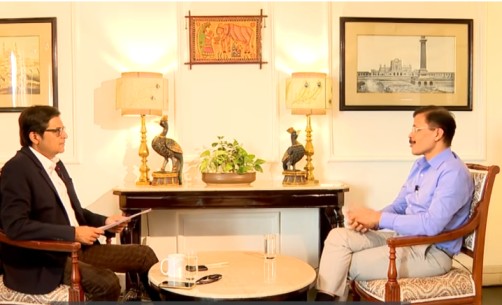
Read the full transcript of Maharashtra FDA Commissioner Tukaram Mundhe’s interview on Nation Wants To Know with host Arnab Goswami, August 22, 2026.
EDITOR’S NOTE: In this hard-hitting interview, Arnab Goswami sits down with Maharashtra FDA Commissioner Tukaram Mundhe—the uncompromising officer who has weathered 25 transfers in 21 years while taking on the food mafia. Mundhe reveals the shocking scale of adulteration in everyday food, from synthetic milk to dark-kitchen horrors at major chains, and details his relentless “Safe Food, Safe Drug, Safe Maharashtra” campaign that is now sparking a nationwide alert.
Introduction
ARNAB GOSWAMI: Welcome to yet another episode of The Nation Wants to Know. First, I want to start by saying that I’m very happy that I’m being able to do these interviews more regularly than I used to. And it was just because of the, I would say, the pressures of entrepreneurship to run the Republic Media Network. My editorial work took a backseat, but I’m enjoying doing these interviews. And now The Nation Wants to Know will become a series which will be about, I would say, a series in educating people about the real truth.
Last episode was with Harish Salve, and we really loved the feedback. It went viral all over the country and internationally where he gave the real reasons behind FCRA. And it was very useful for me to learn that.
Today, I am with a remarkable, remarkable man. His name is Tukaram Mundhe. In case you don’t know him, everyone knows him. But first of all, I want to thank Tukaram Mundhe for coming all the way from Mumbai to meet us. Thank you very much. I can call you Tukaram?
TUKARAM MUNDHE: Yeah, absolutely.
ARNAB GOSWAMI: Because you’re a couple of years younger to me, so I can—
TUKARAM MUNDHE: anybody can. I mean, we should call by name.
ARNAB GOSWAMI: I don’t want to call you Mr. Mundhe. It will be very formal.
TUKARAM MUNDHE: Yeah, yeah.
ARNAB GOSWAMI: So, so Tukaram is a fascinating person. He’s a self-made man. From a very humble family, and he went through many, many years of effort to become an IAS officer in 2005. Now I would say he’s a man on a mission. He is technically holding a charter of Commissioner, Food and Drug Administration of Maharashtra, but many people have similar roles. There is a parallel role everywhere in the country, in every state.
What makes him viral is that he has said, “I’m going to change things, I’m going to expose what’s wrong, and I’m not afraid of taking on the biggest and most powerful people in the process of doing so.” But ladies and gentlemen, there is a story behind Tukaram Mundhe. Before we talk about what he does, I’m going to take an effort in this interview to understand the background of Tukaram, what has brought him to this point, what kind of a person is he, because then we can relate to his life story. Tukaram, welcome to The Nation Wants to Know.
TUKARAM MUNDHE: Thank you.
When Did You Join as FDA Commissioner?
ARNAB GOSWAMI: I’m very excited about this interview, and I think a lot of people will be watching this all over. I want to start with the news point of what’s happening right now. When were you appointed as Commissioner of Food and Drugs Administration of Maharashtra? When did this happen? Which month?
TUKARAM MUNDHE: It was, I think, in the month of May. I joined, yeah, I joined as a Commissioner FDA Maharashtra on 25th of May, ’26.
ARNAB GOSWAMI: Okay, and you wait, you then now it’s just you joined in May.
TUKARAM MUNDHE: Yeah, 25th of May.
ARNAB GOSWAMI: Okay, people stay in positions for decades and don’t make an impact. You’ve been in this post for about 3 months or less, maybe just 3 months, lesser than 3 months, but around lesser than 3 months, and you’re making national headlines because you’re saying that the food quality being served is bad, the restaurants are not run well, the big chains are not doing their job, the big food companies are deceiving people. The packaged foods are promising things that they are not. And you believe that this is one of the reasons we become the cancer and obesity capital of the world, or we are nearing that position here. Can you tell us when all this struck you? It couldn’t have been on day one in this role.
TUKARAM MUNDHE: No, see, whenever I am joining a new post, I try to understand its role. So I don’t just look at the job chart. I mean, job chart, everybody is there. You have to go, you have to do this, you have to implement these laws and rules and regulations, this is your target. But whenever I go to a new post, I try to understand the role of that post.
So when I joined, I discussed with my officers what exactly we are supposed to do. Then the usual answer came that this is a food sector, this is a drug sector, these are the labs. This is what we do. These are the rules and regulations. But that’s the means. Acts, rules, regulations are means. What is the objective? Larger objective.
And then through deliberations, I went through my role through acts and rules, and then we formulated a mission for ourselves, the goal for ourselves. And that mission we called “Safe Food, Safe Drug, Safe Maharashtra.” That’s where we started off.
So when we started, I was not having idea this sector needs this much, if I may use the word, surgery rather than just treatment. And as we went along, I think many things started to strike me. And then we realized that regulations are in place. They’re quite good regulations. If you compare Indian regulations with across the world, they’re one of the best. And this act came into existence in 2006, started implementing in 2011, and the regulations are still in flow in case of food.
But before that, there was a Prevention of Food Adulteration Act, 1954, which was in existence. So the whole intent of that act was to prevent adulteration in the food. And the objective of this act, to provide, ensure safe and standard food. So this total transformation is almost a 360-degree transformation in approach for food business operators, for regulators, and to basically ultimately the objective of providing safe and standard food to the people.
So as we went on, we realized that yes, I think we need to do much, much deeper, much, much wider. And we look to have outcome, what is expected outcome. And I have had always interest in multiple fields. I was posted as the Health Commissioner also. I have worked in State AIDS Control Society also.
The Shift From Communicable to Lifestyle Diseases
And one of the things which I had learned and realized during my stint as Health Commissioner was that disease burden of India has reversed after independence. At the time of independence, we were almost 70% communicable diseases. As on today, we have almost 70% non-communicable diseases, what you call lifestyle diseases, NCDs, or lifestyle diseases.
Now, why has this taken place? There are multiple factors. On the one hand, we have improved our medical industry, public health system, and communicable diseases have gone down. On the other hand, non-communicable diseases or lifestyle diseases have gone up. Dramatically, almost touching 70%. And one of the major causes for this is lifestyle, and one of the major ingredients of lifestyle is what you eat and drink.
So you have to look at from that perspective, and that’s where I started asking my officers to look at from this perspective, not from just implementation of regulation. Regulation and act are a means to achieve the larger goal of healthy people in India. I think this is very crucial. Now there are WHO reports, you can go through it. There are Indian surveys which showcase what is happening. There are sample surveys of Health and Family Welfare Department which show the adulteration of substandard or unsafe food. And what is happening is alarming. So what we need to do is comply. A food business operator need to comply with these regulations, and regulators need to implement.
ARNAB GOSWAMI: So you started this mission: save food, save drugs, save medicine, save Maharashtra. And then you started a crackdown.
TUKARAM MUNDHE: I would not say crackdown. It is basically, see, because of whatever my nature has been and whatever way I have performed during my career, people—I have connected with people, people are connected with me—they expect things, wherever I am posted. So the moment I came there, there was pouring up complaints.
ARNAB GOSWAMI: Complaints?
TUKARAM MUNDHE: Yes, complaints to you about this is happening there, whether in pharmacy there, drug is there, food lab, all these things are happening there.
The E3 Strategy
So what we did was, first thing, we wanted to—so the part of missions part, then strategy part was designed. There, and we decided a 3-prong strategy. I call it E3 strategy. So the 3 E’s are there. First is empower people. That is the first E. That’s the focus.
So how do we empower people? So we empower people by telling them, either through praise or briefings or actions, that this is the role of FDA. Okay. Secondly, we tell them what is happening, what we are doing transparently, so that they come to know this is what is happening, FDA is doing. And thirdly, connecting with them.
How to connect with them was an issue. So there was a toll-free number, we strengthened it further. I issued emails on the public domain in the press note. “If you have any concerns, either tell us on the toll-free number or you can email on this one.” That was in the beginning. And after one month’s time, we came up with the portal, complaints portal. We have full-fledged complaints portal as of today, complaints.mahafda.in.
You can just log on your mobile, register once, and you can complain with details. We have AI-powered it. It’s auto-accountability, transparency. You can track where is it assigned, whether the officer is working. If the concerned officer does not respond in time, it is escalated to the higher authority automatically, and the system itself issues the notice to the officer. So it’s a built-in accountability there.
So through this way, we connected the people. And secondly was enabling the businesses. I mean genuine businesses. So if there are genuine businesses, they are working, they have nothing to fear from me. And if they are non-genuine, they cannot hide anywhere. That was secondary. And final was enforcement of the Act. So this is overall strategy.
So you will be surprised to know that through these 3 means, for example, toll-free number, emails, and my portal, in 3 months’ time we have received more than 10,000 complaints. More than 10,000 complaints across Maharashtra, and we analyze it, we work on it, we categorize it high-risk items, and then we proceed to inspect. So once the inspections are there, whatever findings are based on the facts, we take that.
Cracking Down on Gutka and Paan Masala
ARNAB GOSWAMI: When you inspected, when did you start your inspections? And when you inspected, what did you find? What were some of the more shocking details which you got to know when your people went on the ground? And, who did you decide—you can’t inspect everyone, you can’t seize all items. Did you want to set an example by going after the big fish in the start?
TUKARAM MUNDHE: Not at all.
ARNAB GOSWAMI: So what was your approach like?
TUKARAM MUNDHE: We started actually with prohibited items, gutka and paan masala. That’s where we started. Because it’s already prohibited in Maharashtra. So we acted tough. I issued an order invoking MCOCA provisions if necessary in those cases, and we started with a huge action out there. So it has created deterrence, and we are filing complaints with the police station along with the BNS sections. So manufacturing is prohibited, transport is prohibited, sale is prohibited.
ARNAB GOSWAMI: But it was still going on?
TUKARAM MUNDHE: Yeah, it was still going on. Nowadays also little bit.
ARNAB GOSWAMI: Were the companies involved?
TUKARAM MUNDHE: Many.
ARNAB GOSWAMI: So many big companies were involved.
TUKARAM MUNDHE: Yeah, yeah, which we have caught. There are more than 700-odd FIRs before me also.
ARNAB GOSWAMI: Which big companies were involved?
TUKARAM MUNDHE: All this is Mimal and all this we have heard of. This, there are other, I can’t just remember all the names. So there are multiple. So they are not manufacturing in Maharashtra now, they are manufacturing somewhere else.
ARNAB GOSWAMI: But it is illegal to supply in Maharashtra?
TUKARAM MUNDHE: Absolutely. Transportation—
ARNAB GOSWAMI: was it being officially supplied or through the black market?
TUKARAM MUNDHE: Unofficially, of course.
ARNAB GOSWAMI: Unofficially. But that must be a lot of money to supply banned items.
TUKARAM MUNDHE: Yeah, absolutely.
ARNAB GOSWAMI: Crores, hundreds of crores.
TUKARAM MUNDHE: Yeah, definitely. And that’s why, because it was banned way back in 2012 in Maharashtra.
ARNAB GOSWAMI: Nobody implemented it?
TUKARAM MUNDHE: It was implemented, but I think still people try to find out a means and they—
ARNAB GOSWAMI: Why did previous commissioners of Food and Drugs Administration not implement it?
TUKARAM MUNDHE: No, it was implemented, but maybe, as I said, people try to bring in innovative ideas to bring in and then sell it. Because this always is demand and supply. People demand, there is supply.
ARNAB GOSWAMI: Maybe the government looked the other way.
TUKARAM MUNDHE: I don’t think so, because Maharashtra was the first state to ban it, and this falls in the purview of food commissioner. So food safety commissioner had taken a call on this and it was banned. But I think we need to be much more stringent. That’s where we started off, and the actions were really good one.
Still, I cannot say with 100% certainty it is not available. Yes, it is available, but now they have again changing the means. Big vehicles are not coming, small are coming. They are transporting to state buses or transport or private transport, even railway now. But we are after them.
So this is where we started, and as we went along, then I started sector by sector. Then we went to hotel, restaurant, and eateries. I issued one compliance order. These are the compliances you need to abide by. And before issuing that order, I had actually had a meeting with the association including AHAR, and I told them, “these are the issues, please look into it, please tell your member that you have to comply with that, otherwise we are going to be very, very stringent on you.” After that, issued the order and we started inspections.
Earlier what was happening was the, the qualitative difference, what I can tell, my people used to go, officers used to go. And most of the time inspections are not taking place, but a sample was being taken and then tested and the further action on that. We reversed the strategy. We are inspecting the places. We just don’t go and take, pick up the sample and come back and test it. No, that is just one part of it.
Inspecting Fast Food Chains and Quick Commerce
ARNAB GOSWAMI: You made it a visible, you made it a very visible attempt at enforcing the law.
TUKARAM MUNDHE: Yes.
ARNAB GOSWAMI: So you said we are going to inspect, almost sounds like a raid.
TUKARAM MUNDHE: It’s not a raid, but it’s an inspection.
ARNAB GOSWAMI: Yeah. You go to a Domino’s outlet.
TUKARAM MUNDHE: Yeah.
ARNAB GOSWAMI: You’re inspecting a Domino’s outlet. And then the media will come with you.
TUKARAM MUNDHE: We generally don’t allow media inside.
ARNAB GOSWAMI: Media won’t be allowed inside, but the media gets to know.
TUKARAM MUNDHE: Yeah, that’s right. So we issue press notes on that.
ARNAB GOSWAMI: You issue press notes?
TUKARAM MUNDHE: Almost daily basis we issue press notes.
ARNAB GOSWAMI: And then you start inspecting the place. How did people react when you started inspecting a Domino’s outlet, when you started inspecting a Blinkit store, a Zepto store? What was the first reaction?
TUKARAM MUNDHE: The reaction was basically the change in culture of FDA is underway. Because you just go take a sample and come back, that culture has changed.
ARNAB GOSWAMI: It was a more active role.
TUKARAM MUNDHE: Yes, because what we are supposed to look at—and just inspection doesn’t mean that you go and check kitchen alone. What it means is basically whether that establishment—because they are FBOs for us, whether small or big, whether listed or unlisted, it is an FBO for me, food business operator.
ARNAB GOSWAMI: It doesn’t matter how big the company is, whether it’s a global chain, whether it’s KFC, McDonald’s. It doesn’t matter.
TUKARAM MUNDHE: They are either my licensees as FBO and they have the laws to follow, and I am here to implement those laws.
ARNAB GOSWAMI: So did you yourself go?
TUKARAM MUNDHE: No, I have not.
ARNAB GOSWAMI: But you must have the videos, you must have—can you tell me? Because the reason this conversation is so important is because our viewers are all over India. So people will, are of the view that if there is a problem with these, for example, these multinational fast food outlets, because people think that you go to a Domino’s, you go to a KFC, you’ll get standardized hygienic food, right? But nobody actually goes to the back kitchen. So nobody sees the condition in which that food is being made. They just get a pizza before them and they think it’s an American brand and everything must be okay. Can you share with us? And now the concern is there’s a Domino’s in Guwahati, there will be a Domino’s in Haryana. So we want to know that what did you find? I’m not talking about Domino’s, but what did you find about these so-called branded food stores? What was happening in the backstory?
Schedule 4 Violations and Kitchen Standards
TUKARAM MUNDHE: What happens when my officer goes there? So I asked, told them not to just check one point or two points. Look at whether all regulations are being complied or not. The first regulation, most of them follow registration or licensing. That is one. The second and most important regulations about Schedule 4, what you call Schedule 4.
So the way kitchen has to be run, the way it has to be established, the way raw materials has to be received, it has to be washed, it has to be segregated, it has to be stored, it has to be sorted, it has to be prepared—there’s a whole lot of guidelines over there. Say for example, I did not know personally until I went through the regulation that kitchen is supposed to be absolutely tiles, not only on the floor but the side walls are with tiles. They have to be washable tiles because fungus and other things should not be—they should be able to clean. It should be cross ventilation so that there is a cross ventilation for reception purposes.
You receive, there is a separate compartment area, you receive it, wash it. There are guidelines about washing the food or receive whatever you are receiving raw material. You taste it, grade it, you store it a particular condition. You prepare it and then you serve it. For example, if it is, say, cold food, it should be around 4 degrees. If it is around -18 degrees, if it’s a hot food, you have to have 65 degrees Celsius. These are the guidelines and regulations as they exist as on today.
So are we following that? Number one. Number 2, whatever raw material is there, they have to—every food article has to have traceability. That is expected in the regulation.
ARNAB GOSWAMI: Traceability.
TUKARAM MUNDHE: Traceability. For example, if I am purchasing—I am a hotel or whatever, I’m a non-veg person, I’m purchasing non-veg item from somewhere. So he has to have receipt. He must know where is it coming from. So if there is some issue of health, we should be able to trace it back where is it originated. So regulations exist. Do we follow? These are the questions to be asked.
ARNAB GOSWAMI: Do these companies not follow? What did you find? My question was, what was among the most shocking details that you have found?
TUKARAM MUNDHE: Multiple, multiple. Schedule 4 violations are pertinent. That is all. And so when I say this kitchen part, receiving part, storing, cleaning, sorting, not having the back tracing or details of where it is purchased from, even expired products we have issued everywhere. We have seen everywhere across board expired products. Yes, expired food items we have seen, and those are being prepared, those are being sold. That’s shocking. So we have seen stale raw materials like anything, whether it’s vegetables or for that matter even non-veg items. This is horrible.
ARNAB GOSWAMI: So, you know, this is the real—this is what is really worrying. People think, “Oh, you go to a sort of fast food chain with a global brand on it and you will get safe, clean food.” But you don’t know where the lettuce is coming from, where the onion is coming from, whether the meat is stale or not stale. Without naming brands, can you tell me one interesting story? I’ll tell you a story. Yeah, you tell it.
The Synthetic Lettuce Story
TUKARAM MUNDHE: You started with this lettuce. Yeah, because we just did discuss, so I just clicked to my mind. When I issued this order of HRE, Hotel Restaurant Eateries, and these have to be followed. And lettuce is used by some of the chain.
So some of my friends, 3-4 days after that, they called, “why are we not getting lettuce in this particular brand?” What happened? They are not getting it. They are saying, and there are boards, that lettuce is not available as of now. So what does it indicate? It indicated that either the lettuce was not real quality or it was expired or poor quality or absolutely is synthetic. There are multiple things happening. Artificial things are happening. Artificial milk is there. Synthetic milk. There is a crackdown, we did it, and you can not believe—
No, I want to know what all is synthetic. My job is not to make people distrust. What my job is basically, they should trust everything.
ARNAB GOSWAMI: Your job is to make people aware.
TUKARAM MUNDHE: Exactly.
ARNAB GOSWAMI: So, so I wanted to meet you because I want to be aware. And if you make me aware, we put this video to millions, people will be aware. At least they’ll ask questions. They’ll ask questions about the lettuce in the burger. They will ask questions about the milk. They’ll ask questions about the onion.
TUKARAM MUNDHE: Lettuce, lettuce, you should ask where is it coming from?
ARNAB GOSWAMI: Where does it come from?
TUKARAM MUNDHE: I have no idea where it is coming from.
ARNAB GOSWAMI: What have you found? What is synthetic lettuce?
TUKARAM MUNDHE: See, it’s chemically made.
ARNAB GOSWAMI: Chemically made lettuce?
TUKARAM MUNDHE: Yes, we’re able to detect all these things. Say, I’ll give a story, big story of milk.
The Synthetic Milk Racket
ARNAB GOSWAMI: Tell me about milk. By the way, chemically made lettuce, now I’m never going to have a lettuce in any burger after this. I’m very sorry, but this is worrying and we must find out about it. We must find out about it. Now tell me about milk, which is the most common item. It’s used everywhere in shakes and ice creams and everything.
TUKARAM MUNDHE: Yeah, milk we consume right from what we can say childhood to what would you find? See, I got information, once after, I think one month after I joined there, and was telling that there is a chemical milk or synthetic milk being prepared. And then I said, “give me the details.” And the person gave me details, the total details how it is made.
ARNAB GOSWAMI: Okay.
TUKARAM MUNDHE: And then we continue investigating it. We continue investigation almost for a month period of time. And then we finally strategize, and then along with police we raided, raided and we found it live.
ARNAB GOSWAMI: In Mumbai and outside?
TUKARAM MUNDHE: It is in Pune district, at multiple places. It was spread across, hopping. High six. It was put a packaged into a brand? I’ll tell you. So there is actually what you call proper work on it, and other person provides a formula how to make a milk out of it. And this was prepared. So we caught that person.
That milk skim milk powder was being sold either to the chilling centers or milk collection centers or to even grocery or to a farmer also. And this formula was being provided along with—it had the—we found shampoos in it. We found chemical, industrial chemical in it. We found emulsifier in it. So multiple things we found.
And there was a formula by which they were able to produce a milk which will cost, for the quality of milk, cow milk, ₹15 per liter. For buffalo quality milk, around ₹30 per liter. And it was in the market. So this is made either to increase the quality, quantity. Or then it is added to the existing quantity because the market rate, if it is supposing ₹40 for milk cow, it is being produced at ₹15. So economics works that way.
ARNAB GOSWAMI: If it is ₹60, so you adulterate milk with this fake milk?
TUKARAM MUNDHE: Yes.
ARNAB GOSWAMI: But, was this put into a package? I mean, was it put under a brand or was it sold?
TUKARAM MUNDHE: So because it is going ultimately to dairy, so somebody is selling and it is going to a dairy.
ARNAB GOSWAMI: And the dairy is packaging it and selling it.
TUKARAM MUNDHE: Absolutely.
ARNAB GOSWAMI: In a packaged form.
TUKARAM MUNDHE: Packaged form, whatever form.
ARNAB GOSWAMI: Our problem in India is whenever anything comes in a packet, we think it’s fine.
TUKARAM MUNDHE: No, it’s not.
ARNAB GOSWAMI: No, no, but that’s the way we think.
TUKARAM MUNDHE: Exactly.
ARNAB GOSWAMI: That we get something in a packet, we think, “oh, this is now verifiable, verifiably true.” Rather, we would think that if somebody is coming and selling me milk directly from a gaushala in my house, I doubt that. But if something is in a package, we think that it’s going to be okay. What is your observations?
Loose Milk vs. Raw Milk
TUKARAM MUNDHE: Are very clear. We should not take anything blindly. For take anything blindly, even a loose milk. I mean, we should get very clear about what is a loose milk and what is a raw milk. Loose milk is the one which is already pasteurized, and then it is sold in the market as a loose milk, which is banned, which is not allowed.
So if I am dairy owner, I pasteurize it. Once I pasteurize, it is expected in the industry itself that it has to be packed, pasteurized milk, either in the tin or whatever packets, and then it will be stored. In Mumbai-like places, there are pasteurized milk which is being sold as a loose milk, which is not allowed. We have started acting, we have acted. And raw milk, which is a farmer milks, cowman milks, and then he sells, that’s raw milk, that’s allowed.
ARNAB GOSWAMI: Can I ask you a very naive question? If there are two glasses of milk and I am a milk lover, will I not be able to make the difference by testing it?
TUKARAM MUNDHE: It’s very difficult unless you know what is the original taste and what is the new.
ARNAB GOSWAMI: But now the shocking fact, you’re telling me that there are—you found shampoo?
TUKARAM MUNDHE: Yeah, emulsifiers and other chemical items in synthetic milk. Yeah, and that’s how we then unearthed it. We caught almost 13 people who were arrested. We are further investigating that and we are going to prosecute.
ARNAB GOSWAMI: Is it possible that this is a wider racket than—
TUKARAM MUNDHE: Possible, very much possible.
ARNAB GOSWAMI: You have only found one place. If it’s happening in one place in Pune—
TUKARAM MUNDHE: The people were related places across 5 districts, not just one district.
ARNAB GOSWAMI: The impact on health if you’re having synthetic milk and that has shampoo and emulsifiers and all these products in it, many of these things would be genotoxic, they would be carcinogenic, so they would already have an impact. So maybe thousands of people have already been impacted without their knowing.
TUKARAM MUNDHE: That’s what I’m saying. We started our interview with saying that how it is going to affect the people. This is how it is affecting the people because what you are consuming, we do not know what exactly it is. And it just not remain to either milk or something burger or something where it is across board. Whatever a person package, for example, whatever it is, what are we reading? Are we reading the ingredients? No, we’re not. So “sugar free” written on top, misleading ad. Oh God! Actual ingredient you have sugar.
Misleading Health Claims
ARNAB GOSWAMI: Now for example, you know the companies like Dabur which have said “100% pure fruit juice” and all that. Are they 100% healthy?
TUKARAM MUNDHE: 100%? There is actually guideline. I believe FSSAI has already issued the notice. FSSAI has issued a notice.
ARNAB GOSWAMI: Yes, I think Dabur has taken back one or two claims. Somebody on honey in Dabur has got something from them, and they’re not just Dabur, the other companies, they’ve got some stay order from the High Court, etc. But why is it important to put a stop on these “100% healthy,” “100% pure” kind of claims?
TUKARAM MUNDHE: Because it’s misleading. There is a regulation which came out in 2018, it’s about Advertising and Claims Regulations 2018, which came in existence, implementation since July 2019. So you cannot advertise which is not there. Whatever you say on the packet or advertising, you should not either imply, state, or show which is not true, 100% true.
ARNAB GOSWAMI: But their claim would be, just playing devil’s advocate, that “listen, this is not like—this is not tobacco, it’s not going to cause cancer. A little bit, we may say we are 100% healthy, maybe we are 60% healthy, but we are not tobacco, we are not gutka, we are not paan masala. Why should we be clamped down on?”
TUKARAM MUNDHE: Because you are giving wrong information. You are misleading.
ARNAB GOSWAMI: How is that wrong information affecting?
TUKARAM MUNDHE: Because if you are saying 100% pure and it is not pure 100%, you should be able to prove that it’s 100% pure.
ARNAB GOSWAMI: Now you’re saying people buy it on the basis of the claim of 100% pure. Does it have an impact on consumers?
TUKARAM MUNDHE: It has.
ARNAB GOSWAMI: Suppose a mother is buying a fruit juice.
TUKARAM MUNDHE: Yeah.
ARNAB GOSWAMI: She sees “100% healthy mixed fruit juice.”
TUKARAM MUNDHE: Of course. She—
ARNAB GOSWAMI: you’re saying they take it at face value?
TUKARAM MUNDHE: Because that’s how—I mean, generally we believe that, right? By and large, we should believe that. So it’s written “pure,” right? It’s written “natural.” Now, if that is the claim—
ARNAB GOSWAMI: sugar-free, sugar-free—
TUKARAM MUNDHE: if it is the claim, the product or the industry or the manufacturer should be able to prove that it’s actually that. Otherwise it becomes misleading. So you cannot mislead. It’s as per the law not allowed. It is not my whims and caprice. This is a law. And why it is made a law is basically so that it affects the health of the people. So please understand the overall architecture of the scheme.
A Changing Food Culture
ARNAB GOSWAMI: See, we are in a very quick 2-minute world nowadays. We want food delivery within 5 minutes. We want a lot of packaged food. People have less time to cook. People are not having real ingredients. People are having a lot of outside food. There’s a lot of fast food. There’s a lot of rustling up of elements. You buy something which is already semi-cooked, you cook it.
So I think that I’ve often thought about this, Tukaram, that, you know, I come from Guwahati and I used—I remember that my maternal grandfather used to drive a cycle at the age of 84. He was a communist leader and simple life. And, you know, he used to cook his own soup and he used to draw milk. We had cows in the house and drew milk. And I sometimes think that they had very busy lives. They were very active. But the cases of cancer have suddenly shot up. And the sale of air purifiers is going up. People think if we buy an air purifier, we live in an air-conditioned environment, we will not have cancer. What I’m hearing from you is that you may be unaware of what is in this cup that you’re drinking, the food that you’re eating, and so you are allowing a lot of impurities, chemicals into your body without realizing it.
TUKARAM MUNDHE: Yes, that’s true.
ARNAB GOSWAMI: Then this is a huge thing. Why is it—what you’re doing in Maharashtra—this is a scam and a scandal of untold proportions. Doesn’t there need to be a nationwide crackdown on this? Not a states.
TUKARAM MUNDHE: Can I believe this question I was asked when I joined? One of the media persons, “if you are given a chance, what which you are expecting that you should be achieving in whatever given ten year, one year, two year, three year?” And my answer to that was, and today I should tell, this has to become a public movement, mass movement of eating right food. When I say right food, not by quality or tasty food. What I mean is standard and safe food. Because we have habits of eating, say I want spicy, I want oily, I want tasty. This, this is—taste can be secondary. Primary is safety.
ARNAB GOSWAMI: You think we compromise on safety?
TUKARAM MUNDHE: I think I do. We do.
The Ashwagandha Double Standard
ARNAB GOSWAMI: Can I ask you something? You also look at drugs, right? I have a question for you. There is an ashwagandha, okay? Now, I found out because I like to have some Ayurvedic products that there is an ashwagandha that is sold in India and the same company sells a different ashwagandha for the American market. The American market ashwagandha is priced a little more. Or whatever, ashwagandha or whatever, you know, there are so many Ayurvedic medicines.
Now, is it true that in the Indian Ayurvedic medicine you allow impurities to a higher proportion, and in the one that goes globally it is a purer version? And my question to you is, how can the same company be allowed to have two sets of Ayurvedic products, one for the Indian consumer which has more impurities, maybe lead, maybe other things which are carcinogenic, and something else for the American market. Is this not wrong?
TUKARAM MUNDHE: Is this happening? This is absolutely ethically also wrong and legally also wrong.
ARNAB GOSWAMI: But it is happening.
TUKARAM MUNDHE: Yes.
ARNAB GOSWAMI: Why don’t you crack down on this?
TUKARAM MUNDHE: We have already done.
ARNAB GOSWAMI: You’ve done this?
TUKARAM MUNDHE: Yeah, in drug also. We have found, we have cracked down against Ayurvedic manufacturers also. I think few days back we suspended license of more than 10-12 Ayurvedic license manufacturers.
ARNAB GOSWAMI: Did you find this? What I told you that there are many. Like what? Tell me about the Ayurvedic product.
TUKARAM MUNDHE: Ayurvedic, for example, one of the major issues we found is misleading claims again.
ARNAB GOSWAMI: Misleading claims about Ayurvedic product?
TUKARAM MUNDHE: Yeah, yeah. “This will cure your diabetes.” Actually, there is a full-fledged act of 1954 which prevents this one.
ARNAB GOSWAMI: Prevents what? Misleading claims.
TUKARAM MUNDHE: Claims. Yes. In medicine, 1954 Act is very clear. So you cannot, because in medicine it’s very, very clear as per Drug and Cosmetic Act and miscellaneous, you cannot claim cure. Very clear provision.
ARNAB GOSWAMI: And these are over-the-counter drugs.
TUKARAM MUNDHE: Yeah, I mean, there are schedules which some are scheduled without prescription, you cannot, some are over the counter. But Ayurveda, by and large, everybody says, “oh, it’s Ayurvedic.” See, Ayurvedic, there are two kinds of products. One is called textual products. So they are written way back in our ancient times that these are the products. So we follow that, those products become textual. That’s why we—
ARNAB GOSWAMI: the original.
TUKARAM MUNDHE: Yeah. And the second one is called proprietary products, derivatives. So now I prepare a proprietary, this is my product, then it goes to some authority, we have a committee there, then they look into it and they sanction or reject it. So those are being prepared, manufactured, and they are sold. But advertising and the constituents of it need to be verified. They need to be actually as per the standards.
One of the shocking case which I found in Maharashtra about that, we have almost around 400 Ayurvedic manufacturers in Maharashtra and we are the licensing authority, my joint commission. So we have GMP, Good Manufacturing Practices, as per Drug and Cosmetic Act 1940, and this applies to Ayurvedic also. So some of these Ayurvedic manufacturers were not under GMP certification and they were producing it.
So rules are there, regulations are there. So there are two sides. One is compliance by the FBOs or licensees, and other is implementation and regulation by the regulatory authority. Though both need to go hand in hand, but at the same time, as citizens—because ultimately this is going to the people, consumers—they need to be much more discreet and aware of exactly what they are eating and they’re asking for. Unless that—because there is always going to be demand and supply. So unless demand changes, supply will not change.
Blinkit, Zepto, and Dark Store Conditions
ARNAB GOSWAMI: Now, what have you found out about the Blinkits and the Zeptos and the fast delivery services and the food delivery services about—because we have got some visuals, incredible visuals here in Republic about cockroaches, rodents, rats, infestation where the food items are kept, right? What have you found out about the condition of the dark stores?
TUKARAM MUNDHE: There are multiples we have suspended. You are aware, we have issued the press note about that also. The conditions, sanitary conditions, are way, way beyond our horrible sins. There are expired products we have found. They were kept on the floors. No control of temperature, which is expected, was found there. So multiple violations have come, and that’s the product which is sold.
So, as per the rules, even if they are quick commerce, they are treated as FBO because they are serving it. So wherever they are purchasing from, we should be able to trace. And many times this so-called dark kitchens are not traceable. So we need to be careful. We are actually after them, every food business operator who is violating it. The question is, citizen also need to ask if I have ordered something. Suppose I have some quick commerce and it comes to me. I should ask where has it come from? Who has prepared this food? At least look at it. Because in the guise of that “I don’t have time.” So are you going to eat poison?
On Corruption and Resistance
ARNAB GOSWAMI: But do you think that in India there is a convention that the stronger the rule, the breaker, the easier and more innovative the way to break it. And corruption is a reality. Tukaram, you are an honest, ramrod-straight officer. But everybody is not like you. Everybody in your department may not be like you. Everybody in other districts and other states may not be like you, and they may feel that, “okay, Tukaram Mundhe has created a bit of a shakeup in the system, which allows me a greater opportunity at making money.” So you know, it’s like they say, “Gabbar Singh aane wala hai.” There’s a fear that Tukaram Mundhe is the Gabbar Singh of the food and drug administration. Somebody is going to say, “I’m going to save you from Gabbar Singh, but give me some money.” Because somewhere I feel this kind of—it cannot happen. This situation cannot happen without organized corruption. There has to be some organized corruption, otherwise—or maybe people just sit on the desk, they’re doing their job, they don’t care about the job.
TUKARAM MUNDHE: See, multiple issues here. I think maybe nobody’s tried before. What is the reason? I mean, multiple issues. This is—corruption cannot be the only factor. Yes, it might be one of the factors. Because there are black sheep everywhere. In whatever sector you go, there you will find black sheep. The issue is the shift from prevention of adulteration to safe food standards is a big shift. And I think till today, after 20 years of passing this act, we have not moved to that level of abiding by these safe food standards, safety standards of the food. That’s the context we have to understand.
ARNAB GOSWAMI: Are you afraid that the whole industry will also come back after you now stronger? There was a report about ₹5 lakh of, was that on you? A fine that was put not on you?
TUKARAM MUNDHE: That, that was there.
ARNAB GOSWAMI: See, what was that fine for?
TUKARAM MUNDHE: So that was basically, High Court believed an order that because the license was kept suspended even after compliance, 98% order compliance, and by the FBO, we should have reinstated. So they have the losses. So that’s why High Court has ordered. So we are examining our legal options on that.
ARNAB GOSWAMI: But do you believe all the industries will go to the courts and—
TUKARAM MUNDHE: some of them have already gone—
ARNAB GOSWAMI: and then say that you are being excessive?
TUKARAM MUNDHE: That’s what the charge against me is.
ARNAB GOSWAMI: But what is the charge against you?
TUKARAM MUNDHE: Say that I am going overboard, I’m excessive, my office is excessive. So we should not be suspending the license. We should be given notices first to clarify, follow a process, and a process—no, process is there, but even, 4th week suspension is allowed as per the Act itself. It’s not something I have innovated. It exists, and it exists in cases where the non-closure or non-suspension is likely to lead to—
25 Transfers in 21 Years
ARNAB GOSWAMI: these are big companies, multi-hundred thousands of crores of business these packaged food companies do. You’ve been transferred, what, 25 times in 21 years of service?
TUKARAM MUNDHE: How many times? I have not counted.
ARNAB GOSWAMI: Is it true that you don’t even get to complete a year in service before you’re transferred?
TUKARAM MUNDHE: If you average out, say, 21 years, it’s more than that, it will come to the average out of it.
ARNAB GOSWAMI: Why is it—and this—why is it that in our country today, someone like you is not allowed to do his job by the system? I mean, you don’t last more than 10 months in any job.
TUKARAM MUNDHE: I don’t think much about it, basically because it’s not—
ARNAB GOSWAMI: why are you punished? I really want to know this. Why is an officer like you punished? And we find greasy officers and officers who steal and who are corrupt rise to the very top.
TUKARAM MUNDHE: Whether I am punished or not, that’s for discussion. I am not authorized to discuss about that or comment upon that, but it has given a different perspective to me also in a way that because I have been placed at multiple departments, so I have learned so many things and I have been able to do many things at multiple places.
Going Out to Restaurants and Raiding the High Court Canteen
ARNAB GOSWAMI: Do you think you’ll be ever able to go out to a restaurant again after this?
TUKARAM MUNDHE: That’s a good one, basically because everybody looks at suspicion. If I go somewhere, they will look into suspicion, something is fishy here.
ARNAB GOSWAMI: Have you been to a restaurant recently?
TUKARAM MUNDHE: I have been.
ARNAB GOSWAMI: Tell me what happened.
TUKARAM MUNDHE: It’s a few days back, I think a few days, maybe last week. My friend wanted to have a cup of tea and after office hours, 7, 8 in the night, because somebody had come and wanted me. I said, “let’s come over to either my office or my home.” “No, let’s go there, it’s a good one.” Because now everybody knows you, so no hotel dares to compromise on compliances. So I went. The moment I went there, there was whispering around the corner, and the people who were sitting were asking the management there, “what wrong have you done?” So that may happen. I mean, that’s how it works. But it’s a fortunate—
ARNAB GOSWAMI: and you’re being—your people are going complaining against you in the Bombay High Court, and you go and raid the Bombay High Court canteen? Why did you raid the Bombay High Court canteen?
TUKARAM MUNDHE: See, there was hearing, and in a hearing court observed that you are doing only on private sector or you are doing government and semi-government offices also. We told that we are doing, we have the data to back it up. So then court asked us, “have you done Mantralaya and have you done court?” So we had already done Mantralaya. So I got a call after the hearing from my GP saying that this is what court has said, so you should do High Court. Fine, next day my team went and checked it.
ARNAB GOSWAMI: What did you find?
TUKARAM MUNDHE: I think one or two were unlicensed.
ARNAB GOSWAMI: Okay. Yeah, the High Court canteen was unlicensed. So what is your biggest fear now? You know, the government is supporting you right now.
TUKARAM MUNDHE: Yeah.
Taking on Billion-Dollar Companies
ARNAB GOSWAMI: You know what my biggest fear is, Tukaram? That you’ll be posted out. You’ll become—you’ll be seen to be very high profile. See, you’re cracking down. Let me tell you who all are cracking down. You’re cracking down on the organized gutka industry. You’ve arrested hundreds of people. You have seized vehicles, you’ve raided godowns, you’ve gone after Bollywood superstars for promoting gutka. You have previously—celebrity influencers would be put against officers. You don’t care about them.
I don’t wonder whether you are one person taking on industries whose net value would be going into hundreds of thousands of crores. You’re fully aware that some of the companies you’re going after are worth billions of dollars. And you’re aware that what you’re doing in Maharashtra has an impact across the country. Because whether it is any packaged food, it is not limited to Maharashtra. You have found in all these dark stores, expired Frooti, Appy Fizz, candy, juice being sold in warehouses. You’re going after these fast delivery companies, which are also worth billions of dollars.
And therefore, if I were to say to you today that you are one man, you may not realize the full impact of what you’re doing, but you’re probably standing against, at least, companies worth hundreds of billions of dollars. And I think my biggest fear is they will all come after you. Do you think about this?
TUKARAM MUNDHE: No, I don’t think who I am going after. What I think is basically what is my role. Now I’ll put in a little different perspective. How I look at this role. This role is not just about safe food. It is about the economy also. It is about the health of the people also, health of the society, in a way health of the nation.
If you are aspiring to be a great nation, it has to be a healthy nation. We cannot have unhealthy people living in a healthy nation. We cannot progress. We may be able to progress at a certain level, but if your human capital is not healthy, both physically, mentally, emotionally, we cannot progress beyond a point. That is one.
ARNAB GOSWAMI: Yeah, but you have suspended the licenses of a store operated by Aditya Birla New Age Restaurants. You went after Reliance Retail in one place. You have targeted Zomato-linked and Swiggy-linked warehouses. These are not small players. These are conglomerates worth billions and billions and billions. The nation wants to know, the nation wants to know, Tukaram, has anyone called you? Has anyone told you to go slow?
TUKARAM MUNDHE: No, absolutely not.
ARNAB GOSWAMI: Indirectly?
TUKARAM MUNDHE: No, absolutely not. So I’ll tell you now, I’m coming to that only. That’s the first part I’m talking about, health of the people. The other part is economy. When the nation or society wants to grow, as we progress, economic growth is inevitable. Without that, we cannot grow. The economic growth will come from where? It will come from the people. And this food which we eat is directly related with agriculture.
Pushback From His Own Staff
ARNAB GOSWAMI: You’re trying to change everything overnight. The 29 officers—I’m reading—and employees of your own FDA laboratory went to the minister complaining about your new shift system, extended working hours, staff shortages, and concerns about the quality of sample testing. Now, are you pushing your own people too hard?
TUKARAM MUNDHE: I don’t think, because what has happened—that’s a lab, it’s not office. Unfortunately, they were working 10 to 6, and labs are not supposed to work 10 to 6. They’re actually supposed to work 24/7. So what we have done, we are not asking them to work beyond 8 hours in a day. Absolutely not. Not more than 48 hours in a week.
ARNAB GOSWAMI: But viewers, please note every question here. Here is a man who’s on a mission. He doesn’t give a damn. We think he’s doing a great thing. But let me give you one more example out here. What happens when one man stands against a rotten system is a classical case of what Tukaram Mundhe is doing right now.
“Killing a Mosquito With a Sword”
The Bombay High Court used a devastating phrase while questioning your action against the Amazon warehouse. “Was the FDA under Tukaram Mundhe trying to kill a mosquito with a sword?” The point the court was trying to talk about is proportionality and procedure. Do you think the court also is telling you to go easy a bit?
TUKARAM MUNDHE: I don’t know how to interpret it, but whatever, because these remarks were—might be in the court, they are not in the order. So what we are doing is basically we have to follow the procedure. We are allowed because we are law implementing agency, executing agency. We have to definitely follow the law, we have to definitely follow the procedure. We cannot overboard it, but we have been doing exactly that, and proportionality is there.
The case you mentioned in this is, they were ready, there was complaint and my officers had gone and what we had found there was shocking in the sense that expired food items were recirculated and brought in the food chain to sold. That’s what the license was suspended.
ARNAB GOSWAMI: And yet the court said that you’re trying to kill a mosquito with a sword. You know what the industries will want to do? The industries will say, “okay, let’s fight him together. Let’s wrap him up in court cases. Let’s do multiple court cases.” And, you know, he’s becoming a middle-class hero. And that’s a fact. There is a massive delusion being sold to the middle class. The consumer sees spotless high-tech app on their phone with a 10-minute delivery guarantee. They don’t see the dirty dark—they don’t see the cockroach infestation. They don’t see the live rodents. They don’t see the expired food items, right? These are multi-billion-dollar tech giants. Are they all going to come together at one point? If I put all of them in one room, they would want your head on a plate.
TUKARAM MUNDHE: I believe that they should—everybody should see that plate on which we are eating has to be safe. What I’m just asking is very simple. What we can say, compliance from them. Just comply with the regulations and nothing will happen to you because the businesses will not—
ARNAB GOSWAMI: Are you too idealistic?
TUKARAM MUNDHE: No, I don’t think because the business is—
ARNAB GOSWAMI: Ashok Khemka of Haryana, 57 transfers. Pradeep Kasni, 70 transfers. Officers who fought corruption and paid with their careers.
TUKARAM MUNDHE: I am not being idealistic. What I’m being is basically trying to perform my role, what is given to me. I am being—trying to be a public servant, which I am, and I am trying to do what is expected of me by the law, by the Constitution, and by the government.
From Farmer’s Son to IAS Officer
ARNAB GOSWAMI: How much of this what you’re doing has to do with your background? You know, a village boy from a drought-prone part of Maharashtra, who cracks UPSC after years and years and years and gets, I think, rank 20, and after doing all of this is rewarded by this country with 25 transfers in a 21-year career and therefore has reached a point in his career where he doesn’t give a damn. Is that your story? How much of this has to do with your own background?
TUKARAM MUNDHE: I think everybody is influenced by his environment, whether where he’s brought up. As I was brought up, many of my colleagues also brought up in the same way. We have risen through our efforts, through our own capability.
I was a farmer till 10th standard. I did my farming. I sold vegetables in the market on the bullock cart. So I know what it means for farmers to sell vegetables in the market. I sold onions at the rate of 5 paise per kg in the market, and because there were no takers, we had to destroy almost 100 quintals of onions. So that is the case which I am talking about, late ’80s, early ’90s. That is the time I’m talking about.
And we came here, so I have seen that side also as a farmer. I have seen this policy implementation and policymaking on this side also. So that’s what I was saying. It is, yes, everybody is influenced by the circumstances, but we should know the reality. And I’m trying to, as a public servant, I have the role to play and make this society a better place in whatever capacity I am posted and wherever I am given the opportunity to work.
So if I am an FDA commissioner—I was before this, I was Secretary Animal Husbandry 2 years back, and there was an issue of milk. Now at that point in time, I used to say that because adulteration does not come under my purview, it is under FDA. Now I am in FDA, it—I am able to—because 2 days back, some few farmers came from some districts saying that “we are just wanting to congratulate you.” And I said, “why?” And they said that “our kids who are graduate, they never used to—they gave up the farming, particularly milk farming also, because there is adulteration. We are not getting a proper rate for my milk. After you started this action, the rates of milk have gone up, and our children who are graduate, they have started again milk farming. Milk cows are there, they are selling almost 200 liters per day. And the best thing what has happened now, we are respected that you are genuine farmer and you are providing a good milk quality, milk standard, not adulterating it.”
So if that is going to have impact on the farming on the one hand, if it is going to have impact on the health of the people on the other hand, I think all of us must come together and work in that direction so that we really make this society a better place to live and lead meaningful life, whether it’s for farmer, whether it’s for citizens, or whether it’s for industries who are working in this sector.
On Politics and Ambition
ARNAB GOSWAMI: Do you think a lot of people will be thinking now he’s got 9 more years in service, now where the hell is he going to go next?
TUKARAM MUNDHE: That I should not be thinking. What I’m thinking is—
ARNAB GOSWAMI: Are you ambitious? Do you want to join politics? If you join politics right now, a lot of people will vote for you.
TUKARAM MUNDHE: Absolutely not. Not my cup of tea.
ARNAB GOSWAMI: Not your cup of tea?
TUKARAM MUNDHE: Absolutely.
ARNAB GOSWAMI: Are you certain about it?
TUKARAM MUNDHE: Absolutely. Because I’m too forthright. You might have seen by now.
ARNAB GOSWAMI: No, you are. There’s another ex-civil servant, Arvind Kejriwal, who sat like this with me once and he said, “main bachchon ki kasam khata hoon, I’m never going to join politics.” But he changed his mind. Of course, he was already half into politics. What is your career plan?
TUKARAM MUNDHE: See, I’m public servant and I’ll be public servant.
ARNAB GOSWAMI: Public servants are supposed to remain anonymous. Now you are here sitting with me. Anonymous.
TUKARAM MUNDHE: Yeah.
ARNAB GOSWAMI: Now, does your becoming a very popular figure impact your relationship with the ministers who you serve, or rather who you work with?
TUKARAM MUNDHE: I think it’s for you people to analyze each other.
ARNAB GOSWAMI: No, I’ve very often thought about this, you know, bureaucrats’ lingo—Election Commissioner T.N. Seshan. It had a good and a bad side of it as well. It made people insecure. Do you make people in government insecure?
TUKARAM MUNDHE: I don’t know. I’m very clear about the role. I don’t make any people insecure. What I’m trying to do is just look at our role. And there are—I mean, my batchmates, my friends, also many a time tell that “chhod dena, chhod dena, chhod dena, kitna theka rakhe rakha hai kya?” That is the word “theka rakhe rakha hai.” And instantly my answer, you know what was that?
ARNAB GOSWAMI: What is that?
TUKARAM MUNDHE: Yes, “theka rakhe rakha hai,” because I have a social contract.
ARNAB GOSWAMI: Wow!
TUKARAM MUNDHE: Being a public servant. It is not an afterthought or something. Absolutely instantly. His concern was that “yes, you are being too destabilized. You are not getting tenures. It is affecting you, your family, everybody.” His concern is right. But the question is, being a public servant, I always—in particular in crisis, I do ask myself this question: if I cannot, who else can? And when I see some people think that it’s an arrogant statement, it’s not an arrogant statement. When I say “if I cannot,” what it means is if I am cheating, sitting in a particular chair, a particular position, if I cannot perform that role, who are you expecting to perform that role? And I would expect every citizen to ask the same question to themselves. If I can do something, am I shifting that role to somebody else?
Closing Remarks
ARNAB GOSWAMI: Yeah. What I love is your idealism. I love your attitude. And I think what comes across, what I would add to that is these multi-billion-dollar FMCG companies, fast-moving consumer goods, they spend hundreds of crores in marketing, but they don’t think about the product. And the best way to destroy something is to market a very average product. So I think we should reconsider, these companies should reconsider the way they are doing things.
My big takeaway, you know, Tukaram, from meeting you, you know what I like, why I will leave this interview feeling very good, is here is someone roughly my own age. And I feel terrible when I see people I knew in college who became civil servants compromise. I know too many of them. You know, I’m from Delhi University Hindu College, laboratory of UPSC at one time. I don’t like to see them now after 25 years having changed.
I find in you someone who probably is exactly what you were like 25 years back, or even more stern. And I think that I love the idealism. I like the fact that I meet people in government service today who are committed for the country. I really hope, I wish you achieve your goal. I hope you shake up this system and many more. And I can tell you that you have won a lot of fans in this country for the right reason, which is why you’re truly a middle-class hero today. And I really enjoyed this conversation. I wish you all the best, Tukaram, and may you go from strength to strength, and may our friendship continue.
TUKARAM MUNDHE: Thank you.
ARNAB GOSWAMI: Thank you, Tukaram. Thank you so much. Ladies and gentlemen, I hope you enjoyed that episode with Tukaram Mundhe. He’s quite a remarkable man, isn’t he? Tell me what you think. Tell me whether you like conversations like this and whether you found any meaning in them and whether it was—but what your main takeaway from this conversation was. Till the next episode, thank you for watching. Goodbye.
Related Posts
- Mel Robbins Podcast: w/ Dr. Michael Eisenberg on Men’s Health (Transcript)
- Transcript: Harvard Scientist David Sinclair Interview: FO562 Raj Shamani
- Transcript: Diary Of A CEO Interview w/ Neuroscientist Andrew Huberman
- Mel Robbins Podcast: w/ Gut Specialist Dr. Rajsree Nambudripad (Transcript)
- Transcript of FO556 Raj Shamani Interview: w/ Andrew Huberman