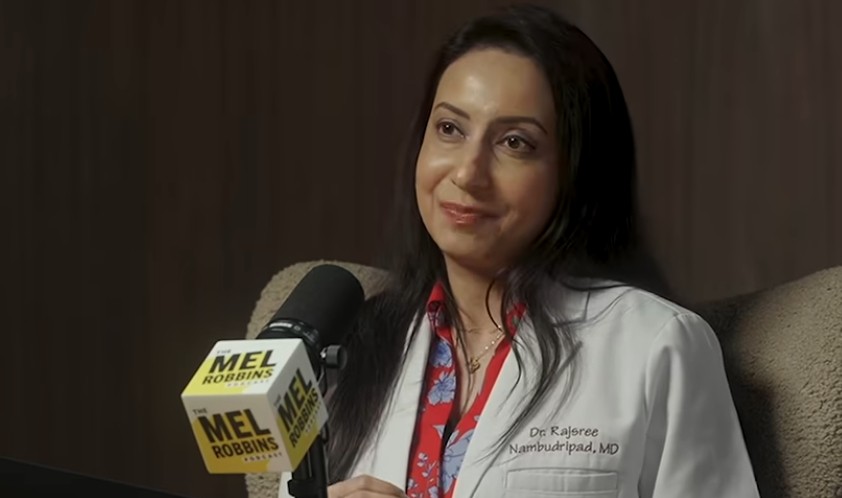
EDITOR’S NOTE: In this episode of The Mel Robbins Podcast, Mel sits down with integrative gut specialist Dr. Rajsree Nambudripad to unpack why so many people stay bloated, exhausted, and dismissed even when tests look “normal.” Together they walk through a practical four-part gut reset—motility, digestion, lining integrity, and microbiome balance—and show how fixing the root causes can ease IBS, SIBO, reflux, food sensitivities, and the downstream effects on energy, mood, thyroid, and metabolism.
TRANSCRIPT:
MEL ROBBINS: (00:00:00 – 00:00:23) Today on the Mel Robbins Podcast, a doctor’s guide to better gut health and 5 simple steps to healing your gut with food and natural protocols. Dr. Rajsree Nambudripad is here to help you feel better now.
Dr. Rajsree, I am so excited that you’re here.
DR. RAJSREE NAMBUDRIPAD: (00:00:23 – 00:00:25) Thank you, Mel. It’s wonderful to be here.
MEL ROBBINS: (00:00:25 – 00:00:41) Well, welcome to the Mel Robbins Podcast. I would love to have you start, Dr. Rajsree, by speaking to the person who’s with us, what could change about their life, their health, how they feel, if they really take to heart everything that you’re about to teach us?
DR. RAJSREE NAMBUDRIPAD: (00:00:41 – 00:01:24) Well, today I’m going to help you better understand what is actually happening in your gut.
So, if you’re someone out there who’s struggling with bloating every day, or chronic constipation, or inconsistent bowels, or maybe you have reflux, or food sensitivities, and you don’t even know what to eat anymore, I want you to know that there’s hope and there’s so much we can do to heal your gut.
And today I’m going to share a lot of practical tips that you can actually begin using right away to start feeling better. And by healing your gut and improving your digestion, you’re going to notice so many other aspects of your health improve, from your energy to your mental focus, your mood, your skin, your immune system, your metabolism, and so much more.
Dr. Nambudripad’s Background and Training
MEL ROBBINS: (00:01:25 – 00:01:48) One of the reasons why I wanted to talk to you is because you have such an extraordinary background, and you’re in a clinical practice, but your approach is grounded in science and deeply personal. Could you just explain a little bit more in depth about your training, and your background, and how you approach your gut health medical practice?
DR. RAJSREE NAMBUDRIPAD: (00:01:48 – 00:02:32) So, I did my internal medicine training at Northwestern in Chicago, and then I did gastroenterology training at UC Irvine. And so during that GI training, I did endoscopies and colonoscopies. I did all the traditional treatments, like reflux was treated with proton pump inhibitors to just shut off the acid. If someone had constipation, they were given prescription laxatives.
So intuitively, I just knew that there was so much more we could do for the gut. I really wanted to help patients heal, not just suppress the symptoms. So, and then I had my own personal journey with SIBO, and I think that really transformed the way I saw so many things in the gut. And then a lot of things I’ve actually learned from my patients.
MEL ROBBINS: (00:02:32 – 00:02:54) Why are you smiling so much? What have you discovered in 15 years of practice of not just treating symptoms, but restoring the overall gut health, and how a simple protocol that we’re going to learn today really is the place to start for absolutely every single thing that you may be experiencing right now related to gut issues.
DR. RAJSREE NAMBUDRIPAD: (00:02:56 – 00:03:48) So many people, I think, maybe are stuck and they’re just living with these symptoms every single day, and they may have nowhere to turn to, and they may feel like, is this how my life is going to be for the rest of my life? I know because I was there and how scary that was.
So when I finally figured it out for myself, I thought, I have to share this with others. There’s so many people suffering. I have to make this standardized, and I need to create a protocol, a roadmap for people. Because if it was that difficult for me to figure out, imagine other people that don’t have GI training. The feedback I get is incredible. I get emails from people every day that tell me that they were suffering for 20-plus years with IBS and diarrhea. And once they fixed their gut, they took a risk in following my protocol, and now they’ve gotten their life back. It’s that powerful.
Why Gut Health Matters
MEL ROBBINS: (00:03:48 – 00:03:54) So why is gut health so important, Dr. Rajsree, for your overall health?
DR. RAJSREE NAMBUDRIPAD: (00:03:55 – 00:04:39) The gut is really the foundation of your health. So if you truly want to be healthy, you absolutely have to pay attention to your gut. Your gut is sending signals to every organ in your body.
So for example, let’s start with your brain. Your gut is constantly talking to the brain through the gut-brain axis. So often when I’ll see patients who have gut issues, they’re also suffering from anxiety and brain fog and often sometimes even insomnia.
And then our gut strongly influences our immune system. 70% of our immune cells are in the lining of our gut. So if your gut is inflamed, you might notice that inflammation pop up elsewhere in your body. And then our gut strongly influences our skin through the gut-skin axis.
MEL ROBBINS: (00:04:39 – 00:04:41) Wait, the gut-skin axis? What is that?
DR. RAJSREE NAMBUDRIPAD: (00:04:41 – 00:04:46) So our skin microbiome strongly reflects our gut microbiome.
MEL ROBBINS: (00:04:46 – 00:04:47) Really?
DR. RAJSREE NAMBUDRIPAD: (00:04:48 – 00:05:06) So what’s fascinating is when I help patients heal their gut, they’ll often come back and tell me, oh, by the way, my acne cleared up, my eczema cleared up.
The Gut Garden Concept
MEL ROBBINS: (00:05:06 – 00:05:12) You’re kidding. You talk about this concept of the gut garden. What is that?
DR. RAJSREE NAMBUDRIPAD: (00:05:13 – 00:05:23) So basically what I want to make clear and share with the audience today is that our gut is not a simple tube where food goes in one end and waste comes out the other end.
MEL ROBBINS: (00:05:23 – 00:05:24) Okay.
DR. RAJSREE NAMBUDRIPAD: (00:05:24 – 00:05:26) A lot of time we’re given that impression.
MEL ROBBINS: (00:05:26 – 00:05:26) Yes.
DR. RAJSREE NAMBUDRIPAD: (00:05:26 – 00:06:00) Because you might’ve had an endoscopy or a colonoscopy. And during those procedures, the gut kind of looks like a tube from the inside, with twists and turns. But so many of my patients have had those procedures and they’re just told that everything looks normal, but they don’t feel normal and they have a lot of symptoms that are affecting their quality of life.
So what I want to share today is that the gut is actually a complex and delicate ecosystem. And the best way that I like to explain it is that it’s a garden. So let me show you more about that.
MEL ROBBINS: (00:06:00 – 00:06:01) Oh, I’d love to see this.
DR. RAJSREE NAMBUDRIPAD: (00:06:01 – 00:06:01) Okay.
MEL ROBBINS: (00:06:01 – 00:06:04) Hey, great. I’m going to come in and help you guys out. All right. Our executive producer, Tracy.
DR. RAJSREE NAMBUDRIPAD: (00:06:04 – 00:06:05) Okay.
MEL ROBBINS: (00:06:05 – 00:06:09) It’s coming. You’re wearing green today, Tracy. I’m ready for the garden. So she’s ready for the garden.
DR. RAJSREE NAMBUDRIPAD: (00:06:09 – 00:06:09) Okay.
MEL ROBBINS: (00:06:09 – 00:06:51) And if you are listening right now, what we have is just a visual prop. We’re going to talk all about this. And it is just kind of a garden that we’ve put together. You see soil, you see a watering can, you see bees, and you’ve got all these beautiful flowers and greens that are growing in the garden. And one of the things I just want to say, Dr. Rajsree, is I am one of those people that have always envisioned a long tube when somebody says the gut. So I think about, okay, my gut is basically from my mouth, down a long tube, out the other end. That’s the gut. I’ve never, ever in my life envisioned a garden in there.
DR. RAJSREE NAMBUDRIPAD: (00:06:51 – 00:06:52) Absolutely.
MEL ROBBINS: (00:06:52 – 00:06:54) Why do you want us to envision a gut garden?
DR. RAJSREE NAMBUDRIPAD: (00:06:55 – 00:07:08) So, what I’ve observed, from 15 years of clinical practice and treating very complex gut disorders, is that sometimes you can’t explain these conditions if you just look at the structural aspects of our gut.
MEL ROBBINS: (00:07:08 – 00:07:08) Okay.
DR. RAJSREE NAMBUDRIPAD: (00:07:09 – 00:07:21) So, what I’ve discovered is that there’s actually 4 main systems of our gut garden, and to really have ideal digestion and to feel your best, you have to correct all 4 aspects of this garden.
MEL ROBBINS: (00:07:22 – 00:07:22) Okay.
DR. RAJSREE NAMBUDRIPAD: (00:07:22 – 00:07:30) And when we do that, remarkable things happen. Patients who have had symptoms for years, sometimes even decades, they get better.
MEL ROBBINS: (00:07:31 – 00:07:32) Wow. Yes.
DR. RAJSREE NAMBUDRIPAD: (00:07:32 – 00:07:35) So, let me tell you what these 4 systems are.
MEL ROBBINS: (00:07:35 – 00:07:35) Great.
The Four Systems of the Gut Garden
DR. RAJSREE NAMBUDRIPAD: (00:07:35 – 00:07:38) The first system is the motility in the gut.
MEL ROBBINS: (00:07:39 – 00:07:39) The motility.
DR. RAJSREE NAMBUDRIPAD: (00:07:39 – 00:07:40) Motility.
MEL ROBBINS: (00:07:40 – 00:07:40) Okay.
DR. RAJSREE NAMBUDRIPAD: (00:07:41 – 00:07:43) That’s like the irrigation system of your garden.
MEL ROBBINS: (00:07:43 – 00:07:43) Okay.
DR. RAJSREE NAMBUDRIPAD: (00:07:43 – 00:07:48) So, think of it as like you have sprinklers, or maybe you have a watering can like we have here.
MEL ROBBINS: (00:07:48 – 00:07:49) Yep.
DR. RAJSREE NAMBUDRIPAD: (00:07:49 – 00:08:02) And so, water comes into your garden, and that water needs to spread evenly through your garden. And there’s going to be a drainage system that’s taking that water out. What would happen if that water stagnated in your garden?
MEL ROBBINS: (00:08:03 – 00:08:04) Everything would die.
DR. RAJSREE NAMBUDRIPAD: (00:08:04 – 00:08:05) Some parts would dry out.
MEL ROBBINS: (00:08:05 – 00:08:09) Oh, it’d get like really, the soil gets all thick.
DR. RAJSREE NAMBUDRIPAD: (00:08:09 – 00:08:10) Exactly.
MEL ROBBINS: (00:08:10 – 00:08:13) And it’s hard to dig in and it gets crusty and ugh. Yes.
DR. RAJSREE NAMBUDRIPAD: (00:08:13 – 00:08:21) Exactly. You would get puddles of water in some parts. And what happens when there’s puddles? Now you’ve got moss growing, you’ve got mushrooms popping up.
MEL ROBBINS: (00:08:22 – 00:08:22) Yep.
DR. RAJSREE NAMBUDRIPAD: (00:08:22 – 00:08:31) So we have to have good motility in your gut. Everything’s got to be moving through your gut nicely. If anything gets slowed down or backed up, that’s a problem.
MEL ROBBINS: (00:08:31 – 00:08:34) What’s the second of the 4 things in the gut garden?
DR. RAJSREE NAMBUDRIPAD: (00:08:34 – 00:08:37) So the second is the pollinators of your garden.
MEL ROBBINS: (00:08:37 – 00:08:37) Yeah.
DR. RAJSREE NAMBUDRIPAD: (00:08:37 – 00:08:50) So like the bees and the butterflies. So we have one little bee here. So similarly in our gut, we have to have digestive enzymes, we have to have stomach acid, and we have to have bile to break down our food.
MEL ROBBINS: (00:08:51 – 00:08:51) Okay.
DR. RAJSREE NAMBUDRIPAD: (00:08:52 – 00:09:10) So many patients I see, they’re lacking in one of those areas. They don’t have enough stomach acid, or they don’t have enough pancreatic enzymes, or they had their gallbladder removed, so they don’t have bile that’s stored up. And so when they eat food, they just can’t break it down. So that would be the second system of the garden.
MEL ROBBINS: (00:09:10 – 00:09:12) Okay, pollinators. What’s the third?
DR. RAJSREE NAMBUDRIPAD: (00:09:13 – 00:09:18) Okay, the third system is the garden bed. So, that’s like the soil in your garden.
MEL ROBBINS: (00:09:18 – 00:09:18) Mm-hmm.
DR. RAJSREE NAMBUDRIPAD: (00:09:19 – 00:09:22) And that’s similar to the integrity of the gut lining.
MEL ROBBINS: (00:09:22 – 00:09:23) Okay.
DR. RAJSREE NAMBUDRIPAD: (00:09:23 – 00:09:42) So, it’s so critical, because if you have inflammation in your gut lining, that’s very close to your immune system. 70% of your immune cells are sitting there, right under the gut lining. So, that’s like having big cracks in your soil. It’s kind of like having leaky gut, which we’ll talk about today.
MEL ROBBINS: (00:09:42 – 00:09:42) Yeah.
DR. RAJSREE NAMBUDRIPAD: (00:09:42 – 00:09:45) So that’s the critical third system of the gut.
MEL ROBBINS: (00:09:45 – 00:09:46) Gotcha. And what’s the final one?
DR. RAJSREE NAMBUDRIPAD: (00:09:47 – 00:10:30) The final one is your microbiome. So the plants and weeds in your garden. So as you can see here, we have these beautiful flowers. These flowers are like the good bacteria in your gut. And then these weeds that have popped up here, these are like the bad bacteria, maybe even fungal organisms and yeast.
So, in order to have a healthy gut, you need to have a balance. You need to have robust and diverse types of plants so that these weeds don’t pop up. But if something causes the good flowers to be wiped away, now all of a sudden, weeds can pop up. And the similar thing happens in the gut. And when we see weeds growing in your gut garden, we call that dysbiosis.
MEL ROBBINS: (00:10:30 – 00:10:32) Dysbiosis? Okay.
DR. RAJSREE NAMBUDRIPAD: (00:10:32 – 00:10:34) Dysbiosis means bacterial imbalance.
MEL ROBBINS: (00:10:35 – 00:10:44) Oh, okay. So, if you’re having gut issues, do you have to know which one of these 4 things is out of whack?
DR. RAJSREE NAMBUDRIPAD: (00:10:44 – 00:10:53) Well, the beautiful thing is, if you’re not sure what to do, you can just start with step 1 and step 2, which I’m happy to explain today.
MEL ROBBINS: (00:10:53 – 00:10:54) Okay.
DR. RAJSREE NAMBUDRIPAD: (00:10:54 – 00:11:12) And for more than 50% of people, that’s going to help them tremendously, and that’s the motility and the pollinators. Those first 2. So what I do with my patients when I see them, most of the time I have them work on that irrigation system, the motility.
MEL ROBBINS: (00:11:12 – 00:11:12) Okay.
DR. RAJSREE NAMBUDRIPAD: (00:11:12 – 00:11:18) And the pollinators breaking down their food, starting at that initial consult, even while we’re waiting for testing to come back.
The First 2 Steps: Motility and Digestion
MEL ROBBINS: (00:11:19 – 00:11:31) So if you have any gut issue and I were to come to your office, Dr. Rajsree, you would tell me, start doing these 2 things immediately, because these 2 things, no matter what you’re dealing with, are going to help your overall gut health?
DR. RAJSREE NAMBUDRIPAD: (00:11:31 – 00:11:32) Absolutely.
MEL ROBBINS: (00:11:32 – 00:11:32) What are they?
DR. RAJSREE NAMBUDRIPAD: (00:11:33 – 00:11:40) Okay, so to promote motility, usually we want to make sure your bowels are 100% and complete every day.
MEL ROBBINS: (00:11:40 – 00:11:41) What does that mean?
DR. RAJSREE NAMBUDRIPAD: (00:11:42 – 00:11:46) So, so many of us, we have some form of constipation.
MEL ROBBINS: (00:11:46 – 00:11:46) Yeah.
DR. RAJSREE NAMBUDRIPAD: (00:11:46 – 00:11:51) So, we got to get the bowels emptying perfectly. So, I’ll put patients on magnesium at bedtime.
MEL ROBBINS: (00:11:52 – 00:11:54) Which kind? ‘Cause there’s so many different kinds of magnesium.
DR. RAJSREE NAMBUDRIPAD: (00:11:54 – 00:11:58) Oh, absolutely. Magnesium citrate, glycinate, and malate.
MEL ROBBINS: (00:11:58 – 00:11:59) Okay.
DR. RAJSREE NAMBUDRIPAD: (00:11:59 – 00:12:16) The citrate part is really the one that works as a natural osmotic laxative. What that means is it pulls water into your colon. So, you take it at bedtime, and you can adjust the dose based on your bowels, but that way, when you wake up, your bowels are like clockwork.
MEL ROBBINS: (00:12:16 – 00:12:17) Really?
DR. RAJSREE NAMBUDRIPAD: (00:12:17 – 00:12:17) Yeah.
MEL ROBBINS: (00:12:18 – 00:12:19) Does that really work for a lot of people?
DR. RAJSREE NAMBUDRIPAD: (00:12:19 – 00:12:20) Absolutely.
MEL ROBBINS: (00:12:20 – 00:12:21) So how much do you take?
DR. RAJSREE NAMBUDRIPAD: (00:12:21 – 00:12:24) So usually we start at around 250 milligrams.
MEL ROBBINS: (00:12:24 – 00:12:24) Okay.
DR. RAJSREE NAMBUDRIPAD: (00:12:25 – 00:12:26) Up to 500 milligrams.
MEL ROBBINS: (00:12:26 – 00:12:31) Okay. And that’s just like basic protocol in order to have good motility?
DR. RAJSREE NAMBUDRIPAD: (00:12:31 – 00:12:31) Absolutely.
MEL ROBBINS: (00:12:32 – 00:12:36) Just take your magnesium. And it was the C, it was the G, and it was the M?
DR. RAJSREE NAMBUDRIPAD: (00:12:36 – 00:12:43) Citrate, glycinate, and malate. That’s the one we use. So that’s the first thing. But we also use something called a prokinetic.
MEL ROBBINS: (00:12:44 – 00:12:45) A prokinetic?
DR. RAJSREE NAMBUDRIPAD: (00:12:45 – 00:12:45) Yes.
MEL ROBBINS: (00:12:45 – 00:12:46) Okay.
DR. RAJSREE NAMBUDRIPAD: (00:12:46 – 00:12:52) A prokinetic is not a laxative, but it’s something that activates those cleaning waves in the gut.
MEL ROBBINS: (00:12:52 – 00:12:55) Really? Give me an example of what a prokinetic would be.
DR. RAJSREE NAMBUDRIPAD: (00:12:55 – 00:12:58) So, a natural prokinetic is ginger.
MEL ROBBINS: (00:12:59 – 00:12:59) Ginger.
DR. RAJSREE NAMBUDRIPAD: (00:12:59 – 00:13:21) So, we use a supplement, but it’s essentially a patented formula of ginger and artichoke. And you take that along with the magnesium at bedtime. And what it’s going to do is it’s going to clean up your small intestine while you’re sleeping, and you take that consistently, and that’s going to help that first system of the gut garden, that motility, that irrigation system, and that’s huge.
MEL ROBBINS: (00:13:21 – 00:13:28) Okay. So that’s number one. The second step that you give to people that come to see you, no matter what their complaints may be, is what?
DR. RAJSREE NAMBUDRIPAD: (00:13:29 – 00:13:31) The second thing is I enhance their pollinators.
MEL ROBBINS: (00:13:32 – 00:13:32) Okay.
DR. RAJSREE NAMBUDRIPAD: (00:13:32 – 00:13:34) So I give them digestive enzyme support.
MEL ROBBINS: (00:13:34 – 00:13:35) And what does that mean?
DR. RAJSREE NAMBUDRIPAD: (00:13:36 – 00:13:43) So, I have them take high-potency digestive enzymes either before or after their meals, and they can try it both ways.
MEL ROBBINS: (00:13:43 – 00:13:43) Okay.
DR. RAJSREE NAMBUDRIPAD: (00:13:44 – 00:14:05) And see what works for them. But what that does is it helps break down the food better. So, it breaks down proteins, fats, and carbohydrates. So, guess what? You don’t get bloated. You might be able to eat foods that normally would upset you. Like, I have some patients who can’t eat Brussels sprouts, but if they take their digestive enzymes, they can, because it breaks down the food better.
MEL ROBBINS: (00:14:06 – 00:14:10) Is there an example of like a food that acts as a digestive enzyme?
DR. RAJSREE NAMBUDRIPAD: (00:14:10 – 00:14:16) Absolutely. So, if you don’t have access to these supplements, you can at least have water with lemon juice.
MEL ROBBINS: (00:14:16 – 00:14:17) Oh, okay.
DR. RAJSREE NAMBUDRIPAD: (00:14:17 – 00:14:22) Or a little bit of apple cider vinegar. The acidity will help you break down the food better.
MEL ROBBINS: (00:14:22 – 00:14:40) So, just those 2 recommendations. You take your magnesium before bed, and then you try some digestive enzymes with your meals. That’s going to help a lot of your patients just out of the gate start to feel a little bit better?
DR. RAJSREE NAMBUDRIPAD: (00:14:41 – 00:14:51) Yeah, basically, when I see patients at their second appointment, they’ve already started this, they’ve been doing it for maybe a month, we now have all their test results back, but they tell me they’re over 50% better.
MEL ROBBINS: (00:14:51 – 00:14:52) No way.
DR. RAJSREE NAMBUDRIPAD: (00:14:52 – 00:14:52) Yes.
What Causes Bloating
MEL ROBBINS: (00:14:53 – 00:15:10) I love this. Okay, great. Let’s talk about some of the things that happen when the gut garden gets out of balance. So we know what we’re looking for and where we’re headed, but let’s talk about the stuff that can make the weeds come and kill the flowers and make the dirt turn into cement. Okay?
DR. RAJSREE NAMBUDRIPAD: (00:15:10 – 00:15:10) Okay, let’s do that.
MEL ROBBINS: (00:15:10 – 00:15:12) All right, let’s remove the gut garden.
DR. RAJSREE NAMBUDRIPAD: (00:15:12 – 00:15:12) Okay.
MEL ROBBINS: (00:15:14 – 00:15:18) Dr. Rajsree, what causes bloating? What is it?
DR. RAJSREE NAMBUDRIPAD: (00:15:18 – 00:15:31) So bloating is that uncomfortable feeling that you get when there’s pressure building up in your abdomen and you notice your abdomen get distended. So the classic scenario is when you feel and look like you’re 6 months pregnant by the end of the day.
MEL ROBBINS: (00:15:32 – 00:15:32) Mm-hmm.
DR. RAJSREE NAMBUDRIPAD: (00:15:33 – 00:15:55) So there’s many reasons for bloating. The first thing I always ask my patients is, how are your bowel movements? And if they tell me, well, I go to the bathroom every 3 to 4 days, well, then that’s the problem, because if you’re constipated that severely, that backup of stool in your colon is going to make you feel bloated. So we have to fix that first.
MEL ROBBINS: (00:15:55 – 00:15:57) How often should you go number 2?
DR. RAJSREE NAMBUDRIPAD: (00:15:58 – 00:15:58) Every day.
MEL ROBBINS: (00:15:59 – 00:15:59) Every day?
DR. RAJSREE NAMBUDRIPAD: (00:16:00 – 00:16:00) Every day.
MEL ROBBINS: (00:16:00 – 00:16:11) So is the protocol that you prescribe to your patients for constipation the same whether you’re going once a day or going once every 3 days or going once a week?
DR. RAJSREE NAMBUDRIPAD: (00:16:12 – 00:16:14) So, we start with the basics.
MEL ROBBINS: (00:16:14 – 00:16:14) Okay.
DR. RAJSREE NAMBUDRIPAD: (00:16:15 – 00:16:25) Magnesium’s my favorite, because of the other benefits on the body. It’s safe to take long-term. The second, again, is that prokinetic, that motility activator, that’s the ginger pill.
MEL ROBBINS: (00:16:25 – 00:16:25) Okay.
DR. RAJSREE NAMBUDRIPAD: (00:16:26 – 00:17:03) That’s also safe to take long-term. If that’s not working, we escalate. We use natural stimulant laxatives, like aloe, the plant aloe vera. They come in dried capsules, so it’s the leaves of the aloe vera plant. And that’s a little bit stronger. That will stimulate the bowels to move. That’s not something I encourage people to use daily. They can for a while, but eventually, our goal is to transition back to just magnesium and motility activator. Those are kind of like game-changing treatments. I’m surprised because they’re so simple, they’re so accessible to anyone, but I don’t think they get enough awareness in mainstream medicine.
MEL ROBBINS: (00:17:04 – 00:17:10) So, Dr. Rajsree, you said that when somebody comes in, and they’re complaining about bloating, the first thing you do is you ask, how often are you going to the bathroom?
DR. RAJSREE NAMBUDRIPAD: (00:17:10 – 00:17:10) Yes.
MEL ROBBINS: (00:17:11 – 00:17:13) ‘Cause you want to rule out constipation.
DR. RAJSREE NAMBUDRIPAD: (00:17:13 – 00:17:13) Absolutely.
MEL ROBBINS: (00:17:14 – 00:17:20) If somebody is bloated and they are going to the bathroom regularly, what are the other causes of bloating?
DR. RAJSREE NAMBUDRIPAD: (00:17:21 – 00:17:26) So usually when we’re talking about bloating, we’re talking about trapped gas in the intestines.
MEL ROBBINS: (00:17:27 – 00:17:27) Okay.
DR. RAJSREE NAMBUDRIPAD: (00:17:28 – 00:18:13) But I do want to make one thing clear. Gas itself is not the problem. ‘Cause if you’re eating certain foods, like you’re eating beans or a salad or broccoli, you’re going to have gas, that’s normal. But if you pass the gas and it doesn’t bother you, that’s totally fine, not a problem. It becomes a problem when that gas is trapped inside of you and it’s causing you pain. And trapped gas can present differently in different people. Some people get sharp stabbing pain, some people get this intense pressure, other people get cramping. So, it really varies. And it can really, the pain can be anywhere in your abdomen. It could be at the top, it could be at the bottom, the sides, but usually it comes down to a problem with one of 3 things in your gut.
MEL ROBBINS: (00:18:13 – 00:18:13) Okay.
DR. RAJSREE NAMBUDRIPAD: (00:18:14 – 00:18:33) The first thing is the motility, like we talked about. Maybe things are not moving properly through your intestines, so it’s getting backed up. The second is maybe you’re not breaking things down properly. So again, a problem with your pollinators, you’re not digesting properly. And the third is maybe you have bacteria in the wrong place.
MEL ROBBINS: (00:18:33 – 00:18:39) Okay. So, how do you stop bloating fast?
DR. RAJSREE NAMBUDRIPAD: (00:18:40 – 00:18:43) First thing, take digestive enzymes right away.
MEL ROBBINS: (00:18:43 – 00:18:43) Okay.
DR. RAJSREE NAMBUDRIPAD: (00:18:43 – 00:18:57) Basically, what it does, it’s going to break down your food. So, if you’re bloated and you’re uncomfortable, go ahead and take 1 or 2 of those and see how you feel. What it’s going to do is start breaking down the food, and within 30 minutes to an hour, you should feel that bloating go down.
MEL ROBBINS: (00:18:58 – 00:19:00) Wow. Yes. What’s another thing you can do?
DR. RAJSREE NAMBUDRIPAD: (00:19:01 – 00:19:24) The second thing is take that prokinetic, that ginger artichoke pill, take 1 or 2 of those, and it’s going to start getting those cleaning waves going so that it moves the gas bubbles downward so you can actually pass those bubbles so they’re not stuck inside of you. So that’s the second thing. And the third thing is kind of what we touched on, taking that magnesium every night so that you never run into a problem where things are backed up.
MEL ROBBINS: (00:19:24 – 00:19:28) What I love about this advice is you keep coming back to the same recommendations.
DR. RAJSREE NAMBUDRIPAD: (00:19:28 – 00:19:29) Oh yeah, it’s very simple.
MEL ROBBINS: (00:19:29 – 00:19:30) Thank you for simplifying it.
DR. RAJSREE NAMBUDRIPAD: (00:19:31 – 00:19:33) You can also go for a little walk.
MEL ROBBINS: (00:19:34 – 00:19:35) Okay, how does a walk help?
DR. RAJSREE NAMBUDRIPAD: (00:19:35 – 00:19:42) So, walk naturally activates the motility in the gut. So, the worst thing you can do if you’re bloated is to just sit there at your desk.
MEL ROBBINS: (00:19:42 – 00:19:45) What if you lie down? That’s what I always do. I always like lie down and unbutton my pants.
DR. RAJSREE NAMBUDRIPAD: (00:19:45 – 00:19:46) Lie down.
MEL ROBBINS: (00:19:46 – 00:19:48) I’m like, I’m so bloated, oh my God.
DR. RAJSREE NAMBUDRIPAD: (00:19:49 – 00:19:54) Well, the problem is when you’re just sitting still or laying down, everything’s kind of stagnant in your gut.
MEL ROBBINS: (00:19:55 – 00:19:55) Yeah.
DR. RAJSREE NAMBUDRIPAD: (00:19:55 – 00:20:03) So, even if you can just get around, walk around the office, go up a flight of stairs, that gets that motility going. So, that’s an easy thing that anyone can try.
MEL ROBBINS: (00:20:04 – 00:20:04) I love that.
DR. RAJSREE NAMBUDRIPAD: (00:20:04 – 00:20:04) Yeah.
Understanding IBS
MEL ROBBINS: (00:20:05 – 00:20:07) Dr. Rajsree, what is IBS?
DR. RAJSREE NAMBUDRIPAD: (00:20:08 – 00:20:17) So, IBS, it’s irritable bowel syndrome, and it actually affects 10 to 15% of the population. It’s that common.
MEL ROBBINS: (00:20:17 – 00:20:19) Wow. What are the symptoms?
DR. RAJSREE NAMBUDRIPAD: (00:20:20 – 00:20:39) So, to have IBS, you just basically need 3 things. You need to have abdominal pain or discomfort. You need to have an alteration in your bowel habits. So, either constipation or diarrhea, or a combination of both. And you need to notice that when you have a bowel movement, your symptoms and your pain improves.
MEL ROBBINS: (00:20:40 – 00:20:40) Okay.
DR. RAJSREE NAMBUDRIPAD: (00:20:41 – 00:20:44) So, so many people fit the criteria for IBS.
MEL ROBBINS: (00:20:44 – 00:20:48) How would you like us to think about IBS?
DR. RAJSREE NAMBUDRIPAD: (00:20:49 – 00:20:51) IBS is just a label for your symptoms.
MEL ROBBINS: (00:20:51 – 00:20:51) Okay.
DR. RAJSREE NAMBUDRIPAD: (00:20:52 – 00:21:00) But it’s not what’s really causing the symptoms. And so, if you’ve been told you have IBS, there’s so much more investigation that can be done.
MEL ROBBINS: (00:21:00 – 00:21:01) Okay.
DR. RAJSREE NAMBUDRIPAD: (00:21:01 – 00:21:06) What we now know is that 70% of IBS is actually caused by SIBO.
MEL ROBBINS: (00:21:07 – 00:21:11) Wow. But if it’s IBS, what do you do about it?
DR. RAJSREE NAMBUDRIPAD: (00:21:12 – 00:22:01) So, if a person is coming to see me, I have the luxury of doing all that further investigation. So we always test for SIBO. We test for food allergies. And most of the time the SIBO test will be positive. If for some reason it’s negative, then we move on to a gut microbiome test. So again, it’s always about figuring out what that root cause is and fixing it.
Now, if you’re just someone with IBS and you don’t know where to start, you can start with the first 2 systems of the gut garden. Which is promoting motility, making sure your bowels are 100% and complete with the help of magnesium and motility activator at night, and improving your digestion of food. Try some digestive enzymes. It’s a low-cost intervention. It might help you tremendously. And see where that takes you.
What Is SIBO?
MEL ROBBINS: (00:22:01 – 00:22:03) What is SIBO?
DR. RAJSREE NAMBUDRIPAD: (00:22:03 – 00:22:58) Small intestine bacterial overgrowth. So SIBO is basically when bacteria back up, so now they’re in the wrong place. So normally our small intestine does not have much bacteria. The job of the small intestine is to absorb nutrients from your food. The trillions of bacteria, they’re located in the colon. That’s where your primary microbiome is.
But if something causes those bacteria to back up into your small intestine where they’re not supposed to be, they start fermenting your food too early. So, every time you eat, you get this miserable gas and bloating, and it can alter your bowel habits. Hence, now it resembles IBS, and maybe you’ve been labeled with IBS. It can also cause acid reflux and nausea. It gives you that feeling of what we call early satiety, where you can’t really eat that much, ’cause you’ve got all this pressure in your abdomen.
MEL ROBBINS: (00:22:58 – 00:22:58) Yeah.
DR. RAJSREE NAMBUDRIPAD: (00:22:59 – 00:23:19) And it can even interfere with your nutrient absorption. So, then you get deficiencies in B12, and vitamin D, and iron. And SIBO can even have effects outside the GI tract. So, people with SIBO get really anxious, they get brain fog, fatigue, joint pain, and so much more.
MEL ROBBINS: (00:23:21 – 00:23:37) Wow. I see that you have a model next to you of a human being, and it’s all the insides. It’s like something you would see at a medical school, I think. So what’s happening for someone who has SIBO?
DR. RAJSREE NAMBUDRIPAD: (00:23:38 – 00:23:53) In this human model, these little stickers are the bacteria in your colon. Imagine what would happen if we take these bacteria and we move them to your small intestine where they’re not supposed to be. This is going to cause so much havoc to your digestion.
MEL ROBBINS: (00:23:54 – 00:23:59) It looks like she’s putting little, like, explosions all over your small intestines.
DR. RAJSREE NAMBUDRIPAD: (00:23:59 – 00:23:59) Yes.
MEL ROBBINS: (00:23:59 – 00:24:03) I’m just looking at this model, and it feels like I’m getting bloated.
DR. RAJSREE NAMBUDRIPAD: (00:24:04 – 00:24:12) That’s exactly what it does. Those bacteria, they start fermenting your food in the wrong place, and they interfere with your digestion of food.
MEL ROBBINS: (00:24:13 – 00:24:26) And there’s not supposed to be bacteria in the small intestine, because while the food is traveling through the small intestine, the intestines are trying to suck nutrients out.
DR. RAJSREE NAMBUDRIPAD: (00:24:26 – 00:24:26) Exactly.
MEL ROBBINS: (00:24:27 – 00:24:49) And how does the bacteria block the ability of the small intestine to do that? Because being a non-medical person, and not having studied this, I think in my brain, well, wouldn’t the bacteria help in some way? Like, we’re eating, we’re supposed to eat probiotics, prebiotics, all this stuff, like enzymes. Like, why wouldn’t it help? Why is it creating gas?
DR. RAJSREE NAMBUDRIPAD: (00:24:49 – 00:25:04) Okay, so I love that question. These bacteria, and this is the part I think a lot of people don’t understand, what they do is they start eating up some critical enzymes instead of being broken down and properly absorbed into your body.
MEL ROBBINS: (00:25:04 – 00:25:04) Yep.
DR. RAJSREE NAMBUDRIPAD: (00:25:05 – 00:25:10) Now it’s just sitting there in your small intestine, and the bacteria ferment it into gas.
MEL ROBBINS: (00:25:10 – 00:25:10) Ew.
DR. RAJSREE NAMBUDRIPAD: (00:25:11 – 00:25:36) And now, all of a sudden, foods that you used to be able to eat, you can’t eat anymore. So, you become more and more sensitive to foods. So, you become more carbohydrate intolerant. You can’t eat certain vegetables because of the fibrous material, and you might even become sensitive to dairy. So, maybe before you could eat cheese, now you can’t. And believe it or not, you can even become sensitive to fruit.
MEL ROBBINS: (00:25:36 – 00:25:37) Huh.
DR. RAJSREE NAMBUDRIPAD: (00:25:37 – 00:25:50) Because fruit has a fruit sugar called fructose, and SIBO causes what we call a secondary fructose intolerance, where now you don’t have the enzymes to break down fruit, so fruit will make you bloated.
MEL ROBBINS: (00:25:50 – 00:25:55) Now, when you say intolerance, Dr. Rajsree, what do you mean medically?
DR. RAJSREE NAMBUDRIPAD: (00:25:56 – 00:26:04) So, when you eat those foods, you get discomfort. You don’t feel well. You get bloating and discomfort, maybe even pain.
MEL ROBBINS: (00:26:04 – 00:26:05) How do you diagnose SIBO?
DR. RAJSREE NAMBUDRIPAD: (00:26:06 – 00:26:12) So, it’s a simple breath test, and it’s a test where you drink the solution of lactulose.
MEL ROBBINS: (00:26:13 – 00:26:14) What is lactulose?
DR. RAJSREE NAMBUDRIPAD: (00:26:14 – 00:26:33) It’s a type of sugar that your body cannot absorb, so it stays in your intestines. And if you have SIBO, the bacteria, they’re going to ferment it into gas. And then you actually blow and collect your breath at 20 to 30 minute intervals for a full 3 hours.
MEL ROBBINS: (00:26:33 – 00:26:34) Okay.
DR. RAJSREE NAMBUDRIPAD: (00:26:34 – 00:26:39) And you mail back the tubes and they’re going to graph out what’s being produced in your breath.
MEL ROBBINS: (00:26:40 – 00:26:43) No way. That’s insane. Can I ask a question?
DR. RAJSREE NAMBUDRIPAD: (00:26:43 – 00:26:43) Sure.
MEL ROBBINS: (00:26:44 – 00:26:50) Okay. I have noticed that there is a particular type of bad breath.
DR. RAJSREE NAMBUDRIPAD: (00:26:50 – 00:26:51) Okay.
MEL ROBBINS: (00:26:51 – 00:27:00) That people have that has a very metally, tinny, like old smell to it.
DR. RAJSREE NAMBUDRIPAD: (00:27:01 – 00:27:02) I know exactly what you’re talking about.
MEL ROBBINS: (00:27:02 – 00:27:02) You do?
DR. RAJSREE NAMBUDRIPAD: (00:27:02 – 00:27:04) Absolutely. I see it all the time.
MEL ROBBINS: (00:27:05 – 00:27:05) You do?
DR. RAJSREE NAMBUDRIPAD: (00:27:05 – 00:27:17) Yes. And bad breath, it’s basically a change in the bacteria in your oral microbiome, and it reflects strongly what’s happening in your gut microbiome.
MEL ROBBINS: (00:27:17 – 00:27:18) No way.
DR. RAJSREE NAMBUDRIPAD: (00:27:18 – 00:27:19) Or body odor.
MEL ROBBINS: (00:27:20 – 00:27:24) Body odor can be an indication of bacteria in your gut?
DR. RAJSREE NAMBUDRIPAD: (00:27:24 – 00:27:24) Absolutely.
MEL ROBBINS: (00:27:25 – 00:27:25) Why?
DR. RAJSREE NAMBUDRIPAD: (00:27:26 – 00:27:42) Whatever’s happening in your gut translates to your skin, your sweat glands, your hormones, and it all comes out. So, the interesting thing is, after we clean up their gut, they tell me, oh, my breath is so much better. I don’t smell as bad anymore.
Dr. Nambudripad’s Personal Story with SIBO
MEL ROBBINS: (00:27:43 – 00:27:49) Dr. Rajsree, tell me about what happened that makes this deeply personal for you.
DR. RAJSREE NAMBUDRIPAD: (00:27:50 – 00:28:26) So, about 7 or 8 years ago, I started to notice that at the end of the day, I had so much pain in my abdomen. It was miserable pain, super sharp. And it was so, so much pressure in my abdomen. I even felt like it was hard to take deep breaths, and that pressure would make me feel anxious. It would make me feel agitated. It’s hard to focus on other things. So, I was really trying to figure out what was causing it. So, I initially thought maybe it’s a sensitivity to gluten and dairy. So, I cut those out because that’s pretty common. A lot of people cut out gluten and dairy.
MEL ROBBINS: (00:28:26 – 00:28:26) Yep.
DR. RAJSREE NAMBUDRIPAD: (00:28:26 – 00:29:22) But then all of a sudden, I couldn’t eat quinoa anymore. I couldn’t eat brown rice. Those would make me bloated too. And then all of a sudden, I couldn’t eat cheese anymore. I had eaten cheese my whole life. Now I couldn’t eat that. I couldn’t have butter. So my diet became very restricted in order to control the symptoms. I literally was down to like eggs, salmon, white rice, arugula salad, and chicken soup. So I couldn’t even go out to restaurants. I was afraid when I got an invitation to someone’s house, I would always eat before going out. The turning point for me was when I realized I couldn’t eat fruit anymore, because fruit is what I consider healthy, and I had always enjoyed eating bananas, but now even a banana was causing bloating. So that’s when I realized that the problem wasn’t the food, the problem was my gut.
MEL ROBBINS: (00:29:22 – 00:29:37) So how did you treat SIBO? What was the first thing that you did to either confirm that this was what this was, or to just go, you know what, I have a feeling this is what this is. And so what do you do to treat this?
DR. RAJSREE NAMBUDRIPAD: (00:29:38 – 00:29:42) So the conventional treatment for SIBO is to take an antibiotic.
MEL ROBBINS: (00:29:43 – 00:30:07) What? Wait, how? How does that work if what you’ve just explained is you have bacteria in there that’s creating havoc? And impacting the functioning of the lining of the small intestine and potentially creating these, like, gross pools of overgrowth of junk.
DR. RAJSREE NAMBUDRIPAD: (00:30:07 – 00:30:08) Uh-huh.
MEL ROBBINS: (00:30:08 – 00:30:10) I mean, that’s my words, not yours.
DR. RAJSREE NAMBUDRIPAD: (00:30:11 – 00:30:23) Absolutely. The conventional treatment unfortunately doesn’t work well. It has a very high failure rate and a very high relapse rate. When I treat SIBO, I look at this as a full garden ecosystem problem.
MEL ROBBINS: (00:30:23 – 00:30:23) Okay.
DR. RAJSREE NAMBUDRIPAD: (00:30:23 – 00:31:19) We have to fix the motility in the gut. We have to fix your breakdown of food. During my own personal struggle with SIBO, I actually first wanted to treat it naturally. I tried to take the herbal antimicrobials, and there were so many different ones out there, different potencies. I didn’t know how long to take them. I just tried different things. I got super nauseous. I got sick. So then I switched gears and I said, well, if this is my only option, let me take the antibiotic. So I did, and I did not get better. In fact, I did a repeat SIBO breath test and it looked identical. Like the antibiotics did not touch it at all. So that’s when I really dug deeper. I’m like, why does SIBO happen? What are the root causes? So that’s when I realized something. That I really had to address the gut motility. That’s that irrigation system of the garden. So I started taking that prokinetic. That was a game changer for me.
MEL ROBBINS: (00:31:19 – 00:31:21) The ginger artichoke pill?
DR. RAJSREE NAMBUDRIPAD: (00:31:22 – 00:31:34) Absolutely. What I didn’t realize is gas was all trapped inside of me. It was never coming out. After I took the motility activator, that ginger artichoke pill, I was finally passing gas.
MEL ROBBINS: (00:31:35 – 00:31:35) Wow.
DR. RAJSREE NAMBUDRIPAD: (00:31:35 – 00:31:41) The second turning point was when I started taking a supplement called betaine and pepsin.
MEL ROBBINS: (00:31:42 – 00:31:44) Betaine and pepsin. Okay.
DR. RAJSREE NAMBUDRIPAD: (00:31:45 – 00:31:49) When I took it, it helped me break down the food better, so I wasn’t bloated anymore.
MEL ROBBINS: (00:31:49 – 00:32:10) So is this just what you did to get the bacteria out of the small intestine and to get things moving again? And then once you are kind of cleared of the gas and you start feeling better and you pass the breath test, now it’s just the standard protocol of the magnesium, the digestive enzymes, and some of the other things we’re going to get into.
DR. RAJSREE NAMBUDRIPAD: (00:32:11 – 00:32:12) Well, what I would—
MEL ROBBINS: (00:32:12 – 00:32:13) Because you don’t want it to come back.
DR. RAJSREE NAMBUDRIPAD: (00:32:13 – 00:32:13) Absolutely.
MEL ROBBINS: (00:32:14 – 00:32:20) And if you have the problem, because those little bacteria keep sneaking out of the colon back up, I’m assuming they might come right back.
The Four Phases of Treating SIBO
DR. RAJSREE NAMBUDRIPAD: (00:32:21 – 00:32:34) Absolutely. So I call it the foundational steps of treating SIBO. The foundational steps is where we get everything ready to kill the bacteria. We don’t kill the bacteria until the 4th and final phase of treatment.
MEL ROBBINS: (00:32:35 – 00:32:35) Oh.
DR. RAJSREE NAMBUDRIPAD: (00:32:35 – 00:33:25) So, phase 1 is promoting motility. That’s the magnesium and the motility activator. We got to get that all going first. Phase 2 is the digestive enzymes. Some people need that extra betaine and pepsin, not everybody, but some people have low stomach acid, and that can be a game changer. So, that’s the pollinators. We’re getting that going. Phase 3 is there’s probably inflammation in the gut from all these bacteria, so I start patients on a spore probiotic that has immunoglobulins to heal the inflammation in their gut. So that’s phase 3. So those are the foundational steps to get everything in order before we can actually kill the bacteria in phase 4 with the herbal antimicrobials. The ones we use are called berberine. It comes from the root of a berberine plant.
MEL ROBBINS: (00:33:26 – 00:33:26) Okay.
DR. RAJSREE NAMBUDRIPAD: (00:33:26 – 00:33:32) Oregano oil. So you’re probably familiar with oregano. And the third one is allicin. It comes from garlic.
MEL ROBBINS: (00:33:32 – 00:33:46) Now, what have you seen in your clinical practice and in yourself, Dr. Rajsree, when you follow this protocol with your patients and with yourself, when somebody comes in and has a positive SIBO test?
DR. RAJSREE NAMBUDRIPAD: (00:33:47 – 00:34:20) So this protocol, I would say, is incredibly successful. It was for me and for hundreds of my patients. But we see incredible results because, again, I think that my protocol really addresses the 4 systems of restoring the gut ecosystem. So at the end of it, not only have you cleared SIBO, you have a healthier gut microbiome. And then we have this whole strategy for prevention of relapse that is so critical in SIBO. Because 50% of patients will relapse in 9 months if you don’t have a strategy.
MEL ROBBINS: (00:34:21 – 00:34:49) One thing I want to say before I ask you this next question is I just want to remind you, as you’re listening, that we have a comprehensive guide to every episode with show notes, with links that we prepare for every episode. So, if you’re like me, and as Dr. Rajsree is talking, you’re trying to take mental notes, okay, what did she just say? Because I got to send this. You can go to the show notes, and it’s all going to be right there for you. So, you can just lean in and listen, and we got you. Let’s talk about leaky gut.
Leaky Gut Explained
DR. RAJSREE NAMBUDRIPAD: (00:34:50 – 00:34:50) Sure.
MEL ROBBINS: (00:34:50 – 00:34:52) What is leaky gut?
DR. RAJSREE NAMBUDRIPAD: (00:34:53 – 00:35:07) So, the medical term for leaky gut is increased intestinal permeability. So, it’s basically a problem with that 3rd system of the gut garden, the garden soil. Imagine your garden soil having big cracks in it.
MEL ROBBINS: (00:35:07 – 00:35:07) Hmm.
DR. RAJSREE NAMBUDRIPAD: (00:35:08 – 00:35:14) So normally, our small intestine is made up of tiny little cells, which I have a little example here.
MEL ROBBINS: (00:35:15 – 00:35:18) She’s got yellow yoga blocks. I’m going to narrate this for you if you’re listening.
DR. RAJSREE NAMBUDRIPAD: (00:35:19 – 00:35:26) And these tiny little cells are what we call enterocytes. They’re like the little tiny cells on the lining of your small intestine.
MEL ROBBINS: (00:35:26 – 00:35:29) Okay, so these are the things that line the wall.
DR. RAJSREE NAMBUDRIPAD: (00:35:30 – 00:35:30) Mm-hmm.
MEL ROBBINS: (00:35:30 – 00:35:31) Okay.
DR. RAJSREE NAMBUDRIPAD: (00:35:31 – 00:35:37) Now, these tiny cells, they’re bound together by tight junctions that hold them together.
MEL ROBBINS: (00:35:37 – 00:35:37) Okay.
DR. RAJSREE NAMBUDRIPAD: (00:35:38 – 00:35:41) And the job of these cells is to just absorb nutrients from your food.
MEL ROBBINS: (00:35:41 – 00:35:42) Okay.
DR. RAJSREE NAMBUDRIPAD: (00:35:42 – 00:35:57) But if something disrupts these tiny junctions between these cells and pops them open, now it could be a variety of things. It could be the standard American diet, which is full of preservatives and emulsifiers and additives.
MEL ROBBINS: (00:35:57 – 00:35:57) Okay.
DR. RAJSREE NAMBUDRIPAD: (00:35:58 – 00:36:09) It could be antibiotics. It could be NSAIDs, like, if you’re taking a lot of ibuprofen on an empty stomach, could be if you’re a heavy drinker. So, all of these are insults to the gut.
MEL ROBBINS: (00:36:10 – 00:36:13) Can the bacteria we talked about also be? Okay, great.
DR. RAJSREE NAMBUDRIPAD: (00:36:13 – 00:36:28) Absolutely. So, SIBO is a big root cause of leaky gut because of the bacteria, again, interfering with the enzymes, creating inflammation in the gut. So, this is what leaky gut looks like. Now, you’ve got openings, between these tiny cells in your small intestine.
MEL ROBBINS: (00:36:29 – 00:36:32) Oh, so instead of having a tube, you have mesh.
DR. RAJSREE NAMBUDRIPAD: (00:36:33 – 00:36:51) Exactly. You have little holes in your gut now. This is a problem because bacteria and food that are normally on the inside of your gut, instead of getting properly absorbed through these cells, they now have an open window to enter your bloodstream.
MEL ROBBINS: (00:36:51 – 00:36:52) Uh-oh. Uh-oh.
DR. RAJSREE NAMBUDRIPAD: (00:36:52 – 00:36:53) Like this. This little ball.
MEL ROBBINS: (00:36:53 – 00:36:56) She’s now got a ping pong ball, and she just shoved it through the wall.
DR. RAJSREE NAMBUDRIPAD: (00:36:56 – 00:36:56) Yeah.
MEL ROBBINS: (00:36:56 – 00:36:58) So now it’s floating around in my body?
DR. RAJSREE NAMBUDRIPAD: (00:36:59 – 00:37:02) It’s entered your bloodstream. And guess what’s over on this side?
MEL ROBBINS: (00:37:03 – 00:37:03) The rest of me.
DR. RAJSREE NAMBUDRIPAD: (00:37:03 – 00:37:09) Yeah. And 70% of your immune cells, they’re sitting right there on the other side of these tiny cells inside.
MEL ROBBINS: (00:37:09 – 00:37:20) Oh, so on the inside, you’ve got this lining that’s absorbing nutrients. And that’s also, when working correctly, is supposed to keep all the food, bacteria, and crap on the tube.
DR. RAJSREE NAMBUDRIPAD: (00:37:20 – 00:37:21) Exactly.
MEL ROBBINS: (00:37:21 – 00:37:47) But if you’re eating a bunch of unhealthy, ultra-processed crap or doing too much ibuprofen or taking antibiotics, or you got bacterial or SIBO or other stuff, it starts to stretch the lining. And now all the stuff on the inside is scooting through and now it’s in your bloodstream. But the first thing in your bloodstream on the outside of your intestinal walls is the immune cells.
DR. RAJSREE NAMBUDRIPAD: (00:37:47 – 00:37:48) Exactly.
MEL ROBBINS: (00:37:48 – 00:37:54) And so they’re like, uh-oh, wait a minute, that piece of broccoli wasn’t supposed to come. Wait, what is that bacteria doing out here?
DR. RAJSREE NAMBUDRIPAD: (00:37:54 – 00:37:55) Right.
MEL ROBBINS: (00:37:55 – 00:37:56) So what happens?
DR. RAJSREE NAMBUDRIPAD: (00:37:56 – 00:38:23) So, it confuses your immune system, and it creates this whole entire inflammatory cascade. So, now, what’s happening in your gut affects the rest of your body, and it can present in different ways in different people. So, I actually had a clinic day, this was a real day, where I saw 5 patients with leaky gut, all on the same day, and they had 5 different presentations entirely.
MEL ROBBINS: (00:38:24 – 00:38:24) What were they?
DR. RAJSREE NAMBUDRIPAD: (00:38:25 – 00:39:18) The first one was a 70-year-old woman who had this dermatitis on her legs, like a skin rash. And she had been to 2 dermatologists. They couldn’t figure it out. They did a skin biopsy. They gave her a bunch of steroid creams to put on the rash, but it wasn’t getting better. So we tested her gut. She had leaky gut, and we worked on healing her gut. Getting these cells back together, and lo and behold, her skin clears up.
So, the second patient I had that day was a 55-year-old woman who had rheumatoid arthritis, which is an autoimmune condition. But her disease was flaring, so she was getting more pain in her joints. So, we check her microbiome, and the same thing, we find leaky gut.
So, the third patient I saw that day was a 45-year-old man. And he was having severe migraine headaches, like almost every day.
MEL ROBBINS: (00:39:18 – 00:39:18) Huh.
DR. RAJSREE NAMBUDRIPAD: (00:39:19 – 00:39:32) And he was having to take abortive medications daily, which was very unusual for him. Tremendous brain fog out of the blue. And sure enough, he had leaky gut. We treated that, and his migraines reduced significantly.
MEL ROBBINS: (00:39:33 – 00:39:35) So, how do you heal a leaky gut?
DR. RAJSREE NAMBUDRIPAD: (00:39:36 – 00:39:52) Okay, so we heal leaky gut. First, we’ve got to clean up the diet. So, we’ve got to get rid of those inflammatory triggers. We have to remove alcohol, gluten, and dairy, because those are potentially inflammatory triggers, at least while we’re treating leaky gut.
MEL ROBBINS: (00:39:52 – 00:39:52) Okay.
DR. RAJSREE NAMBUDRIPAD: (00:39:53 – 00:40:12) We may be able to reintroduce those later. We also cut out processed foods to get rid of all those additives and emulsifiers. And then, the 2 treatments we use for leaky gut, the first is L-glutamine powder. So, it’s just an amino acid, and it happens to be food for these little enterocytes.
MEL ROBBINS: (00:40:12 – 00:40:13) Okay.
DR. RAJSREE NAMBUDRIPAD: (00:40:13 – 00:40:21) So, it feeds these cells, and it nourishes these cells, and seals up these tight junctions between the cells. It does take time. It’s not an overnight process.
MEL ROBBINS: (00:40:21 – 00:40:23) How long do you need to dedicate to do this?
DR. RAJSREE NAMBUDRIPAD: (00:40:24 – 00:40:26) 3 months for sure, sometimes up to 6 months.
MEL ROBBINS: (00:40:26 – 00:40:26) Okay.
DR. RAJSREE NAMBUDRIPAD: (00:40:27 – 00:40:28) So, that’s the first treatment we use.
MEL ROBBINS: (00:40:28 – 00:40:29) Okay.
DR. RAJSREE NAMBUDRIPAD: (00:40:29 – 00:40:40) The second treatment we use is immunoglobulins. Also known as IgG antibodies. They’re kind of similar to colostrum. Are you familiar with colostrum?
MEL ROBBINS: (00:40:40 – 00:40:41) That’s from milk, isn’t it?
DR. RAJSREE NAMBUDRIPAD: (00:40:41 – 00:40:45) It’s like the mother’s first milk, that has all the antibodies.
MEL ROBBINS: (00:40:45 – 00:40:45) Yes.
DR. RAJSREE NAMBUDRIPAD: (00:40:45 – 00:40:47) To nourish the infant’s gut and immune system.
MEL ROBBINS: (00:40:47 – 00:40:47) Mm-hmm.
DR. RAJSREE NAMBUDRIPAD: (00:40:48 – 00:41:55) So, the issue with colostrum is it has dairy proteins. So, immunoglobulins are completely dairy-free. So, there’s no dairy proteins, and they’re derived from bovine serum. And they just come in capsules. So, these 2 are the primary treatments that we have for leaky gut, but leaky gut does not usually happen in isolation. So, we’re back to that garden metaphor, and now there’s this new bacteria that I’m noticing that’s missing in a lot of people’s gut, and it’s called Akkermansia. Akkermansia, the full name is Akkermansia muciniphila, but it lives in the mucus layer of the gut. So it lives right here next to these enterocytes, and it creates that protective mucus that prevents leaky gut. But if you’re missing this critical bacteria that’s making the mucus, well, you’re definitely higher risk of leaky gut. So if you’re missing that, we will also replenish that Akkermansia. And then the final thing is, if you’ve got a bunch of weeds on this side, the bacteria like we talked about—SIBO or dysbiosis or Candida—we’ve got to clean that up as well. And that’s where the herbal antimicrobials come in.
The Best Diet for Gut Health
MEL ROBBINS: (00:41:55 – 00:41:59) Amazing. Dr. Rajsree, what is the best diet for gut health?
DR. RAJSREE NAMBUDRIPAD: (00:41:59 – 00:42:06) So, everyone has a different gut garden. So, the interesting thing is that the same diet might not work for everyone.
MEL ROBBINS: (00:42:07 – 00:42:08) Oh, I see. I wanted a simple answer.
DR. RAJSREE NAMBUDRIPAD: (00:42:09 – 00:42:24) Well, let me give you an example. I have some friends who are vegan, and they eat a vegan diet incredibly high in fiber, and they’re thriving on that. Which is wonderful. But if that same diet was given to someone else, they’d probably get bloated and miserable.
MEL ROBBINS: (00:42:24 – 00:42:24) Hmm.
DR. RAJSREE NAMBUDRIPAD: (00:42:24 – 00:43:10) So some people do good on a Mediterranean diet, some people do good on a paleo diet, but there are some key principles that I recommend across the board. The first is that you want to eat whole foods, so you want to avoid processed foods as much as you can. The second is that you want to have as many colors on your plate as possible. So that means having some berries or colorful purple potatoes or purple cabbage, carrots, because colors is when you’re going to get the antioxidants and the phytonutrients. So try your best to eat a diverse array of colors. The third thing is to listen to your gut and figure out which fibers agree with you.
MEL ROBBINS: (00:43:10 – 00:43:10) Now, how do you know?
DR. RAJSREE NAMBUDRIPAD: (00:43:12 – 00:43:14) So, it’s a little bit of trial and error.
MEL ROBBINS: (00:43:14 – 00:43:14) Okay.
DR. RAJSREE NAMBUDRIPAD: (00:43:15 – 00:44:10) But let’s say you eat arugula. Arugula is usually well tolerated because it doesn’t have any fermentable carbohydrate. So, if you eat arugula with lemon juice and olive oil, and you feel good eating that, that’s a great fiber to keep in your diet. Versus if you eat beans and you get bloated, maybe that doesn’t agree with you. So, fiber is good, but you may have to do trial and error to figure out what fibers agree with your gut and keep those in your diet. And the 4th and final thing is to try to diversify your diet as much as possible. So what that means is that instead of just having broccoli every night, maybe try green beans or asparagus, or better yet, stir fry a bunch of vegetables together, because the more diverse your diet, the more robust and resilient your gut microbiome. So you’re going to get more plants growing in your gut garden. And that’s going to make it more strong so that the weeds don’t come back.
MEL ROBBINS: (00:44:12 – 00:44:15) What foods tend to make your gut health symptoms worse?
DR. RAJSREE NAMBUDRIPAD: (00:44:16 – 00:44:23) Okay, great question. The first one is beans and legumes. I think that’s an obvious one. That can cause gas and bloating.
MEL ROBBINS: (00:44:23 – 00:44:27) It’s true, but I, for some reason, I look at beans and legumes and I’m like, they’re so good.
DR. RAJSREE NAMBUDRIPAD: (00:44:28 – 00:44:30) I know, they’re so yummy, right?
MEL ROBBINS: (00:44:30 – 00:44:30) Yeah.
DR. RAJSREE NAMBUDRIPAD: (00:44:30 – 00:44:35) So yummy. But again, it’s very specific, each person’s different.
MEL ROBBINS: (00:44:35 – 00:44:36) Yes.
DR. RAJSREE NAMBUDRIPAD: (00:44:36 – 00:44:41) Some people eat beans every day, and they’re great. They have the microbiome that’s able to break it down.
MEL ROBBINS: (00:44:41 – 00:44:46) Gotcha. So, beans and legumes. Anything else that tend to make gut health symptoms worse?
DR. RAJSREE NAMBUDRIPAD: (00:44:47 – 00:45:28) The second would be dairy. Again, because a lot of people have lactose intolerance, or they have sensitivity to the dairy proteins, which are casein and whey. So, that would be the second one. The third would be whole grains. So that’s like quinoa, brown rice, oatmeal. Again, it’s not for everyone, but again, the people struggling with SIBO, bloating, that’s a category that can cause discomfort for them. The next one would be garlic and onions. Again, if you’re having bloating and SIBO, those can be problematic. Again, not long-term. Our goal is to always heal the gut and try to reintroduce all these foods back.
MEL ROBBINS: (00:45:29 – 00:45:30) What does fiber do for your gut?
DR. RAJSREE NAMBUDRIPAD: (00:45:31 – 00:45:48) So, when we think about fiber, usually we think of it as bulking up your stool, keeping your bowels flowing regularly. But it does so much more for your gut. So, fiber is actually food for the good bacteria in your gut. So, when you’re eating fiber, it’s like putting fertilizer into your gut garden.
MEL ROBBINS: (00:45:48 – 00:45:49) Mm.
DR. RAJSREE NAMBUDRIPAD: (00:45:49 – 00:46:06) So, you’re going to have more flowers popping up, and the good bacteria use the fiber to then produce critical postbiotics that are critical for your health. These postbiotics influence your immune system, your metabolism, your skin, and so much more.
MEL ROBBINS: (00:46:07 – 00:46:15) How much fiber do you recommend to your patients that they try to get every day? And do you have your favorite forms of it?
DR. RAJSREE NAMBUDRIPAD: (00:46:16 – 00:46:42) So, that’s a great question. Fiber, for a lot of my gut patients, can be like a double-edged sword. A lot of my gut patients are what I call fiber sensitive. So even though fiber in theory is so good for your gut, I can’t just tell patients to take the recommended 25 grams for a woman or 38 grams for a man. That’ll probably cause them a lot of problems.
MEL ROBBINS: (00:46:42 – 00:46:42) Okay.
DR. RAJSREE NAMBUDRIPAD: (00:46:43 – 00:47:24) Usually what I recommend is start with the leafy greens. That’s like the arugula, the spinach, the chard, and start with the cooked form if you prefer. Cooked vegetables are always easier to tolerate than the raw. But the nice thing about these leafy greens is they don’t have any fermentable carbohydrate, so they usually don’t cause bloating. So if you’re someone who’s fiber sensitive, try sautéing a bunch of spinach first. Make sure it’s well cooked. So usually it’s about taking baby steps, starting with really well-cooked, figuring out what agrees with you, and then trying new things in your diet. And then whatever does work for you, keep that in your diet and try to diversify.
The 5 Most Important Daily Habits for Gut Health
MEL ROBBINS: (00:47:25 – 00:47:30) What are the 5 most important daily habits for having a healthy gut?
DR. RAJSREE NAMBUDRIPAD: (00:47:30 – 00:47:45) I love this question because I think we pay so much attention to what we eat, but how we eat and when we eat are so important. So the first thing I recommend to all my patients is to practice meal spacing.
MEL ROBBINS: (00:47:46 – 00:47:47) Meal spacing?
DR. RAJSREE NAMBUDRIPAD: (00:47:47 – 00:49:48) Yep. So meal spacing essentially means no snacking between meals. So that’s having 4 to 5 hours between your meals. And what that does is it activates the cleaning waves in your gut, so it really reduces bloating.
The second thing I recommend is to practice mindful eating. So I think so many of us are eating under very stressful circumstances. We’ve got stress from work, we may be eating on the go, or while doing work or scrolling through stressful emails or news. And that stress puts us into a state of fight or flight. So when you’re eating, you want to activate the parasympathetic nervous system, which helps you rest and digest. So one of the easiest things you can do is put away all your devices, take a few moments for yourself, take a few deep breaths. And that’s going to activate that vagus nerve. And that vagus nerve is what tells your stomach to make stomach acid, your pancreas to make pancreatic enzymes, and it gets that motility going. So your digestion will be so much better. And when you eat, you really want to enjoy every bite. Take the time to chew your food, taste your food.
The third thing would be to only eat when you are truly hungry. So when you are truly hungry, that’s when your stomach acid is going to be strongest, your pancreatic enzymes are going to be strongest, your motility is going to be activating, and your digestion is just going to be so much better.
So the 4th thing is to stay active throughout the day. So after eating, if you can go for a little walk, again, you’re going to naturally activate the motility in the gut. So, if you can work in a little bit of movement throughout the day, that’s going to help your digestion so much more. Again, being stagnant and just sitting at your desk is probably the worst thing you can do for your digestion.
And the 5th thing is to try not to drink too much water with your meals.
MEL ROBBINS: (00:49:48 – 00:49:48) Really?
DR. RAJSREE NAMBUDRIPAD: (00:49:49 – 00:50:23) Yeah. So water obviously is important for hydration, but when you drink a ton of it with your meals, you’re actually diluting your stomach acid and your pancreatic enzymes. So, what I’ve observed with my patients and with myself is when I eat my meal, I’ll take a few sips of water if needed, but I’ll save the bulk of my water for like 45 minutes later. And by doing that, I need far less digestive support. I don’t need to take as much digestive enzymes because my natural acid and enzymes are concentrated.
MEL ROBBINS: (00:50:23 – 00:51:03) Wow. I didn’t realize that about the water, because when I sit down to have dinner in particular, we always have a glass of water for everybody at the table. And I make myself wrong if I don’t finish it because I think I’m supposed to have a lot of water while I’m sitting eating a meal. And it makes sense now that you explain it that way, that the water dilutes the environment. Which makes it more difficult. And here I thought I was doing something. I mean, it is very healthy to drink water. It’s better to drink water than not drink water. But I see what you’re saying. You get up, take a quick 10-minute walk. And then have your water. Awesome.
Histamine Intolerance
So, I’d love to switch gears. What is histamine intolerance?
DR. RAJSREE NAMBUDRIPAD: (00:51:04 – 00:51:32) So, histamine intolerance is another extreme form of food sensitivity. And basically, a person with histamine intolerance suddenly feels like they’re allergic to everything. And the unfortunate part is a lot of really healthy foods that we think are good for our gut are loaded in histamines. So that’s the fermented foods like the kimchi, sauerkraut, kombucha, and the bone broth.
MEL ROBBINS: (00:51:33 – 00:51:34) What is a histamine?
DR. RAJSREE NAMBUDRIPAD: (00:51:34 – 00:52:31) So histamine is a compound that’s made by our immune system, and it’s naturally released when we’re having an allergic reaction. So if you’re having a sneezing attack or environmental allergies, your immune cells are releasing that histamine, and that’s causing the nasal congestion. But histamines can affect multiple organs in your body. So in your brain, it can create anxiety, insomnia, headaches. In your skin, it can cause rashes and hives. In your heart, it can cause palpitations. And in your stomach, it can cause acid reflux. And in your gut, it can cause bloating, and diarrhea. So, it can really affect your whole body. And histamines are found, like I said, in those fermented foods. It’s also found in aged foods. So, it’s found in soy sauce, and aged vinegars, aged cheeses, and alcohol.
MEL ROBBINS: (00:52:31 – 00:52:34) Can you show me how histamine builds up in the body?
DR. RAJSREE NAMBUDRIPAD: (00:52:35 – 00:52:38) Absolutely. So, let me get an example over here.
MEL ROBBINS: (00:52:38 – 00:52:51) Okay, she’s got a glass vase that has ping pong balls in it, white and blue, and there’s a red line halfway up to mark halfway up, and then you’ve got some more ping pong balls here.
DR. RAJSREE NAMBUDRIPAD: (00:52:51 – 00:52:51) Yeah.
MEL ROBBINS: (00:52:52 – 00:52:52) Okay.
DR. RAJSREE NAMBUDRIPAD: (00:52:52 – 00:52:55) So, these balls represent the histamines.
MEL ROBBINS: (00:52:55 – 00:52:55) Okay.
DR. RAJSREE NAMBUDRIPAD: (00:52:56 – 00:53:04) So, I’m gonna give you a story of one of my patients, and describe his day, and what happens with his histamine levels.
MEL ROBBINS: (00:53:04 – 00:53:04) Okay.
DR. RAJSREE NAMBUDRIPAD: (00:53:05 – 00:53:26) So, one of my patients, let’s just call him John, he’s a 45-year-old man, and he comes to see me, and he’s basically reacting to everything. Everything he eats is making him feel sick. He’s bloated all the time. He’s got diarrhea. He’s got headaches now. He’s super anxious, and he can’t sleep at night. And his skin is breaking out.
MEL ROBBINS: (00:53:26 – 00:53:26) That’s a lot.
DR. RAJSREE NAMBUDRIPAD: (00:53:27 – 00:53:28) And sinus congestion.
MEL ROBBINS: (00:53:28 – 00:53:29) It sounds like everything’s going haywire.
DR. RAJSREE NAMBUDRIPAD: (00:53:30 – 00:53:59) Everything’s falling apart. He’s now relying on Benadryl all the time, Zyrtec all the time. He’s trying to suppress all these symptoms. He’s even been to the ER, and they just give him steroids and Benadryl and send him on his way. So let me describe what’s happening to John. So let’s say he wakes up in the morning, and he’s trying to be healthy, so he has his sourdough toast with avocado, a slice of tomato, and an egg.
MEL ROBBINS: (00:54:00 – 00:54:00) That sounds healthy.
DR. RAJSREE NAMBUDRIPAD: (00:54:01 – 00:54:14) It sounds healthy. But little does he realize that avocado and the tomato have histamines. So, now his body’s got more histamines. And I’m going to explain the root cause of all this in a little bit, but I’m going to describe his day first.
MEL ROBBINS: (00:54:14 – 00:54:15) Okay.
DR. RAJSREE NAMBUDRIPAD: (00:54:15 – 00:54:23) So, after lunch, he’s trying to be healthy again, and he’s trying to keep up his protein intake. And he heard sardines are healthy.
MEL ROBBINS: (00:54:23 – 00:54:23) Yep.
DR. RAJSREE NAMBUDRIPAD: (00:54:24 – 00:54:35) So, he has a sardine salad. Little does he realize, sardines are loaded in histamines. So, sure enough, his body has a higher exposure to histamines.
MEL ROBBINS: (00:54:35 – 00:54:35) Okay.
DR. RAJSREE NAMBUDRIPAD: (00:54:36 – 00:55:21) And then for dinner, he goes out to dinner with his wife to his favorite Japanese restaurant, and he has a couple glasses of wine, which again have histamines. And then he has his favorite sushi with a bunch of soy sauce. Soy sauce is loaded in histamines. So, guess what happens to John that night? He comes home, he has a horrible headache, he’s super anxious, he can’t sleep the whole night, his skin is breaking out, it’s itching, he’s absolutely miserable. So he basically crossed the threshold of his histamine bucket. It’s overflowing in his system. So why did this happen? Because literally 6 months ago, he could have eaten the exact same foods and been fine.
MEL ROBBINS: (00:55:21 – 00:55:21) Yes.
DR. RAJSREE NAMBUDRIPAD: (00:55:22 – 00:55:31) Well, it comes down to what’s happened in his microbiome. There’s been a shift, and there’s an overgrowth of weeds in his garden.
MEL ROBBINS: (00:55:31 – 00:55:31) Okay.
DR. RAJSREE NAMBUDRIPAD: (00:55:32 – 00:55:44) These bacteria are now producing more histamines, and they’re eating up a critical enzyme that normally breaks down histamines, and that enzyme is called DAO, diamine oxidase.
MEL ROBBINS: (00:55:44 – 00:55:45) Okay.
DR. RAJSREE NAMBUDRIPAD: (00:55:45 – 00:56:32) So, what I did for John is I had him do the SIBO breath test, and the stool microbiome test. And we found that he had very significant SIBO, both types, and he had leaky gut. So he had the perfect storm. He had a bunch of weeds in the wrong place in his gut, and because of the leaky gut, his immune system was now confused, overreacting. So I basically treated him by putting him on a protocol to heal the SIBO and the leaky gut. So, it was a 3-month protocol doing everything we talked about today. And to help with his symptoms during that time, I put him on a low histamine diet. Now, this is where a lot of people get confused, and they think that the treatment for histamine intolerance is a low histamine diet.
MEL ROBBINS: (00:56:33 – 00:56:35) What’s the treatment for histamine intolerance then?
DR. RAJSREE NAMBUDRIPAD: (00:56:36 – 00:56:39) The treatment is really getting to that root cause, cleaning up those weeds.
MEL ROBBINS: (00:56:40 – 00:57:29) So, it’s like the same protocol we’ve been talking about, over and over, to get the gut environment healthy again. And in order to help it, you’re just lowering your own histamine intake to give your gut a chance to get healthy again. Because one of the things that I think is important to say is you’re not saying these foods are unhealthy. You’re saying that based on your gut system and what’s off in those 4 ways your gut can be off, foods that are really healthy can wreak havoc because your gut environment’s bad. And so, when you recommend a low histamine diet, it’s not because the other stuff was unhealthy, it’s because his gut couldn’t tolerate it because the gut was unhealthy. Got it. Okay. Dr. Rajsree, how are your thyroid and gut connected?
The Thyroid-Gut Connection
DR. RAJSREE NAMBUDRIPAD: (00:57:30 – 00:59:11) So, our thyroid is that butterfly-shaped organ in our neck, and it’s basically connected to your gut through the gut-thyroid axis. So your thyroid can affect your gut and your gut can affect your thyroid.
So let’s talk about the ways that the thyroid can affect the gut. So first is your thyroid strongly influences that motility in the gut. So anytime I see a patient who’s constipated, we need to check the thyroid labs to make sure that’s not a root cause. The thyroid can also influence your production of stomach acid. So a lot of my patients with hypothyroidism, they have slow, low stomach acid, and they may benefit again from the digestive enzymes, sometimes even that betaine and pepsin, those acid pills that I talked about. Now, people with hypothyroidism, because of that slow motility, they’re also higher risk of getting SIBO. So if they’re struggling with bloating or food sensitivities or bowel issues, we always test for SIBO.
So now let me explain how the gut can affect the thyroid. So again, because the immune cells are in the gut, a lot of people with autoimmune thyroid disease, whether it’s Hashimoto’s or Graves’ disease—Hashimoto’s is the one that’s associated with low thyroid, and Graves’ disease is the one that’s associated with high thyroid—a lot of that can be linked to what’s happening in the gut. So, if their disease is flaring, again, it could be because of leaky gut or inflammation in the gut. So, when we pay attention to the gut and treat whatever we find there, we often see antibody levels go down.
MEL ROBBINS: (00:59:11 – 00:59:15) That’s super helpful. What actually is Hashimoto’s and what are the symptoms?
DR. RAJSREE NAMBUDRIPAD: (00:59:16 – 00:59:55) So, Hashimoto’s is an autoimmune disease of the thyroid. Your body is producing an antibody, it’s called the thyroid peroxidase antibody, or TPO antibody, and that’s attacking your thyroid. Now, there’s many stages to Hashimoto’s. A lot of times we can catch Hashimoto’s early before it actually makes you hypothyroid. So, the symptoms of Hashimoto’s are kind of general. It depends on how active the disease is. Some people with mild disease may not have any symptoms. Maybe they’re having fatigue, brain fog, maybe they’re having slow gut motility and bloating and constipation, sometimes joint pain. So, it really varies.
MEL ROBBINS: (00:59:56 – 00:59:57) How do you heal your thyroid?
DR. RAJSREE NAMBUDRIPAD: (00:59:59 – 01:00:36) You know, our thyroid is dependent on critical nutrients. So, an easy thing that I do for patients is I check their nutrient levels, and we try to optimize that. You can easily do that by taking a high-quality multivitamin that has all of these things in there. But if someone’s really deficient in iron or vitamin D, I might have them work on that specifically. And then again, if we’re talking about Hashimoto’s, because of the autoimmune process, we really need to target gut inflammation, the health of the microbiome, and seeing what we can do there to improve the immune regulation.
Insulin and Insulin Resistance
MEL ROBBINS: (01:00:38 – 01:00:40) Let’s talk about insulin. What is insulin?
DR. RAJSREE NAMBUDRIPAD: (01:00:41 – 01:00:52) So insulin is a hormone that’s been made by our pancreas, and the job of insulin is to tell our cells to take up blood sugar. So, let’s say you have a piece of cake.
MEL ROBBINS: (01:00:52 – 01:00:52) Okay.
DR. RAJSREE NAMBUDRIPAD: (01:00:53 – 01:01:08) Your blood sugar goes up, and the way your body controls that is by releasing insulin from the pancreas. Now, the key thing is whether or not your insulin receptors are listening. So, let me show you an example.
MEL ROBBINS: (01:01:09 – 01:01:09) Oh, I would love to see an example.
DR. RAJSREE NAMBUDRIPAD: (01:01:10 – 01:01:10) Okay.
MEL ROBBINS: (01:01:10 – 01:01:13) Okay, she’s got a glass jar of sugar cubes.
DR. RAJSREE NAMBUDRIPAD: (01:01:15 – 01:01:16) Perfect.
MEL ROBBINS: (01:01:16 – 01:01:20) Oh, and she’s got a Tupperware, round Tupperware thing with a lid on it.
DR. RAJSREE NAMBUDRIPAD: (01:01:20 – 01:01:50) So this Tupperware container is like the cells in our body, and then these sugar cubes represent glucose in your bloodstream. So you had your piece of cake and your blood sugar is just going up, so your body is going to release insulin from your pancreas, and insulin is like the key. Now, in order for insulin to work and tell your cells to take up the blood sugar, the cell’s insulin receptors have to be unlocked.
MEL ROBBINS: (01:01:50 – 01:01:50) Got it.
DR. RAJSREE NAMBUDRIPAD: (01:01:51 – 01:02:04) So let’s say this is a receptive cell. It’s unlocked. So it opens up, it listens to insulin, and it takes up the blood sugar. And interestingly, you can actually naturally open up your receptors.
MEL ROBBINS: (01:02:04 – 01:02:05) You can? How?
DR. RAJSREE NAMBUDRIPAD: (01:02:06 – 01:02:06) By exercising.
MEL ROBBINS: (01:02:07 – 01:02:07) Really?
DR. RAJSREE NAMBUDRIPAD: (01:02:08 – 01:02:26) When you exercise, your muscles will naturally open up their insulin receptors and take up glucose. But the problem is a lot of people have cells where the insulin receptors are locked. So that’s like having a tightly closed Tupperware container that’s not responding to this insulin key.
MEL ROBBINS: (01:02:26 – 01:02:27) Got it. Okay.
DR. RAJSREE NAMBUDRIPAD: (01:02:28 – 01:02:34) So when this happens, your pancreas responds by increasing the production of insulin.
MEL ROBBINS: (01:02:35 – 01:03:00) Oh, so hold on. So if your insulin cells are locked and they’re not responding to the little bit of insulin that you have or the normal amount of insulin that would unlock it, your pancreas is like, okay, hold on, I’m getting the memo. Let’s flood the body with insulin. Because we got to get these cells unlocked because this woman just ate some cake. We got to bring the glucose down. Okay, so now the pancreas has come online.
DR. RAJSREE NAMBUDRIPAD: (01:03:00 – 01:03:01) Yeah.
MEL ROBBINS: (01:03:01 – 01:03:03) You now have more insulin, and now what happens?
DR. RAJSREE NAMBUDRIPAD: (01:03:04 – 01:03:06) This is a problematic scenario.
MEL ROBBINS: (01:03:06 – 01:03:06) Okay.
DR. RAJSREE NAMBUDRIPAD: (01:03:07 – 01:04:34) Because high insulin levels is inflammatory on the body. High insulin levels tells your cells to store fat and lock it away. And high insulin levels makes you very hungry. So, guess what? 2 hours later, you’re ready for your cookie. Even though you just had cake. So it drives this vicious cycle of hunger and weight gain. So people who have high insulin levels, they often struggle to lose weight. It’s very difficult to fast because of the hunger that’s controlling everything. Insulin resistance can happen far before you’re diagnosed with prediabetes or diabetes. And we now know that about half the population here in America are insulin resistant. What I do in my practice is I test people’s fasting insulin level. This is a test that’s not usually part of routine blood work, but you could ask your doctor for it because you could have a normal fasting glucose. So normal fasting glucose is under 100, and you could have a normal hemoglobin A1C. That’s that marker of your sugar for 3 months. But you could have elevated fasting insulin far before those become a problem. The good news though, there’s so much we can do to reverse insulin resistance. So that’s kind of a window of opportunity where we can intervene and reverse this whole process.
MEL ROBBINS: (01:04:35 – 01:04:38) What can you do to reverse insulin resistance?
DR. RAJSREE NAMBUDRIPAD: (01:04:39 – 01:05:41) So usually it’s a combination of 3 things. The first thing is the diet. So we take away the things that spike the insulin because that’s feeding into this whole vicious cycle. So obviously we want to avoid simple sugars and carbohydrates as well as alcohol, because alcohol turns into sugar. So we really want to put you on a diet that’s going to stabilize your blood sugar. When we do that and you focus more on eating proteins and vegetables and healthy fats like avocados and nuts, that totally reduces your blood glucose levels. So you’re not having these spikes up and down all day. Your blood sugar is kind of stable meal to meal. So guess what happens? Your pancreas doesn’t have to produce as much insulin, so your hunger goes down. You can still have some carbs like from berries and yams. So the insulin goes down and then all of a sudden because the cells are not overflooded with the insulin, they start opening up.
MEL ROBBINS: (01:05:41 – 01:05:42) What’s the second?
DR. RAJSREE NAMBUDRIPAD: (01:05:42 – 01:06:12) The second thing we can do is exercise. Like I mentioned, exercise is going to naturally open up those insulin receptors. So I’d recommend 30 to 45 minutes of cardio every day. You can split it up into 2 sessions if you want, and strength training 2 to 3 times a week, because the more muscle mass you have, the more insulin sensitive you are. So that’s the second thing. And the third thing you can do is to take some natural supplements. And so the 2 that I use in my practice are berberine and cinnamon and chromium.
MEL ROBBINS: (01:06:12 – 01:06:13) You’re smiling as you say this.
DR. RAJSREE NAMBUDRIPAD: (01:06:15 – 01:07:01) Well, I think because I’ve seen such radical transformation in patients. So I’ll share one of the most fascinating stories of my career. I met a lady, she was vegetarian, and her hemoglobin A1C when I first met her was 13, which in other words, her fasting glucose was over 300. She was a very poorly controlled diabetic, and she was adamant that she did not want to take any pharmaceuticals. I was quite concerned when I met her if that was even possible, and I knew that the high blood sugar was damaging all her organs. Her fasting insulin when I first met her was like 35. Incredibly high. But she followed everything I asked her to do.
MEL ROBBINS: (01:07:01 – 01:07:04) The diet, the exercise, and these supplements.
DR. RAJSREE NAMBUDRIPAD: (01:07:04 – 01:07:22) Yes. And we had a few setbacks here and there where I had to make adjustments with her diet. But by 6 months, she had lost over 30 pounds, and her hemoglobin A1C was 5.7, which is like normal. And her insulin was 8, which is also pretty close to normal.
MEL ROBBINS: (01:07:23 – 01:07:23) That’s incredible.
DR. RAJSREE NAMBUDRIPAD: (01:07:24 – 01:07:24) Yeah.
Acid Reflux vs. GERD
MEL ROBBINS: (01:07:24 – 01:07:30) Dr. Rajsree, what is the difference between acid reflux and GERD, and how do you treat them?
DR. RAJSREE NAMBUDRIPAD: (01:07:32 – 01:07:39) So, GERD is gastroesophageal reflux disease. So, that’s basically the medical term for acid reflux.
MEL ROBBINS: (01:07:40 – 01:07:40) It’s the same thing?
DR. RAJSREE NAMBUDRIPAD: (01:07:40 – 01:07:56) Pretty much. But what I’ve observed in my practice is that out of 10 people who tell me they have reflux, they call it reflux, 7 of those 10 people actually have the opposite problem. They have non-acid reflux.
MEL ROBBINS: (01:07:57 – 01:07:57) What is that?
DR. RAJSREE NAMBUDRIPAD: (01:07:58 – 01:08:34) So, non-acid reflux is where they’re not digesting their food properly because of low stomach acid, and that undigested food fragments kind of trickle up their esophagus. It causes all this phlegm in their throat. They’re constantly clearing their throat after meals. And in the SIBO IBS population, this non-acid reflux is very, very common. And so, it’s an important distinction. So, when we’re dealing with true acid reflux, the patient will often describe burning in their stomach, burning in their chest.
MEL ROBBINS: (01:08:34 – 01:08:40) So, they kind of hold it in between their breasts or right above it, saying it’s kind of right here.
DR. RAJSREE NAMBUDRIPAD: (01:08:40 – 01:08:48) Exactly. When they’re talking about non-acid reflux, they don’t describe any burning. They’re talking about phlegm and throat clearing.
MEL ROBBINS: (01:08:48 – 01:08:49) Huh.
DR. RAJSREE NAMBUDRIPAD: (01:08:50 – 01:09:00) And so, I have to ask these questions to really tease it out, because otherwise, patients just think they all have acid reflux. But this distinction is so important, because the treatments are opposite.
MEL ROBBINS: (01:09:00 – 01:09:05) How do you treat acid reflux and GERD versus non-acid reflux?
DR. RAJSREE NAMBUDRIPAD: (01:09:06 – 01:09:08) I’ll start with the non-acid reflux, because that’s the easy one.
MEL ROBBINS: (01:09:09 – 01:09:09) Okay.
DR. RAJSREE NAMBUDRIPAD: (01:09:09 – 01:09:36) Non-acid reflux, the treatment is to provide the acid. So, we use those capsules of betaine and pepsin. Betaine is hydrochloric acid, and pepsin is an enzyme to digest proteins. So, a patient will try that, they’ll take it after a meal, and if they notice all these symptoms reduce, their phlegm is gone, throat clearing’s gone. Burping is another symptom I forgot to mention. Burping, excessive belching after meals, is a symptom of low stomach acid.
MEL ROBBINS: (01:09:37 – 01:09:37) Oh.
DR. RAJSREE NAMBUDRIPAD: (01:09:38 – 01:10:01) So when a patient starts taking this betaine and pepsin, they notice their belching goes away, their throat clearing goes away, their phlegm goes away, then we know it’s working. And if they take it and they don’t feel any burning, that means they need it. It’s actually helping them. But if they were to get burning, then we know that they don’t need it. They have enough acid. So that’s the treatment of non-acid reflux.
MEL ROBBINS: (01:10:02 – 01:10:02) You just add acid.
DR. RAJSREE NAMBUDRIPAD: (01:10:03 – 01:11:14) Yeah, very simple. Now, when we’re dealing with acid reflux, there are natural treatments, but we also need to do more investigation. We use DGL capsules, which are a type of licorice, and they’re convenient because they’re in capsules that they can take with them anywhere. And it’s very soothing to the stomach and the esophagus. So that’s the symptomatic relief part. But then acid reflux is your body almost saying that it doesn’t like what you ate. It’s sending it back up. Then it could be food sensitivities. So I review their diet very carefully. Maybe they’re drinking 6 cups of coffee a day, or maybe they’re drinking a lot of wine at night, or maybe it’s the tomato sauce or spicy foods. So maybe there’s a trigger that we can identify. Then we do a more investigation of their gut garden. So SIBO, interestingly, is a big root cause of acid reflux. And part of that is because if you have a lot of pressure under the diaphragm from the SIBO, that gas pressure’s going to push the acid upward. So, we have to take a full picture at their gut ecosystem. And once we fix that, usually we see acid reflux go away.
Finding the Right Doctor and Red Flag Symptoms
MEL ROBBINS: (01:11:15 – 01:11:40) How do you suggest or recommend that I, or the person listening, go about finding the right doctor when you have unexplained gut issues? Because I think, as I listen to you, and as the person who’s watching and listening, who’s like, I want you to be my doctor, but what questions would you ask, or how do you find somebody that takes such a holistic approach to gut issues?
DR. RAJSREE NAMBUDRIPAD: (01:11:42 – 01:12:48) So, you probably need to do a little bit of research. I think your gastroenterologist is a great starting point, as far as ruling out all the structural issues. For doing all the standard tests to make sure nothing really serious is going on, like ruling out colon cancer, ruling out inflammatory bowel disease, celiac disease. They can help with all of that. A lot of times, you could ask your GI doctor for the SIBO test. A lot of them are familiar with it. For some reason, they don’t offer it unless you kind of ask for it. And unfortunately, I’ve even had patients who ask for the test, and instead of being given the test, they’re just handed the antibiotics for SIBO without even testing. So you don’t really want to go that route. You always want to know what you’re treating. Then you might want to research someone who has knowledge in integrative and functional medicine, someone who’s familiar with SIBO, familiar with the microbiome, who offers these tests. So the stool microbiome test, the SIBO test, someone who’s going to pay attention to your diet, the food allergies, the food sensitivities. So, it may take a little bit of research.
MEL ROBBINS: (01:12:48 – 01:12:59) What are, for you, kind of top red flag symptoms that you would recommend that I, or the person listening, go talk to a doctor about?
DR. RAJSREE NAMBUDRIPAD: (01:13:01 – 01:13:17) So, if you have blood in the stools, that’s usually a red flag. It can be hemorrhoids, and so I try to understand the patient’s history. Like, if it was after a significant straining, and it was a one-time thing when wiping. But if it’s a consistent blood in the stools, that is definitely a red flag.
MEL ROBBINS: (01:13:17 – 01:13:17) Okay.
DR. RAJSREE NAMBUDRIPAD: (01:13:18 – 01:13:34) If you’re vomiting a lot, that’s a red flag because SIBO can cause nausea, but it shouldn’t cause persistent vomiting. If you’re losing a substantial amount of weight, more than 10 pounds, and you can’t seem to stabilize that weight, it’s just coming off, that’s another red flag.
Closing Thoughts
MEL ROBBINS: (01:13:35 – 01:13:36) Dr. Rajsree, what are your parting words?
DR. RAJSREE NAMBUDRIPAD: (01:13:38 – 01:14:09) So, if you’re someone out there who’s struggling with gut issues, whether it’s bloating every day or constipation or reflux, or you’re reacting to foods, I just want to bring you hope that healing is possible, that you don’t have to live like this for the rest of your life. There’s so much we can do. It’s just a matter of figuring out what part of your gut garden needs support. So hopefully with all of these tools and tips that we’ve talked about today, you can see improvement in your gut health and in your overall health.
MEL ROBBINS: (01:14:10 – 01:15:14) Well, I just want to say thank you. Thank you for getting on a plane and flying across country and taking time out of your extraordinarily busy clinical practice to share all this. This is a comprehensive guide that not only left us with specific things to do that you’re seeing work for yourself, for your clinical practice, over and over again, but that also was easy to understand. And I really appreciated that, and I feel way more hopeful, and I’ve got, like, 7 people in mind that I’m sending this to immediately. They’re having constant problems with their gut. And what I also appreciate that you brought to this is that there is the emotional side. It impacts your quality of life. And so I loved that your approach kept coming back to the baseline understanding of these 4 factors of how you create this healthy garden in your gut system, so that your overall life becomes healthier. So, thank you, thank you, thank you.
DR. RAJSREE NAMBUDRIPAD: (01:15:16 – 01:15:25) Thank you, Mel. It was such an honor and a privilege to be here today, to have this amazing conversation, and I really hope it reaches a lot of people and helps so many people.
MEL ROBBINS: (01:15:25 – 01:16:37) I know it will. And I also want to thank you. Thank you for taking the time to listen to this, to better understand your gut, and to learn how to create a healthier gut. There’s no doubt in my mind, based on the way that she explained this all to us, that you can feel better in your life. And I really hope that you not only take the recommendations and try it, but that you also share this free resource with people in your life who deserve to feel better too. And in case no one else tells you, I want to be sure as your friend to tell you that I love you and I believe in you and I believe in your ability to create a better life. And boy, wouldn’t your life feel better if your gut felt better? Of course it would. I will welcome you into the next episode the moment you hit play. I’ll see you there.
Related Posts
- Decoded Genius w/ Dr. Robert Lustig – Why Food Companies Want You to Stay Fat
- Mel Robbins Podcast: w/ Dr. Michael Eisenberg on Men’s Health (Transcript)
- Transcript: Harvard Scientist David Sinclair Interview: FO562 Raj Shamani
- Transcript: Diary Of A CEO Interview w/ Neuroscientist Andrew Huberman
- Transcript of FO556 Raj Shamani Interview: w/ Andrew Huberman