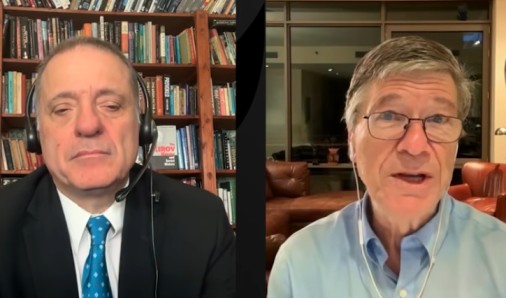
EDITOR’S NOTE: In this timely conversation on The Duran, economist and Columbia professor Jeffrey Sachs sits down with Alexander Mercouris and Alex Christoforou to examine how Western geopolitical narratives are inflating a dangerous financial bubble. Sachs argues that the erosion of American and European hegemony is a crisis for elites clinging to outdated dominance rather than for the world at large, drawing pointed parallels to 1914 while assessing the real strength and rationality of China, Russia, and Iran in an emerging multipolar order.
TRANSCRIPT:
Introduction
ALEX CHRISTOFOROU: (00:00:00 – 00:00:06): All right, Alexander, we are here with Professor Jeffrey Sachs on The Duran. Professor Sachs, thank you for joining us.
JEFFREY SACHS: (00:00:07 – 00:00:08): Great to be with you guys.
ALEX CHRISTOFOROU: (00:00:09 – 00:00:18): We are happy and honored to have you with us. Gentlemen, we have a lot to talk about, so I’m just going to pass it off to you, Alexander, and to you, Professor Sachs, so we can discuss what’s happening in the world.
ALEXANDER MERCOURIS: (00:00:19 – 00:01:55): Absolutely. And no better person to discuss what is happening in the world with than Professor Sachs. We’ve been talking with Professor Sachs for several years now, many years now, in fact, and he has been charting the course of American foreign policy, and he has been explaining in program after program, both on our channel, in many places, including, by the way, the UN Security Council, but in other places too, that US foreign policy is going completely off the rails and that it was all going to end badly.
And I think the events of the last few months bear that out completely. We have conflicts in Ukraine. We have conflicts in the Persian Gulf and the Middle East. We have a looming confrontation with China. We have issues in the US economy. We have very grave issues in the European economy. We have, let’s say it openly, Iran under extreme economic pressure, which is something that should concern everybody because the plight of the Iranian people is not something people should ignore.
All of this going on and everything is connected and there is a single thread and that thread takes us back to Washington. Professor Sachs, is that an adequate summary, or at least I’m not saying a complete summary, but an adequate summary of where we are. And perhaps you could take us further.
A double crisis: the West and the United States
JEFFREY SACHS: (00:01:56 – 00:14:24): That is a great summary, a great start for a conversation. And first, let me thank both of you for the incredible accuracy, perspicacity of what you are discussing and reporting every day, because we know we live in a weird media bubble as well as a financial bubble. And the media bubble is everything’s going great, we run the world, and you pierce that every day and also are proved right months and years in advance. And so I think that this is, for me, your work is extraordinarily important.
We have two foreign policy crises underway, and for the same essential reason. I would say a crisis of the United States and a crisis of the West. The West meaning, in this case, of course, the core of the US alliance, the United States, Britain, European Union, Japan, and Australia. Who knows about others? Because is Canada part of the alliance or at war with the United States? We can’t be sure right now because of Donald Trump. But basically, this core is the core of countries that ran the world for at least two centuries. Basically, the 19th century and till towards the end of the 20th century. And they no longer run the world.
And that’s a crisis for them, not a crisis for the world, not a crisis for you and me in our lives, in our living standards or anything else, but a crisis of power. And the United States, of course, played a particular role in this from 1945 onward, when the US was either the primus inter pares, the first among equals, but it was never quite that. It was the dominant country for decades, and then it declared itself to be the sole superpower after 1991 when the Soviet Union ended.
And that crisis is the same. The US no longer dominates the world, but it is programmed deeply in its foreign policy, in its politics, in the media, in decisions that are made day to day to act to protect a hegemony that no longer exists. And so I see this as a double crisis.
The strange part of all of the behavior of recent years is not so much the United States behavior, which is utterly vulgar and self-defeating, but the behavior of Europe, which seems completely bizarre, totally against Europe’s own economic and strategic interests. European powers have cut themselves off from the energy source that fueled their economy, for example, Russia. And you ask, why is that? And one theory is they do what the United States says, but I think a deeper part of it is that it’s the same mindset.
Even 80 years after Europe lost its empires, they still have an imperial mentality, especially Alexander, your country, Britain, which will never lose it perhaps. It acts like an empire. When a mayor becomes prime minister, the first thing he does is put on the imperial mantle and head to Kyiv and so forth, as if this is the most pressing issue facing Britain today.
So we have a double crisis. The big one is the end of the Western-led world. The specific one is the end of the United States’ world. What makes it a crisis is not that fact of multipolarity, which on the whole is either utterly benign or beneficial. And I just want to stress this, and this may seem paradoxical to many people, but China’s rise is good for my living standards.
Russia’s return after the complete disarray at the collapse of the Soviet Union — this is good for the world that this giant country and a civilization, absolutely, and a source of technology and culture and 17 million square kilometers of land is back and able to be prosperous and able to thrive. That’s not a bad thing. That’s a good thing. But we treat it as a disaster because the mindset of the foreign policy, of course, is a zero-sum mindset.
As economists, I like to think, and going back to Adam Smith, we think of the world as a positive-sum world where trade is mutually beneficial or should be, where interconnection is beneficial, where enjoying each other’s cultures and civilizations is beneficial. But that is not the mindset of the European world for lots of interesting reasons that date back maybe a couple thousand years, but especially of the Anglo-Saxon world, which was a world of us versus them, at least for the last two centuries.
So this is a situation of angst among the political class. And the angst manifests itself in a couple of ways. One is that you can never disclose the weakness that is apparent everywhere. Everything is grandiosity. Everything is, we have won, we are in control. A perversion of thought, period, but bizarre day by day. Ukraine is winning the war. We have defeated Iran. We’ve got China cornered. Who knows? China’s about to collapse. Whatever the meme is, the point is you can’t admit any of the reality of multipolarity, or if you do, you have to immediately explain how you’re going to prevent it from unfolding because that would be terrible.
And the second point is that the result of this is not just narratives, but there’s almost nothing that’s truthful anymore about any word that is said by any of our governments. It’s not a kind of 50-50 proposition. It’s that you cannot listen to a word without being shocked if you know the story, because it bears no recognizable connection with the realities that are now present.
And so I think that one side of this is that this is a kind of geopolitical bubble, which is, okay, we’re talking ourselves into the Western-led world still exists, the US order still exists, we just have to get past Trump, we’ll be back. I want to read you something from Foreign Affairs magazine, which is my favorite psychological journal to test the crazy mindset of the American strategic class, as it were. But it’s a geopolitical bubble, but it actually has stoked a financial bubble.
So one of the points of all of this that is true is that the valuation of these people and their net worth in the stock market and so forth, now is plainly dependent on keeping the bubbles, both geopolitical and financial, alive. And stoking bubbles is not a safe business. You build up until an even bigger crash. And you see the open hand of Bessent trying to manipulate whatever markets he can. Of course, you see the rhetoric of Trump and its absolute insanity these days.
But this is to keep stock market valuations, which are absolutely at historic highs without justification, also going because we have this intertwined story now that the West is dominant, the Western technology is dominant. The AI world is the world of seven magnificent US companies. The multi-trillion-dollar valuations all make sense. And this is all becoming unhinged day by day.
And the strange thing is, as we watch this theater unfold, the broad public gets it that something is completely bizarre and weird. It’s not as if the jingoism or the rhetoric of hegemony appeals or that these narratives have stuck. They are placeholders right now that have no resonance with the public that says, “I can’t get a doctor’s appointment.” “Gasoline prices are unaffordable for me.” They know this.
So this is not somehow the rampant happy nationalism driving us to collision. This is the public being dragged along in amazement and dismay by a political class which has talked itself into these political and economic bubbles. And they seem basically to be endlessly committing the fallacy of sunk costs that we’re in it up to our necks. We can’t get out of it. So we need to keep digging. We need to keep propelling the same falsity. And that’s where we are right now.
And it’s just shocking. You dismantle that every day in your commentaries. And as you point out, little bits and pieces of truth seep out once in a while, but they’re pretty rare still. And usually there’s a kind of new wave of euphoria to try to submerge any of the facts that come out. Can I read you something?
ALEXANDER MERCOURIS: (00:14:26 – 00:14:26): Please, please.
The Foreign Affairs “five possibilities”
JEFFREY SACHS: (00:14:26 – 00:17:10): Because I think it’s a kind of, it’s one of a hundred examples, but Foreign Affairs magazine, which people probably know is the so-called journal, it’s not quite a journal, but it’s a magazine of the American political establishment. It’s the Council on Foreign Relations. And it is what the establishment tells itself. So it’s a kind of psychological journal for me. It’s a little bit of a Rorschach test. What are people saying of themselves?
The analysis is not very interesting, not very high quality. Mostly it’s articles saying we’re still number one, just in a convoluted way saying, well, yeah, if you look at the data the right way, we’re still number one. So the lead article of this issue is by a very bright person who I know, who’s a very senior member of the establishment, Kurt Campbell, and it’s called “How Alliances Survive,” and it’s how the Western world is going to continue to dominate.
And okay, this is his job. He’s been a very senior official in the US government. And it’s the lead story of the September-October issue. And it just struck me how interesting it was. He talks about the five possibilities for the world ahead. And this is quite central. What is the vision of what’s possible?
So if I could just very briefly paraphrase “The Five Possibilities” according to the American political class: it says the first possible alternative for allies is global multipolarity. What does that mean? A world with no rules, no fixed alignments, every state out for itself. The Hobbesian scenario. That’s multipolarity. A little bit bizarre to call a multipolar world a Hobbesian world, a war of all against all.
A second alternative, spheres of influence, adds a bit of stabilizing structure as each great power governs its own neighborhood and the United States retreats to the Western Hemisphere. So that’s the second.
The third, a third possibility that supplies even more order than the other two, is a great power concert that produces a managed peace among the major capitals. Hmm. Then he goes on to say, but this seems implausible today.
ALEX CHRISTOFOROU: (00:17:11 – 00:17:11): Why?
JEFFREY SACHS: (00:17:12 – 00:22:46): When great powers cannot even cooperate on addressing climate change. Well, this is bizarre. The United States is the one country that walked out of the global climate agreement. So we can’t have cooperation because great powers can’t agree. So the logic is we can’t have cooperation because the United States can’t agree. That’s the text. That’s it.
Okay, so that’s dismissed the idea of cooperation. It’s dismissed in one sentence. Oh no, it’s dismissed in two sentences. “Even if the latter two scenarios prove viable,” in other words, cooperation, “they would be markedly less favorable to the economic and security interests of current US allies.” Cooperation — that would be unfavorable.
So what’s a fourth alternative? A fourth alternative that seems more likely is partial Chinese preeminence because of China’s sheer scale. Ah, but this would be devastating. “The resulting dependencies on China would cause the United States and its partners to slide down the value chain into real estate, tourism, commodities finance, and perhaps transnational tax evasion.” That’s the world of Chinese preeminence, partial preeminence, okay?
So the fifth: “It seems increasingly clear to policymakers in allied capitals, just as it should become clear to post-Trump American leaders, that allied scale is the only path to balancing China” — a fifth alternative for world order.
Okay, so what do we have here? We have here the most bizarre idea conceivable. The most bizarre idea is, well, multipolarity means a world of a war of all against all. That’s no good. Well, you could retreat. That’s no good. Well, you could cooperate. Well, that’s not possible, obviously. You can’t have cooperation. Or we could let China run the show and then we could do transnational tax evasion. Or fifth, we could become a world organized against China. This is the logic. This is the logic of American foreign policy.
Okay, that’s precisely the logic of World War I. That’s precisely the logic of walking into war. The only alternative in the world is to unite against our enemy. The idea of cooperation, no, that’s naive.
And that’s — so this is where we are right now. The glimmer of recognition in this thing is the recognition that China is a large, important country. Well, even that is a breakthrough of reality because a year ago or two years ago, it was China’s about to collapse because of its real estate bubble. China’s at the end of the tether. Now it says, oh, China’s large and that’s the problem for the United States because all that’s left for us is tax evasion. How can we compete with them unless our alliance restrengthens? So it’s the us-versus-them world.
And Scott Bessent, who’s a lowlife — I mean, there’s nothing else to say about him. The guy is not a technocrat, he’s not a thinker, he’s not a decent man. He’s a lowlife hedge fund guy whose claim to fame is participating in shorting currencies. He declares this is “economic D-Day.” It’s us versus them. We’re going to crush you. We’re going to crush anyone that doesn’t follow us.
And what I found interesting about his “economic D-Day,” in the context of our discussion, is when he published the piece in the Financial Times last week, declaring economic D-Day, the Financial Times comment section is humorously or worryingly jingoistic. It’s completely Russophobic. It’s, we’re going to whup them. It’s got all the normal delusions of the West. But in this case, it was derision of Bessent. There wasn’t one comment running — dozens or hundreds — that said, oh, now the United States is standing up to Iran, or good for you. It was, “Scotty boy, why don’t you go back to your hedge funds? You’re in way over your head.” One after another.
So there’s a mockery and a derision even within the core of the hegemonic class right now that sees that none of this adds up. And today’s FT, which I didn’t have time to read because it’s a little early still in New York, but I think the headline, if it was the FT or maybe the Wall Street Journal, was bond prices quaking, interest rates rising, the sense that things are not exactly going to plan.
Echoes of 1914
ALEXANDER MERCOURIS: (00:22:47 – 00:24:34): Absolutely. That is brilliant, by the way, Professor Sachs, at many levels. I mean, your point about all the various bubbles, the geopolitical bubbles, the financial bubbles being interconnected, I think that is extraordinary insight, something I never thought of, to say it straight away.
But I just want to make a few quick points. Firstly, you mentioned the First World War. The literature on the origins of the First World War is enormous. But actually, if you cut through it all, there is one very simple underlying cause, and that is the decline of, or at least the relative decline of Britain and Britain’s desire to prevent its displacement by other European powers. I think this is actually now a wide consensus.
So the British in effect pursued foreign policies and economic policies — and by the way, they were also dabbling in sanctions as well at around that time, which are not very different from those policies that are being advocated in the United States. And where did that bring us in Britain? In 1914, we were the richest, most powerful country in the world. By 1945, we were a dependency of the United States. So this is not a successful policy. And the disaster, of course, that was wreaked upon Europe as a result of all of this is on a scale unimaginable and horrible.
JEFFREY SACHS: (00:24:34 – 00:24:36): Europe never recovered from it.
ALEXANDER MERCOURIS: (00:24:36 – 00:27:37): And we have never recovered from it. European civilization suffered a terrible wound which is bleeding still. So this is not a policy, an example anyone should want to follow.
The second is that there is no reason to follow these policies. The United States is an immensely rich country. It has all the potential for having an incredibly high standard of living. It has a constitution, which if it were working properly would provide people with a stable system of government which provides for protections of liberties and all of those sort of things. Those are the things which are important. Those are the things that one should hold on to, not hegemony and that kind of thing.
The third point that you made, which I find extraordinary, again insightful, is the flight from reality, the completely delusional quality of all of this. The idea of economic D-Days, of crushing China, of defeating Russia — all of this is so far beyond our powers today. Now, if the events of the last five years prove anything, especially, dare I say, this year prove anything, it is that. But we still don’t want to give up these illusions of power. And of course, you mentioned grandiosity. When you have a flight from reality, it is a retreat into grandiosity. And as somebody who had to deal with all sorts of people in my working life, who suffered from illusions of grandeur and megalomania and all that, I can say something else: where megalomania goes, paranoia follows. Everybody is out to get me. That is why I am not succeeding. That is why the person on the other side, let’s call him China now, is so dangerous. So all of these things coming together in a most terrible way.
So Professor Sachs, I don’t know whether you want to add to this and perhaps look and explore some of the events that are taking place. The fact that, as you mentioned, all the terrible misreporting that is going on — the terrible misreporting that happened about the war in Ukraine, but we discussed this in many places — the equally extraordinary misreporting about Iran and Iran’s society, which I think by now it ought to be obvious. Everything we were told about Iran — how weak it was, how fragmented it was, how technologically backward it was.
ALEX CHRISTOFOROU: (00:27:37 – 00:27:38): Exactly.
ALEXANDER MERCOURIS: (00:27:38 – 00:27:54): All of that. It’s now clear that that is wrong. That was wrong. And yet we still don’t seem to be able to give up all of these illusions that we had previously. So speak to us about some of these things.
World War I, China, and the myth of hegemonic contest
JEFFREY SACHS: (00:27:54 – 00:43:20): Yeah, let me go back to World War I for just a moment and say that in July 1914, that is the month before World War I started, Europe was in a glorious economic, technological, and scientific era. This was not a war that came because there was some desperation. The contest between Britain and Germany was not because there wasn’t enough food to eat, because supplies were shrinking, because there was some desperate scarcity that one side or another needed to overcome. This was the glory of the scientific and technological age, unrivaled in all of the history before it.
And actually, in one of the most memorable lyrical passages of economics, John Maynard Keynes writes about this age in The Economic Consequences of the Peace, which is his absolutely brilliant and searing tract that he wrote about the devastation of the war and the Treaty of Versailles that he published in 1919. But he says, in 1910, you can sit in bed sipping your tea and be able to order commodities from any part of the world. You can travel without a passport freely across the world and so forth. This was a glory period and Europe destroyed itself.
And I just want to underscore this. The reason that World War I is puzzling to historians is that while you can now tell the story of how we fell step by step into that war — and essentially, it was the formation of two blocs that finally clashed at unprecedented industrial scale, starting in August 1914, and believing that the war would be a one-month, rather happy affair, by the way, as the young men marched off to their deaths in August 1914 — you can tell the story, but the reason that it has puzzled historians is that there’s no deep reason. It’s not a war that came from fundamental reasons.
I would say that the reasons for our conflict now, today — that I just read to you about why, according to American strategists, we must organize an alliance against China — is far weaker even than Britain and Germany in 1914. We know that actually Europe more or less comported itself with some sanity in the 19th century. The so-called Concert of Europe was a formal and then informal system of consultation so as not to attack each other. And Europe avoided war for a hundred years between the end of the Napoleonic Wars in 1815 and the beginning of World War I. And it was largely because there was a system of diplomacy.
It was broken. I would put heavy responsibility on Kaiser Wilhelm II, who was impetuous, ambitious, and dismissed the greatest statesman of the age, Bismarck, who was extraordinarily clever in maintaining equilibrium — of course, pursuing Germany’s interests, but not to the point of provocation of alliances that could destroy Europe. And that was his whole strategy. Kaiser Wilhelm dismissed him and wanted to build the fleet to compete with Britain on the oceans. And that was in some fundamental sense part of the unraveling that led to World War I.
But again, no fundamental reason was pushing the countries. But I would argue strongly that China is not Kaiser Wilhelm. China is not pursuing a global aggressive strategy. China is not saying we will replace the United States as hegemon. China is saying to the West, as it has said basically since 1949, “You really messed with us for more than a century. You invaded us repeatedly. You dismembered us. You colonized us. You will not do that again.” That is the fundamental logic of Chinese foreign policy.
The fundamental logic of China’s economic policy is we were impoverished by all of this, and we don’t want to be impoverished. We want to live normal, prosperous lives. And we want to be creative, innovative members of a world economy and technology society.
China is not an aggressive power. China has not been in a single war for the last 46 years. And the last one that China was in was a one-month affair from mid-January to mid-February 1979, with Vietnam. It was a little tangle. China does not go to war. China does not have an overseas archipelago of military bases. Arguably, China has one overseas military base — that’s a small naval base in Djibouti, where the United States and other powers also have their bases. Some people argue that there’s a second one in Cambodia. If you’re really aggressive on the count, China could have maybe four or five bases. The United States has around 750 overseas military bases in 80 countries.
So the idea that this is some battle for hegemony is part of the delusional rhetoric or paranoia. And it’s also hard to understand — is this a game? Is this real paranoia? Is this complete ignorance? But if you, as I do, go to China several times a year, they are not out to take over the world. They are making their way with, by the way, extreme talent and impressiveness of raising their living standards and contributing technologies which will be good for the world.
So just to say on World War I, it’s a very good analogy. It is the most sobering analogy conceivable. And the case for it, quote unquote, is that there never was a case. That’s the whole mystery of World War I. It was a disaster of epic scale with no fundamental reason, though it does have a TikTok narrative reason. But the reasons today are much less even than the almost zero reasons around World War I.
Eurasia, the SCO, and the BRICS
In terms of the reality versus the delusion, the reality is today, as we speak, 10 countries and many partners are meeting in Bishkek, Kyrgyzstan, in the Shanghai Cooperation Organization. And I think it’s worth us mentioning the Shanghai Cooperation Organization and the BRICS, because next week will be the BRICS summit in India.
So the Shanghai Cooperation Organization is most of Eurasia — it’s Russia, Belarus, the Central Asian countries, India, and China. And it’s 10 countries and it has 42% of the world population. It has 34% of the world output measured at purchasing power parity. It’s bigger than the G7 countries, which are, by the way, only 9% of the world population and 28% of world output.
Well, what’s happening is Eurasia is saying, look, whatever this Western world, meaning the Western peninsula of Eurasia, which we call Europe, whatever crazy stuff they’re doing and however much they bothered us in the last two centuries, we — Russia, Uzbekistan, Kazakhstan, Tajikistan, Kyrgyzstan, India, China — we want peace. We’re trading with each other. We’re actually in a good place economically. We’re advancing. Our technologies are advancing. India is growing at nearly 8% per year. China continues its rapid growth. Russia will be an enormously successful economy without Europe, by the way.
This is the deep point that Europe cut itself off from the rest of Eurasia. Russia did not. Russia is core to Eurasia. And with its vast resources and extraordinarily talented and sophisticated human skills and technological and mathematical and scientific skills, the Russia-China alliance is not an alliance of convenience that will break. It’s a tremendously smart economic complementarity.
Europe gave it up. Western Europe and Russia was a perfect combination. You combine densely settled Western Europe and the great resources of Russia, and it’s a perfect combination. And that’s what would’ve naturally unfolded after 1991. By the way, the United States wouldn’t have it. The idea of Germany and Russia cooperating, which is the most natural economic cooperation, is anathema to the United States. “Don’t do that. Don’t you dare build a pipeline between the two countries.”
So Russia has said, okay, Eurasia — that small part on the Western rim, which actually for most of 2,000 years really was not a bit player, that’s our Western history, but it was kind of a fringe to the core of world civilization and economy — that is reforming. And the BRICS is essentially the same grouping, adding in importantly Brazil, which the United States is now working overtime to try to undermine by somehow derailing President Lula’s reelection, which in normal circumstances will certainly occur, but the United States is doing its best to try to foment something to dismantle that.
But the point is that the Western world, which is now part of a multipolar reality, is also a very modest demographic part of that reality. The US and European Union together is 800 million people. Add in Britain, add in Japan, add in Korea, kind of, because the United States is dismantling that one also, add in Canada — you might reach, if you add in the whole Western alliance, you might reach 12% of the world population. 12%.
And what’s happening is the rest of the world is saying, we don’t need this. We don’t need this craziness. Some countries may have no choice because the Western Hemisphere is under the US CIA’s thumb to a much greater extent, because China and Russia are not going to intervene if the United States basically invades Venezuela or bribes the leadership into submission or whatever it is. But for the rest of the world, the old world, if I could call it that, they don’t want this.
The reality of Iran
And this is where the delusion is absolutely extraordinary. When it comes to Iran, by the way, the image in the United States of Iran was turbaned mullahs, ayatollahs living in the 11th century. And so it will take a few hours to overthrow them. This is the level. Iran is one of the technologically most sophisticated places in the world. And by the way, civilizationally, it is absolutely one of the most sophisticated places in the world. Persia was the first great multinational empire. That was 2,500 years ago. And the Persian influence on global civilization is as profound as any civilizational influence.
And when I speak with leading Iranian officials today, I feel that gravitas actually of diplomacy. I worry they’re a little bit too nice for their own good, many of them. They act in a very dignified way against a kind of thuggish United States. But there is that full gravitas of a 5,000-year-old civilization and an imperial world that is 2,500 years old. And yet our image of it is a cartoon.
ALEXANDER MERCOURIS: (00:43:21 – 00:43:49): I’ll just say something about Iran, which is that, in my opinion, with what it has — an educated population, apparently a developed infrastructure — if the sanctions were to go and they were to get on top of their fiscal and financial instability, which you know more about than anyone else, but if they did that, their economy would just take off, to a degree that we can barely imagine.
The dollar weapon and de-dollarization
JEFFREY SACHS: (00:43:49 – 00:48:10): And just to say, Iran is in an economic crisis because the United States targeted it. And one should understand that this so-called “economic statecraft,” in Bessent’s phrase, has been part of the American imperial toolkit dating back to the 1940s. It was the containment toolkit, but in the early 2000s, it was tremendously enlarged when they realized that it wasn’t only using blockades of technology, which was at the core, or trade, which was at the core of the anti-Soviet containment, but to use the dollar payment system as the enforcement mechanism.
So the point is that starting in the George Bush Jr., post-2001 government, they said, oh, we can actually enforce our economic punishment through the banking system, which was a little bit new, to use it as a heavy blunderbuss in addition to other economic tools. And since then, the US weaponized the dollar — meaning that it can confiscate $300 billion of Russian assets, or it can confiscate Venezuelan assets, or Iranian assets, or North Korean assets, or it can impose extraterritorial sanctions by threatening banks abroad: “If you do any transactions with Iran, we will cut you out from your dollar-based business,” which is core for your business — not even cut you out on the Iran issue, but on any issue. So that’s the basis of the US sanctions regime, and that’s the “economic D-Day” idea.
But what they don’t understand, and it’s so simple-minded, is you don’t need to use US dollars to settle international transactions. It was convenient. It was actually not bad to have one main currency, which was the currency of denomination, which was the currency of settlements, which was the basis of the interbank settlement system. But it’s simple — actually, I’ve done it mechanically myself, helping advise countries on starting new currencies. It’s not hard to use non-dollar settlements. And so they’re not going to succeed.
But the point with Iran is that it did succeed for a while because there has been a lag. Everyone used the dollar. This method has worked, but now they figured it out. China figured it out. Iran has figured it out. Russia has figured it out. They have other ways to settle. And if the BRICS are clever, they’re going to accelerate this.
And interestingly, other than threatening to destroy Iranian civilization and the other vulgarities of Trump, one of the few threats that he directly made, which shows the mindset of the briefings that he gets, is he said, “If you don’t use the dollar, we’ll destroy you.” So they’re very much aware of how fragile this is. And if you have to make threats, you must use the dollar — you’re already lost. It’s already over because it means you’re already not using the dollar for settlements.
So my view is if a few technicians in China, Russia, Iran, a few other places get together, Iran can stabilize its currency, can stabilize this situation, because the current financial unrest, which was created by the United States, is a legacy of the lag of moving to non-dollar payments.
Is there a way out?
ALEXANDER MERCOURIS: (00:48:12 – 00:49:41): Professor Sachs, I’m going to ask you one very, very last question, because I think we are approaching fast now the moment when reality crashes through. You can’t maintain this illusion about the war in Ukraine. The situation in the Persian Gulf, in Iran, speaks for itself. All of these things that you’re talking about in the economy, the stock market — soon we’re coming up to the reckoning.
What happens then? Is there any chance that this will finally be the moment when people in the United States say, “Enough’s enough, we’ve tried it all, it’s over, let’s start working with this new system that is developing around the world”? We have a place in it, which we do. I mean, we’ve been offered places in it. Is there any chance that this will happen, or will the US do what Britain has basically done, which is retreat into gnawing little plots and schemes and all kinds of things in order to try to somehow maintain, as it imagines, its influence? Because that is the decision that matters, in the West as well, not just in the United States, mostly in the United States, but in the West too.
JEFFREY SACHS: (00:49:42 – 00:55:17): Yeah. There’s no entirely benign soft landing right now. Just because when you have built up a debt of 100% of GDP, have deficits of 6% or 7% of GDP as far as the eye can see, have hugely unmet social pressures and social needs, as is the case in the United States, and have a stock market that is at record highs relative to GDP, the so-called Buffett ratio, the market valuation relative to GDP, or the price-earnings ratio — there’s going to be, quote, a correction, a financial correction. It can be a modest affair. But I think since the US is a very cyclical economy, we’ll have a business cycle, we’ll have a contraction at some point that can be quite modest and contained.
Of course, what you’re talking about is can we avoid a geopolitical explosion or a massive financial crash? And the answer is, first of all, if there was non-delusional, rational policymaking, the answer is certainly yes, without question. Just as World War I wasn’t fated, just as the Great Depression was a series of mistakes, just as the 2008 financial crisis was the dumbest policy — we could talk about that at some point — that has been done in the United States for decades in the financial markets, when Lehman Brothers was forced into bankruptcy one afternoon without any preparation. If you have rational, intelligent policymaking, there’s no reason for any kind of global crisis.
The real ballast of the world is we are in a technological age, which, if we weren’t using it to blow up each other, could actually be quite useful for human wellbeing. So we’re not in some kind of dark period where the bubble is hiding the inevitable collapse of the world. We have lots of imbalances and we have a real ecological crisis. So we have things to do, but we are not bereft of kind of normal solutions.
So the question that you’re asking is really about political behavior. And the good part of the political behavior is that the European and American public want normalcy. This is important. This is not a crazy, jingoistic era marching off to war. This is a public that has no say. And this is a public that is unhappy and disgruntled, wants wars to stop. This war in Iran is a direct betrayal by Trump of what he promised. He promised no war. That was a big part of his base. That’s why Tucker Carlson and Marjorie Taylor Greene and Tom Massie and others are creating a movement on the right, as there is on the left.
So the mass majority of the public in the United States is disgusted with Israel, disgusted with the war in Iran, absolutely uninterested in a war with Russia or China. So that’s very, very good news.
Can our institutions translate into that as the final issue? Do we have enough of — because we are organized formally as democratic institutions where that public opinion should matter in some way. Will the ballots be counted in November? Will they be counted honestly in November? Will it change things? These are, uh, they’re ponderable, but they’re unanswerable directly, because we have an institutional breakdown. We have a deep state. We have a foreign policy that is run by the Five Eyes rather than run by the publics in our countries.
But I would put some measure of hope in the unhappiness of the publics in Europe and the United States who are not defending Western hegemony, who just want to get on with their lives. That’s probably our biggest hope. And Trump is an old, ignorant, incompetent man, unfortunately deeply psychologically unstable. But the fortunate thing is presidents don’t run much in the United States anyway. So the good news is — the bad news is he’s horrible. The good news is it’s not really in his control. The bad news is it’s in the CIA’s control. The good news is the public doesn’t want that.
So how this all adds up, I’m hopeful, because it would be so insane to walk into World War I territory again, and nobody wants it. So that’s why what you guys do every day is so important. Let me end there.
Closing
ALEXANDER MERCOURIS: (00:55:18 – 00:55:36): Professor Sachs, thank you very much. I will take those words of hope. I think I share them and I am very, very happy to hear you express them in that way. Thank you very much for joining us in this absolutely wonderful program. Let’s absolutely do this again and do it soon. And we’ll do it soon.
ALEX CHRISTOFOROU: (00:55:36 – 00:55:48): Let me just jump in real quick and tell everybody to follow, recommend that everybody follow jeffsachs.org. That’s the website where you can follow all of Professor Jeffrey Sachs’ work and all of his appearances as well.
JEFFREY SACHS: (00:55:49 – 00:55:49): Thank you.
Related Posts
- Pepe Escobar: Rise of a Post-Western World at the SCO Summit (Transcript)
- Alexander Mercouris: Ukraine Unravelling – War Enters New & Dangerous Phase (Transcript)
- Transcript of Nepal Floods: China’s Silence, Medog Dam And India’s Himalayan Nightmare w/ Abhijit Iyer-Mitra
- Chas Freeman: U.S. & Iran Back at War & NATO’s Abuse of Ukraine (Transcript)
- Transcript: ‘China Had 20 Minutes to Warn People’ – Lobsang Sangay on Nepal–Tibet Floods’