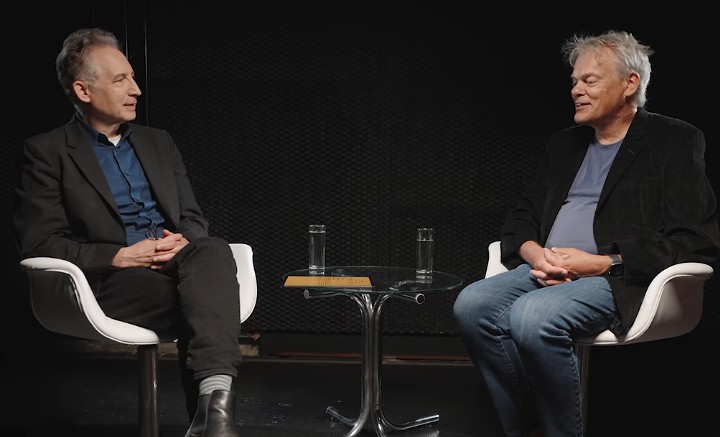
EDITOR’S NOTE: In this conversation from the World Science Festival, host Brian Greene sits down with Nobel laureate Edvard Moser, director of the Kavli Institute for Systems Neuroscience in Trondheim, Norway, to explore how the brain builds its own internal map of space. Moser, who shared the Nobel Prize for discovering grid cells, discusses place cells, head direction cells, the geometry of grid cells, and what these discoveries might reveal about the nature of space itself, memory, artificial intelligence, and consciousness. (This episode was premiered September 4, 2026.)
TRANSCRIPT:
From Math to Neuroscience
BRIAN GREENE: Hey everyone, thanks for joining us. Conversation today is on the brain and the way the brain manages to understand where it is in space and what that actually tells us about the nature of space. And I’m so pleased that we’re speaking with Edvard Moser, who’s an expert on these ideas.
He runs the Kavli Institute for Systems Neuroscience in Trondheim, Norway, and he shared the Nobel Prize for discovering how a brain can build its own map of space, a kind of coordinate system driven by neurons themselves, and that is able to keep track of where it is.
His work raises questions which, in a sense, I think about all the time from a very different perspective. What is space? Where does it come from? Do we impose our own need for organization on the external world, or is space in some sense really out there?
And toward the end of our conversation, I hope we’ll get to some of those ideas. So Edvard, thanks so much for joining us. So if we go all the way back, not like to birth or so, but you did — am I correct? Did you begin in math and statistics early on?
EDVARD MOSER: Yes, I was among the first subjects I did at university, math and statistics. I did some coding, but just because I thought it was fun. I didn’t really have any plan, but then it turned out in the end that’s one of the most useful things I’ve ever done.
BRIAN GREENE: Yeah.
EDVARD MOSER: Although I did go into psychology and then later neuroscience.
BRIAN GREENE: And what drove the transition?
EDVARD MOSER: I was interested in everything and didn’t — found it really hard to choose. And that included our own mind. Why we behave like we do. And that drove me into psychology. And I thought that was fascinating, but what was lacking was really the connection to the brain, which was so obvious.
But at that time, this was in the 1980s, there wasn’t much about it. In an elementary textbook of 1,000 pages, it was 3 pages, and the rest was non-brain.
So at the same time as I was really interested in this, it also felt like the wrong place to go. So the best thing that happened was that a professor advised me and also May-Britt, my long-term collaborator, that we go to a different department of, as it was called then, neurophysiology. So it was in medicine.
And they didn’t know anything about psychology, but they did know a lot about the brain. And we went to a professor named Per Andersen, who was then among the best neuroscientists that Norway ever had, a very famous guy. And he then taught us about the basic workings of the brain. And we came with our little psychology knowledge, which then that merged. I think that was the beginning of our success story.
BRIAN GREENE: And was this an arena that was bubbling up all over the world, or were you just at the right place at the right time?
EDVARD MOSER: And I wouldn’t say it was yet bubbling up, but if we hadn’t been there, it would have happened anyway. I’m pretty sure about that. So it was early days and still people were making a big jump between descriptions of what happens in cells, and maybe between a pair of cells, brain cells, and on the other hand, behavior.
And that’s a huge gap, right? It’s very difficult to explain that connection. And that only came later in the 2000s when you can start investigating what neural networks do, how thousands, hundreds of many subgroups of cells work together like communities. And that is something that we were part of building up. So we built it up for our area and others did. But I think it would have come anyway, right? It was the right development for neuroscience.
BRIAN GREENE: It just happened why it started.
EDVARD MOSER: Right.
The Discovery of Place Cells
BRIAN GREENE: Well, it’s modest, but obviously you pushed things forward dramatically. But if we go back to early days before people were studying the communities of cells and single cells, I gather there was a precursor to your work that was pretty vital, which was this discovery of place cells.
EDVARD MOSER: Yes.
BRIAN GREENE: Can you give us some sense of what that was?
EDVARD MOSER: That was absolutely vital. So for the study of space, like for almost any other brain function, it began with studies of single cells. So what properties do individual cells have, and does their activity in any way reflect something in the outside world?
It began already in the ’50s, ’60s with studies of the visual system, how we see the world. And people like Hubel and Wiesel discovered that there are cells in the visual cortex that respond to bars with certain orientation and so on, so the building blocks for vision. And this came then to the field of space too. So when John O’Keefe in 1971 discovered place cells, and place cells are cells in the brain area that’s called hippocampus. So it’s normally known for memory.
BRIAN GREENE: Memory, yeah.
EDVARD MOSER: But it contains those cells, and those cells are such that each cell is active only in a certain place in the environment.
BRIAN GREENE: Can I just dwell on — just for a pause for one second, I don’t mean to interrupt — but that idea seems almost outlandish that individual cells would somehow be tied to specific locations, because you’re not telling me that there’s a light signal that’s coming from that location. Somehow there’s a joining together in the brain of a cell and a spot.
EDVARD MOSER: Exactly, and we also thought it was outlandish because how can these cells know anything about locations? Because it’s not derived — this is different from the visual system, right? It’s not derived from anything that comes in through the senses, through the eyes or ears. You don’t smell it, nothing. Either it’s composed by combining those inputs, that was commonly thought at that time, or as we said today, it’s actually internal.
BRIAN GREENE: It seems again so counterintuitive. So, for instance, naively, if that rat is navigating that maze in the dark, so it’s really not getting any visual signal, is there still the association between that cell and that location?
EDVARD MOSER: It is. So there are two ways you can think about that. The first, which was common in the early days when they discovered this already in the 1990s, that it still is there when they go walk in darkness, is that it’s not the visual sense that matters, but it is your bodily sense.
Senses like proprioception. That means that you essentially sense your muscle movements and you can, in some not too difficult way, count the steps you’re walking, right? And then if you count the steps and also even the turns, and then you add that up, you can calculate where you are. That was one common idea.
Another one, though, is that there is an internal map in the brain that you’re born with and that you then only have to learn to apply it to the world, and that’s much easier. It’s just a matter of calibration of a map that’s already there. You don’t have to build up that map. So that’s the more modern view, but it started out by asking these questions about sensory inputs, and of course sensory inputs are important, but they are not all.
BRIAN GREENE: And so this map, is it stable over time? I mean, if I live on one side of the world, then I live on the other side of the world, does the old map get replaced? Or when I go back, will there still be a firing even if I don’t have a direct memory of the location?
EDVARD MOSER: Yeah, so then I would say there are different maps. So the map that we have worked on, it’s a brain area called entorhinal cortex and contains grid cells, which we can talk more about.
BRIAN GREENE: I would love to, yeah.
EDVARD MOSER: Yeah, but the essential thing now is that there is one map that is active whatsoever. Even if you sleep, it’s active. And it is stable in the sense that the relative positions of firing of the cells are the same wherever you are. Even if you’re nowhere, I mean, if you’re sleeping or if you’re shutting off all sensory inputs, the map is just moving around on some internal thing, right? But it keeps its internal relationships.
But to be useful to the animal or to ourselves, it has to learn to connect this to the outside world. So it has to calibrate it or know that the map should be oriented this way and so far away from the wall and so on. And then once this is learned, that’s fast, takes a few seconds, then the animal keeps it. And next time it comes back to the same place, it pulls up the same map so that if a particular cell is active here, it will also be active here next time it comes back.
BRIAN GREENE: Right. So I’d love to drill down on grid cells, but before we do, I presume it’s the case that — and I guess the question is, to what degree has the story been fully written? Knowing where you are is evolutionarily useful, right? There’s survival value to knowing how to navigate your surroundings. So presumably this is a biological solution to a very specific challenge, which is to be able to do that navigation effectively, efficiently, and stabilize over time.
EDVARD MOSER: Yeah.
BRIAN GREENE: Is that where this comes from?
EDVARD MOSER: That makes a lot of sense, and I would say it’s not only useful, it’s actually necessary.
BRIAN GREENE: Yeah.
EDVARD MOSER: Because if you can’t navigate, you won’t survive, right? I mean, it’s so fundamental. And the need has been there from the earliest days of evolution, right? So it’s probably common to a lot of very different species. The solutions may still be different, but also major parts of those solutions probably evolved very, very early.
And we do see that in the sense that there is a kind of cell that responds to orientation. Not position, but how you orient your head relative — in degrees relative to the 360 degrees around you. And that system is even expressed in flies, fruit flies. So they even have it. So it means that this probably evolved extremely early. And then it seems like the mechanism is very much the same as we have, so that it’s just been retained through evolution, but then become more sophisticated, so the position system has probably evolved further later on.
BRIAN GREENE: And how refined is it in the sense of, like, degrees? What fraction of a degree do you need to turn for the firing to change?
EDVARD MOSER: Just a few degrees, but it depends — if you ask that question only about a single cell, we’ll say there’s a noise level of 5, 10 degrees. But you ask the same question from a number of cells that you record from simultaneously, it’s extremely precise. It’s 1, 2 degrees, probably usually in the measurement noise level.
BRIAN GREENE: And so earlier when we said that there’s a cell that responds to specific location, if we then broaden our view and look at the totality of cells, presumably it’s a collection of cells that are responding to one spot and a collection of cells that respond to another. So can I sort of think of this as sort of a QR code that the brain kind of creates that allows it to map its internal response to given locations in the external world?
EDVARD MOSER: Yes, I would say so. It is quite often we refer to it as an internal map, right? An internal map that by default has no anchoring points. It just lives its own life in the brain. But it has all the relationships so that you have some cells that always fire together and always fire when you are in some place, and others that don’t fire when you’re there because they fire at other places. And then some are close, fire at close locations, some fire at distances that are far away.
But all this matrix is retained between environments and just goes on all the time. And then, as I mentioned, the animal has to learn to connect this to the outside world. That is the task, but that’s a fairly easy task. It’s much, much easier than creating all these relationships from the bottom.
Grid Cells and the Geometry of Space
BRIAN GREENE: Right. And so that is now basically taking us to the idea of grid cells. And again, I’ve done a little bit of reading on this, so correct me if it’s wrong, but I gather it’s as if the brain imposes a whole variety of different grids on the external world with different periodic — what is a grid? It’s a periodic lattice structure. We all know about XY coordinates in school, but of course the XY axes don’t have to be perpendicular the way ours go. They could be at angles and so forth. And so you can have a whole variety of different grids that you place down on the external world, and grid cells then don’t respond to unique points in the external world. They actually respond to points that are related by grid spacings in the external world. Is that a correct summary?
EDVARD MOSER: So we often say that the grid cells are organized into what we call modules, so that they’re discrete groups of cells. So if you start at the top of the brain in this brain area called entorhinal cortex, you have the ones that have the highest period, so highest frequency, so there really is a small distance between each of those points.
And then you go further deep into the brain, then you get to another group that has a longer period, so it’s further away between the active points. And you get further, you get to another one where the distance is even further. But it’s not continuous, it’s discrete groups that each have their own frequency.
And then if you only had access to one of these groups, then the question of where you are in space would be ambiguous because it would just repeat. So you could be here or many places further ahead. But since these groups have their own frequency, and those frequencies are not multiples of each other, then you actually, by combining those frequencies, you can read out very accurately where you are.
So this is, of course, something we know is possible, but we are not yet at the point that we actually can show that individual cells receive this or that combination.
BRIAN GREENE: But the data is there, in other words.
EDVARD MOSER: Yeah. So it tells us that the brain, with the grid cells, is able to, with this information, to tell exactly where we are.
BRIAN GREENE: And so the grid cells are one of the things that you’re known for, of course. How did you find this?
EDVARD MOSER: The beginning was that then we started out with a question you just asked, namely the place cells that O’Keefe discovered in 1971. And you said it was outlandish that you have these place cells in the middle of the brain from nothing, or at least we didn’t know where this came from. And that was the question that motivated our earlier research. So where does this place cell signal come from?
And the most natural place to go is one step before the hippocampus, where these cells are, into that other brain area called entorhinal cortex. At that time, nothing was known about that brain area. It was really terra incognita. And it was known that it provides input to the hippocampus, but basically no studies had been done there because it was difficult to access and many different things.
But we tried, and we used the anatomy as a guide to where to go exactly and put our electrodes so that we found the cells that were one step upstream of the place cells. And then started recording there. And then we did not expect to find any periodic cells at all, but we expected to find some spatial cells of some sort. So that was our motivation. But then we saw—
BRIAN GREENE: And this is in rats?
EDVARD MOSER: In rats, yeah. And then we saw that they had these multiple firing fields, not one field like in most place cells. But there were many places, and it was extremely regular. We just couldn’t understand that.
But at that time, it was still done in quite small boxes where the rats walked around, so you couldn’t really easily see the periodicity. But it was enough that we then decided, now let’s get a very big environment, and very big at that time was a 2-meter-wide circle, and put them into that cylinder. And then we saw the firing fields lining up in a very, very regular hexagonal lattice, and there was no doubt, right? I mean, first of all, actually there was doubt because we thought it was an artifact.
BRIAN GREENE: Right. Yeah, I mean, that’d be the natural thought, right?
EDVARD MOSER: Yes.
BRIAN GREENE: So basically, had you not made the arena within which the rats walked large enough, you kind of may not have seen this effect.
EDVARD MOSER: No, that’s true. But it was already enough in the small environment that we had the suspicion this should be the case. But it wouldn’t be enough to convince the world because it broke so radically with what people thought.
BRIAN GREENE: And so you said in a hexagonal lattice, so I can think of tiling the space with hexagons. And the periodicity — now is this for one of the modules and the distinct ones are different sized hexagons?
EDVARD MOSER: Yes, yes, they have different sized hexagons. That’s the easiest way to describe it.
BRIAN GREENE: Right.
EDVARD MOSER: Yeah.
BRIAN GREENE: And so I can build those up from triangles and I can put the triangles together. I can also think of them as tori?
EDVARD MOSER: Yeah, you can think of them as — where each unit is a rhombus.
BRIAN GREENE: Yes.
EDVARD MOSER: Because, what’s so — if you now consider that each cell has a lattice that it could be described as a hexagon, but you can also actually describe it as repeating rhombi.
BRIAN GREENE: Yes.
EDVARD MOSER: And the nice thing about the rhombi is if you now imagine — and we can say more about that — but if you now wrap the rhombus on the left and the right side around and the top and the bottom side around, what do you get? You get a torus.
BRIAN GREENE: Yes.
EDVARD MOSER: So this — already at that time, this repeating pattern suggested that perhaps we hit — I mean, in some sense it’s obvious because you have a repeating pattern and you could describe the units both as moving on a rhombus, but when it comes to the end of that, since it’s a repeating pattern, you come to the end of the rhombus you actually just go around and come back on the other side.
BRIAN GREENE: Yes.
EDVARD MOSER: So in that sense, it is a torus. So if you wrap a rhombus around on both sides, you get the torus.
BRIAN GREENE: Yeah. And I love framing it that way because, as a physicist and string theorist, we spend a lot of time thinking about these tori. So this angular parameter that you refer to as a modular — modulus is the language that we use. And there are a couple special points in the space of all tori, one which has Z2 symmetry when it’s just sort of square, then there’s the Z3 symmetric. So I presume the Z3 is the one that you use to build up these hexagonal structures. So it’s sort of a beautiful confluence of some very foundational mathematics with how the brain actually works. Which I’d love to return to in just a moment, but I just want to understand the playing field a little more fully. So you did this in rats, and again, like you say, because the challenge of knowing where you are is pretty basic — how far back in the evolutionary trail have people gone to see whether or not this really is something that was put in biological place way, way back?
Evolution of the Spatial Navigation System
EDVARD MOSER: So the first thing we can say is that I can answer that question both for head direction cells, for place cells, and for grid cells. So head direction cells are the orientation cells that just give you the compass direction. Those are present already in flies. So it means really, really early, and it seems to be quite similar. How it’s wired up in the brain is slightly different, of course, but the principle of how you connect cells to get orientation. So those directional cells, they are not on the torus, they are on a ring. It’s just one dimension away.
BRIAN GREENE: So it’s just a compass direction.
EDVARD MOSER: Yeah, but it’s the same. You connect the cells in a certain way, you’ll get the activity to move around on the ring. So that’s very early. Place cells — how the place cells are generated is a bit more difficult because they are probably derived to some extent from the grid cells. But in any case, place cells are also present early, not in flies that we know, but they are present in birds and they are present in fish. So probably also very early.
When it comes to grid cells, it has been much more difficult to find them outside mammals, but bats have them, and bats are on a separate branch compared to rodents. So it means it must at least have evolved very early.
BRIAN GREENE: So they’re common ancestors. Yeah.
EDVARD MOSER: At least early in mammals, and perhaps earlier than that. We don’t know. So, but even in mammalian evolution, it must have come pretty early. But this is slightly more advanced because now you don’t have a ring, which is very easy to create in the brain — like you have for orientation systems, just wire cells in a certain way and you can get the activity to go around on a ring. But to get it to move on a torus in 2 dimensions is slightly harder because then the connectivity has to be somewhat more complicated, and it’s possible that that arose later.
BRIAN GREENE: And so if we do think about the evolutionary question even a little bit further, the natural thought comes to mind when you mention bats and birds. They’re not crawling around on a 2-dimensional surface. So, evolutionarily speaking, it makes sense to think that early on all that mattered to life was to navigate the flat surface of whatever the life was living on. So it makes sense that that would sort of happen first. But as life then evolves and begins to stand upright and be able to even navigate the third dimension, is there a version of this story that extends to the third dimension as well?
EDVARD MOSER: Yes, I would say a version. It’s still being investigated, so it’s not totally clear, but it is clear that all of these cells — the place cells, the head direction or orientation cells, and the grid cells — they all map onto the third dimension in some way. But it is not such, for grid cells at least, that they map onto — that they’re sort of in 3 dimensions, which you can address in flying bats, for example. Not such that you have peaks that are regularly spaced in 3D. More likely is it is sort of — they have still 2-dimensional solutions that are mapped into subspaces.
BRIAN GREENE: Like slices?
EDVARD MOSER: Slices, yeah. Slices in the 3D environment, and then they put them together in some higher-level way, which is actually what happens in 2 dimensions too. Because while you have in grid cells — if you record grid cells from rats that just walk on a flat surface, you get this nice, beautiful repeating pattern. But if you start making it more complicated, put in walls and barriers, everything, it breaks up. And then you have mini-grids around, and those mini-grids are connected at certain critical places. And I think something like that happens in 3D too, that you have the fragments, but then you must have some other, more advanced system where you then connect those fragments. And that is necessary, but often it’s not that accurate. And I think that’s even reflected in behavior, that how good are we at estimating a place that’s up there in the air. Not very good, I would say.
BRIAN GREENE: Well, that also raises the question — now, to what extent have you studied this in humans? Has this — how do you do that and how far have you gone?
EDVARD MOSER: Yeah, it has been studied in humans because in humans there are some groups of patients who suffer from very serious epilepsy and they have then electrodes in the brain to localize where the epilepsy, where the seizures start, and then you get, for possible surgery, and then you get recordings from brain cells in that area for free. And those patients—
BRIAN GREENE: With permission, presumably.
EDVARD MOSER: Yeah, yeah, certainly with permission. But for those patients who have the electrodes in there anyway, they have to go and wait for a long time. So it’s actually quite fun to participate for them rather than just sitting there. But it’s usually in VR, so they have the environment on computer screens. Which is not quite the same, but walking around with all those cables on is not an easy thing, right? But in any case, they hint that the same cells are present in humans also.
BRIAN GREENE: And so, you mentioned how we may not be as good at estimating distances in the third dimension, maybe because it’s not as refined. There are certain members of our species who are pretty good at that, like Olympic gymnasts. My wife is at that level. Is it possible that their success is tied to, for whatever reasons, they’ve got a more refined capacity?
EDVARD MOSER: Yeah, I would say, first of all, it’s possible to train it in humans. You can get really good, but maybe not completely by default. And the other thing I would say is that many other species, like monkeys who jump between trees, they always hit, right? So I think it may not require a lot of training, but still, they may still have these fragments of maps that they need to nest together, which they can do, no doubt. And I’m pretty sure if it was important for us to localize that point up in the air here, we’ll manage, because we had to learn to pay attention to the landmarks around, right? And just calibrate our map just like we do in 2D as well.
BRIAN GREENE: And so if you were designing a system, a biological system to do this kind of navigation, are there considerations that would lead you to this particular solution, or is it just something that happened? It works, but when you look at it, you’re like, wow, that’s really not very efficient. It’s redundant. How does this stack up against the optimal solution to the navigation problem?
EDVARD MOSER: I would say in retrospect, and then I would say, why didn’t we think about that before? I would say that this is certainly the most efficient way for the brain to solve the navigation problem.
BRIAN GREENE: It is, you’re saying?
EDVARD MOSER: Yeah, I am saying that, because to have an internal map that is pretty much pre-wired at the outset but can be calibrated, aligned with the environment, requires much less resources than wiring it up from the beginning. But that means that we have such a map probably from the very beginning, and it also may be expressed, be present, be active, even when we don’t need it. It’s just walking around randomly on that map. But this must be set up from the beginning, and those are questions we are working on now, and the evidence is pointing in that direction in all kinds of ways, that these maps are present very, very early on.
BRIAN GREENE: And what’s the extent of the abstract map? Is it relevant for the typical size of, like, a hunter-gatherer tribe realm, or is it just, the infant’s capacity to move is limited to a few meters? What sets the scale?
EDVARD MOSER: Well, the scale is set internally in some sense because you’re born with these different maps that are different modules, so different scales.
BRIAN GREENE: And can you give me a sense of the different scales? Can you actually give me actual — in meters or centimeters?
EDVARD MOSER: Yeah, at least for rats. I can’t give you for humans. No. So for a rat or for a mouse, if a rat walks in a box, the smallest scale has a period of about 30 centimeters, and the next one is about 50, and then it comes 80 and so on. It’s actually a fun fact, which is a clue to how this is organized, is that it’s a geometric order so that this one — the next level is always 1.42, or 1.4 at least, times the previous, times the previous, and the next one then 1.4 and so on, which is square root of 2.
BRIAN GREENE: So, well, I can ask you how that helps, but at least I can tell you when I think square root of 2, I just think it’s the diagonal of the square with size 1, and 1 is a very nice unit. Does that have anything to do with it, or?
EDVARD MOSER: Not that I know, but at least what helps is that you don’t get repetition, right? So you’ll never come into the same cycle again.
BRIAN GREENE: So you just need some irrational number. Yeah, right, right. And how many levels are there, or how many have you seen?
EDVARD MOSER: So we don’t know where it ends, but I would say probably less than 10, extrapolating, because we start from the top end and then we’ll go deeper and deeper. But then also the period gets wider and wider, which means that we have to record from environments where the rats have to walk at least 10 meters.
BRIAN GREENE: Exponentially larger, right.
EDVARD MOSER: Yeah. So we don’t know where it ends. But that said, now we have the advantage that at least we can identify the modules even without having the rats or mice run in an environment at all. Because the difference from today compared to some 20 years ago when it all started is we don’t record one cell at a time any longer. We record many hundreds, thousands. And that means you can actually localize where is a cell active compared to the other cells. So the reference is not the physical environment any longer. It’s just the other cells. And you create an internal map where everyone is referred to everyone else. And that means that you can actually identify these maps regardless of scale or anything.
The Torus in the Brain
BRIAN GREENE: Wow. Another thing that you mentioned, of course, is thinking of the modules in the language of rhombuses or tori. There’s an analogous version of the torus, as I understand it, if one looks in the more abstract space, not real space, but the abstract space of the firing rates of neurons. And you have, say, n neurons. In principle, their firing rates could fill out that full — like, if each axis is the firing rate of neuron 1, neuron 2, neuron 3, and so forth, it could fill out a whole cloud within that space. But I gather you find that it actually fills out an incredibly small space within that. Just a toroidal shape within that space of firing.
EDVARD MOSER: Yes, because, in principle, if you record thousands of cells, you could have a 1,000-dimensional space with so many combinations that you can’t even think about it, and it would move around in that space. But it actually, as you say, fills out only a very small subset of those possible locations in that space. And then it turns out that those locations actually, if you put them together, they actually form a torus.
So you can break it down, all this, using what we call dimensionality reduction techniques, and then find out which are the dimensions that explain most of the variation in the activity. And you can describe very much of it just by a few dimensions which describe the grid pattern. Then there is more on top of it, but we choose to ignore it for the moment.
And then actually, if you then focus on those few dimensions, you can actually describe it very much by 2 dimensions that then move in a 3-dimensional embedding around on a torus. And just as the animal then walks around in space and say it moves like this, you will also see on the torus it moves like this. So it matches the movement in the physical environment, is then matched on that space on the torus. So you can literally, on that torus, by recording activity, you can follow the animal as it’s moving around in the space.
BRIAN GREENE: It’s wild.
EDVARD MOSER: It’s an internal map, right?
BRIAN GREENE: Yeah. And so, again, the way that you find that torus — a torus is an interesting 2-dimensional surface, right? We’re used to — spheres are perhaps more common. We understand the surface of a sphere, and the difference between the surface of a ball, a sphere, and a torus — one of the key differences is if I draw any loop on a sphere, I can smoothly make that loop smaller and smaller till it disappears. There are similar loops on a torus, but there are also some that you can’t contract in that way. Those are the loops that, as you mentioned, go around the circular part of the doughnut, if you will. Am I right in saying that part of the way that you identified that the shape is a torus is by finding those incontractible loops in the data? In the language that I would use, the so-called Betti numbers. I don’t want to go off into heavy mathematics here, but there are certain so-called topological invariants — numbers that can be used to delineate certain shapes, and you kind of found those numbers in the experimental data of the neural firing.
EDVARD MOSER: Absolutely, so what we did when we published the first work on the torus is that we did something you know 100 times more about than me, that’s called persistent cohomology, right? You identify these Betti numbers and then from those you can actually infer what I would say the whole structure in that point cloud. And you can do that in n dimensions. But the point is that if we didn’t do that and just used — plotted them in some dimensionality-reduced point cloud, no one would believe us, right? Because we have to quantify it. And that quantification was extremely clear. So it stood out — it is a torus.
BRIAN GREENE: And so was that like sort of going back to your early math training that you’re able to—
EDVARD MOSER: I never got to persistent cohomology, okay, but I sensed that, oh, suddenly it makes sense to work with mathematicians, right? And they were on campus, so it’s fantastic. Perfect, perfect.
BRIAN GREENE: Now I can’t help but ask — there is a kind of evil twin to the torus. Called the Klein bottle, which has similar Betti numbers, especially if you use the field of Z2. So how do you distinguish then, or do you distinguish between the ordinary torus and maybe the twisted torus, which you can think of as the Klein bottle?
EDVARD MOSER: Yeah, no, so that’s what the mathematician told me, right? We can still not be sure because you may end up with the same solution from some different structures. But in addition, what we did is that we did something called cohomological decoding, which essentially means that we can decode for each cell where is it active on the torus, so that we can actually then plot each cell’s activity on the torus, which I think you couldn’t do necessarily on some of the other shapes. But here I have to pass, right? This is not my field.
BRIAN GREENE: So it’s conceivable that maybe shapes that share the same numbers, cohomological properties, could in principle play some role, but we haven’t any evidence for that yet.
EDVARD MOSER: Yeah, and I wouldn’t rule it out because now I have talked about rings for orientation, right? And tori for the position system. But they all come together, and people are today thinking about much more complicated structures where all these things are part of them so that you get combinations. For example, more complicated tori that both have the ring for the orientation and the position system on the torus, which sometimes are expressed in the same cells, so that you get these 3 tori and all these things I don’t know anything about, but you can just build it up.
Internal Maps, Space, and Philosophy
BRIAN GREENE: Yeah, it’s wonderful. Yeah, I want to turn now to something you made reference to before, that these maps are there even in the dark. They’re there even if the — I guess the rat is sleeping on these. And that sounds profound. Again, for this idea that we started early on with — I think that many of us naively, I count myself in this naive group too, kind of think of the brain as, yeah, data comes in, the brain processes it, comes to some new answer from that information processing, and that yields some kind of response. But that would seem to miss — I agree.
EDVARD MOSER: But this, what you refer to now, was a classical view in the 1980s, ’90s, 2000s, right? But now I would say that it has been switching over to a view where we, to a much larger extent, consider that there are internal structures in the brain how cells are wired, but not only the wiring, it’s also how they tick, what the activity patterns are, that are already there. And then there is an interaction between these preformed patterns and the world. So you have to match it to the world, right? And the sense of space is just one example. This is probably true for cognition all over, that you have these internal modules that can produce activity. It could be motor planning, could be language, many things where you come to the world with a lot already wired up, capable of doing something, and then you just have to do it.
BRIAN GREENE: So, that raises some profound questions.
EDVARD MOSER: I mean, it’s philosophy, right?
BRIAN GREENE: Yeah, right. Immanuel Kant said a lot of profound things, many of which resonate with me. And I should say, many of which don’t resonate with my colleagues. I am of the view that much of what we think of reality is human constructs. I even go as far to say calculus, geometry.
EDVARD MOSER: Yeah, yeah.
BRIAN GREENE: I think these are human-invented ideas and languages that we impose on the external world. Would you go as far as suggesting that some of the discoveries that you’re referring to take us at least partway along a trajectory of saying that space is actually, or the way we experience space, is a human construct because we’ve got this inner map, this inner grid, and it’s standing at the ready to impose itself on the external world, whatever the external world may be?
EDVARD MOSER: Yeah, so I would say that space is so fundamental that it’s present all over in many species. But I think what maybe distinguishes primates and humans in special, to some extent at least, is that we have been able to use these constructs for cognition much more widely, so that it’s not only for space in physical terms. It could be for other kinds of spaces which are totally internal, including maths, thinking about spaces, geometry, it could be language, it could be social networks, and abstract thinking.
The problem is that this is very hard to investigate, right? But there are people working on it, and it is a very common idea that grid cells are just a foundation upon which this has been developed, and then, of course, the interesting question is, does it exist other places in the brain, or is it unique to entorhinal cortex and hippocampus, but then used in humans also for more abstract kinds of spaces?
Artificial Intelligence and Consciousness
BRIAN GREENE: But an interesting question that leads to is, is this structure even intrinsic to living systems, right? And you can ask yourself, if you have an artificially intelligent system that itself needed to solve the similar kind of challenge, would it come upon something similar?
EDVARD MOSER: Yeah, to this absolutely relevant question, I would ask the same too, and I wouldn’t exclude it. There was some early work actually from the DeepMind group which suggested that if you give machines a task of finding their way in a complex environment, they ended up with something that looked like grid cells.
BRIAN GREENE: Really?
EDVARD MOSER: Yes, but there are many—
BRIAN GREENE: Is it convincing?
EDVARD MOSER: Now, there are many ifs and buts. It was early days, right? But it still introduced the possibility, and I don’t think the last word has been said.
BRIAN GREENE: Yeah. But as you were mentioning, you can also go away from trying to map real space. Certainly an issue in large language models is understanding the relationships of the tokens, the words to each other in a corpus of data.
EDVARD MOSER: Yes.
BRIAN GREENE: And the way that that has been resolved is by having different filters at different frequencies that map the different relationships. It feels on its surface very similar to what we do. Has that been studied? Is there a resonance there?
EDVARD MOSER: It’s too new that nothing is published about it, but people are thinking about it. But again, it is — maybe it’s actually an easier way to go because studying it in humans is still technically very challenging, right? But in machines, you can easily find out how they work. But of course, the difference is that they don’t have neurons. So, but maybe still the computational algorithms could be very similar. And then it sounds like that is something that works. It’s an internal module that works. And then evolution in different species sort of drives it towards that solution.
BRIAN GREENE: Right, right. So, two more quick questions if you have the patience for it. One, and the first is completely speculative, nobody knows the answer, but just like to get the feel of various people on this question. You have spent your professional life looking in brains.
EDVARD MOSER: Yeah.
BRIAN GREENE: Does that give you a feeling one way or another whether an artificial system can be conscious?
EDVARD MOSER: Yeah, I think — I think it also, you always come back to the question what you mean by conscious, right? I think consciousness is many things, but it includes a component of thinking about one’s own thinking and observing oneself from the outside, not just doing things. And I think if that is a definition, I think you can get quite far because you can get machines to start thinking about themselves. I don’t have much doubt about that.
But consciousness is also not easy to define, and people think quite often that it contains more that makes us feel human, right? And then the question is, what is that more that perhaps machines don’t have? Does it mix, for example, with emotions? Machines don’t necessarily have emotions, I would think. At least not in the same way. Maybe a different kind of emotion. But so, as you say, I don’t have an answer. No one has an answer. But I think it’s interesting and also scary to think about what machines can do, or cognitive capacities. And I don’t think consciousness necessarily is anything different. It’s just the most complex of it all.
BRIAN GREENE: That’s my feeling too. I mean, were you surprised or have you been surprised in the last handful of years with what has happened in the arena of artificial intelligence?
EDVARD MOSER: Oh yeah, yeah. No, it’s overwhelming. It’s 3, 4 years back and it’s a totally different world, right?
BRIAN GREENE: So does it frighten you at all or?
EDVARD MOSER: Yeah, to some extent. But I’m old enough that I’ve been through these revolutions before, right? There was the molecular biology revolution some 20 or 30 years ago where you could clone people and everything. But I think then we had more time so that sort of you got regulations and it has to a large extent been followed. Whether that will happen now, I’m not so sure really because there’s a mix of politics and money and everything. So I must say, I don’t know where it’s going to end.
Alzheimer’s, Navigation, and Closing Thoughts
BRIAN GREENE: Yeah. So I said one more question, actually two more, if you wouldn’t mind. So, one of the early signs I gather of, for instance, Alzheimer’s is a loss of capacity to navigate as well as one did.
EDVARD MOSER: Yeah.
BRIAN GREENE: Is that — do you see any relationship?
EDVARD MOSER: Oh yeah, there’s definitely a relationship because one of the areas in the brain where Alzheimer’s starts, where the cells die at first, is entorhinal cortex. So it just begins with entorhinal cortex, in particular part of entorhinal cortex, spreads next to the hippocampus and also to the grid cell system. So all of these are early parts, and that accounts for the fact that the first symptoms include you don’t find your way, you get lost, and also memory, because space is a fundamental part of what we call episodic memories, or memories for things that happen.
BRIAN GREENE: Sure, sure. So then the final, final question is, so you’ve given so much insight into how brains navigate. When you are in the real world navigating, do you have a self-referential sensibility that comes from understanding what’s actually going on? Does it change things?
EDVARD MOSER: No, I think in reality I’m in 2 different worlds. I’m applying it. I like navigating, so I like walking in mountains and so on and finding my way. But I don’t think we’re at the level where I can say this is because Module 1 and Module 2 of grid cells interact in this or that way. So it’s still a way to go.
BRIAN GREENE: So you don’t find it distracting when you’re out there in the mountains?
EDVARD MOSER: It’s nice to think about, but it doesn’t help me navigate. Not yet.
BRIAN GREENE: Well, Edvard, thank you so much.
EDVARD MOSER: Appreciate it. Thank you very much.
BRIAN GREENE: Thank you.
Related Posts
- Transcript: Should A Democracy Control the Right to Protest – Arghya Sengupta vs Saurabh Kirpal
- Transcript: Sebastian Kurz Interview on Figuring Out With Raj Shamani
- Transcript: ‘China’s AI Revolution under Xi Jinping’ – Kevin Rudd’s ANU CIW Lecture, 2026
- Transcript: True History of the Middle East w/ Simon Sebag Montefiore on TRIGGERnometry
- Transcript: Abdul El-Sayed’s 2019 Commencement Address At The University Of Michigan