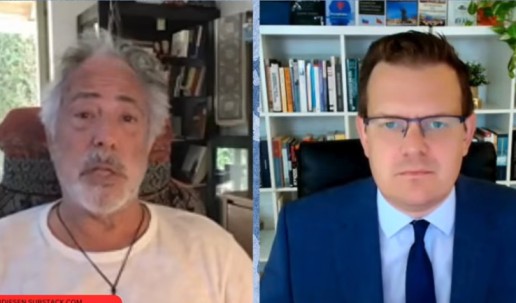
EDITOR’S NOTE: In this episode, veteran journalist and geopolitical analyst Pepe Escobar joins Professor Glenn Diesen to discuss the Shanghai Cooperation Organization (SCO) summit held in Bishkek, Kyrgyzstan. They examine the SCO’s evolution from a regional security body into a major Eurasian geo-economic institution, and explore the significance of key bilateral meetings, Iran’s growing role, and the widening divide between the Western-led order and the emerging Eurasian integration space. (September 2, 2026)
TRANSCRIPT:
Introduction
GLENN DIESEN (00:00:00 – 00:00:11): Welcome back, everyone. We are joined today by Pepe Escobar, a journalist and a political analyst, to discuss the Shanghai Cooperation Organization summit. So thank you for coming back on.
PEPE ESCOBAR (00:00:12 – 00:00:17): Always a pleasure with you, Glenn. Yes, this was a heavy, heavy day. Lovely Bishkek, Kyrgyzstan.
The SCO’s Evolution Over 25 Years
GLENN DIESEN (00:00:18 – 00:01:20): Yeah, and I was going to say, the Shanghai Cooperation Organization, it’s well, definitely changed over the past 25 years. As we all know, it began as this organisation only with Russia, China, and 4 of the Central Asian states to manage security in the Central Asian region, also manage any possible competition between Russia and China. But now they’d grown to be an economic, geo-economic entity. It’s taken in all these new members. India, Iran, Belarus. It’s quite a — it has changed to a large extent.
So, what are your takeaways from this summit in terms of where the SCO, that is the Shanghai Cooperation Organisation, has moved? I mean, is it now an actual Eurasian security institution or a geo-economic institution? How do you see what was effectively achieved at this summit?
PEPE ESCOBAR (00:01:20 – 00:11:32): Yeah, well, I am particularly fond of the SCO, Glenn, because I’ve been following it from the beginning. Which is a long time ago. That was in June 2001, 3 months before 9/11. It was a very simple meeting in Shanghai by a garden, by the way. And the Shanghainese love to say it, “ah, this organization, it’s so big, it started in a garden in Shanghai.” True.
And at the start, there were 3 major targets. Against separatism, against terrorism, and against religious extremism, which we could define at the time essentially Al-Qaeda and the ramifications of Al-Qaeda across the Central Asian states, something that we could already see at the time, especially in Afghanistan.
And in this particular year, it was a concourse of circumstances. It was crazy. When they founded the SCO, I was in Hong Kong and I was getting ready to go to Pakistan and Afghanistan. And that, as we all know, this was 3 months before 9/11. And when I was in Afghanistan waiting to interview Commander Massoud, we could visit Massoud’s prisons. And guess what I found over there? Al-Qaeda members, many of them Uyghurs, but also Uzbeks. So we had Central Asians and Uyghurs from Xinjiang in China.
So this was in fact one of the targets of the SCO at the time when it was under the Taliban. Of course, the Al-Qaeda cells were tolerated or not by the Taliban. They were all over the place. So, to a certain extent, they were already previewing what could happen next, which, as we all remember, was the famous War on Terror, which of course metastasized into a war of terror. And of course, the US using Al-Qaeda for a lot of parallel underground, hidden and very, very dark agendas.
Expansion and the Geo-Economic Turn
This first configuration of the SCO started to evolve little by little. And then by the early 2010s, they started to expand. And by the end of the previous decade, they had already India and Pakistan as full members. And Iran had already started a move to be accepted as a full member, which is what happened 2 years ago.
So the observers are also very important. Among them, the top observer is Mongolia. But we find also, guess what? Afghanistan. And the Afghans were also at the SCO as guests. Of course, they are part of what they call it SCO Plus. It’s equivalent of BRICS+. These are partners, associate members, members that may become full members in the future, etc. Turkey is also one of the observers, partners, but not full members.
So now it is an enormous geo-economic organization. And I went to a lot of SCO sessions during the previous decade. Usually in Russia, but sometimes even other parts of Central Asia. And they started to talk essentially business, trade, commerce, business around 10 years ago, even less than 10 years ago. So now this has become a huge organization where the most important thing is the interconnection of trade, commerce, and especially trade in their own currencies all across Eurasia, the Eurasia space.
And of course, they still think about terrorism. The declaration that they released today talks once again about terrorism. They worry about nuclear proliferation, no question about that. But they’re starting to focus especially on the financial angle, which is the proposal, which is by Iran, that’s very, very important, for them to set up an SCO development bank. The Russians already said yes. So the heavily sanctioned Iran and Russia support an SCO development bank, which can be even more effective than the BRICS bank, the NDB, where the statutes are all tied up with the US dollar. It’s an enormous problem. We have to turn the NDB upside down so it can start working as a real development bank.
Key Bilaterals and the Summit’s Takeaways
So what we saw between yesterday and today, something very — we were expecting. The bilaterals, some of them were fantastic. So we could see, for instance, in the corridors, Arashi discussing with Wang Yi face-to-face. We could see immediately after the official group photo, smiles all around between Putin, Modi, and Xi. So we could have another — in fact, we also saw a fantastic trilateral: Putin, Lukashenko, and Erdogan.
So everybody’s dying to know what they discussed, if this was a pitch by Erdogan or if this Putin telling Erdogan, “look, we’d like to have you here, but you have to make up your mind. What you really want in the future.”
So it was immensely interesting, everything that happened. The final declaration, I would characterize it as a mix of, wow, hardcore diplomacy. It’s not a good deal for the SCO to frontally antagonize the United States, but at the same time assertiveness. It’s a very assertive declaration there. And they’re detailing all the major points that they want emphasized.
In terms of Iran, for instance, they, all of them, all members condemned the unilateral war by the US on Iran without naming the US and without defining it as a unilateral war. But the language, even diplomatically, is very, very straight to the point. Respect for the UN Charter, although nobody knows what the UN Charter means nowadays because it was already buried a long time ago. So all the right moves, but we can expect from now on the SCO to be more forceful than it has been, at least for the past 24 years.
This is the 25th anniversary. Last year, I was in Tianjin during the SCO meeting in Tianjin, which was right before the Vladivostok Forum, which starts today in Vladivostok. And in China, it was in China, of course. And China was very forceful in terms of emphasizing global governance last year. This year in Kyrgyzstan, they did not emphasize global governance per se, but everything that they are proposing implies a radically different system of international relations where all these major Eurasia players will be at the forefront.
Two Worlds No Longer Speaking
And as you know, Glenn, and as you can imagine as well, the coverage in Western mainstream media was next to zero in the whole space that I call NATOstan. And obviously the Europeans were not there. In Kyrgyzstan, as they won’t be in Vladivostok starting today, and many won’t even be at the BRICS summit, which is going to be in less than 2 weeks in New Delhi.
So once again, it’s 2 worlds which are not even speaking to each other anymore. We had, for instance, Minister of Finance, Russian Minister of Finance, Siluanov, in a G20 meeting. And the Europeans didn’t even bother to shake his hand. It’s not even stupid. It’s childish as a reaction, undiplomatic as hell and childish.
But it’s true. These 2 worlds, the NATOstan space, with very few exceptions, and the Eurasia integration space, does it matter that they are not talking to each other? To virtually everyone across Eurasia, it doesn’t. Because yesterday and today, everybody has been busy doing business with everybody else. This was the key takeaway of the Kyrgyzstan meeting.
So it was immensely interesting to watch. I wish I was there, but I had other commitments. It’s a pity, but it was not as grandiose as in Tianjin last year. But it was very effective. And once again, the secret is in the bilaterals. And we don’t know what happened in many of these bilaterals. For instance, we had China and Iran, and we had Putin with Pezeshkian as well. Obviously, guess what they were discussing? Everybody knows, right? Especially because they interlock strategic partnerships. But a good sign. And of course, a world that the West ignores to their own — okay, it’s their own problem if they ignore it.
Western Media Silence and Iran’s Significance
GLENN DIESEN (00:11:34 – 00:13:02): Yeah, the media coverage is quite interesting. One gets the impression that the idea often in the West is if we don’t recognize that it’s happening, then it doesn’t have relevance because we’re not giving it legitimacy. But in reality, we just see a whole world being constructed without the average person in the West even being aware of this.
I mean, the fact that you can have now the heads of states of Russia, China, India, Iran, Pakistan, all of them coming together discussing how to set up an economic architecture that doesn’t depend so much on Western banks, Western currencies, how is this not relevant? And pursuing their own formats for security cooperation, political cooperation. I mean, it’s as if, if we start to talk about it, then slowly NATO, the NATO world, the bloc politics, the alliance system will start to fade away. So it’s kind of retreating into a world that doesn’t exist anymore. It is a bit concerning, yeah.
But of course, you mentioned Iran, and this must have been, just the optics of it to have Iran, which the US is doing so much, well, everything now to isolate, to have them there, among the world majority effectively. How significant do you think this is, though?
PEPE ESCOBAR (00:13:03 – 00:18:27): Enormous, Glenn, because we had Pezeshkian talking face to face with both Xi and Putin. This is immensely — apart from, of course, their discussions in the roundtable, but these bilaterals are absolutely crucial. All of us who have been following the war on Iran know that Iran has a lot of support at several levels from both Russia and China. Several levels, not only diplomatic, and in some cases military. Certainly geopolitically, geoeconomically, no question about that. And it’s very important that the leaders meet face to face.
And can you imagine that in less than 2 weeks they will meet face to face again in New Delhi at the BRICS Summit? So it’s back to back. And it’s fascinating also how these 2 top multilateral organizations are already, also in myriad ways, there is a fusion because the interests are the same. The big, big players are the same. Their targets are the same. Even though the SCO doesn’t bill itself as a bloc against the West, just like BRICS doesn’t bill itself as an economic bloc against the West. No, they are trying to build a different system of international relations, which of course the Global South is going to be much more influential than it is now. And of course, Eurasia, the supercontinent Eurasia, will be at the forefront. No question about that.
The Bullet Train of the Future
As we can see, every trade flow on the planet — everything is moving from West to East, at least for the past 2 decades and especially these past few years. So it’s inevitable. And when we have all the big players in 2 multilateral organizations and we have 2 summits nearly back to back where they’re all talking to each other, that’s it.
So once again, the fact that the absolute majority of the West ignores it, downplays it, or characterizes at best as, “ah, it’s just a meeting of a bunch of autocrats,” which is the typical stupid Western definition. Okay, it’s their problem. They are missing the bullet train of the future, which, it’s station to station. This is happening all across Eurasia.
And this is what we see. Once again in Vladivostok today, which is almost complementary to the SCO summit. We’re going to have other nexus of Eurasia. For instance, the president of Indonesia, Prabowo, is going to be at — he’s one of the guests of honor of the forum in Vladivostok this year. This is the Russian Southeast Asia connection. There’s always one or two top Southeast Asians, not to mention all the delegations going to Vladivostok year after year.
And of course, the role, for instance, of very important mid-level countries like Malaysia, even though Malaysia is not part of the SCO, but they are a partner of BRICS. They are at BRICS Plus. And they go to Vladivostok every year, sending delegations to do business, and they want to invest in the Russian Far East as well. All that is fascinating, and it’s virtually ignored all across the West, not only by the average Westerner but by mainstream media as a whole. It’s like there’s a sort of total censorship of every effort to unite Eurasia more and more. It’s to their detriment.
The Bilaterals Tell the Real Story
And they are already advancing on, and they are on escape velocity terms. Now, both BRICS, we still don’t know what’s going to happen in Delhi, even if it’s not very good. But once again, the bilaterals are going to be quite something. And SCO, the same thing, even though the final declaration has to be diplomatically very serious, very, let’s say, politically correct. The bilaterals, the whole story was in the bilaterals and everybody met everybody else.
We had, for instance, a very friendly meeting between Aliyev from Azerbaijan and Pezeshkian. They start talking in Kurdish among them. So, literally breaking the ice. They were talking about their mineral waters. So, these things matter, and especially in Asia. Asia, face-to-face contact is essential. It’s not bureaucratic. It’s not board meetings. It’s when you actually meet people, what our friend Xi Jinping describes as “people-to-people contacts.” This is how business is done all across Asia from times immemorial.
The Eurasian Anchors: China, Russia, and the SCO’s Integration Drive
GLENN DIESEN (00:18:29 – 00:19:40): Well, the difference now happening, well, when you look towards the Shanghai Cooperation Organization summit, when you have the heads of states of this generation giants trying to work out how to harmonize their economic interest and manage competition to again ensure prosperity as well as peace. It just contrasts a lot. And I say this with great pain as a European because I look towards this continent and we have the German leader arguing that the public should learn, well, should stop to complain that deindustrialization is effectively the price they have to pay. The only hope for the future is essentially militarism without money. I mean, it’s very that there’s not much optimism about with the future anymore. While at the SCO, they’re kind of preparing for a whole new world.
But I did want to ask about China and Russia though, because they’re kind of the, well, they’re the original members of SCO, and they’re also the 2 Eurasian powers, which have essentially spearheaded a lot of these integration initiatives, which has now pulled in all these other states. How do you see that bilateral relationship having developed now, especially at the SCO?
The New “Three Musketeers”: Russia, Iran, and China
PEPE ESCOBAR (00:19:41 – 00:23:21): Wow, this is immensely important because they are the anchors of Eurasia integration. The famous RIC, which I love to play a little bit with these concepts. I start to call them the Three Musketeers. The new RIC, the old Primakov Triangle of the late 1990s— Russia, India, and China— now Russia, Iran, and China. So why not call them the Three Musketeers in a playful, pop way?
They are meeting back to back in these summits. Putin and Xi may meet again in Shenzhen in November during the APEC summit. Xi is going to the US where we have no idea what the Trump administration may offer China, but certainly, no, Xi won’t even bother because he’s not expecting anything from the US. He’s expecting a lot from the rest of Eurasia. And the area chosen by China to expand as a big trading commerce power, geopolitical and geoeconomic powers across Eurasia, which is the basis of the Belt and Road launched in 2013. The Belt and Road is a gigantic, let’s say, business trade fair extended to the neighbors across Eurasia and therefore any Westerners who want to participate all across Europe and of course to Africa and of course to Latin America as well. So Chinese foreign policy is The Belt and Road Initiative essentially is the New Silk Road.
So obviously they are not paying too much attention to the bombers. They’re paying attention to the builders, to the co-builders of this sphere of trade, commerce, mutual investments, development banks, et cetera. They look at the West in terms as, and it’s fascinating when you go to China and you feel even on a popular level, wow, those losers over there in the West. It’s like they were without even saying it out loud. And they brought this on themselves. Their suicidal policies, especially in terms of energy, the lack of creativity and dynamism in top information electronic industries, the degree of rage of Europe against the Global South, against the rest of the world, and against very, very specific Eurasia big players.
But this is starting not to register anymore all across. When you travel all across Eurasia, you feel it. For instance, you go to Uzbekistan or Kazakhstan, which are being heavily courted by some Western industrial interests and by the Americans again. They are partners of BRICS, so they’re paying more attention to what BRICS may offer them and what China and Russia may offer them in interactions with China and Russia, and even with some things that Turkey might offer them than what the Americans or the Europeans might offer them.
A Transformed Eurasia: From Separatism to Stabilization
GLENN DIESEN (00:23:22 – 00:23:23): It, it changed.
PEPE ESCOBAR (00:23:23 – 00:24:54): It, it changed completely. And it’s much to, we can attribute the merit of this change, especially since the past decade, to organizations like BRICS, and especially in terms of Eurasia, the SCO, and how they were clever enough to start fine-tuning their main interest from separatism, terrorism. Of course, they know it’s all over the place, but when they were founded, it was much more acute. When they were founded, the Chinese were fighting American and British infiltration in Xinjiang, and the Russians were fighting Salafi jihadi Wahhabi once again MI6 infiltration in Chechnya. Now this is more or less contained everywhere.
For instance, during the one of the themes of the final declaration is how to normalize Afghanistan. They want to stabilize Afghanistan and bring Afghanistan as a full member of the SCO. So this would be then Afghanistan would have done in 25 years, 26 maybe. Everything happened with Afghanistan, and now they are finally going to be stabilized and normalized as a very important crossroads nation and economy at the heart of Eurasia.
GLENN DIESEN (00:24:55 – 00:24:55): So this is—
PEPE ESCOBAR (00:24:56 – 00:25:19): When you compare to the situation 25 years ago, Glenn, it’s absolutely mind-boggling. In historical terms, as you know, 25 years is not much. It’s like this in history. And now the situation is completely different from how we were 25 years ago before the SCO and before 9/11.
Biden’s 1997 Prediction and the Four Powers at the SCO
GLENN DIESEN (00:25:19 – 00:26:16): Yeah, no, I often cite this speech that Joe Biden gave at the Atlantic Council back in 1997 where he — you’ve probably seen it — where he was talking about the Russians warning the US against expanding NATO because that would push them, that would make it impossible for Russia to work with the West. It would push them towards China. And Biden was essentially saying, well, I told them, well, go ahead, and if that doesn’t work, how about you try Iran? And the whole room just burst into laughter. I mean, that’s 29 years ago. And look at it today. So it is, it happened in a very, very short time, but it should have been predictable.
But yeah, that being said though, again, the 4 most powerful countries at this SCO summit was China, Russia, Iran, and India. And well, there’s some differences between them though.
PEPE ESCOBAR (00:26:16 – 00:26:17): Of course.
GLENN DIESEN (00:26:17 – 00:27:02): China, Russia, and Iran, they’re all in the crosshairs of the United States. While India is still an ally or friend of the US, even though it’s a friend which has to take a lot of abuse, but nonetheless, it’s not seen as an adversarial state. But for this reason, the Indians, they’re careful not to end up in any anti-American rhetoric. They want to not be in any bloc, essentially, anti-American bloc especially. How do you see this impacting the ability of that organization to work? Now, I’m not saying that the Chinese and Russians wanted to be anti-American. I think they’re aiming more for anti-hegemonic, but still, this must create some tensions within.
India’s Role: Sidelined at the SCO, Tested at BRICS
PEPE ESCOBAR (00:27:04 – 00:33:51): Yes, it’s interesting. I was looking at some of the coverage of Indian media. They were extremely— there was a lot of discomfort. In terms of the fact that India was not a protagonist during this summit. The key protagonists were once again China, of course, the Central Asians, but China and Iran especially. Even Erdoğan from Turkey was more of a protagonist than Modi. And Modi, at least he got some, let’s say, chatter time with Putin and Xi. That’s never negligible because they can, there’s some signs and some words that can make an instant impact. And face to face, once again, Asia, everything in Asia is about face to face and not losing face.
And the real test for India is going to be at BRICS less than 2 weeks from now, because then they’re the hosts, then they have to imprint a credible agenda. They need a strong final declaration, and they had to take position among some very, very complicated issues, including their relation with Iran, which before the war, they were depending on Iran to solidify their own Silk Road. The Indian Silk Road goes through the port of Chabahar in Sistan and Baluchestan in Iran. Without that, they cannot have their Silk Road going to Iran, then to Afghanistan, and then to other Central Asians.
And there is a feeling in Iran that India— well, 2 days before the start of the war, Modi was fraternizing with the leader of the death cult in Tel Aviv. That’s not a very good sign, isn’t it? And of course, India never condemned anything coming from US-Israel against Iran. And of course, both are full members of BRICS, as they are full members of the SCO. The SCO declaration was very circumspect on it, and we can imagine why. The Indians probably vetoed language that will be more forceful. They condemned the war, of course, but not so emphatically. In fact, not the way that the Chinese have been condemning it from the beginning.
So, but India was on, is on the table. They signed on the final declaration. Same thing is going to happen in BRICS in less than 2 weeks. They’re going to have to mention the war on Iran, one of their full members. They cannot escape it. Let’s see how the angels are going to maneuver around that.
But the key players, which are Russia and China, they are already once again in escape velocity mode. They’re not going to wait for India to start, okay, get your game in place. No, no, no. Now they’re already out. They’re already playing with everybody, especially the Central Asians.
Turkey’s Hedging Game and the Organization of Turkic States
And even Turkey, Turkey sees an opening. Well, we have to try to sell ourselves to the SCO. We want to become full members. But the ones that they have to convince, in fact, are Russia and China. So it’s going to be very, very easy for, if they keep playing their hedging games, including NATO, continuing to sell oil to Israel and all that, that’s not going to sit well with both Russia and China. And with Iran, they are not on the forefront in terms of trying to find a peaceful pathway, including the dead cat MOU, Memorandum of Understanding, or not. They are a bit too far.
So once again, it all comes back to potentially hegemonic objectives by Ankara across Eurasia. And that’s where we enter the Organization of Turkic States. They were all there. Many of the members were there at the table at the SCO. There are, I wouldn’t say substantial, but some visible investments by Turkish firms when we— and you see it especially in Kazakhstan and Uzbekistan. But compared to Russia and China, it’s still, you know, it’s Russia and China on a whole different level.
So what did the Organization of Turkic States really want? Not even themselves know. When you talk to them about that, they don’t even know how to explain it. It’s basically marketing opportunities for Turkish construction firms. This is one possible definition of the Organization of Turkic States. And in terms of being a security partner at the main table of the SCO, some members are still very uncomfortable if Turkey joins as a full member. They will be much more relaxed with Mongolia joining first.
Afghanistan: The SCO’s Most Critical Priority
And in terms of what’s in the mind of the leadership in both Moscow and Beijing— Afghanistan. We have to stabilize Afghanistan by all means. Otherwise, if we don’t, guess what’s going to happen next? There’s going to be an Al-Qaeda 10.0 back in Afghanistan sooner rather than later. And this turns us back to the original SCO. The original SCO, they had in mind in the future, okay, maybe one day we can normalize Afghanistan. Of course, they would never expect that this would last almost 20 years. Afghanistan only got rid of the Americans 5 years ago. It’s not much. But this is much more important than, for instance, absorbing Turkey. So Turkey is in fact losing because they’re hedging too much. They may lose the Eurasia train. They may miss the Eurasia train.
They have to. This might have been part of the discussion between Lukashenko, Putin, and Erdoğan today. So far on Turkish media, of course, nothing about it. I’m not sure there are going to be any leaks about it.
Turkey’s Reliability Problem and the Geoeconomics of SCO Integration
GLENN DIESEN (00:33:52 – 00:36:09): Well, I think it’s a bit of a shame because Turkey kind of would fit very well into the Eurasian construct because they do aspire to be an independent pole of power. And in order to be so, you do really need to diversify your economic and political structures. And that’s essentially what the SCO allows for. But yeah, Turkey tends to be, well, let’s go with untrustworthy. That is, they always play a lot of unpredictable games. So, what are they going to do with Armenia? How are they going to work with Azerbaijan to probably weaken Iran or play a game against the Russians? Or whenever they make a deal, it’s often they but they don’t follow through. They break it, as we saw with the Azov fighters they had in Turkey, which weren’t supposed to be handed back to Ukraine, or with the attacks now on Syria, where they helped them to topple Assad and bring essentially al-Qaeda to power. I mean, it’s so much, so many different games.
But I’m wondering if it could be forced upon them in the future though, because now that the Israelis are suggesting they might turn their guns on Turkey in the future, and I’m assuming the US would pick Israel over Turkey. You would assume that, yeah, they can’t afford to alienate that many of the rising powers in the East. Again, it remains to be seen.
Well, my last question was just about the geoeconomics of it because the security issues, obviously, there’s a big return to that as well. But what do you think is required to become a genuine, well, to have genuine economic integration? That is to be able to use this alternative payment system, be able to de-dollarize in a big way, to establish independent energy and transportation corridors outside the US control, something at least reduce the US influence because the US, very openly sees all this cooperation as undermining its hegemonic position. So it wants to throw a stick in the whole thing. So what are the main obstructions from the SCO to move further here?
The SCO as a Geoeconomic Powerhouse: De-Dollarization and Eurasian Integration
PEPE ESCOBAR (00:36:11 – 00:41:17): Well, this was emphasized in different ways by the speeches by Xi, Putin, and Pezeshkian as well. The Iranians, in fact, they proposed 2 very, very important things.
One of them, it was already discussed with the Russians and Putin referred to it even before the summit, an SCO development bank. This is a key, absolutely key, crucial idea. If they go for it and they establish between today and next year, next year is going to be in Pakistan. The chair next year is Pakistan, which by the way, this summit for Pakistan was quite something. They were compared to previous summits, they were on the far front and not India. And no wonder the Indians were supremely uncomfortable.
And Pakistan, of course, as we all know, they are the key mediators between Iran and the US, now demoted again because the Trump administration once again is choosing a military escalation ladder. We don’t know how this is going to end. And obviously the Pakistanis will work very, very hard to get some sort of replay of let’s go back to the negotiating table. Everybody’s dejected by now, but that’s how it is when you deal with the Trump administration.
But okay, these 2 proposals, the SCO Development Bank, which has to be established with statutes completely bypassing the US dollar. And then we can see the Russian influence, which obviously Putin communicated to everybody else. And he was emphasizing all the time that most of, I think, I don’t know if he said 98 or 99%, but something like that, of Russian trade with their SCO partners already bypassing the US dollar. It’s in their local currencies. This suits India— oh, sorry, this suits China, this suits Russia, this suits Iran. India is a different story because India is tied to the international financial system, SWIFT, you name it.
And the other proposal by Iran is for the SCO to build an energy consortium. So this means that every member of the SCO as part of the consortium has an interest in stable oil and gas prices coming from the big producers. And the top 2 producers, as we all know, are Russia and Iran, and the 3rd largest is Kazakhstan. We also has an interest in stable prices. So these two points are essential, energy and economic finance.
No question. Now that the SCO has finally found, let’s say, its true mission as a geoeconomic body, much more than an anti-terrorism, anti-extremism organization, this is it. And they are coordinating this very complex project, as you know very well. It’s your area of expertise, Eurasia integration. So the top organization conducting all the connectivities and organizing all the connectivities is the SCO. The other one is the Eurasian Economic Union on a more restricted scale. And BRICS because BRICS of course deals also with the rest of the world, not only Eurasia specifically.
And has the opportunity to become even more influential in the short term than the NDB, the BRICS Bank, depending on how it’s set up, depending if it escapes completely the clutches of the international financial system controlled by the West. And of course, in terms of energy, they have all the energy they need within Eurasia. So that’s it. It’s the supercontinent in effect once again.
And when you look at history back to where it was most of history, most of recorded history, the center of the world is in Eurasia. It’s not anywhere else. It has always been. That’s what is fascinating. So it’s once again one of those quirks. History can be very, very playful most of the time, in fact. And when we have things recurring, which is what we are seeing now, the center of the world is being back to where it was most, most of the history of the world across Eurasia.
Mackinder’s Nightmare: The Rise of Eurasian Land Power
GLENN DIESEN (00:41:18 – 00:41:48): Yeah, I was going to say, how would you think Halford Mackinder would report on this SCO summit and the developments on the Eurasian continent? Because, well, as you know, Halford Mackinder, he wrote a lot of this work on essentially the threat of a Eurasian land power. Well, this was in the beginning of the 20th century. I think he wrote the first paper in 1904, then he expanded it to—
PEPE ESCOBAR (00:41:48 – 00:41:48): 1904, absolutely.
GLENN DIESEN (00:41:48 – 00:42:07): Yes. The whole idea that these land powers would then come together, cooperate, and that would, well, remove the competitive advantage of Britain as a maritime power, which again, his idea is still, you know, you can see it cited through American strategic documents.
The Anglo-American Paranoia and the Post-Western Shift
PEPE ESCOBAR (00:42:08 – 00:45:50): Absolutely. Well, that’s— and the supreme paranoia of the British Empire at the time, Glenn, which then translated into the science of geopolitics. We can say that they invented the science of geopolitics in 1904. And then that was fine-tuned by people like Mahan, by Spykman, even by Brzezinski. But it’s still the main thing is there. If we have the emergence of a peer competitor in Eurasia, or even worse now, the supreme nightmare, a coalition of peer competitors, Russia, China, plus an emerging middle power that is becoming a big power in Eurasia terms and Global South terms, Iran. Well, that’s the supreme nightmare of the Anglo-American system. First Anglo, then Anglo-American. And of course, this past 30 years or so, the unilateral moment, essentially American.
Well, but now once again, this bullet train has already left the station. This is where we are. And it’s not only Russia-China strategic partnership as peer competitors and as big, 2 big superpowers, but everybody riding on the train. The other Eurasian partners. And when you have a summit like this, it’s just a reconfirmation that, yes, finally we’re putting everybody in the house together, including, of course, the partners. They will become full members in the future when they are— when the situation with them is more normalized or they stop hedging, or in the case of Afghanistan, everybody knows that Afghanistan will never fall again into the arms of religious extremism, which was the case since 1979, for that matter, even before the jihad.
And we all know by now that this was invented, provoked, and instigated by the Americans. It was not— nothing was indigenous. Everything was instrumentalized. That army of Arab Africans, that was totally manufactured by the Americans with the help of Pakistani intelligence. Now we all know the story and what— why the whole thing led to 9/11, then the war on terror, and now the normalization of al-Qaeda when you have a former al-Qaeda throat slitter playing basketball with American generals and fully normalized by the West. It proves to us that everything was a sham, right?
So all these players in Eurasia, they learned their lessons. And now they are rebuilding the primacy of Eurasia based on, especially on these lessons that they learned since the end of the past millennium. So it’s going to be a completely different game. And once again, the people who are the heirs of Mackinder, Spykman, etc., it’s impossible, Glenn, for them to understand that. There’s a psychological block. There’s a cultural block. They always thought that this was anathema. And of course, the loss of the free lunch. There won’t be any more free lunch for them.
Closing Remarks
GLENN DIESEN (00:45:51 – 00:46:07): I was going to say, maybe if they sent some journalists to Kyrgyzstan, they would have known what was happening, but obviously not. Pepe, thank you so much. Well, keep following the SCO and yeah, hope to speak with you soon. Thank you.
PEPE ESCOBAR (00:46:08 – 00:46:15): Absolutely. I’m going to start on Vladivostok tomorrow. Cheers. Thank you very much.
Related Posts