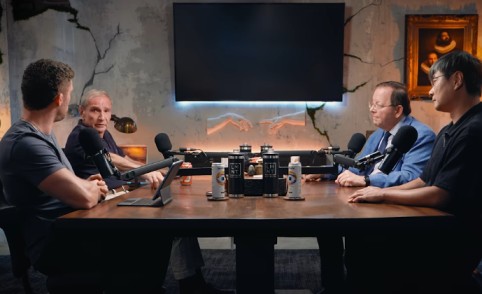
EDITOR’S NOTE: This is a discussion from Modern Wisdom titled “WW3 DEBATE: ‘We’re On the Brink of Global Collapse.'” Host Chris Williamson moderates a debate between three geopolitical experts, Robert Pape, Jiang Xueqin, and George Friedman, about the internal divisions inside the United States, the rise of China, the Iran war and its escalation risks, the future of Israel and the Middle East, and whether the world is heading toward a broader global conflict. The conversation ranges across topics including political violence in America, the balance of power between the US and China, and the possibility of nuclear proliferation over the next several years. This episode was premiered August 31, 2026.
TRANSCRIPT:
The Biggest Threat to Global Peace
CHRIS WILLIAMSON: There’s a lot to pay attention to right now, given how many global conflicts are happening, shifting political powers, populist uprisings. What do you think is the biggest threat to global peace at the moment?
ROBERT PAPE: (00:00:39 – 00:01:42): The biggest threat to global peace we’re about to see in our midterm elections. It’s the internal divisions in the United States. Those internal divisions have been building for the last 5 years. They’ve been normalizing political violence in the United States. They’ve led to the rise of leaders in the United States that find the use of political violence increasingly normal. That’s how we got to the Iran War.
And so that, a lot of the specifics that we see, Chris, around the world, I think it’s very important to understand that there is a hub. The United States is the most important, the most powerful country on the planet. And what happens internally in the United States can have ripple effects around the world.
And so I think it’s really important to not just talk about all the other issues, but to see the United States is at the center of many, maybe not all, but many of those issues. And what’s happening internally in the United States, this is increasingly becoming a house divided.
CHRIS WILLIAMSON: (00:01:43 – 00:01:43): What do you think?
JIANG XUEQIN: (00:01:44 – 00:02:01): I think the United States right now is the greatest threat to global peace because for the past 30 years, Pax Americana has been dominant. And now with the rise of other powers, the United States refuses to cede its global hegemony, and this is why we’re seeing conflicts all around the world, specifically in the Middle East.
GEORGE FRIEDMAN: (00:02:03 – 00:02:57): I don’t see a global conflict coming. Many regional conflicts are coming because the global system is restructuring itself. There is not really a global system at this point as there was during the European Imperial Age or during the period of after World War II. So rather than looking at a confrontation like nuclear war between the United States and Russia, we’re looking at various smaller elements.
Sometimes the United States gets involved, but as to the international conflict, I lived through the 1970s. It was intense in the United States. But it was intense over a very small war. So the idea that there’s a global system at this point, it’s emerging, but because it’s not emerged yet, many of the wars are going to be regional, right?
CHRIS WILLIAMSON: (00:02:57 – 00:03:08): So you still see— is it right in thinking that Ukraine, Iran, whatever happens, Taiwan, China, that these things are separate conflicts rather than part of a single global conflict?
ROBERT PAPE: (00:03:08 – 00:04:45): Well, I think that we may, the 3 of us, disagree about whether or not there will be a World War III, a true unified global war. I just want to point out that right now we’re experiencing multiple regional conflicts. They are linked in some ways, but together they are wrecking the global economy. They’re having a major effect on the global economy.
What’s happening in Russia with the Russia-Ukraine war, what’s happening in the Iran conflict, and if we had a conflict with Taiwan and China on top of that, even if those remain 3 separate arenas, Chris, we might be heading to something far worse than the 1930s Depression. So for the world, this would have blowback effects on Africa, even though they wouldn’t even be involved.
So we can usefully talk about whether we should expect a true World War III scenario, but we are already seeing global consequences in ways we haven’t seen since World War II. We did not see these global consequences in the Vietnam War, for example. We did not see these global consequences with the 2, what we called forever wars, Iraq and Afghanistan. We’re seeing them now. And that, even if it doesn’t become army on army, Chinese army on American, that kind of force on force, this is already amazingly consequential for our lives.
Who Is Orchestrating the Regional Conflicts
JIANG XUEQIN: (00:04:46 – 00:06:16): I think what’s really important to appreciate is that, yes, these conflicts are regional, but there’s a power orchestrating these conflicts, and that is the United States. So, it is the United States that unilaterally, without any reason, decided to attack Iran, which started the war in the Middle East, which is right now threatening to destroy the global economy.
The war in Ukraine can also be blamed on the United States because at the onset of the war in 2022, Putin and Zelensky would’ve come to an agreement, but Boris Johnson flew into Kyiv and convinced Zelensky to fight this war. Right now in Southeast Asia, the United States is withdrawing, but we’re seeing Japan being remilitarized, and we can imagine that Japan is being supported by the United States.
In fact, if you look at the National Defense Strategy, which was published by the Pentagon earlier this year, it calls for the United States withdrawing from the global stage and creating balance of power in each different region: Europe, the Middle East, and Southeast Asia.
So you can make the argument that the United States is intent on maintaining its global hegemony, but it recognizes that it doesn’t have the military power, the political will to control the entire world as it did in Pax Americana.
ROBERT PAPE: (00:06:16 – 00:06:20): See, I agree with about 70% of what he’s saying.
JIANG XUEQIN: (00:06:20 – 00:06:21): I believe—
ROBERT PAPE: (00:06:21 – 00:09:46): Well, I think you’re really on it. And I think that the parts I really agree with are that American decisions have been at the taproot of both of these wars, the war with Russia and Ukraine and the Iran war that we’re experiencing right now. Where I may disagree is I think that they’re very much a function of decisions and decision makers that have been evolving given our internal divisions in our country.
I think that we shouldn’t look at this as simply a product of a global cycle of empires. I think we need to see that for the last 10 years, we have seen, and 10 years, not just 2 years, an incredible rise of political violence in the United States. That is being driven, Chris, by major social changes inside of the United States. The shift from a white majority democracy to a white minority democracy for the first time in our 250-year history.
The shift of massive wealth to the top 1% over the last several decades. These are having amazing consequences inside of our government. It’s producing a set of priorities and leaders which are very different. So we are now seeing leaders that find political violence normal. And what— this is what you see with President Trump, both in his first term and now increasingly in his second term, and also some by Democratic leaders.
You’re also seeing, because of these internal problems, Chris, I think not sufficient attention to the consequences of these global decisions. So I don’t believe that we have over the last 10 years devoted the amount of attention to the consequences of issues with Russia and Ukraine, issues with Iran. I think that, and I think that because I’ve advised every White House from 2001 to 2024, I know something about this degree of attention.
And I am overall observing not no attention. I think that’s not quite right. And I don’t mean that they’re truly trivial, but nonetheless, the idea that we would continue to support NATO expansion and make Ukraine a much, much stronger country, even after Putin takes Crimea in 2014, without serious attention to the consequences. I think this is, there’s just not, there’s too much we need to see.
As we’re becoming internally absorbed, we have less cognitive space for the thing that I often do, strategy in the rest of the world. And that lack of cognitive space has not just been a function of one president, I think it’s been a function of multiple presidents. And I think that’s really what, maybe it’s not a disagreement, it’s what I would say maybe an extension, or I would add to what you’re saying.
Is America Losing Its Grip?
CHRIS WILLIAMSON: (00:09:47 – 00:09:56): I guess people keep debating whether America is losing its grip as a world superpower. 20 years from now, do you think America is relatively stronger or weaker than it is?
GEORGE FRIEDMAN: (00:09:56 – 00:11:33): I would say it’s not losing it, it’s wanting to lose it. The past 80 years has not been a happy time for the United States. For the United States, the fundamental principle is command of the sea, from a long time. Keeping them away from the Atlantic ports was essential in this. This drew us into creating NATO, creating an economic system based on Bretton Woods and all these other things that put tremendous pressure on the American economy.
Even recently, we had to bail out the Japanese in a way. So what I see the United States is doing, okay, and these things are not gracefully done ever. It’s pulling back from its vulnerability to the world, not engaging it. Now, the world is not seeing it that way because various things happened. Okay, one, the Cold War ended in Ukraine. The Russian army could not take Ukraine after 5 years. This is not a military threat.
So now the Cold War is obsolete and the idea is that, so the American desire is to disengage, and what’s predictable, was to disengage to the extent possible. But what the Americans are doing is not increasing their power around the world. It’s trying to remove its vulnerability from the world and the world feels betrayed. So the United States is no longer doing it. It no longer wants the role it had for the past 80 years.
ROBERT PAPE: (00:11:34 – 00:12:38): But if we look out 20 years, Chris, and you ask the question— well, right now we’re 26% of the world’s GDP, China 17% of the world’s GDP, so we still are number one, at least in terms of the numbers. And, but if we look out 20 years, China has a tremendous advantage going forward. But it’s not just the slope of the curve.
A big thing is happening, Chris, and it’s been happening for the last 20 years, which is we are losing the next industrial advance, the next economic revolution, and we’re losing it to China. And we’re not even noticing it very much, Chris. So in June of 2025, while we were bombing Fordow, I spent 2 weeks in China touring China’s advanced industries. This was in Beijing, and this was in Wuhan. This was in Hangzhou. This was in Shenzhen. Most people go to China. First of all, they stopped going after COVID, and most people who went tend to go to Beijing and Shanghai. I want to see the actual advanced industries on the shop floor.
GEORGE FRIEDMAN: (00:12:39 – 00:12:43): From my point of view, China is in a terrifically difficult position economically.
ROBERT PAPE: (00:12:44 – 00:14:50): Well, let me just explain. You can challenge it, George, but let me explain what I mean. What I saw on that 2-week trip, I thought I was going to go and look at Alibaba, see how they were a little bit ahead of different— I came away with a completely different impression. It was the most important trip. I was in China in 1979, so I had some experience here.
What I saw was not just uplifting of individual companies, Chris, uplifting whole cities, Wuhan, whole cities. So, not just the advanced sector, the healthcare sector, the construction sector. When you look at what’s happening in the cities, we’re getting 10% of the idea of what’s happening inside of China in the New York Times and in the media. In February, I want to organize a trip to go back to China, Chris, if you want to come.
I think you’d find this really interesting because it’s what’s— so I was born in Erie, Pennsylvania. I went to the University of Pittsburgh in the Rust Belt. That’s a— if you go from Chicago to, say, Pittsburgh, and down to St. Louis, that’s about 50 million people, give or take. Well, that’s about the half-moon crescent from Wuhan to Shenzhen. Not identical, but pretty close, as you know, that area is a huge country. Very— it’s a huge country.
But that crescent we’re talking about, what China has done, and literally in about 10 or 12 years— it has some roots in the ’90s— is they have uplifted those in that entire 50 million people, Chris. They integrate. Why are they ahead? They’re not just building companies. Their universities are tightly producing the BAs, the MAs, the PhDs. Why can’t we produce more Patriot missiles right now? Why can’t we just have an Operation Warp Speed? We don’t have the workers to do that because we’re not integrating the advanced workforce with the advanced healthcare. And by the way, advanced driver’s license.
GEORGE FRIEDMAN: (00:14:51 – 00:16:23): China’s cities is not China. The rural areas of China are profoundly important. It is the 2nd largest economy in the world. In terms of per capita income, it’s 71st. The fundamental problem that China has is it cannot consume the products it produces right now. Xi, just a few weeks ago, announced a plan to make more demand possible in the rural regions, which are very different from the coastal regions.
And so when we look at China, we look at a country that has an economy too large for it to consume. It is dependent on exports, with the United States being the largest importer of Chinese goods. So when you take a look at China and you take a look at how the summits are evolving and what’s happening there, we see very— I see a very different China from you.
I see the cities in marvelous shape, the coastal areas and South China, but that’s not the majority of China. The Chinese still have the rural area where Mao Zedong went to raise the rebel army on the Long March and brought it back. And that’s what it did. Now, when you look at it from a point of view on a global basis, it is the second largest economy. When you look at its ability to sustain itself, it heavily depends on exports. And what are the things that—
CHRIS WILLIAMSON: (00:16:23 – 00:16:25): Because it can’t consume what it produces?
GEORGE FRIEDMAN: (00:16:25 – 00:17:49): It can’t. It can’t possibly. It has tremendous capabilities, but its per capita income is very low. So you see a situation emerging. It has emerged several times before, particularly with the United States. The United States was a China of the 19th century. That is to say, first the Civil War took place, after that an industrial rising that heavily depended on exports to Europe.
So when you take a look at the relationship between the economic issues and the political issues and so on and so forth, the nature of the United States is to simultaneously have deep divisions and be able somehow to manage it. Okay? So when I look at these events, and I lived through the ’70s, this loathing of various passions, if you were not anti-war and went into university, you did not come out of that university frequently.
So I’m not so impressed by the tensions within the United States. I don’t know of a period where they weren’t there. We survived the Civil War, which was really a big discussion. Okay, so I see United States is constantly dynamically evolving through tension.
CHRIS WILLIAMSON: (00:17:49 – 00:18:33): So if I was to categorize at least what I’m hearing so far, from your side, China, very impressive. Not just the upward trend, but the integration, this almost like systemic blending of education in with industry, etc., etc., beyond what we’re doing. Yes. And internal strife inside of America, that’s worrying. This could cause fracture and fissure. From your side, China, well, it’s got some problems. Look at the rural area of this.
Yes, you’ve got great development inside of the cities, but those are pockets that are relatively localized. That makes it less— also, you’ve got high export dependency because you can’t consume what it is that you produce. And America’s been through shit before, it can probably put up with it.
GEORGE FRIEDMAN: (00:18:33 – 00:18:54): Most of all, China is vulnerable because it depends on these exports. Assume that the other economies falter where they can’t buy it, or there’s a political shift. The Chinese get into trouble because they must have access to the global market the same way the United States had to in the early part of this century.
CHRIS WILLIAMSON: (00:18:55 – 00:18:55): Yeah.
GEORGE FRIEDMAN: (00:18:55 – 00:19:18): So when we look at all these things, okay, we say, okay, China has evolved dramatically. It has not solved this fundamental problem which historically was there: the difference between the coastal regions of South China and the interior. This is what led to the revolution under Mao Zedong, and he didn’t solve that problem.
CHRIS WILLIAMSON: (00:19:19 – 00:19:24): Jiang, give me your perspective. We’ve seen two relatively diametrically opposed insights here. Give me yours.
JIANG XUEQIN: (00:19:24 – 00:21:55): Yeah. So I am completely surprised by this, but unfortunately, and my wife’s going to get very angry at me for this, but I’m going to have to agree with George on this issue. So let me explain my reasoning. So George mentions the vulnerability of the American empire, and that’s the US dollar as a global reserve currency. The American people do not want this system because essentially the world can become a parasite on America, right?
So if America has a global reserve currency, then America’s capital markets are completely free and open and liberal. You cannot control capital flows, and this caused tremendous problems. For example, wealth inequality and financialization, the hollowing out of the American manufacturing sector. Okay, that’s one issue. Another issue is America needs to guarantee global peace and security. So that’s why its army is spread throughout the world.
That’s why its Pentagon budget is $1 trillion a year. So the United States assumes a lot of costs. And who benefits from this arrangement? Well, 2 forces: Wall Street, right, because of the financialization, but also the Chinese Communist Party. Because as George points out, China is an export-dependent economy. In fact, you can make the argument that what China is doing is free riding on the American system, right?
Because when Chinese ships export their goods to Europe, to the Middle East, to the United States, it’s being protected by the U.S. Navy, not the Chinese Navy. China doesn’t even have a blue water navy. It’s the Americans that protect the seas, and when Chinese do exchanges, when they trade, it’s through the U.S. dollar.
So China is completely dependent on Pax Americana, and so the idea that as Pax Americana is falling, China will rise makes no sense. And I mean, the reality is, as George points out, China lacks domestic consumption power. Its people do not spend any money because its people do not have any money. All the rich people are going where? To the United States. That’s problem number one.
But there’s a huge problem that we haven’t discussed, which is the demographic issue where China’s aging rapidly because of the one-child policy. China has no workforce. That’s why China’s spending everything on robotics and on semiconductors and on AI, because China doesn’t have the productive force it needs to carry it for the next 20, 40 years because of the aging crisis. So China’s in a world of trouble. But where I disagree with them—
CHRIS WILLIAMSON: (00:21:55 – 00:21:57): A bigger world of trouble than America?
JIANG XUEQIN: (00:21:57 – 00:22:23): Oh yeah, absolutely. Because regardless of how you feel about the United States right now, the United States is a self-sufficient, resource-rich economy with a very vibrant, energetic young population. China has the opposite problem, which is that it is extremely export-oriented. It’s a very poor country, very limited resources. It’s very dependent on global supply chains. And what’s breaking down right now are global supply chains.
China’s Growth Model and America’s Blind Spot
ROBERT PAPE: (00:23:22 – 00:25:59): So let me just respond in this way. I had exactly their image 10 years ago, exactly their image. So I first went to China in 1979, then I didn’t go back until 2012, 10 trips from 2012 to 2015. Then I went back in 2025. Even as late as 2015, I had exactly their image. Here’s what happened in this trip, and this is what really are the core things that I’m seeing. Number one, the Alibaba, BYD, Xiaomi. I didn’t just go and look at the shop floors.
I met with their executives. They showed me their growth plans. It’s not just that they have been spurting up since COVID. So all this building, massive development since COVID. It’s that since 2017, essentially the Trump tariffs that were first put on China in 2017 by President Trump, there’s been a dramatic emphasis to disengage the development of the next generation of industries from America.
So you can’t buy the cutting-edge BYD vehicles here in the United States. You can’t buy the next-level Teslas of Xiaomi here in the United States. And they’re not trying to sell them here. Also, the whole issue with Walmart and so forth, that’s the last generation of what’s occurring. They showed me their growth models.
They are still export-oriented, but they’re not export-oriented to Europe and they’re not export-oriented to the United States, although they take a little crumbs on the edges. It is built around Asia. They showed me their growth models they’re really counting on are in Asia now. True in the short term here. There’s some problems with the Iran war and of course Asia. So we talked about that with the actual top VPs, the top executives.
And they explained to me that the bottom line is the more the United States gets sucked into a quagmire with Iran, yes, they will run into some short-term problems. But just like COVID, when they came out of those problems of the supply chain problem in COVID, they jettisoned ahead. They thought they were likely going to get ahead.
And if you look at the numbers of what the BYD production has been this year in 2026, what the numbers of Xiaomi has been, the numbers at least we can see, they’re not as good as they were hoping, but they’re about at the same level as the last year. So China’s not collapsing.
GEORGE FRIEDMAN: (00:25:59 – 00:26:07): The Chinese growth rate is down to a little over 4%. It was previously 5% and its greatest price— was it 15% growth?
ROBERT PAPE: (00:26:07 – 00:26:47): And I’m saying this is the wrong measure. This would be like measuring America’s growth rate without noticing electrification in the 1880s, which starts in this really small way. America has been great because since 1880, we have led every technological revolution since 1880. The AI revolution that we’re right going through right now, we hope we’re going to come out ahead. The stock market’s certainly betting on that. I’m telling you what I saw in China. It’s not just about DeepSeek and Alibaba. They’re building the core infrastructure to be able to beat us.
JIANG XUEQIN: (00:26:48 – 00:27:00): If I may, let me ask you this question. So right now Japan is remilitarizing rapidly. And it’s building an alliance with India, the Philippines, and Australia, the Quad, right?
GEORGE FRIEDMAN: (00:27:00 – 00:27:15): It seems to me in the long term the intention is to embargo China, to cut supply chains with India coming into it, Indonesia coming into it, and so on and so forth. So from Japan all the way to India, there is at sea a blockade.
JIANG XUEQIN: (00:27:15 – 00:27:19): That’s right. So what is China’s response to this possible embargo?
ROBERT PAPE: (00:27:19 – 00:28:16): So as I look out here, first of all, if you’re quite right that there’s a military possible consequence here, I think President Xi’s question to Trump was exactly the right question, which was, are you, President Trump, going to fight here if there’s a conflict between China and Taiwan? And President Trump said he wouldn’t answer that question. Because if you— yes, you have the Quad moving forward.
But if you take out the United States from that equation, as I think we are heading in that direction, then this is just a very different competition between the Quad and China. They might fight. They might decide to fight just the Quad and China, and both will go down some. But this is not a sure winner for the Quad over China. So I think this would be very different. And notice, this is not China provoking the war.
JIANG XUEQIN: (00:28:16 – 00:28:17): That’s right.
ROBERT PAPE: (00:28:17 – 00:28:30): This is outsiders attacking China. And what happened with Mao? This was a gigantic revolution inside of China to foreign conquest. So this is not talk about unifying China.
GEORGE FRIEDMAN: (00:28:30 – 00:29:05): If I could, the Taiwan situation has profoundly changed. Inside of Taiwan, the population is divided almost down the middle, with the KMT, the Kuomintang, which is inclined in favor of reuniting with China in some sort of way. That’s about half the population. The other half the population is very much opposed to it. From the Chinese point of view, Taiwan was a very great danger because between Japan and the Philippines, Taiwan was a blocking force.
JIANG XUEQIN: (00:29:06 – 00:29:08): The first island chain. The first island chain.
GEORGE FRIEDMAN: (00:29:08 – 00:30:37): Yeah, that’s the first island chain that they want Taiwan opened. Okay, United States does not have a fundamental interest on Taiwan, so the idea is we see that Xi is coming to the United States, and he has said this week we’re going to reach many great agreements in the United States. One of the forecasts I had was that this year China and the United States would come to a fundamental understanding with each other. Why?
China must have that understanding. The United States is not a trivial partner, okay? It is the number one trading partner, and it is the only military threat to China. Therefore, accommodation is rational for China. And these talks have been taking place. So what I’m seeing in China is a tremendous amount of instability in the political system. The economic system is moving ahead properly.
But China has a fundamental problem because, as I said, it must have a decent relationship with the United States. And the United States has said to it, we cannot be dependent on China for its imports if it is also possible to go to war with us. That happened to us during the Arab oil embargo. We were dependent on the Arabs. The Israelis went to war and they cut it. It was a disaster in the 1970s. So if we are too dependent on a country with whom we have hostile relations, that’s unsustainable.
CHRIS WILLIAMSON: (00:30:38 – 00:30:41): So you’re suggesting that the US and China are going to become friends? Soon?
GEORGE FRIEDMAN: (00:30:41 – 00:30:44): We’re not going to be friends, they’re not going to be lovers, they simply need each other.
ROBERT PAPE: (00:30:45 – 00:31:47): And here I agree. So my whole point was not that we must then have conflict with China. In fact, when I was in China, I was giving talks arguing that given everything I just said, I think that China can rise peacefully with the United States. That’s my big position. And it’s because when I look out at the growth of power, what is power today? Power is modernization, technological development.
We see that right now with the drone, with what we’re experiencing with Iran. We’re not losing to Iran because of Iran’s 4%— it’s because we’re behind in understanding the second precision revolution. What’s happening, Chris, is others are evolving. We’re used to thinking we, the United States, are on the cutting edge of everything. And what we’re learning is we’re not on the cutting edge of everything. Now, that doesn’t mean we have to go to war against China. I was also impressed President Xi basically asked Trump about the Thucydides trap.
ROBERT PAPE: (00:31:48 – 00:32:21): are we going to go to war? So I believe these are the right questions. I don’t think we’re heading to a war with China if we’re smart, because what we need to do is develop our industrial base. We need to develop and modernize internally. This is a choice. Back to your question, will we be replaced as the world’s number one in 20 years? This is a choice. If we keep fighting these horrible quagmires, if we don’t develop internally here, if we don’t catch up to China, the answer is yes.
Whose Century Is It
CHRIS WILLIAMSON: (00:32:21 – 00:32:29): Given where we’re at at the moment, looking into your respective crystal balls, which country do you think is the most powerful in the world in 20 years’ time?
GEORGE FRIEDMAN: (00:32:29 – 00:32:51): The United States is the only global power. China is a regional power. It cannot push force into the Atlantic and so on. Okay, we can. So we’re reaching a world that’s very different. That doesn’t mean that the United States is in decline. Okay, certainly I agree with you on many of these things, but I don’t think it’s fundamental to the position of the United States.
CHRIS WILLIAMSON: (00:32:52 – 00:32:52): It is—
GEORGE FRIEDMAN: (00:32:52 – 00:33:05): The United States occupied a position in the world which cost it a great deal in many different dimensions. And now backing off from that reduces tensions within the United States and so on.
CHRIS WILLIAMSON: (00:33:05 – 00:33:17): I was thinking that there would be some sort of seesaw, probably between China and the US, but maybe there was another player that I hadn’t thought about. It sounds like both are in some form of mild decline.
ROBERT PAPE: (00:33:17 – 00:34:25): They’re in flux. So my position is it’s up to our leaders who’s going to be number one in 2020— there’s 3 dimensions of global power. I would look at dimension number one as the country’s GDP as a fraction of world product. Right now we’re 26%, China’s 17%. But if you look forward here, this could easily flip flop in 20 years. The second is allies. How many friends do you have in the world? Well, look at what’s happened with the tariffs.
Look at what’s happening with Canada right now today. What is happening is in the middle of this gigantic war that we’re having with Iran, we are deciding to alienate friends. Well, who’s likely to pick up those friends? It’s going to be China. And then issue number 3 is our technological base, our growth.
If the world economy goes over a cliff with our $40 trillion in debt, I think the idea that we’re going to invest our way out of this in the AI— I’m just— look, maybe that will all work out, Chris. Okay. And we’re going to be fine with $40 trillion.
CHRIS WILLIAMSON: (00:34:25 – 00:34:27): I’m laughing my way through the apocalypse. I don’t know about you.
ROBERT PAPE: (00:34:27 – 00:34:30): Well, I’m just trying to explain. These are the problems. I’m worried, afraid about.
GEORGE FRIEDMAN: (00:34:31 – 00:34:31): So I want to—
CHRIS WILLIAMSON: (00:34:31 – 00:34:33): just one second, let’s hear from Professor Zhang.
JIANG XUEQIN: (00:34:33 – 00:35:56): So, I think that these past 30, 40 years of Pax Americana have been unique in human history. Never before had we had a power that could span the entire globe, that had— for the first time, we had a global reserve currency. Never before had one nation been able to dictate the global economy. So I think Pax Americana has been unique in human history. And I think we’re reverting back to the mean, which is more regional dominance.
So the way that I examine how nation-states thrive or die is using 3 basic criteria, which is going to be very different from yours. But first, I look at energy— basically, how hardworking are the people? Second thing is openness, which is how open are people to change? How much are they willing to absorb new ideas? The third is cohesion, which is how much do they value their own neighbor.
If you actually use these 3 metrics, okay, energy, openness, and cohesion, you find that in each region, one nation will dominate above all else. So in East Asia, it will not be China that dominates, it will be Japan that dominates. In Europe, it will either be Germany or Poland, one of the 2. Germany is more powerful, but Poland is more cohesive. And you can tell me next week what you find.
GEORGE FRIEDMAN: (00:35:56 – 00:35:57): It’s more dynamic by far.
JIANG XUEQIN: (00:35:57 – 00:35:58): Absolutely, absolutely.
GEORGE FRIEDMAN: (00:35:58 – 00:36:00): And it’s more endangered. Asia, it seems.
JIANG XUEQIN: (00:36:01 – 00:36:02): And that’s what’s more energetic—
GEORGE FRIEDMAN: (00:36:02 – 00:36:02): Energy.
JIANG XUEQIN: (00:36:03 – 00:36:20): That’s right. And then in North America, it’s the United States by far. The United States is so dominant that the United States could keep on electing Donald Trump and that could faceplant its way through the next few decades. And still, unfortunately, that is the case in the United States. And then in the Middle East, I believe it is Israel that is most dominant.
America’s Momentum and the Risk of Civil Unrest
Interesting on the US’s ability to put both of its feet in its mouth and continue to be a preeminent power. Does that help to smooth over some cracks and inefficiencies and instabilities inside of America? The momentum, just the sheer size of it, means that there can be issues burbling below the surface that don’t get seen for a little while, and then eventually the lid gets blown off. Obviously you’re talking about civil unrest. I don’t know how likely you think proper civil unrest is going to be due to this?
ROBERT PAPE: (00:37:47 – 00:39:29): So, I have coming out, Chris, a book called Our Own Worst Enemies: America in the Age of Violent Populism. It’s pre-order now on Amazon. It’ll be available in just a couple weeks to be in your mailbox. And I’ve spent 5 years studying this problem because my work on political violence— what I do, Chris, is I look at where the biggest threat to America is. It changes from time to time.
And what I started to see after the George Floyd protests, which were mostly peaceful, but what does mostly peaceful mean with the George Floyd protests when 28 million are protesting and 7% are riots and political violence? That’s millions of people who are unrest.
And then also January 6th, this is the first time in our history that we’ve had a violent mob supported by the president of the United States to try to stop the constitutional process of changing presidential power in the United States. Then we’ve had the rise of political assassinations and assassination attempts. I could go on and on. This is, I would say, akin to the 1960s. I agree, we’ve had some periods of violent populism before.
The book covers that. But what’s different is it’s on both the right and the left. The number one fact today is tens of millions of Americans on each side of the political spectrum support political violence for the goals that they also support. That’s why you’re getting support for very aggressive ICE tactics against Democratic protesters, even after ICE kills those Democratic protesters.
GEORGE FRIEDMAN: (00:39:29 – 00:40:35): I would argue that this is not the first time it happened. We had a civil war. In that civil war, we ripped ourselves apart and then came together again. There’s a strangeness in the United States. Most countries that have that kind of civil war could not accommodate itself again. We are historically, when we take a look at these various periods in history, at each other’s throats.
It is one of the dimensions of the United States which is based on the fact that we’re an invented country. Invented not only in the sense that the Constitution was invented, but that the population was invented. There was no— other nations have histories of culture and so on. We constantly came together.
So one of the things that the United States is very good at from the founding is being deeply divided because as John Adams said, one-third of the people were for the revolution, one-third of the people were against the revolution, one-third of the people didn’t care. That was his reading. So I see the divisions in a very different way than you do.
ROBERT PAPE: (00:40:35 – 00:41:03): Well, I don’t think it’s good enough to say that we survived the Civil War because 600,000 people died in the Civil War. So let’s just be clear. We are $40 trillion in debt. The idea that, sure, we’ll just have a civil war and no problem, we’ll get out of this just fine— we’ve got to go to the Civil War standard to say we can survive a civil war? No, we will not be able to be anything like— we won’t even be a regional power.
GEORGE FRIEDMAN: (00:41:03 – 00:41:13): I disagree profoundly. There’s a cultural nature. China has a culture, it has a history, it has an evolution. Britain has a history, and so on.
CHRIS WILLIAMSON: (00:41:13 – 00:41:13): Okay, thank you.
GEORGE FRIEDMAN: (00:41:14 – 00:41:15): When you take a look at—
JIANG XUEQIN: (00:41:15 – 00:41:16): Or you used to—
CHRIS WILLIAMSON: (00:41:16 – 00:41:18): Well, shut up, dude.
ROBERT PAPE: (00:41:18 – 00:41:19): All right, shut up.
GEORGE FRIEDMAN: (00:41:19 – 00:42:12): Okay, when you take a look at American history, you measure yourself and your state and your company against something. Otherwise, you’re constantly in a feeling of, this has never been so terrible. So you have to have a sense of proportion on what goes on. So when we look at the division in the United States between World War II, between the isolationists and the interventionists, we have constantly approached the world deeply divided.
Okay, I mentioned the Civil War because that was the most extreme example, but even the revolution was not a joint universal uprising. It was deeply divided. And my wife’s family had to move to Canada because after they won—
CHRIS WILLIAMSON: (00:42:12 – 00:42:13): That’s a high price to pay.
GEORGE FRIEDMAN: (00:42:14 – 00:42:17): Well, they were— the point I’m making here is that—
CHRIS WILLIAMSON: (00:42:17 – 00:42:17): Put me on the wall.
GEORGE FRIEDMAN: (00:42:19 – 00:42:45): One of the things about the Americans is we’re constantly having the feeling we’re going to hell. We have the ability to overestimate tremendously our weaknesses and underestimate our tremendous strengths. And this is where I have to respect you and disagree with you. I look at the past as a measure of the culture and its flexibility and viability, even under pressure.
CHRIS WILLIAMSON: (00:42:45 – 00:42:52): Do you think America is a country permanently in strife internally, or is that something unique about the modern world?
ROBERT PAPE: (00:42:52 – 00:43:01): Well, let me also be clear. My book is explaining we’re not heading to civil war. We are heading to violent populism, and we’re in the middle of violent populism.
CHRIS WILLIAMSON: (00:43:01 – 00:43:03): Can you explain what the difference is, please?
ROBERT PAPE: (00:43:03 – 00:45:25): Yes. Civil war is where you have armies going toe-to-toe. Truly, this is battle after battle. So we start to see the movies on civil war. These are, I think, the extreme scenarios. And we can talk about extreme scenarios. I hope we would never get there. So I don’t find them acceptable, but I don’t think that’s really what our future is.
I think our future is more, we’re more in danger of becoming Turkey, for example, where because we have normalized political violence, it starts to become normal for the president to absorb more and more powers under the presidency. And then also to sort of hide things. So this isn’t just happening with President Trump, during President Biden’s presidency, we had open borders essentially. We had 10 million plus come into the country.
And yet this was all the image was, oh no, there’s nothing happening at the border. It’s literally not happening. And that was by a Democratic president. So what I’m trying to point out, Chris, is that we’re in a world where because political violence is becoming normal and George is finding it, well, sure, it’s just okay, it’s just another day in America. This is what I’m saying. This is what the book’s about.
It’s about how political violence has become normal for tens of millions of Americans for the first time since the 1960s. And this has consequences because it’s on both the right and the left. And we’re coming to an election. And this midterms, we already have, and I was just on many podcasts, we have people who are terrified that President Trump is going to seize ballot boxes.
Now, why would they be terrified of that because President Trump said he was going to do that in February. And so this isn’t just coming out of nowhere. And when I’m on those podcasts, I’m trying to say, yes, that may happen, but we will hold ourselves together and here’s how we’re going to do it. So I’m not trying to tell you we’re heading to civil war. I’m also not trying to tell you civil war would just be fine.
What I am trying to tell you is the way you’re going to see powers absorbed by the federal government, things like use of martial law and so forth, is because political violence has become normalized.
CHRIS WILLIAMSON: (00:45:25 – 00:45:27): The normalization, which is the difference on your—
ROBERT PAPE: (00:45:27 – 00:45:27): And it creates—
CHRIS WILLIAMSON: (00:45:27 – 00:45:30): What’s your perspective on internal strife in America?
Rome, Rats, and Young Men Without Status
JIANG XUEQIN: (00:45:30 – 00:47:06): Right, so I think the best historical analogy for the United States right now is the Roman Empire. And the critical turning point for the Roman Empire is maybe 150 BCE. And this is the Third Punic War. This is before the Third Punic War starts between Carthage and Rome. At this point, Carthage is basically destroyed, and it’s just an economic center. It’s no longer a military power.
And there’s a huge debate in the Roman Senate about what to do with Carthage. Cato the Elder demanded the destruction of Carthage, because Carthage would always be a threat to Rome otherwise. Everyone else was like, no, guys, we cannot destroy Carthage, because if we destroy Carthage, what will happen is we will have no external enemy and we will start to tear ourselves apart. Cato the Elder won and they destroyed Carthage in the Third Punic War.
And then right after, what happens afterwards? Complete civil strife. And after the civil war starts, it starts about 100 BCE, some called the Social War, but it never really stops. It leads to the rise of Julius Caesar, which then leads to the rise of Augustus Caesar, which then leads to all sorts of wars. So that’s a problem with the United States. The United States is probably the most violent country on this planet, by far.
There are more guns per capita, there are more guns than people. And America is the only nation to play football. Am I correct to say only Americans play football? Yeah. So Americans have this tremendous energy.
CHRIS WILLIAMSON: (00:47:06 – 00:47:14): Hang on, hang on, you’re going to have to draw the parallel between there’s lots of guns in America and America is the only country to play football. I feel like I’ve missed something there, right?
JIANG XUEQIN: (00:47:14 – 00:47:27): What I’m saying is that America is a society that prides itself on the First Amendment and the Second Amendment. It’s a society that is, by the standards of every other society, pretty aggressive.
CHRIS WILLIAMSON: (00:47:28 – 00:47:35): And right, the physical contact, violence, that’s right, like doing like listening to Metallica and flying F-14s and shit.
JIANG XUEQIN: (00:47:35 – 00:48:02): So this energy, you can either direct it outwards, to conquering the world. Or if you don’t direct it outwards, and there’s a fear that it becomes directed inwards, which could lead to civil war. It could be violent populism, it could be a full civil war. It could also be an insurgency, very much like the movie One Battle After Another. But I do think that right now at this point, domestic violence is almost unavoidable.
CHRIS WILLIAMSON: (00:48:03 – 00:48:05): You. Really? Why?
JIANG XUEQIN: (00:48:06 – 00:48:22): If you just— I mean, you can agree or disagree, but I think there are certain trends that are in place that make internal violence unavoidable. So the first is just the wealth inequality, the financialization of society.
ROBERT PAPE: (00:48:22 – 00:48:23): This is what I was talking about.
JIANG XUEQIN: (00:48:23 – 00:49:22): That’s one trend. But another major trend is the gerontocracy. The baby boomers. So what’s happened is that baby boomers— I apologize to both of you— but the baby boomers have monopolized political power, economic wealth, and social status. And if you’re a young person, you have absolutely no opportunity. So James B. Calhoun in the 1960s, he ran a very successful experiment called the Rat Utopia Experiment.
He basically put rats in a paradise where there’d be no predators, free food every day. And all that happened was the rats just turned against each other and killed each other. And the reason why is young men, especially young men, they strive for social status. If you don’t give them social status, if they’re unable to climb the social hierarchy and find recognition and status, they turn violent. And this is just human nature.
ROBERT PAPE: (00:49:23 – 00:52:21): So we tried to get at this. So this book that I’m coming out with, it’s not— it’s a product of this 5 years of research that we’ve been doing at the Chicago Project on Security and Threats at the University of Chicago. 20 national surveys. This is where all that millions of dollars— so, and why we did all that was to try to answer some of the why questions.
So we asked questions such as, how worried are you you won’t be as prosperous as your parents? That kind of gets at the wealth inequality and the social mobility. Well, we didn’t just find out the general answer to that. We wanted to know, did that make you more likely to support violence? Political violence.
And it turns out the more you think you won’t be as prosperous as your parents, the more you support political violence on the right and on the left. It’s a wedge. It drives both sides up. We also asked, remember I mentioned the second social change? We’re transitioning from a white majority democracy to a white minority democracy. Well, other countries in the world, this has played a huge role in political violence.
That’s why Lebanon, for instance, has had so much political violence over the years, over the decades. Well, this is not unique to America, but it’s happening for us now, Chris, for the first time. And so we ask the question, if you— are you happy with the transition to a white minority democracy, or are you unhappy and want to reverse it? And what do we find?
If you want to reverse it, you are far more likely to support political violence on right-wing issues. If you want to keep it going, you’re more likely to support political violence on left-wing issues. These are not happening in isolation. They’re not just swirling around and gee, it’s kind of random why we’re having this rise of violent populism now.
There are actual reasons and they overlap with some of what Jiang’s talking about, but we’re able to get to the data to see, well, let’s do some tests here and see, can we really see it in the data? And the answer is yes. And this is why, so it’s been very worrisome, Chris, for some time. So a year ago, I published a big op-ed, June 2025, in the New York Times.
I was explaining this data in this op-ed, and I was warning, we’re on the brink of major political violence. And what happens? The Charlie Kirk assassination happens. What happens? We get the rise of Operation Midway Blitz and then Metro Blitz. And that wasn’t the first time, Chris. So a year before that, this data was showing a rise of anger to the point of violence against President Trump. This was in June 2024.
So I brought it to our National Sheriffs Association. So I’m connected with these. So remember, advised White Houses, etc. And I warned them that there’s a non-trivial possibility that we’re going to see an assassination attempt against President Trump.
CHRIS WILLIAMSON: (00:52:21 – 00:52:22): When did you say this?
ROBERT PAPE: (00:52:22 – 00:52:40): This was the last week of June 2024. Now they listened. I’m just going to say, Chris, they listened. And guess what happened on July 13th? And then what happened is my phone blew up because suddenly people were—
JIANG XUEQIN: (00:52:40 – 00:52:43): It literally blew up.
ROBERT PAPE: (00:52:43 – 00:53:28): But what I’m trying to say is, Chris, this is— so just as my 20 years of modeling of the Iran War has led to some predictions about what might come in advance. We haven’t— but that’s, of course, been well known at this point. This is not the first time. My work has been studying political violence, not just in the rearview mirror, but with an eye toward giving real decision makers, whether it’s Chief of Staff of the Air Force, West Wing of the White House, FBI— I call it strategic intelligence. It’s not tactical intelligence. It’s where things are heading to see where probabilities of events in the future are shifting.
GEORGE FRIEDMAN: (00:53:28 – 00:55:00): That’s my work. I don’t disagree with you. We are in a violent time. I simply put that in context of American history and American culture. So if we’re doing something that we’ve never done before and never done before and recovered from, that is very different from saying this is unprecedented. So when I look at culture, I take a look at the culture itself, at its history, and ask the question, is there a precedent for this? Okay?
Have we, is this something we’ve never seen? If that’s true, then there’s a radical shift possible. If this is a cycle, a process that periodically happens and comes and goes and is handled in the past, there’s a high probability of a counteraction, of it subsiding. So this is why I go back to things that don’t seem very relevant because they went away.
But if you’d lived through the 1930s with the isolationists deeply in some ways antisemitic and everything else, and the tensions that were there— well, I’ve seen that. So when I talk about the Civil War, it’s just to say this was the most extreme event of this sort and we survived. So I ask questions, not only is a crisis coming, which I completely agree with you on, but is it in the nature of the culture of the United States to withstand those crises and recover?
CHRIS WILLIAMSON: (00:55:00 – 00:55:14): Yeah. Okay. So your point is this might not be terminal. This might not be existential to the United States. I mean, does anybody think, like, even if there was a civil war, there would be some people left, right? And then you’ve got a country afterward, like, from the ashes something can come back.
GEORGE FRIEDMAN: (00:55:14 – 00:55:24): What came out of that civil war was the most dynamic development economically perhaps in history.
CHRIS WILLIAMSON: (00:55:24 – 00:55:26): It’s like the accelerationist argument. We could—
GEORGE FRIEDMAN: (00:55:26 – 00:55:52): No, it has nothing to do with the causality, or this is necessary. I’m simply saying to you that if you get a fever that you’ve never had before, well, that’s really significant. If on the other hand you had another cold, you don’t take it that seriously. I’m trying to put this in the context of the American nature. So I’m arguing there’s a culture, there’s a nature, there’s a history.
ROBERT PAPE: (00:55:52 – 00:55:53): I just want to make 2 points.
GEORGE FRIEDMAN: (00:55:53 – 00:56:10): And one thing, no, one thing is every time we thought we were finished during the ’70s— the killings, the kidnappings, and everything that were going on— well, they went away. So I’m saying there’s a cyclical process.
ROBERT PAPE: (00:57:12 – 00:57:18): So I would just say 2 quick points. Number one is I want it on the record, I am not pro-Civil War. That’s the acceleration cycle.
CHRIS WILLIAMSON: (00:57:18 – 00:57:19): I just want to be clear.
ROBERT PAPE: (00:57:19 – 00:58:59): Just want to make sure I’m on the record. Number 2, more seriously. So the point of the research of the book isn’t just to give histories of the ’60s. It’s why did the violence in the ’60s end? It ends for real reasons. It’s not just we burn ourselves out. There were 2 drivers to the 1960s political violence.
Driver number one was we had a massive shift in migration of Blacks to the North and the Midwest that were not getting political representation. That was underneath the Black riots, Malcolm X, the ballot or the bullet. By the mid-1970s, you start to have the Black Caucus. You actually get some Black representation— now, it’s not as good as it should be.
I’m not trying to say it’s perfect, but this is one of the big reasons why that violence comes down. There’s a second driver of violence in the 1960s. It’s the Vietnam War, the anti-war movement, conscription. What ends? It’s not just the Vietnam War ends, Chris. Conscription ended. We end in 1973, conscription. So I never had to be conscripted. Okay. Something structural has changed. And that took the steam out of the anti-war movement.
As soon as that happened— that’s what ended the Weathermen, the Weather Underground. That’s what ended those violent protests here. Both of those issues end. So my point is we can actually look today at the social causes. And I can tell you, we’re likely to have this violent populism for another 10 years. It’s not just— you think that there’s another decade of this? Yes, because of the social changes. We can talk about those shifts, Chris.
GEORGE FRIEDMAN: (00:58:59 – 00:59:01): Then I ask you the question, how does it end this time?
ROBERT PAPE: (00:59:02 – 00:59:36): This is up to us. And that’s my point. My point is that this is not all historical inevitability, and we shouldn’t just throw the dice to the wind. We should understand what’s happening to us so that we can make more intelligent decisions going forward. It’s not just a prediction of doom and gloom. It’s things are going in a bad direction. Let’s take that seriously, and then let’s do something to offset it. That’s been my world with mostly foreign policy elites for the last 30 years. I’m now trying to do that with the public.
The Young Man Problem and Talk of Colonizing the Americas
CHRIS WILLIAMSON: (00:59:36 – 00:59:39): So do you reckon there’s going to be internal strife for the next 10 years?
JIANG XUEQIN: (00:59:40 – 00:59:53): Right, so, back to the young man problem. So right now there’s a very popular phrase called hypergamy. I’m not sure if you know what hypergamy means. You know what it means. Why are you looking at me about hypergamy?
CHRIS WILLIAMSON: (00:59:53 – 00:59:57): He’s saying that’s because I’m a high-value male. That’s right. That’s right.
JIANG XUEQIN: (00:59:57 – 01:00:54): Yes. So the problem is that the majority of young men are not able to find a suitable mate because one way to reduce young men’s violent tendencies is to get married, have children, and then become productive members of society. But if the majority of young men cannot get married, then what’s the solution? Well, you send them off to war, right? So there are 2 possibilities ahead for the United States.
How do you deal with these millions of young men who cannot get laid, basically? Well, you send them off to war to die. But if you did that, if you had conscription, it’s possible they would just rather fight you. Okay, so another solution is to colonize North and South America, to turn the entire Western Hemisphere into a U.S. colony. And they’re doing that already with Venezuela. They’ll probably do that with Canada. They’re talking about Greenland.
CHRIS WILLIAMSON: (01:00:55 – 01:01:06): You think that realistically America would try and colonize Canada, Greenland, and Venezuela? Not just, oh, we’re going to take a couple of leaders here and have soft power.
JIANG XUEQIN: (01:01:07 – 01:01:21): They would actually try to— Yes, I do, because there’s no one to stop the United States from this. Why wouldn’t the United States just take Alberta? What’s stopping the United States from just taking Alberta? And is that not like— Canada has what army again? Yeah, yeah.
ROBERT PAPE: (01:01:21 – 01:02:39): The reason he’s saying Alberta is that’s where the oil is. So one of the things— with my classes at the University of Chicago, so not for the reason of the exact dynamic, I won’t quite go that far, but having studied violent populism, I watched over 200 of President Trump’s speeches as he was running for president. 200 all the way through. I went to 4 of his rallies, which didn’t mean you just go to his rallies and listen to a Trump rally.
That means you get there at 8 a.m., you’re already 3 hours late because you can— and you can still barely see the stage, by the way. And you have to wait 10 hours and you can’t move. If you move, you lose your place in line. And you’re all the way at the back. So that’s why those hundreds of people were dropping over there. So what do you do? I surveyed them. I talked to them. That’s what surveys are.
And so I learned a lot about what was underneath the support for Trump. I also went to Harris rallies, and it was easier to get there. You get there at 3:30, you still get a seat. So it was a little different there. So nonetheless, what he is describing here, you could see a lot of, in some of what President Trump was saying, he was planting some seeds.
CHRIS WILLIAMSON: (01:02:39 – 01:02:47): But come on, bombastic, this guy, gregarious, talky-talky, like, isn’t this a cool talk? Well, realistically, he’s going to go to China.
ROBERT PAPE: (01:02:47 – 01:03:06): Hold it, that was all fine, Chris, until after the election. It wasn’t just talky-talky, it got seriously serious. Okay, so I’m not telling you I immediately jumped to the conclusion, oh, that would be a 99% likelihood of happening. I work in percentages. Okay.
CHRIS WILLIAMSON: (01:03:06 – 01:03:16): What do you think is the percentage likelihood that Greenland or Canada or Venezuela are brought into the American remit?
ROBERT PAPE: (01:03:17 – 01:03:50): I think it turns hugely on what happens with this election in 2028. So if we are internally divided, as I think there’s likely to be, I think this external expansion is likely to go down. However, if it turns out that this is not just— we’re not internally divided, but we see the MAGA red wave get stronger and stronger and stronger, there’s a very good chance that what Jiang is talking about will come to be. Because this is what I mean by it’s up to— Chris, this is wild.
CHRIS WILLIAMSON: (01:03:51 – 01:04:05): I did not think that I was going to find out that we were maybe going to invade Canada and Greenland and Venezuela. Why not? I just— it seems so intense. It’s so absurd. And this would be— it would be invasion.
ROBERT PAPE: (01:04:06 – 01:05:21): I’d agree with you. Well, I’m not— again, the probabilities here. So let’s be clear. I’m not saying this is 70% likely. So I deal in the world of probabilities. But if we’re talking about where there is a world where this is even a 20% probability, this changes everything. The idea then, if it’s even 20% likely, and notice what’s happening with Carney, notice what’s happening with the leaders.
I don’t think Carney believes it’s 80% likely, but if you watch his speech, listen to his speech in Munich this year, he certainly thinks this is, there’s something on the horizon. And President Trump has been talking directly to him about moving the border with Canada and the treaty and abandoning the 1908 treaty with Canada. This has been a direct conversation with the prime ministers of Canada in the last year and a half.
This is, I don’t say it means it’s a certainty, Chris, that’s going too far. But to ignore that this is then translating into taking Venezuela’s oil, serious war planning now for Greenland— the war planning doesn’t equal conquest, Chris, but I think we’re making a mistake to just simply dismiss it as, oh, this is just talk. I wasn’t dismissing it.
CHRIS WILLIAMSON: (01:05:21 – 01:05:30): I didn’t even know that it was an option on the table. What do you think is more likely, China into Taiwan or the US into one of Canada, Greenland, Venezuela?
ROBERT PAPE: (01:05:30 – 01:05:35): Oh, I vote for the latter with the US. So I think that— 100%. No way. Yeah.
CHRIS WILLIAMSON: (01:05:35 – 01:05:46): All of this talk, all of this talk that people do, the processors, the microchip, all of the China into Taiwan. And so I’ve been arguing for decades, more likely that we’re going to go into Canada, Venezuela, or Kenya?
ROBERT PAPE: (01:05:46 – 01:07:21): If China plays its cards right, Taiwan is going to fall right into China’s lap. President Chen brought me to Taiwan in January 2003. I was one of 5 air power experts. This was the president of Taiwan, okay, for a 2-day conference with the president of Taiwan. He wanted the answer to the question— this is January 2003— what should Taiwan do if China preemptively attacks Taiwan while the United States is preemptively attacking Iraq?
So remember, we had this thing called the Iraq War. Well, for Taiwan, that was a very scary situation. So for 2 days, I was with the president and also with the top of the Air Force, and we were discussing the no-kidding discussions here. And I also got windows into their national security, and I got the polls— that is, the internal polls— which there was nothing classified inside, no NDAs.
So I’m not revealing anything that I’m not supposed to be. But I’m telling you that one of the absolute issues here with Taiwan is there’s a large part of the population that sees growth over there and they’re happy to get some growth called Taipei 101. So there’s a whole lot underneath this, Chris. Doesn’t mean Taiwan is certain to go China’s way.
But what I’ve been arguing for some time is that if China just continues, then what’s going to happen is it will eventually dwarf Taiwan even more than it does today. And a lot of folks in Taiwan are going to want to make money in China.
GEORGE FRIEDMAN: (01:07:21 – 01:08:46): And we’ve already talked about that. What I want to do is not deny any of these things, put them in perspective. Take a look at a community like the United States, which is a community, common values, so on and so forth. Has there ever been deep divisions? How did we handle them? So when we take a look at, for example, immigration, right from the beginning of the founding, there was a dread of migrants.
The Scotch-Irish that came here were marginalized profoundly and so on and so forth. Okay. Along with these evolutions of immigration and so on and so forth, which we were built on, we needed. There’s also tension between those who wanted it and didn’t want it. The businessmen wanted cheap labor. The others didn’t want it. The workers didn’t want it.
So we have to enter these from my point of view, and I agree with you absolutely on what’s coming. I simply have a different sense of proportionality. That it’s not as profoundly serious as we who’ve never experienced it before would want to make it be. There’s precedent for it. There’s a manner in which the Americans have historically gone through this. My pointing to the Civil War was simply to point to the most extreme situation that even that we recovered from.
CHRIS WILLIAMSON: (01:08:46 – 01:08:49): When was the last time that you saw something you would say was unprecedented?
GEORGE FRIEDMAN: (01:08:50 – 01:08:58): Internally in America, I see a long line of continuum, including the tensions and everything else.
CHRIS WILLIAMSON: (01:08:58 – 01:09:11): But eventually you break— you’re using so much artistic license to say, well, this thing has been analogous to something that’s occurred before. Is there a time— like, I’m trying to work out when that cycle hasn’t—
GEORGE FRIEDMAN: (01:09:11 – 01:09:34): Well, my point is, before I say this is catastrophic, unprecedented, and so on, I have to step back. Most stable countries go through vast cycles, periods of economic, social unrest. So it’s not smooth flying anywhere, not even Iceland.
JIANG XUEQIN: (01:09:34 – 01:09:45): Do you think it’s perfectly normal for a United States president to invade a country with no reason, with no strategy, no plan at all to win the war?
GEORGE FRIEDMAN: (01:09:45 – 01:09:52): I will say, let me see in 3 months what happens. First of all, there was a reason.
JIANG XUEQIN: (01:09:53 – 01:09:53): What was the reason?
Why Trump Bombed Fordow
GEORGE FRIEDMAN: (01:09:55 – 01:11:08): Basically, he keeps going after nuclear material. Why? Because I was on staff at Times after 9/11 doing scenarios. What is the worst-case scenario? And it was a nuclear— a country like Iran getting nuclear weapons, putting them on board a French ship, and sailing into New York Harbor. At this point, we’ve had very few casualties on the American side.
And 2 days ago, a commander of the IRGC, a very senior commander, stood up and said, we’ve got to stop this war. The people are suffering and everything else. All I’m saying about this war is when you’re in the middle of it, it’s extraordinary. On the other hand, we see one, it’s been a very short one. There’s been on the American side, very small losses. You’re seeing evolutions in Iran with very different outcomes. So I simply say, okay, step back from this extraordinary event and ask the question, and then ask, is it really extraordinary?
JIANG XUEQIN: (01:11:09 – 01:11:20): So if the reason was a nuclear weapon, why assassinate— why assassinate on the first day the Ayatollah, who had a religious fatwa against nuclear weapons?
GEORGE FRIEDMAN: (01:11:20 – 01:12:23): Because his president wouldn’t listen to intelligence. The head of counterterrorism resigned, saying that he will not allow me into his office. He’s listening to the Israelis. And presidents make massive mistakes. He confused the people there as the government of Iran. He confused them, killed them. That’s not the government of Iran, it’s the IRGC. So on the other hand, it’s very important to say this war has lasted a few months. Okay.
We are far from understanding how it will end, but that it will end is certain, and so on. So when I take a look at this, yeah, he did a very stupid thing. He profoundly— he’s not the first president to do some very stupid things. The only thing I’m saying is that we tend to overreact to things when we don’t put them in context. How big of a deal is the Iran deal?
ROBERT PAPE: (01:12:24 – 01:16:20): Well, it is the biggest deal since going up against Germany in World War II. So Iran is the most difficult challenge we’ve had since Germany in World War II. So let me give a different window into this. So I’ve been modeling the bombing of Iran for 20 years. And in the modeling of the bombing of Iran, I started to do this in 2005. And here’s where I partly agree with George.
I do this in 2005 because once it is known that Iran is enriching uranium, that’s when the military planning of going against Iran really jacks up. And I know because I was teaching for the Air Force in the ’90s. I had a lot of experience. So from ’79 to about 2002, we have political tensions. Yes, we occasionally do a war game, but after 2002 and ’03, things get much more serious.
I start to model the bombing of Iran in 2005, and I did it every year for 20 years. I did this in my classes at the University of Chicago. And what I’m doing, I lay out the target set. There were all changes, of course, the target set changes. Fordow comes on, we get the MOABs. So we get the different technology changes and so forth.
But the big thing that the modeling always showed is that once we, meaning America, bombed the Fordow facility, which only we could do because the Israelis didn’t have the large precision ordnance to be able to do it— once we did that, we would be 90% likely to destroy the centrifuge industrial, the enrichment capability of the facility of Fordow.
But we would have virtually no knowledge of whether we destroyed the 60% enriched uranium, the actual fissile material. And that’s critical, Chris, because building a bomb is a piece of cake once you have the enriched material. Most people don’t know that. I also teach my students how to build a bomb. So I take them through the soup to nuts so they really understand. It’s the fissile material.
And then the modeling, and this is what I told my class and I have the slides and so forth and I put them on my Substack— and I said, then what would happen is if we bomb Fordow, then a year or two later, we would do regime change bombing. Not just come back and bomb in general, we would literally do regime change bombing. And why would you do regime change bombing? Back to your question, kind of link and connect all the dots.
It’s because you would become— once you bomb Fordow, you couldn’t track with high confidence the dispersal of that fissile material. And we know we have civilian satellites showing that a couple days before we bomb Fordow, stuff’s coming out of Fordow. We have civilian satellites showing that Esfahan, another site, in February of this year, a month before we do the bombing, Iran is digging stuff out.
We think that maybe they moved the stuff from Fordow to Esfahan and now they’re digging it out. So this issue of a nuclear weapon, I think, is really quite serious. Now, Israel, I think, is playing a role, but I, in my mind, I think it’s secondary because they have been arguing to do this for every year for 20 years. What made the difference here, I believe, was the concern that we couldn’t track the fissile material.
And that’s still going on to this day. That’s why we’re worried about Pickaxe Mountain, very specifically. So what all that means, Chris, is we’re in an escalation trap. The trap didn’t just start with killing the leader on February 28th. It starts with the bombing of Fordow. And that’s the stages I published literally several days before we killed the leader. I laid out the stages of what would come.
CHRIS WILLIAMSON: (01:16:20 – 01:16:23): Is it following your predictive game plan thus far? Yes.
ROBERT PAPE: (01:16:23 – 01:18:20): And that’s what’s so scary about this. And what I’m really concerned about is we are coming now to a serious stage of the escalation trap that’s going to start next week and the following week. So I’ve been laying out on my Substack, The Escalation Trap, the nightmare scenario for how this is going to escalate to get worse. And that nightmare scenario, which I started laying out in July, was the rise of gas prices in the United States.
Well, I don’t know if you’ve been tracking it, but in Chicago, they’re going up. And what this is doing, is it creates the opportunity for Iran to really try to shut down Hormuz. Why? So that they can try to damage Trump politically in the midterms, to irrevocably destroy his presidency. And what did I say that was going to do, that was going to energize the Trump administration to start fighting back?
And what we’re going to see literally tomorrow with Scott Bessent is D-Day. Okay. Now it’s an economic D-Day, but that economic D-Day is— Iran’s already talking about further escalation here. If Iran escalates, are we really just going to sit back and say, oh sure— no, there’s a real danger. We’re in the spiral phase of the escalation trap. As those gas prices went up, this created a window of maximum leverage for Iran.
They’re using that maximum leverage to wreck Trump’s presidency in the— for the midterms. And I think that what President Trump is doing is trying to figure a way to— it’s not just how to deal with Iran now. It’s what does he do to show he is going to do something as Iran is really doing great damage to our economy and his presidency.
The Collapse of the Global Economic Deal
JIANG XUEQIN: (01:18:20 – 01:19:17): We’re seeing the collapse of the global economy because for the past 30, 40 years, there’s a very simple deal that governed the world, which is that the United States would provide protection to the GCC and to Japan. In return, Japan and the GCC would buy U.S. Treasuries. And that was a deal that made the American economy so vibrant. The GCC now is being destroyed by this war.
And because Japan gets most of its oil from the GCC, the Japanese yen is weakening, which means that these two regions of the world that provided most of the world’s liquidity, especially to the United States, they can no longer do so. So what Scott Bessent is worried about is the GCC and Japan can’t buy U.S. Treasuries. And so what that means is the United States cannot refinance its $40 trillion debt. This is the apocalypse. This is a catastrophe. This is not just a short war.
GEORGE FRIEDMAN: (01:19:17 – 01:20:07): We should also take a look at the other side, what Iran is experiencing, what is happening in Iran. This is not simply the United States. There’s a significant split happening in Iran. A speech the other day made by a major leader said, look, our people are starving, we cannot continue this war. Okay? The Artesh is there, which is the secular army. So in other words, look at this war not just from our side and the consequences to us.
See the pain on the other side. Okay? So we assume that the IRGC is super powerful, can continue to do anything it wants, has no resistance. We forget that there was about 20,000 people killed in an uprising before the war. Okay, that division is not gone.
JIANG XUEQIN: (01:20:08 – 01:20:17): Iran has been under sanctions for the past 50 years. It’s a poor place. People are used to being poor. Are Americans going to put up with $10 a gallon gas prices?
Blockades, Sanctions, and Whether Air Power Alone Ever Wins Wars
ROBERT PAPE: (01:21:17 – 01:23:03): So for 30 years, I’ve been studying air power, economic sanctions, blockades. I’ve focused on American political violence. So again, it’s the intersection of these military actions and politics. One thing that’s very important to know in advance of what Scott Bessent is about to tell us is since World War I— even heavy economic pressure alone, without other military force, has never won a major war. Never won a major war.
All I want, and this is going to, there’s going to be a big Substack tomorrow as I put this out— all I want is I want the reporters at that news conference to ask a very simple question. So the British blockade on Germany in World War I did not defeat Germany, even though it killed over 700,000 German civilians. And we still had to have ground power to end that conflict.
So the economic sanctions on Japan before World War II and then during World War II itself did not stop us from bombing its cities, using the atomic bomb, and then also Russian entry into the war with ground forces. That’s how we defeated Japan. If we look at Iraq from 1990 to 2003, it was our American military that kicked Saddam out of Kuwait. And once Saddam was out of Kuwait from ’91 to 2003, we had sanctions that crushed the Iraqi economy by 50% each year for all those years. And what did we have to do? 150,000— you see my point.
CHRIS WILLIAMSON: (01:23:04 – 01:23:07): Every time you speak, I feel like I’m treading on eggshells. I’m like, I don’t want to know what comes next.
ROBERT PAPE: (01:23:08 – 01:23:18): Well, now you see what it was like when I taught for the Air Force, because see, f*ing awful, that’s how they describe it. So the prison of data, he gets you in the data so you can’t get out.
GEORGE FRIEDMAN: (01:23:18 – 01:23:53): We see Iran as a completely united country, no factions and so on and so forth. Okay. That’s obviously a delusion because there are always factions and so on and so forth. So I’m not saying that it’s economic force, but there were great divisions that we saw before. Those divisions are still there in some ways. So the question is not just the economic consequences, but also the fact that it’s very rare to have a country that is totally united in this way, and this is not a country like that.
ROBERT PAPE: (01:23:53 – 01:24:00): So George, the external force is bringing those divisions closer together, they’re not breaking them apart.
GEORGE FRIEDMAN: (01:24:00 – 01:24:07): I profoundly disagree. They can sometimes push them together. Sometimes, as we did in the Vietnam War—
JIANG XUEQIN: (01:24:07 – 01:24:08): I haven’t seen the—
ROBERT PAPE: (01:24:08 – 01:24:22): All I say is, what’s the case since World War I? All I need is one case. One case where our external pressure, our economic pressure— and again, I just gave you 4, we have another 5.
GEORGE FRIEDMAN: (01:24:22 – 01:24:32): I just particularly said, I’m not meaning economic pressure. I’m talking about the inherent differences within this vast country.
CHRIS WILLIAMSON: (01:24:32 – 01:24:32): Why does that matter?
GEORGE FRIEDMAN: (01:24:33 – 01:24:46): It matters because when the attacks start to happen and the pain starts to rise, they become more powerful in the sense that others look at them and say, you were right, this was not the government we should have.
CHRIS WILLIAMSON: (01:24:47 – 01:24:51): So did they not already try and uprise before and that didn’t work?
GEORGE FRIEDMAN: (01:24:52 – 01:24:53): Of course. No, they killed them all.
CHRIS WILLIAMSON: (01:24:54 – 01:24:56): Now, under these circumstances, is that going to stop?
GEORGE FRIEDMAN: (01:24:57 – 01:25:02): Well, this is the fundamental question. Okay. And all we need is a case, George.
ROBERT PAPE: (01:25:02 – 01:25:13): Just give us even a case of bombing. So let’s widen it beyond military pressure. Where’s the case that without ground forces, bombing alone wrecked the government.
GEORGE FRIEDMAN: (01:25:14 – 01:25:25): And the answer is that the question in my mind is not bombing, okay? It is the disunity of the country itself, which we saw the weeks before the war began.
CHRIS WILLIAMSON: (01:25:25 – 01:25:37): Is your suggestion that if Iran had sufficient disunity inside, that the government would choose to give up because it’s got so much pressure happening internally?
GEORGE FRIEDMAN: (01:25:37 – 01:25:59): What I’m saying is the government itself— the statement that was made and was transmitted all over the world by this leader of the IRGC, a former head of the IRGC, that we must not continue this. So I’m saying that, as in Vietnam, the U.S. government was completely frequently divided on what should be done.
CHRIS WILLIAMSON: (01:25:59 – 01:26:12): I, at least from what I know, tiny amount I know about Iran, I don’t get the sense that the government is going to be too concerned about the quality of life of its citizens to give in to what Trump’s pressures are going to be. Am I right or wrong here?
GEORGE FRIEDMAN: (01:26:12 – 01:27:26): All I have is one speech from the former president that was published. He is still alive, apparently. So when you take a look at a country, take a look at the fragments within our own country, and don’t assume that this country is totally united or simply afraid of the regime. The regime itself is divided. We’ve seen it. Unless this speech that I saw and everything— it’s translated— was made up by somebody, this represented a significant thing.
Now, the Pakistani head of the military is coming to talk to the Iranians. He may already be there. Okay, there has been talk this morning about Iran being allowed to become part of the entity that was created. In other words, wars don’t end because of the bombings. I totally agree with you. They end through political processes, sometimes within countries. You don’t totally defeat them, but we have to be aware that these are human beings. They’re not all fanatics ready to die.
CHRIS WILLIAMSON: (01:27:26 – 01:27:57): Well, I think there’s a difference between— do we see all of the citizens of Iran as supporting a regime that we are concerned about, that might be part of global terrorism or something like that. I don’t think anybody’s making that claim. I think the concern is no matter what’s going on internally, whether it’s divided or cohesive, whether they’re in support or against, the war is going on from the people at the top of Iran and the people at the top of America, regardless of what the people below that—
GEORGE FRIEDMAN: (01:27:57 – 01:28:07): But somebody who was at the top of Iran, this man made this speech, but he’s no longer in power, right? No, he’s not in power. He’s not in power, but he has tremendous influence.
ROBERT PAPE: (01:28:10 – 01:28:30): That’s what— since World War I starts with Julio Douhet, he wrote a book, Command of the Air, mostly has to do with air power. There’s been a hope with either economic blockades or air power that air power or blockades without a ground force could incite a popular revolt to topple the government so that we—
CHRIS WILLIAMSON: (01:28:30 – 01:28:31): We don’t want to do it, you do it for us.
ROBERT PAPE: (01:28:31 – 01:28:35): Exactly. And this has been a hope, and it hasn’t happened.
GEORGE FRIEDMAN: (01:28:35 – 01:28:55): No, I have not talked about toppling the government. I am saying that the government itself is split in various ways. The IRGC is not totally unified. As we go into wars, we are not totally unified, and sometimes this— you have to take a look at the internals.
The Mosaic Defense and Iran’s Fractured Command
JIANG XUEQIN: (01:28:55 – 01:29:30): So one factor that we need to look at is that right now the Iranians have chosen to adopt something called the mosaic defense, which is a decentralized command and control military warfare, which means that it’s entirely possible no one is in charge of Iran right now. So it doesn’t really matter what the people want. It doesn’t really matter what the leadership wants, because you have 31 commanders spread out all over the country. As long as one of them wants to keep on fighting, the shuttles will remain closed and this war will continue.
CHRIS WILLIAMSON: (01:29:30 – 01:29:36): That’s a problem. Sounds like decentralization, but it might just be leaderlessness in that way.
ROBERT PAPE: (01:29:36 – 01:30:40): It’s— they run the government through consensus. We saw this with the Taliban in Afghanistan as well. So there’s different models for how you govern. Some are very rigid, top-down. Gaddafi ran his government very rigid, top-down. That’s absolutely the case. Others are more decentralized, fragmented almost. I don’t think that’s where Iran is. Iran is in this middle of consensus.
And it’s hard to see because this is where the Supreme Leader, when he made a statement, remember the MOU— the Supreme Leader made a statement saying that he personally didn’t agree with the MOU, but he was going to give it a chance and support those who did, which meant there was a division, just as George is saying. And that side of getting a negotiated outcome won on June 17th.
That has now been replaced, I believe, by the other side, the Supreme Leader’s side. And that’s what you see with the replacement of the whole command structure of the IRGC in the last several weeks. It’s all in one direction.
JIANG XUEQIN: (01:30:40 – 01:31:12): The MOU was a major turning point because before the MOU, I think George is right, there were these factions. I agree. And the MOU was a compromise. And what the Americans have shown is for the reason they will not abide by the terms of the MOU. And so the Iranians have at some point said, screw this, we are not going to negotiate, we are not going to compromise, we’re going to fight this to the end. So now the Houthis have been brought into the war, and this war is just expanding very rapidly.
CHRIS WILLIAMSON: (01:31:12 – 01:31:14): What do you think is the likely outcome of the Iran war?
JIANG XUEQIN: (01:31:15 – 01:31:38): It doesn’t end. What’s going to happen is eventually the Ukraine war and the Iran war will merge. Already we’re seeing that after Zelensky bombed an Iranian cargo ship in the Caspian Sea, and Zelensky was very proud of this. Like, you see, I can do this for the Americans. So it is very likely that all the world powers are brought in. China is brought into the war. Russia is brought into the war.
CHRIS WILLIAMSON: (01:31:40 – 01:31:44): This sounds a lot like the World War III that we said wasn’t going to happen at the top of this episode.
GEORGE FRIEDMAN: (01:31:45 – 01:31:46): Except it’s not a world.
CHRIS WILLIAMSON: (01:31:47 – 01:31:49): So I mean, it’s a f*ing good— did I say that?
ROBERT PAPE: (01:31:49 – 01:33:08): No, no, no, he actually thinks World War III is kind of coming quickly. Okay. Here’s where I would— here’s where I see the trends that Jiang is saying. I don’t want to disagree with the trends. I think January of next year is going to be a focal point moment. January 2027 will be a focal point moment where all the actors, the United States, China, Iran, have a chance to reset. Now, where they go— but why January?
Go back to what I just said, which is Iran has a strategy for the US midterms. It sees the oil inventories running down. It sees its period of maximum pressure. The opportunity here is to destroy Trump’s presidency politically, not to knock him out of office, but so that he is the lamest of lame ducks. Well, will that happen or not? We’ll know quite a bit in the first week in January.
Now, we won’t necessarily know 100%, but we’ll know a lot of information. And I believe what’s going to happen is once we get to the first week in January, everybody will be recalibrating for a post-Trump world, or a future Trump world.
CHRIS WILLIAMSON: (01:33:08 – 01:33:10): How do you feel about this?
JIANG XUEQIN: (01:33:10 – 01:34:41): Look, the problem is we’re trying to see this from an economic lens, and the reason why the MOU fell apart is Israel refused to abide by the terms. One of the major terms of the MOU signed between the United States and Iran is that all peace terms that apply to Iran would also apply to Iran’s allies, especially Hezbollah in Lebanon. And that required Israel to withdraw its forces from southern Lebanon.
Israel refused to do so, and Israel has only accelerated its attacks on Hezbollah. So we think that it’s entirely between the United States and Iran. But Israel has a lot of options. And right now, for whatever reason, we can discuss this, Israel is choosing to escalate the war. And the Houthis have been brought in. And the thing about the Houthis is that they are religious fanatics. They are very poor people.
They live in mountains and they’re not afraid to die. And right now they’re fighting this war against Saudi Arabia. So Saudi Arabia’s Aramco facilities are being hit. And the Bab el-Mandeb Strait has been closed by the Houthis. So we’re seeing this war escalate. And again, we’re trying to see this from an economic lens. But if you look at what the Houthis are doing, if you look at what the IRGC and the Israelis are doing, I would say this is almost like a religious war. It’s a crusade. It’s an eschatological war.
A New Middle East Alliance and Israel’s Fear of Turkey
GEORGE FRIEDMAN: (01:34:41 – 01:37:36): But there’s another dimension we have to see, the alliance between Saudi Arabia, Turkey, and Pakistan. Now, if you take a look at the map, all around them, these countries— Saudi Arabia has no use for Iran. The Turks are seeking to evolve themselves into a major point, scaring the Israelis to death. And Pakistan itself is evolving dramatically in this war to a very sophisticated state.
So when you take a look at the situation in Iran, let’s not just talk about the bombing and everything, but the geopolitical development. Now today there was a story, I don’t know if it’s true or not, that Iran is going to be asked to join this coalition. In other words, submit. Whether they do it or not, whether this is an actual offer or anything, I have no idea, but it was there.
But this created a new structure in the Middle East, this alliance, a very different one with a very powerful country. Israel is terrified of Turkey because they know they do not— it just bombed Turkish officials in Syria. Yes, and that was part of it because this is a country they cannot defeat. They’ve only fought countries along their borders and they were able, since the founding of Israel, to hold those borders.
The Turkish army is 3 times as large as the Israeli army. And while I don’t believe that the Turks really have any desire to fight them, Israeli society is built around a commitment to the belief that they’re going to try to destroy us. There is a built-in paranoia. So when this ends, this problem ends a little bit, they bomb Syria. They then tell the American ambassador they didn’t bomb Syria.
Then they say Turkey is our greatest fear, built into Israel. By name, by history, is a paranoia. Who is my greatest enemy? I have one. Now they’re facing for the first time an enemy that they cannot, because of both geography and military capability, defeat. All right. Now, when Rundstedt was asked what to do after the Battle of the Bulge, he said, make peace, you fools. And this is the situation that Israel is in. It’s an internal crisis. It has reached a point where its military capability is not enough.
ROBERT PAPE: (01:37:37 – 01:39:24): So the reason I think the midterms are a decisive threshold— and I agree, not just a minor threshold— is it will determine whether the Democrats control Congress. If the Democrats control Congress, which is still an if, but we’ll know in January, there are 2 things that are going to happen. And we see this in the Democratic policies already. Number one is there’ll be tremendous pressure to literally end the Iran War.
So we saw this in 1974 by Congress. Congress has not played much of a role in foreign policy. The last time it got involved was ’74 with Vietnam to truly constrain the executive. There’ll be a battle about this, of course. But number one is the Democrats wanting to shut this down, and that would stop it from becoming a forever war. One more point and then I’ll let you— the second point is they’re going to want to constrain Israel.
There’s a huge push in the Democratic Party to shut down all of the— look at all the Democrats that were pro-Israel that are losing. And they’re losing because there’s a huge movement inside of the Democratic Party to zero out the budgets to Israel. And that means that come January, Israel’s going to have to calibrate. Iran, others are going to calibrate based on the results of whether the Democrats control Congress.
Now, we don’t know whether the Democrats will control Congress, but what I’m saying is it’s too soon to truly project out beyond January because come January, we’ll know, are we in a forever war or not? And by the way, if the Democrats, even though they control Congress, support the war— oh yeah, we’re in a forever war.
JIANG XUEQIN: (01:39:25 – 01:39:35): So which major Democratic leader has come out against the war, and which leader has said we must end this war right now? Which leader?
ROBERT PAPE: (01:39:35 – 01:40:38): I mean, just watch CNN, they come on all the time. So if you listen to the Democratic leaders, this has just been a mantra to end the— I’m sorry, to end the Iran war. And the real question is going to be, Jiang, whether or not once they control Congress, will they take responsibility for that? Because right now it’s easy to run against the Iran war because gas prices going up, bad mistakes by the Trump administration, which they hate anyway.
Where it will become difficult will be once the Democrats assume power, because if it turns out that the Democrats stop the war and Iran gets a nuclear weapon, think about that for the Democratic Party. That could bring the Republicans right back in in 2028. So I think these are the real issues, and that’s why it’s about not just what you claim you’re going to do, but what you do when you’re in power.
JIANG XUEQIN: (01:40:38 – 01:40:43): So I must have missed the news, but can you name me one major Democratic leader, whether it’s Chuck Schumer?
ROBERT PAPE: (01:40:43 – 01:41:14): Well, Hakeem Jeffries was just on CNN, I think it was 3 days ago, arguing that the war should end now. I just listened to the woman who just ran, the progressive who just won the Senate seat in the primary here in Florida. I was just on a podcast with her on the Joy Reid Show just 2 days ago, talking about this issue. And she was hugely against the war and thought it was a total mistake and it should end. So, I mean, those are at least 2 people right there.
JIANG XUEQIN: (01:41:14 – 01:41:25): So how come Jeffries didn’t say that if the Democrats were to win the House in November, they would immediately try to restrict Trump’s war powers and try to—
ROBERT PAPE: (01:41:25 – 01:41:55): I haven’t said anybody has gone that far. That’s the next step. That’s the real issue here. And that’s what I’m saying is you won’t be able to know whether they’ll do it until they’re in power, Jiang. And if they’re in power and they support the war for fear that they will lose their political viability, as Hillary Clinton was worried about with the Iraq War, then this— that’s how you got a forever war. You get both parties in favor of the war because neither one will stop it. Now you have a forever war.
GEORGE FRIEDMAN: (01:41:56 – 01:42:57): But in this particular case, both the Republicans oppose the war because that’s one of the bases on which he won the election, was not to get into these forever wars. The Democrats also are doing it. When you take a look at the poll numbers on this war, they’re enormously popular. Congress tends to do what’s popular, and ending the war is popular not only with the Democrats but with the Republicans.
This is the fundamental difference that I’ve never seen, which is that his own party feels betrayed. So I think one of the things I think the Iranians are saying, let’s wait, let’s wait to see if they come apart. The same way I’m talking about Iran having internal problems, we have enormous internal problems. I’m seeing the Iranians trying to put this off as long as possible and then try to make a deal in September or October before the election.
CHRIS WILLIAMSON: (01:42:57 – 01:43:31): It’s so fascinating that Trump’s positioning and his desire to be seen as a competent president, and obviously the last couple of years of legacy, that is being used as a geopolitical tool. That’s almost a weapon that other people can insert themselves into because they know that this is a point of weakness or a point of leverage that can be used to play with the incentives that the US has got. Do they want to push further? Do they want to pull back?
ROBERT PAPE: (01:43:31 – 01:44:39): This is something I’ve seen in— again, advised 4 White Houses, 2001 to ’24, 2 Democrats, 2 Republican. Legacy matters to, let’s call it the White House, if not the president. I also think the president— but let’s just make it that legacy is beyond just getting the next win. Legacy is what you’re remembered for. And I think this is what is important that we miss when we talk about presidents in the United States.
We think, well, you can’t run for reelection again, you don’t care anymore about anything. No, I think what I see is even in their first term, they’re thinking about their legacy going forward. And that legacy— there have only been 47 presidents in our history. This is— there’s not that many presidents. Not a big sample size. It’s because they know they’re one of 47 or 48. Their legacy is going to be with them after they’re dead for 100 years plus.
What Was Trump’s Real Reason for Attacking Iran
JIANG XUEQIN: (01:44:40 – 01:44:44): But if he’s so worried about his legacy, why did he attack Iran in the first place?
ROBERT PAPE: (01:44:45 – 01:45:23): I think again, back to the modeling. I’m just going to keep going back to the modeling because I made a prediction to my classes for 20 years in a row that once we bomb Fordow— but why? We would panic about Iran getting a nuclear weapon in a way we couldn’t see. And we would get intel, whether it’s Israel or somebody else, that was showing us they were getting intelligence. And we would try to resolve it through regime change. Not because regime change was magically thought to be a better strategy, but it was really the only way you could come up with even a half plausible idea.
CHRIS WILLIAMSON: (01:45:23 – 01:45:26): Was your question about why to do the bombing in the first place though?
JIANG XUEQIN: (01:45:26 – 01:45:26): Yeah.
CHRIS WILLIAMSON: (01:45:26 – 01:45:27): So I want to take a step back from that.
JIANG XUEQIN: (01:45:28 – 01:45:41): Yeah. I want to present another theory, okay? Besides your modeling. So 1996 is the Clean Break memo. Yes. Right. And you probably know the people who wrote that, right? Very. Paul Wolfowitz. That was five.
ROBERT PAPE: (01:45:41 – 01:45:46): Paul Wolfowitz was from my department, Jiang. Okay. All right. So I know these people pretty well.
JIANG XUEQIN: (01:45:46 – 01:47:03): So just for some context for the idiot in the room. Thank you. Yeah. The Clean Break memo was a proposal to Benjamin Netanyahu. And the argument is that Israel under Netanyahu should withdraw from the Oslo Peace Accords because in order to assure peace in the Middle East, Israel had to be strong. It had to conduct regime change in Iraq and Syria. Also, Israel needed to be self-sufficient economically and militarily.
It needed to basically stop being dependent on the United States. If you want to resolve the Palestinian issue, then you beat the crap out of them rather than try to compromise and give them land. That would just make them more greedy. Instead, you establish peace through strength. Those were the exact terms, peace through strength. Okay? So that’s the 1996 Clean Break Memo.
Why that’s important is if you look at the Clean Break Memo and you look at today, they basically implemented every single point of the Clean Break Memo, right? Every single point. That’s number one. Number 2 is what’s interesting is the people who are responsible for the Clean Break Memo, Richard Perle, Douglas Feith, went on to work in the Bush administration, and they were, along with Paul Wolfowitz, your friend, the architects—
ROBERT PAPE: (01:47:03 – 01:47:05): My friend, okay, sorry, no, no, that’s going too far.
JIANG XUEQIN: (01:47:05 – 01:48:02): But the 3 of them, okay, the 3 of them in the Pentagon were the architects of the Iraq War, right? And then, after 9/11, Wesley Clark appears on stage with Amy Goodman, and Amy Goodman is like, what’s the plan? And Wesley Clark is like, we’re going to go after 7 nations in 5 years. And these 7 nations include Iraq, Syria, Libya, Lebanon, Sudan, Somalia, and there’s one more, Iran.
So if I’m just looking at it from a top-down bird’s-eye view, I would say that this was always the plan. Plan ever since 1996, the Clean Break Memo, to attack Iran eventually, because they’ve been saying this for the past 30 years. And so isn’t that a good reason to attack Iran? Because that was always the plan.
ROBERT PAPE: (01:48:02 – 01:51:01): So let me, first of all, number one, I agree with your characterization of the Clean Break Plan. Number two, I agree it was a plan. What I see from 2005 on, and I was working with the Bush administration about how to essentially calm down the Iraq War— I had many, many interactions here with the Bush administration because I was warning before we did Iraq that we would touch off the largest suicide terrorist campaign in modern times.
We did invade Iraq, we did touch off the largest suicide terrorist campaign in modern times. And who started my center at the University of Chicago, the Chicago Project on suicide terrorism? It was actually the Bush administration. Think about that for a moment, because suddenly somebody made a unique prediction. None of the other terrorism experts was predicting that. And I gave it directly to Paul Wolfowitz. He did Iraq anyway.
It touched it off anyway. And so now suddenly I’m engaging with them. We never put an army in a certain African country. Think Somalia. That was a possibility. That did not happen. Certain things that did not happen also are important to know. So one of the things that happened during this period after the Iraq War became a disaster is all that influence by Wolfowitz left, Feith left, Perle left.
And it’s because it became widely understood what the real dangers were of going into Iran. I mean, Iraq was already a problem, but Iran is much bigger. I said the biggest challenge since Germany in World War II. This was widely understood at the time, and it’s widely understood by the military. It’s widely understood in both Democrat and Republican White Houses. This is not a unique situation here.
I think you really run into an issue with why did President Trump bomb Fordow? So I’ve talked to the people from the administration who have left in detail about this in May. I think you have to understand one thing, which is although President Trump decided to reject Netanyahu in his first administration, President Trump has become his own national security advisor, his own secretary of defense, his own secretary of state.
If you look at all the decisions that are happening, everybody else is essentially executing his policies, and occasionally he’ll get mad at them and blame them for something. But he’s not really following closely the advice of any of those people around him. I think what’s happening is that our system gives the president inordinate discretion when it comes to the use of force.
CHRIS WILLIAMSON: (01:51:01 – 01:51:03): You’re saying that this was a personal bias in a whim?
ROBERT PAPE: (01:51:04 – 01:52:01): I think it was, yes, largely so. But I would say it’s because what you’re seeing here is that this style of president— it doesn’t matter if he fires Pete Hegseth next week or he fires Scott Bessent next week. Do we really think the style of the president is going to change? I think that we need to understand that we are a system of government. We have given inordinate power to the president.
I’m not calling for a change of the Constitution, but I am saying that means if the president wakes up one day and wants to press the button— and by the way, there’s a famous Abraham Lincoln story in Doris Kearns Goodwin’s A Team of Rivals, where Abraham Lincoln goes around the table, asks the entire cabinet, and they all say no, no, no, no, no. And they come to the end, and Lincoln says, aye, and gentlemen, the ayes have it. This is what happened.
JIANG XUEQIN: (01:52:01 – 01:52:11): What does Trump have against Iran? He can’t even find Iran on a map. Well, I mean, he can’t. Well, look, I guarantee you cannot do it.
ROBERT PAPE: (01:52:11 – 01:53:10): Well, look, I think we’ve pushed— I like to talk to people directly. I’ve never, in this case— everybody I’ve talked to who’s been around this, who’s actually briefed the president on this, they only go so far in willing to say why he did certain things. And I’m saying it’s because of the way he has chosen to make his decisions. There’s not the process we’re used to seeing here.
So what that would mean is, and I’ve never talked to President Trump, is unless I could actually talk to Trump, I won’t go further than I’ve currently said. Because I do think that this is how we got here.
And once he did Fordow, I don’t know that he understood— but I think then he was sunk, Jiang, because once he did that and he sees the satellite imagery I’m seeing in the civilian world, and there’s probably more, he knows if they develop, if they test nukes on his watch, man, he’s sunk for all of history.
Xi Jinping’s Pattern and the Greater Israel Question
CHRIS WILLIAMSON: (01:53:10 – 01:53:12): Jiang, what’s your psychoanalysis of Xi Jinping?
JIANG XUEQIN: (01:53:13 – 01:55:08): So let’s just look at his pattern of behavior in both his first term and second term, right? First term he comes into office, he cancels the JCPOA. The JCPOA, which is the Iran nuclear deal under Obama, right? He’s like, we’re not doing this anymore, guys. That’s number one. Then he transfers the American embassy from Tel Aviv to Jerusalem, which is one of the most provocative acts an American president has ever done in the Middle East.
You don’t do that, okay? That’s number 2. Number 3 is he recognizes Israel’s control of the Golan Heights. Then the most dramatic thing he does is in January 2020, he orders the assassination of General Qasem Soleimani, who was Iran’s de facto ambassador in the Middle East. So for those, this seemed a logical extension of his actions. He is the most pro-Israel president the United States has ever had, right?
It seems like if you just look at the Clean Break memo of 1996 and you look at what Trump is doing in the Middle East, it seems like he is trying to create the Greater Israel Project. Sorry, do you know what the Greater Israel Project is? Right, so the Greater Israel Project is the idea that Israel should occupy all biblical lands, or the lands that Yahweh God promised to Abraham.
And these lands extend from the Nile in Egypt all the way to the Euphrates in Iraq. So if you look at the entire map of what the United States has been doing for the past 20 years— attacking Iraq, Libya, Syria, and now this war which promised to engulf Saudi Arabia, Turkey, Lebanon, Jordan— it seems like this is all to achieve the Greater Israel Project. I believe.
ROBERT PAPE: (01:55:08 – 01:55:15): But if he was only interested in Israel, why Venezuela, why Greenland, why Canada? What I see—
CHRIS WILLIAMSON: (01:55:15 – 01:55:17): Does that have something to do with the weekend?
ROBERT PAPE: (01:55:17 – 01:55:42): Well, what I’m pointing out, so I agree with you, that’s the second most important reason, Israel. I’m not saying it doesn’t matter at all. I think that what we need to see is that first of all, President Trump is really enthralled with the use of violence, enthralled with the use of violence. He’s part and parcel of violent populism. He’s both a cause and a symptom of it at the same time. And it’s not— I mean, just in the—
JIANG XUEQIN: (01:55:42 – 01:55:47): I mean, in his first term, he did not start a war. Well, he kept his promise. I will not start a new war.
ROBERT PAPE: (01:55:47 – 01:56:05): And after January 6th, I think, the process leading up to January 6th, and then in chapter 5 of the book, I trace this out, that in the aftermath of January 6th, this has radicalized MAGA. MAGA is not the same sort of group politically.
CHRIS WILLIAMSON: (01:56:05 – 01:56:07): We’re talking about international policy, not just internal culture.
ROBERT PAPE: (01:56:08 – 01:56:14): Yes, but once political violence is normal for you at home, it’s a lot easier to use it abroad.
CHRIS WILLIAMSON: (01:56:15 – 01:56:16): He was in office from way before that.
ROBERT PAPE: (01:56:16 – 01:56:43): Well, what I’m trying to tell you is that there’s a trajectory that’s emerging. It’s not that he comes in planning on, you know, 2017 to do January 6th. There is a trajectory that emerges. And I think that we need to see that, yes, Israel’s playing a role, but there’s a lot more that he is doing. Do you think the number one reason is this escalating acceptance, normalization of political violence. It is the thing that is underneath.
GEORGE FRIEDMAN: (01:56:43 – 01:58:26): But there’s something else to look at. I think there is also in Trump a fear of a 9/11, and there’s— in ways it should be. Okay, so when you take a look at Iran and their relationship with al-Qaeda, ruined but still there, something comes to mind at times, which is what would happen if instead of 9/11 happening with aircraft, a ship sailed in with a nuclear weapon to New York Harbor and detonated.
So given the ideology of Iran, given the fact that they have nuclear materials, and the presence of al-Qaeda, we can say all the various things we say about Trump in various ways, and I agree with much of them. There’s also a rational fear that could involve— this is why his fundamental demand has been the nuclear weapons. Now, he attacked them first. He claimed it succeeded. It failed. Okay.
And we really don’t know, I think, for sure where the nuclear capabilities are. We don’t know how to destroy them. And we’re looking at that. But I think that underneath it, if you take a look at the question of what happens if there’s a nuclear weapon, especially a secret one developed in Iran, given the ideology, what might happen. And I think in many ways when you look at how we will be viewed in history from that, if that were allowed to happen under his watch, would also be driving him.
JIANG XUEQIN: (01:58:26 – 01:58:28): Do you think the JCPOA was working?
GEORGE FRIEDMAN: (01:58:31 – 01:58:40): It didn’t fail. What it was working— is another matter. The fundamental thing was to denuclearize these areas.
JIANG XUEQIN: (01:58:41 – 01:58:47): So if Trump is most concerned about Iran developing a nuclear weapon, why did he withdraw from the JCPOA?
GEORGE FRIEDMAN: (01:58:48 – 01:59:27): Because I— he wanted more control, I think. I have no idea what has been through his mind. He wanted to have direct American control on that. He thought that would be more effective. When you take a look at his practices, okay, he clearly doesn’t go through reliance systems. He doesn’t want to have dependence on others. He wants that power in his own hand. I can’t psychoanalyze him, but what I see happening is that— and this is something I wrote on in books— the fundamental fear was the nuclear 9/11. And he keeps coming back to that.
JIANG XUEQIN: (01:59:27 – 01:59:47): So if he was afraid of a nuclear weapon, he should have avoided 3 things. Okay. One is withdraw from the JCPOA. Second is do not assassinate the Ayatollah Khamenei because he refused to ever use a nuclear weapon. And number 3 is do not attack Iran. And Trump did all 3 things. Yes.
GEORGE FRIEDMAN: (01:59:47 – 01:59:57): But that doesn’t mean that the operational action didn’t have a certain end in mind. So in other words, it was rational to be concerned about it.
ROBERT PAPE: (01:59:58 – 02:01:33): He proceeded irrationally in action. Yes. And I think the choice set is interesting here. So I agree, by the way, with George that there’s a rational fear of a nuclear weapon with Iran. There is an element of a rational fear that I think we could learn to live with, by the way. So I don’t think it means that once you’re concerned about an Iranian nuclear weapon, the solution is the use of force.
And I certainly would have— but yeah, I thought you might. But let me say that what we saw with the JCPOA was not just that Trump ripped it up, but he replaced it with a maximum pressure campaign. So what President Trump has done very often in his career, and this is before January 6th, but there’s a trajectory here, which is he is more and more comfortable with force domestically and internationally as he goes through his 2 presidencies.
And that’s what I mean by the normalization of it. It becomes more normal. He didn’t just rip up the JCPOA. He thought a maximum pressure campaign would be better. And I think that he learned from that failure, because it didn’t stop Iran, that he should apply more pressure. A lot of others of us would say you should learn from that by seeing that the pressure campaign is making things worse. And I think that this is what we’re seeing with our president. He finds a lot of comfort in the use of political violence.
GEORGE FRIEDMAN: (02:01:33 – 02:02:05): He also doesn’t really understand power. He overestimates what he has. He went into that war expecting it to be readily done. He did not understand the mosaic system. He did not care about responses. So one of the problems I have— I don’t necessarily disagree with pressure as a measure. He doesn’t understand how to apply the pressure, nor does he have a clear understanding of just how much power he has.
JIANG XUEQIN: (02:02:05 – 02:02:14): My question is, if this is just complete chaos, if this is just one guy behaving irrationally, why are all events helping to create the Greater Israel Project?
ROBERT PAPE: (02:02:15 – 02:03:21): That’s my question. Well, and my challenge to you is that, explain the Western Hemisphere, because if you really want to build the Greater Israel Project and you look out here over time, what you would like is you’d like President Trump completely focused on the Middle East, and yet President Trump starts out with his tariffs, again, very— which not quite violent, but again, very aggressive against our own allies.
Then he moves to actual military ideas with Greenland and our allies, Canada. And so what he’s doing, Jiang, is it’s not that I just— again, I want to be very clear, I think that Israel is the second most important driver here. This is where I just, I think also with the 2003 Iraq War, some of the people I most respect in the world believe the number one reason we did the Iraq War in 2003 was Israel. I think it’s what happened after 9/11. I think 9/11 created an enormous fear of Muslims in the United States, including with the people at the very top. It wasn’t only Israel.
JIANG XUEQIN: (02:03:21 – 02:04:04): Right. One thing that people don’t appreciate about the Greater Israel Project is the major impediment to that thing is actually the US military, because the US military provides balance of power in the Middle East. The US military provides protection to the GCC. So if Israel were to become the dominant nation, it would need a way to remove the United States from the equation, right? And this Iran war, it is a solution to this problem.
Because if the Americans send in ground troops, which is part of the escalation trap, then the United States would probably lose this war and the United States would be forced to withdraw back into the Western Hemisphere. Hang on.
CHRIS WILLIAMSON: (02:04:04 – 02:04:18): Are you saying that Israel managed to convince Trump to go into Iran to do the bombing, which then gets into the escalation trap, which means that you need to put boots on the ground, which means that America ultimately loses, which means that America then has to withdraw to make room for Israel?
JIANG XUEQIN: (02:04:19 – 02:04:25): I do not know if this was intentional. I don’t know if this was planned, but it’s turning out this way.
ROBERT PAPE: (02:04:25 – 02:04:49): But if you’re right, Jiang, if you’re right, then— and I did a piece on my Professor Pape Substack on this— what will happen if America truly withdraws is a much smaller Israel. I think it really does become a nuclear Sparta. It doesn’t quite get wiped off the map, but a much smaller Israel. What if Israel took over CENTCOM?
JIANG XUEQIN: (02:04:50 – 02:05:12): What if all of America’s military apparatus, okay, the planes, the troops, all of it then became under the control of Israel? Which is happening right now, right? Because you have de-Ba’athification right now in the Middle East, which means that all these planes, all this weaponry is now forced to go to Israel because it’s the only safe space.
ROBERT PAPE: (02:05:13 – 02:05:53): Under that hypothetical, I agree with you. But what you see with the Democratic Party and about a third of the Republican Party is they’re not having that. So what you see, exactly your scenario by the way, is one of the big reasons why there’s been so much anger against Israel. So there are 2 actors that are getting blamed for this war in Iran, which is wrecking the world’s economy. It’s number one, President Trump, and number two, it’s Israel. And both of those are in deep trouble as we go forward. And Israel’s in trouble with the American public. Israel is losing the American public in droves.
Why Israel Has So Much Influence Over the US
GEORGE FRIEDMAN: (02:05:53 – 02:07:12): Israel is losing profoundly because Israel has always faced enemies that it could defeat. With this alliance that occurred, with Turkey evolving, Israel is much too weak to do this. Therefore, Israel has to change its fundamental strategy, which is to face the fact that it’s a small country in an area that doesn’t welcome it, make peace, try to find ways to enter it.
So when Israel takes a look at this alliance that was formed, there are 2 ways to look at it. One, it might restrain non-state actors. The other, it is a massive alliance that threatens Israel. So at this point, Israel is making very strange sounds like, you know, we’re going to do something about Turkey. They can’t do it.
Remember, this is a situation in which Israel has not found itself before, where it does not have the military power to deal with a threat. So you look at this from 2 sides. One, yes, I think the Israelis manipulated Trump’s thinking. That was very clear. At the same time, Netanyahu has made massive mistakes in overestimating his influence and his power.
JIANG XUEQIN: (02:07:12 – 02:07:21): Do you think Congress will pass the NDAA, which will allow Israel to access data and intelligence from the U.S. military? Not if the Democrats—
GEORGE FRIEDMAN: (02:07:21 – 02:07:23): I can’t imagine that happening. Not if the Democrats—
ROBERT PAPE: (02:07:23 – 02:07:57): And I don’t even think if the Democrats don’t, because I think that this is— you’ve been part of the reason it’s your attention, bringing this attention on social media, I think it’s been very important, because I think that the more sunlight that falls on that, the much less likely this is to happen. Israel’s grand strategic problem from the beginning and to this day is it is 7 million Jews surrounded by— I think, well, 9 million, 7 million Jews. Yeah, sorry.
JIANG XUEQIN: (02:07:57 – 02:07:58): That’s right.
GEORGE FRIEDMAN: (02:07:58 – 02:08:02): 7 million Jews. Also, that is 71 miles wide at its widest point.
ROBERT PAPE: (02:08:03 – 02:09:02): Yeah, but 7 million Jews surrounded by 300 to 400 million Muslims, depending on how far out you want to count with Pakistan. So that ratio, the only way you can have Israel the greater project is with American power. So if American power withdraws completely from the Middle East the way Iran wants it to be, and that may end up being the outcome, then Israel’s in deep trouble.
If they can’t stop Iran now with America’s presence still there, what’s going to happen a year or two from now when there’s no military from America there? Israel, those 7 million are going to be on their own up against those 300 to 400 million. I don’t think this means Israel, by the way, gets wiped off the face of the map, but I do think it becomes at least a second-tier power at best.
GEORGE FRIEDMAN: (02:09:03 – 02:11:12): Israel was successful in wars. It gave it an illusion of power. What is evolving now geopolitically in the Middle East is terrifying to the Israelis, particularly with the rise of Turkey. At the same time, the United States now wants to withdraw from these various conflicts and even wants to reduce its reliability on Israel as well. And there are movements in the United States in the public and also in strategists and stuff.
The fundamental crisis in Israel is one that the Americans can’t solve because the American public is not going to go that deeply into it. But there is the possibility of accommodation by Israel. Now, Netanyahu does not believe in accommodation and believes he must use force in all cases. Now, he’s had a peace treaty with Egypt for many years, and it’s held.
The theory that Netanyahu has, that no agreement with the Arabs will ever be honored, in this particular case he’s wrong because the Egyptians did. Certainly Saudi Arabia has nothing hostile to Israel. They’ve been quietly working with them on intelligence matters and a range of things. Okay. Pakistan has no fundamental interest in Israel. And Turkey really has many bigger fish to fry as it evolves than Israel.
At the same time, Israel does not know how not to call attention on itself. It somehow always gets into it because its grand strategy has been since its founding, always attack, be stronger than the other guy. But they’ve reached a point where they’re not and they won’t be. So the question is, how does Israel evolve in this situation, along with how does the American relationship with Israel evolve? Very deep questions for these areas. But I think you’re absolutely right that Israel is at the heart of this as a problem. But at this point, it’s profoundly weakening hour by hour almost.
CHRIS WILLIAMSON: (02:11:13 – 02:11:16): Why is it that Israel’s got so much influence over the US?
ROBERT PAPE: (02:11:16 – 02:11:48): Oh, money. It’s money. It’s AIPAC. This is in The Israel Lobby, John Mearsheimer and Steve Walt’s book. They lay it out. And it’s fundamentally a very simple story, which is that although anybody can give money to elections, it’s a free and open process, it just turns out, if you look at all the data, that Jews as a group give more money than any other group per capita. And as a group overall, about a third of all money in elections is coming from Jewish America.
JIANG XUEQIN: (02:11:48 – 02:11:49): There is a very different reason.
GEORGE FRIEDMAN: (02:11:50 – 02:13:12): During the Cold War, the Soviets had relations with Syria, had relations with Egypt, and so on. The Cold War was fought there as well. When the Arabs attacked Israel in 1973, okay, it was with Soviet weapons, Soviet training, in many cases Soviet tactics imposed. Israel at that point was one of the few countries that was pro-American, and who had a strategic point that it could undermine Egypt, it could undermine these things.
So remember, ever since the Suez Crisis, the Soviets had gotten involved in it. The Cold War is over now. These are not relevant to this thing. But it’s not simply money or stuff like that. That was there too.
But when the Cold War— you take a look at the situation that the Russians had and the amount of influence they had even in Lebanon and so on and so forth, destabilizing— it was deeply involved in the region, and the United States didn’t have very firm allies. It had Iran as an ally, had Israel as an ally, and they were players. So that situation is obsolete. The Soviets are no longer there, and so it’s irrelevant.
JIANG XUEQIN: (02:13:12 – 02:15:18): So to answer the question why Israel has so much power— there’s an alliance between Zionist capital, basically AIPAC, as well as Christian evangelicals, which is about a quarter of the population. Among these Christian evangelicals, maybe a minority are Christian Zionists, which believe that Israel is God’s plan to save the world. So Israel has to be protected at all costs.
Okay, so you have this massive alliance between Zionist capital and then you have these fanatical Christian evangelicals. So one of the most powerful organizations in the United States is something called Christians United for Israel, run by someone named John Hagee, and about 7 million members. And all they care about is Israel.
So if you’re a congressman and you say anything bad about Israel, you have millions of people literally calling you up every single day bitching at you. Like, literally. Um, these are the people who are funding the West Bank settlement settlers, and they are the main cause of friction between the Israelis and the Arabs, because these West Bank settlers are just complete nutso. They’re crazy.
So, you say that, okay, in November the Israel lobby will be taught a lesson. But if you’ve got this alliance in place, right, between Zionist capital— and we’re talking like a lot of money, right? They put in like $30 million to defeat Thomas Massie in Kentucky. They put in $70 million to defeat Abdul El-Sayed in Michigan. That’s a lot of money for a primary, right? They almost have access to unlimited capital.
They have someone like Larry and David Ellison, who’s able to buy up CBS News and install Bari Weiss. So this alliance is almost unprecedented in American politics. So I don’t see how just disgust with Israel can negate the power of the Israel lobby.
ROBERT PAPE: (02:15:18 – 02:16:24): Well, you’re seeing that Jewish representatives running for Congress are losing right and left. And also it’s not just whether they are Jews running for the American Congress, whether they are the Christian Zionists running for Congress. And one of the big things that’s underneath that is that there is a large movement among the right. So most of the evangelicals are on the right. They’re not on the left. They’re not Democrats.
They’re conservatives. Many of the folks supporting, say, Tucker Carlson, Joe Kent has run for office several times. They are folks that are extremely unhappy with the role of Israel in driving the foreign wars as they see it. I see it as a secondary factor. They agree with you, Jiang, that it’s a number one factor. And what they’re doing is they’re voting the bums out. They’re literally voting the bums out and replacing them with new people who they think are going to zero out the money for Israel. And I think they’re going to hold those people to account.
GEORGE FRIEDMAN: (02:16:24 – 02:16:51): They want Israel’s money— and that is not, you know, realizing that the primary use of Israel is obsolete. Syria does not have Russian bases, Soviet bases. Egypt is not a Soviet power, potentially blocking the Suez Canal and so on and so forth. So Israel was once a vital asset for the United States under the circumstances.
CHRIS WILLIAMSON: (02:16:51 – 02:16:53): Surely as long as Israel has money, it’s a vital asset.
GEORGE FRIEDMAN: (02:16:54 – 02:16:58): No, the answer is a lot of countries have far more money than Israel.
CHRIS WILLIAMSON: (02:16:58 – 02:17:01): Can they put it into American politics as easily as Israel can?
GEORGE FRIEDMAN: (02:17:03 – 02:17:22): If that was the only thing that was doing it, that’d be true. On the other hand, if you go back to the Cold War and how desperate it was, the relationship between the U.S. and Israel isn’t based on money, and it isn’t because the Soviets are so powerful there.
ROBERT PAPE: (02:17:22 – 02:18:29): The reason this is happening now, this anger against Israel, is not just that it’s another forever war; it’s because this is the war that’s hurting the American pocketbook in a serious way.
If you go back since 1991, and you can even go back further, but if listeners will just go back to 1991 and call up on Google and say, give me a chart of annual GDP growth or decline in the United States since 1991 to today, they’re going to see some great patterns. They’re going to see, number one, GDP growth goes down during the 2007 housing crisis, COVID, but it does not go down during the Gulf War in ’91. It does not go down in Kosovo.
It does not go down in 2003 when we invade Iraq. It does not go down during the forever wars in Iraq and Afghanistan. This war is different. And the reason it’s different is not just that it’s another war in a long period of time. It’s different because this is the war that Americans are feeling in their pocketbook for real. Sorry.
JIANG XUEQIN: (02:18:29 – 02:18:42): So if it is the case that the American public is turning against Israel, and I certainly hope so, how did Thomas Massie, who was one of the most ardent anti-Israel voices in Congress—
ROBERT PAPE: (02:18:42 – 02:19:09): Oh, Trump. Trump went after him in a big way. Trump targeted Massie. He targeted Marjorie Taylor Greene. He targeted Massie. And when you’re targeted by Trump, and we know this most from Marjorie Taylor Greene, this means assassination attempts against you and your kids and your families. So this isn’t just a small— this isn’t just political targeting we’re talking about.
JIANG XUEQIN: (02:19:09 – 02:19:32): So let’s summarize what you’re saying. Number one is you believe money has a significant impact on American politics. Oh yeah. And Zionists have a lot of money to spend. Okay, that’s number one. Number two is Trump is very powerful within the Republican Party. So if he targets you, whether you be Thomas Massie or MTG, you will lose.
ROBERT PAPE: (02:19:32 – 02:20:20): Right, but I think Trump’s influence is waning. I think it’s up for grabs between now and January. That’s what I’m saying. And it’s what’s driving the escalation trap. His desire to hold on to power is what’s really driving the escalation trap between now and January. And I definitely agree it’s an uphill battle because of all the money and all the sort of institutionalization as you are explaining it. That’s all true.
However, that can crumble within a period of just a couple of years. I don’t think this idea that it will take 5 or 10 years— in fact, by 2028, I’m expecting there will be a candidate for the Democratic presidency of the United States that will be avowedly anti-Zionist, not just kind of on the edges. And I think this is just—
CHRIS WILLIAMSON: (02:20:20 – 02:20:21): I think that’s what they’ll almost run on.
ROBERT PAPE: (02:20:22 – 02:20:43): I think at least one person, because yes, almost run on, because somebody’s going to be blamed for all the wreckage of this Iran war. And who are you going to blame? Why wouldn’t you just blame Trump? Because Trump will already be toast by that point. This wreckage is going to go on for a while.
CHRIS WILLIAMSON: (02:20:43 – 02:20:46): You need an active candidate. I’m just saying, we don’t—
ROBERT PAPE: (02:20:46 – 02:20:50): We’re not going to be done blaming people because, you know, Iran—
CHRIS WILLIAMSON: (02:20:50 – 02:20:54): This Iran War is one of the biggest messes in modern history.
ROBERT PAPE: (02:20:54 – 02:21:03): It’s the biggest mess. It’s the biggest mess we have had in our country since really all the way back to World War I.
CHRIS WILLIAMSON: (02:21:03 – 02:21:05): There’s no bigger— biggest mess in 100 years.
ROBERT PAPE: (02:21:05 – 02:21:08): Yes, not because of the casualties. So we’re used to—
CHRIS WILLIAMSON: (02:21:09 – 02:21:10): Well, it’s basically been at least on—
ROBERT PAPE: (02:21:10 – 02:21:21): It’s the economic consequences that are so big. And as you’re hearing, and I agree with his economic analysis here, he’s talking about massive economic—
JIANG XUEQIN: (02:21:21 – 02:21:22): The collapse of the global economy.
ROBERT PAPE: (02:21:22 – 02:21:48): Oh my gosh, it’s massive. And I hope he’s wrong. I mean, this is where I’m predicting— you’re predicting the other. And I think we each hope the other is not quite right. But I am really concerned with his analysis because I can’t chip away at it. I brought Jeff Currie on my Substack to do these, you know, sort of like what you do here, because I think he’s just an amazing economist and so forth. He’s right there. I mean, so he’s right.
CHRIS WILLIAMSON: (02:21:49 – 02:21:50): Can you give me—
GEORGE FRIEDMAN: (02:21:50 – 02:22:44): I’d like to say, okay, I agree this will be the biggest crisis if it doesn’t end. If it ends, it’ll become like those other wars that we’ve had in the past and it goes on. The fundamental question is, how does it end? How could it end? And so on and so forth. I don’t understand fully the nature of political systems in Russia or in Iran and how they continue the wars.
So before we’re ready to say this is the biggest disaster, I would say yes, if it continues, it will certainly be that. So far it has not created the kind of crisis in the United States, for example, that Vietnam did, by far. So it’s a question of how does this end? And how long would it have to go on for?
CHRIS WILLIAMSON: (02:22:45 – 02:22:47): If it goes on for another year, would you say it’s the biggest crisis?
GEORGE FRIEDMAN: (02:22:47 – 02:23:04): I have no way to see it because I don’t know the consequences, nor do I know what will happen in the Straits of Hormuz and so on. If they were secured and the war went on, it might have one path. There’s another path.
ROBERT PAPE: (02:23:04 – 02:23:16): But Trump, don’t you see, George, that Trump’s effort to end the war quickly with a victory for Trump is what is likely to create the Pyrrhic victory that’s going to go on and on?
GEORGE FRIEDMAN: (02:23:16 – 02:23:45): The answer is, I probably agree with you, but I’m not certain, because I’m not certain about how Iran is evolving. So I agree with you certainly that if this war continues, the consequences will be massive. I also agree with you that Trump will have a great deal of difficulty ending it on his own terms. But there’s a variable there that we have to seriously consider— the internal capabilities of Iran.
ROBERT PAPE: (02:23:45 – 02:24:02): We do have to put some probabilities between now and November, which is what, 75 days? I think between now and November to expect Iran to implode— which is possible, I would say possible, but I wouldn’t even give it a 10% chance between now and November.
GEORGE FRIEDMAN: (02:24:03 – 02:24:11): I think they’re using the election to try to force Trump into a position that he has to end it, even by making massive concessions.
ROBERT PAPE: (02:24:11 – 02:24:13): We agree. There we agree. The question is—
CHRIS WILLIAMSON: (02:24:13 – 02:24:19): So what’s the likelihood of Trump voluntarily ending it?
ROBERT PAPE: (02:24:19 – 02:24:38): 0%. All right. 0%. 0%. Yeah. I think that what you’re seeing is the opposite. He is more likely to use force, and it’s starting with economic force, to get a symbolic victory. And I don’t think Iran is going to play their part. Iran is just not willing to give him the victory that he can— yeah, they’re giving him the middle finger.
GEORGE FRIEDMAN: (02:24:38 – 02:25:40): So in the same way that we say Trump doesn’t have the power to do these things, we have to take a look at the power of Iran as well. So one of the things that Trump wants is to end the war and not be a crippled president above all else. Yep. The Iranians seem to be operating, trying to push it out. Now, come October, he can’t— the president can’t not make a deal.
They’re trying to force him into a position of negotiation, and they’re succeeding because he understands he’s going to lose power if he continues this. So now we ask the question, psychologically, that I can’t answer. Does Trump care more about remaining powerful as president or more about beating the Iranians because he started the war and wanted to be successful? I have no idea which way he goes. But the Iranians, I think, are sophisticated and are using the election as a bargaining chip.
What Would Actually End the War
JIANG XUEQIN: (02:25:41 – 02:26:33): If Trump wants to win this war and bring world peace and prosperity, he needs to do 2 things, okay? If he does these 2 things, I guarantee you this war will end, the United States will come up on top. And these 2 things are: one, give $2 trillion to Iran. The United States is $42 trillion in debt. Give $2 trillion to Iran, not a big deal.
The second thing is control Israel, embargo Israel, say, if you misbehave, we will cut off arms to you guys and we’ll no longer support you, right? So withdraw from Lebanon, stop these wars you’re fighting right now. Come to peace with the Palestinians. So if he does these, he will be remembered as the greatest president in U.S. history. What do you think the likelihood of him doing that is? No, no, no, no.
ROBERT PAPE: (02:26:33 – 02:28:06): First of all, I think that the problem with the plan— first of all, I think that containing Israel is becoming more and more part of President Trump’s repertoire. He’s not doing as much as I think he should be, but the bigger part is your first point. The key problem President Trump faces is he’s trying to end this conflict between now and the midterms, or now and say January, but really now and the midterms.
And if he were to give $2 trillion, what would happen is Iran would say, sure, we also want you to pull all your forces out. Fine, Trump pulls all the forces out and— it’s already happening. No, hold it, hold it. And $2 trillion— what then is Iran going to do? It’s going to likely topple the governments in the Gulf states. It’s not going to sit back and say, oh sure, because they’ve got free rein because there’s no other side.
Because there’s a power vacuum. What’s been created now, and this would make it even worse, is a power vacuum where it used to be America preeminent, Israel on the rise, Iran declined. Well, now the power vacuum has been— because this is changing, and what’s going to fill that power vacuum is critical for the future. Iran, if under your plan, they will fill the vacuum, and this will wreck Trump’s future. It’s not just that Trump won’t viscerally do it. This is just going to wreck Trump’s future.
JIANG XUEQIN: (02:28:06 – 02:28:14): I did not say give Iran two trillion dollars of gold. I said give them two trillion U.S. dollars, which means—
ROBERT PAPE: (02:28:14 – 02:28:16): Oh, it’s going to be worthless anyway. Yeah, that’s the point.
JIANG XUEQIN: (02:28:17 – 02:28:29): If you want the $2 trillion deal— no, you want to give them a sucker deal. You want the $2 trillion, okay, you need to participate in the global economy. You need to make sure the Middle East is able to send oil to East Asia.
ROBERT PAPE: (02:28:29 – 02:29:03): Well, this is a version of J.D. Vance’s idea of pay for performance. And as I argued before, when the MOU was coming up, Vance’s whole approach to this as a business deal, I think was completely misguided. What Iran is doing is not a business deal, pay for performance like paying a football player. What they want is power. Power is what’s at issue. So that’s why I’m describing it as there’s a power vacuum. Who’s going to fill the vacuum? It’s not about the money per se. It’s about power because in international politics, that’s what determines outcomes.
JIANG XUEQIN: (02:29:04 – 02:29:24): 20 years ago, there was a philosophy in Washington called neoliberalism. I’m not sure if it’s still around, but the idea was fading fast. Well, the idea was that trade would promote peace, right? So if you wanted peace in the Middle East, you just trade with Iran. Iran has a lot of oil. You let them sell the oil, and then you have peace. Is there anything wrong with that idea?
ROBERT PAPE: (02:29:25 – 02:30:38): There’s nothing inherently wrong with it as long as you had a big protector like the United States that could enforce the stability on which that deal depends. And this is your point about how globalization is coming unglued. So I agree. I wrote a piece in Foreign Affairs laying out that what’s happening with the Iran war is America as protector of the global rules of power, meaning stability for commerce, is simply coming unglued.
So it’s not just here in the Middle East, it’s going to be around the world. And in ’91, when America won this stunning victory in the Middle East, it wasn’t just confidence that America could police the sea lanes in the Middle East. There was confidence America could police the sea lanes globally. That’s why trade went from 38% of world product to 62% of world product. Think about that. Because it became cheaper to trade.
You didn’t have to worry about instability as much. Now instability is back. What does that mean? Trade is more expensive, more risky, insurance rates. And what does that mean? Anything that becomes more expensive, you get less of it.
NATO’s Real Function and Trump’s Grudge Against Europe
CHRIS WILLIAMSON: (02:30:38 – 02:30:42): Do you think Trump’s really serious about pulling out of NATO?
ROBERT PAPE: (02:30:43 – 02:30:47): Oh, I don’t think it even— I think NATO’s already dead in terms of the key element of NATO.
CHRIS WILLIAMSON: (02:30:47 – 02:30:49): But is it not symbolic to do that?
ROBERT PAPE: (02:30:49 – 02:31:35): It’s not about that. NATO at its core is not just a political alliance. What’s in Article 5 is that once Article 5 is declared, a US general— there’s no other decision— it’s a US general, SACEUR, who commands all the NATO troops, not just US troops, all the NATO troops, the British troops, the German troops. France not in NATO for this reason. And that is what NATO is. NATO is a unified warfighting alliance where you decide in advance the Americans call the shots for everybody. Who’s going to be in Europe— after what they’ve been through, who’s going to let America run British troops?
GEORGE FRIEDMAN: (02:31:36 – 02:32:02): But you also remember that the Americans don’t want to be exposed there. Always— when you’re looking at Trump, okay, and he was serious about these forever wars, that he clumsily, stupidly got involved in— that is true. But he hit on a fundamental principle of the United States: we did not want to be involved in these wars, these endless wars that we lost. It never helped.
JIANG XUEQIN: (02:32:02 – 02:32:18): There’s actually a much simpler reason: Trump really hates the Europeans. He hates the Europeans much more than he hates the Iranians. He blames— I’m serious. He blames the Europeans for his 2020 election loss. He thinks that Obama conspired with the Europeans to defeat him. That’s why he went out of NATO.
CHRIS WILLIAMSON: (02:32:19 – 02:32:28): I’d be doing a patriotic disservice if I didn’t bring it up. Is the UK ever seriously going to be considered in discussions of world powers moving forward again? Well, if you—
ROBERT PAPE: (02:32:28 – 02:33:55): So I look at percentages of a country’s world product compared to world product. If you look at the UK in 1990, that was around 6 to 6.5% of world GDP. What is it today? Just under 4%. So what’s happened since 1990? So again, I track power with some key metrics that we can observe. And in 1990, America was 26% of world’s GDP. China was 2%. Wow. And the Europeans varied from about 5 to 7%, Germany the highest.
You look today and America’s flat at 26%. China’s up from 2 to 17%. And what’s happened to all those Europeans, they’re down by a third or more. Who’s the sucker here? So people say we’ve been uncle sucker— this is one of my complaints against this argument that America’s uncle sucker. No, we played the Europeans here, not the other way around. And Japan, this is why I don’t worry about Japan, was over 10% of world’s GDP at that point.
Where are they today? 4%. So if you just— this is all World Bank numbers, people listening can go and Google it— you will see that we have been inordinately privileged by this period called the Cold War, which this war is ending, at the expense of other countries.
GEORGE FRIEDMAN: (02:33:55 – 02:35:23): One of the things you should point out, however, is Japan responded by massively increasing its military power. So it did not simply look at the United States and say, where are you going? It took action. And China now worries a great deal about Japan. The Europeans thought it was an immoral act, improper to want to pull back and depend on them. The American point of view was the EU is larger than China economically.
There is no possible reasonable reason why we should be the primary defender of Europe. That was a fundamental reason for many years, but why now? So I don’t think this should be put onto Trump. I think with or without Trump, this questioning of whether or not we should remain exposed in NATO and what NATO should evolve into would’ve been put on the table by any president at this point. The Japan example is very much what Europe should have done.
We pulled back from that. The Japanese created a much greater force along with the Australians and along with the Vietnamese who are now involved in that too. So many things are happening. So I think there are limits to what we can blame Trump for.
CHRIS WILLIAMSON: (02:35:23 – 02:35:24): We mentioned this earlier on.
ROBERT PAPE: (02:35:25 – 02:35:30): Well, I wasn’t really blaming Trump, just to be clear. I was just showing the hole in the argument. I understand that.
GEORGE FRIEDMAN: (02:35:30 – 02:35:41): I’m simply saying that there’s a very reasonable redefinition of Europe after Ukraine essentially defeated Russia.
Demographics, AI, and an Emerging Anarchy
CHRIS WILLIAMSON: (02:35:41 – 02:35:50): We mentioned this earlier on, changing demographics specifically in China, but this is happening globally. Looks like global population is going to peak around 2100, something like that.
ROBERT PAPE: (02:35:50 – 02:35:55): Maybe— decline is happening not just in the United States but in Europe as well.
CHRIS WILLIAMSON: (02:35:55 – 02:36:33): This is the bottom of 10 billion maybe, and then it’s going to do this unless there’s some intervention that we can’t yet foresee. When it comes to you guys planning out how you think about the future geopolitically, how much of a curveball is the potential changing demographics? Obviously we’ve got AI and robotics and automation coming in at the same time, but what it seems like China’s doing is basically trying to speedrun using humans to build robots so that the robots can replace the humans once the humans have gone. How do you think about global population decline playing into your models moving forward?
JIANG XUEQIN: (02:36:34 – 02:37:19): So this war in the Middle East, people don’t really appreciate the geopolitical consequences. So right now we’re about 8 billion people, but if you talk to economists, they’ll tell you that the Earth by itself can only support about 2 billion people. The way we get around this is with fertilizer, right? So the Middle East is important not just because it provides cheap energy, but also provides a lot of fertilizer to the world.
I can’t remember the exact number, maybe a quarter to a third of the world’s fertilizer. So if a quarter to a third of the world’s fertilizer goes offline for a year, then you’re going to have millions of people starve to death. So there’s no way we will reach 9 billion people. You will see massive starvation throughout Africa at some point.
CHRIS WILLIAMSON: (02:37:19 – 02:37:21): You think this is going to happen?
JIANG XUEQIN: (02:37:21 – 02:37:23): Oh, I think it’s baked in already.
ROBERT PAPE: (02:37:23 – 02:38:49): So I agree, maybe a slightly different angle on this, which is— so I think about power, balance of power. You’re hearing me come at everything from a balance of power perspective. That’s why I sometimes agree, disagree with the other. But from the balance of power, what’s happening? America was preeminent from 1991 until this war. America’s being knocked back because for the first time since ’91, a state beat America. Just think about that.
And everybody’s learning that lesson that America can be beaten. Well, that means America’s global influence, what we call the world empire, you can call it American hegemony— this is now fading fast. What’s going to replace it? We could say it’s multipolarity. I think it’s going to be more fragmented than that. I think you might even call it an emerging anarchy that’s going to occur.
And under those conditions, this is because the states that used to be under America’s protection, they’re not under America’s protection anymore. We’re talking about Japan building force. And notice we’re not saying Japan getting America to come and help it. We’re talking about Japan on its own. Many states around the world are thinking this way. That’s what I mean by an emerging anarchy. It’s not really quite a multipolar world. It’s more fragmented than that. Who would be the poles?
GEORGE FRIEDMAN: (02:38:50 – 02:39:26): It’ll be a center. The U.S. and China have aligning interests fundamentally, and we are seeing that diplomatic process playing out. I think it will succeed with an understanding, okay? But at the same time, China is not the Soviet Union. It doesn’t occupy countries. It uses economic influence in those countries, investment, and so on and so forth. So it’s a very different country, not too different from the United States in the way it operates as well, although the United States actually operates with more military power.
ROBERT PAPE: (02:39:27 – 02:40:07): Okay. But in this emerging anarchy, you will see greater incentives for nuclear proliferation, for example, with greater incentive. And you already saw that with Iran, Saudi Arabia. You will see these incentives start to spread as a result of this war. What will also happen as a result of the incentives for proliferation is concerns about preventive wars, preemptive wars to stop that. So we’ve worried about for some time Poland might start to think about going nuclear. People are already noticing Putin has been focusing on Poland. Why would Putin focus on Poland?
GEORGE FRIEDMAN: (02:40:08 – 02:40:10): I’m going to Poland next week to meet the president.
CHRIS WILLIAMSON: (02:40:11 – 02:40:12): There you go. Ask him if he’s got any nukes.
GEORGE FRIEDMAN: (02:40:13 – 02:41:17): The answer is Poland is the Eastern Front of Europe. It cannot trust the Western Front because it’s the alliance of the willing. Okay. And with that statement, that shows it. Poland is evolving dramatically, and it has the capability and is discussing becoming a nuclear power. There you go. So the question is— when I talk to them, I constantly hear back, you know, we’re not counting on the United States.
We have 10,000 troops there, but we’re not counting on the United States. So it’s evolving dramatically, and it’s going to be looking at that. So I agree with you that the need to have nuclear weapons, okay, or this supposed need to have nuclear weapons, will create it.
But at the same time, I see the economic alliance between the United States and China, and I think that’s going to happen, is going to create a strange pull between the two because they have very similar interests.
ROBERT PAPE: (02:41:18 – 02:41:25): I don’t disagree with you. I don’t disagree with Jiang. What I’m saying is we’re moving to a more war-prone world.
GEORGE FRIEDMAN: (02:41:25 – 02:41:31): Yep. Well, the world has been fairly full of war for a while, but this is about to get much worse.
CHRIS WILLIAMSON: (02:41:31 – 02:41:37): What are the places that you’re keeping an eye on with regards to conflicts that aren’t just going to expand from existing ones?
JIANG XUEQIN: (02:41:37 – 02:41:58): North Korea. North Korea is the big one. If I’m North Korea and I’m poor but I’ve got nukes, and Japan, China, South Korea are all distracted— why don’t I just extort everyone? Right? Why don’t I just hold a gun to everyone’s head and say, pay up or I’ll blow you all up.
GEORGE FRIEDMAN: (02:41:59 – 02:42:01): China itself has tensions with North Korea. That’s right.
CHRIS WILLIAMSON: (02:42:02 – 02:42:11): Okay. Why is it— why is it the case, this whatever you want to call it, global quasi-anarchist world? Why is that happening?
ROBERT PAPE: (02:42:11 – 02:42:34): Because we have lived under a certain amount of stability from 1990, ’91, when the Cold War ended— that Cold War conflict receded. It was immediately followed by the First Gulf War, which showed America could easily beat Iraq, which was a power trying to control the world’s economy.
CHRIS WILLIAMSON: (02:42:34 – 02:42:36): Now people know that daddy can’t look after everybody.
ROBERT PAPE: (02:42:36 – 02:42:46): Daddy can’t take care of you anymore. Daddy’s either too old— baby boomers, so maybe, you know, too old. Daddy’s too old. He doesn’t have all his marbles.
GEORGE FRIEDMAN: (02:42:46 – 02:42:54): And I’ll also assert the other thing: the United States doesn’t want that role. So it’s not only that they can’t do it; it doesn’t want to do it.
CHRIS WILLIAMSON: (02:42:54 – 02:43:09): So it’s strange to think that you can have a globe with a bunch of different nation states, individual countries who are competing with each other and sometimes in tension with each other, but you still kind of need somebody in charge. And now there’s nobody in charge.
JIANG XUEQIN: (02:43:09 – 02:43:17): So yeah. You know what? If you go back to 2000, the world was perfect. But then— I’m serious, the world was perfect in 2000. Pretty perfect.
ROBERT PAPE: (02:43:18 – 02:43:18): Yeah.
JIANG XUEQIN: (02:43:18 – 02:43:48): And then you decided to go invade Iraq, Libya, Syria, and create all this chaos in the Middle East. And then it started to sanction Russia. NATO started to expand westwards. And then you have this conflict in Ukraine between Russia. So, I mean, I think it’s hubris. So it’s not just the United States becoming exhausted, it doesn’t want its power. I think it’s also hubris.
Is the Iran War the Worst Decision in Decades
CHRIS WILLIAMSON: (02:43:48 – 02:43:58): So this makes the Iran War even more stupid. Oh yeah, it sort of expedited something that was already kind of quite predictable.
ROBERT PAPE: (02:43:58 – 02:44:26): I modeled other wars and conflicts for years. This was the one I modeled for 20 years, year after year, in and out. Why? And it was because this was the biggest problem if we took it on that we would find for the United States since Germany. So what the f* do we do? That’s what I’m asking, right? We’re trying to tell you the reasons, but we will be debating this, Chris, for decades.
GEORGE FRIEDMAN: (02:44:26 – 02:44:34): I will agree with you that if it extends, it will become that. It has not extended. Let’s not overestimate it yet. Okay, but I understand.
CHRIS WILLIAMSON: (02:44:34 – 02:44:58): Understand on that. But if you say this is an insane move, which if you give it enough time— and it’s not that much time, presumably 18 months or 2 and a half years or something like that— it’s a really big deal. Like, we don’t need to worry about it, it wasn’t that big of an error if we don’t reach the end of the gangplank. It’s like, no, no, no, you’re already on the plank, you’re walking, there’s water either side of you.
GEORGE FRIEDMAN: (02:44:58 – 02:45:06): If you just about manage to turn around at the end— and the difference between life and death is how far you go down the plank.
CHRIS WILLIAMSON: (02:45:06 – 02:45:06): Oh, I agree.
GEORGE FRIEDMAN: (02:45:06 – 02:45:08): So that is a very important— I disagree.
CHRIS WILLIAMSON: (02:45:08 – 02:45:12): I disagree, still on the plank. I’m less confident about the decision.
ROBERT PAPE: (02:45:12 – 02:45:14): Because you get a little wind that pushes you off.
JIANG XUEQIN: (02:45:14 – 02:45:15): Yeah.
CHRIS WILLIAMSON: (02:45:15 – 02:45:20): But it really is like, oh, this was the worst thing you could do.
ROBERT PAPE: (02:45:20 – 02:45:40): This was absolutely, yes. And I think this was where the real issue with President Trump wallowing himself off from anything like strong advisors. So if you just look at the advisors around Trump, I’m sorry, this is just an extremely weak group of advisors. It’s not—
JIANG XUEQIN: (02:45:40 – 02:45:41): And Natalie Harp as well.
ROBERT PAPE: (02:45:42 – 02:45:44): I don’t want to get into the—
GEORGE FRIEDMAN: (02:45:44 – 02:45:54): Vietnam was far worse than this war from the American point of view. Only from a global point of view, it was not that terrible. Exactly. But for the Americans, this was the moment.
ROBERT PAPE: (02:45:55 – 02:46:01): That’s why after Vietnam we could just shift over to deal with Europe, try to defend Europe from the Soviet Union.
CHRIS WILLIAMSON: (02:46:01 – 02:46:27): This war, we’re not shifting. Dude, if this turns out, if history looks back and does its analysis and finds out that one guy one morning just decided to press the button— what was the motivation? Was it some deeply sought after analyst-fueled thing? It’s like, no, some guy just woke up and decided to press a button. You will think, how was it that we allowed power to be centralized so much behind one human who’s got biases?
ROBERT PAPE: (02:46:27 – 02:46:47): There was a famous commercial by Hillary Clinton in 2016, which is the red phone is ringing, it’s 3 AM, and that means that was the phone to the nuclear weapons. Who do you want to answer that phone? This is the way we’ve built our Constitution, Chris. And one person makes that decision.
GEORGE FRIEDMAN: (02:46:47 – 02:47:31): But I would argue you don’t overestimate this. Okay, if you extrapolate all the way forward, but see the forces that are making Iran itself consider what to do and so on. So yes, if this war continued, it would have massive effects. It’s already had significant effects. On the other hand, do not assume that we understand at this point just how far Iran can go as well. Yes, one man started this war, okay? He’s failed to win it. But do not assume that this war cannot end except go on forever.
CHRIS WILLIAMSON: (02:47:31 – 02:47:33): I very much hope that it does.
ROBERT PAPE: (02:47:33 – 02:47:36): Well, when I say January, we’ll know the answer to that.
CHRIS WILLIAMSON: (02:47:36 – 02:47:39): So January, kind of a point of no return?
ROBERT PAPE: (02:47:39 – 02:48:02): It’s an inflection point because in January, either President Trump will have the wherewithal to be able to continue the war, or he won’t. And that’s because of the Democrats in Congress. So the Democrats will either win Congress or not. And if they win Congress, they’ll either act to shut down the war or not. We will know this in January.
JIANG XUEQIN: (02:48:03 – 02:48:15): The damage has already been done to a lot of the facilities, the energy facilities— they’ve been shut down. It’s going to take them 6 months. Let’s assume the war ends today or tomorrow. It takes them 6 months to restart all these facilities.
GEORGE FRIEDMAN: (02:48:16 – 02:48:29): Yes, well, in 6 months, it’ll get better then. So we’re talking about a fundamental shift in the nature of life on Earth, which could happen, but not in this shorter run.
ROBERT PAPE: (02:48:29 – 02:49:12): Well, wait a minute, but— I don’t think the two of you are as far apart because remember, you’re speaking in very broad strokes. What he is saying is that even by January, my threshold, he’s very concerned about the debt crisis. He’s very concerned about the world. He’s worried about the world economy. So your point is, even if we have a world recession or depression, we’ll recover. You two are not as far apart as you might think. But the point is, I think that we are at a bookend with this war. The one thing that won’t come back is confidence in America as the protector of that global system. That’s not coming back for decades.
GEORGE FRIEDMAN: (02:49:12 – 02:49:59): To end it— this is exactly what we in Texas want, because we served during the Cold War at the Fulda Gap. And there’s really a desire in the United States in the public not to have this role. Okay? Among those of us working this, this is a natural thing— we should have this role. But when I talk to my neighbors, the idea that we are responsible for the world, and one of the reasons there’s hostility from the Texas Republicans, with whom I’ve spoken, toward Trump, very much so, is that he did what he promised he wouldn’t do, get us involved again.
ROBERT PAPE: (02:49:59 – 02:50:07): Yes, and I’m not arguing for taking care of the world, I’m saying that America’s primacy is not coming back.
GEORGE FRIEDMAN: (02:50:08 – 02:50:08): Is there a—
ROBERT PAPE: (02:50:09 – 02:50:51): And again, I will say that means that’s not a tragedy for America. Well, the economy losing— if this is right, then the future of Social Security is not long for this world. And that’s a tremendous problem. I have a 97-year-old mother-in-law. And I am seeing already that we are horrendous in this country at— I’ve been taking care of people in their 90s, and we’re going to have more people living in their 90s. What if Social Security goes away as a result of this war? I don’t know how the connection can be made that that would be possible. Well, this is more his area than mine.
GEORGE FRIEDMAN: (02:50:51 – 02:50:58): Well, I would argue that American production and trade and everything else is critical to the world.
ROBERT PAPE: (02:50:59 – 02:51:04): It’s the debt— it’s these financial underpinnings that are being stressed.
GEORGE FRIEDMAN: (02:51:04 – 02:51:11): When you look at world trade, you look at who consumes it and who can’t consume it, the United States still has a role.
JIANG XUEQIN: (02:51:11 – 02:51:43): Okay, artificial intelligence now accounts for 50% of GDP growth in the United States. 50% of GDP growth are these AI data centers. Guess who’s financing these data centers? The GCC. So imagine a scenario where this war continues, the GCC is no longer able to provide any financing, the AI bubble bursts. You have millions of unemployed Americans. I mean, the consequences will be very dire.
GEORGE FRIEDMAN: (02:51:46 – 02:52:28): There are different models that may play out. That may be one of them, but I see it happening somewhat differently, which is that the United States dominating the Western Hemisphere, not having the price to pay in terms of defense and everything else, may well get by. So the issue here is not that the world isn’t changing. I think we all agree that a radical new system is emerging. Okay, we may not agree on what it would look like, but it’s certainly going to be different. At the same time, I don’t view this evolution as catastrophic from the American point of view or from the global point of view.
What to Watch: Nuclear Tests, Power Plants, and the Midterms
CHRIS WILLIAMSON: (02:52:29 – 02:52:42): Is there a conflict or a war or an area of focus that everyone’s preparing for right now that probably won’t happen? Is there something that a lot of attention is being paid to, a type of nuclear war?
JIANG XUEQIN: (02:52:43 – 02:52:58): Nuclear war will not happen. Why? Because there’s no incentive for these nations to blow themselves up. It’s madness, right? Mutual assured destruction. Yeah, yeah.
GEORGE FRIEDMAN: (02:52:59 – 02:53:01): Which is why we haven’t had any such wars, right?
JIANG XUEQIN: (02:53:01 – 02:53:04): So I don’t see any scenario where nuclear weapons are used, even tactically.
ROBERT PAPE: (02:53:06 – 02:54:50): I think that before the war started on February 28th, I put the odds of a nuclear weapon being used by the United States in this conflict, because I modeled it for 20 years, as under 5%, and by Israel at about 15%. So just to tell you where this has been, I’ve now essentially been doubling those over time because of the nature of the players.
So the modeling is agnostic to the decision makers, right, over time, because you have different presidents come in. But what we’ve already seen is that President Trump is already inordinately looking into nuclear weapons. A Dolphin, which is a nuclear arms-carrying submarine by Israel, Israel moved it into the Red Sea within firing range of Tehran. Now, these are not by themselves— these are just movements. So I understand that.
But nonetheless, these are encouraging Iran to move forward to do nuclear tests. So as you just look at strategic interaction, that’s what a model is. It’s not just one player, it’s strategic interaction.
The reason I’ve upped my percentages is because I’ve seen actions by Israel and the United States that I believe are increasing Iran’s incentives to do nuclear tests, and once Iran would actually literally prepare to do nuclear tests, if we see those coming, that is another interaction. So that’s the dynamic that I’m concerned about, but it’s not at the level of 50 to 70%.
JIANG XUEQIN: (02:54:51 – 02:55:00): Right now, Iran cannot develop a nuclear weapon because of the fatwa in place. So for the fatwa to be rescinded, the Supreme Leader would need to organize a council, and they would need to—
CHRIS WILLIAMSON: (02:55:00 – 02:55:03): There’s no chance that they could subvert the religious doctrine.
JIANG XUEQIN: (02:55:03 – 02:55:10): It’s like saying, let’s ignore the First Amendment of the Constitution. Okay. Yeah, but that could be arranged pretty quickly.
ROBERT PAPE: (02:55:10 – 02:55:20): Well, and they’re about to withdraw from the NPT possibly. So they’re already talking about— right. So these are under-the-hood actions to invoke that fatwa.
JIANG XUEQIN: (02:55:20 – 02:55:35): Okay. According to their system, Iran would only develop a nuclear weapon if Israel or the United States were to attack first. But if you’re Israel or the United States, you use a tactical nuclear weapon. Maybe on Pickaxe Mountain, right?
GEORGE FRIEDMAN: (02:55:35 – 02:55:47): What do you perceive? Building a deliverable nuclear weapon is much more complex than testing one. You have to have all sorts of elements come together. It would take time.
ROBERT PAPE: (02:55:48 – 02:56:08): Well, that’s true for hydrogen, generation 2 weapons, but not atomic weapons, Fat Man and Little Boy. So Fat Man and Little Boy are undergraduate-level— well, no, Fat Man and Little Boy were delivered on aircraft. This was not put into— the second generation was miniaturized to put into missiles.
GEORGE FRIEDMAN: (02:56:08 – 02:56:18): But I’m simply saying that developing a nuclear weapon and testing it and making certain it works takes a bit of time.
ROBERT PAPE: (02:56:18 – 02:56:27): Well, if North Korea, the 212th poorest country on the planet, can do it, pretty sure this country can conquer this problem over a period of time.
GEORGE FRIEDMAN: (02:56:28 – 02:56:29): Yes. Well, just—
ROBERT PAPE: (02:56:29 – 02:56:44): Pointing out, you’re raising the bar. It must be miniaturized and look like our— if once we go back to World War II level nuclear weapons, which just killed well over 100,000 people in those 2 explosions.
GEORGE FRIEDMAN: (02:56:44 – 02:56:49): North Korea’s nuclear program lasted many years.
ROBERT PAPE: (02:56:49 – 02:56:55): Well, that’s because they went to miniaturize it. I’m just pointing out that Iran may go much more quickly to atomic.
GEORGE FRIEDMAN: (02:56:55 – 02:57:06): What I want to say is I see the risk of nuclear war even with Iran down the road, with plenty of time to do it. We’re talking about things you’re afraid of.
ROBERT PAPE: (02:57:06 – 02:57:30): If Iran tests 2 nuclear devices, I think that the odds that we are going to look at those 2 nuclear tests— let’s say it’s an October surprise— I totally— if they test 2 nuclear weapons in October, are you telling me, George, no, we’re going to look at those 2 nuclear tests and say don’t worry, folks, it’s going to be years before they could get 2 nuclear devices? You’re absolutely right.
GEORGE FRIEDMAN: (02:57:32 – 02:57:44): I am saying, however, knowing something about developing nuclear weapons, that first test will probably fail and so on and so forth. There is time, is all I’m saying, okay? Nothing more than that.
CHRIS WILLIAMSON: (02:57:45 – 02:58:15): What should people be paying the most attention to, let’s say, the next 2 years, something like that? People that are listening, what are the warning signs? Nuclear tests coming out of Iran, one of those. What are the little hurdles in terms of timing? You mentioned November, you also mentioned January. What are the bad signs or some of the good signs? Just what should people be paying attention to if this is the sort of change which occurs? What would be the big inflection points that you guys are paying attention to over the next year or so?
ROBERT PAPE: (02:58:15 – 02:59:13): Well, the number one inflection point I’m tracking, and again, building on what I just told you about January, is whether we will see the Democrats win one or both houses of Congress and seated peacefully. So we need to understand that what we saw in November 2020 was an election that did not go Trump’s way. Now, we have not seen President Trump as president have that happen again.
He is about to be president, and we’re going to see in November 2026, will an election not go President Trump’s way? And if it doesn’t go President Trump’s way, is he going to do anything to disturb the process of it going forward? And that will go on for months because the election is November 3rd. Seating the Congress is January 3rd. I see that’s what I’m really focused on because if that goes south, all of these issues are going to get much, much worse.
GEORGE FRIEDMAN: (02:59:13 – 02:59:37): I see the positive one evolving is a US-China economic entente and reducing tensions within that. If those 2 countries get together, the global system changes, possibly with proper presidents, stabilizes in a different form. So I’m looking at that as the most critical thing coming.
JIANG XUEQIN: (02:59:38 – 02:59:55): My question is, will the United States target critical civilian infrastructure in Iran in the next 1 or 2 months? If the United States starts targeting power plants or desalination plants en masse, this war is now out of control. We are now beyond the escalation trap.
CHRIS WILLIAMSON: (02:59:56 – 03:00:01): It’s complete madness. Even if it’s done remotely, it doesn’t need to be boots on the ground. It just needs to be nukes.
JIANG XUEQIN: (03:00:02 – 03:00:15): If the United States targets Iranian power plants, Iran will target all of the Middle East energy infrastructure, the pipelines, the energy fields. And it’s easy to do with drones.
ROBERT PAPE: (03:00:16 – 03:00:23): I agree with this. I just put the internal problem a little bit higher, but I agree with his assessment that, and this is part of my nightmare scenario.
CHRIS WILLIAMSON: (03:00:23 – 03:00:27): And it’s not like these 2 things exist separately. They actually go together.
The Nightmare Scenario: Targeting Iran’s Power Grid
ROBERT PAPE: (03:00:27 – 03:01:39): That’s what I’m trying to say. These things actually go together. And I gave this presentation on my Substack about the 4 steps that would be the nightmare scenario just in the Iran War. And this is pretty nightmare. This is the critical step because once you hit— and when I taught for the US Air Force in the 1990s, targeting electric power plants was one of the critical things we studied for months and months.
We fortunately did it in the unclassified world so that I’m able to talk about this. Brought in people that ran the power plants, the engineers that built them. So I have a fair idea of the different places you would target the plants, what the consequences are. And there’s a great paper, if people are listening, by Thomas Griffith called Targeting Electric Power. He was a military officer when he wrote this paper.
It is the best paper on the consequences of targeting electric power. And on my Substack, I wrote a lengthy piece, what targeting Tehran would really mean for the people of Tehran. When you take out the electric power in Tehran for a month, and I walk through it— but not good, I imagine starvation.
CHRIS WILLIAMSON: (03:01:39 – 03:01:41): Oh my God, starvation.
ROBERT PAPE: (03:01:41 – 03:02:28): You would— it’s much, because so much of the food, 25% of the food in Tehran is under refrigeration. And that includes all supermarkets, all— there’s so much that is. And then you really start to run out of the ability to pump water. So things like water pumping stations in the Middle East where you depend on water. So there’s so much detail underneath this summary of droughts, starvation, mass evacuations of the city. But where do these 10 million people go? It’s not like they just run to some other place and turn on the faucet. So this targeting of electric power is much worse than most—
JIANG XUEQIN: (03:02:29 – 03:02:43): Oh my God, it’s actually worse than a nuclear option. To do that would be worse than using a tactical nuke on Pickaxe Mountain in terms of destruction, quality of life change, in terms of the escalation ladder, civilian—
ROBERT PAPE: (03:02:43 – 03:02:43): No way.
CHRIS WILLIAMSON: (03:02:44 – 03:02:49): So if you hit— you’re saying if you hit power plants with any kind of missile that’s more—
ROBERT PAPE: (03:02:50 – 03:04:57): Well, just to be super clear, there’s 2 aim points on the electric power, and this is a target set that the American Air Force has had for many years. You designed it. Yeah. So, well, in order to understand why not to do it— by the way, from the moment of Tom Griffith’s paper, and we did this in the mid-’90s, until right now, we’ve not targeted electric power. So that paper for 20 years has been the warning to all the generals in CENTCOM.
This is what it means to target electric power. And it shows. And so what you are seeing in the plant itself— so if we could imagine, I don’t see a good thing to use as a plant, but you can hit the cables that connect the plant to the grid, the electric power grid, that’s like blowing a fuse in your home. That knocks it out for— easy to fix. Yeah, about a week, okay, maybe 2 at most, but maybe— it’s probably about 4 or 5 days.
But if you hit the hulls, the actual generating hulls, those are each specially made. They’re gigantic. They’re much bigger than this whole building. And it takes 6 months to even design them and produce them, much less bring them back in. So once you go after the hulls— so when President Trump, his rhetoric here is worrisome because he’s talking about these massive consequences, this would fit with the description of going after the hulls.
And you’re not bringing this back with the Red Cross and you’re not going to come in and support this with a giant Berlin airlift of massive water to all these people. This is going to be much more horrendous. And if you take out Tehran, that’s 10 million people. It wouldn’t be long before you took out another 10 different nodes, and the entire 70% of the population would be without electric power. It’s a much bigger problem than people realize.
Closing
CHRIS WILLIAMSON: (03:04:59 – 03:05:10): That is scary. That is terrifying, gentlemen. I appreciate you all. This is— I don’t know whether I’m reassured, but I’m definitely more educated, which is nice. Where should people go to check out everything that you’ve got going on?
JIANG XUEQIN: (03:05:10 – 03:05:12): I’m on YouTube and Substack, Predictive History.
ROBERT PAPE: (03:05:13 – 03:05:43): Oh yeah, I’m on Substack here, Escalation Trap, Professor Pape. And starting tomorrow, a brand new YouTube channel that’s coming tomorrow afternoon, Pape on the Politics of Force. So stay tuned. And a new book, Our Own Worst Enemies: America in the Age of Violent Populism. And my nightmare scenario was always that we’d have an election as contentious as this, with an international crisis, and they’re both happening.
GEORGE FRIEDMAN: (03:05:43 – 03:05:58): Heck yeah. And, for me, geopoliticalfutures.com is what you can visit. And I’m of the opinion humanity will survive again. As improbable as it might seem.
CHRIS WILLIAMSON: (03:05:58 – 03:06:01): Gentlemen, I appreciate you all. Thank you very much. Thank you. Goodbye, my beauties. Thank you.
JIANG XUEQIN: (03:06:01 – 03:06:02): That was great. Thanks so much, George.
ROBERT PAPE: (03:06:03 – 03:06:08): George, thank you very much. That was awesome. Enjoyed that. Thanks, Chris.
Related Posts
- Pepe Escobar: Rise of a Post-Western World at the SCO Summit (Transcript)
- Alexander Mercouris: Ukraine Unravelling – War Enters New & Dangerous Phase (Transcript)
- Transcript of Nepal Floods: China’s Silence, Medog Dam And India’s Himalayan Nightmare w/ Abhijit Iyer-Mitra
- Chas Freeman: U.S. & Iran Back at War & NATO’s Abuse of Ukraine (Transcript)
- Transcript: ‘China Had 20 Minutes to Warn People’ – Lobsang Sangay on Nepal–Tibet Floods’