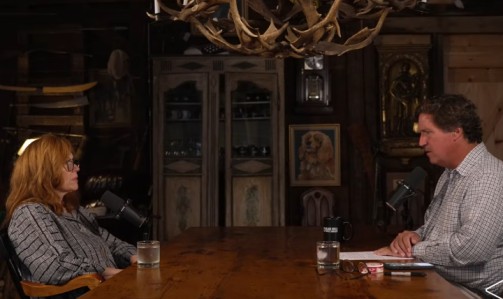
EDITOR’S NOTE: Thirty-one years after the Oklahoma City bombing, Tucker Carlson sits down with Kathy Sanders, who lost her two grandsons, Chase and Colton, in the attack and has spent more than three decades investigating what really happened. Sanders lays out the case for why she believes the official story — that Timothy McVeigh acted alone — is false, pointing to unexplained warnings, a mysterious “John Doe 2,” and the compound known as Elohim City. The conversation also covers her long personal journey toward forgiving McVeigh and Terry Nichols. (The episode was premiered September 3, 2026.)
TRANSCRIPT:
Introduction
TUCKER CARLSON: Ever notice that whenever there’s a history-changing act of violence, it was a lone wolf? It was a lone wolf. It was a random crazy guy. We have no idea why he did it. That would be, the guy who killed JFK and RFK and MLK and the Butler shooting. It just goes on and on and on.
Almost all shootings in real life are between people who know each other, or trying to steal something from one another. But all the political killings are just some random crazy person. It’s weird, isn’t it? What are the chances?
But when you question the official story, the people in charge don’t even respond. They react like people have got something to hide. They just attack you. That’s what liars do. Journalists doing their job, which is seeking real answers, are a massive threat to their power. So noticing is the crime.
And that’s certainly the case with the subject of our new series, “The OKC Bomb Files.” This is the story of what actually happened, to the extent we know, at the 1995 bombing in Oklahoma City that killed 168 people. Now, you’ll recall that the feds told us the bomber was a guy called Tim McVeigh, and he was a veteran white supremacist lone wolf. But over the past 31 years, a lot of evidence has accumulated to suggest, well, really to show that’s a full-blown lie. There were many more people involved in that crime.
We’re talking to a person today who lost her two young grandsons in that bombing, and she has spent the last 30 years investigating the attack herself. She’s smart, she’s methodical, she’s not crazy, and she has a lot to say. She’s here today to tell us why she believes that the FBI story about Tim McVeigh acting alone is a lie, and who else may have been involved, and how the government knows more than it has admitted. Here’s Kathy Sanders. Kathy, thank you so much for doing this.
KATHY SANDERS: Well, it’s my pleasure. Thank you.
The Morning of April 19, 1995
TUCKER CARLSON: I think most Americans under, let’s say, 40 have only a dim understanding, if any knowledge at all, about what happened in Oklahoma City. Can you tell the outline of the story for us?
KATHY SANDERS: I’ll be happy to. People don’t know about Oklahoma City because it’s not even in the history books, not even in Oklahoma.
What happened to me was on April 19th, 1995, I woke up one morning and I went to the bedroom next to mine because my grandchildren lived in my home. My daughter was a young divorced mother, and Chase and Colton lived in our home, and everything in our life evolved around these little boys.
And I went in to wake them up, and they weren’t in there. And I thought, how strange. So I walked down the hall to the end of the hallway, and sometime during the night, those two little boys, two and three years old, had toddled down the hall and gotten in bed with their mother, where they spent the last night of their lives.
I turned on the light in the bedroom like I did every morning at our house. We always started with a song. It’s like, “Good morning to you, good morning to you, we’re all in our places with sunshiny faces. What a nice way to start a new Wednesday.” And the little boys begin to giggle and we get them ready for daycare.
In our home, it was a group effort. Edie’s working on the boys, I’m working on the boys, brushing their teeth, and we get them all dressed and take them into the kitchen where we feed them breakfast. And Edie and I load them in the car because she and I not only lived together, we worked together downtown, and we took the boys and dropped them off at the daycare. I remember the little crumbs on Colton’s face when we left him.
We went on to our office to go to work. Edie had been sick on Monday and Tuesday before the bombing on Wednesday, and she had kept the boys at home with her. She was going to stay home on Wednesday as well, but on Tuesday night she got a call from a coworker that said, “Edie, you’ve got to come to work tomorrow, because we’re having the office birthday parties for the people whose birthdays were in April.” And it was Edie and another girl’s. And so Edie agreed she would come in, but she might go home afterwards if she still felt bad.
So she went into the office. I’m two floors above her, and she’s walking across the floor to blow out the candles on her birthday cake when the bomb goes off. It’s this huge explosion unlike anything I’d ever heard before. I knew something had happened and it was bad.
So Edie and I— I ran the two floors down to her office and I opened the door and everybody’s looking out the windows. They’re trying to figure out what happened. Someone is on the phone and they hang up the phone and they said they just blew up the bank. And I said, “Edie, let’s go see.”
So we run down three flights of stairs and out the front door of our office, which was three blocks from the Murrah Building.
And Edie turned to go back in the building where it was safe. And I’m walking behind her. And then I look up the street and I see the smoke rising from the Murrah Building. And I said, “Edie, the babies.” So we take off running.
And we get to the south side of the street, and she had tennis shoes on because she was planning on going home, and the parking lot was a long way from our building. I couldn’t keep up with her. I said, “Edie, wait, wait, wait up.” We stop at the south side of the building and we’re surveying the damage, and the windows were all blown out, and there were blinds just dangling in the air like ruptured blood vessels. It was just a mess. I’d never seen anything like it.
And then we hear boom, boom, boom, and we see this black billowing smoke. And I didn’t know what that was, but we turned and we ran to the north side of the building. And when we did, it was the cars in the parking lot blowing up. And I turned back to look behind me, and we saw the daycare. The Murrah Building was nothing left but just a pancake pile of rubble.
And my daughter falls to her knees, and she begins to cry, “My babies, my babies.” That was the first time in my daughter’s life she had a problem that her mother wasn’t going to be able to fix.
We’re running through the rubble trying to find the babies, and a second bomb threat came, and people were running all away from the building. They were stampeding, trying to get away. “Another bomb, another bomb.” Well, we’re trying to get in. And a law enforcement official grabbed us and said, “You can’t go in.” He physically made us leave the area. And we were told to go to the children’s hospital, that that’s where they were going to take the children when they were removed from the building.
So at the hospital, I lost all track of time. But my son was an off-duty police officer, and he had seen his mother and sister on TV, and he came downtown and he said, “Mama, don’t worry, I’m going to find the boys.” And he left. And he came back. And I knew when he walked through the door something was wrong. And I jumped up and I said, “Danny, Danny, what is it? What is it, son?”
He goes, “Mama, did Colton have on little green shorts and a white shirt?” And I said, “Yes, son.” “Yeah, that’s Colton.” And I see the tears on his face. And I said, “Son, is the baby gone? Is the baby gone?” And he puts his big old arms around me and goes, “Yeah, Mama, I’m sorry. Colton’s gone.” And he held me for a few minutes, and then he set me in a chair and he goes, “Mama, where’s Edie?”
Well, by this time I couldn’t stand watching her grieve the loss of the children. I was grieving the loss of the children. I was grieving for her. It was just horrible. And I said, “Son, she’s around the corner in the chaplain’s office.” And in a few minutes I heard a blood-curdling scream and I knew my son had found my daughter. And later that day, he found my oldest grandson had also been toe-tagged.
Nothing like this had ever happened in my life. This was so foreign to me. I remember telling an interviewer when asked about this, probably just in the weeks after the bombing, I told him, “You know, it won’t be very long when I tell someone I lost my grandchildren in the bombing, they’ll say, ‘Which one?'” And haven’t we come a long way? We’ve had so many bombings, so many school shootings. The whole world has changed. And I wouldn’t believe this story about the bombing if it hadn’t happened to me. I would have been one of those people— I live in la-la land. I like to be happy. I would have never believed anything like this could have happened.
A few weeks after the bombing, we had a dinner at our home. I reached out to the 19 families that lost their kids. We’re sitting in the den, we’re talking about our children. People were saying, “Well, my little girl lost her arm.” And I remember one mother saying, “The only thing I ever seen about my baby again was his toes. I got to touch, kiss his little toes.” And another grandmother, her grandson was beheaded.
And then one mother speaks up and she said, “Well, when I dropped my son off there, I saw the bomb squad downtown.” We didn’t believe her.
TUCKER CARLSON: The next day, when she dropped her son off that morning, of course, before the bombing, she saw a bomb squad.
KATHY SANDERS: She saw the bomb squad downtown, there at the Murrah Building, when she was taking her son in before the bombing, before the bomb went off.
Early Signs Something Was Wrong
TUCKER CARLSON: So just to be clear for people who aren’t familiar with the official version of the story, the government announced very quickly that, of course, they knew nothing about this, and it was an act of terror committed by two white supremacist veterans, Timothy McVeigh and Terry Nichols. And that was it. Just two crazy people did this crime. That was the version.
KATHY SANDERS: That was the story that was given to us.
TUCKER CARLSON: Yes.
KATHY SANDERS: And that’s the one I thought I should believe.
TUCKER CARLSON: Of course everyone did.
KATHY SANDERS: But it’s like, were they down there? And it made my husband so mad. The next day he went down to the fire station. The chief said, “No, we didn’t have our bomb squad down there. We didn’t.” There wasn’t any prior knowledge, because some other people had said they’d seen the bomb squad truck with the bomb disposal unit on the back. And so we left not knowing what to think.
And then the next day we saw an article in a paper where a woman gave an interview and said the people in her office had been watching the bomb squad truck in the alleyway. And there were reports of bomb-sniffing dogs through the bushes in the alleyway. I never directly talked to that person, but— as my husband was leaving the fire station, the fire dispatcher there said, “I’m not going to lie for anyone.” He goes, “We got a memorandum in this office last week to be on high alert for terrorist activity.” And after that, we found out that the federal courthouse had also gotten that same high alert. No one had ever mentioned that to us. We didn’t know it was a bad day to go to the Murrah Building and drop your kids off.
TUCKER CARLSON: But the dispatcher at the fire station told your husband that.
KATHY SANDERS: Yes.
TUCKER CARLSON: “I’m not going to cover this up. I’m not going to lie.”
KATHY SANDERS: Yeah, that’s what he said. He said, “You know, we got an alert to be on alert for terrorist activity in downtown Oklahoma City.” And the federal courthouse also got that same alert.
TUCKER CARLSON: That raises all kinds of questions, which I hope we get to in this conversation and in the documentary series. If they had an alert that this was coming, that raises the question: how would they know? If it was just two random white supremacists who did this, and there was not a larger conspiracy, then how would the government have had warning of this?
The Elohim City Connection
KATHY SANDERS: Well, I know how they had their warning. As I began to investigate, this was just a first baby step. This story is so big and it goes so far— but I know how they found out.
I learned about an ATF informant who was living at Elohim City. I have her documents, her reports she turned into her handler. She warned her handler that, beginning in December of 1994, the informant, along with two other individuals, had taken trips to Oklahoma City and Tulsa to target buildings they planned to blow up. They took three trips. The handler was brand new to the job, and her reports almost were written just exactly as the informant turned them in.
So someone somewhere had some information there, and Elohim City is a big part of it, because not only was that informant warning the ATF of a possible bombing— Timothy McVeigh called there two minutes after calling the Ryder truck rental company. I believe it was two weeks before the bombing. He asked to speak to a fella by the name of Andreas Strassmeir. And if I was an FBI agent, I would be interested in knowing what’s going on at Elohim City and who this Strassmeir is. The FBI never talked to Strassmeir. They never interviewed him. But they interviewed McVeigh’s— I don’t know, she was like his fourth grade schoolteacher. They interviewed tens of thousands of people in connection with McVeigh, but they didn’t think it was important to talk to Strassmeir.
TUCKER CARLSON: Who was Strassmeir?
KATHY SANDERS: He was living at Elohim City, and he was taking these trips to Oklahoma and to Tulsa planning a bombing. They were planning on bombing something.
TUCKER CARLSON: And the FBI never interviewed him? Now, he was a German national.
KATHY SANDERS: He was a German national. A year after the bombing, after he was allowed to leave and return to Germany, they called and did a telephone interview.
TUCKER CARLSON: So, I mean, I don’t know this, of course, I can’t— but the only logical reason I can think of that they wouldn’t interview him would be that he was working for them.
KATHY SANDERS: Well, that would seem logical to me. I don’t know— maybe it was a case if the left hand didn’t know what the right hand was doing. I know that the ATF informant Carol Howe was indeed an informant, and I know what Strassmeir at Elohim City, according to the people there that I visited with, was trying to incite them to do bad things. Why? And why did he leave the country? And why wasn’t he ever interviewed? McVeigh calls him two minutes after calling the Ryder Truck Company. There has to be some kind of connection, but he just disappeared.
TUCKER CARLSON: Is he still alive?
KATHY SANDERS: Yes.
TUCKER CARLSON: Has he ever been interviewed by the FBI that you know of, in person?
KATHY SANDERS: Not to my knowledge, no. And there’s more about Elohim City if you want to hear it.
TUCKER CARLSON: Well, let’s just go back to your story.
KATHY SANDERS: Okay.
TUCKER CARLSON: And I do want to hear it, but first I want to understand how it dawned on you, in the middle of your grief, having just lost your two grandsons, that there was more going on here. So you learn that a bomb disposal squad has been seen at the site of the bombing before the bombing. Your husband asks the fire chief, he denies it, but the dispatcher basically confirms it.
KATHY SANDERS: That’s right.
TUCKER CARLSON: What happens next?
KATHY SANDERS: Well, next we’ve got the largest manhunt in American history going on for John Doe Number 2.
The Search for John Doe 2
TUCKER CARLSON: And who’s John Doe Number 2? The accomplice.
KATHY SANDERS: He’s Timothy McVeigh’s accomplice that the FBI was looking for. They first were looking for John Doe 1 and John Doe 2. They found John Doe 1 from the VIN number off of the vehicle. So they traced him back to Junction City.
TUCKER CARLSON: The Ryder truck that exploded, that had the bomb in it, the ammonium nitrate fuel oil bomb.
KATHY SANDERS: But the axle from the truck had the VIN number on it, and then the registration and the information they got from the Ryder Truck Company, they located Timothy McVeigh. But according to the people where they rented the truck, there were two men. And so there was a John Doe 2. And so there was this largest manhunt in American history for John Doe 2, $2 million reward. And in just a couple of weeks, the FBI said, “You know what, it was all a mistake. There is no John Doe number 2.” And that Eldon at the body shop was mistaken.
Well, maybe I could have dropped it at that. But we started investigating early on when I thought something was wrong. And I finally went down to— I talked to Stephen Jones, McVeigh’s defense attorney. And I said, “Look, if you want to point the finger at the other people that were involved, I’ll help you.” And so I worked with his investigators, McVeigh’s investigators. So I was privy to documents. That’s how I found out about Carol Howe, the ATF informant. That’s why I had access to her documents.
That’s how I knew that there were way over 20 people that had seen Timothy McVeigh downtown that morning in the presence of this John Doe 2. I had their 302 witness statements. I went and talked to them. There was Rodney Johnson, the catering delivery guy. He sees McVeigh with a guy walking across the street. There’s Jeff Davis, the delivery boy that delivered Chinese food to McVeigh’s room in Junction City. It wasn’t McVeigh that he gave the food to. And there was another man in the room.
There was Dana Bradley. She was on the first floor of the Murrah Building when the bomb— with her mother, her sister, and her two children. When the bomb went off, it killed her mother and her two children. She fell down to the basement. You’ll remember she was pinned in the rubble and they had to cut her leg off to get her out of the rubble. She tells the FBI— and I’ll watch her testify at the courtroom— that she and her sister were people watching. They were just standing there in front of the windows of the Social Security office waiting for their number to be called, and they’re just watching people go by. They were just people watching, killing time, and they see the truck drive up, they see McVeigh get out, and they see someone get out of the passenger side and take off running. And at the trial, the FBI said, “Well, she doesn’t know what she’s talking about because she’s been traumatized.”
TUCKER CARLSON: There’s just dozens of people that saw McVeigh downtown with other people. And what’s really mystifying— if you were prosecuting Timothy McVeigh, wouldn’t you call a witness that could place him at the crime scene?
KATHY SANDERS: You would. The prosecution didn’t, because every witness they had that saw McVeigh downtown that morning at the crime scene saw him with another guy. Mike Morose at Johnny’s Tires— McVeigh drives up there, Mike comes out to his car to greet him, and McVeigh jumps out of the truck like he’s keeping Mike away from the truck. And he’s asking for directions to the corner of 5th and Harvey. And then he jumps back in his truck and he sits there a few more minutes. Mike watches him as he and the other guy drive off.
Danny Wilkinson worked at the Regency Tower, just one block and across the street from the Murrah Building. The truck pulls up. McVeigh comes inside. According to Danny Wilkinson, he buys two Cokes and a package of Marlboro Reds. McVeigh didn’t smoke, so he obviously had someone with him. The list just goes on and on, but John Doe 2 was totally dismissed. He never happened.
And when we were talking about the bomb squad being downtown, I have— I had access to the payroll records from the ATF. There were ATF agents brought in the night before the bombing. They will admit that they were working on a sting operation, but they won’t admit that it was at the Murrah Building.
My theory is— and this is just a theory based on the evidence I’ve gathered— but perhaps they knew the building was going to be blown up, and the information they had was the building would be blown up in the wee hours of the night. When no one came to blow up the building, they called the bomb squad to give a clean sweep, and then they let everybody enter. I don’t know, I can’t explain a lot of things. I don’t know everything, but I think I know a lot more than some people inside the government wish I knew.
The ATF Visit and the Lockbox
TUCKER CARLSON: Well, that’s obvious from the way they responded to you. So you got a visit from the ATF to your home, correct?
KATHY SANDERS: We did. On May 23rd, 1995, they imploded the Murrah Building. And there was a lot of dissension about that. There were some that didn’t want it imploded and some that said it needed to be. But by this time— that’s a month after the bombing, and we’re really hitting hard and heavy now, because we’re thinking things are not right. We’re making accusations and bringing things to light about the John Doe 2 and this stuff going on, and we’re really getting kind of scared.
So we’re thinking, when we go down there and we see that building, we’re going to let reporters know that we think there’s a problem. So I remember a CNN reporter came over to my daughter and said, “Edie, what do you think about the building being imploded?” And she goes, “I want to know where the hell was the ATF? Why weren’t they in that building?” And she just went off on them.
And so the next day, Pat Ryan, the head of ATF, a couple of ATF agents, including one Luke Franey, they came because they wanted to calm us down, that everything was okay. And they told us the ATF wasn’t there because they were at a golf tournament that was happening that morning. Luke Franey, his hands bandaged up, tells us his harrowing story about how he had to karate chop his way out of the building because he was stranded on the ninth floor, and that’s how he hurt his hand. Later I found sheriff’s video of Luke shaking hands with the sheriff, so I don’t know how bad his hand was hurt. It just kept your mind wandering.
But the thing that caused me the greatest concern about Luke Franey was the AP reporter had a picture of him on the ninth floor. He’s holding a little silver lockbox, and 168 dead people behind him or underneath him. He’s standing there with this silver lockbox shaking it, and there’s 168 dead people below him and all these hundreds of walking wounded. And I’m thinking, whatever’s in that box has got to be really important. I went to Franey and asked, “What’d you have in that box?” “Oh, I’m sorry, I can’t talk about it, can’t tell you.”
Well, then Hal Francis, a former FBI agent that was working on a story, an acquaintance of mine— I told him about this. He took Luke Franey out for lunch, and he asked about that lockbox. And Luke Franey told him, “Oh, it was $150 worth of my kids’ savings bonds.” Why couldn’t he tell me that? And would you really be— 168 dead people below you and all the walking wounded, and you’re trying to save the lockbox with your children’s savings bonds? That just didn’t add up.
See, I’m a simple person: two plus two equals four. The facts of this case do not lead up to there was one bomber that came into Oklahoma City and blew the building up. Terry Nichols was in Herington, Kansas the morning of the bombing.
TUCKER CARLSON: Terry Nichols is the convicted accomplice of Timothy McVeigh, who was executed. Terry Nichols remains in prison.
KATHY SANDERS: That’s right. And there was a third one, Michael Fortier. But Fortier cut a plea deal with the government, and he was every bit as guilty as Terry Nichols. But he only had to spend 10 years in prison, and he was caught lying under oath three different occasions. And he got a plea deal for his wife. She never spent a night in prison, and she testified at McVeigh’s trial how she sat at the kitchen table and watched McVeigh show her, with Campbell’s Soup cans, how he was going to put the barrels in the back of the truck to blow up the building. So Fortier spent 10 years in prison, and when he got out, he is now in the Witness Protection Program. Who are they protecting him from? Things just don’t add up.
TUCKER CARLSON: So Fortier has never given an interview that you’re aware of?
KATHY SANDERS: No, no.
TUCKER CARLSON: Have you ever spoken to him?
KATHY SANDERS: No. I took his wife out for dinner though. I went to Kingman, Arizona, and we went to the Dam Bar, and I said, “You know, I’d like for you to tell me about your part in the bombing. I know about you sitting with McVeigh and doing the barrels.” And she begins to cry and said, “I’m sorry, I can’t tell you. My lawyers told me I can’t talk about it.” And I said, “Well, okay, if you can’t tell me how the bombing affected you, let me tell you how it affected me.” And I pulled out pictures of Chase and Colton and told her how different our lives were and the tragedy that we’ve been through. And I said, “You know, I really wish you would help me.”
And at the end of the night, she said, “You know, would you write to Michael?” He was in prison at that time. I said, “Well, I don’t— what do you want me to say?” And she goes, “I don’t know, but I think you’ll know.” I said, “Okay, I’ll write to him.” So I wrote to Michael Fortier. Told him I’d had dinner with his wife. I found her to be a very nice person, a very broken person. And he wrote back, but I felt like he was deceiving me. At least Laurie told me she couldn’t talk. He said, “I’m glad you saw her for the person she really is.” And I’ve got his letter at home. It’s been 30 years, I can’t remember what it was, but it was like that— he didn’t have anything to do with it, or he didn’t know about it. And it’s like, that’s so untrue based on the evidence that’s been recovered.
TUCKER CARLSON: And you have no idea where he is now?
KATHY SANDERS: No, he’s in the Witness Protection Program. He’s probably got a new name and everything. I suppose we’re probably supporting him, right?
TUCKER CARLSON: Oh, of course we are.
KATHY SANDERS: Yep.
Questions About the Building and the Elevators
TUCKER CARLSON: So the ATF comes to your house to, quote, “calm you down.” Did it have that effect? Did it calm you down?
KATHY SANDERS: No, no. We had two of the agents that were in the building. They told us that when the bomb went off, they were in an elevator and that they free fell from the top of the ninth floor to the first floor. And they were trapped in the elevator and they had to pry the doors open. Well, it just so happened my husband was a CPA and he worked for that elevator company. We went and interviewed the men at the elevator company. They said as soon as the bomb went off, they were called to come down there and to help get people out and to check on the elevators. And they said there was no elevator that had been pried open. They said, “Kathy, if the elevator had free-fallen from the ninth floor to the first floor, they would have been dead.”
TUCKER CARLSON: Of course.
KATHY SANDERS: So I don’t know. I know I don’t have answers for this. All I know is that doesn’t seem to make sense to me.
TUCKER CARLSON: So if you were interviewing Michael Fortier’s wife and the elevator company that installed the elevators at the Murrah Building in Oklahoma City, you were doing reporting on this?
KATHY SANDERS: Oh, Tucker, you have no idea. I’ve spent the last 32 years— I’ve had some of the bomber’s family come to my home.
TUCKER CARLSON: McVeigh?
KATHY SANDERS: Yeah.
TUCKER CARLSON: His family?
KATHY SANDERS: His sister came. I had her to my home for dinner when I knew she was in Oklahoma. Most people don’t realize that she also cut a deal with the government. She testified against her brother. In her confession, she says that she was laundering $100 bills for her brother that he told her came from bank robberies. Well, there’s a group of bank robbers living at Elohim City— the place that the ATF informant warns her handler these people are planning a bombing. They’re living at Elohim City and they’re bank robbers, and she’s laundering money that Tim says came from bank robbers.
Anyway, when the FBI came to Jennifer’s home the first time, she was on her back patio with her charcoal grill burning the letters from her brother. But I’ve had Jennifer at my home and I asked her, “Can you tell me about your brother’s politics?” And she said, “Oh no, I’m sorry, he never discussed that with me.” Well, I knew that wasn’t true. And my daughter just lived two blocks from me by this time, and she had a new baby. And I thought, well, I’ll take Jennifer over to meet the baby her brother didn’t kill. It’s what I thought in my heart. But I didn’t get anything significant from her.
But I’ve been to Elohim City. I’ve had guns pointed at me. Edie and I did, when we drove up to Elohim City. The armed guards came out with guns.
TUCKER CARLSON: Whose armed guards were they?
KATHY SANDERS: Elohim City’s.
TUCKER CARLSON: Hmm.
KATHY SANDERS: I told Edie, after I learned what I did, I said, “Edie, we need to go to Elohim City. I want to know what’s going on out there.” I had been told that if you go there, you have to— if you want to talk to them, you have to attend their church service. They had church service every day at noon. So we’re driving up, it’s just about time for church. I mean, it is in the boonies. I’ve never seen anything like it.
TUCKER CARLSON: Where is it?
Inside Elohim City
KATHY SANDERS: It’s at the Muldrow, Oklahoma–Arkansas border. And you have to know— and I had learned from the defense team where it was— and you have to know where you’re going to get there because it is in the middle of nowhere. And we’re driving up there and there’s a sign that says Elohim City, which by the way is Hebrew for City of God. There’s these big domed buildings unlike anything I had ever seen before.
And I grab the camcorder, which at that time was as big as a bazooka, and I put it on my shoulder and I start filming because I’m thinking no one’s ever going to believe I’ve been here. And then Edie says, “Put the camera down, Mom, put the camera down.” And I throw the camera into the floor, and there are two men coming with guns to our car pointed right at us. I rolled the window down and they said, “Can we help you?” And I said, “Yeah, I’m here for church.”
So our armed escorts took us into the church, and when we got inside the church building, which is another one of the round domed buildings with stuff oozing from the top, it was set up like a horseshoe type. The parishioners were around the perimeter of the building, and the Iron Cross Band was playing. And these guys had guns on their shoulders and sidearms on their waist. And the Iron Cross Band was playing, and they were singing some kind of glory and guns to God.
And then when they quit playing, Reverend Millar looks at us and he says, “Well, I see we have guests.” And he said, “Would you stand and introduce yourselves?” So we stood up and I said, “Well, this is my daughter Edie. We lost her children in the Oklahoma City bombing.” And I said, “We’re ATF’s worst nightmare.” And they stood up and gave us a standing ovation. And so we were welcomed into the fold.
Afterwards, they gave me a tour of the compound. They showed me Andreas Strassmeir’s house, Dennis Mahon, which is the man that also accompanied Carol Howe and Andreas Strassmeir. It was the three of them that made those three trips. So I found out where Carol was staying. I really wanted to see where Richard Wayne Snell was buried, but they wouldn’t show me that.
TUCKER CARLSON: Who was Richard Wayne Snell?
KATHY SANDERS: Richard Wayne Snell was a part of the Covenant, the Sword and Arm of the Lord. And 10 years earlier, the FBI had raided their compound on the same day as the Oklahoma City bombing, on April 19th. And Snell got in a lot of trouble. He killed an Arkansas pawnbroker, shot an Arkansas state trooper. And some of it was out of revenge for what had happened at his compound on April 19th, 1985.
Snell was executed in Arkansas, and Arkansas officials chose to execute him on April 19th, 1995, the day of the Oklahoma City bombing. But here’s what gets peculiar: on the day of his execution, according to the prison death watch logs, Snell asked for the TV to be turned on in his cell, and he smiled and chuckled as he watched the Oklahoma City bombing. His spiritual advisor was Robert Millar, the head of—
TUCKER CARLSON: Of Elohim City.
KATHY SANDERS: His spiritual advisor was Robert Millar, the head spiritual advisor of Elohim City, and he was taken back and buried at Elohim City. All the roads keep going back to Elohim City. And coincidentally, at Snell’s sedition trial, it came out at trial that he had planned to blow up the Murrah Building some 10 years earlier out of revenge for the raid on the Covenant, the Sword and Arm of the Lord. This story just is so big. But all roads come back to the same direction.
Was McVeigh Really Alone?
VIDEO CLIP BEGINS:
TUCKER CARLSON: If you’re under 40, you might not know much about what the FBI describes as the deadliest act of domestic terror in our history, the bombing of the federal building in Oklahoma City in 1995.
UNIDENTIFIED SPEAKER: We felt this boom.
TUCKER CARLSON: All the official stories are the same: Timothy McVeigh, acting alone, bombed a federal building and in so doing killed 168 people, including almost 20 children.
KATHY SANDERS: What an emotional experience.
TUCKER CARLSON: The government quickly declared the case solved, but three decades later, many questions remain. Did Timothy McVeigh really act alone?
KATHY SANDERS: There is a strong likelihood that other persons are involved.
TUCKER CARLSON: Why were so many obvious warnings ignored?
KATHY SANDERS: It’s pure chaos.
TUCKER CARLSON: And who was he with? A man called John Doe Number 2.
KATHY SANDERS: Who was John Doe 2 and where was he?
TUCKER CARLSON: We spoke with survivors, investigators, law enforcement, even Timothy McVeigh’s defense attorney.
UNIDENTIFIED SPEAKER: The story that he was telling me, I did not feel was the truth.
TUCKER CARLSON: Watch “The OKC Bomb Files,” streaming exclusively on TuckerCarlson.com.
VIDEO CLIP ENDS:
TUCKER CARLSON: What do you think Timothy McVeigh’s role in all of this was? Do you believe he was the bomber?
KATHY SANDERS: Yes, I believe he was the bomber. I think he was happy to be the bomber. I think he was happy to have the credit for it. He was the one person that I reached out to a number of times, and he would never respond. One time I knew a law journalist that was going in to see him, and I sent a picture of Chase and Colton to him. And I said, “I’d really like to talk with you.” And the reporter said he just shook his head and said, “Well, I don’t know what to think of this.”
TUCKER CARLSON: You think he was happy to take credit for it? You don’t believe he acted alone?
KATHY SANDERS: No, there is no way he acted alone. At Geary Lake, where they built the bomb, the prosecution and the defense agreed that the bomb was built at Geary Lake. Well, there were several eyewitnesses at Geary Lake that watched men coming and going from the truck. The activity went on all day. A sergeant had just retired, his first day of retirement, and he went to the lake to go fishing to celebrate. He watched those men there all day. There were people with him.
There were people in the Dreamland Motel room. The Chinese delivery person, Jeff Davis— that’s not who he left. He didn’t leave the Chinese food with Tim McVeigh. It was some other people. The maid, Hilda Sastra, she took towels to the room. And the man that answered the door wasn’t McVeigh. And she was complaining to Leah McGown, the owner of the hotel, that there were other men in that room. David King, he was a guest at the hotel. He saw the men coming and going from McVeigh’s room. Leah McGown, that rented him the truck— she would walk the perimeter and she heard men talking in there. Who were these men?
Because McVeigh drove the Ryder truck with the bomb in it from the front doors of the Dreamland to the front door of the Murrah Building. Whoever was there with him were important, and the FBI never bothered to find them.
TUCKER CARLSON: I wonder why.
KATHY SANDERS: Well, I wonder why too.
TUCKER CARLSON: I mean, the most obvious explanation is that the people with McVeigh were FBI informants, and the FBI knew all of this was happening and that they were monitoring it, but for whatever reason didn’t stop it. And they’re hiding that fact. I think that’s the conclusion most people would draw.
KATHY SANDERS: Very logical. I’ve taken all the information that I have gathered over the last 32 years. I’ve written three books about the bombing. The bombing really changed my life. The first one was when I started asking questions. The second one’s when I learned to forgive, which is the greatest story. And this third one that I just wrote, “Shadows of Conspiracy,” I call it a historical novel because I’ve created the story based on the facts that I have, but I’ve had to include the dialogue that I believe the men would have been having to create this thing. And it is a page-turner, barnburner kind of book. It’s a really good read. If you want to know, my story in that book is much closer to the truth than what the American people have been given.
TUCKER CARLSON: So if you could just summarize, what do you think likely happened? What is the truth of Oklahoma City after 32 years of looking into it, do you think?
KATHY SANDERS: Well, I don’t have the whole truth.
TUCKER CARLSON: Of course.
KATHY SANDERS: I have— I think they knew. Carol Howe had warned them.
TUCKER CARLSON: The government knew.
KATHY SANDERS: The government knew. I think they tried to stop it. I think they were there the night before. And I think that’s why they called the bomb squad in. And if they were trying to stop it and just flubbed it up, I could appreciate that. Say, “You know, we worked hard, we tried to stop it, we’re really sorry, but we tried.” It’s been hanging like this. I don’t know what to think. There’s something not right. There’s something sinister about it, clearly.
Contact with the FBI Over the Years
TUCKER CARLSON: What kind of contact have you had with the FBI since that day, since April of ’95?
KATHY SANDERS: Well, I’ve talked to different ones. I’ve had Danny Colson— I write about him in my book. He was the agent that was brought in after the bombing, and they brought in the team of the FBI’s elite to investigate the bombing. And I found out 10 years after the bombing that Danny had retired. And I thought, well, maybe he’ll tell me now that he’s retired, he’ll tell me about what really happened.
I called him on the phone, and he lives in Dallas. He agreed to meet me. I took all— I have three-ring binders. I had a trunk full. I loaded my car with those three-ring binders. I went to Motel 6. I put all those binders out on that bed, and then a tap came at the door, and I knew it was Danny because we had a specific time. I answered the door, and at that time he looks like Simon Cowell. He’s got on a black tight t-shirt and blue jeans and had hair. He doesn’t anymore.
But he comes in and I said, “I just have some questions,” and I’d start pulling out binders. “Why didn’t you talk to Carol Howe? Why didn’t anybody pay attention to the information that she’s given them?” And he’s looking at— then I’m pulling out Jennifer McVeigh’s confession, that she was laundering the $100 bills for her brother. I said, “Look at this, the Midwest Bank Robbers”— that’s the name the FBI gave them— “they’re living there at Elohim City. Why didn’t they do anything? And Andreas Strassmeir— McVeigh calls him two minutes after calling the Ryder Truck Company. Why wasn’t he ever interviewed?”
And I could see Danny’s countenance was changing. And he said, “Man, that explains it.” I said, “Explains what?” And he said, “Kathy, after the bombing, the FBI brought in their finest to investigate.” And he said, “I was called off and put on leave with pay. I’ve been on leave with pay the last 10 years. I don’t know anything about these things.” He said, “You probably have more information in one place than any other organization, because I have information from everybody.” And he said, very nicely, “You need to get a federal grand jury— that’s the only way you’re ever going to get this solved.”
Well, before I could get to Nichols to tell him to do that— he doesn’t trust anyone.
TUCKER CARLSON: Terry Nichols.
KATHY SANDERS: Terry Nichols. I approached him about a grand jury and he wouldn’t agree to it. But I’ll never forget that day, because at the end of our meeting, Danny said, “Aren’t you afraid?” I said, “I don’t know, who should I be afraid of?” And he said, “Well, the people that you could get convicted and possibly put to death.” I said, “No, I don’t have that much sense. I’m just doing what I believe is the right thing to do.” Edmund Burke said, evil flourishes when good men do nothing. Something needs to be done.
TUCKER CARLSON: Will something be done?
KATHY SANDERS: I don’t know. I’ve been trying for 32 years. I hope we come to the truth.
Learning to Forgive
TUCKER CARLSON: You said that you forgave Timothy McVeigh.
KATHY SANDERS: I did.
TUCKER CARLSON: How and why?
KATHY SANDERS: Okay. I never set out planning to forgive anybody, really. I didn’t. But I had such grief. There wasn’t anything I could do about that grief, but there was something I could do about the anger. And I watched my husband die. And I believe his anger and the bitterness and hatred that he harbored in his heart killed him.
TUCKER CARLSON: How old was he?
KATHY SANDERS: Forty-seven.
TUCKER CARLSON: Oh gosh.
KATHY SANDERS: And I remember he was mad. He was mad at God for not answering our prayer, because we came home the day of the bombing and one of the parents of a child that lived was by his side in the hospital. And he says, “Well, looky here, God answered our prayer, our boy lived.” Which I would have said too if our boys would have lived. But I’ve learned, don’t do that. You can thank God that your boy lived, but God’s not a cherry picker. He didn’t go through that day and think, “Oh, I’ll let this one and this one and this one perish, and I’m going to save these others.” It made us feel really bad.
So Glenn was really mad at God. He was mad at Timothy McVeigh. I heard him say a dozen times the day that he dies, he’s going to spit on his grave and toast his death with a bottle of fine champagne. Well, Glenn wound up dying before McVeigh, but he was really mad at the government because he didn’t believe he had been given the truth.
And watching him die scared me. I said, “God, I don’t know why this happened, but I know if I have a chance of making it, I’m going to have to depend on you.” I can remember after the bombing, John Walsh of “America’s Most Wanted,” he spoke to a group of survivors and he looked at us and he said, “You will grieve and you will grieve deeply, but you will survive.” Up to that point, I didn’t know if I would survive. I’d even thought about killing myself because I didn’t want to live in that kind of pain. But I couldn’t do that to my husband and to my daughter.
So I said, “Lord, you’re going to have to help me. I can’t live like this.” I’ve since learned that forgiveness isn’t an event, it’s a process. I can remember when I read my Bible, I read the Lord’s Prayer: “Forgive us our trespasses as we forgive those who trespass against us.” And when I got to that part, I said, “Lord, I don’t know how to do that. So, Lord, you’re going to have to send your Holy Spirit to intercede for me. I don’t know how to do this.”
And Tucker, when I began to pray for Timothy McVeigh and Terry Nichols, it began to change my life. I don’t know what it did for Terry or Tim. I went to Terry Nichols’ trial right after my husband died. There was a break in the hallway, there was a little lady there with a brown coat on, long brown coat. She was over there by herself. Nobody was talking to her, but I could see they were talking about her. And I thought, “Oh my God, that’s Terry Nichols’ mother.” And I go over and I begin to introduce myself, and she begins to cry. And I put my arms around her and I said, “I’m so sorry for your family.” And we became great friends.
During the court, I sat with my friend Joyce. We ate lunch together. I know the other families didn’t understand why I was sitting with the Nichols family. But I felt like she was a forgotten victim, and she did become my friend.
When the trial was over, the jury forewoman said, “We can’t give Terry Nichols death because we don’t know how— he’s guilty, but we don’t know how guilty. Who were those other people with him at the Dreamland Motel? Who was with him out there building the bomb at Geary Lake?” And so they got off. But Oklahoma had a backup plan. So after his federal trial, he didn’t get the death penalty. They brought him to Oklahoma, and Oklahoma planned to have a state trial and hoped to get him executed.
Well, just a couple of days after I returned home, I went to my mailbox and there’s a letter from Terry Nichols. And I’m looking at that and I’m thinking, I’m not looking for a pen pal, and if I was, it wouldn’t be the Oklahoma City bomber. And then I thought, well, who’s going to know more about the bombing? So I began to write to Terry, and he said, “If you’ll send me your phone number, I’ll call you.” So he began to call me.
I learned a lot from him. He wasn’t raised in a Christian home. He said they only went to church for weddings or for funerals. He said, “We went then for a free meal.” And he just kind of laughed about it. But he said, once he was arrested, in his cell was a Gideon Bible and he read it cover to cover. And then someone gave him an AM radio and he listened to an old radio preacher that told him if he’d invite Jesus into his heart, that Jesus would cleanse him of his sins and forgive him for all unrighteousness. And he said, “Kathy, I did that.”
Now, I know a lot about— there are no atheists in the foxholes. And I know a lot about jailhouse religion. I’m nobody’s judge. But I chose to believe him. Some people would say, “Oh, Kathy, he doesn’t deserve mercy.” And I said, “Well, yeah, you’re right, he doesn’t. If he deserved it, it wouldn’t be mercy.”
So Terry’s son hadn’t seen him, Josh, in four years. He was 12 at the time of the bombing. He’s 16 at that time. McVeigh had just been executed, and Josh was very disturbed. His mother called and said, “Josh is having a hard time. I’m going to bring him to Oklahoma to see his dad.” And I said, “Well, come stay with me.” And she said, “Well, I’m not sure that Josh would be comfortable.” I said, “Well, that’s okay. Just come by and have dinner. If he’s not comfortable, I understand.”
So when they came to the door that night, I answered the door and what was a short, fat kid is now a tall, good-looking kid. And I look up at him. I mean, what do you say? Being the wise woman that I am, I said, “Well, I knew you were coming, so I baked a cake.” And we began to laugh. We had dinner. Josh and I stayed up till the wee hours of the night. He told me how the kids at school had nicknamed him Bomber and how he’d randomly get beat up when he walked down the street and how he dropped out of school.
And I had not told anybody. I didn’t tell my family. I didn’t tell my neighbors. I told no one, because I didn’t want it to be a press release or press event that I’ve got the bomber’s family at my home. And they wound up staying for four days. And the last day, Josh asked me— and I didn’t take them anywhere. I just cooked for them, kept them at the house. And Terry’s lawyer would come over and see them, and they’d go see Terry. But I didn’t go out publicly with him.
And on the last day, Josh said, “Kathy, would you take me to the memorial?” And at that time everyone knew who I was in Oklahoma City. And I’m thinking, “Oh no, I hope they don’t recognize him.” But how could I tell him no after what he had been through? But I can tell you, Tucker, when I took him to the memorial, and I stood at chairs number 60 and 61 with my arm around the bomber’s son, that God had done a work in my life.
And it amazes me, the transformation. John Walsh was right. I did survive. Here I am, 32 years later. I made the decision to forgive, and I think it changed the ending to my story.
TUCKER CARLSON: It’s a wonderful story. Thank you.
Related Posts
- Transcript: Tucker and Saagar Enjeti on America’s Fastest-Growing Addictions – Tucker Carlson Show
- Transcript: NVIDIA’s .2B Quarter, China’s 200,000 Fake Accounts, & OpenAI’s New Chip – Moonshots EP #284
- Transcript: The Historians Who’ve Had Enough of Woke History – Nigel Biggar and Robert Tombs
- Tucker Carlson Interviews Missouri Farmer Joe Maxwell (Transcript)
- Transcript: David Friedberg Interview on Diary Of A CEO Podcast