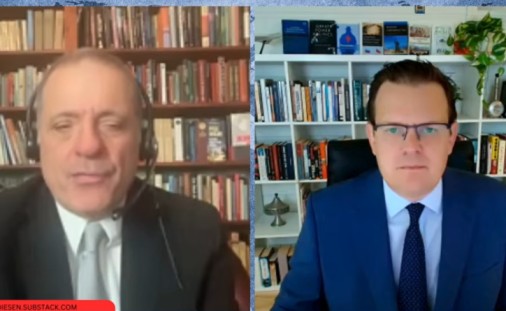
EDITOR’S NOTE: In this episode of the Glenn Diesen podcast, political analyst Alexander Mercouris of The Duran joins host Glenn Diesen to discuss the rapidly shifting dynamics of the Ukraine war. Mercouris argues that Russia has entered a new and more determined phase of military and economic attrition, while Ukraine faces mounting pressures across its financial system, military front lines, and political landscape. The conversation also explores the growing desperation in European capitals, the Fedorov political crisis, and Zelensky’s increasingly dangerous escalatory options. (September 4, 2026)
TRANSCRIPT:
Welcome and Introduction
GLENN DIESEN (00:00:00 – 00:00:19): Welcome back, everyone. We are joined today by Alexander Mercouris, the popular host of the Duran Podcast and also his own podcast, Alexander Mercouris. So thank you for coming back on the program. I left a link in the description to your podcast, so make sure to follow.
ALEXANDER MERCOURIS (00:00:22 – 00:00:26): Delighted to be here, Glenn, can I just quickly say.
GLENN DIESEN (00:00:26 – 00:01:05): Yeah, great to see you again. I wanted to ask you about what’s happening in Ukraine, because again, one should always be cautious about predicting too much, but what we’re watching now, it does appear to be somewhat unprecedented. We do have, we’ve had this, problems in Ukraine in the past where, but it’s been able to either mobilize more men, get more weapons from NATO, or just some pure resilience in terms of being able to withstand the pressure. But there seems to be something unravelling at the moment, though. I was wondering, how do you see this?
Russia’s Shifting Strategy and Growing Resolve
ALEXANDER MERCOURIS (00:01:06 – 00:02:45): I think that is exactly right. I think there are a number of factors at play. Firstly, we should not underestimate Ukrainian resilience and resolve. I mean, they have wanted to withstand and resist, and they have been successfully doing so. And that has played an important role in keeping this war going.
Critically important has been the assistance of the West. If the West had not been sending weapons and hadn’t been sending economic assistance to Ukraine and not provided an enormous amount of political assistance too, then again, the events, the course of events would have been different.
But I think something else has changed, and that is both attitudes in Russia and Russian capabilities. I think that the Russians have been building up their military and economic system to the point where they’re now producing even more weapons and even more machines and even more drones than ever before. But I think that over the course of this year, the Russians came to a conclusion that there was not going to be a diplomatic or political resolution of this conflict, that there had to be therefore a military one, and they became deadly serious about pursuing it. So I think that this has changed the dynamic. So the Russians are now doing things that they were not prepared to do before.
The Danger of Western Desperation
GLENN DIESEN (00:02:47 – 00:03:48): But I guess the problem is if you see some big cracks in Ukraine, be it the military, economy, the political system, society overall, 2 things can happen. One, the Russians might get overly confident and do something foolish. Or alternatively, the Europeans and Americans will get desperate, in a panic, and they will try to do something radical to rescue the situation.
And you see now some of the rhetoric indeed increasingly getting more hostile in Europe, especially out of Germany. I’m not sure if this is domestic politics, all this argument that they’ve been attacked in Leipzig by the Russians, but how dangerous do you think the time ahead of us is? Because I don’t think the Ukrainian army will simply collapse, the Russians will declare victory, and then we’ll call it a day.
ALEXANDER MERCOURIS (00:03:49 – 00:06:33): Absolutely not. And I think this is the most dangerous period of the war up to now. Up to this moment, up to the moment when there was a chance of a diplomatic resolution, the Russians had an incentive to act with restraint. And I think some people in the West were able to build on that and were able to tell themselves, well, Ukraine is holding together, things are holding together in Ukraine. We have a potential stalemate there. We can bide our time, outlast the Russians, and it will all turn out right for us.
The change in dynamic is also having an effect in Western capitals, in European capitals especially too. There they are becoming increasingly frightened and I think increasingly nervous. And we’ve had lots of reports. We had some reports a few weeks ago about European leaders contacting the Americans, telling the Americans, “Please get negotiations with the Russians restarted again, only make sure that this time you have us again in the room. This time you must have us in the room.” But the Europeans telling the Americans to negotiate with the Russians, whereas a year ago the Europeans were telling the Americans, “Don’t negotiate with the Russians.” So you see that there’s been a kind of flip.
You also see, as you rightly say, this intensification of the rhetoric, the talk about the Russians waging some kind of hybrid war against Europe. A drone discovered on the runway in Leipzig, and this somehow proves that the Russians are waging some kind of secret war against the West and the Europeans as well, and that there is this threat. And an even further, even more extreme escalation in language.
And the great danger — the thing that I think we all need to be aware of and concerned about — is that as things get worse in Ukraine, the demands for direct Western intervention in the conflict itself to somehow prevent a Ukrainian collapse are going to grow, and that demands will eventually translate into a demand for Western troops to be sent to Ukraine, for some kind of no-fly zone to be established over Ukraine, things like that.
Assessing the Cumulative Effects of the War
GLENN DIESEN (00:06:35 – 00:07:37): There seems to be some parallels though with that war against Iran.
That is, the worse things go in Iran, the more Trump takes to social media and declares this a great victory, how Iran is defeated, we’re winning, we’re winning. But it’s, yeah, you see to some extent the same in Europe though. The worse now it goes for Ukraine, the more, the rhetoric intensifies, not just the call for escalating, but also, yeah, we’re winning, we’re winning.
But I did want to ask about some of the territorial changes, but before I get to that, it’s not a great indicator to assess a war of attrition, which takes place in both the military and the economic realm. So I was wondering, how do you see the cumulative effects, though, of this war? Because it’s not just one variable you would look at. There’s a lot of things at play.
ALEXANDER MERCOURIS (00:07:38 – 00:09:16): Indeed so. And this is partly a reflection of the way the Russians conduct war. The Russians do not conduct war in the kind of tactical way, I think, that we do in the West, where it’s all based around one great maneuver which ends in some great victory. And then we dictate terms over a defeated opponent who nonetheless survives.
The Russians have a much, much more historically rooted philosophy, which is that war, victory in war, is the destruction of the enemy’s will to continue fighting. And in the case of a country like Ukraine, because negotiations have proved impossible, that means attrition, in-depth attrition that affects the army, the economy, the whole of Ukrainian society, the West as well, to the extent that the West is involved in trying to support Ukraine. All of this cumulatively creating a point of crisis in Ukraine, which will create a total breakdown there, a total systemic breakdown there, which will mean that Ukraine itself is no longer in a position to keep fighting either now or in the future. It is, if you like, a recipe — a plan for total victory, though not for total war.
Energy, Economy, and the Coming Winter
GLENN DIESEN (00:09:18 – 00:10:17): Well, the summer is now officially over, and heading into the winter months. I mean, I saw Putin just make — well, was it a day or two ago — making the argument that he had now given the orders to essentially knock out all of Ukraine’s energy facilities. And we’re seeing this at the same time as other critical infrastructure is being hit. Of course, Ukraine has also run out of air defences to a large extent, but they also go after the industrial capacity, they continue to bleed the manpower. And so with the logistics breaking down, the economy breaking down, what is it that you think has the greatest impact here? Will you see energy becoming a greater problem now that, well, essentially winter is coming, or will it still be the manpower issues that top the concerns?
ALEXANDER MERCOURIS (00:10:17 – 00:12:54): I would have thought, and by the way, Putin has made comments about this, that where we are likely to see the strains first become visible, very, very publicly visible in ways that they can no longer be denied, is in the financial system. If you have an economy like the economy in Ukraine, which is no longer able to import or export goods, where production is collapsing — with the agricultural economy, which was to a great extent the mainstay of the economy together with the steel industry and the metallurgical industries, collapsing — where the government’s ability to collect taxes is reduced still further, and where at the same time, because the pressure of the war continues, spending has to continue at extremely high levels, then you are at very great risk of uncontrolled inflation.
And Putin basically alluded to that during a press conference. I mean, he didn’t use exactly those words, but if you read what he said, he was talking about the strains of the financial system. Now, uncontrolled inflation can take many forms. It can take very high inflation — and inflation in Ukraine is already rising — or it can lead to hyperinflation, which is ultimately a situation where confidence in the whole currency collapses. One shouldn’t perhaps go to the whole lengths of predicting which one of those it will be, but I think this is where we’re going to start to see the first visible signs if this pressure continues.
And high inflation has its own effect because it means the soldiers who are being paid are being paid less. The monetary value of their wages declines, the police, the entire economy starts to suffer. And then that has an accumulative effect on everything else too.
Now, where the collapse will come, the final crumbling, if you like, will come ultimately though — that will be in the front lines. I mean, it’s always been this way. It’s been that way in every war. It is military defeat on the battlefield that will be the point where we can start to say that the war is coming to an end.
The Fedorov Crisis and Zelensky’s Escalatory Options
GLENN DIESEN (00:12:56 – 00:14:12): Yeah, the political crisis appears to be, well, not resolved, but pushed back a little bit. That is, I see Fedorov’s pleas for pushing for elections, that this has been resolved. That is, the Italians gave him a job if he would, get out of Ukraine, go to Italy. So that appears to buy some room of manoeuvre for Zelensky, at least temporarily, by having to avoid the elections. But still, as the situation goes wrong on the battlefield, what do you see as being the options here for Ukraine?
Because last time, they bet a lot on this 40-plus days of deep strikes in Russia. Now we see Zelensky threatening Russian civilian aviation, which is — I’m not sure if he would actually do something or if this is just low-hanging fruit. I mean, he refers to the insurers, don’t fly planes. So he doesn’t — if he just threatens, then he could achieve something just based on threats, or if he would actually go down this route and kill hundreds of civilians. So I’m not sure exactly where this is headed, but what are his options at this point?
ALEXANDER MERCOURIS (00:14:12 – 00:17:30): Well, indeed. Well, let’s just talk quickly about Zelensky’s own political position, because the reason Zelensky is able to see off political challenges in Kyiv is precisely because the West backs him. At least the Europeans specifically backed him. We see that, as you correctly said, with Italy giving a job to Fedorov to get him out of Kyiv. So we have repeated political challenges, but they melt away because without the support of Europe, Ukraine is going to lose. It’s going to lose faster.
So what the Europeans are doing is that they’re interfering to an extraordinary degree in Ukraine’s domestic political processes in a way which is cutting off potential political options. Because if one person is always securely in place, ultimately it is up to that person, Zelensky in this case. And Zelensky is now so bound up with the war and his value to the West is so much also connected to prolonging the war, that he cannot ultimately himself change course, pursue a diplomatic route that might lead Ukraine to some better outcome. Another leader might be able to do that, but that option of getting another leader, because of what the West is continuously doing — it simply isn’t there.
Now, in the absence of diplomacy, there is only one way for Zelensky to go, and that is further escalation. Now, in terms of escalation, military escalation on the battlefields is now beyond him. It’s probably beyond Ukraine’s military power. They’ve tried this drone offensive against the shipping, the Russian shipping, the refineries, all of those things. That didn’t work. So now they’re moving towards a much more ugly, dirty war scenario — threats against airports, attempts basically to dissuade people like Turkish Airlines from flying to Moscow, cutting off people who want to travel to Russia from the West from doing so. Things of this kind, more assassinations, more operations of that kind.
And if you look at his statement, I mean, it was dripping basically, I thought, with implicit threats of that kind. And in Zelensky’s case, I’m sorry to say, I think we have to take these threats very seriously. I don’t think they are just intended — Zelensky’s saying something and he doesn’t really mean it, he just intended to scare people off. When he’s made threats of this sort, unfortunately, ugly things tend to happen.
The Dirty War and Escalating Tactics
GLENN DIESEN (00:17:32 – 00:18:11): Well, on this dirty war though, because this is something that has intensified, that is assassinations in Moscow and the killing of military leaders in their own homes. Or, the streets in front of their homes. How do you see— I don’t see Russia standing on the sidelines for too long on this. I’m sure they’ve already done something, but not of the same intensity. And you do see, I’m assuming that a lot of these assassinations are done in cooperation with Western intelligence agencies. So did you see any indications that the Russians might join in on this dirty war and begin to employ similar tactics?
ALEXANDER MERCOURIS (00:18:12 – 00:19:53): I have no doubt that that is going to come. And that is one of the things that I’m most concerned about looking forward, because a dirty war can continue long after the actual fighting on the battlefields ends, as we saw, for example, with what happened in the Caucasus in the 2000s and 2010s. So that unfortunately is a real prospect.
And of course, if it continues, dirty wars by definition have no geographical boundaries. If people who are involved in waging them are based in, say, Europe, then unfortunately and disastrously, we might start to see some of the backwash of that reach Europe itself. So I think this is a very, very dangerous game that we are playing, and the Russians are not going to stand aloof.
Up to now, they have avoided getting too deep into the dirty war because until now they have thought that a negotiation might eventually happen. But just as they no longer think that, and that’s lifted some of their inhibitions on the battlefronts, if we have a dirty war waged against them, I think their inhibitions there are going to go away very, very quickly. And the Russians have shown in the past that if they have to wage this kind of war, they’re very effective in doing it.
Cracks in the Front Lines: The Significance of Orikhiv
GLENN DIESEN (00:19:56 – 00:21:24): Well, in terms of— well, I haven’t seen the dirty war yet, but in terms of the willingness to use more brutal tactics on the front lines, not just in the front lines, but with missile attacks and all, there we do see a huge difference though. That is the way that Kyiv has been attacked now, days on days and days without stop.
But we do see some cracks though, important ones in the front lines, which we haven’t really seen. I mean, for people who measure developments in the war only by territorial shifts, of course, the last 4 and a half years have been very gradual because you have this powerful defensive belts. They had all these fortified positions, they had the Ukrainians armed to the teeth. NATO opened up their weapon depots and sent it all to Ukraine. And of course, this large standing army.
But we’ve seen now over the 4 and a half years, not just the army being ground down, the weapons being spent, the missile defences disappearing, but also the fortified lines have been lost. And we seem to have some critical cities we reached. One of them which catches many people’s attention would be Orikhiv, which is, yes, in the Zaporizhzhia region. I think the Russians hold about half of it now, and what remains is almost in a semi-cauldron. So why do you think Orikhiv matters so much?
ALEXANDER MERCOURIS (00:21:25 – 00:23:48): Well, the key thing about Orikhiv is its capture by the Russians achieves 2 things. Firstly, it moves the front lines in southern Ukraine north. So the Ukrainians have been repeatedly trying to attack Crimea either by land or through the air. That is going to become much, much more difficult because with the Russians controlling Orikhiv, they have the ability to protect Crimea and to establish a big belt to defend Crimea to the north.
But of course, that’s a defensive thinking about Orikhiv. There is also an offensive way of looking at Orikhiv. And Orikhiv is the last big place in Zaporizhzhia which, other than the city of Zaporizhzhia itself, it sits astride all the big railway and road communications here. If the Russians capture it, then the whole of the southern front opens up for them. They can advance north towards the city of Zaporizhzhia itself, which is mostly located on the east bank of the Dnieper. So the Russians don’t have to cross the Dnieper to capture Zaporizhzhia, the city.
And of course, the Russians also have the option, if they choose, of moving northwards as well. And advancing further up the Dnieper. And people who have a background in economic geography, as I once upon a time did, can say that the Dnieper is not a natural border in today’s Ukraine. It is Ukraine’s vital economic and transport artery. So if the Russians reach and occupy positions on the central Dnieper, it is an existential matter for Ukraine. If that happens on top of the blockade of the Black Sea, frankly, it’s very difficult to see Ukraine remaining a viable state beyond it.
Odesa: The Blockade and Its Strategic Significance
GLENN DIESEN (00:23:51 – 00:24:34): Well, on that topic though, the blockade, because we do see this with— which has been one of the biggest consequences of doing this 40-day campaign of striking civilian infrastructure deep inside Russia would be the Russian retaliation because they now of course put this naval blockade on Odesa, not just a blockade but also destroying a lot of the port facilities and other infrastructure. What do you see being the objective and the significance of Odesa? Because it does, it’s not just landlocking Ukraine, but it has a vulnerable geography, let’s say. I mean, it’s not connected that well to the rest of the country.
ALEXANDER MERCOURIS (00:24:34 – 00:26:50): Well, exactly. I think you’re leading to the key point. I think the Russians, at least some people in Russia, have long entertained ideas about Odesa. Odesa was created, is a creation of Catherine the Great. It was founded by a Russian empress when Russia conquered all this territory from Ottoman Turkey at the end of the 18th century. Odesa is one of the key places of Russian history, modern history and culture. Anybody who has at all any familiarity with Russian culture knows this.
Odesa used to be the Russian Empire’s biggest port. It was still, I think, the 3rd biggest port during the period of the Soviet Union. It is a vital place. And of course, for the Russians, control over Odesa seals their position of strategic dominance in the Black Sea.
Now, to me, and I have to say this, I’m not a military person, but to me, a lot of this does look like a softening up operation for a future arrival of the Russian army in the Odesa area, cutting Odesa off from the rest of Ukraine, cutting off its access to the sea, creating situations where the Russian army can either advance towards Odesa across the land or advance towards Odesa via the sea itself by, with an amphibious operation.
And well, I know that on the Russian side of the internet, this kind of thing gets discussed quite a lot. Again, I’m not an expert in these things, but I would be very surprised if some ideas of that kind aren’t circulating within Russia. And to say it very simply, if we ever get to a situation where the Russians do reach Odesa and capture Odesa, then everybody should understand that they’re never going to give it back.
Donbas, Diplomacy, and the Shifting Calculus of War
GLENN DIESEN (00:26:52 – 00:27:59): I think that’s a great point. And that’s also, that should be one of the motivations for NATO though, to seek a compromise now today while this Odesa is not on the table yet, because, the Russians have a lot to go through. They have to go through Kherson, and Mykolaiv before they can put that land bridge to Odesa. So they still have time. But once it’s within reach of Russia, I think it’s going to be very hard to come up with some diplomatic settlement which the Russians won’t trust. They will assume it’s deceptive.
And well, if this comes up, I think they would rather just take the territory as a guarantee that NATO won’t expand in that direction. So no, it’s, well, maybe once they get closer, NATO will start to sue for peace. But what other parts on the front are you looking at though? Because, the war was supposed to primarily be about Donbas. And, if Sloviansk and Kramatorsk are taken, there wouldn’t be much more left though, would there?
ALEXANDER MERCOURIS (00:28:00 – 00:32:04): Well, this is it. I think the war ultimately, when it started, was about Sloviansk and Kramatorsk. When we, if we go back in time to the negotiations that took place in 2022, the negotiations that took place in Belarus and the negotiations that took place in Istanbul and the draft Istanbul Agreement, they were basically about Donbas, about Sloviansk and Kramatorsk, well, not Sloviansk and Kramatorsk, but Donetsk, Luhansk, those regions.
And if we look at the discussions that have happened since then, the proposals Putin made on the 14th of June, 2024, to the Russian Foreign Minister in his speech he gave to the Russian Foreign Ministry, and the discussions that took place between Putin and Trump in Anchorage last year, they all still seemed to be very much focused on Donetsk and Luhansk. And an essential part of all of the agreements was that there would be some sort of settlement on Donetsk and Luhansk, with the Russians insisting since June 2024 that the Ukrainians must leave.
But if these places are captured, then of course, this completely changes the dynamic because if Donetsk and Luhansk are captured, in a sense, they are taken off the table in just the same way as Odesa would be taken off the table if Odesa is ever captured. So where does that leave the war? Does it mean that the Russians stop after they’ve captured Donetsk and Luhansk. Once upon a time, I would have thought that quite likely. It seems far less likely today.
It is not consistent with what the Russians are saying about diplomacy, about the way in which they’re talking about the government, Zelensky’s government now. It does not seem consistent with the way that the Russians are waging the war. The blockade of Ukraine, the economic pressure, all of those things. So that then brings us back to the question, if Donetsk and Luhansk fall, Ukraine has lost its major negotiating card, what it could have played in order to leverage Russian concessions in other places, whilst simultaneously the Russians are freed from thinking about Donetsk and Luhansk, and you called it the fortress belt earlier in the program, which is exactly what it is.
Arguably, they are also freed in a military sense in that they can start moving beyond Donetsk and Luhansk in a much more aggressive and much more rapid way because there are fewer defenses and fewer positions which the Ukrainians have to hold them. So I would’ve thought people should be very worried about what is going on in Donetsk and Luhansk.
And here precisely because this has been a war of sieges, you talk again of fortress belt, but it’s been a war more of sieges than of battles. And sieges by definition take a very long time. I think that has created a degree of complacency in the West. Because people can’t quite get the idea that this war of sieges is now going to end and that we might be moving towards a war closer to a war of maneuver very soon.
Sumy, Kharkiv, and the Risk of Delayed Diplomacy
GLENN DIESEN (00:32:07 – 00:34:04): Yeah, well, these wars of attrition, they tend to go very slow before something cracks when the cumulative impact really builds up to a breaking point, and then it suddenly goes very, very fast.
But if I put myself in the shoes of the Ukrainians, what seems the ideal thing to do would be, well, first of all, get an agreement in place which addresses the root causes of the war, which would be restoring Ukraine’s neutrality, and of course restoring the rights of Russian speakers within Ukraine. But then to deal with the territorial issue, you would think, because the Russians demand Donbas, this is, written in stone. They’re either going to take it by force or with the Ukrainians can trade.
And I thought that a trade would make sense because let’s say they would sit, would have sat down already and made a deal now. They could have perhaps asked, the Russians, we’ll give you all of Donbas, but can you pull out of Sumy and Kharkiv? Now, if they’re forcing the Russians essentially to take it by force, I thought, yes, then there could be peace because it’s very painful for good reasons for the Ukrainians to leave territory which they still control. I kind of understand that point.
But if they wait until the Russians conquer it, by that time, the Russians might also have taken Sumy. They will stand at the outskirts of Kharkiv and suddenly, they have nothing to trade for these cities. And indeed, the Russians have no reason after fighting so hard for them to give them up. So it just seems like, as you suggested, a whole new territorial dispute would open up if they delay this further, or if NATO delays this further. But do you see— I mean, Sumy looks very vulnerable at the moment, but do you see Kharkiv possibly going down the same route?
The Possibility of Diplomatic Settlement
ALEXANDER MERCOURIS (00:34:05 – 00:36:27): Absolutely. There’s no reason. I mean, I think the assumption that too many people are making is that these places, because they’re big, are somehow invulnerable. Mariupol, which the Russians captured early on in the war, is pretty big, about 550,000 people. So a big city doesn’t mean that it is an unconquerable city.
I absolutely think the Russians might want to capture these places. And of course, they don’t have to capture these places physically in order to make the whole situation there all but impossible. If the Russian army, if the war ends and the Russian army is permanently stationed around Kharkiv, I mean, that is not going to be good for Kharkiv. I mean, people can talk about West Berlin and all of that, but the idea that the West is going to be able to sustain indefinitely, a position for Ukraine in a place like Kharkiv is, in my opinion, fantastical.
But fundamentally, I mean, you go exactly to the correct point. Last year, at the time of Alaska, territorial swaps were a realistic prospect. In fact, what we know of Alaska suggests that that was what that was mostly about. If Donbas is lost, the idea of territorial swaps suddenly looks very unattractive from a Russian point of view.
And given that the Russians have history in all of these places, they can point to times when Kharkiv was a Russian city. One can see that there would be all kinds of people in Russia who say, “We do not give up Kharkiv. Kharkiv is part of our history. It’s part of our Russian world. We don’t give it up any more than we’re prepared to give up Odessa.” I’m not saying it has quite the same hold on the Russian imagination that Odessa does, but there will be people in Russia who will argue in that way. And they’re important people. They’re people the Kremlin listens to.
GLENN DIESEN (00:36:30 – 00:37:59): Well, what are the possibilities now of a diplomatic settlement? Because that’s another thing which has been exhausted. That is, Alaska, it’s not that easy to simply start from scratch after this because from what I understand, it was the Americans who put forth the proposal, and then which involved some Russian concessions. The Russians accepted this, and then they never heard again from the Americans, and then they began to walk it back.
Meanwhile, the Europeans — they don’t even want to talk to the Russians. It seems they want to sit at the table, but they don’t want to talk. And I saw the vice chancellor of Germany — he was in the G20 — and he kind of bragging about this great diplomatic victory because the Russian counterpart was invited. But he made a big deal about how they avoided having the Russian counterpart in a group photo. I mean, this is diplomacy apparently. It’s like children.
But in the past you saw more, at least openness on the Russian side that, you know, Putin always made the point, “We didn’t shut the doors, we’re always willing to talk.” But now, you know, Putin seems very dismissive of Zelensky calling this, “We don’t talk to terrorists,” after he threatened their airliners. And Lavrov essentially dismissed not just the Ukrainians, but the Americans, Europeans as well, as saying this is all trickery and deception. So, I mean, has that window closed now, you think, of diplomacy? Right.
ALEXANDER MERCOURIS (00:37:59 – 00:41:29): I think there is still a current of opinion in Moscow, and I think Putin is very open to it, which wants — is still not quite ready to slam that door entirely shut. And I think the person who expresses this best, the 2 people who express this best, one is John Mearsheimer, who you regularly interview, and the other is George Beebe, who you also interview. I think there are still people in Moscow who say, “Do we really want to just dictate peace? We have to have some kind of settlement with the West. Otherwise, we’re going to be locked into permanent confrontation with them. And do we really want to take over, take control of more and more of Ukraine, given how challenging and difficult that is going to be for us to handle and absorb?” And I think those views are there. And as I said, I think the people who hold them have influence.
The problem is we have been through such a terrible history of bad faith negotiations. History, by the way, which you have charted in your books better than anyone else I know. Scott Horton too, one should say. We have had such a long history of bad faith negotiations, that it is going to be very, very difficult now, especially at this point when the Russians must sense that a military victory is coming, to persuade them to sit down and come to an agreement. And not only that, but there will probably be opposition to doing so in Moscow, which might not have existed 4 years ago. Which is a further problem.
If we are going to break through this diplomatic wall, we in the West need to make a conceptual revolution, very difficult. And we need to come forward and make proposals like we absolutely categorically accept that Ukraine is going to remain indefinitely a neutral country. We are prepared to enshrine that in legal documents. We are prepared to accept that Ukraine cannot have large armed forces, that there won’t be Western military bases in Ukraine, and that Western troops will not be allowed there.
Now, if Trump or Rubio or someone like that were prepared to come forward and come with proposals along those lines, then as I said, I think there would be people in Moscow who would still be interested. But short of that, it’s very difficult to see. And of course, again, as you’ve just pointed out, there is absolutely no sign of anybody thinking in that way in Europe. And unfortunately, until we see a change in Europe, we’re not going to see a change in the United States either.
NATO’s Deepening Involvement and the Risk of Escalation
GLENN DIESEN (00:41:31 – 00:43:17): Well, just the last question. That is, of course, another issue for the Russians is NATO’s continuous deepening involvement. And many point out that there’s a lot of pressure on the Kremlin to begin to restore its deterrence, that is by essentially punching back, and will not accept this premise that NATO can essentially take the war to Russia, but somehow Europe should be a safe zone for weapons production. And you see the Russians making the point that the weapon facilities in the West are legitimate targets.
Now, they haven’t struck anything, but you see some developments. That is within Ukraine, the Russians have begun hitting a lot of Western industries within Ukraine, which is kind of one step still within Ukraine, so it’s escalation, but not that much. I think last night they struck the FedEx and some other American, German companies. But you also see a lot of this either accidents or sabotage against the weapons manufacturers in the West. I mean Bulgaria, was it Italy? And we just had Poland.
I always make the point that it’s not necessarily sabotage. You know, it’s going to ramp up weapons production. There could be mistakes being made, you’re not going to have the sufficient know-how. So I can see why there would be more accidents in such a period of time. But we also have to keep under the possibility that this is Russia essentially retaliating against Europe, but in a way they won’t essentially take us to nuclear war with some plausible deniability. Do you see any shifts here in terms of the Russians being willing to push harder against NATO?
ALEXANDER MERCOURIS (00:43:17 – 00:45:53): Well, yes, I think that we are seeing increasing demands for it. I mean, all right, I know people don’t take Medvedev seriously. I take him seriously, by the way. I mean, I think he is the vice chairman of the Russian Security Council and he is the de facto head of the Military Industrial Commission. He’s very close to senior military people. He probably reflects to some extent at least their views. So I don’t think we should just dismiss him as I think far too many do. And of course, what he says is repeated by many, many people. Again, you only need to spend a little time going through Russian social media to see this. So absolutely, I think that the demand, the pressure within Russia to hit back is definitely there.
Now, I was in Russia a few months ago, as you know, and I was surprised and relieved to see that overall public opinion, to the extent, limited extent I could gauge it, is not enthusiastic for this. I mean, they’re not demanding that Russia must hit back against facilities in Germany and this kind. This is a country which is very used to war and which has an ability to absorb these blows that perhaps would surprise us in the West.
But I don’t think this should lead us into complacency. I mean, if something really bad happens in Russia, let’s hope it doesn’t, but if something really bad does eventually happen, then there does come the point when patience could snap, when people start to demand that action must be taken and that any delay in doing so is simply going to encourage more attacks of this kind. It’s a little bit like the dirty war scenarios that we were talking about. This conflict has real possibilities of escalation and of geographical expansion. The reason it has not done so up to now has been entirely because of Russian restraint. And it would be complacent to assume that restraint is always going to be there.
Medvedev’s Role and Russian Red Lines
GLENN DIESEN (00:45:55 – 00:46:47): Yeah, well, I noticed that often Medvedev almost plays the bad cop to Putin as the good cop. But what is interesting though is his rhetoric. There seems to be a lot of political support in Moscow gravitating towards Medvedev’s position. So again, one shouldn’t be dismissive of it. And also this whole argument that, well, the Russians often said, “We’re not going to accept this and that,” and then they didn’t actually back up the red lines by force. You know, this could be the case if the conflict was stable. But if the lesson is they don’t back up the red lines, so we go up a little bit more, up a little bit more, at some point you will reach that level where it becomes impossible for the Russians not to respond. I just think we have kind of reached that point already. But do you have any final thoughts?
ALEXANDER MERCOURIS (00:46:47 – 00:48:15): No, I completely agree with that, by the way. And just to say, I think one of the reasons why Medvedev does what he does is precisely in order to draw and neutralize some of this feeling that he’s out there, that somebody in the leadership talks in the way that people think. And that means that there’s less criticism of the entire leadership as a result.
But again, sooner or later, one form or other, you know, if we push this too far, that kind of escalation is possible. And think how far the Russians have escalated in the war already. We’ve gone from a situation right at the beginning of the special military operation when the Russians promised that would be no attacks on civilian infrastructure. I remember this so well. No attacks on bridges, no attacks on railways, no attacks of any kind like that. And they would give warnings before they attacked television stations in Kyiv and tell people, “Stay away.” And they’d do it 2 days in advance, things of that sort. So we are already far past that point. The next step in the escalation sequence is not that far off. And assuming you can test Russian red lines indefinitely is an extremely reckless one.
Closing Remarks
GLENN DIESEN (00:48:16 – 00:48:39): Yeah, I was going to say that Russian rhetoric belongs back to the days when Joe Biden said, “F-16s means World War III. We’re not doing it.” So I think we’ve all kind of gone up that escalation ladder now. So it’s going to be hard to climb back down. Absolutely. Yeah. Well, Alexander, thank you so much for taking the time and yeah, hope to see you again soon. Absolutely.
ALEXANDER MERCOURIS (00:48:39 – 00:48:42): Huge pleasure and look forward to it.
GLENN DIESEN (00:48:43 – 00:48:49): Yes. For our viewers, please make sure to check out the Duran and Alexander Mercouris’s podcast. So thank you all for watching.
Related Posts