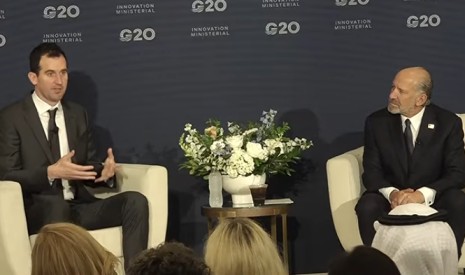
EDITOR’S NOTE: In this interview at the G20 Innovation Summit, U.S. Secretary of Commerce Howard Lutnick sits down with Tom Brown, co-founder and Chief Compute Officer of Anthropic, to discuss the rapid pace of AI progress, what countries need to build in order to participate in the AI-driven economy, and Anthropic’s vision for how artificial intelligence can transform science, industry, and everyday life over the next decade. This event took place on September 2, 2026.
TRANSCRIPT:
Introductions and Background
HOWARD LUTNICK: Great. Well, nice to see you all again. It’s been moments. I’m really excited for our conversation. So I’d like to introduce you all to Tom Brown, one of the founders of Anthropic. So, Tom, thanks for coming and joining us. Would you mind giving my partner ministers sort of a background of yourself and Anthropic, because I don’t think they know you so well. Anthropic, of course, is famous, but a little story would always be helpful.
TOM BROWN: Yeah, I’d love to. And yeah, just first off, thank you so much for inviting me to this. It’s an honor to be here and to get to speak with you all.
Maybe I’ll talk through a little bit about myself and my background. Maybe even before that, I think three things that I’d love all of you guys to take away from this conversation.
One is that AI capabilities have been increasing very rapidly, obviously. I expect them to continue to be increasing really rapidly and consistently. Two, as a result of that, we are seeing this demand that’s not just fast but also exponential, so increasing in multiples every year. And then I think three, as a result of that, we have this incredible industrial build-out, the likes of which we’ve never seen in the history of humanity, even more than the railroads of the 1800s. And so that’s a place where any country that wants to be involved has a chance to be involved.
So I guess my background is, I was an engineer originally. I’m now the Chief Compute Officer at Anthropic. I kind of got into this back in 2014 where a few of my friends came to me and they were like, “Tom, it seems like we might end up getting human-level intelligence from AI within our lifetimes, so in the next 50 years.” And I was like, wow, that seems kind of crazy, but if it does happen, that would be the biggest, most important thing that ever happens to humanity. The thing that makes us special is our minds. It’s not our body. The Industrial Revolution transformed all of society, but really the second most important thing about humans is our bodies. The main thing is our minds.
And so that got me to think, okay, maybe I’ll switch from engineering to try to help out learning about AI. And so I did. I started doing self-study on that. And then about a year after that, OpenAI was founded. And so I knew some of the folks from that. I’d long been a fan of Elon Musk. And so I went to see if I could help out in some way. And so I joined them as one of the first 20 employees basically to do engineering work.
And then I think the key thing for me where I was like, oh wow, this actually is going to be a big deal that’s not just in 50 years but faster, was the scaling laws paper, which was in 2019. That was basically looking at, within AI, people had seen for a decade before 2019 that if the models were getting bigger and bigger, people were using more and more compute, and the quality of the models was improving over time. But they didn’t have a good understanding of what the mechanism was for taking the bigger models and making them smarter.
And so this was a thing where some of my collaborators, now Anthropic co-founders, went and tried to do the same kind of scientific research that you would do if you were in the early days of a combustion engine. And you were like, okay, we see combustion engines, bigger engines provide more power, but how much power do you get from an engine? And if you scale up the size of the engine or change the ratio of how much fuel versus oxygen you put in the engine, how much power do you get?
And so those studies that they did then gave a recipe of what exact combinations of compute, data, and model size resulted in a given level of intelligence. And so those types of algorithms and those types of recipes have been improving over time. And then also just the amount of compute that we’ve been putting into the models has been scaling up.
And so that’s been the underlying thing that got me to be like, okay, wow, we can look and see, try it out over eight orders of magnitude, many, many orders of magnitude, and see this consistent trend. And now we’ve seen it over even more, over 15 orders of magnitude. And so that gave us the confidence that this stuff would continue to advance at the rapid rate that it has been, which ended up leading to the founding of Anthropic, because we saw that this was going to be something that was happening not in 50 years, but on the order of under 10 years.
So that kind of was my origin story of getting into this entire thing. Anthropic is focused on making sure that as we go through this very rapid AI revolution, things go well for everyone. And so I’ve been really grateful to get to work with you, Secretary, and with the rest of government to make sure that this stuff is benefiting everybody. And now is a chance also, I think, for all of you guys to be included in this incredible once-in-a-generation, perhaps probably once in the entire history of humanity, technology change.
Staying at the Frontier
HOWARD LUTNICK: So Anthropic has managed to stay at the frontier, right?
And we toss around the word frontier, but there’s no real frontier. It’s just that which you’re creating that’s new tomorrow. How have you managed to stay focused? And how are you selecting where to go? Because you’re doing things different than the other companies are doing. So what’s the thinking behind it? And that’ll give us a little sense of where you’re going next, or not going next.
TOM BROWN: Yeah, that’s a great question. So I think from the beginning, we’ve wanted to make the AIs great at scientific innovation and entrepreneurship.
And so from the very get-go, initially the first thing that took off with the models was ChatGPT, basically kind of like a better Google. And so you could ask them questions and they would go and answer a question, much better than what you could do before.
I think from the beginning we were thinking about, okay, the main underlying source of all of the value, all of the prosperity that we have, is the hard work of people doing intellectual labor. And so we wanted to make sure that the models could help with that. And so that ended up resulting in our focus on coding, where that was a place where, if you imagined just a very smart friend who wanted to do work but they were trapped in a computer, what are the things that they could do to help out and add a huge amount of their value to the world there?
And so a programmer is a very clear way that you could do that. You don’t need to be running physical experiments like a biologist would or a physicist. You can just go ahead and do it in the computer. And so that was kind of why we initially focused on that.
It also has the benefit now where our models are able to help out with the research that we do, where the vast majority of all of the work that Anthropic does itself is software engineering, internal software engineering, solving bugs in the model training. And so that focus then was both useful for promoting things externally and also for helping us out internally.
Building the Infrastructure for AI
HOWARD LUTNICK: So my ministerial partners, my objective for today is growth, global growth, that they can go home and have ideas that will help their societies, their citizens grow and be more successful. So in your experience trying to figure out how to have AI around the world, what’s the infrastructure you think they need? What are the moves that our G20 ministerial partners need to make so that they can participate with you in the coming benefits from AI?
TOM BROWN: Oh, that’s a great question. So I think the biggest thing by far is building more, making it possible to build more data centers, more compute in your countries. It’s very clearly the bottleneck for all of our progress. We’re in a huge shortage of the power and labor needed to support the demand for AI.
I really loved President Trump’s post from earlier this week, where he was pointing out that the data centers are just an enormous source of prosperity. They produce a ton of jobs. They reduce taxes. Now, the way that we design them, we actually bring on more power to the grid. So the ratepayer pledge is something that we’ve signed up to, as have the major other labs. And that makes it so that we bring on power behind the grid, behind the meter, and we can give it back to the grid as well. So I think that’s a place where every country can quickly be helping out and having a big part to play here.
HOWARD LUTNICK: So what I try to have people think about is the red carpet, right, that if your country rolls out the red carpet to great investment, they’re more likely to have that investment than if it’s a fight to get in.
TOM BROWN: Yes, that sounds right.
HOWARD LUTNICK: So in our conversation last night, Tom was suggesting that he’d really like to build in countries around the world. Can you help me? So I said, well, actually, you’re going to have the opportunity to talk directly yourself. So what do you need? Data centers and infrastructure. Is that basically— and you should tell them what you need.
TOM BROWN: Yeah, no, that’s definitely right. So I think the biggest things that we need in order to build data centers are, we need permitting for the land to be able to build there, and then we need to figure out how to get enough labor to do the construction there as well.
And then the obvious benefits to the country too is, now it’s a huge investment in the country. It produces jobs. It can be taxed, which provides more revenue to the country. And so I think that there’s many things that can block data centers from being built, so we could get a very long list of it. But once they are built, they provide huge amounts of value.
What AI Delivers
HOWARD LUTNICK: All right, so our partners build data centers, they embrace AI. What are the deliveries? What’s the outcome? How can AI make their countries better and make the world a better place? Can you give us sort of your vision from Anthropic’s perspective? What do you bring that’s different? And what can you help them achieve?
TOM BROWN: Yeah. So I think there’s probably two main areas. One is just the reindustrialization that’s caused by building huge amounts of valuable physical infrastructure. And so we talked about that. I think that’s pretty clear.
And then a separate thing there is that the reason that people want to build more compute is because the models end up then adding value. And so the places that that’s happened so far has been mostly by scaling up the effective labor force for intellectual labor, which is the key component of the overall economy: how many smart people do we have doing good work. The AIs now are not quite people, but they’re doing intellectual labor also. And so they feed into that same economic calculus that improves, that raises all boats.
And then very concretely, some of the most important problems that have plagued humanity, like disease, cancer, et cetera, are all blocked by not having enough smart, dedicated people who can be constantly working to solve those problems. I think that there’s no doubt that if we had a million times more oncology researchers, we could make progress that’s not just 10% faster, it would be multiples faster.
And so that I think is the thing that will come from this very large scale-up of more and more smart models. And we see that now with math. Historically, the models were doing more rote tasks that you would ask them to do, simple things that maybe like paralegal work or something like that, or a basic software engineering task. Now they’re doing much more complex software engineering tasks.
Also with math, they traditionally could do okay with math, and then they got to the point where they would be like an undergraduate-level mathematician, graduate level. Now over the last three months, they’ve gotten to the point where they’re like a once-in-a-generation genius on math. Any of the frontier models now are, I think, a top 100 current mathematician in many of the subfields of mathematics, which is just astonishingly fast.
And so many aspects of science are kind of a combination of engineering plus mathematics. And so my expectation is that over the next 12 months, we’ll see that same thing where now they’re like okay scientists or biologists. But my prediction is that within the next 12 months, we’ll get the same thing where they could be a once-in-a-generation scientist for key scientific fields.
Using AI Ambitiously
HOWARD LUTNICK: So it’s your view then that using Anthropic’s model, you can really be aspirational, right? Meaning that what are the problems facing your economy, your people, and use the models to try to really deeply examine what could be solutions to those problems, and use the sort of bottled logic of Anthropic to achieve that. So how would one think about that from your perspective? Because you know what’s capable in Anthropic and you know where it’s going. So maybe give us some sense on how to solve those kind of problems.
TOM BROWN: Yeah, and I think that’s exactly right. I think that often people are not ambitious enough in what they ask the models to do. And I think that, because the way that the model started out was you would ask them a question that you would ask Google and it wouldn’t have that much context, it would give you a page-long response or paragraph response. People often will take one of the new models from the last three months and do that same thing. And they’re like, oh, it’s slightly better. Cool, I guess.
But the way that I see the best people who get the most value out of the models using them now is, instead, they treat them like they would treat a collaborator, like a coworker in their organization. And so they do the same thing that you would need to do if you were like, “I’ve hired the smartest person I know. I want them to be as productive as possible within my organization.” And so you go and you make sure that they have access to all of the documents that they need. You make sure that they have access to the tools. If they’re a software engineer, you’re like, “I’m going to make sure that you have all of the documentation for the code, that you have access to the actual servers so that you can go and run things.” If they’re a scientist, you make sure that they have access to the machines that can actually move stuff around— with a model like that, you would now need an API to move the machines. But that’s the thing that you can get for them now.
You also need to make sure— so in government, you would need to make sure that they have the right permissions to access the right information that they would need to go and do the work. And so I think once you do that, then you end up with a model that has all the things that a great coworker would need in order to do work. And we see that that’s now actually how the majority of the intellectual labor within Anthropic is done, is by these models that have the same permissions that a human coworker would have, and they can go and do that work autonomously.
The Pace of Innovation
HOWARD LUTNICK: So, if I were to take that and understand that the design of your models is logic-based, right? Does that mean the speed of innovation is going to relentlessly accelerate as the models get better at being the models?
TOM BROWN: Yeah, I definitely think that. Also, it’s my guess that the capabilities will continue to be increasing at roughly the same rate from an intelligence-of-the-model perspective. And so I think the hops that we’re seeing in terms of, like, how smart is the model, how many new types of tasks can they do each couple of months, my guess is that that’ll continue happening at the same rate.
And then I think the economic impacts of that will continue on an exponential rate. And so we do a lot of tracking of that, where we’ll look at what the doubling time is of different types of things. So, the doubling time of the overall economy, of how much value people are getting from all of the different frontier AI labs put together, is doubling. It’s like 4x per year. So it doubles every six months, which is incredibly fast. There’s never been an industry of this size that’s been growing at that speed.
Another one that I think is interesting is if you look at how much— if you look at the smartest model that we had a year ago, and then you say, okay, how much does it cost for a person now to access a model that’s equivalently smart to the model that was the best model a year ago? It’s roughly 20 times cheaper to access a model that was the smartest model one year ago today. And if you look back in time, it’s pretty consistent for that too. And so we have this very, very rapid decrease in the overall cost, which I think will result in these models proliferating and filling all of the cracks for all of the problems that right now might be too expensive to use the best model. But if they become 20 times cheaper in a year, it becomes something that becomes a no-brainer to go ahead and use them there as well.
Context, Contextualization, and the Ecosystem
HOWARD LUTNICK: So to harness the models, they need context, right? If I were to hire the smartest person who ever lived and I have Anthropic’s model, I still need to contextualize what I want them to achieve. Do you think that creates a subindustry around you, or do you think ultimately that Anthropic itself can provide that contextualization? How do you see the next three years emerging? Is it a surround model or coming from the model itself?
TOM BROWN: Oh yeah, it’s definitely a surround model. I think that Anthropic, we have like 4,000 people or something like that. The only thing that we’re focused on is how can we make a good, useful model. And then there’s a huge ecosystem now of different people who are able to take that raw model and turn it into something that’s actually useful.
And exactly as you said, giving the— training the model to be useful for tasks is a whole industry. We don’t know how to make the model a good lawyer, whereas there’s tons of companies now that will go and they will take the model and figure out what are the things that it needs to know, what are the tools that it needs to have in order for it to be a productive lawyer in a law firm. Same thing for biology, same thing for mechanical engineering, a long list of all the possible different things where you might want a model to be going and doing work. And so that’s a place where I’m extremely grateful for the vibrant ecosystem around the world of all of the different startups that can go and take this thing that’s not that useful by itself and then get it connected to the real world.
HOWARD LUTNICK: So the scale of opportunity surrounding Anthropic is— it sounds like that’s almost bigger than the scale of Anthropic’s model. Is that sort of the way you see it?
TOM BROWN: Oh, yeah, it’s way, way bigger. That, definitely.
Looking Ten Years Ahead
HOWARD LUTNICK: So I think the opportunity is, if we were going to think back, if we were going to think forward 10 years from now, right? We come and have a G20. Yeah, right. And we’re 10 years from now, and you come back. Now, I’m old, so you never know, I might not remember what we’re talking about today. But if we were to come 10 years, what do you think? If we look back, how we viewed the conversation we had today? And then looking forward, what do you think we’d be wanting to think about and talk about with respect to AI, and the possibility.
TOM BROWN: Yeah, 10 years. Okay.
HOWARD LUTNICK: Yeah. Well, so I guess, or if 10 years is too long, maybe it’s five years.
TOM BROWN: Ten years, I’ll feel like I’ll be on Elon’s moon base or something like that in 10 years.
So I think, probably looking back, I think we will have felt like that despite all of this conversation, we still will have underestimated how fast progress— looking back, we’ll be like, wow, back in 2026, we thought stuff was going fast and we thought we were seeing this. But actually we underestimated how impactful this would be and what the progress would be. And I think also we’ll feel like we underbuilt, that we ended up with an even greater shortage than what we were expecting would be my prediction.
And then I think also we will feel like the— I think the economic and scientific impacts that we’ll see, five years from now, will just be immense. I think that we will make a major dent in things like curing cancer. I would be astonished if we haven’t made material progress on that in five years. So I really think it can’t be overstated.
A Better World
HOWARD LUTNICK: So, to wrap up this time, can you just, from Anthropic’s perspective, tell us a story of how, not only in cancer but in broad-based, how will Anthropic and AI in general make this a better world, right? We hear lots of doomers, and we know that the Industrial Revolution didn’t put everybody out of a job, and the invention of electricity didn’t put everyone out of a job. And so I don’t buy the doomerism at all. I think this is an opportunity to democratize intelligence, to make the world smarter, better, more productive, more successful, that everybody can now hire the perfect person, in their culture and in their language. So maybe can you give me, just to wrap it up, the story on how Anthropic views how we can make the world a better place?
TOM BROWN: Yeah, I think it comes down to, yeah, I think both what you described, of just people having access to smart coaches and teachers that can help them be more of the people that they want to be and that fundamentally care about their success. That’s one thing.
And then the other thing is the driving force of prosperity everywhere being innovation. And innovation has been bottlenecked on how many smart people we can have working on that. And I think that for the first time now, we’re getting the ability to really scale up innovation much faster than we’ve ever been able to.
And so I think those two things together is, at least for me, a big source of my confidence that this will be seen as just an incredible, perhaps the most positive thing that’s ever happened for humanity.
HOWARD LUTNICK: Thank you, everybody. I appreciate it. Thank you.
TOM BROWN: Really honored to be here.
HOWARD LUTNICK: Thanks.
Related Posts