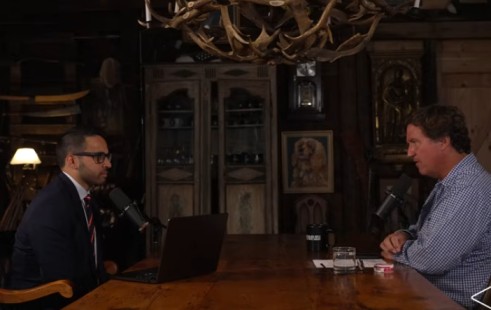
EDITOR’S NOTE: America’s fastest-growing addictions rarely get discussed as a single story — but Tucker Carlson and journalist Saagar Enjeti, co-host of Breaking Points, argue that online sports betting, prediction markets, marijuana, and pornography are all connected by the same pattern of exploitation, and increasingly by the same donors and political patronage. In this conversation, Enjeti lays out the data behind gambling’s explosive growth since 2018, the neuroscience of addiction driving it, and how the Trump administration’s regulatory choices have accelerated all four industries — before the two turn to what that pattern might mean for the country’s political future. This podcast episode was premiered September 3, 2026.
TRANSCRIPT:
TUCKER CARLSON: A couple of years ago, leaked internal documents from AIPAC showed that the single largest donor to the organization, the American Israel Public Affairs Committee, number one donor, was a man called Leonid Rudvinsky. Rudvinsky was a Ukrainian-born pornographer. He was the owner of OnlyFans, one of the largest porn sites and human exploitation sites in the world, the site that has effectively turned thousands upon thousands of American women into prostitutes. And according to these documents, Rudvinsky and his wife had pledged $11 million to AIPAC.
Huh. He later denied that, but the documents remain. And you had to ask yourself, and many people did ask themselves at the time, why would someone who runs a pornography site donate this much money to a pro-war organization, neocon organization like AIPAC? What’s the connection between the two?
Huh. Then, of course, it was that same year, 2024, that Miriam Adelson became one of the biggest donors to the Trump campaign. Hundreds of millions of dollars. Now, Miriam Adelson is not in the pornography business that we know of, but very much the beneficiary of the gambling business. Her late husband was one of the largest proprietors of casinos in the world, Sheldon Adelson. And she became one of the biggest donors and partly because of those donations, became one of the driving forces behind our war with Iran and also immensely powerful within this administration. In fact, literally one of the people who picked employees of the Department of Justice, Mary Maitland, calling up PPO, Presidential Personnel Office at the White House. “I want this person at DOJ.” Bam. That person gets a job at DOJ. That happened.
But again, you have to ask, what is the connection between pornography, in that case gambling, and neocon politics? You wouldn’t have thought there was one, but the connection keeps showing up.
Here, for example, is a pretty amazing and telling clip from Ben Shapiro’s recent podcast. Watch this.
VIDEO CLIP BEGINS:
SAAGAR ENJETI (in clip): In my opinion, as I said at the time, I thought the MOU was counterproductive, that it signaled weakness. That it actually gave credibility to the Iranian regime. Well, now things are starting to reverse. You have Operation Economic Outcast led by Secretary of the Treasury Scott Bessent. The goal is to economically strangle the Islamic Republic.
So the odds have been steadily going down about when we will actually have full traffic in the Strait of Hormuz, according to our friends and sponsors over at Kalshi. But they are rising actually rather sharply recently. Before April 1st, 2027, is now up to 42%. Before July 1st of 2027 is up to 53%. Honestly, I think we’ll probably get there before that.
VIDEO CLIP ENDS:
The Exploitation Connection
TUCKER CARLSON: So that’s a pretty amazing clip. Here’s Ben Shapiro, and if you see the whole show, he spends a lot of it, as he always does, pushing the United States to send more money and, well, more of our American soldiers and airmen into harm’s way fighting Israel’s war in Iran. And then he kind of seamlessly moves to a pitch for Kalshi, a gambling company with whom he’s a partner, apparently. “Not only am I excited about the war,” he’s effectively saying, “you can bet on its outcome. Here, sign up now for Kalshi.”
So here’s Ben Shapiro using his daily lecture on why war is good when it’s fought by Americans on behalf of a foreign country to seamlessly pitch a gambling company. If war wasn’t good enough, how about some gambling for you? Why not pornography? Why not weed? Here’s some prescription drugs.
Well, of course, virtually everybody who pushes for wars like the war in Iran or the war in Iraq or toppling the Syrian government or killing the leader of Libya, that group, we call them neoconservatives. Almost all of them are on board with all of these other public policy questions, every one of which has the net effect of hurting Americans, weakening people.
So what’s the connection here? There clearly is one, and we’re just guessing, but maybe the connection is exploitation. So the idea of the Iran War, like the Iraq War before it, was we use the world’s best-funded military backed by the world’s most powerful economy to fight a war on behalf of another country, a tiny country that can’t fight its own wars. In other words, take the United States and use it for our purposes to achieve something that we can’t achieve ourselves. Basically treat the population of the United States, the 340 million Americans who live here, like livestock and just use them.
And that’s really not so different from the attitude that, I don’t know, gets you to buy OnlyFans or promote gambling companies or push legalized weed or prescription drugs on the population. None of those things is good for people. And of course, you know that you would encourage your own kids to spend all day betting on their phones or smoke more weed. You probably wouldn’t want your daughter on OnlyFans, would you? But these aren’t your kids. These are other people’s kids. These are American kids. And why do you care? Because you can get something out of it.
So that’s a worldview that most normal people would consider repugnant.
And you should know that the same people pushing for these wars whose outcome can’t possibly benefit you — your only role is to go die in their prosecution or pay for it, face the consequences long-term bankruptcy, destruction of a generation. That’s your role. The people pushing for those wars don’t care about you at all, because if they did, they certainly wouldn’t be steering you to gambling sites or getting your kids to smoke more weed or convincing your daughters to join OnlyFans.
So we’re just starting to notice this because it’s kind of hard to ignore. The president’s top donor runs a gambling empire. Ben Shapiro is shilling for gambling. The guy who owns OnlyFans is AIPAC’s biggest donor. Maybe there’s a connection here.
Very few people have noted that, but one of them is a man called Saagar Enjeti. Now, we know Saagar, actually hired Saagar out of college years ago. And what set Saagar apart was not simply that he was smart, but that he didn’t — and this was almost 15 years ago — have any real interest in the partisan system. He thought it was fake back when most of us, very much including me, bought into the idea that this is a war between two parties and differing worldviews. And of course, that wasn’t what it was. We learned February 28th that in fact the parties are aligned on the basic questions, and the rest of us are encouraged to argue at the margins to preserve that lie that this is a real argument when in fact they’re colluding against us.
Saagar Enjeti realized that many years ago, and so he left conventional journalism and has wound up running something called Breaking Points, which is an excellent show that he co-hosts on all social media platforms. We strongly recommend.
But maybe because he doesn’t have a conventional worldview, he is one of the only people in all media to point out that actually gambling on your phone, digital gambling, is utterly destructive of people. It’s incredibly addictive. The odds are abysmal. In fact, there’s almost no chance you can win. And it is growing at a pace that has eclipsed all other forms of entertainment. And one of the reasons Saagar Enjeti has been able to point this out is because he’s one of the very few people in media who’s not taking money from gambling interests. And we share that with him. We are strongly pro-dog on this show. We make no secret of that. Dogs are one of the great blessings of this life. And to keep them healthy, we recommend Dutch.
So we were really grateful to talk to him the other day about the growth of online gambling and what it means for this country and who’s promoting it. Here it is.
Saagar, thank you for doing this.
SAAGAR ENJETI: Thank you for having me.
“The Most Popular Entertainment in America”
TUCKER CARLSON: Every year, this is one of my favorite interviews of the year, so I’m grateful that you made the effort to come up here. Um, so I was — I’m a little cut off from the question of gambling. I think of it as something that takes place in a casino. Craps and blackjack and Pai Gow and whatever.
SAAGAR ENJETI: Yeah.
TUCKER CARLSON: Um, but suddenly it’s omnipresent, and I’m wondering if that’s good or bad.
SAAGAR ENJETI: Well, I think it’s very bad, and I’ll just set the stage. I wish that we were at the stage where you were at, which, by the way, I still think is bad for people. Yeah. Waste a lot of their money on craps, blackjack. But those people would put modern-day gambling companies to shame because at the very least, the house edge on those games is very limited. And in fact, you can win. It’s just you’re very unlikely in the long run to do so.
The products that are available today for the vast majority of Americans are effectively legalized theft, especially the ones that are being pushed by these gambling companies like FanDuel and DraftKings, where their whole and/or 60% of their revenue are a type of bet which again would put a Las Vegas casino to shame. They’re called the single-game parlay.
But before I even get into all of that, let’s zoom out. Gambling as of this year is now the most popular entertainment in America. America is a nation of gamblers. It’s the most popular entertainment in America by not only just the most popular of entertainment gambling, the total amount that was gambled in the United States eclipsed all types of other entertainment revenue, movies, books, and others combined. So that is the amount of dollars that we’re talking about, hundreds of billions of dollars, in some cases tens of billions of dollars per state.
And most of it is targeted to young men specifically, which where we see the data overwhelmingly is depressing not only their savings rates, bankruptcy goes up, domestic violence goes up by nearly 10%, especially whenever there’s a home team loss, which is largely been associated with the NFL for quite some time. But when you add dollars into that, it makes the magnitude of the loss, of the drinking, of the depression, and of the anger express itself even more.
So there’s basically nothing good that has come out of it. There’s an argument that comes from many of these states about revenue, but even the revenue argument honestly falls apart. The Ohio governor even said that legalizing sports gambling was a huge mistake, the same governor who legalized it. And he gave us some of the numbers where the amount of revenue that, let’s say, Ohio raised, it’s $200 million. Well, the amount of associated social costs was roughly equivalent to the same amount of revenue that they took in. Gambling has the highest suicide rate of any addiction in the United States.
TUCKER CARLSON: Actually?
SAAGAR ENJETI: Yes, yes it does. Well, it’s one of those addictions where you can operate and hit your rock bottom without actually — well, if you hit your rock bottom as an alcoholic, everybody around you knows. You probably lost your job, right? There’s not an ability to maintain that. Same with drug addicts, fentanyl addicts and any other types of addictions. With gambling specifically, to hit rock bottom, you can gamble your way into a hole and a debt spiral and shame. And it often leads to a point where many of these men just can’t face the music, often very tragically leads to suicide.
TUCKER CARLSON: I believe that. I’ve actually — I don’t want to play dumb. I’ve actually seen it, right? And I, you know, quit drinking myself. So if you reach the bottom of alcoholism or drug addiction, you can stop using drugs or alcohol. You reach the bottom of gambling and it’s insolvency. It’s pretty hard to fight your way out of that.
SAAGAR ENJETI: That’s right. And it’s on your phone. So even, imagine if you could drink out of your phone when you were an alcoholic. That’s the equivalent of what we’re looking at. This is the most omnipresent environment for gambling in modern history.
And just again, to put some color on the numbers, I have some of my notes in front of me. There’s been $500 billion wagered since 2018. In 2025 alone, $166 billion on sports, more than movies, recorded music, live music, books, museums combined of a normal $70 billion. So it’s double the amount of revenue for all of those associated other types of entertainment, which I would argue have a lot more of a social net positive.
Now, what we see is that there is a 25 to 30% increase in states which legalize online gambling. $1 bet leads to $2 of less savings. 10 percentage point increase in domestic violence after an NFL upset loss. And that’s just the top line.
And in terms of how much this is pervading everything, these companies spend billions of dollars a year on the most expensive advertising real estate in the world. And this is all of sports media. So you had ESPN, you have all of these podcasts which are being paid millions of dollars above market rate simply to promote gambling and to get these people, many of their audience, a lot of these young men hooked into the sport.
And I think we can also have a bigger conversation about what it’s done for sports generally. You were talking about, as an older person, you know, you may not realize it, but if you talk to the young generation, I’m talking 12, 13, 14 years old, specifically teenage boys, if I ask them before an NFL game what the line on a game was, they’ll know it. They’ll even know what the odds of relative prop bets are for some of their favorite players. That is a completely new reality that has only emerged just since 2018, since the landmark Supreme Court decision originally struck down the — I think it’s PASPA was the law which had been passed, which allowed Nevada to continue sports betting again in a casino, but did not allow sports betting wagering nationwide. And we can thank Chris Christie for all of this.
TUCKER CARLSON: There’s no one worse. There’s no one more corrupt than Chris Christie. He’s just — and I mean, like, on a deep human level corrupt. Yeah. I mean, you said podcasts without getting into it, but we were approached by a couple of different gambling companies with real money. I had no idea they were gambling companies.
SAAGAR ENJETI: Yes.
TUCKER CARLSON: I thought they were polling companies. Right? I mean, I really didn’t know, and I mean that.
SAAGAR ENJETI: Yeah.
TUCKER CARLSON: I called someone about it. “No, those are gambling companies.” Oh, okay.
SAAGAR ENJETI: Mhmm.
TUCKER CARLSON: What’s the difference between a polling company and a gambling company?
Prediction Markets vs. Sportsbooks
SAAGAR ENJETI: Right. Well, this is where it also gets complicated. So all of my criticism right now has been about online sports betting companies, FanDuel, DraftKings, Hard Rock Bet, any of those types of actual wagering. And just to explain the difference, that is a house against you, as in the house of DraftKings sets the line on a specific book for, let’s say, a Patriots versus the Eagles. So that’s you against the house trying to make sure that you get an edge, hopefully, and you’ll win.
What you’re talking about are these prediction market companies predominantly in the United States. It’s Kalshi and Polymarket. And I do want to be fair to them. They are not the same thing. However, operationally, I think they are. So they advertise themselves as event contracts. And so it’s a prediction market. So for example, there’s two sides of the bet. And so I come in and somebody else is willing to take the other side of that. It’s similar, I would say, to horse race betting in terms of the amount of dollars which are inside the pool, and then who’s going to take the, you know, 85% chance versus the 15% chance.
TUCKER CARLSON: And the house gets a set percentage.
SAAGAR ENJETI: And they get a set fee that they take off. And so that’s their similar difference, let’s say, between the prediction market and the actual gambling company.
However, these prediction market companies have a lot of the same problems. So when you were to speak to them, I’m sure that they would talk a lot about derivatives and event contracts. It’s all very financialized language. And so they try to present themselves as above what these companies are. But here’s the truth. The vast majority of the action which is taken on these platforms — and I use that term specifically because they would say the amount of dollars placed, I’m saying “action” because it is ultimately gambling — is all in sports. Over 80–85% of the volume on Kalshi and/or Polymarket is placed on sports.
You also have the same power law problems where the vast majority of the profit accrues to a very small group of traders known as “sharps,” both in the prediction market business and/or in actual online gambling. And I think even by their own data, only 25% of the people who trade within a month, as they would call it, are even people who win money. And by the way, that’s actually quite high if you were to wager over a month whenever we’re talking about sports betting.
This is what I mean by legalized theft. When I step back and you ask me the question, is this good for America? How can it be good for young men to routinely participate in a daily, sometimes more than daily practice of just throwing their money away to either groups of Wall Street traders or large gambling houses based in Europe and the United States to accrue for shareholder value. There is no good that comes from that. I laid out domestic violence, thinks about the social costs, but bigger picture — and this might even be — I talk a lot about sports betting, I do think it’s the number one scourge, but the CEO of Kalshi, Tarek Mansour, had said that he envisions a future where people can trade on everything.
Think about the social and corrosive cost of what it means for some of the event contracts which are offered either on Kalshi or Polymarket. We’re talking about flight delays. I mean, can you imagine the perverse incentive of manipulating flight delays? They frame it as hedging, saying, well, somebody wanted to do a conference and they wanted to make sure that if the conference got flight delays, that they could hedge their bet. They promote the hell out of this, but they don’t think about the social cost of what it means to be able to wager literally on everything.
You could create a market right now for what you and I are going to spend, say, on this platform. By their rules, according to their internal house rules, that would be insider trading if you or I were to wager on that. However, I was at a restaurant yesterday, we both were, and I was speaking to some people or asking about what I was going to talk about. Well, they could have wagered, they could have created a market about what I was going to say with that inside information.
There is no regulatory authority to actually go after insider trading at a bigger level. There is for the military, and I can talk about that as well, where large bets, specifically on Polymarket, for insider information, things like the Maduro raid and others, clearly leaked out to a small group of people who then went and placed bets on these markets on whether the United States was going to go capture Maduro. Same whenever it came to the military operations against Iran. There were huge sums of money that were paid out on that. The Trump administration has gone after a few select cases, but those are only the most obvious cases of members of the military. The Israeli military also had to prosecute several of its own soldiers for placing bets on Polymarket for events that they knew they were going to happen because they were participating.
TUCKER CARLSON: Betting on wars.
SAAGAR ENJETI: Betting on wars, yeah, on death. And again, they would push back very heavily, “we don’t have death markets,” but when you have — well, how is betting on a war not a death market? Betting on whether the United States is going to bomb Iran is effectively a death market.
Manipulating Reality Itself
SAAGAR ENJETI: But again, let’s just even keep it here because that’s the most obvious, easy example. The social trust between all of us is broken when everything is tradable and everything becomes a scam. Everything from sports, to our flights, to — in some places people are betting on the temperature at an airport. There was a case recently where people are betting on weather markets, and the way that the weather market was decided was off of a single sensor which was at an airport. So a man took a bet for an outshot of the — how much the temperature would be on that specific day. He went to the sensor and held a hair dryer next to it to cause the sensor to rise so that that would then resolve in his favor. I mean, these are extreme examples, but this is the extent to which people will start to manipulate literal reality just to make money.
TUCKER CARLSON: This is the free market capitalism they promised us.
SAAGAR ENJETI: This is the free market capitalism that they’ve promised us. And it makes it so you can’t trust anything.
There was recently a case where Karoline Leavitt was holding a press conference, one of her press briefings, and there was a market that it would go over X amount of time. I forget exactly how much time she would spend at the podium, and she happened to end it seconds before the majority position was. So you could have bet the under on how long that press conference was going to take place, and you could have paid out — I forget the exact dollar, maybe 20 to 1.
There’s also all these insider trading things. So I gave the obvious example that you and I talked about, this specific one. I’ll give you another one that relates to a vice, marijuana. I don’t think like this, but I could have. I got a call because — this is my job, I do reporting — somebody called me and said, “Trump’s going to reschedule marijuana.” I was like, wow. So I start working the phones, I start seeing what I can find out about this, I email the White House. At that time, I could have gotten a 1% chance on either prediction markets or I could have purchased marijuana stocks because I had inside information. And I actually watched as I started doing my reporting that it started to leak out in broader Washington, and I can see the stock start to rise. I see rumors begin to come out, then the official announcement eventually breaks from some establishment media outlet. The price goes sky high. I personally could have profited literally millions of dollars if I had wanted to. I would never do such a thing. I think that’s literally blood money and scumbag behavior, but there’s no law that prevents me from doing that.
I was doing my job on a routine basis. I could have made myself extraordinary sums of money. You probably could have done the same thing with all kinds of various things that you’ve been doing in your line of work. Is it technically insider trading? No, we’re not part of these — it’s never even occurred to me.
TUCKER CARLSON: Exactly, ’cause that’s our character.
SAAGAR ENJETI: But how many — is character really the constraint through which we should offer the integrity of our financial markets? And even worse, I see these viral social media claims. People will say, “I’m getting rich betting on what Donald Trump is going to say.” You can get various odds of whether Trump will say the words “low IQ” this week, or which — pretty much a lock, I think, if you hold that one — whether he would criticize you this week. And so, you know, people in the White House, they have relatives, they could call them, the relatives could call another relative, they could easily make a lot of money doing this.
I mean, this is about our government, this is about sports, it’s about entertainment. But my bigger picture, this is bad for society. There was a recent poll that came out. Go ahead.
TUCKER CARLSON: Well, isn’t the reason that sports betting was banned in the first place 100 years ago because it corrupted sports?
SAAGAR ENJETI: Exactly.
TUCKER CARLSON: And people started throwing games.
How Sports Betting Became Legal
SAAGAR ENJETI: Exactly. And, you know, Major League Baseball itself, the National League and others were formed specifically to stop the corrosive effects to the game of gambling because they knew that it was a problem. And for over 80 years, these companies held the line. Paul Tagliabue, the NFL commissioner, testified before the US Senate against gambling. David Stern, the NBA commissioner, also testified against gambling.
But what ended up happening — it’s a very tragic story — is that the English Premier League, when Britain legalized gambling and specifically has had long sports gambling for quite some time, their valuations began to skyrocket. And so the capitalist greed of the NBA owners and of the NFL owners and the commissioners, they look across the pond and they think, how can I accelerate my valuation and the amount of dollars that I can pluck out of America just like they did?
Now, you and I as social critics would say, in what way would we want to emulate the British working class for our working class who have been immiserated and who currently have a GDP which is less than the state of — GDP is not everything, but, you know, less than the state of Mississippi.
I could look at Brazil, another horrific example. Really ground zero of sports betting, where, in Brazil they have those cash transfer programs for poor Brazilians, which previously was held up as a major social welfare benefit. Well, more recent data has come out from Brazil. The vast majority of that money is being cycled right back into sports gambling. And so people are getting their cash transfer from the government. They’re handing it right over to the gambling companies. They are massively addicted to soccer betting down there specifically.
So our NFL commissioner, our MLB commissioner, they looked abroad to the Premier League all at the same time while Chris Christie is advancing his case for New Jersey to have sports betting. All of this came from the Great Recession. Atlantic City was really having a hard time with their revenue in the aftermath of the Great Recession. Chris Christie becomes the governor. Christie decides that he’s going to try and have a workaround to allow sports betting in New Jersey specifically.
And so I won’t take everyone through all the complicated legal minutiae. The basics of it are they passed several laws, they took it through various circuit courts, went all the way up to the Supreme Court. Five conservative justices, one liberal justice rule on behalf of the state of New Jersey. And they say that what Congress did by restricting sports betting, specifically only allowing a loophole where Nevada could have it, but nobody else could have it, was unfair to states’ rights.
This comes at a time, too, when states are revenue hungry. 2018, right into the pandemic. So what happens? Vast majority of these states, I think 42 states now have legalized sports betting. And what they did is they not only allowed legalized sports betting in the casino like Nevada always had, they quickly realized that there were these apps like DraftKings and FanDuel, which had the infrastructure laid out already, which allows you to normalize and create online sportsbooks specifically. And so that’s how I gave you that number, $500 billion, half a trillion dollars wagered in this nation since 2018.
And it just dispels all of this notion of how, “oh, well, people are always going to sports bet.” That’s actually BS in my opinion, because if we look to the current types of bets that people place today, they place the types of bets which I’ve talked about, which no bookie or mafia boss would ever offer you. They’re talking about offering you — when I open the app, the single-game parlay — it’s not just whether you win or lose, and it’s not even just the spread, +3.5, -3.5. It’s the spread combined with the quarterback throwing for 200 yards, combined with the receiver scoring two touchdowns, and they offer you a price. Bet $10 to win $750. The idiot brain combined with alcohol or marijuana for a lot of these guys sitting on their couches, “let’s do it, $10.”
What they don’t realize is that the contingent odds that they just placed lose money so regularly that the companies can project their revenue based off of that type of bet, the single-game parlay bet, so much so that they can project their earnings out into the future. 60% of their revenue comes specifically from that type of bet.
So when people tell me America’s always been a nation of sports gamblers, that’s totally wrong. The type of bets that they were making were usually illegal, backroom types of bets, plus or minus on the spread, to the extent that they were ever able to even get these types of parlay bets. It was in person in a Vegas casino, and they would never take the amount of dollars that they’re wagering currently at a lot of these places.
And one thing I beg for a lot of the listeners, and I’ve tried to explain this: if you’re a younger guy out there and you’re doing this for the thrill, I just want you to know, especially with the parlay bets, you will not win. You will not win. It’s a mathematical fact if you do this over time.
And this brings me to the worst part of the industry. If you do win, they’ll ban you. And so I’m sure you know this with blackjack, for example — everybody famously lionizes the people who can count cards, right? What they don’t tell you, if you walk into a Las Vegas casino and you start counting cards, you will be asked to leave the blackjack table within probably 30 minutes to an hour, unless you’re really good at it and you’re working with a team. How is that legal, you might ask? They have the right to refuse service. And it’s because even with the small house edge of blackjack, if you are an advantage player in blackjack, and especially if they allow those advantage players to have unlimited bet size and they get that 1% — really that’s all it is, counting cards gives you a 1% or so edge — you will eventually beat the house.
It’s the perfect game: you can addict people, you can effectively legalize theft, and if you happen to, despite all of this, win money, they will simply ask you to no longer play with them. Or if they don’t ask you to no longer play with them, they will limit your bet size. So where previously you might have been able to put $1,000, $2,000, $3,000 on a game, they’ll say, “sir, you’re only allowed to bet up to $3 on this game.”
It’s an easy way: so you addict the losers, and you look for the whales. The vast majority of the profit for these gambling companies comes from a very small group of users. Roughly 3% to 5% of the people make up almost 50% of the revenue. So these are absolute gambling addicts who by law shouldn’t even be gambling in the first place. The winners, if you’re able to even win in this game, they will ban you. In fact, their algorithms are so sophisticated that if you place the type of bets which look like a winner, a potential winner, before you even win, they will limit your bet size. They will say “we don’t want your business,” or “you’re only capped to $10 down on a game.”
So they’ve created a system where they can addict young men, they can find the potential whales out there, those 3% who are just full-blown addicts. They can shower them with gifts, they call them incessantly — “hey, where have you been? Haven’t heard from you. Do you want tickets to the next Patriots game? Do you want free whiskey? Let me fly you out on a private jet from here to here.” They shower them with more benefits than you can even believe. Now they think it’s for free, but they’re paying for it obviously with their losses. They do all of this while if you’re actually a winner, they’ll ban you. And so for the casual bettor who is doing $3 to $5 to $8, I just want those people to know that is only enabled by these people getting crushed by gambling addiction, throwing their futures away, their lives, their marriages.
The DraftKings Case
SAAGAR ENJETI: I covered the case of a guy. His wife, I think, sued DraftKings. So he had never placed a bet before 2020. He ended up gambling after a few years every dollar that he had, every single dollar. He bankrupted his children’s 529 plans. He took out multiple mortgages on his house. The entire time he was being called and encouraged to gamble by DraftKings, his host, his casino host, who would ask him, “hey, where have you been this week? I’ve got a good game for you. This is exactly the type of thing you would like to do. Here’s some free whiskey. Here’s some free anything” — you know, free concert tickets, those types of things. They’re encouraging him despite him showing obvious symptoms of gambling addiction. And by their own rules, they’re supposed to tell them not to do it. But of course they don’t. And in some cases, not just this case, there have been other cases where they say, “don’t put this in text, or they’re going to come after me. Make sure you just talk to me on the phone if you’re having a problem.”
Again, this is scum-of-the-earth type of behavior to even participate in this. But this is what’s been enabled by these laws. This is sweeping the nation, the largest gambling —
TUCKER CARLSON: So what happens to the guy?
SAAGAR ENJETI: Oh, he went absolutely bust and his wife is suing.
TUCKER CARLSON: Who owns DraftKings?
SAAGAR ENJETI: I actually had to — they’re a publicly traded company, so it’s, you know, Fortune 500.
TUCKER CARLSON: Is Portnoy involved in any of this?
SAAGAR ENJETI: I don’t know if he owns DraftKings, but I know that Barstool has an affiliation with DraftKings. I think that they have a partnership between the two of them.
TUCKER CARLSON: And ESPN does too, promotes a lot of stuff.
SAAGAR ENJETI: ESPN — well, it’s a complicated case. They had their own bet, their own actual casino called ESPN Bet, which is ironic because it’s a media organization with ESPN Bet that was down literally on the chyron encouraging people to bet. I think now they just have an exclusive partnership, I believe, with Penn Entertainment, which is a large casino conglomerate which previously owned Barstool Sports.
TUCKER CARLSON: Oh, it’s also disgusting. It’s horrible. So why is this allowed? Yeah, because I thought the promise of this administration was the country was going to produce things. Like, New Jersey was once a rich state because they made a lot of stuff in New Jersey — pharmaceuticals, soup, you know, like tangible —
SAAGAR ENJETI: Trenton makes, the world takes.
TUCKER CARLSON: Yeah, thank you. Exactly. I think that sign’s still there. It’s still there, but it’s not true. So the idea that you’re going to fix the state budget hole by just treating your population like livestock, that’s not really the answer we were promised, right? Is it?
The Most Pro-Vice Administration
SAAGAR ENJETI: No, it’s certainly not. And this administration is the most pro-vice administration in modern American history. So really, this administration, the CFTC, the Commodity Futures Trading Commission, has taken a very different line from the Biden administration. They not only reversed many of the rulings against the Kalshis and the Polymarkets, they not only enable them just to do what they do, which is worse, but there’s gradations of worse. They go to extraordinary lengths to defend them in court.
Recently, there was a case — let’s take New York State. So New York State, Kathy Hochul, the governor, she sued, or her and the attorney general went after Kalshi because Kalshi, they said, was illegally operating as a prediction market, as a gambling house in their state. The argument that they had was, look, there’s federalism. We are a state. We have the right to regulate sportsbooks in the way that we see fit. And by doing that, we charge — I believe it’s a 20% excise tax on the amount of trades or revenue or something like that generated within the state.
Kalshi obviously argued against them, although I will say in negotiations previously, they had come to them and had acknowledged some level of regulatory authority. They said, “why don’t we pay you 6% the way that we do in North Carolina?” New York State rejected that. “So we don’t do carve-outs. We believe you’re a gambling company. You need to abide by our gambling laws.” The CFTC under Donald Trump issued emergency authority, an emergency release ordering and telling Kalshi to please continue operating because they have absolute authority as the federal government over the regulation of these prediction markets.
TUCKER CARLSON: Wait, so the Trump administration described it as an emergency?
SAAGAR ENJETI: As an emergency.
TUCKER CARLSON: People wouldn’t be able to bet enough online?
SAAGAR ENJETI: Yes. That’s right. Effectively, that’s right. I mean, Kalshi would tell you that they’re trading online. But in my or your estimation, yeah, it’s gambling.
And so the Trump administration has their CFTC Commissioner, Mike Selig, routinely goes and delivers on-video press conferences, many with crypto magnates and others. Recently, there was one with Donald Trump, Mike Selig, and one of the Winklevoss twins behind him, who himself is a Bitcoiner, with Gemini, where they’re giving press conferences and extolling the virtues of prediction markets. I mean, Trump’s own son is either on the board or was an advisor with both Kalshi and with Polymarket.
You have a situation now where Kalshi and Polymarket — Kalshi specifically, because their regulatory approach is to try and work extensively with the federal government to ensure that they’re totally legalized. The CFTC commissioner has issued multiple guidances and even written briefs on their behalf in many other state courts and places where they’re being sued because many state attorneys general and others believe that they are illegally operating as a gambling house.
So that’s Trump on gambling. There’s no question he has made gambling more prevalent in the United States than any previous president, just because of the way prediction markets work. And in fact, running roughshod over federalism — California and Texas, bless them, they did not have legal gambling before this. But now, because Trump as the president and of the federal government is protecting these prediction market companies, we now have legalized gambling in all 50 states.
And in fact, as I know, both Kalshi and Polymarket now, they would not want legalized DraftKings or FanDuel in those states so they could be the only option for potential people who want to put action. So in California, it was the Indian tribal casinos that didn’t want nationwide or statewide gambling, and they successfully defeated it at a statewide ballot initiative. In Texas, to preserve their own monopoly — I’m not saying it’s a good thing, but they still, the voters there decided not to legalize it.
TUCKER CARLSON: You’re not describing any organized force acting on behalf of the public.
SAAGAR ENJETI: No, there’s — there’s maybe the evangelicals in Texas. They’re the only reason that we didn’t have statewide betting from my own home state. Not that Miriam Adelson isn’t working overtime to make sure that that’s been repealed. I mean, one of the reasons she bought the Dallas Mavericks and their whole vision for that, as I understand it, was to create kind of this super entertainment gambling complex. Mark Cuban himself even said that before he sold it to her, that the valuation of his franchise doubled because of legalized gambling.
So I don’t think it takes a genius to see that was part of the long-term Adelson plan for my home state of Texas to legalize gambling and to make it part of the fabric of the state, which to their credit was one of the last actually willing to stand up with a substantial population. However, of course, Trump has now made prediction markets legalized in the nation.
Marijuana Rescheduling and Banking
SAAGAR ENJETI: Let’s talk about marijuana. So Trump rescheduled marijuana. He did so not after any rigorous review. He did so at the behest of marijuana companies. Schedule I status by the federal government was prohibiting their ability to use the legalized banking system. That was it. There were huge donors in Mar-a-Lago and in Florida, as I understand it, who were constantly complaining to him about their inability to — because, right, in these states where there was legalized weed, cannabis as they call it, they would take these vast amounts of cash and they had problems on their hands. Many banks would not touch the money because the federal government — technically, it was Schedule I, and they saw it was illegal. So there was an entire side banking arrangement that was happening.
TUCKER CARLSON: Conducted in currency.
SAAGAR ENJETI: Conducted in hard cash for a lot of these companies. They were having to hire armored guards. It was causing them all kinds of problems. They heavily lobbied the administration to reschedule, specifically, not for the reasons that Trump came out and said, for studying. We’ve had plenty of studies on marijuana, specifically medical marijuana. All of them are absolutely false.
TUCKER CARLSON: It saves a lot of lives.
SAAGAR ENJETI: No, it’s complete nonsense. There is not one claim for medical marijuana that’s held up in scrutiny. You can read that in the New York Times and from some of the most prominent health journals in the United States. But nonetheless, they claim we need more research. That was the justification. That’s not the justification. The justification specifically had to do with allowing these companies to have more access to the legitimate banking system. And so the venture capitalists and the stocks — remember I told you earlier about that story about how I could have made money — there’s an entire ETF and others that track marijuana companies, which exploded post-rescheduling. So that tells you the story, and it made people very, very wealthy who are very connected to Donald Trump.
Marijuana’s Toll
TUCKER CARLSON: Did it improve the country at all?
SAAGAR ENJETI: You can ask. I’m in this state. I’m shocked at the amount of cannabis stores everywhere. Downtown Portland, cannabis everywhere. You smell it everywhere. You’ll be in the rural parts of this state — we’re here in Maine — I see a brand new cannabis dispensary next to a rotting home. So you can tell me whether you think that’s been an improvement. It’s lowered IQ. Talks about young men, the number of people who drive while they’re under the influence of marijuana skyrocketed.
TUCKER CARLSON: Lower testosterone, increases the schizophrenia rate. It’s been a true disaster.
SAAGAR ENJETI: It has probably been one, aside from gambling, the single biggest disaster to hit our population. Oh, and by the way, daily marijuana use now outnumbers daily alcohol use. Not that alcohol is good, but now you’re using a force which massively increases the amount of people who go schizophrenic, mental illness, testosterone, pregnant women use is dramatically up because of a lot of these false health claims that people make. Doctors are not caught up. There’s actually a teenage-specific affliction where if they smoke too much high-potency marijuana, they end up vomiting for days and it gets stored in their fat cells. They literally had to create an entire new term for that type of affliction because it’s spread across ERs. Ask any ER doctor in America, they’ll know exactly what I’m talking about.
Pornography and the Banking System
SAAGAR ENJETI: So Trump has been a boon to the marijuana industry, but pornography doesn’t get covered nearly as much. And in my opinion, pornography — yeah. And so I talked to you about this a little bit before. The Treasury Department — so conservatives were rightfully very upset about debanking under the Biden administration, or debanking concerns broadly, for ideological reasons. Which is fair, and nobody should lose their bank account.
The Treasury Department issued a report on debanking in which they specifically said banks should not discriminate against these vice industries, and one of them that they named was pornography. And so the Trump administration issued a guidance to the nation’s banks that they should do their best to facilitate banking for pornography companies and for OnlyFans and others who previously had had trouble getting access to the legitimate banking system. Now, why, you might ask? Do you think banks —
TUCKER CARLSON: Wait a second. So when people voted for Trump in the hope that he would end debanking, they probably weren’t thinking, “I hope OnlyFans can find a more efficient way to transfer its funds.”
SAAGAR ENJETI: Exactly right. And that’s what’s happened. And we’ve seen that now.
TUCKER CARLSON: So it’s sort of like you vote for Trump to do something about immigration, but the only people who get deported are those who criticize Netanyahu.
SAAGAR ENJETI: Right. Yeah, it’s interesting kind of how that works.
TUCKER CARLSON: So they subverted the idea.
SAAGAR ENJETI: Subverted the idea. By the way, you want to know who’s buying OnlyFans? You can look into this — the people who are buying a majority stake in OnlyFans, which was run by a Ukrainian billionaire who we knew nothing about, turned out to be a major AIPAC donor, by the way. He recently died in Florida. Well, it turns out he’s selling to a Silicon Valley operation, which I didn’t know a ton about, but one of the co-founders there was part of the tech team on Clearview AI, which is the facial recognition software. And so now a majority stake in OnlyFans is being acquired by somebody who previously worked over at Clearview AI, which is facial recognition software used by the federal government and by —
TUCKER CARLSON: Why would you allow OnlyFans in your country?
SAAGAR ENJETI: Yeah, that’s a great question.
TUCKER CARLSON: But why not just arrest the owners?
SAAGAR ENJETI: Arrest the owners. And, you know, I try not to even take the maximalist position because I see how far gone we are here — can we at least say let’s enforce our human trafficking laws in this country? Because that’s why the banks didn’t want anything to do with the pornography companies or OnlyFans, is because they were deeply afraid, rightfully, of the amount of human trafficking and exploitation that happens in the pornography industry. That is bedrock to it. Everybody knows.
And I’ve listened and unfortunately heard the testimony of so many men and women who were involved in that industry. None of it, none of it is from a place of entrepreneurialism or capitalism. It’s all deep from a place of exploitation, of being used by these broader systems. And if anything, it is shocking to the conscience that a woman who’s 18 or 19, who sees her only chance of being able to make money, buy a house, or achieve financial success is to sell nude images of herself to perverts online who are three, four, five times her age. That’s something that the federal government, I think, in my opinion, should want at the very least to make sure they’re not being human trafficked.
TUCKER CARLSON: If some Ukrainian billionaire is turning our women into prostitutes, maybe we should do something about it. Isn’t that why we have a military?
SAAGAR ENJETI: That’s exactly why. That’s why we have a justice system. And same when we talk about the gambling. How can you argue with a straight face that normalizing — because even if we take Kalshi and Polymarket, which are the darlings of Wall Street, everybody loves them in New York City. They’re offering all kinds of liquidity for trading on the Federal Reserve and whether they’re going to hike rates, on the futures of Bitcoin, on all of these complicated derivatives, which you and I will never understand until there’s another financial crash. So they’re the darlings of the hedge funds, Wall Street, and all these other industries. But how could you say that when 80% of the volume is sports, and most of it is customers who, by their own admission, only 25% or so are the ones taking profit. How can you say it’s a good thing? Why would you want to encourage the daily, weekly even, participation of placing wagers on events which were primarily known and wanted to be known as non-gambling entertainment?
TUCKER CARLSON: Maybe because it’s not so different from the equities markets. Maybe the red pill here is that it’s like, of course Wall Street loves them ’cause Wall Street already does this.
SAAGAR ENJETI: Exactly.
TUCKER CARLSON: It’s the same thing.
SAAGAR ENJETI: But, to zoom out from that — and this is where I get frustrated, ’cause Kalshi wants to make the argument that if they were to say things are corrupt, they would say the equities markets are just as corrupt. I would say, yes, but the average American can still largely just put their money in the S&P 500 and get an 8 to 10% return over the long run. They’re much better off doing that than they are trading on Kalshi.
Oh, I forgot one thing with the Trump administration. They lowered the bar for day trading. So previously, there was a regulation that you needed to have $25,000 of liquidity to engage as a day trader, and the Trump administration removed that. And so by removing that threshold, obviously it’s supposedly sold as a populist move. “It’s like everybody should have the right to day trade.” Over 80% of people —
TUCKER CARLSON: Day trade?
SAAGAR ENJETI: Day trade. Over 80% of people who day trade lose money. It’s statistically true.
TUCKER CARLSON: I wonder how many Fox News viewers — well, I’ll speak for myself, I campaigned for Trump. I didn’t think Trump’s election would result in more gambling, drugs, and pornography. That kind of wasn’t on the menu that I remember.
SAAGAR ENJETI: It certainly was. It was on the donor menu though. And every one of the donors, especially marijuana, I can link that directly back to Mar-a-Lago and to Florida. With the CFTC, it’s largely venture capital and — and it’s libertarians, I should be fair. There are a lot of libertarians and others that support these on their face, the wisdom of crowds and how great they are at predicting various types of events.
TUCKER CARLSON: Isn’t that lynching?
SAAGAR ENJETI: Uh, right, exactly. Especially —
TUCKER CARLSON: And why don’t they shut up at a certain point? Like, it’s just too stupid.
SAAGAR ENJETI: It’s foolish in the sense of what social utility —
TUCKER CARLSON: Again, the wisdom of the crowd —
SAAGAR ENJETI: What social utility do we have on gambling on everything? There is none.
TUCKER CARLSON: It would be funny to have — you know, there were all those horrifying pictures of lynching in the South, and I know it was more complicated than the images suggest, right? Some of the people really were rapists, and I get it, but we still have to oppose lynching. You need a justice system, right?
SAAGAR ENJETI: Okay. So, yeah.
TUCKER CARLSON: But these kind of wild-eyed crazy people and the guy swinging from the tree, and then underneath it says “the wisdom of crowds.”
SAAGAR ENJETI: The wisdom of crowds, right. Or the Bolshevik mobs. The Bolsheviks, exactly. We can find all kinds of cross-ideological examples.
TUCKER CARLSON: Yeah, I mean, wow. Okay. Has this received coverage?
Media Complicity
SAAGAR ENJETI: Very little. And you know why? Because the news organizations are in bed with these same companies. CNN has a deal with Kalshi. They use Kalshi odds on their network. There are multiple major news organizations which incorporate their actual odds into their coverage.
And a famous example more recently was Harry Enten, the stats guy over at CNN, covering the Kalshi odds of a specific race, Francesca Hong, I believe. He said she had a 95% chance to win. She lost the election. But the coverage was not just polls. And by the way, a sophisticated news consumer, even a casual news consumer, has a general feeling polls are wrong all the time. We’ve just lived through too much to know that. But an event market, a prediction market — well, those, they were right in 2024, right? They predicted Donald Trump would win. So a 95% chance of that, that’s a sure thing. Well, it wasn’t a sure thing ’cause she lost. And there have been multiple of these primaries where it’s happened.
TUCKER CARLSON: Okay, so that’s what kept me away from the prediction markets. As a sponsor for this show, I didn’t even get the gambling part of it, because I’m obviously too stupid to see the whole picture. But I do understand my little slice of the world. And I thought, this seems like an intel-inflected thing. It felt to me on the basis of no evidence at all, but just my instinct told me, these are companies that are not simply reflecting back the public’s opinion, but trying to shape the public’s opinion.
SAAGAR ENJETI: You’re making a great argument in that point. I just feel that. Well, because in that case — actually, we recently had a case where I believe it was in California. A polling company put out a poll, which I think it said a candidate was leading by 12 points. It comes out months later, the polling company admits, quote, “it was a social experiment to see how much our poll would get coverage.”
TUCKER CARLSON: Well, exactly.
SAAGAR ENJETI: And so now, how much did that one poll have influence on Kalshi or the prediction market? Probably very little. But in the aggregate, all of these polling companies, their error, to the extent there’s an error — which you and I know that there’s no money riding on it, but we have a feeling many of these polls often understate or overstate the way things are going — they then get extrapolated to the nth degree and financialized in these prediction markets where the liquidity trading in these can be hundreds of thousands, millions of dollars, depending on the race, hundreds of millions in the case of the presidency.
So in these cases, the actions of certain polls — let’s say the Selzer poll, we famously remember that before the Donald Trump election, which was so dramatically off despite her reputation. Is it so outside the bounds of possibility to say, was that an event meant to manipulate a market? Now, I don’t think that actually to be the case, but there isn’t a lot of law that would prevent her necessarily from doing that as long as things are covered or their ass is covered in a certain way.
And then take it even deeper with foreign governments or others that may want to influence a certain type of event here in the United States who might buy a large position on one of these prediction markets to again generate the news coverage that it deserves. Because these are taken as fact when they are not fact at all.
Again, to be fair to Kalshi, they recently did a meta-study where they sent me their data. Where they said when there’s a 5% chance of happening, it usually happens 5%. If there’s a 90% chance of happening, there usually is 90%. They’re trying to prove that they are predictive. My problem with that is their sample size, especially it’s taking elections. You and I know the vast majority of primaries are not contested and the winner is clear. The data would only be useful to me in an actual contested primary.
TUCKER CARLSON: Right.
SAAGAR ENJETI: And in many of these contested primaries, totally wrong. They were wrong with Angie Nixon. They were wrong with Francesca Hong. They were wrong with Abdul Sayed. They had Abdul Sayed winning dramatically more than he actually ended up winning his election by. Francesca Hong, they had her at a 95% chance she’d win, and she lost. Angie Nixon, who beat her opponent by like 10 points or something, they had as a dramatic underdog.
And so when it actually mattered — again, in this case where you had an event where you would have looked to these prediction markets for information that you wouldn’t be able to glean from polls or from other open-source material — it didn’t end up mattering. And so in the contested primary, and these things haven’t even been around that long, what’s their actual track record? Because right now it just seems like a casual election bettor goes on the RCP average, sees Francesca Hong. There’s even a meme where they say, “oh, look guys, they’re selling dollars for 95 cents because, look, 95% chance of winning.” And so, easy 5% pop, you put $500 in it, not a lot to some people, a lot to most people, and next thing you know, you lose all of it. And that story has compounded on sports, on elections, on what color dildo will be thrown on the WNBA court, on the color of Gatorade which will be poured on a coach after they win the Super Bowl. I could go on.
TUCKER CARLSON: All of it’s nonproductive, though. Nothing is being created.
SAAGAR ENJETI: Nothing is being created except the youngest female billionaire is one of the founders of Kalshi. So we can just thank God for that. Just entrepreneurial, MIT grad. Entrepreneurial. Right.
TUCKER CARLSON: How is it entrepreneurial to find new ways to exploit desperate people? Right.
SAAGAR ENJETI: Exactly.
TUCKER CARLSON: That’s just evil.
SAAGAR ENJETI: Or offer liquidity to financial houses so they can bet up and down on Federal Reserve policy.
The Psychology of Gambling Addiction
TUCKER CARLSON: It just seems predatory. So why would young men participate in this when some of them presumably are smart enough to know the odds, but they do it anyway?
SAAGAR ENJETI: I would dispute that because unfortunately they don’t know. I mean, we just have too much data — they don’t know the odds, and they’re bombarded by advertising. But a lot of it is — everyone can understand this. Actually, I did a lot of research into this. I go, why is — so I don’t have the gene. I don’t have the gene. You know, playing craps is fun and winning is fun, but I can easily walk away after losing $25 and say, I’m done. But yeah, so what is it?
So it’s actually fascinating. Our dopamine rewards risk. When you get the reward, you get serotonin, which brings you down. So the risk, the action itself — and there’s a famous line from Heat, “for me, the action is the juice.” That’s actually true, especially when you’re a high-testosterone male. Well, what it means is that gambling is a derivative of our chase of dopamine and of risk.
And specifically, the reason why we are rewarded with dopamine for risk is hunting. And so you’ll understand this as a hunter. The vast majority of hunting is extraordinary boredom and using your mind to — and most of the times it doesn’t work unless you’re deeply familiar with the terrain, especially when we’re talking about non-rifle hunting, right? It’s an incredibly difficult task. You can ask anybody who does it. Well, nature needed to reward you. And so you needed to go out there, fend for yourself, probably burn more calories than you were going to get. It’s a totally irrational thing when you actually think about it, but it only makes sense if there is the payoff at the end.
Gambling is basically hijacking the dopamine and the nervous system which we developed to become hunters so that we could go out and provide food for our families, for our clan. To be able to feed our children. But in modernity, with the grocery store and all of that removed, that nervous system, our biology has not caught up to that. And there’s a specific subset of our population, just like there is with alcohol or marijuana, where that dopamine, or even drugs — I don’t think I could ever be addicted to drugs. I just don’t have that type of gene. But I know a lot of people who do. I’m not better than them or worse. There’s a scale whenever it comes to human biology. There’s a specific subset of our population where that rush is the greatest thing in the world.
TUCKER CARLSON: Yes.
SAAGAR ENJETI: And if you’ve seen them, if you’ve ever been to a casino, when you see those wide-eyed guys, you notice they don’t feel when they win. They feel when they lose. It’s when they lose that they finally feel alive. Because to be alive for them was the moments in which they thought they would win. They have to come back to the crash. And then they have to chase again. Because if they won, then they wouldn’t be able to get the same chase because they would actually get the reward which they think that they’re seeking. But what they don’t realize is they’re seeking the drug itself.
And when you normalize this, like I said, across hundreds of millions of people, you hijack the biology largely of a lot of young men who are full of testosterone, traditionally would be the hunters. That’s really where it all seems to come down to.
This is why I talked previously about pornography — it’s the same thing, right? It’s the same artificial construction, hijacking of the dopamine and the nervous system, which is intended for you to be able to procreate. Whenever we talk about day trading, it’s a very similar thing. It’s easy ways to get riches, but ultimately it’s about risk.
And so what gambling does, it hijacks that, and it takes somebody in the prime of their life where they could have used that risk and that appetite for dopamine — if it wasn’t legal — to at the very least participate maybe in something more sociable. Because what did I just say about everything with gambling? They do it on the phone. Even with alcohol, you have to go out and buy alcohol. You have to at the very least speak to the clerk who’s selling you the booze or the bartender. Even marijuana, you have to go and buy it from a store. All of this can be done in total solitude on your phone.
And actually, I read a book — Danny Funt, who wrote this incredible, well-reported book on gambling. He said that sometimes FanDuel or one of these companies would survey their customers and say, “would you recommend this product to a friend?” Their best customers said no, because they wouldn’t want their friends to participate, or they’re ashamed, or they don’t have any friends. They just do it by themselves. It’s the only rush that they have.
And I’ve seen it bleed now into our society. We say male loneliness obviously is an epidemic, but the other thing I hate about gambling is that it has replaced the common parlance of sports talk with all men. When you talk sports with my generation of men and younger, it’s very little to do with whether the team is good. It’s about how much you’ve bet on the games. If you go to a bar, you can go to any sports bar in the middle of football season, sit next to a guy, almost certainly if he’s there by himself, he’s got money riding on the game and probably on both sides of the ball in terms of this down.
I was at a football game where I saw a man severely intoxicated in front of me tell his son to place $100 that the Eagles were going to score on this specific down, this drive. So his son goes on, they immediately — they don’t score. I saw him lose that $100 right in front of me. Okay, it’s $100. He can afford the seats, probably fine. But multiply this at scale, and that ultimately is the rush that people are chasing, is all being channeled by our government, by our capitalist oligarchic elites into sinful activity.
Freedom to Sin vs. Freedom From Sin
TUCKER CARLSON: So you said a minute ago that there are people, libertarians, you described them, who argue that it happens anyway. So is there any acknowledgment that if you make something easier, you’ll get more of it?
SAAGAR ENJETI: They say that you should tax and regulate it, and that eventually it will normalize over time. There’s no evidence that — oh, “we’re just in the Wild West days of gambling, and we’ll figure out the regulations and we’ll figure out more safeguards, and in the long run we’ll be better off because there’s no more illegal gambling.” Even though there is still a lot of illegal gambling, because they can sometimes offer different things or customer service that the illegal gambling companies do. They said the same thing with marijuana. Nope. Illegal marijuana market is still booming because they sell it under the price of tax. And none of the tax revenue has even come close to making up the social costs that have been inflicted on all of us for having a dumber population.
TUCKER CARLSON: When did more tax revenue become the goal?
SAAGAR ENJETI: Right. I mean, this is what happens whenever you —
TUCKER CARLSON: Like what?
SAAGAR ENJETI: Yeah.
TUCKER CARLSON: Who cares about your tax revenue?
SAAGAR ENJETI: And even tax revenue bastardizes it because they look at it. I mean, I said it earlier, secularized America has decided that freedom means freedom to sin. For the vast majority of human history, specifically under Abrahamic faiths, freedom was freedom from sin. And so the changing of “freedom is freedom from sin” to “freedom is freedom to sin” was one of the great social changes and understandings in modern American history. And that is what is now being reflected.
TUCKER CARLSON: But in all of our values, indebted people, addicted people, compulsive people are not free. They’re enslaved, right?
SAAGAR ENJETI: You and I understand that, but well, that just seems so obvious.
TUCKER CARLSON: But you know any? I know a lot of them. They’re all enslaved.
SAAGAR ENJETI: A lot of them too. They are literally enslaved to the credit card companies, to the banks, to the gambling companies which help them go bust, to the mortgage lender, to their job, to their boss, to the system which they work in. But that’s because you and I have empathy for them. Whereas the libertarian argument, the impersonal argument, would be they’re an idiot. A man is free to do with his money — a fool and his money are going to part anyway, so we might as well allow that transaction to take place out in the open and profit from it.
Institutional Distrust Among the Young
TUCKER CARLSON: Do young people understand that they are being farmed for resources?
SAAGAR ENJETI: People see it, but they don’t have the language. That’s one of the reasons I’m really happy that we’re doing this. So there was a recent Gen Z poll that came out that a lot of people are discussing. The lowest level of institutional trust of any generation in modern American history usually doesn’t set things up for a productive century. But I think the reason that they feel that way is that they are at the mercy of the student loan companies, the banks. They were locked down during COVID. They’re bombarded with predatory scam advertising. With AI promises which may take their job. So of course they’re deeply untrusting of a government where a decent portion of young men vote for Donald Trump. I would say, having met most of them, anti-war was one of the major reasons why they did so. And then they launched one of the most extraordinary, dastardly acts in modern history.
TUCKER CARLSON: Sneak attack.
SAAGAR ENJETI: Iran, under cover of negotiations, twice actually that we did that, our own version of Pearl Harbor, which we all understood was the ultimate betrayal. And so that’s who we are now.
And so for them, I think they can sense this level. And there is polling actually coming out where you can see that the actual support for legalized sports betting is beginning to dip right along with marijuana. Now that we’ve run the experiment, people are coming around. But I want to acknowledge at the top, it is not popular. And we have to look for past social revolutions to see where the change came from. It’s actually from women. So the reason why Prohibition happened was because women had gotten the right to vote, and they were living in a nation where people were drinking like a liter of whiskey a day, and these women were getting, you know, absolutely beaten up almost every single night or left destitute with their children in the poorhouses, left at the mercy of literal charity organizations. Literally the first thing they did when they got the right to vote was to outlaw alcohol, the temperance movement. I know it’s controversial. I think it’s one of the most righteous movements in American history.
TUCKER CARLSON: I think it was the same year — universal suffrage and the Volstead Act, both 1919.
SAAGAR ENJETI: Both 1919. The great show Boardwalk Empire actually shows that exact meeting.
TUCKER CARLSON: Really?
SAAGAR ENJETI: Yeah, it shows the politician Steve Buscemi meeting with the Women’s Temperance League, despite the fact that he is himself involved in bootlegging. But it made the point that many of these women, the first thing that they did with the vote was to support politicians who supported Prohibition. And the reason why is very similar to the gambling and marijuana and pornography — they were the primary victims, as they were being left with a population who was deracinated, who was drunk, who was beating them, very much like the domestic violence case that I just pointed out.
I mean, imagine being in a position where you’re such a slave to your addiction that you’re losing your home and you’re selling your children’s Christmas gifts, which has happened in that case. Another more recent case in Philadelphia, very similar circumstances. I have somewhat of a connection to this one. What happened is he took two mortgages out on his home, gambled away tens of millions of dollars. It appears that he was gambling with FanDuel. FanDuel actually got him a personalized video from Bryce Harper, who is a player for the Philadelphia Phillies. And in that video, Bryce, in a video with the FanDuel logo on it, tells him, “hey man, I just wanted to reach out and say Happy Thanksgiving. Your host from FanDuel just wanted me to make this video for you.” It turns out she went on Cameo and purchased that video for her client here over at FanDuel. He denies that he knew that it was for gambling purposes. And even though he says “your host from FanDuel” is involved — he makes hundreds of millions of dollars, by the way, and is a Mormon — and so it’s one of those where, look, I mean, maybe I believe him that he didn’t know that it was involved, even though it said the word “FanDuel” in the script that he was read and he did read on camera. Nobody who’s worth hundreds of millions just says, “I’m not going to do this video.” But those are the lengths to which they’ll keep you gambling. And by the way, he lost everything. He lost his house, second mortgage, etcetera. Tens of millions of dollars. I think he gambled $18 million.
A Culture of Shame
TUCKER CARLSON: Are any politicians against this?
SAAGAR ENJETI: Well, Mike DeWine, I’ll give him credit. He said, “I legalized it and it was a mistake.” And he published some of the statistics. That’s pretty much it. I can’t think of a single nationwide politician, and it’s because of the money. I mean, even in our industry, Tucker, what I’m saying is so rare. Most of my colleagues are taking money from Kalshi or from Polymarket.
TUCKER CARLSON: Actually?
SAAGAR ENJETI: Yes, absolutely. A lot of them are taking money or have been sponsored by Polymarket, or they don’t want to close off the potential revenue source. My friends in the sports podcasting industry — I can think of one guy I know who doesn’t take money from the gambling companies. They’re really flooding them with tens of millions of dollars. They find themselves in a position, it’s the only financially viable way for them to do what they want to do. I get it, right? I blame the politicians. I wish it wasn’t this way, but they are showering them with so much cash that it’s only people who are willing to say “I won’t take your blood money” — who are the people who will come out and speak about that?
And that’s part of the reason I wanted to do this show and talk about it in these stark terms — is, at the very least, if we’re to be confronted with a secular government who will do nothing to protect our children, our young men, and the women, can we at least start a cultural revolution of shame? There should be shame for smoking marijuana every single day, for gambling away your children’s inheritance. I feel sorry for that person in terms of him being a gambling addict — I would actually support funding recovery programs and all of that, but I don’t want him to get to that place in the first place. And if you see a person who’s gambling who you’re friends with, there should be — we should have the social space to say, “hey man, that’s bad, you shouldn’t do that, you’re throwing your family’s money” —
TUCKER CARLSON: Profiting from it.
SAAGAR ENJETI: Oh, that’s — yeah, they’re there.
TUCKER CARLSON: I mean, that’s what blows my mind. It’s not that people destroy themselves, it’s that other people get rich from their destruction, and those people still have their names on the buildings at Harvard. I don’t understand that.
SAAGAR ENJETI: Harvard, they become — I told you, you become president, you make a billion dollars in office.
TUCKER CARLSON: How can you make money in office?
SAAGAR ENJETI: I mean, tens of thousands of trades that Trump has placed while he was in office. His net worth obviously skyrocketed. The Trump coin — my God, the details on that are shocking, genuinely, in terms of some of the —
TUCKER CARLSON: I mean, it wasn’t a good deal for the investors, right?
SAAGAR ENJETI: For the ordinary people who are his most devoted fans who put in their hard-earned money. That’s what gets me, is that money is not everything, and the chasing of it after a certain point, in my opinion, makes you evil.
TUCKER CARLSON: I totally agree. I completely agree.
SAAGAR ENJETI: And so when I see these hard-earned people, and I’ve met some of them who are either his biggest fans, and they put their trust in the name of Trump — and this doesn’t just apply to Trump, but it’s really just generally when they put their hard-earned dollars into this and then they end up losing their savings. That’s just the height of scumbag behavior. And that’s not just Donald Trump, that applies to podcasters and other people in tech who promote SPACs and other sketchy financial instruments and tell their audience to invest, and they betray the trust of those people by stealing their money.
TUCKER CARLSON: I’ll just say, in their defense, it is a minefield because I have almost taken money from all kinds of bad people, and I just didn’t — you know, gold companies, prediction markets, crypto scams.
SAAGAR ENJETI: Like, I get it.
TUCKER CARLSON: I would never have taken money from any of them, but I came pretty close a couple of times. Like, “hey, this seems like a good deal, right?”
SAAGAR ENJETI: Yeah, you have to do your research, and that’s where the public — the lack of public reporting, that’s what is, I think, the worst part. And look, I’ll say there are a few places which still do good journalism. The Wall Street Journal, Financial Times have done great deep dives into prediction markets. They have more bulletproof business models because finance relies on them, so they’re able to charge higher subscription fees. A lot of the cable companies are in bed with the prediction market companies. They’re using their odds. A lot of election coverage, come midterm season, you will see Kalshi and Polymarket odds featured very prominently in the coverage. It’s going to be embedded in our daily life.
And what’s so crazy is this wasn’t even the norm 10 years ago. It only became legal 2019, really 2018, 2019 onward. And now we’re living in this already, in my opinion, dystopian society where gambling eclipses all other revenue. I cannot even imagine what 10 years from now is going to look like. We’re going to look like the late 1900s in the same way as temperance. We’ll have paupers, we’ll have poorhouses, we will have literal shelters for the women and children of gambling addicts if the community doesn’t step up. That’s the future we’ve created.
Gambling Anonymous has reported an absolute skyrocket in the number of calls. Congress won’t even pass a piece of legislation for a national exclusion, where if you put yourself on the exclusion list in one state, that it applies to states elsewhere. So if you live on the border of a state, even though you’ve excluded yourself from one place, you get the itch, you could drive across the state lines. Kalshi only recently introduced self-exclusion, but there are workarounds around that. There is no regulatory body looking out for the consumer —
TUCKER CARLSON: Exclusion is like a gambling gun safe, where you just keep it out of your own hands.
SAAGAR ENJETI: You can go into the sportsbook and say, “I want to self-exclude, don’t allow me to bet.” And I think there’s actually a way to reverse that sometime in the future, but at the very least, on that day, they won’t allow you. Any casino in America will do the same thing. If you tell MGM, “I don’t want to be allowed on any of your properties,” they will exclude you and they won’t take your action. But obviously, there are still workarounds — you go to other properties, etc.
But Congress, the government, they’re happy to work on behalf of the prediction market companies. Nobody looks out for the consumer, for trying to at least marginally protect potential gambling addicts, which we all know will massively increase as a result of this epidemic, which is now sweeping the nation. I think this is worse than opioids. It might be worse, honestly, because opioids at least take you down very, very quickly. The insidiousness of this — yes, it’s only compounding. It’s compounding every day. But already in the data, we know tens of thousands more people will likely commit suicide as a result of this epidemic. Tens of millions will have lost money, or hundreds of millions will have lost money. Tens of millions, potentially millions, will go broke, completely broke, or on the verge of bankruptcy. And it’s all voluntary on behalf of the people who run our country.
Looking for a Historical Parallel
TUCKER CARLSON: So obviously there’s going to be a revolution of some kind. I hope it’s peaceful. What’s it going to look like politically as a result of this and all the trends you described?
SAAGAR ENJETI: Yeah, I think the lack of institutional trust is very similar to what we saw. I hope it’s peaceful too.
TUCKER CARLSON: Yes, definitely.
SAAGAR ENJETI: I’m hoping we look to our cousins in the United Kingdom, an aristocratic elite — I’m not talking about in the current moment, but at their time of mass social change, where they voluntarily, yes kicking and screaming, ended up giving up power, giving more of the vote to the people to avoid violent revolution. They had an aristocracy and a bourgeoisie which fundamentally understood that they had to address the actual concerns of the people driving social change, that they would have to voluntarily give up some of their power, some of their wealth, their hold over the establishment, in order to keep what they really wanted to protect, which was their monarchy and their social status. And it worked, to their credit.
Well, we’ll look across the continent to all of the other monarchies which didn’t survive the First World War and many of the other revolutions which ended up sweeping them. I hate to say, I don’t think we’re there, but we are in — if we were to look at what I laid out, mass institutional distrust, a period now of multiple presidents, Trump being one of the most egregious, of multiple presidents saying one thing and doing the opposite whenever they come into office. “I’m going to end the war.” How many times have I heard that one? Only to end up right now where we are.
Now you have Trump, who is effectively sacrificing the might and the prestige of the American empire for his foolhardy decision to go and attack Iran. I heard about “Economic D-Day” today. I could only wish that it had the level of seriousness and intellect behind the original planning of D-Day, who were real men. You could say a lot about them, but they were real men. They thought about things. They didn’t just throw out terms like “Economic D-Day” and “the most sophisticated financial campaign or sanctions of all time.” When are we really going to do secondary sanctions on China and blow up our relationship with the second largest economy on Earth? Xi Jinping is flying to our country. I don’t think so. And if we do, it would be even more extremely foolhardy.
It’s foolhardy in both cases. You have sanction-proof economies. But so you have this disastrous war, very much like the First World War, which can ignite more social change and revolution. We’re obviously not there yet — tens of millions of people are not dying. But every American who is consuming anything remotely about this war is watching again the destruction of our bases, of the inability to feed, clothe, and keep sane the people on the USS Abraham Lincoln, where stories have come out of them literally jumping off the ship due to distraught relatives. We’re watching our ships have to be refueled or resupplied from Diego Garcia, outside the region, ’cause our bases were destroyed.
I didn’t even think that could happen. I’m one of the ultimate pessimists about the American empire before going into this war. If you had told me Iran’s ballistic missiles and drones will kill 18, I believe, Americans, injure — I believe the latest number is over 700 — that we will be driven like dogs from the region, have to resupply our carriers from 2,400 kilometers away, I would not have believed you. That we were going to expend the vast majority of our THAAD interceptors and our Patriot missiles, which are the technologically advanced spear of the American defense systems, and that we were to do it all on behalf of Israel while leaving real countries like South Korea and Japan in the lurch — I would not have believed that. And yet we did all of that. We did it only in a span of six months. So congratulations to Donald Trump.
But more so, you asked me about revolution. So I watched that happen. I watched the expenditure of all this. What is the Trump administration’s response? Double down. Economic D-Day. $1.5 trillion for the military. The same technology which we just delivered a massive strategic loss over the Strait of Hormuz. So you see that there’s no learning in the state. You have multiple instances of politicians who say I’m going to do one thing and do the other. Everything in America, like you just said, is a scam. Everything is about extracting more value from you, the consumer, than creating value for your daily life.
TUCKER CARLSON: That’s right.
SAAGAR ENJETI: This is what backstops, I think, a lot of the data center backlash. You talked about Flock. That was a great episode that you guys did. But that all comes down to — we can’t enrich you, we can’t make you richer, so we have to oppress you. And we also have to take your money and spend it on even more foolish adventures. All of the ingredients are there if you want to look for everything ranging from a minor revolution to a major revolution. You know, you and I know many people think, despite what the Soviets said, a working-class revolution — it was a bourgeoisie revolution.
TUCKER CARLSON: Always.
SAAGAR ENJETI: I mean, it always is. Take a look at our elites versus elites, right? Elites versus elites is the classic story of every revolution. Our current elite is either literally morally bankrupt, trying to extract people through gambling and marijuana, pornography, everything I just discussed here, or they are people who have been failed by the institutional promises of the 2000s, saddled with student debt, put into a situation where they can’t get married and have children, can’t buy a house, have no upward mobility. Total lack of trust and failure by the system, which was never necessarily going to deliver for the bottom quintile, but was at the very least supposed to make life decent or better for the 50th to the 90th percentile.
Right now in the US, if you’re in the 50th to 75th percentile, your quality of life has gone down as a result not just of Donald Trump’s war, not just because of gambling, but because of all of the institutional measures that are used to oppress you. And so that is the group I pay the most attention to. And that group is angrier than they’ve ever been, dramatically liberal. They’re behind a lot of these DSA wins that have been sweeping the nation in terms of the Democratic Party. And you can see highly educated people who are downwardly mobile are the two ingredients, along with mass institutional distrust, and an unpopular foreign war which is bankrupting the empire. World War I — does anybody want to pick up a history book? And I hope it doesn’t get there. I desperately —
TUCKER CARLSON: No, but unemployed nonprofit executives are the most dangerous people. Underemployed lawyers, people like that. White college-educated people whose dreams have been shattered, man, those are scary people.
SAAGAR ENJETI: Yeah.
TUCKER CARLSON: And smart, motivated, angry, resentful. They’ve been betrayed.
SAAGAR ENJETI: Yeah. Yes. I mean, those are the backbone of the Russian Revolution, the backbone of the German Revolution. And that’s exactly what led to the outcomes in those two countries, or to the destruction or rewriting of the general rules of society. I was recently — the French Revolution, I had just read a fascinating book, several series of books there on the French Revolution, and the extent to which there’s something inspiring and terrifying — and this is kind of what I think we’re going to begin to see in the United States — is at the beginning of the French Revolution, there was just a sense of, “why should we do it that way at all? The old way? Let’s just do something brand new, inspiring.” And you can actually see how easily that message could catch on in a society like ours. But what they didn’t realize is that by opening Pandora’s box, it would lead to the terrors, to Napoleon, to the destruction, beheadings of nuns, to the persecution of every institution in your society. That’s what it leads to. And it has happened now so many times over the course of the last several hundred years that I could see a very similar situation happening.
TUCKER CARLSON: I could too. And it’s interesting, we spend so much time thinking about, you know, Stalin’s crimes, Hitler’s crimes, Robespierre’s crimes, and so little time thinking about the predicate. How’d they get there? How did a society like 18th century France — was a pretty sophisticated, pretty rich country with all the —
SAAGAR ENJETI: A liberal society.
TUCKER CARLSON: Totally.
SAAGAR ENJETI: That’s the thing that strikes you.
TUCKER CARLSON: Yes.
SAAGAR ENJETI: This was not an oppressive regime.
TUCKER CARLSON: No, it’s right.
SAAGAR ENJETI: Not to cape for the French monarchy, but it was not one of the most authoritarian and oppressive societies. And in fact, one of the critiques that later on many of the other monarchies of Europe took away was, “we need to be much more oppressive because the libertine French allowed this modicum of speech, of pamphleteers, of openness in their society, and look what it got — Louis XVI.”
TUCKER CARLSON: No, it’s totally right. Nicholas II was not — you know, he was pretty liberal, pro-Western, right? Spoke French at home guy.
SAAGAR ENJETI: Yeah, exactly. And I mean, he was a fool in —
TUCKER CARLSON: Oh, of course. But yeah, it does seem like those are the periods worth studying, the pre-revolutionary period.
SAAGAR ENJETI: I totally agree.
TUCKER CARLSON: And you can’t find a good book on Weimar. I’ve never been able to find a single one. I heard there’s a good one coming out, but there should be 100 of them.
SAAGAR ENJETI: There’s like 10,000.
TUCKER CARLSON: We spend your entire childhood learning about the Nazis is the only thing that ever happened in history along with the civil rights movement. Okay, I’m totally anti-Nazi, I get it. How’d they win the Nazis in an election? No one wants to talk about that. What is the answer? I’m not even sure I understand the answer.
SAAGAR ENJETI: And even then they reduce it down to just the Depression, which is ridiculous.
TUCKER CARLSON: Oh, of course it’s ridiculous.
SAAGAR ENJETI: It’s like, you know, there’s all these social forces both from — actually, Weimar, very similar to what I talked about, the French Revolution idea of “we could try anything.” So you saw that sexual absolute insanity, very similar to how things were happening in France, in pre-revolutionary France, the same. It’s fascinating how you could always see the same types of things happening, similar in some ways to a lot of the gender dynamics currently here in the United States. And I don’t want to take it too far — we don’t have brownshirts currently on our streets. We’re not in a Great Depression.
You mentioned the Russian Revolution. So my historical parallel would be, okay, it’s not 1917. What if it’s 1904? What if it’s the Russo-Japanese War? What if it is the war that previously broke institutional trust and showed the brittleness and created the crackdown?
TUCKER CARLSON: It’s smart.
SAAGAR ENJETI: Ten years later, it explodes.
TUCKER CARLSON: They were so shocked to lose that war.
SAAGAR ENJETI: They were stunned. The world was —
TUCKER CARLSON: I know, I know —
SAAGAR ENJETI: — by that. And that is our equivalent, I think, of what we have watched here. People try to extrapolate too much of the most extreme, Suez or that, but you have to pick some of these side wars, which at the time were monumental in their understanding of geopolitics.
The Midterms
TUCKER CARLSON: That’s totally right. Yeah. So what happens in the midterms more imminently?
SAAGAR ENJETI: Right, well, if we were to believe the polls — let’s take the polls aside, let’s just look at structure. The incumbent president almost always loses ground in the midterm elections. America is a nation of the median voter who loves a Republican president and a Democratic Senate for some reason, or vice versa. This is baked into our political consciousness. So normally you would always expect to see some sort of a backlash against the Trump administration as they actually enact what they wanted to. Similar happened in 2018. Okay, so that’s normal times. We are not living in normal times. We’re living in times of $4 gasoline for the last six months. By the way, nobody’s paying attention to diesel. Open call, everybody please pay attention.
TUCKER CARLSON: $117 a barrel this morning.
SAAGAR ENJETI: I think it might be more. Well, it might be more in a different marketplace, but it’s $5.69 a gallon national average. It was $3.50 or so just a year ago. So the inflation that’s happened in diesel is dramatic compared to what’s happened in gasoline. Do we really need diesel? Oh yeah, it turns out that we do. It turns out it literally runs all of our industrial machinery, our grocery prices — everything has diesel price baked into it. So we’ve had six months of — and I’m sure, you know, working people like I do, who work in trucking, and I’ve spoken with a few — diesel is destroying them, or they’re having to pass it on. So that’s just on the gas front.
On inflation generally, we have seen that the Trump administration, specifically foolhardy actions in Iran, have bled into some of the more inflation data. We have seen mortgage rates, which again are impacted by this foolhardy decision in Iran — I believe they’re hovering around 6.7%, something like that, for the average American, if they were to try and get a normal 30-year fixed-rate mortgage. If they were to do so, they would be entering a home market where, if you were to look at the median wage and what it’s required to be able to save for a down payment of 20% to avoid PMI or any of these other things that set people back, you would need to save for literally like a decade just to be able to get the down payment and the ability to sustain the income on a two-parent household if you were to actually be able to afford it. So an extraordinarily expensive housing market.
You’re also met with — let’s see, in terms of the midterms, the way that the Trump administration acted even before all of what happened with Iran was in such a manner where they didn’t really act as if they needed to convince the public of anything that they did. They did a decent job enough in the campaign of getting a popular vote for their victory, but they turned around, and to the extent they did anything for their voters or their promises, they did it in such a fashion as to ignite major public debate, which is fine in a campaign, but when it comes to policy, if you don’t do it exactly correctly, you will get torn apart with the press, which is a lot of what happened.
But that was side by side with some of the most corrupt actions that we’ve ever seen from a White House. And we’re not just talking about Trump personally enriching himself to the tune of billions — nobody even knows from his own financial disclosure. We’re talking about the basic sale of pardons, right, that have happened, where all of these pardons that Trump issues to these corrupt Ponzi schemers and others who then go on to victimize other people, all of it basically done for his either donor pressure or largely just because he likes feeling powerful by letting people, specifically rich people, off the hook.
And then Israel hovers over all of that because a proud nation cannot serve another nation.
TUCKER CARLSON: Yes.
SAAGAR ENJETI: And this is left and right, is that everybody feels this way. And specifically for a decent portion of our population, to watch us go into this war, to deport people for their opinions on Israel, to have the Department of Justice sue campuses and others for their opinions on Israel. I said this on our show last time — it’s even more true today. Everything the Trump administration has done on antisemitism was Ibram X. Kendi’s dream when it came to anti-racism. The Department of Antisemitism might as well exist for what Ibram X. Kendi has done.
TUCKER CARLSON: It’s the entire government.
SAAGAR ENJETI: It is our whole government, from our military, the infusion now of the NDAA, of our Congress. I was amazed recently — Rick Scott, Israel attacked Turkey in Syria, a NATO ally, which we’re told is the most important thing in the world. Rick Scott backs Israel. I was like, wow, same people who will tell you about how NATO’s a religion to them.
TUCKER CARLSON: Rick Scott is so disgraceful. He’s really disgraceful. One of his constituents was murdered in the occupied territories in the West Bank, right, by a group of terrorists. And Rick Scott refused to meet with the parents who run an ice cream shop and a Smashburger place in Tampa, and he wouldn’t meet with them because their son, an American citizen born in the United States, had been murdered by Israelis. And so Rick Scott took the side of the Israelis. How can he serve in the Senate?
SAAGAR ENJETI: How can our ambassador, who you interviewed, defend a foreign country over our own? I think Israel —
TUCKER CARLSON: So who would vote for that?
SAAGAR ENJETI: Who would vote for that? Also, yeah, if I were to ask you —
TUCKER CARLSON: Not me.
SAAGAR ENJETI: I’ll tell you that. If you ask me about the midterms — Republican vision, what’s their vision for the country? What are you going to do about my home price? Nothing. What are you going to do about my gas prices? Increase them. “Tell me short-term pain for long-term gain.” They said that six months ago. It’s been six months. What are you going to do to create a better future for my child, who’s ultimately — that’s all I actually care about, I don’t even really care about myself anymore. Oh, we’re going to create a den of sin and gambling and marijuana and pornography. It’s like, that’s the types of industries which we’re going to elevate? If I voted Republican in the midterms, what are they going to pass? My healthcare premium went up 30%. Are you going to do anything about that?
TUCKER CARLSON: When did they become liberals? Like, everything I dislike about liberals — the neoconservative foreign policy, the identity politics at home, the promotion of the destruction of people, drugs, pornography, crime — that’s the Republican Party. I can’t — where’s the DSA in all this stuff?
SAAGAR ENJETI: Yeah.
TUCKER CARLSON: Wow.
DSA and the Populist Realignment
SAAGAR ENJETI: That’s fascinating. I mean, everything you just laid out is probably the position and the same articulation that the DSA co-chairs, the people in New York City who Fox News likes to bring on and argue with. The candidates themselves are very interesting. And you can either say this is insidious or not, but they are learning. And I do, at the very least, have to admire their ability to shapeshift from where they were not that long ago.
Abdul El-Sayed, who’s running in Michigan against Mike Rogers, who, as you and I know, probably the most pro-intel neocon — they couldn’t find anybody else to run in Michigan for the United States Senate, who, by the way, already lost. Why are they running him again? Anybody want to tell me that?
TUCKER CARLSON: Mike Rogers is really, I wouldn’t vote for Mike Rogers at gunpoint, right?
SAAGAR ENJETI: And so that’s the candidate — the guy, a literal loser who lost when Donald Trump won the state, just to show you how much of a headwind he had at his back.
TUCKER CARLSON: He was basically a tool of Israel and the intel agencies. How would you run someone like that? I don’t even — it doesn’t even make sense.
SAAGAR ENJETI: Twice. So that makes no sense. Well, El-Sayed — look, El-Sayed is a full-blown DSA — he doesn’t call himself DSA, he’s a full-blown leftist. I’ve known him for quite a long time.
TUCKER CARLSON: You know him personally?
SAAGAR ENJETI: Not well. I’ve interviewed him many times over the years because of my co-host Crystal. And so I’ve watched his ideological evolution, who you could easily call, as AOC said, was quote “woke 1.0,” where he said “defund the police” on a podcast. He said all kinds of silly things about football and masculinity — standard leftist shibboleths.
TUCKER CARLSON: Yeah, hates Mackinac Island. He’s for vaccine mandates, right? Classic stuff, right?
SAAGAR ENJETI: I watch his campaign now. It’s America First. The amount of times he says — he doesn’t even, when he talks about Israel, he says “Israel is committing a genocide,” but ultimately, “I want to make sure that you don’t pay more for healthcare. I don’t want your tax dollars going abroad to fund this barbaric military.” He stands in front of a giant American flag. It’s almost Trumpian in terms of a lot of those promises.
TUCKER CARLSON: Well, it’s literally Trumpian.
SAAGAR ENJETI: Exactly. And so you see candidates like that, especially him — he will be the most interesting test case come November.
TUCKER CARLSON: Is he going to win?
SAAGAR ENJETI: If I had to bet, which I don’t, I would probably bet he’ll win.
TUCKER CARLSON: I would think so.
SAAGAR ENJETI: I think so too.
TUCKER CARLSON: Do you have any idea — not to fixate on poor Mike Rogers, who I know, but I mean, there’s no one who should be farther from a position of power than Mike Rogers. How did he get the Republican nomination for Senate?
SAAGAR ENJETI: I looked into it. It was relatively uncontested. He had the most backing of the Michigan GOP, which is of course very in touch with their own voters.
TUCKER CARLSON: Mike Rogers.
SAAGAR ENJETI: So they just decided to go with him. And again, this is the guy who lost to Slotkin when Donald Trump was able to win the state. And so they can cry about vote rigging and all that as we want. Okay, whatever. But we all know that this is not a strong candidate in a wave year, which just happened. And they decided to nominate him literally yet again.
TUCKER CARLSON: Genuinely, he was the AIPAC candidate, to be clear.
SAAGAR ENJETI: Right.
TUCKER CARLSON: He’s told AIPAC not to advertise in public for him.
SAAGAR ENJETI: Right. And do you see, that’s where I was saying with El-Sayed — his ability to go up against AIPAC and to win, if you’re a DSA person, that’s got to be one of the most inspiring wins of your entire life. That’s way bigger than Zohran Mamdani’s.
TUCKER CARLSON: They’ve got to get rid of the social liberalism. If they get rid of that — because that’s where the world is, most people are not orthodox free market people. They just want the economy to serve their families, right? I think that’s fair. They want to be treated fairly. I don’t think there’s anything wrong with that at all. And they’re not for radical social change. They think that there are two genders and each has a distinct role, and it’s not good to sexualize children, and drugs are bad, and they kind of want law and order. I mean, these are not crazy right-wing goals. No, that’s what we would call the socially — roughly speaking — socially conservative view. And that’s the majority view around the freaking world.
SAAGAR ENJETI: Yes, everyone feels that way.
TUCKER CARLSON: Yes.
SAAGAR ENJETI: So why can’t we have a party that feels that way?
TUCKER CARLSON: Well, I mean, that’s where we have to say — we have to just be honest with the DSA. Like, at the very least, they’re not willing to have that conversation.
SAAGAR ENJETI: They’re not. They are — because it’s run by rich girls. Is that why?
TUCKER CARLSON: I mean, part of it is that, but part of it is deeply — look, they are a — they were a small movement with very little backing as of eight years ago, and they are now a major force within the Democratic Party. They’re not the dominant one yet because the establishment of the Democratic Party hates them largely over Israel, but over all kinds of other campaign issues — healthcare, let’s be fair, is one of them. But they are the prototype of the upwardly mobile — or downwardly mobile, highly educated, largely white — female or male.
SAAGAR ENJETI: Yeah, that’s what they are.
TUCKER CARLSON: Yes. And you and I, having spent a lot of time around these people, these people are largely delusional whenever it comes to the actual social views of the vast majority of the public. Their theory of change is that Trump is so bad and has so destroyed the credibility of working-class messaging that we will emphasize what we have here in our America First platform whenever it comes to Israel, healthcare for all, which is their belief. We’re going to not talk about our radical social views, but they still have them. El-Sayed is on tape saying that Medicare for All should pay for gender-affirming surgery, okay? He’s on tape saying that. So I don’t want to sit here and claim he is a conservative or just sensible.
TUCKER CARLSON: I mean, I don’t know if you have to be good, but if you’re telling me abortion is awesome, you’re a freak. Yeah, you’re a freak if you think it’s awesome. Maybe you think it should be legal in some cases or whatever, but if you’re celebrating abortion, you’re evil. Can we just have a normal person run for some office at some point?
SAAGAR ENJETI: I agree. And that’s why I do want to be — and there are some within the DSA who actually very much disagree with some of the tactics of woke 1.0, like AOC herself. Many of them saw her as a much weaker person. Look, you can see Zohran Mamdani — I have a lot of disagreements with Zohran, especially going into the campaign. But you can’t deny that the guy has kind of embodied their vision. The current DSA, at least the people I speak to, Crystal specifically and Ryan, their vision, I know, is like the sewer socialist model, which is very much how Zohran is trying to govern the city of New York. He uses his extraordinary popularity and charisma. He focuses heavily on quality-of-life issues. He does use his political capital on social issues which he feels are very important to him, let’s say like Transgender Day of Visibility, but he doesn’t make it the main component of his overall governance.
On law and order, he capitulated completely. He reappointed Jessica Tisch. There has been, at the very least now currently, no actual defunding of the police. He’s largely worked — he apologized to NYPD for saying he should defund the police. So he retreated dramatically. He’s a pragmatist ultimately whenever it came to that, at least rhetorically and from what we’ve seen.
TUCKER CARLSON: How is the crime rate in New York?
SAAGAR ENJETI: Well, actually, let’s be fair. New York has one of the lower actual crime rates in major American cities. If you were to pick one of New York or San Francisco, I’m choosing New York every single day.
TUCKER CARLSON: Yeah.
SAAGAR ENJETI: And he’s also focused, let’s say, on new garbage containers in neighborhoods to make sure that there’s not trash on the street. He put a video out this morning about rebuilding the BQE, which is a disaster.
TUCKER CARLSON: Yeah.
SAAGAR ENJETI: You and I have been on it. I’ll say, again, as a guy who has deep disagreements with a lot of their vision, it’s pretty attractive to see somebody who says, “I’m going to fix the infrastructure and I actually am going to do it.” As opposed to seeing Donald Trump, who has multiple times now run on rebuilding America. And now whenever it does come to rebuilding, his most recent tactic is to go to bat for the data center companies and for AI.
Data Centers, AI, and Surveillance
TUCKER CARLSON: More weed, more porn, more gambling.
SAAGAR ENJETI: At a regulatory level, he’s done that. But then even to the extent that they support building — their main saving grace for their presidency has been AI. AI is the only reason we’re not in an economic depression. AI capital expenditure, specifically with data centers, is the major driver of any GDP growth that we have left. It is the only thing holding up our capital markets whenever it comes to the S&P 500. They need AI to keep working, and so they are going to bat at a regulatory level, at a rhetorical level, to make sure that this industry becomes the multi-trillion-dollar promise.
TUCKER CARLSON: But why not protect the public from mass surveillance in the process, right? Why doesn’t — how about a bill in Congress that Trump could call for saying, “you want your data centers, okay, but we’re not going to turn this into East Germany”?
SAAGAR ENJETI: Yeah, we are going to — every data center, I mean, he claims, he says, right, executive orders, they have to pay for their own power, but it hasn’t necessarily — or they have to build their own power whenever they build it. I support that, but that needs to be codified into law. We need to make sure that they are not bribing local officials like that case in Utah with Kevin O’Leary and the data center project that he spearheaded. We need to make sure — look, many of the water use claims are overblown, but at the very least they are somewhat of a concern.
And then power. Power generation is ultimate. The amount of power — Virginia, where I live, 40% of the power goes to data centers. 40%. It’s the largest in the entire state. 40% of power generation goes to data centers in the entire Commonwealth of Virginia. In Oregon, it’s 30%. It depends on various different states. Virginia is the worst because all the data centers are largely powered for the government, for Amazon, for — we have the best fiber optic cable because of the defense contracting industry.
But so that’s an extreme example, but I’m giving one where you can see that power generation itself is becoming a zero-sum game, which is a nightmare, especially when you’re competing against one of the fastest growing industries in the world, which is the most power hungry, especially with these hyperscale data centers. If we had abundant cheap power, none of this would really be as much of a conversation. But we’re actually living in a world where the administration is coming to the back of these data center companies and is in many cases attacking Republican governors who, again, in my opinion, are just trying to do some very sensible stuff.
Greg Abbott — let’s not pretend he’s doing this out of the goodness of his own heart, he was dragged kicking and screaming to the data center moratorium.
TUCKER CARLSON: He’s about to lose that election.
SAAGAR ENJETI: He very well may, but he signed a data center moratorium, and in it all he says is, “look, we’re doing a moratorium. We have to figure out rural land use and water, noise generation. We need to make sure that you don’t get certain tax breaks. We just need to make things normal so that when the local community allows the data center to be built, they reap some of the benefits.” And Trump comes out and says, “I think it’s a mistake,” right? He said that about Greg Abbott, and he said that about Kathy Hochul. There’s all these governors — Josh Shapiro similarly also just announced another data center moratorium.
The proponents of the data centers will attack you for speaking this way. They’ll say, “you know better than the water use,” or any of that not being true. In some of these cases, we’ve been able to lower property tax. West Virginia data centers, they’re looking at potentially trying to remove their own income tax. And if the actual benefits of all of that work out, I would be happy.
However, and this is what you’re talking about with mass surveillance, with data, with privacy — is that we cannot use just the promise of riches to offset what could potentially be an industry which, by their own admission, they say will be the most radical social and economic change since the Industrial Revolution. Some of their own CEOs say that they will make it so that none of us are even necessary in their future world. I know that privately they want that because they want to be gods. They see themselves as gods, literally, as transhumanists. Their goal is to infuse the human in the machine, and that they will personally be part of a rarefied elite which is transnational, above governments, and so powerful that governments are ultimately answerable to them.
That’s where Flock comes in. You and Glenn did such a great job of talking about that, about mass surveillance. And it was amazing to me, with Flock, for example, everybody talks about the crime — I totally get it, it is very useful in many cases — but the internal mechanisms and controls are not governed by any real federal privacy laws.
TUCKER CARLSON: No.
SAAGAR ENJETI: A lot of it is up to these corrupt local sheriffs. We have all these cases of police officers stalking their ex-girlfriends or their wives while using the technology. Only in response to that do they put some safeguards in. They claim their new customers’ data will be deleted after 7 days, not 30 days. It raises the biggest question about warrantless surveillance and privacy in your own nation to be able to move about your daily life. People say solving crimes is worth that. I say let’s at least have a real debate and guardrails and not leave it entirely up to the companies themselves.
TUCKER CARLSON: Well, they haven’t ended crime. That’s for sure.
SAAGAR ENJETI: Of course not. Yeah. Right.
TUCKER CARLSON: I mean, I think Harris County, Texas, has the highest or one of the highest penetrations of Flock cameras. A lot of crime there, in Houston. So, like, but I don’t see — let me just ask you a question that I actually have been talking to someone involved in AI about this morning. We just interviewed a guy called Nate Soares, who’s an early developer of AI. He’s been sounding the alarm that it’s out of control and superintelligence is a threat to humanity. And I know you’re very familiar with the argument. So he’s written a new book on this. He doesn’t have a counterpart on the other side. That’s what strikes me. There’s not one person I’m aware of who can explain the tangible benefits to me and other people from AI. All I hear is “China, China, China, China.” I don’t care at all. I’m sick of “your lies, China.” Oh, shut up. But that’s not even the beginning of an answer to the question, why should I support this?
SAAGAR ENJETI: Right. The —
TUCKER CARLSON: Do you know the answer to that question?
SAAGAR ENJETI: I do, actually. I have a lot of friends in tech.
TUCKER CARLSON: Well, so what’s the upside?
The Case for and Against AI
SAAGAR ENJETI: I’m — it’s not a vision I necessarily support. The best-case scenario for AI, the way that they see it, is it will simply remove friction in our daily lives. It will be equivalent to a credit card. This is the case my friend John Coogan from TBPN gave me — this analogy. He’s much more bullish on AI than I am. The credit card was able to facilitate more transactions and ease of pay, which doesn’t just open up the ability for me to pay you, it opens up more financial transactions via the distribution of credit and mass adoption of this so that more businesses can be built. It is simply a workplace invention which unlocks productivity, which creates and grows the pie of the amount of commerce that can take place in our society.
That’s how I would say the best-case scenario for AI works. The best-case scenario for AI is it makes white-collar workers more productive at white-collar work. It makes radiologists able to view more scans — they can do 30 instead of what used to be 15. And in some cases, that is true, I want to be fair. And it can make research tasks — for example, all the notes that I have in front of me, I had all the data from across all of my different spreadsheets because I research this topic and cover it often. I was able to use it to compile all of that into one place. It would have taken me hours. It was able to do it in 5 minutes. So that’s very productive, right, in terms of what it’s able to gain. That is the best-case scenario for AI, is it is a workplace productivity tool.
Now, and this is what I would say also to my friends — what else did the credit card industry give us? So yes, it facilitated more transactions, it eased payments between individuals, it made settlement of transactions between — by Visa — make it so that even disputes and all of that can be resolved. But what do you talk about often with credit cards? Debt. 70-something percent of people ended up in debt.
TUCKER CARLSON: Right.
SAAGAR ENJETI: And the idea that the problem with America is we don’t have enough commerce —
TUCKER CARLSON: Right. We don’t have enough creativity. We don’t have enough contemplative time. We don’t have enough love between people. We don’t have enough commerce. Are you joking? We have a lot of commerce.
SAAGAR ENJETI: Right. And so the argument is that technology will remove friction. But what we have seen is technology removes friction in some ways, but introduces it in a variety of others.
TUCKER CARLSON: Well, that’s right.
SAAGAR ENJETI: Email. Nobody was able to get in touch. If you, in the 1970s, when you left your job, somebody would have to call you on the phone. If something happens after 5:00 PM, now everybody just sends an email. People are — if you know white-collar workers, they’re slaves to their phones. And they’re slaves to their phones not just for work purposes, but they also have gambling, entertainment, Instagram Reels, and TikTok. And you end up focusing so much on this device that you forget all of the other things that are around you.
TUCKER CARLSON: Like your wife.
SAAGAR ENJETI: Like your wife.
TUCKER CARLSON: And your children.
SAAGAR ENJETI: Children.
TUCKER CARLSON: One of the most liberating things I ever did was get rid of email. Yep. 10 years ago, no email. And I don’t think it’s made me less productive. I think it’s made me more productive, right?
SAAGAR ENJETI: And you’re in the position to do that, but there are a lot of people who are —
TUCKER CARLSON: Oh wait, no, it’s a privilege. Exactly. And I’m very aware of that, right?
SAAGAR ENJETI: And I always think, I’m also in a position where I’m my own boss. I can do what I want. That’s an incredible feeling. I don’t take that for granted for a single day. I know so many people who are living in effective wage slavery, who are chained to the desk, and they’re making good money, but they’re spending all that money because they need to be able to buy a home or support their child or pay for daycare. Their wife has to work even though she doesn’t want to work. And that’s a tragedy, actually, to me.
And so what our system has done is when they say “productivity,” they want to make that person more productive. What I want to do is give that person more leisure or more ability to the extent that they’re more productive — I want them to be able to use that productivity to make up the time and spend it with their kids.
There was a viral interaction — I think it was Sam Altman who was talking about being able to create custom podcasts that he said parents could listen to with their children, use ChatGPT, the calendars and all of that, and play that podcast. He said — I might butcher this, but it’s like the ability to play that custom ChatGPT podcast while the parent drives their kid to school. And any real parent is like, “I don’t want to do any of that.”
TUCKER CARLSON: Well, imagine a world in which you’re getting parenting advice from Sam Altman.
SAAGAR ENJETI: Exactly.
TUCKER CARLSON: No, honestly, a normal society would be like, “hey, take a pass on that, Sam Altman.”
SAAGAR ENJETI: When I drive my kid to school, I want to ask her how her day is.
TUCKER CARLSON: Yeah, “go fix my washing machine, son.” I don’t know, what are you weighing in on stuff you don’t understand?
SAAGAR ENJETI: Do not tell me how I should be interacting with my child on the drive. But that’s ultimately their vision for society — depersonalized and entirely sacrificed —
TUCKER CARLSON: That’s right.
SAAGAR ENJETI: — to the phone, which ultimately is to their profit. The more time I spend on ChatGPT, the more ads they can serve me even on the free version, the more of my data they can suck up, the more that they could potentially — there’s no restrictions really on any of that data, they could do anything they want. You know how many people have — there have been cases lawyers have used ChatGPT and they end up saying that’s not privileged, and so they’re able to subpoena some of your privileged information. Nobody knew that. Nobody even thought about it whenever they were using it for that purpose.
And so the amount of our personal lives that we give over to these things, and then we allow it to make decisions for ourselves — I think one of the real lessons I’ve learned as an adult is that friction itself is learning, and that there is deep joy on the other side of it. But, of course, in this modern world you have to intentionally put yourself in a situation, because it is too easy to outsource your thinking just to AI. It’s too easy to just outsource your entertainment to gambling, to whatever everybody else is doing. So it seems like an easy way to get rich, but the system — everything is designed to be extractive from you.
And so what do I want from our leaders? I want them to end that. I want them to create a society where everybody at home is not a slave to their phone or to gambling or to any other extractive means, to be able to spend time with their families, to be able to do it on a modest budget. We’re not saying it’s for free, but on a modest budget, to be able to take a vacation or two. And then the most important thing — that your child will grow up and have a better life than you do, which has been broken as part of the social contract since my generation, the millennials.
Closing: Trump Voters and DSA
TUCKER CARLSON: That’s exactly right. Yeah. So I just have a couple more very quick questions about politics because you follow it closely. Do you think that there is a sizable number of Trump voters, 2024 Trump voters, who would vote for DSA candidates?
SAAGAR ENJETI: I’ve thought about this a lot. We don’t have enough evidence yet. Michigan will be the big test. There was a sizable contingent of Trump-Mamdani voters. I do know this.
TUCKER CARLSON: Is that true?
SAAGAR ENJETI: We interviewed many of them on our show. We sent our producer out, found many of them. There’s a decent overlap, actually, maybe 10, 15% or so of the people who ended up voting for Mamdani or AOC even who voted for Trump. All of it came down to the antiwar position. I do think specifically on issue-contingent things like Israel, the war with Iran, there is a massive swing group, which in our modern politics is everything. The ability to swing even 2% of the electorate is the difference between winning or losing in half of the states that Trump won in 2024. So if you’re asking me, is that contingent, the independent contingent, available? I would say yes.
But I do think that many conservatives harbor a dream — a sad dream, which I wish for too, but which is just not reality — where Fox News hardened boomers, are they going to vote? Let’s put DSA out of it. Are they not going to vote? Are they going to turn on Trump? We haven’t seen enough evidence of that. We just haven’t seen enough evidence in terms of support for the war dropping with the 65-plus coalition. Self-identified MAGA still seems very appreciative of Trump, like Trump. Now, the argument there would be self-identified MAGA is a much more restricted group than it used to be before.
TUCKER CARLSON: Yes.
SAAGAR ENJETI: And I would make that argument, because I say the independent people are out of that, but the people who are still in are very much in. Thomas Massie actually said that to me. He said that the reality is that the Republican primary voter was still willing to go with Trump on Israel and with the Adelsons, and with Israel on the Iran War, and they were not able to vote him out of office. And he lamented that fact specifically about elderly Republicans. And so I just want to break the two of those apart.
TUCKER CARLSON: But it’s got to change after the midterms, right?
SAAGAR ENJETI: I don’t know. I don’t know. Because how will Trump respond to the midterms? Is there going to be self-reflection, or is it just going to be —
TUCKER CARLSON: By launching a ground war with Iran, probably.
SAAGAR ENJETI: Yeah, right, launching a ground war. He will be the most — and this is part of the foolishness where I wonder, do they have any self-preservation instincts? You were around for Clinton’s ’98 onwards.
TUCKER CARLSON: I sure was.
SAAGAR ENJETI: That’s your life, Mr. President. That’s what your life is going to be like under a Democratic House and a Democratic Senate. Good luck to you, sir. The amount of money — if you’re an appointee, I hope you all saved a lot of money. Your legal fees are going to be insane. I hope you all signed up for legal insurance. If you served in DOJ or ICE or in the Pentagon or any of these, you will be called before Congress. You will be inundated by subpoena. There will be independent counsels and all kinds of absolute insanity waged against you, and it’s your fault for allowing the country to get to a position where something like that could be elevated. That will be what his life is going to look like his last two years in office, if things are trending the way I think they’re trending.
TUCKER CARLSON: And you think they’ll lose the Senate?
SAAGAR ENJETI: It’s possible. I’m not 100% on that one. There’s still structural advantages for some of the Republicans. It depends on the course of the Iran war. I would say gas prices there probably matter more than anything. But we’re close enough where — Iran gets a vote in this war too — it’d be very hard to go from “Economic D-Day” back to $3.50 gasoline.
So in the reality of where things seem to be going, I would at least say this: they have a 50% chance, which is 25% higher than it should have been. And so if they have a 50% chance, maybe even a little bit more, to be able to take the Senate, we could even see an ’08-style takeover. I could see that. I mean, in my bell curve of possibilities, if things go dramatically in one direction, you can see Texas going Democratic.
TUCKER CARLSON: Oh yeah, especially with —
SAAGAR ENJETI: Yeah, especially with Abbott and Paxton, and there’s enough drama there. You could see Alaska — there’s actually some questions that are up there. I saw a crazy poll out of Kansas. Who knows if it’s true, could have just been leaked Democratic opposition. But as you remember from 2008, you can have Democratic senators in all kinds of places which you never would think even possible. And maybe, you know, we’re still too partisan of a country, but people are very upset. There’s a combination of people being very upset and a combination of people being very demoralized. And then even the hardcore ones — why do they come out to vote? Because Trump is not on the ballot. And that is a perfect storm for those three things to come together for a potential situation like the one I just laid out.
TUCKER CARLSON: It sounds right to me. Yeah, I’ll check Polymarket for the odds. Saagar, thank you for — that was so smart.
SAAGAR ENJETI: Thank you, Tucker. Needed.
TUCKER CARLSON: I appreciate it.
Related Posts
- Stephen Semler Interview: Poverty and Inflation Crush Americans – Tucker Carlson Show
- Transcript of President Zelenskyy Interview: Diary Of A CEO Podcast
- Transcript of Megyn Kelly Interview: Cornell 7 Case on Tucker Carlson Show
- Transcript: Suhel Seth Interview – WTF Is Going On With India? – Azzallure Podcast
- Transcript: TRIGGERnometry Interview w/ Historian Andrew Roberts on Napoleon